


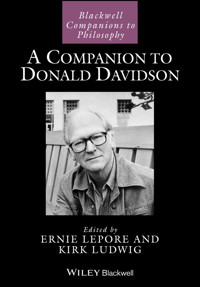
A Companion to Donald Davidson E-Book
188,99 €
Mehr erfahren.
- Herausgeber: John Wiley & Sons
- Kategorie: Geisteswissenschaft
- Serie: Blackwell Companions to Philosophy
- Sprache: Englisch
A Companion to Donald Davidson presents newly commissioned essays by leading figures within contemporary philosophy. Taken together, they provide a comprehensive overview of Davidson's work across its full range, and an assessment of his many contributions to philosophy. * Highlights the breadth of Davidson's work across philosophy * Demonstrates the continuing influence his work has on the philosophical community * Includes newly commissioned contributions from leading figures in contemporary philosophy * Provides an in-depth exposition and analysis of Davidson's work across the range of areas to which he contributed, including philosophy of action, epistemology, metaphysics, philosophy of language, and philosophy of mind
Sie lesen das E-Book in den Legimi-Apps auf:
Seitenzahl: 1601
Veröffentlichungsjahr: 2013
Ähnliche




















Table of Contents
Blackwell Companions to Philosophy
Title page
Copyright page
Notes on Contributors
Introduction: Life and Work
Life, Early Career, and the First Phrase of Davidson's Work through 1969
Second Phrase of Davidson's Work, 1970–1981
Third Phase of Davidson's Work from the 1980s On
Organization and Contents of the Volume
Part I: Action Theory
1: Action Explanation
1. Introduction
2. Actions and Their Rationalization
3. Davidson's Challenge and the Problem of Wayward Causal Chains
4. The Logical Connection Argument
5. Reasons as Causes?
6. The Role of Laws in Action Explanations and the Causal Relevance of Mental Properties
7. Singular Causal Statements and Causal Explanations
8. Strict Laws, Generalizations, and Causal Concepts
9. Causal Powers
10. Propositional Attitudes as Causal Powers
11. The Explanatory Value of Action Explanations
Acknowledgements
2: Practical Reason
1. Three Degrees of Complexity
2. The Partitioned Model
3. Davidson's View
4. Final Thoughts: Why Not Partition?
3: Action Individuation
1. Modifiers and Multiple Things Done
2. Primitive Actions
3. The Competition: Actions as Fine Grained
4. Preliminary Objections
5. “By,” Cause, and Time
6. Deeper Problems
7. Actions as Extended Processes
8. Conclusion
4: Freedom to Act
1. Introduction
2. Davidson's Interest in His Work on Freedom
3. Davidson's Project and Its Relationship to Moore and Austin
4. Methodological Problems for Conditional Analyses
5. The Analysis of Freedom to Act and Abilities to Do x
6. Subjective Conditions and the Thinness of Davidson's Analysis
7. Concluding Discussion: The Challenge for a Causal Theory of Action
5: Intention
1. The Initial Account
2. Agency
3. Weakness of Will
4. Intending
Part II: Metaphysics
6: Event Variables and Their Values
1. Quantifying over Events
2. Events to Quantify Over
3. Logical Form and Grammatical Form
7: Causation
1. Actions, Reasons, and Causes
2. Mental Causes
3. Difficulties With This Account
4. Another Look at Davidson
5. Causation and Mental Causation
6. Concluding Remarks
8: Davidson's “Method of Truth” in Metaphysics
9: The Concept of Truth
1. Tarski, Truth, and Meaning
2. Satisfaction and Correspondence
3. Radical Interpretation and Coherence
4. Defining Truth and Deflationism
5. Objectivity and Truth
Part III: Philosophy of Language
10: Truth in the Theory of Meaning
1. Introduction
2. Compositionality
3. Criticism of Traditional Approaches
4. The Positive Proposal
5. Problematic Passages?
6. Later Work
7. Conclusion
11: Parataxis
1. Indirect Discourse
2. Mood and Mood-Setting
3. Quotation
4. A Parting Shot
12: Logical Form
1. The Idea of Logical Form and Its Philosophical Significance
2. Constraints on Accounts of Logical Form
3. Davidson's Account of Logical Form
4. Criticisms
Acknowledgment
13: Radical Interpretation and the Principle of Charity
1. What Is Radical Interpretation?
2. The Role of Radical Interpretation for Meaning Theory
3. The Principle of Charity
4. The Power of Charity
5. The Justification of Charity
14: Davidson's Measurement-Theoretic Analogy
1. Introduction
2. Radical Interpretation and Indeterminacy
3. The Inscrutability of Reference
4. The General Case
5. Instrumentalism or Realism?
15: Reference
1. Reference in T-Theories
2. The Inscrutability of Reference
3. Explanations and Reference
16: Language and Thought
1. Davidson's View and Two Others
2. Davidson and the View that Thought Precedes Language
3. Conclusion
Acknowledgments
17: Conceptual Schemes
18: Interpretation and Value
Interpretation and Value
1. The Interpretation Argument
2. The Application to Desires and Normative Beliefs
3. The Application to Values and Normative Truths
4. The Triangulation Argument
19: Predication
20: Convention and Meaning
1. Introduction
2. The Public Nature of Meaning
3. Semantics and Ulterior Purposes
4. Word Meaning and Speaker Meaning
5. Is There Such a Thing as a Language?
6. Radically Interpreting Mrs. Malaprop
21: Metaphor and Varieties of Meaning
Davidson on Metaphor
1. “What Metaphors Mean”
2. “A Nice Derangement of Metaphors”
3. Evaluating a Hybrid Davidsonian View of Metaphor
Acknowledgment
22: Davidson and Literary Theory
Davidson and Literary Theory
1. Locating Literary Language
2. Convention
3. Davidson's Influence on Literary Theory
4. Texts
5. Sketch of a Davidsonian Account of Texts
Part IV: Philosophy of Mind
23: The Larger Philosophical Significance of Holism
The Larger Philosophical Significance of Holism
1. Holism and Charity Defended
2. How to Formulate Relativism
3. The Davidsonian Strategy Against Relativism
4. Two Further Issues
24: Anomalous Monism
1. Three Principles
2. Event Individuation
3. An Argument for Monism
4. Strict Laws
5. Anomalism
6. Irreducibility
7. Supervenience
8. Mental Causation
25: Triangular Externalism
1. Outlines of Triangular Externalism
2. Externalism, Interpretation, and Holism
3. Davidson on Other Forms of Externalism
4. Triangulation and the Determination of Thought Content
5. Triangulation and the Objectivity of Thought
26: Triangulation
1. Introduction
2. The Triangulation Argument
3. Objections to the Triangulation Argument
4. Conclusion
27: Rationality as a Constitutive Ideal
1. Kant, Carnap, and Quine
2. Davidsonian Interpretation Theory
3. Charity as a Constraint on Interpretation
4. Realism, Instrumentalism, and Eliminativism
5. Cognitive Science and Radical Interpretation
6. Representation and Rationality in Nonlinguistic Creatures
7. Davidson's Contributions to the Study of Rationality
28: Irrationality
29: The Rationality of the Emotions
1. Introduction
2. Emotions and Cognition
3. Emotions and their Causes
4. Objections
5. Privileged Access to Emotions
6. Emotions and Irrationality
7. Animal Affects
Acknowledgments
Part V: Epistemology
30: Davidson and Radical Skepticism
1. Introduction
2. Davidson on Radical Interpretation and the Principle of Charity
3. Davidson's Route to Antiskepticism I: The Omniscient Interpreter
4. Davidson's Route to Antiskepticism II: Triangulation and Content Externalism
5. Contra Davidson's Transcendental Antiskepticism
Acknowledgments
31: First-Person Authority
1. The Phenomenon of First-Person Authority
2. Davidson's Explanation of First-Person Authority
3. First-Person Authority and Semantic Externalism
32: Knowledge of Other Minds in Davidson's Philosophy
1. The Measure of All Things
2. Understanding Others
Part VI: Influences and Influence
33: Quine and Davidson
1. Logical Pragmatism
2. Naturalism
3. Language, Meaning, and Use
4. Truth
5. Meaning and Radical Interpretation
6. Assent, Distal versus Proximal Meaning, and the “Third Dogma”
7. Farewell to Empiricism?
34: Davidson and Contemporary Philosophy
1. Introduction
2. Meaning and Truth Conditions
3. Mind and Action
4. Truth, Knowledge, and Reality
5. Normativity and Rationality
6. Conclusion
Name Index
General Index
Blackwell Companions to Philosophy
This outstanding student reference series offers a comprehensive and authoritative survey of philosophy as a whole. Written by today's leading philosophers, each volume provides lucid and engaging coverage of the key figures, terms, topics, and problems of the field. Taken together, the volumes provide the ideal basis for course use, representing an unparalleled work of reference for students and specialists alike.
Already published in the series:
Forthcoming:
A Companion to Rawls, Edited by Jon Mandle and David Reidy
A Companion to Derrida, Edited by Leonard Lawlor and Zeynep Direk
A Companion to Locke, Edited by Matthew Stuart
This edition first published 2013
© 2013 John Wiley & Sons, Inc.
Wiley-Blackwell is an imprint of John Wiley & Sons, formed by the merger of Wiley's global Scientific, Technical and Medical business with Blackwell Publishing.
Registered Office
John Wiley & Sons Ltd, The Atrium, Southern Gate, Chichester, West Sussex, PO19 8SQ, UK
Editorial Offices
350 Main Street, Malden, MA 02148-5020, USA
9600 Garsington Road, Oxford, OX4 2DQ, UK
The Atrium, Southern Gate, Chichester, West Sussex, PO19 8SQ, UK
For details of our global editorial offices, for customer services, and for information about how to apply for permission to reuse the copyright material in this book please see our website at www.wiley.com/wiley-blackwell.
The right of Ernie Lepore and Kirk Ludwig to be identified as the authors of the editorial material in this work has been asserted in accordance with the UK Copyright, Designs and Patents Act 1988.
All rights reserved. No part of this publication may be reproduced, stored in a retrieval system, or transmitted, in any form or by any means, electronic, mechanical, photocopying, recording or otherwise, except as permitted by the UK Copyright, Designs and Patents Act 1988, without the prior permission of the publisher.
Wiley also publishes its books in a variety of electronic formats. Some content that appears in print may not be available in electronic books.
Designations used by companies to distinguish their products are often claimed as trademarks. All brand names and product names used in this book are trade names, service marks, trademarks or registered trademarks of their respective owners. The publisher is not associated with any product or vendor mentioned in this book.
Limit of Liability/Disclaimer of Warranty: While the publisher and author(s) have used their best efforts in preparing this book, they make no representations or warranties with respect to the accuracy or completeness of the contents of this book and specifically disclaim any implied warranties of merchantability or fitness for a particular purpose. It is sold on the understanding that the publisher is not engaged in rendering professional services and neither the publisher nor the author shall be liable for damages arising herefrom. If professional advice or other expert assistance is required, the services of a competent professional should be sought.
Library of Congress Cataloging-in-Publication Data applied for
Hardback ISBN: 978-0-470-67370-6
A catalogue record for this book is available from the British Library.
Cover image: Photo of W.V.O Quine courtesy of Harvard University Archives.
Cover design by Workhaus.
Notes on Contributors
Anita Avramides is Southover Manor Trust Fellow in Philosophy at St. Hilda's College and Reader in the Philosophy of Mind at the University of Oxford.
Sven Bernecker is Professor of Philosophy at the University of California, Irvine and the University of Vienna. His main areas of research are epistemology, metaphysics, and philosophy of mind. He is the author of Reading Epistemology (2006), The Metaphysics of Memory (2008), and Memory: A Philosophical Study (2010); and editor, with Fred Dretske, of Knowledge: Readings in Contemporary Epistemology (2000) and, with Duncan Pritchard, of The Routledge Companion to Epistemology (2011).
Agnes Callard is the Neubauer Family Assistant Professor in Philosophy. Her primary areas of specialization are Ancient Philosophy and Ethics. She is currently writing a book, Remoralizing Weakness of Will.
Elisabeth Camp is an Associate Professor at Rutgers University. She works on topics in the philosophy of mind and philosophy of language, including figurative speech, slurs, fiction, cartographic and diagrammatic representations, and nonhuman animal cognition.
William Child is a Fellow in Philosophy at University College, Oxford. He is the author of Causality, Interpretation, and the Mind (Oxford University Press, 1994) and Wittgenstein (Routledge, 2011), and co-edited Wittgensteinian Themes: Essays in Honour of David Pears (Oxford University Press, 2001). He has written on various aspects of Davidson's work, and has published widely in the philosophy of mind and on the philosophy of Wittgenstein.
Pascal Engel is Professor of Contemporary Philosophy at the University of Geneva and senior research director at Ecole des hautes études en sciences sociales in Paris. He has published articles and books in philosophy of language, philosophy of logic, philosophy of mind and epistemology, among which are The Norm of Truth (Prentice Hall, 1991), Ramsey, Truth and Success (with J. Dokic, Routledge, 2002), Truth (Acumen, 2002), and Philosophy of Psychology (Palgrave, 2013). He is the author of Davidson et la Philosophie du Langage (PUF, 1994) and of a number of essays on Davidson.
Luca Ferrero is Associate Professor of Philosophy at the University of Wisconsin Milwaukee. He earned his PhD at Harvard University. He has been a Humanities Fellow and Visiting Assistant Professor at Stanford University, and NEH Summer Fellow at Princeton University. He works on the nature of diachronic agency, intentions, constitutivism, practical reasoning, and personal identity. His work has been published in Noûs, Philosophical Studies, Philosophers' Imprint, Philosophical Issues, Oxford Studies in Metaethics, and Oxford Studies in Agency and Responsibility.
Olav Gjelsvik is Professor of Philosophy and Director of The Centre for the Study of Mind in Nature at the University of Oslo. Educated in Oslo and at Balliol College Oxford, he works in epistemology, metaphysics, philosophy of mind, and philosophy of action, and has also written several papers about addiction. He is a member of the Norwegian Academy of Science and Letters and also of the Academia Europaea.
Michael Glanzberg is Professor of Philosophy at Northwestern University. He works in the areas of philosophy of language, logic, and metaphysics.
Hans-Johann Glock is Professor of Philosophy at the University of Zurich (Switzerland), and Visiting Professor at the University of Reading (UK). He is the author of A Wittgenstein Dictionary (Blackwell 1996), Quine and Davidson on Language, Thought and Reality (Cambridge University Press, 2003), La Mente de los Animals (KRK, 2009) and What is Analytic Philosophy? (Cambridge University Press, 2008). He has published numerous articles on the philosophy of mind, the philosophy of language, the history of analytic philosophy and Wittgenstein. At present, he is working on a book on animal minds and coediting The Blackwell Companion to Wittgenstein.
Kathrin Glüer is Professor of Theoretical Philosophy at Stockholm University. She works mainly in the philosophy of mind and language. Recent work includes Donald Davidson. A Short Introduction (Oxford University Press, 2011), “General Terms and Relational Modality,” with Peter Pagin, in Noûs 46(2012): 159–199, “In Defence of a Doxastic Account of Experience,” in Mind & Language 24(2009):297–373, and “Against Content Normativity,” with Åsa Wikforss, in Mind 118(2009):31–70.
Mitchell Green teaches Philosophy at the University of Connecticut. His primary research areas are Philosophy of Language, Philosophy of Mind, and Aesthetics, with special interests in pragmatics, attitude ascription, reference, empathy, and the epistemic significance of music and literature. He has published Self-Expression, Engaging Philosophy: A Brief Introduction, and Moore's Paradox: New Essays on Belief, Rationality and the First Person (coedited with John Williams), as well as numerous journal articles.
John Heil is Professor of Philosophy at Washington University in St Louis and honorary research associate at Monash University. His most recent book is The Universe as We Find It (Oxford, 2012).
David Henderson is the Robert R. Chambers Professor of Philosophy at the University of Nebraska, Lincoln. He works in the philosophy of social science and epistemology. He is the author, with Terry Horgan, of The Epistemic Spectrum. In the philosophy of social science, he has written on the explanatory relevance of norms, the significance of simulation, and the explanatory limits of rationalizing explanation. A central concern in his work has been the relation between various forms of explanation and the adequacy of one's interpretation.
Miguel Hoeltje is Assistant Professor at the Universität Duisburg-Essen (Germany). He graduated from Hamburg University with a thesis on truth conditional semantics for which he received the 2012 Wolfgang Stegmüller award of the German Society for Analytic Philosophy. Miguel works primarily in the philosophy of logic and language and metaphysics, and he has recently taken an interest in social ontology.
Ernie Lepore is Professor of Philosophy at Rutgers University and Acting Director of the Rutgers Center for Cognitive Science. He is the author of numerous articles and books in the philosophy of language and mind, including, with Kirk Ludwig, Donald Davidson: Meaning, Truth, Language and Reality (2005) and Donald Davidson's Truth-theoretic Semantics (2007), with Herman Cappelen, Language Turned on Itself, and most recently, with Barry Loewer, Meaning, Mind and Matter: Philosophical Essays (2011).
Kirk Ludwig is Professor of Philosophy at Indiana University, Bloomington. He has written extensively in the philosophy of language, mind and action, and epistemology. He is coauthor with Ernie Lepore of Donald Davidson: Meaning, Truth, Language and Reality (2005), and Donald Davidson's Truth-theoretic Semantics (2007).
William G. Lycan is William Rand Kenan, Jr. Professor of Philosophy at the University of North Carolina, Chapel Hill. He is author of Logical Form in Natural Language, Consciousness, Judgement and Justification, Modality and Meaning, Consciousness and Experience, and Real Conditionals.
A.P. Martinich is Roy Allison Vaughan Centennial Professor in Philosophy and Professor of History and Government at the University of Texas at Austin. He is the coeditor with David Sosa of The Philosophy of Language, 6th edition (Oxford University Press, 2013) and Analytic Philosophy: An Anthology (Wiley-Blackwell, 2012).
Hugh J. McCann in Professor of Philosophy at Texas A&M University, and specializes in action theory and the philosophy of religion. He is the author of The Works of Agency, and of numerous articles on the subject of human action.
Brian P. McLaughlin is a Professor II of Philosophy at Rutgers University. He is the author of numerous papers in the philosophy of mind, the philosophy of psychology, metaphysics, and philosophical logic.
Robert H. Myers is Associate Professor of Philosophy at York University, Toronto. He works mainly on theoretical ethics – both metaethics and normative ethics – and has published extensively on the implications of Davidson's philosophy for these topics.
Peter Pagin is Professor of Theoretical Philosophy at Stockholm University. He has published papers on Quine and Davidson, on compositionality, vagueness, assertion, reference and modality, bivalence, and on other topics in the philosophy of language and the philosophy of logic
Paul M. Pietroski is Professor of Philosophy and Professor of Linguistics at the University of Maryland, College Park. He is the author of Causing Actions and Events and Semantic Architecture.
Duncan Pritchard is Professor of Philosophy at the University of Edinburgh. He works mainly in epistemology, and has published widely in this area, including the books Epistemic Luck (Oxford University Press, 2005), The Nature and Value of Knowledge (with A. Millar & A. Haddock, Oxford University Press, 2010), and Epistemological Disjunctivism (Oxford University Press, 2012).
Piers Rawling is Professor and Chair of Philosophy at Florida State University. He has wide-ranging interests. In addition to work on the philosophy of Donald Davidson, his dissertation director, he has also published papers in various other areas, including decision theory, ethics (with David McNaughton), and quantum computing (with Stephen Selesnick). He is coeditor (with Alfred Mele) of The Oxford Handbook of Rationality (2004).
Michael Rescorla is an Associate Professor in the philosophy department at the University of California, Santa Barbara. His research concerns the philosophies of mind, language, and logic.
Carol Rovane is a Professor of Philosophy at Columbia University, and is the author of numerous articles on mind, agency, metaphysics and ethics. Her two books are The Bounds of Agency: An Essay in Revisionary Metaphysics and the forthcoming Multimundialism: The Metaphysics and Ethics of Relativism.
Adam Sennet is Associate Professor at UC Davis. He works on issues in the philosophy of language. Recent work includes “Embedding If and Only If” (with Jonathan Weisberg) in Journal of Philosophical Logic 41 (2): 449–460, “Semantic Plasticity and Epistemicism”in Philosophical Studies 161 (2): 273–285, and “Unarticulated Constituents and Propositional Structure,” in Mind and Language 26 (4):412–435.
Jeff Speaks is the Rev. John A O'Brien Associate Professor of Philosophy at the University of Notre Dame. He works mainly in the philosophy of language and the philosophy of mind.
Ralf Stoecker is Professor for Practical Philosophy at the University of Bielefeld (Germany). He has worked on different topics in applied ethics, the foundations of ethics and in particular in action theory. Among his most recent publications are “Why Animals Can't Act,” Inquiry 52 (2009), “Acting for Reasons,” in C. Sandis (ed.), “New Essays on the Explanation of Action” (2009), and the entry “Donald Davidson” in the Blackwell Companion to Action Theory (2010). He is the editor of Reflecting Davidson (1993).
Sarah Stroud is Associate Professor of Philosophy and Associate Vice-Principal, Research and International Relations, at McGill University in Montreal, Canada. She works mainly in moral philosophy and is particularly interested in issues at the intersection of moral psychology and the philosophy of action. She coedited Weakness of Will and Practical Irrationality (Oxford University Press, 2003) with Christine Tappolet and is Associate Editor of The International Encyclopedia of Ethics, forthcoming from Wiley-Blackwell (in 9 print volumes + electronic publication). Her recent papers include essays on moral demandingness, on procrastination, and on plural agency and partiality.
Claudine Verheggen is Associate Professor of Philosophy at York University, Toronto. She has a special interest in issues at the intersection of the philosophies of language and mind, such as the nature of meaning and content, the normativity and the objectivity of meaning and content, and the prospects of semantic reductionism. She has published numerous papers on these topics, as well as on Davidson and the later Wittgenstein.
J. Robert G.Williams is Professor of Theoretical Philosophy at the University of Leeds, where he arrived in 2005 after graduate work at the Arche Centre at the University of St Andrews. He works in the philosophy of logic and language, metaphysics, and formal epistemology.
Samuel C. Wheeler III, PhD Princeton 1970, is Professor of Philosophy at the University of Connecticut. He has published on philosophy of language, metaphysics, political philosophy, ethics, literary theory, the links between analytic and continental philosophy, and the history of philosophy.
Introduction
Life and Work
Ernie Lepore and Kirk Ludwig
Donald Davidson was one of a handful of philosophers in the latter half of the twentieth century who reshaped the terrain of analytic philosophy.
Davidson's philosophical project was centered on two interconnected inquiries, one into the nature of human action, and the other into nature of linguistic meaning. Both of these projects had their origins early in his career at Stanford, and became more closely integrated as time went on. Davidson sought to understand the nexus of mind and world through an understanding of what makes possible our capacity to communicate with one another. At the center of this was, on the one hand, the project of constructing a theory of truth for a natural language and, on the other, an investigation into the conditions on confirming such a theory for a speaker from the standpoint of an interpreter (the radical interpreter) who did not already know a correct theory, on the basis of evidence distant enough from what is to be confirmed to yield illumination of the concepts deployed in the theory. His central thesis was that any theory confirmed in the manner he described could be used to interpret the other's speech. The conditions a speaker had to meet to be interpretable in turn he regarded as constitutive of the interpreter's subject matter. The role of the theory of action in this overall project is to provide a theoretical framework for identifying patterns in behavior that can be interpreted as expressions of intentional behavior, including speech behavior.
Davidson sought to ground far-reaching conclusions in reflection on radical interpretation. For example, he has argued that we cannot make sense of conceptual schemes radically different from our own, and that language is required for thought, and actual communication for language. He has argued that interpretation is indeterminate, and that the reference of terms and extensions of predicates is inscrutable in the sense that given any workable reference scheme for a language, there are an indefinitely large number of schemes that assign referents and extensions differently but capture everything there is to capture about how words are used by the speakers of the language. He has argued on the basis of reflection on what is required for success in interpretation, together with the assumption that speakers by their nature are interpretable, that we could not be massively wrong about the external world and that we of necessity have knowledge of our own and of other minds. Concomitantly, he has argued that the contents of our thoughts are individuated (in part) by our relations to our environment. And he has sought to ground the objectivity of (in principle agreement on) values in reflections on radical interpretation parallel in certain respects to the argument for the impossibility of massive error in our empirical beliefs.
These three aspects of Davidson program can be represented in Figure I.1. At the center stands the project of radical interpretation. The theory of action, which is developed to an extent independently, provides part of the theoretical framework for radical interpretation. The project of radical interpretation, focused centrally though not exclusively on the development of a theory of truth for a speaker's language, is to yield a theory of meaning for the speaker's language in the form of an interpretive truth theory for it – one meeting an analog of Tarski's Convention T for natural languages that requires the sentence giving truth conditions to provide an interpretation of it. From reflection on this project, we are to arrive at a deeper understanding of what it is for words to mean what they do in general, not just for sentences, but for their significant parts as well. At the same time, assumptions that have to be in place for the project to succeed, as Davidson thought it must, are seen as constitutive of the interpreter's subject matter, and thus reflection on radical interpretation leads to a variety of metaphysical and epistemological theses. We do not here mean to suggest that absolutely everything Davidson argued for is bound up in one way or another with this central project. For example, work on the individuation of events, on metaphor, on the rationality of the emotions, on the nature of causation and causal laws, and the argument for anomalous monism, though these may inform his work on interpretation, are not based on it (Davidson does invoke the indeterminacy of interpretation in his argument for anomalous monism in “Mental Events” (1970), but it is not in the end clear that it plays an essential role). But reflection on the nature and structure of radical interpretation is nonetheless the central organizing project of Davidson's philosophical work as a whole.
Figure I.1
As this indicates, Davidson's work was both far ranging and systematic. It is therefore surprising that the bulk of his work appeared in essay form, spread out over a period of more than 40 years. These are now almost all collected in five volumes of essays from Oxford University Press (OUP): Essays on Actions and Events (2001, 2nd edition, originally published in 1980), Inquiries into Truth and Interpretation (2001, 2nd edition, originally published in 1984), Subjective, Objective, Intersubjective (2001), Problems of Rationality (2004), and Truth, Language, and History (2005). Truth and Predication (Harvard, 2005), whose first three chapters are Davidson's Dewey lectures at Columbia University from 1990 on the structure and content of truth, and whose last three chapters were his Hermes lectures delivered at the University of Perugia in 2001, was published posthumously, and collects the only major work not included in the OUP volumes. No one paper, of course, describes the shape of the whole, and the essays and lectures, though elegant and written in an accessible style, are densely argued, and difficult even by the standards of analytic philosophy. They presuppose considerable background knowledge, and later essays often presuppose familiarity with earlier work. Though they range widely over action theory, metaphysics, language, mind, epistemology, and value, they are still informed by a central project under which they can be organized. For these reasons, his work stands in need of systematic and detailed interpretation. And though Davidson's work has received an enormous amount of commentary, no single volume has attempted to cover its full range. The current volume aims to remedy this in 34 chapters that provide a detailed picture of Davidson's thought across the range of topics to which he contributed.
In light of the detailed discussion of nearly every facet of Davidson's thought in the following, this introduction will be limited to a brief overview of Davidson's life and the development of his central project, and then a brief description of the organization and contents of the volume.
Life, Early Career, and the First Phrase of Davidson's Work through 1969
Donald Davidson was born in Springfield, Massachusetts on March 6, 1917. After early travels that included a stint in the Philippines, his family settled on Staten Island in 1924. He began studies at Harvard University in 1935 on a scholarship from the Harvard Club of New York, studying English literature initially, and then classics and comparative literature. When he graduated in 1939, he was offered a fellowship at Harvard in Classical Philosophy, and he took his first course with W.V.O. Quine, who was to become a major influence on him later (see Chapter 37). When the United States entered the Second World War, Davidson interrupted his graduate studies to join the navy, in which he served as an airplane spotter in the Italian campaign, and then as an instructor. Discharged in 1945, he returned to Harvard in 1946, and in 1947, took up a teaching job at Queens College in New York. He finished his dissertation on Plato's Philebus on a grant from the Rockefeller Foundation in the 1947–1948 academic year and received his PhD from Harvard in 1949. In 1951, he left Queens to join Stanford University in Palo Alto, where he taught for 16 years until he left for Princeton in 1967.
This was a formative period for Davidson. Working with Patrick Suppes and J.J.C. McKinsey at Stanford, Davidson became interested in formal decision theory, which had an important influence on his later work in action theory and on radical interpretation (see Chapter 15). He was invited by McKinsey to join him in writing a paper on Carnap's method of intension and extension for the Library of Living Philosophers volume on Carnap, and when McKinsey died, the task fell to him, and sparked his interest, first, in the problem of the semantics of attitude sentences and indirect discourse, and, second, in the theory of meaning (see Chapter 11 for the tack Davidson eventually took on indirect discourse and belief sentences). This led to Davidson's skepticism about the utility of assigning meanings to sentences in the theory of meaning (see Chapter 10). In a bit of serendipity, Davidson gave a talk on Carnap at Berkeley, and Alfred Tarski was in the audience. Tarski gave Davidson a reprint of his “The Semantic Concept of Truth and Foundations of Semantics,” which led Davidson to Tarski's more technical “The Concept of Truth in Formal Languages.” Davidson saw in this a model for how to give a serious theory of language, and, then, in turn, a powerful criterion for the adequacy of an account of the logical form of a sentence (namely: incorporate it into a truth theory that yields the right results for the whole of the language – see Chapter 12), and the framework for a compositional meaning theory for natural language that dispensed with meanings (see Chapter 10).
In the 1958–1959 academic year, Quine was a fellow at the Center for Advance Study in the Behavioral Sciences at Stanford, where he revised the manuscript of Word & Object (1960). At the center of this is Quine's description of the project of radical translation, that is, the project of constructing a translation manual for another solely on the basis of behavioral evidence. Davidson, on an ACLS fellowship that year, read the manuscript, and adopted the central idea that there is no more to meaning than can be recovered from a speaker's behavior. Davidson put together the idea he had developed from Tarski's work with this principle he took from Quine to forge his own distinctive approach to the theory of meaning, at the core of which is reflection on the project of confirming on nonquestion begging evidence a truth theory for another speaker's language. In the late 1950s at Stanford, Davidson also became interested in general issues in the philosophy of action when his student Dan Bennett spent a year in Oxford and brought back the ideas of the neo-Wittgenstenians who held that giving an agent's reasons for doing something was a matter of redescribing an action in a way that fit it into a larger social, linguistic, or evaluative pattern, but decidedly not a species of causal explanation (causation was, according to A.I. Melden (1961: 184), “wholly irrelevant to understanding” human action). Davidson's reaction against this orthodoxy began his program in the philosophy of action, which then became connected with the program in the theory of meaning as part of the conceptual framework of interpretation.
The results of Davidson's thinking during this period began to appear in the early 1960s and immediately established him as a major figure in analytic philosophy. (See Table I.1 for a summary of Davidson's principal work from 1963 to the posthumous publication of Truth and Predication in 2005). “Actions, Reasons and Causes,” originally delivered at the American Philosophical Association, was published in 1963. It argued so influentially that action explanation was causal explanation, contrary to the prevailing orthodoxy, that it became the new orthodoxy almost overnight. Six major interconnected papers appeared in the three-year span from 1966 to 1969: “Theories of Meaning and Learnable Languages” (1966), which urged the importance of formulating a compositional meaning theory for natural languages, “Truth and Meaning” (1967), the seminal paper in his semantic program, introducing the proposal that a truth theory can be exploited in pursuit of a compositional meaning theory (see Chapter 10), “The Logical Form of Action Sentences” (1967), which introduces his concept of logical form and argues for the event analysis of action sentences on the grounds that it best explains the formal patterns of entailments in which action sentences figure, “Causal Relations” (1967), which extends an event analysis to singular causal statements, “On Saying That” (1968), which introduces the paratactic analysis of indirect discourse, “True to the Facts” (1969), which argues against the traditional correspondence theory of truth in favor of the importance of Tarski's approach, and “The Individuation of Events” (1969), which argues that events are datable particulars individuated by their place in the network of causes and effects.
Table I.1 Summary of Davidson's principle work from 1963 to 2005
Second Phrase of Davidson's Work, 1970–1981
Davidson left Stanford for Princeton where he taught from 1967 to 1969, then left Princeton for Rockefeller University in 1970. He moved to the University of Chicago in 1976 when the philosophy department was disbanded at Rockefeller and then to the University of California at Berkeley in 1981 where he taught, even after retirement, until his unexpected death in 2003 at the age of 86.
A second phase of his work began in the 1970s, and represented further development of the themes introduced in the 1960s, responses to objections, and modifications of his positions.
In the philosophy of action and events, “How is Weakness of the Will Possible?” (1970) introduced a new model for the logical form of practical reasoning, which treated it as analogous to probabilistic reasoning, and in the light of which Davidson argued that a puzzle about how akratic action is possible could be resolved. This is also the first paper in a series that stretches into the 1990s on the nature of irrationality. “Action and Reaction” (1970), “Agency” (1971), and “Freedom to Act” (1973) deal respectively with objections to the causal theory of action, further work on the possibility of analyzing agency in purely causal terms (Davidson rejects this view), and work on the nature of free action, which at the same time introduces the problem of deviant (or wayward) causal chains. “Hempel on Explaining Action” (1976) takes up the extent to which action explanation can be modeled on explanation in the natural sciences, and argues they are fundamentally different because of the way in which attributions of attitudes that explain action are dependent on the events that they are cited to explain. “Intending” (1978) takes back a claim made in “Actions, Reasons and Causes,” namely, the claim that talk of intentions was syncategorematic and that “intention” has no genuine use as a count noun. Davidson's acknowledges that pure (or prior) intending is a counterexample, and suggests that intending be identified with a pro-attitude expressed by what he called an all-out judgment in favor of an action in “How is Weakness of the Will Possible?” During this period, Davidson also wrote a paper on “Hume's Cognitive Theory of Pride” (1976), which interprets Hume's theory in the light of Davidson's causal theory of action explanation. The work on the nature of events and the logical form of action sentences was followed up in “Events as Particulars” (1970) and “Eternal versus Ephemeral Events” (1971).
In philosophical psychology, the publication of “Mental Events” in 1970 introduced the thesis of anomalous monism and nonreductive materialism. Davidson argued that there were no strict psychophysical laws, though mental and physical events were causally related, so that on the assumption that events causally related were subsumed by strict laws, and that only physical laws were strict, all mental events were also physical events. This was followed by a number of other papers elaborating on this theme: “Psychology as Philosophy” (1974), “The Material Mind” (1973), and (mentioned earlier) “Hempel on Explaining Action” (1976).
In natural language semantics, Davidson elaborated and defended his proposal for using a truth theory in pursuit of a compositional meaning theory. The main papers connected with this are, “Semantics for Natural Languages” (1970) and “In Defense of Convention T” (1973), which contain useful clarifications of his position. In this period, he also extended the device of parataxis introduced in “On Saying That” to quotation and sentential mood in “Quotation” (1979) and “Moods and Performances” (1979).
In “Truth and Meaning” (1967), Davidson clearly had in mind that a truth theory for another's language was to be treated as an empirical theory. This theme comes to the prominence in “Radical Interpretation” (1973), in which Davidson offered a new account of what conditions a truth theory could meet that would enable it to be used for interpretation, namely, that it be confirmed from the standpoint of a radical interpreter of another speaker. This was intended both to illuminate the concepts of the theory by showing how evidence that did not presuppose their application could be marshaled in its support and to remedy a defect in the earlier proposal, which was that a true truth theory for a language would ipso facto be interpretive (see Chapter 10). The account was elaborated in “Belief and the Basis of Meaning” (1974) and in “Thought and Talk” (1975), in which Davidson also argued for the thesis, which turns out to be central to later themes, that language is necessary for thought. “Reply to Foster” (1976), which was written in response to a paper presented by John Foster (1976) at a conference in 1973, provides an especially useful perspective on how Davidson understands his own project and its development from its initial presentation to 1973. In two papers from the later 1970s, “Reality without Reference” (1977) and “Inscrutability of Reference” (1979), Davidson draws out some of the consequences of his theoretical perspective for the content and determinacy of the concept of reference, assigning it basically an instrumental role in the theory of interpretation.
Other work in the 1970s included “On the Very Idea of a Conceptual Scheme” (1974), “The Method of Truth in Metaphysics” (1977), and “What Metaphors Mean” (1978). The first of these originated in the last of Davidson's six John Lock Lectures in 1970 and was delivered as his presidential address to the Eastern Division meeting of the American Philosophical Association in 1973. It influentially argued that relativity of truth to a conceptual scheme is incoherent and that there can be no radically different conceptual schemes from our own in the sense that there can be no languages which are not largely translatable into our own. “The Method of Truth in Metaphysics” concerns the relation of semantic theory of reality. It is the first place Davidson draws out a connection between the principle of charity, which he introduces as a principle constitutive of interpretation, and the impossibility of massive error in our beliefs, especially in our empirical beliefs about the world around us. The paper also argues that, against this background guarantee, an investigation into the large-scale ontological commitments of language through an investigation of the logical form of the sentences that we endorse at the same time reveals the ontological structure of the world. “What Metaphors Mean” pursues the question of meaning into figurative language. Davidson offers an important and novel account of metaphor that rejects the view that words have metaphorical meanings and even the view that metaphors must necessarily involve the conveyance even indirectly of a propositional content. Thus, metaphor, whose existence depends essentially upon literal meaning, functions not to do the same thing indirectly that language used literally does directly, but to get us to see things in a different light. Its intent, to borrow from speech act theory, is primarily perlocutionary, and not illocutionary.
Third Phase of Davidson's Work from the 1980s On
A third phase of Davidson work began in the 1980s and developed through the 1990s. While the work in this period followed up on, and developed out of, his earlier work, there are several new or newly prominent themes. We will here remark only on the major themes and not trace them out in detail through the papers. First, and most notable (see Table I.1), Davidson shifted attention to the implications of his basic standpoint for epistemology and the individuation of thought. He argued in a series of papers that reflection on the standpoint of the interpreter of another as conceptually fundamental reveals that we cannot be massive wrong about the external world, about our own thoughts, or about the minds of others, and that this resolves a number of traditional philosophical puzzles about knowledge (beginning with “Empirical Content” and “A Coherence Theory of Truth and Knowledge”; as mentioned earlier, the theme is first introduced in “The Method of Truth in Metaphysics”). He argued at the same time that this shows that our thought contents are relationally individuated, and that in very different environments, fixing our nonrelational states, we would have had very different beliefs, which would have been largely true of those environs. In the 1990s, a new theme connected with the relational individuation of thought emerges, namely, the idea that crucial to the possibility and objectivity of thought is what he called the triangulation of a speaker, auditor, and object to which each responds similarly while responding to each other. A second main theme in the philosophy of mind takes up a thread in “How Weakness of the Will is Possible?”, namely, what is required for rationality, on the one hand, and what scope there is for irrationality, on the other (these begin in 1982 with “Rational Animals” and “Paradoxes of Rationality”). A third, less prominent theme, falling under the heading of philosophy of mind, is a defense of the argument for anomalous monism. Davidson defends the view against the charge that it leads to epiphenomenalism in “Thinking Causes” (1993) and supplies an argument for one of the premises in the original argument, the nomological character of causality, in “Laws and Cause” (1995). There were three new directions of work in the philosophy of language. The first was on the role of convention in linguistic communication, which Davidson argued was not essential to it, most notoriously, if a bit misleadingly, in “A Nice Derangement of Epitaphs” (1986; page citation to the reprint in 2005), in which he declared: “there is no such thing as a language, not if a language is anything like what many philosophers and linguists have supposed. There is therefore no such thing to be learned, mastered or born with.” The second was a further development of his views on truth, represented in his early work primarily by “Truth to the Facts” in 1969. Davidson argued that truth is a fundamental, indefinable concept (see especially “The Folly of Trying to Define Truth”), discussed his differences with Quine about truth, and argued in the latter three chapters of Truth and Predication that the problem of predication has a solution or dissolution at any rate in reflection on Tarskian truth theories (see Chapter 9). The third was further reflections on the import of his views on meaning on understanding literature and literary language (see Chapter 22). The final major new development is represented by four papers on value that aimed to extend something like the principle of charity from beliefs to evaluative judgments, beginning with “Expressing Evaluations,” the Lindley Lectures at the University of Kansas in 1985 (see Chapter 18).
Organization and Contents of the Volume
We now turn to a brief description of the organization and contents of this volume, which is divided into six parts, of varying length, on action theory, metaphysics, philosophy of language, philosophy of mind, epistemology, and on Davidson's influence and influences on Davidson.
In the first division, the chapters take up Davidson's seminal account of action explanation as causal explanation (Chapter 1), his account of the structure and content of practical reason (Chapter 2), his account of action individuation (Chapter 3), of free action (Chapter 4), and of intention (Chapter 5), on which he changed his mind. The second division on metaphysics takes up Davidson's conception of events and his analysis of the logical form of event sentences as involving an implicit quantifier over events (Chapter 6), which lies behind his account of action, then his account of mental causation (Chapter 7), his defense of the method of truth in metaphysics, essentially, the method of reading large-scale features of reality off of the -cale commitments of ordinary language (Chapter 8), and then his treatment of the concept of truth (Chapter 9), which is central to his semantic program.
The third division on philosophy of language takes up a range of issues dealing with meaning and language to which Davidson has contributed influentially. The first three chapters concern the proposal to use a truth theory in pursuit of giving a compositional meaning theory for natural languages. The first defends the view that Davidson's project was not to replace the theory of meaning with the theory of truth, but instead to pursue traditional aims by a bit of indirection (Chapter 10). The second reviews his use of the device of parataxis – in Davidson's hands, treating what appears to be syntactically a single sentence as semantically equivalent to two sentences, one of which in use makes a reference to the other in order to say something connected with it – in the analysis of indirect discourse, quotation, and sentential mood, all in defense of the claim that an extensional truth theory is adequate for natural languages (Chapter 11). The third takes up his use of a truth theory in an account of the concept of logical form (Chapter 12). The next three chapters are concerned with the role of the project of radical interpretation in Davidson's overall enterprise. The first focuses on the content and role of the principle of charity in radical interpretation (Chapter 13). The second focuses on Davidson defense of indeterminacy as innocuous by appeal to the analogy with measurement, likening the different schemes of interpretation that his method sanctions with different scales of measurement (Chapter 14). The third focuses on the implications that Davidson draws for the concept reference and the determinateness of reference schemes used in truth theories (Chapter 15). The next three chapters concern the relation of thought to language (Chapter 16) and the extent of variation between languages or conceptual schemes (Chapter 17), and whether the interpreter's standpoint affords ground for an argument for the objectivity of values. Of the final four chapters in this section, the first two concern central concepts of language, the first the problem of predication (Chapter 19), and the second the role of convention in communication (Chapter 20), and the last two concern departures from the literal, metaphor (Chapter 21), and the relevance more generally of Davidson work to understanding literature (Chapter 22).
The fourth division concerns issues in the philosophy of mind. The nature and extent of Davidson's holism is the focus of the first (Chapter 23) and Davidson's argument for anomalous monism is the topic of the second (Chapter 24). The next two chapters concern Davidson's account of the individuation of thought content, his externalism about thought content (Chapter 25), and the role of triangulation in particular (Chapter 26). The last three chapters in this section concern Davidson's views on rationality and irrationality, first the nature of rationality (Chapter 27), then of irrationality (Chapter 28), and then rationality in connection with the emotions (Chapter 29).
The fifth division concerns the three domains that Davidson argues we must have knowledge in if we are to be speakers of a language and so creatures with any thoughts at all. The first concerns his response to radical skepticism about the external world (Chapter 30), the second his defense of first-person authority from a third-person point of view (Chapter 31), and the third his account of our knowledge of other minds.
The final division takes up, on the one hand, Davidson's relation to the most important philosophical influence on him, namely, W.V.O. Quine (Chapter 33), and, on the other, Davidson's influence on contemporary philosophy (Chapter 34).
* * *
We hope this volume will serve as an introduction to Davidson's philosophy to those who have not yet studied it, a resource for those who wish to get some orientation on particular topics in Davidson, a source of stimulation to those with interests in Davidson's work, and a portrait from many vantage points of the varied but unified work of one of the most influential analytic philosophers of his time.
Bibliography
Davidson's primary works
(2001). Essays on Actions and Events, 2nd ed. Oxford: Clarendon. Original edition, 1980.
(2001). Inquiries into Truth and Interpretation, 2nd ed. Oxford: Clarendon Press. Original edition, 1984.
(2001). Subjective, Intersubjective, Objective. Oxford: Clarendon Press.
(2004). Problems of Rationality. Oxford: Oxford University Press.
(2005). Truth, Language and History. Oxford: Clarendon Press.
(2005). Truth and Predication. Cambridge, MA: Harvard University Press.
Selected commentary
Glüer, K. (2011). Donald Davidson: A Short Introduction. Oxford: Oxford University Press.
Hahn, L.E. (1999). The Philosophy of Donald Davidson. Chicago: Open Court.
Kotatko, P., Pagin, P. and Segal, G. (eds) (2001). Interpreting Davidson. Stanford, CA: CSLI Publications.
Lepore, E. (ed.) (1986). Truth and Interpretation: Perspectives on the Philosophy of Donald Davidson. Cambridge: Blackwell.
Lepore, E. and Ludwig, K. (2005). Donald Davidson: Meaning, Truth, Language and Reality. Oxford: Oxford University Press.
Lepore, E. and McLaughlin, B.P. (eds.) (1985). Actions and Events: Perspectives on the Philosophy of Donald Davidson. Cambridge, MA: Blackwell.
Ludwig, K. (ed.) (2003). Donald Davidson. New York: Cambridge University Press.
Melden, A.I. (1961). Free Action. London: Routledge & Paul.
Preyer, G. (ed.) (2012). Donald Davidson on Truth, Meaning, and the Mental. Oxford: Oxford University Press.
Stoecker, R. (ed.) (1993). Reflecting Davidson. Hawthorne, NY: de Gruyter.
Part I
Action Theory
1
Action Explanation
Ralf Stoecker
1. Introduction
Lesen Sie weiter in der vollständigen Ausgabe!
Lesen Sie weiter in der vollständigen Ausgabe!
Lesen Sie weiter in der vollständigen Ausgabe!
Lesen Sie weiter in der vollständigen Ausgabe!
Lesen Sie weiter in der vollständigen Ausgabe!
Lesen Sie weiter in der vollständigen Ausgabe!
Lesen Sie weiter in der vollständigen Ausgabe!
Lesen Sie weiter in der vollständigen Ausgabe!
Lesen Sie weiter in der vollständigen Ausgabe!
Lesen Sie weiter in der vollständigen Ausgabe!
Lesen Sie weiter in der vollständigen Ausgabe!
Lesen Sie weiter in der vollständigen Ausgabe!
Lesen Sie weiter in der vollständigen Ausgabe!
Lesen Sie weiter in der vollständigen Ausgabe!
Lesen Sie weiter in der vollständigen Ausgabe!
Lesen Sie weiter in der vollständigen Ausgabe!
Lesen Sie weiter in der vollständigen Ausgabe!
Lesen Sie weiter in der vollständigen Ausgabe!
Lesen Sie weiter in der vollständigen Ausgabe!
Lesen Sie weiter in der vollständigen Ausgabe!
Lesen Sie weiter in der vollständigen Ausgabe!
Lesen Sie weiter in der vollständigen Ausgabe!
Lesen Sie weiter in der vollständigen Ausgabe!
Lesen Sie weiter in der vollständigen Ausgabe!
Lesen Sie weiter in der vollständigen Ausgabe!
Lesen Sie weiter in der vollständigen Ausgabe!
Lesen Sie weiter in der vollständigen Ausgabe!
Lesen Sie weiter in der vollständigen Ausgabe!
Lesen Sie weiter in der vollständigen Ausgabe!
Lesen Sie weiter in der vollständigen Ausgabe!
Lesen Sie weiter in der vollständigen Ausgabe!
Lesen Sie weiter in der vollständigen Ausgabe!
Lesen Sie weiter in der vollständigen Ausgabe!
Lesen Sie weiter in der vollständigen Ausgabe!
Lesen Sie weiter in der vollständigen Ausgabe!
Lesen Sie weiter in der vollständigen Ausgabe!
Lesen Sie weiter in der vollständigen Ausgabe!
Lesen Sie weiter in der vollständigen Ausgabe!
Lesen Sie weiter in der vollständigen Ausgabe!
Lesen Sie weiter in der vollständigen Ausgabe!




