


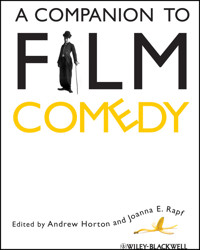
A Companion to Film Comedy E-Book
28,99 €
Mehr erfahren.
- Herausgeber: John Wiley & Sons
- Kategorie: Geisteswissenschaft
- Sprache: Englisch
A wide-ranging survey of the subject that celebrates the variety and complexity of film comedy from the 'silent' days to the present, this authoritative guide offers an international perspective on the popular genre that explores all facets of its formative social, cultural and political context * A wide-ranging collection of 24 essays exploring film comedy from the silent era to the present * International in scope, the collection embraces not just American cinema, including Native American and African American, but also comic films from Europe, the Middle East, and Korea * Essays explore sub-genres, performers, and cultural perspectives such as gender, politics, and history in addition to individual works * Engages with different strands of comedy including slapstick, romantic, satirical and ironic * Features original entries from a diverse group of multidisciplinary international contributors
Sie lesen das E-Book in den Legimi-Apps auf:
Seitenzahl: 1300
Veröffentlichungsjahr: 2012
Ähnliche




















Table of Contents
Title Page
Copyright
Notes on Editors and Contributors
Editors
Contributors
Comic Introduction: “Make 'em Laugh, make 'em Laugh!”
References
Further Reading
Part I: Comedy Before Sound, and the Slapstick Tradition
Chapter 1: The Mark of the Ridiculous and Silent Celluloid: Some Trends in American and European Film Comedy from 1894 to 1929
Fred Ott's Infectious Sneeze (1894)
A Plot Underfoot: The Lumière Brothers' L'Arroseur arrosé (1895)
Documentary of a Slap Shoe Hero: Little Tich et ses “Big Boots” (1900)
Georges Méliès, “Fantasist Filmmaker” (1896–1902)
Fantasist Filmmaking in Britain (1900–1901)
Cut to the Chase (1907–1909)
Silent Super Star: Max Linder (1905–1912)
Ethnic Comedy and the American Character (1900–1916)
Mack Sennett's Commedia dell'Arte (1912–1917)
American Comedy Gets Some Manners: Flora Finch, John Bunny, Mr. & Mrs. Sidney Drew (1908–1917)
The “Mark of the Ridiculous” of Charlie Chaplin's “Pierrot” (1914–1918)
The Mark of the Ridiculous and American Middle Class Silent Comedy of Manners (1915–1929)
Conclusion: The Loss of Silents
Notes
References
Further Reading
Chapter 2: Pie Queens and Virtuous Vamps: The Funny Women of the Silent Screen
Pioneers of the Pie: Early Silent Comediennes
The “Rough Gals” of Slapstick
Flappers, Flirts, and “Polite” Comedy
Conclusion
References
Further Reading
Chapter 3: “Sound Came Along and Out Went the Pies”: The American Slapstick Short and the Coming of Sound
“To put it unkindly”: Sound and the Historiography of Film Comedy
“The artistry of the Actor in Delivering the Spoken Lines”: Playlets and the Uses of Dialogue
“The Funniest Sound Effect Yet Recorded”: Slapstick and the Uses of Noise
“They Love it in the Small Towns”: Early Sound Slapstick and the Short-Subject Market
“You Don't have to Speak Funny Words to Make Things Funny”: Charlie Chaplin versus the Three Stooges
Notes
References
Further Reading
Part II: Comic Performers in the Sound Era
Chapter 4: Mutinies Wednesdays and Saturdays: Carnivalesque Comedy and the Marx Brothers
Unaccustomed Laughter
Plurality Humor
Rabelais on Celluloid
Delirious Abandon
Notes
References
Further Reading
Chapter 5: Jacques Tati and Comedic Performance
Notes
References
Further Reading
Chapter 6: Woody Allen: Charlie Chaplin of New Hollywood
The Nebbish
The Artist
Notes
References
Further Reading
Chapter 7: Mel Brooks, Vulgar Modernism, and Comic Remediation
The Last Gas(p) of Vulgar Modernism
Be a Clown!
Chicken Fat and Blackouts
Bodily Eruptions and Generic Transformations
Sound Gags and Silent Movies
“Hey, It Worked in Blazing Saddles”
References
Further Reading
Part III: New Perspectives on Romantic Comedy and Masculinity
Chapter 8: Humor and Erotic Utopia: The Intimate Scenarios of Romantic Comedy
References
Further Reading
Chapter 9: Taking Romantic Comedy Seriously in Eternal Sunshine of the Spotless Mind (2004) and Before Sunset (2004)
References
Further Reading
Chapter 10: The View from the Man Cave: Comedy in the Contemporary “Homme-com” Cycle
Introduction
The Man Cave
The Lair
Homme-coms
Conclusion
Notes
References
Further Reading
Chapter 11: The Reproduction of Mothering: Masculinity, Adoption, and Identity in Flirting with Disaster
References
Further Reading
Part IV: Topical Comedy, Irony, and Humour Noir
Chapter 12: It's Good to be the King: Hollywood's Mythical Monarchies, Troubled Republics, and Crazy Kingdoms
The Genesis of Ruritanian Comedy
The 1910s: America is Ace High
The 1920s: Forbidden Paradiso
The Talkies: See Sylvania First!
The Pinnacle: Hail Klopstokia! Hail Freedonia!
Leaving Ruritania
Acknowledgments
References
Further Reading
Chapter 13: No Escaping the Depression: Utopian Comedy and the Aesthetics of Escapism in Frank Capra's You Can't Take It with You (1938)
Notes
References
Further Reading
Chapter 14: The Totalitarian Comedy of Lubitsch's To Be or Not To Be
Notes
References
Further Reading
Chapter 15: Dark Comedy from Dr. Strangelove to the Dude
Comic Nightmare
Critical Responses; or, The Half-life of Not Getting the Point
Charlie Don't Surf
The Dude Abides
Notes
References
Part V: Comic Perspectives on Race and Ethnicity
Chapter 16: Black Film Comedy as Vital Edge: A Reassessment of the Genre
The Specter of Amos ‘n’ Andy and the Anxiety about Minstrelsy
Killing the Messenger: Tyler Perry and the Crisis of Black Representation
Bamboozled: Spike Lee's Political Satire of the Black Image in the White Mind
Barbershop as Both an Internal and External Spectator Film
Conclusion
Notes
References
Further Reading
Chapter 17: Winking Like a One-Eyed Ford: American Indian Film Comedies on the Hilarity of Poverty
References
Further Reading
Chapter 18: Ethnic Humor in American Film: The Greek Americans
The Greeks: Language
Comic Persona
It's Greek to Me
My Big Fat Greek Wedding
Curtain Calls
Notes
References
Further Reading
Part VI: International Comedy
Chapter 19: Alexander Mackendrick: Dreams, Nightmares, and Myths in Ealing Comedy
References
Further Reading
Chapter 20: Tragicomic Transformations: Gender, Humor, and the Plastic Body in Two Korean Comedies
Introduction
Remaking Korean Female Bodies
“It's Tough Being Beautiful”: The Pain and Labor of Beauty
Skinny Unruliness, Fake Innocence, and a Happy, Unromantic Ending
Feminist Black Humor in 301, 302
From Abject Housewife to Liberated Cannibal: 301's Volatile Body
Conclusion
Acknowledgements
References
Further Reading
Chapter 21: Comedy “Italian Style” and I soliti ignoti (Big Deal on Madonna Street, 1958)
Comedy “Italian Style”
I soliti ignoti: Monicelli's Comedy “Italian Style”
Closeup on Comedy “Italian Style”
The Beginnings of commedia all'italiana
The Final Stages of Comedy “Italian Style” and its Heritage in Italian Film Comedy
Notes
References
Further Reading
Chapter 22: “Laughter that Encounters a Void?”: Humor, Loss, and the Possibility for Politics in Recent Palestinian Cinema
Is Film a Refuge for Politics?
Humor, a Divine Intervention?
Rashid Mashrawi's Laila's Birthday (2008)
At the Limits of Representation: Elia Suleiman's Divine Intervention
Hany Abu-Assad's Paradise Now (2005)
Notes
References
Further Reading
Part VII: Comic Animation
Chapter 23: Laughter is Ten Times More Powerful than a Scream: The Case of Animated Comedy
“I'm a Toon. Toons are Supposed to Make People Laugh”
A Patient in a Lunatic Asylum
Girls' Nights Out
Taigu and Laughing Gods
That May Not Be All, Folks!
Notes
References
Further Reading
Chapter 24: Theatrical Cartoon Comedy: From Animated Portmanteau to the Risus Purus
Introduction
Preamble: Definitions, the Human and Metamorphosis
The Joke in Language
Animated Portmanteau
The Advent of Sound and Sonic Portmanteau
Cartoon Anarchy and Noncompossibility
It's All in a Name: Caricature and Parody
Animated Paranomasia, Idiom, and the Parodic Grotesque
The Risus Purus
Notes
References
Further Reading
Index
This edition first published 2013
© 2013 John Wiley & Sons Inc.
Wiley-Blackwell is an imprint of John Wiley & Sons, formed by the merger of Wiley's global Scientific, Technical and Medical business with Blackwell Publishing.
Registered Office
John Wiley & Sons Ltd, The Atrium, Southern Gate, Chichester, West Sussex, PO19 8SQ, UK
Editorial Offices
350 Main Street, Malden, MA 02148-5020, USA
9600 Garsington Road, Oxford, OX4 2DQ, UK
The Atrium, Southern Gate, Chichester, West Sussex, PO19 8SQ, UK
For details of our global editorial offices, for customer services, and for information about how to apply for permission to reuse the copyright material in this book please see our website at www.wiley.com/wiley-blackwell.
The right of Andrew Horton and Joanna E. Rapf to be identified as the authors of the editorial material in this work has been asserted in accordance with the UK Copyright, Designs and Patents Act 1988.
All rights reserved. No part of this publication may be reproduced, stored in a retrieval system, or transmitted, in any form or by any means, electronic, mechanical, photocopying, recording or otherwise, except as permitted by the UK Copyright, Designs and Patents Act 1988, without the prior permission of the publisher.
Wiley also publishes its books in a variety of electronic formats. Some content that appears in print may not be available in electronic books.
Designations used by companies to distinguish their products are often claimed as trademarks. All brand names and product names used in this book are trade names, service marks, trademarks or registered trademarks of their respective owners. The publisher is not associated with any product or vendor mentioned in this book. This publication is designed to provide accurate and authoritative information in regard to the subject matter covered. It is sold on the understanding that the publisher is not engaged in rendering professional services. If professional advice or other expert assistance is required, the services of a competent professional should be sought.
Library of Congress Cataloging-in-Publication Data
A companion to film comedy / edited by Andrew Horton and Joanna E. Rapf.
p. cm.
Includes bibliographical references and index.
ISBN 978-1-4443-3859-1 (hardback : alk. paper)
1. Comedy films–History and criticism. 2. Comic, The. I. Horton, Andrew. II. Rapf, Joanna E.
PN1995.9.C55C675 2012
791.43′617–dc23
2012023048
A catalogue record for this book is available from the British Library.
Cover design by Simon Levy Design Associates
Cover images: Charlie Chaplin as the Little Tramp © Bettmann / Corbis, from the Archives of Roy Export Company Establishment. Banana skin © leeavison / iStockphoto
Notes on Editors and Contributors
Editors
Contributors
Comic Introduction
“Make 'em Laugh, make 'em Laugh!”
Make 'em laugh
Make 'em laugh
Don't you know everyone wants to laugh?
Donald O'Connor as Cosmo in Singin' In The Rain (1952)
We need laughter more than we need a sheriff.
Larry Gelbart, Laughing Matters
Our goal is simple: we hope that our readers' enjoyment of worldwide comedy will be enriched by insights offered in these essays. Comedy is important, as Preston Sturges reminds us in the conclusion to Sullivan's Travels (1941), when Sullivan gives up his desire to make the serious Depression drama O Brother, Where Art Thou? and is ready to return to Hollywood and once more make comedies: “…there's a lot to be said for making people laugh…did you know that's all some people have? It isn't much…but it's better than nothing in this cockeyed caravan…”
Given the universality of film comedy, and its importance as a genre to the development of the motion pictures and as a reflection of social, political, and cultural trends, it was a natural subject for our anthology. It has been argued that all genres can be conceived in terms of dialectic between cultural and counter-cultural drives where, in the end, the cultural drives must triumph. But between the inevitable “fade in” and “fade out,” screen comedy has been free to work its complex and often subversive purpose, revealing and commenting on the preoccupations, prejudices, and dreams of the societies that produce it.
Our collection celebrates both the variety and complexity of international film comedy from the “silent” days to the present. We are well aware that it is by no means comprehensive. There are huge gaps; we do not cover queer comedy, for example. But the genre is so vast, drawing on human behavior in its many and manifold forms, that our selection of essays can only touch on some areas, while ignoring others. Since Gerald Mast's second edition of The Comic Mind (1979) went out of print with his lively and provocative “opening up” of cinematic comedy's diverse nature and characteristics, there has been no complete history of comic film, and again, this Companion does not provide that. Like Geoff King's Film Comedy (2002), ours is only a selective analysis of the genre, but it does ask us to take it seriously. Comic films raise questions that have no easy answers and explore social and personal problems that have no easy resolution. In short, they expose folly and present no cure, for folly is an incurable human disease for which, as Beckett wrote in Waiting for Godot, there is “nothing to be done.”
There are other useful anthologies, such as Andrew Horton's Comedy/Cinema/Theory (1991), Kristine Karnick and Henry Jenkins' Classical Hollywood Comedy (1995), and Frank Krutnik's Hollywood Comedians (2003), but our collection embraces not just American cinema, including Native American and African American, but also the comic films of Europe including Britain, France, Spain, Italy, Germany, the Middle East, and Korea. Hopefully, this anthology will begin to map out some of the myriad ways in which comic films have helped to reflect and influence history, culture, politics, and social institutions globally.
There are many fine studies on specific film comedy topics including Neale and Krutnik (1990), Jenkins (1992), Harvey (1998), Dale (2000), on slapstick in American movies, and Glitre (2006), to mention just a few, along with recent studies by some of our contributors: Claire Mortimer's Romantic Comedy (2010), Tom Paulus and Rob King's Slapstick Comedy (2011), and Leger Grindon's Hollywood Romantic Comedy: Conventions, History, Controversies (2011). These works will be cited throughout this volume and referenced in the authors' lists of suggestions for further reading.
As an overview of the significance of this wonderfully complex topic and of some of the myriad ways of approaching it, we want to lay out six of what could easily be dozens of observations on comedy in general that go beyond film, television, theater, books, or the Internet. Some of these were initially discussed in Horton (2000: 1–16).
Comedy is obviously a slippery genre, as is the language used in describing it. “Comedy” and “humor” are often seen as interchangeable, although etymologically the words have quite different meanings, with “comedy” coming from the Dionysian komos, as described above, while “humor” has its origin in the ancient idea that the body is made up of four “humors”—black bile, yellow bile, phlegm, and blood—which control a person's temperament. Categories or types of comedy overlap. Romantic comedies can contain slapstick elements and they often deal with gender, for example. Because of this element of pastiche or mélange, readers may wonder why some of the chapters in this volume fall under one heading and not another. Some headings are clear. We begin at the beginning, with “Comedy Before Sound,” and the development of the slapstick tradition as it carried into the sound era in the American slapstick short. We end with “Animation,” another obviously distinct category, and one that is perhaps growing in significance in our digital age. In between, there is a certain amount of fluidity, although the titles of the chapters identify the focus.
Beginning with French audiences laughing at the Lumière Brothers' The Gardener and the Little Scamp (1895), cinema has created comedies that have made the world laugh. In France, George Méliès was making trick films and Max Linder became the first internationally known comic film star at the turn of the century, while in the United States, the Biograph Company was soon turning out one-reel comedy shorts. Although D.W. Griffith is sometimes said to the “the father of film,” at least in the United States, it might well be argued that it was in the area of comedy that film experienced its most spectacular growth and popularity worldwide, as Frank Scheide's chapter covering key performers in Europe and America during the so-called “silent era” from 1895 to 1929 clearly suggests. Like other chapters in this volume, Scheide talks about the tradition of the Commedia dell'Arte, and he emphasizes some of the early comic films before the heyday of Max Sennett and the Keystone Kops, with sections on Max Linder, Bert Williams, Flora Finch, John Bunny, and Mr. and Mrs. Sidney Drew; he ends with Charlie Chaplin. Kristen Anderson Wagner also discusses Finch and Drew, but her chapter, “Pie Queens and Virtuous Vamps,” is a more complete look at many of the largely neglected women comics who were so popular in those early years.
Donald Crafton and Tom Gunning have identified the “pie” along with the “chase,” the gags that disrupt the narrative, as defining elements of early slapstick. Rob King, writing on early sound shorts, such as those produced by Hal Roach and Educational Pictures, looks at the waning “pie tradition” as sound begins to dominate. He traces the distinction between speech and noise in these films—speech aligned with sophistication and culture, noise with the “lower” aspects of life and suggestively argues that “the history of film comedy might finally be said to have ‘begun again’ with sound…sundering once again standards of ‘low’ versus ‘sophisticated’ comedy that it was the legacy of the silent era to have mediated and reconciled.”
Representing the kind of comedy defined by Steve Seidman (1981) as “comedian comedy,” four essays discuss comedy in the era of sound with the Marx Brothers, Jacques Tati, Woody Allen, and Mel Brooks, although Jacques Tati, of course, does not rely on dialogue, as the others do, but is a master of sound (noise). Kevin Sweeney identifies the pattern of repetition in his gags—gags that help us to see the comic in the mundane. Influenced by Mikhail Bakhtin, Frank Krutnik puts the Marx Brothers in the anarchistic tradition of carnival, quite different from Tati, and explores a critique of hegemonic orthodoxy that bubbles beneath their fun. Seeing Woody Allen as a modern incarnation of Charlie Chaplin, not in his style of comedy but in the fact that he writes, directs, and stars in his films, David Shumway examines two fairly distinct Allen personae: “the Nebbish,” more characteristic of his earlier films, and the “Artist,” predominating in his later, more realistic comedies. With Mel Brooks, Henry Jenkins uses J. Hoberman's concept of “vulgar modernism,” a style of comedy he sees emerging after World War II across a range of media, to look at how Brooks plays different media against each other for comic effect. He centers his discussion around a close analysis of Silent Movie (1976).
Romantic comedy, as opposed to comedian comedy, obviously involves comic pairs and it tends to be narrative oriented rather than episodic. Celestino Deleyto's essay deals with this sometimes uneasy balance between comic moments and narrative in three films, The Smiling Lieutenant (Lubitsch 1931), The Palm Beach Story (Sturges 1942), Man's Favorite Sport (Hawks 1964), his remake of Bringing Up Baby (1938), and Green Card (Peter Weir 1990), noting changes in the genre as it developed through evolving social, cultural, and political climates, and how the comic moments he analyzes are also narrative in nature and contribute to the overall structure of the films. Romantic comedies are founded on what may be an irrational belief in the ability of human beings to transform a drab reality into a “utopian scenario.” Drawing on this idea, Leger Grindon takes this genre from the twentieth century into the twenty-first with two films from 2004: Before Sunset (Richard Linklater) and Eternal Sunshine of the Spotless Mind (Michel Gondry). Celestino Deleyto has called Before Sunset a romantic comedy “on the margins” (Deleyto 2009: 157–74), but Grindon explores them specifically as comedies of infidelity, portraying doubts about romance without abandoning completely something of the utopian vision seen in their predecessors.
The chapters by Tamar Jeffers McDonald and Lucy Fischer both look at variations of romantic comedy from a male perspective. Jeffers McDonald identifies what she calls the “Homme-com Cycle,” comedies that center on the humorous misadventures of a male pair or ensemble but preserve an allegiance to the generic tropes of romantic comedy, such as I Love You, Man (John Hamburg 2009) and which feature what is known as the Man Cave or the Lair, and she makes a distinction between them. Lucy Fischer, on the other hand, gives an in-depth reading of Flirting with Disaster (David O. Russell 1996), a comedy about the search of a young man (Ben Stiller) for his birth parents. The search becomes fertile ground for a good deal of topical humor on race, religion, and politics. Fischer observes that although adoption comedies are rare, in recent years they have proliferated on that harbinger of what is new and important: YouTube.
Like Celestino Deleyto, Charles Morrow also examines the Smiling Lieutenant, and his essay might seem to belong, at least in places, under the category of “Romantic Comedy,” but he is more specifically concerned with a unique genre he calls “Ruritanian Comedy”—comedies about mythical kingdoms that flourished between World War I and the years of the Great Depression. Some of these comedies, such as Harold Lloyd's Why Worry (1923) are gag-oriented, while others, such as Lubitsch's Love Parade (1929) are indeed romantic comedies. Morrow gives us an invaluable survey of this genre, through the 1920s and 1930s, including Will Rogers in Ambassador Bill (Sam Taylor 1931), W.C. Fields in Million Dollar Legs (Edward Cline 1932), and, of course, the Marx Brothers in Duck Soup (Le McCarey 1933). Morrow speculates on some of the reasons for the fascination with these fantastic places, and like William Paul in his essay on You Can't Take It with You (Frank Capra 1938), sees the need for escapism during the dark years of America's Depression. Paul's essay might fall under the category of “Romantic Comedy” too but it is specifically “topical” in its concern with what he calls an “aesthetics of escapism,” seeing romantic comedy not simply in terms of Deleyto's “utopian scenario,” but as a way of engaging with the real world.
The “real world” emerges vividly, darkly, and comically in Ernst Lubitsch's wartime farce, To Be or Not To Be (1942). Maria DeBattista's detailed analysis of this film that she calls a “totalitarian comedy” is deliberately “disquieting.” As other essays in the Companion suggest, laughter can sometimes be the best way of saying something about dictatorship, the slaughter of civilians, the repression of individual freedoms, all kinds of human atrocities. Totalitarian comedy, she writes, is a modern marriage of “the not-serious and the dreadful.” They are comedies that “refuse to silence their insolent wit or suspend their unruly farces just when they are most needed and least tolerated—during reigns of unfreedom.” Such a comedy is To Be or Not To Be. In conclusion she cites both Renoir's Rules of the Game (1939) and Stanley Kubrick's Dr. Strangelove (1964) as two other films that show totalitarianism as vulnerable to farce, and it is Kubrick's film, along with some of the work of the Coen Brothers, that concludes this section in our volume on “Topical Comedy, Irony, and Humour Noir” in the essay by Mark Eaton.
Using André Breton and Matthew Winston to define what is known as humour noir, Eaton distinguishes it dramatically from romantic comedy, for example, in its unsentimentality, and its emphasis on the fantastic, the surreal, the grotesque, its shattering of expectations, and the way it disturbs our sense of moral certainty. These characteristics, he argues, made it a natural form of comedy for that period of antiauthoritarian upheaval, the 1960s and early 1970s, as antiwar protests proliferated. In this context, he looks specifically at such films as Dr. Strangelove, M * A * S * H (Altman 1970), Catch-22 (Mike Nichols 1970), and Slaughterhouse Five (George Roy Hill 1971). To illustrate the re-emergence of dark comedy over 20 years later, but with less political emphasis, he focuses on The Big Libowski (Coen Brothers 1998). Eaton concludes with some reflections on the state of the post-9/11 world, with the “war on terror,” and other wars in Iraq and Afghanistan, and wonders why they seem incompatible with the moral disturbance of black comedy. He cites Four Lions (Christopher Morris 2010) but, as pure farce, that film may fall more into a genre of “escapism” than social critique.
We offer three essays touching on comic perspectives regarding race and ethnicity. Catherine John writing on African Americans and film comedy builds on Mark Reid's innovative study, Redefining Black Cinema (1993) with three objectives as she examines how white stereotypes of African Americans continue, how Tyler Perry's films have opened a variety of truly Black levels of comedy, concluding with a close-up analysis of Spike Lee's Bamboozled (2000) and Tim Story's Barbershop (2002). Joshua Nelson similarly notes the past Hollywood stereotypes, in this case of American Indians including John Ford's films up through more contemporary films such as Dances With Wolves (Kevin Costner, 1990), and he explores how, as he explains, “Indian comedic film takes aim at mainstream misrepresentations and their tried-and-true caricatures of Indians,” using examples such as Chris Eyre's Smoke Signals (1998) and Sterlin Harjo's Four Sheets to the Wind (2007). Dan Georgakas focuses on Greek Americans appearing in American film comedies covering My Big Fat Greek Wedding (2002), of course, and also others. It is important that he emphasizes that “Genuine cultural patterns only emerge by looking at how they manifest themselves over a very long period in a multitude of films,” an observation that clearly could be used in taking on many other immigrant identities in American film comedy.
Film comedy is so much a part of every nation's cinema, as we have noted, and while the majority of our essays focus on American film comedy, we include a selection on international comedy. Claire Mortimer treats us to insights about the comic ambiguity between myth and reality reflected in the Ealing Studio comedies such as Whisky Galore (1949) and The Ladykillers (1955), directed by the Scottish American director Alexander Mackendrick who, as she observes, “brought a sensibility to Ealing Studios which reflected the fractured times in the wake of the Second World War, with shifting populations having lost their roots and connections.” Jane Park introduces us to film comedy that developed in Korea after the Korean War and a period of censorship. She gives a close reading of two comedies, 301,302 (1995) and 200 Pounds Beauty (2006), focusing on how urban Korean women are portrayed. Roberta Di Carmine takes on comedy “Italian style,” explaining how comedies between the 1930s and 1970s were able to be both satirical and supportive of social and cultural changes that Italy was experiencing during and after World War II. Her analysis of Mario Monicelli's I soliti ignoti (Big Deal on Madonna Street, 1958) allows her to depict clearly the double vision of such a comic style, which, as she observes, “although inclined to provoke laughter,” also “offers a dark portrayal of the illness of society.”
Finally, in our international section, Najat Rahman clearly depicts how recent Palestinian films have made constructive use of comedy in taking on the difficult realities of the Middle East. Building on film scholars of Middle Eastern cinema such as Hamid Naficy who observes that Palestinian cinema is “…one of the rare cinemas in the world that is structurally exilic…made either in…internal exile in an occupied Palestine or under the erasure…of displacement and external exile,” he provides insight to the surprising humor of films such as Rashid Mashrawi's Laila's Birthday (2008), Elia Suleiman's Divine Intervention (2002), and Abou Assad's Paradise Now (2005). Rahman's conclusion touches on how multifaceted film comedy can be to a nation that continues to endure a complex reality. As he states, “the films discussed in this essay push through humor and beyond humor to reconfigure the assault on senses and lives delivered by occupation and by discourses that maintain it, to an aesthetic that neither harmonizes the violence into a simple effect of the beautiful nor falters on its innovative possibilities.”
Our volume concludes with a section on “Comic Animation.” Paul Wells reminds us that, while animation does share many techniques of comic construction with other kinds of comedy, it also offers “particular and distinctive forms of visual and verbal ‘gags’,” and his chapter, along with Suzanne Buchan's, illustrates this uniqueness. Wells discusses early animation in the United States, from Gertie the Dinosaur (1914) to productions at Disney and Warner Brothers during the golden era between 1928–45. But he also emphasizes animation elsewhere, in Canada, Japan, Poland, Eastern Europe—notably the Estonian animator, Priit Pärn, and the innovative work done in this area by women such as the Czech animator Michaela Patlatova and the English animator, Joanna Quinn. Suzanne Buchan covers some of the same ground as Wells with the early years but her approach is more theoretical, using Henri Bergson, Freud, and even James Joyce to illuminate some of the comic techniques animation exploits. A primary feature of animation's film form is its unique ability to express metamorphosis, and a wonderful example of this is Porky in Wackyland (Bob Clampett 1938). She discusses the figures in this film as “visual portmanteaus” that can be compared to the way James Joyce uses language. Tex Avery's King-size Canary (1947), she argues, utilizes ideas of Freud and Bergson, while also suggesting some of the grotesque characteristics of black comedy and surrealism. The idea of the surreal and the dark are integral to her essay as she quotes from Samuel Beckett's Watt (1959) where he describes the risus purus as the highest laugh in the world, “the laugh that laughs at the laugh, the laugh at that which is unhappy.” Tex Avery, Chuck Jones, Bob Clampett, and others covered in her essay, were all masters of this risus purus, exploiting a range of comedy as only animation can do, from the silly to the absurd, from the whacky to the dark recesses of humour noir. Her essay, along with Wells' international perspective, reveal how varied and provocative animation can be, and how, like its human forms, it points to new ways of seeing the world. Today sources of laughter include everything from video games to cell phone gimmicks but especially the comic websites and worlds offered on the Internet including the ever-increasing number of YouTube films. Perhaps there may well be a Companion to YouTube down the line (and online too!). But in the meantime, cinematic laughter has offered audiences everywhere, and will continue to offer them, a chance to escape and transcend the often harsh failures, losses, disappointments, fears and despair in the huge gaps between the ideal and the real. Since movies began, filmmakers from Hollywood to Hong Kong and everywhere else have been working and playing hard to “make 'em laugh.” As we have been suggesting, comedy that celebrates the human capacity to endure rather than to suffer, is, as François Truffaut once said, “by far the most difficult genre, the one that demands the most work, the most talent, and also the most humility.” We hope this Companion will help to illuminate that difficulty, expose that talent, reveal that humility, and celebrate our capacity to endure.
References
Bakhtin, M. (1968) Rabelais and his World (trans. Helene Iswolsky), MIT Press, Cambridge, MA.
Cousins, N. (1979) Anatomy of an Illness, W.W. Norton, New York, NY.
Dale, A. (2000) Comedy is a Man in Trouble, University of Minnesota Press, Minneapolis, MN.
Deleyto, C. (2009) The Secret Life of Romantic Comedy, Manchester University Press, Manchester.
Glitre, K. (2006) Hollywood Romantic Comedy: States of the Union, 1934–1965, University of Manchester Press, Manchester.
Grindon, L. (2011) Hollywood Romantic Comedy: Conventions, History and Controversies, Wiley-Blackwell, Oxford.
Harvey, J. (1998) Romantic Comedy In Hollywood: From Lubitsch to Sturges, Da Capo Press, New York.
Horton, A. (ed.) (1991) Comedy/Cinema/Theory, University of California Press, Berkeley, CA.
Horton, A. (2000) Laughing Out Loud: Writing the Comedy Centered Screenplay, University of California Press, Berkeley, CA.
Huizinga, J. (1950) Homo Ludens: The Study of the Play Element in Culture, Beacon Press, Boston, MA.
Jenkins, H. (1992) What Made Pistachio Nuts? Early Sound Comedy and the Vaudeville Aesthetic, Columbia University Press, New York.
Karnick, K. B. and Jenkins, H. (eds.) (1995) Classical Hollywood Comedy, Routledge, New York, NY.
King, G. (2002) Film Comedy, Wallflower Press, New York, NY.
Klein, A. (1989) The Healing Power of Humor, Penguin Putnam, New York, NY.
Mast, G. (1979) The Comic Mind: Comedy and the Movies. 2nd edn, University of Chicago Press, Chicago, IL.
Mortimer, C. (2010) Romantic Comedy, Routledge, New York, NY.
Neale, S. and Krutnik, F. (1990) Popular Film and Television Comedy, Routledge, London.
Paulus, T. and King, R. (2010) Slapstick Comedy, Routledge, New York, NY.
Rowe, K. (1995) Comedy, melodrama, gender, in Classical Hollywood Comedy (eds. K. B. Karnick and H. Jenkins), Routledge, New York, NY, pp. 39–59.
Seidman, S. (1981) Comedian Comedy: A Tradition in Hollywood Film UMI Research Press, Ann Arbor, MI.
Further Reading
Bermel, A. (1982) Farce: A History From Aristophanes to Woody Allen, Simon & Schuster, New York, NY.
Cavell, S. (1981) Pursuits of Happiness: The Hollywood Comedy of Remarriage, Harvard University Press, Cambridge, MA.
Denby, D. (2007) A Fine Romance: The New Comedy of the Sexes. The New Yorker, July 23, 58–65.
DiBattista, M. (2001) Fast Talking Dames, Yale University Press, New Haven, NJ.
Gehring, W. (1996) American Dark Comedy: Beyond Satire, Greenwood Press, Westport, CT.
Gelbart, L. (1998). Laughing Matters: On Writing M*A*S*H, Tootsie, Oh,God! And A Few Others, Random House, New York, NY.
Kerr, W. (1967) Tragedy and Comedy, Simon & Schuster, New York, NY.
McDonald, T. J. (2007) Romantic Comedy: Boy Meets Girl Meets Genre, Wallflower, New York, NY.
Sikov, E. (1994) Laughing Hysterically: American Screen Comedy of the 1950s, Columbia University Press, New York, NY.
Vineberg, S. (2005) High Comedy in American Movies: Class and Humor from the 1920s to the Present, Rowman & Littlefield Publishers, New York, NY.
Part I
Comedy Before Sound, and the Slapstick Tradition
Chapter 1
The Mark of the Ridiculous and Silent Celluloid
Some Trends in American and European Film Comedy from 1894 to 1929
Fred Ott's Infectious Sneeze (1894)
Throughout its history silent film comedy was affected by the technology with which it was produced, the culture and mindset of the filmmakers, and the intended audience's desires. When Thomas Edison expressed interest in combining moving pictures with his phonograph in 1888, other inventors around the world were already experimenting with sequential imaging. Edison's approach to inventing was to encourage his “muckers” (technicians, machinists, and engineers) to come up with new ideas by “playing” with state-of-the art resources at his lab (Spehr 2008: 75–82, 649).
Edison Kinetoscopic Record of a Sneeze/Fred Ott's Sneeze, the studio's nineteenth film, was produced from January 2 to 7, 1894. Fred Ott was an engineer credited with making major contributions to Edison's early Kinetograph movie camera, but most film historians remember him for sneezing in an early motion picture. Initially considered a comic novelty for the way it used technical innovation to make much ado about nothing, the title of this film succinctly informs us of its content. The filming of an entire action from conflict to resolution, although only a few seconds in duration, gives the movie a kind of narrative structure. One reason this documentary is associated with comedy is that the subject's loss of bodily control, a condition that theorist Henri Bergson described as “something mechanical encrusted upon the living,” makes Fred Ott a comic figure characterized by the “mark of the ridiculous” (Bergson 1956: 92).
Lesen Sie weiter in der vollständigen Ausgabe!
Lesen Sie weiter in der vollständigen Ausgabe!
Lesen Sie weiter in der vollständigen Ausgabe!
Lesen Sie weiter in der vollständigen Ausgabe!
Lesen Sie weiter in der vollständigen Ausgabe!
Lesen Sie weiter in der vollständigen Ausgabe!
Lesen Sie weiter in der vollständigen Ausgabe!
Lesen Sie weiter in der vollständigen Ausgabe!
Lesen Sie weiter in der vollständigen Ausgabe!
Lesen Sie weiter in der vollständigen Ausgabe!
Lesen Sie weiter in der vollständigen Ausgabe!
Lesen Sie weiter in der vollständigen Ausgabe!
Lesen Sie weiter in der vollständigen Ausgabe!
Lesen Sie weiter in der vollständigen Ausgabe!
Lesen Sie weiter in der vollständigen Ausgabe!
Lesen Sie weiter in der vollständigen Ausgabe!
Lesen Sie weiter in der vollständigen Ausgabe!
Lesen Sie weiter in der vollständigen Ausgabe!
Lesen Sie weiter in der vollständigen Ausgabe!
Lesen Sie weiter in der vollständigen Ausgabe!
Lesen Sie weiter in der vollständigen Ausgabe!
Lesen Sie weiter in der vollständigen Ausgabe!
Lesen Sie weiter in der vollständigen Ausgabe!
Lesen Sie weiter in der vollständigen Ausgabe!
Lesen Sie weiter in der vollständigen Ausgabe!
Lesen Sie weiter in der vollständigen Ausgabe!
Lesen Sie weiter in der vollständigen Ausgabe!
Lesen Sie weiter in der vollständigen Ausgabe!
Lesen Sie weiter in der vollständigen Ausgabe!
Lesen Sie weiter in der vollständigen Ausgabe!




