


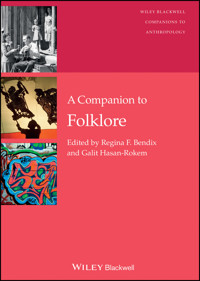
A Companion to Folklore E-Book
43,99 €
Mehr erfahren.
- Herausgeber: John Wiley & Sons
- Kategorie: Geisteswissenschaft
- Serie: Blackwell Companions to Anthropology
- Sprache: Englisch
A Companion to Folklore contains an original and comprehensive set of essays from international experts in the field of folklore studies. This state-of-the-art collection uniquely displays the vitality of folklore research across the globe. The Companion covers four main areas: the first section engages with the practices and theoretical approaches developed to understand the phenomena of folklore; the second discusses the distinctive shapes that folklore studies have taken in different locations in time and space; the third examines the interaction of folklore with various media, as well as folklore’s commoditization. In the final section on practice, essays offer insights into how folklorists work, what they do, and ways in which they have institutionalized their field.
Throughout, contributors investigate the interplay of folklore and folkloristics in both academic and political arenas; they evaluate key issues in the folk life of communities from around the world, including China, post-communist Russia, post-colonial India, South America, Israel and Japan. The result is a unique reflection and understanding of the profoundly different research histories and current perspectives on international research in the field.
Sie lesen das E-Book in den Legimi-Apps auf:
Seitenzahl: 1660
Veröffentlichungsjahr: 2012
Ähnliche




















Contents
NOTES ON CONTRIBUTORS
INTRODUCTION
PART I: CONCEPTS AND PHENOMENA
INTRODUCTION TO PART I
CHAPTER 1 THE SOCIAL BASE OF FOLKLORE
THE VERNACULAR LAYER
THE SOCIAL BOND
PERFORMANCE IN CONTEXT
EMBLEM AND STIGMA
CHAPTER 2 TRADITION WITHOUT END
TRADITIONALIZATION
TRADITOR
THEME AND VARIATIONS
SYMBOLIC EFFICACY
SARAMAGO TRADITOR
MEMETIC SELECTION
THE LONG REACH OF TRADITION
CONCLUDING THOUGHTS
CHAPTER 3 THE POETICS OF FOLKLORE
HISTORICAL ROOTS FOR A POETICS OF FOLKLORE
THE POETICS OF FOLKLORE AS CREATIVE COMMUNICATION
THE PERMANENCE/INSTABILITY OF FORM
THE POETICS OF FOLKLORE GENRES
INTERACTIVE, DIALOGIC APPROACHES TO GENRE
INTERTEXTUALITY
FRAME AND RITUAL GENRES
CONCLUSION
CHAPTER 4 THREE ASPECTS OF ORAL TEXTUALITY
ON THE NON-AUTONOMY OF TEXTS
ON THE NON-AUTONOMY OF AUTHOR/PERFORMERS
ON THE AUTONOMY OF AUTHOR/PERFORMERS
CHAPTER 5 PERFORMANCE
INTRODUCTION
FOUNDATIONS
THEORIZING PERFORMANCE
TEXT AND CONTEXT IN PERFORMANCE
CONCLUSION
CHAPTER 6 MYTH-RITUAL-SYMBOL
RITUAL
MYTH
SYMBOL
HISTORICAL CHANGE AND COMPARISON: PASSOVER AS AN EXAMPLE
CHAPTER 7 RELIGIOUS PRACTICE
PROBLEMS IN DEFINING RELIGION
RELIGION AS A CULTURAL SYSTEM: GEERTZ AND HIS CRITICS
AMERICAN APPROACHES TO THE STUDY OF FOLKLORE AND RELIGION
RELIGIOUS PRACTICE IN A GLOBAL CONTEXT
CHAPTER 8 WORK AND PROFESSIONS
THE MEANING OF WORK
WORK AND PROFESSIONS AS A TOPIC IN FOLKLORISTICS
WHO ARE THE FOLK WHO WORK AND ARE TO BE RESEARCHED?
THE CONCERNS AND LEITMOTIFS OF RESEARCH ON WORK
WORK RESEARCH IN FLUX: FROM “WORK AND OCCUPATIONS” TO “WORK AND ORGANIZATIONS”
THE CULTURES OF A GLOBALIZED, NEOLIBERAL REGIME OF WORK
RESEARCHING WORK
CHAPTER 9 MATERIAL CULTURE
GUARDIANS OF FOLK CULTURE
THE RETURN OF THE MATERIAL
THE NON-MATERIALITY OF MATERIAL STUDIES – THE PHENOMENOLOGICAL CRITIQUE
THE LIFE HISTORY APPROACH
ROUTINES, HABITS, AND PRACTICES
HOME AND WORK
THE TECHNOLOGIES OF BELONGING
CONCLUSION
PART II: LOCATION
INTRODUCTION TO PART II
CHAPTER 10 TRANSLINGUAL FOLKLORE AND FOLKLORICS IN CHINA
THE BIRTH OF MODERN FOLKLORE STUDIES IN CHINA
POLITICAL RULE AND THE VOICE OF THE OTHER
TRANSLATION AND TRANSLINGUAL PRACTICES
FOLKSONG IN OFFICIAL POPULAR CULTURE
CODA
CHAPTER 11 JAPAN
INTRODUCTION
HISTORICAL DEVELOPMENT
THE INTELLECTUAL CONTEXT OF JAPANESE FOLKLORE STUDIES
RECENT WORKS AND A PROSPECT FOR FOLKLORE STUDIES
CHAPTER 12 INDIA
CULTURE ZONE INDIA
SCHOLARLY RESOURCES FOR FOLKLORE IN INDIA IN HISTORICAL PERSPECTIVE
MAJOR TEXTS OF INDIAN FOLKLORE
FOLKLORE AND FOLK PERFORMERS IN CONTEMPORARY INDIA
CONCLUSION
CHAPTER 13 OCEANIA
CHAPTER 14 FOLKLORE AND FOLKLORE STUDIES IN LATIN AMERICA
FOLKLORE STUDIES IN LATIN AMERICA: FROM THE LATE NINETEENTH-CENTURY PRECURSORS TO THE PRESENT
THE FIRST STAGE: THE PRECURSORS
THE SECOND STAGE: THE FORMATIVE YEARS OF FOLKLORE STUDIES
THE THIRD STAGE: NEW LATIN AMERICAN PERSPECTIVES FROM THE 1970S TO THE PRESENT
REAPPRAISING LATIN AMERICAN FOLKLORE STUDIES
CHAPTER 15 FOLKLORE STUDIES IN THE UNITED STATES
FROM THE COLONIAL PERIOD TO INDEPENDENCE
THE INVENTION OF FOLKLORE: FROM THE CIVIL WAR TO WORLD WAR II
BREAKTHROUGH INTO DISCIPLINARITY
CHAPTER 16 DANCING AROUND FOLKLORE
OTTOMAN-TURKISH INTEREST IN FOLKLORE
FROM TURKISH HEARTHS TO PEOPLE’S HOUSES: THE MAKING OF “TURKISH FOLKLORE”
PUTTING FOLKLORE ON TRIAL: THE REVIVAL OF TURKISM AND ITS IMPACT ON FOLKLORE STUDIES
FOLKLORE AS POPULAR CULTURE: THE YEARS DOMINATED BY FOLK DANCING
CHAPTER 17 FOLKLORE STUDIES IN ISRAEL
WHO? WHERE? WHY? WHEN?
FROM THE PAST TO THE PRESENT – A CULTURAL HISTORICAL BIRD’S EYE VIEW OF THE CONTEXT OF FOLKLORE IN THE HOLY LAND
THE CURRENT STATE OF THE STUDY OF FOLKLORE IN ISRAEL
CHAPTER 18 FULANI (PEUL, FULFULDE, PULAAR) LITERATURE
THE CONTRIBUTION OF SPEAKERS TO THE LANGUAGE
RESEARCH IN FULANI LITERATURE
ORAL LITERATURE
FULANI WRITTEN LITERATURE
CHAPTER 19 FROM VOLKSKUNDE TO THE “FIELD OF MANY NAMES”
SWITZERLAND
THE GERMANIES
AUSTRIA
THE PRESENT AND FUTURE
CHAPTER 20 FINLAND
INTRODUCTION
DANIEL JUSLENIUS, HISTORICAL KNOWLEDGE, AND FOLKLORE DOCUMENTS OF EIGHTEENTHC-CENTURY FINLAND
THE ADVENT OF THE ROMANTIC CURRENTS
THE HISTORICAL-GEOGRAPHIC METHOD AND THE FOLKTALES
THE HISTORICAL-GEOGRAPHIC METHOD AND THE KALEVALA EPICS
THE FINNISH SCHOOL IN THE 1930S AND 1940S
THE TYPOLOGICAL SCHOOL
DID THE HISTORICAL-GEOGRAPHIC SCHOOL PERSIST?
THE METHODOLOGICAL REVOLUTION OF FINNISH FOLKLORISTICS IN THE 1960S
THE DEVELOPMENT OF MODERN FIELDWORK IN THE 1960S AND 1970S
THE FINNISH LITERATURE SOCIETY’S FOLKLORE ARCHIVES FROM THE 1965 ONWARDS: LIFE STORIES AND ORAL HISTORY
A NEW UNDERSTANDING OF THE OLD ARCHIVED COLLECTIONS
CHAPTER 21 IRELAND
NATIONAL OR POPULAR?
FROM ANTIQUARIANISM TO THE FIRST COLLECTORS
ETHNOGRAPHIC POPULISM?
INSTITUTIONALIZATION
CHAPTER 22 RUSSIA
INTRODUCTION: SOCIAL CONSTRUCTIONISM AND THE HISTORY OF RUSSIAN FOLKLORISTICS
ROMANTIC BEGINNINGS: RUSSIAN FOLKLORISTICS AND GERMAN MYTHOLOGICAL STUDIES
RUSSIAN HEROIC EPICS (BYLINY) AND THE POLITICS OF FOLKLORE
RUSSIAN FOLKLORISTICS IN THE 1870SL–1920S
“SOVIET FOLKLORE”: A NEW POLITICS OF CULTURE
VLADIMIR PROPP
LIBERAL TURN: TRENDS OF FOLKLORE RESEARCH IN 1960S–1980S
DEVELOPMENT OR DECLINE? FOLKLORISTICS IN POST-SOVIET RUSSIA
PART III: REFLECTION
INTRODUCTION TO PART III
CHAPTER 23 FOLKLORE AND LITERATURE
RE-SITUATING THEIR DYNAMICS
RE-VIEWING FOLKLORE IN/AS LITERATURE
RE-CONTEXTUALIZING FOLKLORE AND LITERATURE
RE-VALUING TRANSLATION IN FOLKLORE AND LITERATURE
CHAPTER 24 FOLKLORE AND/IN MUSIC
FOLK MUSIC
TYPES OF FOLK MUSIC
FOLK MUSIC AND MUSICAL STYLE
FOLK MUSIC, ART MUSIC, POP MUSIC
FOLK, POP, AND GLOBAL CULTURAL FLOW: THE CASE OF “MISIRLOU”
MUSIC ABOUT FOLKLORE
FOLKLORE ABOUT MUSIC
CONCLUSION
CHAPTER 25 FOLKLORE AND/ON FILM
DOCUMENTARIES OF TRADITIONAL CULTURE
VERNACULAR FILM
FILMS INCORPORATING TRADITIONAL CULTURE (CINEMATIC FOLKLORE)
FICTIONAL FILMS BY INSIDERS ABOUT INSIDERS
IS THAT ALL THERE IS?
CHAPTER 26 CULTURAL HERITAGE
HERITAGE BY FIRE
AGE OF HERITAGE
PATRIMONIAL RÉGIME
CRITIQUE OF HERITAGE
HERITAGE UNDER UNESCO
HERITAGE AS SOCIAL IMAGINATION
NATIONAL CULTURE AND CULTURAL HERITAGE
PATRIMONIALITY
HERITAGE AS A METACULTURAL PRACTICE
JEMAA EL-FNA, OR VERTICAL INTEGRATION OF VERNACULAR CULTURE
THE ALIEN GAZE, OR GOVERNMENT OF HABITUS IN THE NAME OF HERITAGE
THE BODY OF HERITAGE
CULTURAL HERITAGE AND THE IRONIC SUBJECT
CHAPTER 27 CULTURAL PROPERTY
WHAT IS CULTURAL PROPERTY?
SETTING THE STAGE: DEBATES AND DEBACLES
FOUR MODES OF THINKING THROUGH CULTURAL PROPERTY
THE CUNNING OF CULTURAL PROPERTY
CHAPTER 28 FOLKLORE: LEGAL AND CONSTITUTIONAL POWER
INTRODUCTION: THE INTERSECTION BETWEEN FOLKLORE AND LAW
THE STATUS OF FOLK LAW IN THEORY AND PRACTICE
STATE CONTROL OF FOLK LAW: COLONIAL CONTEXTS
FOLK LAW – MIGRATION AND THE CULTURAL DEFENSE
FOLKLORE AND THE LITIGATION OF RELIGIOUS DISPUTES
THE SIGNIFICANCE OF LANDSCAPES: ENVIRONMENT LITIGATION
HOW INTERNATIONAL LAW PROTECTS FOLKLORE: CULTURAL RIGHTS AND CULTURAL HERITAGE
CONCLUSION
PART IV: PRACTICE
INTRODUCTION TO PART IV
CHAPTER 29 SEEING, HEARING, FEELING, WRITING
EUROPEAN ETHNOLOGY (VOLKSKUNDE) AND ITS METHODOLOGICAL APPROACH
AVENUES OF RESEARCH: (ETHNOGRAPHIC) METHODS AT A GLANCE
TRENDS IN AND CURRENT DISCUSSIONS ON ETHNOGRAPHY
OUTLOOK: ETHNOGRAPHIC TURN
CHAPTER 30 IMAGINING PUBLIC FOLKLORE
POLITICS AND PRINCIPLES
VALUING MULTIPLE EXCELLENCES
ADDRESSING BOUNDARIES
HISTORIES AND CONTEXTS
CHAPTER 31 THE INSTITUTIONALIZATION OF FOLKLORE
INSTITUTIONALIZATION AND ITS COUNTERFORCES
NATIONAL INSTITUTIONS
INDEX
The Blackwell Companions to Anthropology offers a series of comprehensive syntheses of the traditional subdisciplines, primary subjects, and geographic areas of inquiry for the field. Taken together, the series represents both a contemporary survey of anthropology and a cutting edge guide to the emerging research and intellectual trends in the field as a whole.
Forthcoming
A Companion to Forensic Anthropology, edited by Dennis Dirkmaat
A Companion to the Anthropology of Europe, edited by Ullrich Kockel, Máiréad Nic Craith, and Jonas Frykman
A Companion to Paleoanthropology, edited by David Begun
This edition first published 2012© 2012 Blackwell Publishing Ltd
Blackwell Publishing was acquired by John Wiley & Sons in February 2007. Blackwell’s publishing program has been merged with Wiley’s global Scientific, Technical, and Medical business to form Wiley-Blackwell.
Registered OfficeJohn Wiley & Sons, Ltd, The Atrium, Southern Gate, Chichester, West Sussex, PO19 8SQ, UK
Editorial Offices350 Main Street, Malden, MA 02148-5020, USA9600 Garsington Road, Oxford, OX4 2DQ, UKThe Atrium, Southern Gate, Chichester, West Sussex, PO19 8SQ, UK
For details of our global editorial offices, for customer services, and for information about how to apply for permission to reuse the copyright material in this book please see our website at www.wiley.com/wiley-blackwell.
The right of Regina F. Bendix and Galit Hasan-Rokem to be identified as the authors of the editorial material in this work has been asserted in accordance with the UK Copyright, Designs and Patents Act 1988.
All rights reserved. No part of this publication may be reproduced, stored in a retrieval system, or transmitted, in any form or by any means, electronic, mechanical, photocopying, recording or otherwise, except as permitted by the UK Copyright, Designs and Patents Act 1988, without the prior permission of the publisher.
Wiley also publishes its books in a variety of electronic formats. Some content that appears in print may not be available in electronic books.
Designations used by companies to distinguish their products are often claimed as trademarks. All brand names and product names used in this book are trade names, service marks, trademarks or registered trademarks of their respective owners. The publisher is not associated with any product or vendor mentioned in this book. This publication is designed to provide accurate and authoritative information in regard to the subject matter covered. It is sold on the understanding that the publisher is not engaged in rendering professional services. If professional advice or other expert assistance is required, the services of a competent professional should be sought.
Library of Congress Cataloging-in-Publication Data
A companion to folklore / edited by Regina F. Bendix and Galit Hasan-Rokem.p. cm. – (Blackwell Companions to Anthropology)Includes bibliographical references and index.
ISBN 978-1-4051-9499-0 (hardback)1. Folklore–Study and teaching. 2. Folklore–Cross-cultural studies. I. Bendix, Regina. II. Hasan-Rokem, Galit.GR45.C64 2012398.2–dc23
2011036434
A catalogue record for this book is available from the British Library.
NOTES ON CONTRIBUTORS
Cristina Bacchilega is Professor of English at the University of Hawai’i at Mānoa, where she teaches folklore and literature, fairy tales and their adaptations, and cultural studies. She has published Legendary Hawai’i and the Politics of Place: Tradition, Translation, and Tourism (2007) and Postmodern Fairy Tales: Gender and Narrative Strategies (1997), and she is the review editor of Marvels and Tales: Journal of Fairy-Tale Studies. Recent essays include “Generic Complexity in Early 21st-Century Fairy-Tale Film” with John Rieder (2010) and work on nineteenth-century translations of The Arabian Nights into Hawai’ian with historian Noelani Arista and translator Sahoa Fukushima (2007). With Donatella Izzo and Bryan Kamaoli Kuwada, she co-edited “Sustaining Hawai’ian Sovereignty,” a special issue of Anglistica, an online journal of international interdisciplinary studies (2011). Her current book project focuses on the poetics and politics of twenty-first-century fairy-tale adaptations.
Richard Bauman is Distinguished Professor Emeritus of Folklore and Ethnomusicology, Communication and Culture, and Anthropology at Indiana University, Bloomington. The principal foci of his research include narrative, oral poetics, performance, genre, and language ideologies. He has done fieldwork in Scotland, Nova Scotia, Texas, and Mexico, historical research on early Quakers and medieval Iceland, and is currently engaged in research on the metapragmatics of early commercial sound recordings. He has served as President of the Society for Linguistic Anthropology and the Semiotic Society of America, and as Editor of the Journal of American Folklore. Among his publications are Verbal Art as Performance (1977), Story, Performance, and Event (1986), Voices of Modernity (with Charles L. Briggs, 2003), which won the Edward Sapir Prize of the Society for Linguistic Anthropology, and A World of Others’ Words (2004). In 2008, he received the Lifetime Scholarly Achievement Award of the American Folklore Society.
Ursula Baumgardt is Professor of Orality and African Literature at the Institut National des Langues et Civilisations Orientales (INALCO) in Paris. She is also member of the council on Langage, Langues et Cultures d’Afrique Noire (LLACAN) and a member of the council of the International Society for Oral Literature in Africa (ISOLA). Her publications include Littératures orales africaines. Perspectives théoriques et méthodologiques (with Jean Derive, Ed., 2008), Autour de la performance,Cahiers de Littérature orale (Sandra Bornand, Ed., 2009), and L’expression de l’espace dans les langues africaines I,Journal des Africanistes (Paulette Roulon-Doko, Ed., 2010).
Regina F. Bendix has been Professor of Cultural Anthropology/European Ethnology at Georg-August-University in Göttingen, Germany, since 2001; before then she taught folklore and anthropology at the University of Pennsylvania, Philadelphia. She studied folklore and Volkskunde in Switzerland and the United States and has throughout her career enjoyed the challenge of linking European and American research traditions. Among her major research interests at present is the interface of culture, economics and politics as it manifests itself in questions of heritage and cultural property as well as productions for tourists. She has also worked extensively on matters pertaining to the history of the discipline, including in her monograph InSearch of Authenticity (1997), and has contributed to research in narrative and the ethnography of communication as well as the ethnography of the senses.
Fernando Fischman teaches at the University of Buenos Aires, Argentina. He is a researcher for CONICET (Consejo Nacional de Investigaciones Científicas y Técnicas). His main research interests are verbal art, performance theory, Jewish-Argentine folklore, and social memory. He edited Donos da Palavra: autoria, performance e experiência em narrativas orais na América do Sul (2007) (with Luciana Hartmann) and Dime cómo cuentas … Narradores folklóricos y narradores urbanos profesionales (2009) (with Maria Inés Palleiro).
Harvey E. Goldberg held the Sarah Allen Shaine Chair in Sociology and Anthropology at the Hebrew University of Jerusalem. He has focused on the cultural history of the Jews in North Africa, on religious and ethnic identities in Israel, and on the interfaces between anthropology and Jewish Studies. He has been a Visiting Professor at the University of California, Berkeley, and at Boğaziçi University, Istanbul, a Visiting Lecturer at the École des Hautes Études en Science Sociale, Paris, and a Fellow at the Center for Advanced Judaic Studies at the University of Pennsylvania. His books include Jewish Life in Muslim Libya: Rivals and Relatives (University of Chicago Press, 1990) and Jewish Passages: Cycles of Jewish Life (University of California Press, 2003). He has recently co-edited Perspectives on Israeli Anthropology with Esther Hertzog, Orit Abuhav, and Emanuel Marx (Wayne State University Press, 2010).
Pauline Greenhill has been Professor of Women’s and Gender Studies at the University of Winnipeg since 1996. Her most recent books are Make The Night Hideous: Four English-Canadian Charivaris (University of Toronto Press, 2010) and with Sidney Eve Matrix, co-editor, Fairy Tale Films: Visions of Ambiguity (Utah State University Press, 2010). With Liz Locke, primary editor, and Theresa Vaughan, she is co-editor of the Encyclopedia of Women’s Folklore and Folklife (Greenwood Press, 2 vols., 2008). She has published in Signs: Journal of Women in Culture and Society; parallax; Jeunesse: Young People, Texts, Cultures; Acadiensis; Resources for Feminist Research/Documentation sur la Recherche Feministe; Marvels and Tales; Ethnologies; Canadian Journal of Women and the Law; Manitoba History; Türkbilig: Türkoloji Arastirmalari; and the Journal of American Folklore, among other journals. She is currently working with Kay Turner on a collection tentatively entitled Transgressive Tales: Queering the Fairy Tale for Wayne State University Press.
Valdimar T. Hafstein is an Associate Professor of Folkloristics/Ethnology in the School of Social Sciences at the University of Iceland, and a Visting Professor at Gothenburg University. He completed his PhD at the University of California, Berkeley, in 2004. His publications in recent years have focused on cultural heritage as a concept, category, and social dynamic and on intellectual property in traditional expressions. His book on the making of intangible cultural heritage in UNESCO is forthcoming from the University of Illinois Press and he is presently involved in a European collaborative research project on “Copyrighting Creativity.”
Lee Haring is Professor Emeritus of English at Brooklyn College of the City University of New York. He has conducted folklore fieldwork in Kenya, Madagascar (as Fulbright Senior Lecturer), and Mauritius (as Fulbright researcher). He has published Malagasy Tale Index, a comprehensive analysis of folktales, the English translation of Ibonia, Epic of Madagascar, available at http://xroads.virginia.edu/∼public/Ibonia/frames.html, and Verbal Arts in Madagascar, a study of four genres of oral literature. His book Stars and Keys: Folktales and Creolization in the Indian Ocean shows the cultural interrelations of the Southwest Indian Ocean islands, through translating and commenting on a hundred stories from Madagascar, Mauritius, Réunion, the Comoros, and Seychelles. He also published the bilingual field manual Collecting Folklore in Mauritius, in English and Kreol, and two collections of tales. He has taught in graduate folklore programs at the University of California at Berkeley, the University of Pennsylvania, and the University of Connecticut.
Lauri Harvilahti, Director of the Folklore Archives of the Finnish Literature Society, has, as a result of fieldwork carried out over 20 years, become familiar with a number of traditional cultures. His theoretical interests lie in ethnocultural processes and ethnic identity, computer folkloristics, and currently questions of archiving oral tradition. He is currently directing a project for the Academy of Finland and the Chinese Academy of Social Sciences on “Documenting and Archiving Oral Tradition: Research and Interdisciplinary Approaches” (2009–2011), and he is in charge of the digital archive projects of the Finnish Literature Society’s Folklore Archives. He has published a number of monographs in Finnish and his publications in English include “The Holy Mountain. Studies of Upper Altay Oral Poetry.”
Galit Hasan-Rokem is Max and Margarethe Grunwald Professor of Folklore at the Mandel Institute of Jewish Studies at the Hebrew University of Jerusalem and Director of the Folklore Research Center there. Her publications include: Proverbs in Israeli Folk Narratives: A Structural Semantic Analysis of Folklore. FFC 232 (1982); The Wandering Jew: Interpretations of a Christian Legend (1986, co-edited with A. Dundes); Untying the Knot: On Riddles and Other Enigmatic Modes (1996, co-edited with D. Shulman); Web of Life: Folklore and Midrash in Rabbinic Literature (2000); Tales of the Neighborhood: Jewish Narrative Dialogues in Late Antiquity (Berkeley 2003); “Dialogue as Ethical Conduct: The Folk Festival that Was Not,” Research Ethics in Studies of Culture and Social Life. FFC 292 (2007), eds. B. G. Alver et al., pp. 192–208; “Jews as Postcards, or Postcards as Jews: Mobility in a Modern Genre,” Jewish Quarterly Review 99/4 (2009): 505–546. She has served as President of the International Society for Folk Narrative Research (1998–2005), and as Head of the Mandel Institute of Jewish Studies at the Hebrew University (2001–2004), as Visiting Professor – among other institutions – at the University of California, Berkeley, the University of Pennsylvania, and the University of Chicago, and has been Fellow at the Wissenschaftskolleg zu Berlin, at the Institute for Advanced Studies, and at Scholion – Interdisciplinary Research Center in Jewish Studies at the Hebrew University.
Gertraud Koch is a Professor at the Department of Communication and Cultural Management at Zeppelin University, a private university in Friedrichshafen, Germany. She studied European Ethnology/Empirical Culture Research in Frankfurt am Main and Tübingen. She has a doctorate in European Ethnology from Humboldt University in Berlin and wrote her dissertation on the culture of artificial intelligence. Her research fields include working cultures, diversity and migration, urban and regional studies as well as virtual communities. Recent publications discuss how the digital media augment and enhance life worlds and how these media can be approached ethnographically.
Debora Kodish is the founding director of the Philadelphia Folklore Project (PFP), where she has worked since 1987. After receiving a PhD in folklore from the University of Texas, she worked on emerging public folklore projects in Oregon and Maine, and taught before focusing primarily on developing public interest folklore practice in Philadelphia (see www.folkloreproject.org). There, she has participated in dozens of long-term collaborative efforts with local activists, artists, and community members (and raised a family). In between responsibilities for the day-to-day management of PFP, she is working on a book on public interest folklore.
Lydia H. Liu is a theorist of language, media, and translingual practices. She teaches at Columbia University as W. T. Tam Professor in the Humanities in the Department of East Asian Languages and Cultures and the Institute of Comparative Literature and Society. She directs the Center for Translingual and Transculture Studies at Tsinghua University in Beijing. Her work has focused on cross-cultural exchange in recent history, the movement of words, theories, and artifacts across national boundaries, and the evolution of writing and technology. She is the author of Translingual Practice: Literature, National Culture, and Translated Modernity (1995), The Clash of Empires: The Invention of China in Modern World Making (2004), and the editor of Tokens of Exchange: The Problem of Translation in Global Circulations (1999). Her new book, entitled The Freudian Robot: Digital Media and the Future of the Unconscious was published by the University of Chicago Press in 2010.
Orvar Löfgren is an Emeritus Professor of European Ethnology at Lund University, Sweden. The cultural analysis of everyday life has been an ongoing focus in his research; see for example The Secret World of Doing Nothing (together with Billy Ehn, 2010) and Off the Edge: Experiments in Cultural Analysis (edited with Richard Wilk 2006). Other central research fields have been studies of national identity and transnational mobility, as in tourism and travel, see, for example, On Holiday. A History of Vacationing (1999).
Sabina Magliocco is Professor of Anthropology at California State University, Northridge. She grew up in Italy and the United States. She received her AB from Brown University in 1980 and her PhD from Indiana University in 1988. As recipient of Guggenheim, National Endowment for the Humanities, Fulbright, and Hewlett fellowships, and an honorary Fellow of the American Folklore Society, she has published on religion, folklore, foodways, festival, and witchcraft in Europe and the United States. Her books include The Two Madonnas: The Politics of Festival in a Sardinian Community (1993 and 2005), Neo-Pagan Sacred Art and Altars: Making Things Whole (2001), and Witching Culture: Folklore and Neo-Paganism in America (2004). Along with documentary film maker John M. Bishop, she produced and directed a set of documentary films entitled Oss Tales (2007), on a May Day custom in Cornwall and California. Her hobbies include music (she plays guitar and banjo), gardening, and animal welfare. She is a Gardnerian priestess and has a small, eclectic coven in the Los Angeles area. For more information, visit her website at http://www.csun.edu/∼sm32646.
Phillip H. McArthur is Professor of International Cultural Studies at Brigham Young University Hawai’i, and an Affiliated Faculty to the Jonathan Napela Center for Hawai’ian and Pacific Islands Studies. He presently serves as the Dean to the College of Language, Culture, and Arts. He is also the current editor of the journal Pacific Studies. His research and publications concentrate on social theoretical and semiotic approaches to oral narrative, cultural performance, history, cosmology, nationalism, and globalization in Oceania, with special attention to the Marshall Islands. His publications include, “Narrative, Cosmos, and Nation: Intertextuality and Power in the Marshall Islands” in the Journal of American Folklore, “Ambivalent Fantasies: Local Prehistories and Global Dramas in the Marshall Islands” in the Journal of Folklore Research, and “Modernism and Pacific Ways of Knowing: An Uneasy Dialogue in Micronesia” in Pacific Rim Studies.
Akiko Mori is currently Professor of Cultural Anthropology and Ethnographical Research of Central Europe at the National Museum of Ethnology, Osaka, Japan. She has carried out ethnographical research in Carinthia and Berlin since the mid-1980s. Her recent theme is “Anthropological Descriptions and their Social Context,” and in this framework, she worked on “A Comparative Study on the Historical Process of Folklore Studies since the 1950s in Germany and Japan: Academic Interests and Society” (2007–2010). This project includes three folklorists, M. Iwamot, Y. Shigenobu, and H. Hokkyo, and one media study scholar, T. Sato. The contribution in this volume reflects a part of this project. Her works include “German Volkskunde and Cultural Anthropology” (Bulletin of the National Museun of Ethnology, 2009) (in Japanese) and “Grab, Epitaph und Friedhof. Neue Zugänge: ethnologischer Familienforschung am Beispiel einer Kärntner Landgemeinde” (Historische Anthropologie, 1995) (in German).
Sadhana Naithani teaches literature and folklore at the Centre of German Studies, Jawaharlal Nehru University, New Delhi. She is the author of In Quest of Indian Folktales (2006) and of The Story-Time of the British Empire (2010). Her current research interests are German folklore theory since 1945 and Indian folk performers since 1947.
Dorothy Noyes is Associate Professor of English and Comparative Studies at Ohio State University, where she directs the Center for Folklore Studies and is a research associate of the Mershon Center for International Security Studies. She is the author of Fire in the Plaça: Catalan Festival Politics After Franco (University of Pennsylvania Press, 2003). Her interests include the traditional public sphere in Romance-speaking Europe, the social organization of vernacular creativity, the careers of culture concepts, and the role of cultural performance in international relations.
Diarmuid Ó Giolláin is Professor in the Department of Irish Language and Literature and Concurrent Professor in the Department of Anthropology at the University of Notre Dame. He previously worked in and headed the Department of Folklore and Ethnology in University College Cork, Ireland. His publications include Locating Irish Folklore. Tradition, Modernity, Identity (Cork: Cork University Press, 2000) and An Dúchas agus an Domhan (The Native/Vernacular and the World) (Cork: Cork University Press, 2005). He recently was guest editor for a special issue of Ethnologie française (2011/2) devoted to Irish ethnology. His research interests include the history of folklore and ethnology; ethnomuseology and heritage; and popular religion.
Arzu Öztürkmen is a professor of Folklore and History at Boğaziçi University, Istanbul. She received a doctorate from the University of Pennsylvania and is the author of Türkiye’de Folklor ve Milliyetçilik (Istanbul: Iletism Yayınları, 1998) in addition to numerous articles on folklore, oral history, and cultural history in the Turkish and Ottoman world.
Alexander A. Panchenko is Director of the Research Center for Literary Theory and Interdisciplinary Studies at the Institute of Russian Literature, Russian Academy of Sciences (St Petersburg, Russia), a Professor of Social Anthropology at St Petersburg State University (College of Liberal Arts and Sciences), and the director of the Center for Anthropology of Religion at the European University at St Petersburg. His research interests include religious folklore and vernacular religion in Russia and Europe, theory and history of folklore research, contemporary folklore and popular culture, and anthropological approaches in the study of Russian literature. He published more than 100 research works (including two books) in Russian and other European languages on vernacular religion in rural Russia, various religious movements in modern Russia, the political use of folklore in the Soviet Union, and comparative studies in folklore and anthropology of religion.
Alison Dundes Renteln is a Professor of Political Science and Anthropology at the University of Southern California where she teaches Law and Public Policy with an emphasis on international law and human rights. A graduate of Harvard (History and Literature), she has a PhD in Jurisprudence and Social Policy from the University of California, Berkeley and a JD from the USC Law School. Her publications focus on the conflicts between state law and folk law including The Cultural Defense (Oxford, 2004), Folk Law (University of Wisconsin, 1995), Multicultural Jurisprudence: Comparative Perspectives on the Cultural Defense (Hart, 2009), and Cultural Law: International, National, and Indigenous (Cambridge, 2010). She has taught seminars on cultural rights for judges, lawyers, court interpreters, jury consultants, and police officers at meetings of the American Bar Association, the National Association of Women Judges, North American South Asian Bar Association, American Society of Trial Consultants, and others.
Bjarne Rogan is Professor of Culture History (formerly European ethnology) in the Department of Culture History and Oriental Languages, University of Oslo. He is presently director of the French-Norwegian Center for Social Sciences and Humanities in Paris. He has published extensively in the following fields: Material culture and consumption studies, especially on collecting; transport history and tourism; littoral culture and fisheries; language, culture and communication; museology and the historiography of European ethnology, with a special focus on its organizations. His most recent edited books are on the history, politics, and ideologies of museums (Oslo, 2010) and on material culture and the materiality of culture (Oslo, 2011). He is presently working on a book on the history of ethnology and folklore in Norway. For further information, see http://www.hf.uio.no/ikos/english/people/aca/bjarner/index.html.
Hagar Salamon is the head of the Jewish and Comparative Folklore Program and the Africa Unit at the Harry S. Truman Research Institute for the Advancement of Peace, both at the Hebrew University of Jerusalem, Israel. Her research focuses on cultural perceptions of the Ethiopian Jews both in Ethiopia and Israel, women’s expressive culture and life stories, as well as present-day Israeli folklore. She is the author of The Hyena People: Ethiopian Jews in Christian Ethiopia (University of California Press, 1999), editor of Ethiopia: Jewish Communities in the East in The Nineteenth and Twentieth Centuries (Jerusalem: Ben-Zvi, 2007), and is a co-editor of the journal Jerusalem Studies in Jewish Folklore. She lives in Jerusalem with her husband and four daughters.
Dani Schrire is based at the Jewish and Comparative Program at the Hebrew University of Jerusalem. His dissertation, “Collecting the Pieces of Exile: A Critical view of Folklore Research in Israel in the 1940s–1950s” is under evaluation. It is based on an ethnographical-history of folklore studies in Israel in the context of the history of Jewish folkloristics in Europe and it employs an Actor-Network-Theory approach. Currently, he is a Minerva post-doctoral fellow at the Institute for Cultural Anthropology/European Ethnology at the University of Göttingen. His latest publication “Raphael Patai, Jewish Folklore, Comparative Folkloristics, and American Anthropology” appeared recently in the Journal of Folklore Research.
Brigitta Schmidt-Lauber is Professor of European Ethnology at the University of Vienna. She studied Volkskunde, ethnology (Völkerkunde), and social and economic history at the universities of Hamburg and Cologne and gained her PhD in 1997 (“Ethnicity as social practice”). After completing post-doctoral qualifications at the University of Hamburg (“Gemütlichkeit,” 2003) and becoming a Visiting Lecturer at the universities of Vienna, Basel, and Zurich she was appointed professor at the Georg-August University in Göttingen in 2006. In 2009 she accepted a full professorship at the University of Vienna. In addition to ethnographic methods and methodology, ethnicity, and migration, she is an expert in the area of cultural urban study. Her empirical research has included fieldwork on the ethnicity of German-speaking people in Namibia, on the St Pauli district soccer club, and soccer as an urban phenomenon. She is also leading a research project on everyday life in middletowns as urban life beyond the metropolis.
Peter Seitel retired from the Smithsonian Institution in 2004 as Senior Folklorist Emeritus. He has written about several folklore genres, about genre itself, and about social practices that make use of folklore genres.
Amy Shuman is Professor of Folklore, English, Women’s Studies, and Anthropology at Ohio State University. She is the author of three books: Storytelling Rights: The Uses of Oral and Written Texts Among Urban Adolescents, Other People’s Stories: Entitlement Claims and the Critique of Empathy, and, with Carol Bohmer, Rejecting Refugees: Political Asylum in the 21st Century. Her current projects include a study of the life history narratives related by artisan stonecarvers in Pietrasanta, Italy, research on narratives told by the parents of children with disabilities, and community narrative projects at the intersection of collective memory and public policy.
Francisco Vaz da Silva teaches anthropology and folklore at Instituto Universitário de Lisboa (ISCTE-IUL), Lisbon, Portugal. His research interests include symbolic codes in mythology, ritual, wondertales, and the arts; and intertextual techniques for narrative analysis. His most recent book is Archeology of Intangible Heritage (New York: Lang, 2008).
Martin Skrydstrup is a Postdoctoral Fellow in the Department of Anthropology, University of Copenhagen. He holds a doctorate in Cultural Anthropology from Columbia University, New York, supported by Fulbright and the Danish Research Academy (FUR). His dissertation project, entitled “Once Ours: The Making and Unmaking of Claims to Cultural Property,” cut through a lateral anthropology of exchange with postcolonial theory, arguing for a new theory of topology. For this research, he conducted ethnographies in Hawai’i, Ghana, Iceland, and Greenland, exploring various repatriation cases on a comparative scale, supported by grants from Wenner-Gren and the National Science Foundation. In the field of cultural resource management, he has worked as an expert consultant for the Nordic Africa Institute and the UN World Intellectual Property Organization. He has served on the Board of the International Committee for Museums and Collections of Ethnography (ICME) as a correspondent for repatriation and was appointed a special advisor to the Ethics Committee of the International Council of Museums (ICOM).
Stephen D. Winick is a folklorist, writer and editor at the American Folklife Center at the Library of Congress. He obtained a PhD in folklore and folklife from the University of Pennsylvania, and has taught folklore courses both there and at George Mason University. For over 20 years, he was a columnist and contributing editor at Dirty Linen, the Magazine of Folk and World Music, and has published on folk music in many academic and popular venues. He is also a singer of traditional folksongs and performs with several groups in the Washington DC area.
INTRODUCTION
Regina F. Bendix and Galit Hasan-Rokem
Once, a number of blind men encountered an elephant. Every one of them touched one of the parts of its body with his hand and imagined the animal in his mind. Then they turned away. The one who had touched the leg said that the shape of the elephant was long and round like the trunk of a tree or a palm tree. The one who had touched the back thought that its shape was similar to that of a high mountain or a hill. The one who had touched its trunk described it as something smooth without any bones. And the one who had touched its ear thought it to be of a large size, thin, and constantly moving. In that manner, each of the blind men described that part of the animal that he himself had sensed. At the same time, each of them said something different from the others and accused them of misjudgment and inaccuracy in relation to the elephants shape as sensed by himself.1
What do people in general think of when they hear the word folklore: stories, festivals, open air museums, holiday greetings and party games? Masks, riddles, lullabies, and fortune cookies? Crafts and knowledge of healing plants? All of these and much more is comprised in the term folklore and much as in the ancient parable about the wondrous elephant, the field of folklore research unfolds as a multifaceted array of learning, best understood when many views, perspectives, and experiences are combined. This book is meant to introduce its readers to folklore studies by illustrating how folklore has stimulated imaginations and sent individuals to places near and far, to forgotten books and internet blogs – all to study folklore where it lived and lives. Becoming a folklore scholar involves questions about the things that people in general call folklore. Some of the answers may grow out of looking at a number of phenomena that are called folklore or, as in some international contexts, traditional cultural expressions. Yet another set of questions deals with the context and the circumstances in which a thing, an event or a creative expression conceived of as folklore unfolds or materializes. Documenting such phenomena in the here and now, comparing them or following their transformations through time and space are all approaches to begin understanding how individuals and groups create and transform expressive forms.
The Companion to Folklore Studies seeks to represent the state of the art for readers intrigued with the field’s theoretical potential and international scope. The volume has grown out of our conviction that there is not one unambiguous way of defining what folklore is and what its study comprises. For although folkloristics has always been international in aspiration, the field is also closely tied to the politics of groups and states and hence its flourishing has depended on the vagaries of state institutions. The best approach to unveil this elephant appeared thus to be an assembling of answers from colleagues engaged in the subject, its study and history around the globe: to comprehend an elephant, it is necessary to consult as many experts as possible who are situated at diverging angles in relation to the object of our investigation. As our object is not really a humongous mammal but rather a complex, multi-layered and fascinating cultural phenomenon and the equally complex intellectual engagement with it, the discourses unfolding in this book will tell more intricate tales than the leg, the tail or the trunk of the elephant.
This volume is rooted in the awareness that in the present, academic folklore studies find themselves situated among a number of other fields and sharing large portions of discourse with them. With its inconclusive situation between the humanities and the social sciences, folkloristics has lost its maverick status by being joined in this hybridity by many other fields such as large elements of, for instance, geography, psychology, archeology, and even history. The rise of inter-disciplinarity itself – in some places growing into a veritable norm of good research – has renewed the vision of folklore studies in the eyes of its practitioners and others.
Politically, the rise of folklore and its study has been associated with the grand transformations entailed in democratization and industrialization, in short, the powers of (Western) modernity (Bauman and Briggs 2003). Modernist thinking rejected the traditional – long perceived as the seedbed of folklore. In tandem with such rejection, the documentation and preservation of folklore began to flourish as a testimony to a given society’s recognition of its movement forward. Yet in the present era, we acknowledge multiple modernities unfolding at different rates within the cultural poly-systems of the world. Detraditionalization and retraditionalization have often gone hand in hand, and the state of folklore research in history and in the present has been intertwined with this dynamic, while simultaneously offering a reflexive accompaniment to it.
As a subject, folklore is vast, for there is hardly a facet of cultural practice that is not in some way shaped by expressive forces. “Folklore is everything” may sometimes be a sour judgment of those who marvel at a field that may stretch from interpreting Homeric texts to investigating immigrant gardening in a Scandinavian capital, to name just some concrete examples of the variation everyone who has been at a folklore studies conference instantly recognizes. Folkloristics comprises the study of many phenomena and areas that are studied by other disciplines. Scholars are engaged in a continuous search for the coordinates which may provide for a common ground for a disciplinary discourse of folkloristics on the one hand, and may shape a graspable entity of knowledge that can be fitted into the existing academic structures on the other hand. The history and sociology of knowledge teaches us that institutionalized forms of transmitting a collectively accumulated set of concepts and a shared methodology and terminology reifies the existence of fields. The congregation of a scholarly collective, albeit on the pages of an edited volume, marks a stance in the persistence of a disciplinary biography. Or, using our own disciplinary tool, a compendium such as this represents one possible incarnation within the field’s ethnography. This is also an opportunity for claiming, in addition to genealogy, the charting of new terrain.
We might propose that the striking consciousness about “Uprootings/Regroundings” (as in the title of a contemporary volume, Ahmed et al. 2003) has actualized the kinds of discourse that folklore scholars have developed in their disciplinary dialogues. Terms and concepts such as actors, creative subjects, and locality in performance have been made usable for and by folklorists themselves but also facilitate communication with other fields as a result of new geo-political and geo-cultural configurations. Fresh streams of theory and thought rejuvenate the discussion of the subjects and processes that have been at the center of folklore studies. So, rather than feeling that by composing this reader we are sending out a voice in the wilderness, we instead sense that we are in the midst of a vivid blend of voices and ideas that we can only represent here in part, but hope to stimulate even more.
In putting together this volume, we have chosen the terms “concepts and phenomena,” “location,” “reflection,” and “practice” as organizing principles for bodies of knowledge comprising the field. While we do not consider this order as constitutive or deterministic, we rather saw in sections thus named an opportunity for effective communication with the reader. Approaching folklore through its phenomena allows for an engagement at once with expressive practices and forms and theoretical approaches developed in an effort to circumscribe and understand them. Thanks to the fact that the disciplinary bookshelf is populated by works introducing folklore’s subject matter2 as well as by reference works offering detailed work on folklore genres and folklore in specific geographic regions and groups,3 we are privileged here to concentrate on overarching concepts that problematize the field rather than describe it. Our format also refers to the history of concepts launched by Reinhart Koselleck (2002), focusing on the historicity of concepts and their socially interactive power, while also throwing light on the time bound ontology and epistemology of phenomena.
Whereas the section on phenomena situates the concepts discussed in a timeframe, our next section pays full tribute to the weight of local specificity and “local knowledge” (Geertz 1983) in the field of folklore studies. Notably the terminology of folklore seems to have been particularly context-sensitive: early on there has been a tension between the need for a universally applicable term, such as “physics” or “philosophy” or even “geography” on the one hand, and on the other an emically recognizable category intelligibly referencing the subject matter and its producers, such as “Volkskunde” (German), “folklivsforskning” (Swedish), “kansanrunoudentutkimus” (Finnish) or “minsuxue” (Chinese).4 Each of these terms also demarcates clearly the focus of the field in particular linguistic contexts, so that, for instance, the Finnish term that has now been largely replaced by the universalizing “folkloristiikka,” reveals the preponderance of the research of epic poetry in the formative stages of the discipline there. It may be suggested that the prevailing sentiment among folklorists to deal with something of “our own” intensified the need to forge a local term in the local language. The blatant absence of a pre-existing term in classical antiquity – which provided the terminology for sciences and disciplines established much earlier – is another reason for the diversified emergence of names for our discipline, the Greek effort to revitalize “laographia” notwithstanding. This terminological multiplicity has far-reaching epistemological consequences for instance on the level of genre, so that despite efforts being made to translate ethnic genres into analytically comparable categories (Ben-Amos 1969), the overlap very often shows discernable gaps.
The “discovery” of the expressive power of group cultures has almost always occurred at moments of political transformation in territorial histories. Such discovery has been a part of firming and defining identities, often vis-à-vis other groups vying for space and control. It is not just during the often mentioned period of Romantic nationalism that this can be observed; liberation movements, especially in postcolonial situations, but also other subaltern assertions such as ethnic or social minority group rights’ struggles, show this propensity to mobilize via taking recourse to expressive traditions (Gramsci 1985: 189–195; Scott 1990). Folklore studies could thus take shape in what one might term revolutionary or transformational moments of history, with each of these situations differing in terms of the sociopolitical goals sought and – not always – achieved. Once successful, folklore studies often found themselves in a position of assisting in the preservation of the materials that had contributed to a new political matrix, turning from a revolutionary force to a guarantor of stability and continuity. Folklore thus evolves in peculiar cycles of innovation and conservatism, which also fed into the evolving discipline and is reflected in some of the institutions established both to preserve folklore and to ensure the continuity of the field devoted to its study. Inherent to folklore is, however, the power of subversion and parallel to sanctified forms of folkloric expression, new forms constantly evolve, evading the centralizing cultural institutions responsible for canonization and similar processes. Despite such consistencies observable in the tandem workings of folklore and folklore studies (a phrase that will recur many times in this volume), every location will generate particular situations marked not just by the specificity of the political systems within which actors are engaged, but by the composition of groups present or migrating in and out of a given territory, the legitimacy they are endowed with, and, among other considerations, the languages and religions that have to come into negotiation with one another. Another continuity observable even in the selection of locations assembled here is the dialectics between academic folkloristics and public folklore practice. This is a tenuous relationship which awaits further analysis, as the political contingency of folklore and/or folklore studies within a given type of political system is far from predictable.
In addition to what we have presented as concepts and phenomena, folklore’s versatility in the cultural arena is expressed in reflexive modes that make folklore perform cultural work in the context of other registers and an array of media. We would not necessarily claim a linear order of primary-secondary on an ontological level between what we have categorized as phenomena and reflections, but the analytical procedure of observing them is easiest accomplished by positing such a relationship. Thus the respective status of source and elaboration between folklore and other media with which it is brought to interact constantly oscillates in diachronic sequences, destabilizing any hierarchical order that one might attempt to introduce into the complex. Reification and codification are thus, to an extent, brief moments of stability in a continuously and dynamically unfolding process.
Under the heading of practice, we have assembled contributions that look at the work of folklorists themselves in various arenas of professional life. What do folklorists actually do? From among the many possible answers, this section affords insights into three realms of activity: folklorists’ approach to conducting research in the field, folklorists engaged in work with and for the public sector, and folklorists building institutions to promote the endurance of the field and its subject matter.
To pay tribute to the foundational internationalism of folkloristics and to honor the profoundly different research histories and current perspectives of the field in different places around the globe, we approached both authors who were intimately familiar with (their) national research traditions and authors who have by training and fieldwork gained deep knowledge of a region or a central phenomenon. We were as pleased to win the participation of authors deeply grounded in an area as to convince scholars to tackle a subject they had thus far never considered assessing in the handbook format required here. As life takes unexpected turns, not everyone who initially committed to participate in this endeavor could ultimately complete the task in time for the present publication. Readers will undoubtedly note what appear to be glaring omissions. As editors, we have our sights firmly set on a future second edition where we would hope to include further contributions on Africa and the Middle East, ancient and historical folklore issues, theoretical aspects that have not been specifically treated here such as embodiment, gender, ecology and place-making, as well as the interfaces between folklore and other fields of expressive culture such as sports, politics, medicine, painting and sculpture, and so forth.
Finally, it is a great pleasure to thank a number of people without whom this endeavor would not have seen completion. First, we want to express our appreciation and admiration to the contributors; as we realized ourselves, compiling any one of the chapters enclosed proved to be a challenge so as to find an acceptable balance between choosing the most essential aspects of a given corner of disciplinary practice and representing adequately what may be most important to knowledgeable readers. From the cooperation with our authors, we have not only learned a great deal but have also enjoyed their intellectual patience and generosity. Further, we owe thanks to our mentors, colleagues and students who all have enriched and widened our view of the field that we share. Our thanks also go to Rosalie Robertson who approached us to take on this task and to Julia Kirk who has devotedly accompanied our toil. We place this volume into the hands of hopefully many interested readers whose criticism, reflection, and perhaps also some approval, we are expecting with some trepidation. Finally, we thank each other.
NOTES
1 Translated by Ulrich Marzolph from the oldest Arabic version in Abu Hayyan al-Tawhidi’s al-Muqabasat (cf. Marzolph 2010, 180).
2 We would like to refer the reader here to a small selection of introductory works, largely in English, that have to our knowledge been widely used over years or even decades: Bausinger (1980 and 1999), Brednich (2001), Dorson (1972), Dundes (1967), Oring (1986), and Toelken (1996). We would expect that there exists a range of introductory works in all languages in which folklore is taught, though given the heterogeneity of the field, producing introductory texts is also one of the most difficult tasks confronted by educators working in the field.
3 The encyclopedia on folk narrative, in German, is perhaps the major ongoing reference endeavor in the field (Brednich 1975–); the following is a selection of more concise, recent encyclopedic and handbook efforts: Brown and Rosenberg (1998), Brunvand (1996), Claus et al. (2003), Clements (2005), Green (1997), Haase (2008), Korom (2006), Prahlad (2006), Peek and Yankah (2004).
4 For the emergence of the term “folklore” itself which has become the most, if not totally accepted term, see Dundes 1967; cf. also Dundes 1999 for a collection of classic contributions on folklore spanning two centuries which may serve as a companion to the present volume.
REFERENCES
Ahmed, Sara, Claudia Castañeda, Anne-Marie Fortier, and Mimi Sheller. 2003.Uprootings/Regroundings: Questions of Home and Migration. Oxford: Berg.
Bauman, Richard and Charles Briggs. 2003. Voices of Modernity: Language Ideologies and the Politics of Inequality. Cambridge: Cambridge University Press.
Bausinger, Hermann. 1980. Formen der Volkspoesie. 2nd, enlarged edition. Berlin: Erich Schmidt Verlag.
Bausinger, Hermann. 1999. Volkskunde. Von der Altertumswissenschaft zur Kulturanalyse. 2nd enlarged edition. Tübingen: Tübinger Vereinigung für Volkskunde.
Ben-Amos, Dan. 1969. “Analytical Categories and Ethnic Genres.” Genre 2(3): 275–301.
Brednich, Rolf W., Ed. 2001. Grundriss der Volkskunde. 3rd, enlarged edition. Berlin: Reimer.
Brednich, Rolf W. et al., Eds. 1975–. Enzyklopädie des Märchens. Handwörterbuch zur historischen und vergleichenden Erzählforschung. Berlin: De Gruyter.
Brown, Mary Ellen and Bruce Rosenberg, Eds. 1998. Encyclopedia of Folklore and Literature. Santa Barbara: ABC-Clio.
Brunvand, Jan Harold, Ed. 1996. American Folklore: An Encyclopedia. New York: Garland.
Claus, Peter J., Sarah Diamond, and Margaret A. Mills, Eds. 2003. South Asian Folklore: An Encyclopedia: Afghanistan, Bangladesh, India, Nepal, Pakistan, Sri Lanka. New York: Routledge.
Clements, William M., Ed. 2005. Greenwood Encyclopedia of World Folklore. Santa Barbara: ABC-CLIO.
Dorson, Richard M., Ed. 1972. Folklore and Folklife. An Introduction. Chicago: University of Chicago Press.
Dundes, Alan, Ed. 1967. The Study of Folklore. Engelwood Cliffs, NJ: Prentice Hall.
Dundes, Alan. 1999. International Folkloristics. Classic Contributions by the Founders of the Field. Oxford: Rowman and Littlefield.
Geertz, Clifford. 1983. Local Knowledge. Further Essays in Interpretive Anthropology. New York: Basic Books.
Green, Thomas A., Ed. 1997. Folklore: An Encyclopedia of Beliefs, Customs, Tales, Music, and Art. New York: Garland.
Gramsci, Antonio. 1985. Selections from Cultural Writings. Trans. William Boelhower, David Forgacs, and Geoffrey Nowell-Smith. Cambridge, MA: Harvard University Press.
Haase, Donald. 2008. The Greenwood Encyclopedia of Folktales and Fairy Tales. Westport, CT: Greenwood Press.
Korom, Frank, Ed. 2006. South Asian Folklore. A Handbook. Santa Barbara: ABC-CLIO.
Koselleck, Reinhart. 2002. The Practice of Conceptual History: Timing, History, Spacing Concepts. (Cultural Memory in the Present). Stanford: Stanford University Press.
Marzolph, Ulrich. 2010. “The Migration of Didactic Narratives across Religious Boundaries” in R. Forster and R. Günthart, Eds. Didaktisches Erzählen. Bern: Peter Lang, pp. 173–188.
Oring, Elliott, Ed. 1986. Folk Groups and Folklore Genres. An Introduction. Logan: Utah State University Press.
Peek, Philipp and Kwesi Yankah, Eds. 2004. African Folklore: An Encyclopedia. New York: Routledge.
Prahlad, Asand. 2006. The Greenwood Encyclopedia of African American Folklore. Westport, CT: Greenwood Press.
Scott, James C. 1990. Domination and the Arts of Resistance. Hidden Transcripts. New Haven: Yale University Press.
Toelken, Barre. 1996. The Dynamics of Folklore. Revised and expanded edition. Logan: Utah State University Press.
PART I
CONCEPTS AND PHENOMENA
Lesen Sie weiter in der vollständigen Ausgabe!
Lesen Sie weiter in der vollständigen Ausgabe!
Lesen Sie weiter in der vollständigen Ausgabe!
Lesen Sie weiter in der vollständigen Ausgabe!
Lesen Sie weiter in der vollständigen Ausgabe!
Lesen Sie weiter in der vollständigen Ausgabe!
Lesen Sie weiter in der vollständigen Ausgabe!
Lesen Sie weiter in der vollständigen Ausgabe!
Lesen Sie weiter in der vollständigen Ausgabe!
Lesen Sie weiter in der vollständigen Ausgabe!
Lesen Sie weiter in der vollständigen Ausgabe!
Lesen Sie weiter in der vollständigen Ausgabe!
Lesen Sie weiter in der vollständigen Ausgabe!
Lesen Sie weiter in der vollständigen Ausgabe!
Lesen Sie weiter in der vollständigen Ausgabe!
Lesen Sie weiter in der vollständigen Ausgabe!
Lesen Sie weiter in der vollständigen Ausgabe!
Lesen Sie weiter in der vollständigen Ausgabe!
Lesen Sie weiter in der vollständigen Ausgabe!
Lesen Sie weiter in der vollständigen Ausgabe!
Lesen Sie weiter in der vollständigen Ausgabe!
Lesen Sie weiter in der vollständigen Ausgabe!
Lesen Sie weiter in der vollständigen Ausgabe!
Lesen Sie weiter in der vollständigen Ausgabe!
Lesen Sie weiter in der vollständigen Ausgabe!
Lesen Sie weiter in der vollständigen Ausgabe!
Lesen Sie weiter in der vollständigen Ausgabe!
Lesen Sie weiter in der vollständigen Ausgabe!
Lesen Sie weiter in der vollständigen Ausgabe!
Lesen Sie weiter in der vollständigen Ausgabe!
Lesen Sie weiter in der vollständigen Ausgabe!
Lesen Sie weiter in der vollständigen Ausgabe!
Lesen Sie weiter in der vollständigen Ausgabe!
Lesen Sie weiter in der vollständigen Ausgabe!
Lesen Sie weiter in der vollständigen Ausgabe!
Lesen Sie weiter in der vollständigen Ausgabe!
Lesen Sie weiter in der vollständigen Ausgabe!
Lesen Sie weiter in der vollständigen Ausgabe!
Lesen Sie weiter in der vollständigen Ausgabe!




