


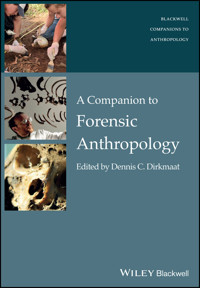
A Companion to Forensic Anthropology E-Book
39,99 €
Mehr erfahren.
- Herausgeber: John Wiley & Sons
- Kategorie: Geisteswissenschaft
- Serie: Blackwell Companions to Anthropology
- Sprache: Englisch
A Companion to Forensic Anthropology presents the most comprehensive assessment of the philosophy, goals, and practice of forensic anthropology currently available, with chapters by renowned international scholars and experts. * Highlights the latest advances in forensic anthropology research, as well as the most effective practices and techniques used by professional forensic anthropologists in the field * Illustrates the development of skeletal biological profiles and offers important new evidence on statistical validation of these analytical methods. * Evaluates the goals and methods of forensic archaeology, including the preservation of context at surface-scattered remains, buried bodies and fatal fire scenes, and recovery and identification issues related to large-scale mass disaster scenes and mass grave excavation.
Sie lesen das E-Book in den Legimi-Apps auf:
Seitenzahl: 1663
Veröffentlichungsjahr: 2012
Ähnliche




















Contents
List of Illustrations
List of Tables
Notes on Contributors
About This Book
FORENSIC ARCHAEOLOGY PLAYS A ROLE
FORENSIC TAPHONOMY ARRIVES
SHIFTING THE PARADIGM
PREVIEWING THE BOOK
Acknowledgments
PART I Introduction and Brief History of Forensic Anthropology
CHAPTER 1: Forensic Anthropology: Embracing the New Paradigm
INTRODUCTION: THE ENTITY
FIRST, A BIT OF HISTORY: THE EARLY YEARS
THE MORE RECENT YEARS
CHINKS IN THE ARMOR: CONSIDERING BEST PRACTICES
BETTER STATISTICS
FINALLY, ADDING FORENSIC ARCHAEOLOGY
PRIMARY BENEFITS OF FORENSIC ARCHAEOLOGY
OUTSIDE INFLUENCES
SUMMARY
PART II Recovery of Human Remains from Outdoor Contexts
Introduction to Part II
SEARCH EFFORTS
CHAPTER 2: Documenting Context at the Outdoor Crime Scene: Why Bother?
INTRODUCTION
THE FORENSIC DEATH INVESTIGATION
CRIMINAL INVESTIGATIONS AND PROCESSING OF THE INDOOR SCENE
LAW-ENFORCEMENT PERCEPTION OF THE OUTDOOR CRIME SCENE
CAN INDOOR RECOVERY METHODS APPLY TO OUTDOOR SCENES?
WHY NOT FORENSIC ARCHAEOLOGY?
CONTEMPORARY ARCHAEOLOGICAL PRINCIPLES
THE OUTDOOR FORENSIC SCENE
DEFINING CONTEXT AT THE OUTDOOR SCENE
FORENSIC ARCHAEOLOGY
A CASE EXAMPLE
DISCUSSION
CHAPTER 3: Determining the Forensic Significance of Skeletal Remains
INTRODUCTION
DISTINGUISHING BONE FROM NONBONE MATERIALS
DISTINGUISHING HUMAN BONES FROM NONHUMAN BONES
DETERMINING FORENSIC SIGNIFICANCE
CLASSIFICATION OF ARCHAEOLOGICAL MATERIAL
CLASSIFICATION OF WAR TROPHIES
CLASSIFICATION OF TEACHING MATERIAL
DATING OF SKELETAL REMAINS USING ARTIFICIAL RADIOCARBON
CONCLUSIONS
CHAPTER 4: The Application of Ground-Penetrating Radar for Forensic Grave Detection
INTRODUCTION
CONTROLLED RESEARCH
PLANNING THE SEARCH
INCORPORATING GPR INTO THE SEARCH PROTOCOL
GPR EQUIPMENT
THE GPR PROCESS AND RESULTING IMAGERY
ADVANTAGES AND LIMITATIONS OF USING GPR FOR FORENSIC CONTEXTS
HIRING A GEOPHYSICAL CONSULTANT
PERFORMING THE SEARCH
FUTURE CONSIDERATIONS
CHAPTER 5: Crime Scene Perspective: Collecting Evidence in the Context of the Criminal Incident
INTRODUCTION
CASE HISTORY
DEFINING THE CRIME SCENE
DOCUMENTING THE SCENE
RECOVERY
CONCLUSIONS
CHAPTER 6: The Role of Forensic Anthropology in the Recovery and Interpretation of the Fatal-Fire Victim
EFFECT OF FIRE ON THE SCENE AND VICTIM
BONE STRUCTURE AND COMPOSITION MODIFICATION
COMMON PRACTICES IN THE INVESTIGATION OF FIRES
COMMON FATAL-FIRE VICTIM RECOVERY PROTOCOLS EMPLOYED TODAY
PROBLEMS WITH THESE APPROACHES
FORENSIC ARCHAEOLOGY AT THE FIRE SCENE
BRIDGEVILLE FATAL-FIRE RECOVERY PROTOCOLS
AT THE POSTMORTEM EXAMINATION
LABORATORY ANALYSIS OF THE FATAL-FIRE VICTIM
PATTERNS OF THERMAL DAMAGE AND TRAUMA ANALYSIS
FORENSIC TAPHONOMIC ANALYSIS
DISCUSSION
CONCLUSIONS
CHAPTER 7: Forensic Anthropology at the Mass Fatality Incident (Commercial Airliner) Crash Scene
RESPONSIBILITY FOR THE INVESTIGATION
MFI MANAGEMENT RESPONSIBILITY 1: VICTIM IDENTIFICATION
BUT CHANGES ARE AFOOT…
MFI MANAGEMENT RESPONSIBILITY 2: VICTIM RECOVERY
CHANGES IN THE FIELD RECOVERY PHILOSOPHY
WELDON SPRING PROTOCOLS
THE CONTINENTAL (COLGAN AIR) FLIGHT 3407 CRASH SITE
CONCLUSIONS
CHAPTER 8: Mass Graves and Human Rights: Latest Developments, Methods, and Lessons Learned
ARCHAEOLOGY AND THE FORENSIC ANTHROPOLOGIST
LOCATING MASS GRAVES
EXCAVATION
EVIDENCE RECORDING
LINKING EVIDENCE
CONCLUDING REMARKS
CHAPTER 9: Archaeology, Mass Graves, and Resolving Commingling Issues through Spatial Analysis
INTRODUCTION
METHODS
RESULTS
DISCUSSION
PART III Developments in Forensic Osteology
Introduction to Part III
CHAPTER 10: Developments in Forensic Anthropology: Age-at-Death Estimation
ADULT SKELETAL AGE ESTIMATION
TRADITIONAL ADULT SKELETAL AGING METHODS
OTHER METHODS
THINGS TO CONSIDER WHEN AGING A SKELETON
FUTURE DIRECTIONS
CHAPTER 11: Skeletal Age Estimation: Where We Are and Where We Should Go
AGE INDICATORS
REFERENCE SAMPLES
ESTIMATION PROCEDURES
FUTURE DIRECTIONS
CHAPTER 12: Adult Sex Determination: Methods and Application
METRIC SEX DETERMINATION
NONMETRIC SEX DETERMINATION
CONCLUSION: WHAT TO USE?
CHAPTER 13: Sexual Dimorphism: Interpreting Sex Markers
INTRODUCTION: EASY SEX?
PROBLEMS AND QUESTIONS: NAUGHTY BITS AND NOISY SEX
MORE PROBLEMS: NO MEANS NO… BUT YOU HAVE TO EXPLAIN WHY
SEXUAL SIZE DIMORPHISM: SIZE DOES MATTER
I TELL YOU, IT’S A WHOLE DIFFERENT SEX!
TECHNIQUE IS (ALMOST) EVERYTHING
THERE IS MORE THAN ONE POSTURE
WRAPPING IT UP
DOING IT: SOME PRACTICAL ADVICE
WHAT’S NEXT?
RECOMMENDED READINGS
CHAPTER 14: Morphoscopic Traits and the Assessment of Ancestry
ANATOMY, SYSTEMATICS, AND THE SEARCH FOR ORDER
TYPOLOGY, POLYGENISM, AND THE AMERICAN SCHOOL
NONMETRIC VERSUS METRIC ANALYSIS OF HUMAN SKELETAL TRAITS
CONSIDERING NONMETRIC TRAITS
NONMETRIC TRAIT ANALYSIS IN FORENSIC ANTHROPOLOGY
MORPHOSCOPIC TRAITS AND ANCESTRY ASSESSMENT IN A STATISTICAL FRAMEWORK
ASSESSING ANCESTRY FROM AN UNKNOWN SKULL
CONCLUSIONS
CHAPTER 15: Fordisc 3 and Statistical Methods for Estimating Sex and Ancestry
INTRODUCTION
DISCRIMINANT FUNCTION ANALYSIS
EVALUATING DFA RESULTS FROM AN UNKNOWN INDIVIDUAL
FORDISC AND HUMAN VARIATION
ANALYZING ANCESTRY IN FORDISC 3
SUMMARY
CHAPTER 16: Estimating Stature
PART IV Developments in Human Skeletal Trauma Analysis
Introduction to Part IV
CHAPTER 17: Interpreting Traumatic Injury to Bone in Medicolegal Investigations
INTRODUCTION
SKELETAL BIOMECHANICS
IDENTIFICATION OF SKELETAL TRAUMA
BLUNT-FORCE TRAUMA
SPECIAL CLASS OF BFT: EVIDENCE FOR ABUSE/TORTURE
SHARP-FORCE TRAUMA
BALLISTIC TRAUMA
TRAUMA ANALYSIS OF FATAL-FIRE VICITIMS
DISCUSSION
The Biomechanics of Gunshot Trauma to Bone: Research Considerations within the Present Judicial Climate
INTRODUCTION
BASIC BONE BIOMECHANICS
GUNSHOT WOUND TRAUMA
CURRENT GUNSHOT RESEARCH AND FUTURE DIRECTIONS
CONCLUSIONS
CHAPTER 19: Developments in Skeletal Trauma: Blunt-Force Trauma
INTRODUCTION TO BLUNT-FORCE TRAUMA
HISTORICAL TRENDS IN TRAUMA ANALYSIS
RESEARCH IN BFT
BFT RESEARCH USING NONHUMAN ANIMAL MODELS
LOOKING TO THE FUTURE
PART V Advances in Human Identifi cation
Introduction to Part V
CHAPTER 20: Advances in the Anthropological Analysis of Cremated Remains
INTRODUCTION
CREMATION PROCESS
CROSSING BETWEEN ARCHAEOLOGICAL AND MODERN CREMATION STUDIES
PERSISTENCE OF DIAGNOSTIC FRAGMENTS
ARTIFACTS IN CREMATION
ADVANCES IN THE STUDY OF CREMATION
CONCLUSIONS
CHAPTER 21: Human Identification Using Skull–Photo Superimposition and Forensic Image Comparison
INTRODUCTION
SKULL–PHOTO SUPERIMPOSITION
IMAGE COMPARISON
DISCUSSION
CONCLUSION
DNA Analysis and the Classic Goal of Forensic Anthropology
INTRODUCTION
REPLICATION
AMPLIFICATION
SEQUENCING
COMPARISON AND MATCHING
PRESORTING: MEET THE BAYONET
WHO IS AFRAID OF THE BIG, BAD WOLF?
AUTOMATING DNA PROCESSING
POWERING AND SIMPLIFYING PROFILE MATCHING
DISCUSSION: WHERE WE WERE AND WHERE WE ARE
ABANDON ALL HOPE?
CHAPTER 23: DNA Identification and Forensic Anthropology: Developments in DNA Collection, Analysis, and Technology
INTRODUCTION
DNA IN THE HUMAN SKELETON
DETERMINING APPROPRIATE DNA SAMPLES
BONE SAMPLE COLLECTION
SUITABLE DNA COMPARISON REFERENCES
DNA LABORATORY ANALYSIS
SUMMARY
PART VI Forensic Taphonomy
Introduction to Part VI
CHAPTER 24: Current Research in Forensic Taphonomy
INTRODUCTION
TAPHONOMIC PROCESSES IN CONTEXT
TAPHONOMIC APPLICATIONS TO FORENSIC PROBLEMS
CONCLUSIONS
CHAPTER 25: The Use of Taphonomy in Forensic Anthropology: Past Trends and Future Prospects
INTRODUCTION
HISTORY OF TAPHONOMY RESEARCH
DIFFERENCES BETWEEN PALEOZOOLOGICAL TAPHONOMY AND FORENSIC TAPHONOMY
TAPHONOMY IN FORENSICS
GENERAL PRINCIPLES AND TRENDS IN FORENSIC TAPHONOMY
THE FUTURE OF FORENSIC TAPHONOMY
CONCLUSION
PART VII Forensic Anthropology Beyond Academia
Introduction to Part VII
CHAPTER 26: Forensic Anthropologists in Medical Examiner’s and Coroner’s Offices: A History
CHAPTER 27: Forensic Anthropology at the New York City Office of Chief Medical Examiner
INTRODUCTION
HISTORY OF FORENSIC ANTHROPOLOGY AT THE NYC-OCME
ROLES OF THE FAU IN NEW YORK CITY
SCENE RESPONSE
THE FORENSIC ANTHROPOLOGY REPORT
EXPERT TESTIMONY
DISASTER PREPAREDNESS AND SPECIAL OPERATIONS
WTC OPERATIONS
TRAINING AND PROFESSIONAL DEVELOPMENT
RESEARCH IN FORENSIC ANTHROPOLOGY
CONCLUSION
CHAPTER 28: The Many Hats of a Recovery Leader: Perspectives on Planning and Executing Worldwide Forensic Investigations and Recoveries at the JPAC Central Identification Laboratory
INTRODUCTION
OVERVIEW OF JPAC-CIL AND FORENSIC ANTHROPOLOGY
A SHORT HISTORY OF THE CIL
FIELD RECOVERIES CONDUCTED BY CIL
OVERVIEW OF RECOVERY OPERATIONS
ORGANIZING THE FIELD RECOVERY
DISCUSSION
CONCLUDING REMARKS
PART VIII Forensic Anthropology Outside North America
Introduction to Part VIII
CHAPTER 29: European Perspectives and the Role of the Forensic Archaeologist in the UK
INTRODUCTION
FORENSIC ARCHAEOLOGY IN EUROPE
THE ROLE OF THE FORENSIC ARCHAEOLOGIST IN THE UK
THE ROLE OF THE FORENSIC ARCHAEOLOGIST
WHY AN ARCHAEOLOGIST?
CONCLUSION
CHAPTER 30: The Establishment and Advancement of Forensic Anthropology in South Africa
INTRODUCTION
THE NEED FOR FORENSIC ANTHROPOLOGY IN SOUTH AFRICA
PAST RESEARCH
CURRENT RESEARCH
MODERN SKELETAL COLLECTIONS
CONCLUSION
CHAPTER 31: The Application of Forensic Anthropology to the Investigation of Cases of Political Violence
INTRODUCTION
THE POLITICAL AND LEGAL FRAMEWORK FOR INVESTIGATIONS INTO POLITICAL VIOLENCE
ARGENTINA AND ITS POLITICAL CONTEXT IN 1984
WHERE ARE THE DISAPPEARED?
1983/1984, FIRST EXHUMATIONS: DR CLYDE SNOW ARRIVES IN ARGENTINA
THE CREATION OF EAAF
HOW TO INVESTIGATE CASES OF DISAPPEARED PEOPLE
FORENSIC ANTHROPOLOGY AND INVESTIGATIONS INTO HUMAN-RIGHTS VIOLATIONS
CREATION OF THE LATIN AMERICAN ASSOCIATION OF FORENSIC ANTHROPOLOGY
THE INTERNATIONAL EVOLUTION OF THE EAAF
PART IX Ethics, Overview, and the Future of Forensic Anthropology
Introduction to Part IX
CHAPTER 32: The Pervasiveness of Daubert
INTRODUCTION
ERROR
RELIABILITY
VALIDITY
STUPIDITY
TWO CAUTIONARY TALES
CONCLUSIONS
CHAPTER 33: Ethics in Forensic Anthropology
INTRODUCTION
CODES OF ETHICS AND CONDUCT IN THE PRACTICE OF FORENSIC ANTHROPOLOGY
CODES OF ETHICS AND CONDUCT IN RESEARCH
DISCIPLINARY ACTIONS
FINAL CONSIDERATIONS
CHAPTER 34: An “Outsider” Look at Forensic Anthropology
INTRODUCTION
FORENSIC ANTHROPOLOGY AS A DISCIPLINE
FORENSIC ANTHROPOLOGY AS A SCIENCE
SCIENCE IN FORENSIC ANTHROPOLOGY
FORENSIC ANTHROPOLOGY: QUO VADIS?
Index
The Blackwell Companions to Anthropology offers a series of comprehensive syntheses of the traditional subdisciplines, primary subjects, and geographic areas of inquiry for the field. Taken together, the series represents both a contemporary survey of anthropology and a cutting-edge guide to the emerging research and intellectual trends in the field as a whole.
Forthcoming
A Companion to Paleoanthropology edited by David Begun
A Companion to Chinese Archaeology edited by Anne Underhill
This edition first published 2012© 2012 Blackwell Publishing Ltd
Blackwell Publishing was acquired by John Wiley & Sons in February 2007. Blackwell’s publishing program has been merged with Wiley’s global Scientific, Technical, and Medical business to form Wiley-Blackwell.
Registered OfficeJohn Wiley & Sons Ltd, The Atrium, Southern Gate, Chichester, West Sussex, PO19 8SQ, UK
Editorial Offices350 Main Street, Malden, MA 02148-5020, USA9600 Garsington Road, Oxford, OX4 2DQ, UKThe Atrium, Southern Gate, Chichester, West Sussex, PO19 8SQ, UK
For details of our global editorial offices, for customer services, and for information about how to apply for permission to reuse the copyright material in this book please see our website at www.wiley.com/wiley-blackwell.
The right of Dennis C. Dirkmaat to be identified as the author of the editorial material in this work has been asserted in accordance with the UK Copyright, Designs and Patents Act 1988.
All rights reserved. No part of this publication may be reproduced, stored in a retrieval system, or transmitted, in any form or by any means, electronic, mechanical, photocopying, recording or otherwise, except as permitted by the UK Copyright, Designs and Patents Act 1988, without the prior permission of the publisher.
Wiley also publishes its books in a variety of electronic formats. Some content that appears in print may not be available in electronic books.
Designations used by companies to distinguish their products are often claimed as trademarks. All brand names and product names used in this book are trade names, service marks, trademarks or registered trademarks of their respective owners. The publisher is not associated with any product or vendor mentioned in this book. This publication is designed to provide accurate and authoritative information in regard to the subject matter covered. It is sold on the understanding that the publisher is not engaged in rendering professional services. If professional advice or other expert assistance is required, the services of a competent professional should be sought.
Library of Congress Cataloging-in-Publication Data
A companion to forensic anthropology/edited by Dennis Dirkmaat.p. cm. – (Blackwell companions to anthropology)Includes bibliographical references and index.
ISBN 978-1-4051-9123-4 (hardback)1. Forensic anthropology. I. Dirkmaat, Dennis.GN69.8.C659 2012599.9–dc23
2011044947
A catalogue record for this book is available from the British Library.
List of Illustrations
List of Tables
Table 4.1
Advantages and limitations of using GPR for grave detection.
Table 13.1
Pearson correlations between different body dimensions, bone measurements, and the discriminant scores obtained from the latter for sex classification.
Table 13.2
Percentages of correct classification for the discriminant function using two humeral and two femoral variables.
Table 13.3
Pearson correlations between the variables in
Table 13.1
, now calculated separately for each sex group.
Table 14.1
Traditional morphoscopic traits used to assess ancestry.
Table 14.2
Demographic composition of Hefner’s (2003, 2007, 2009) skeletal populations.
Table 14.3
Frequency distribution of inferior nasal aperture (INA) morphology.
Table 14.4
Classification matrix from a two-group
k
-nearest neighbor analysis.
Table 14.5
Classification rates (cross-validated) for the two-group CAP analysis for eight distance measures.
Table 14.6
Classification rates (cross-validated) of a three-way CAP analysis.
Table 17.1
Summary of tension, compression, and shear forces on bone. Note the capability of bone to withstand the three types of external loading.
Table 17.2
Description of different types of bone fracture.
Table 17.3
Three major classes of skeletal trauma with descriptions of the types of force involved as well as morphological manifestations.
Table 20.1
Break down of particulate size as an average percentage of the total human cremated remains with a processing time of either 30 or 60 s.
Table 24.1
Problem-focused areas of forensic taphonomy research.
Table VII.1
Current skill sets of forensic anthropologists.
Table 28.1
Organization of JPAC and key functions.
Notes on Contributors
Bradley J. Adams, PhD, D-ABFA (University of Tennessee), is Director of the Forensic Anthropology Unit for the Office of Chief Medical Examiner in New York City. Dr Adams and his team are responsible for all forensic anthropology casework in New York City, including the ongoing recovery and identification efforts of victims of the World Trade Center attacks. Prior to accepting this position, Dr Adams worked at the Joint Prisoners of War, Missing in Action Accounting Command Central Identification Laboratory (JPAC-CIL) in Hawaii from 1997 to 2004. Dr Adams is a Diplomate of the American Board of Forensic Anthropology, a Fellow with the American Academy of Forensic Sciences, and a member of the Editorial Board of the Journal of Forensic Sciences.
James M. Adovasio, PhD (University of Utah), is Director of the Mercyhurst Archaeological Institute, and Provost, at Mercyhurst College, Erie, PA. He achieved world acclaim in the 1970s with his excavation of Meadowcroft Rockshelter, southwest PA, widely recognized as the earliest well-dated (c. 16 000 years ago) archaeological site in North America. He has also conducted multidisciplinary investigations at Mezhirich, Ukraine; Dolni Vestonice/Pavlov, Czech Republic; and Gault, TX. One of the world’s foremost experts in perishable material culture (basketry, textiles, cordage) he has published more than 400 books, monographs, articles, and technical papers.
Lesen Sie weiter in der vollständigen Ausgabe!
Lesen Sie weiter in der vollständigen Ausgabe!
Lesen Sie weiter in der vollständigen Ausgabe!
Lesen Sie weiter in der vollständigen Ausgabe!
Lesen Sie weiter in der vollständigen Ausgabe!
Lesen Sie weiter in der vollständigen Ausgabe!
Lesen Sie weiter in der vollständigen Ausgabe!
Lesen Sie weiter in der vollständigen Ausgabe!
Lesen Sie weiter in der vollständigen Ausgabe!
Lesen Sie weiter in der vollständigen Ausgabe!
Lesen Sie weiter in der vollständigen Ausgabe!
Lesen Sie weiter in der vollständigen Ausgabe!
Lesen Sie weiter in der vollständigen Ausgabe!
Lesen Sie weiter in der vollständigen Ausgabe!
Lesen Sie weiter in der vollständigen Ausgabe!
Lesen Sie weiter in der vollständigen Ausgabe!
Lesen Sie weiter in der vollständigen Ausgabe!
Lesen Sie weiter in der vollständigen Ausgabe!
Lesen Sie weiter in der vollständigen Ausgabe!
Lesen Sie weiter in der vollständigen Ausgabe!
Lesen Sie weiter in der vollständigen Ausgabe!
Lesen Sie weiter in der vollständigen Ausgabe!
Lesen Sie weiter in der vollständigen Ausgabe!
Lesen Sie weiter in der vollständigen Ausgabe!
Lesen Sie weiter in der vollständigen Ausgabe!
Lesen Sie weiter in der vollständigen Ausgabe!
Lesen Sie weiter in der vollständigen Ausgabe!
Lesen Sie weiter in der vollständigen Ausgabe!
Lesen Sie weiter in der vollständigen Ausgabe!
Lesen Sie weiter in der vollständigen Ausgabe!
Lesen Sie weiter in der vollständigen Ausgabe!
Lesen Sie weiter in der vollständigen Ausgabe!
Lesen Sie weiter in der vollständigen Ausgabe!
Lesen Sie weiter in der vollständigen Ausgabe!
Lesen Sie weiter in der vollständigen Ausgabe!
Lesen Sie weiter in der vollständigen Ausgabe!
Lesen Sie weiter in der vollständigen Ausgabe!
Lesen Sie weiter in der vollständigen Ausgabe!
Lesen Sie weiter in der vollständigen Ausgabe!
Lesen Sie weiter in der vollständigen Ausgabe!
Lesen Sie weiter in der vollständigen Ausgabe!
Lesen Sie weiter in der vollständigen Ausgabe!
Lesen Sie weiter in der vollständigen Ausgabe!
Lesen Sie weiter in der vollständigen Ausgabe!
Lesen Sie weiter in der vollständigen Ausgabe!
Lesen Sie weiter in der vollständigen Ausgabe!
Lesen Sie weiter in der vollständigen Ausgabe!
Lesen Sie weiter in der vollständigen Ausgabe!
Lesen Sie weiter in der vollständigen Ausgabe!
Lesen Sie weiter in der vollständigen Ausgabe!
Lesen Sie weiter in der vollständigen Ausgabe!
Lesen Sie weiter in der vollständigen Ausgabe!
Lesen Sie weiter in der vollständigen Ausgabe!
Lesen Sie weiter in der vollständigen Ausgabe!




