


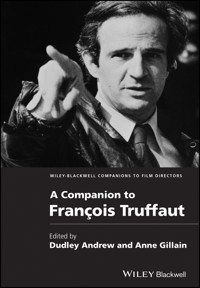
A Companion to François Truffaut E-Book
155,99 €
Mehr erfahren.
- Herausgeber: John Wiley & Sons
- Kategorie: Geisteswissenschaft
- Serie: WBCF - Wiley-Blackwell Companions to Film Directors
- Sprache: Englisch
A Companion to François Truffaut
“An unprecedented critical tribute to the director who, in France, wound up becoming the most controversial figure of the New Wave he helped found.”
Raymond Bellour, Centre National de la Recherche Scientifique
“This exciting collection breaks through the widely held critical view that Truffaut abandoned the iconoclasm of his early work for an academicism he had consistently railed against in his own film criticism. Indeed, if ‘fever’ and ‘fire’ were Truffaut’s most consistent motifs, the essays in this collection live up to his lifelong, burning passion for the cinema. Written by world-famous scholars, the essays exhaustively explore the themes and styles of the films, as well as Truffaut’s relationships to André Bazin, Alfred Hitchcock, and the directors of the New Wave, his ground-breaking and controversial film criticism, and his position in the complex politics of French cultural life from the Popular Front to 1968 and after.”
Angelo Restivo, Georgia State University
Although the New Wave, one of the most influential aesthetic revolutions in the history of cinema, might not have existed without him, François Truffaut has largely been ignored by film scholars since his death almost thirty years ago. As an innovative theoretician, an influential critic, and a celebrated filmmaker, Truffaut formulated, disseminated, and illustrated the ideals of the New Wave with exceptional energy and distinction. Yet no book in recent years has focused on Truffaut’s value, and his overall contribution to cinema deserves to be redefined not only to reinstate him in his proper place but to let us rethink how cinema developed during his lifetime.
In this new Companion, thirty-four original essays by leading film scholars offer new readings of individual films and original perspectives on the filmmaker’s background, influences, and consequence. Hugely influential around the globe, Truffaut is assessed by international contributors who delve into the unique quality of his narratives and establish the depth of his distinctively styled work.
An extended interview with French filmmaker Arnaud Desplechin tracks Truffaut’s controversial stature within French cinema and vividly identifies how he thinks and works as a director, adding an irreplaceable perspective to this essential volume.
Sie lesen das E-Book in den Legimi-Apps auf:
Seitenzahl: 1576
Veröffentlichungsjahr: 2013
Ähnliche




















Contents
Acknowledgments
Notes on Contributors
Preface
Filmography
Part I La Planète Truffaut
1 Interview with Arnaud Desplechin, Part I
Paris, June 18, 2010
2 Truffaut and His “Doubles”
Reflecting on Reflections of Truffaut in His Films
Photographs from a Family Album
Picasso, Masked in the Filigree of Jules et Jim
On Details
Motifs Repeated and Inflected
Other Kinds of Mirrors
3 Aesthetic Affinities
Imagination: “La Reine des Facultés”
Emotion and Hypnosis
David Stern’s Infant and the Spectator
Tirez sur le pianiste: The Metaphoric Network
Patrick Modiano: Literature and Amodal Perception
La Femme d’à côté: Stylization and Repetitions
Douglas Sirk: Deciphering Style
Fiction and the Intersubjective Matrix
Conclusion: The Obscure Side of the Moon
4 Interview with Arnaud Desplechin, Part II
Paris, June 19, 2010
Part II Style and Sensibility
5 Flashes of Happiness
Communities, Good and Bad
When the Stalling Stops
Love is Not Cheerful
Touching the Ground
Untimely Joys
6 Truffaut and the Photographic
Cinema
Fetishism
Death
7 The Impasse of Intimacy
Triangulating Truffaut
Reverse Triangles: Jules et Jim and Les Deux Anglaises et le continent
Shadows of Absence: La Sirène du Mississippi and L’Histoire d’Adèle H.
Personal Catastrophes: La Peau douce and La Femme d’à côté
Conclusion: Truffaut and the Modernist Psychodrama
8 A Fine Madness
Prowling Madness
Intoxications
Traps, Ramparts
Perversions?
Collapse and Dissolution
The Madness of the Real
9 The Ecstatic Pan
The Case of the Missing Camera (Movement)
Methodological Issues
Stairs: “Women’s Legs Are Compasses”
The Work of Art: “I Have the Religion of Love”
Ecstasy: “Films Are More Harmonious Than Life”
The Agony and the Ecstasy
Conclusion
Acknowledgment
10 The Untimely Moment and the Correct Distance
The Untimely Director
A Logical Game
Secret Shocks
Linkage and Balance, Repertoire and Score
Birth of the Lyric
The Essential Part of the Superfluous
Brutality and Nuance
“A Riddle in the Book of Love, Obscure and Obsolete”30
Part III The Making of a Filmmaker
11 Every Teacher Needs a Truant
From Year Zero to Maturity
Bazin
Deligny
Itard
12 Certain Tendencies of Truffaut’s Film Criticism
A Critic Before a Filmmaker
Truffaut’s Critical Strategies
Provocation on the Front Lines of Criticism
Toward “Tomorrow’s Cinema” and a New Wave
Conclusions
13 Truffaut–Hitchcock
The Hitchcock Correspondence
Pneu-ma-tique!
The “Hitchbook”
The Man We Loved to Be Hated By
What Truffaut Knew
Acknowledgment
14 The Paradox of “Familiarity”
Renoir at the Heart of the Politique des Auteurs
Renoir’s System of “Checks and Balances”
Conclusion
15 Cain and Abel
Decade by Decade
The End of a Friendship
Mutual Fascination, Mutual Support
Reflections: Film to Film
“François Is Perhaps Dead. I Am Perhaps Alive.”
16 Friction, Failure, and Fire
The Failure to Adapt: Antoine Doinel and Honoré de Balzac
Reenacting Authors and Books
A Lover of Books, Lost in the Flames of Films
The Flame of the Candle
Part IV Truffaut and His Time
17 Growing Up with the French New Wave
The Young Critic and the New France
A Young Director and a Young Cinema
Belated Modernism
18 Bad Objects
La Grande Illusion
The Reluctant Schoolmaster
A Patricide
Acknowledgment
19 Between Renoir and Hitchcock
Autobiography and New Wave Cinephilia
Jeanne Moreau: The Femme Fatale of the New Wave
Catherine Deneuve: The Blonde Mermaid of the Post-1968 Years
Bernadette Lafont: Truffaut’s Carnivalesque Woman
20 Truffaut in the Mirror of Japan
A Vulnerable Director
An Exemplary Friendship
A New Generation
Part V Films
21 Directing Children
Children on the Screen
Children in De Sica’s Shoeshine
Les 400 Coups
Humans and Insects
The Search for the Absolute
22 Jules et Jim … et Walter Benjamin
Benjamin’s Ambivalence at the Cinema
The Virulent Modesty of the New Wave
The Art of Life and the Life of Art
Adapting Life to Literature and Literature to Film
Adoration, Translation
23 Digging Up the Past
The Frozen Image
The Whirlwind of Life
Newsreels: Fiction Meets History
Acknowledgments
24 The Elevator and the Telephone
25 La Peau douce
Cinephilia, 1960
A New Geography
The Gas Station
A Montage of Affect
Appendix
26 La Peau douce
Revising the Romantic Melodrama
A Critique of Middle-class Domesticity
Cinema: A Passionate Object
27 An Unsettling Passage
Truffaut’s Proustian Obsessions
Not Alone but with a Ghost …
Blanchot and Truffaut
Spelling the Death of Present Desire
Quivering Tributes to Stillness
28 The Structural Role of Intervals in L’Argent de Poche
The Social and Political Dimension of a Children’s Film
A Film Built on The Interval
The Game of the Reel
Child-adults and the Reversal of Roles
A Double Exclusion
Desire and Chance
The Game with The String
On the Interval as a Recurring Figure
29 To Die or to Love
Beginnings
Erotic Drive, a Mythical Being?
Bertrand’s Mille e Tre
Paulo’s Mille e Tre
Endings
30 Film as Literature
The Self-Questioning Signature
The Death of the Author
Malaise and the Phallic Women
Autofiction and the Emancipated Spectator
Acknowledgments
31 The Elegist
“The Cult of the Dead”
Life Stilled
There Is No “Holiday from History”
32 La Chambre verte and the Beating Heart of Truffaut’s Oeuvre
“A Handwritten Letter”
A Magic Lantern for a Dark Film
An Aesthetic Autobiography
33 Le Dernier Métro
The Sweet Smell of Success, and the Weird Distortion of Historical Backgrounds
Holes and Dark Sides
An Apparently Simple Film Freighted with Heavy Questions
Marguerite Duras and the Jewish Question
The Story of Jean and François
Renoir’s Moral Position in a Post-Holocaust World
34 Disillusionment and Magic in La Nuit américaine and Le Dernier Métro
A Few Differences
A Fragmented Film
Two Intriguing Scenes
A Few Similarities
Magic and Communion
Index
Wiley-Blackwell Companions to Film Directors
The Wiley-Blackwell Companions to Film Directors survey key directors whose work together constitutes what we refer to as the Hollywood and world cinema canons. Whether on Haneke or Hitchcock, Bigelow or Bergman, Capra or the Coen brothers, each volume comprises 25 or more newly commissioned essays written by leading experts, explores a canonical, contemporary, and/or controversial auteur in a sophisticated, authoritative, and multidimensional capacity. Individual volumes interrogate any number of subjects – the director’s oeuvre; dominant themes, well-known, worthy, and underrated films; stars, collaborators, and key influences; reception, reputation, and above all, the director’s intellectual currency in the scholarly world.
Published
A Companion to Michael Haneke, edited by Roy Grundmann
A Companion to Alfred Hitchcock, edited by Thomas Leitch and Leland Poague
A Companion to Rainer Werner Fassbinder, edited by Brigitte Peucker
A Companion to Werner Herzog, edited by Brad Prager
A Companion to Pedro Almodóvar, edited by Marvin D’Lugo and Kathleen Vernon
A Companion to Woody Allen, edited by Peter J. Bailey and Sam B. Girgus
A Companion to Jean Renoir, edited by Alastair Phillips and Ginette Vincendeau
A Companion to François Truffaut, edited by Dudley Andrew and Anne Gillain
A Companion to Luis Buñuel, edited by Robert Stone and Julian Daniel Gutierrez-Albilla
This edition first published 2013© 2013 Blackwell Publishing Ltd
Blackwell Publishing was acquired by John Wiley & Sons in February 2007. Blackwell’s publishing program has been merged with Wiley’s global Scientific, Technical, and Medical business to form Wiley-Blackwell.
Registered OfficeJohn Wiley & Sons, Ltd, The Atrium, Southern Gate, Chichester, West Sussex, PO19 8SQ, UK
Editorial Offices350 Main Street, Malden, MA 02148-5020, USA9600 Garsington Road, Oxford, OX4 2DQ, UKThe Atrium, Southern Gate, Chichester, West Sussex, PO19 8SQ, UK
For details of our global editorial offices, for customer services, and for information about how to apply for permission to reuse the copyright material in this book please see our website at www.wiley.com/wiley-blackwell.
The right of Dudley Andrew and Anne Gillain to be identified as the authors of the editorial material in this work has been asserted in accordance with the UK Copyright, Designs and Patents Act 1988.
All rights reserved. No part of this publication may be reproduced, stored in a retrieval system, or transmitted, in any form or by any means, electronic, mechanical, photocopying, recording or otherwise, except as permitted by the UK Copyright, Designs and Patents Act 1988, without the prior permission of the ublisher.
Wiley also publishes its books in a variety of electronic formats. Some content that appears in print may not be available in electronic books.
Designations used by companies to distinguish their products are often claimed as trademarks. All brand names and product names used in this book are trade names, service marks, trademarks or registered trademarks of their respective owners. The publisher is not associated with any product or vendor mentioned in this book. This publication is designed to provide accurate and authoritative information in regard to the subject matter covered. It is sold on the understanding that the publisher is not engaged in rendering professional services. If professional advice or other expert assistance is required, the services of a competent professional should be sought.
Library of Congress Cataloging-in-Publication Data
A companion to Francois Truffaut / edited by Dudley Andrew and Anne Gillain.pages cm.Includes bibliographical references and index.Includes filmography.
ISBN 978-1-4051-9847-9 (hardback : alk. paper)1. Truffaut, Francois–Criticism and interpretation. I. Andrew, Dudley, 1945– editor of compilation. II. Gillain, Anne, editor of compilation.PN1998.3.T78C75 2013791.4302′33092–dc23
2012042143
A catalogue record for this book is available from the British Library.
Cover image: Photo of Francois Truffaut © Eva Sereny / Camera Press, LondonCover design by Nicki Averill Design and Illustration
Acknowledgments
The editors are grateful to Wellesley College for a grant awarded to Anne Gillain to help cover the translation costs for this volume. At a time of fiscal vigilance, Wellesley College displayed once more its commitment to faculty research and publication. Our sincere appreciation goes to Madeleine Morgenstern who expressed active interest in our work and warmly welcomed us into her home to discuss it. Her support has been a great encouragement. We must single out Arnaud Desplechin for graciously spending two afternoons of his busy professional life to share with us his insights on François Truffaut. It was a privilege to watch segments of the films with him and to be there to catch the fervor as well as the intuitive aptness of his spontaneous reactions. His dedication not just to Truffaut but to a serious, yet never ponderous, idea of cinema ought to inspire young filmmakers and scholars the way it has us. Thanks go to Liam Andrew and especially to Madeline Whittle for assisting with the countless details and versions of so many chapters that have been in production for so many months. Madeline’s care and her quickness of both intelligence and execution kept this multilingual, two-year enterprise on track. In the home stretch we were ably assisted by Jeremi Szaniawski, Michael Cramer, Stephanie Andrew, and especially Dana Benelli. We salute Jayne Fargnoli, cheerful optimist, and our forgiving editor, who has shown herself ready to bend protocol for the health of this particular volume. We hope we to have been worthy of her trust.
Notes on Contributors
Dudley Andrew is Professor of Film and Comparative Literature at Yale. He began his career with three books commenting on film theory, including the biography of André Bazin, whose thought he explored in the recent What Cinema Is! and the edited volume Opening Bazin. His interest in aesthetics and hermeneutics led to Film in the Aura of Art (1984), and his fascination with French film and culture resulted in Mists of Regret (1995) and the coauthored Popular Front Paris (2005). He is currently completing Encountering World Cinema.Alain Bergala, former editor in chief of Cahiers du cinéma, has written articles and books on filmmakers such as Godard, Rossellini, Kiarostami, and Buñuel. Having taught at Université Sorbonne Nouvelle (Paris III), he served as cinema advisor to the French Ministry of Education from 2000 to 2002. Currently he teaches cinema at La Femis. He has directed numerous films for cinema and television. He has also curated two important expositions: “Correspondances: Kiarostami-Erice” (CCCB de Barcelone 2006; Beaubourg 2007) and “Brune Blonde” (Cinémathèque française 2011).Michel Chion is a composer of concrete music, a writer, a researcher, and a director of short films and videos. Currently a senior fellow at the IKKM at the University of Bauhaus, he has published some 30 books, several of which have been translated into English: Audio-Vision (1994), Voice in Cinema (1999), Film: a Sound Art (2011), David Lynch, The Films of Jacques Tati, and, for the BFI “modern classic” series, The Thin Red Line.Tom Conley, Professor of French and of Film at Harvard University, has translated Michel de Certeau, Gilles Deleuze, and Marc Augé among other French authors. In addition to several works on Renaissance literature and culture, he has written Cartographic Cinema and Film Hieroglyphs: Ruptures in Classical Cinema.Timothy Corrigan is Professor of Cinema Studies, English, and History of Art at the University of Pennsylvania. His principal books include New German Film: The Displaced Image; The Films of Werner Herzog: Between Mirage and History; A Cinema without Walls: Movies and Culture after Vietnam; and The Essay Film: from Montaigne, after Marker. He has also written several widely used textbooks and serves as a founding editor of the journal Adaptation.Ludovic Cortade, an associate professor in NYU’s Department of French, is the author of Antonin Artaud: La Virtualité Incarnée (2000) and Le Cinéma de l’immobilité: style, politique, réception (2008). His research centers on French film theory and its rapport with literature and the human sciences. Among his essays are contributions to English language anthologies on André Bazin and on Jean Epstein.Angela Dalle Vacche is a professor of Film Studies at the Georgia Institute of Technology. She is the author of The Body in the Mirror: Shapes of History in Italian Cinema (Princeton Univeristy Press, 1992); Cinema and Painting: How Art is Used in Film (University of Texas Press, 1996); Diva: Defiance and Passion in Early Italian Cinema (University of Texas Press, 2008). She has edited Film, Art, New Media: Museum Without Walls? (Palgrave Macmillan, 2012); The Visual Turn: Classical Film Theory and Art History (Rutgers University Press, 2003); and coedited Color: The Film Reader (Routledge, 2006). Her current project deals with André Bazin’s rapport with art, film, and science.Arnaud Desplechin graduated from IDHEC in 1984. He won the Jean-Vigo Prize in 1991 and gained prominence at Cannes in 1994 with Comment je me suis disputé… In 2000, Esther Kahn, filmed in English, was saluted as a homage to Truffaut. Rois et Reine and Un Conte de Noël, with Catherine Deneuve, have been internationally acclaimed. Desplechin speaks publicly about the history and aesthetics of film. He acknowledges the influence on his work of Serge Daney and especially Stanley Cavell.Sam Di Iorio is an associate professor of French at Hunter College. He studies connections between film, literature, philosophy, and politics in twentieth-century France and has published articles on figures such as Jean Rouch, Chris Marker, and Jacques Rivette. His current research explores the political implications of postwar debates about formalism.Elizabeth Ezra is Professor of Cinema and Culture at the University of Stirling in Scotland. She is the author of The Colonial Unconscious (Cornell University Press, 2000), Georges Méliès (Manchester University Press, 2000), and Jean-Pierre Jeunet (University of Illinois Press, 2008). She has edited European Cinema for Oxford University Press (2004) and coedited Transnational Cinema: The Film Reader for Routledge (2006) and France in Focus (Berg, 2000). She is currently coauthoring a book on biology, consumption, and waste in global cinema.Jean-Michel Frodon served as film critic at Le Monde (1990–2003) before becoming Editorial Director of Cahiers du Cinéma (2003–2009). Currently, he teaches cinema at Sciences Po and is Professorial Fellow in Film Studies and Creative Industries at the University of St Andrews, Scotland. His major book, Le Cinéma français, de la Nouvelle Vague à nos jours has recently been updated; he has also authored La Projection nationale and Horizon cinéma and put together volumes on Edward Yang, Hou Hsiao-hsien, Woody Allen, Robert Bresson, Amos Gitai, and Chinese cinema. He edited Gilles Deleuze et les images and Cinema and the Shoah (SUNY Press, 2010).Anne Gillain is professor emerita at Wellesley College, known principally for her work on French Cinema, particularly the films of François Truffaut, in books that include Le Cinéma selon François Truffaut (1988), Les 400 Coups (1991), and her major work, François Truffaut: The Lost Secret (Indiana, 2013), the French version of which came out in 1991.Jonathan Everett Haynes is a PhD candidate in Film & Media Studies at the University of California, Berkeley. His dissertation, “A History of Water: Cinema in the Mid-Atlantic,” focusses on the transferential relationships between French and American artists and critics during the New Wave period.Junji Hori is associate professor of Film and Media Studies at Kansai University. He is the author of “Godard’s Two Historiographies” (in For Ever Godard, 2004) and coeditor of a collection of essays on Histoire(s) du cinéma entitled Godard, Image, History (2001). He has translated several books into Japanese, including Colin MacCabe’s Godard: A Portrait of the Artist at Seventy and Jacques Rancière’s Le Destin des images.Luiza Jatobá is a practicing psychoanalyst active in São Paulo, Brazil. She received her doctorate in Esthetics and Psychoanalysis at the University of São Paulo and has taught art history at Unisantos, the Catholic University of Santos, in São Paulo.Martin Lefebvre is University Research Chair in Film Studies at Concordia University in Montreal. He is the editor of Recherches sémiotiques/Semiotic Inquiry and has published on film theory and semiotics in CiNéMAS, Iconics, Semiotica, The Canadian Journal of Film Studies, New Literary History, Screen, Protée, and Theory, Culture and Society. His books include Psycho: de la figure au musée imaginaire (L’Harmattan, 1997) and Landscape and Film (Routledge, 2006).Carlos Losilla is a professor of Audiovisual Communication at Pompeu Fabra University (Barcelona). He is on the board of the film quarterly Caimán as well as the multilingual web-journal La Furia Umana. His books include studies of Austrian film and of Hollywood as well as the recent La invención de la modernidad. He has contributed to Joe McElhaney’s Vincente Minnelli: The Art of Entertainment (2009), and has edited En tránsito: Berlín-París-Hollywood (2009) and François Truffaut: el deseo del cine (2010).Michel Marie is a professor emeritus at Université Sorbonne Nouvelle (Paris III). Since 1988 he has overseen the “Cinéma et arts visuels” collection for Armand Colin, which recently brought out his Les Films maudits. He is best known in English for French New Wave, an Artistic School, and as coauthor of Aesthetics of Film. He also coauthored L’Analyse des films (1988) and the Dictionnaire critique et théorique du cinéma (2001). He has written monographs on A bout de souffle and Le Mépris and, in Portuguese, A Nouvelle Vague e Godard. Cofounder of l’AFECCAV, the French equivalent of SCMS, he has been President of la Cinémathèque universitaire (2001–2004).Adrian Martin is an associate professor in Film and Television Studies at Monash University (Melbourne). A film critic since 1979, he is the author six books (Phantasms, Once Upon a Time in America, Raúl Ruiz: sublimes obsesiones, The Mad Max Movies, Qué es el cine moderno? and Last Day Every Day). He is coeditor of Movie Mutations: The Changing Face of World Cinephilia and of the online film journal LOLA.Lúcia Nagib is Centenary Professor of World Cinemas at the University of Leeds. She has authored in English World Cinema and the Ethics of Realism (2011) and Brazil on Screen: Cinema Novo, New Cinema, Utopia (2007), and in Portuguese, The Brazilian Film Revival: Interviews with 90 Filmmakers of the 90s (2002), Born of the Ashes: The Auteur and the Individual in Oshima’s Films (1995), Around the Japanese Nouvelle Vague (1993), and Werner Herzog: Film as Reality (1991). She has edited or coedited three anthologies in English: The New Brazilian Cinema (2003), Theorizing World Cinema (2011), and Realism and the Audiovisual Media (2009).Richard Neupert is the Charles H. Wheatley Professor of the Arts and a Josiah Meigs Distinguished Teaching Professor in Film Studies at the University of Georgia. His books include French Animation History, A History of the French New Wave Cinema, and The End: Narration and Closure in the Cinema, as well translations from French of Aesthetics of Film and The French New Wave: An Artistic School.Kan Nozaki, Professor of French Literature at the University of Tokyo, has published books on literature and on cinema in Japanese. His film books include Jean Renoir: A Cinema without Frontiers (2001) and Honk Kong, City of Cinema (2005). He is the translator of a forthcoming Japanese edition of Bazin’s Qu’est-ce que le cinéma?John Orr passed away shortly after submitting his chapter to this collection. He had been a professor emeritus at Edinburgh University where he spent his career. Trained at Birmingham in Philosophy and Sociology, he was an early proponent of Cultural Studies. The books he authored on theater and the novel preceded those on cinema in reconciling sociological and aesthetic approaches. In 1993 his Cinema and Modernity put him far in the lead of Anglophone critics dealing with film art. Contemporary Cinema (1998) only strengthened that position.Phil Powrie is Dean of the Faculty of Arts and Human Sciences and Professor of Cinema Studies at the University of Surrey. He has authored French Cinema in the 1980s: Nostalgia and the Crisis of Masculinity (1997), French Cinema: An Introduction (2002), Jean-Jacques Beineix (2001), Carmen on Film: A Cultural History (2007), and Pierre Batcheff and Stardom in 1920s French Cinema (2009). Among his many edited collections are Contemporary French Cinema: Continuity and Difference (1999), The Trouble with Men: Masculinities in European and Hollywood Cinema (2004), The Cinema of France (2006), and The Films of Luc Besson: Master of Spectacle (2006). He heads the Association for Studies in French Cinema and is the chief general editor of its journal, Studies in French Cinema.Hilary Radner is Professor of Film and Media Studies in the Department of History and Art History, University of Otago, New Zealand. Her recent publications include Neo-Feminist Cinema: Girly Films, Chick Flicks, and Consumer Culture (2011) as author and New Zealand Cinema: Interpreting the Past (2011) and Feminism at the Movies: Understanding Gender in Contemporary Cinema (2011) as coeditor. She is coediting ACompanion to French Film for Wiley-Blackwell.James Tweedie is an associate professor of Comparative Literature and Cinema Studies at the University of Washington. He is author of the forthcoming The Age of New Waves: Youth, Cities, and the Globalization of Art Cinema (Oxford University Press) and coedited Cinema at the City’s Edge: Film and Urban Networks in East Asia. His work on French and Chinese cinema can be found in Public Culture, Cinema Journal, Cultural Critique, Screen, and SubStance, as well as in many anthologies.Francis Vanoye is professor emeritus of cinema studies at the University of Nanterre (Paris X), where he directed the département des Arts du spectacle. Among his books are Récit écrit – Récit filmique, L’emprise du cinéma (2005) and L’Adaptation littéraire au Cinéma (2011). For Nathan’s “Synopsis” series, which he directs, he contributed Le Règle du jeu and The Passenger. He coordinated the major reference volume Dictionnaire de l’image reissued in 2008.Marc Vernet is Professor of Cinema at the University Denis Diderot (Paris VII) and has served as advisor for film heritage at the Institut National du Patrimoine. A founding editor of the journals Iris and Cinémathèque, he is the author of Figures de l’absence (1989) and coauthor of Film Aesthetics (Texas, 1992). He served as the founding director of the Bibliothèque du Film (BIFI), for which he acquired the archives, among many others, of François Truffaut.Ginette Vincendeau is Professor of Film Studies at King’s College, London, and a regular contributor to Sight and Sound. Focusing on popular French and European cinema, her 2000 book Stars and Stardom in French Cinema (Continuum) is now available in French. She has published Jean-Pierre Melville: An American in Paris, and studies of two films, Pépé le Moko and La Haine. She recently completed Brigitte Bardot, French Star, International Icon for BFI/Palgrave and coedited A Companion to Jean Renoir for Wiley-Blackwell.Philip Watts is a professor in the Department of French at Columbia University. He is the author of Allegories of the Purge (1999) and coeditor of the volume Jacques Rancière: History, Politics, Aesthetics (2009). He is currently finishing a book on Roland Barthes and cinema.Françoise Zamour teaches aesthetics and film theory at the Ecole Normale Supérieure, rue d’Ulm. Her principal publications concern the Nouvelle Vague (Truffaut in particular), classic Hollywood (King Vidor, John Ford), and Martin Scorsese. She also works on theater and cinema, including a study of Jean Genet, with ongoing research on melodrama in contemporary cinema.
Preface
To the two of us, this anthology is far more than an academic service, for we both knew François Truffaut and were indelibly marked by his life; indeed we still have trouble accepting his death, realizing that he would have been just turned eighty. We regret the films he would have made; we regret even more the loss of his encouragement, not just for our efforts (which he invariably provided, often unsolicited) but for the growth of cinematic culture everywhere. Janine Bazin, who was effectively his foster mother, claimed she felt the temperature of cinephilia drop precipitously after 1984. His fever for cinema was contagious, radiating beyond Paris, beyond Europe, across the seas as far as Asia, where, as Kan Nozaki documents in his piece, an acolyte like Koichi Yamada spread not just his fame but his fever.
Fièvre (fever) was a word that meant a lot to Truffaut. In 1959 – that blazing year of his sudden international triumph – he commissioned an essay for Cahiers du Cinéma entitled “La Fièvre de Jean Vigo.” A quarter century separates Les 400 Coups from Vigo, who died in 1934; yet this is less than the distance between us and Truffaut’s death. Can we still register and pass on such fever? For that is one of our chief goals, and that is why we feature, right at the outset, our spirited interview with filmmaker Arnaud Desplechin. If cinema is an idea and an ambition, then it can be passed on like an inspiration or a secret: from Vigo to Truffaut to Desplechin … to all of us.
It is alarming to realize that inspiration might dissipate, that a secret might be lost. And it is shocking that Truffaut could require the attention and reconsideration signaled by this book, Truffaut whose name for his last twenty-five years was synonymous with cinema’s health. But so much has changed (in the way films are made, the way they look, how they are viewed) that Truffaut is seen as belonging to an earlier age altogether; indeed, there were many in his own day who felt this about him even then. But did they really know him at all?
Recall the beautiful elegiac flashback halfway through Tirez sur le pianiste when the impersonal narrator wonders in voice-over, “Who is Charlie Kohler?” This volume raises the mirror question, “Who is François Truffaut?” Who was he back then, and who is he now when we look at any of his films?
The fact is that most of those who claim to care about cinema have tucked away a simplified image of Truffaut, a common image they are comfortable with: that he squandered the exuberance and brilliance of his youth on undertakings that, while often good and always professional, lacked the flash of those initial New Wave ventures. He has been singled out to exemplify the decline of French cinema and of the European art film of the 1970s: a prodigy who, after garnering worldwide success and igniting the hopes of the next generation, became increasingly cautious and conventional, someone who seemed glad to be working at his métier but who was no longer driven by the wild genie that had audaciously forged the New Wave. Truffaut had become reliable, it was said. And so what more need is there to say more?
A clichéd image of the self-satisfied bourgeois has overshadowed the reality of the uncomfortable rebel. Recently a scholar expressed to us his dismay at having discovered that Truffaut had signed the Manifeste des 121, a violent leftist pamphlet supporting “insubordination” in response to the Algerian War, a most defiant expression during the tightly controlled De Gaulle years. “I thought he was not political. This was very engagé and extremely dangerous at the time.” Truffaut, who had experienced military prison after he went AWOL during the Indochina War and who understood insubordination like few others, must have felt strongly about this issue. He was the only one at Cahiers du Cinéma to answer the call put out by Marguerite Duras and signed by Maurice Blanchot, Simone de Beauvoir and other prominent leftists.
The aesthetic clichés, just as misleading, are not so easily discarded with plain facts in this manner. A composite of these might go: “Truffaut made charming comedies about children and love; his best work was produced in the first part of his career; he betrayed his New Wave ideals to create works resembling the cinéma de qualité he had decried as a critic; by the end of his life he had become a bourgeois director out of tune with his time, serving up a lukewarm philosophy of the juste milieu (happy medium). One could add to this the blaring fact that his films propose a sexist representation of women.”
Obviously the passage of time has not been on Truffaut’s side. He used to appear conciliatory and consensual, whereas evidently he has become controversial. So much about him has been inverted that curiously, as Desplechin pointed out in an earlier interview, everybody now agrees about Godard and his impact, but “On peut se disputer très fort sur Truffaut.” To argue about Truffaut, however, we must begin by looking at him closely, which is exactly the challenge we issued to recruit our contributors, many of whom were skeptical at the outset. Sam Di Iorio’s response to this challenge is exemplary: “The more I watch Truffaut’s work, the more convinced I become that it doesn’t need to be reread, it needs to be unearthed.” And Di Iorio does just this in digging to the roots of “the radical” Truffaut. This is not to suggest, however, that Truffaut should be repositioned in every case on the side of “acceptable politics.” As in the Langlois Affair, he could be the first to mount the barricades, but if the issues seemed distant, he refused to sign petitions for or against them. Moreover, he was capable of supporting unpopular and even discredited figures, like the fascist critic Lucien Rebatet, even while being an unwavering fan of Sartre. He has deservedly encountered hostility from feminists, yet he would never apologize for his feelings, since they involved the most personal part of his world. Ginette Vincendeau shows just how paradoxical (her term) was his attitude toward the women who took over his life and art, tempting him – perhaps forcing him – to intermingle characters, actresses, and human beings in an exceptionally troubling yet endlessly fascinating manner.
Yes, compared to Godard, today the mention of Truffaut is likely to draw one into an argument. Godard may be inveterately difficult, truculent, and contradictory, but his oeuvre is so expansive in style and topics that it calls out for an overriding vision, one that hundreds of critics and thousands of paying spectators have supplied as they lionize or disdain it. Truffaut’s “Petite Planète,” more restricted and understated, has proven far more elusive and avoidable. As Michel Marie details, Godard and Truffaut were lifelong enemy brothers. When he was alive, Truffaut was considered the more popular artist, Godard known as the provocative rebel of the avant-garde. Today, Godard has become a conventional value and, unlike Truffaut, the darling of academia. Godard’s bibliography is abundant, the majority of leading film scholars having written about his work at some point. Whereas in the past two decades Truffaut has attracted comparatively little criticism.
Scholarship exists, of course, and some of it in English, though not nearly enough. One can find a collection of Truffaut’s interviews (Mississippi Press), of his “Early Criticism” (Nebraska Press), of materials relating to Shoot the Piano Player and The Last Metro (Rutgers Press). Even while he was alive, a number of devotees aimed to make sense of the films in portraits of Truffaut as auteur; by far the best of these is Annette Insdorf’s elegant and deservedly famous volume published in 1978, then later updated. After his death there came a lull until 1998, when the BFI included La Nuit américaine in its “Classics” series, and when Diana Holmes and Robert Ingram addressed his full output (in the Manchester series on French directors). As for more targeted studies, disappointingly few exist. In chapters within books of their criticism, T. Jefferson Kline (on Adèle H.) and Eliane DalMolin (on women) pursue a psychoanalytic inquiry to startling conclusions. The most sustained and exciting study in English must be Robert Stam’s François Truffaut and Friends. Like the director in his own “real life,” it mixes issues involving cinema with those involving cultural history, including extraordinary “true romance” adventures of bohemian writers and artists as these were inflected by actual politics and as they came to bear on a suite of novels and films, the centerpiece being Jules et Jim.
Truffaut has received far more critical attention around the world, especially in France, of course, but of the many books that engage his films in acts of interpretation, only Anne Gillain’s Francois Truffaut, the Lost Secret, exists in English translation. Beyond critical studies, three particularly important French resources have fortunately found their way into English. The first, a partial compendium of his correspondence, lets one inside the day-to-day life of what can only be called this “total man of cinema.” No one who pages through his letters will ever doubt Truffaut’s passion, vigilance, morality, and energy. Just browsing the Correspondence one finds not a single tepid letter. As both of us know from accessing the archives at the Bibliothèque du film (at the Cinémathèque Francaise), hundreds more letters could fill an additional volume or two. We are fortunate to have this one. Then there is the 400-page Truffaut: A Biography, for which Antoine de Baecque and Serge Toubiana went through much more material than just all the letters. This essential source of information about the director’s life includes a lively and detailed account of the material conditions, the inspiration, and the realization of each film. However, it does not aim to portray or assess aesthetic achievements, for instance, Truffaut’s contribution to the history of cinema. That task fell to Carole Le Berre, whose FrançoisTruffaut au travail (FrançoisTruffaut at Work) describes in detail the genesis and production of each film from start to finish. Le Berre interviewed Truffaut’s collaborators: scriptwriters, cinematographers, editors, and actors. A wonderful volume in the Phaidon series on key directors, hers delves into the minutiae of the creative process, inevitably sparking valuable insights on the films.
Our contributors, who work in English or French, immediately consulted these fastidiously researched volumes while exploring specific films and issues or in pursuit of lines of thought on Truffaut and his work never before ventured. Other contributors working in Spanish, Japanese, or Portuguese were able bring to their essays ideas bubbling out of quite distinct academic and film cultures. Penetrated this way from the multiple angles permitted by the format of the Blackwell Companion, Truffaut’s hermetic works begin to open, responding to a discourse that honors their privacy while extolling what is universal about them. We are glad the films remain recalcitrant, for that is part and parcel of their appeal, and indeed their power.
We take this book, then, to be a rare moment of sustained scrutiny of a director who made what he called “closed” films, in contrast to “open” works that enter directly into dialogue with the public (Godard’s trademark, in his opinion). Truffaut likened his own films, especially those created in the second half of his career, to objects that could be held up, admired, and touched, but whose intricate inner organization made them nearly impossible to break into or take apart. Where Godard, while deliberately withholding satisfaction, challenges the viewer to understand him, even to deconstruct him, Truffaut’s films are specifically designed to be experienced, to be, in the first instance at least, undergone but not understood.
The implicit contracts that these two “enemy brothers” (Michel Marie’s term) maintain with the spectator form a chiasmus. Godard, who has generally feigned indifference to audience response, and who even broke completely with the public in the seventies to produce trenchant political videos, attracts high-level critical discourse, to which, let us admit it, his work appeals in the true sense of the word. Few of his films feel finished, or carry a smooth finish. Truffaut, for his part, keeps the audience’s experience so constantly in mind that he closes off each work, cutting short any analysis of an experience that should be so complete it leaves the spectator speechless. Rather than instigate discourse, Truffaut wants to compel his spellbound spectators – perceptually with images, narratively with fictions – until they are riven with emotion. Hence his complicity with Hitchcock (see the chapter by Jonathan Haynes), for whom “suspense” describes the lure and entrapment of the viewer. Truffaut preferred the term “emotion,” because suspense is inflicted by filmmaker on spectator while emotion is something they can be said to share. In this, as Ludovic Cortade shows, he was closer to Renoir, who claimed all his life to have but a single ambition: “to meet,” to come together with others via the cinema.
If Truffaut’s films feel more closed than Renoir’s, is it not because he came to meet his ideal spectator in himself? Not only did he watch an extraordinary number of films all his life but that life began, so to speak, in the movie theater where he escaped the Occupation and his miserable adolescence. Hence, the adult filmmaker aimed to tap and deepen the emotions he first felt as a compulsive viewer when he was at an age he believed to be by far the most crucial in everyone’s life. This helps account for his success filming adolescence, as the contributions by Angela Dalle Vacche and Dudley Andrew demonstrate, and, as Martin Lefebvre’s chapter reveals, for the complex body/screen relations all his films establish, including doubles formed by mirrors, photos, paintings, and allusions. More generally Truffaut’s recursion to himself as spectator underwrites the pleasure he takes and gives in so assiduously observing, then occasionally flaunting, the pictorial protocols of the classical cinema he grew up with: close-ups, looks, gestures, off-screen spaces; Michel Chion and Tom Conley both explore this aspect of his work.
If each Truffaut film is calculated to hold your attention, the entire oeuvre, whether calculated or not, forms an interdependent environment, a “planète.” Unlike Godard’s expanding universe, Truffaut’s planet turns on itself, indeed on himself; Truffaut obsessively restages the terrors of adolescence, of betrayed love, of sublime but destructive passion, as Anne Gillain, John Orr, and Francis Vanoye show; he navigates this planet like a sailor by locating his position under familiar constellations of books and movies, as he travels his interior distances. And he never loses sight of death, the unchanging pole star under which all his films whirl.
While he personalizes these obsessions, Truffaut has never claimed them to be his “invention.” Inventiveness lies elsewhere, in what you do with them. Hence his relation to tradition is fraught. As a critic he excoriated “a certain tendency” (as Richard Neupert writes), yet he wrote fondly, reverentially of melodramatists like Griffith and Gance. He loved Hollywood and he proudly called on a line of French progenitors and uncles, including Renoir, Cocteau, Guitry, Becker, Bresson, and Ophüls (whom he took to be French). All of them refreshed the cinema, even in their failed works.
How to refresh the legacy one loves? How to make cinema as if one were inventing it from scratch? “It’s all in the petty details of cinematography” James Tweedie quotes Truffaut as saying just as he was launching his career as critic. Tweedie reinforces Richard Neupert’s examination of that career, showing how attuned he was to the “petty details” of filmmaking as these reveal the texture of a world that was modernizing under his eyes and later under his own camera. Truffaut’s New Wave style surely contributed to a world of which he, like his avatar Antoine Doinel, was suspicious. To circumvent its depersonalizing automation, he would have to be rebellious, delinquent, and inventive. And invention comes, for Antoine, from reading, from Balzac. For the next 20 years (1959–1979) Antoine and his creator, Truffaut, would proclaim their allegiance to the purity of the literary imagination, novels giving them the courage to author lives of flesh and blood in an increasingly plastic world.
Desplechin believes no postwar French director to be more inventive than Truffaut. Others appear more radical in featuring off-limit subjects or concocting ostentatious stylistic strategies. Truffaut’s inventiveness, by contrast, can be felt in the minute choices – those “petty details of cinematography”– he continually made within films whose subjects are unapologetically generic (La Peau douce, read by Tom Conley, Michel Chion, and Hilary Radner). You just need to look closely; you need even to look at what you don’t see, at the intervals that stretch Truffaut’s space, distending it until its emotion and significance take shape, as Alain Bergala does. You have to be sensitive to what Adrian Martin calls “the untimely moment and the correct distance.”
Martin is especially sensitive to the risks Truffaut takes, risks for which he has seldom been given credit. He “approaches the sun with sunglasses on.” His films are full of “incandescent” material, and his characters are, in Desplechin’s term, brûlant (burning, on fire). This applies to his anguished children as much as to his anguished lovers. By restraining thematic violence with narrative and pictorial control, Truffaut manages to lure us into the recesses of the psyche. Francis Vanoye follows him there in a piece he aptly titles “A Fine Madness.” To channel, repeatedly, the subterranean currents that unexpectedly burst to the surface of his narratives, Truffaut relied on a highly structured and controlled aesthetic vision residing in some buried interior space. Like the “madeleine episode” in Proust, physical shocks or the innocuous details of everyday life often lead to emotional memory, the sensory body mediating a psychic topography, as Carlos Losilla and Anne Gillain show.
This is where his autobiographical impulse sets him apart from Hitchcock, who inscribed his obsessions on the bodies of others; Truffaut, meanwhile, obstinately tracked his own drives and etched them into the bodies of his films. He often thematized this practice by focusing uncomfortably on the vulnerable bodies of the adolescent (Antoine when given a bath by his mother, or the wild child, Victor, when stretched out nude on an examination table), or on the visibly aching bodies of those driven by sexual passion (especially women, including Adèle, the two English girls, and “the woman next door”). Finally, there is the scandal of corpses, Catherine and Jim incinerated in Jules et Jim (as discussed by Elizabeth Ezra and Dudley Andrew), Bertrand Morane still ogling the women who pour dirt on him in his grave (referenced by Luiza Jatobá and Lúcia Nagib). Few of his films fail to touch on death, with La Chambre verte being an undisguised homage to “nos pauvres morts,” opening as a hymn to the millions lost in the Great War; Françoise Zamour and Philip Watts both foreground this theme.
How did Truffaut handle such unflinching awareness of the frightful force of inner drives – of the loneliness, suffering, madness, and death they entail? He did so with rare lightness, thanks to the splendid artistic achievements to which drives can give rise. In the midst of disorder, Truffaut kept faith in reason and in its main instrument, language, to liberate us who are all, at base, wild children needing to grow up. He claimed Lubitsch to be his model, in striving for mastery, elegance, and originality. Understanding this, Phil Powrie keeps track of Truffaut’s systematic, yet expressive use of the pan shot, while Junji Hori goes through Truffaut’s ingenious and varied deployment of photographs and of photography, whether to capture a sense of the past or of time passing, to produce sometimes a morbid stillness, or to imply a witness to the events on screen. Truffaut emerges from such analyses almost as an avatar of Racine, a genius who has managed to calculate the infinitesimal motions of the heart, giving near mathematical precision to inner turbulence. He is at once a victim of his passions and prodigiously enlightened about how they can fuel and be contained by his greatest obsession, the cinema.
As with many masters, over the years Truffaut’s style increased in its economy as well as in its evocative power. However, the elements he worked with, as Martin Lefebvre demonstrates with a dazzling set of examples, were there from the outset. Truffaut performed stylistic variations on certain themes, manipulating actors, props, and locations whose value he understood and put in play like a composer orchestrating a composition; or, to use an analogy far better suited to him, like a writer over the course of many books, like Balzac, for instance, or Henry James. We must never forget that Truffaut was, before anything else, a reader and a writer. Timothy Corrigan shows him to be a thoroughly literary creature, adapting fiction naturally, because fiction has already adapted the stuff of history and lived experience. Like Roland Barthes, another lover of Balzac and nearly his exact contemporary, Truffaut moved productively from reading to writing, as critic, adaptor, and author.
The constellation of characters and situations of La Comédie humaine, which Balzac derived both from history and from fiction, helped Truffaut navigate his own life, including the history he lived through, the encounters he had, the entanglements that producing films involved him in. His two marvelous films on “directing,” La Nuit américaine and Le Dernier Métro, make this abundantly and entertainingly clear, and so this anthology concludes with them. Jean-Michel Frodon excavates Europe’s traumatic history in the theater of the latter film, demonstrating the permeability of Truffaut’s supposedly hermetic cinema even when he was immersed in the hothouse years of the Occupation. Marc Vernet puts the two films in motion like a Möbius strip along which art and life pursue one another interminably. His conclusion – and the final words of this anthology – give a new twist to the crucial notion of adaptation: “It’s the films that are the remakes, not life.”
Yes, Truffaut’s life and his films never ceased feeding on one another, to the point of exhaustion. Did he dry up his life to irrigate his art? Yet his movies hold the secret to that life. In an issue of Cahiers du Cinéma (July–August 2004) devoted to Truffaut, Hou Hsiao-Hsien summed up this paradox by recounting a fable. Once long ago, the king of the seas, disappointed that his daughter had married a mere scholar, locked her in his palace deep under the ocean. The distraught scholar was so intent on recovering his bride that he enlisted a genie to evaporate the seas by boiling them. Confronted with this disaster, the king returned his daughter to her husband. François Truffaut, Hou Hsiao-hsien implies, is just such a “passionate scholar,” burning with desire but well-versed in the magic of cinema, so that, in the face of authority and convention, he boils to extinction everything that stands in the way of what he loves. Ultimately, however, it is the cinema itself that Truffaut loves.
We pledged, in setting out to edit this anthology, that we would touch both the heat of Truffaut’s films and the coolness of his cinematographic intelligence. We think we have done just that, by gathering for our contributors an array of sensitive viewers–reviewers from around the world, writing in different languages and representing distinct traditions. The discoveries they each made in encountering Truffaut demonstrate that, while time inevitably removes the sheen from the novelty of films (and certainly from something datable called the “New” Wave), this process also exposes layers of significance beneath; and with the veneer gone, a close look at the grain reveals a great deal about the texture of these films and how they were made. We believe this volume will prove beyond a doubt that time is on Truffaut’s side.
DUDLEY ANDREWANNE GILLAIN
Filmography
1954
Une Visite
(
A Visit
) (short)
1957
Les Mistons
(
The Mischief Makers
) (short)
1958
Une Histoire d’eau
(
A Story of Water
) (short)
1959
Les 400 Coups
(
The 400 Blows
)
1960
Tirez sur le pianiste
(
Shoot the Piano Player
)
1962
Jules et Jim
(
Jules and Jim
)
1962
Antoine et Colette
(
Antoine and Colette
) (first sketch of
L’Amour à vingt ans
(
Love at Twenty
))
1964
La Peau douce
(
The Soft Skin
)
1966
Fahrenheit
1967
La Mariée était en noir
(
The Bride Wore Black
)
1968
Baisers volés
(
Stolen Kisses
)
1969
La Sirène du Mississippi
(
Mississippi Mermaid
)
1970
L’Enfant sauvage
(
The Wild Child
)
1970
Domicile conjugal
(
Bed and Board
)
1971
Les Deux Anglaises et le continent
(
Two English Girls
)
1972
Une Belle Fille comme moi
(
Such a Gorgeous Kid like Me
)
1973
La Nuit américaine
(
Day for Night
)
1975
L’Histoire d’Adèle H
. (
The Story of Adele H
.)
1976
L’Argent de poche
(
Small Change
or
Pocket Money
)
1977
L’Homme qui aimait les femmes
(
The Man Who Loved Women
)
1978
La Chambre verte
(
The Green Room
)
1979
L’Amour en fuite
(
Love on the Run
)
1980
Le Dernier Métro
(
The Last Metro
)
1981
La Femme d’à côté
(
The Woman Next Door
)
1983
Vivement dimanche!
(
Confidentially Yours
or
Finally, Sunday!
)
Part I
La Planète Truffaut
1
Interview with Arnaud Desplechin, Part I
Truffaut and His Position
Anne Gillain and Dudley Andrew
Paris, June 18, 2010
“Je suis un converti”
Q: When did you start watching Truffaut’s films? In your childhood?
D: No. Quite late, quite late. I remember a screening of Les 400 Coups [1959] when I was twenty-nine, something like that.
Q: Before that you had not seen any of his films?
D: Oh no, I saw all of them, for sure, but they didn’t register with me, since these are films which belong to my father’s generation, not mine. You know, I really hate the idea of showing films to kids. So, sure, they showed Truffaut at school, but it left no impression. … Perhaps it wasn’t Les 400 Coups. It was [1970]; yes. I remember, I saw that one when I was still in primary school. It was part of the social life of every young pupil. So I knew of them early but hadn’t really them, not till I was twenty-nine. Till then I was stupid. I love to admit I was stupid, because it means that something happened in my life to have changed me. For me at twenty-nine something happened.
Lesen Sie weiter in der vollständigen Ausgabe!
Lesen Sie weiter in der vollständigen Ausgabe!
Lesen Sie weiter in der vollständigen Ausgabe!
Lesen Sie weiter in der vollständigen Ausgabe!
Lesen Sie weiter in der vollständigen Ausgabe!
Lesen Sie weiter in der vollständigen Ausgabe!
Lesen Sie weiter in der vollständigen Ausgabe!
Lesen Sie weiter in der vollständigen Ausgabe!
Lesen Sie weiter in der vollständigen Ausgabe!
Lesen Sie weiter in der vollständigen Ausgabe!
Lesen Sie weiter in der vollständigen Ausgabe!
Lesen Sie weiter in der vollständigen Ausgabe!
Lesen Sie weiter in der vollständigen Ausgabe!
Lesen Sie weiter in der vollständigen Ausgabe!
Lesen Sie weiter in der vollständigen Ausgabe!
Lesen Sie weiter in der vollständigen Ausgabe!
Lesen Sie weiter in der vollständigen Ausgabe!
Lesen Sie weiter in der vollständigen Ausgabe!
Lesen Sie weiter in der vollständigen Ausgabe!
Lesen Sie weiter in der vollständigen Ausgabe!
Lesen Sie weiter in der vollständigen Ausgabe!
Lesen Sie weiter in der vollständigen Ausgabe!
Lesen Sie weiter in der vollständigen Ausgabe!
Lesen Sie weiter in der vollständigen Ausgabe!
Lesen Sie weiter in der vollständigen Ausgabe!
Lesen Sie weiter in der vollständigen Ausgabe!
Lesen Sie weiter in der vollständigen Ausgabe!
Lesen Sie weiter in der vollständigen Ausgabe!
Lesen Sie weiter in der vollständigen Ausgabe!
Lesen Sie weiter in der vollständigen Ausgabe!
Lesen Sie weiter in der vollständigen Ausgabe!
Lesen Sie weiter in der vollständigen Ausgabe!
Lesen Sie weiter in der vollständigen Ausgabe!
Lesen Sie weiter in der vollständigen Ausgabe!
Lesen Sie weiter in der vollständigen Ausgabe!
Lesen Sie weiter in der vollständigen Ausgabe!
Lesen Sie weiter in der vollständigen Ausgabe!
Lesen Sie weiter in der vollständigen Ausgabe!




