


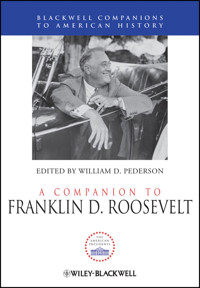
A Companion to Franklin D. Roosevelt E-Book
166,99 €
Mehr erfahren.
- Herausgeber: John Wiley & Sons
- Kategorie: Geisteswissenschaft
- Sprache: Englisch
A Companion to Franklin D. Roosevelt presents a collection of historiographical essays by leading scholars that provides a comprehensive review of the scholarship on the president who led the United States through the tumultuous period from the Great Depression to the waning days of World War II. * Represents a state-of-the-art assessment of current scholarship on FDR, the only president elected to four terms of office and the central figure in key events of the first half of the 20th century * Covers all aspects of FDR's life and times, from his health, relationships, and Supreme Court packing, to New Deal policies, institutional issues, and international relations * Features 35 essays by leading FDR scholars
Sie lesen das E-Book in den Legimi-Apps auf:
Seitenzahl: 1666
Veröffentlichungsjahr: 2011
Ähnliche




















Contents
List of Figures
Preface
Notes on Contributors
Chapter One FDR BIOGRAPHIES
Historians
Journalists
Associates
Relatives
Conclusion
Chapter Two ELEANOR ROOSEVELT BIOGRAPHIES
Examining Herself
Exploring the Woman in the Mirror
Questions of Interpretation
The Continuing Search
Chapter Three PRE-PRESIDENTIAL CAREER
Lawyer, 1907–1910
State Senate, 1911–1913
Assistant Secretary of the Navy, 1913–1921
Vice-Presidential Nomination, 1920
Poliomyelitis, 1921
Attorney, Businessman, and Political Activist, 1922–1929
Governor of New York, 1929–1933
Chapter Four PHYSICAL AND PSYCHOLOGICAL HEALTH
A History of Health Problems
Poliomyelitis
The Response to the Disease and Treatment
Debates about FDR’s Health
The 1944 Campaign
April 12, 1945
Health and FDR’s Legacy
Chapter Five THE ELECTION OF 1932
The Biographers
The Democratic Convention
The Campaign
Voter Realignment
Chapter Six THE 1936–1944 CAMPAIGNS
The 1936 Campaign
The 1940 Campaign
The 1944 Campaign
Conclusions
Chapter Seven URBAN AND REGIONAL INTERESTS
Overview
The Regional Dimension
The Urban Scenario
Conclusion
Chapter Eight MINORITIES
African-Americans
Japanese Americans
Women
Native Americans
Jews
Hispanics
Chapter Nine LABOR
Roots of New Deal Innovation
Roosevelt and Perkins
Aiding Unemployed Workers
The NIRA’s Section 7(a)
Union Struggles and Administration Mediation
The Wagner Act
Social Security
The CIO, Industrial Union Victories, and the Supreme Court Shift
The NLRB under Attack
The Fair Labor Standards Act
World War II
Workers outside the New Deal Tent
Gender and Race
Workers’ Cultures
Workers’ Civil Liberties
Workers’ Politics
Roosevelt and Labor Leaders
Critical Scholarly Trends and New Directions
Chapter Ten BUSINESS
Chapter Eleven OPPONENTS AT HOME AND ABROAD
Chapter Twelve FDR AS A COMMUNICATOR
Chapter Thirteen THE NEW DEAL
Chapter Fourteen THE BANKING CRISIS
Herbert Hoover’s Response
FDR’s Responses
Chapter Fifteen FDR AND AGRICULTURE
Chapter Sixteen CONSERVATION
Personal Leadership
The CCC: FDR’s Primary Employment Tool
The TVA: FDR’s Second Major Conservation Instrument
The Soil Erosion Service and Other “Green” Changes
Services Often in Conflict
A Consistent Record and Future Research
Chapter Seventeen POLITICAL CULTURE
A Revolution in Politics and Communications
The New Deal’s Own Political Culture
An Age of Empathy and Sharing?
Divisions and Dissenting Voices
Building Support for the New Deal
Nationalism and Unity
Conclusion
Topics for Further Study
Chapter Eighteen HUMAN RIGHTS
FDR and the Holocaust
FDR and Japanese Internment
FDR and Civilian Targeting
Chapter Ninteen THE INSTITUTIONAL PRESIDENCY
Literature Review
The Institutional Presidency
Future Research
Chapter Twenty POLITICAL AND ADMINISTRATIVE STYLE
Roosevelt and Administrative Style in the New Deal
Roosevelt, Administrative Style, and World War II
Roosevelt, Administrative Style, and the Third New Deal
Conclusions and Future Research
Chapter Twenty-One THE CONGRESS
Roosevelt and Congress
Roosevelt, Congress, and World War II, 1941–1945
Further Areas for Consideration
Conclusion
Chapter Twenty-Two THE SUPREME COURT
Chapter Twenty-Three THE AMERICAN MILITARY
Chapter Twenty-Four SCIENCE AND TECHNOLOGY
The First Modern President
Liar, Waffler, or Master Tactician? – The Nature of FDR’s Leadership
A “New Deal” for Science
The Emergence of the Scientist as Statesman
Allied Scientific and Technical Interchange
The Winning Weapon
The Decision to Use the Bomb
Radar: The Other Winning Weapon
The Rise of American Air Power
History and Memory
Chapter Twenty-Five INTELLIGENCE
Background
Intelligence for the Pacific Theater of Operations (PTO)
Intelligence for the European Theater of Operations (ETO)
Conclusion
Chapter Twenty-Six RELATIONS WITH THE BRITISH AND FRENCH
Early Stumbles
From Peace to War: Intermediaries and Personal Diplomacy
Topical Controversies
Gaullophobia
Imperial Challenges
Conclusions
Chapter Twenty-Seven RELATIONS WITH CANADA
A Postwar Consensus? The American Historiography, 1945–1975
No Canadian Consensus? 1945–1970
Splintering and Revision: The Canadian Historiography since 1975
A Forgotten Connection? The American and British Historiography after 1975
What Remains Undone?
Chapter Twenty-Eight THE GOOD NEIGHBOR POLICY AND THE AMERICAS
Historiography
The Good Neighbor Policy
Case Studies
Chapter Twenty-Nine RELATIONS WITH THE SOVIET UNION
Chapter Thirty RELATIONS WITH CHINA AND INDIA
China, 1933–1938
The United States and the Unequal Treaties Forced on China
China at War, 1937–1945
India
Chapter Thirty-One RELATIONS WITH JAPAN
Personalities in US–Japan Relations
Japan in China
Naval Confrontations
Japan Joins the Axis, Enters Indochina, and Faces Embargo
August 1941 to December 1941: Last Chance for Peace?
Chapter Thirty-Two RELATIONS WITH ITALY AND NAZI GERMANY
Chapter Thirty-Three RELATIONS WITH SPAIN AND EUROPEAN NEUTRALS
The United States, FDR, and the Spanish Civil War
The United States, FDR, and Spain, 1939–1941
The United States, FDR, Britain, and Spain in World War II, 1941–1945
The United States, FDR, and Other European Neutrals in War, 1939–1945
Conclusion
Chapter Thirty-Four INTERNATIONAL LEGACY
Chapter Thirty-Five POLITICAL REPUTATION
A Presidential Library
Early Critiques
A Second Round of Critiques
A Third Phase
Centennial Celebration
Canonization
Conclusions
Bibliography
INDEX
BLACKWELL COMPANIONS TO AMERICAN HISTORY
This series provides essential and authoritative overviews of the scholarship that has shaped our present understanding of the American past. Edited by eminent historians, each volume tackles one of the major periods or themes of American history, with individual topics authored by key scholars who have spent considerable time in research on the questions and controversies that have sparked debate in their field of interest. The volumes are accessible for the non-specialist, while also engaging scholars seeking a reference to the historiography or future concerns.
Published
A Companion to the American Revolution
Edited by Jack P. Greene and J. R. Pole
A Companion to 19th-Century America
Edited by William L. Barney
A Companion to the American South
Edited by John B. Boles
A Companion to American Indian History
Edited by Philip J. Deloria and Neal Salisbury
A Companion to American Women’s History
Edited by Nancy Hewitt
A Companion to Post-1945 America
Edited by Jean-Christophe Agnew and Roy Rosenzweig
A Companion to the Vietnam War
Edited by Marilyn Young and Robert Buzzanco
A Companion to Colonial America
Edited by Daniel Vickers
A Companion to 20th-Century America
Edited by Stephen J. Whitfield
A Companion to the American West
Edited by William Deverell
A Companion to American Foreign Relations
Edited by Robert Schulzinger
A Companion to the Civil War and Reconstruction
Edited by Lacy K. Ford
A Companion to American Technology
Edited by Carroll Pursell
A Companion to African-American History
Edited by Alton Hornsby
A Companion to American Immigration
Edited by Reed Ueda
A Companion to American Cultural History
Edited by Karen Halttunen
A Companion to California History
Edited by William Deverell and David Igler
A Companion to American Military History
Edited by James Bradford
A Companion Los Angeles
Edited by William Deverell and Greg Hise
A Companion to American Environmental History
Edited by Douglas Cazaux Sackman
In preparation
A Companion to American Urban History
Edited by David Quigley
PRESIDENTIAL COMPANIONS
Published
A Companion to Franklin D. Roosevelt
Edited by William Pederson
In preparation
A Companion to Abraham Lincoln
Edited by Michael Green
A Companion to Thomas Jefferson
Edited by Francis D. Cogliano
A Companion to Benjamin Franklin
Edited by David Waldstreicher
A Companion to Richard M. Nixon
Edited by Melvin Small
A Companion to George Washington
Edited by Edward G. Lengel
A Companion to Harry S. Truman
Edited by Daniel S. Margolies
A Companion to Theodore Roosevelt
Edited by Serge Ricard
A Companion to Lyndon B. Johnson
Edited by Mitchell Lerner
A Companion to Andrew Jackson
Edited by Sean Patrick Adams
A Companion to Woodrow Wilson
Edited by Ross A. Kennedy
A Companion to Dwight D. Eisenhower
Edited by Chester J. Pach
A Companion to Ronald Reagan
Edited by Andrew L. Johns
A Companion to James Madison and James Monroe
Edited by Stuart Leibiger
Planned
A Companion to John Adams and John Quincy Adams
A Companion to Alexander Hamilton
A Companion to Gilded Age and Progressive Era Presidents
A Companion to the Reconstruction Presidents
A Companion to the Antebellum Presidents
This edition first published 2011© 2011 Blackwell Publishing Ltd
Blackwell Publishing was acquired by John Wiley & Sons in February 2007. Blackwell's publishing program has been merged with Wiley's global Scientific, Technical, and Medical business to form Wiley-Blackwell.
Registered OfficeJohn Wiley & Sons Ltd, The Atrium, Southern Gate, Chichester, West Sussex, PO19 8SQ, United Kingdom
Editorial Offices350 Main Street, Malden, MA 02148-5020, USA9600 Garsington Road, Oxford, OX4 2DQ, UKThe Atrium, Southern Gate, Chichester, West Sussex, PO19 8SQ, UK
For details of our global editorial offices, for customer services, and for information about how to apply for permission to reuse the copyright material in this book please see our website at www.wiley.com/wiley-blackwell.
The right of William D. Pederson to be identified as the author of the editorial material in this work has been asserted in accordance with the UK Copyright, Designs and Patents Act 1988.
All rights reserved. No part of this publication may be reproduced, stored in a retrieval system, or transmitted, in any form or by any means, electronic, mechanical, photocopying, recording or otherwise, except as permitted by the UK Copyright, Designs and Patents Act 1988, without the prior permission of the publisher.
Wiley also publishes its books in a variety of electronic formats. Some content that appears in print may not be available in electronic books.
Designations used by companies to distinguish their products are often claimed as trademarks. All brand names and product names used in this book are trade names, service marks, trademarks or registered trademarks of their respective owners. The publisher is not associated with any product or vendor mentioned in this book. This publication is designed to provide accurate and authoritative information in regard to the subject matter covered. It is sold on the understanding that the publisher is not engaged in rendering professional services. If professional advice or other expert assistance is required, the services of a competent professional should be sought.
Library of Congress Cataloging-in-Publication Data
A companion to Franklin D. Roosevelt / edited by William D. Pederson.
p. cm. - (Blackwell companions to American history)
Includes bibliographical references and index.
ISBN 978-1-4443-3016-8 (hardcover: alk. paper)
1. Roosevelt, Franklin D. (Franklin Delano), 1882-1945. 2. Roosevelt, Franklin D. (Franklin Delano), 1882–1945–Political and social views. 3. United States–Politics and government–1933–1945. 4. United States–Foreign relations–1933–1945. 5. United States–Social conditions–1933–1945. 6. Presidents–United States–Biography.
I. Pederson, William D., 1946–
E807.C563 2011
973.917092–dc22
2010038988
A catalogue record for this book is available from the British Library.
James MacGregor Burns
List of Figures
3.1
Franklin D. Roosevelt at Campobello, 1907. Courtesy of the Franklin D. Roosevelt Library website; version date 2009
4.1
Franklin D. Roosevelt golfing in Campobello, 1907. Courtesy of the Franklin D. Roosevelt Library website; version date 2009
6.1
Franklin D. Roosevelt and Fala, 1943. Courtesy of the Franklin D. Roosevelt Library website; version date 2009
19.1
Franklin D. Roosevelt and Grace Tully on the Inspection Train, 1942. Courtesy of the Franklin D. Roosevelt Library website; version date 2009
27.1
Franklin D. Roosevelt, Princess Alice, and the Earl of Athlone in Ottowa, Canada 1943. Courtesy of the Franklin D. Roosevelt Library website; version date 2009
30.1
Franklin D. Roosevelt, Churchill, Jiang Jieshi (Chiang Kai-shek), and his wife, Soong Mai-ling, in Cairo, Egypt, 1943. Courtesy of the Franklin D. Roosevelt Library website; version date 2009
34.1
Franklin D. Roosevelt and Ibn Saud of Saudi Arabia at Great Bitter Lake, Egypt, 1945. Courtesy of the Franklin D. Roosevelt Library website; version date 2009
Preface
Scholars consistently rank Franklin D. Roosevelt among the greatest presidents in American history and as the greatest president of the twentieth century (Pederson and McLaurin 1987; Murray and Blessing 1994). His ranking is based, no doubt, on his successful leadership of the United States during the nation’s two great, back-to-back crises of the twentieth century: the Great Depression and World War II. Myriad books have explored aspects of his leadership and presidency. This proliferation of scholarly examination in turn has resulted in reference works providing both general and specialized information about Roosevelt and his contemporaries.
Among the best of these reference works are encyclopedias (e.g., Olson 1985; Beasley, Shulman, and Beasley 2001; Ciment 2001) and annotated bibliographies (e.g., Hendrickson 2005). This Companion is designed to supplement existing works by adding works published since these reference standards were issued (e.g., the bibliography at the end of the volume focuses on works published after 1993, the ending date for those included in Hendrickson’s annotated bibliography). The historiographical essays assess what is known about each topic, the ongoing debates on these topics, and suggestions for future research. As a result, students should be able to quickly gain insights into each of the topics covered in the volume, ranging from biographies, policies, institutional changes, diplomacy, and area studies.
I extend thanks to the contributors to the volume. My thanks also to Peter Coveney, Executive Editor, History, Wiley-Blackwell Publishing in Massachusetts, for suggesting it, and to Galen Smith, Editorial Assistant at Wiley-Blackwell, US History, Classics and Ancient History. Special appreciation goes to Donna Byrd for her multiple research talents, computer skills, and knowledge of FDR.
This book is dedicated to James MacGregor Burns, who in 1983 helped to launch the American Studies program at Louisiana State University in Shreveport. A decade later, he participated in the inaugural presidential conference series that the American Studies program hosts triennially. He was keynote speaker at the 1995 FDR conference, a three-day conference held during the 50th anniversary year of FDR’s death. It was the largest such conference on FDR ever held. The fertile scholarship from that1995 conference was a catalyst for expansion of the literature about FDR. More books resulted from that conference than from any other presidential conference (e.g., Daynes, Pederson, and Riccards 1998; Young, Pederson, and Daynes 2001; Wolf, Pederson, and Daynes 2001; Howard and Pederson 2003; Pederson and Williams 2003; Pederson 2006). A number of the participants at the 1995 conference are either among the contributors to this volume or their works are cited herein.
REFERENCES
Beasley, M. H., Shulman, H. C., and Beasley, H. R., eds., 2001. Eleanor Roosevelt Encyclopedia. Westport, CT: Greenwood Press.
Ciment, J., ed., 2001. Encyclopedia of the Great Depression and the New Deal, 2 vols. Armonk, NY: M. E. Sharpe.
Daynes, B. W., Pederson, W. D., and Riccards, M. P., eds., 1998. The New Deal and Public Policy. New York: St Martin’s Press.
Hendrickson, K. E., Jr, 2005. Life and Presidency of Franklin Delano Roosevelt. An Annotated Bibliography. 3 vols. Lanham, MD: Scarecrow Press.
Howard, T. C. and Pederson, W. D., eds., 2003. Franklin D. Roosevelt and the Formation of the Modern World. Armonk, NY: M. E. Sharpe.
Murray, R. K. and Blessing, T. H., eds., 1994. Greatness in the White House. Rating the Presidents, Washington through Reagan, 2nd updated edn. University Park, PA: Pennsylvania State University Press.
Olson, J. S., ed., 1985. Historical Dictionary of the New Deal. From Inauguration to Preparation for War. Westport, CT: Greenwood Press.
Pederson, W. D. and McLaurin, A., eds., 1987. Rating Game in American Politics. New York: Irvington.
Pederson, W. D. and Williams, F. J., eds., 2003. Franklin D. Roosevelt and Abraham Lincoln. Competing Perspectives on Two Great Presidencies. Armonk, NY: M. E. Sharpe.
Pederson, W. D., 2006. The FDR Years. New York: Facts on File.
Wolf, T. P., Pederson, W. D., and Daynes, B. W., eds., 2001. Franklin D. Roosevelt and Congress. The New Deal and Its Aftermath. Armonk, NY: M. E. Sharpe.
Young, N. B., Pederson, W. D., and Daynes, B. W., eds., 2001. Franklin D. Roosevelt and the Shaping of American Political Culture. Armonk, NY: M. E. Sharpe.
FURTHER READING
Rozell, M. and Pederson, W. D., eds., 1997. FDR and the Modern Presidency. Leadership and Legacy. Westport, CT: Praeger.
Shaw, S. K., Pederson, W. D., and Williams, F. J., eds., 2004. Franklin D. Roosevelt and the Transformation of the Supreme Court. Armonk, NY: M. E. Sharpe.
Notes on Contributors
William Ashbaugh is Associate Professor and Chair of the Department of History at the State University of New York, College at Oneonta, where he won the 2008 Chancellor’s Award for Excellence in Teaching.
Jean Choate is Professor of History at the College of Coastal Georgia. She is the author of Disputed Ground: Farm Groups that Opposed the New Deal Agricultural Program (2002), Eliza Johnson, Unknown First Lady (2006), and a soon to be published collection of accounts of impressed sailors.
Byron W. Daynes is Professor of Political Science at Brigham Young University. He is the co-author of 14 books on American government, the American presidency (Franklin D. Roosevelt and the Shaping of American Political Culture, 2001), and social policy (The New Deal and Public Policy, 1998).
Brian Domitrovic is Assistant Professor of History at Sam Houston State University in Huntsville. He is the author of Econoclasts: The Rebels Who Sparked the Supply-Side Revolution and Restored American Prosperity (2009).
R. Blake Dunnavent is Associate Professor of History at Louisiana State University in Shreveport. His the author of Brownwater Warfare (2003) and The River War (2011).
Richard M. Fried is Professor of History Emeritus at the University of Illinois at Chicago. He is the author, most recently, of The Man Everyone Knew: Bruce Barton and the Making of Modern America (2005), and The Russians are Coming! The Russians are Coming! Pageantry and Patriotism in Cold-War America (1998).
Regina U. Gramer received her doctorate in history from Rutgers University, New Brunswick. She teaches in the Liberal Studies Program at New York University. Her work has appeared in a variety of books and journals, including Diplomatic History and Reviews on American History.
Rodney A. Grunes is Professor of Political Science and Chair of History and Political Science at Centenary College of Louisiana. His numerous articles have appeared most recently in White House Studies, Encyclopedia of American Civil Rights and Liberties, and the University of San Francisco Law Review.
Michael R. Hall is Professor of History at Armstrong Atlantic State University. Past president of the Association of Third World Studies, he is the author of Sugar and Power in the Dominican Republic (2000). From 1984 to 1987, he served as a Peace Corps volunteer in the Dominican Republic.
Martin Halpern is Professor of History at Henderson State University in Arkansas. He is the author of Unions, Radicals and Democratic Presidents: Seeking Social Change in the Twentieth Century (2003), and UAW Politics in the Cold War Era (1988).
Kenneth E. Hendrickson, Jr is Regent’s and Hardin Distinguished Professor of American History, Emeritus, at Midwestern State University, Wichita Falls, Texas. Among his 12 books is The Life and Presidency of Franklin D. Roosevelt: An Annotated Bibliography (2005).
June Hopkins is Professor of History and Chair of the Department of History at Armstrong Atlanta State University. She is the author of Harry Hopkins: Sudden Hero, Brash Reformer (1999), and co-editor of Jewish, First Wife, Divorced: Selected Letters and Papers of Ethel Gross and Harry Hopkins (2003).
Lance Janda is Associate Professor and Chair of the Department of History and Government at Cameron University. He is the author of Stronger Than Custom: West Point and the Admission of Women (2001), and articles entitled “The Flying Tigers” and The United States Marine Corps in the Pacific, 1941–1945” in Timothy Dowling’s Personal Perspectives: World War II (2005) among other works.
Cherisse Jones-Branch is Associate Professor of History at Arkansas State University. She has written numerous articles and is completing a manuscript entitled “ ‘Repairers of the Breach’: Black and White Women and Racism Activism in South Carolina, 1940s–1960.”
William E. Kinsella, Jr is Assistant Dean and Professor of History in the Liberal Arts Division of Northern Virginia Community College (Annandale Campus). He has published numerous articles on Franklin Roosevelt and American diplomatic history, and Leadership in Isolation: FDR and the Origins of the Second World War (1978).
Timothy W. Kneeland is Associate Professor of History and Political Science at Nazareth College. He is the author of Push Button Psychiatry. A Cultural History of Electroshock (2008).
Joseph Edward Lee is Professor of History at Winthrop University. He is past president of the South Carolina Historical Association, and the mayor of the City of York, South Carolina, and the author of 14 books, including Yorkville to York (1998).
Stefano Luconi teaches US history at the University of Padua in Italy. He is the author of many books including Little Italies e New Deal (2002), The Italian–American Vote on Providence, Rhode Island, 1916–1948 (2004), and La faglia dell’antisemitismo: Italiani ed ebrei negli Stati-Uniti, 1920–1941 (2007).
John Thomas McGuire is Adjunct Associate Professor of History at Tompkins Cortland Community College, State University of New York. He is the recipient of the 2005 Philip S. Klein Pennsylvania History Prize for his article on Mary Williams (Molly) Dawson and her conflicts with Emma Guffey Miller. His current book project is on the Women’s Division of the Democratic National Committee during the New Deal.
Patrick J. Maney is Professor of History and Dean of the College of Arts and Sciences at Boston College. He is the author of “Young Bob” La Follette: A Biography of Robert M. La Follette, Jr., 1895–1953 (1978, 2003) and The Roosevelt Presence: The Life and Legacy of FDR (1993, 1998).
David A. Messenger is Assistant Professor of European and International History at the University of Wyoming. He is the author of L’Espagne Republicaine: French Policy and Spanish Republicanism in Liberated France (2008), and currently completing another book, Dangerous Germans in Franco’s Spain: The Allied Program of Forced Repatriation of German Criminals after the Second World War.
Wesley K. Mosier is a doctorate student in history at Oklahoma State University. His research interests include the American West, federal Indian policy, human rights and social reform in the twentieth century.
James S. Olson is Texas State University System Regent’s Professor of History. He is the author of Herbert Hoover and the Reconstruction Finance Corporation (1977); Saving Capitalism: The Reconstruction Finance Corporation and the New Deal (1988); and editor of Historical Dictionary of the New Deal. From Inauguration to Preparation for War (1985).
Peter K. Parides is Associate Professor of History at New York City College of Technology, The City University of New York. His recent work appeared in Rosemary B. Mariner and G. Kurt Piehler, eds., The Atomic Bomb and American Society (2009), and is currently working on a book Atomic Brothers: The Anglo-American Alliance and the Birth of the Nuclear Age, 1939–1945.
Galen Roger Perras is Associate Professor of American History at the University of Ottawa. His books include Franklin Roosevelt and the Origins of the Canadian-American Security Alliance, 1933–1945: Necessary But Not Necessary Enough (1988), and Stepping Stones to Nowhere: The Aleutian Islands, Alaska, and American Military Strategy, 1867–1945 (2003).
William D. Pederson is the American Studies Endowed Chair and Director of the International Lincoln Center at Louisiana State University in Shreveport. Among his many books are The FDR Years (2006), Franklin D. Roosevelt and Abraham Lincoln (2003), FDR and the Modern Presidency (1997), and The Rating Game in American Politics (1987).
Norman W. Provizer is Professor of Political Science and Director of the Golda Meir Center for Political Leadership at Metropolitan State College of Denver. His books include Leaders of the Pack (2003), Great Justices of the U.S. Supreme Court (1993), Grassroots Constitutionalism (1988), and Analyzing the Third World (1978).
Patrick D. Reagan is Assistant Professor of History at Tennessee Technological University in Cookeville. His most recent books include Designing a New America: The Origins of New Deal Planning, 1890–1943 (2000); American Journal: World War I and the Jazz Age (2000); and History and the Internet: A Guide (2002).
Donald A. Ritchie is the Historian of the United States Senate. His recent book is Electing FDR: The New Deal Campaign of 1932 (2007).
Margaret C. Rung is Assistant Professor of History and Director of the Center for New Deal Studies at Roosevelt University. She is the author of numerous articles and Servant of the State: Managing Diversity and Democracy in the Federal Workforce, 1933–1953 (2002). Her interests include the relationship of gender and race to the development of the administrative state, especially during the New Deal, World War II, and the early years of the Cold War.
Sean J. Savage is Professor of Political Science at Saint Mary’s College in Notre Dame, Indiana. He is the author of Roosevelt: The Party Leader (1991), Truman and the Democratic Party (1997), and JFK, LBJ, and the Democratic Party (2004).
Stephen K. Shaw is Professor of Political Science, and Director, University Honors Program at Northwest Nazarene University. He is the editor of Franklin D. Roosevelt and the Transformation of the Supreme Court (2004) and author of The Ninth Amendment: Preservation of the Constitutional Mind (1990).
Kevin E. Smith is Associate Professor of History and Department Chair at Ball State University in Muncie, Indiana. He is the author of Conflict over Convoys: Anglo-American Logistics Diplomacy in the Second World War (1996). His current research deals with the role of “Hossier” statesmen in American foreign policy during the 1930s.
Mary Stockwell is Professor of History and Department Chair at Lourdes College. The author of Woodrow Wilson: The Last Romantic (2009) and many articles, she is the recipient of a Gilder–Lehrman Research Fellowship (2006) and the Association of Educational Publisher’s Golden Lamp Award (2005).
Robert P. Watson is Professor of Political Science and Coordinator of American Studies at Lynn University in Florida. He is the author or editor of 30 books and numerous articles.
Betty Houchin Winfield is University of Missouri Curators’ Professor in the Missouri School of Journalism, Department of Political Science and the Harry S. Truman School of Public Affairs Professor. She is the author of many articles on FDR as well as four books, including FDR and the News Media (1990, 1994), which received a Frank Luther Mott award for a best mass media history book (1991).
Chapter One
FDR BIOGRAPHIES
Kenneth E. Hendrickson, Jr
Historians have long debated whether history is a science or an art, and some have concluded that the question is moot because science and art are closely related. In History as Art and as Science: Twin Vistas of the Past (Hughes 1964: 2), E. K. Carr argued that, “Scientists … and historians are … engaged in different branches of the same study: the study of man and his environment … the object … is the same: to increase man’s understanding and mastery over his environment.”
While this assessment may seem logical and persuasive at first glance, it is, in fact unsustainable. True, there may be some similarities between the goals of historians and scientists, but the similarities are, at best, superficial and in no way tie the two disciplines together. There is nothing scientific about history. It is a form of literature; it is a highly sophisticated but utterly unscientific art. Unlike the scientific process where objectivity is the essential ingredient and all examinations of the same evidence must produce the same result, the historical process is inevitably subjective. All historians – sometimes by design, sometimes unintentionally, but nevertheless in all cases – impose themselves upon their subjects and the cumulative result is often chaos. That is, the outcomes produced by various historians dealing with the same topic are never the same and thus result in confusion. Put another way, if one examines all the historical literature on a given topic, the answers to the fundamental question of how human beings seek to understand and control their environment are never clear. Moreover, in no subdiscipline of history is this phenomenon more obvious than in biography, and no subject of biography has generated more literary chaos than Franklin Delano Roosevelt.
Roosevelt became the subject of historians and other writers long before his death, has continued to attract attention to the present time, and without doubt will be targeted by many writers with various agendas well into the future. The total number of books on Roosevelt is staggering. In addition to biographies, there are works dealing with topics such as the Great Depression, World War II, and general politics, and all of them, of course, include some biographical material. But this chapter, for the most part, deals only with those works intended to be biographical in the strictest sense of the word. Even this approach leads to more than 80 books, and not all of them are discussed. Instead, the most important biographies are selected and divided into four categories: those written by professional historians, journalists, close associates, and relatives. The discussion of them suggests the imperfect nature of Roosevelt biographical literature.
Historians
Emil Ludwig comes first in the discussion. A Pole who lived at various times in Poland, Switzerland, the United States, and Germany, he could be classified as either a historian or a journalist, but I have chosen to include him with the former because of the quantity and quality of his biographical and historical works. His biography, Roosevelt: A Study in Fortune and Power (Ludwig 1938 – English translation by Maurice Samuel), was released in the United States in 1938. Though he attempted to enshrine Roosevelt’s greatness as the savior of the capitalist system and democracy, the result is overly sentimental and not especially persuasive.
Nearly a decade and a half lapsed before another historian attempted a Roosevelt biography, but once Frank Freidel began, he maintained his interest in Roosevelt for the remainder of his life After spending most of his academic career at Harvard, he concluded it at the University of Washington. His four-volume biography appeared over the course of 20 years. First was Franklin D. Roosevelt: The Apprenticeship (1952), followed by Franklin Delano Roosevelt: The Ordeal (1954), Franklin Delano Roosevelt: The Triumph (1956), and FDR: Launching the New Deal (1973). The delay in the publication of the fourth volume was caused by the controversy that blazed about the New Deal during the Red Scare of the 1950s and the search for additional documents. While generally sympathetic to Roosevelt, Freidel’s work is also critical when the need is obvious, in such cases, for example, as the Supreme Court fiasco and his intervention in the congressional election of 1938. It is one of the best written and most comprehensive of all the FDR biographies and remains today an excellent example of biographical literature, although it is not definitive.
The next historian to publish a Roosevelt biography was James McGregor Burns. Professor Burns is a well-known presidential biographer and an authority on leadership studies, serving as the Woodrow Wilson Professor emeritus, of Political Science at Williams College. His two-volume biography is Roosevelt: The Lion and the Fox (1956) and Roosevelt: The Soldier of Freedom, 1940–45 (1970) The second volume won a Pulitzer Prize and the National Book Award in 1971. The former is a fine example of historical literature, in which Burns evaluates FDR as a leader and politician during the Great Depression. Finding both weakness and strength, many fans of the president did not like the book; nevertheless, it was for the most part well received by reviewers. In Roosevelt: The Soldier of Freedom, Burns once again exhibited his skill as a literary craftsman. More critical of FDR than in the first volume, he describes the president as a deeply divided man who provided inadequate leadership to a fragmented nation. He censures Roosevelt especially for his treatment of the Japanese Americans and his insensitivity to civil liberties.
Professor Dexter Perkins was known throughout the western world as a prominent authority on US history. During his long career, he taught at the University of Rochester, Cornell University, the University of London, and Cambridge. He was the official US historian at the San Francisco Security Conference that preceded the organization of the United Nations in 1945. His biography, entitled The New Age of Franklin Roosevelt, 1932–1945 (1956), is an account of FDR’s leadership through the Great Depression and World War II. Though only 193 pages, mostly anecdotal, not based on primary sources, and bereft of anything unknown up to its date of publication, it is a well-balanced, fair-minded summary of what many have styled the beginning of America’s modern era. It is also beautifully written and thus attracted many readers who were not likely to seek out the massive multi-volume works of other well-known authors.
One of those who, like Frank Freidel, successfully attempted a huge multi-volume biography was Kenneth S. Davis, who graduated from Kansas State University in 1934 with a degree in journalism and received a Master of Science degree from the University of Wisconsin in 1935. He taught journalism at New York University, was a war correspondent during World War II, and later taught history at both Kansas State and the University of Kansas. Though a biographer of Charles Lindbergh, Dwight D. Eisenhower, and Adlai Stevenson, his best known biography is on FDR.
Davis intended to produce five volumes, but the last was never completed due to his illness and death in 1999. Volume I, FDR: The Beckoning of Destiny, 1882–1928 (1972) is based largely on secondary sources, mainly from Burns and Freidel, but also includes some new information. The major thesis of this book is that character develops and persists; it does not appear full blown at birth, nor does it change to meet each new responsibility. He pictures Roosevelt not as a hero, but as a man whose character exhibited significant flaws. FDR: The New York Years, 1928–1932 (1985) features Roosevelt as governor of New York and as candidate for the Democratic presidential nomination. Again, the author is both sympathetic and critical. The best parts of this volume are the description of Roosevelt’s assembling of the Brains Trust and its persuasive argument that Roosevelt represented a significant political alternative in 1932. He entitled volume III FDR: The New Deal Years, 1933–1937 (1986). Here, he focused on the period known to historians as the First New Deal, considering issues such as currency reform, banking, agriculture, labor, the regulation of labor relations, welfare, and especially social security. Roosevelt, says Davis, was essentially conservative in his outlook and succeeded not because of any particular piece of legislation, but because of his grasp of his historic role. His approach to practically all problems was both pragmatic and erratic.
FDR: Into the Storm, 1937–1941 (1993), was Davis’s fourth and last volume. It covers the efforts to sustain the New Deal, the Supreme Court controversy, the failed purge of conservative Democrats, the successful battles over wages and hours, farm tenancy, housing bills, and the third-term struggle. With respect to the latter, Davis is at his best as an analyst. For example, he shows that Roosevelt knew Wendell Willkie represented a serious threat, but was mistaken in his belief that Willkie was a puppet of the far right. Davis is very critical of the president for his handling of events leading up to US entry into World War II. He pictures Roosevelt as a cautious and ineffective leader, who had an opportunity to deter Hitler and failed. How Davis would have interpreted Roosevelt’s wartime leadership will never be known, but it was obvious that as each volume appeared, Davis’s work became more critical and more controversial. At the same time it received significant recognition. Volume I won the Francis Parkman Prize in 1973 and was nominated for the National Book Award. The New York Times ranked volumes I and II among the 10 best books of the years when they appeared.
Gerald D. Nash, Distinguished Professor of History at the University of New Mexico, produced a biographical work entitled Franklin Delano Roosevelt (1967), not written by himself but consisting of excerpts from the works of other authors, including Richard Hofstadter, James McGregor Burns, Arthur M. Schlesinger, Jr, and Roosevelt himself. The president’s section, Part I, features comments about the first 50 years of his life and career. Part II consists of comments by people who knew Roosevelt, including his mother, American politicians, journalists, and world leaders. Part III includes well-known interpretations by Hofstadter, Burns, Schlesinger, and John Gunther. All the entries are very brief, running from a few paragraphs to five or six pages. Nash’s goal was to combine the intimacy of autobiography, the immediacy of eyewitness observations, and the “objectivity” of modern scholarship. Whether or not he was successful can be determined only by the reader.
John Morton Blum has long been regarded as one of the preeminent political historians in the United States. One of his best known works is a college textbook, The American Experience, still in use by many universities, but he also was the author of another important work, The Progressive Presidents: Roosevelt, Wilson, Roosevelt, and Johnson (1980). Blum, an outspoken liberal, argues that the progressive presidents, including FDR, successfully protected capitalism from both right and left wing extremists by pushing successfully for significant domestic reforms. Their achievements, he declares, far outweigh any of their activities that might be regarded as abuses of power. They performed well despite their imperfections.
One of the best one-volume Roosevelt biographies came from the pen of “Ted Morgan,” the pseudonym of a French-American writer whose real name is Comte St Charles Armand Gabriel de Gramont. In 1977, he became an American citizen and adopted the name “Ted Morgan,” which is an anagram of De Garmont. In addition to his biography of FDR, he has written much admired biographies of Winston Churchill and Somerset Maugham. In FDR: A Biography (1985), he covers Roosevelt’s entire life and career in 800 pages. He is neither a great admirer nor a hateful critic, but attempts to capture the character of a man he saw as at once judicious, rash, cunning, naive, mean, and generous. To do this, he reconstructs the atmosphere of Roosevelt’s day, recounts anecdotes, recreates events, and by implication asks readers to judge for themselves. This technique is interesting, but of course produces mixed results.
Geoffrey C. Ward is both an historian and a screenwriter. Early in his career he was an editor for American Heritage magazine, and he later collaborated with Ken Burns on the television mini-series The Civil War and several documentaries, including Jazz, Baseball, The War, and The West. His biography of FDR, Before the Trumpet: Young Franklin Roosevelt, 1882–1905 (1985), won the National Book Critics Award and the Francis Parkman Award. It begins with FDR’s birth and concludes with his marriage to Eleanor. He intended to add a second volume but never did, although he published several articles dealing with various aspects of Roosevelt’s life and career. Among the best parts of Before the Trumpet are Ward’s discussions of Roosevelt’s relationship with his mother, and his courtship of Eleanor. He also focuses on the source of certain aspects of Roosevelt’s character, especially his boldness, caution, deviousness, charm, and self-assurance.
Professor Patrick J. Maney contributed his Roosevelt biography in 1992. Maney received his PhD from the University of Maryland in 1976. He taught for several years at the University of South Carolina and Tulane, and later at Boston College. In The Roosevelt Presence: The Life and Legacy of FDR (1992), he pictures Roosevelt as a decisive figure in American history largely because, in one way or another, he influenced many of his successors – Truman, Eisenhower, Kennedy, Johnson, Clinton, and even Reagan. The Roosevelt administration contributed, among other things, social security, unemployment insurance, minimum wage law, public housing, bankruptcy insurance, farm subsidies, and regulation of the stock market. These became permanent fixtures in American society and have remained so whether supported, ignored, or opposed by those leaders who came after Roosevelt.
After a hiatus of a decade, historians once again turned their attention to Roosevelt and produced some interesting work. One of the first authors in this group was the Englishman, Roy Jenkins, the author of many books, including the prize-winning Winston Churchill. He was a politician, having served in the House of Commons as Minister of Aviation, Home Secretary, and Chancellor of the Exchequer, as well as Chancellor of the University of Oxford, and was raised to the House of Lords in 1987. His biography of FDR, Franklin Delano Roosevelt (2003), was unfinished at the time of his death, but was completed by Richard E. Neustadt. Although only 208 pages, it is insightful. In very stylish prose, Jenkins deals with the peculiarities of Roosevelt’s character, his skill and flexibility as a politician, and his ability to charm and dazzle both close associates and casual acquaintances, while at the same time keeping them at arms length. He gives Roosevelt high marks as commander-in-chief, arguing that he successfully oversaw the complex mobilization of the economy and the military during World War II. Emphasizing the importance of Roosevelt’s relationship with Eleanor – who, he reminds readers – was not only his wife but an important adviser, despite their peculiar relationship.
Two historians, Allan Winkler and Jeffery W. Coker, published Roosevelt biographies in 2005. Coker’s work, Franklin Delano Roosevelt: A Biography (2005), appeared in May, and Winkler’s Franklin Delano Roosevelt (2005) came out in July. Coker, an Assistant Professor of History at Belmont University, had two books to his credit before embarking on the Roosevelt project. His work is part of Greenwood’s Biographies Series and is brief. Nevertheless, he traces Roosevelt’s life from his childhood through the New Deal and the war, and concludes with a discussion of the various controversies concerning his legacy. Though critical of Roosevelt and not ranking him as one of the greatest presidents, at the same time he admits that Roosevelt was one of the most influential presidents; that influence being not entirely positive. Allan Winkler is Distinguished Professor of History at Miami University in Ohio. His work, an addition to Longman’s Library of American Biography Series, is also brief. Though little more than a summary from earlier, more extensive studies, it is clear and concise and much less judgmental than Coker’s volume.
Two longer Roosevelt biographies by Jean Edward Smith and H. W. Brands appeared in 2008. Professor Brands is the Dickson Allen Anderson Centennial Professor of History at the University of Texas at Austin, who has also published biographies of Andrew Jackson and Benjamin Franklin, among others. Professor Smith is the author of 12 books, including biographies of Ulysses S. Grant, John Marshall, and Lucius D. Clay. He taught at the University of Toronto for 35 years before joining the faculty at Marshall University, where he is the John Marshall Professor of Political Science.
Brands’s volume, Traitor to His Class: The Privileged Life and Radical Presidency of Franklin Delano Roosevelt (2008), is a big book weighing in at 896 pages. Based on both primary and secondary sources and featuring attractive prose, Brands deals with the president’s early life, of course, and devotes two-thirds of the book to the New Deal and World War II, but adds little that is new to the Roosevelt story. So, his work attracted some unfriendly evaluations. For example, in its November 4, 2008 edition, Publishers’ Weekly summarized the overall value of Brands’s effort as follows: “It’s fitting that Roosevelt commands the amount of scholarly attention that he does, but sad that so much is wholly redundant with what has come before.”
FDR (2008) is Professor Smith’s contribution. In summing up Roosevelt’s legacy, Smith argues that the president engineered fundamental changes in the relationship between the American people and the government, revolutionized the art of campaigning, and used the media more effectively than anyone else to gain the support of the public and at the same time calm their fears. Very persuasive in arguing its conclusions, Smith’s work is one of the most powerful accounts of Roosevelt’s career.
One of the most unusual and engaging contributions to Roosevelt literature is Joseph E. Persico’s Franklin and Lucy: President Roosevelt, Mrs. Rutherfurd, and the Other Remarkable Women in His Life (2009). Using never before revealed documents from Lucy Rutherfurd’s estate, Persico demonstrates that Roosevelt’s affair with her was much more intense and much longer than has been generally believed. He also explains more clearly than any of his predecessors how Roosevelt’s infidelity transformed his wife from a repressed Victorian girl into one of the greatest women of the twentieth century. By focusing on Roosevelt’s relationship with the women in his life, Persico creates a unique portrait of this complex American leader.
The most recent Roosevelt biography is the work of Alan Brinkley, Allan Nevins Professor of History at Columbia University. His Franklin Delano Roosevelt (2009) is brief (128 pages) and features an unusual twist. He summarizes FDR’s entire career with an emphasis on the New Deal, referring not to its impact on American society and the size of the federal bureaucracy during the 1930s, but its relationship to the efforts of later administrations and the implementation of deficit spending.
Although strictly speaking not a biography, one cannot ignore the magnificent work of Arthur M. Schlesinger, Jr, who did his graduate work in history at Harvard, but never completed a PhD. During World War II, he served in the Office of War Information and the Office of Strategic Services. He began his teaching career at Harvard in 1939, returned after the war, and stayed there until 1961. After serving as an adviser to the Kennedy administration, he again returned to teaching in 1966, as Albert Schweitzer Professor of Humanities at the Graduate Center of the City University of New York, retiring in 1994. Between 1939 and 2007, he produced 29 books, two of which won the Pulitzer Prize, but his best known work is his three-volume study of Roosevelt and the New Deal. The titles are: The Crisis of the Old Order: 1919–1933 (1957), The Coming of the New Deal: 1933–1935 (1958), and The Politics of Upheaval: 1935–1936 (1960). Schlesinger meant to complete his study of Roosevelt with two additional volumes covering the last days of the New Deal and the war, but instead went to work as an adviser to JFK in 1961 and never returned to this project.
Throughout his life, Schlesinger remained an unapologetic liberal and his written works reflect that stance. These three lengthy volumes (1976 pages), devote considerable space to both the life and career of Roosevelt and are, for the most part, biased in favor of the president. He notes Roosevelt’s shortcomings, but is more understanding than many of his biographers. As a result, conservatives do not care much for Schlesinger, but be that as it may, all serious students of recent American history must reckon with him, whether they like him or not.
Journalists
Ernest K. Lindley was an internationally known journalist and foreign affairs expert. He and his wife, Elizabeth, were friends with Franklin and Eleanor Roosevelt, so Lindley was chosen as the first authorized Roosevelt biographer. Franklin D. Roosevelt: A Career in Progressive Democracy (1932) was, of course, a campaign biography, which stressed Roosevelt’s service during the Wilson administration and his physical fitness in public service.
At about the same time that Lindley was at work, reporter Earle Looker, who had been a friend of the Oyster Bay Roosevelts, challenged Franklin to undergo a thorough examination to determine his physical fitness and, satisfied, he wrote several articles and produced two pro-Roosevelt books. This Man Roosevelt (1932) is another campaign biography, and a very good one. It is vivacious in style, but not maudlin or hopelessly eulogistic. FDR liked it. Two years later, Looker published The American Way: Franklin Delano Roosevelt in Action (1934). Here, he begins with a description of the earliest efforts of the National Recovery Administration, but he also devotes considerable space – two-thirds of the book, in fact – to Roosevelt’s life before the presidency. Even though Looker was a lifelong Republican, he continued his praise for FDR.
Gerald White Johnson was a journalist, editor, essayist, historian, biographer, and novelist. A professor of journalism at the University of North Carolina, who worked at the Baltimore Evening Sun for many years, he was a friend of H. L. Mencken. In 1941, he published a review of the Roosevelt administration entitled Roosevelt: Dictator or Democrat?, which was the first major defense of the New Deal in American historical literature. The work is skillfully done, the arguments are persuasive, and the writing style is appealing. Johnson’s work is included in the realm of biography because, in addition to his analysis of the New Deal, he considers Roosevelt’s early life and career.
Among those who hated Roosevelt, the most virulent was John T. Flynn. By the time of Roosevelt’s drive for the White House, Flynn was one of the best known political commentators in the country and at first he supported the New York governor. But soon after the election he began to criticize the New Deal, and by 1936 he had broken completely with Roosevelt and began to call him a fascist. Flynn also detested Roosevelt’s foreign policy and was one of the founders of the America First Committee. After that group disbanded in 1941, Flynn renewed his savage attacks on the New Deal, referring to it as a degenerate form of socialism. In 1948, he published The Roosevelt Myth (1948), the most scandalous attack to appear to that date. In it, Flynn accused FDR of ruining the nation with the New Deal and plunging it into the war in a quest for personal power and glory. His book was little more than a study in pathological hatred, but Roosevelt was not his only target. Later in his life, he supported Senator Joe McCarthy, was rejected by such reasonable conservatives as William F. Buckley, and joined forces with the John Birch Society.
Two years after the appearance of Flynn’s assault on FDR, the renowned journalist John Gunther published Roosevelt in Retrospect (1950). Despite his fame as a journalist, Gunther had only met FDR socially on four or five occasions. Nevertheless, his book is replete with details, pertinent anecdotes, and interesting sidelights that appear to reflect significant personal contact but in fact represent an affective culling of the previously published works of those who were close to the president. Like most of Gunther’s writings, it is beautifully done and was happily received by Roosevelt admirers, but as Gunther himself stated, it was not intended to be definitive. Instead, he saw it as a preliminary sketch summarizing the existing journalistic and personal literature on Roosevelt, and encouraging further research.
After the appearance of Gunther’s work, there would not be another Roosevelt biography by a journalist for 11 years. Then, in 1961, Nicholas Halasz published Roosevelt through Foreign Eyes (1961). A native of Slovakia, which was a part of the Austro-Hungarian Empire at the time of his birth, Halasz was trained in both the law and journalism but devoted himself to a writing career after coming to the United States in 1941. The purpose of his book was to analyze Roosevelt in light of his impact on world opinion. He succeeded in producing a reasonably accurate appraisal of the interest in and the understanding of the New Deal among serious writers in England, France, Switzerland, and even Germany, at least until the late 1930s. The result was useful, but by no means complete.
In 1982, Joseph Alsop published FDR, 1882–1940: A Century Remembered (1982), a sentimental celebration of Roosevelt’s centennial birthday. The following year, a journalist attempted a more serious biography. This time it was Nathan Miller, an award-winning author of 12 books of biography and history. FDR: An Intimate History (1983), a lengthy tome (563 pages), is based largely on well-documented secondary sources and thus adds no new facts or interpretations that would be of interest to Roosevelt scholars. However, it is skillfully written and was popular with the general reading public when it appeared. The major problem with the book is its lack of balance. More than 300 pages are devoted to the period before the presidency and only 40 pages to World War II.
By far the best Roosevelt biography by a journalist, Franklin Delano Roosevelt: Champion of Freedom (2005), has come from Conrad Black. Formerly the chairman and chief executive officer of Hollinger International, Inc., whose newspaper holdings include the Daily and Sunday Telegraph and The Spectator in London, the Chicago Sun-Times, and the Jerusalem Post, Black entered the British House of Lords as Lord Black of Crossharbour in 2001. Although his political views are generally conservative, he is a great fan of Roosevelt. He argues that FDR was the most important person of the twentieth century because he transformed the United States and the world with unequaled skill as a politician, war leader, strategist, and visionary. His interpretation offers a stark and persuasive contrast to those of Burns and Davis.
Associates
The first of Roosevelt’s closest associates to attempt a biography was Frances Perkins, in The Roosevelt I Knew (1946). The first woman to hold a cabinet position, serving as Secretary of Labor, Perkins was a loyal Roosevelt supporter who helped pull the labor movement into the New Deal coalition and worked hard supporting most New Deal reform legislation. She was one of only two cabinet members – the other being Harold Ickes, Secretary of the Interior – who remained in office through Roosevelt’s entire presidency. Her book is divided into four parts: “The Man,” “The State,” “The Nation,” and “The World,” where she places the president, his character, and his polices in the relevant context. Her writing is clear and strong, and even though she was openly biased, she was by no means uncritical of Roosevelt as a man or a leader. But whether he was right or wrong, she believed that Roosevelt’s leadership was the means by which the people’s voice was heard.
The Perkins biography was followed by Grace Tully’s effort. Tully went to work for Eleanor Roosevelt when FDR was running for governor of New York in 1928. When he was elected, she became assistant to Roosevelt’s personal secretary, Marguerite “Missy” LeHand. Tully was ill at the time of Roosevelt’s move to the White House, but joined the staff in 1934 and became the president’s personal secretary in 1941. She remained in that position until Roosevelt died on April 12, 1945, at Warm Springs, Georgia. She was with him on that day. FDR: My Boss (1949) is not a complete biography, but it is an important memoir of 17 years of close association with one of the great leaders of the twentieth century, in which the author affirms her belief in his simplicity, courage, and honesty.
More important than the efforts of Perkins and Tully are those of Rexford Tugwell. Holding a PhD in economics from the University of Pennsylvania, he joined the faculty of Columbia University in 1922, and then joined the Roosevelt team in 1932, playing a key role in the presidential campaign as a member of the Brains Trust. He was named Assistant Secretary of Agriculture in 1934 and was promoted to Under Secretary that same year. In 1935, he was named director of the Resettlement Administration. Tugwell pursued other interests from 1937 to 1940, but was appointed Governor of Puerto Rico in 1941 and held that position until 1946. His first book about the president, The Democratic Roosevelt (1957), deals with both Roosevelt’s political and personal lives and explains the latter from a psychological viewpoint. It is sympathetic but much less personal than the works by Perkins and Tully, and actually tries to be objective. He drew heavily on his own relationship with Roosevelt, but did not attempt to place himself in the forefront of events. His book was regarded by many as the best Roosevelt biography for that time.
Ten years later, Tugwell brought forth a second biography, FDR: Architect of an Era (1967). In the preface, he informs readers that his goal is to describe the changes during the Roosevelt years that were intended to improve the lives of the American people and bring permanent peace to the world. His description and analysis of Roosevelt’s polices, followed by a brief evaluation, leaves more questions than it answers. His third book, In Search of Roosevelt (1973), consists of a series of essays drawn from previously published material. They were carefully chosen to capture a sense of intimacy and nostalgia, to demonstrate Roosevelt’s response to various circumstances, but not to provide a final understanding of his character. In 1977, Tugwell published his last book on the president, Roosevelt’s Revolution: The First Year (1977). Part autobiography and part analysis, it dealt with the first year of Roosevelt’s administration and was extremely critical, with an emphasis on politics, corruption, and incompetence.
Relatives
Roosevelt’s mother, Sara, was the first of his blood relatives to produce a biography, with My Boy Franklin, as told to Isabel Leighton and Gabrielle Forbush (1933). It covers the first 50 years of Roosevelt’s life, with an emphasis on his childhood and youth, and his political career from the time he served in the New York State legislature to the beginnings of his presidency. Anecdotal rather than scholarly, it is beautifully written and entertaining to the general reader even today.
With the help of journalist Sidney Shalett, Roosevelt’s oldest son, James, wrote Affectionately, F.D.R.: A Son’s Story of a Lonely Man (1959), which makes clear from the beginning that he adored his father; James uses many intimate family stories to lend depth to his claim. One of the most engaging confessions of the younger Roosevelt comes from his description of his relationship with FDR, revealing that he often felt as though he had not one but three fathers. First was the glamorous, vigorous man of the pre-polio period, second was the man of the recovery period, when James and the other children felt as if they had no father, and third was the father as a public figure. James was closer to this version of his father than his brothers and sister because, as the oldest, he was at times FDR’s legs, his unofficial aid, and finally an official White House assistant. The book is revealing in many ways, but is best described as a study in hero worship.
James Roosevelt’s younger brother, Elliott, published two biographical studies of his father, An Untold Story: The Roosevelts of Hyde Park with James Brough (1973), and A Rendezvous with Destiny: The Roosevelts of the White House (1975). The former includes valuable insight into FDR’s campaign for the vice presidency in 1920, his two terms as governor of New York, and his quest for the presidential nomination in 1932, with the aid of Louis Howe. The Untold Story also reveals details about Franklin and Eleanor’s marital life, and makes specific references to FDR’s intimate relations with Lucy Mercer Rutherfurd and Marguerite “Missy” LeHand. While the book is equally as personal as James’s effort, it is much less heroic. Elliott’s second volume follows the Roosevelt saga from the days of the Great Depression to World War II. While it describes the conclusion of FDR’s dalliance with Lucy Mercer Rutherfurd, it adds little to what was well known at the time of publication.
Conclusion
There is one large category of Roosevelt biographies that has been omitted from this discussion: children’s books. Amazingly, since 1946 more than two dozen Roosevelt biographies aimed at the young readers’ market have been published. They are, for the most part brief, bland and un-analytical, and their inclusion here would neither clear nor further cloud the effort to answer the fundamental question concerning Roosevelt biographies. That question is: After examining all the major discussions of Roosevelt’s life, is it possible for the serious reader to come away with a clear picture of the man? Probably not.
As mentioned earlier, historical research is not scientific. Therefore, it is inevitable that the work of various researchers produces various results. Of course, the issues faced by all presidential biographers are similar. They include questions of character, leadership skill, domestic policy-making skill, foreign policy-making skill, communications skill, personal relations, political philosophy, family matters, and so on. It is true that practically all biographers approach these questions and attempt to deal with them, but it is also true that even if their conclusions are similar they are infrequently given equal weight, and this leads to distortion of the final picture; that is, “literary chaos.” Among the accepted definitions of the term chaos is “extreme confusion or disorder.” The serious student of Roosevelt biography is likely to experience confusion and disorder, but an examination of the 34 essays that follow should help to deal with these problems.
REFERENCES
Alsop, J., 1982. FDR, 1882–1940: A Century Remembered. New York: Viking.
Black, C., 2005. Franklin Delano Roosevelt: Champion of Freedom. New York: Perseus.
Blum, J. M., 1980. The Progressive Presidents: Roosevelt, Wilson, Roosevelt, and Johnson. New York: W. W. Norton.
Brands, H. W., 2008. Traitor to His Class: The Privileged Life and Radical Presidency of Franklin Delano Roosevelt. New York: Doubleday.
Brinkley, A., 2009. Franklin Delano Roosevelt. New York: Oxford University Press.
Burns, J. M., 1956. Roosevelt: The Lion and the Fox. New York: Harcourt.
Burns, J. M., 1970. Roosevelt: The Soldier of Freedom. New York: Harcourt.
Coker, J. W., 2005. Franklin Delano Roosevelt: A Biography. New York: Longman.
Davis, K. S., 1972. FDR: The Beckoning of Destiny, 1882–1928. New York: Putnam.
Davis, K. S., 1985. FDR: The New York Years, 1928–1932. New York: Random House.




