


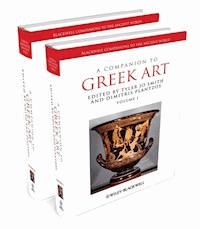
A Companion to Greek Art E-Book
38,99 €
Mehr erfahren.
- Herausgeber: John Wiley & Sons
- Kategorie: Geisteswissenschaft
- Serie: Blackwell Companions to the Ancient World
- Sprache: Englisch
A comprehensive, authoritative account of the development Greek Art through the 1st millennium BC.
- An invaluable resource for scholars dealing with the art, material culture and history of the post-classical world
- Includes voices from such diverse fields as art history, classical studies, and archaeology and offers a diversity of views to the topic
- Features an innovative group of chapters dealing with the reception of Greek art from the Middle Ages to the present
- Includes chapters on Chronology and Topography, as well as Workshops and Technology
- Includes four major sections: Forms, Times and Places; Contacts and Colonies; Images and Meanings; Greek Art: Ancient to Antique
Sie lesen das E-Book in den Legimi-Apps auf:
Seitenzahl: 1634
Veröffentlichungsjahr: 2012
Ähnliche




















Contents
Volume I
List of Illustrations
List of Color Plates
List of Maps
Notes on Contributors
Preface
PART I Introduction
CHAPTER 1 The Greeks and their Art
1.1 A Companion to Greek Art
1.2 Greek Art after the Greeks
1.3 A Companion to Greek Art
PART II Forms, Times, and Places
CHAPTER 2 Chronology and Topography
2.1 Chronology
2.2 Topography
2.3 Conclusion
CHAPTER 3 Greek Decorated Pottery I: Athenian Vase-painting
3.1 Introduction
3.2 Late Bronze Age and Sub-Mycenaean
3.3 Protogeometric
3.4 Protogeometric
3.5 Protoattic
3.6 Painters and Techniques
3.7 Black-figure
3.8 Red-figure
3.9 Trade and Distribution
3.10 Pictures
3.11 Shapes
3.12 Chronology
CHAPTER 4 Greek Decorated Pottery II: Regions and Workshops
4.1 Introduction
4.2 Corinthian
4.3 Boeotian
4.4 Euboean
4.5 Lakonian
4.6 Elean
4.7 Cycladic
4.8 Cretan
4.9 East Greek
4.10 Northern Greek
4.11 Conclusion
CHAPTER 5 Free-standing and Relief Sculpture
5.1 Introduction
5.2 The Geometric Period
5.3 The Archaic Period
5.4 The Classical Period
5.5 The Hellenistic Period
CHAPTER 6 Architecture in City and Sanctuary
6.1 Early Development in Greek Architecture
6.2 Forms and Conventions
6.3 The Temples
6.4 Other Buildings in Sanctuaries
6.5 City Planning
6.6 Public Structures in Greek Cities
6.7 Residential Structures
6.8 Tombs
CHAPTER 7 Architectural Sculpture
7.1 Introduction
7.2 Polychromy
7.3 Pediments
7.4 Friezes
7.5 Metopes
7.6 Acroteria
7.7 Sculptured Column Drums
7.8 Sculptured Ceiling Coffers
7.9 Caryatids and Telamons
7.10 Parapets
7.11 Medallion Busts
7.12 Testimonia
CHAPTER 8 Wall- and Panel-painting
8.1 Introduction
8.2 Techniques and Pigments
8.3 Tetrachromy, Polychromy, Skiagraphia
8.4 From Mimesis to Visual Trickery
8.5 The Evidence from Macedonian Tombs
8.6 Painting at the Time of Alexander and Later
8.7 Skenographia and the Invention of the Landscape
8.8 Art Criticism
CHAPTER 9 Mosaics
9.1 Pebble Mosaics: Origins, Function, and Design
9.2 Style and Chronology of Pebble Mosaics
9.3 Alternative Techniques, and the Development of Tessellated Mosaic
9.4 Tessellated Mosaics: Function and Meaning
CHAPTER 10 Luxury Arts
10.1 Introduction
10.2 Jewelry
10.3 Metal Vessels
10.4 Engraved Gems
10.5 Finger Rings
CHAPTER 11 Terracottas
11.1 Introduction
11.2 Technology
11.3 Types and Functions of Terracotta Figures
11.4 Terracottas, Bronzes, and Other Sculpture
CHAPTER 12 Coinages
12.1 Availability
12.2 Iconography
12.3 Opportunities
12.4 Weaknesses
12.5 The Die-engravers
12.6 Conclusion
CHAPTER 13 Workshops and Technology
13.1 Craft Workshops and the Community in the Greek World
13.2 The Potter’s Workshop
13.3 The Smith’s Workshop
13.4 The Sculptor’s Workshop
13.5 Workshops
13.6 Borrowings and Breakthroughs
13.7 Social Standing and Appreciation
CHAPTER 14 Ancient Writers on Art
14.1 Introduction
14.2 Inscriptions
14.3 Artists’ Treatises
14.4 Pliny and Pausanias
14.5 Homer and the Poets
14.6 Orators, Rhetoricians, and Essayists
14.7 Philosophers
14.8 Historians and Others
14.9 Conclusion
PART III Contacts and Colonies
CHAPTER 15 Egypt and North Africa
15.1 Greeks in Egypt: Prehistory
15.2 Greeks in Egypt: Archaic Contact
15.3 Naukratis
15.4 Other Sites
15.5 Decorated Pottery and Transport Amphorae
15.6 The Persian Conquest to the Ptolemies
15.7 Greek Colonies in North Africa
15.8 Conclusion
CHAPTER 16 Cyprus and the Near East
16.1 Introduction
16.2 The Greeks in Cyprus
16.3 The Greeks in Syria and the Levant
16.4 The Greeks in Persia
16.5 Conclusion
CHAPTER 17 Asia Minor
17.1 Introduction
17.2 Ionian Migration
17.3 Temples: An Exemplary Form of Greek Art and Architecture
17.4 Ionian, Phrygian, and Lydian Sculpture and Art
17.5 The Classical Period
17.6 The Hellenization of Dynastic Lycia
17.7 Alexander the Great and the Hellenistic Kingdoms
17.8 Sagalassos: From Rural Settlement to Hellenized Greek City
CHAPTER 18 The Black Sea
18.1 Introduction
18.2 First Traces of Greek Contacts
18.3 Foundation of Colonies and Greek Pottery Finds
18.4 Constitutions, Public Life, and Coinage
18.5 Agriculture, Handicrafts, and Fishing
18.6 Art and Warfare
18.7 Religion
18.8 Architecture
18.9 Sculpture, Painting, and Minor Arts
18.10 Graves and Burials
18.11 Greeks and Scythians
18.12 Greeks and Thracians
18.13 Eastern and Southern Black Sea
CHAPTER 19 Sicily and South Italy
19.1 Introduction
19.2 Late Geometric and Orientalizing
19.3 Archaic
19.4 Early Classical
19.5 High Classical
19.6 Late Classical
19.7 Hellenistic
19.8 Conclusion
Volume II
List of Illustrations
Notes on Contributors
PART IV Images and Meanings
CHAPTER 20 Olympian Gods at Home and Abroad
20.1 Introduction
20.2 The Gods on the Parthenon Frieze
20.3 Gods on Earth: The Wedding of Peleus and Thetis
20.4 Warfare and the Gods
20.5 A Hero Among the Gods
20.6 Epilogue: Gods and Mortals on the Parthenon
CHAPTER 21 Politics and Society
21.1 Introduction
21.2 Burial and Cultic Evidence, Iconography, and Iron Age Society
21.3 Tyrants, Aristocrats, and their Impact on Art in the Archaic Period
21.4 Images and Dedications of Famous and Anonymous People
21.5 The Impact of the Persian Wars on Early Classical Art (c. 490–450 BC)
21.6 Interaction of Civic Life and Visual Arts during the Classical Period
21.7 Epilogue: Hellenistic Art, Rulers, and Society
CHAPTER 22 Personification: Not Just a Symbolic Mode
22.1 Introduction
22.2 Personification in Greek Art
22.3 Personification and Agency
CHAPTER 23 The Non-Greek in Greek Art
23.1 Introduction
23.2 Encountering the Uncivilized
23.3 Pre-Classical Amazons
23.4 Legendary Trojans
23.5 Encountering Non-Greeks
23.6 Greeks versus Persians: Non-Greek Others in Monumental Art of the Classical Period
23.7 Conclusion
CHAPTER 24 Birth, Marriage, and Death
24.1 Introduction
24.2 Birth
24.3 Marriage
24.4 Death
CHAPTER 25 Age, Gender, and Social Identity
25.1 Introduction
25.2 Geometric to Archaic
25.3 Classical
25.4 Hellenistic
CHAPTER 26 Sex, Gender, and Sexuality
26.1 Introduction
26.2 The Seeming Transparency of Greek Art
26.3 Sex
26.4 Gender
26.5 Sexuality
26.6 Heterosexuality
26.7 Homosexuality
26.8 Conclusion
CHAPTER 27 Drinking and Dining
27.1 Introduction
27.2 The Changing Role of Dining from the Bronze Age to the Classical Period
27.3 The Symposion: A Definition
27.4 The Development of the Symposion
27.5 Sympotic Equipment
27.6 Decoration on Sympotic Vases
27.7 The Export Market
27.8 Drinking, Dining, and Greek Culture
CHAPTER 28 Competition, Festival, and Performance
28.1 Introduction
28.2 Athlete, Sport, and Games
28.3 Dance, Drama, and Dithyramb
28.4 ‘Tenella Kallinike’ (‘Hurrah, Fair Victor!’)
CHAPTER 29 Figuring Religious Ritual
29.1 Introduction
29.2 Sacrifice, Procession, Consumption
29.3 Space, Gestures, Time
29.4 Dionysian Imagery
CHAPTER 30 Agency in Greek Art
30.1 Introduction: Agency and Pausanias
30.2 Concepts of Agency
30.3 From the François Vase to the Euphronios Krater
30.4 Myron’s Diskobolos
30.5 Conclusion
PART V Greek Art: Ancient to Antique
CHAPTER 31 Greek Art through Roman Eyes
31.1 Introduction
31.2 Greek Art as Roman Art, and Vice Versa: The Tabula Iliaca Capitolina
31.3 Greek Art as Roman Cultural Capital: ‘Cubiculum B’ in the Villa Farnesina
31.4 Greek Art and Roman Decor: The Sperlonga Grotto
31.5 Conclusion: Greek Art through Roman Eyes
CHAPTER 32 Greek Art in Late Antiquity and Byzantium
32.1 Introduction
32.2 Athens
32.3 Constantinople
CHAPTER 33 The Antique Legacy from the Middle Ages to the Enlightenment
33.1 Introduction
33.2 The Medieval Period
33.3 The Renaissance
33.4 The Age of Enlightenment
33.5 Conclusion
CHAPTER 34 Greek Art and the Grand Tour
34.1 The Grand Tour in Outline
34.2 Greek Art in Italy
34.3 What They Saw on the Grand Tour
34.4 Emma Hamilton’s Attitudes
34.5 Rediscovering Greek Architecture on the Grand Tour to Italy and Greece
34.6 The Impact of the Grand Tour
CHAPTER 35 Myth and the Ideal in 20th c. Exhibitions of Classical Art
35.1 The Rise of Idealism
35.2 The Beau-Ideal Tradition
35.3 Ideal in Style – Ideal in System
35.4 The Overtly Political Louvre
35.5 Epistemological Tension at the British Museum
35.6 The Educational Aspect of Beauty at the Metropolitan Museum of Art
35.7 Antiquity at the National Archaeological Museum at Athens
35.8 Conclusion
CHAPTER 36 The Cultural Property Debate
36.1 ‘Who Owns Ancient Art and Cultural Heritage?’
36.2 Owning Ancient Art and Cultural Heritage
36.3 ‘The Nation is the Steward of Cultural Property’
36.4 ‘Of Humankind’
36.5 Deconstructing the National: Critique and New Developments
36.6 ‘Peopling the Nations’ and the Social Value of the Past
36.7 ‘Cultural Property Internationalism’
36.8 Conclusion: ‘Someone Always Owns the Past’
CHAPTER 37 Greek Art at University, 19th–20th c.
37.1 Introduction
37.2 Origins of Classical Archaeology
37.3 Classical Studies in Germany
37.4 Architects, Artists, and the Study of Greek Archaeology
37.5 Classical Archaeology in the United States
37.6 Classical Archaeology in France and Italy
37.7 Classical Archaeology in Great Britain
37.8 Classical Archaeology in the Interwar Period
37.9 Classical Archaeology after World War II
CHAPTER 38 Surveying the Scholarship
38.1 First in the Humanities
38.2 Opening the Flood Gates: Content Portals
38.3 Still in the Books Stacks
38.4 Excavation Reports and the National Schools
38.5 Travelers and Popular Writers
38.6 The Search for the Perfect Picture
38.7 The Path Not Yet Taken
Bibliography
Plates
Index
BLACKWELL COMPANIONS TO THE ANCIENT WORLD
This series provides sophisticated and authoritative overviews of periods of ancient history, genres of classical literature, and the most important themes in ancient culture. Each volume comprises between twenty-five and forty concise essays written by individual scholars within their area of specialization. The essays are written in a clear, provocative, and lively manner, designed for an international audience of scholars, students, and general readers.
ANCIENT HISTORY
Published
A Companion to the Roman ArmyEdited by Paul Erdkamp
A Companion to the Roman RepublicEdited by Nathan Rosenstein and Robert Morstein-Marx
A Companion to the Roman EmpireEdited by David S. Potter
A Companion to the Classical Greek WorldEdited by Konrad H. Kinzl
A Companion to the Ancient Near EastEdited by Daniel C. Snell
A Companion to the Hellenistic WorldEdited by Andrew Erskine
A Companion to Late AntiquityEdited by Philip Rousseau
A Companion to Ancient HistoryEdited by Andrew Erskine
A Companion to Archaic GreeceEdited by Kurt A. Raaflaub and Hans van Wees
A Companion to Julius CaesarEdited by Miriam Griffin
A Companion to ByzantiumEdited by Liz James
A Companion to Ancient EgyptEdited by Alan B. Lloyd
A Companion to Ancient MacedoniaEdited by Joseph Roisman and Ian Worthington
A Companion to the Punic WarsEdited by Dexter Hoyos
A Companion to AugustineEdited by Mark Vessey
A Companion to Marcus Aurelius
Edited by Marcel van Ackeren
Literature and Culture
Published
A Companion to Classical ReceptionsEdited by Lorna Hardwick and Christopher Stray
A Companion to Greek and Roman HistoriographyEdited by John Marincola
A Companion to CatullusEdited by Marilyn B. Skinner
A Companion to Roman ReligionEdited by Jörg Rüpke
A Companion to Greek ReligionEdited by Daniel Ogden
A Companion to the Classical TraditionEdited by Craig W. Kallendorf
A Companion to Roman RhetoricEdited by William Dominik and Jon Hall
A Companion to Greek RhetoricEdited by Ian Worthington
A Companion to Ancient EpicEdited by John Miles Foley
A Companion to Greek TragedyEdited by Justina Gregory
A Companion to Latin LiteratureEdited by Stephen Harrison
A Companion to Greek and Roman Political ThoughtEdited by Ryan K. Balot
A Companion to OvidEdited by Peter E. Knox
A Companion to the Ancient Greek LanguageEdited by Egbert Bakker
A Companion to Hellenistic LiteratureEdited by Martine Cuypers and James J. Clauss
A Companion to Vergil’s Aeneid and its TraditionEdited by Joseph Farrell and Michael C. J. Putnam
A Companion to HoraceEdited by Gregson Davis
A Companion to Families in the Greek and Roman WorldsEdited by Beryl Rawson
A Companion to Greek MythologyEdited by Ken Dowden and Niall Livingstone
A Companion to the Latin LanguageEdited by James Clackson
A Companion to TacitusEdited by Victoria Emma Pagán
A Companion to Women in the Ancient WorldEdited by Sharon L. James and Sheila Dillon
A Companion to SophoclesEdited by Kirk Ormand
A Companion to the Archaeology of the Ancient Near EastEdited by Daniel Potts
A Companion to Roman Love ElegyEdited by Barbara K. Gold
A Companion to Greek ArtEdited by Tyler Jo Smith and Dimitris Plantzos
This edition first published 2012© 2012 Blackwell Publishing Ltd.
Blackwell Publishing was acquired by John Wiley & Sons in February 2007. Blackwell’s publishing program has been merged with Wiley’s global Scientific, Technical, and Medical business to form Wiley-Blackwell.
Registered OfficeJohn Wiley & Sons, Ltd, The Atrium, Southern Gate, Chichester, West Sussex, PO19 8SQ, UK
Editorial Offices350 Main Street, Malden, MA 02148-5020, USA9600 Garsington Road, Oxford, OX4 2DQ, UKThe Atrium, Southern Gate, Chichester, West Sussex, PO19 8SQ, UK
For details of our global editorial offices, for customer services, and for information about how to apply for permission to reuse the copyright material in this book please see our website at www.wiley.com/wiley-blackwell.
The right of Tyler Jo Smith and Dimitris Plantzos to be identified as the authors of the editorial material in this work has been asserted in accordance with the UK Copyright, Designs and Patents Act 1988.
All rights reserved. No part of this publication may be reproduced, stored in a retrieval system, or transmitted, in any form or by any means, electronic, mechanical, photocopying, recording or otherwise, except as permitted by the UK Copyright, Designs and Patents Act 1988, without the prior permission of the publisher.
Wiley also publishes its books in a variety of electronic formats. Some content that appears in print may not be available in electronic books.
Designations used by companies to distinguish their products are often claimed as trademarks. All brand names and product names used in this book are trade names, service marks, trademarks or registered trademarks of their respective owners. The publisher is not associated with any product or vendor mentioned in this book. This publication is designed to provide accurate and authoritative information in regard to the subject matter covered. It is sold on the understanding that the publisher is not engaged in rendering professional services. If professional advice or other expert assistance is required, the services of a competent professional should be sought.
Library of Congress Cataloging-in-Publication Data
A companion to Greek art / edited by Tyler Jo Smith, Dimitris Plantzos.p. cm. – (Blackwell companions to the ancient world ; 90)Includes bibliographical references and index.
ISBN 978-1-4051-8604-9 (hardback)1. Art, Greek–History. I. Smith, Tyler Jo. II. Plantzos, Dimitris.N5630.C716 2012709.38–dc23
2011046043
A catalogue record for this book is available from the British Library.
List of Illustrations
Figure 1.1
Megarian bowl from Thebes. Scenes of the Underworld. c. 200
BC
( London, British Museum 1897.0317.3. © The Trustees of the British Museum).
Figure 1.2
Attic marble votive relief from Eleusis. Cave of Pan. 4
th
c.
BC
(Athens, National Museum 1445. Photo: Studio Kontos/Photostock).
Figure 1.3
Lakonian lead figurine of a warrior, from Sparta. 6
th
–5
th
c.
BC
(New York, Metropolitan Museum of Art. Gift of A.J.B. Wace, 1924 (24.195.64). Image © The Metropolitan Museum of Art/Art Resource/Scala, Florence).
Figure 1.4
London, Hyde Park Gate, designed by Decimus Burton with a free version of the Parthenon frieze designed by John Henning, 1825 (photo: D. Plantzos).
Figure 1.5
Athens, the building of the Academy designed by Theophile Hansen, with free-standing statues of Athena and Apollo by Leonidas Drosis, 1859–1887 (photo: D. Plantzos).
Figure 1.6
Athens, ‘Greek art’ replicas on sale in one of the city’s souvenir shops, 2011 (photo: D. Plantzos).
Figure 2.1
Development of Lakonian Pottery (after Dawkins 1929: pl. 19).
Figure 2.2
Chronological table of overlapping terminologies, historical, cultural, and artistic events (after Whitley 2001: 62,
fig. 4.1
).
Figure 2.3
Athenian red-figure pelike fragment. Hermaic stelai. c. 480–470
BC
( Paris, Louvre C 10793 © RMN/Hervé Lewandowski).
Figure 2.4
Plan of Alexandria (after Hoepfner and Schwandner 1994: fig. 225).
Figure 2.5
Athens, the Agora. Planning development from the Archaic to the Hellenistic period (after Camp 1986: figs. 21, 66 and 139).
Figure 3.1
Chart of main Greek pottery shapes (after Pedley 2007: fig. 6.72).
Figure 3.2
Athenian Late Geometric krater. Funeral procession. c. 745–740
BC
(Athens, National Archaeological Museum A 990. Photo: akg-images/Erich Lessing).
Figure 3.3
Athenian black-figure dinos signed by the painter Sophilos. Wedding of Peleus and Thetis. c. 580
BC
(London, British Museum 1971, 1101.1).
Figure 3.4
Athenian black-figure kylix. Gigantomachy. c. 550–540
BC
( Munich, Staatliche Antikensammlungen und Glypothek 2238. Photo: Renate Kühling).
Figure 3.5
Athenian red-figure kylix signed by Douris. School scene. c. 485–480
BC
(Berlin, Archaeological Museum 2285. Photo: Johannes Laurentius. © 2011. Photo Scala, Florence/BPK, Bildagentur für Kunst, Kultur und Geschichte, Berlin).
Figure 3.6
Athenian red-figure amphora of Panathenaic shape. Gorgon pursued by Perseus. c. 490–480
BC
( Munich, Staatliche Antikensammlungen und Glypothek 2312. Photo: Renate Kühling).
Figure 3.7
Athenian white-ground lekythos. Mistress and maid with child. c. 460–450
BC
(Berlin, Archaeological Museum 2443. bpk/Antikensammlung, Staatliche Museen zu Berlin/Johannes Laurentius).
Figure 4.1
Middle Protocorinthian aryballos. Bellerophon and the Chimaira. c. 660
BC
(Boston, Museum of Fine Arts 95.10. USA/Catharine Page Perkins Fund/The Bridgeman Art Library).
Figure 4.2
Corinthian Outline Style oinochoe. Ritual race (?) or
komos
(?). c. 450–400
BC
(Corinth Archaeological Museum C-1934-362, 2003-2-28, Hesperia 1937: 311–312, fig. 40. Courtesy of the American School of Classical Studies, Corinth Excavations, I. Ioannidou and L. Bartzioti).
Figure 4.3
Boeotian black-figure kantharos. Komasts. Mid 6th c.
BC
(Munich, Staatliche Antikensammlungen und Glypothek 6010. Photo: Renate Kühling).
Figure 4.4
Boeotian Kabeiran skyphos fragments. Kabeiros reclining, to left ‘caricatured’ figures. c. 410–400
BC
(Athens, National Archaeological Museum 10426. © Hellenic Ministry of Culture and Tourism/Archaeological Receipts Fund).
Figure 4.5
Eretrian Orientalizing amphora. c. 625–600
BC
(Athens, National Archaeological Museum 12077. Photo: Studio Kontos/Photostock).
Figure 4.6
Lakonian black-figure cup (interior). Hunt for the Kalydonian Boar. c. 560
BC
( Paris, Louvre E 670 Giraudon/ The Bridgeman Art Library).
Figure 4.7
‘Melian’ amphora. Riders. c. 660
BC
(Athens, National Archaeological Museum 912. Photo: Studio Kontos/Photostock).
Figure 4.8
South Ionian Wild Goat Style oinochoe. c. 630–620
BC
(Tübingen, Institut für Klassische Archäologie 1237).
Figure 4.9
Fikellura style amphora with a running man. c. 530
BC
(London, British Museum 1864,1007.156. © The Trustees of the British Museum).
Figure 4.10
Klazomenian black-figure amphora. c. 540–525 (London, British Museum 1888.2-8.71a. © The Trustees of the British Museum).
Figure 5.1
Marble statue of a maiden (kore). c. 510
BC
( Athens, Acropolis Museum 675. Evangelos Tsiamis/Acropolis Museum Acr. 675).
Figure 5.2
Marble statue of a youth (kouros). c. 600
BC
(Athens, National Archaeological Museum 2720. Photo © AISA/The Bridgeman Art Library).
Figure 5.3
Marble statue of a youth. c. 460
BC
(Mozia, Whitaker Museum 23102. © Johnny Jones/Alamy).
Figure 5.4
Marble statue of a youth. Roman copy of the bronze Doryphoros by Polykleitos. c. 440
BC
(Minneapolis Institute of Arts 86.6). The John R. Van Derlip Fund and Gift of funds from Bruce B. Dayton, an anonymous donor, Mr and Mrs Kenneth Dayton, Mr and Mrs W John Driscoll, Mr and Mrs Alfred Harrison, Mr and Mrs John Andrus, Mr and Mrs Judson Dayton, Mr and Mrs Stephen Keating, Mr and Mrs Pierce McNally, Mr and Mrs Donald Dayton, Mr and Mrs Wayne MacFarlane, and many other generous friends of the Institute.
Figure 5.5
Marble statue of Athena. Roman copy of the chryselephantine Athena Parthenos by Pheidias. c. 447–432
BC
(Athens, National Archaeological Museum 129. © Universal Images Group/SuperStock).
Figure 5.6
Marble gravestone of Ampharete. c. 410
BC
(Athens, Kerameikos Museum P 695, I 221. © Karl Hausammann/Alamy).
Figure 5.7
Marble statue of Aphrodite. Roman copy of the Knidian Aphrodite by Praxiteles. c. 350
BC
. (Vatican, Museo Pio-Clementino. © 2011. Photo Scala, Florence).
Figure 5.8
Marble head of Alexander. c. 330–320
BC
(Athens, Acropolis Museum 1331. Socratis Mavrommatis/Acropolis Museum, Acr. 1331).
Figure 5.9
Marble statue of an athlete. Roman copy of the bronze ‘Apoxyomenos’ by Lysippos. c. 330
BC
. (Vatican, Museo Pio-Clementino. © 2011. Photo Scala, Florence).
Figure 5.10
Marble statue of Gaul chieftain committing suicide alongside his wife. c. 220–210
BC
(Rome, Terme National Museum 8608. The Art Archive/Museo Nazionale Terme Rome/Gianni Dagli Orti).
Figure 6.1
Lefkandi (Euboea). Reconstruction of the ‘heroon’. 10
th
c.
BC
(after Boardman 1996: 31, fig. 13).
Figure 6.2
Standard Greek temple plan.
Figure 6.3
Greek architectural orders (after Jenkins 2006: fig. 1).
Figure 6.4
Athens, the Hephaisteion. c. 450–400
BC
(American School of Classical Studies at Athens: Agora Excavations).
Figure 6.5
Acropolis, the Erechtheion. c. 430/420–410/400
BC
(American School of Classical Studies at Athens: Agora Excavations).
Figure 6.6
Delphi, the Tholos. c. 390–380
BC
(photo: D. Plantzos).
Figure 6.7
Delphi, the Athenian Treasury (restored). c. 490–450
BC
(photo: D. Plantzos).
Figure 7.1
Reconstruction of the Siphnian Treasury in Delphi. c. 525
BC
(drawing after E. Hansen).
Figure 7.2
West frieze of the Great Altar of Pergamon. Detail showing Nereus and Oceanus fighting the Giants. c. 170
BC
(Berlin, Pergamon Museum. © Ruggero Vanni/Corbis).
Figure 7.3
Parthenon, reconstruction of the east pediment. 447–432
BC
(drawing by K. Iliakis).
Figure 7.4
Reconstruction of the north pediment of the Hieron of Samothrace. c. 280
BC
(drawing by D. Scahill).
Figure 7.5
The Mausoleum at Halikarnassos, slab from the Amazonomachy frieze. c. 360–350 (London, British Museum 1015. © The Trustees of the British Museum).
Figure 7.6
Parthenon, south metope 27. Fight between a human Lapith and a centaur. 447–432
BC
(London, British Museum. © Universal Images Group/SuperStock).
Figure 7.7
Marble acroterion from a temple in the Athenian Agora. Nike. c. 420–400
BC
(Athens, Agora Archaeological Museum S312. American School of Classical Studies at Athens: Agora Excavations).
Figure 7.8
Artemision of Ephesos, sculptured column drum. Hermes and Alcestis. c. 320
BC
(London, British Museum 1206. © The Trustees of the British Museum).
Figure 8.1
Wooden panel depicting a sacrifice scene. Pitsa Cave, Peloponnese. 540–530
BC
(Athens, National Archaeological Museum 16464. © Universal Images Group/SuperStock).
Figure 8.2
Wall-painting depicting a banquet. Tomb of the Diver, Paestum. c. 470
BC
(Paestum, National Archaeological Museum. © The Art Archive/ SuperStock).
Figure 8.3
Mosaic pavement of an unswept floor, presumably copying a Hellenistic original by Sosos. From the Aventine Hill, Rome. 2
nd
c.
AD
. (Vatican, Museo Gregoriano Profano. © 2011. Photo Scala, Florence).
Figure 8.4
Wall-painting depicting a guard in Macedonian military gear from the façade of the Tomb at Agios Athanasios, Thessaloniki. c. 300
BC
(Tsimpidou-Avloniti 2005: table 39, Hellenic Ministry of Culture – Archaeological Receipts Fund).
Figure 8.5
Mosaic panel depicting a battle of Alexander against Darius. From the House of the Faun, Pompeii. Late 2
nd
c.
BC
(Naples, National Archaeological Museum. © David Lees/Corbis).
Figure 8.6
Painted gravestone of Hediste from Demetrias, Thessaly. c. 200
BC
(Volos, Archaeological Museum L 1. © The Art Archive/Alamy).
Figure 9.1
Pebble mosaics, dining-room, and anteroom, ‘House of the Mosaics’ at Eretria. c. 375–350
BC
(Photo courtesy of the Swiss School of Archaeology in Greece).
Figure 9.2
Mosaic of irregular tesserae and split pebbles at Euesperides, set in a surround of pebble mosaic. 261–c. 250
BC
(Photo © John Lloyd, 1998).
Figure 9.3
Tessellated mosaic, site of the new Bibliotheca Alexandrina, Alexandria. Crouching dog. Probably 2
nd
c.
BC
(© BA Antiquities Museum/M. Nafea).
Figure 9.4
Tessellated mosaic, House III S, Theater Quarter, Delos. Late 2
nd
or early 1
st
c.
BC
(Photo © Ruth Westgate).
Figure 10.1
Gold earring, said to come from Rhodes. 7
th
c.
BC
(London, British Museum BM 1860.0404.107 (1174/75) © The Trustees of the British Museum).
Figure 10.2
Gold pendant disc from Kul Oba (Crimea). Head of Athena. c. 400–350
BC
(St Petersburg, Hermitage Museum KO5. Fine Art Images/Heritage- Images/TopFoto).
Figure 10.3
Pair of gold boat-shaped earrings, said to come from Eretria. c. 420–400
BC
(London, British Museum BM 1893.11-3.1. © The Trustees of the British Museum).
Figure 10.4
Gold strap necklace with seed-like pendants, said to be from Melos. c. 330–300
BC
(London, British Museum BM 1872.6-4.660. © The Trustees of the British Museum).
Figure 10.5
Agate sealstone in the form of a scarab. A satyr at the
symposion
. c. 550–500
BC
(London, British Museum BM GR 1865.7-12.106 (Gems 465). © The Trustees of the British Museum).
Figure 10.6
Impression of a chalcedony sealstone signed by Dexamenos of Chios. A flying heron. c. 450–430
BC
(St Petersburg, Hermitage Museum Ju O. 24. Beazley Archive, Oxford University. Photo: C. Wagner).
Figure 10.7
Chalcedony sealstone. Nike erecting a trophy. c. 350
BC
(London, British Museum GR 1865.7-12.86. © The Trustees of the British Museum).
Figure 10.8
Impression of a tourmaline sealstone. Portrait of Alexander the Great. c. 330–300
BC
(Oxford, Ashmolean Museum. Beazley Archive, Oxford University. Photo: C. Wagner).
Figure 10.9
Gold finger ring. Herakles worshipping. Late 5
th
c.
BC
(Private collection. Beazley Archive, Oxford University. Photo: C. Wagner).
Figure 11.1
Terracotta model. Mule carrying amphorae. c. 780–720
BC
(London, British Museum GR.1921.11–29.2. © The Trustees of the British Museum).
Figure 11.2
Terracotta figurine. Goddess. c. 520–500
BC
(London, British Museum 68. © The Trustees of the British Museum).
Figure 11.3
Terracotta figurine. Woman carrying water jar. c. 200
BC
(London, British Museum 2518. © The Trustees of the British Museum).
Figure 11.4
Terracotta ‘Tanagra’ figurine. Woman. c. 250–200
BC
(Cambridge, Fitzwilliam Museum GR66.1937. University of Cambridge/The Bridgeman Art Library).
Figure 11.5
Terracotta figurine. Winged Victory (Nike). c. 180
BC
(Boston, Museum of Fine Arts 01.7690. Museum purchase/The Bridgeman Art Library).
Figure 12.1
Silver stater of Elis/Olympia. Head of Zeus (obverse). c. 330
BC
(All rights reserved. Brussels, Royal Library of Belgium).
Figure 12.2
Silver tetradrachm of Syracuse. Head of Athena (reverse). c. 410
BC
(All rights reserved. Brussels, Royal Library of Belgium).
Figure 12.3
Silver decadrachm of Syracuse. Head of Arethusa (reverse). Signed by Kimon. c. 405–400
BC
(All rights reserved. Brussels, Royal Library of Belgium).
Figure 12.4
Silver decadrachm of Syracuse. Head of Arethusa (reverse). Signed by Evainetos. c. 400–390
BC
(All rights reserved. Brussels, Royal Library of Belgium).
Figure 12.5
Silver tetradrachm of Alexander the Great, possibly struck in Memphis. Head of Herakles (obverse). c. 321
BC
(All rights reserved. Brussels, Royal Library of Belgium).
Figure 12.6
Silver tetradrachm of Athens. (a) Head of Athena (obverse). (b) Owl (reverse) c. 450–431
BC
(All rights reserved. Brussels, Royal Library of Belgium).
Figure 12.7
Silver tetradrachm of Syracuse. (a) Quadriga (obverse). Signed by Euth[…]. (b) Head of Arethusa (reverse). Signed by Eum[…]. c. 410
BC
(All rights reserved. Brussels, Royal Library of Belgium).
Figure 12.8
Silver tetradrachm of Alexander the Great, struck by Nikokles of Paphos. Head of Herakles (obverse). c. 320
BC
(after E.T. Newell 1919) (All rights reserved. Brussels, Royal Library of Belgium).
Figure 12.9
Silver tetradrachm of Syracuse. (a) Quadriga (obverse). Signed by Kimon. (b) Head of Arethusa (reverse). c. 410
BC
(All rights reserved. Brussels, Royal Library of Belgium).
Figure 12.10
Silver tetradrachm of Mithridates Eupator of Pontos. (a) Head of Mithridates (obverse). (b) Pegasos (reverse). 89
BC
(All rights reserved. Brussels, Royal Library of Belgium).
Figure 12.11
Silver tetradrachm of Aitna. (a) Head of Silenos (obverse). (b) Zeus (reverse). c. 465
BC
(All rights reserved. Brussels, Royal Library of Belgium).
Figure 12.12
Silver tetradrachm of Naxos. (a) Head of Dionysos (obverse). (b) Silenos (reverse). c. 460
BC
. (All rights reserved. Brussels, Royal Library of Belgium).
Figure 13.1
Athenian red-figure calyx-krater (Caltagirone, Museo Regionale della Ceramica 961. Drawing by D. Weiss).
Figure 13.2
Black-figure plaque. A potter by his kiln. 6
th
c.
BC
(Paris, Louvre MNB 2858; drawing after Hoffmann and Boehm 1965: fig. 147).
Figure 13.3
Black-figure plaque. A potter working at a kiln loaded with pottery wares. 6
th
c.
BC
. (Berlin, Antikensammlung F893; drawing after Hoffmann and Boehm 1965: fig. 147).
Figure 13.4
Suggested diagram of the three stages (oxidization, reduction, reoxidization) in a single firing of Athenian gloss-covered pottery (drawing by E. Hasaki, adapted from Clark et al. 2002: 92, fig. 88).
Figure 13.5
Techniques of bronze-working and select examples of each (illustration by E. Hasaki and D. Weiss).
Figure 13.6
Athenian red-figure kylix (Foundry Cup). c. 490–480
BC
(Berlin, Antikensammlungen F 2294. bpk/Antikensammlung, SMB/Johannes Laurentius).
Figure 13.7
Relief on a sarcophagus, from Ephesos. A sculptor’s workshop. 2
nd
c.
AD
(inv. 775 T. DAI neg. no. 1055-D-DAI-IST-R16453/Mendel Foto).
Figure 15.1
Statuette of kouros, from Naukratis. 6
th
c.
BC
(London, British Museum GR 1888,1006.1 (sculpture B 438). © The Trustees of the British Museum).
Figure 15.2
East Greek ‘situla’, from Tell Defenneh. 6
th
c.
BC
(London, British Museum GR 1888.2-8.1 © The Trustees of the British Museum).
Figure 15.3
Bronze statuette of Alexander Aigiochos. 1
st
c.
AD
(London, British Museum 1922,0711.1. © The Trustees of the British Museum).
Figure 15.4
Marble statuette of Sarapis. 1
st
–2
nd
c.
AD
(LOAN ant.103.93. Reproduced by permission of the Master and Fellows of Corpus Christi College, Cambridge. Photo © The Fitzwilliam Museum, Cambridge).
Figure 16.1
Rhodian aryballos. Late 8
th
–early 7
th
c.
BC
(Rhodes, Archaeological Museum; drawing by S. Grice).
Figure 16.2
Athenian oinochoe produced for the Cypriot market. Mythological scene. c. 550
BC
(London, British Museum 94.11–1.476. © The Trustees of the British Museum).
Figure 16.3
Limestone statue of a maiden (kore). c. 500
BC
(London, British Museum C280. © The Trustees of the British Museum).
Figure 16.4
Cypro-Phoenician silver bowl from Amathus. Egyptianizing deities, sphinxes, city-siege. c. 750–600
BC
(London, British Museum 123053. © The Trustees of the British Museum).
Figure 16.5
Relief from Palace P at Pasargadae. Late 6
th
c.
BC
(photo: J. Boardman).
Figure 17.1
The Temple of Apollo ruins at the Didyma site in western Turkey. 3
rd
c.
BC
–2
nd
c.
AD
(© Pixtal/SuperStock).
Figure 17.2
Didyma, Temple of Apollo. 3
rd
c.
BC
–2
nd
c.
AD
(after Jenkins 2006: fig. 31).
Figure 17.3
Didyma, Temple of Apollo: fragment of female figure (kore) carved onto a column. 6th c.
BC
. (bpk/Antikensammlung, Staatliche Museen zu Berlin/ Johannes Laurentius).
Figure 17.4
Ivory statuette of female figure with children, from Bayındır. Late 8
th
–7
th
c.
BC
(Antalya, Archaeological Museum 2.21.87 © Bogdan Berkowskiy).
Figure 17.5
Statue of a wounded Amazon. Marble copy after a Greek original of c. 440–430
BC
(so-called Sciarra type) (Berlin, Antinkensammlung, Staatliche Museen zu Berlin. Photo: Juergen Liepe. © 2011. Photo Scala, Florence/BPK, Bildagentur für Kunst, Kultur und Geschichte, Berlin).
Figure 17.6
Reconstruction drawings of the Mausoleum of Mausolos and Artemisia, Halikarnassos. Mid 4
th
c.
BC
(after Jenkins 2006: figs. 205–208).
Figure 17.7
The Nereid Monument at Xanthos (Lycia). c. 400
BC
(London, British Museum. © Peter Horree/Alamy).
Figure 18.1
Jubilejnoe II (Russia), reliefs from a heroon. 4
th
c.
BC
(drawing by D. Weiss).
Figure 18.2
Gold pectoral from Tolstaya Mogila, Ukraine. 4
th
c.
BC
(Kiev, Historical Museum, Ukraine/Photo © Boltin Picture Library/The Bridgeman Art Library).
Figure 18.3
Gold vessel decorated in relief from Kul Oba (Crimea). Herakles with Scythian warriors. Second half of the 4
th
c.
BC
(St Petersburg, State Hermitage Museum K-O 11. akg-images/Electa).
Figure 18.4
Silver phiale from Duvanli (Bulgaria). Chariot race. Late 5
th
c.
BC
(Bashova Tumulus, Plovdiv, Bulgaria. © The Art Archive/Alamy).
Figure 18.5
Silver phiale from the Rogozen treasure (Bulgaria). Herakles and Auge. 4
th
c.
BC
(Vratsa, Regional Historical Museum NIM 22304. INTERFOTO/Alamy).
Figure 18.6
Marble relief from Plevna (Bulgaria). A Thracian hero. 2
nd
c.
AD
(Pleven, Regional Historical Museum. Drawing by D. Weiss).
Figure 19.1
Krater from Cerveteri, signed by Aristonothos. Odysseus and his men blind the cyclops Polyphemos. Mid 7
th
c.
BC
(Rome, Capitoline Museums Ca 172. © Gianni Dagli Orti/Corbis).
Figure 19.2
The so-called ‘Temple of Poseidon’, Paestum. c. 460
BC
(© Jim Zuckerman/Corbis).
Figure 19.3
Selinus, limestone metope from ‘Temple E’. Hieros Gamos between Zeus and Hera. c. 460–450
BC
(Palermo, Regional Archaeological Museum ‘Antonino Salinas’ 3921B. Photo Scala, Florence – courtesy of the Ministero Beni e Att. Culturali).
Figure 19.4
Apulian red-figure ‘phlyax’ vase. Chiron and Apollo. c. 380–370
BC
( London, British Museum F151. © The Trustees of the British Museum).
Figure 19.5
Limestone grave relief from Taras. Young warrior and woman in front of an altar (Elektra and Orestes?). c. 300
BC
(New York, Metropolitan Museum of Art Fletcher Fund, 1929. Acc.n.: 29.54. Image © The Metropolitan Museum of Art/Art Resource/Scala, Florence).
List of Color Plates
Plate 1
Chian chalice. Lion. c. 575–550
BC
(Thessaloniki Archaeological Museum 14305. © Hellenic Ministry of Culture and Tourism/Archaeological Receipts Fund).
Plate 2
Athenian black-figure amphora signed by Exekias. Achilles and Ajax playing dice. c. 530
BC
(Rome, Museums of the Vatican 16757 (344). Gregorian Museum of Etruscan Art. © Universal Images Group/SuperStock).
Plate 3
Athenian white-ground calyx-krater. Hermes entrusts the infant Dionysos to a silen and nymphs. c. 440–435
BC
(Rome, Museums of the Vatican 16586 (559). Gregorian Museum of Etruscan Art. Photo Scala, Florence).
Plate 4
Pair of bronze statues of soldiers (The Riace Warriors). (a): c. 450
BC
; (b): c. 430
BC
(Reggio di Calabria, National Museum. Photo Scala, Florence – courtesy of the Ministero Beni e Att. Culturali).
Plate 5
Marble relief from the east frieze of the Parthenon (slab V). The frieze is usually thought to show the procession of the Panathenaic festival, the commemoration of the birthday of the goddess Athena. 447–432
BC
(London, British Museum 1816,0610.19. © The Trustees of the British Museum).
Plate 6
Athenian Acropolis, the Parthenon. 447–432
BC
(© SuperStock).
Plate 7
Epidauros, the theater. 4
th
c.
BC
(
TakB/Shutterstock.com
).
Plate 8
Wall-painting depicting Hades abducting Persephone. Persephone Tomb, Vergina. c. 350–340
BC
(Vergina, Macedonia, Greece. The Bridgeman Art Library).
Plate 9
Wall-painting depicting a female kithara player with younger
companion. From the Villa of P. Publius Synistor, Boscoreale. c. 50–40
BC
(New York, Metropolitan Museum of Art. Rogers Fund, 1903. Acc.n. 03.14.5. Image © The Metropolitan Museum of Art/Art Resource/Scala, Florence).
Plate 10
Mosaic signed by Gnosis, ‘House of the Rape of Helen’ at Pella. ‘The Deer Hunt’. c. 325–300
BC
(© World History Archive/Alamy).
Plate 11
Bronze krater from Derveni (northern Greece). Dionysos and Ariadne. c. 330–320
BC
(Thessaloniki Archaeological Museum B1. © DeAgostini/SuperStock).
Plate 12
Sardonyx plate (‘Tazza Farnese’) engraved in the cameo technique. Isis and other Egyptian divinities in an allegory of fertility. Late 2
nd
–early 1
st
c.
BC
(Naples, National Archaeological Museum. Photo Scala, Florence – courtesy of the Ministero Beni e Att. Culturali).
List of Maps
Map 1
Greece and the Aegean (source: Erskine,
Companion to Ancient History
, map 1; adapted by D. Weiss).
Map 2
Greece and the East (source: Erskine,
Companion to Ancient History
, map 2; adapted by D. Weiss).
Map 3
Egypt and the Nile Delta (source: drawn by S. Weber).
Map 4
Cyprus and the Near East (source: drawn by S. Grice).
Map 5
The Black Sea, showing Greek cities (source: drawn by J. Bouzek).
Map 6
Southern Italy and Sicily (source: Rhodes
, A History of the Classical World
, map 2; adapted by D. Weiss).
Notes on Contributors
John Boardman is Emeritus Professor of Classical Art and Archaeology at the University of Oxford. He has published widely on many aspects of Greek art and archaeology, Greek gems, and collection history, most recently (together with C. Wagner) The Marlborough Gems (2009). He has worked in the Beazley Archive (Classical Art Research Centre) since his retirement in 1994.
Jan Bouzek, Professor of Archaeology is currently vice-director of the Institute of Classical Archaeology at Charles University in Prague. He specialized in European prehistory, early Greek, Etruscan and Black Sea archaeology, and studies concerned with contact archaeology, Roman provincial and Far Eastern archaeology and art history. Editor of the periodical Studia Hercynia, he is also a member of the scientific committee of the Lexicon Iconographicum Mythologiae Classicae. His books include Studies of Greek Pottery in the Black Sea Area (Prague, 1990) and, as editor, The Culture of Thracians and their Neighbours (2005).
Lucilla Burn is Keeper of Antiquities at the Fitzwilliam Museum and Fellow of Newnham College, Cambridge. She is the author of several important books on ancient art, including a monograph on The Meidias Painter (1987), A Catalogue of Greek Terracottas in the British Museum vol. 3 (with R.A. Higgins, 2001), and Hellenistic Art: From Alexander the Great to Augustus (British Museum Press, 2004). Her primary research interests are Greek vases, terracottas, and the Classical tradition.
François de Callataÿ is the Head of Curatorial Departments at the Royal Library of Belgium. A member of the Royal Academy of Belgium (Class of Letters), he is a professor at the École Pratique des Hautes Études (Paris/Sorbonne) as well as at the Université Libre de Bruxelles. He has published extensively on Greek numismatics, especially on royal Hellenistic numismatics. A specialist of quantification in ancient times, he is increasingly interested in the ancient economy.
Dimitris Damaskos is Assistant Professor in Classical Archaeology at the University of Western Greece. He studied classical archaeology at Athens and Berlin. His first book was Untersuchungen zu hellenistischen Kultbildern (1999). He has also published various articles on Greek and Roman art and archaeology. His research focuses on Hellenistic and Roman art and society, sculpture and topography of ancient Macedonia, and the history of archaeology in Greece in the 19th and 20th c.
Eleni Hasaki is an Associate Professor of Anthropology and Classics at the University of Arizona. She is a Mediterranean archaeologist whose research focuses on the craft technologies of Greco-Roman antiquity, the spatial organization of workshops, craft apprenticeship, and the negotiation of social status through crafts, especially ceramics. She has been involved in archaeological fieldwork in Greece (Paros, Cyclades), ethnoarchaeology in Tunisia (Moknine), and an experimental open-air lab for pyrotechnology in Tucson, Arizona. Her book, The Penteskouphia Pinakes and Potters at Work at Ancient Corinth, is being published by the American School of Classical Studies at Athens.
Tamar Hodos is Senior Lecturer in Archaeology at the University of Bristol. She is a specialist in the archaeology of the Mediterranean during the Iron Age. The author of Local Responses to Colonization in the Iron Age Mediterranean (2006) and co-editor (with S. Hales) of Material Culture and Social Identities in the Ancient World (2009), her areas of focus have been Sicily, Italy, Turkey, and North Africa, encompassing themes such as post-colonial perspectives, globalization, and identity.
Veli Köse is Senior Lecturer in Archaeology at Hacettepe University in Ankara. He is a classical archaeologist who specializes in the material culture and archaeology of the Hellenistic and Roman worlds, and the author of Necropoleis and Burial Customs of Sagalassos in Pisidia in Hellenistic and Roman Times (2005). Since 2008, he has directed the Aspendos Survey Project and is co-director of the Pisidia Survey Project (with L. Vandeput). His areas of research focus have been western and southern Turkey, and the themes of burial customs, architecture, urbanization, acculturation, and the material culture of Hellenistic and Roman Asia Minor, as well as the ancient economy.
Kenneth Lapatin is Associate Curator of Antiquities at the J. Paul Getty Villa in Malibu, CA. He is the author or editor of several books, including Chryselephantine Sculpture in the Ancient Mediterranean World (2001), Mysteries of the Snake Goddess: Art, Desire, and the Forging of History (2002), and Papers on Special Techniques in Athenian Vases (2008). He has mounted exhibitions of Greek vases, polychrome sculpture, ancient and modern gems, and Roman villas around the Bay of Naples. His current research projects address ancient luxury and historiography.
Thomas Mannack is Director of the Beazley Archive’s pottery database and Reader in Classical Iconography at Oxford. He has published extensively on Greek pottery, including A Summary Guide to Corpus Vasorum Antiquorum (with T.H. Carpenter, 1999), several fascicules of the Corpus Vasorum Antiquorum for collection in Great Britain, and a monograph on The Late Mannerists in Athenian Vase-Painting (2001). His handbook of Greek vase-painting, entitled Griechische Vasenmalerei: eine Einführung, appeared in 2002.
Clemente Marconi is the James R. McCredie Professor of Greek Art and Archaeology at the Institute of Fine Arts of New York University. A specialist in the archaeology of Sicily and South Italy, he is the author of Temple Decoration and Cultural Identity in the Archaic Greek World: The Metopes of Selinus (2007) and the editor of Greek Painted Pottery: Images, Contexts, and Controversies (2004). He is Director of the Institute of Fine Arts excavations on the acropolis of Selinunte, and is also involved in the investigations of the Sanctuary of the Great Gods at Samothrace.
Olga Palagia is Professor of Classical Archaeology at the National and Kapodistrian University of Athens. She is a specialist in Greek sculpture and Macedonian art. She has published a monograph (The Pediments of the Parthenon, 1993) and several articles on the sculptures of the Parthenon. She has also published widely on Athenian sculpture of the Classical period, Ptolemaic portraiture, Greek sculptural techniques, Greek sculptures of the Roman period, and Macedonian painting and sculpture. Her most recent edited books include Greek Sculpture (2006), Art in Athens during the Peloponnesian War (2009), and, co-edited with B.D. Wescoat, Samothracian Connections: Essays in Honor of James R. McCredie (2010).
Stavros A. Paspalas is Deputy Director of the Australian Archaeological Institute at Athens. A specialist in ancient pottery, he has researched the non-figured wares from the Anglo-Turkish excavations at Old Smyrna, and contributed to the Lexicon Iconographicum Mythologiae Classicae. He is Deputy Director of the Australian Excavations at Torone, and Director of the Australian Paliochora Kythera Archaeological Survey.
Dimitris Plantzos is Assistant Professor of Classical Archaeology at the University of Ioannina, Greece. His research focuses primarily on Greek gems and seals, Greco-Roman painting, and modern receptions of classical antiquity. His publications include Hellenistic Engraved Gems (1999), a modern-Greek translation with introduction and commentary of the Imagines by Philostratos the Elder (2006), and (as co-editor with D. Damaskos) A Singular Antiquity: Archaeology and Hellenic Identity in 20th-c. Greece (2008).
Tyler Jo Smith is Associate Professor of Classical Art and Archaeology at the University of Virginia. A specialist in Greek vase-painting, iconography, and performance, she has edited (with M. Henig) CollectaneaAntiqua: Essays in Memory of Sonia Chadwick Hawkes (2007) and is the author of Komast Dancers in Archaic Greek Art (2010). Her current research focuses on early Greek drama and the visual and material manifestations of Greek religion. She is Fellow of the Society of Antiquaries of London and a Senior Fellow at the Institute of Classical Studies, London.
Claudia Wagner is a senior member of the Classics Faculty of the University of Oxford and Director of the gem programme in the Beazley Archive, the Classical Art Research Centre of the University (http://www.beazley.ox.ac.uk/gems/). She has published on Greek dedication practices, antique and post-antique gems, and most recently (together with J. Boardman) Gem Mounts and the Classical Tradition (2009).
Nicki Waugh is a part-time lecturer at Edinburgh University for the Office of Life-Long Learning. Her primary areas of research include the Archaic sanctuaries of Sparta and interpretations of fertility. She has contributed to Spartan Women, edited by E. Millender (2009), with a summary of her research on the sanctuary of Artemis Orthia, and has provided an article on interpretations of fertility at the site in Sparta and Lakonia from Prehistory to Premodern (2009). She is also a contributor to the Cambridge Dictionary of Classical Civilization (2006).
Sabine Weber is Lecturer at the Institute of Classical Archaeology at the University of the Saarland in Saarbrücken, Germany. Her primary areas of research include Greek pottery and Archaic Greek sculpture. She is author of several articles on Greeks in Egypt, among them ‘Greek Painted Pottery in Egypt: Evidence of Contacts in the Seventh and Sixth Centuries BCE’, in Moving across Borders: Foreign Relations, Religion and Cultural Interactions in the AncientMediterranean (2007). She is also co-author (with U. Schlotzhauer) of the forthcoming volume Griechische Keramik des 7. und 6. Jhs. v. Chr. aus Naukratis und anderen Orten in Ägypten.
Ruth Westgate is Lecturer in Archaeology and Ancient History at Cardiff University. Her research focuses on the social, political, and economic aspects of ancient domestic architecture and interior decoration. She has co-edited (with N. Fisher and J. Whitley) a conference volume exploring these themes, Building Communities: House, Settlement and Society in the Aegean and Beyond (2007), and is currently working on a comprehensive study of Classical and Hellenistic mosaics.
Marina Yeroulanou studied Classical Archaeology at the University of Oxford, focusing on architectural dedications in Greek sanctuaries and building techniques. She is the co-editor (with M. Stamatopoulou) of Excavating Classical Culture – Recent Archaeological Discoveries in Greece (2002) and Architecture and Archaeology in the Cyclades: Papers in Honour of J.J. Coulton (2005). She is currently working in Greece as a project manager on documentation and management systems for museums and cultural organizations.
Preface
While there is certainly no shortage of introductory handbooks devoted to ancient Greek art, the aims of the current two-volume set are rather new and somewhat different. Some readers may be surprised to learn that the idea for this Companion originated not as one of a series of such books covering the various aspects of the Greco-Roman world, its history, religion, literature, and such, but instead as a result of the publication of Blackwell’s A Companion to Contemporary Art Since 1945 (ed. A. Jones, 2006), to which an Art History colleague had contributed a chapter. At the time, the ‘companion’ phenomenon had not yet found its way to the visual and material cultures of the ancient Mediterranean. Thus, we were delighted with Blackwell’s enthusiasm for the idea, and their plans subsequently to publish similarly in the Roman, Egyptian, and Near Eastern areas. Our aim has been first and foremost to lend multiple voices to Greek art in its many manifestations: from the ‘nuts and bolts’ (sculpture, vases, architecture, etc.), to engagement with the world beyond via colonization and trade, to the themes and interpretations of images, to the history of research and reception. We have encouraged our authors to approach their topics as they have best seen fit and tried as little as possible to insert our own opinions or examples. Some chapters are more purely archaeological, others more art-historical, and most (expectedly) make use of the rich store of textual sources familiar to and at the disposal of all classical archaeologists. The result, we hope, is a pleasing melange suitable for student, scholar, and enthusiast alike.
A few preliminary comments might prove helpful. The abbreviations, unless otherwise noted, follow those listed in the Oxford Classical Dictionary, 3rd edition. Owing to a great deal of overlap, especially with regard to major publications cited by a number of our authors, a collated bibliography follows on from the book’s final chapter. Each chapter concludes with a brief ‘Further Reading’ section intended to direct the reader to more detailed or specialized aspects of the various topics, as well as those that are most accessible. As in the main text, the full citations are listed in the comprehensive bibliography. The illustrations, which appear throughout the main text, have been chosen to represent a good range of types, materials, and quality. That being said, it has been impossible to include every major work of Greek art or architecture, and our intention has been to include as well some of the less well-known or more ‘minor’ examples. Where an illustration is lacking, we have attempted to indicate a handy reference to a decent published photograph or drawing. Greek spellings, italics, and the like are always a tricky business, and no particular system has been followed here. Italics have been used sparingly for Greek terms, and avoided for more technical ones (e.g. vase shapes, parts of a temple, etc.). For the sake of clarity, capital letters have been used generally to denote chronological time periods. When quoting from other texts, we have of course retained the original types.
In addition to our many patient contributors, the editors gratefully acknowledge the people and institutions who have aided in the successful completion of this publication: the British School at Athens; the Australian Institute of Athens; the Fiske Kimball Fine Arts Library, University of Virginia; the Visual Resources Collection, University of Virginia; graduate students at the University of Virginia – Katelyn Crawford, Dylan Rogers, Carrie Sulosky, and Anne Williams – who have read drafts of chapters and saved us all from many errors; Dan Weiss (Virginia), who prepared the drawings and assisted in numerous ways with all visual aspects; and Amanda Sharp (Virginia/Oxford), who prepared the bibliography. At Blackwell we thank Al Bertrand, who oversaw the project until it crossed the Atlantic (from Oxford to Boston), where Haze Humbert and Galen Young so brilliantly took over. To each of the museums and collections who have so kindly permitted the publication of material in their holdings we extend our sincere thanks. Funding has been generously provided by: the College of Arts and Sciences, University of Virginia; the McIntire Department of Art (Lindner Endowment), University of Virginia; and an anonymous donor.
Tyler Jo Smith,Charlottesville, Virginia, USAJanuary 2011
Dimitris Plantzos,Ioannina, Greece
PART I
INTRODUCTION
CHAPTER 1
The Greeks and their Art
Tyler Jo Smith and Dimitris Plantzos
We start from the purpose of the Greek artist to produce a statue, or to paint a scene of Greek mythology. Whence this purpose came, we cannot always see. It may have come […] from a commercial demand, or from a desire to exercise talent, or from a wish to honour the gods (Gardner 1914: 2).
1.1 Greek Art and Classical Archaeology
When Percy Gardner was appointed the first Lincoln and Merton Professor of Classical Archaeology at Oxford in 1887, the discipline was still largely in its infancy. His book entitled The Principles of Greek Art, written almost 100 years ago, demonstrates that classical archaeology of the day was as much about beautiful objects and matters of style as it was about excavation and data recording. Now, as then, the terms ‘Greek art’, ‘classical art’, and indeed ‘classical archaeology’ are somewhat interchangeable (Walter 2006: 4–7). To many ears the term ‘classical’ simply equals Greek – especially the visual and material cultures of 5th and 4th c. BC Athens. Yet it should go without saying, in this day and age, that Greek art is no longer as rigidly categorized or as superficially understood as it was in the 18th, 19th, and much of the 20th c. By Gardner’s own day, the picture was already starting to change. Classical archaeology, with Greek art at the helm, was coming into its own. The reverence with which all things ‘classical’ were once held – be they art or architecture, poetry or philosophy – would eventually cease to exist with the same intensity in the modern 21st c. imagination. At the same time, there would always be ample space for some old-fashioned formal analysis, and the occasional foray into connoisseurship.
Greek art has been defined in various ways, by various people, at various times. Traditionally, it has been divided into broad time periods (Orientalizing, Archaic, Classical, etc.) dependent on style and somewhat on historical circumstances or perceived cultural shifts. As with most areas of the discipline, this rather basic framework has seen a number of versions and has encouraged further (sometimes mind-numbingly minute) sub-categorization. In fact, no chronology of the subject has been universally accepted or considered to be exact. Some (though by no means all) speak in terms of the Late Archaic, High Classical, or Hellenistic Baroque; others prefer the Early Iron Age or the 8th c. BC (Whitley 2001: ch. 4). Regardless of terminology, within these large chronological divisions the subject has routinely been taught, discussed, and researched according to a triumvirate much loved by the history of art: sculpture, architecture, and painting (normally including vases); and leaving much of the rest relegated to the ill-defined catch-all phrase of ‘minor arts’ (Kleinkunst): terracottas, bronze figurines, gems and jewelry, and so on.
But major versus minor is not the whole story. Some areas of Greek art have proved more difficult to assemble than others. For example, should mosaics be placed under architecture, viewed in relation to wall-painting, or, for lack of a better option, classified as ‘minor’ art despite their sometimes vast scale? Other objects, such as coins, have not always been considered ‘art’ per se, in spite of their stylistic and iconographic similarities with other artifacts, and their sometimes critical role in the dating of archaeological contexts. Alas, it is a hierarchy that we have all come to live with for better or worse. It encourages questions of quality, taste, and value, and these days even plays a role in debates over cultural property and the repatriation of antiquities. Did all objects of ancient Greek art have ‘equal’ value? How might such value be measured? Should we even try? Is it valid to speak of earrings and fibulae in the same breath as Skopas and Mnesikles? Is a Boeotian ‘bell-idol’ as much a ‘work of art’ as a life-size sculpture, or a mold-made Megarian bowl (Figure 1.1) as worthy of our attention as an Athenian red-figure vase? Where, if at all, shall we draw the line? Do altars, votive reliefs (Figure 1.2), and perirrhanteria make the A-list? What about roof tiles and gutters; or, indeed, the ‘lost’ arts of weaving and basketry? Is it simply the inclusion of figure decoration, both mythological and everyday, on such ritual or utilitarian objects that allows them to join the corpus? Surely, the answer must lie somewhere between design and function, material and process. It is reassuring to think that any of the above might constitute ‘Greek art’, from the stately, good, and beautiful to the mundane, lewd, and grotesque.
Figure 1.1 Megarian bowl from Thebes. Scenes of the Underworld. c. 200 BC (London, British Museum 1897.0317.3. © The Trustees of the British Museum).
Figure 1.2 Attic marble votive relief from Eleusis. Cave of Pan . 4th c. BC (Athens, National Museum 1445. Photo: Studio Kontos/Photostock).
The function and context of ancient objects and monuments are crucial elements in the story of Greek art, and they place our subject on firm archaeological footing. The Greeks made little if any ‘art for art’s sake’. Even their most profound and aesthetically pleasing examples served a utilitarian purpose. Sanctuaries have produced abundant material remains, in some instances resulting from years of excavation. It is also worth noting that at many locations around the Greek world, evidence of the ancient built environment has been (more or less) visible, above ground, since antiquity. Panhellenic sites on the Greek mainland, such as Delphi and Olympia, fall firmly into this category. They have yielded everything from monumental architectural structures to large-scale stone sculptures, to bronze figurines, tripods, armor, and other objects suitable for votive dedication to the divine. Less well-known sanctuaries, such as the Boeotian Ptoon, have contributed a large number of Archaic kouroi. At Lokroi in southern Italy, a unique cache of terracotta votive plaques has been uncovered at the sanctuary of Demeter and Kore. The Heraion on Samos and the sanctuary of Artemis Orthia at Sparta have preserved rare examples of carving on ivory and bone, and in the case of the latter, thousands of tiny lead figurines in the form of gods, goddesses, warriors (Figure 1.3), dancers, musicians, and animals. Cemeteries and tombs located all around the Greek world have been equally important in preserving visual and material culture. In addition to informing us about burial customs, demography, and prestige goods, the necropoleis of the Kerameikos in Athens have been the single most important source for Geometric pottery (e.g. Figure 3.2), and the painted tombs at Vergina (Figure 8.4; Plate 8) the best surviving evidence for wall-painting of any period. Arguably, most of our current knowledge about Boeotian black-figure vases (e.g. Figure 4.3) stems from the excavations of the graves at Rhitsona conducted by P.N. and A.D. Ure early in the 20th c. The ongoing exploration of many sites confirms their importance as producers or consumers (or both) of ancient Greek art and architecture, and through this lens continues to advance our knowledge of society, religion, the economy, and so on. For example, Miletos in Ionia has been confirmed as an important center for the production of East Greek Fikellura vases (Cook and Dupont 1998: 77–89; Figure 4.9); Morgantina in central Sicily gives us the earliest known tessellated mosaic (Bell 2011); and Berezan (ancient Borysthenes), a small island on the north coast of the Black Sea, offers an excellent case study of Greek interaction with the nearby (Scythian) population through a combination of domestic dwellings, pottery styles, and burial methods (Solovyov 1999).
Figure 1.3 Lakonian lead figurine of a warrior, from Sparta. 6th–5th c. BC (New York, Metropolitan Museum of Art. Gift of A.J.B. Wace, 1924 (24.195.64). Image © The Metropolitan Museum of Art/Art Resource/Scala, Florence).
In recent year there has been a surge of publications designed to address the ‘state of the discipline’ and, in some cases, to challenge the ‘classical’ status quo (cf. Dyson 1993; Osborne 2004; Oakley 2009). Others, including articles, books, and conference volumes, have attempted whole-heartedly to thrust Greek art and classical archaeology into the 21st c., bringing in methods and ideas more at home in the (frankly, more progressive) disciplines of anthropology or art history (e.g. Donohue 2005; Stansbury-O’Donnell 2006; Schmidt and Oakley 2009), on the one hand, and cultural history or reception studies on the other (e.g. Beard 2003; Kurtz 2004; Prettejohn 2006). Their authors have represented various ‘schools’ or approaches, among them Cambridge, Oxford, continental Europe, and the United States (Meyer and Lendon 2005). Such daring, which is commonplace in most scholarly fields, might be met with suspicion amongst a classics establishment still grappling with issues such as the relationship between art, literature, and history, or the question of ‘lost originals’ that might unlock the mysteries of the great artistic masters once and for all. It is satisfying to think that we are still quite a long way from having heard the last word about ancient Greek art.
There are two further issues that should be addressed by way of introduction. Though seemingly quite different, they are each related to the study of Greek art and, in turn, to one another: (classical) text and (archaeological) theory. As a sub-field of classics, classical archaeology and thus the study of Greek art has been forever dependent on a good knowledge of Greek and Latin languages and literature (Morris 1994). Alongside this has come the expectation of using that knowledge to inform the objects and monument themselves, and to read the archaeological record. Thus, we would rarely, if ever, speak of the Athena Parthenos, a gold and ivory cult statue designed by the sculptor Pheidias, without referencing Pliny or Pausanias, or of the Athenian red-figure hydria in Munich portraying the Sack of Troy (Ilioupersis




