


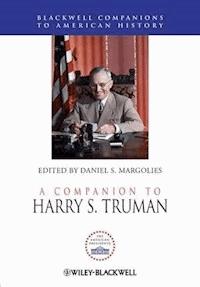
A Companion to Harry S. Truman E-Book
155,99 €
Mehr erfahren.
- Herausgeber: John Wiley & Sons
- Kategorie: Geisteswissenschaft
- Serie: Blackwell Companions to American History
- Sprache: Englisch
With contributions from the most accomplished scholars in the field, this fascinating companion to one of America's pivotal presidents assesses Harry S. Truman as a historical figure, politician, president and strategist.
- Assembles many of the top historians in their fields who assess critical aspects of the Truman presidency
- Provides new approaches to the historiography of Truman and his policies
- Features a variety of historiographic methodologies
Sie lesen das E-Book in den Legimi-Apps auf:
Seitenzahl: 1598
Veröffentlichungsjahr: 2012
Ähnliche




















Contents
Cover
Blackwell Companions to American History
Presidential Companions
Title Page
Copyright
List of Illustrations
Notes on Contributors
Acknowledgments
Introduction
Plan of the Book
Part I: Considering Truman in Historical Perspective
Chapter 1: Truman in Historical, Popular, and Political Memory
References
Further Reading
Chapter 2: Rhetoric and Style of Truman's Leadership
The Contemporary View
The Revival of Plain-Speaking, Give 'em Hell Harry
Profiles in Courage
The Defects of his Qualities
How Truthful, Courageous, and Pre-modern?
The Truman Doctrine but the Marshall Plan
Conclusion
References
Part II: Enduring Questions
Chapter 3: Anxieties of Empire and the Truman Administration
The Atomic Bomb
The Wisconsin School
“Postrevisionism”
National Security
New Research
References
Chapter 4: Harry S. Truman and the Decision to Use the Atomic Bomb
References
Further Reading
Chapter 5: The Origins of the Cold War in International Perspective
Orthodoxy, Revisionism, and Postrevisionism
Postwar
The Cold War in Context
References
Further Reading
Part III: Truman, the State, and the World System
Chapter 6: Exporting the American Experience: Global Economic Governance and the Foreign Economic Policy of the Truman Administration
The End of World War II
Planning the Postwar World: Reconstruction and Deconstruction
The Marshall Plan, European Integration, and the Cold War
The Superpowers and the Cold War
Conclusions
References
Further Reading
Chapter 7: NSC-68 and the National Security State
The Origins of the National Security State
Studies in National Security
The National Security Thesis
NSC-68
Where to Go from Here?
Conclusion
References
Further Reading
Chapter 8: Strategists and Rhetoricians: Truman's Foreign Policy Advisers
James F. Byrnes
George F. Kennan
George C. Marshall
Dean G. Acheson
Clark M. Clifford
Conclusion
References
Further Reading
Part IV: The Truman Presidency and the Shaping of Postwar American Society
Chapter 9: Truman, Reconversion, and the Emergence of the Post-World War II Consumer Society
The Challenges of Reconversion
The New Deal Order and Consumerism in a Conservative Age
Price Controls
The G.I. Bill
Labor
Future Research and Bringing a Global Perspective to the Story
References
Further Reading
Chapter 10: The Fair Deal
References
Further Reading
Chapter 11: The Election of 1948
The Road to the Nomination
The Fall Campaign
The Election in Retrospect
References
Further Reading
Chapter 12: The Truman Administration and the Public Policy of Civilian Defense: Making the Best of a Nightmare
1946–48: The Rationale for Civilian Defense in the Atomic Age
The Civil Defense Studies: Moving Towards an FCDA
The Federal Civil Defense Administration
Conclusion
References
Chapter 13: The Environmental History of the Truman Years, 1945–53
Suburbs, Consumers, and Nature
Automobiles, Consumers, and Nature
Recreation and Pollution
Growing Concern for Public Health
The Environmental Alarm Bells of the Bomb
The Hazards of DDT, DES, and Household Chemicals
The Public Lands and Waterways of the West
The Great Showdown over Echo Park
Aldo Leopold: Environmental Seer, Sage, and Prophet
References
Further Reading
Chapter 14: Truman and Civil Rights
Debating the Making of Truman
Truman's Early Political Career
Breakthroughs and Detours during Truman's First Term
A Crucial Year: 1948
Truman's Second Term
References
Further Reading
Part V: Truman's Foreign Policy
Chapter 15: Great Britain and American Hegemony
The Early Years of the Cold War
The Middle East
The Global Economy
Conclusion
References
Further Reading
Chapter 16: The Truman Doctrine
Between West and East
Truman's Worldview
1946: The Near East
1947: The Near East and Beyond
A New Grand Strategy
Contemporary and Scholarly Responses
Truman's Legacy
References
Further Reading
Chapter 17: Harry S. Truman and the Marshall Plan
The Genesis of the Marshall Plan, July 1945–September 1947
The Marshall Plan in Congress, September 1947–April 1948
The Marshall Plan in Practice, April 1948–December 1951
The Marshall Plan in Retrospect, December 1951–Present
The Marshall Plan and the Opening of Soviet Archives
References
Further Reading
Chapter 18: Truman and the Middle East
U.S.–Middle Eastern Relations Before Truman
The Man from Missouri and the Middle East
The Iranian Crisis, 1945–6
Turkey and the Truman Doctrine, 1947
Israel, 1948
Consequences of Truman's Policies and Avenues for Future Study
References
Further Reading
Chapter 19: Harry S. Truman's Latin American Policy
Truman and the Legacy of the Good Neighbor
Argentine Exceptionalism in the Truman Years
Postwar Conjuncture in Latin American Politics
Plain Speaking in the White House
Early Crisis for the OAS
Dictators Welcome
Army for Progress?
Commies Go Home
The Founding Father's Appraisal
The Troubled Isle
Three Final Crises
Legacies, Continuities, and Disconnects
References
Further Reading
Chapter 20: Truman and NATO
Leadership Style in Foreign Policy and NATO
Truman's Economic Calculus
Atlantic Values: Ideology, Strategy, and International “Virtue”
A Man for All Seasons: Directions in Truman's Historiography
References
Further Reading
Chapter 21: Truman, the United Nations, and the Origins of the Postwar World Order
Multilateralism or Mere Prelude to Cold War?
The United Nations and Anticolonialism Movements
References
Chapter 22: The Truman Administration and Cold War Neutrals
Sweden
Finland
Switzerland
Ireland
Yugoslavia
Austria
India
Conclusion
References
Further Reading
Chapter 23: The Legacies of Nuremberg in International Law and American Policy
Nuremberg: Structure and Process of the Trials
Fusion of Common and Civil Law
Common Criticisms of the Nuremberg Trials
Legacy of Nuremberg Trials in Contemporary Times
References
Part VI: America and the Postwar Pacific Rim
Chapter 24: The Occupation of Japan: A History of Its Histories
The Making of SCAP History
From State to Society
Going Global
Yesterday, Today, Tomorrow
References
Chapter 25: The Birth of a Rivalry: Sino-American Relations During the Truman Administration
The Truman Administration and the Chinese Civil War
The Lost Chance in China Debates
China and the Korean War
Possible New Directions
References
Further Reading
Chapter 26: Conflicts in Korea
References
Further Reading
Chapter 27: Setting the Pattern: The Truman Administration and Southeast Asia
The Restoration of European Rule
The “Hands Off” Interlude
From Neutrality to Cold War Activism
Mixed Results
Evaluations and Legacies
References
Further Reading
References
Further Reading
Index
Blackwell Companions to American History
This series provides essential and authoritative overviews of the scholarship that has shaped our present understanding of the American past. Edited by eminent historians, each volume tackles one of the major periods or themes of American history, with individual topics authored by key scholars who have spent considerable time in research on the questions and controversies that have sparked debate in their field of interest. The volumes are accessible for the non-specialist, while also engaging scholars seeking a reference to the historiography or future concerns.
PublishedA Companion to the American RevolutionEdited by Jack P. Greene and J. R. PoleA Companion to the American WestEdited by William DeverellA Companion to 19th-Century AmericaEdited by William L. BarneyA Companion to the Civil War and ReconstructionEdited by Lacy K. FordA Companion to the American SouthEdited by John B. BolesA Companion to American TechnologyEdited by Carroll PursellA Companion to American Indian HistoryEdited by Philip J. Deloria and Neal SalisburyA Companion to African-American HistoryEdited by Alton HornsbyA Companion to American Women's HistoryEdited by Nancy HewittA Companion to American ImmigrationEdited by Reed UedaA Companion to Post-1945 AmericaEdited by Jean-Christophe Agnew and Roy RosenzweigA Companion to American Cultural HistoryEdited by Karen HalttunenA Companion to the Vietnam WarEdited by Marilyn Young and Robert BuzzancoA Companion to California HistoryEdited by William Deverell and David IglerA Companion to Colonial AmericaEdited by Daniel VickersA Companion to American Military HistoryEdited by James BradfordA Companion to American Foreign RelationsEdited by Robert SchulzingerA Companion to Los AngelesEdited by William Deverell and Greg HiseA Companion to 20th-Century AmericaEdited by Stephen J. WhitfieldA Companion to American Environmental HistoryEdited by Douglas CazauxSackmanPresidential Companions
Published A Companion to Franklin D. RooseveltEdited by William Pederson A Companion to Richard M. NixonEdited by Melvin Small A Companion to Benjamin FranklinEdited by David Waldstreicher A Companion to Theodore RooseveltEdited by Serge RicardA Companion to Thomas JeffersonEdited by Francis D. Cogliano A Companion to Lyndon B. JohnsonEdited by Mitchell Lerner A Companion to George WashingtonEdited by Edward G. Lengel A Companion to Harry S. TrumanEdited by Daniel S. MargoliesThis edition first published 2012
© 2012 Blackwell Publishing Ltd.
Blackwell Publishing was acquired by John Wiley & Sons in February 2007. Blackwell's publishing program has been merged with Wiley's global Scientific, Technical, and Medical business to form Wiley-Blackwell.
Registered Office
John Wiley & Sons Ltd, The Atrium, Southern Gate, Chichester, West Sussex, PO19 8SQ, UK
Editorial Offices
350 Main Street, Malden, MA 02148-5020, USA
9600 Garsington Road, Oxford, OX4 2DQ, UK
The Atrium, Southern Gate, Chichester, West Sussex, PO19 8SQ, UK
For details of our global editorial offices, for customer services, and for information about how to apply for permission to reuse the copyright material in this book please see our website at www.wiley.com/wiley-blackwell.
The right of Daniel S. Margolies to be identified as the author of the editorial material in this work has been asserted in accordance with the UK Copyright, Designs and Patents Act 1988.
All rights reserved. No part of this publication may be reproduced, stored in a retrieval system, or transmitted, in any form or by any means, electronic, mechanical, photocopying, recording or otherwise, except as permitted by the UK Copyright, Designs and Patents Act 1988, without the prior permission of the publisher.
Wiley also publishes its books in a variety of electronic formats. Some content that appears in print may not be available in electronic books.
Designations used by companies to distinguish their products are often claimed as trademarks. All brand names and product names used in this book are trade names, service marks, trademarks or registered trademarks of their respective owners. The publisher is not associated with any product or vendor mentioned in this book. This publication is designed to provide accurate and authoritative information in regard to the subject matter covered. It is sold on the understanding that the publisher is not engaged in rendering professional services. If professional advice or other expert assistance is required, the services of a competent professional should be sought.
Library of Congress Cataloging-in-Publication Data
A companion to Harry S. Truman / edited by Daniel S. Margolies.
p. cm.
Includes bibliographical references and index.
ISBN 978-1-4443-3141-7 (hardback: alk. paper) 1. Truman, Harry S., 1884-1972. 2. United States–Foreign relations–1945-1953. 3. United States–Politics and government–1945-1953.
I. Margolies, Daniel S., 1969-
E813.C65 2012
973.918092–dc23
2012004863
A catalogue record for this book is available from the British Library.
Jacket image: Harry S. Truman at his desk in the White House c.1945. Granger Collection / Topfoto.
Jacket design by Richard Boxhall Design Associates.
List of Illustrations
Numbers refer to the chapters and illustration number.
1.1 Harry S. Truman of Missouri in 1937 or 1938. Photograph from the Library of Congress Prints and Photographs Division, Washington, D.C., LC-H22-D-2618.
1.2 This photograph, taken on February 17, 1938 in Washington, D.C., was titled “Senatorial stickup” by photographers Harris & Ewing. In the photograph, Vice President John Nance Garner “playfully tries his ‘stickup’ technique” on Harry Truman, then a Senator from Missouri, with a pair of 45 caliber pistols formerly owned by the bandit Jesse James.Truman received the guns from the wife of a doctor who had received them as payment for his medical care of Frank James. Jesse James had reputedly “garnered nearly $1,000,000 in a series of holdups with the guns.” Photograph from the Harris & Ewing Collection, Library of Congress Prints and Photographs Division Washington, D.C., LC-DIG-hec-29118.
2.1 Harry S. Truman at his desk, 1945. Photograph from the Library of Congress Prints and Photographs Division, Washington, D.C., LC-USZ62-70080.
4.1 Official U.S. Army photo of the “General panoramic view of Hiroshima after the bomb” demonstrating the devastation from “about 0.4 miles.” Photograph from the Library of Congress Prints and Photographs Division, Washington, D.C., LC-USZ62-134192.
8.1 Portrait of George F. Kennan. Photograph from the Harris & Ewing Collection, Library of Congress Prints and Photographs Division, Washington, D.C., LC-H261-112729.
10.1 John L. Lewis. Photograph from the Library of Congress Prints and Photographs Division, Washington, D.C., LC-DIG-hec-21637.
11.1 Truman in 1948, likely in a photograph from his upset presidential campaign. Photograph from the Library of Congress Prints and Photographs Division, Washington, D.C., LC-USZ62-77801.
15.1 President Harry S. Truman in October 1945, in a photo labeled “Pres. Truman's Real Smile.” Photograph from the Library of Congress Prints and Photographs Division, Washington, D.C., LC-USZ62-56643.
26.1 Douglas MacArthur at the front lines above Suwon, Korea, accompanied by Courtney Whitney, Matthew B. Ridgway, William B. Kean, and others. Photograph from the Library of Congress Prints and Photographs Division, Washington, D.C., LC-USZ62-70920.
Notes on Contributors
Stephanie Trombley Averill is an Assistant Professor of History at Embry-Riddle Aeronautical University. Her dissertation, “Forging the West in Words and Iron,” examined the rhetoric of identity accompanying and supplementing the decision to rearm the Federal Republic of Germany and its incorporation into NATO. She is currently researching the first Status of Forces Agreements and the problem of sovereignty within “free world” alliance systems.
Gregg Brazinsky is an Associate Professor of History and International Affairs at the George Washington University. His first book, Nation Building in South Korea: Koreans, Americans and the Making of a Democracy appeared in 2007 from University of North Carolina Press. He is completing a new book on Sino-American competition in the Third World during the Cold War.
Curt Cardwell is Associate Professor of History at Drake University in Des Moines, Iowa. He is the author of NSC 68 and the Political Economy of the Early Cold War published by Cambridge University Press.
Steven Casey is Reader in International History at the London School of Economics and Political Science. He is the author of Cautious Crusade: Franklin Roosevelt, American Public Opinion and the War against Nazi Germany (Oxford University Press, 2001), and Selling the Korean War: Propaganda, Politics and Public Opinion (Oxford University Press, 2008), which won the 2010 Truman Book Award.
Benjamin A. Coates is Assistant Professor of History at Wake Forest University, where he teaches the history of the U.S. and the World. He earned his Ph.D. from Columbia University in 2010 and has received fellowships from the U.S. Institute of Peace and the American Academy of Arts & Sciences. His current book manuscript, entitled Legalist Empire, explores the creation of the American international law profession and the role of lawyers in building an American empire in the early twentieth century.
Michael Donoghue received his B.A. and M.A. from the University of Rhode Island. In 2006 he received his Ph.D. from the University of Connecticut where he studied under Thomas G. Paterson and Frank Costigliola. He was a 2002–3 recipient of a Fulbright Overseas Research Grant which he spent in the Republic of Panama. He currently works as an Assistant Professor of History at Marquette University where his specialty is U.S. foreign relations history and the history of U.S.–Latin American relations. His book Borderland on the Isthmus: Zonians, Panamanians, West Indians, and the Struggle of the Canal Zone 1939–1979 is forthcoming from Duke University Press.
Charles H. Ford, Ph.D., is a Professor of History at Norfolk State University (NSU). He also serves as the Interim Associate Dean of the University's College of Liberal Arts and as Acting Chair of its History Department. In the 1990s, his primary research areas were in eighteenth-century Britain and the Atlantic world, and he published Hannah More: A Critical Biography in 1996. In this century, Dr. Ford has pursued and published – along with his colleagues, Dr. Cassandra Newby-Alexander of NSU and Dr. Jeffrey Littlejohn, once of NSU and now at Sam Houston State University in Huntsville, Texas – a number of projects explicitly dealing with the desegregation of public schools in Norfolk, Virginia. Ford and Littlejohn's Elusive Equality: Desegregation and Resegregation in Norfolk's Public Schools is under contract at the University of Virginia Press.
Andrew D. Grossman is Professor of Political Science at Albion College in Albion, Michigan. He works in the area of American political development, homeland security policy, and national security policy. He is the author of Neither Dead Nor Red: Civilian Defense and American Political Development During the Early Cold War (2001). He has also published articles in the area of civilian defense in the United States and national security policy. Currently he is working on completing a book on internal security and policing comparing the United States, Great Britain, and Israel.
Mark Harvey is Professor of History at North Dakota State University, Fargo. His scholarship focuses on the American West and its environmental history. He is the author of A Symbol of Wilderness: Echo Park and the American Conservation Movement (Seattle, 2000) and Wilderness Forever: Howard Zahniser and the Path to the Wilderness Act (Seattle 2005). He is now at work on an interpretive biography of the western historian and conservation writer Bernard DeVoto.
Hiroshi Kitamura is Associate Professor of History at the College of William and Mary. He is the author of Screening Enlightenment: Hollywood and the Cultural Reconstruction of Defeated Japan (Cornell University Press, 2010), which won the 16th Shimizu Hiroshi Award from the Japanese Association for American Studies. He is currently working on two projects: a study of transnational Japanese cinema of the 1950s and 1960s and a relational history of Hollywood and East Asian cinemas during the Cold War.
Dean J. Kotlowski is Professor of History at Salisbury University. In 2008 he was a Fulbright professor at De La Salle University in Manila, the Philippines. He is the author of Nixon's Civil Rights: Politics, Principle, and Policy (Cambridge, MA: Harvard University Press, 2001) and nearly 20 scholarly journal articles on the presidency, civil rights, and foreign and domestic policy, the most recent of which is “Independence or Not? Paul V. McNutt, Manuel L. Quezon, and the Reexamination of Philippine Independence, 1937–9,” International History Review (September 2010). His next book, Paul V. McNutt and the Age of FDR, will be published by Indiana University Press.
Robert H. Landrum is an Associate Professor of History at the University of South Carolina-Beaufort. He is the author of several articles on early modern Scotland, Scottish emigration, modern Europe, and the Atlantic world. He is currently editing a cache of documents to be published by the Scottish History Society.
Mark Atwood Lawrence, Associate Professor of History at the University of Texas at Austin, is author of Assuming the Burden: Europe and the American Commitment to War in Vietnam, published in 2005 by the University of California Press, and The Vietnam War: A Concise International History, published by Oxford University Press in 2008. He has also published articles and essays on various topics in Cold War history and is now at work on a study of U.S. policy-making toward the Third World during the 1960s and early 1970s.
Jeffrey L. Littlejohn, Ph.D., is an Associate Professor of History at Sam Houston State University in Huntsville, Texas. His research interests include the civil rights movement, school desegregation, and the conflict over cross-town busing. Littlejohn has published articles on the civil rights movement in Tidewater, Virginia, and he is co-author with Charles H. Ford of a forthcoming book, Elusive Equality: Desegregation and Resegregation in Norfolk's Public Schools.
Jinee Lokaneeta is an Assistant Professor in Political Science at Drew University, New Jersey. Her areas of interest include law and violence, public law, political theory, jurisprudence, and cultural studies. She has published in journals such as Studies in Law, Politics and Society; Economic and Political Weekly; Theory and Event; and Law, Culture, and Humanities. She is the author of Transnational Torture: Law, Violence, and State Power in the United States and India (New York University Press, 2011).
Sean L. Malloy is an Associate Professor of History and member of the founding faculty at the University of California, Merced. He is the author of Atomic Tragedy: Henry L. Stimson and the Decision to Use the Bomb Against Japan (Cornell University Press, 2008) as well as articles dealing with nuclear targeting in World War II and the radiation effects of the atomic bomb. His current research project explores the links between black power, the Third World, and the Cold War with an emphasis on the radical internationalism of the Black Panther Party.
Daniel S. Margolies is Professor of History at Virginia Wesleyan College. He received his Ph.D. at the University of Wisconsin-Madison under Thomas J. McCormick. Margolies has been a Fulbright Senior Scholar/Lecturer at Sogang University in Korea, a Visiting Scholar at the Center for the Study of Law and Society at the University of California, Berkeley, and a Faculty Fellow at the American Center for Mongolian Studies in Ulaanbaatar. He is the author of Henry Watterson and the New South: The Politics of Empire, Free Trade, and Globalization (University Press of Kentucky, 2006) and Spaces of Law in American Foreign Relations: Extradition and Extraterritoriality in the Borderlands and Beyond, 1877–1898 (University of Georgia Press, 2011). He is currently working on a study of Conjunto music of South Texas and a comparative global history of Foreign Trade Zones in the United States and Special Economic Zones across the world system.
James I. Matray earned his doctoral degree in U.S. History at the University of Virginia, where he studied under Norman A. Graebner. Since 2002, he has been Professor of History at California State University, Chico. Matray has published more than 40 articles, book chapters, and essays on U.S.–Korean relations during and after World War II. He is editor of the forthcoming Northeast Asia and the Legacy of Harry S. Truman. His most recent books are Korea Divided: The 38th Parallel and the Demilitarized Zone and East Asia and the United States: An Encyclopedia of Relations Since 1784. Currently, Matray is writing a book on the Battles of Pork Chop Hill, to be published by Indiana University Press.
Robert McGreevey is an Assistant Professor of History at the College of New Jersey. His research focuses on the intersection of colonial law and migration in the twentieth century and has been supported by the Society for Historians of American Foreign Relations, the Immigration and Ethnic History Society, and the Organization of American Historians. He is currently completing a book manuscript entitled Borderline Citizens: The United States, Puerto Rico, and the Politics of Colonial Law and Migration, 1898–1948.
Francine McKenzie is an Associate Professor in the Department of History at the University of Western Ontario. She is the author of Redefining the Bonds of Commonwealth 1939–1948: The Politics of Preference (Palgrave, 2002) and has written several articles on the intersection of international trade and global geopolitics in the twentieth century.
Amanda Kay McVety is an Assistant Professor of History at Miami University. Her book, Enlightened Aid: U.S. Development as Foreign Policy in Ethiopia, came out in 2012 with Oxford University Press. She has published a piece on American assistance to Ethiopia in Diplomatic History and has an article on images of Ethiopia in the United States in The Journal of the Gilded Age and Progressive Era.
Kathleen Britt Rasmussen is a historian at the Office of the Historian, U.S. Department of State, where she has completed three volumes in the Foreign Relations of the United States series, two on U.S. foreign economic policy and one on U.S. relations with western Europe. She also serves as a Professorial Lecturer in History at the George Washington University, where she teaches U.S. diplomatic history.
T. Michael Ruddy is a Professor of History and director of graduate studies at Saint Louis University. He has authored a number of articles on U.S. relations with the Cold War neutrals and is the editor of Charting an Independent Course (Claremont, CA, 1998). He is currently researching U.S.–neutral relations in the context of European integration.
Sean J. Savage is Professor of Political Science at Saint Mary's College in Notre Dame, Indiana. He is the author of Roosevelt: The Party Leader, 1932–1945 (1991), Truman and the Democratic Party (1997), and JFK, LBJ, and the Democratic Party (2004).
Kelly J. Shannon is Assistant Professor of History at the University of Alaska Anchorage. She is a specialist on the history of American foreign relations in the twentieth century with a focus on U.S.–Islamic relations. She is the author of “The Right to Bodily Integrity: Women's Rights as Human Rights and the International Movement to End Female Genital Mutilation, 1970s–1990s” in The Human Rights Revolution: An International History, edited by Akira Iriye, Petra Goedde, and William I. Hitchcock (Oxford, 2011). Her current book project, Veiled Intentions: Islam, Global Feminism, and U.S. Foreign Policy Since the Late 1970s, examines how Americans' concerns about the rights of women in Muslim countries have been integrated into U.S. foreign policy in recent decades.
Jason Scott Smith is the author of Building New Deal Liberalism: The Political Economy of Public Works, 1933–1956.After completing his Ph.D. at the University of California, Berkeley, he held postdoctoral fellowships at Harvard Business School and Cornell University before joining the faculty at the University of New Mexico. His work has appeared in a range of journals, including the Journal of Social History, the Pacific Historical Review, Enterprise & Society, and the Journal of Interdisciplinary History. Smith studies the histories of capitalism and liberalism.
Elizabeth Edwards Spalding is Associate Professor of Government at Claremont McKenna College, where she teaches U.S. foreign policy and American government and directs CMC's Washington, D.C. program. The author of The First Cold Warrior: Harry Truman, Containment, and the Remaking of Liberal Internationalism (2006), she has also contributed to several volumes on the presidency and American foreign policy and written for the Wilson Quarterly, the Journal of American History, Comparative Political Studies, and Presidential Studies Quarterly.
Jeremi Suri is the Mack Brown Distinguished Professor of Global Leadership, History, and Public Policy at the University of Texas at Austin. He is the author of five books, including, most recently, Liberty's Surest Guardian: American Nation-Building from the Founders to Obama. Professor Suri also writes frequently for scholarly journals and popular magazines and newspapers. He also blogs on current affairs at http://globalbrief.ca. See Professor Suri's professional webpage: http://jeremisuri.net.
Susannah Walker is a historian of the twentieth-century United States, focusing on women's history, African American history, and the history of consumer culture. She is the author of Style and Status: Selling Beauty to African American Women, 1920–1975 (University Press of Kentucky, 2007). She taught for nine years at the University of Prince Edward Island, Carnegie Mellon University, and Virginia Wesleyan College. She now teaches at Buckingham Brown & Nichols School in Cambridge, Massachusetts.
Acknowledgments
Creating this volume on Harry S. Truman has been a complex endeavor involving the efforts of a large number of contributors to whom credit for the fine final result is due. Working with this distinguished group of scholars, some of whom are old friends and the rest of whom I am happy to count as new ones, has been a real pleasure. I am very appreciative of their work and thoroughness, not least because of how much I have learned in the process.
Peter Coveney and Galen Young at Wiley-Blackwell have been consistently gracious and helpful on this project, which has made the process of completing the volume very easy. I appreciate the encouragement and support of Jeff Engel to tackle this volume in the first place. I have been working on topics in late nineteenth-century American foreign relations for some time, but Jeff reminded me of my longstanding interest in the Truman era and my first, discarded dissertation topic on postwar civil aviation networks. It has been a pleasure to step back into the twentieth century as a field. A sojourner for now, perhaps I will stay for awhile.
Many thanks go to Tom McCormick for his keen insights into the Truman era and generally for his guidance that helped bring me to this point. Virginia Wesleyan College gave me a course release as the volume neared completion, which was helpful. I appreciate the thoughts of Rich Bond and Eric Mazur and the assistance of Bethany Bayles, Kathleen McCully, and Fiona Screen.
This book, annihilator of time as these things are, is dedicated to my always supportive and entirely lovely wife Skye, and to our three kids, Lark, Aura, and Birch.Though I am passionate about the study of history, being with my family always brings to mind one of my favorite verses of the Dhammapada:
Those who mistake the unessential to be essential
and the essential to be unessential
dwelling in wrong thoughts
never arrive at the essential.
Dan Margolies
Introduction
Daniel S. Margolies
It is hard to imagine a more consequential period to study than the era of Harry S. Truman. He became president at a key moment of change in the history of the world. The United States stood unmatched in power, prosperity, and international influence in an era of extremes and promise. Few shaped it more than this improbable man from Missouri. The essential nexus between Truman the individual politician and the machinery of emerging U.S. global hegemonic power under his administration has long fascinated historians. The range of issues and crises the United States engaged in this era was, simply, staggering. Historians' responses have been correspondingly vast.
The Companion to Harry S. Truman provides a comprehensive presentation of the many different interpretations of the Truman presidency and its significance in American and world history. The essays in this volume, coming from a wide array of the top scholars in the field today, focus on essential historiographical themes and questions. The contentious issues of the Truman era have continued to shape the trajectory of American politics, economy, and society in the post-World War II world. It is tempting to address the full range of post-1945 events upon which Truman had a direct impact, but there are other fine Companion volumes dedicated to broader readings of the extended period. The Companion to Harry S. Truman maintains a disciplined emphasis on Truman as a person and politician and on the long-term impact of his policies. It also explores different understandings of Truman as a historical figure of great complexity, changeability, and continued fascination. Eschewing any single interpretative track, methodological approach, or disciplinary constraint, the scholars in this volume provide thorough and quite stimulating coverage of the core questions of the Truman era as well as keen suggestions for future research.
Central to the historiographical ferment surrounding the Truman era has been the Cold War. The formative era of fiercely fought interpretative battles over the origins and unfolding of the Cold War has subsided. But the tumultuous historiographical disputes themselves have become of historical, as well as intellectual, interest. These conflicts variously present a refracted and somewhat totemic romp through the political concerns and theoretical debates of the decades since the 1950s. New approaches and new archival materials have now transformed the old debates and opened entirely new fields of inquiry. As many of the authors in this volume explain, the new scholarly literature now moves in exciting and nuanced directions that link domestic and global histories of the Cold War.
The legacies of U.S. global hegemony have profoundly influenced the thinking of historians grappling with the Truman era. One frame of analysis which underlies the historiography of much of the Truman era most saliently is the conception of U.S. power in an imperial frame. The tenor of American empire has been long contested among historians. It is clear that understanding Truman and his era requires considering the origins, intent, and broad trajectories of American imperial power as it was sought and established on a global hegemonic scale after 1945. The significance of the imperial framework for understanding the Truman era has only been enhanced since the end of the Cold War. American empire has proven to be resilient and expansive. The broad interpretative schools forged in historiographical debates over empire which originally focused on Truman's policy have continued vibrancy and methodological relevance in consideration of contemporary American empire in numerous places across the globe from Korea to the Middle East.
Much attention in this volume is paid to international perspectives on Truman policymaking. Historians interested in U.S. foreign relations no longer merely focus on the behavior and policy of Americans or of their counterparts in Western Europe or the Soviet Union. Today, the study of American foreign relations occurs in a broad international frame across the scholarly literature of many fields. The fine contributions of Gregg Brazinsky, Michael Donoghue, Hiroshi Kitamura, Mark Lawrence, Jinee Lokaneeta, James I. Matray, Francine McKenzie, T. Michael Ruddy, and Kelly Shannon signal this essential approach on a wide array of topics.
Also considered in this volume are numerous other issues which defined life in the United States during the era of Harry S. Truman and still have a critical and evolving place in contemporary scholarship. These include the creation of the postwar international economic and legal orders and the blossoming of a new consumer society. These systems have garnered new attention from scholars in the wake of the 2008 global downturn and the subsequent challenges to American financial hegemony and prosperity. Renewed scrutiny has been directed to Truman's approach to foreign economic questions, to problems of the dollar as the global currency, and to the meaning and longevity of European recovery and integration. Moreover, some of the issues which for a time seemed of specialized academic interest have suddenly re-emerged as fields of intense new consideration and controversy. Environmental history has been relatively neglected in Truman literature, but offers a rich historiographical field in the immediate postwar era. Occupation studies, for example in the cases of Germany and Japan, have been broadened and re-enlivened by the American experience of war and occupation in the George W. Bush era. Other issues of perennial importance and relevance include questions of power and conflict in Korea, the malignancies of McCarthyism and the national security state, the rise of postwar Conservatism, and the transformative launching of the modern civil rights movement. The many lessons, choices, and legacies of the Truman era have not been exhausted. Questions continue to be asked anew in the dynamic context of contemporary globalization.
Plan of the Book
The six sections of this book cover the fullest possible range of issues confronted by Truman. While there are significant thematic connections between all of the sections, it is intended that each chapter stand alone in consideration of the historiography on Truman and his era. Some issues naturally stretch between chapters. These connections help to highlight the interrelatedness and complexities of the era in the domestic and international realms.
Part I grapples with the literature of Truman as an individual, as a politician, and as a figure in historical memory. Scholarly characterization of Truman has grown remarkably sophisticated, but consensus on Truman as a political figure has been elusive. What has changed has been the perceived utility of his life as either an aspirational model or a foil for contemporary figures. This has also had a not insignificant impact on varying interpretative approaches among historians and others writers, as well as public figures. Certainly Truman stands today as a president whom contemporary beleaguered presidents like George W. Bush and Barack Obama are wont to evoke. Some biographers have been tempted to frame Truman variously as a template, model, or cartoon for contemporary purposes. Sean J. Savage engages the different approaches to the historical transformation of Truman in historical and popular memory. Steven Casey's chapter completes this section with a comprehensive assessment of approaches to the critical issue of Truman's leadership style.
Part II covers what have emerged as among most significant critical concerns of the Truman era. While each successive era generates historical debates, the issues of the Truman presidency have inspired an unprecedented literature in scope, imagination, and significance. Each of the chapters in this section takes on the task of surveying fields of literature as vast as they are passionate. Jeremi Suri situates interpretations of Truman policy within the historiography of American empire articulated for the period both before and after his administration. Sean L. Malloy analyzes the vast and complicated literature surrounding the decision to drop the atomic bombs on Japan. Amanda Kay McVety discusses the literature on the origins of the Cold War and Truman policy from an international perspective.
Part III of the Companion is among the most unique for a historiographical survey of the Truman era. While part II directly engages the most frequently debated aspects of U.S. history from this time, this part tackles critical but often overlooked or misunderstood aspects of Truman policy and situates them in theoretically sophisticated consideration of power, interest, and the state. Francine McKenzie presents the complex and interdisciplinary scholarship on the foreign economic policy of the Truman administration and its significance in creating integrated systems of global trade and governance. Curt Cardwell uncoils the layers of interest and imperative in interpretations of the national security state and the utilities of the core Cold War document NSC 68. Benjamin A. Coates examines Truman's three secretaries of state, James F. Byrnes, George C. Marshall, and Dean G. Acheson; White House adviser, Clark M. Clifford; and guru of containment, George F. Kennan. Each of these men shaped the era in profound ways increasingly emphasized by historians, and a thorough understanding of Truman policy requires recognition and appreciation of their interests and influence.
Part IV grapples with significant aspects of domestic policy in the Truman years, including the legacies of the New Deal and the challenges of the postwar era in economic and social terms. This was an arena of remarkably complex and contested issues and politics that were in no way second to the challenges or difficulties of foreign policy. It has, accordingly, yielded an equally rich historiographic tradition. Susannah Walker tackles the literature on Truman's approach to reconversion, demobilization, and especially consumerism, which came to dominate postwar culture, economy, and society. Jason Scott Smith considers the literature on the social and economic policies which formed Truman's Fair Deal, and also details newly emergent aspects of this field such as the rise of conservatism, the travails of the labor movement, and other issues. Dean J. Kotlowski explores the rich literature on the 1948 election. Truman's improbable re-election helped to define the Truman presidency as well as capture the imagination of historians and politicians ever since, and Kotlowski further demonstrates its significance in terms of postwar culture. Andrew D. Grossman covers the challenges and shifting perspectives of Truman Civil Defense Policy, an especially critical topic in the atomic era. Mark Harvey provides a thorough and fresh reconsideration of environmentalism during the Truman years. Jeffrey L. Littlejohn and Charles H. Ford close this section with a complete consideration of historical understandings of Truman's role and impact in the civil rights movement.
Part V covers the range of historical interpretations of all aspects of Truman's foreign policy, which encompassed virtually every area of the globe in establishing American power and interest. Kathleen Britt Rasmussen grapples with accounts of the turn from British to American hegemony during the Truman administration. Jinee Lokaneeta provides an account of the legacies of the Nuremberg trial both in the immediate and long-term historical contexts. This part includes focused accounts of the historical literatures on major events, such as Elizabeth Edwards Spalding's chapter on the Truman Doctrine and Robert H. Landrum on the Marshall Plan. Stephanie Trombley Averill, Robert McGreevey, and T. Michael Ruddy take broader approaches to consider interpretations of Truman policy on the NATO alliance, on the United Nations, and on neutral nations during the Cold War. Michael Donoghue provides an important and comprehensive account of Truman's Latin American policy, a vital topic too often overlooked in Cold War historiography covering the Truman era given the broader emphasis on Europe and Asia. Kelly J. Shannon surveys the literature on U.S. policy in the postwar Middle East, a field which was relatively underdeveloped but has recently become of great interest and policy relevance.
Part VI considers Truman policy in the Pacific Rim, an area of incredible historiographical depth today, though it was long de-emphasized by historians in favor of examinations of policy in Europe. The authors in this section demonstrate the reversal of this trend and the vibrancy of this field of study. Hiroshi Kitamura's important chapter covering Truman policy in the occupation of Japan freshly engages the rich historiographic fields from both the American and Japanese literatures. Gregg Brazinsky similarly engages a diverse and international array of sources in his examination of the scholarship on Sino-American relations during the Truman Administration. James I. Matray explores the enormous literature on Korean-American relations surrounding the Korean War and covers the exacting assessments of Truman's war policy. Mark Atwood Lawrence closes the volume with an excellent synthetic survey of approaches to Truman policy across Southeast Asia. Lawrence examines interpretations of the ways that Truman policy approached the long and destructive aftermath of European colonialism in Southeast Asia and clarifies scholarly assessments of American Cold War imperatives in the region.
Truman's enduring historical significance, his motivations as an man and as a politician, and the origin, execution, and meaning of his policies are topics that all of the chapters in this book examine in the historiographic record from a variety of perspectives and with a sometimes surprising amount of diversity. This volume has attempted to divide the issues in thematic ways most useful for students and scholars of the period, with the caveat that these distinctions at times could be fruitfully challenged. It is worth noting that given the significance and intensity of the events of the Truman years, many, if not most, of the chapters could have been grouped under the rubric of “enduring questions.”
Part I
Considering Truman in Historical Perspective
Chapter One
Truman in Historical, Popular, and Political Memory
Sean J. Savage
The perception and assessment of Harry S. Truman in historical, popular, and political memory have been influenced by the following factors. First, the American public and elites, namely, scholars, and politicians, have alternately argued and disagreed with each other's opinions of Truman's presidency in general and specific decisions in particular. For example, Truman's decision to drop atomic bombs on Japan was and continues to be broadly supported by the American public but is persistently controversial among historians. Conversely, Truman's decision to begin the racial integration of the military was initially unpopular with both the Joint Chiefs of Staff and the general public. Eventually, however, this decision became widely accepted and supported by both elite and public opinion (Leuchtenburg, 2005: 224–5).
Second, an evaluation of Truman's life and presidency is influenced by whether it is based on the totality of his life or a particular aspect of his character or period of his life. Consequently, people who concentrate on Truman's reputation as a devoted husband and father have a more affectionate and admiring perception of Truman than those who focus on his participation in unsavory machine politics in Missouri (Truman, 1981; Algeo, 2009; Powell, 1948; Miller, 1986). In assessing the long-term consequences of his presidency in general, historians have consistently ranked Harry S. Truman as a “near great” president, along with Andrew Jackson and Theodore Roosevelt, and as one of the ten best presidents in American history (Stanley and Niemi, 1994: 260).
Lesen Sie weiter in der vollständigen Ausgabe!
Lesen Sie weiter in der vollständigen Ausgabe!
Lesen Sie weiter in der vollständigen Ausgabe!
Lesen Sie weiter in der vollständigen Ausgabe!
Lesen Sie weiter in der vollständigen Ausgabe!
Lesen Sie weiter in der vollständigen Ausgabe!
Lesen Sie weiter in der vollständigen Ausgabe!
Lesen Sie weiter in der vollständigen Ausgabe!
Lesen Sie weiter in der vollständigen Ausgabe!
Lesen Sie weiter in der vollständigen Ausgabe!
Lesen Sie weiter in der vollständigen Ausgabe!
Lesen Sie weiter in der vollständigen Ausgabe!
Lesen Sie weiter in der vollständigen Ausgabe!
Lesen Sie weiter in der vollständigen Ausgabe!
Lesen Sie weiter in der vollständigen Ausgabe!
Lesen Sie weiter in der vollständigen Ausgabe!
Lesen Sie weiter in der vollständigen Ausgabe!
Lesen Sie weiter in der vollständigen Ausgabe!
Lesen Sie weiter in der vollständigen Ausgabe!
Lesen Sie weiter in der vollständigen Ausgabe!
Lesen Sie weiter in der vollständigen Ausgabe!
Lesen Sie weiter in der vollständigen Ausgabe!
Lesen Sie weiter in der vollständigen Ausgabe!
Lesen Sie weiter in der vollständigen Ausgabe!
Lesen Sie weiter in der vollständigen Ausgabe!
Lesen Sie weiter in der vollständigen Ausgabe!
Lesen Sie weiter in der vollständigen Ausgabe!
Lesen Sie weiter in der vollständigen Ausgabe!
Lesen Sie weiter in der vollständigen Ausgabe!
Lesen Sie weiter in der vollständigen Ausgabe!
Lesen Sie weiter in der vollständigen Ausgabe!
Lesen Sie weiter in der vollständigen Ausgabe!
Lesen Sie weiter in der vollständigen Ausgabe!
Lesen Sie weiter in der vollständigen Ausgabe!




