


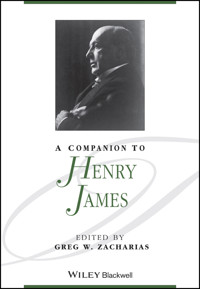
A Companion to Henry James E-Book
40,99 €
Mehr erfahren.
- Herausgeber: John Wiley & Sons
- Kategorie: Geisteswissenschaft
- Serie: Blackwell Companions to Literature and Culture
- Sprache: Englisch
Written by some of the world's most distinguished Henry James scholars, this innovative collection of essays provides the most up-to-date scholarship on James’s writings available today.
- Provides an essential, up-to-date reference to the work and scholarship of Henry James
- Features the writing of a wide range of James scholars
- Places James’s writings within national contexts—American, English, French, and Italian
- Offers both an overview of contemporary James scholarship and a cutting edge resource for studying important individual topics
Sie lesen das E-Book in den Legimi-Apps auf:
Seitenzahl: 1271
Veröffentlichungsjahr: 2013
Ähnliche




















Table of Contents
Blackwell Companions to Literature and Culture
Title page
Copyright page
Dedication
Notes on Contributors
Acknowledgments
Introduction
Chronology of Henry James's Life and Work
Part I: Fiction and Non-Fiction
1: Bad Years in the Matrimonial Market: James's Shorter Fiction, 1865–1878
2: What Daisy Knew: Reading Against Type in Daisy Miller: A Study
Acknowledgments
3: Growing Up Absurd: The Search for Self in Henry James's The American
4: Vital Illusions in The Portrait of a Lady
5: The Bostonians and the Crisis of Vocation
6: “The Abysses of Silence” in The Turn of the Screw
Background
Readers, Reviewers, and Critics
The Governess's Background
The Text
7: On Maisie's Knowing Her Own Mind
I
II
III
IV
V
VI
VII
VIII
8: “What woman was ever safe?” Dangerous Constructions of Womanhood in The Ambassadors
Acknowledgment
9: Unwrapping the Ghost: The Design Behind Henry James's The Wings of the Dove
James's Aesthetic Instincts
M.T.'s “heroism of the last chance”
Becoming a “near witness”
Acknowledgments
10: Truth, Knowledge, and Magic in The Golden Bowl
Truth and Knowledge
Magic: Homeopathic and Contagious
Equilibrium
11: Henry James and the (Un)Canny American Scene
12: Revisitings and Revisions in the New York Edition of the Novels and Tales of Henry James
13: What We Don't Talk About When We Talk About Love: Henry James's Last Words
14: Henry James, Cultural Critic
15: Timeliness and Henry James's Letters
Part II: Contexts for Reading Henry James
16: A Brief Biography of Henry James
17: Jamesian Matter
18: Henry James and the Sexuality of Literature: Before and Beyond Queer Theory
A History of Reading Sexuality; or, a Prehistory of Queer Theory, James-style
After Sedgwick; or, How to Read Henry James Like a Queer Theorist
Queering the Queer; or, How to Read Queerness Like Henry James
19: Exuberance and the Spaces of Inept Instruction: Robert Baden-Powell's Scouting for Boys and Henry James's The Art of the Novel
20: Nothing Personal: Women Characters, Gender Ideology, and Literary Representation
Asking the “Woman Question”
The Strange Case of the Missing Happy Ending
Framing the American Princess: “Daisy Miller”
The Portrait of a Lady, or the Limits of Free Will
Emancipations and Empowerments
21: The Others: Henry James's Family
Father
Mother
Aunt Kate
Wilky and Bob
Alice
William
22: Beyond the Rim: Camp Henry James
23: Henry James and the United States
24: Henry James and Britain
25: Henry James in France
The American, The Portrait of a Lady, The Wings of the Dove, and the French Ancien Régime
The Ambassadors and the “dreadful little old tradition”
How Did France Receive Henry James?
26: Henry James and Italy
Art and Italy
James's Visits to Italy
The Name of Italy, “sweet for all its dimness”
“A chain of cities”
Florence and Venice, Rome
27: Henry James in the Public Sphere
“Sketching one's age”
Public Knowledge
“Optical Commerce”
28: James and Film
Index
Blackwell Companions to Literature and Culture
This series offers comprehensive, newly written surveys of key periods and movements and certain major authors, in English literary culture and history. Extensive volumes provide new perspectives and positions on contexts and on canonical and post-canonical texts, orientating the beginning student in new fields of study and providing the experienced undergraduate and new graduate with current and new directions, as pioneered and developed by leading scholars in the field.
Published Recently
This paperback edition first published 2014
© 2014 John Wiley & Sons Ltd, except chapter 10 © 2014 Sigi Jöttkandt
Edition history: Blackwell Publishing Ltd (hardback, 2008)
Registered Office
John Wiley & Sons Ltd, The Atrium, Southern Gate, Chichester, West Sussex, PO19 8SQ, UK
Editorial Offices
350 Main Street, Malden, MA 02148-5020, USA
9600 Garsington Road, Oxford, OX4 2DQ, UK
The Atrium, Southern Gate, Chichester, West Sussex, PO19 8SQ, UK
For details of our global editorial offices, for customer services, and for information about how to apply for permission to reuse the copyright material in this book please see our website at www.wiley.com/wiley-blackwell.
The right of Greg W. Zacharias to be identified as the author of the editorial material in this work has been asserted in accordance with the UK Copyright, Designs and Patents Act 1988.
All rights reserved. No part of this publication may be reproduced, stored in a retrieval system, or transmitted, in any form or by any means, electronic, mechanical, photocopying, recording or otherwise, except as permitted by the UK Copyright, Designs and Patents Act 1988, without the prior permission of the publisher.
Wiley also publishes its books in a variety of electronic formats. Some content that appears in print may not be available in electronic books.
Designations used by companies to distinguish their products are often claimed as trademarks. All brand names and product names used in this book are trade names, service marks, trademarks or registered trademarks of their respective owners. The publisher is not associated with any product or vendor mentioned in this book.
Limit of Liability/Disclaimer of Warranty: While the publisher and author have used their best efforts in preparing this book, they make no representations or warranties with respect to the accuracy or completeness of the contents of this book and specifically disclaim any implied warranties of merchantability or fitness for a particular purpose. It is sold on the understanding that the publisher is not engaged in rendering professional services and neither the publisher nor the author shall be liable for damages arising herefrom. If professional advice or other expert assistance is required, the services of a competent professional should be sought.
Library of Congress Cataloging-in-Publication Data
A companion to Henry James / edited by Greg W. Zacharias.
p. cm.—(Blackwell companions to literature and culture ; 55)
Includes bibliographical references and index.
ISBN 978-1-4051-4042-3 (hardcover: alk. paper) – ISBN 978-1-118-49234-5 (pbk. : alk. paper)
1. James, Henry, 1843–1916—Criticism and interpretation—Handbooks, manuals, etc. I. Zacharias, Greg W., 1958–
PS2124.C235 2008
813′.4—dc22
2008008193
A catalogue record for this book is available from the British Library.
Cover image: Henry James. Photo © Bettmann / Corbis
Cover design by Richard Boxall Design Associates
For Bob Gale and Edward Chalfant
Notes on Contributors
Michael Anesko is the author of “Friction with the Market”: Henry James and the Profession of Authorship (1986) and Letters, Fictions, Lives: Henry James and William Dean Howells (1997). He is currently finishing a new book, Monsieur de l'Aubépine: The French Face of Nathaniel Hawthorne, a critical study and translation of francophone responses to one of the key figures of the American Renaissance.
Nicola Bradbury is Lecturer in English and American Literature at the University of Reading. She is the author of Henry James the Later Novels (1979) and several books and articles on James, Dickens, and the novel form.
Bill Brown is the Edward Carson Waller Distinguished Service Professor at the University of Chicago, in the Department of English Language and Literature. He is the author of A Sense of Things: The Object Matter of American Literature (2003), and the editor of Things (2001), a special issue of Critical Inquiry that subsequently appeared in book form.
Gert Buelens has published several books on Henry James, multi-ethnic American literature, and cultural theory, and is the author of some sixty essays in collections and journals, the latter including the Henry James Review, Modern Philology, Texas Studies in Literature and Language, and PMLA. He serves on several editorial boards, including the Canadian Review of American Studies, Comparative American Studies, the Henry James E-Journal, the Henry James Review, MELUS, and Open Humanities Press. He is a past president (2005) of the Henry James Society.
Sarah Daugherty, Professor of English (retired) at Wichita State University, is the author of The Literary Criticism of Henry James (1981) and writes the Henry James chapter for American Literary Scholarship: An Annual.
Anna Despotopoulou is Assistant Professor of English at the University of Athens, Greece. Her published work includes articles on Henry James and publicity, Jane Austen, George Eliot, film adaptation of Victorian novels, and the contemporary playwright Peter Shaffer.
Jennifer Eimers is finishing her dissertation, “It is Art That Makes Life: Experiencing Visual Art in Henry James's Novels,” at the University of Georgia. She has published articles in the Henry James Review and Searching for America: Essays on American Art and Architecture. Her research interests include nineteenth-century American literature, British Aestheticism, Southern literature, and scholarly editing.
Evelyne Ender holds a doctorate in Comparative Literature from the Université de Genève. She is currently professor of French at Hunter and at the Graduate Center at CUNY. Her specialties are nineteenth- and twentieth-century French and English literatures, feminist criticism and gender, and memory studies. She is the author of Sexing the Mind: Nineteenth-Century Fictions of Hysteria (1995) and Architexts of Memory: Literature, Science, and Autobiography (2005), which won the 2006 Scaglione Prize in Comparative Literary Studies.
Denis Flannery is Senior Lecturer in American and English Literature at the School of English, University of Leeds. His first book, Henry James: A Certain Illusion was published in 2000 and his second, On Sibling Love, Queer Attachment and American Writing was published in 2007. As well as several articles on James, Flannery has written extensively on visual culture, most notably on the work of David Fincher and Robert Mapplethorpe.
Wendy Graham is an Associate Professor of English at Vassar College, where she teaches British and American Literature, Literary Theory, and American Studies. She is the author of Henry James's Thwarted Love (1999).
Susan M. Griffin is Professor and Chair of English and Justus Bier Chair of Humanities at the University of Louisville. She is the editor of the Henry James Review and Henry James Goes to the Movies (2002) and author, most recently, of Anti-Catholicism and 19th-Century Fiction (2004).
Philip Horne is a Professor in the English Department at University College London. He is the author of Henry James and Revision: The New York Edition (1990); and editor of Henry James: A Life in Letters (1999). He has also edited Henry James, A London Life & The Reverberator; Henry James, The Tragic Muse; Charles Dickens, Oliver Twist; and written articles on a wide range of subjects, including telephones and literature, zombies and consumer culture, the films of Powell and Pressburger and Martin Scorsese, the texts of Emily Dickinson, and the criticism of F. R. Leavis. He co-edited Thorold Dickinson: A World of Film (2008). He is working on a study of Henry James and Theodore Roosevelt.
Clair Hughes, educated in Scotland and at the universities of Bristol and London, taught English and American Literature and the History of Art in the UK and latterly in Japan. She retired as Professor of English and American Literature at the International Christian University of Tokyo in 2004, and now lives in France. Publications include articles on Henry James, Anglo-Irish Literature, and the novels of Anita Brookner. She has published books on British portraiture, Henry James and the Art of Dress (2001), and Dressed in Fiction (2005).
Natasha Hurley is a Killam Postdoctoral Fellow at the University of Alberta in Edmonton where she works in the fields of American Literature, Children's Literature, and Sexuality Studies. She earned her PhD in 2007 from Rutgers University and is co-editor (with Steven Bruhm) of Curiouser: On the Queerness of Children (2004).
Donatella Izzo is Professor of American Literature at Università di Napoli “L'Orientale,” Italy. Her latest studies of James are Portraying the Lady: Technologies of Gender in the Short Stories of Henry James (2001) and “Killing Mothers: Decadent Women in James's Literary Tales” (in Henry James Against the Aesthetic Movement, ed. David Barrett Izzo and Daniel T. O'Hara, 2006), part of a wider project investigating the gendered construction of the literary field in James's tales of writers and artists.
Sigi Jöttkandt is a researcher at the Jan van Eyck Academy, the Netherlands where she co-edits the open access journal S. She is author of Acting Beautifully: Henry James and the Ethical Aesthetic (2005) and is currently completing a manuscript titled First Love: A Phenomenology of the One.
Robert B. Pippin is the Evelyn Stefansson Nef Distinguished Service Professor in the Committee on Social Thought, the Department of Philosophy, and the College at the University of Chicago. He is the author of several books on theories of modernity, on German idealism, and on later German philosophy, and in 2001 published Henry James and Modern Moral Life.
Peter Rawlings is Professor of English and American Literature and Head of the Department of English at the University of the West of England, Bristol. He has published widely on Henry James, American theories of fiction in the nineteenth century, and the American reception of Shakespeare. His books include Americans on Shakespeare, Americans on Fiction, 1776–1914 (3 vols.), Henry James and the Abuse of the Past, Three American Theorists of the Novel: Henry James, Lionel Trilling, and Wayne C. Booth, and Henry James Studies. His current research project is Transatlantic Sensations: Henry James and the Empirical Tradition; the pendant project is Towards Pragmatism: Americans on Religion and Philosophy, 1620–1910 (6 vols.).
Kimberly C. Reed is Professor of English and French at Lipscomb University. She is the editor of Approaches to Teaching Henry James's “Daisy Miller” and “The Turn of the Screw” (2005) and of two forthcoming books, one on James's ghost stories, the other a collection of those stories. She is currently working on a book about Edith Wharton and the ghostly.
John Carlos Rowe is USC Associates' Professor of the Humanities at the University of Southern California. In addition to other scholarly works, he is the author of Henry Adams and Henry James: The Emergence of a Modern Consciousness (1976), The Theoretical Dimensions of Henry James (1984), and The Other Henry James (1998).
Richard Salmon is a Senior Lecturer in the School of English, University of Leeds, where he specializes in teaching Victorian literature. He is the author of Henry James and the Culture of Publicity (1997) and has more recently written a monograph on W. M. Thackeray (2005). He is currently working on a study of literary professionalism and the iconography of authorship in the early Victorian period, provisionally entitled The Disenchantment of the Author.
Linda Simon is Professor of English at Skidmore College. She is the author of The Critical Reception of Henry James: Creating a Master (2007) and Genuine Reality: A Life of William James (1998). She has edited William James Remembered (1996), and has written an introduction to The Diary of Alice James (1999).
Sarah Wadsworth is an Assistant Professor of English at Marquette University. She is the author of In the Company of Books: Literature and Its “Classes” in Nineteenth-Century America (2006). Currently, she is working with Wayne A. Wiegand on a history and analysis of the women's library of the 1893 Chicago World's Fair (World's Columbian Exposition).
Pierre A. Walker is a Professor of English at Salem State College. He is the author of Reading Henry James in French Cultural Contexts (1995), editor of Henry James on Culture, and co-general editor, with Greg W. Zacharias, of The Complete Letters of Henry James (2006–).
Jonathan Warren is co-editor of the Norton Critical Edition of Henry James's The Turn of the Screw (1999) and author of numerous journal articles and conference papers on James. His current research inquires into the motley after-echoes of the Jamesian fin de siècle in twentieth-century American and British camp. He is Associate Professor of English at York University in Toronto, Ontario.
Julie Wolkenstein teaches comparative literature in Caen Basse-Normandie University in France. Both scholar and writer, she has worked on the representation of Europe in Henry James's novels and has published four novels.
Greg W. Zacharias is Professor of English and Director of the Center for Henry James Studies at Creighton University. He is author of Henry James and the Morality of Fiction (1993) and articles on Henry James, Mark Twain, and John Milton. He is project director and co-general editor (with Pierre A. Walker) of The Complete Letters of Henry James (2006–).
Rosella Mamoli Zorzi is Professor of American Literature and Director of the Graduate School at the University of Venice, Italy. She has edited several collections of letters by James, among them Beloved Boy: Letters to Hendrik C. Andersen, 1899–1915 (2004) and Letters from the Palazzo Barbaro (2001, second edn.).
Acknowledgments
Thanks to the Johns Hopkins University Press for permission to reprint “Henry James and the United States” by John Carlos Rowe in chapter 23, which first appeared in substantially the same form in the Henry James Review (27.3 [2006] 228–36.) Thanks too to Aya Zacharias for her help with a range of difficult editing problems. Most of all, thanks to all of my companions around the world in Henry James studies.
Introduction
Greg W. Zacharias
When I was offered the opportunity to edit this volume, I couldn't accept quickly enough. The idea of a “companion” to Henry James was suited to the way I think about and try to practice James studies, a discipline in which companions are valued. Henry James himself referred to the significance of those readers who would be companions when he wrote in “The Art of Fiction” that “[a]rt lives upon discussion, upon experiment, upon curiosity, upon variety of attempt, upon the exchange of views and the comparison of standpoints” (James 1984: 44–5). For James, it is in the engagement of individuals with the text, with art, and with each other that art “lives.”
Kenneth Burke's “parlor” of criticism – a metaphor that depends obviously and fundamentally on the relation of “parlor” to parler and thus to the notion of companions – for neither the parlor nor parler make sense without companions – serves to dramatize James's understanding of the process through which “art lives” through the company of companions:
Imagine that you enter a parlor. You come late. When you arrive, others have long preceded you, and they are engaged in a heated discussion, a discussion too heated for them to pause and tell you exactly what it is about. In fact, the discussion has already begun long before any of them got there, so that no one present is qualified to retrace for you all the steps that had gone before. You listen for a while, until you decide that you have caught the tenor of the argument; then you put in your oar. Someone answers; you answer him; another comes to your defense; another aligns himself against you, to either the embarrassment or gratification of your opponent, depending upon the quality of your ally's assistance. However, the discussion is interminable. The hour grows late, you must depart. And you do depart, with the discussion still vigorously in progress.
(Burke 1973: 110–11)
The conversation among companions that sustains the critical dialogue for Burke is the same one that sustains art for James. It's the one that makes James studies important for me because that conversation fosters and sustains the community of those interested in Henry James studies. This Companion to Henry James, then, may serve its readers as an invitation, a “way in,” to the unending conversation that is Henry James studies. It is meant to stand as an invitation to join the conversation that's been in progress for more than one hundred years and was initiated by James himself, through his writing, from his own companions actual and textual.
When I wrote for a couple of years the section on “Henry James” for American Literary Scholarship, I was repeatedly surprised by the depth and breadth of scholarly writing on Henry James. A review then of the MLA International Bibliography showed that for the rather recent past (1970s through the 1990s), there was more published work on Henry James than on any other American writer. In the mid-1990s, most of what was being published in English on James came from those traditional companions writing in North America and the United Kingdom. At the same time, mostly missed, a significant amount of work was also being done by Jamesians from Europe, Japan, and South Korea. Annick Duperray's The Reception of Henry James in Europe (2006) testifies to this point in terms of Europe. When I became Executive Director of the Henry James Society in 1999, I was encouraged to work to “internationalize” the Society, which then was comprised mainly of individuals who resided in the US, Canada, and Britain. Today, the Henry James Society has members in twenty countries around the world and the circle of companions continues to grow wider and more vigorous. Recent international conferences on James organized by the Henry James Society in New York (1993), Paris (2002), Venice (2005), and Newport (2008) brought together parlor and parler-style companions in James studies. Smaller meetings continue to reinforce that collegiality. Part of the editorial mission of the Henry James Review is that of a companion as well: to foster new scholarship in Henry James studies.
James's place in the world extends past a parlor of scholarly companions. As Adeline Tintner pointed out, for example, “Henry James” has made his way into the everyday of current US culture, at least. There is no sign, wrote Tintner,
that James is releasing his grip on the popular imagination. The frequency in advertising of both James's likeness and familiar quotations from his work attests to that. When Barnes and Noble, the gigantic bookseller, wants a striking image for its plastic bags, it chooses James's familiar face and his familiar formal clothes. When Banana Republic, a chain of stores selling informal clothing, seats his figure among the modern expatriates in a café and Rolls Royce quotes from The Ambassadors, “Live all you can,” to market the most costly of production motor cars, it is plain that James has penetrated communication addressed to the general consciousness.
(Tintner 1998: 2, 4)
Given such scholarly and popular interest in James, it seemed unwise to me and, I imagined, uninteresting to readers to shape this Companion as a kind of review of conventional positions. In my view, that would not make the kind of companion I would choose to sit with. First, other publications strive to do that already. Second, the production of writing during James's career: some twenty novels published during his lifetime, short fiction (more than one hundred pieces), more than a dozen plays and dramatic pieces, thousands of pages of criticism and reviews, travel writing, autobiography and biography, cultural commentary, and more than 10,400 extant letters mock every attempt to summarize. Third, even if an accurate summary were possible, such a summary volume would have difficulty representing the richness and diversity of Henry James scholarship today. If this Companion should be the kind of companion that James knew provided art with its vitality and Burke knew provided a motive for companionship, I reasoned that it would have to be emblematic of what a Henry James “companion” could be. It would have to discuss things Jamesian in Henry James's or Kenneth Burke's sense. It would have to provide points of contact for James's texts and works. It would have to represent things Jamesian as they are occurring now around the world.
Thus I offer this group of essays, this Companion, from authors both established and newer who are themselves companions and who together I believe represent the diversity and richness of Henry James studies today. My aim for this volume-as-companion is that its organization would promote engagement between its authors and readers, who together comprise the conversation, as it were, that nourishes, sustains, and helps to promote the discipline. Each of the authors is not only a first-rate Jamesian. Each is an excellent reader. Each is an excellent teacher.
The purpose of this volume is to provide students and teachers of Henry James with individual chapters that mark the state of the art in significant areas of James scholarship. Taken together, the chapters map the direction of James studies overall. The first part of the volume offers chapters on James's most frequently read fiction and non-fiction. The second part offers chapters that outline current approaches to reading and teaching James's fiction. Special attention is given to reading James in national contexts – American, British, French, Italian – and to understanding his work in terms of the cultures which informed his life and writing. Fashionable approaches and readings were not the goal of this volume. Instead, recently relevant approaches that are now shaping and seem certain to continue to shape the discussion of James's fiction and non-fiction for the foreseeable future were chosen. While each chapter works within the restrictions of space to develop its subject in some depth, the range of chapters attempts to represent the wide sweep of possibilities in James scholarship. I hope that in the representation and suggestion of those possibilities, each reader of this Companion will, each in his or her own way, be encouraged to join the ongoing Jamesian conversation.
References and Further Reading
Burke, Kenneth (1973). “The Philosophy of Literary Form.” The Philosophy of Literary Form. Berkeley: University of California Press, 1–37.
Duperray, Annick (ed.) (2006). The Reception of Henry James in Europe. London: Continuum.
James, Henry (1984). Henry James, Literary Criticism: Essays on Literature, American Writers, English Writers. New York: Library of America.
Tintner, Adeline (1998). Henry James's Legacy. Baton Rouge: Louisiana State University Press.
Chronology of Henry James's Life and Work1
Jennifer Eimers
Notes
1 For further publication information, see A Bibliography of Henry James (Edel and Laurence 1982) and A Henry James Chronology (Harden 2005). For further details of James's life, see Leon Edel's five-volume biography (Edel 1953–72), R. W. B. Lewis's The Jameses (Lewis 1991), and Fred Kaplan's Henry James: The Imagination of Genius (Kaplan 1992).
2 Habegger writes that the James family left Liverpool for New York on October 12, 1844.
3 First book publication information is noted for the novels. Also noted are works included in the 24-volume New York Edition (NYE) of 1907–9.
Part I
Fiction and Non-Fiction
1
Bad Years in the Matrimonial Market: James's Shorter Fiction, 1865–1878
Clair Hughes
When Henry James was asked to list an introductory selection of his work for a new reader he advised that his tales, the “little tarts,” should be read “when you have eaten your beef and potatoes” (Krook 1967: 325). After serious effort with the novels, that is, the ideal reader might indulge in something lighter by way of a dessert. To extend the culinary metaphor, we might consider James's early tales as amuse bouches – introductory savouries, evidence of style and content, challenge and innovation, perhaps, but, most importantly, a promise that staying the course will be rewarding.
Not all readers have been enthusiastic about these early tales. Rebecca West dismisses “those first stories” as “pale dreams as might visit a New England spinster looking out from her snuff-coloured parlour on a grey drizzling day” (West 1916: 24). West, in the year of James's death, might have been more charitable, given her real admiration for James, but the literary personality she ascribes here to James – female, morose, and sexually thwarted – was already current, and is one that still lingers, particularly amongst those who have not seriously read the novels. Philip Sicker's description of the heroes of the early stories as “a collection of demented artists, chronic invalids, drunkards, suicides, ineffectual dilettantes and hypochondriacs” (Sicker 1980: 26) adds an edge of excitement to the spinster parlor imagined by West, but not much cheer.
West's comment is less a considered judgment than a young writer's urge to be amusingly iconoclastic; but, for all its superficiality, it does at least point us to one important aspect of the early stories: in relation to fiction's traditional courtship/marriage paradigm, things do not turn out well for the protagonists. James's “little tarts” were not reassuring confections of the kind familiar to the readership of the magazines in which they first appeared. In “The Art of Fiction” of 1884, James observed that novelistic convention required “a distribution at the last of prizes, pensions, husbands, wives, babies, millions, appended paragraphs and cheerful remarks”; such an ending was like that of “a good dinner, a course of dessert and ices” (James 1984a: 48). From the first, however, James felt himself bound to frustrate readers of their usual fare. The editor of the Atlantic Monthly, according to James's biographer, Fred Kaplan, grumbled about his “penchant for ending stories unhappily” (Kaplan 1992: 50). The early work looks forward to the central importance of narrative experiment in the great novels: these “pale dreams” constantly affront and deny narrative expectations, particularly in relation to the possibility of a happy marriage as acceptable closure.
In what follows I look at a selection of James's early tales and his neglected first novel, Watch and Ward, to focus on how the traditional narrative of courtship is deployed and the ways in which its problems are resolved. These stories fall roughly into four thematic groups: those with a Civil War setting; tales of the ghostly; tales of the early 1870s, exploring James's “International Theme,” often involving concerns with tradition and the past; and tales which reflect his increasing focus on the problematic situation of women. There are no hard and fast boundaries between the groups: “The Last of the Valerii,” for example, involves the past, the supernatural, and one of James's first American girls in Europe. Modern readers of the stories cannot avoid, of course, the urge to read back from later work, to find situations similar to those encountered in the novels. There is a certain artificiality in reading in this way, as it places the early fiction constantly at a disadvantage in relation to later achievements, but there are also positive aspects to this inevitable process. As Dorothea Krook says, James's treatment in the early work, while tentative, is also remarkable for “a degree of explicitness,” providing “valuable corroborative evidence of [his] main preoccupations in the novels” (Krook 1967: 326).
Certain Jamesian obsessions stand out from the start, in particular the ambivalent fascination of strong, independent (often American) women, and the threatening prospect for a man of being closely involved with one of them. If magazine fiction seems to move ineluctably towards satisfying resolutions, the elements within the stories struggle not to accept such a desired pattern. From the start of James's career, things work out only at great cost. James's choice of the marriage-plot for the early stories was arrived at through a complex of causes. His early education, for example, had exposed him to the culture and literature of Europe, where the novel had evolved alongside the fortunes of the bourgeoisie, for whom the inheritance of property was of central concern and property problems made the fate of the jeune fille à marier crucial. There is no one, as Leslie Fiedler says, “to whom the phrase ‘they lived happily ever after’ is meaningless” (Fiedler 1982: 46), and in Europe that usually means they finally had enough property and money to start a new household. This format, however, was by no means the stuff of the American literary scene. The great works of American fiction, Fiedler points out, “tend to avoid treating the passionate encounter of a man and woman.” If in Europe Flaubert “was dreaming of Madame Bovary,” in America “Melville was finding Moby Dick”(Fiedler 1982: 24, 28), Fenimore Cooper had headed for the wilderness, and Twain's Huck Finn was fleeing domesticity on the Mississippi.
James had no intention to attempt anything in this robustly American style, but his return to America from Europe with his family in 1860 coincided with the start of the Civil War, a topic that a hopeful writer for the magazine market might well have been expected to address.1
Furthermore, the younger Jameses, Wilky and Bob, went on to enlist in the Union army in 1862, Wilky returning wounded in 1863. The question of James's “obscure hurt” of 1860, his non-participation in the war, and the relation of these events (or non-events) to his work has been the subject of discussion; most recently in Peter Rawlings's Henry James and the Abuse of the Past. Rawlings suggests that “[w]hether James was either unable or unwilling to take up arms is less significant than the use to which he put his negative experience of the Civil War in terms of the discourse of fiction-compelling obscurity” (Rawlings 2005: xi, xii) – which sensibly frees us from worrying at unanswerable biographical questions and directs our attention to the work. James himself in his autobiographical writings saw in the “hurrying troops, the transfigured scene … a cover for every sort of intensity” (Dupee 1956: 415–16).
The war, then, is less a background to stories such as “The Story of a Year” (1865), “Poor Richard” (1867), and “A Most Extraordinary Case” (1868) than an off-stage element, a testing, threatening obscurity, “a cover for every sort of intensity.” As Rawlings says, war became for James “subservient to a campaign in which popular fiction, common assumptions about the unproblematic nature of representation, and the torrid zones of gender come under a reviling scrutiny” (Rawlings 2005: 46).
The start of “The Story of a Year” at once questions the assumptions of popular fiction: “when the hero is despatched does not the romance come to a stop?” John Ford and Lizzie Crowe – the “romance” – are introduced within an idyllic if damp landscape setting, and so besotted with one another that the young lieutenant disregards damage to his uniform and Lizzie is “reckless of her stockings.” Ford marches off to war on clouds of imagined glory – “columns charging … standards floating” – clasping a vision of Lizzie as “Catholics keep little pictures of their adored Lady in their prayer-books” (James 1999a: 26, 27). His romantic illusions are early instances of the trap that unexamined imagery lays for the unwary, a theme that will occupy James to the end of his life.
James's narrator declines to follow his hero into battle, but the language of war is transferred to the domestic front: waiting for her soldier's return, “Lizzie became a veteran at home.” The year's seasonal changes suggest “another silent transition” (James 1999a: 39) as she grows bored with Ford's battlefield letters and a life of suspended activity. Christmas brings invitations and Lizzie arms herself for a party in “voluminous white, puffed and trimmed in wondrous sort,” puts on “her bracelet, her gloves, her handkerchief and her fan, and then – her smile” and conquers Mr. Bruce, who is not young, but, as her friend says, “beautifully educated” (James 1999a: 41, 42). Romance stops no more than do the seasons.
Ford is gravely wounded in battle and in Lizzie's muddled mind the two men now stand “like opposing knights” (James 1999a: 49). Her emotional confusion makes her ill, and on accepting Bruce's proposal of marriage, she collapses. News arrives that Ford has improved and is on his way home, although on arrival he worsens. Lizzie fulfils her role of loving sweetheart and falls weeping at his bedside. But Ford, having been told of Mr. Bruce, gives up, like “an old wounded Greek who … has crawled into a temple to die,” adoring his “sculptured Artemis” (James 1999a: 65).
So much for all the complications of the narrative: James's conclusion must, however, have perplexed readers of the Atlantic. Lizzie first appears to do the “right” romantic thing in breaking her engagement to Bruce after Ford's death, and angrily protests when he refuses to leave: “But for all that, he went in” (James 1999a: 66). Wedding bells are clearly imminent. Is this really a “happy ending”? The war hero has been defeated by the country lawyer, a denial of readerly expectations, but also of common ideas of war and the performance of masculinity. But it is Lizzie's happy ending: she has opted for the more viable mate. Rawlings puts Lizzie among James's “predatory women” (Rawlings 2005: 51), though she is hardly calculating enough for that. She wants to be – we




