


A Companion to Impressionism E-Book
151,99 €
Mehr erfahren.
- Herausgeber: John Wiley & Sons
- Kategorie: Geisteswissenschaft
- Serie: Blackwell Companions to Art History
- Sprache: Englisch
The 21st century's first major academic reassessment of Impressionism, providing a new generation of scholars with a comprehensive view of critical conversations
Presenting an expansive view of the study of Impressionism, this extraordinary volume breaks new thematic ground while also reconsidering established questions surrounding the definition, chronology, and membership of the Impressionist movement. In 34 original essays from established and emerging scholars, this collection considers a diverse range of developing topics and offers new critical approaches to the interpretation of Impressionist art.
Focusing on the 1860s to 1890s, this Companion explores artists who are well-represented in Impressionist studies, including Monet, Renoir, Degas, and Cassatt, as well as Morisot, Caillebotte, Bazille, and other significant yet lesser-known artists. The essays cover a wide variety of methodologies in addressing such topics as Impressionism's global predominance at the turn of the 20th century, the relationship between Impressionism and the emergence of new media, the materials and techniques of the Impressionists, and the movement's exhibition and reception history. Part of the acclaimed Wiley Blackwell Companions to Art History series, this important new addition to scholarship in this field:
- Reevaluates the origins, chronology, and critical reception of French Impressionism
- Discusses Impressionism's account of modern identity in the contexts of race, nationality, gender, and sexuality
- Explores the global reach and influence of Impressionism in Europe, the Middle East, East Asia, North Africa, and the Americas
- Considers Impressionism's relationship to the emergence of film and photography in the 19th century
- Considers Impressionism's representation of the private sphere as compared to its depictions of public issues such as empire, finance, and environmental change
- Addresses the Impressionist market and clientele, period criticism, and exhibition displays from the late 19th century to the middle of the 20th century
- Features original essays by academics, curators, and conservators from around the world, including those from France, Germany, the United States, the United Kingdom, Japan, Turkey, and Argentina
The Wiley Blackwell Companion to Impressionism is an invaluable text for students and academics studying Impressionism and late 19th century European art, Post-Impressionism, modern art, and modern French cultural history.
Sie lesen das E-Book in den Legimi-Apps auf:
Seitenzahl: 1380
Veröffentlichungsjahr: 2021
Ähnliche




















WILEY BLACKWELL COMPANIONS TO ART HISTORY
These invigorating reference volumes chart the influence of key ideas, discourses, and theories on art, and the way that it is taught, thought of, and talked about throughout the English-speaking world. Each volume brings together a team of respected international scholars to debate the state of research within traditional subfields of art history as well as in more innovative, thematic configurations. Representing the best of the scholarship governing the field and pointing toward future trends and across disciplines, the Wiley Blackwell Companions to Art History series provides a magisterial, state-of-the-art synthesis of art history.
A Companion to Contemporary Art since 1945
edited by Amelia Jones
A Companion to Medieval Art, Second Edition
edited by Conrad Rudolph
A Companion to Asian Art and Architecture
edited by Rebecca M. Brown and Deborah S. Hutton
A Companion to Renaissance and Baroque Art
edited by Babette Bohn and James M. Saslow
A Companion to British Art: 1600 to the Present
edited by Dana Arnold and David PetersCorbett
A Companion to Modern African Art
edited by Gitti Salami and Monica BlackmunVisonà
A Companion to Chinese Art
edited by Martin J. Powers and Katherine R. Tsiang
A Companion to American Art
edited by John Davis, Jennifer A. Greenhill and Jason D. LaFountain
A Companion to Digital Art
edited by Christiane Paul
A Companion to Dada and Surrealism
edited by David Hopkins
A Companion to Public Art
edited by Cher Krause Knight and Harriet F. Senie
A Companion to Islamic Art and Architecture, Volumes 1 and 2
edited by Finbarr Flood and Gulru Necipoglu
A Companion to Modern Art
edited by Pam Meecham
A Companion to Nineteenth-Century Art
edited by Michelle Facos
A Companion to Contemporary Design since
1945 edited by Anne Massey
A Companion to Illustration
edited by Alan Male
A Companion to Feminist Art
edited Hilary Robinson and Maria Elena Buszek
A Companion to Curation
edited by Brad Buckley and John Conomos
A Companion to Korean Art
edited by J.P. Park, Burglind Jungmann, and Juhyung Rhi
A Companion to Textile Culture
edited by Jennifer Harris
A Companion to Contemporary Drawing
edited by Kelly Chorpening and Rebecca Fortnum
A Companion to Australian Art
edited by Christopher Allen
A Companion to Modern and Contemporary Latin American and Latina/o Art
edited by Alejandro Anreus, Robin Adèle Greeley, and Megan A. Sullivan
A Companion to Impressionism
edited by André Dombrowski
Forthcoming
A Companion to Contemporary Art in a Global Framework
edited by Amelia Jones and Jane Chin Davidson
A Companion to Impressionism
Edited by
André Dombrowski
This edition first published 2021
© 2021 John Wiley & Sons, Inc.
All rights reserved. No part of this publication may be reproduced, stored in a retrieval system, or transmitted, in any form or by any means, electronic, mechanical, photocopying, recording, or otherwise, except as permitted by law. Advice on how to obtain permission to reuse material from this title is available at http://www.wiley.com/go/permissions.
The right of A. Jordan Wright and Susan Engi Raiford to be identified as the author(s) of this work has been asserted in accordance with law.
Registered Office(s)
John Wiley & Sons, Inc., 111 River Street, Hoboken, NJ 07030, USA
John Wiley & Sons Ltd, The Atrium, Southern Gate, Chichester, West Sussex, PO19 8SQ, UK
Editorial Office
9600 Garsington Road, Oxford, OX4 2DQ, UK
For details of our global editorial offices, customer services, and more information about Wiley products visit us at www.wiley.com.
Wiley also publishes its books in a variety of electronic formats and by print-on-demand. Some content that appears in standard print versions of this book may not be available in other formats.
Limit of Liability/Disclaimer of Warranty
The contents of this work are intended to further general scientific research, understanding, and discussion only and are not intended and should not be relied upon as recommending or promoting scientific method, diagnosis, or treatment by physicians for any particular patient. In view of ongoing research, equipment modifications, changes in governmental regulations, and the constant flow of information relating to the use of medicines, equipment, and devices, the reader is urged to review and evaluate the information provided in the package insert or instructions for each medicine, equipment, or device for, among other things, any changes in the instructions or indication of usage and for added warnings and precautions. While the publisher and authors have used their best efforts in preparing this work, they make no representations or warranties with respect to the accuracy or completeness of the contents of this work and specifically disclaim all warranties, including without limitation any implied warranties of merchantability or fitness for a particular purpose. No warranty may be created or extended by sales representatives, written sales materials, or promotional statements for this work. The fact that an organization, website, or product is referred to in this work as a citation and/or potential source of further information does not mean that the publisher and authors endorse the information or services the organization, website, or product may provide or recommendations it may make. This work is sold with the understanding that the publisher is not engaged in rendering professional services. The advice and strategies contained herein may not be suitable for your situation. You should consult with a specialist where appropriate. Further, readers should be aware that websites listed in this work may have changed or disappeared between when this work was written and when it is read. Neither the publisher nor authors shall be liable for any loss of profit or any other commercial damages, including but not limited to special, incidental, consequential, or other damages.
Library of Congress Cataloging-in-Publication Data
A catalogue record for this book is available from the Library of Congress
Hardback ISBN: 9781119373896; ePub ISBN: 9781119373933; ePDF ISBN: 9781119373872; oBook: 9781119373919.
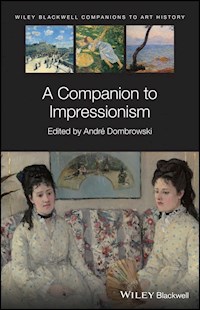
Cover image: Cover (Main): The Sisters, by Berthe Morisot, 1869. Gift of Mrs. Charles S. Carstairs, Courtesy National Gallery of Art, Washington.
Cover Panel: (left) Pont Neuf, Paris, by Pierre-Auguste Renoir, 1872. Ailsa Mellon Bruce Collection,Courtesy National Gallery of Art, Washington. (center) Under the Shade of Tree, by Seiki Kuroda, 1898. Woodone Museum of Art, Hatsukaichi, Hiroshima, Japan. (right) Antibes, by Claude Monet, 1888. Courtauld Institute of Art, London. Photo by Sailko is licensed under CC BY-SA. Cover design by Wiley
Set in 10/12pt and ITC Galliard Std by Integra Software Services Pvt. Ltd, Pondicherry, India
Table of Contents
Cover
Wiley Blackwell Companions to Art History
Title Page
Copyright
list of figures
About the Editor
Notes on Contributors
Series Editor’s Preface
Acknowledgments
Introduction
Part I: What Was Impressionism? What Is an Impression? Definitions and New Directions
Chapter 1: Impressionism and Criticism
Chapter 2: Rethinking the Origins of Impressionism: The Case of Claude Monet and Corner of a Studio
Chapter 3: Monet in the 1880s: The Motif in Crisis
Chapter 4: As a Glass Eye: Manet’s Flower Paintings
Chapter 5: Figuring Perception: Monet’s Leap into Plein Air, 1866–1867
Chapter 6: Pater, Impressionism, and the Undoing of Sense
Chapter 7: The impressionist Mind: Modern Painting and Nineteenth- Century Readerships
Part II: Painting as Object: Tools, Materials, and Close Looking
Chapter 8: Impression, Improvisation, and Premeditation: New Insights into the Working Methods and Creative Process of Claude Monet
Chapter 9: Piquer, Plaquer: Cézanne, Pissarro, and Palette-Knife Painting
Chapter 10: John Singer Sargent’s Lady with a Blue Veil and the Matter of Paint
Part III: New Visual Media and the Other Arts
Chapter 11: Painting Photographing Ballooning: At the Boulevard des Capucines
Chapter 12: Series and Screens: Seeing Monet’s Cathedrals through the Lens of the Cinematograph
Chapter 13: Critical Impressionism: A Painting by Mary Cassatt and Its Challenge to the Social Rules of Art
Chapter 14: James Mcneill Whistler: Veiling the Everyday
Part IV: Impressionism and Identity
Chapter 15: cassatt’s alterity
Chapter 16: Bazille, Degas, and Modern Black Paris
Chapter 17: Expert Hands, Infectious Touch: Painting and Pregnancy in Morisot’s The Mother and Sister of the Artist
Chapter 18: Painting the Prototype: The (Homo)Sexuality of Bazille’s Summer Scene
Part V: Public and Private
Chapter 19: Revival and Risk: Renoir, Fragonard, and the Epistolary Theme
Chapter 20: “The Little Dwarf and the Giant Lady:” At Home with Gustave Caillebotte
Chapter 21: Renoir, Impressionism, and the Value of Touch
Chapter 22: Morisot’s Urbane Ecologies
Chapter 23: Incorporating Impressionism: The Société Anonyme and the First Impressionist Exhibition in 1874
Part VI: World Impressionism
Chapter 24: “Plume Mania:” Degas, Feathers, and the Global Millinery Trade
Chapter 25: Home and Alienation in the Colonies: Auguste Renoir in Algiers, Jean Renoir in India
Chapter 26: Impressionism in Japan: The Awakening of the Senses
Chapter 27: Impressionism in Argentina: A Historiographical Discussion
Chapter 28: Turkish Impressionism: Interplays of Culture and Form
Chapter 29: Impressionism and Naturalism in Germany: The Competing Aesthetic and Ideological Imperatives of a Modern Art
Part VII: Criticism, Displays, and Markets
Chapter 30: Degenerate Art: Impressionism and the Specter of Crisis in French Painting
Chapter 31: Impressionism Through the Prism of New Methods: A Social and Cartographic Study of Monet’s Address Book
Chapter 32: Against the Grain: Gustave Caillebotte and Paul Durand-Ruel’s Impressionism
Chapter 33: Are Museum Curators “Very Special Clients?” Impressionism, the Art Market, and Museums (Paul Durand-Ruel and the Musée du Luxembourg at the Turn of the Twentieth Century)
Chapter 34: The Museum of Impressionism, 1947
Index
End User License Agreement
List of Illustrations
Chapter 1
1.1 Claude Monet,
Impression, Sunrise
, 1872.12
Chapter 2
2.1 Claude Monet,
Corner of a Studio
, 1861.28
2.2 Eugène Delacroix,
The Combat of the Giaour and the Pasha
, 1835.31
2.3 Gustave Courbet,
2.4 Claude Monet,
Hunting Trophy
, 1862.36
2.5 Eugène Boudin,
Chapter 3
3.1 Claude Monet,
On the Cliff at Pourville, Clear Weather
, 1882.44
3.2 Claude Monet,
Antibes
, 1888.45
3.3 Claude Monet,
Argenteuil
, 1872.49
3.4 Claude Monet,
La Grenouillère
, 1869.50
3.5 Claude Monet,
The Church at Varengeville
, 1882.52
3.6 Claude Monet,
The Four Trees
, 1891.56
Chapter 4
4.1 Édouard Manet,
Vase of White Lilacs and Roses
, 1883.63
4.2 Édouard Manet,
Vase of Peonies on a Pedestal
, 1864.65
4.3 Édouard Manet,
Lilacs in a Vase
, c. 1882.68
4.4 Édouard Manet,
Moss Roses in a Vase
, 1882.69
4.5 Édouard Manet,
Flowers in a Crystal Vase
, c. 1882.71
Chapter 5
5.1 Claude Monet,
Women in the Garden
, 1866–1867.78
5.2 Claude Monet,
Flowering Garden at Sainte-Adresse
, 1867.83
5.3 Claude Monet,
Woman in the Garden: Sainte-Adresse
, 1867.84
5.4 Claude Monet,
Adolphe Monet Reading in a Garden
, 1867.85
5.5 Claude Monet,
Garden at Saint-Adresse
, 1867.86
Chapter 7
7.1 Gustave Courbet,
Pierre-Joseph Proudhon and His Children in 1853
, 1865.109
7.2 Paul Cézanne,
Gustave Geffroy
, 1895–1896.110
7.3 Claude Monet,
Rue Saint-Denis, Celebration of June 30, 1878
, 1878.112
7.4 Vincent van Gogh,
Still-Life with Bible
, October 1885.115
7.5 Pierre-Auguste Renoir...
Chapter 8
8.1 Claude Monet,
The Beach at Sainte-Adresse
, 1867.131
8.2 X-ray of Claude Monet,
Stacks of Wheat (Sunset, Snow Effect)
, 1890–1891.134
8.3 Transmitted-infrared image of Claude Monet,...
8.4 Canvas weave match group. Left (top to bottom): Claude Monet...
8.5 Detail of Claude Monet,
On the Bank of the Seine, Bennecourt
, 1868.141
Chapter 9
9.1 Camille Pissarro,
A Square in La Roche-Guyon
, 1867.147
9.2 Camille Pissarro,
Banks of the Marne in Winter
, 1866.149
9.3 Paul Cézanne,
The Lawyer (Uncle Dominique)
, 1866.151
9.4 Camille Pissarro,
The Climb, Rue de la Côte-du-Jalet, Pontoise
...
9.5 Paul Cézanne,
The Étang des Soeurs, Osny, near Pontoise
...
Chapter 10
10.1 John Singer Sargent,
Lady with a Blue Veil (Sally Fairchild)
, 1890.163
10.2 Photograph of Violet Sargent (dated 21 February 1889 on verso).164
10.3 Photograph of John Singer Sargent in Nahant...
10.4 John Singer Sargent,
Henry Cabot Lodge
, 1890.166
10.5 John Singer Sargent,
Claude Monet Painting by the Edge of a Wood
...
10.6 Photograph of Sally Fairchild, n. d.172
10.7 Édouard Manet,
Young Woman in a Round Hat
, c. 1877–1879.174
Chapter 11
11.1 Claude Monet,
Boulevard des Capucines
, 1873–1874.184
11.2 Claude Monet,
Boulevard des Capucines
, 1873–1874.185
11.3 Gaspard-Félix Tournachon [Nadar],...
11.4 Victor Navlet,
General View of Paris from a Hot-Air Balloon
, 1855.191
11.5 Gaspard-Félix Tournachon [Nadar],
Interior of Le Géant Inflating
, 1863.193
Chapter 12
12.1 Demonstration of the cinematograph, in G. Mareschal, “Le Cinématographe...
12.2 Exhibition view of four of Claude Monet’s
Rouen Cathedral
paintings in...
12.3 Claude Monet,
Rouen Cathedral: West Façade, Sunlight
, 1894.206
12.4 Claude Monet,
Rouen Cathedral: West Façade
, 1894.207
12.5 Detail of Claude Monet,...
Chapter 13
13.1 Mary Cassatt,
Lady at the Tea Table
, 1883–1885.220
13.2 Berthe Morisot,
The Sisters
, 1869.221
13.3 Unknown artist,
Two Ladies and an Officer Seated at Tea
...
13.4 Henri Guérard, after James McNeill Whistler,...
13.5 Unknown artist, Tea set, Chinese, nineteenth century....
13.6 Unknown artist, Lappet, Flemish, early-eighteenth century.231
Chapter 14
14.1 Rembrandt van Rijn,
Self Portrait Leaning on a Stone Sill
, 1639.239
14.2 Percy Thomas, after
James McNeill Whistler
, 1874.240
14.3 James McNeill Whistler,
The Dance House: Nocturne
, 1889.243
14.4 Rembrandt van Rijn,
Slaughtered Ox (or Carcass of Beef)
, 1655.244
14.5 James McNeill Whistler,
Brown and Gold
, 1895–1900.246
Chapter 15
15.1 Stone plaque mounted in 2012 by the American Club of Paris...
15.2 Mary Cassatt,
Under the Lamp
, c. 1882.258
15.3 Mary Cassatt,
The Tub (or The Bath)
, 1890–1891.260
15.4 Mary Cassatt,
Mother and Child
, c. 1890.263
15.5 Mary Cassatt,
Seated Woman with an Infant in Her Arms
, 1889–1890.264
Chapter 16
16.1 Édouard Manet,
Olympia
, 1863.273
16.2 Thomas Eakins,
Female Model
, c. 1867–1869.274
16.3 Frédéric Bazille,
Young Woman with Peonies
, 1870.276
16.4 Frédéric Bazille,
Black Woman with Peonies
, 1870.277
16.5 Edgar Degas,
Miss Lala at the Cirque Fernando
, 1879.281
16.6 Edgar Degas,
Miss Lala at the Fernando Circus
, 1879.282
Chapter 17
17.1 Berthe Morisot,
The Mother and Sister of the Artist
, 1869–1870.288
17.2 Berthe Morisot,
Portrait of Madame Edma Pontillon
, 1871.292
17.3 Cham [Charles Amédée de Noé], “Madame!...
17.4 Paul Gavarni, “Philanthropy Bump,”
Le Charivari
,...
17.5 Antoine Chazal, “Placenta above the Orifice,”...
Chapter 18
18.1 Frédéric Bazille,
Summer Scene (Bathers)
, 1869-1870.305
18.2 Arthur Belorget [“The Countess”],...
18.3 Frédéric Bazille,...
18.4 Frédéric Bazille,
Fisherman with a Net
, 1868.312
18.5 Detail of Figure 18.1.313
18.6 Bertall [Charles Albert d’Arnoux], Caricature...
Chapter 19
19.1 Gustave Jean Jacquet,
The Love Letter
, c. 1900.326
19.2 Édouard Manet,
Woman Writing
, before 1866.327
19.3 Jean-Honoré Fragonard,
The Love Letter
, early 1770s.328
19.4 Pierre-Auguste Renoir,
Woman with a Letter
, c. 1890.332
19.5 Pierre-Auguste Renoir,
The Letter
, c. 1895–1900.333
Chapter 20
20.1 Gustave Caillebotte,
Young Man Playing the Piano
, 1876.345
20.2 Gustave Caillebotte,
Luncheon
, 1876.346
20.3 Gustave Caillebotte,
Interior, Woman at the Window
, 1880.347
20.4 Gustave Caillebotte,
Interior, a Woman Reading
, 1880.349
20.5 Gustave Caillebotte,
A Game of Bezique
, 1881.350
Chapter 21
21.1 Pierre-Auguste Renoir,
The Great Bathers
, 1884–1887.358
21.2 Anonymous,
The Touch
, 1635, in
21.3 Pierre-Auguste Renoir,
Bather Arranging Her Hair
, 1885.361
21.4 Pierre-Auguste Renoir,
After the Bath
, 1910.363
21.5 Pierre-Auguste Renoir,
Sleeping Girl
, 1880.364
Chapter 22
22.1 Berthe Morisot,
Landscape at Gennevilliers
, 1875.377
22.2 Berthe Morisot,
Venus at the Forge of Vulcan
...
22.3 Berthe Morisot,
On the Lake
, 1884.383
22.4 Berthe Morisot,
On the Lake
, 1889.385
22.5 Berthe Morisot,
Duck at Rest on the Bank
, 1888/90.386
Chapter 23
23.1 Cover of Société anonyme des artistes...
23.2 Hadol, Caricature of the first impressionist...
23.3 Minutes of the liquidation meeting of the...
23.4 Bertall [Charles Albert d’Arnoux],...
23.5
May-Triptych
, consisting of (from left to right)...
Chapter 24
24.1 Edgar Degas,
At the Milliner’s
, 1882.418
24.2 G. Gonin,...
24.3 Advert for Morin-Hiélard, 27, rue des...
24.4 Ostrich Park at Misserghin, close to...
24.5 “Feathers and Flowers,” in...
Chapter 25
25.1 Drawing of a Rangoli circle, from
The River
...
25.2 Pierre-Auguste Renoir,
Mosque in Algiers
, 1882.438
25.3 Pierre-Auguste Renoir,
Banana Trees
, 1881.442
25.4 View inside the jute mill, from
The River
...
25.5 The Knight family residence, from
The River
...
Chapter 26
26.1 Kiyoteru Kuroda [Seiki Kuroda]...
26.2 Keiichir Kume,
Late Autumn
, 1892.454
26.3 Ch Asai,
Farmers Returning Home
, 1887.455
26.4 Torajir Kojima,
Green Shade
, 1909.456
26.5 Kijir ta,
Reading by the Window
, c. 1909–1910.462
Chapter 27
27.1 Eduardo Sívori,
Plains, or La Porteña Ranch, Moreno
...
27.2 Eduardo Schiaffino,
After the Bath
, 1888.470
27.3 Eduardo Schiaffino,
The Funeral of Victor Hugo
, 1885.471
27.4 Martín Malharro,
Grainstacks: The Pampa Today (Parvas)
...
27.5 Pío Collivadino,
Factory
, c. 1910.480
Chapter 28
28.1 Avni Lifij,
Self-Portrait with a Red Book
, n. d.485
28.2 Halil Pasha,
Fenerbahçe Bay
, 1902.488
28.3 Namık Ismail,
Morning at Sea
, 1925.489
28.4 Nazmi Ziya Güran,
Istanbul Harbor
, n. d.491
28.5 Ibrahim Çallı,
Lovers in a Caique
, n. d.494
Chapter 29
29.1 Max Liebermann,
Workers in the Beet Field
, 1873–1876.501
29.2 Max Liebermann,
Beer Garden in Brannenburg
, 1893.501
29.3 Max Liebermann,
Old Men’s Home in Amsterdam
, 1881.503
29.4 Max Liebermann with his canvas,
Striding Peasant
...
29.5 Max Liebermann,
Woman with Goats in the Dunes
, 1890.510
Chapter 31
31.1 Double-page of addresses from Monet’s account book...
31.2 Map of Paris showing contacts contained in Monet’s...
31.3 Map of Paris showing contacts contained in Monet’s...
Chapter 32
32.1 Gustave Caillebotte,
Luncheon
, 1876.553
32.2 Gustave Caillebotte,
Portrait of Madame X
, 1878.556
32.3 Gustave Caillebotte,
Man at His Bath
, 1884.558
32.4 Gustave Caillebotte,
Nude on a Couch
, c. 1880.559
32.5 Gustave Caillebotte,
Calf’s Head and Ox Tongue
...
Chapter 34
34.1 Photograph of the Jeu de Paume museum entrance in...
34.2 Photograph of the vestibule, Jeu de Paume...
34.3 Photograph of the exhibition panel on...
34.4 Photograph of the Monet room, Jeu de...
Guide
Cover
Wiley Blackwell Companions to Art History
Title Page
Copyright
Table of Contents
list of figures
About the Editor
Notes on Contributors
Series Editor’s Preface
Acknowledgments
Begin Reading
Index
End User License Agreement
Pages
i
ii
iii
iv
v
vi
vii
viii
ix
x
xi
xii
xiii
xiv
xv
xvi
xvii
xviii
xix
xx
xxi
xxii
xxiii
xxiv
xxv
xxvi
1
2
3
4
5
6
7
8
9
10
11
12
13
14
15
16
17
18
19
20
21
22
23
24
25
26
27
28
29
30
31
32
33
34
35
36
37
38
39
40
41
42
43
44
45
46
47
48
49
50
51
52
53
54
55
56
57
58
59
60
61
62
63
64
65
66
67
68
69
70
71
72
73
74
75
76
77
78
79
80
81
82
83
84
85
86
87
88
89
90
91
92
93
94
95
96
97
98
99
100
101
102
103
104
105
106
107
108
109
110
111
112
113
114
115
116
117
118
119
120
121
122
123
124
125
126
127
128
129
130
131
132
133
134
135
136
137
138
139
140
141
142
143
144
145
146
147
148
149
150
151
152
153
154
155
156
157
158
159
160
161
162
163
164
165
166
167
168
169
170
171
172
173
174
175
176
177
178
179
180
181
182
183
184
185
186
187
188
189
190
191
192
193
194
195
196
197
198
199
200
201
202
203
204
205
206
207
208
209
210
211
212
213
214
215
216
217
218
219
220
221
222
223
224
225
226
227
228
229
230
231
232
233
234
235
236
237
238
239
240
241
242
243
244
245
246
247
248
249
250
251
252
253
254
255
256
257
258
259
260
261
262
263
264
265
266
267
268
269
270
271
272
273
274
275
276
277
278
279
280
281
282
283
284
285
286
287
288
289
290
291
292
293
294
295
296
297
298
299
300
301
302
303
304
305
306
307
308
309
310
311
312
313
314
315
316
317
318
319
320
321
322
323
324
325
326
327
328
329
330
331
332
333
334
335
336
337
338
339
340
341
342
343
344
345
346
347
348
349
350
351
352
353
354
355
356
357
358
359
360
361
362
363
364
365
366
367
368
369
370
371
372
373
374
375
376
377
378
379
380
381
382
383
384
385
386
387
388
389
390
391
392
393
394
395
396
397
398
399
400
401
402
403
404
405
406
407
408
409
410
411
412
413
414
415
416
417
418
419
420
421
422
423
424
425
426
427
428
429
430
431
432
433
434
435
436
437
438
439
440
441
442
443
444
445
446
447
448
449
450
451
452
453
454
455
456
457
458
459
460
461
462
463
464
465
466
467
468
469
470
471
472
473
474
475
476
477
478
479
480
481
482
483
484
485
486
487
488
489
490
491
492
493
494
495
496
497
498
499
500
501
502
503
504
505
506
507
508
509
510
511
512
513
514
515
516
517
518
519
520
521
522
523
524
525
526
527
528
529
530
531
532
533
534
535
536
537
538
539
540
541
542
543
544
545
546
547
548
549
550
551
552
553
554
555
556
557
558
559
560
561
562
563
564
565
566
567
568
569
570
571
572
573
574
575
576
577
578
579
580
581
582
583
584
585
586
587
588
589
590
591
592
593
594
595
596
597
598
599
600
601
602
603
604
605
606
607
608
609
List of Figures
1.1 Claude Monet, Impression, Sunrise, 1872.12
2.1 Claude Monet, Corner of a Studio, 1861.28
2.2 Eugène Delacroix, The Combat of the Giaour and the Pasha, 1835.31
2.3 Gustave Courbet, The Painter’s Studio: A Real Allegory Summing Up Seven Years of My Artistic and Moral Life, 1854–1855.33
2.4 Claude Monet, Hunting Trophy, 1862.36
2.5 Eugène Boudin, Still-Life: White Duck on a Console, c. 1854–1857.37
3.1 Claude Monet, On the Cliff at Pourville, Clear Weather, 1882.44
3.2 Claude Monet, Antibes, 1888.45
3.3 Claude Monet, Argenteuil, 1872.49
3.4 Claude Monet, La Grenouillère, 1869.50
3.5 Claude Monet, The Church at Varengeville, 1882.52
3.6 Claude Monet, The Four Trees, 1891.56
4.1 Édouard Manet, Vase of White Lilacs and Roses, 1883.63
4.2 Édouard Manet, Vase of Peonies on a Pedestal, 1864.65
4.3 Édouard Manet, Lilacs in a Vase, c. 1882.68
4.4 Édouard Manet, Moss Roses in a Vase, 1882.69
4.5 Édouard Manet, Flowers in a Crystal Vase, c. 1882.71
5.1 Claude Monet, Women in the Garden, 1866–1867.78
5.2 Claude Monet, Flowering Garden at Sainte-Adresse, 1867.83
5.3 Claude Monet, Woman in the Garden: Sainte-Adresse, 1867.84
5.4 Claude Monet, Adolphe Monet Reading in a Garden, 1867.85
5.5 Claude Monet, Garden at Saint-Adresse, 1867.86
7.1 Gustave Courbet, Pierre-Joseph Proudhon and His Children in 1853, 1865.109
7.2 Paul Cézanne, Gustave Geffroy, 1895–1896.110
7.3 Claude Monet, Rue Saint-Denis, Celebration of June 30, 1878, 1878.112
7.4 Vincent van Gogh, Still-Life with Bible, October 1885.115
7.5 Pierre-Auguste Renoir, Claude Monet Reading, 1872.119
8.1 Claude Monet, The Beach at Sainte-Adresse, 1867.131
8.2 X-ray of Claude Monet, Stacks of Wheat (Sunset, Snow Effect), 1890–1891.134
8.3 Transmitted-infrared image of Claude Monet, Poppy Field (Giverny), 1890–1891.138
8.4 Canvas weave match group. Left (top to bottom): Claude Monet, Étretat: The Beach and the Falaise d’Amont, 1885; Claude Monet, The Departure of the Boats, Étretat, 1885; and Claude Monet, Rocks at Port-Goulphar, Belle-Île, 1886.139
8.5 Detail of Claude Monet, On the Bank of the Seine, Bennecourt, 1868.141
9.1 Camille Pissarro, A Square in La Roche-Guyon, 1867.147
9.2 Camille Pissarro, Banks of the Marne in Winter, 1866.149
9.3 Paul Cézanne, The Lawyer (Uncle Dominique), 1866.151
9.4 Camille Pissarro, The Climb, Rue de la Côte-du-Jalet, Pontoise, 1875.154
9.5 Paul Cézanne, The Étang des Soeurs, Osny, near Pontoise, c. 1875.155
10.1 John Singer Sargent, Lady with a Blue Veil (Sally Fairchild), 1890.163
10.2 Photograph of Violet Sargent (dated 21 February 1889 on verso).164
10.3 Photograph of John Singer Sargent in Nahant (Lucia Fairchild is in the background), August 1890.165
10.4 John Singer Sargent, Henry Cabot Lodge, 1890.166
10.5 John Singer Sargent, Claude Monet Painting by the Edge of a Wood, c. 1885.168
10.6 Photograph of Sally Fairchild, n. d.172
10.7 Édouard Manet, Young Woman in a Round Hat, c. 1877–1879.174
11.1 Claude Monet, Boulevard des Capucines, 1873–1874.184
11.2 Claude Monet, Boulevard des Capucines, 1873–1874.185
11.3 Gaspard-Félix Tournachon [Nadar], Aerial View of Paris (Premier résultat de la photographie aérostatique), c. 1868.188
11.4 Victor Navlet, General View of Paris from a Hot-Air Balloon, 1855.191
11.5 Gaspard-Félix Tournachon [Nadar], Interior of Le Géant Inflating, 1863.193
12.1 Demonstration of the cinematograph, in G. Mareschal, “Le Cinématographe à l’exposition de l’enseignement de la Ville de Paris,” La Nature, 29 September 1900.203
12.2 Exhibition view of four of Claude Monet’s Rouen Cathedral paintings in the galleries of the Musée d’Orsay, Paris, 2016.204
12.3 Claude Monet, Rouen Cathedral: West Façade, Sunlight, 1894.206
12.4 Claude Monet, Rouen Cathedral: West Façade, 1894.207
12.5 Detail of Claude Monet, Rouen Cathedral: West Façade and Saint-Romain Tower, Morning Effect, 1893.208
13.1 Mary Cassatt, Lady at the Tea Table, 1883–1885.220
13.2 Berthe Morisot, The Sisters, 1869.221
13.3 Unknown artist, Two Ladies and an Officer Seated at Tea, c. 1715.224
13.4 Henri Guérard, after James McNeill Whistler, Madame Whistler, 1883.225
13.5 Unknown artist, Tea set, Chinese, nineteenth century (prior to 1883).227
13.6 Unknown artist, Lappet, Flemish, early-eighteenth century.231
14.1 Rembrandt van Rijn, Self Portrait Leaning on a Stone Sill, 1639.239
14.2 Percy Thomas, after James McNeill Whistler, 1874.240
14.3 James McNeill Whistler, The Dance House: Nocturne, 1889.243
14.4 Rembrandt van Rijn, Slaughtered Ox (or Carcass of Beef), 1655.244
14.5 James McNeill Whistler, Brown and Gold, 1895–1900.246
15.1 Stone plaque mounted in 2012 by the American Club of Paris on the façade of Mary Cassatt’s apartment building at 10 rue de Marignan, Paris.254
15.2 Mary Cassatt, Under the Lamp, c. 1882.258
15.3 Mary Cassatt, The Tub (or The Bath), 1890–1891.260
15.4 Mary Cassatt, Mother and Child, c. 1890.263
15.5 Mary Cassatt, Seated Woman with an Infant in Her Arms, 1889–1890.264
16.1 Édouard Manet, Olympia, 1863.273
16.2 Thomas Eakins, Female Model, c. 1867–1869.274
16.3 Frédéric Bazille, Young Woman with Peonies, 1870.276
16.4 Frédéric Bazille, Black Woman with Peonies, 1870.277
16.5 Edgar Degas, Miss Lala at the Cirque Fernando, 1879.281
16.6 Edgar Degas, Miss Lala at the Fernando Circus, 1879.282
17.1 Berthe Morisot, The Mother and Sister of the Artist, 1869–1870.288
17.2 Berthe Morisot, Portrait of Madame Edma Pontillon, 1871.292
17.3 Cham [Charles Amédée de Noé], “Madame! This Is Not Prudent. Stay Back!,” Le Charivari, 16 April 1877.295
17.4 Paul Gavarni, “Philanthropy Bump,” Le Charivari, 30 March 1838.296
17.5 Antoine Chazal, “Placenta above the Orifice,” in Jacques-Pierre Maygrier, Nouvelles démonstrations d’accouchemens, Paris: Béchet, 1822.297
18.1 Frédéric Bazille, Summer Scene (Bathers), 1869-1870.305
18.2 Arthur Belorget [“The Countess”], “The Countess Putting on Make-Up,” in Henri Legludic, “Confidences et aveux d’un Parisien: La Comtesse (1850-1861),” Notes et observations de médecine légale: Attentats au moeurs, Paris: G. Masson, 1896.307
18.3 Frédéric Bazille, Young Male Nude Lying in the Grass, 1870.311
18.4 Frédéric Bazille, Fisherman with a Net, 1868.312
18.5 Detail of Figure 18.1.313
18.6 Bertall [Charles Albert d’Arnoux], Caricature of Frédéric Bazille’s Summer Scene, in “Promenade au Salon de 1870,” Journal amusant, 28 May 1870.315
19.1 Gustave Jean Jacquet, The Love Letter, c. 1900.326
19.2 Édouard Manet, Woman Writing, before 1866.327
19.3 Jean-Honoré Fragonard, The Love Letter, early 1770s.328
19.4 Pierre-Auguste Renoir, Woman with a Letter, c. 1890.332
19.5 Pierre-Auguste Renoir, The Letter, c. 1895–1900.333
20.1 Gustave Caillebotte, Young Man Playing the Piano, 1876.345
20.2 Gustave Caillebotte, Luncheon, 1876.346
20.3 Gustave Caillebotte, Interior, Woman at the Window, 1880.347
20.4 Gustave Caillebotte, Interior, a Woman Reading, 1880.349
20.5 Gustave Caillebotte, A Game of Bezique, 1881.350
21.1 Pierre-Auguste Renoir, The Great Bathers, 1884–1887.358
21.2 Anonymous, The Touch, 1635, in Collection Michel Hennin: Estampes relatives à l’histoire de France, vol. 30, no. 2650.360
21.3 Pierre-Auguste Renoir, Bather Arranging Her Hair, 1885.361
21.4 Pierre-Auguste Renoir, After the Bath, 1910.363
21.5 Pierre-Auguste Renoir, Sleeping Girl, 1880.364
22.1 Berthe Morisot, Landscape at Gennevilliers, 1875.377
22.2 Berthe Morisot, Venus at the Forge of Vulcan (after François Boucher), 1884.379
22.3 Berthe Morisot, On the Lake, 1884.383
22.4 Berthe Morisot, On the Lake, 1889.385
22.5 Berthe Morisot, Duck at Rest on the Bank, 1888/90.386
23.1 Cover of Société anonyme des artistes peintres, sculpteurs, graveurs, etc., Première exposition 1874, Boulevard des Capucines, 35: Catalogue, Paris: Alcan-Lévy, 1874.394
23.2 Hadol, Caricature of the first impressionist exhibition, in “La Semaine comique,” L’Éclipse, 26 April 1874.395
23.3 Minutes of the liquidation meeting of the Impressionists’ société anonyme, 17 December 1874, in John Rewald, Histoire de l’impressionnisme, Paris: Albin Michel, 1955.401
23.4 Bertall [Charles Albert d’Arnoux], Caricature “The End of the Exposition,” in “Revue comique du mois,” L’Illustration, 5 June 1875.406
23.5 May-Triptych, consisting of (from left to right) Alfred Sisley, L’Île Saint-Denis, 1872; Camille Pissarro, Entrance to the Village of Voisins, 1872; and Claude Monet, Pleasure Boats, 1872–1873.408
24.1 Edgar Degas, At the Milliner’s, 1882.418
24.2 G. Gonin,“Jolie Miss” Chapeau by Madame Hélène, in La Modiste universelle, January 1882.422
24.3 Advert for Morin-Hiélard, 27, rue des Pyramides, Paris, in “Plumassiers,” Annuaire-almanach du commerce, de l’industrie, de la magistrature et de l’administration, Paris: Firmin-Didot, 1892.424
24.4 Ostrich Park at Misserghin, close to Oran, Algeria, in Lacroix-Danliard, La Plume des oiseaux, Paris: J.B. Ballière, 1891.425
24.5 “Feathers and Flowers,” in Au Bon Marché: Catalogue de la saison d’été, Paris, 1882.428
25.1 Drawing of a Rangoli circle, from The River, 1951, directed by Jean Renoir.436
25.2 Pierre-Auguste Renoir, Mosque in Algiers, 1882.438
25.3 Pierre-Auguste Renoir, Banana Trees, 1881.442
25.4 View inside the jute mill, from The River, 1951, directed by Jean Renoir.444
25.5 The Knight family residence, from The River, 1951, directed by Jean Renoir.445
26.1 Kiyoteru Kuroda [Seiki Kuroda], A Maiko Girl, 1893.453
26.2 Keiichir Kume, Late Autumn, 1892.454
26.3 Ch Asai, Farmers Returning Home, 1887.455
26.4 Torajir Kojima, Green Shade, 1909.456
26.5 Kijir ta, Reading by the Window, c. 1909–1910.462
27.1 Eduardo Sívori, Plains, or La Porteña Ranch, Moreno, 1899.468
27.2 Eduardo Schiaffino, After the Bath, 1888.470
27.3 Eduardo Schiaffino, The Funeral of Victor Hugo, 1885.471
27.4 Martín Malharro, Grainstacks: The Pampa Today (Parvas), 1911.474
27.5 Pío Collivadino, Factory, c. 1910.480
28.1 Avni Lifij, Self-Portrait with a Red Book, n. d.485
28.2 Halil Pasha, Fenerbahçe Bay, 1902.488
28.3 Namık Ismail, Morning at Sea, 1925.489
28.4 Nazmi Ziya Güran, Istanbul Harbor, n. d.491
28.5 Ibrahim Çallı, Lovers in a Caique, n. d.494
29.1 Max Liebermann, Workers in the Beet Field, 1873–1876.501
29.2 Max Liebermann, Beer Garden in Brannenburg, 1893.501
29.3 Max Liebermann, Old Men’s Home in Amsterdam, 1881.503
29.4 Max Liebermann with his canvas, Striding Peasant (completed in 1894 and destroyed during World War II) and the model, photograph taken in 1894 at Kaatwijk, Holland.509
29.5 Max Liebermann, Woman with Goats in the Dunes, 1890.510
31.1 Double-page of addresses from Monet’s account book of 1882–1912.535
31.2 Map of Paris showing contacts contained in Monet’s first address book overlaid with the geography of the Parisian art scene (1877–1881).538
31.3 Map of Paris showing contacts contained in Monet’s second address book overlaid with the geography of the Parisian art scene (1882–1912).539
32.1 Gustave Caillebotte, Luncheon, 1876.553
32.2 Gustave Caillebotte, Portrait of Madame X, 1878.556
32.3 Gustave Caillebotte, Man at His Bath, 1884.558
32.4 Gustave Caillebotte, Nude on a Couch, c. 1880.559
32.5 Gustave Caillebotte, Calf’s Head and Ox Tongue, c. 1882.560
34.1 Photograph of the Jeu de Paume museum entrance in the Tuileries Gardens, Paris, August 1959.587
34.2 Photograph of the vestibule, Jeu de Paume, Paris, 1947.589
34.3 Photograph of the exhibition panel on impressionist technique, Jeu de Paume, Paris, 1947.591
34.4 Photograph of the Monet room, Jeu de Paume, Paris, 1947.593
About the Editor
André Dombrowski is Frances Shapiro–Weitzenhoffer Associate Professor of Nineteenth–Century European Art at the University of Pennsylvania, specializing in the arts and material cultures of France, Germany, and Britain in the late–nineteenth century. Author of Cézanne, Murder, and Modern Life (2013), a book about the artist’s early work, he has also written essays on Manet, Monet, Degas, and Menzel, among others. He is currently at work on his next book, rooting the rise of the impressionist instant — and nineteenth–century painting’s presumed new “quickness” more broadly — in the period’s innovative time technologies and forms of time management.
Notes on Contributors
Ahu Antmen is Professor of Modern and Contemporary Art at Sabancı University in Istanbul. Her research focuses on issues of modernity, cultural identity, and gender in twentieth-century Turkish art. She has contributed to various international publications, including Globalizing Impressionism: Reception, Translation, and Transnationalism (2020), Curatorial Challenges – Interdisciplinary Perspectives on Contemporary Curating (2019), Artists in Their Time (2015), Unleashed – Contemporary Art from Turkey (2010), and Beyond Imagined Uniqueness – Nationalisms in Contemporary Perspectives (2010). Her curatorial work includes Bare, Naked, Nude: A Story of Modernization in Turkish Painting (2015) at the Pera Museum, Istanbul. She is currently working on a history of modern art in Turkey.
Carol M. Armstrong is Professor of History of Art at Yale University, where she has taught since 2008. She teaches and writes about nineteenth-century French and European art, the history of photography, the history of art criticism, and feminist art history and theory. She has published books and essays on Degas, Manet, and Cézanne, nineteenth-century photography, and women artists of the nineteenth and twentieth centuries. Her most recent book is Cézanne’s Gravity (2018), and she is currently working on a new project, offering a feminist perspective on the question of medium specificity, titled Medium Matrix Materiality.
Caroline Arscott is Walter H. Annenberg Professor of the History of Art at The Courtauld Institute of Art, London (where she has been on faculty since 1988). She is the author of William Morris and Edward Burne-Jones: Interlacings (2008), and has been an editor of the Oxford Art Journal and RIHA Journal. As Head of Research at The Courtauld from 2009 to 2014, she directed research strategy, projects, and events programming. She was principal investigator and exhibition curator for “Scrambled Messages,” on Victorian art and telegraphy (2013–2017). Her research and publications have centered on art and sexuality, industrial technologies, and changing conceptions of the body.
Hollis Clayson is Bergen Evans Professor Emerita in the Humanities and Professor Emerita of Art History at Northwestern University. She has published widely on diverse Paris-based art practices. Her books include Painted Love (1991), Paris in Despair (2002), Is Paris Still the Capital of the Nineteenth Century?, coedited with André Dombrowski (2016), and Paris Illuminated (2019). She has also written about the interior and the threshold, intaglio printmaking as an integral component of Modernism, and art produced within social and political networks of transatlantic exchange. Her current research centers upon the inescapabilty of the Eiffel Tower.
Laura Malosetti Costa is Professor of Art History at the National University of San Martín (UNSAM), specializing in the art and culture of late nineteenth-century Latin America. She also serves as researcher of CONICET (National Council for Scientific and Technological Research) and Dean of the Institute of Arts and Conservation at UNSAM. Malosetti Costa is the author of a number of books, exhibition catalogs, and articles, including Los primeros modernos: Arte y sociedad en Buenos Aires a fines del siglo XIX (2001), Collivadino (2006), La seducción fatal (2015), and Ernesto de la Cárcova (2019).
Mary-Dailey Desmarais is Director of the Curatorial Department of the Montreal Museum of Fine Arts. Her writing has appeared in numerous scholarly publications, art magazines, and exhibition catalogs. Recent exhibitions curated, and accompanying catalogs edited, include Signac and the Indépendants (2020), About Face: Photographs by Cindy Sherman, Laurie Simmons, and Rachel Harrison (2019), and Once Upon a Time … The Western: A New Frontier in Art and Film (2017). She holds a BA from Stanford University, an MA in art history from Williams College, and a PhD in art history from Yale University. A specialist in the work of Claude Monet, her doctoral dissertation “Claude Monet: Behind the Light” brought renewed attention to the artist’s lesser-known works.
About the EditorAndré Dombrowski is Frances Shapiro-Weitzenhoffer Associate Professor of Nineteenth-Century European Art at the University of Pennsylvania, specializing in the arts and material cultures of France, Germany, and Britain in the late-nineteenth century. Author of Cézanne, Murder, and Modern Life (2013), a book about the artist’s early work, he has also written essays on Manet, Monet, Degas, and Menzel, among others. He is currently at work on his next book, rooting the rise of the impressionist instant — and nineteenth-century painting’s presumed new “quickness” more broadly — in the period’s innovative time technologies and forms of time management.
Nina L. Dubin is Associate Professor of Art History at the University of Illinois at Chicago, specializing in European art since 1700. She is the author of Futures & Ruins: Eighteenth-Century Paris and the Art of Hubert Robert (2010) and coauthor of Meltdown! Picturing the World’s First Bubble Economy (2020). Her chapter in this volume stems from her current book project, which examines the ascendancy of the love-letter theme in French art alongside the rise of a trust economy.
Briony Fer is Professor of History of Art at the University College, London, and a fellow of the British Academy, specializing in modern and contemporary art. She is the author of On Abstract Art (1997), The Infinite Line: Re-Making Art After Modernism (2004), as well as books and exhibition catalogs on Eva Hesse, Gabriel Orozco, Richard Serra, Louise Bourgeois, and Anni Albers, among many other publications.
Marc Gotlieb is Halvorsen Director of the Williams-Clark Graduate Program in the History of Art at Williams College and the Clark Art Institute. His book The Deaths of Henri Regnault was published in 2017, and he is the author of The Plight of Emulation: Ernest Meissonier and French Salon Painting (1996). He is currently preparing a study on the role of the viewer in the art of Jean-Léon Gérôme, as well as a study on the poetics of mortality in nineteenth-century artistic biography.
Gloria Groom is Chair of Painting and Sculpture of Europe, and David and Mary Winton Green Curator at the Art Institute of Chicago. She is an internationally acclaimed and widely published scholar of nineteenth-century French painting. Since joining the Art Institute in 1984, she has been involved in numerous major exhibitions and catalogs and has led the museum’s initiative for monographic digital scholarly collection catalogs on the impressionist collection (covering, to date, Caillebotte, Gauguin, Manet, Monet, Pissarro, and Renoir), which bring together international teams of scholars, conservators, and scientists. Her current project is Cezanne, a retrospective exhibition with Tate Modern, opening in 2022.
Anne Higonnet is a Professor of Art History at Barnard College and Columbia University. She has worked on Impressionism since starting her PhD dissertation on Berthe Morisot in 1985. The author of five books, two book-scale digital projects, and many essays, she is a prize-winning teacher and lectures widely. She is currently working on the fashion aspect of the French Revolution.
Mary Hunter is Associate Professor of Art History at McGill University. She is the author of The Face of Medicine: Visualising Medical Masculinities in Late Nineteenth-Century Paris (2016), in addition to texts on Impressionism, Henri de Toulouse-Lautrec, and the visual culture of medicine. She is currently writing a book about waiting in the impressionist era.
Jonathan D. Katz is an art historian, curator, and queer activist. Associate Professor of Practice in History of Art and Gender, Sexuality, and Women’s Studies at the University of Pennsylvania, Katz is a pioneering figure in the development of queer art history, and author of a number of books and articles, often having written the first queer accounts of numerous artists. He has curated many exhibitions, nationally and internationally, including the first queer exhibition at a major US museum, Hide/Seek, at the Smithsonian’s National Portrait Gallery. Katz cofounded the Queer Caucus for Art, Queer Nation in San Francisco, The Harvey Milk Institute, and is president emeritus of The Leslie-Lohman Museum for Gay and Lesbian Art in New York City.
Simon Kelly is Curator and Head of the Department of Modern and Contemporary Art at the Saint Louis Art Museum. He has written extensively on nineteenth-century French painting, particularly landscape and imagery of rural life, focusing on the importance of cultural markets. Author or coauthor of exhibition catalogs on Millet, Degas, Monet, Barye, and French landscape and nationhood, he has also written essays on artists including Manet, van Gogh, Matisse, and others. His book, Théodore Rousseau and the Rise of the Modern Art Market: An Avant-Garde Landscape Painter in Nineteenth-Century France, is forthcoming in 2021.
Marine Kisiel is Scientific Advisor at the National Institute for Art History (INHA), Paris, specializing in the arts and visual culture of late nineteenth-century France. Formerly Curator of Paintings at the Musée d’Orsay, Kisiel curated the exhibitions Degas Danse Dessin: Un hommage à Degas avec Paul Valéry (2017), Degas à l’Opéra (2019), and James Tissot: Ambiguously Modern (2020). Kisiel has most recently produced a general introduction to Impressionism called Comment regarder l’impressionnisme (2018). She received her PhD from the Université de Bourgogne and the University of Edinburgh with a thesis entitled “Impressionist Painting and Decoration, 1870–1895,” which will be published as a book in 2021.
Felix Krämer is Director General of the Kunstpalast in Düsseldorf, Germany. From 2008 to 2017, he was chief curator of modern art at the Städel Museum in Frankfurt am Main, where he was responsible for the exhibitions Matisse/Bonnard: “Long Live Painting!” (2017), Battle of the Sexes (2016), Monet and the Birth of Impressionism (2015), and Dark Romanticism (2012), which traveled to the Musée d’Orsay in Paris as L‘Ange du bizarre. His book Das unheimliche Heim (stemming from his doctoral thesis at the University of Hamburg) addresses the representation of social tensions in paintings of the interior around 1900, and was published in 2007.
Ségolène Le Men is Professor Emerita of Art History at Université Paris Nanterre, and chevalier de la Légion d’honneur. She specializes in the history of modern art, with an emphasis on artists of the nineteenth century such as Courbet and Monet. Among her many publications are Les Abécédaires français illustrés du XIXe siècle (1984), Seurat et Chéret (1994), La Cathédrale illustrée de Hugo à Monet (1998), Courbet (2007), as well as a large number of edited volumes, exhibition catalogs, and other essays.
Nancy Locke is Associate Professor of Art History at the Pennsylvania State University, where she teaches courses on modern European art and the history of photography. She is the author of Manet and the Family Romance (2001), as well as articles on Manet, Cézanne, Futurism, and the early photographer of Paris, Charles Marville. Her second book, in progress, considers Cézanne’s ongoing dialogue with artists of the past.
Martha Lucy is Deputy Director for Research, Interpretation, and Education at the Barnes Foundation in Philadelphia. A specialist in nineteenth-century French art, she is the coauthor of Renoir in the Barnes Foundation (2012) and has written many essays on topics ranging from evolutionary themes in the work of Redon and Gauguin to the use of mirrors in impressionist painting. Her current research focuses on images of the toilette in nineteenth-century art and visual culture, as well as the relationship between touch and Realism during the industrial era.
Michael Marrinan is Professor Emeritus of Art History at Stanford University, where he taught the history and theory of eighteenth and nineteenth-century European art for 30 years. His writings include the books Painting Politics for Louis-Philippe (1988), Romantic Paris (2009), Gustave Caillebotte (2016), and, with John Bender, The Culture of Diagram (2010). He is currently writing a monograph on the early Impressionism of Claude Monet, from which the chapter for the present volume is taken.
Félicie Faizand de Maupeou is currently working at the Labex Pasts in Present, coresponsible for a program on artists’ libraries. She specializes in the history of Impressionism, especially Claude Monet, and histories of exhibitions. Her book, Claude Monet et l’exposition (2018), is an innovative approach to the manifold ways that Monet used exhibitions to promote his career socially, economically, and aesthetically. She has also developed scholarship in the digital humanities as part of the research team at GeoMap, a digital repository of Parisian art dealers.
Neil McWilliam is Walter H. Annenberg Professor of Art and Art History at Duke University. A specialist in the cultural history of nineteenth and early twentieth-century France, his work focuses on the history of art criticism and aesthetics, particularly as they relate to political ideologies, the historiography of French art, and the political history of sculpture. Publications include Dreams of Happiness: Social Art & the French Left (1993), Monumental Intolerance: Jean Baffier, a Nationalist Sculptor in Fin-de-siècle France (2000), Émile Bernard: Les Lettres d’un artiste (2012), and L’Esthétique de la réaction: Tradition, foi, identité et l’art français (1900–1914) (2021).
Jeremy Melius is a specialist in modern art and art writing. His essays on figures such as Ruskin, Hildebrand, Picasso, and Bontecou have appeared in Critical Inquiry, Art History, October, and elsewhere. He has recently completed a book called The Invention of Botticelli and is at work on another concerning the fraught relationship between Ruskin and art history.
Mary Morton is Curator and Head of the French Paintings Department at the National Gallery of Art in Washington, DC. Her exhibition projects prior to her arrival in Washington included Courbet and the Modern Landscape (2006), Oudry’s Painted Menagerie (2007), and The Spectacular Art of Jean-Léon Gérôme (2010). At the National Gallery, she organized the presentation of Gauguin: Maker of Myth (2011), a reinstallation of the gallery’s renowned nineteenth-century collection (2012), Gustave Caillebotte: The Painter’s Eye (2015), Cézanne Portraits (2017), Corot Women (2018), and True to Nature: Open-Air Painting in Europe, 1780–1870 (2020).
Kimberley Muir is Research Conservator for Paintings at the Art Institute of Chicago. Her work focuses on the technical study of paintings, using a range of imaging and analytical techniques to inform scholarship and conservation efforts. She has published and lectured on the methods and materials of Monet, Manet, Whistler, and Picasso, and has contributed to Art Institute initiatives in digital publishing and post-secondary object-based art history education. She is currently researching the museum’s collection of paintings by Paul Cézanne.
Denise Murrell is Associate Curator of Nineteenth- and Twentieth-Century Art at the Metropolitan Museum of Art in New York City. She was the curator of the 2018–2019 exhibition Posing Modernity: The Black Model from Manet and Matisse to Today at Columbia University’s Wallach Art Gallery, and the author of its catalog, as the Wallach’s first Ford Foundation Postdoctoral Research Scholar. She was a cocurator of the exhibition’s 2019 expansion at the Musée d’Orsay in Paris, entitled The Black Model from Géricault to Matisse, contributing essays to its catalog. She has taught art history at Columbia University in New York and Paris.
Takanori Nagaï is Associate Professor at the Kyoto Institute of Technology, specializing in the history of modern French art, as well as modern and contemporary design. His single-authored and edited books (in Japanese) of the past 10 years include Picasso and the Art of Humanity (2020), Cézanne: The Father of Modern Art? (2019), The Site in French Modern Art (2016), Research and Methods: Analyzing French Modern and Contemporary Art (2014), and Want to Know More About Cézanne? (2012).
Sylvie Patry serves as Conservatrice générale du Patrimoine and Director of Curatorial Affairs and Collections at the Musée d’Orsay in Paris. Earlier, Patry held the position of Deputy Director and Chief Curator of Collections, Exhibitions, Publications, and Archives at the Barnes Foundation in Philadelphia; she assumed that role after 10 years as curator, then chief curator, at the Musée d’Orsay. She specializes in the history of painting in the second half of the nineteenth century, with particular emphasis on Impressionism and Post-Impressionism. She has conducted the majority of her teaching, publication, and research in this area, and thanks to her expertise, has participated in numerous high-profile international exhibitions and museum acquisitions.
Todd Porterfield’s research, teaching, and curating address international and intercultural relations, imperialism, and globalization. He is the author of The Allure of Empire: Art in the Service of French Imperialism, 1798–1836 (1998), coauthor of Staging Empire: Napoleon, Ingres, and David (2006), editor of The Efflorescence of Caricature, 1759–1838 (2011), and curator of the Ashmolean Museum exhibition, Love Bites: Caricatures by James Gillray (2015). He has written essays on Kent Monkman, León Ferrari, Edgar Degas, Théodore Chassériau, and Jacques-Louis David, among other topics. He is currently Professor at New York University’s Gallatin School.
Alex Potts is author of Flesh and the Ideal: Winckelmann and the Origins of Art History (1994), The Sculptural Imagination: Figurative, Modernist, Minimalist (2000), and most recently, Experiments in Modern Realism: World Making, Politics and the Everyday in Postwar European and American Art (2013). Currently, he is writing a book on labor and the picturing of the social in later nineteenth-century art. He taught at the University of Michigan, Ann Arbor, where he was Max Loehr Collegiate Professor in the History of Art.
Susan Sidlauskas teaches the visual culture of the long nineteenth century, as well as its resonance with contemporary issues, at Rutgers University, where she is Professor of the History and Theory of Modern Art and currently Chair of the Art History Department. She is the author of Body, Place and Self in Nineteenth-Century Painting (2000), Cézanne’s Other: The Portraits of Hortense (2009), and is at work finishing the book, John Singer Sargent and the Physics of Touch. Chapters of a book on the medical portrait have appeared as articles, one for Nonsite #26, and the other in Before-and-After Photography, edited by Jordan Bear and Kate Palmer Albers (2017).
Alison Syme is Associate Professor of Modern Art at the University of Toronto. Specializing in art and visual culture of the late-nineteenth and early-twentieth centuries in Britain, France, and the United States, she is the author of A Touch of Blossom: John Singer Sargent and the Queer Flora of Fin-de-Siècle Art (2010) and Willow (2014). Her work frequently explores intersections between the histories of art, literature, and science, and she is currently completing a book on Edward Burne-Jones.
Martha Ward is Associate Professor of Art History at the University of Chicago. Her primary research interests are nineteenth- and twentieth-century French painting, criticism, and exhibition practice. Publications include Pissarro, Neo-Impressionism and the Spaces of the Avant-Garde (1996), and the coauthored Looking and Listening in Nineteenth-Century France (2007). She is now completing The Art Show, an examination of museological exhibition practice in the interwar period.
Marnin Young is Associate Professor and Chair of Art History at Stern College for Women, Yeshiva University. He received his PhD from the University of California, Berkeley. Young’s first book, Realism in the Age of Impressionism: Painting and the Politics of Time, appeared in 2015. He has published articles on nineteenth-century French painting in The Art Bulletin, Art History, The RIHA Journal, Nineteenth Century Studies, and Nonsite, where he is a contributing editor. Recent work includes an essay on art criticism in the catalog for the exhibition Félix Fénéon: The Anarchist and the Avant-Garde (2020).
Series Editor’s Preface
Blackwell Companions to Art History is a series of edited collections designed to cover the discipline of art history in all its complexities. Each volume is edited by specialists who lead a team of essayists, representing the best of leading scholarship, in mapping the state of research within the sub-field under review, as well as pointing toward future lines of enquiry.
This Companion to Impressionism aims to move beyond established histories to assemble examples that have proliferated over recent decades both of the various approaches to interpreting impressionist art and of new ways of experiencing and examining the works themselves as physical objects. Attention is paid to how and why Impressionism became a near-global phenomenon around 1900. Essays trace how the style spread to across continents, and the ways in which its underpinning concepts spoke to different cultures.
Impressionist painting as practised by the principal artists who participated in the eight impressionist exhibitions between 1874 and 1886 is the main concern of this volume. The tight focus on these artists (and their international followers) opens up the rich range of approaches to Impressionism that have evolved over recent decades. The thematic and methodological interconnectedness of the essays in the seven sections of the volume underscore the depth of this investigation. And this detailed enquiry is intended to show how the movement was in fact an artistic and intellectual challenge to the art world in the nineteenth century.
Together, these essays combine to provide an exciting and challenging revision of our conception and understanding of Impressionism that will be essential reading for students, researchers and teachers across a broad spectrum of interests. A Companion to Impressionism is a very welcome addition to the series.
Dana Arnold, 2021




