


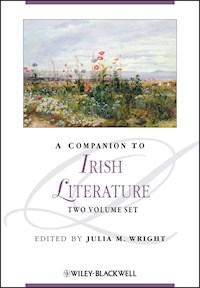
A Companion to Irish Literature E-Book
65,99 €
Mehr erfahren.
- Herausgeber: John Wiley & Sons
- Kategorie: Geisteswissenschaft
- Serie: Blackwell Companions to Literature and Culture
- Sprache: Englisch
Featuring new essays by international literary scholars, the two-volume Companion to Irish Literature encompasses the full breadth of Ireland's literary tradition from the Middle Ages to the present day. * Covers an unprecedented historical range of Irish literature * Arranged in two volumes covering Irish literature from the medieval period to 1900, and its development through the twentieth century to the present day * Presents a re-visioning of twentieth-century Irish literature and a collection of the most up-to-date scholarship in the field as a whole * Includes a substantial number of women writers from the eighteenth century to the present day * Includes essays on leading contemporary authors, including Brian Friel, Seamus Heaney, Eavan Boland, Roddy Doyle, and Emma Donoghue * Introduces readers to the wide range of current approaches to studying Irish literature
Sie lesen das E-Book in den Legimi-Apps auf:
Seitenzahl: 2407
Veröffentlichungsjahr: 2011
Ähnliche




















Contents
VOLUME I
Acknowledgments
Notes on Contributors
Introduction
Recovery and Reassessment
Sketching Literary Histories
Fifteen Centuries, Six Parts
Part One: The Middle Ages
1 Táin Bó Cúailnge
2 Finn and the Fenian Tradition
3 The Reception and Assimilation of Continental Literature
Introduction
The Reception of Latin Literature
Latin Epic or Irish Saga, Literature or Historiography?
Literary Responses to the Viking Incursions
The Reception of Anglo-Norman Literature
The Dánta Grádha and L’Amour Courtois in Ireland
Conclusion
Part Two: The Early Modern Era
4 Bardic Poetry, Masculinity, and the Politics of Male Homosociality
5 Annalists and Historians in Early Modern Ireland, 1450–1700
A Traditional World, 1450–1550
Beginnings of Change, 1560–1600
Adapting to Change, 1601–1640
Discontinuities, 1641–1700
6 “Hungry Eyes” and the Rhetoric of Dispossession: English Writing from Early Modern Ireland
7 Kinds of Irishness: Henry Burnell and Richard Head
Henry Burnell: “the rest degenerate”
Richard Head: “onely a Wiseacre … I have no Acres of Land”
Conclusion: “no Utopian stories …”
Part Three: The Eighteenth Century
8 Crossing Acts: Irish Drama from George Farquhar to Thomas Sheridan
9 Parnell and Early Eighteenth-Century Irish Poetry
10 Jonathan Swift and Eighteenth-Century Ireland
Made in Ireland
Modes of National Belonging
Writing Ireland
A Colonial Nationalism?
Monumentality
11 Merriman’s Cúirt An Mheonoíche and Eighteenth-Century Irish Verse
12 Frances Sheridan and Ireland
Depicting National Character: Memoirs of Miss Sidney Bidulph
Abusing (the) English: Sheridan’s Comedies
Reforming Lord George Sackville: The History of Nourjahad
Conclusion
13 “The Indigent Philosopher”: Oliver Goldsmith
“Our Conquered Kingdom”
“A Philosophic Vagabond”
Citizens of the World
The Patriot’s Boast
“England’s Griefs”
The Beauties of Goldsmith
14 Edmund Burke
15 The Drama of Richard Brinsley Sheridan
Part Four: The Romantic Period
16 United Irish Poetry and Songs
17 Maria Edgeworth and (Inter)national Intelligence
The “Public Woman” in Edgeworth’s Letters for Literary Ladies and Leonora
“Savage Policy” and “Despotic Benevolence”: Edgeworth’s Essay on Irish Bulls (1802) and Ennui (1809)
Conclusion
18 Mary Tighe: A Portrait of the Artist for the Twenty-First Century
I
II
III
IV
19 Thomas Moore: After the Battle
20 The Role of the Political Woman in the Writings of Lady Morgan (Sydney Owenson)
Part Five: The Rise of Gothic
21 Charles Robert Maturin: Ireland’s Eccentric Genius
The Romantic Misfit
“A Nut Between Two Blades”
National Romance and The Wild Irish Boy
Melmoth the Wanderer
22 Joseph Sheridan Le Fanu: Gothic Grotesque and the Huguenot Inheritance
Comic Grotesque in Le Fanu’s Irish Poetry and Fiction
The Metaphysical Grotesque: In a Glass Darkly
Feminist Grotesque
23 A Philosophical Home Ruler: The Imaginary Geographies of Bram Stoker
Part Six: The Victorian Era
24 Scribes and Storytellers: The Ethnographic Imagination in Nineteenth-Century Ireland
Fairies, Leprechauns, and Peasants
Official Ethnography
25 Reconciliation and Emancipation: The Banims and Carleton
26 Davis, Mangan, Ferguson: Irish Poetry, 1831–1849
27 The Great Famine in Literature, 1846–1896
28 Dion Boucicault: From Stage Irishman to Staging Nationalism
The Knight of Arva
The Colleen Bawn
Arrah-na-Pogue
The Shaughraun
29 Oscar Wilde’s Convictions, Speciesism, and the Pain of Individualism
Nineteenth-Century Individualism and the Ethics of Suffering Animals
Personal Pain and Imaginative Sympathy in Oscar Wilde
Animality and Irishness in Wilde
VOLUME TWO
Introduction
International Celebrities and Irish Canons
History and the Problem of Periodization
Eleven Decades, Four Parts
Part Seven: Transitions: Victorian, Revival, Modern
30 Cultural Nationalism and Irish Modernism
31 Defining Irishness: Bernard Shaw and the Irish Connection on the English Stage
32 The Novels of Somerville and Ross
Big House Territory
Revivalist Territory
Gender Territory
33 W.B. Yeats and the Dialectics of Misrecognition
Revivalism and Misrecognition
The Early Period: 1888–1910
The Middle Period: 1910–1928
The Late Period: 1928–1939
34 John Millington Synge – Playwright and Poet
35 James Joyce and the Creation of Modern Irish Literature
Life
Writing
Part Eight: Developments in Genre and Representation after 1930
36 The Word of Politics/Politics of the Word: Immanence and Transdescendence in Sean O’Casey and Samuel Beckett
37 Elizabeth Bowen: A Home in Writing
38 Changing Times: Frank O’Connor and Seán O’Faoláin
39 “Ireland is small enough”: Louis MacNeice and Patrick Kavanagh
40 Irish Mimes: Flann O’Brien
Dry Chat
Being a Summary
Impostures
Out of Control
In Any Event Indescribable
The Badge of Poverty
For Which the City of Dublin is Famous
Part Nine: Debating Social Change after 1960
41 Reading William Trevor and Finding Protestant Ireland
42 The Mythopoeic Ireland of Edna O’Brien’s Fiction
43 Anglo-Irish Conflict in Jennifer Johnston’s Fiction
44 Living History: The Importance of Julia O’Faolain’s Fiction
45 Holding a Mirror Up to a Society in Evolution: John McGahern
Part Ten: Contemporary Literature: Print, Stage, and Screen
46 Brian Friel: From Nationalism to Post-Nationalism
Stages of Postcolonial Development
Friel’s Nationalism
Friel’s Critique of Nationalism
Friel’s Critique of the Republic of Ireland
Friel’s Critique of Northern Ireland
Personal and Polycentric
47 Telling the Truth Slant: The Poetry of Seamus Heaney
48 Belfast Poets: Michael Longley, Derek Mahon, and Medbh McGuckian
49 Eiléan Ní Chuilleanáin’s Work of Witness
I
II
III
50 Eavan Boland’s Muse Mothers
51 John Banville’s Dualistic Universe
52 Between History and Fantasy: The Irish Films of Neil Jordan
Jordan and Irish History
Jordan and Fantasy
Jordan and the Gothic
53 “Keeping That Wound Green”: The Poetry of Paul Muldoon
Life and Background
Early Work
The Violence of Interpretation
Middle Period
Recent Work
54 Nuala Ní Dhomhnaill and the “Continuously Contemporary”
Early Poems
Poems on Emigration
On Return to Ireland
55 The Anxiety of Influence and the Fiction of Roddy Doyle
Doyle’s Dublin Voices
Who Are Your Influences?
The Case of Henry Smart
The Unacknowledged Dinner Guest
Return of the Rabbittes
56 The Reclamation of “Injurious Terms” in Emma Donoghue’s Fiction
57 Martin McDonagh and the Ethics of Irish Storytelling
Index
Blackwell Companions to Literature and Culture
This series offers comprehensive, newly written surveys of key periods and movements and certain major authors, in English literary culture and history. Extensive volumes provide new perspectives and positions on contexts and on canonical and post-canonical texts, orientating the beginning student in new fields of study and providing the experienced undergraduate and new graduate with current and new directions, as pioneered and developed by leading scholars in the field.
Published Recently
53. A Companion to Latin American Literature and Culture Edited by Sara Castro-Klaren 54. A Companion to the History of the English Language Edited by Haruko Momma and Michael Matto 55. A Companion to Henry James Edited by Greg Zacharias 56. A Companion to the British and Irish Short Story Edited by Cheryl Alexander Malcolm and David Malcolm 57. A Companion to Jane Austen Edited by Claudia L. Johnson and Clara Tuite 58. A Companion to the Arthurian Literature Edited by Helen Fulton 59. A Companion to the Modern American Novel 1900–1950 Edited by John T. Matthews 60. A Companion to the Global Renaissance Edited by Jyotsna G. Singh 61. A Companion to Thomas Hardy Edited by Keith Wilson 62. A Companion to T. S. Eliot Edited by David E. Chinitz 63. A Companion to Samuel Beckett Edited by S. E. Gontarski 64. A Companion to Twentieth-Century United States Fiction Edited by David Seed 65. A Companion to Tudor Literature Edited by Kent Cartwright 66. A Companion to Crime Fiction Edited by Charles Rzepka and Lee Horsley 67. A Companion to Medieval Poetry Edited by Corinne Saunders 68. A New Companion to English Renaissance Literature and Culture Edited by Michael Hattaway 69. A Companion to the American Short Story Edited by Alfred Bendixen and James Nagel 70. A Companion to American Literature and Culture Edited by Paul Lauter 71. A Companion to African American Literature Edited by Gene Jarrett 72. A Companion to Irish Literature Edited by Julia M. WrightThis edition first published 2010
© 2010 Blackwell Publishing Ltd except for editorial material and organization
© 2010 Julia M. Wright
Blackwell Publishing was acquired by John Wiley & Sons in February 2007. Blackwell’s publishing program has been merged with Wiley’s global Scientific, Technical, and Medical business to form Wiley-Blackwell.
Registered Office
John Wiley & Sons Ltd, The Atrium, Southern Gate, Chichester, West Sussex, PO19 8SQ, United Kingdom
Editorial Offices
350 Main Street, Malden, MA 02148–5020, USA
9600 Garsington Road, Oxford, OX4 2DQ, UK
The Atrium, Southern Gate, Chichester, West Sussex, PO19 8SQ, UK
For details of our global editorial offices, for customer services, and for information about how to apply for permission to reuse the copyright material in this book please see our website at www.wiley.com/wiley-blackwell.
The right of Julia M. Wright to be identified as the author of the editorial material in this work has been asserted in accordance with the UK Copyright, Designs and Patents Act 1988.
All rights reserved. No part of this publication may be reproduced, stored in a retrieval system, or transmitted, in any form or by any means, electronic, mechanical, photocopying, recording or otherwise, except as permitted by the UK Copyright, Designs and Patents Act 1988, without the prior permission of the publisher.
Wiley also publishes its books in a variety of electronic formats. Some content that appears in print may not be available in electronic books.
Designations used by companies to distinguish their products are often claimed as trademarks. All brand names and product names used in this book are trade names, service marks, trademarks or registered trademarks of their respective owners. The publisher is not associated with any product or vendor mentioned in this book. This publication is designed to provide accurate and authoritative information in regard to the subject matter covered. It is sold on the understanding that the publisher is not engaged in rendering professional services. If professional advice or other expert assistance is required, the services of a competent professional should be sought.
Library of Congress Cataloging-in-Publication Data
A companion to Irish literature/edited by Julia M. Wright.
p. cm. – (Blackwell companions to literature and culture)
Includes bibliographical references and index.
ISBN 978-1-4051-8809-8 (hardcover: alk. paper)
1. English literature–Irish authors–History 2. Epic literature, Irish–History and criticism. and criticism. 3. Irish literature–History and criticism. 4. Northern Ireland–In literature. 5. Ireland–In literature. I. Wright, Julia M.
PR8711.C66 2010
820.9'9417–dc22
2010011933
VOLUME I
Acknowledgments
I would like to thank, first and foremost, my contributors for all of their work on this project, many of them completing their essays under especially challenging circumstances – including a happy total of seven births across the two volumes. Their steady good humor, thoughtful responses, and patience with my queries, requests, and nudges helped to make editing these volumes a very pleasant experience as well as an intellectually rewarding one.
I am also grateful to the Canada Research Chairs Program and the Social Sciences and Humanities Research Council of Canada for their indispensable support, and to Gordon Miller for his very careful and thorough work as a research assistant. My thanks as well to Dalhousie University for providing me with a sabbatical essential to the timely completion of the manuscript and to the Killam Library, and especially the incredibly efficient Interlibrary Loan Department, for its invaluable assistance. My colleagues at Dalhousie have, as always, been a source of both collegial calm and intellectual excitement, creating an energizing environment for scholarship. Isobel Bainton and Emma Bennett at Wiley-Blackwell offered their usual excellent advice and they, along with others at the press, made Wiley-Blackwell once again a joy to work with. And, above all, I thank Jason Haslam, for everything and always, including steady encouragement about work and much laughter (and sci-fi) at home.
Notes on Contributors
Guinn Batten is the author of The Orphaned Imagination: Melancholy and Commodity Culture in English Romanticism (1998), a contributor to The Cambridge History of Irish Literature, the editor (and author of an Afterword for) Medbh McGuckian’s The Soldiers of Year II (2002), and the author of a dozen essays on contemporary Irish poetry that include contributions to two Cambridge Companions.
Scott Boltwood is the author of Brian Friel, Ireland, and the North (2007) and articles on Dion Boucicault, Augusta Gregory, Brian Friel, and the Ulster Group Theatre. He has been a Research Fellow at the Academy of Irish Cultural Heritages, University of Ulster, and Visiting Professor at Queen’s University Belfast. He is currently an Associate Professor at Emory & Henry College.
Joseph Brooker teaches modern literature at Birkbeck College, University of London. He is the author of Joyce’s Critics: Transitions in Reading & Culture (2004) and Flann O’Brien (2005). He has co-edited special issues of the Journal of Law & Society (on law and literature) and New Formations (on the 1990s). His next book concerns the literature of the 1980s.
Helen M. Burke is a Professor of English at Florida State University. She is the author of Riotous Performances: The Struggle for Hegemony in the Irish Theatre, 1712–1784 (2003), and is currently completing a book on the Irish diaspora and the eighteenth-Century London stage.
Matthew Campbell teaches English literature at the University of Sheffield. He is the author of Rhythm and Will in Victorian Poetry (1999) and editor of The Cambridge Companion to Modern Irish Poetry (2003), as well as co-editor of two volumes on nineteenth-century literature.
Andrew Carpenter is Emeritus Professor of English at University College Dublin and a Member of the Royal Irish Academy. His most significant publications in recent years are two anthologies, Verse in English from Eighteenth-Century Ireland (1998) and Verse in English from Tudor and Stuart Ireland (2003).
Gregory Castle is Professor of British and Irish Literature at Arizona State University. He has published Modernism and the Celtic Revival (2001), Reading the ModernistBildungsroman (2006), and the Blackwell Guide to Literary Theory (2007). He also edited Postcolonial Discourses (2000) and is editor of volume 1 (1900–66) of the BlackwellEncyclopedia of Literary and Cultural Theory (2010). He is currently working on a book project, “Inventing Souls: Pedagogies of Irish Revivalism.”
Heather Clark is Professor of Literature at Marlboro College in Marlboro, Vermont, and teaches at NYU’s Glucksman Ireland House. She is the author of The UlsterRenaissance: Poetry in Belfast 1962–1 972 (2006), and a forthcoming book on Sylvia Plath and Ted Hughes. She reviews Irish poetry for the Harvard Review, and is currently working on a book about Paul Muldoon.
Bernadette Cunningham is Deputy Librarian of the Royal Irish Academy, Dublin. She is author of The World of Geoffrey Keating: History, Myth and Religion in Seventeenth Century Ireland (2000) and The Annals of the Four Masters: Irish History, Kingship andSociety in the Early Seventeenth Century (2010).
Paul Delaney is a Lecturer in the School of English, Trinity College Dublin. His work includes the edited collection Reading Colm Tóibín (2008). He has written widely on Irish literature and on representations of Travelers in Irish writing. Current projects include an essay collection on William Trevor (co-edited with Michael Parker) and a study of Seán O’Faoláin.
Dennis Denisoff is the Chair of English at Ryerson University, Toronto. His current research focuses on nineteenth-Century decadence, paganism, and non – human animals’ subjectivity. Past publications include Aestheticism and Sexual Parody: 1840–1940 (2001) and Sexual Visuality from Literature to Film: 1850–1950 (2004).
Elke D’hoker is an Associate Professor at the University of Leuven, Belgium. She has written a critical study of John Banville’s work (Rodopi 2004) and has published several articles on modern and contemporary Irish fiction. She is currently working on a book about the modern short story by Irish women writers.
Ann Dooley is a professor with the Centre for Medieval Studies and the Program for Celtic Studies at the University of Toronto. She is the author of Playing the Hero: Reading the Táin Bó Cúailnge (2006).
Susan B. Egenolf, Associate Professor at Texas A & M University, teaches courses in British and Irish literature and culture. She authored The Art of Political Fiction inHamilton, Edgeworth, and Owenson (2009) and has published essays focused upon women writers and the intersection of literature and visual culture. Her current project investigates the works of Josiah Wedgwood and the cultivation of eighteenth century aesthetics.
Silvia Diez Fabre is Lecturer in English Literature at the University of Burgos, Spain. She is a founder member of the Spanish Association for Irish Studies and was its Secretary until 2008. She has published essays about the literary interpretation of the Big House in nineteenth-and twentieth-Century Irish fiction. Her interest in Jennifer Johnston’s fiction grew from this area of studies.
Danine Farquharson is Associate Professor of Irish Literature at Memorial University in St John’ s, Newfoundland, Canada. She is co-editor of Shadows of the Gunmen: Violenceand Culture in Modern Ireland (2008) and has published and presented papers on Roddy Doyle, Robert McLiam Wilson, Edna O’Brien, John McGahern, and Liam O’Flaherty.
Melissa Fegan is a Reader in the Department of English at the University of Chester. She is the author of Literature and the Irish Famine 1845–1919 (2002); she is currently working on the poetry and prose of James Clarence Mangan, and twentieth-and twenty-first-Century representations of the Great Famine.
Luke Gibbons is Professor of Irish Literary and Cultural Studies at the National University of Ireland, Maynooth, and the author of such books as Edmund Burke andIreland: Aesthetics, Politics, and the Colonial Sublime (2003), Gaelic Gothic (2006), and Transformations in Irish Culture (1996).
Michael Patrick Gillespie is a Professor of English at Florida International University. He has written books on James Joyce, Oscar Wilde, William Kennedy, chaos theory, and Irish film.
Alan Gillis lectures at the University of Edinburgh. His award-winning first collection of poetry, Somebody, Somewhere, was followed by Hawks and Doves, which was shortlisted for the 2007 T.S. Eliot Prize. As a critic, he is author of Irish Poetryof the 1930s (2005), and he is currently co-editing The Oxford Handbook of Modern Irish Poetry.
Clement Hawes is Professor of English and History at the University of Michigan. His recent books include The British Eighteenth Century and Global Critique (2005) and, as editor, G ulliver’s Travels and Other Writings by Jonathan Swift (2003).
Barbara Lisa Hillers is an associate of the Celtic Department at Harvard University. She has taught Irish and Scottish Gaelic language, literature, and folklore at the University of Edinburgh and at Harvard, and has published on medieval and modern Gaelic literature and folklore. She is currently completing The Medieval Irish Odyssey, and editing, jointly with Joseph Harris, Child’s Children: Ballad Study and its Legacies.
Lisa Hopkins is Professor of English at Sheffield Hallam University. Her previous publications include Bram Stoker: A Literary Life (2007), Screening the Gothic (2005), and Giants of the Past: Popular Fictions and the Idea of Evolution (2004). She has also worked extensively on Renaissance literature.
Christopher Innes holds the Canada Research Chair in Performance and Culture at York University, and is a Fellow of the Royal Society of Canada. Author of fourteen books – which have been translated into eight different languages – and over a hundred articles, he is also General Editor of the Cambridge Directors in Perspective series and editor of the Cambridge Companion to Bernard Shaw (1998).
Jennifer M. Jeffers is Professor of English at Cleveland State University. Professor Jeffers’ books include The Irish Novel at the End of the Twentieth Century: Gender, Bodies, and Power (2002), Britain Colonized: Hollywood’s Appropriation of British Literature (2006), and Beckett’s Masculinity (2009). She is the General Editor for Palgrave Macmillan on the work and legacy of Samuel Beckett.
Robert W. Jones is a Senior Lecturer in Eighteenth-Century Literature at the University of Leeds. He is the author of Gender and the Formation of Taste in EighteenthCentury Britain: The Analysis of Beauty (1998), as well as articles on Barbauld, Chatterton, and Reynolds. He is currently writing a book on “The Theatre of Richard Brinsley Sheridan.”
Vera Kreilkamp is Visiting Professor at the Irish Studies Program at Boston College, Professor of English at Pine Manor College, and co-editor of Éire-Ireland: AnInterdisciplinary Journal of Irish Studies. Her publications include The Anglo-Irish Noveland the Big House (1998) and chapters in the Cambridge Companion to the Irish Novel (2006) and Ireland and Empire (2004).
Harriet Kramer Linkin is a Professor of English at New Mexico State University. She is the editor of the first scholarly edition of The Collected Poems and Journals of MaryTighe (2005) and co-editor (with Stephen C. Behrendt) of Romanticism and Women Poets:Opening the Doors of Reception (1999) and Approaches to Teaching Women Poets of the BritishRomantic Period (1997).
Patrick Lonergan teaches drama at National University of Ireland, Galway. His book Theatre and Globalization: Irish Drama in the Celtic Tiger Era won the 2008 Theatre Book Prize, and he is the editor of critical editions of two of Martin McDonagh’s plays. He also writes about theater for The Irish Times and Irish Theatre Magazine.
Eamon Maher is Director of the National Centre for Franco-Irish Studies at the Institute of Technology, Tallaght (Dublin). He edits the Reimagining Ireland and Studies in Franco-Irish Relations series for the Peter Lang Publishing Group. He is currently working on a monograph entitled “‘The Church and its Spire’: John McGahern and the Catholic Question.”
Susan Manly is a Reader at the University of St Andrews. She is the editor of several volumes in the Novels and Selected Works of Maria Edgeworth (1999–2003), and the author of Language, Custom and Nation in the 1790s: Locke, Tooke, Wordsworth, Edgeworth (2007). She is currently working on Schools for Treason, a book about Jacobin writing for children.
Michael Mays is Professor and Chair of English at the University of Southern Mississippi. He is the author of Nation States: The Cultures of Irish Nationalism (2007).
F.C. McGrath is Professor of English at the University of Southern Maine. He has published and presented widely on Irish literature and culture. His books include Brian Friel’s (Post)Colonial Drama: Language, Illusion, and Politics (1999) and The Sensible Spirit: Walter Pater and the Modernist Paradigm (1986).
Brian McIlroy is Professor of Film Studies at the University of British Columbia. He is the author of Irish Cinema: An Illustrated History (1988), Shooting to Kill: Filmmaking and the “Troubles” in Northern Ireland (1998; revised edition 2001), and editor of Genre and Cinema: Ireland and Transnationalism (2007).
Sarah E. McKibben is Assistant Professor of Irish Language and Literature at the University of Notre Dame. She has published articles in such journals as Éire-Ireland and The Irish Review, and essays in Geographies and Genders in Irish Studies and TheMidnight Court: A Critical Edition (forthcoming). She is currently completing a booklength manuscript entitled “Endangered Masculinities: Gender, Colonialism, and Sexuality in Early Modern Literature in Irish, 1540–1780.”
Alison Milbank is Associate Professor of Literature and Theology at the University of Nottingham. She is the author of Daughters of the House: Modes of the Gothic inVictorian Fiction (1992), with chapters on Le Fanu, Dante and the Victorians (1998), and Chesterton and Tolkien as Theologians: The Fantasy of the Real (2007).
Robert Miles is Chair of the Department of English at the University of Victoria. He has written widely on Romantic and gothic subjects. His books include AnnRadcliffe: The Great Enchantress (1995), Gothic Writing 1750–1820: A Genealogy (2002), and Romantic Misfits (2008).
Joseph Falaky Nagy is Professor in the Department of English at the University of California, Los Angeles, where he has taught since 1978. He is the author of books and articles on medieval Celtic literature, and the founding editor of the Celtic StudiesAssociation of North America Yearbook.
Eugene O’Brien is Head of the Department of English Language and Literature at Mary Immaculate College, University of Limerick, Ireland. His publications include Seamus Heaney: Creating Irelands of the Mind (2002); Seamus Heaney and the Place ofWriting (2003); Seamus Heaney: Searches for Answers (2006); and “Kicking Bishop Brennan up the Arse”: Negotiating Texts and Contexts in Contemporary Irish Studies (2009).
Stiofán Ó Cadhla is Head of Folklore in University College Cork. He has published Cá bhFuil Éire: Guth an Ghaisce i bPrós Sheáin Uí Ríordáin (1998), The Holy WellTradition: The Pattern of St Declan, Ardmore, Co Waterford 1800–2002 (2002), Civilizing Ireland: Ordnance Survey 1824–1842: Ethnography, Cartography, Translation (2007), and An Creidmheach Déanach, poems from Coisc éim (2009).
Helen O’Connell is a Lecturer in English Studies at Durham University and is the author of Ireland and the Fiction of Improvement (2006).
Maureen O’Connor lectures in the Department of English at Mary Immaculate College, University of Limerick, Ireland. She is co-editor, with Lisa Colletta, of WildColonial Girl: Essays on Edna O’Brien (2006), and, with Kathryn Laing and Sin é ad Mooney, of Edna O’Brien: New Critical Perspectives (2006). She is the author of TheFemale and the Species: The Animal in Irish Women’s Writing, forthcoming from Peter Lang.
Liam P. Ó Murchú, a Senior Lecturer in Modern Irish in National University of Ireland, Cork, studied Irish language, literature, and history in NUIC and Irish literature and linguistics in the School of Celtic Studies, Dublin Institute for Advanced Studies. He has published textual and literary studies and has lectured on Merriman in the USA, France, Germany, and Japan.
Kathleen M. Oliver is Associate Professor of English at the University of Central Florida. Previous and forthcoming publications include Samuel Richardson, Dress, and Discourse (2008), as well as essays on Daniel Defoe, Sarah Fielding, Samuel Richardson, and Frances Sheridan.
Patricia Palmer teaches in the Department of English at King’s College London. She is the author of Language and Conquest in Early Modern Ireland (2001), “Missing Bodies, Absent Bards: Spenser, Shakespeare and a Crisis in Criticism” (English Literary
Renaissance, 2006), and “‘An headless Ladie’ and a ‘horses loade of heades’: Writing Atrocity in a Time of Conquest” (Renaissance Quarterly, 2007). She is currently writing on violence in sixteenth-Century Ireland.
Deana Rankin is Lecturer in English and Drama at Royal Holloway, University of London and former Fellow of Girton College, University of Cambridge. She is author of B etween Spenser and Swift: English Writing in Seventeenth-C entury Ireland (2005), and of a number of articles on drama, history-writing, republicanism, and Irish writing in the early modern period. Formerly a theatre manager, she maintains close links with the Royal Shakespeare Company’s education program.
Richard Rankin Russell is Associate Professor of English at Baylor University in Texas. His essays on Irish writers have appeared in Éire-Ireland, Irish University Review, Twentieth-Century Literature, and Modern Drama, and he has edited a collection of essays on Martin McDonagh (2007), and published a monograph on Bernard MacLaverty (2009).
Ann Saddlemyer, Professor Emeritus of English and Drama, University of Toronto, has published extensively on Irish theater and is the editor of Synge’s plays and letters and Lady Gregory’s plays, one of the general editors of the Cornell Yeats series, and co-editor of the Selected Irish Drama series. Her most recent publication is a biography of Mrs W.B. Yeats.
Christine St Peter is Professor of Women’s Studies at the University of Victoria, Canada. She has published widely in the areas of Irish and Canadian women’s writing. Two recent publications include Changing Ireland: Strategies in Contemporary Women’s Fiction (2000) and Opening the Field: Irish Women: Tests and Contexts (2007).
Gregory A. Schirmer is Professor of English at the University of Mississippi. He is the author of The Poetry of Austin Clarke (1983), William Trevor: A Study of his Fiction (1990), and Out of What Began: A History of Irish Poetry (1998). He has also edited Austin Clarke’s essays, the poems of J. J. Callanan, and an anthology of verse translation from the Irish.
Frank Sewell is Course Director of English at the University of Ulster, and also a writer and translator. His publications include Modern Irish Poetry (2000). His poems have appeared in numerous anthologies, including The New North: Contemporary Poetry from Northern Ireland (2008), edited by Chris Agee, and in many journals.
Eluned Summers-Bremner is Senior Lecturer in English at the University of Auckland, New Zealand. She has published Insomnia: A Cultural History (2008) and Ian McEwan: Sex, Death and History (2009), and is currently working on A History of Wandering (Reaktion) along with other projects on trauma, affect, and reading, and the literature of World War II.
Mary Helen Thuente is Professor of English at North Carolina State University. Her publications include W. B. Yeats and Irish Folklore (1981), The Harp Re-strung: TheUnited Irishmen and the Rise of Irish Literary Nationalism (1994), and numerous essays and journal articles. Her current research focuses on the visual iconography of women and harps in the construction of Irish identity.
Jeffery Vail is Assistant Professor of Humanities at Boston University. He is the author of The Literary Relationship of Lord Byron and Thomas Moore (2001), and of numerous articles and reviews on Byron, Moore, and the British Romantics. He is currently preparing an edition of the collected letters of Thomas Moore.
James Watt teaches in the Department of English and Related Literature at the University of York. He is the author of Contesting the Gothic: Fiction, Genre, and CulturalConflict 1764–1832 (1999), and is currently completing a book provisionally titled “British Orientalisms, 1759–1835.”
David Wheatley lectures at the University of Hull and is the author of three collections of poetry with Gallery Press: Thirst (1997), Misery Hill (2000), and Mocker (2006). His work has been awarded the Rooney Prize for Irish Literature and the Vincent Buckley Poetry Prize, and he has edited the Poems (2003) of James Clarence Mangan for Gallery Press and Samuel Beckett’s Selected Poems 1930–1989 (2009) for Faber & Faber.
Julia M. Wright is Canada Research Chair in European Studies at Dalhousie University. She is the author of Blake, Nationalism, and the Politics of Alienation (2004), Ireland, India and Nationalism in Nineteenth-Century Literature (2007), and over thirty articles and chapters; she is the editor of The Missionary: An Indian Tale by Sydney Owenson (2002), Irish Literature, 1750–1900: An Anthology (2008), and a special issue of the Canadian Journal of Irish Studies on nineteenth-Century Ireland, and co-editor of four volumes and two special issues, most recently Reading the Nation in English Literature: A Critical Reader (2009).
Sandra Wynands is an Assistant Professor in the Department of Humanities and Social Sciences, Zayed University, Dubai. She conducts research in the intersection of literature, philosophy, and religion. Her published works include articles on Leonard Cohen, Sam Shepard, Samuel Beckett, Z ü rich Dada, and Bob Dylan, as well as a book on iconicity in Beckett’s work. She is currently writing a new book on the (poetic) image in modernism and postmodernism.
Introduction
Julia M. Wright
This Companion to Irish Literature is designed to offer a range of theoretical approaches to the full history of Irish literature, and to provide a guide to a wide, but not encyclopedic, range of key issues and authors within that rich tradition. The essays sketch a literary-historical trajectory from the Middle Ages to the present and are divided according to literary period, but they can also be grouped for genre study (for instance, to consider Irish drama from the early modern period forward to the present or Irish poetry over a thousand years), or to investigate Irish-language literature from the medieval period to the present, or to consider the cultural history of gender, including the literary representation of masculinity from the Middle Ages forward. In both volumes, there are essays that deal with translation, religion, nationhood, gender and sexuality, and literary form, as well as myriad other shared concerns. The selection of topics and authors proceeded on the basis not of a canon in which authors constitute fixed literary coordinates, but rather a motile literary history in which authors are part of an always reflexive and constantly developing understanding of the past; the coverage of authors here is thus topical rather than exhaustive. Hence, both volumes include essays that focus on authors whose importance is newly emerging, others who were more important a few decades ago than now, and others who have been canonical since their work was first circulated. Other essays take a broader sweep of the cultural terrain than an author-centered focus allows and they, along with the author-specific chapters, bring dozens more significant authors into these pages. Together, these two volumes provide a diverse and flexible framework for the study of nearly fifteen hundred years of Irish literature – a companion for a literary journey.
Recovery and Reassessment
This first volume is testimony to the significant work of the last twenty or so years in the field of Irish literature before 1900. Long focused on the modernist period and after, with some attention to the medieval era, Irish literary studies has been catching up to Irish historical studies in addressing the long colonial period between those two epochs. As is well known, Irish writers before 1900 who wrote in universals were co-opted into the English tradition, while Irish writers who wrote about the Irish situation – about the particulars of Irish culture, colonization, and lthe problems of English hegemony – were typically consigned to the dustbin of (English) literary history. There was always some attention to this material, including such essential studies as Thomas Flanagan’s Irish Novelists (1958), Terence Brown’s Northern Voices (1975), J.Th. Leerssen’s Mere Irish and the Fíor-Ghael (1986), various articles (such as J.W. Foster’s on eighteenth-century topographical verse), and numerous essay collections, including many in Colin Smythe’s Irish Literary Studies series. Arguably, a major watershed in the development of these now multiple fields of enquiry was the publication, in 1991, of the (Deane et al. 1991). As the debate which ensued suggested, the first three volumes of the had some limitations. Nevertheless, for the first time in a significant way outside of the archive and pre-World War I anthologies (see Read 1879; McCarthy 1902), the made available hundreds of pages of material from the Middle Ages to modernism. And what it did not offer – most famously, substantive representation of women writers (addressed in the addition of two later volumes; Bourke et al. 2002) – triggered a highly generative debate about what other valuable literary works might have been collected within its bindings, a debate that continues as materials are recovered, the canon is reshaped, and old assumptions are reconsidered. In both its omissions and inclusions, then, the helped to precipitate a meaningful discussion about the Irish literary tradition across its full history. This work of the was assisted by other recovery projects, mostly on nineteenth-century literature, from Christopher Morash’s groundbreaking anthology of Famine verse, (1989), to machine-read or reprint editions of novels published by Pandora Press and Garland (particularly the series Ireland from the Act of Union, 1800, to the Death of Parnell, 1891).
Lesen Sie weiter in der vollständigen Ausgabe!
Lesen Sie weiter in der vollständigen Ausgabe!
Lesen Sie weiter in der vollständigen Ausgabe!
Lesen Sie weiter in der vollständigen Ausgabe!
Lesen Sie weiter in der vollständigen Ausgabe!
Lesen Sie weiter in der vollständigen Ausgabe!
Lesen Sie weiter in der vollständigen Ausgabe!
Lesen Sie weiter in der vollständigen Ausgabe!
Lesen Sie weiter in der vollständigen Ausgabe!
Lesen Sie weiter in der vollständigen Ausgabe!
Lesen Sie weiter in der vollständigen Ausgabe!
Lesen Sie weiter in der vollständigen Ausgabe!
Lesen Sie weiter in der vollständigen Ausgabe!
Lesen Sie weiter in der vollständigen Ausgabe!
Lesen Sie weiter in der vollständigen Ausgabe!
Lesen Sie weiter in der vollständigen Ausgabe!
Lesen Sie weiter in der vollständigen Ausgabe!
Lesen Sie weiter in der vollständigen Ausgabe!
Lesen Sie weiter in der vollständigen Ausgabe!
Lesen Sie weiter in der vollständigen Ausgabe!
Lesen Sie weiter in der vollständigen Ausgabe!
Lesen Sie weiter in der vollständigen Ausgabe!
Lesen Sie weiter in der vollständigen Ausgabe!
Lesen Sie weiter in der vollständigen Ausgabe!
Lesen Sie weiter in der vollständigen Ausgabe!
Lesen Sie weiter in der vollständigen Ausgabe!
Lesen Sie weiter in der vollständigen Ausgabe!
Lesen Sie weiter in der vollständigen Ausgabe!
Lesen Sie weiter in der vollständigen Ausgabe!
Lesen Sie weiter in der vollständigen Ausgabe!
Lesen Sie weiter in der vollständigen Ausgabe!
Lesen Sie weiter in der vollständigen Ausgabe!
Lesen Sie weiter in der vollständigen Ausgabe!
Lesen Sie weiter in der vollständigen Ausgabe!
Lesen Sie weiter in der vollständigen Ausgabe!
Lesen Sie weiter in der vollständigen Ausgabe!
Lesen Sie weiter in der vollständigen Ausgabe!
Lesen Sie weiter in der vollständigen Ausgabe!
Lesen Sie weiter in der vollständigen Ausgabe!
Lesen Sie weiter in der vollständigen Ausgabe!
Lesen Sie weiter in der vollständigen Ausgabe!
Lesen Sie weiter in der vollständigen Ausgabe!
Lesen Sie weiter in der vollständigen Ausgabe!
Lesen Sie weiter in der vollständigen Ausgabe!
Lesen Sie weiter in der vollständigen Ausgabe!
Lesen Sie weiter in der vollständigen Ausgabe!
Lesen Sie weiter in der vollständigen Ausgabe!
Lesen Sie weiter in der vollständigen Ausgabe!
Lesen Sie weiter in der vollständigen Ausgabe!
Lesen Sie weiter in der vollständigen Ausgabe!
Lesen Sie weiter in der vollständigen Ausgabe!
Lesen Sie weiter in der vollständigen Ausgabe!
Lesen Sie weiter in der vollständigen Ausgabe!
Lesen Sie weiter in der vollständigen Ausgabe!
Lesen Sie weiter in der vollständigen Ausgabe!
Lesen Sie weiter in der vollständigen Ausgabe!
Lesen Sie weiter in der vollständigen Ausgabe!
Lesen Sie weiter in der vollständigen Ausgabe!
Lesen Sie weiter in der vollständigen Ausgabe!
Lesen Sie weiter in der vollständigen Ausgabe!
Lesen Sie weiter in der vollständigen Ausgabe!
Lesen Sie weiter in der vollständigen Ausgabe!
Lesen Sie weiter in der vollständigen Ausgabe!
Lesen Sie weiter in der vollständigen Ausgabe!
Lesen Sie weiter in der vollständigen Ausgabe!
Lesen Sie weiter in der vollständigen Ausgabe!
Lesen Sie weiter in der vollständigen Ausgabe!
Lesen Sie weiter in der vollständigen Ausgabe!
Lesen Sie weiter in der vollständigen Ausgabe!
Lesen Sie weiter in der vollständigen Ausgabe!




