


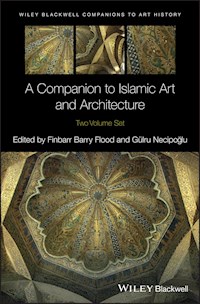
A Companion to Islamic Art and Architecture E-Book
359,99 €
Mehr erfahren.
- Herausgeber: John Wiley & Sons
- Kategorie: Geisteswissenschaft
- Serie: Blackwell Companions to Art History
- Sprache: Englisch
The two-volume
Companion to Islamic Art and Architecture bridges the gap between monograph and survey text by providing a new level of access and interpretation to Islamic art. The more than 50 newly commissioned essays revisit canonical topics, and include original approaches and scholarship on neglected aspects of the field.
- This two-volume Companion showcases more than 50 specially commissioned essays and an introduction that survey Islamic art and architecture in all its traditional grandeur
- Essays are organized according to a new chronological-geographical paradigm that remaps the unprecedented expansion of the field and reflects the nuances of major artistic and political developments during the 1400-year span
- The Companion represents recent developments in the field, and encourages future horizons by commissioning innovative essays that provide fresh perspectives on canonical subjects, such as early Islamic art, sacred spaces, palaces, urbanism, ornament, arts of the book, and the portable arts while introducing others that have been previously neglected, including unexplored geographies and periods, transregional connectivities, talismans and magic, consumption and networks of portability, museums and collecting, and contemporary art worlds; the essays entail strong comparative and historiographic dimensions
- The volumes are accompanied by a map, and each subsection is preceded by a brief outline of the main cultural and historical developments during the period in question
- The volumes include periods and regions typically excluded from survey books including modern and contemporary art-architecture; China, Indonesia, Sub-Saharan Africa, Sicily, the New World (Americas)
Sie lesen das E-Book in den Legimi-Apps auf:
Seitenzahl: 2851
Veröffentlichungsjahr: 2017
Ähnliche




















Table of Contents
Cover
Volume I
Title Page
List of Illustrations
List of Maps
Notes on Contributors
Acknowledgments
Introduction to Both Volumes of
A Companion to Islamic Art and Architecture
1 Frameworks of Islamic Art and Architectural History: Concepts, Approaches, and Historiographies
The Rationale for the Two Volumes of
A Companion to Islamic Art and Architecture
The Structure of the Volumes and their Reconceptualized Periodization
Foundations and Historiography of the Field
Some Historical Peculiarities and Tropes of the Field
Recent Developments in the Study of Islamic Art and Architecture
Conclusion
Bibliography
Part I: The Early Caliphates, Umayyads, and the End of Late Antiquity (650–750)
2 The Material Culture of Pre‐ and Early Islamic Arabia
First Millennium BCE
Second to Fourth Centuries CE
Fourth to Sixth Centuries CE
The Islamic Seventh Century
References
3 The Formation of Religious and Caliphal Identity in the Umayyad Period: The Evidence of the Coinage
The Evidence of the Coinage
The Conservative Phase (650–691)
The Civil War and its Aftermath
The Adaptive Phase (I): The
Shahada
Coinage (691–693)
The Adaptive Phase (II): The Caliphal Image Coinage (693–696)
The Epigraphic Phase (696–)
Coinage and Identity
References
4 The Qurʾan, Calligraphy, and the Early Civilization of Islam
The Arabic Script before Islam
The First Seven Decades of Islam
The Umayyad Period and the Codification of Arabic Scripts (
c
. 690–750)
Calligraphy at the Height of Abbasid Power (750–
c
. 900)
The Transformation of Arabic Writing in the Tenth Century
Acknowledgment
References
5 Sacred Spaces in Early Islam
Narratives on Mecca and Medina
Early Islamic Religious Spaces: Plan and Structure
The Location of Sacredness in Early Islam
A New Decorum for Islamic Sacred Spaces
References
Part II: Abbasids and the Universal Caliphate (750–900)
6 Early Islamic Urbanism
Pre‐Islamic Urbanism in Arabia
The Early
Amsar
New Urban Settlements of Umayyad Syria
Baghdad and the Abbasids
Raqqa and Qadisiyya
Samarra
The Later Royal City
References
7 Samarra and Abbasid Ornament
Architectural Ornament in Samarra
Architectural Ornament in Late Antiquity and Early Islam
Samarra and Later Modes of Islamic Architectural Ornament
References
8 The China–Abbasid Ceramics Trade during the Ninth and Tenth Centuries: Chinese Ceramics Circulating in the Middle East
Made for Export: Evidence from the Belitung Shipwreck,
c.
Ninth Century
From Kilns to Ports to Destined Markets: Findings from Two Tenth‐Century Shipwrecks
The Interwoven Network of Trade Routes
Conclusion
References
Part III: Fragmentation and the Rival Caliphates of Cordoba, Cairo, and Baghdad (900–1050)
9 The Three Caliphates, a Comparative Approach
Introduction
Urban Foundations: Abbasid, Umayyad, and Fatimid
Religious Foundations
Comparative Analysis of Architecture under the Rival Caliphates
Court Ceremonies and Religious Rituals
Conclusions: The Waning of Caliphal Competition
References
10 Early Islam on the East African Coast
Introduction
East African Islam and its Architecture
The “Shirazi” Towns
East Africa in the Global Islamic Economy
References
11 Textiles and Identity
Inscribed Textiles as Symbols of Caliphal Hegemony: The Abbasids
Inscribed Textiles as Caliphal Relics: The Fatimids
References
Part IV: “City States” and the Later Baghdad Caliphate (1050–1250)
12 The Resurgence of the Baghdad Caliphate
Brief Political and Urban History
Fortifications
Religious Architecture
Secular Architecture: The Abbasid Palace
The Arts of the Book during the Late Baghdad Caliphate
The Legacy of the Architecture and Arts of the Late Baghdad Caliphate
References
13 Turko‐Persian Empires between Anatolia and India
Survey of Scholarship and Key Issues
Techniques and Materials
Greater Iran (Iran and Iraq, Transoxania, Afghanistan)
Anatolia
Syria and al‐Jazira
The Punjab and Northern India
Conclusion
References
14 Bridging Seas of Sand and Water: The Berber Dynasties of the Islamic Far West
The Berbers in History and Scholarship
Trade across the Sahara
The Development of a Common Material and Visual Culture
Conclusion
References
15 Sicily and the Staging of Multiculturalism
“Fortunate city, endowed with a trilingual people”
The Royal Palaces
Churches and Architectural Decoration
The Cappella Palatina Ceiling and other Painted Ceilings
“Siculo‐Arabic” Painted Ivories and the Popularization of Courtly Painting
Conclusion
Acknowledgments
References
16 Transculturation in the Eastern Mediterranean
Spatial and Temporal Connections and Continuities
Palatial Culture
Conclusion
References
17 Patronage and the Idea of an Urban Bourgeoisie
References
18 The Social and Economic Life of Metalwork
An Astrolabe Made by Ahmad and Muhammad, Sons of Ibrahim al‐Isfahani
Serçe Limanı Box from the Bodrum Museum of Underwater Archaeology
Seljuq Sabre Blade from the Furusiyya Collection
Zebu and Calf Aquamanile from the Hermitage Museum
The Freer Pen Box Made by Shazi/Shadhi the
Naqqash
in 1210
A Silver‐Inlaid Tray Made for Badr al‐Din Luʾluʾ in Thirteenth‐Century Mosul
Conclusions
References
19 Ceramics and Circulation
The Qualities of Pottery
The Status of Pottery
Circulation of Pottery
The Beginnings of Islamic Fine Glazed Pottery
Samarra, China, and the Origin of Islamic Polychrome Glazed Pottery
Ceramic Families
Later Circulations
Conclusions
References
20 Figural Ornament in Medieval Islamic Art
References
21 Medieval Islamic Amulets, Talismans, and Magic
What is Magic?
The Literature on Magic
The Nature and Survival of Magical Objects and the Magical Vocabulary
Elements of the Magical Vocabulary
Categories of Objects
Conclusion
References
22 The Discovery and Rediscovery of the Medieval Islamic Object
Art of the Islamic Object: An Overview
What Can Literary and Visual Sources Tell Us?
Rediscovering the Object
Conclusion: Future Directions
References
Volume II
Title Page
List of Illustrations
List of Maps
Notes on Contributors
Part V: “Global” Empires and the World‐System (1250–1450)
23 Architecture and Court Cultures of the Fourteenth Century
Secular Architecture
Mosques and Other Religious Architecture
Conclusions
References
24 Islamic Architecture and Ornament in China
China’s Earliest Islamic Architecture: The Song Dynasty
Golden Age of Islamic Architecture in China: The Mongol Yuan Dynasty
Islamic Architecture in Ming China
Other Evidence of Islamic Material Culture in China
25 Chinese and Turko‐Mongol Elements in Ilkhanid and Timurid Arts:
Part 1: The Mongols (c. 1250–1350)
Textiles as Political Legitimacy and Cultural Identity
Ceramics, Miscellaneous Objects, and the Cycle of Chinoiserie
China and the Rise of Manuscript Painting in Iran
Multireligious Ingredients in the Pictorial Arts of Ilkhanid Iran
References
25 Chinese and Turko‐Mongol Elements in Ilkhanid and Timurid Arts:
Part 2: Timurids, Central Asia, and Ming China (1370–1507)
Manuscripts and Paintings
Kitabkhana
Designs
Papermaking and Decoration
Ceramics
Nephrite Jade
Conclusion
References
26 Persianate Arts of the Book in Iran and Central Asia
The Arts of the Book under the Mongols
The Arts of the Book from the Mongols’ Demise to the Timurids
References
27 Later Qurʾan Manuscripts
The Scribal Traditions of Iraq and their Dissemination
Qurʾan Manuscripts from Anatolia, Iraq and Iran, and Central Asia
Qurʾans Produced for Mongol Patrons
The Qurʾans of India
Qurʾans of the Mamluks
Conclusion
References
28 Locating the Alhambra: A Fourteenth‐Century “Islamic” Palace and its “Western” Contexts
The Palace of Comares: Seat for a Western Caliphate
Al‐Riyad al‐Saʿid: Garden of Knowledge
Courtliness, Contacts, and
Mudéjar
Directions for Further Research
References
29 Architectural Patronage and the Rise of the Ottomans
Historiography
Continuity and Change under Orhan and Murad I (1326–1389)
Bayezid I and the Anatolian Heritage (1389–1402)
Mosques of Bayezid I and Mehmed I (1389–1421)
The Mosques of Çandarlı Qara Khalil Pasha and Bayezid Pasha
The Green Mosque in Bursa (1419–1424) and Later Buildings
Concluding Remarks
References
30 Islam beyond Empires: Mosques and Islamic Landscapes in India and the Indian Ocean
Introduction
Islamic Landscapes beyond the Lands of Islam
Mosques and the Islamic Landscape of South Asia
South Asian Mosques beyond Hypostyle Paradigms
Early South Asian Mosques and Indic Spatialities
Architectural Patronage beyond the Lands of Islam
Conclusions and Future Directions
References
31 The Deccani Sultanates and their Interregional Connections
Political Mechanisms
Economic and Social Mechanisms
Conclusion
References
Part VI: Early Modern Empires and their Neighbors (1450–1700)
32 The Mughals, Uzbeks, and the Timurid Legacy
The
Leitmotifs
of Timurid Architecture
Mughal Architecture – Assessing the Timurid Legacy
Conclusion
References
33 Istanbul, Isfahan, and Delhi: Imperial Designs and Urban Experiences in the Early Modern Era
City Portraits
c.
1650
Populations and Neighborhoods
Configuring Capital Cities and the Politics of Space
Court into the City: Urban Spaces of Ceremonial
Public Spaces and Modes of Sociability, Old and New
References
34 Painting, from Royal to Urban Patronage
Epic and Romantic Tales
Dynastic and Universal Histories
Religious Themes
Albums and the Perpetuation of Artistic Legacies
Portraiture: From Royal to Urban
Conclusion
References
35 Objects of Consumption: Mediterranean Interconnections of the Ottomans and Mamluks
When Did Consumer Society Take Off?
Market and Non‐Market Forms and Levels of Exchange
Courtly Gifts: Negotiating Political, Confessional, and Linguistic Borders
Cross‐Cultural Portraiture: Mirroring the “Other”
Domestic Interiors: Hygiene, Comfort, Taste, and Refinement
Conclusion: Moral Strictures and the Public Order
References
36 Safavid Arts and Diplomacy in the Age of the Renaissance and Reformation:
Part 1: The Safavids and Their Neighbors: The Movement of Objects
Shah Ismaʿil I: Appropriation of the Past
Shah Tahmasp: Forging of a New Visual Identity
Shah ʿAbbas I: Disseminating a Vision of Power
Acknowledgments
References
36 Safavid Arts and Diplomacy in the Age of the Renaissance and Reformation:
Part 2: The Arts of Gifting between Safavids and Habsburgs
References
37 Carpets, Textiles, and Trade in the Early Modern Islamic World
Symbolism, Status, Economics, and Taste
Scholarship
Commerce and Taxation
Commerce in Carpets
Creativity and Style: The Art of Making Textiles
Textiles and Carpets in the Ottoman Empire
Textiles of Mamluk Egypt and Syria
Textiles of the Timurid, Turkmen, and Safavid Realms
Textiles of the Mughal Empire and Deccani Kingdoms
Conclusion
References
38 Trade, Politics, and Sufi Synthesis in the Formation of Southeast Asian Islamic Architecture
Southeast Asian Islamic Architecture?
Range and Scope of Existing Surveys
The Sense of a Region
Categories and Contexts: Mosque Halls and Mausolea
Islam as “Overlay”: Discursive Re‐signification Beyond Mosques
Temporal Paradox and Political Posturing
Conclusion
References
39 Mudejar Americano: Iberian Aesthetic Transmission in the New World
References
Part VII: Modernity, Empire, Colony, and Nation (1700–1950)
40 Beyond the Taj Mahal: Late Mughal Visual Culture
Monuments as Models: The Legacy of “Shahjahani” Architecture
Urban Culture
Late Mughal Painting and Muhammad Shah
The Visual Culture of the Itinerant Mughal Court
The Nineteenth Century: Looking Back, Looking Ahead
41 Kings and Traditions in
Différance
: Antiquity Revisited in Post‐Safavid Iran
Zand and Early Qajar: Looking to the Recent Past
High Qajar Period: Revivalism as Recovered Kingdom
Late Qajar and Pahlavi: Eclecticism as Anti‐Colonialism
References
42 Public Sphere in the Eastern Mediterranean
Spaces of Sociability
Spaces of Dissent
Spaces of Modernity
References
43 “
Jeux de miroir
”: Architecture of Istanbul and Cairo from Empire to Modernism
References
44 Islamic Art in Islamic Lands: Museums and Architectural Revivalism
Codifying National Art and Architecture
Museums of Islamic Art
Architectural Revivalism
Conclusions
References
45 Islamic Art in the West: Categories of Collecting
The Religious Domain
Cabinets of Curiosity and Other Collections
Manuscripts in European Libraries
Universal Museums
Special Collections
Museums of Applied Art and International Exhibitions
Ethnographic Collections
Private Collections: The Cult of the Art Object
Connoisseurship in Islamic Art
Museums in Islamic Lands
American and Russian Museum Collections
Developments and Re‐evaluations Since World War II
Dispersal and Dismemberment
References
46 Islamic Arts and the Crisis of Representation in Modern Europe
Crisis in Western Identity
Orientalism
Ornamental Revolution
Islamophilia
Modernism
References
Part VIII: Islam, Art, and the Contemporary (1950–Present)
47 Resonance and Circulation: The Category “Islamic Art and Architecture”
Definitions and Boundaries
The Plot of Islamic Art History
Islam‐as‐Religion versus Islam‐as‐Culture
The Corpus of Islamic Art: Inclusions and Exclusions
Preservation and Destruction
Reproduction and Exhibition, or the “Agency of Display”
The Creator’s Dilemma: Islamic Art and Muslim Identities
Islamization and Secularization in Dialogue
Conclusion
References
48 Dubai, Anyplace: Histories of Architecture in the Contemporary Middle East
History and Context
Constructing an Imperial Past
Heritage Reclaimed and Reimagined
A Capitalist Modernity
Skyscraper Dreams
References
49 Translations of Architecture in West Asia during the Twentieth Century
Translations into the National: The New World after World War I
Translations into the Regional: Cold‐War Balances
Translations into the Islamic: Postmodern and Global Currents
References
50 Calligraphic Abstraction
Calligraphic Abstraction in Context
Art and Decolonization
The Discursivity of Calligraphic Abstraction
References
51 Articulating the Contemporary
Contemporary Figures
Globalized Convergences
Histories of the Contemporary
Ruptures within the Contemporary
Conclusion
References
Index
End User License Agreement
List of Tables
Vol1-c21
Table 21.1 Correspondence between letters and cosmological levels according to
The Sun of Knowledge and the Secrets of Gnosis
.
Table 21.2 Correspondence of letters, cardinal points, angels, day, and qualities according to
The Sun of Knowledge and the Secrets of Gnosis
.
Table 21.3 Verses of
Sura al‐fatiha
and their corresponding days, divine names, planets, and angels according to
The Sun of Knowledge and the Secrets of Gnosis
.
Table 21.4 The 4 × 4 magic square.
List of Illustrations
Vol1-c02
Map 2.1 The Arabian Peninsula, catalogue Paris 2010, 28–29.
Figure 2.1 Al‐ʿUla, statue, probably of a king of the dynasty of Lihyan (fourth–third century
BCE
), catalogue Paris 2010, 278.
Figure 2.2 Shabwa, the Royal Palace (third century
CE
).
Figure 2.3 Marib, Awam cemetery, tombstone (second–first century
BCE
).
Figure 2.4 Madaʾin Salih (Hegra), façade of a tomb (first century
CE
).
Figure 2.5 Jabal al‐ʿAud, bust of Athena (first century
BCE
–first century
CE
).
Figure 2.6 Zafar, plaque decorated with a vine scroll composition (sixth century
CE
).
Figure 2.7 Saqaf/Khaulan painting of a castle (probably Ghumdan, second–third century
CE
).
Vol1-c03
Figure 3.1 (a) Mutilated cross solidus.(b) Arab‐Sasanian drachm, Bishapur mint, 47 AH.
Figure 3.2 (a)
Shahada
solidus.(b) Arab‐Sasanian drachm, Damascus, 74/693–694 (Balog 1950).
Figure 3.3 (a) Caliphal image solidus.(b) Caliphal image drachm 1.(c) Caliphal image drachm 2 (“Mihrab and ʿAnaza” drachm).
Figure 3.4 (a) Early epigraphic
dinar
, no mint 77/696–697.(b) Epigraphic dirham, Damascus 99/717–718).
Vol1-c04
Figure 4.1 Qurʾanic palimpsest in Hijazi script (unknown provenance, seventh century).
Figure 4.2 Opening illumination of an Umayyad Qurʾan discovered in Sanaa (probably Greater Syria, early eighth century).
Figure 4.3 The Qurʾan of Amajur, classical Kufic script (Greater Syria, in or shortly after 876).
Figure 4.4 The Isfahan Qurʾan, written in the New Style (Isfahan, 993). London and Geneva, The Nasser D. Khalili Collection of Islamic Art, KFQ90 recto.
Vol1-c05
Figure 5.1 The Kaʿba, Mecca,
c.
1910.
Figure 5.2 The main nave of the sanctuary leading to the mihrab, Great Mosque of Qayrawan.
Figure 5.3 The courtyard and façade of the sanctuary, Great Mosque of Damascus.
Figure 5.4 Wall mosaics rinceaux, narthex, Church of Haghia Sophia, Istanbul.
Figure 5.5 Wall mosaic rinceaux, outer façade of the inner octagon, Dome of the Rock, Jerusalem, 692.
Vol1-c06
Figure 6.1 Umayyad city of ʿAnjar, Lebanon, 714: 1. and 3. palaces, 2. mosque, 4. bathhouses, 5. zone of housing, 6. and 7. colonnaded avenues, 8. tetrapylon, 9. gates.
Figure 6.2 The Round City of Baghdad, 762–766.
Figure 6.3 The layout of Samarra, 836–892.
Figure 6.4 Plan of al‐Mutawakkiliyya, 859–861.
Figure 6.5 Schema of the development of Fustat and al‐Qahira.
Vol1-c07
Figure 7.1 Luster‐painted earthenware tiles from Samarra, Iraq, ninth century.
Figure 7.2 Hypothetical tile friezes based on examples from Qayrawan, Tunisia. After Allan 2001.
Figure 7.3 Speculative reconstruction of a Samarran interior using luster tiles from Qayrawan, Tunisia, and stucco elements from the palaces of Balkuwara, Iraq.
Figure 7.4 Examples of ornamental stucco friezes from Samarra (not to scale). (a) Style A; (b) Style B; (c) Style C.
Figure 7.5 Carved stucco panels from the palaces north of Rafiqa (Raqqa), Syria, late eighth–early ninth centuries.
Vol1-c08
Figure 8.1 Bowl painted in brown and green with bird. Chinese,
c.
ninth century, Changsha ware, diameter 20 cm. From the Belitung shipwreck.
Figure 8.2 Dish painted in blue with a lozenge and foliage. Chinese,
c.
ninth century, Gongxian ware, diameter 23 cm. From the Belitung shipwreck. Asian Civilisation Museum, Tang Shipwreck Collection, Singapore.
Figure 8.3 Basin engraved with an inscription along the rim and a six‐pointed star on the bottom, Afghanistan,
c.
early eleventh century. Bronze, diameter 57 cm. From the tomb (dated 1018) of the Princess of the State of Chen and her consort in Naiman Banner, Inner Mongolia Autonomous Region.
Figure 8.4 Bottle with a short tapering neck and wheel‐cut decoration, Iran,
c.
tenth century. Glass, height 9.8 cm. From the relic deposit underneath the foundation of the Jingzhi Temple Pagoda in Dingzhou, Hebei province.
Vol1-c09
Figure 9.1 Reception Hall of ‘Abd al‐Rahman III, Madinat al‐Zahra’, Cordoba.
Figure 9.2 Cup bearer and musician, from al‐Mahdiyya, in the Bardo National Museum, Tunis.
Figure 9.3 Great Mosque of Cordoba, Spain, mihrab.
Figure 9.4 Mosque of al‐Azhar, Cairo.
Figure 9.5 Mosque of al‐Hakim, Cairo, south minaret with encasing, inscription, and reconstructed portal.
Figure 9.6 Carved wood doors, ninth‐century Iraq.
Figure 9.7 Detail of Fatimid palace beams, from the Museum of Islamic Art, Cairo.
Figure 9.8 Abbasid
tiraz
, 991–1031. Its inscription reads: “Bismillah. Praise be to God, the Lord of the worlds, and a good end to those who fear God. And God bless Muhammad the seal of the Prophets, and all his family, the good, the excellent. Blessing from God and glory to the Caliph, the servant of God, Abu’l‐ʿAbbas Ahmad, al‐Qadir billah, Commander of the Faithful, may God glorify him and [. . .].” 31.106.56a.
Vol1-c10
Map 10.1 Map of East Africa showing sites mentioned in the text.
Figure 10.1 The Shanga lion, a “Hindu” style figurine, probably produced in Islamic East Africa.
Figure 10.2 Locally minted silver coins from East Africa: 1, 2 Shanga, Muhammad, eighth or early ninth century; 3, 4 Shanga, ʿAbd Allah, ninth or early tenth century; 5–8, Mtambwe Mkuu, tenth–early eleventh century.
Figure 10.3 Development sequence of the Shanga mosques, eighth–eleventh century.
Figure 10.4 Timber mosque on Songo Mnara island, closely resembling ninth‐century examples that have been excavated.
Figure 10.5 The mihrab at Kizimkazi, 1107. After its restoration, the coral was unfortunately covered in oil paint covering some of details of the carving and inscriptions.
Figure 10.6 Kufic inscription from Tumbatu, mid‐twelfth century.
Figure 10.7 The main mosque at Kilwa, early twelfth century.
Figure 10.8 The “classic” mihrab at Ras Mkumbuu, Pemba Island.
Vol1-c11
Figure 11.1
Tiraz
textile fragment, dated 939–940, Egypt, linen plain weave, silk embroidered, height 41.9 × width 74.9 cm.
Figure 11.2 Mahmud ibn Sebuktegin donning a robe of honor sent by the Abbasid caliph al‐Qadir (947–1031) in the year 1000, illustration from the
Jamiʿ al‐tawarikh
(Compendium of Chronicles) of Rashid al‐Din,
c.
1306 or
c.
1314/15.
Figure 11.3 Joshua ordering the property taken at Jericho to be destroyed. Illustration from the
Jamiʿ al‐tawarikh
(Compendium of Chronicles) of Rashid al‐Din,
c.
1306 or
c.
1314/15.
Figure 11.4 Enshrouded corpse from Tomb 49 in the second funerary enclosure (B6) at Istabl ʿAntar, Fustat.
Figure 11.5 Members of the Museum of Islamic Art, Cairo, examining an enshrouded corpse at Khadra Sharifa, Fustat during the early 1930s.
Figure 11.6 A member of the Museum of Islamic Art, Cairo, examining an enshrouded corpse at Khadra Sharifa, Fustat during the early 1930s and cutting away a portion covering the head.
Figure 11.7 Coronation mantle of Roger II of Sicily, Palermo,
c.
1133–1134, silk and gold embroidery, pearls, gemstones, cloisonné enamel on samite, 146 × 345 cm, Kunsthistorisches Museum Wien (Vienna, Austria).
Vol1-c12
Figure 12.1 Baghdad: Dhafariya (Wastani) Gate, 1221, from north.
Figure 12.2 Baghdad: Conical dome of ʿUmar al‐Suhrawardi, early thirteenth century.
Figure 12.3 Baghdad: Madrasa al‐Mustansiriyya, completed 1233, courtyard from east.
Figure 12.4 Baghdad: Abbasid Palace,
c.
1200, corridor with
muqarnas
vaulting.
Vol1-c13
Figure 13.1 Ardistan (Iran), Great Mosque, dome hall, 1158.
Figure 13.2 Bukhara (Uzbekistan), Great Mosque, minaret, 1127.
Figure 13.3 İnce Minareli closed court madrasa and mosque, Konya,
c.
1265 (before collapse of minaret in 1901).
Figure 13.4 Plan, Karatay Han with arcaded open court and covered stable, Kayseri–Malatya road, 1231–1240.
Figure 13.5 Aleppo, Madrasa Kamaliyya ʿAdimiyya, 1241–1252, ground plan.
Figure 13.6 Damascus, al‐Salihiyya, street view with façades, domes, and minarets of the Madrasas al‐Farnathiyya, al‐Murshidiyya, al‐Ashrafiyya, and al‐Atabakiyya, first half of thirteenth century.
Figure 13.7 Detail of corbelled ogee arch of Qutb al‐Din Aybak’s screen showing vegetal and epigraphic borders, Qutb mosque, Delhi,
c.
1200, showing Indic‐style corbelled ogee arches and carved decoration of meandering vines, buds, and floral medallions.
Figure 13.8 Prayer hall screen, Adhai‐din‐ka‐Jhompra Mosque, Ajmer, 1206.
Vol1-c14
Figure 14.1
Minbar
of the Kutubiyya Mosque, al‐Badiʿ Palace, Marrakesh.
Figure 14.2 Qubbat al‐Barudiyyin, exterior and interior dome, Marrakesh.
Figure 14.3 Rectangular
muqarnas
vault, al‐Qarawiyyin Mosque, Fez.
Figure 14.4 Bab al‐Ruwah, Rabat.
Figure 14.5 Puerta del Perdón, Cathedral of Seville, detail.
Vol1-c15
Figure 15.1 Spolia column from Arab mosque with Qurʾan 7:52 (tenth–eleventh century?) Palermo Cathedral, south portico.
Figure 15.2 Epitaph with quadrilingual inscription of Anna, mother of “royal priest” Grisandus, 1149, white marble with
opus sectile
marble and glass tesserae inlays (40 × 32 cm), from San Michele Arcangelo, Palermo, Museo della Zisa.
Figure 15.3 Fountain hall (
shadhirwan
) of the Zisa Palace (restored), Palermo,
c.
1165–1180.
Figure 15.4 SS. Trinità di Delia, Castelvetrano, mid‐twelfth century (restored).
Figure 15.5 Cappella Palatina, Palermo, nave
muqarnas
ceiling with a marked Christian cross inside rhombus, 1140s.
Vol1-c16
Figure 16.1 Oliphant, Museum für Islamische Kunst, Staatliche Museen zu Berlin‐ Preußischer Kulturbesitz, K3106.
Figure 16.2 Shadhbakhtiyya madrasa in Aleppo, mihrab.
Figure 16.3
Muqarnas oculi.
(a)
Gavit
of the Church of the Holy Apostles at Ani, late twelfth century.(b) Ulu Cami in Erzurum, late twelfth century.(c) Imam Yahya Mashhad, Mosul.
Figure 16.4 Reception room, 1150–1200, Norman Royal Palace, Palermo.
Figure 16.5 Two dancers. (a) Fatimid, ivory panel, tenth–twelfth century, Museo del Bargello, Florence.(b) Norman Royal Palace, Palermo, painting on
muqarnas
ceiling, Cappella Palatina,
c.
1140–
c.
1147.
Figure 16.6 Automaton of female court attendant, in al‐Jazari,
Book of Ingenious Mechanical Devices
.
Figure 16.7 Canteen, brass inlaid with silver, Syria or Mesopotamia,
c.
1250.
Vol1-c17
Figure 17.1 Silver‐inlaid, pear‐shaped, metal ewer with a lamp‐shaped spout, with inscriptions including one identifying the owner as a “doctor in religious law.” Probably Khurasan, late twelfth century. New York, Metropolitan Museum of Art, inv. no. 54.64.
Figure 17.2 Wood panel with an inscription of best wishes to its owner. Egypt, Tulunid period, ninth century. Cairo, Museum of Islamic Art, no. 3498.
Figure 17.3 Two glass beakers with enameled and gilded painted decoration showing Christian scenes, possibly made for local Christian markets. Attributed to Syria, datable to the first half of the thirteenth century.
Figure 17.4
Tiraz
textile with an inscription referring to production for a general market (
tiraz al‐ʿamma
). Tuna (Egypt), 388 (998). Athens, Benaki Museum, 15006.
Figure 17.5 Bobrinsky bucket. Herat, dated Muharram 559 (December 1163). Brass, silver, and copper; cast, forged, and decorated with inlay. Height 18.5 cm. Inv. no. IR‐2268. The State Hermitage Museum, St. Petersburg.
Figure 17.6 Frontispiece with a sage holding a
flabellum
. Ibn Bakhtishuʿ,
Kitab Naʿt al‐Hayawan
, probably produced in Baghdad,
c.
1225. London, British Library, Or. 2784, fol. 3r.
Vol1-c18
Figure 18.1 Astrolabe, brass, Isfahan, 984.
Figure 18.2 Box, brass, east Mediterranean, eleventh century, from the Serçe Limanı shipwreck.
Figure 18.3 Saber blade, steel, Iran, eleventh–twelfth century, length 75.4 cm.
Figure 18.4 Zebu and calf aquamanile, cast from a quaternary alloy, inlaid with silver, probably made in Herat, Afghanistan, 1206, height 35 cm.
Figure 18.5 Pen box, cast brass, inlaid with silver, Iran or Afghanistan, 1210.
Figure 18.6 Tray, brass, inlaid with silver, Mosul, first half of the thirteenth century.
Vol1-c19
Figure 19.1 Jar, earthenware with turquoise glaze, Iraq, eighth century, height: 40 cm.
Figure 19.2 Sherds of Yellow Glazed family ware, earthenware, with painting in yellow, green, and white glazes, and in black pigment, Syria, Raqqa (finds from the Tell Aswad), late eighth or early ninth century, Raqqa Museum, Syria.
Figure 19.3 Dish, earthenware bowl, painted in blue in an opaque, white glaze, Iraq, ninth century, diameter: 20.5 cm.
Figure 19.4 Bowl, earthenware, with a white slip and painted in black and red slips under a transparent glaze, eastern Iran, Nishapur or Samarqand, tenth century, diameter: 27 cm. The inscription reads: “He who believes in a reward [from God] is generous with gifts.”
Figure 19.5 Bowl, fritware painted in black and blue under a transparent glaze, Iran, Kashan, beginning of thirteenth century, diameter: 21 cm.
Vol1-c20
Figure 20.1 Bone “doll,” probably Egypt, eighth–tenth century.
Figure 20.2 Luster‐painted ceramic bowl with figure holding a cup, Iraq, tenth century.
Figure 20.3 Polychrome glazed ceramic bowl with bull‐masked dancer, eastern Iran, tenth–eleventh century.
Figure 20.4 Inlaid bronze inkwell with signs of the zodiac, Iran, early thirteenth century.
Figure 20.5 Luster‐painted ceramic tile with enthronement scene and poetic inscriptions, Iran, 1211–1212.
Vol1-c21
Figure 21.1 Authors’ reproduction of symbols from
The Goal of the Sage
to be inscribed on a cloth in order to attract a lover.
Figure 21.2 Authors’ reproduction of symbols from
The Goal of the Sage
associated with the angel Bayel assigned to the sun.
Figure 21.3 Authors’ reproduction of magical alphabet of Qalfatrios from
Ancient Alphabets
and hieroglyphic characters attributed to Ibn Wahshiyya.
Figure 21.4 Clay bulla, lion facing a scorpion under star canopy,
c.
ninth–tenth century. Diameter: 2.9 cm.
Figure 21.5 Brass talismanic plaque with magical scripts and the seated figure of Solomon,
c.
nineteenth century. 11.5 × 9.0 cm.
Figure 21.6 Brass seal with 3 × 3 magic square,
c.
nineteenth century. 27.0 × 2.5 cm. Each of the numbers has had 39 added to it, totaling 1185. In the
abjad
system this makes up the invocation
ya ism al‐Aʿzam
(O greatest name [of God]).
Figure 21.7 Carnelian amulet inscribed with the “Seven Magical Signs.” 1.5 × 1.2 cm.
Figure 21.8 Magic medicinal bowl. Syria dated 565 (1169–1170). Height: 7.5 cm; Diameter: 19.0 cm. Nasser D. Khalili Collection of Islamic Art (MTW 1443).
Figure 21.9 Talismanic shirt with Qurʾanic inscriptions, the phrase “There is no youth except ʿAli, no sword but Dhuʾl Faqar,” groups of letters and numbers, and depictions of the sanctuaries of Mecca and Medina. Probably Deccan sixteenth–seventeenth centuries. Nasser D. Khalili Collection of Islamic Art (TXT 0471)).
Vol1-c22
Figure 22.1 The so‐called Marwan II ewer. Bronze cast and pierced. Syria eighth–early ninth century.
Figure 22.2 Earthenware, white and black slip decoration under transparent glaze. Iran, Nishapur, tenth century.
Figure 22.3 Carved ivory pyxis. Cordoba, dated 966
CE
. The Hispanic Society of America, D 752.
Figure 22.4 Painted ivory box. Probably Norman Sicily or Italy, thirteenth century. Mounting: gilded silver and semi precious and glass stones. Dimensions: length 17.1 cm, depth 10 cm.
Figure 22.5 The so‐called Pisa griffin. Provenance uncertain,
c.
1000. Dimensions: height 107 cm; length 87 cm; width 43 cm.
Vol2-c23
Figure 23.1 Courtyard, Sahrij madrasa, Fez.
Figure 23.2 Interior of mausoleum, complex of Qalawun, Cairo.
Figure 23.3 Exterior, complex of Sultan Hasan, Cairo.
Figure 23.4 Exterior of the Mosque of Bibi Khanum, Samarqand.
Figure 23.5 Exterior of mausoleum of Uljaytu, Sultaniyya, Iran.
Figure 23.6 Interior of lecture hall, madrasa, Khargird.
Figure 23.7 Exterior of mausoleum of Rukn‐i ʿAlam, Multan.
Vol2-c24
Figure 24.1 Entry and wall of Shengyousi, Quanzhou, 1009–1010; repaired 1310–1311.
Figure 24.2 Pieces of cenotaphs with lotus petals, standard imagery in Buddhist pagodas and altar bases, along base level, Quanzhou Maritime Museum.
Figure 24.3 Guangta (minaret), Huaisheng Mosque, Guangzhou,
c.
1350 with repairs as late as the twentieth century.
Figure 24.4 Tomb of Tughluq Timür, Huocheng, Xinjiang Uygur Autonomous Region,
c.
1363.
Figure 24.5 Huajuexiang Mosque, Xi’an, Ming period and later.
Vol2-c25a
Figure 25.1 Hanging with roosters and dragons. Lampas weave. Mongol Eurasia,
c
. 1300. The David Collection, Copenhagen, 40/1997.
Figure 25.2 Mausoleum of Rukn al‐Din (also known as the “Rukniyya”): interior painted decoration. Yazd, Iran, 1325.
Figure 25.3 Frieze tile with a phoenix, clouds, and lotuses. Fritware, overglaze luster painting. Iran (probably Takht‐i Sulayman),
c
. 1270s. The Metropolitan Museum of Art, New York, Rogers Fund, 1912 (12.49.4).
Figure 25.4 Isfandiyar approaching Gushtasp, page from the Great Mongol
Shahnama
. Iran (probably Tabriz), 1330s. Berenson Collection, Villa I Tatti, Florence. Reproduced with permission of the President and Fellows of Harvard College.
Figure 25.5 Rock‐carved dragon. From a former Buddhist site near Viar, Iran, late thirteenth century.
Vol2-c25b
Figure 25.6 “Two dancing dervishes” and “Two seated demons,” attributed to Muhammad Siyah Qalam, Album paintings, Topkapı Palace Museum Library, Hazine 2153, f. 34b.
Figure 25.7 “Five horses,” Chinese painting on silk, Topkapı Palace Museum Library, Hazine 2153, f. 151a.
Figure 25.8 Pages from Haydar’s Chaghatai poem
Makhzan al‐asrar
, Tabriz, 1478, New York Public Library, Spencer Collection, Pers. Ms. 41, ff. 21b–22a.
Figure 25.9 Plate, underglaze‐painted, Mashhad, 1473, The State Hermitage Museum VG‐2650.
Figure 25.10 Cup inscribed with the name of Ulugh Beg Küregen, nephrite,
c
. 1420–1449, The British Museum, OA 1959.11‐20.1 (36).
Vol2-c26
Figure 26.1 Two elephants, from the
Manafiʿ‐i hayavan
(The Benefits of Animals) by Abu Saʿid ʿUbayd Allah bin Ibrahim, known as Ibn Bakhtishuʿ, Iran, Maragha, dated 1297–1298 or 1299–1300. Opaque pigment and ink on paper, 35.5 × 28 cm (folio).
Figure 26.2 “Bahram Gur fights the Karg,” illustrated folio from the Great Mongol
Shahnama
(Book of Kings) by Firdawsi, Iran, Tabriz (?), 1330s. Opaque pigment, silver, and ink on paper, 41.5 × 30 cm (folio). Harvard Art Museums, Arthur M. Sackler Museum, Cambridge, MA, bequest of Abby Aldrich Rockefeller, 1960.190.
Figure 26.3 “Humay recognizes Humayun,” illustrated folio from the “Three
Masnavi
s” by Khvaju Kirmani, Iraq, Baghdad, 1396. Copied by Mir ʿAli bin Ilyas al‐Tabrizi al‐Bavarchi for Sultan Ahmad. Opaque pigment, gold, and ink on paper, 32 × 24 cm (folio). The British Library, London, Add. 18113, fol. 23a.
Figure 26.4 Gemini, marginal drawings of Khusraw Parviz watching Shirin bathing, and rams fighting, from a treatise on astrology in the “Anthology” made for Iskandar Sultan, Iran, Shiraz, 1410–1411. Opaque pigment, gold, and ink on paper, 18.4 × 12.7 cm (folio). The British Library, London, Add. 27261, fol. 538b.
Figure 26.5 “Isfandiyar slays Arjasp in the Brazen Hold,” illustrated folio from the
Shahnama
(Book of Kings) by Firdawsi made for Muhammad Juki. Afghanistan, Herat,
c
. 1440–1445. Opaque pigment, gold, and ink on paper, 34 × 22 cm (folio). The Royal Asiatic Society, London, MS239, fol. 278a.
Vol2-c27
Figure 27.1 Right half of the frontispiece to Juz 4 (Q.39: 92) with interlinear glosses in Persian and Turkish, 27 × 29 cm, paper, gold, pigments, Turkey or Central Asia, mid‐fourteenth century.
Figure 27.2 Double‐page frontispiece from a Qurʾan, Egypt (Q.9: 128–129),
c
. 1370, ink, paper, gold, colors, 40.9 × 65 cm.
Figure 27.3 Spain, thirteenth century, Q.64.18–65.1, ink, colors, and gold on peach‐colored paper probably from Jativa, 33.63 × 26.04 cm.
Figure 27.4 Left half of a colophon signed by Ahmad ibn al‐Suhrawardi al‐Bakri, Baghdad, 1308, text in a script that combines
muhaqqaq
and
tawqiʿ
with headings in Kufic, 51.3 × 36.8 cm.
Figure 27.5 Folio from a Qurʾan manuscript, India, early fifteenth century, 22.2 × 23.7 cm,
Sura
8:74–75,
Sura
9: 1–2.
Vol2-c28
Figure 28.1 Plan of the Alhambra, with the Hall of Comares projecting towards the northeast. After Contreras.
Figure 28.2 Alhambra, Hall of Comares, interior.
Figure 28.3 Alhambra, Palace of the Lions, courtyard.
Figure 28.4 Alhambra, Palace of the Lions, Hall of Justice, ornament.
Figure 28.5 Alhambra, Palace of the Lions, Hall of Justice, painted ceiling with courtly images.
Vol2-c29
Figure 29.1 Behramkale (Assos), mosque of Murad I,
c
. 1380. Gate with reused Byzantine lintel from a church of St. Cornelius.
Figure 29.2 Iznik, mosque of Çandarlı Kara Halil Pasha (a.k.a. Green Mosque), 1378–1392.
Figure 29.3 Bursa, Green Mosque, 1419–1424.
Figure 29.4 Bursa, Green Mosque, 1419–1424. Interior view towards the entrance and royal loggia (top) and view from the royal loggia (bottom).
Figure 29.5 Edirne, Triple‐Galleried (Üç Şerefeli) Mosque, 1437–1447. View from the northeast with the Old Friday mosque, 1403–1414, in the background on the left.
Vol2-c30
Figure 30.1 Inked rubbing of the Arabic endowment text to the mosque of Firuz al‐ʿIraqi built outside Somnath Patan in western India in 662 (1264).
Figure 30.2 Longitudinal section of the mosque of al‐Idhaji at Junagadh in western India, dated by its foundation inscription to 685 (1286–1287). The section shows the northern entrance gateway and the main mosque with its portico and prayer hall, together with the earlier cave in the bedrock below.
Figure 30.3 Ground plan of the Friday mosque at Calicut, Kerala, showing the expansion of the mosque around the original fourteenth‐ or early fifteenth‐century prayer hall and “antechamber.”
Figure 30.4 View of the porch or
dihliz
with seating platforms built on to the “antechamber” of the Friday mosque at Calicut, dated by its foundation inscription to 1090 (1679–1680). Photograph by the author.
Figure 30.5 Site plan of the mosque of al‐Idhaji at Junagadh, 685 (1286–1287) showing 1. prayer hall, 2. secondary chamber, 3. portico, 4. northern gateway, 5. lower courtyard, 6. domed pavilion attached to mosque, 7. domed pavilion in courtyard of cave.
Vol2-c31
Figure 31.1 Daulatabad, Jamiʿ Masjid,
c
. 1313–1318.
Figure 31.2 Aurangabad, Bibi ka Maqbara, 1660–1661.
Figure 31.3 Jahangir receives Prince Khurram on his return from the Deccan in 1617, painted by Murar, folio 49a from the Windsor Castle
Padshahnama
. Two Deccani courtiers are seen in the lower left corner of the page.
Figure 31.4 Ibrahim ʿAdil Shah II as a musician, painted by Farrukh Beg in Bijapur,
c
. 1605–1609. From the Gulshan Album. Inv. no. A 12 182.
Figure 31.5 Ewer in the shape of a goose (
hamsa
), Deccan, fifteenth or sixteenth century. Bronze with layer brass repairs, copper‐arsenic paste. Helen and Alice Colburn Fund, 1937, 37.470.
Figure 31.6 Golconda, mosque attached to the tomb of Hayat Bakhsh Begum, carved stone inscription with text from the Qurʾan (
sura
2, verses 142 and 143) framing the mihrab. Written by Taqi al‐Din Muhammad, son of Shaykh Salih of Bahrain, 1667.
Figure 31.7 Madrasa established by Mahmud Gawan at Bidar, 1472.
Figure 31.8 Portraits of the patrons Viranna and Virupana, ceiling painting from the temple of Virabhadra at Lepakshi, mid‐sixteenth century.
Vol2-c32
Figure 32.1 Registan Square in Samarqand: 1 Madrasa of Ulugh Beg (1417–1221); 2 Madrasa Shir Dar (1619–1636); 3 Tilleh‐kari Mosque (1646–1660); 4 Chahar‐su (commercial kiosk).
Figure 32.2 Model of the Friday mosque of Samarqand.
Figure 32.3 Plan of the shrine of Ahmad Yasavi, Turkestan.
Figure 32.4 Section of the dome of the Gur‐i Amir in Samarqand, showing the internal structure and geometric analysis of the proportions of the building.
Figure 32.5 Interior of the dome chamber left of the entrance in the madrasa at Khargird.
Figure 32.6 Tomb of Humayun at Delhi, built between 1562 and 1571, plan of the garden showing in the center the platform of the tomb with surrounding rooms and burial chambers. The so‐called Tomb of the Barber dated 1590–1591 is situated in the southeast corner of the garden.
Figure 32.7 Tomb of Humayun, ground plan of the tomb structure on the platform.
Figure 32.8 Tomb of Humayun after its restoration by the Aga Khan Trust for Culture, seen from the west. The restoration included the facing of the niches in the platform with white stucco plaster (
chunam
) and the renovation of the original tile mosaic of the small kiosks (chhatris) topping the frames of the grand entrance niches (
pishtaqs
).
Figure 32.9 Reconstruction of the entire Taj Mahal complex with its now lost bazaar and caravanserai complex in the south, length 896 m, width 300.84 m.
Figure 32.10 Jamiʿ Masjid, Khiva, Uzbekistan, reconstructed in the eighteenth century with wooden columns dating from different periods reaching back to the ninth century and earlier.
Vol2-c33
Map 33.1 Istanbul, map with main landmarks in the mid‐seventeenth century. 1. Hagia Sophia; 2. Topkapı Palace; 3. Hippodrome/Atmeydanı; 4. Ibrahim Pasha Palace; 5. Ahmed I mosque complex; 6. Divan Yolu; 7. Bayezid II mosque complex; 8. The Old Palace; 9. Bedestan; 10. Süleymaniye mosque complex; 11. Mehmed II mosque complex; 12. Janissary barracks and Etmeydanı; 13. Ayyub al‐Ansari complex; 14. Greek Orthodox Patriarchate; 15. Armenian Patriarchate; 16. Mosque‐convent complex; 17. Mosque complex; 18. Madrasa and mausoleum complex; 19. Markets; 20. Caravanserai; 21. Public bath; 22. Yedikule citadel; 23. Royal palace or palatial garden; 24. Arsenal.
Map 33.2 Isfahan, map with main landmarks of Safavid Isfahan.
Map 33.3 Map of Shahjahanabad,
c
. 1850. 1. Red Fort; 2. Diwan‐i ʿAmm; 3. Naqqarakhana; 4. Diwan‐i Khass; 5. Urdu bazaar; 6. Lahori gate; 7. Akbarabadi gate; 8. Salimgarh; 9. Chandni Chawk; 10. Caravanserai of Jahanara; 11. Jahanara (Sahibabad) Gardens; 12. Jama‘ Masjid; 13. Faiz bazaar; 14. Khass bazaar; 15. Akbarabadi Masjid; 16. Fatehpuri Masjid and caravanserai; 17. Chawk; 18. Mosque; 19. Temple; 20. Royal Garden; 21. Haveli; 22. City gate.
Figure 33.1 Istanbul, view towards the peninsula from the north, the Süleymaniye complex (1550–1557), the mosque of Rüstem Pasha (
c
. 1560), and the Tahtakale public bath (
c
. 1460) in the port area.
Figure 33.2 Isfahan, Maydan‐i Naqsh‐i Jahan, view from the roof of the Qaysariyya: Shaykh Lutfallah mosque on the east, the ʿAli Qapu Palace on the west, and Masjid‐i Jadid‐i ʿAbbasi on the south.
Figure 33.3 Ali Mazhar Khan, Jamaʿ Masjid in Delhi and the Khass bazaar leading to it;
c
. 1840. Victoria and Albert Museum, IS.482‐1950.
Figure 33.4 Procession of the Bedestan merchants and their apprentices in the Atmeydanı during the circumcision festival of 1582, with the Ibrahim Pasha palace and its royal loggia in the upper register, Intizami,
Surname‐i Humayun
,
c
. 1587.
Figure 33.5 Isfahan, Maydan‐i Naqsh‐i Jahan. Washed pen drawing by G. Hofsted van Essen (1703) 420 × 712 mm (with caption). Leiden, University Library, COLLBN Port. 314‐I N 58.
Vol2-c34
Figure 34.1 Isfandiyar slays a dragon, from a
Shahnama
of Firdawsi, produced for Shah Tahmasp, Tabriz, Iran
c
. 1530.
Figure 34.2 Humayun with Shah Tahmasp, by Sanwlah, from the
Akbarnama
of Abuʾl‐Fazl, Mughal, 1603–1604.
Figure 34.3 Sultan Murad III giving audience to Ibrahim Pasha who is about to leave Istanbul for his post as governor of Egypt in Cairo, from the
Shahanshanama
of Seyyid Lokman, Ottoman, 1592–1598.
Figure 34.4 Abu Jahl (smeared) attempting to hurl a stone onto the Prophet Muhammad at the Kaʿba, from
Siyer‐i Nebi
of Darir, Istanbul, 1594–1595.
Figure 34.5 Shaykh Safi al‐Din’s dream of the political downfall of the Chupanids,
Safwat al‐Safa
of Ibn Bazzaz, Shiraz, Iran, 1582.
Figure 34.6 Lady with a Fan, Riza‐yi ʿAbbasi, Isfahan, Iran,
c
. 1590–1592.
Figure 34.7 Album page including the portrait of Sultan Mehmed II. Portrait attributed to Sinan Beg, Ottoman,
c
. 1480.
Figure 34.8 Portrait of Shah Jahan standing on the globe, by Hashim, Mughal India,
c
. 1618–1629.
Vol2-c35
Figure 35.1 Tapestry (Burgundian?), fifteenth century, skirted with fifteenth‐century Italian (probably Venetian) silk velvet with silver‐gilt‐wrapped brocaded wefts. Topkapı Palace Museum, Istanbul. Inv. Nr. :13/1422; l: 457 cm. w: 252 cm.
Figure 35.2 Silk velvet ceremonial robe (kaftan), fifteenth century, Italian (probably Venetian), lined in Istanbul with Ottoman satin. Topkapı Palace Museum, Istanbul. Inv. Nr. :13/500; l : 109 cm.
Figure 35.3 Rock crystal pitcher, fifteenth century, Burgundy; with an encrusted golden lid added, sixteenth century, Ottoman. Topkapı Palace Museum, Istanbul. Inv. Nr. : 2/472.
Figure 35.4
Pietra dura
panel decorating the fountain in the bedchamber of Murad III (1578–1579), Harem. Topkapı Palace Museum, İstanbul.
Figure 35.5 Aleppo Room, Museum of Islamic Art at the Pergamon Museum, Berlin. Inv. Nr. : I. 2862. Wood, multilayered painting using a variety of pigments and metal coatings.
Vol2-c36a
Figure 36.1 Belt, Iran, Safavid period, dated 1507–1508, iron, gold, rubies, turquoise, velvet; Istanbul.
Figure 36.2 Textile fragment, Iran, Safavid period,
c
. 1540, silk; cut and voided velvet with continuous floats of flat metal thread.
Figure 36.3 Polonaise carpet, Iran, Safavid period, seventeenth century, cotton (warp and weft), silk (weft and pile), metal wrapped thread.
Figure 36.4 Plate, Iran, Isfahan, early seventeenth century, stone‐paste painted underglaze.
Vol2-c36b
Figure 36.5 Sash, Iran (possibly Kashan), seventeenth century; compound plain weave, brocaded, silk and metal‐wrapped thread.
Figure 36.6 Aegidius Sadeler II, “Portrait of Anthony Sherley,” Prague, 1601; engraving.
Figure 36.7 Aegidius Sadeler II, “Portrait of Husayn ‘Ali Beg,” Prague, 1601; engraving.
Figure 36.8 Casket, Italy (Venice), end of sixteenth century; rock crystal, lacquered wood, gilt silver and bronze.
Figure 36.9 Panel with birds and flowering vines, Iran, first half of seventeenth century; compound plain weave, silk and metal‐wrapped thread.
Vol2-c37
Figure 37.1 Silk panel from a chasuble, Nasrid, Spain, Granada, probably fourteenth century. 138.5 × 75 cm.
Figure 37.2 Silk
serenk
panel from a garment, Ottoman, Istanbul, late sixteenth century. 126.5 × 69 cm.
Figure 37.3 Silk mantle for a statuette of the Virgin Mary, Mamluk, fourteenth century. 70.5 × 111.1 cm.
Figure 37.4 Cut and voided silk velvet interior tent ornament, Safavid, Iran, mid‐sixteenth century. Diameter: 97 cm.
Figure 37.5 Wool knotted‐pile carpet with pictorial design, Mughal, north India,
c
. 1590–1600. 243 × 154 cm.
Vol2-c38
Map 38.1 Map of maritime Southeast Asia indicating places mentioned.
Figure 38.1 Structural distinction between the
tajug
hall (mosque),
wantilan
(cockfighting pavilion), and
meru
(deity tower).
Figure 38.2 Roof ornaments and symbolism. (a) Memolo finial ornament from one of the pavilions in Kudus complex, Central Java. (b) Mustaka finial and Perabung Som ridge ornament, Pengkalan Rama mosque, Melaka.
Figure 38.3 Roof form. (a) Banten royal mosque, North Coast (Pesisir) West Java, miniature upper tiers of the tajug roof. (b) Limo Kaum mosque, West Sumatra, Minangkabau roof form and central tower. (c) Lubuk Bauk mosque, West Sumatra, Minangkabau roof form with four projecting gables and central tower.
Figure 38.4 Kraton Kasepuhan (palace complex) in Cirebon, West Java. (a) Central column of Langgar Alit, private royal prayer hall in Kraton Kasepuhan. (b) Five‐columned pavilion in the Siti Hinggil court, Kraton Kasepuhan. (c) The Sang Cipta Rasa royal mosque of Kraton Kasepuhan. (d) Plan of Kraton Kasepuhan and the alun‐alun royal square of Cirebon, with Sang Cippta Rasa mosque.
Figure 38.5 Royal funerary stone monuments from Makassar, South Sulawesi. (a) Mausoleum buildings around Katangka mosque. (b) Tall grave in Tallo’ Citadel.
Figure 38.6 Ornament. (a) Ornamental brick patterns and ceramic plate inserts, Siti Hinggil compound wall, Kraton Kasepuhan, Cirebon, West Java. (b) Terracotta medallions on the brick wall of Sang Cipta Rasa royal mosque of Kraton Kasepuhan, Cirebon, West Java. (c) Stone medallions of Mantingan mosque, near Jepara, Central Java. (d) Blue‐and‐white custom‐made Vietnamese wall tiles at Demak, Central Java. (e) Ceramic plates in plasterwork decorative schema, Kraton Kasepuhan gateway, Cirebon, West Java.
Figure 38.7 Kudus minaret and several old brick gateways to the complex, Central Java.
Vol2-c39
Figure 39.1
Artesonado
at the Church of San Francisco in Tlaxcala, Mexico.
Figure 39.2
Artesonado
at the Church of San Francisco in Quito, Ecuador.
Figure 39.3
Artesonado
at the Church of San Pedro Apóstol, Andahuaylillas, Peru.
Figure 39.4 Fray Andrés de San Miguel,
Breve compendio de la carpintería de lo blanco
. (ms. G73).
Figure 39.5 Choir stalls at the Cathedral of Puebla, Mexico.
Figure 39.6 Miguel Mauricio (attributed).
Tablón de Tlatelolco
, Church of Santiago Tlatelolco, Mexico City.
Figure 39.7
The Defense of the Eucharist
.
Figure 39.8 Saint James, Moxos, Bolivia.
Vol2-c40
Figure 40.1 Moti Masjid, Delhi,
c
. 1659–1663.
Figure 40.2 Interior, Moti Masjid, Delhi,
c
. 1659–1663.
Figure 40.3 Bibi ka Maqbara, mausoleum of Rabiʿa Daurani, Aurangabad, 1660–1661.
Figure 40.4 Mausoleum of Safdar Jang, Delhi, 1753–1754.
Figure 40.5
Muhammad Shah Celebrating Holi
, Bhupal Singh,
c
. 1737, Bodleian Library, University of Oxford, MS Douce Or. b.3, no. 22.
Figure 40.6
Akbar II in Darbar with the British Resident Charles Metcalfe in Attendance
, attr. Ghulam Murtaza Khan,
c
. 1810–1811, Cincinnati Art Museum, The William and Louise Taft Semple Collection, 1962.458.
Figure 40.7
View of the Qutub Minar
,
c
. 1815–1820, Ghulam ‘Ali Khan. Wellcome Library no. 579943i.
Figure 40.8 “Zafar in Captivity,” May 1858, British Library Photo 797/37.
Vol2-c41
Figure 41.1 Main façade of one of the three
talar
s in the citadel of Karim Khan (
arg‐i karim khan
), Shiraz, 1766–1767.
Figure 41.2 Main façade of Fath ʿAli Shahʾs Imarat‐i Takht‐i Marmar, Golestan Palace, Tehran, 1806.
Figure 41.3 View of rock cut depicting Fath ʿAli Shah on the throne, inside the Sasanian grotto of Taq‐i Bustan, Kirmanshah, nineteenth century.
Figure 41.4 Main façade of Bagh‐i Ferdows House, northern Tehran, 1840s.
Figure 41.5 Front façade of the police prefecture (
shahrbani
) in Darband, northern Tehran,
c
. 1935.
Vol2-c42
Figure 42.1 Tophane Coffeehouse, Istanbul, by Antoine‐Ignace Melling.
Figure 42.2 Coffeehouse of Ipşir Pasha, Aleppo, street side elevation.
Figure 42.3 Public garden and fountain at Emirgan, by William Bartlett after an engraving by J. Cousen.
Figure 42.4 Photograph showing Sahat al‐Burj in Beirut,
c
. 1898–1914.
Figure 42.5 “Jardin de l’Esbékieh” (Azbakiyya Garden). Albumen print attributed to Félix Bonfils (1860s–1880s).
Vol2-c43
Figure 43.1 Mosque of Süleyman Pasha al‐Khadım, 1528, Cairo.
Figure 43.2 Public fountain of Mahmud I, Tophane, 1732, Istanbul.
Figure 43.3 Fountain of Mustafa III, 1759–1760, Cairo.
Figure 43.4 View looking towards the Nusretiye Mosque, Tophane,
c
. 1890–1900, Istanbul.
Figure 43.5 (a) Sir David Wilkie
, Highness Muhemed Ali, Pacha of Egypt
, 1841. Oil on board, 610 × 508 mm.
Figure 43.6 Albert Goupil, Photograph of Munastirli Palace, Rawda, built
c
. 1850, Cairo, 1868
Figure 43.7 Anon., General view of villa Harari, Garden‐City, 1921, Cairo.
Figure 43.8 Vakıf Han built by Mimar Kemalettin, 1912–1914, Istanbul.
Vol2-c44
Figure 44.1 Installation of Islamic collections at the Ottoman Imperial Museum, Istanbul, 1891. “Müze‐i Hümayun.”
Figure 44.2 Maison Bonfils, Interior of the Museum of Arab Art, display of
mashrabiyya
screens,
c
. 1883–1889.
Figure 44.3 Installation of Islamic collections at the Süleymaniye Mosque complex,
c
. 1914.
Figure 44.4 Installation of Islamic collections at the Tiled Pavilion of the Ottoman Imperial Museum, 1909.
Figure 44.5 Museum of Arab Art, Cairo. Ninth Hall (Metal Work).
Vol2-c45
Figure 45.1 “Le Palais Persan,” Exposition Universelle, Paris, 1878.
Figure 45.2 Cairo Street, Exposition Universelle, Paris, 1889.
Figure 45.3 Exhibition of Persian and Arab Art, Burlington Fine Arts Club, London, 1885.
Figure 45.4 “English tourist” acquiring antiques.
Figure 45.5 Excavations in the plain of Rayy. Aerial view taken June 1, 1936, at 5.40 a.m. “The honeycombed patches are the results of commercial diggings.”
Vol2-c46
Figure 46.1 “Muslim Art in Paris,” photographic view of a room of the
Exposition des arts musulmans
, Paris, Palais de l’Industrie, 1893.
Figure 46.2 Jules Bourgoin, “Epure 71,”
Les Eléments de l’art arabe. Le trait des entrelacs
, Paris, 1879.
Figure 46.3 Owen Jones, “Moresque no. 5,”
Figure 46.4 Paul Klee,
Structural I
, 1924, gouache on paper, 28.6 × 14 cm, New York.
Vol2-c47
Figure 47.1 I.M. Pei (Pei Cobb Freed & Partners). Museum of Islamic Art in Doha, Qatar, 2008.
Figure 47.2 Façade of al‐Aqmar Mosque (1125), Cairo, after restoration in the 1990s.
Figure 47.3 Cesar Pelli. The Petronas Towers in Kuala Lumpur, 1991.
Figure 47.4 Minaret of the Great Mosque of Aleppo (1090), seen from the courtyard, before its destruction on 23 April 2013.
Vol2-c48
Figure 48.1 Jumeirah Mosque, Hegazy Engineering Consultancy,
c
. 1979.
Figure 48.2 Al‐Fahidi Fort, renovated
c
. 1995.
Figure 48.3 Emirates NBD, Carlos Ott in consultation with NORR, 1997.
Figure 48.4 Al‐Kazim Towers, National Engineering Bureau (NEB), 2008.
Figure 48.5 Burj Khalifa, Adrian Smith with Skidmore, Owings, & Merrill, 2010.
Vol2-c49
Figure 49.1 Sedad Eldem, Taşlık Coffee House, Istanbul, Turkey, 1947–1948.
Figure 49.2 Josep Lluís Sert, The chancery building of the US Embassy, Baghdad, Iraq, 1955–1960.
Figure 49.3 Jørn Utzon, Parliament Building, Kuwait City, Kuwait, 1972–1983.
Figure 49.4 New use of
mashrabiyya
. Top: Arata Isozaki Associates, Qatar Education City, Ceremonial Court, Doha, Qatar, 2004–2008; Bottom: Jean Nouvel, West Bay Towern, Doha, Qatar, 2005–2012.
Figure 49.5 Aybars Aşçı for SOM, Al‐Hamra Firdous Tower, Kuwait City, Kuwait, 2003–2010.
Vol2-c50
Figure 50.1 Ibrahim El Salahi,
The Last Sound
, 1964. Oil on canvas, 121.5 × 121.5 cm.
Figure 50.2 Ibrahim El Salahi,
They Always Appear
, 1964–1965. Oil on canvas, 30.5 × 45.5 cm.
Figure 50.3 Sadequain,
Untitled
, 1960. Oil on canvas, 139.5 × 213.5 cm.
Figure 50.4 Sadequain
, Self‐portrait
, 1966. Pen and ink on paper. Dimensions n.a.
Figure 50.5 Anwar Jalal Shemza,
Roots Three
, 1984. Oil on canvas, mounted on silk and hardboard, 30 wide × 40 high cm.
Vol2-c51
Figure 51.1 Yto Barrada,
Dormeurs
(Sleepers), Figure 2, 2006, photography, 49.21 × 49.21 in.
Figure 51.2 Hassan Khan,
Jewel
, 2010, 35 mm film transferred to FULL HD video, original music by the artist, suspended screen, projector, audio system, room painted according to certain specifications, 6 min 30 s.
Figure 51.3 Walid Raad,
Scratching on Things I Could Disavow
, 2007–ongoing, mixed media.
Figure 51.4 Installation view of Walid Raad,
On Walid Sadek’s Love is Blind (Modern Art
, Oxford, 2006), 2009, acrylic paint.
Figure 51.5 Abdel Hadi el‐Gazzar,
Untitled (Face)
, 1946, conté crayon and colored pencil on paper, 8 × 10 in.
Figure 51.6 Jewad Selim,
Majlis al‐Khalifa
(Caliph’s Majlis), 1958, oil on canvas, 30.7 × 50 cm. State Museum of Oriental Art, Moscow.
Figure 51.7 Mohamed Melehi, photograph of the 1969 outdoor painting exhibition in Jemaa el‐Fna Square in Marrakech.
Guide
Cover
Table of Contents
Begin Reading
Pages
ii
iii
iv
viii
ix
x
xi
xii
xiii
xiv
xv
xvi
xvii
xviii
xix
xx
xxi
xxii
xxiii
2
3
4
5
6
7
8
9
10
11
12
13
14
15
16
17
18
19
20
21
22
23
24
25
26
27
28
29
30
31
32
33
34
35
36
37
38
39
40
41
42
43
44
45
46
47
48
49
50
51
52
53
54
55
56
ii
iii
iv
ix
ix
ix
ix
ix
ix
ix
ix
ix
ix
xix
xx
xxi
xxii
xxiii
xxiv
xxv
xxvi
xxvii
57
58
59
61
62
63
64
65
66
67
68
69
70
71
72
73
74
75
76
77
78
79
80
81
82
83
84
85
86
87
88
89
90
91
92
93
94
95
96
97
98
99
100
101
102
103
104
105
106
107
108
109
110
111
112
113
114
115
116
117
118
119
120
121
122
123
124
125
126
127
128
129
130
131
132
133
134
135
136
137
138
139
140
141
142
143
144
145
146
147
148
149
150
151
152
153
155
156
157
158
159
160
161
162
163
164
165
166
167
168
169
170
171
172
173
174
175
176
177
178
179
180
181
182
183
184
185
186
187
188
189
190
191
192
193
194
195
196
197
198
199
200
201
202
203
204
205
206
207
208
209
210
211
212
213
214
215
216
217
219
220
221
223
224
225
226
227
228
229
230
231
232
233
234
235
236
237
238
239
240
241
242
243
244
245
246
247
248
249
250
251
252
253
254
255
256
257
258
259
260
261
262
263
264
265
266
267
268
269
270
271
272
273
274
275
276
277
278
279
280
281
282
283
284
285
286
287
288
289
290
291
292
293
294
295
297
298
299
296
301
302
303
304
305
306
307
308
309
310
311
312
313
314
315
316
317
318
319
320
321
322
323
324
325
326
327
328
329
330
331
332
333
334
335
336
337
338
339
340
341
342
343
344
345
346
347
348
349
350
351
352
353
354
355
356
357
358
359
360
361
362
363
364
365
366
367
368
369
370
371
372
373
374
375
376
377
378
379
380
381
382
383
384
385
386
387
388
389
390
391
392
393
394
395
396
397
398
399
400
401
402
403
404
405
406
407
408
409
410
411
412
413
414
415
416
417
418
419
420
421
422
423
424
425
426
427
428
429
430
431
435
436
440
432
433
434
437
438
439
441
442
443
444
445
446
447
448
449
450
451
452
453
454
455
456
457
458
459
460
461
462
463
464
465
466
467
468
469
470
471
472
473
474
475
476
477
478
479
480
481
482
483
484
485
486
487
488
489
490
491
492
493
494
495
496
497
498
499
500
501
515
502
503
504
505
506
507
508
509
510
511
512
513
514
516
517
518
519
520
521
522
523
524
525
526
527
528
529
530
531
532
533
534
535
536
537
538
539
540
541
542
543
544
545
546
547
548
549
550
552
553
554
555
556
557
551
558
559
560
561
562
563
564
565
566
567
568
569
570
571
572
573
574
575
576
577
578
579
580
581
582
583
585
586
587
588
589
590
591
592
593
594
595
596
597
598
599
600
601
602
603
604
605
606
607
608
609
610
611
612
613
614
615
616
617
618
619
620
621
622
623
624
625
626
627
628
629
630
631
632
633
634
635
636
637
638
639
640
641
642
643
644
645
646
647
648
649
650
651
652
653
654
655
656
657
658
659
660
661
662
663
664
665
666
667
668
669
670
671
672
673
674
675
676
677
678
679
680
681
682
683
684
685
686
687
688
689
690
691
694
695
692
693
696
697
698
699
700
701
702
703
704
705
706
707
708
709
710
711
712
713
714
715
716
717
718
719
720
721
722
723
724
725
726
727
728
729
730
731
732
733
734
735
736
737
738
739
740
741
742
743
744
745
746
747
748
749
750
751
752
753
754
755
756
757
758
759
760
761
762
763
764
765
766
767
768
769
770
771
772
773
774
776
775
777
778
779
780
781
782
783
784
785
786
787
788
789
790
791
792
793
794
795
796
797
798
799
800
801
802
803
804
805
806
807
808
809
811
812
813
814
815
816
817
818
819
820
821
822
823
824
825
826
827
828
829
830
831
832
833
834
835
836
837
838
839
840
841
842
843
844
845
846
847
848
849
850
851
852
853
854
855
856
857
858
859
860
861
862
863
864
865
866
867
868
869
870
871
872
873
874
875
876
877
878
879
880
881
882
883
884
885
886
887
888
889
890
891
892
893
894
895
896
897
898
899
900
901
902
903
904
905
906
907
908
909
910
911
912
913
914
915
916
917
918
919
920
921
922
923
924
925
926
927
928
929
930
931
932
933
934
935
936
937
938
939
940
941
942
943
944
945
946
947
948
949
950
951
952
953
954
955
956
957
958
959
960
961
962
963
964
965
966
967
968
969
970
971
972
973
974
975
976
977
978
979
980
981
982
983
984
985
986
987
988
989
990
991
992
993
994
995
996
997
998
999
1000
1001
1002
1003
1004
1005
1006
1007
1008
1009
1010
1011
1012
1013
1014
1015
1016
1017
1018
1019
1020
1021
1022
1023
1024
1025
1026
1027
1028
1029
1030
1031
1032
1033
1034
1035
1036
1037
1038
1039
1040
1041
1042
1043
1044
1045
1046
1047
1048
1049
1051
1052
1053
1055
1056
1057
1058
1059
1060
1061
1062
1063
1064
1065
1066
1067
1068
1069
1070
1071
1072
1073
1074
1075
1076
1077
1078
1079
1080
1081
1082
1083
1084
1085
1086
1087
1088
1089
1090
1091
1092
1093
1094
1095
1096
1097
1098
1099
1100
1101
1102
1103
1104
1105
1106
1107
1108
1109
1110
1111
1112
1113
1114
1115
1116
1117
1118
1119
1120
1121
1122
1123
1124
1125
1126
1127
1128
1129
1130
1131
1132
1133
1134
1135
1136
1137
1138
1139
1140
1141
1142
1143
1144
1145
1146
1147
1148
1149
1150
1151
1152
1153
1154
1155
1156
1157
1158
1159
1160
1161
1162
1163
1164
1165
1166
1167
1168
1169
1170
1171
1172
1173
1174
1175
1176
1177
1178
1179
1180
1181
1182
1183
1184
1185
1186
1187
1188
1189
1190
1191
1192
1193
1194
1195
1196
1197
1198
1199
1200
1201
1202
1203
1204
1205
1206
1207
1208
1209
1210
1211
1212
1213
1214
1215
1216
1217
1219
1220
1221
1222
1223
1224
1225
1226
1227
1228
1229
1230
1231
1232
1233
1234
1235
1236
1237
1238
1239
1240
1241
1242
1243
1244
1245
1246
1247
1248
1249
1250
1251
1252
1253
1254
1255
1256
1257
1258
1259
1260
1261
1262
1263
1264
1265
1266
1267
1268
1269
1270
1271
1272
1273
1274
1275
1276
1277
1278
1279
1280
1281
1282
1283
1284
1285
1286
1287
1288
1289
1290
1291
1292
1293
1294
1295
1296
1297
1298
1299
1300
1301
1302
1303
1304
1305
1306
1307
1308
1309
1310
1311
1312
1313
1314
1315
1316
1317
1318
1319
1320
1321
1322
1323
1324
1325
1326
1327
1328
1329
1330
1331
1332
1333
1334
1335
1336
1337
1338
1339
1340
1341
1342
1343
1344
1345
1346
1347
1348
1349
1350
1351
1352
1353
1354
1355
1356
1357
1358
1359
1360
1361
1362
1363
1364
1365
1366
1367
1368
1369
1370
1371
1372
1373
1374
1375
1376
1377
1378
1379
1380
1381
1382
1383
1384
1385
1386




