


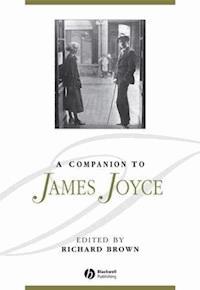
A Companion to James Joyce E-Book
40,99 €
Mehr erfahren.
- Herausgeber: John Wiley & Sons
- Kategorie: Geisteswissenschaft
- Serie: Blackwell Companions to Literature and Culture
- Sprache: Englisch
A Companion to James Joyce offers a unique composite overview and analysis of Joyce's writing, his global image, and his growing impact on twentieth- and twenty-first-century literatures. * Brings together 25 newly-commissioned essays by some of the top scholars in the field * Explores Joyce's distinctive cultural place in Irish, British and European modernism and the growing impact of his work elsewhere in the world * A comprehensive and timely Companion to current debates and possible areas of future development in Joyce studies * Offers new critical readings of several of Joyce's works, including Dubliners, A Portrait of the Artist as a Young Man, and Ulysses
Sie lesen das E-Book in den Legimi-Apps auf:
Seitenzahl: 1127
Veröffentlichungsjahr: 2013
Ähnliche




















Contents
List of Illustrations
Acknowledgments
Notes on Contributors
List of Abbreviations and Editions Used
1 Introduction: Re-readings, Relocations, and Receptions
Re-reading Texts
Joycean Geographies: Biographical Contexts and Global Relocations
Critical and Creative Approaches, Receptions, and Responses
Part I: Re-reading Texts
2 Dubliners: Surprised by Chance
3 Desire, Freedom, and Confessional Culture in A Portrait of the Artist as a Young Man
Judging the Young Artist: Autobiography, Nationhood, Sexuality
A Tale of Confessions and Constraints
Giving Lip Service to Confession: Desire, Heresy, Literature, Politics
Confessional Turnings and the Snakes of Ireland
The Thrill and the End of Confession
Beyond the Horizon of Confessional Constraints
4 Ulysses: The Epic of the Human Body
Inner Organs
Cloacal Obsessions
Throwaway Economics
Returns
The Flesh Made Word
5 Finnegans Wake: Novel and Anti-novel
Duality and Criticism
The “War on Language” as a Defense of “Active Nature”
Knowledge and the Resilience of Nature
“Look at all the plotsch!” (FW 81 2)
“All the charictures in the drame” (FW 302 32)
Part II: Contexts and Locations
6 European Joyce
Joyce’s View of His Own Mission
Artistic Europe in Joyce’s Work
The View from Europe
Master of Languages
7 “In the Heart of the Hibernian Metropolis”? Joyce’s Reception in Ireland, 1900–1940
Placing Joyce in Histories of Irish Literature
Reading Joyce before 1922
Reading Joyce in the 1920s
8 His città immediata: Joyce’s Triestine Home from Home
9 James Joyce and German Literature, or Reflections on the Vagaries and Vacancies of Reception Studies
Approaches to Reception and Influence
Gustav Freytag as Influence
The Potential Connection with Heinrich Böll
Ostensible Non-connection with Rilke
Conclusion
10 Molly’s Gibraltar: The Other Location in Joyce’s Ulysses
The Exegetical Tradition
The Multi-ethnic Field
“The B Marche Paris”
11 Joyce and Postcolonial Theory: Analytic and Tropical Modes
Analytic and Tropical Modes and the Language of Postcolonialism
Deconstruction, Bakhtin, and Postcolonial Appropriations
Familiar and Unfamiliar Tropes: The Same Anew
The Analytic and the Psychoanalytic: Bhabha and the Ghosts of History
From Analytic Cleansing to Tropical Rebirth: Voicing Joyce
12 “United States of Asia”: James Joyce and Japan
Introduction
The Rise of the Empire of Japan in Ulysses
The Early Reception of Joyce in Japan
The Fall of the Empire of Japan in Finnegans Wake
Conclusion
13 Where Agni Araflammed and Shiva Slew: Joyce’s Interface with India
Joyce and India
India and Joyce
14 Joyce and New Zealand: Biography, Censorship, and Influence
Family Ties
Antipodean Content
Joyce and Censorship
Spheres of Influence
In the Academy
Some Conclusions
Part III: Approaches and Receptions
15 Joyce’s Homer, Homer’s Joyce
16 The Joyce of French Theory
17 Joyce, Music, and Popular Culture
Literary Theory and Popular Culture
Joyce Studies and Popular Culture
Joyce and Music
18 The Joyce of Manuscripts
Books or Manuscripts?
Repairing the Text?
The Dynamics of Invention
Multiple Contextuality
Over-Determination: A Genetic Aporia
19 Joyce’s Bridge to Late Twentieth-Century British Theater: Harold Pinter’s Dialogue with Exiles
20 The Joyce Effect: Joyce in Visual Art
Inspiration, Influence, Legacy, Effect, and Reverence
Exhibitions
Irreverent Appropriations
Reading Groups
Future Directions
21 “In his secondmouth language”: Joyce and Irish Poetry
22 “Ghostly Light”: Spectres of Modernity in James Joyce’s and John Huston’s “The Dead”
“Pale Phantoms of Desire”
Haunted Cinema: A “Second Spectre”
The Memory of the Dead
23 Joyce through the Little Magazines
The Egoist: Firing the Sex Problem?
The Little Review: Making no Compromise with the Public Taste?
transition: A Revolution of the Word?
24 Joyce and Radio
Radiospace
Radio Text
Radio Set
Book II Chapter 3
Radio Work
25 Scotographia: Joyce and Psychoanalysis
Introduction: Misnomering One’s Own
Jungian and Joycean Triangles
Lacanian and Joycean Knots
Joyce’s “x” Communicated
Index
“Boasting twenty-five essays by well-known Joyce experts from across the globe, the companion has been designed to serve both as a comprehensive and accessible guide for university students (who will also benefit from the useful ‘directions for further reading’ that feature in every essay), and as an invaluable resource for Joyce experts who will have much to glean from the expanding circuits of scholarship made available here. Above all, the volume is a testament not just to the continuing importance of James Joyce, but also the global ubiquitousness of this modernist icon.”
Journal of British Comparative Lit. Association
“Essays offering new riffs and revisions stand out – Vicki Mahaffey on Dubliners, Finn Fordham on Finnegans Wake, Declan Kiberd on the Odyssey, Rabaté on French theory, and Daniel Ferrer on genetic criticism – and one welcomes the contributions of newer scholars, e.g., Katherine Mullin. Recommended.”
Choice
“A diverse collection … A fascinating discussion of Joyce.”
James Joyce Broadsheet
Blackwell Companions to Literature and Culture
This series offers comprehensive, newly written surveys of key periods and movements and certain major authors, in English literary culture and history. Extensive volumes provide new perspectives and positions on contexts and on canonical and post- canonical texts, orientating the beginning student in new fields of study and providing the experienced undergraduate and new graduate with current and new directions, as pioneered and developed by leading scholars in the field.
Published Recently
59.
A Companion to the Modern American Novel 1900–1950
Edited by John T. Matthews
60.
A Companion to the Global Renaissance
Edited by Jyotsna G. Singh
61.
A Companion to Thomas Hardy
Edited by Keith Wilson
62.
A Companion to T. S. Eliot
Edited by David E. Chinitz
63.
A Companion to Samuel Beckett
Edited by S. E. Gontarski
64.
A Companion to Twentieth-Century United States Fiction
Edited by David Seed
65.
A Companion to Tudor Literature
Edited by Kent Cartwright
66.
A Companion to Crime Fiction
Edited by Charles Rzepka and Lee Horsley
67.
A Companion to Medieval Poetry
Edited by Corinne Saunders
68.
A New Companion to English Renaissance Literature and Culture
Edited by Michael Hattaway
69.
A Companion to the American Short Story
Edited by Alfred Bendixen and James Nagel
70.
A Companion to American Literature and Culture
Edited by Paul Lauter
71.
A Companion to African American Literature
Edited by Gene Jarrett
72.
A Companion to Irish Literature
Edited by Julia M. Wright
73.
A Companion to Romantic Poetry
Edited by Charles Mahoney
74.
A Companion to the Literature and Culture of the American West
Edited by Nicolas S. Witschi
75.
A Companion to Sensation Fiction
Edited by Pamela K. Gilbert
76.
A Companion to Comparative Literature
Edited by Ali Behdad and Dominic Thomas
77.
A Companion to Poetic Genre
Edited by Erik Martiny
78.
A Companion to American Literary Studies
Edited by Caroline F. Levander and Robert S. Levine
This paperback edition first published 2011
© 2011 Blackwell Publishing Ltd except for editorial material and organization
© 2011 by Richard Brown
Edition history: Blackwell Publishing Ltd (hardback, 2008)
Blackwell Publishing was acquired by John Wiley & Sons in February 2007. Blackwell’s publishing program has been merged with Wiley’s global Scientific, Technical, and Medical business to form Wiley-Blackwell.
Registered Office
John Wiley & Sons Ltd, The Atrium, Southern Gate, Chichester, West Sussex, PO19 8SQ, United Kingdom
Editorial Offices
350 Main Street, Malden, MA 02148-5020, USA
9600 Garsington Road, Oxford, OX4 2DQ, UK
The Atrium, Southern Gate, Chichester, West Sussex, PO19 8SQ, UK
For details of our global editorial offices, for customer services, and for information about how to apply for permission to reuse the copyright material in this book please see our website at www.wiley.com/wiley-blackwell.
The right of to Richard Brown be identified as the editor of the editorial material in this work has been asserted in accordance with the UK Copyright, Designs and Patents Act 1988.
All rights reserved. No part of this publication may be reproduced, stored in a retrieval system, or transmitted, in any form or by any means, electronic, mechanical, photocopying, recording or otherwise, except as permitted by the UK Copyright, Designs and Patents Act 1988, without the prior permission of the publisher.
Wiley also publishes its books in a variety of electronic formats. Some content that appears in print may not be available in electronic books.
Designations used by companies to distinguish their products are often claimed as trademarks. All brand names and product names used in this book are trade names, service marks, trademarks or registered trademarks of their respective owners. The publisher is not associated with any product or vendor mentioned in this book. This publication is designed to provide accurate and authoritative information in regard to the subject matter covered. It is sold on the understanding that the publisher is not engaged in rendering professional services. If professional advice or other expert assistance is required, the services of a competent professional should be sought.
Library of Congress Cataloging-in-Publication Data
A companion to James Joyce / edited by Richard Brown.
p. cm.—(Blackwell companions to literature and culture; 52)
Includes bibliographical references and index.
ISBN-13: 978-1-4051-1044-0 (hardcover: alk. paper); ISBN 978-0-470-65796-6 (pbk)
1. Joyce, James, 1882–1941—Criticism and interpretation. I. Brown, Richard, 1954–PR6019.O9Z52715 2008823′.912—dc222007015777
A catalogue record for this book is available from the British Library.
This book is published in the following electronic formats: Epdf 9781444342932,Epub 9781444342949 and Wiley Online Library 9781405177535
1 2011
Illustrations
3.1 “The Sting of Conscience.” From Hell Opened to Christians, to Caution Them from Entering into It, by the Rev. F. Giovanni Pietro Pinamonti SJ
3.2 Laocoön and His Sons in the Vatican museum
20.1 Richard Prince, Spoken English: Lolita (2005)
20.2 John Dogg (Richard Prince), GGOD (Ulysses) (1987)
20.3a and b Miroslaw Balka, 250 × 280 × 120 (Sweets of Sin) (2004)
20.4 Rebecca Horn, Knuckle Dome for James Joyce (2004)
20.5 James Coleman, Ulysses Project (1982)
20.6 Royal Hibernian Academy, showing “Joyce in Art” (2004). Installation shot showing (left to right) works by Man Ray, E. L. Kirchner, Gereon Inger, Raymond Pettibon, Tony Smith, Joseph Beuys, and Joseph Kosuth (ceiling)
20.7 William Anastasi, me innerman monophone (2004)
20.8 Davide Cascio, “Space for Reading Ulysses” (2004)
25.1 Lacan’s Borromean Knot (1976)
Acknowledgments
I’m happy to acknowledge the imaginative, prompt, courteous, and professional efforts made by each of the contributors to this volume and the depth and range of their enthusiasms and expertise which have made the project both conceivable in the first place and such an enjoyable and rewarding challenge in its coming to fruition. The intellectual resources of the international community of James Joyce studies never ceases to impress and many of the perspectives offered in this volume represent intellectual obligations and much-valued, friendly working relationships that have been established over several years of conference-going, editorial work on the James Joyce Broadsheet, and so on. I should offer special thanks to David Wright and the Department of English at the University of Auckland, New Zealand, for their hospitality and assistance in allowing me to open a genuinely antipodean vantage-point on the project during its early phase. I am grateful to my colleagues in the School of English at Leeds for the semester of study leave which allowed its completion. I’d also like to thank Emma Bennett and Karen Wilson at Blackwell for their advice, patience, and support at various stages in the making of the book, and David Williams, John Gaunt, and Jackie Butterley for hard work in the production of a complex text.
Material from some chapters has previously appeared in more or less different versions. Chapter 15 was delivered as the first A. N. Jeffares Memorial Lecture in the School of English at the University of Leeds in 2006. A version of Chapter 12 was originally read at the International Conference on the East-Asian Reception of James Joyce, held at Songsil University, Seoul, Korea, on November 4, 2006. Chapter 11, an earlier version of which appeared with the title “Joyce in the postcolonial tropics” in the James Joyce Quarterly, 39:1 (2003): 69–92, is included with the permission of that journal.
Harold Pinter kindly granted permission for the use of material in his possession and the quotation of copyright material in Chapter 19. Richard Prince, Miroslav Balka, James Coleman, William Anastasi, and Davide Cascio granted permission for the inclusion of images of their work in Chapter 20. David Wheatley agreed the publication of his poem in Chapter 21.
Editing a volume like this can make a range of demands. I’d like to thank my wife Jane and William, Charlotte, and Arthur for keeping me going with, and offering me occasional relief from the task.
Notes on Contributors
Richard Brown is Reader in Modern Literature in the University of Leeds, the author of James Joyce and Sexuality (1984) and James Joyce: A Postculturalist Perspective (reprinted 2005), and editor of Joyce, “Penelope” and the Body (2006). He co-founded in 1980 and co-edits the James Joyce Broadsheet, currently serves as Trustee of the International James Joyce Foundation, and has written widely on James Joyce and on such contemporary writers as Paul Muldoon, Ian McEwan, and Bob Dylan.
Maud Ellmann is Donald and Marilyn Keough Professor of Irish Studies at the University of Notre Dame. Her books include The Poetics of Impersonality: T. S. Eliot and Ezra Pound (1987), The Hunger Artists: Starving, Writing, and Imprisonment (1993), and Elizabeth Bowen: The Shadow across the Page (2004), which won the British Academy’s Rose Mary Crawshay Prize.
Daniel Ferrer is Director of Research at the Institut des textes et manuscrits modernes (CNRS-ENS) in Paris. He is editor of the journal Genesis. The books he has written or co-edited include Post-structuralist Joyce (1984); Virginia Woolf and the Madness of Language (1990); Ulysse à l’ article: Joyce aux marges du roman (1992); Genetic Criticism: Texts and Avant-texte (2004). With Vincent Deane and Geert Lernout he is currently editing the Finnegans Wake notebooks.
Finn Fordham is a Lecturer in Twentieth-Century English in the School of English Studies at the University of Nottingham. His publications include articles on Joyce, genetic criticism, modernism, and contemporary writing, and reviews for the Guardian Review. His Lots of Fun at “Finnegans Wake” was published in 2007.
Luke Gibbons is Keough Family Professor of Irish Studies, and Professor of English, and Film, Television, and Theater, at the University of Notre Dame. He is the author of Gaelic Gothic: Race, Colonialism and Irish Culture (2004), Edmund Burke and Ireland: Aesthetics, Politics and the Colonial Sublime (2003), The Quiet Man (2002), and Transformations in Irish Culture (1996), co-author of the pioneering book Cinema in Ireland (1988), and a contributing editor of the landmark Field Day Anthology of Irish Writing (1991). He is the co-editor (with Dudley Andrew) of “The Theatre of Irish Cinema,” a special issue of The Yale Journal of Criticism (2002), and of Re-Inventing Ireland: Culture, Politics and the Global Economy (2002). He is currently working on Joyce’s Ghosts: Ireland, Modernity and the Memory of the Dead.
Eishiro Ito is Associate Professor of English at Iwate Prefectural University, Japan. His field of research is modern Irish literature, particularly the works of James Joyce, W. B. Yeats, and Seamus Heaney. His recent research focuses on “Joyce and Orientalism,” involving Jewish and East Asian studies.
R. Brandon Kershner is Alumni Professor of English at the University of Florida. He is author of Dylan Thomas: The Poet and His Critics (1977), Joyce, Bakhtin, and Popular Literature (1989), The Twentieth-Century Novel: An Introduction (1997); he also edited Joyce and Popular Culture (1996) and Cultural Studies of Joyce (2003).
Declan Kiberd is Professor of Anglo-Irish Literature at University College Dublin. Among his books are Synge and the Irish Language (1979), Men and Feminism in Modern Literature (1985), Idir Dhá Chultúr (1993), Inventing Ireland (1995), and Irish Classics (2000). He edited Ulysses for Penguin Twentieth-Century Classics (1992). A member of the Royal Irish Academy, he is a Director of the Abbey Theatre.
Christa-Maria Lerm Hayes is a Lecturer in Historical and Theoretical Studies in Visual Art at the University of Ulster, Belfast. She gained her PhD at Cologne University and was James Joyce Foundation Scholar in Zurich. She has published on contemporary Irish artists and interventionist arts practices. Her books include one on Joseph Beuys (2001, in German) and Joyce in Art: Visual Art Inspired by James Joyce (2004). The latter accompanied a large-scale art exhibition on the theme. She also curates for the Goethe Institut, Dublin.
Geert Lernout is Professor of English and Comparative Literature at the University of Antwerp where he is also director of the James Joyce Center. He is the author of The French Joyce (1990), and co-editor (with Wim van Mierlo) of The European Reception of James Joyce in Europe (2004), and has published widely on Joyce, Hölderlin, genetic criticism, textual editing, and the Bible.
Jane Lewty has served as Postdoctoral Fellow at University College London and Assistant Professor of British and Irish Literature at the University of Northern Iowa. She has published on Joyce, Pound, Woolf, and aspects of sound technology in modernist literature. A co-edited collection, Broadcasting Modernism, is forthcoming from the University Press of Florida. She is currently pursuing an MFA in Poetry at the Iowa Writers’ Workshop.
John McCourt teaches at the Università di Roma. He is founder and co-director of the Trieste Joyce School. He is the author of The Years of Bloom: Joyce in Trieste 1904 – 1920 (2000) and of James Joyce: A Passionate Exile (an illustrated biography). He guest-edited a special Trieste issue of the James Joyce Quarterly in 2001 and is currently editing James Joyce in Context for Cambridge University Press.
Vicki Mahaffey is Professor of Modern Literature at the University of York and the author of Reauthorizing Joyce (1988) and States of Desire: Wilde, Yeats, Joyce and the Irish Experience (1998). Her most recent book is Modernist Literature: Challenging Fictions (2007), which argues for the importance of the intellectual challenges presented by supposedly difficult modernist texts.
Katherine Mullin is Lecturer in the School of English at the University of Leeds. Her James Joyce, Sexuality and Social Purity was published in 2003. Her current project, Working Girls, explores the literary and cultural representations of typists, shop-girls, and barmaids between 1880 and 1920.
John Nash is Lecturer in English Studies at Durham University. He is the author of James Joyce and the Act of Reception: Reading, Ireland, Modernism (2006) and the editor of Joyce’s Audiences (2002). He has contributed many essays and articles on Joyce, modern literature, and critical theory to books and journals.
Jean-Michel Rabaté has been Professor of English at the University of Pennsylvania since 1992 and is currently Professor of Comparative Literature at Princeton University. He is on the editorial board of the Journal of Modern Literature, and he is a Trustee of the James Joyce Foundation and a senior curator of the Slought Foundation, Philadelphia. He has authored or edited 30 books on modernism, psychoanalysis, theory, Joyce, Pound, and Beckett. Recent titles include Given: 1) Art, 2) Crime (2006) and Lacan Literario (2007). Forthcoming are 1913: The Cradle of Modernism (2007) and The Ethic of the Lie (2008).
John Paul Riquelme is Professor of English at Boston University and author of Teller and Tale in Joyce’s Fiction (1983) and Harmony of Dissonances: T. S. Eliot, Romanticism, and Imagination (1991). He has edited Fritz Senn’s Joyce’s Dislocutions: Essays on Reading as Translation, as well as A Portrait of the Artist, Dracula, Tess of the d’Urbervilles, and Gothic and Modernism: Essaying Dark Literary Modernity.
Krishna Sen is Professor of English at the University of Calcutta. She has published Negotiating Modernity: Myth in the Theatre of Eliot, O’Neill and Sartre (1999) and Critical Essays on R. K. Narayan (2003), and has edited the Penguin (India) edition of Ibsen’s A Doll’s House.
Mark Taylor-Batty is a Senior Lecturer in Theatre Studies in the School of English, University of Leeds. His Harold Pinter was published in September 2001 and About Pinter: The Playwright and the Work in 2005. He is Associate Editor in Britain of the Pinter Review.
Luke Thurston is Lecturer in English at the University of Wales at Aberystwyth. He is the author of James Joyce and the Problem of Psychoanalysis (2004) and editor of Re- inventing the Symptom: Essays on the Final Lacan (2002).
Derval Tubridy is Lecturer in English and Visual Culture at Goldsmiths, University of London. She has published a monograph on Thomas Kinsella: The Peppercanister Poems (2001) and many articles on Samuel Beckett, James Joyce, the Dolmen Press, Literature and Philosophy, the Livre d’Artiste, and contemporary visual art. Her research has been supported by the Fulbright Commission and the British Academy.
Robert K. Weninger is Professor of German at King’s College London and editor of Comparative Critical Studies. He has published several studies of Joyce and Arno Schmidt in German as well as “Framing a Novelist”: Arno Schmidt Criticism 1970 – 1994 (1995). His most recent monograph, Streitbare Literaten, was published in 2004.
Mark Wollaeger is Associate Professor of English at Vanderbilt University. He is author of Modernism, Media, and Propaganda: British Narrative from 1900 to 1945 (2006) and Joseph Conrad and the Fictions of Skepticism (1990). He is editor of James Joyce’s “A Portrait of the Artist as a Young Man”: A Casebook (2003), and co-editor, with Victor Luftig and Robert Spoo, of Joyce and the Subject of History (1996).
David G. Wright is Senior Lecturer in English and Irish literature at the University of Auckland, New Zealand. He is the author of Characters of Joyce (1983), Yeats’s Myth of Self: The Autobiographical Prose (1987), Ironies of “Ulysses” (1991), and “Joyita”: Solving the Mystery (2002), and of articles about Joyce, Yeats, Harold Pinter, and Graham Greene.
Abbreviations and Editions Used
The following editions of Joyce’s works have been used except where additional or alternative editions have been cited in the essay concerned. Abbreviations that are usual in Joyce criticism have been used for parenthetical references to these editions. These abbreviations are normally followed by page numbers, though in the case of Ulysses episode and line numbers are given throughout. For Finnegans Wake reference is to page and line number. In references to the Garland Archive of Joyce’s manuscripts (JJA) the volume and page number are given.
D Joyce, James (1992) Dubliners (first published 1914), ed. Terence Brown. London and New York: Penguin Books. In Chapter 22 the edition ed. John Wyse Jackson and Bernard McGinley, London: Sinclair Stevenson, 1995 cited as Joyce 1995 is used.
E Joyce, James (1973) Exiles. London and New York: Penguin Books. (First published 1918.)
FW Joyce, James (1939) Finnegans Wake. London: Faber and Faber.
GJ Joyce, James (1968) Giacomo Joyce. London: Faber and Faber.
JJ Ellmann, Richard (1982) James Joyce, revised edn. Oxford: Oxford University Press.
JJA Joyce, James (1977 – 9) The James Joyce Archive, ed. Michael Groden et al., 63 vols. New York and London: Garland.
LI, LII, LIII Joyce, James (1966) Letters of James Joyce, Vol. I ed. Stuart Gilbert. New York: Viking Press. Vols II and III ed. Richard Ellmann. New York: Viking Press.
OCPW Joyce, James (2000) Occasional, Critical and Political Writing, ed. Kevin Barry. Oxford: Oxford University Press.
P Joyce, James (2000) A Portrait of the Artist as a Young Man, ed. Jeri Johnson. Oxford: Oxford University Press. In Chapter 3 additional part and line references are given to Joyce, James (APortrait of the Artist as a Young Man, 1993) ed. Hans Walter Gabler with Walter Hettche. New York and London: Garland Publishing. In Chapter 9, A Portrait of the Artist as a Young Man: Text, Criticism and Notes, ed. Chester G. Anderson, New York: Viking Press, 1968 cited as Joyce 1968 is used. (First published 1916.)
PE Joyce, James (1992) Poems and Exiles, ed. J. C. C. Mays. London and New York: Penguin Books.
SH Joyce, James (1956) Stephen Hero, ed. Theodore Spencer and rev. John J. Slocum and Herbert Cahoon. London: Jonathan Cape.
SL Joyce, James (1975) Selected Letters of James Joyce, ed. Richard Ellmann. New York: Viking.
U Joyce, James (1986) Ulysses, ed. Hans Walter Gabler. New York and London: Garland. (First published 1922.)
1
Introduction: Re-readings, Relocations, and Receptions
Richard Brown
The contribution of a volume on James Joyce to this series of Companions to Literature and Culture is not hard to justify in itself. Joyce’s work has outstandingly developed the kind of academic interest that would especially repay such treatment, with an intellectually distinguished as well as highly diverse body of criticism having grown up around it, at times exponentially. Joyce’s Dubliners (1914), A Portrait of the Artist as a Young Man (1916), Ulysses (1922), and, in its own way, Finnegans Wake (1939) have established quite unassailable places within the canons of twentieth-century modernistic literature, in Irish literature, more widely in the new, postcolonial, and global literatures in English, and in developments in the study of literary theory and culture, gender and sexuality, and so on. Joyce’s distinctive cultural placement as an iconic founding figure of British, American, and Irish modernism, as well as his unique and emerging significance as a prototypical figure for the discussion of modern multinational and transnational European cultural identity, contribute to the sense of a writer whose importance to a variety of key interests and constituencies is hard to overestimate and continues to grow.
Joyce’s work has been an inspiration to writers of prose fiction, poetry, drama, and film throughout the last century, with his status as a guru of the experimental or avantgarde frequently placing him at the forefront of significant cultural change. Innovations in literary and cultural theory (such as the revolutions in Continental philosophy associated with the post-1968 generation of Francophone intellectuals) as well as modern developments in academic empirical scholarship (such as historical and contextual study, reception study, and textual and genetic study) have frequently defined important stages of their progress in and through productive encounters with Joyce’s work. Joyce’s work remains authorial in a way that sometimes seems more comparable with the authorial status of a Shakespeare than with that of his modern contemporaries, whether you define that iconic position in relation to the newly independent Ireland, to the genre of twentieth-century prose fiction, or to our modernity itself.
Nevertheless aspects of Joyce’s work once provoked scandal and can frequently remain awkward, typically no doubt because of misunderstandings that may arise from the scale and complexity of the work. Significant areas of the work remain less well known, despite such attempts to put them back on the agenda as we can see in approaches to his stage play Exiles (1918) (whose revival in the 1970s by Harold Pinter is discussed here and which was produced on the London stage in a substantial new production in 2006); his critical prose writing, political journalism, and reviews (that became more available when re-edited by Oxford University Press for World’s Classics in 2001); his poetry (more fully collected in the Penguin Twentieth-Century Classics series in 1992); and the prose poem Giacomo Joyce, on which the first full volume of essays appeared last year (Armand and Wallace 2006). These works are all touched upon in this volume, though its emphasis is on the canonical and later work.
Adding an expansive new Companion on Joyce provides the opportunity to mark a moment in this re-approach to Joyce for our new century, presenting distinctively themed, critical readings of canonical texts and places of entry into the wide variety of current approaches within a single volume, and contributing informative pointers to current and possible future movements in the study of Joyce.
That there have already been two Companion volumes published on Joyce tells its own story and is another of the issues which face the editor of this one. The first, edited by Zack Bowen in 1984, contained 16 articles and two appendices written by a variety of academic and some non-academic enthusiasts and it retains much of value – not least in its broad intellectual frame. It offers a critical overview of each of the texts (including the less-well-known texts) with only a single final chapter offered on “The History of Joyce Criticism” (Bowen 1984). Alongside it the more contemporary Companion edited by Derek Attridge in 1990 and updated in 2004 thoroughly responds to the theory revolution of the 1970s and 80s with five chapters on texts, two on geographical and one on historical contexts, and four on the topics of feminism, sexuality, consumer culture, and colonialism/nationalism (Attridge 2004).
Lesen Sie weiter in der vollständigen Ausgabe!
Lesen Sie weiter in der vollständigen Ausgabe!
Lesen Sie weiter in der vollständigen Ausgabe!
Lesen Sie weiter in der vollständigen Ausgabe!
Lesen Sie weiter in der vollständigen Ausgabe!
Lesen Sie weiter in der vollständigen Ausgabe!
Lesen Sie weiter in der vollständigen Ausgabe!
Lesen Sie weiter in der vollständigen Ausgabe!
Lesen Sie weiter in der vollständigen Ausgabe!
Lesen Sie weiter in der vollständigen Ausgabe!
Lesen Sie weiter in der vollständigen Ausgabe!
Lesen Sie weiter in der vollständigen Ausgabe!
Lesen Sie weiter in der vollständigen Ausgabe!
Lesen Sie weiter in der vollständigen Ausgabe!
Lesen Sie weiter in der vollständigen Ausgabe!
Lesen Sie weiter in der vollständigen Ausgabe!
Lesen Sie weiter in der vollständigen Ausgabe!
Lesen Sie weiter in der vollständigen Ausgabe!
Lesen Sie weiter in der vollständigen Ausgabe!
Lesen Sie weiter in der vollständigen Ausgabe!
Lesen Sie weiter in der vollständigen Ausgabe!
Lesen Sie weiter in der vollständigen Ausgabe!
Lesen Sie weiter in der vollständigen Ausgabe!
Lesen Sie weiter in der vollständigen Ausgabe!
Lesen Sie weiter in der vollständigen Ausgabe!
Lesen Sie weiter in der vollständigen Ausgabe!
Lesen Sie weiter in der vollständigen Ausgabe!
Lesen Sie weiter in der vollständigen Ausgabe!




