


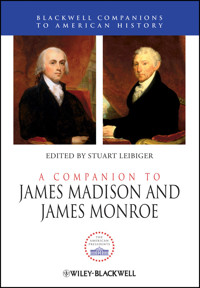
A Companion to James Madison and James Monroe E-Book
188,99 €
Mehr erfahren.
- Herausgeber: John Wiley & Sons
- Kategorie: Geisteswissenschaft
- Serie: Blackwell Companions to American History
- Sprache: Englisch
A Companion to James Madison and James Monroe features essays from leading academics that consider various aspects of the lives and legacies of our fourth and fifth presidents. * Provides historians and students of history with a wealth of new insights into the lives and achievements of two of America's most accomplished statesmen, James Madison and James Monroe * Features 32 state-of-the field historiographic essays from leading academics that consider various aspects of the lives and legacies of our fourth and fifth presidents * Synthesizes the latest findings, and offers new insights based on original research into primary sources * Addresses topics that readers often want to learn more about, such as Madison and slavery
Sie lesen das E-Book in den Legimi-Apps auf:
Seitenzahl: 1473
Veröffentlichungsjahr: 2012
Ähnliche




















Cover
Blackwell Companions to American History
Title Page
Copyright
Dedication
List of Illustrations
Notes on Contributors
Acknowledgments
Introduction
Chapter One: James Madison's Political Thought: The Ideas of an Acting Politician
Introduction
Revolutionary Experiences
Setting the Constitutional Agenda
The Case for Ratification
The Challenge of Constitutional Interpretation
Later Thoughts
Chapter Two: James Madison's Journey to an “Honorable and Useful Profession,” 1751–1780
The Death and Re-Burial of James Madison
Beginnings
Education
Searching for an “Honorable and Useful Profession”
Beginning a Career in Politics
Conclusion: The Birth of Montpelier
Chapter Three: James Madison, 1780–1787: Nationalism and Political Reform
Introduction
Historiography
Madison in Congress, 1780–1783
Back in Virginia
Preparations for the Philadelphia Convention
Chapter Four: James Madison and the Grand Convention: “The Great Difficulty of Representation”
Madison's Presentation of the Convention Debates
Act I of the Federal Convention: The Alternative Plans
Act II: The Connecticut Compromise
Conclusion: Madison's Contribution to the Federal Republic
Chapter Five: James Madison and the Ratification of the Constitution: A Triumph Over Adversity
Introduction
The Philadelphia Convention and Confederation Congress
The Federalist
The Run-Up to Richmond
The Array of Forces, and a Signal Victory
Patrick Henry's Counterbalance
The Mississippi Issue
Antifederalists Range Far and Wide, and Federalists Calmly Reply
Cautiously Optimistic
Randolph's (and Nicholas's) Momentous Position
The Climax
Madison's Candidacies – And Election
Chapter Six: James Madison in the Federalist: Elucidating “The Particular Structure of this Government”
Introduction
The Introduction: Federalist 37–38
The General Form of the Proposed Government: Federalist 39–40
The General Mass of Power in the Government: Federalist 41–46
The Particular Structure of this Government: Federalist 47–51
Particular Structure of this Government: The House of Representatives and the Senate: Federalist 52–58 and 62–63
Chapter Seven: James Madison, Republican Government, and the Formation of the Bill of Rights: “Bound by Every Motive of Prudence”
Introduction: Understanding Madison's Puzzling Role in the Formation of the Bill of Rights
“Early and Strong Impressions in Favour of Liberty both Civil and Religious”
A Reform Therefore Which Does Not Make Provision for Private Rights, Must Be Materially Defective”
“Separating the Well Meaning From the Designing Opponents”
“The Nauseous Project of Amendments”
Chapter Eight: James Madison in the U.S. House of Representatives, 1789–1797: America's First Congressional Floor Leader
Introduction
Election to the U.S. Congress
The First Congress and the National Tariff
Madison and the Bill of Rights
Hamiltonian Finance
A Republican Congressman
Madison's Congressional Legacy
Chapter Nine: James Madison and the National Gazette Essays: The Birth of a Party Politician
Introduction
The Two Gazettes
The Early Essays: Foundations in Republican Theory
The Latter Essays: The Birth of Party Politics
Legacies
Chapter Ten: James Madison, the Virginia Resolutions, and the Philosophy of Modern American Democracy
The Virginia Resolutions as a Statement of Political Principles
The Alien and Sedition Acts
Philosophical Foundations of American Political Thought
Madison and the Alien and Sedition Acts
The Virginia Resolutions
Address on the Resolutions
Report on the Resolutions (1800)
Chapter Eleven: James Madison's Secretary of State Years, 1801–1809: Successes and Failures in Foreign Relations
Introduction
Taking up the Reins
The Louisiana Purchase
Negotiations with Great Britain, France, and Spain
The United States' Neutral Rights
The Monroe–Pinkney Treaty
The Embargo
Conclusion
Chapter Twelve: President James Madison's Domestic Policies, 1809–1817: Jeffersonian Factionalism and the Beginnings of American Nationalism
Introduction
Madison's Ascension and Jeffersonian Factionalism
Madison and the Constitution: Vetoes and Joseph Story
The Non-Intercourse Act, Macon's Bills, and a Second Bank of the United States
Political Solidarity but National Strife during the War of 1812
Madison Shapes the Awakening of American Nationalism
Chapter Thirteen: President James Madison and Foreign Affairs, 1809–1817
Introduction: International Relations Ideals
Twice Hope and Twice Heartbreak
An Occupation and a War
The War of 1812
Conclusion and Assessment
Chapter Fourteen: James Madison's Retirement, 1817–1836: Engaging the Republican Past, Present, and Future
Madison's Retirement Rediscovered
From Gratitude to Controversy
Affirming Judicial Review
Denouncing Nullification
Agonizing over Slavery
“Advice to My Country”
Chapter Fifteen: James Madison and George Washington: The Indispensable Man's Indispensable Man
Introduction
Winning Independence
Strengthening Bonds of Union and Friendship
Framing and Ratifying the Constitution
Washington's Prime Minister
Friendship Tested
A Second Term
Farewell
Conclusion
Chapter Sixteen: James Madison and Thomas Jefferson: A “Friendship Which Was for Life”
Introduction: “The Mutual Influence of These Two Mighty Minds”
Friendship, 1779–1826: “An Intimacy Took Place”
A Political Philosophy of Liberty: A “System Founded on Popular Rights”
Conclusion: “Take Care of Me When Dead”
Chapter Seventeen: James and Dolley Madison and the Quest for Unity
Introduction: A Glorious Retirement
Personality as Policy
The Problem of Unity
Quaker to Queen
Coming Together in Washington City
Access in the Unofficial Sphere
Mrs. Madison's War
A Model for the Future
Chapter Eighteen: James Madison and Montpelier: The Rhythms of Rural Life
Madison's Lifelong Home
The Building of Montpelier
Madison's Early Days
Madison's Marriage and Return to Montpelier
Madison as Secretary of State
Madison as President
Madison in Retirement
Montpelier after James Madison
Madison and Montpelier
Chapter Nineteen: James Madison and the Dilemma of American Slavery
Introduction
Madison, Slavery, and the American Revolution
Madison, Slavery, and the Constitution
Madison, Slavery, and the Federalist Era
Madison and Slavery at Montpelier
Madison, Slavery, and the Republican Ascendency
Madison, Slavery, and the Impending Crisis
Madison, Racism, and Republicanism
Chapter Twenty: James Monroe's Political Thought: The People the Sovereigns
Introduction
Intellectual Sources of Monroe's Work
Federalism
Monroe: Slavery as a “Modification of Private Property”
Mixed Government and Democracy
Executive, Legislative, and Judicial Branches in a Representative Democracy
The State of Nature and the Origins of Government
The Personal as Political: The Failure of the French Revolution and the Triumph of U.S. Republicanism
Conclusion
Chapter Twenty-One: James Monroe, 1758–1783: Student and Soldier of the American Revolution
Introduction
Family, Boyhood, and College
The Revolutionary War
The Revolutionary Legacy
Chapter Twenty-Two: James Monroe and the Confederation, 1781–1789: The Making of a Virginia Statesman
Introduction
The Invasion of Virginia
The Virginia House of Delegates
The Council of State
Monroe in Congress
New States in the West
Regulation of Commerce
The Mississippi River
Marriage and Return to Virginia
The Constitution
Monroe as Antifederalist
The Virginia Ratification Convention
The Race for Congress
Conclusion
Chapter Twenty-Three: James Monroe in the 1790s: A Republican Leader
Introduction
Early Life
United States Senator from Virginia
Republican Party Champion
Chosen Minister to France
A Diplomat in France
Republican Party Activist in France
Recall as Minister
Controversies
Elected Governor of Virginia
Conclusion: Republican Leader
Chapter Twenty-Four: James Monroe as Governor of Virginia and Diplomat Abroad, 1799–1810: A Revolution of Principles and the Triumph of Pragmatism
Introduction
First Governorship: The Revolution of 1800 and the Rebellion of 1800
The Louisiana Purchase
London, Aránjuez, and a Diplomatic Impasse
The Monroe–Pinkney Treaty
The 1808 Presidential Campaign: Dissidence and Recantation
Conclusion
Chapter Twenty-Five: James Monroe as Secretary of State and Secretary of War, 1809–1817: Toward Republican Strategic Sobriety
Introduction
Origins of the Debate: Federalists and Republicans
Jefferson's Embargo and the Coming of the Second War with Great Britain
Monroe as Secretary of State
The Road to War
Acting Secretary of War
War and a Divided Cabinet: Monroe and Armstrong
Peace and Consolidation
Conclusion and Assessment
Chapter Twenty-Six: James Monroe, James Madison, and the War of 1812: A Difficult Interlude
Introduction
Estrangement and Reconciliation
From the Fall of Detroit to the Fall of Washington
Restoring Government and Peace
The Twilight of the Virginia Dynasty
Chapter Twenty-Seven: President James Monroe's Domestic Policies, 1817–1825: “To Advance the Best Interests of Our Union”
Introduction
National Tours
Internal Improvements
The Missouri Crisis
Chapter Twenty-Eight: President James Monroe and Foreign Affairs, 1817–1825: An Enduring Legacy
Introduction
Revolutionary War Service and Civilian Mentors
Early Diplomatic Experiences: France, Louisiana, and Great Britain
Secretary of State and Secretary of War during the War of 1812
Monroe's Presidential Election and the Transatlantic World in 1817
John Quincy Adams as Monroe's Secretary of State
First-Term Achievements: The West, Great Britain, and Florida
The Monroe Doctrine, 1823
The Long-Term Ramifications of the Monroe Doctine
Conclusion
Chapter Twenty-Nine: The Domestic Life of James Monroe: The Man at Home
Introduction
A Married Man
Family
France
Return to Highland
The Issue of Slavery
Return to Europe
The Monroes in Washington
The Final Years
Chapter Thirty: James Monroe and Thomas Jefferson: Republican Government and the British Challenge to America, 1780–1826
A Well-Timed Friendship: Mentor and Protégé
Political Collaboration
Republican Statecraft
The Jefferson–Monroe Legacy
Chapter Thirty-One: James Monroe and James Madison: Republican Partners
Introduction
The Partnership Begins
Republicans in Opposition
Republicans in Power: A Split and Reconciliation
A Partnership Renewed: The War of 1812
Monroe's Presidency
Retirement
Chapter Thirty-Two: James Madison and James Monroe Historiography: A Tale of Two Divergent Bodies of Scholarship
Introduction
James Madison's Consistency
The Inconsistency Thesis
President Madison's Leadership
James Monroe Historiography
Conclusion
References
Index
Blackwell Companions to American History
This series provides essential and authoritative overviews of the scholarship that has shaped our present understanding of the American past. Edited by eminent historians, each volume tackles one of the major periods or themes of American history, with individual topics authored by key scholars who have spent considerable time in research on the questions and controversies that have sparked debate in their field of interest. The volumes are accessible for the non-specialist, while also engaging scholars seeking a reference to the historiography or future concerns.
Published
A Companion to the American Revolution
Edited by Jack P. Greene and J. R. Pole
A Companion to 19th-Century America
Edited by William L. Barney
A Companion to the American South
Edited by John B. Boles
A Companion to American Indian History
Edited by Philip J. Deloria and Neal Salisbury
A Companion to American Women's History
Edited by Nancy Hewitt
A Companion to Post-1945 America
Edited by Jean-Christophe Agnew and Roy Rosenzweig
A Companion to the Vietnam War
Edited by Marilyn Young and Robert Buzzanco
A Companion to Colonial America
Edited by Daniel Vickers
A Companion to American Foreign Relations
Edited by Robert Schulzinger
A Companion to 20th-Century America
Edited by Stephen J. Whitfield
A Companion to Benjamin Franklin
Edited by David Waldstreicher
A Companion to the American West
Edited by William Deverell
A Companion to the Civil War and Reconstruction
Edited by Lacy K. Ford
A Companion to American Technology
Edited by Carroll Pursell
A Companion to African-American History
Edited by Alton Hornsby
A Companion to American Immigration
Edited by Reed Ueda
A Companion to American Cultural History
Edited by Karen Halttunen
A Companion to California History
Edited by William Deverell and David Igler
A Companion to American Military History
Edited by James Bradford
A Companion to Los Angeles
Edited by William Deverell and Greg Hise
A Companion to American Environmental History
Edited by Douglas Cazaux Sackman
Presidential Companions
Published
A Companion to Franklin D. Roosevelt
Edited by William Pederson
A Companion to Richard M. Nixon
Edited by Melvin Small
A Companion to Theodore Roosevelt
Edited by Serge Ricard
A Companion to Thomas Jefferson
Edited by Francis D. Cogliano
A Companion to Lyndon B. Johnson
Edited by Mitchell Lerner
A Companion to Harry S. Truman
Edited by Daniel S. Margolies
A Companion to James Madison and James Monroe
Edited by Stuart Leibiger
This edition first published 2013
© 2013 John Wiley & Sons Inc.
Wiley-Blackwell is an imprint of John Wiley & Sons, formed by the merger of Wiley's global Scientific, Technical and Medical business with Blackwell Publishing.
Registered Office
John Wiley & Sons Ltd, The Atrium, Southern Gate, Chichester, West Sussex, PO19 8SQ, UK
Editorial Offices
350 Main Street, Malden, MA 02148-5020, USA
9600 Garsington Road, Oxford, OX4 2DQ, UK
The Atrium, Southern Gate, Chichester, West Sussex, PO19 8SQ, UK
For details of our global editorial offices, for customer services, and for information about how to apply for permission to reuse the copyright material in this book please see our website at www.wiley.com/wiley-blackwell.
The right of Stuart Leibiger to be identified as the author of the editorial material in this work has been asserted in accordance with the UK Copyright, Designs and Patents Act 1988.
All rights reserved. No part of this publication may be reproduced, stored in a retrieval system, or transmitted, in any form or by any means, electronic, mechanical, photocopying, recording or otherwise, except as permitted by the UK Copyright, Designs and Patents Act 1988, without the prior permission of the publisher.
Wiley also publishes its books in a variety of electronic formats. Some content that appears in print may not be available in electronic books.
Designations used by companies to distinguish their products are often claimed as trademarks. All brand names and product names used in this book are trade names, service marks, trademarks or registered trademarks of their respective owners. The publisher is not associated with any product or vendor mentioned in this book. This publication is designed to provide accurate and authoritative information in regard to the subject matter covered. It is sold on the understanding that the publisher is not engaged in rendering professional services. If professional advice or other expert assistance is required, the services of a competent professional should be sought.
Library of Congress Cataloging-in-Publication Data
A companion to James Madison and James Monroe / edited by Stuart Leibiger.
p. cm. – (Blackwell companions to American history–Presidential companions)
Includes bibliographical references and index.
ISBN 978-0-470-65522-1 (hardback : alk. paper)
1. Madison, James, 1751–1836.2. Monroe, James, 1758–1831.3. United States–Politics and government–1783–1865.4. Presidents–United States–Biography. I. Leibiger, Stuart Eric.
E342.C66 2012
973.5′1092–dc23
2012005848
A catalogue record for this book is available from the British Library.
Jacket image: Portrait of James Madison by Thomas Sully (left), portrait of James Monroe (right) by James Bogle. Virginia Historical Society, www.vahistorical.org
Jacket design by Richard Boxhall Design Associates
For Jennifer, Ethan, and Laura,My domestic team
List of Illustrations
1.1 U.S. Congressman James Madison by James Sharples, c. 1796–1797. (Courtesy of Independence National Historical Park.)
2.1 James Madison's Grave, Montpelier, Orange County, Virginia. (Photo by Stuart Leibiger.)
3.1 “A N.W. view of the state house in Philadelphia taken 1778.” 1787 engraving by James Trenchard after a sketch by Charles Willson Peale. (Courtesy of the Library of Congress.) The Continental and Confederation Congresses, as well as the 1787 Federal Convention, met here.
4.1 Scene at the Signing of the U.S. Constitution, September 17, 1787, by Howard Chandler Christy, 1940. (Courtesy of the U.S. Capitol Historical Society.) Madison is seated at center beneath first window from the right.
13.1 “Sketch for the regent's speech on Mad-ass-son's insanity.” 1812 hand-colored etching by George Cruickshank, published by Walker and Knight, London. (Courtesy of the Library of Congress.) Madison, standing between Napoleon and the Devil, receives the message “bad news for you” from Gabriel. Women representing Great Britain and America watch.
17.1 Dolley Payne Todd Madison and her niece Anna Payne. Quarter-plate Daguerreotype by an unknown artist. Copy after Mathew B. Brady, c. 1848. (Courtesy of the National Portrait Gallery, Smithsonian Institution; gift of Dortha Louise Dobson Adem Rogus, direct descendant of Dolley Madison. NPG.2006.92.)
18.1 Modern Restoration of James Madison's Montpelier, Orange County, Virginia. (Photo by Stuart Leibiger.)
19.1 Virginia Convention of 1829–1830 by George Catlin, 1829–1830. (Courtesy of the Virginia Historical Society. 1957.39.) Monroe, seated at the left, presided over the state constitutional convention. Madison, standing, delivers a speech.
20.1 “James Monroe, L.L.D., President of the United States.” 1817 engraving by Goodman & Piggot after a painting by Charles Bird King. (Courtesy of the Library of Congress.)
26.1 “The fall of Washington, or Maddy in full flight.” 1814 cartoon published by S.W. Fores, London. (Courtesy of the Library of Congress.) Cartoon mocking President Madison and an advisor, probably Secretary of War John Armstrong, fleeing Washington during the 1814 British invasion.
29.1 James Monroe's Oak Hill, Loudoun County, Virginia. 1930 photograph by Frances Benjamin Johnston. (Courtesy of the Library of Congress.) After leaving the presidency, Monroe retired to this plantation.
31.1 “A view of the Presidents house in the city of Washington after the conflagration of the 24th August 1814.” 1814 hand-colored aquatint by William Strickland, engraver and George Munger, artist. (Courtesy of the Library of Congress.)
Notes on Contributors
Catherine Allgor is a professor of history at the University of California at Riverside and a University of California Presidential Chair. She is the author of Parlor Politics: In Which the Ladies of Washington Help Build a City and a Government (2000) and A Perfect Union: Dolley Madison and the Creation of the American Nation (2006). She is currently researching coverture and the Founding.
Jeff Broadwater is a professor of history at Barton College in Wilson, North Carolina, where he was the Jefferson-Pilot Faculty Member of the Year in 2006–2007. He is also a past president of the North Carolina Association of Historians. His book George Mason, Forgotten Founder (2006) received the Richard Slatten Award from the Virginia Historical Society. His most recent book, James Madison: A Son of Virginia and a Founder of the Nation, was published by the University of North Carolina Press in 2012.
Denver Brunsman is an assistant professor of history at The George Washington University. He is the author of The Evil Necessity: British Naval Impressment in the Eighteenth-Century Atlantic World (2013). He is a co-editor of Colonial America: Essays in Politics and Social Development (6th edn., 2010) and Revolutionary Detroit: Portraits in Political and Cultural Change, 1760–1805 (2009). In 2007–2008, he was a National Endowment for the Humanities Fellow at the Newberry Library in Chicago.
Meghan C. Budinger, formerly the curator of the James Monroe Museum and Memorial Library at the University of Mary Washington in Fredericksburg, Virginia, has curated a number of exhibitions related to James Monroe and his era, including Our Face to the World: The Clothing of James and Elizabeth Monroe, which highlighted historical costume used throughout the Monroes' lives. She is a frequent guest lecturer on the subject of Monroe and his life, and has taught in the University of Mary Washington's Department of Historic Preservation. She is currently the curator at the George Washington Foundation, also in Fredericksburg.
Christopher Burkett is an assistant professor of political science at Ashland University, and author of several online lesson plans on the American Founding and the 1787 Constitutional Convention for the National Endowment for the Humanities EDSITEment project.
Aaron N. Coleman is an assistant professor of history at Kentucky Christian University. He earned a PhD in American history from the University of Kentucky. He has published in the Journal of the Early Republic and is currently researching the reintegration of the loyalists and the constitutional settlement of the American Revolution. He is a 2001 graduate of Cumberland College (now the University of the Cumberlands). He lives in Paintsville, Kentucky, with his wife and two children.
William M. Ferraro earned a PhD in American civilization from Brown University and is an associate professor and associate editor with The Papers of George Washington at the University of Virginia. He previously worked with The Salmon P. Chase Papers at Claremont Graduate School and The Papers of Ulysses S. Grant at Southern Illinois University Carbondale. His research interests include these historical figures and John Sherman, William Tecumseh Sherman, and James Monroe.
Alan Gibson is a professor of political science at California State University, Chico. He is the author of numerous articles on James Madison and the American Founding as well as Interpreting the Founding: Guide to the Enduring Debates Over the Origins and Foundations of the American Republic (2006) and Understanding the Founding: The Crucial Questions (2007). Gibson has held fellowships at the James Madison Program in American Ideals and Institutions, Princeton University, the Social Philosophy and Policy Center at Bowling Green State University, and the International Center for Jefferson Studies in Charlottesville, Virginia.
Kevin R. C. Gutzman is a professor of history at Western Connecticut State University. He is the author of James Madison and the Making of America (2012), Virginia's American Revolution: From Dominion to Republic, 1776–1840 (2007), two other books, and hundreds of articles and reviews. He is also a featured expert in the documentary film John Marshall: Citizen, Statesman, Jurist.
Mary Hackett has edited The Papers of James Madison: Secretary of State Series since 1988. In 1996 volume 2 of the series received the Arthur S. Link Prize from the Society of Historians of American Foreign Relations. In 2006 she received the Lyman H. Butterfield Award for recent contributions in the areas of documentary publication, teaching, and service from the Association for Documentary Editing.
Peter Daniel Haworth is the editor of ANAMNESIS, A Journal for the Study of Tradition, Place, and ‘Things Divine,’ and the founder of the Ciceronian Society. He earned a PhD in government from Georgetown University in 2008. He specializes in American political thought and constitutional law, especially the American Founding, federalism, the separation of powers, the war powers, confederations, and American exceptionalism.
Stuart Leibiger is an associate professor and History Department chair at La Salle University. He is the author of Founding Friendship: George Washington, James Madison, and the Creation of the American Republic (1999, 2001, 2006). He has written numerous articles on the Founders for historical magazines and journals, and has been a historical consultant for television documentaries and museums. He has worked on the editorial staffs of The Papers of George Washington and The Papers of Thomas Jefferson. He was the scholar-in-residence for the Landmarks of American History Program at Mount Vernon, 2004–2009.
Gordon Lloyd is a professor of public policy at Pepperdine University. He co-edited The Essential Antifederalist (1985), The Essential Bill of Rights (1998), and The Two Narratives of Political Economy (2010), and edited The Two Faces of Liberalism (2006). He has also created interactive websites on the 1787 Constitutional Convention and Ratification Debates at www.TeachingAmericanHistory.org.
David B. Mattern is a research professor and senior associate editor of The Papers of James Madison at the University of Virginia. He is the lead editor of five volumes of The Papers of James Madison, co-editor, with Holly Shulman, of The Selected Letters of Dolley Payne Madison (2003), and author of Benjamin Lincoln and the American Revolution (1995).
Michael J. McManus is an independent scholar living in Chapel Hill, North Carolina. He earned a PhD in history from the University of Wisconsin–Madison in 1991. His publications include: Political Abolitionism in Wisconsin, 1840–1861 (1998) and “Freedom and Liberty First and the Union Afterwards: State Rights and the Wisconsin Republican Party, 1854–1861,” in Union & Emancipation: Essays on Politics and Race in the Civil War Era (1997), edited by David W. Blight and Brooks D. Simpson.
Sandra Moats is an associate professor of history at the University of Wisconsin–Parkside. She is the author of Celebrating the Republic: Presidential Ceremony and Popular Sovereignty, from Washington to Monroe (2010). She is currently working on a book entitled The Origins of American Neutrality, from the French Revolution to the Monroe Doctrine.
Jeffry H. Morrison is an associate professor of government at Regent University and a faculty member of the James Madison Memorial Fellowship Foundation in Washington, D.C. He has also taught at Princeton University, the United States Air Force Academy, and in the departments of government and history at Georgetown University, where he earned a PhD. He is the co-editor or author of numerous articles and four books on early American history and politics, including The Political Philosophy of George Washington (2009), and John Witherspoon and the Founding of the American Republic (2005, 2007).
Paul Douglas Newman is a professor of early American history at the University of Pittsburgh at Johnstown. He is the author of Fries's Rebellion: The Enduring Struggle for the American Revolution (2004), and co-editor of Pennsylvania History: Essays and Documents (2010). He has written a number of articles and served on the editorial staff of Pennsylvania History: A Journal of Mid-Atlantic Studies for 11 years, five as editor.
David A. Nichols is an associate professor of history at Indiana State University, and the author of Red Gentlemen & White Savages: Indians, Federalists, and the Search for Order on the American Frontier (2008). He is currently finishing The Engines of Diplomacy, a study of the U.S. government's Indian trading-house program.
Mackubin Thomas Owens is a professor of national security affairs at the Naval War College and editor of Orbis, the quarterly journal of the Foreign Policy Research Institute (FPRI). He has written extensively on U.S. security issues and the Founding period. He is the author of U.S. Civil–Military Relations After 9/11: Renegotiating the Civil–Military Bargain (2011) and Abraham Lincoln: Leadership and Democratic Statesmanship in Wartime (2009). He is currently completing a book for the University Press of Kentucky tentatively titled Sword of Republican Empire: A History of U.S. Civil–Military Relations.
Brook Poston is a teaching fellow and PhD candidate at Texas Christian University under the direction of Dr. Gene Allen Smith. He is finishing his dissertation, titled James Monroe and Republican Legacy. He has a journal article on Madison and Monroe's split and reconciliation during the election of 1808 under peer review. He earned a law degree from the University of Kansas.
Daniel Preston is the editor of The Papers of James Monroe at the University of Mary Washington. He has taught at the University of Maryland and Virginia Wesleyan College as well as at the University of Mary Washington. In addition to the Monroe Papers, Preston is co-editor of the Daniel Chester French Papers. He has received grants from the National Endowment for the Humanities, has held a Mellon Fellowship at the Virginia Historical Society, and received a David Bruce Fellowship at Keele University in Staffordshire, England.
Jack N. Rakove is the William Robertson Coe Professor of History and American Studies and professor of political science at Stanford University, where he has taught since 1980. He is a member of the American Philosophical Society, the American Academy of Arts and Sciences, and past president of the Society for the History of the Early American Republic.
James H. Read is a professor of political science at the College of St. Benedict and St. John's University of Minnesota, and has been visiting professor of political science at University of California–Davis. His books include Power versus Liberty: Madison, Hamilton, Wilson, and Jefferson (2000) and Majority Rule versus Consensus: The Political Thought of John C. Calhoun (2009).
Carey Roberts earned his PhD in American History from the University of South Carolina in 1999. He has written and lectured widely on several areas of early American finance, federalism, and southern intellectual history. Currently he is associate professor of history at Arkansas Technical University.
Arthur Scherr teaches history at New York University. He has written numerous works on the political culture and foreign policy of the Early Republic, especially on James Monroe and Thomas Jefferson. His articles on Monroe have appeared in numerous scholarly journals, such as Mid-America, The Historian, Southern Studies, and Midwest Quarterly. He has devoted himself to rehabilitating the reputation of Monroe and to increasing interest in the fifth president among scholars and the general public.
Michael Schwarz is an assistant professor of history and a fellow of the Ashbrook Center for Public Affairs at Ashland University. He has published essays on Founding-era politics and diplomacy, and he is currently revising his doctoral dissertation on Thomas Jefferson and U.S. relations with Great Britain after the American Revolution. He lives in Ashland, Ohio, with his wife and 13-year-old beagle.
Garrett Ward Sheldon is The John Morton Beaty Professor of Political Science at The University of Virginia's College at Wise. He is the author of 10 books on political theory, and on early American thought and religion, including The Political Philosophy of James Madison (2001). He has lectured at Oxford, Pri-nceton, Moscow University, and the University of Vienna, Austria, and received the Outstanding Faculty in Virginia Award, the highest honor given academics in the Commonwealth.
David J. Siemers is a professor and chair of the Political Science Department at the University of Wisconsin–Oshkosh. Siemers specializes in the presidency and American political thought. He is the author of Ratifying the Republic: Anti-Federalists and Federalists in Constitutional Time (2002) and Presidents and Political Thought (2009).
Robert W. Smith is an assistant professor of history at Worcester State University, specializing in United States foreign policy, the Early Republic, and the age of Jackson. He is the author of Keeping the Republic: Ideology and Early American Diplomacy (2004) and Amid a Warring World: American Foreign Relations, 1775–1815 (2012). He is a contributing editor to the online edition of American Foreign Relations since 1600: A Guide to the Literature.
J.C.A. Stagg was educated at the University of Canterbury in Christchurch, New Zealand, and at Princeton University. He is currently professor of history and editor-in-chief of The Papers of James Madison at the University of Virginia. In 2012 he published The War of 1812: Conflict for a Continent.
Adam Tate is associate professor of history at Clayton State University in Morrow, Georgia. He studied American history at the University of Alabama where he earned an MA and PhD. He researches and writes on American intellectual history. In 2005 he published Conservatism and Southern Intellectuals, 1789–1861.
Michael Zuckert is Nancy Reeves Dreux Professor of Political Science at the University of Notre Dame. He has written extensively on American political thought and is the founding editor of the journal American Political Thought.
Acknowledgments
This book, three years in the making, would not have been possible without seemingly endless hours of assistance from countless individuals. While it would be impossible for me to recognize the many people who contributed in one way or another, I would like to recognize those who helped the most.
I would like to thank my editor, Peter Coveney, as well as Galen Young, Allison Medoff, Sarah Dancy, Tom Bates, and the production and marketing staffs of Wiley-Blackwell. Copy-editor Claire Creffield went through the manuscript with a fine-toothed comb, ensuring uniformity of style throughout, and catching numerous errors and omissions. The Leaves and Grants Committee of La Salle University provided me with a year off from teaching to complete this project. La Salle History Department Secretary Lauren De Angelis assisted with the index and a variety of details. I would especially like to thank the 31 authors who found the time in their busy careers to contribute top-notch, state-of-the-field chapters to this volume. They completed their tasks in timely fashion and invariably put up with my edits and my badgering for drafts with good cheer. The countless librarians and archivists who helped all of the contributors deserve to be acknowledged as well. Finally, I would like to thank the members of my “domestic team” – Jennifer, Ethan, and Laura Leibiger – for providing love, support, diversion, and respite.
Introduction
Stuart Leibiger
James Madison and James Monroe left a huge imprint on the Early American Republic. One or both of them served the public for 49 of the nation's first 50 years of existence, from 1776 to 1825. Only during the year 1798 did neither man hold a state or federal office. Both served in the Virginia legislature, the Virginia Executive Council, the Confederation Congress, the U.S. Congress, and as secretary of state. Their combined service culminated with 16 consecutive years in which they occupied the office of the president of the United States, 1809–1825.
Despite their similarly impressive careers, historians and political scientists have treated these two Founders quite differently. Madison has won tremendous attention, especially for his roles as “Father of the Constitution,” and “Father of the Bill of Rights.” His political philosophy has received especially intense scrutiny. In addition to countless monographs, chapters, and articles, Madison has also been the subject of at least half a dozen biographies in the past five decades, with two more (one by Jeff Broadwater and one by Kevin R.C. Gutzman, both contributors to this volume) appearing in 2012. The Papers of James Madison, located at the University of Virginia and employing an editorial staff of eight, has thus far published 33 large letterpress volumes of Madison's papers in four separate series. To date, all of Madison's papers up through the year 1805 have been published, as well as substantial portions of his presidential writings, and one volume of his retirement correspondence.
James Monroe, on the other hand, has suffered a surprising degree of scholarly neglect. Only three biographies of Monroe have been published in the past half century. The Papers of James Monroe, located at The University of Mary Washington, with a much smaller editorial staff of two people, and much less public funding, has issued four volumes. As Arthur Scherr points out in his chapter on Monroe's political philosophy (chapter 20), most Early National specialists are unaware that the fifth president even had a political philosophy.
Prior to the 1980s, Madison was often pictured as something of a flip-flopper, even by sympathetic biographers, one who performed an about-face from being a leading Federalist-nationalist-loose constructionist in the 1780s, to becoming a Republican-states' rights-strict constructionist in the 1790s. Scholars emphasized that Madison waffled in other areas as well, including on the Bill of Rights, a national bank, and internal improvements. Overall, Madison was seen as an inconsistent, weak sidekick to Thomas Jefferson, and as a timid, uninspiring, third-rate president and wartime commander-in-chief.
Since the 1980s, Madison's reputation has enjoyed a remarkable resurgence, facilitated by the appearance of The Papers of James Madison volumes. Leading the way in enhancing our understanding and appreciation of Madison's thought have been numerous historians and political scientists. In particular Lance Banning, Drew McCoy, and Jack Rakove have elucidated Madison's thought in its full complexity, analyzed its strengths and weaknesses, and placed it into historical context.
Thanks to this recent scholarship, Madison has emerged not only as a sophisticated, nuanced, and flexible thinker, but as a remarkably consistent one as well. Once Madison's core beliefs are isolated and understood, his course of action appears remarkably steady. These fundamental beliefs include preserving majority rule, minority rights, and the balance of power between the branches and levels of government. This rehabilitation of Madison, in short, has restored him to center stage as the Father of the Constitution. James Madison's pre-presidential career was arguably as important as – if not more important than – his presidency. This observation is amazing, considering that Madison served two terms as chief executive and took the nation into its first declared war. Today the Virginian is remembered more as a legislator than as a chief executive, and his pre-White House record is studied more than his presidency. This volume, however, devotes as much attention to Madison's nineteenth-century career as it does to his eighteenth-century record. Overall, as I argue in chapter 15, Madison emerges as “much more than a brilliant political philosopher. He also stands out as a practical statesman, one as capable of accomplishing great deeds as of thinking profound thoughts.”
James Monroe has not drawn as much scholarly attention as Madison, yet presidential polls consistently rank him as near-great. (In 16 surveys of professional historians taken from 1961 to 2011, he ranks from a high of 7 to a low of 16. The 2010 Siena poll ranks him the seventh greatest president.) Very recent scholarship, especially Robert P. Forbes's The Missouri Compromise and its Aftermath (2007) and Giles H. Unger's The Last Founding Father (2009), is finally recognizing Monroe's contributions. As I began to recruit contributors to this volume, more than one colleague warned me that I would struggle to find authors willing to write on Monroe. Quite to the contrary, I was pleasantly surprised to find that scholars eagerly snapped up the Monroe chapters even more quickly than the Madison ones. This volume gives Monroe's long and distinguished career the attention it deserves. As Michael J. McManus concludes in his chapter on President Monroe's domestic policies (chapter 27), the Virginian is “perhaps America's most underappreciated great president.”
Grounded in the latest scholarship and written by leading Madison/Monroe specialists, each essay in this volume explores a specific theme or episode in the lives of these two statesmen. Nineteen chapters are devoted to Madison, 12 chapters focus on Monroe, and a final historiographical chapter examines both presidents. Most of the chapters trace their lives in chronological progression, although a few thematic chapters are included as well. The thematic essays address each man's political philosophies, key friendships and collaborations, and domestic lives. Pivotal issues such as Madison and slavery are also covered. Each chapter synthesizes current scholarship and offers new insights based on original research into primary sources. The chapters can be read individually to learn about a specific time period or topic. Read cover to cover, the book serves as the definitive biography of each Founder for academics, graduate and undergraduate students, and non-specialists alike.
Figure 1.1 U.S. Congressman James Madison by James Sharples, c. 1796–1797. (Courtesy of Independence National Historical Park.)
Chapter One
James Madison's Political Thought: The Ideas of an Acting Politician
Jack N. Rakove
Introduction
James Madison's stature as America's greatest political thinker is dominated by the leading role he played in the adoption of the federal Constitution of 1787 and the subsequent amendments that Congress proposed to the states in 1789. On both occasions, his agenda for political action was strongly shaped by his 1787 analysis of the “Vices of the Political System of the U. States,” a title which covered fundamental problems of federal and republican government (PJM, 9:348–57). Madison's reputation as a political thinker is also tied more directly to the critical essays that he wrote to support his political goals, particularly his 29 contributions to The Federalist during the ratification debates of 1787–1788. Scholars generally regard these essays as the strongest, most original statements of the underlying theory of the Constitution. They represent an American answer to the work of Charles de Secondat, Baron de Montesquieu, with his paradigmatic views of the optimal size of republics and the separation of powers. Madison made Montesquieu, “the celebrated oracle” of eighteenth-century political science, his effective target in 10 and again in 47–51. By arguing that an extended, socially diverse national republic could better protect personal liberty and the public good than the small homogeneous polities that Montesquieu idealized, Madison rebutted one of the standard arguments of early modern political theory. Similarly, his discussion of the separation of powers moved away from the rigid division between legislative, executive, and judicial branches that many readers found in Montesquieu, opening the way for a scheme of checks and balances that better accords with the framers' ideas of a constitutionally balanced government.
Lesen Sie weiter in der vollständigen Ausgabe!
Lesen Sie weiter in der vollständigen Ausgabe!
Lesen Sie weiter in der vollständigen Ausgabe!
Lesen Sie weiter in der vollständigen Ausgabe!
Lesen Sie weiter in der vollständigen Ausgabe!
Lesen Sie weiter in der vollständigen Ausgabe!
Lesen Sie weiter in der vollständigen Ausgabe!
Lesen Sie weiter in der vollständigen Ausgabe!
Lesen Sie weiter in der vollständigen Ausgabe!
Lesen Sie weiter in der vollständigen Ausgabe!
Lesen Sie weiter in der vollständigen Ausgabe!
Lesen Sie weiter in der vollständigen Ausgabe!
Lesen Sie weiter in der vollständigen Ausgabe!
Lesen Sie weiter in der vollständigen Ausgabe!
Lesen Sie weiter in der vollständigen Ausgabe!
Lesen Sie weiter in der vollständigen Ausgabe!
Lesen Sie weiter in der vollständigen Ausgabe!
Lesen Sie weiter in der vollständigen Ausgabe!
Lesen Sie weiter in der vollständigen Ausgabe!
Lesen Sie weiter in der vollständigen Ausgabe!
Lesen Sie weiter in der vollständigen Ausgabe!
Lesen Sie weiter in der vollständigen Ausgabe!
Lesen Sie weiter in der vollständigen Ausgabe!
Lesen Sie weiter in der vollständigen Ausgabe!
Lesen Sie weiter in der vollständigen Ausgabe!
Lesen Sie weiter in der vollständigen Ausgabe!
Lesen Sie weiter in der vollständigen Ausgabe!
Lesen Sie weiter in der vollständigen Ausgabe!
Lesen Sie weiter in der vollständigen Ausgabe!
Lesen Sie weiter in der vollständigen Ausgabe!
Lesen Sie weiter in der vollständigen Ausgabe!
Lesen Sie weiter in der vollständigen Ausgabe!
Lesen Sie weiter in der vollständigen Ausgabe!




