


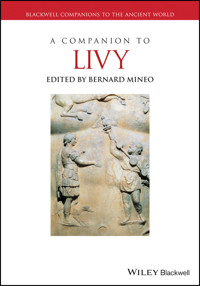
A Companion to Livy E-Book
183,99 €
Mehr erfahren.
- Herausgeber: John Wiley & Sons
- Kategorie: Geisteswissenschaft
- Serie: Blackwell Companions to the Ancient World
- Sprache: Englisch
A Companion to Livy features a collection of essays representing the most up-to-date international scholarship on the life and works of the Roman historian Livy.
- Features contributions from top Livian scholars from around the world
- Presents for the first time a new interpretation of Livy's historical philosophy, which represents a key to an overall interpretation of Livy's body of work
- Includes studies of Livy's work from an Indo-European comparative aspect
- Provides the most modern studies on literary archetypes for Livy's narrative of the history of early Rome
Sie lesen das E-Book in den Legimi-Apps auf:
Seitenzahl: 1290
Veröffentlichungsjahr: 2014
Ähnliche




















Table of Contents
Blackwell Companions to the Ancient World
Title Page
Copyright
Figures
Maps
Notes on Contributors
Abbreviations
Introduction: Livy
References
Part I: Text and Context
Chapter 1: Livian Manuscript Tradition
Books 1–10
Books 21–30
Books 31–40
Books 41–45
Notes
Cross-References
References
Further Reading
Chapter 2: Historical Context of the Ab Urbe Condita
Introduction: Lives and Writings
Earliest Memories and Livy's Date of Birth
Livy's Time of Writing
The Events of Livy's Writing Years
The Ends of Livy's History
The
Spolia Opima
and the Corselet of Cornelius Cossus
A Possible Gap within the Narrative
Relations with Augustus
Livy on the Principate
Cross-References
References
Further Reading
Part II: Ideological and Historical Aspects
Chapter 3: Portraits of Peoples
Foreign Peoples
Populus orbis terrarum princeps
Identity and Alterity
Conclusion
Notes
Cross-References
References
Further Reading
Chapter 4: Rome, Magna Graecia, and Sicily in Livy from 326 to 200
BC
Livy and the Greeks in the Fourth Century: Themes and Narratives
Magna Graecia and Sicily in the Hannibalic War
South Italian and Sicilian Politics
Ethnic Characterization
Notes
Cross-References
References
Further Reading
Chapter 5: Urban Landscape, Monuments, and the Building of Memory in Livy
Notes
References
Further Reading
Chapter 6: Livy and Religion
The Origins of Roman Religion
The Aim of Religion
Public and Private
Piety in the Face of Impiety
Piety and Superstition
Emotion in Roman Religion
Roman Religion According to Livy—Allegory or History?
Cross-References
References
Further Readings
Chapter 7: Livy's Liturgical Order: Systematization in the History
Annalistic Tradition
Patterns of Repetition and Variation
Normative Ritual Types
Dominance of Contemporary Cult
Antiquarian Touches
Textual and Institutional Sources of Legitimacy
Cross-References
References
Further Reading
Chapter 8: Livy's Use of Exempla
Introduction
Camillus as Audience and Speaker of
Exempla
Camillus as
Exemplum
Patterns
Moderatio
Conclusion
Notes
Cross-References
References
Further Reading
Chapter 9: Roman Wars and Armies in Livy
Early Rome
The Roman Army in 340
BC
The Second Punic War (218–201
BC
)
The World Controlled by Rome (201–168
BC
)
The Roman Army
circa
160
BC
On the Usefulness of the
Periochae
Cross-References
References
Chapter 10: Livy's Political and Moral Values and the Principate
Livian Political and Social Dualism
The Ideological Wake of Livian Political Dualism
Augustan Actuality
The Requirements for the Good Health of the Civic Organism: The Quest of the
Concordia
The Ethics of the Rulers
The Ethics of the Masses
Counter-Values
Aristocratic Tradition and Philosophical Influence
Concord and the Political Actuality of the Principate
Conclusion
Cross-References
References
Further Reading
Chapter 11: Livy's Historical Philosophy
Cyclical Concept of Roman History and Historical Background
Cyclical Pattern
A Recurring Use of Analogies: The Past Sheds Light on the Present
The Start of New Historical Cycles: The City Becomes Contaminated
Evander, an Augustan Prototype
Romulus
Camillus, First Refounder of Rome
The Two Roman Apexes: Servius Tullius and Scipio Africanus
Use of Rhetorical Devices to Highlight the Cyclical Patterns
Conclusion
Note
References
Further Reading
Part III: Literary Aspects
Chapter 12: Livy and Indo-European Comparatism
According to Livy: A Limited Historical Criticism
The Reigns of the Early Kings: An Historical Projection of an Indo-European Scheme?
Other Applications of the Comparatist Method
Livy and the Indo-European Heritage
Notes
Cross-References
References
Further Reading
Chapter 13: Livy and the Annalistic Tradition
The Problem of the
Quellenkritik
Livy's Art of Storytelling
Cross-References
References
Further Reading
Chapter 14: The Complications of Quellenforschung: The Case of Livy and Fabius Pictor
Quellenforschung
and Livy
The Influence of Family Models
The Influence of Greek Models
Notes
Cross-References
References
Further Reading
Chapter 15: Livy and the Greek Historians from Herodotus to Dionysius: Some Soundings and Reflections
Muted Influences of Herodotus and Thucydides
Livy and Polybius on the Middle Roman Republic
Livy and Dionysius of Halicarnassus on the Monarchy and Early Republic
Conclusions
Cross-References
References
Further Reading
Chapter 16: Allusions and Intertextuality in Livy's Third Decade
Introduction
Finding Allusions
Allusions and Source-Analysis
Allusion and History
Historical Allusion and Historical Authorship
Cross-References
References
Further Reading
Chapter 17: The Composition of the Ab Urbe Condita: The Case of the First Pentad
The Separability of the Pentad
The Structure of Books 1, 3, and 5
The Annalistic Framework and Narrative Episodes
Stereotypical
Personae
Speech as a Structuring Element
Pentadic Structure of the Remaining Extant Books
Cross-References
References
Further Reading
Chapter 18: Reading Livy's Book 5
Introduction
Structure
The Opening Two Episodes
Like a Roman
Religion
Camillus' Speech
Political Behavior and Government
Notes
Cross-References
References
Further Reading
Part IV: Book 1. The Regal Period
Chapter 19: Livy's Narrative of the Regal Period and Historical and Archaeological Facts
Notes
Cross-References
References
Further Reading
Chapter 20: Livy's Narrative of the Regal Period: Structure and Ideology
A Patchwork
A “Timeless” Story
The Direction to which History Points
The March to
Libertas
…
…Corollary to the Degradation of the Monarchy
Livian Originality
Livy the Republican
Notes
Cross-References
References
Further Reading
Chapter 21: Literary Archetypes for the Regal Period
Influences by Eastern plotlines
Themes Shared with the Greek Literature Concerning Tyrants
The Enlightened Lawgiver
Influences from Greek Tragedy
The Greek Topos of the Treacherous Maiden
Other Possible Greek Influences and Final Considerations
Notes
Cross-References
References
Further Reading
Chapter 22: The Representation of the Regal Period in Livy
Establishing the History of Rome: Origins and Details
Etiology
Politics and the Regal Period
Cross-References
References
Further Reading
Part V: Book 1-5. From Tarquinius Superbus to the Siege of Rome by the Gauls (390
BC
)
Chapter 23: Tarquin the Superb and the Proclamation of the Roman Republic
Livy and Annalists of Gracchan Age
Livy's Preferences for Aristocracy
Intrusion of Greek History into Roman Archaic History
What Livy Did Not Say
Livian Chronology
Traces of Greek Historical Tradition
Livy and Shakespeare's Macbeth
Cross-References
References
Chapter 24: The Beginnings of the Republic from 509 to 390
BC
Introduction
Book 2 (509–468
BC
)
Book 3 (467–446
BC
)
Book 4 (445–404
BC
)
Book 5 (403–390
BC
)
Notes
Cross-References
References
Further Reading
Part VI: Book 6-10. From the Siege of Rome (390 BC) to Sentinum (295 BC)
Chapter 25: From 390
BC
to Sentinum: Diplomatic and Military Livian History
Moral Vision of Romans. A More Reliable Tradition
A Homogenous Tradition
The Annalistic Tradition
Roman Imperialism and Its Causes. Building Hegemony
The Causes of Roman Imperialism
Empire by Invitation
Romanocentrism. Rome and Italy
Mediterranean Background
Notes
Cross-References
References
Further Reading
Chapter 26: From 390
BC
to Sentinum: Political and Ideological Aspects
From 390
BC
to Sentinum: Livy's Sources and Methodology
The Reorganization of the Magistracy: From Patrician
Imperium
to the Patricio-Plebeian Consulship
A New Aristocracy: The Patricio-Plebeian Nobility
The Building of Republican Consensus:
Libertas
and
Concordia
Tribes and Citizenship: The Republic of Tribes
Publication of a Calendar (
Fasti
) and of the Law (
Ius
): Unification of Civic Space and Time
Notes
Cross-References
References
Further Reading
Part VII: Books 21-45: From the Second Punic War to Pydna
Chapter 27: Rome and Carthage in Livy
Livy's Sources
The Vices of the Carthaginians
Carthage: Virtues and Victimization
Rome's Heroic Virtues
Rome: Pragmatic Ruthlessness
Livy's Intentions
Notes
Cross-References
References
Further Reading
Chapter 28: Livy: Overseas Wars
Cross-References
References
Further Reading
Chapter 29: The Roman Republic and its Internal Politics between 232 and 167
BC
Notes
Cross-References
References
Further Reading
Chapter 30: Livy, Polybius, and the Greek East (Books 31–45)
Introduction
Notes
Cross-References
References
Further Reading
Part VIII: Books 1-142/150. Periochae
Chapter 31: The Periochae
Cross-References
References
Further Reading
Part IX: Reception
Chapter 32: The Transmission of Livy from the End of the Roman Empire to the Beginning of the Seventeenth Century: Distortion or Discovery, a Story of Corruption
References
Further Reading
Index
End User License Agreement
Pages
ix
xi
xii
xiii
xiv
xv
xvii
xviii
xix
xx
xxi
xxiii
xxiv
xxv
xxvi
xxvii
xxviii
xxix
xxxi
xxxii
xxxiii
xxxiv
xxxv
xxxvi
xxxvii
xxxviii
xxxix
3
4
5
6
7
8
9
10
11
12
13
14
15
16
17
18
19
20
21
22
23
24
25
26
27
28
29
30
31
32
33
34
35
36
39
40
41
42
43
44
45
46
47
48
49
50
51
52
53
54
55
56
57
58
59
60
61
62
63
64
65
66
67
68
69
70
71
72
73
74
75
76
77
78
79
80
81
82
83
84
85
86
87
88
89
90
91
92
93
94
95
96
97
98
99
100
101
102
103
104
105
106
107
108
109
110
111
112
113
114
115
116
117
118
119
120
121
122
123
124
125
126
127
128
129
130
131
132
133
134
135
136
137
138
139
140
141
142
143
144
145
146
147
148
149
150
151
152
155
156
157
158
159
160
161
162
163
164
165
166
167
168
169
170
171
172
173
174
175
176
177
178
179
180
181
182
183
184
185
186
187
188
189
190
191
192
193
194
195
196
197
198
199
200
201
202
203
204
205
206
207
208
209
210
211
212
213
214
215
216
217
218
219
220
221
222
223
224
225
226
227
228
229
230
231
232
233
234
235
236
237
238
239
240
241
242
245
246
247
248
249
250
251
252
253
254
255
256
257
258
259
260
261
262
263
264
265
266
267
268
269
270
271
272
273
274
275
276
277
278
279
280
281
282
283
284
285
286
287
288
289
290
291
292
293
294
295
296
297
301
302
303
304
305
306
307
308
309
310
311
312
313
314
315
316
317
318
319
320
321
322
323
324
325
326
329
330
331
332
333
334
335
336
337
338
339
340
341
342
343
344
345
346
347
348
349
350
351
352
353
354
355
356
357
358
359
360
361
362
363
364
365
366
369
370
371
372
373
374
375
376
377
378
379
380
381
382
383
384
385
386
387
388
389
390
391
392
393
394
395
396
397
398
399
400
401
402
403
404
405
406
407
408
409
410
411
412
413
414
415
416
417
418
419
420
421
422
425
426
427
428
429
430
431
432
433
434
435
436
439
440
441
442
443
444
445
446
447
448
449
450
451
453
454
455
456
457
458
459
460
461
462
Guide
Cover
Table of Contents
Introduction: Livy
Part I: Text and Context
Begin Reading
List of Illustrations
Figure 1.1
Figure 1.2
Figure 1.3
Figure 11.1
Blackwell Companions to the Ancient World
This series provides sophisticated and authoritative overviews of periods of ancient history, genres of classical literature, and the most important themes in ancient culture. Each volume comprises approximately twenty-five and forty concise chapters written by individual scholars within their area of specialization. The chapters are written in a clear, provocative, and lively manner, designed for an international audience of scholars, students, and general readers.
Ancient History
A Companion to the Roman Army
Edited by Paul Erdkamp
A Companion to the Roman Republic
Edited by Nathan Rosenstein and Robert Morstein-Marx
A Companion to the Roman Empire
Edited by David S. Potter
A Companion to the Classical Greek World
Edited by Konrad H. Kinzl
A Companion to the Ancient Near East
Edited by Daniel C. Snell
A Companion to the Hellenistic World
Edited by Andrew Erskine
A Companion to Late Antiquity
Edited by Philip Rousseau
A Companion to Ancient History
Edited by Andrew Erskine
A Companion to Archaic Greece
Edited by Kurt A. Raaflaub and Hans van Wees
A Companion to Julius Caesar
Edited by Miriam Griffin
A Companion to Byzantium
Edited by Liz James
A Companion to Ancient Egypt
Edited by Alan B. Lloyd
A Companion to Ancient Macedonia
Edited by Joseph Roisman and Ian Worthington
A Companion to the Punic Wars
Edited by Dexter Hoyos
A Companion to Augustine
Edited by Mark Vessey
A Companion to Marcus Aurelius
Edited by Marcel van Ackeren
A Companion to Ancient Greek Government
Edited by Hans Beck
A Companion to the Neronian Age
Edited by Emma Buckley and Martin T. Dinter
A Companion to Greek Democracy and the Roman Republic
Edited by Dean Hammer
A Companion to Livy
Edited by Bernard Mineo
Literature and Culture
A Companion to Classical Receptions
Edited by Lorna Hardwick and Christopher Stray
A Companion to Greek and Roman Historiography
Edited by John Marincola
A Companion to Catullus
Edited by Marilyn B. Skinner
A Companion to Roman Religion
Edited by Jörg Rüpke
A Companion to Greek Religion
Edited by Daniel Ogden
A Companion to the Classical Tradition
Edited by Craig W. Kallendorf
A Companion to Roman Rhetoric
Edited by William Dominik and Jon Hall
A Companion to Greek Rhetoric
Edited by Ian Worthington
A Companion to Ancient Epic
Edited by John Miles Foley
A Companion to Greek Tragedy
Edited by Justina Gregory
A Companion to Latin Literature
Edited by Stephen Harrison
A Companion to Greek and Roman Political Thought
Edited by Ryan K. Balot
A Companion to Ovid
Edited by Peter E. Knox
A Companion to the Ancient Greek Language
Edited by Egbert Bakker
A Companion to Hellenistic Literature
Edited by Martine Cuypers and James J. Clauss
A Companion to Vergil's
Aeneid
and its Tradition
Edited by Joseph Farrell and Michael C. J. Putnam
A Companion to Horace
Edited by Gregson Davis
A Companion to Families in the Greek and Roman Worlds
Edited by Beryl Rawson
A Companion to Greek Mythology
Edited by Ken Dowden and Niall Livingstone
A Companion to the Latin Language
Edited by James Clackson
A Companion to Tacitus
Edited by Victoria Emma Pagán
A Companion to Women in the Ancient World
Edited by Sharon L. James and Sheila Dillon
A Companion to Sophocles
Edited by Kirk Ormand
A Companion to the Archaeology of the Ancient Near East
Edited by Daniel Potts
A Companion to Roman Love Elegy
Edited by Barbara K. Gold
A Companion to Greek Art
Edited by Tyler Jo Smith and Dimitris Plantzos
A Companion to Persius and Juvenal
Edited by Susanna Braund and Josiah Osgood
A Companion to the Archaeology of the Roman Republic
Edited by Jane DeRose Evans
A Companion to Terence
Edited by Antony Augoustakis and Ariana Traill
A Companion to Roman Architecture
Edited by Roger B. Ulrich and Caroline K. Quenemoen
A Companion to Sport and Spectacle in Greek and Roman Antiquity
Edited by Paul Christesen and Donald G. Kyle
A Companion to Plutarch
Edited by Mark Beck
A Companion to Greek and Roman Sexualities
Edited by Thomas K. Hubbard
A Companion to the Ancient Novel
Edited by Edmund P. Cueva and Shannon N. Byrne
A Companion to Ethnicity in the Ancient Mediterranean
Edited by Jeremy McInerney
A Companion to Ancient Egyptian Art
Edited by Melinda Hartwig
A Companion to the Archaeology of Religion in the Ancient World
Edited by Rubina Raja and Jörg Rüpke
A COMPANION TO LIVY
Edited by
Bernard Mineo
This edition first published 2015
© 2015 John Wiley & Sons, Inc.
Registered Office
John Wiley & Sons Ltd, The Atrium, Southern Gate, Chichester, West Sussex, PO19 8SQ, UK
Editorial Offices
350 Main Street, Malden, MA 02148-5020, USA
9600 Garsington Road, Oxford, OX4 2DQ, UK
The Atrium, Southern Gate, Chichester, West Sussex, PO19 8SQ, UK
For details of our global editorial offices, for customer services, and for information about how to apply for permission to reuse the copyright material in this book, please see our website at www.wiley.com/wiley-blackwell.
The right of Bernard Mineo to be identified as the author of the editorial material in this work has been asserted in accordance with the UK Copyright, Designs and Patents Act 1988.
All rights reserved. No part of this publication may be reproduced, stored in a retrieval system, or transmitted, in any form or by any means, electronic, mechanical, photocopying, recording or otherwise, except as permitted by the UK Copyright, Designs and Patents Act 1988, without the prior permission of the publisher.
Wiley also publishes its books in a variety of electronic formats. Some content that appears in print may not be available in electronic books.
Designations used by companies to distinguish their products are often claimed as trademarks. All brand names and product names used in this book are trade names, service marks, trademarks or registered trademarks of their respective owners. The publisher is not associated with any product or vendor mentioned in this book.
Limit of Liability/Disclaimer of Warranty: While the publisher and author have used their best efforts in preparing this book, they make no representations or warranties with respect to the accuracy or completeness of the contents of this book and specifically disclaim any implied warranties of merchantability or fitness for a particular purpose. It is sold on the understanding that the publisher is not engaged in rendering professional services and neither the publisher nor the author shall be liable for damages arising herefrom. If professional advice or other expert assistance is required, the services of a competent professional should be sought.
Library of Congress Cataloging-in-Publication Data
A companion to Livy / edited by Bernard Mineo.
pages cm
Includes bibliographical references and index.
ISBN 978-1-118-30128-9 (cloth)
1. Livy. Ab urbe condita—Criticism and interpretation. 2. Rome—Historiography. 3. Rome— History—Early works to 1800. 4. Rome—History—To 510 B.C. I. Mineo, Bernard, editor, author.
DG207.L583.C66 2015
937′.02—dc23
2014015383
A catalogue record for this book is available from the British Library.
Cover image: Detail from Roman statue of Augustus of Prima Porta, showing the return of the Roman legionary
eagels, lost to Parthia at Carrhes, 53 BC. De Agostini Picture Library / Bridgeman Images
Figures
Figure 1.1 Stemma for the First Decade
Figure 1.2 Stemma for the Third Decade
Figure 1.3 Stemma for the Fourth Decade
Figure 11.1 Livy's Cyclical Pattern
Maps
Map 1Rome, third and second centuries BC
Map 2The Mediterranean, third century BC
Map 3Italy and islands
Map 4Asia Minor
Notes on Contributors
Jacques-Emmanuel Bernard
is a professor of Latin literature at the University of Toulon (France). He has specialized in historiography and rhetoric in the ancient Mediterranean world. He has recently published
Le portrait chez Tite-Live. Essai sur une écriture de l'histoire romaine
(Bruxelles, Latomus 2000), and
La sociabilité épistolaire chez Cicéron
(Paris 2013).
Luigi Bessone
, formerly associate professor at the Facoltà di Magistero of Turin, is now full professor of Roman history at the University of Padua. He has cultivated different fields of research, which includes the Livian epitomical tradition. Among his recent publications are
Le congiure di Catilina
(2004) and
Senectus imperii. Biologismo e storiografia romana
(2008), and a variety of articles in
Acta Classica Universitatis Scientiarum Debreceniensis
.
Klaus Bringmann
is emeritus professor for ancient history at the University of Frankfurt. Selected publications:
Schenkungen hellenistischer Herrscher an griechische Städte und Heiligtümer
(Mitautor und Mitherausgeber). 3 Vols. (1995/2000);
Geschichte der römischen Republik
(2002, 2nd ed. 2010, English. 2007, Polish. 2010);
Kaiser Julian
(2004, Spanish. 2006);
Geschichte der Juden im Altertum
(2005);
Augustu
s (2007, 2nd ed. 2012, Spanish. 2008); and
Cicero
(2010).
Dominique Briquel
was born in Nancy (France) in 1946, and is a specialist in Etruscology and the ancient periods of Roman history. He is interested in Indo-European comparatism in the Dumezilian tradition. He currently teaches at the University of Paris-Sorbonne and the École Pratique des Hautes Études, Paris.
Giovanni Brizzi
is a professor of Roman history at Bologna University. He has taught at Sassari and Udine Universities. He was official professor (1993/1994 and 2005/2006) at the Sorbonne, is Officier de l'Ordre des Palmes Académiques of the French Republic, and is a member of the Academy of the Sciences of the Istituto di Bologna. He is director of the
Rivista Storica dell'Antichità
, assistant director of the
Revue des Études Militaires Anciennes
, and a member of the Scientific Committee of the review
Kentron
. Giovanni Brizzi is the author of more than 200 publications, in different languages, and is one of the leading scholars in ancient military history.
Giambattista Cairo
holds a law degree and a Ph.D. in Ancient history. He has collaborated with Giovanni Brizzi, chair of Roman history and Roman military history at the University of Bologna, and has served as the editor of the journal
Rivista di Studi Militari
. He has published articles and monographs on different aspects of Roman history with focus on the origins of Rome. He currently works as editor for the publisher Edizioni Dehoniane Bologna.
Craige B. Champion
teaches ancient history at Syracuse University. He is the author of
Cultural Politics in Polybius's Histories
(2004); editor of
Roman Imperialism: Readings and Sources
(2004); general editor of
The Encyclopedia of Ancient History
(2013); and co-editor of
The Landmark Edition of the Histories of Polybius
(forthcoming).
Jane D. Chaplin
is James I. Armstrong Professor of Classics at Middlebury College, where she has taught since 1992. Her major publications are
Livy's Exemplary History
, a translation of Livy Books 41–45, and the Livian Periochae under the title
Rome's Mediterranean Empire
, and, with Christina S. Kraus,
Livy
.
Timothy Cornell
is a professorial research fellow at the University of Manchester. His research interests include Roman historiography and the history and archaeology of early Rome and Italy. His major publications include
The Beginnings of Rome
(London 1995) and
The Fragments of the Roman Historians
, 3 vols. (Oxford 2013).
Arthur M. Eckstein
is a professor of history and Distinguished Scholar–Teacher at the University of Maryland at College Park. He received his Ph.D. from the University of California, Berkeley, in 1978, and has since published four books, an edited book, and over 60 scholarly articles or chapters in scholarly books. His main areas of interest have been Roman imperial expansion, Greek historiography (especially Thucydides and Polybius), and the integration of modern international-systems theory (political science) into discussion of ancient empires.
Gary Forsythe
is a professor of ancient Greek and Roman history in the Department of History at Texas Tech University (Lubbock, Texas). He is the author of
The Historian L. Calpurnius Piso Frugi and the Roman Annalistic Tradition
(Lanham-London 1994) and also of
A Critical History of Early Rome
(Berkeley-London 2005).
Matthew Fox
, MA (Oxon.), D.Phil, has been a professor of Classics at the University of Glasgow since 2007. He has written two books:
Roman Historical Myths
(Oxford 1996) and
Cicero's Philosophy of History
(Oxford 2007). In addition to historiography, his publications deal with poetry, gender, and classical reception.
Marielle de Franchis
is a senior lecturer in Latin language and literature at the University of Paris-Sorbonne (Paris IV). Her main interest is Roman historiography, and its transmission and reception in Western culture. Her latest publications aim at characterizing Livy's first readers. She is at present completing the edition of Livy's Book 30 for the
Collection des Universités de France
(CUF).
Mary Jaeger
is a professor of Classics at the University of Oregon, where she has taught since 1990. She is the author of
Livy's Written Rome
(University of Michigan Press 1997),
Archimedes and the Roman Imagination
(University of Michigan Press 2008), and
A Livy Reader
(Bolchazy-Carducci 2011).
Frances Hickson Hahn
studied at the University of North Carolina in Chapel Hill with Jerzy Linderski. Since 1987, she has been at the University of California at Santa Barbara, where she is now Professor Emerita of Classics.
Dexter Hoyos
is an honorary associate professor at Sydney University, where he lectured from 1972 to 2007. His works on ancient Rome and Carthage include
Unplanned Wars
(1998),
Hannibal's Dynasty
(2003, 2005),
The Carthaginians
(2010),
A Companion to the Punic Wars
(2011), and papers in scholarly journals since 1973.
Michel Humm
is a professor of Roman history at the University of Strasbourg. His research focuses on the history of the Roman republic, particularly in the mid-republican period (fourth–third centuries
BC
). His book
Appius Claudius Caecus: La République accomplie
was published in 2005. This study is further developed in a series of articles on the presence of Pythagoreanism in the Roman political milieu (1996 and 1997), the links between the architectural form of the Comitium of the Roman forum and its institutional and ideological functions (1999), the role played by the figures of Servius Tullius and Numa in the political ideology of the Roman Republic (2001 and 2004), etc. The value system and the forms of social and ideological representation of the Roman ruling class have been the subject of several studies, notably,
Forma virtutei parisuma fuit
: les valeurs helléniques de l'aristocratie romaine à l'époque (médio-) républicaine (
IV
e
–
III
e
siècles) (2007), and Exhibition et “monumentalisation” du butin dans la Rome médio-républicaine (2009). He is also the editor (with M. Coudry) of
Praeda
:
Butin de guerre et société dans la Rome républicaine / Kriegsbeute und Gesellschaft im republikanischen Rom
(2009), and is preparing for the publication of a collaborative work on
Caton et l'hellénisme
as well as a monograph on
Rome ‘polis Hellenis’: Identité culturelle et réception de l'hellénisme à Rome (fin VI
e
–III
e
siècle)
.
Yann Le Bohec
is professor emeritus at the Sorbonne (Paris IV). Specialized in Roman military history, he is the author of some 190 articles and 22 books, some of which have been translated into English. To be published:
Naissance, vie et mort de l'empire romain
;
Alésia (52
BC
)
;
La bataille de Lyon
(
197
AD
)
.
David S. Levene
is a professor of Classics at New York University. His publications include
Religion in Livy
(1993) and
Livy on the Hannibalic War
(Oxford 2010); he is currently preparing an edition with commentary of Livy's fragments and
Periochae
.
Barbara Levick
is Emeritus Fellow and tutor in ancient history, St. Hilda's College, Oxford. She is the author of works on Roman Imperial history, most recently
Augustus, Image and Substance
(2010), and on studies of Roman Asia Minor, having co-edited, with Michel Cottier and others,
The Customs Law of Asia
(2008).
Dr Kathryn Lomas
is an honorary senior research associate at University College London, and researches on the history and archaeology of Italy and the Western Mediterranean, ethnic and cultural identities, and early literacy. Her publications include
Rome and the Western Greeks
and
Roman Italy, 338
BC–AD
200
, several volumes of collected papers, and numerous articles.
Pierre Maréchaux
is a professor of Latin and neo-Latin literature at the University of Nantes, and a fellow of the Nantes
Institute for Advanced Study
. At the instigation of Marc Fumaroli, in the wake of the Warburg school, he wrote research papers on mythography at an early stage in his career. He was awarded scholarships by the
Warburg Institute
in London and the
Université Laval
in Quebec, where he was
Frances Yates Fellow
and research fellow. As a lecturer at the
Centre d'Etudes Supérieures de la Renaissance
in Tours, he has worked in partnership on ancient and neo-Latin literature, publishing annotated translations of Aristotle, Plutarch, Jean Chrysostome, Lucian of Samosata, Horace, Seneca, Marcus Aurelius, and Petrarch, and essays on Ovid, Boccaccio, and Greek myths. As a junior member of the
Institut Universitaire de France
and then a university professor in Nantes, he has directed his studies toward the hermeneutics of music and narrative dialectics. He is currently working on an original translation of
Speeches
by Procopius of Gaza for the Collection des Universités de France.
Paul-Marius Martin
is professor emeritus at Montpellier III University, and honorary president of the revue
Vita Latina
, which he has headed for a long time, as well as the “Classical Studies Library,” Peeters, Louvain-Paris. He is a specialist in the monarchical concept in Rome, from the origins to the Augustan princedom.
Attilio Mastrocinque
is a professor of Roman history at the University of Verona. He researches in Roman history, Hellenism, and religions of the Roman Empire, and his publications include
Lucio Giunio Bruto
(Trento 1988);
From Jewish Magic to Gnosticism
(Tübingen 2005);
Des mystères de Mithra aux mystères de Jésus
(Stuttgart 2009); and
Kronos, Shiva, and Asklepios
(Philadelphia 2011).
Bernard Mineo
is a professor of Latin literature at the Université de Nantes in Brittany, France. He is the author of a monograph on Livy entitled
Tite-Live et l'histoire de Rome
. He has also edited Book 32 of
Livy's Roman History
for the
Collection des Universités de France
. He is currently working on an edition of Pompeius Trogus'
Philippic Histories
in the abridgement by Justin for the same publishers.
Stephen P. Oakley
, Kennedy Professor of Latin in the University of Cambridge and Fellow of the British Academy, has published
The Hill-Forts of the Samnites
(London, British School at Rome 1994) and
A Commentary on Livy, Books vi–x
(Oxford, Clarendon Press 1997–2005, 4 vols), as well as articles and reviews on Livy and other topics.
James H. Richardson
is a lecturer in Classics at Massey University. He is the author of
The Fabii and the Gauls: Studies in Historical Thought and Historiography in Republican Rome
(2012) and various articles on Roman history and historiography, and the editor (with F. Santangelo) of
Priests and State in the Roman World
(2011) and
The Roman Historical Tradition: Regal and Republican Rome. Oxford Readings in Classical Studies
(2014).
Marianna Scapini
, presented her Ph.D. Thesis at the University of Verona, which concerned certain aspects of initiation rites for Roman women. In 2011, she published
Temi greci e citazioni da Erodoto nelle storie di Roma arcaica
in Germany on Herodotean influences on the Roman annalistic tradition. She is part of the ongoing excavation campaigns at Grumento Nova (Potenza), directed by Attilio Mastrocinque.
John Scheid
is a professor at the Collège de France, in Paris, and chair for
Religion, institutions et société de la Rome antique
, whose main works are on Roman religion and institutions (end of the Republic, first centuries of the Empire). Among his topics are the arval brethren, the
Res Gestae Divi Augusti
, and the
Roman Questions
of Plutarch.
Ghislaine Stouder
is a lecturer of Roman history at the University of Poitiers, and a former member of the École française de Rome. She wrote her Ph.D. on
La diplomatie romaine: histoire et représentations (IVe–IIIe siècles av. n. è.)
, and is still working on the diplomatic argument during the Republican period and the correlative historiographical problems.
Jürgen von Ungern-Sternberg
is professor emeritus for ancient history at the University of Basel. His main fields of research include the Roman republic (public law, historiography); Archaic and Classical Greece; and the history of science (especially the relationships between French and German scholars). He has published
Römische Studien
(Leipzig 2006);
Griechische Studien
(Berlin 2009); and, together with Ève Gran-Aymerich,
L'Antiquité partagée
(Paris 2012).
Ann Vasaly
is an associate professor of Classics at Boston University. Her research focuses on Ciceronian rhetoric and Latin historiography. Author of
Representations: Images of the World in Ciceronian Oratory
, as well as shorter works on Cicero and Livy, she is currently completing a book on Livy's first pentad.
Abbreviations
Acc
.
Accius
Acta Tr
.
Fasti Triumphales
Aug.
Augustine
De civ. D
.
De civitate Dei
AHB
Ancient History Bulletin
AJA
American Journal of Archeology
AJP
American Journal of Philology
Ampel.
L. Ampelius,
Liber Memorialis
Anc. Hist. Bull
.
see
AHB
Anc. Soc
.
Ancient Society
Ann
.
Annales
Ant. Afr
Antiquités Africaines
ANRW
Aufstieg und Niedergang der Römischen Welt
Apollod.
Apollodorus
Bibl
.
Bibliotheca
App.
Appian
BC
Bella ciuilia
Hann
.
Hannibalica
Iber
.
Iberica
Ill
.
Illyrica
Lib
.
Libyca
Mac
.
Macedonica
Mith
.
Mithridatica
Sam
.
Samnitica
Sic
.
Sicelica
Syr
.
Syriaca
Arist.
Aristotle
Pol
.
Politics
Ath. Pol
.
'Αθηναίων Πολιτεία
Aristox.
Aristoxenus
Arr.
Arrian
Anab
.
Anabasis
ASD
Amsterdam edition. Desiderii Erasmi omnia opera
BAfr
.
Bellum Africum
BAlex
.
Bellum Alexandrinum
BIDR
Bulletino dell'Istituto di Diritto Romano
Bk
Book
Brit. Libr
.
British Library
c
.
circa
Caesar,
Bciv
.
Bellum ciuile
Bgall
.
Bellum Gallicum
CAH
Cambridge Ancient History
(first edition)
CAH
2
Cambridge Ancient History
(second edition)
Calp.Piso
Calpurnius Piso
Cass.Hem
Cassius Hemina
Cato
Cato
Orig
.
Origines
Catull.
Catullus
cf.
(=
confer
) compare
Cic.
M. Tullius Cicero
Ad Brut
.
Epistulae ad Brutum
Amic
.
De amicitia
Arch
.
Pro Archia
Att
.
Epistulae ad Atticum
Balb
.
Pro Balbo
Brut
.
Brutus
Caecin
.
Pro Caecina
Cael
.
Pro Caelio
Cato Maior
=De senectute
Cat
.
In Catilinam
De or
.
De oratore
Div
.
De divinatione
Dom
.
De domo sua
Fam
.
Ad familiares
Fin
.
De finibus
Flac
.
Pro Flacco
Font
.
Pro Fonteio
Har. resp
.
De haruspicum responsis
Leg
.
De legibus
Leg. agr
.
De lege agraria
Leg. Man
.
Pro lege Manilia
(
=de Imperio Cn. Pompei
)
Mur
.
Pro Murena
Nat. D
.
De natura deorum
Off
.
De officiis
Phil
.
In M. Antonium orationes Philippicae XIV
Pis
.
In Calpurnium Pisonem
Q. Fr
.
Epistulae ad Quintum fratrem
Quinct
.
Pro P. Quinctio
Rep
.
De republica
Sest
.
Pro P. Sestio
Senect
.
De senectute
Sull
.
Pro Sulla
Tusc
.
Tusculanae disputationes
Verr
.
In C. Verrem actio secunda, orationes I-V
2 Verr
.
Second Verrines
CIG
Corpus Inscriptionum Graecarum
CIL
Corpus Inscriptionum Latinarum
CISA
Contributi dell'Istituto di storia antica
Class. Philol
.
Classical Philology
cos
.
consul (with year of office)
CP
Classical Philology
CQ
Classical Quarterly
CR
Classical Review
CUF
Collection des Universités de France
DCPP
Dictionnaire des Civilisations Phénicienne et Punique
De vir. Ill
.
De viris illustribus
(auctor ignotus)
Dio Cass.
Dio Cassius
Diod.
Diodorus
Dion. Hal.
Dionysius of Halicarnassus
Ant. Rom
.
Antiquitates Romanae
ed.
editor, edited (by)
edn.
edition
eds.
editors
EFR
École Française de Rome
Ennius V
3
Ennius, ed. Vahlen (third edition)
Enn.
Ann
.
Ennius,
Annales
(ed. Skutsch)
Epist
.
Epistulae
Epit
.
Epitome
esp
.
especially
Eus.-Jer.
Eusebius-Jerome
Chron
.
Chronica
Eutr.
Eutropius
F. Cap
.
Fasti Capitolini
Fest.
Festus
FgrH
Fragmente de Griechischen Historiker
FRHist
Fragments of the Roman Historians
Flor.
Florus
Fr., frg., frgs.
fragment(s)
FRH
Die Frühen Römischen Historiker
(ed. Beck & Walter)
Frontin.
Frontinus
aq
.
De aquae ductu urbis Romae
Strat
.
Strategemata
Ftr
Fasti Triumphales
Gell.
NA
A. Gellius
Noctes Atticae
Gell. Hist.
Cn. Gellius
GRBS
Greek, Roman & Byzantine Studies
HAAN
see Gsell (Bibliography)
Hdt.
Herodotus
HN
see Pliny
Hor.
Q. Horatius Flaccus, Horace
Carm
.
Odes
Carm. Saec
.
Carmen Saeculare
Ep
.
Epistles
Epod
.
Epodes
Sat
.
Satires
Isid.
Etym
.
Isidorus, Isidore,
Etymologiae
Hom.
Homer
Il
.
Iliad
Od
.
Odyssey
HRR
Peter,
Historicorum Romanorum Reliquiae
HSCP
Harvard Studies in Classical Philology
HZ
Historische Zeitschrift
I Congr. di Studi
I Congresso di Studi Fenici e Punici
Fen. e Pun
.
IG
Inscriptiones Graecae
IGRR
Inscriptiones Graecae ad Res Romanas pertinentes
ILLRP
Inscriptiones Latinae Liberae Rei Publicae
ILS
Dessau,
Inscriptiones Latinae Selectae
Inscr. It
.
Degrassi,
Inscriptiones Italicae
Jer.
Chron
.
Jerome,
Chronica
Just.
Epit
.
M. Junianus Justinus, Justin,
Epitome
JRS
Journal of Roman Studies
Juv.
D. Junius Juvenalis, Juvenal
Lact.
Lactantius
Inst
.
Divinae institutiones
LMC
Liverpool Classical Monthly
Liv.
Titus Livius, Livy
AUC
Ab Urbe Condita
per
.
Periochae
LTUR
Lexicon Topographicum Urbis Romae
Luc.
M. Annaeus Lucanus, Lucan
Macrob.
Macrobius
Sat
.
Saturnalia
Mart.
M. Valerius Martialis, Martial
MDAI (R)
Mitteilungen des Deutschen Archäologischen Instituts (Römische Abteilung)
MEFRA
Mélanges de l'École française de Rome (Antiquité)
Mél
.
Mélanges
Mon. Anc
.
Monumentum Ancyranum
MRR
Broughton,
Magistrates of the Roman Republic
Mus. Afr
.
Museum Africum
NC
Numismatic Chronicle
Nep.
Cornelius Nepos
Att
.
Atticus
Hamil
.
Hamilcar
Hann
.
Hannibal
Obs.
Julius Obsequens, Prodigiorum liber
OCT
Oxford Classical Texts
ORF
Malcovati,
Oratorum Romanorum Fragmenta
Orig
.
Origines
Oros.
Orosius
ORF
H. Malcovati,
Oratorum Romanorum Fragmenta
(second edition 1955, fourth edition 1967)
Ov.
P. Ovidius Naso, Ovid
Am
.
Amores
Met
.
Metamorphoses
Tr
.
Tristia
Pac
Pacuvius
Paul.
Dig
.
Iulius Paulus, Digesta Iustiniani
P, P
2
(citations of
HRR
ed. Peter
Roman historians)
Paul. Diac.,
Hist. Lang
.
Paul the Deacon,
Historia Langobardorum
Paus.
Pausanias
PCPS
Proceedings of the Cambridge Philological Society
Per
.
see Livy,
Per
.
Phamb
.
Hamburg Papyri
Pl.
Plato
Resp
.
Respublica
Plaut.
Bacch
.
Bacchides
Ep
.
Epidicus
Men
.
Menaechmi
Mil
.
Miles gloriosus
Per
.
Persa
Rud
.
Rudens
Trin
.
Trinummus
Pryl
.
Rylands Papyri
Plin.
Ep
.
C. Plinius Secundus, Pliny (the Younger),
Epistulae
Plin.
HN
&
NH
C. Plinius Secundus, Pliny (the Elder)
Historia Naturalis
Plut.
Caes
.
Caesar
Cam
.
Camillus
Cic
.
Plutarch
Comp. Phil. and Flam
.
Comparatio Philopoemenis et Flaminini
Coriol
.
Coriolanus
Fab
.
Fabius
Flam
.
Flaminius
Lys
.
Lysander
Marc
.
Marcellus
Mor
.
Moralia
Mul. Virt
.
De mulierum uirtute
Num
.
Numa
Phil
.
Philopoemen
Pomp
.
Pompeius
Pyrrh
.
Pyrrhus
Quaest. Rom
.
Quaestiones Romanae
Rom
.
Romulus
Ti. Gr
.
Tiberius Gracchus
Pol.
Polybius
Polyaenus
Polyaneus
Strat
.
Strategemata
Pomp. Mela
Pomponius Mela
Prop.
Propertius
Praef
.
praefatio
PUF
Presses Universitaires de France
Q. Cic.
Comment. pet
.
Quintus Cicero,
Commentariolum petitionis
Quint.
Inst
.
M. Fabius Quintilianus, Quintilian,
Institutes of Oratory
Rhet. Her
.
Rhetorica ad Herennium
Roman Praenomina
A. (Aulus), Ap. (Appius), C.( Gaius), Cn. (Gnaeus), D. (Decimus), L. (Lucius), M. (Marcus), M'.(Manius), N. (Numerius), P. (Publius), Q. (Quintus), Ser. (Servius), T. (Titus), Ti. (Tiberius)
RE
Pauly-Wissowa,
Realencyclopädie der Klassischen Altertumswissenschaft
RÉA
Revue des Études Anciennes
Rev. Hist
.
Revue Historique
REL
Revue des Études Latines
RFC
Rivista di Filologia Classica′
RG
Res Gestae
RhM
Rheinisches Museum für Philologie
RIDA
Revue internationale des Droits de l'Antiquité
RIN
Rivista italiana di numismatica e scienze affini
Rol
.
Warmington,
Remains of Old Latin
RSA
Rivista Storica dell'Antichità
Sall.
C. Sallustius Crispus, Sallust
BJ
Bellum Iugurthinum
Cat
.
De conjuratione Catilinae
Hist
.
Historiae
Schol. Bob.
Scholia Bobiensia
Sen.
Controv
.
Seneca (the Elder)
Controversiae
Sen.
Seneca (the Younger)
Ep
.
Epistulae
Q Nat
.
Quaestiones Naturales
Serv.
Servius
Ad Georg
.
On
Georgics
ad Aen
.
On
Aeneid
Sil.,
Pun
.
Silius Italicus,
Italica
SNG
Sylloge Nummorum Graecorum, numerous vols
Solin.
Solinus
Stob.
Flor
.
Stobaeus,
Florilegium
Str.
Strabo
s.v.
sub uerbo
, under the word
Suda
Greek Lexicon formerly known as Suidas
Suet.
Suetonius
Gramm
.
De grammaticis
Aug
.
Augustus
Calig
.
Caligula
Div. Iul
.
Divus Iulius
Dom
.
Domitianus
Ner
.
Nero
Tib
.
Tiberius
Syll
.
Sylloge
Tac.
Tacitus
Agr
.
Agricola
Ann
.
Annales
Dial
.
Dialogus de oratoribus
Hist
.
Historiae
TAPA
Transactions of the American Philological Association
Tert.
Tertullianus
Ad nat
.
Ad nationes
Thuc.
Thucydides
TLE
(Pallotino)
Testimonia Lingua Etruscae
TLL
Thesaurus Linguae Latinae (1900-)
tr.
translator, translated by
Val. Max.
Valerius Maximus
Varr.
M. Terentius Varro
Ling
.
De Lingua Latina
Vita pop. Rom
.
Vita populi Romani
LL
De Lingua Latina
Vell. Pat.
Velleius Paterculus
Verg.
P. Vergilius Maro, Vergil
Aen
.
Aeneis, Aeneid
Ecl
.
Eclogae, Eclogues
G
.
Georgicae, Georgics
Zon.
Zonaras
Zos.
Zosimus
ZPE
Zeitschrift für Papyrologie und Epigraphik
Introduction: Livy
Bernard Mineo
Livian scholarship, which has flourished during the past few decades, has produced remarkable analyses that make it possible to transcend the purely historical or archeological approaches to Livy's Ab Urbe Condita, which have prevailed for too long. On both sides of the Atlantic, the number of books and articles on Livy has multiplied, enabling one to better appreciate the richness of a work some of whose hidden beauties are, I believe, yet to be discovered. However, this renewed interest in Livy's work did not, for a long time, prove to be as fruitful as it might have been, because of a lack of communication between researchers, some of whom were too often unaware of the findings of others. The aim of this book is to take stock of the developments in our understanding of Livy's Roman history to date, and to put an end to this waste of scientific talent by publishing together contributions by some of the best contemporary Livian scholars in the world. Our other objective is to offer cultured readers, whether they be students, secondary school teachers, or university professors, the opportunity to rediscover this great author whose work is likely to be of as much interest to those whose special field is history as to those whose fields are Latin and Greek literature, ancient philosophy, or archeology. Livy's Roman history is indeed far from being solely a history book; it is, in Ciceronian parlance—and Livy shared Cicero's perspective on history—an opus oratorium, a literary work expressing, through the use of narrative, a particular view of Roman history whose aim was to help attain a well-defined civic ideal. This being the case, it is obvious that the best way to fully appreciate Ab Urbe Condita as a whole is by combining together the views of specialists in the fields of literature and of history who too often tend not to know about one another and to carry out their work within their own spheres, making it impossible to truly understand a work of, in fact, great complexity.
Thus, editing this book, A Companion to Livy, has been an extraordinary opportunity to bring together the marvelously talented academics who have so generously contributed toward producing this collection of chapters, providing a synthetized view unique in the history of Livian scholarship. The contributors' views do not always totally harmonize, but the end result is not, as might have been feared, a series of jarring discordant notes. Indeed, most scholars nowadays agree that Livy was not only a well-informed and reliable historian but also a writer of genius and great originality. As a matter of fact, all the most recent findings, which this compilation aims to shine a light on, underline the immense complexity and originality of Livy's Roman history. He is no longer thought to have been a plodding scrivener conscientiously adding one historical episode, taken from his predecessors, the annalists, to another without ever reflecting on what the end result would be and on the message it would convey. In fact, what shines through Ab Urbe Condita, and what it stems from, is a most original philosophical approach to history that points toward a particular moment in time and space—the end of the civil wars and the establishment of Augustus' principate. Livy painstakingly worked on and rewrote the sometimes sparse and meager material that his sources provided to offer the reader a history of Rome that reflected his philosophical approach. This is what entitles Livy to number among the greatest writers. He also shows a particular talent in the way in which he structures his narrative and in the way he adapts, like a virtuoso, the style of his writing to his subject matter. Who indeed would have thought that the author of Book 1, with its poetic language, was the same author who narrated the events of the Second Punic War with all the eloquence of Cicero's prose?
The complexity and richness of Livy's narrative no doubt explain why it is so difficult to precisely define where he positions himself ideologically. However, on this point as well, the present compilation has been a means of showing how our interpretation of Livy's standpoint has evolved. Admittedly, the contributors are far from being unanimous in this regard; some are more sensitive to the politically critical tone of the work, while others, on the contrary, are more sensitive to its pro-Augustus overtones and stress Livy's desire to follow the same line as the princeps by striving toward a restoration of the moral and religious values that were supposed to have been at the root of Rome's greatness. Nevertheless, what I find most striking when comparing these different perspectives is, assuredly, the absence of any truly irreconcilable conflict of opinions among scholars today. If no one will deny that Livy's values are profoundly republican, nobody, however, is prepared to claim that this necessarily implies that he was really hostile to Augustus' policy. Indeed, the actual political situation at the time of the res publica restituta, itself a web of ambiguities, makes it possible to reconcile Livy's republican convictions with the political slogans in vogue at the beginning of the principate (Hurlet and Mineo 2009). For the rest, one would need to have second sight to be able to define with any degree of certainty what the historian had exactly in mind. Nevertheless, one can reasonably assume—and that is what, finally, the authors of this book are agreed on—that Livy, similar to Virgil or Horace, faced with either chaos or the hope of a return to civil harmony, had preferred the second option. It is also quite possible—and this I believe—that Livy gambled on the success of Augustus' plan to restore moral values and a lawful state because there was no other possible rational choice, and he did that with a degree of conviction that it is impossible to measure exactly. It also seems likely that his view of the political situation evolved when the princeps, far from wanting to step aside and leave the limelight to the political institutions as Camillus had done in his narrative, established his ascendency over the state and lent a dynastic dimension to the new regime.
By giving readers the findings that the latest research on Livy has provided, the authors of A Companion to Livy intend to show that, in the Republic of Letters, Livian scholarship is bursting with vitality. They also hope to foster and stimulate research into Livy's work. Much remains to be done in order to discover the meaning or the symbolic or ideological aspects of a great many passages that academics in the past traditionally interpreted literally, not taking into account the backdrop against which history was being written in Antiquity. It seems that Livy's narrative depicting the beginnings of the Republic, in particular, deserves to form the subject of a thorough, detailed study using the new approaches that contemporary Livian scholars have chosen to adopt. It would greatly improve our understanding of the events and of the political upheavals that led to the true birth of the Roman republic since the old foundations on which, until now, our knowledge of this period has been based have been rocked by more recent findings.
Before handing over to the authors of this book, it seems essential, however, to recap what little information we have on Livy's life in order to support our analyses of Ab Urbe Condita.
We are uncertain about Livy's precise date of birth. On the strength of Jerome's testimony (Messala Coruinus orator nascitur et Titus Livius Patauinus scriptor historicus: Ad Euseb. Chron. Ad ann. Abr. 1958), he was, for a long time, thought to have been born in 59 BC. A remark about the historian's lifetime suggested that he must have died in 17 AD. It is possible that the choice of these dates is the result of an initial misapprehension and that 64 BC and 12 AD should be favored. Corvinus' date of birth seems indeed to have been postdated by 5 years (Syme 1955; Burck 1992; Walsh 1961, 2; Ogilvie 1965a, 1). Jerome may have mistaken the consuls of 59 (Cæsare et Bibulo) for those of 64 (Cæsare et Figulo).
Jerome's chronicle leaves us in no doubt as to where Livy died (ibid. 2033): Livius historiographus Pataui moritur. The tombstone belonging to the writer's family may actually have been discovered. Indeed, one dating from the age of Augustus and inscribed with the names of a T. Livius C. f., of his wife Cassia Sex. f. Prima (CIL V 2975 = Dessau 2919) has been found in Padua. One of his sons wrote a geographical treatise. Livy is also supposed to have advised one of them to read Demosthenes and Cicero and to have written a treatise on stylistics for his benefit (Quint. Inst. 10. 1. 39). His daughter married the rhetorician Lucius Magius (Sen. Controv. 10, prœm. 2), whose recitationes attracted a large audience because of his father-in-law's fame.
Padua seems to have been known for its quiet provincial life and its very strict morals (Str. 3. 5. 3; 5. 1. 7; Pomp. Mela 2. 60; Plin. Ep. 1. 14. 6). Asinius Pollio, according to Quintilian (Inst. 1. 5. 56), mentioned, somewhat ironically, Livy's patauinitas. However, it is difficult to know whether he only wanted to underline certain stylistic aspects of his work or poke fun at the moral tone of his Roman history (Ogilvie 1965a, 5; Syme [1939] 1939, 485–6; 1959, 76). Miles (1995, 51) remains prudent on the subject, but suggests that Pollio's little barb implies, at the very least, that Livy's point of view was felt to be that of an outsider, historiographically as well as socially speaking.
Livy probably received his first formal schooling in his native city while Rome was prey to the disruptions caused by the civil war, which forms the backdrop against which the future historian's youth was spent (Chapter 2). Actually, the latter took his first unsteady steps when the rights and freedoms of the Republic had just been curtailed by the first triumvirate; he must have been 15 when Caesar crossed the Rubicon, and 33 at the time of Actium. One understands, then, why, when the hope of lasting peace and civic harmony presented itself at the time of the establishment of the principate in 27 BC, Livy might have opted to support a project that he would have seen as likely to contribute to the restoration of national unity.
We should also keep in mind, in particular, Livy's supposed interest in philosophy. Seneca thus mentions dialogues, the contents of which, whether philosophical or historical, one would find difficult to determine. He also states that Livy wrote philosophical works:
Scripsit enim et dialogos, quos non magis philosophiæ adnumerare possis quam historiæ, et ex professo philosophiam continentes libros.
He also wrote dialogues, not less liable to be filed among philosophical works than among historical works, as well as books whose contents were professedly philosophical.
Does this versatility mean that Livy hesitated for a long time before opting for a career as a historian? It does seem that he had, in any case, completed these essays when he embarked on his magnum opus.
We do not know whether he spent some time in Greece studying as so many Roman youths did. There is nothing that would indicate that this had been the case, and the geographical locations he sometimes mentions are so vague as to suggest that the opposite was true (Walsh [1961] 1963, 154).
Judging from his lack of technical vocabulary use when describing a battle scene, he cannot have had any military experience (Walsh [1961] 1963, 157–162).
We also do not know when he moved to Rome and how long he stayed there. Opinions differ greatly on this point. If some believe that he wrote the major part of his contemporary Roman history in Padua, others, on the other hand, argue that his relationship with Augustus, the part he played in the education of the future emperor Claudius, and the arrival in Rome of a Spanish admirer who had come on purpose to meet him (Plin. Ep. 2. 3. 8) would all seem to indicate that he remained in the capital for quite a while.
When did he begin to write his Roman history? The answer to that question is of major importance to those who wish to interpret the dialectical structure of the work. Everything would seem to suggest, a priori, that he started his opus any time between the years 27 and 25 BC




