


A Companion to Locke E-Book
139,99 €
Mehr erfahren.
- Herausgeber: John Wiley & Sons
- Kategorie: Geisteswissenschaft
- Serie: Blackwell Companions to Philosophy
- Sprache: Englisch
This collection of 28 original essays examines the diverse scope of John Locke’s contributions as a celebrated philosopher, empiricist, and father of modern political theory.
- Explores the impact of Locke’s thought and writing across a range of fields including epistemology, metaphysics, philosophy of science, political theory, education, religion, and economics
- Delves into the most important Lockean topics, such as innate ideas, perception, natural kinds, free will, natural rights, religious toleration, and political liberalism
- Identifies the political, philosophical, and religious contexts in which Locke’s views developed, with perspectives from today’s leading philosophers and scholars
- Offers an unprecedented reference of Locke’s contributions and his continued influence
Sie lesen das E-Book in den Legimi-Apps auf:
Seitenzahl: 1424
Veröffentlichungsjahr: 2015
Ähnliche




















Blackwell Companions to Philosophy
This outstanding student reference series offers a comprehensive and authoritative survey of philosophy as a whole. Written by today's leading philosophers, each volume provides lucid and engaging coverage of the key figures, terms, topics, and problems of the field. Taken together, the volumes provide the ideal basis for course use, representing an unparalleled work of reference for students and specialists alike.
Already published in the series:
The Blackwell Companion to Philosophy, Second Edition
Edited by Nicholas Bunnin and Eric Tsui-James
A Companion to Ethics
Edited by Peter Singer
A Companion to Aesthetics, Second Edition
Edited by Stephen Davies, Kathleen Marie Higgins, Robert Hopkins, Robert Stecker, and David E. Cooper
A Companion to Epistemology, Second Edition
Edited by Jonathan Dancy, Ernest Sosa and Matthias Steup
A Companion to Contemporary Political Philosophy (two-volume set), Second Edition
Edited by Robert E. Goodin and Philip Pettit
A Companion to Philosophy of Mind
Edited by Samuel Guttenplan
A Companion to Metaphysics, Second Edition
Edited by Jaegwon Kim, Ernest Sosa and Gary S. Rosenkrantz
A Companion to Philosophy of Law and Legal Theory, Second Edition
Edited by Dennis Patterson
A Companion to Philosophy of Religion, Second Edition
Edited by Charles Taliaferro, Paul Draper, and Philip L. Quinn
A Companion to the Philosophy of Language
Edited by Bob Hale and Crispin Wright
A Companion to World Philosophies
Edited by Eliot Deutsch and Ron Bontekoe
A Companion to Continental Philosophy
Edited by Simon Critchley and William Schroeder
A Companion to Feminist Philosophy
Edited by Alison M. Jaggar and Iris Marion Young
A Companion to Cognitive Science
Edited by William Bechtel and George Graham
A Companion to Bioethics, Second Edition
Edited by Helga Kuhse and Peter Singer
A Companion to the Philosophers
Edited by Robert L. Arrington
A Companion to Business Ethics
Edited by Robert E. Frederick
A Companion to the Philosophy of Science
Edited by W. H. Newton-Smith
A Companion to Environmental Philosophy
Edited by Dale Jamieson
A Companion to Analytic Philosophy
Edited by A. P. Martinich and David Sosa
A Companion to Genethics
Edited by Justine Burley and John Harris
A Companion to Philosophical Logic
Edited by Dale Jacquette
A Companion to Early Modern Philosophy
Edited by Steven Nadler
A Companion to Philosophy in the Middle Ages
Edited by Jorge J. E. Gracia and Timothy B. Noone
A Companion to African-American Philosophy
Edited by Tommy L. Lott and John P. Pittman
A Companion to Applied Ethics
Edited by R. G. Frey and Christopher Heath Wellman
A Companion to the Philosophy of Education
Edited by Randall Curren
A Companion to African Philosophy
Edited by Kwasi Wiredu
A Companion to Heidegger
Edited by Hubert L. Dreyfus and Mark A. Wrathall
A Companion to Rationalism
Edited by Alan Nelson
A Companion to Pragmatism
Edited by John R. Shook and Joseph Margolis
A Companion to Ancient Philosophy
Edited by Mary Louise Gill and Pierre Pellegrin
A Companion to Nietzsche
Edited by Keith Ansell Pearson
A Companion to Socrates
Edited by Sara Ahbel-Rappe and Rachana Kamtekar
A Companion to Phenomenology and Existentialism
Edited by Hubert L. Dreyfus and Mark A. Wrathall
A Companion to Kant
Edited by Graham Bird
A Companion to Plato
Edited by Hugh H. Benson
A Companion to Descartes
Edited by Janet Broughton and John Carriero
A Companion to the Philosophy of Biology
Edited by Sahotra Sarkar and Anya Plutynski
A Companion to Hume
Edited by Elizabeth S. Radcliffe
A Companion to the Philosophy of History and Historiography
Edited by Aviezer Tucker
A Companion to Aristotle
Edited by Georgios Anagnostopoulos
A Companion to the Philosophy of Technology
Edited by Jan-Kyrre Berg Olsen, Stig Andur Pedersen, and Vincent F. Hendricks
A Companion to Latin American Philosophy
Edited by Susana Nuccetelli, Ofelia Schutte, and Otávio Bueno
A Companion to the Philosophy of Literature
Edited by Garry L. Hagberg and Walter Jost
A Companion to the Philosophy of Action
Edited by Timothy O’Connor and Constantine Sandis
A Companion to Relativism
Edited by Steven D. Hales
A Companion to Hegel
Edited by Stephen Houlgate and Michael Baur
A Companion to Schopenhauer
Edited by Bart Vandenabeele
A Companion to Buddhist Philosophy
Edited by Steven M. Emmanuel
A Companion to Foucault
Edited by Christopher Falzon, Timothy O'Leary, and Jana Sawicki
A Companion to the Philosophy of Time
Edited by Heather Dyke and Adrian Bardon
A Companion to Donald Davidson
Edited by Ernest Lepore and Kirk Ludwig
A Companion to Rawls
Edited by Jon Mandle and David Reidy
A Companion to W.V.O Quine
Edited by Gilbert Harman and Ernest Lepore
A Companion to Derrida
Edited by Zeynep Direk and Leonard Lawlor
A Companion to David Lewis
Edited by Barry Loewer and Jonathan Schaffer
A Companion to Kierkegaard
Edited by Jon Stewart
A Companion to Locke
Edited by Matthew Stuart
A Companion to Locke
Edited by
Matthew Stuart
This edition first published 2016 © 2016 Blackwell Publishing Ltd
Registered OfficeJohn Wiley & Sons Ltd, The Atrium, Southern Gate, Chichester, West Sussex, PO19 8SQ, UK
Editorial Offices350 Main Street, Malden, MA 02148-5020, USA 9600 Garsington Road, Oxford, OX4 2DQ, UK The Atrium, Southern Gate, Chichester, West Sussex, PO19 8SQ, UK
For details of our global editorial offices, for customer services, and for information about how to apply for permission to reuse the copyright material in this book please see our website at www.wiley.com/wiley-blackwell.
The right of Matthew Stuart to be identified as the author of the editorial material in this work has been asserted in accordance with the UK Copyright, Designs and Patents Act 1988.
All rights reserved. No part of this publication may be reproduced, stored in a retrieval system, or transmitted, in any form or by any means, electronic, mechanical, photocopying, recording or otherwise, except as permitted by the UK Copyright, Designs and Patents Act 1988, without the prior permission of the publisher.
Wiley also publishes its books in a variety of electronic formats. Some content that appears in print may not be available in electronic books.
Designations used by companies to distinguish their products are often claimed as trademarks. All brand names and product names used in this book are trade names, service marks, trademarks or registered trademarks of their respective owners. The publisher is not associated with any product or vendor mentioned in this book.
Limit of Liability/Disclaimer of Warranty: While the publisher and author have used their best efforts in preparing this book, they make no representations or warranties with respect to the accuracy or completeness of the contents of this book and specifically disclaim any implied warranties of merchantability or fitness for a particular purpose. It is sold on the understanding that the publisher is not engaged in rendering professional services and neither the publisher nor the author shall be liable for damages arising herefrom. If professional advice or other expert assistance is required, the services of a competent professional should be sought.
Library of Congress Cataloging-in-Publication Data
A companion to Locke / edited by Matthew Stuart. pages cm. – (Blackwell companions to philosophy) Includes bibliographical references and index. ISBN 978-1-4051-7815-0 (cloth) 1. Locke, John, 1632-1704. 2. Philosophy, English–17th century. I. Stuart, Matthew, editor. B1297.C625 2015 192–dc23 2015019382
A catalogue record for this book is available from the British Library.
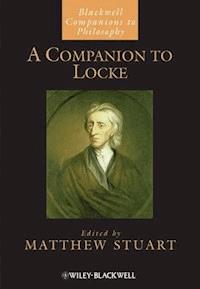
Cover image: Portrait of John Locke (1632–1704) (see also 1419), Kneller, Sir Godfrey (1646–1723) (after) / Private Collection / Photo © Philip Mould Ltd, London / Bridgeman Images Cover design by Workhaus
CONTENTS
Notes on Contributors
References to Locke's Works
Introduction
Life and Background
Metaphysics and Epistemology
Government, Ethics, and Society
Religion
Locke's Legacy
References
Part I: Life and Background
Chapter 1: Locke's Life
1.1 Early Years, 1632–1652
1.2 Oxford, 1652–1667
1.3 Shaftesbury's “Assistant Pen,” 1667–1675
1.4 France, 1675–1679
1.5 Whig Politics, 1679–1683
1.6 Exile, 1683–1689
1.7 The Revolution, 1689–1690
1.8 Publication, 1689–1699
1.9 Court Whig and the Board of Trade, 1695–1700
1.10 Last Years, 1700–1704
References
Further Reading
Chapter 2: The Contexts of Locke's Political Thought
2.1 The Politics of Memory
2.2 The Politics of Religion
2.3 Partisanship and the Public Sphere
2.4 British and Irish Contexts
2.5 European Contexts
2.6 Conclusion
References
Chapter 3: Locke and Natural Philosophy
3.1 Introduction
3.2 Medicine and Chymistry
3.3 Experimental Philosophy
3.4 Locke and Speculative Philosophy
3.5 Demonstrative Knowledge and the Knowledge of Nature
3.6 Mathematics and a Corpuscular Metric
3.7 Locke and Newton
3.8 Conclusion
References
Further Reading
Chapter 4: Locke and Scholasticism
4.1 Introduction
4.2 The Oxford Curriculum
4.3 Locke's Acquaintance with Scholasticism
4.4 Metaphysics (1): Being
4.5 Metaphysics (2): Substance
4.6 Logic: Syllogistic and Demonstration
4.7 Language (1): Basic Notions
4.8 Language (2): Signs and Signification
4.9 Conclusion
References
Further Reading
Chapter 5: Locke and Descartes
5.1 Introduction: Locke's Engagement with Descartes
5.2 Locke's Anti-innatism as Anti-Cartesianism: The Idea of Infinity
5.3 Locke Contra Cartesian Ontology
5.4 Lockean Ontology and Method in a Cartesian Context
Note
References
Further Reading
Part II: Metaphysics and Epistemology
Chapter 6: The Genesis and Composition of the ESSAY
6.1 The Early Drafts: Draft A
6.2 The Early Drafts: Draft B
6.3 Work in Progress, 1671–1685
6.4 Draft C (1685)
6.5 First Publication: the Abrégé
References
Further Reading
Chapter 7: The Theory of Ideas
7.1 What Are Ideas?
7.2 Simple and Complex Ideas
7.3 Mental Operations
7.4 Representation
7.5 Conclusion
References
Further Reading
Chapter 8: Locke's Critique of Innatism
8.1 Varieties of Dispositional Nativism
8.2 Locke's Overall Critique of Innatism
8.3 Assessing Locke's Arguments
8.4 Conclusion: Locke's Real Challenge
References
Further Reading
Chapter 9: Locke on Perception
9.1 General Considerations on Sensation
9.2 Visual Perception of Shape
9.3 Perception and Time
Note
References
Chapter 10: Primary and Secondary Qualities
10.1 Introduction
10.2 Context
10.3 Location
10.4 Structure
10.5 Locke's view
10.6 The “Berkeleyan interpretation” of Locke
10.7 Resemblance Revisited
10.8 Qualities and Powers
10.9 Conclusion
References
Further Reading
Chapter 11: Locke on Essence and the Social Construction of Kinds
11.1 Stages in Kind Creation
11.2 The Simplicity and Strength of Locke's Story
11.3 Are There Real Essences of Kinds or Species?
11.4 Conclusion
References
Further Reading
Chapter 12: Locke's Theory of Identity
12.1 Introduction
12.2 Easy Cases: God, Finite Intelligences, Atoms, and Masses
12.3 A Less Easy but More Interesting Case: Organisms
12.4 A Problem about Coincidence
12.5 The Least Easy but Most Interesting Case: Persons
12.6 Locke against Substance-Based Theories of Personal Identity
12.7 Getting Away with Murder?
12.8 Two Famous Objections: The Circularity Objection and the Transitivity Objection
12.9 The Transitivity Objection
12.10 Attempts to Save Locke from the Transitivity Problem
12.11 Conclusion: The Silver Lining
References
Further Reading
Chapter 13: Liberty and Suspension in Locke's Theory of the Will
13.1 Locke's Key Concepts
13.2 Locke's Key Doctrines
13.3 “Motivational Determinism” and the “Elusive Something”
13.4 Just Punishment, Intellectual Freedom, and Freedom to Will
References
Further Reading
Chapter 14: Language and Meaning
14.1 Some Methodological Preliminaries
14.2 Locke on Language, Thought, and Linguistic Signification
14.3 Linguistic Communication and the Problem of Privacy
14.4 Locke on General Terms and Abstraction
14.5 Propositions and particles
References
Further Reading
Chapter 15: Locke on Knowledge and Belief
15.1 Introduction
15.2 The Varieties of Knowledge
15.3 The Two Demonstrative Sciences
15.4 “The Twilight … of Probability”
15.5 The Regulation of Assent
15.6 Practical Advice on Improving One's Opinions
15.7 Conclusion
References
Chapter 16: Sensitive Knowledge: Locke on Skepticism and Sensation
16.1 Definitions and Distinctions
16.2 The nature of sensitive knowledge
16.3 Pleasure, Pain, and Certainty “As Great as Our Happiness, or Misery”
References
Further Reading
Chapter 17: Locke on Thinking Matter
17.1 The Uncertain Nature of Thinking Substance
17.2 Mechanism and The Possibility of Thinking Matter
17.3 The Intelligence and Immateriality of God
17.4 Divine Superaddition
References
Chapter 18: The Correspondence with Stillingfleet
18.1 The Origins of the Controversy
18.2 Locke's First Letter
18.3 Stillingfleet's First Answer
18.4 Locke's Second Letter
18.5 Stillingfleet's Second Answer
18.6 Locke's Third Letter
References
Further Reading
Part III: Government, Ethics, and Society
Chapter 19: Locke on the Law of Nature and Natural Rights
19.1 Locke's “Potter-God”
19.2 Concurrent Univocal Property
19.3 Divine Versus Human Workmanship and Self-Ownership
19.4 “Nesting” Property, The Law of Nature, and Natural Rights
19.5 Slavery and Suicide
19.6 Conclusion
Notes
References
Further Reading
Chapter 20: Locke on Property and Money
20.1 Introduction
20.2 The Nature and Extent of Lockean Property
20.3 The Labor Theory of Appropriation
20.4 Money and the Origins of Inequality
20.5 From Money to Political Society
20.6 Conclusion
References
Chapter 21: Locke on the Social Contract
21.1 Locke and Social Contract Theory
21.2 The State of Nature
21.3 Locke's Social Contract
21.4 Limits on and Forms of Consent
21.5 Government
Further Reading
Chapter 22: Locke on Toleration
22.1 The Historical Context
22.2 The Two Tracts
22.3 An Essay Concerning Toleration and Epistola de Tolerantia
22.4 The Later Letters on Toleration
22.5 Conclusion
References
Further Reading
Chapter 23: Locke on Education
23.1 Some Thoughts Concerning Education
23.2 Of the Conduct of the Understanding
23.3 Interpretive Issues
23.4 Conclusion
References
Part IV: Religion
Chapter 24: Locke's Philosophy of Religion
24.1 Introduction
24.2 Arguments for the Existence and Unity of God
24.3 The Ladder of Being: Man's Place in the World
24.4 The Problem of Evil: God's Goodness and Justice and Human Limitation and Knowledge
24.5 Reason and Faith, Revelation and Miracles
24.6 Conclusion
References
Chapter 25: The Reasonableness of Christianity and A Paraphrase and Notes on the Epistles of St Paul
25.1 Introduction
25.2 The Reasonableness of Christianity
25.3 A Paraphrase and Notes on the Epistles of St Paul
25.4 Conclusion
References
Part V: Locke's Legacy
Chapter 26: Locke and British Empiricism
26.1 Lockean Apparatus
26.2 Demonstrative Knowledge
26.3 Hume and Locke's Restrictions on the Third Degree of Knowledge
26.4 Association and Custom
26.5 Hume's Meaning Empiricism Reconsidered
26.6 Meaning Empiricism and Cartesian Metaphysics in Berkeley
26.7 Epistemic Priority and Reification
26.8 The External World and Inference to the Best Explanation
26.9 Enumerative Induction and a Revived Explanationism
26.10 Nativism and Basic Beliefs in External Objects
26.11 Berkeley's Influence on Hume
References
Chapter 27: Locke and the Liberal Tradition
27.1 Natural Law and Natural Moral Rights
27.2 Theology and Ethics
27.3 Consent
27.4 The Family
27.5 Property
27.6 Limited Government and the Right to Rebel
27.7 Three Conceptions of Liberalism
References
Chapter 28: Locke and America
28.1 Postcolonial Locke
28.2 Governing America
28.3 Anthropology and Moral Philosophy
28.4 Theories of Empire
28.5 The Agriculturist Argument
28.6 Colonial Legacies
28.7 Slavery
28.8 Constraining Empire
References
Index
EULA
Guide
Cover
Table of Contents
Part I
Pages
ix
x
xi
xii
xiii
xiv
xv
xvi
xvii
1
2
3
4
5
6
7
8
9
10
11
12
13
14
15
16
17
18
19
20
21
22
23
25
27
28
29
30
31
32
33
34
35
36
37
38
39
40
41
42
43
44
45
46
47
48
49
50
51
52
53
54
55
56
57
58
59
60
61
62
63
64
65
66
67
68
69
70
71
72
73
74
75
76
77
78
79
80
81
82
83
84
85
86
87
88
89
90
91
92
93
94
95
96
97
98
99
100
101
102
103
104
105
106
107
108
109
110
111
112
113
114
115
116
117
118
119
120
121
123
124
125
126
127
128
129
130
131
132
133
134
135
136
137
138
139
140
141
142
143
144
145
146
147
148
149
150
151
152
153
154
155
156
157
158
159
160
161
162
163
164
165
166
167
168
169
170
171
172
173
174
175
176
177
178
179
180
181
182
183
184
185
186
187
188
189
190
191
192
193
194
195
196
197
198
199
200
201
202
203
204
205
206
207
208
209
210
211
212
213
214
215
216
217
218
219
220
221
222
223
224
225
226
227
228
229
230
231
232
233
234
235
236
237
238
239
240
241
242
243
244
245
246
247
248
249
250
251
252
253
254
255
256
257
258
259
260
261
262
263
264
265
266
267
268
269
270
271
272
273
274
275
276
277
278
279
280
281
282
283
284
285
286
287
288
289
290
291
292
293
294
295
296
297
298
299
300
301
302
303
304
305
306
307
308
309
310
311
312
313
314
315
316
317
318
319
320
321
322
323
324
325
326
327
328
329
330
331
332
333
334
335
336
337
338
339
340
341
342
343
344
345
346
347
348
349
350
351
352
353
354
355
356
357
358
359
360
361
362
363
364
365
366
367
368
369
371
373
374
375
376
377
378
379
380
381
382
383
384
385
386
387
388
389
390
391
392
393
394
395
396
397
398
399
400
401
402
403
404
405
406
407
408
409
410
411
412
413
414
415
416
417
418
419
420
421
422
423
424
425
426
427
428
429
430
431
432
433
434
435
436
437
438
439
440
441
442
443
444
445
446
447
448
449
450
451
452
453
454
455
456
457
458
459
460
461
462
463
464
465
467
469
470
471
472
473
474
475
476
477
478
479
480
481
482
483
484
485
486
487
488
489
490
491
492
493
494
495
496
497
498
499
500
501
502
503
505
506
507
508
509
510
511
512
513
514
515
516
517
518
519
520
521
522
523
524
525
526
527
528
529
530
531
532
533
534
535
536
537
538
539
540
541
542
543
544
545
546
547
548
549
550
551
552
553
554
555
556
557
558
559
560
561
562
563
564
565
566
567
568
569
Notes on Contributors
Peter R. Anstey is an ARC Future Fellow and Professor of Philosophy in the School of Philosophical and Historical Inquiry at the University of Sydney. He specializes in early-modern philosophy with a special focus on the philosophy of leading English philosophers including John Locke, Robert Boyle, and Francis Bacon. He is the author of John Locke and Natural Philosophy (Oxford University Press, 2011) and editor (with Lawrence M. Principe) of the Clarendon edition of John Locke: Writings on Natural Philosophy and Medicine, forthcoming.
Richard J. Arneson is Professor of Philosophy, and occupies the Valtz Family Chair in Philosophy, at the University of California, San Diego. He also codirects the Institute for Law and Philosophy at UCSD's School of Law. He is the author of more than 100 articles on a wide range of topics in political philosophy. His recent current research is on distributive justice. Some of this work explores how one might best incorporate a reasonable account of personal responsibility into a broadly egalitarian theory of justice. He also considers how consequentialist morality might be developed in a version that is appealing and appropriately responsive to its critics. This latter project involves exploring the structure of moderate deontology to identify the best rival of consequentialism.
E. Jennifer Ashworth is Distinguished Professor Emerita of Philosophy at the University of Waterloo in Canada. She has published extensively on medieval and postmedieval logic and philosophy of language. Her first book, Language and Logic in the Post-Medieval Period, was published in 1974 and her most recent book, Les théories de l'analogie du XIIe au XVIe siècle, was published in 2008. She has contributed to the Cambridge History of Later Medieval Philosophy (1982), the Cambridge History of Renaissance Philosophy (1988) and the new Cambridge History of Medieval Philosophy (2010).
Martha Brandt Bolton is Professor of Philosophy at Rutgers University. She works on the history of seventeenth- and eighteenth-century philosophy and is currently interested in theories of cognition and substance metaphysics. Her articles on Locke include “The taxonomy of ideas in Locke's Essay” in Cambridge Companion to Locke's Essay concerning Human Understanding, ed. Lex Newman, and “Intellectual virtue and moral law in Locke's Ethics” in Contemporary Perspectives on Early Modern Philosophy, eds Paul Hoffman, David Owen, and Gideon Yaffe.
Richard Boyd is Associate Professor of Government at Georgetown University. He is the author of Uncivil Society: The Perils of Pluralism and the Making of Modern Liberalism (Rowman & Littlefield, 2004) and coeditor of Tocqueville and the Frontiers of Democracy (Cambridge University Press, 2013). His articles on early-modern political thought, liberalism, and civil society have appeared in Journal of Politics, Review of Politics, History of Political Thought, Political Theory, Social Philosophy & Policy, Political Studies, Perspectives on Politics, Polity, European Journal of Political Theory, and other journals. Before coming to Georgetown he taught at the University of Wisconsin-Madison, University of Pennsylvania, University of Chicago, and Deep Springs College.
Raffaella De Rosa is Associate Professor and Chair of the Philosophy Department at Rutgers-Newark. She is also a member of the Graduate Faculty in the Philosophy Department at Rutgers-New Brunswick and of the Graduate Faculty in the Psychology Department at Rutgers-Newark. Her research interests are in early modern theories of cognition, mental representation, and concept acquisition, as well as contemporary theories of mind and concepts. Some of her work can be described as being at the intersection between early-modern and contemporary theories of mind. After publishing several articles on Locke's and Descartes' theories of mind and ideas and a book on Descartes' account of sensory representation (Descartes and the Puzzle of Sensory Representation, Oxford University Press, 2010), she turned the focus of her research onto the philosophical and psychological question of the origin of concepts.
Lisa Downing is Professor of Philosophy at the Ohio State University. She has published essays on Locke in The Philosophical Review, The Journal of the History of Philosophy, The Cambridge Companion to Locke's Essay, and many other journals and volumes. She also works on Descartes, Malebranche, Boyle, Berkeley, and early Newtonianism, especially on issues at the intersection between philosophy and natural philosophy in the seventeenth and early eighteenth centuries, such as mechanist conceptions of body and their justification, the status of gravity/attraction, the structure of efficient causation, and changing views of scientific explanation.
Don Garrett is Silver Professor of Philosophy at New York University. He was previously Kenan Distinguished Professor for Teaching Excellence at the University of North Carolina at Chapel Hill. He has also taught at Harvard University and the University of Utah. His research interests include seventeenth- and eighteenth-century metaphysics, epistemology, philosophy of mind, ethics, and political philosophy. He is the author of Cognition and Commitment in Hume's Philosophy (Oxford University Press, 1997), Hume (Routledge, 2015), and Nature and Necessity in Spinoza's Philosophy (Oxford University Press, forthcoming). He is the editor of The Cambridge Companion to Spinoza (Cambridge University Press, 1996; second edition forthcoming), and has served as coeditor of Hume Studies and as North American editor of Archiv für Geschichte der Philosophie.
Mark Goldie is Professor of Intellectual History and Fellow of Churchill College, University of Cambridge. He has published extensively on the political, religious, and intellectual history of seventeenth- and eighteenth-century Britain. He is editor of John Locke: Political Essays (Cambridge University Press, 1997) and The Selected Correspondence of John Locke (Oxford University Press, 2002), and coeditor of The Cambridge History of Political Thought, 1450–1700 (1991) and The Cambridge History of Eighteenth-Century Political Thought (2006). An intellectual biography of Locke in the post-Revolution era is in preparation.
Ruth W. Grant is Professor of Political Science and Philosophy and a Senior Fellow at the Kenan Institute for Ethics at Duke University. She is the author of John Locke's Liberalism and of several articles on Locke's political thought. She is the editor, with Nathan Tarcov, of Locke's educational writings. She has published widely in early-modern thought and ethics and politics. Her most recent book is Strings Attached: Untangling the Ethics of Incentives (Princeton University Press, 2014).
Benjamin Hertzberg is Visiting Professor of Political Science at Brigham Young University in Provo, Utah, where he researches and teaches contemporary liberal and democratic theory, the history of political thought, and religion and politics. He is the author of “Chains of persuasion in the deliberative system: addressing the pragmatics of religious inclusion,” Journal of Politics 2015 (4). Hertzberg's current research analyzes the epistemic and deliberative costs and benefits of religious participation in democratic decision making. He completed an appointment as a Robert Wood Johnson Foundation Scholar in Health Policy Research at Harvard University in 2013.
Michael Jacovides is Associate Professor of Philosophy at Purdue University. He has published articles on a variety of topics, including nine on various aspects of Locke's philosophy. He is also at work on a book about Locke and the scientific revolution.
Dan Kaufman is Associate Professor of Philosophy at the University of Colorado, Boulder. He has published extensively on seventeenth-century philosophy, especially on metaphysical issues – modality, individuation, identity, and substance. He is the editor of the forthcoming Routledge Companion to Seventeenth Century Philosophy, as well as the volume Identity, for the Oxford Philosophical Concepts series.
Marcy P. Lascano is Associate Professor of Philosophy at California State University Long Beach. Her primary research is in early-modern philosophical theology and metaphysics. Her published work includes “Emilie du Châtelet on the existence and nature of god: an examination of her arguments in light of their sources,” in British Journal for the History of Philosophy, 19 (4) 2011: 739–756, “Mary Astell on the existence and nature of God,” in Feminist Interpretations of Mary Astell, edited by Penelope Weiss and Alice Sowaal (Pennsylvania State University Press, forthcoming), and “Arguments for the existence of God” in The Routledge Companion to Seventeenth Century Philosophy, edited by Daniel Kaufman (Routledge, 2015). She is the recipient of an NEH Fellowship for the 2015–2016 year to work on her book manuscript, Early Modern Women Philosophers: Cosmology to Human Nature.
Louis Loeb is Arthur F. Thurnau Professor of Philosophy at the University of Michigan. He is the author of From Descartes to Hume: Continental Metaphysics and the Development of Modern Philosophy (Cornell University Press, 1981) and Stability and Justification in Hume's Treatise (Oxford University Press, 2002). His Reflection and the Stability of Belief: Essays on Descartes, Hume, and Reid (Oxford University Press, 2010), a collection of his papers, includes an introduction that updates and consolidates his prior work on Hume's approach to justification. Professor Loeb delivered the American Philosophical Association's Patrick Romanell Lecture on Philosophical Naturalism for 2006–2007. His current research traces main differences between Hume's Treatise and first Enquiry to tensions within Hume's theory of knowledge once he developed his critique of the argument from design for Section XI of the Enquiry and the Dialogues.
Antonia LoLordo is Professor of Philosophy at the University of Virginia. She is the author of Locke's Moral Man (Oxford University Press, 2012) and Pierre Gassendi and the Birth of Early Modern Philosophy (Cambridge University Press, 2007), as well as the coeditor of Debates in Modern Philosophy (Routledge, 2013). She has published articles on Descartes, Edwards, Gassendi, Hume, Locke, and Malebranche, and is a section editor for Ergo (www.ergophiljournal.org). She is currently working on Edwards' metaphysics and on early-modern theories of education.
The late E.J. Lowe was Professor of Philosophy at Durham University. He was the author of Locke on Human Understanding (Routledge, 1995) and Locke (Routledge, 2005), as well as six other books: Kinds of Being (Blackwell, 1989), Subjects of Experience (Cambridge University Press, 1996), The Possibility of Metaphysics (Oxford University Press, 1998), An Introduction to the Philosophy of Mind (CambridgeUniversity Press, 2000), A Survey of Metaphysics (Oxford University Press, 2002), and The Four-Category Ontology (Oxford University Press, 2005). He published more than 150 articles on a vast array of topics in metaphysics, philosophy of mind, philosophy of language, and philosophy of logic.
J.R. Milton has recently retired from the Philosophy Department at King's College London, where he is now Professor Emeritus of the History of Philosophy. He was the editor (with Philip Milton) of An Essay Concerning Toleration and Other Writings on Law and Politics, 1667–1683 in the Clarendon Edition of the Works of John Locke, and is currently working on two other volumes in the same edition: Drafts for the Essay Concerning Human Understanding and Other Philosophical Writings, volume 2 (with G.A.J. Rogers), and Literary and Historical Writings.
Jennifer Nagel is Associate Professor of Philosophy at the University of Toronto, Canada. Her research covers both historical and contemporary topics in the theory of knowledge, ranging from seventeenth-century debates about skepticism to current controversies about the context-sensitivity of the verb “to know.” Much of her recent work focuses on epistemic intuitions – natural instincts about knowledge – and the question of exactly what these instincts can tell us about knowledge itself. She is the author of Knowledge: A Very Short Introduction (Oxford University Press, 2014).
Victor Nuovo is Charles A. Dana Professor of Philosophy Emeritus, Middlebury College, and Senior Research Fellow, Harris Manchester College, Oxford. He is also an editor of the Clarendon Edition of the Works of John Locke. His publications include John Locke: Writings on Religion (Oxford University Press, 2002), Christianity, Antiquity, and Enlightenment: Interpretations of Locke, (Springer, 2011), and John Locke: Vindications of the Reasonableness of Christianity (Oxford University Press, 2012). Works in preparation include John Locke: The Philosopher as Christian Virtuoso (Oxford University Press) and John Locke: Theological Manuscripts (Oxford University Press).
Jacqueline Rose is Lecturer in History at the University of St Andrews and Associate Director of the St Andrews Institute of Intellectual History. She researches and teaches early-modern intellectual, religious, and political history. Her book, Godly Kingship in Restoration England: The Politics of the Royal Supremacy, 1660–1688 (Cambridge University Press, 2011) won the Royal Historical Society's Whitfield Prize for 2011. She is working on a monograph on kingship and counsel in early-modern England alongside convening a wider research project on medieval and early-modern political counsel, and editing some of Locke's early political and religious writings.
S. Adam Seagrave is Assistant Professor of Political Science at Northern Illinois University as well as managing editor of the journal American Political Thought. He has published articles on Locke's thought in the American Journal of Political Science,Journal of the History of Ideas, and Locke Studies. He is the author of The Foundations of Natural Morality: On the Compatibility of Natural Rights and the Natural Law (University of Chicago Press, 2014), and the editor of Liberty and Equality: The American Conversation (University Press of Kansas, 2015).
A. John Simmons is Commonwealth Professor of Philosophy and Professor of Law at the University of Virginia. He has been an editor of the journal Philosophy & Public Affairs since 1982. He is the author of Moral Principles and Political Obligations (Princeton University Press, 1979), The Lockean Theory of Rights (Princeton University Press, 1992), On the Edge of Anarchy: Locke, Consent, and the Limits of Society (Princeton University Press, 1993), Justification and Legitimacy: Essays on Rights and Obligations (Cambridge University Press, 2000), Is There a Duty to Obey the Law? For and Against (with C.H. Wellman) (Cambridge University Press, 2005), Political Philosophy (Oxford University Press, 2008), and many other publications on topics in moral, political, and legal philosophy. He has edited the books International Ethics (Princeton University Press, 1985) and Punishment (Princeton University Press, 1995) and has chaired the University of Virginia's Philosophy Department and its Program on Political and Social Thought.
David Soles is Professor and Chair of Philosophy at Wichita State University. He holds degrees from the University of Pittsburgh (BA) and Johns Hopkins University (PhD). He has teaching and research interests in the history of philosophy, especially early-modern and classical Chinese philosophy, and epistemology. He has published several articles on the work of John Locke and currently is working on a book on Locke's natural philosophy of the mind.
Matthew Stuart is Professor of Philosophy at Bowdoin College. He is the author of Locke's Metaphysics (Oxford University Press, 2013). His articles on Locke's philosophy have appeared in Journal of the History of Philosophy, British Journal for the History of Philosophy, Philosophical Review, and elsewhere.
Alex Tuckness is Professor at Iowa State University in the Departments of Political Science and Philosophy. He was a Faculty Fellow in Ethics at Harvard's Center for Ethics and the Professions in 2003–2004. His research focuses on connections between the history of political philosophy and contemporary debates about mercy, toleration, punishment, international humanitarianism, and public service ethics. He is the author of Locke and the Legislative Point of View (Princeton University Press, 2002) and The Decline of Mercy in Public Life (with John Michael Parrish) (Cambridge University Press, 2014). His articles on Locke have appeared in a number of scholarly outlets including Journal of Political Philosophy, American Political Science Review, Journal of the History of Philosophy, and American Journal of Political Science.
Robert A. Wilson is Professor in the Departments of Philosophy and Educational Policy Studies at the University of Alberta, Canada, and the founding Director of Philosophy for Children Alberta and of Eugenics Archives (eugenicsarchive.ca), a five-year initiative focused on eugenics in Western Canada and its contemporary significance. His areas of specialization include the philosophy of mind and cognitive science, philosophy of biology, and disability studies. He is the author or editor of six books, including Boundaries of the Mind (Cambridge University Press, 2004) and Genes and the Agents of Life (Cambridge University Press, 2005), and is currently completing book projects on eugenics and on kinship. A more complete view of Rob's work is available at his website, www.artsrn.ualberta.ca/raw/. He is an Australian, born in Broken Hill and growing up there and in Perth, and completed his MA and PhD at Cornell University.
Kenneth P. Winkler is Professor of Philosophy at Yale University. In 2012 he was the Sir Isaiah Berlin Visiting Professor in the History of Ideas at Oxford University, where he lectured on the history of idealism in America. His books include Berkeley: An Interpretation (Oxford University Press, 1989) and an abridgment, with introduction and notes, of Locke's Essay (Hackett, 1996). Matters of Reason, a volume of his essays on early-modern British philosophy, is forthcoming from Oxford University Press.
References to Locke's Works
References to works by Locke are to the Clarendon Edition of the Works of John Locke, published by Oxford University Press, in cases where the relevant volume has been published. These are listed below. Passages in these volumes are cited using the conventions specified.
An Essay Concerning Human Understanding
, ed. Peter H. Nidditch. Cited by Arabic numerals for book, chapter and section, e.g. (2.27.1) for Book Two, chapter 27, section 1.
Drafts for the Essay Concerning Human Understanding, and other Philosophical Writings
, ed. Peter H. Nidditch and G.A.J. Rogers. Cited as ‘
A
’ for Draft A and ‘
B
’ for Draft B, followed by paragraph number.
The Correspondence of John Locke
, 8 vols, ed. E.S. de Beer. Cited as
Corr
. followed by the letter number.
The Reasonableness of Christianity
, ed. John C. Higgins-Biddle. Cited as ‘
RC
’ followed by page number.
Some Thoughts Concerning Education
, ed. John W. Yolton and Jean S. Yolton. Cited as ‘
STCE
’ followed by page number.
Locke on Money
, 2 vols, ed. Patrick Hyde Kelly. Cited as
M
followed by volume number: page number, e.g. (
M
, 1:50) for vol. 1, page 50.
A Paraphrase and Notes on the Epistles of St Paul
, 2 vols, ed. Arthur W. Wainwright. Cited as
Para
. followed by volume number: page number.
An Essay Concerning Toleration, and Other Writings on Law and Politics, 1667–1683
, ed. J.R. Milton and Philip Milton. Cited as ‘
ECT
’ followed by page number.
References to modern editions of works by Locke that have not yet appeared in the Clarendon Edition are to the volumes listed below. Passages in these are cited by the abbreviations given and by page number.
Aaron, John and Gibb, Jocelyn. (1936)
An Early Draft of Locke's
Essay
: together with excerpts from his journals
. Oxford: Clarendon Press. Cited as
AG
.
Goldie, Mark, ed. (1997)
Locke: Political Essays
. Cambridge: Cambridge University Press. Cited as
PE
.
Klibansky, Raymond (Ed.) and Gough, J.W. (Trans.) (1968)
Epistola de Tolerantia
. Oxford: Oxford University Press. Cited as
ET
.
Laslett, Peter (Ed.) (1960)
Two Treatises of Government
. Cambridge: Cambridge University Press. Cited as
TT
followed by ‘1’ for the
First Treatise
, ‘2’ for the
Second Treatise
and paragraph number.
In the case of works by Locke that were published during his lifetime but that do not appear in a modern edition, references are to the original lifetime editions listed below. These can be consulted at most academic libraries using the Early English Books Online database (EEBO;
http://eebo.chadwyck.com/home
). These works are cited by author, date, and page.
Locke, John. (1695)
A Vindication of the Reasonableness of Christianity, &c. from Mr. Edwards's Reflections
. London: Printed for Awnsham and John Churchill, at the Black Swan in Paternoster Row.
― (1697a)
A Letter to the Right Reverend Edward Ld Bishop of Worcester
. London: Printed by H. Clark, for A. and J. Churchill, at the Black Swan in Paternoster Row.
― (1697b)
A Second Vindication of the Reasonableness of Christianity
. London: Printed for A. and J. Churchill, at the Black Swan in Paternoster Row.
― (1697c)
Mr. Locke's Reply to the Right Reverend the Lord Bishop of Worcester's Answer to his Letter
. London: Printed by H. Clark, for A. and J. Churchill, at the Black Swan in Paternoster Row.
― (1697d)
An Answer to Remarks upon an Essay Concerning Humane Understanding, &c.
London: Printed by H. Clark, for A. and J. Churchill, at the Black Swan in Paternoster Row. Printed as an appendix to Locke 1697c.
― (1699)
Mr. Locke's Reply to the Right Reverend the Lord Bishop of Worcester's Answer to his Second Letter
. London: Printed by H.C. for A. and J. Churchill, at the Black Swan in Paternoster Row.
In the case of works that did not appear during Locke's lifetime, but that have also not appeared in a modern edition, references are to the edition of Locke's
Works
given below.
The Works of John Locke
, 10 vols. London: Printed for Thomas Tegg (etc.), 1823. Cited as
Works
followed by volume: page number.
Introduction
MATTHEW STUART
The influence of John Locke's career as a writer is so great that one can forget what a rich and varied life he led. His contributions to political theory and to epistemology have had such an impact that one can overlook what a remarkable polymath he was. He began his career as an academic, but spent much of it in the service of Anthony Ashley Cooper, who was Chancellor of the Exchequer when they met, and later Lord Chancellor. This association brought Locke close to the upper echelons of political power, and involved him in economic and New World policy making. In the aftermath of the Rye House plot against Charles II and his brother James, it also placed Locke in real danger, prompting him to flee the country and to spend five and a half years in exile, sometimes under an assumed name. Locke was a physician, a serious student of chemistry, and a collector of botanical specimens. He was a metaphysician, a theologian, a civil servant, and an economic theorist. He was the friend of Boyle and Newton, a Fellow of the Royal Society, a keeper of extensive meteorological records. He theorized about the best means of educating children, wrote a lengthy exegesis of the Epistles of St Paul, and devised a method for indexing commonplace books that was widely adopted for 100 years.
The present volume focuses primarily on Locke's contributions to philosophy, but philosophy broadly construed. The plan of the book is designed to achieve breadth as well as depth. There is thorough coverage of most of the topics in Locke's philosophy that receive much attention from scholars. These include, among others, his empiricist theory of ideas, his distinction between primary and secondary qualities, and his account of personal identity. They include his theory of natural rights, his understanding of the social contract, his arguments on religious toleration. Yet this book also contains chapters on relatively neglected sectors of Locke's oeuvre, such as the drafts of the Essay concerning Human Understanding, the correspondence with Stillingfleet, and the Reasonableness of Christianity. In addition, it pays considerable attention to the context in which Locke developed his philosophical theories, and to their influence going forward. Thus there are chapters on his relations to the scholastics and Descartes, and chapters that trace his influence on British empiricism, the liberal tradition, and the New World.
All of the chapters that follow have been commissioned specifically for this volume. The authors include many of the best known, and most highly regarded, scholars who have worked on Locke over the last few decades. They also include a few of the most talented members of a promising new generation of Locke scholars. It is safe to say that Locke scholarship is flourishing now in a way that it was not 50 years ago. Each of the chapters in this volume makes some attempt to acquaint the reader with the current state of this scholarship within a specific domain. Many of them also aspire to push that scholarship forward a significant step or two. The result is a collection that should be of real use to general readers and professional philosophers alike. Let us survey the ground to be covered.
Life and Background
Locke lived in dramatic times. He grew to manhood during the English Civil War, saw the restoration of the Stuart monarchy while a student at Christ Church, and celebrated the Dutch invasion of England in 1688 that made possible his return from exile. The remarkable changes he lived through were not just political. There was, for example, the Great Plague of London in 1665, and the Great Fire that destroyed much of that city the following year – though Locke learned of both of these momentous events from a safe distance, at Oxford. There was also the remarkable expansion of scientific knowledge in England in the second half of the seventeenth century: the invention of calculus, the development of air pumps and microscopes as serious tools for scientific investigation, the publication of Newton's Principia. These events shaped the intellectual world that Locke inhabited, and to which he contributed so much.
In Chapter 1, Mark Goldie charts the course of Locke's progress through these times. He tells us of Locke's relatively humble beginnings, his education at Westminster School and Oxford. He tells us of Locke's reluctance to take the holy orders that his Christ Church studentship required, and of his success in obtaining a dispensation to avoid doing so. Locke's service in Shaftesbury's household began in 1667, and he soon became involved in many of his employer's projects. He also initiated some of his own, drafting a work that he would later expand into the Essay concerning Human Understanding, and writing the Two Treatises of Government. Shaftesbury died in 1683, the year Locke's peripatetic exile in Holland began. The Essay and the Two Treatises were not published until his return to England in 1689. More publications soon followed, and Goldie helps us to understand both the praise and criticism they earned Locke. He also describes how, during the philosopher's final years, he was protected from the pressures of both fame and notoriety by his quiet retirement at Oates, the family home of his friend Damaris Cudworth Masham.
In sketching the major events of Locke's life, Goldie does not neglect the political context that informed his theorizing about the nature and extent of political authority. Nor does he fail to touch on Locke's involvement with natural science, his antagonism to scholasticism, his acknowledged debt to Descartes. Yet each of these topics is worthy of fuller exploration, and that is what we get in the next four chapters.
In Chapter 2, Jacqueline Rose describes several contexts that figure in Locke's evolution as a political theorist. Perhaps the most obvious is the autocratic nature of Charles II's rule, though Rose is keen to draw our attention to a variety of other factors as well. There is the tension caused by religious divides: unease fueled by fears of sectarian instability on the one side, and of popery on the other. It was the crisis of 1679 to 1681/1682 – in which Charles II blocked Shaftesbury and his supporters' attempts to exclude the Catholic Duke of York from succession to the throne, and punished their actions – that immediately prompted Locke to write the Two Treatises, a work directed against the actions of a presently existing “popish” and “arbitrary” government, as well as any that might exist in the future. Yet Rose suggests that this work is also haunted by memories of the upheavals caused by the earlier Civil War. Locke's main targets are the errors of a tyrannical monarch, but she says that he is also mindful of Parliamentarian excesses during the Civil War, and alive to the possibility that a parliament too can be tyrannical. Other factors that Rose examines include the increase in political partisanship (if not the emergence of actual political parties), and the growth of a public sphere dominated by the printed word. Thinking particularly of Locke's writings on toleration, she points to the importance of his experience of peaceful religious coexistence in the Dutch republic, and to what he must have known about the influx of Protestant refugees from France after Louis XIV revoked the Edict of Nantes, which had protected that religious minority.
Just as we must look to social and political developments in England to understand the impetus for much of Locke's political theorizing, so we must appreciate his engagement with natural science – what was then called “natural philosophy” – if we are to adequately frame the central concerns of his Essay concerning Human Understanding. We are informed by his friend James Tyrrell that it was discussions about the foundations of morality and religion that first prompted Locke to write an essay on epistemology (Woolhouse 2007, 98). Nevertheless, he makes it clear from the outset of the published work that his project has important connections to the larger enterprise of expanding our knowledge of the natural world. In his “Epistle to the Reader,” Locke famously describes his role as that of “an Under-Labourer” who clears the ground a little so that the work of such “Master-Builders” as Boyle and Newton is not impeded by the confusions attendant upon the misuse of language. He is alluding to his discussion in Book III about various abuses of language and how to avoid them. Yet it is not only in Book III that Locke's engagement with natural philosophy is in evidence. Many of the central questions of the Essay – about how knowledge is grounded in experience, and how things are ranked into kinds, about which features of bodies are more basic, and what are the prospects for a demonstrative science of bodies – are questions raised by his reflection on, and participation in, research in physics, chemistry, botany, and medicine.
If Locke was less than a full-fledged natural philosopher, he was more than a dilettante. He had a serious interest in medicine and chemistry dating as far back as the 1650s, and by the end of that decade he was doing an enormous amount of reading and note taking on these subjects (Woolhouse 2007, 461). Early in the next decade he became friends with Boyle, attended lecture courses on medicine and chemistry, and broadened his reading in natural philosophy to include, among other things, Descartes' writings on physics, optics, and meteorology (Milton 2001). In the middle of the 1660s, Locke set up a chemical laboratory with his friend David Thomas, and also became the associate of an important London physician, Thomas Sydenham, who did much to introduce him to medical practice and also to shape his views about medical theory (Milton 2001). In 1675 Locke was awarded the degree of Bachelor of Medicine (Woolhouse 2007, 116). Though travel and the association with Shaftesbury eventually placed many other demands on his attention, his interest in medicine and natural philosophy continued for the rest of his life. Thus, during his exile in Holland we find him discussing colic with Dutch medical men (Woolhouse 2007, 203), and writing reviews of works by Boyle and Newton for the Bibliothèque universelle (Anstey 2011, 2–3). As late as the 1690s, when he had become Boyle's literary executor, he had his manservant copy hundreds of pages of chemical notes from Boyle's papers (Anstey 2011, 176).
In Chapter 3, Peter Anstey describes Locke's engagement with natural philosophy, while also exploring several tensions in his philosophy of science. The first tension involves competing views about scientific method: one that permits speculative hypotheses about unobservable causal mechanisms, and the other a neo-Baconian approach that discourages such hypotheses and recommends instead the collection of “natural histories.” Anstey says that Locke is committed to the method of natural history, but that this commitment sits uneasily with his allegiance to corpuscularianism. Another tension that Anstey locates is that between Locke's view that natural philosophy should be grounded in observation and his allegiance to something like the Aristotelian ideal of scientific knowledge as demonstrative knowledge. By Locke's own lights, a demonstrative science of bodies is probably unachievable, though Anstey suggests that he allows that we might make progress in that direction if we could make exact measurements of corpuscular structures. Finally, Anstey sees some tension between Locke's earlier methodological pronouncements and his growing appreciation – in the 1690s – of Newton's achievement in the Principia. In the Essay and elsewhere, Locke says disparaging things about the idea of founding a system of knowledge on principles or maxims, and yet one could say that Newton managed to do just that. Anstey concludes that Locke's views about scientific method were still evolving late in his life.
Locke's Essay is an ambitious, wide-ranging philosophical book, not a narrow treatise on the philosophy of science. It is a work influenced by, and written in reaction to, not just the science of its day, but also the philosophical writings of its author's contemporaries and near-contemporaries. The philosophies that loom largest in the background of Locke's own are those of the scholastics and Descartes. His relation to scholasticism is the subject of an essay by E.J. Ashworth (Chapter 4), and Lisa Downing (Chapter 5) explores his response to Descartes.
The most casual reader of the Essay will see that Locke's relations to both the scholastics and Descartes are largely antagonistic. His references to them are almost always critical, and he is sometimes dismissive or even derisive. What Ashworth and Downing offer us is a more nuanced picture of just how well or poorly he understands some of his predecessors' views, and how thoroughly or incompletely he rejects them. The results are something of a mixed bag, though it is fair to say that his engagement with Descartes' philosophy is more serious than is his engagement with the scholastics'. Ashworth suggests that this is partly because much of his exposure to scholasticism came not from the study of great works by Aquinas, Scotus, and Ockham, but from acquaintance with textbooks written by competent but second-rate authors. On one subject – the nature of substance – Locke actually claimed to agree with the scholastics, but Ashworth shows that the similarity between their accounts is only superficial. Where she does find some evidence of scholastic influence is not in Locke's metaphysics, but in his logic and philosophy of language.
Though one can see a Cartesian influence in Locke's conception of ideas, and in his characterization of intuitive and demonstrative knowledge, he rejects the basic tenets of Descartes' philosophy. Whereas Descartes claims to know that the whole essence of body is extension, and the world a plenum, Locke argues against the identification of body and extension, and for the possibility of a vacuum. While Descartes claims that thinking is the essence of mind, Locke challenges the Cartesian result that we are always thinking. Descartes is also a target of Locke's critique of innatism, and his remarks about skepticism.
Locke finds little enough to praise in Descartes' philosophy but if Downing is right, he respects the French philosopher enough to read him very carefully. She sees Locke as responding not only to positions that Descartes takes in well-known passages in the Meditations and the Principles of Philosophy, but also to Descartes' subtle defenses of these in the Reply to Gassendi, and in his correspondence. What this suggests is that although Locke may regard scholasticism as an already moribund tradition – and so not worth the trouble of a careful refutation – he views Descartes' philosophy as a force to be reckoned with. And reckon he does. When he began writing the earliest version of the Essay concerning Human Understanding, it was not with the goal of offering the world an antidote to Cartesian epistemology and metaphysics. Yet it was not long before that ambition grew within him.
Metaphysics and Epistemology
We are most fortunate that portions of several early drafts of the Essay survive, affording us a fascinating look at Locke's growing ambitions over the long period of its composition. Two of these early drafts – now referred to as Draft A and Draft B – bear the date 1671 but as J. R. Milton explains in Chapter 6, at least some portions of the second draft might have been composed in 1672. A third manuscript, now called Draft C, is dated 1685. (It is clear that many other manuscripts once existed that have since been lost.) Locke's commitment to empiricism is there from the first line of Draft A, though a sustained volley against innatism does not make its appearance until Draft B. Draft A also contains a discussion of Descartes' account of body, and an explicit rejection of the Cartesian view that sensory beliefs stand in need of some kind of justification. Locke's antagonism to Descartes' system thus makes its appearance early on. Curiously, some of the important elements of his own system do not make theirs until later. For example, Drafts A and B make reference neither to the distinction between primary and secondary qualities, nor to that between real and nominal essences.
It is in Draft B that Locke first tells us that his purpose is to “enquire into the Originall, Certainty & Extent of humane knowledge. togeather with the ground<s> & degrees of Opinion Belief Perswasion or Assent” (B, 2). That declaration reappears, with minor cosmetic changes, in the Introduction to the Essay




