


A Companion to Luis Buñuel E-Book
155,99 €
Mehr erfahren.
- Herausgeber: John Wiley & Sons
- Kategorie: Geisteswissenschaft
- Serie: WBCF - Wiley-Blackwell Companions to Film Directors
- Sprache: Englisch
A Companion to Luis Buñuel presents a collection of critical readings by many of the foremost film scholars that examines and reassesses myriad facets of world-renowned filmmaker Luis Buñuel’s life, works, and cinematic themes.
- A collection of critical readings that examine and reassess the controversial filmmaker’s life, works, and cinematic themes
- Features readings from several of the most highly-regarded experts on the cinema of Buñuel
- Includes a multidisciplinary range of approaches from experts in film studies, Hispanic studies, Surrealism, and theoretical concepts such as those of Gilles Deleuze
- Presents a previously unpublished interview with Luis Buñuel’s son, Juan Luis Buñuel
Sie lesen das E-Book in den Legimi-Apps auf:
Seitenzahl: 1442
Veröffentlichungsjahr: 2013
Ähnliche




















Contents
Contributors
Acknowledgments
Introduction
An Aragonese Dog
A Golden Age
The Forgotten One
Strange Passions
An Exterminating Angel
Discretion and Desire
And in the Spring
Contents of This Volume
Part One An Aragonese Dog
1 Interview with Juan Luis Buñuel
2 Luis Buñuel and the Politics of Self-Presentation
Early Days
The Man with the Knife: Un chien andalou
Assault and Retreat: L’Âge d’or (The Golden Age, 1930)
Selling Out and Signing Up: Las Hurdes, aka Tierra sin pan (Land without Bread, 1933/1936)
“Buñuel Is Dead”: The United States
Hard Times and Potboilers: Mexico
Return to Self: Los olvidados
A Hot Time: Viridiana
Staying Afloat: Publicity
The Oscar
Versions of Self
Playing Buñuel
Long Interviews: No Peeking
Telling It Like It Should Be: My Last Sigh
3 Buñuel, Master Pyrotechnician
Introduction: A Passion for Firearms
Buñuel Opens Fire: The Six-Gun Mystique and Western Parody in Un chien andalou
L’Âge d’or: Parodic Pyrotechnics and Erotic Pulverization
4 Buñuel’s Critique of Nationalism
Displacement, Misplacement
Migratory Aesthetics as a Cultural Politic
Sound Out of Place
Real, Right, True
Transnationalism versus Migratory Aesthetics
Part Two A Golden Age
5 Surreal Souls
The Soul in the 1920s Avant-Garde in France
Surrealism and Un chien andalou
6 Fixed-Explosive
7 L’Âge d’or
Historical Context
Structure
Themes and Techniques
8 Buñuel Entomographer
Part Three The Forgotten One
9 The Complicit Eye
Terrains of the “Ojosauro”
The Unwholesome Eye and Visual Mediations
Cross-cuttings of the Eye in Art and Cinematography
The Last Arena
10 Out of Place, Out of Synch
Conclusion
11 Susana
12 Young Outlaws and Marginal Lives in Latin American Cinema
Introduction
The Lesson of the Master
Los olvidados: A Classic
Conclusion
Part Four Strange Passions
13 The Creative Process of Robinson Crusoe
The Origins of an Assignment with Potential
Buñuel and the Blacklist: Writing the Script
The Shooting and the Script: Nature, Specters, and Instincts
The Rewriting of the Script during Editing and Dubbing
The Film’s Release and Reception
14 The Cinematic Labor of Affect
Learning Urbanity
Cinema and the Capture of Affect
Taming the Brute
Space, Family, and Genre
Of Crime, Musical Boxes, and Film Reels
Unheard-of Becomings
15 Stars in the Wilderness
Exiles in Eden
Signoret, Piccoli, Marchal: Transnational Transformations?
16 Transitional Triptych
Cela s’appelle l’aurore
La Mort en ce jardin
La Fièvre monte à El Pao
Conclusion
17 Buñuel Goes Medieval
Part Five An Exterminating Angel
18 The Galdós Intertextin Viridiana
Buñuel and Literary Adaptations
Buñuel and Galdós: Mutual Illumination
Galdós Adaptations in Spanish Cinema: Lost Opportunities
19 Spectral Cinema
20 Between God and the Machine
Miracles between Religion and Science
The Saint as Cineaste: Simón del desierto
Prodigious Travel: La Voie lactée
21 The Road and the Room
On the Road and in the Room
The Way In and the Way Out: Un chien andalou and L’Âge d’or
Insiders and Outsiders: The Transnational Remix in Las Hurdes and Los olvidados
Narrative Vehicles in Mexican Road Movies
Internalizing the Narrative Vehicle and Eroticizing the Room: From Él to Belle de jour
Going on a Pilgrimage or Holding Your Sacred Ground
The Final Radical Remix: Le Fantôme de la liberté and Cet obscur objet du désir
Those Obscure Dynamics of Desire
Part Six Discretion and Desire
22 On a Road to Nowhere
23 The Intertextual Presence of Lewis Carroll’s Alice in Belle de jour
24 Splitting Doubles
Ángela Molina’s First Appearance: Conchita in Mathieu’s Bedroom
Conchita at Home
Conchita. Not the End
Interview with Ángela Molina, held in Madrid, February 19, 2011
25 Buñuel and Historical Reason
26 Through a Fractal Lens
Fractal Films
Techniques
Parallel Realities and Schrödinger’s cat
Part Seven And in the Spring
27 Mutilation, Misogyny, and Murder
28 Inside/Outside
Don’t Box Me In: Confining Interior Space
Wanting Out: Desire for Sexual Perversion as a Means of Release
Go and Play Outside: Outside Space, Sexual Perversion, and Freedom
Inside and Outside: The Transition to Outside Space
Reclaiming Space: Belle de jour, La Pianiste,and Henri Lefebvre
Conclusion
29 Surrealist Legacies
Fredric Jameson’s Cinematic Magic Realism
Art-historical and Literary Roots of Magic Realism: An International Mode
Los olvidados: Buñuel’s Latin American Marvelous
Indigenous Japanese Modernism: Otoshiana and the Struggle for Survival
Marvelous Hybridity: A Composite Avant-Garde Response to Late Capitalism
30 Luis Buñuel’s Angel and Maya Deren’s Meshes
Two Exiles
Repetition as Structure
Attacking Visual Space
A Communal Nightmare
Angel of History
Filmography
Index
Wiley-Blackwell Companions toFilm Directors
The Wiley-Blackwell Companions to Film Directors survey key directors whose work together constitutes what we refer to as the Hollywood and world cinema canons. Whether Haneke or Hitchcock, Bigelow or Bergman, Capra or the Coen brothers, each volume, comprised of 25 or more newly commissioned essays written by leading experts, explores a canonical, contemporary and/or controversial auteur in a sophisticated, authoritative, and multi-dimensional capacity. Individual volumes interrogate any number of subjects – the director’s oeuvre; dominant themes; well-known, worthy, and under-rated films; stars, collaborators, and key influences; reception, reputation, and above all, the director’s intellectual currency in the scholarly world.
Published
This edition first published 2013© 2013 Blackwell Publishing Ltd
Blackwell Publishing was acquired by John Wiley & Sons in February 2007. Blackwell’s publishing program has been merged with Wiley’s global Scientific, Technical, and Medical business to form Wiley-Blackwell.
Registered OfficeJohn Wiley & Sons, Ltd, The Atrium, Southern Gate, Chichester, West Sussex, PO19 8SQ, UK
Editorial Offices350 Main Street, Malden, MA 02148-5020, USA9600 Garsington Road, Oxford, OX4 2DQ, UKThe Atrium, Southern Gate, Chichester, West Sussex, PO19 8SQ, UK
For details of our global editorial offices, for customer services, and for information about how to apply for permission to reuse the copyright material in this book please see our website at www.wiley.com/wiley-blackwell.
The right of Rob Stone and Julián Daniel Gutiérrez-Albilla to be identified as the authors of the editorial material in this work has been asserted in accordance with the UK Copyright, Designs and Patents Act 1988.
All rights reserved. No part of this publication may be reproduced, stored in a retrieval system, or transmitted, in any form or by any means, electronic, mechanical, photocopying, recording or otherwise, except as permitted by the UK Copyright, Designs and Patents Act 1988, without the prior permission of the publisher.
Wiley also publishes its books in a variety of electronic formats. Some content that appears in print may not be available in electronic books.
Designations used by companies to distinguish their products are often claimed as trademarks. All brand names and product names used in this book are trade names, service marks, trademarks or registered trademarks of their respective owners. The publisher is not associated with any product or vendor mentioned in this book. This publication is designed to provide accurate and authoritative information in regard to the subject matter covered. It is sold on the understanding that the publisher is not engaged in rendering professional services. If professional advice or other expert assistance is required, the services of a competent professional should be sought.
Library of Congress Cataloging-in-Publication Data
A companion to Luis Buñuel / edited by Rob Stone and Julián Daniel Gutiérrez-Albilla.pages cm. – (Wiley-Blackwell companions to film directors)Includes bibliographical references and index.Includes filmography.
ISBN 978-1-4443-3633-7 (hardback : alk. paper) 1. Buñuel, Luis, 1900-1983–Criticism and interpretation. I. Stone, Rob, editor of compilation. II. Gutiérrez-Albilla, Julián Daniel, editor of compilation. PN1998.3.B86C66 2013791.4302′33092–dc23
2012042930
A catalogue record for this book is available from the British Library.
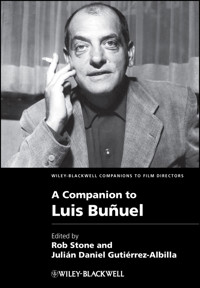
Cover image: Luis Buñuel in 1954. Photo © Getty ImagesCover design by Nicki Averill Design and Illustration
Contributors
Ernesto R. Acevedo-Muñoz is Associate Professor and Chair of Film Studies at the University of Colorado at Boulder. He teaches courses on Latin American and Spanish cinemas, film theory, classical genres, and on directors Luis Buñuel, Pedro Almodóvar, Alfred Hitchcock, and Stanley Kubrick. He is the author of the books Pedro Almodóvar (BFI, 2007) and Buñuel and Mexico: The Crisis of National Cinema (University of California Press, 2003), and his work has appeared in many journals and anthologies including Quarterly Review of Film and Video, Lit, Film & History, Letras peninsulares, After Hitchcock, Authorship in Film Adaptation, and Genre, Gender, Race & World Cinemas.Mieke Bal is a cultural theorist and critic based at the Amsterdam School for Cultural Analysis (ASCA), University of Amsterdam. Her areas of interest range from biblical and classical antiquity to seventeenth-century and contemporary art and modern literature, feminism, migratory culture, and mental illness. Her many books include Of What One Cannot Speak: Doris Salcedo’s Political Art (University of Chicago Press, 2010), A Mieke Bal Reader (University of Chicago Press, 2006), Travelling Concepts in the Humanities (University of Toronto Press, 2002), and Narratology: Introduction to the Theory of Narrative (University of Toronto Press, 3rd edition 2009). Mieke is also a video artist, and co-directed a series of experimental documentaries. She made the video installation “Nothing Is Missing” that continues to be displayed (2006 to present). Her first fiction film, A Long History of Madness, and exhibitions derived from it, are currently touring internationally (with Michelle Williams Gamaker). Occasionally she acts as an independent curator. Her co-curated group exhibition “2MOVE: Video, Art, Migration” traveled to four countries. www.miekebal.orgPaul Begin is Associate Professor of Hispanic Studies at Pepperdine University (Malibu, CA). He has authored various articles on Luis Buñuel’s filmography and cinematic technique. He has also published essays related to social issue cinema in Spain.Tom Conley is the author of An Errant Eye: Poetry and Topography in Early Modern France (University of Minnesota Press, 2011) and Cartographic Cinema (University of Minnesota Press, 2007), and has studied Buñuel in Surrealismo: lectura de “Tierra sin pan” (Valencia, 1988) and other places. He is the translator of works by Marc Augé, Gilles Deleuze, and others. He teaches in Visual & Environmental Studies and in Romance Languages at Harvard University.Sarah Cooper is Reader in Film Theory and Aesthetics at King’s College London, where she is also Head of the Film Studies Department and Deputy Head of the School of Arts and Humanities. She has published widely on French film and theory. Her books include Selfless Cinema?: Ethics and French Documentary (Legenda, 2006) and Chris Marker (Manchester University Press, 2008). She is currently completing a book titled The Soul of Film Theory for BFI/Palgrave Macmillan.Arnaud Duprat de Montero is a former student of the Conservatoire Libre du Cinéma Français and Lecturer at Rennes 2 University. His research focuses on Buñuel’s final films, with a transcultural approach between Hispanic and French cinema. The representation of characters on screen and the precise part that actors play in cinematic creation are also key elements of his research. He is the author of articles on Luis Buñuel, Jean-Claude Carrière, Raúl Ruiz, Pedro Almodóvar, Carlos Saura, Víctor Erice, Vittorio de Sica, Isabelle Adjani, André Téchiné, and Fabrice du Welz. In 2011 he published Le dernier Buñuel (Rennes University Press: Le spectaculaire collection).Peter William Evans is Emeritus Professor of Film Studies at Queen Mary, University of London. He has published widely on Hollywood, British, and Spanish films (especially Buñuel). His most recent book is Top Hat (Wiley-Blackwell, 2010), and he is currently writing a BFI Classic on Douglas Sirk’s Written on the Wind (1956).Wendy Everett is former Reader in Film Studies and French at the University of Bath, and Research Fellow at the Camargo Foundation, Cassis, France. Her principal research interests are in European cinema, and she has published widely in the field, as well as giving lectures and papers around the world. Recent publications include books on colour, identity, and space in European cinema, as well as numerous articles on the fractal narratives of the postmodern, concepts of genre in European film, and the European road movie. She is a member of the editorial board of Literature/Film Quarterly, USA, and The Soundtrack.Sally Faulkner is Senior Lecturer in Hispanic studies at the University of Exeter in the UK. Her research and teaching interests include Spanish cinema, modern Spanish literature, cultural studies, film studies, and adaptation studies. She is the author of Literary Adaptations in Spanish Cinema (Tamesis-Boydell & Brewer, 2004) and A Cinema of Contradiction: Spanish Film in the 1960s (Edinburgh University Press, 2006), and co-editor (with Derek Flitter) of “Memory and Exile in Twentieth- and Twenty-First Century Spanish Culture,” a special edition of the Journal of Iberian and Latin American Research (2011). In 2011 she held a UK Arts and Humanities Research Council Fellowship for a project entitled “A New History of Spanish Cinema: Middlebrow Films and Mainstream Audiences,” and is currently writing A History of Spanish Cinema for Continuum’s European Cinema series.Ramona Fotiade is Senior Lecturer in French at the University of Glasgow. She has recently published several book chapters and co-edited several books and magazine special issues on Surrealist and experimental cinema, in particular the special issue of La Part de l’Oeil devoted to Benjamin Fondane (no. 25–26, 2010–2011), the new critical edition of Fondane’s Ecrits pour le cinéma (Verdier, 2007), as well as contributions to the edited works Quaderni degli studi danteschi – Dante in France (2012), Mélusine XXIX – Le Surréalisme sans l’architecture (2009), and The Unsilvered Screen: Surrealism on Film (Wallflower Press, 2007). In 2010 she contributed several articles on cinema and architecture to the catalogue of The Surreal House exhibition (Barbican Arts Centre, London). Her book Pictures of the Mind: Surrealist Photography and Film and a study of Jean-Luc Godard’s À bout de souffle are forthcoming.Felicity Gee completed her doctoral studies in the Department of Media Arts, Royal Holloway University of London, on the subject of cinematic magic realism and its critical inception in the modernist avant-garde. She has written and presented on a variety of topics related to this research, including the surrealist marvelous, Marxism and geopolitics in magic realism, René Magritte, and F.W. Murnau. She worked previously as a lecturer in English and film studies in Japan, and has recently taught film theory as a visiting lecturer at Royal Holloway.Kate Griffiths is Lecturer in French and Translation at Cardiff University. She has published widely on the adaptation of texts across time and media. Her AHRC-supported monograph, Emile Zola and the Artistry of Adaptation, appeared with Legenda in 2009. She is currently working on a companion volume, supported by the AHRC, on Zola and television as well as a web resource on Zola and radio adaptation.Julián Daniel Gutiérrez-Albilla is Assistant Professor of Spanish at the University of Southern California. His research and teaching interests are in Spanish and Latin American cinema and Spanish cultural studies, critical theory, and psychoanalysis. His article on Almodóvar’s Volver was recently published in the Bulletin of Hispanic Studies and a chapter on Jaime Camino’s Los niños de Rusia was recently published in Spain on Screen: Developments in Contemporary Spanish Cinema (Palgrave Macmillan, 2010). His publications on Spanish and Latin American cinema have appeared in the Bulletin of Latin American Research and the Hispanic Research Journal. His book, Queering Buñuel: Sexual Dissidence and Psychoanalysis in His Mexican and Spanish Cinema, is published with I.B. Tauris. His publications on the cinema of Buñuel have appeared in Visual Synergies in Fiction and Documentary Film from Latin America (Palgrave Macmillan, 2009), Revista del Centro de Estudios en Diseño y Comunicación, Universidad de Palermo, Buenos Aires, Argentina, Revista de Cine, Facultad de Filosofía y Letras, Universidad de Buenos Aires, Argentina, The Journal of Romance Studies, and Gender and Spanish Cinema (Berg, 2004). He has also published on the cinema of Almodóvar in Studies in Hispanic Cinemas and in Almodóvar: el cine como pasión (Ediciones de La Universidad de Castilla La-Mancha, 2003). His research on the cinema of Lucrecia Martel is forthcoming in an edited volume, Hispanic and Lusophone Female Filmmakers:Theory, Practice and Difference (Manchester University Press), which he co-edited with Parvati Nair. He has also published on Almodóvar’s Todo sobre mi madre, in ACompanion to Spanish Cinema, and another chapter on Almodóvar’s La mala educación is forthcoming in A Companion to Almodóvar. His article on Héctor Babenco’s Pixote was published in the Revista de Crítica Literaria Latinoamericana. He is currently working on a book on ethics, trauma, and subjectivity in contemporary Spanish cinema.Jimmy Hay completed his MA in Film Studies at Queen Mary, University of London, before pursuing his doctoral studies at Swansea University with a thesis focused on Neo-melodrama in contemporary European and American independent cinema. He convenes and teaches on a variety of film and media modules and has published several journal articles and chapters in edited volumes on melodrama and contemporary European cinema.Javier Herrera Navarro is the Director of the library in the Filmoteca Española (National Film Archives) in Madrid. He is the author of numerous books on cinematography and has edited and/or collaborated on other books on Spanish film history and Luis Buñuel including Las Hurdes: Un documental de Luis Buñuel (Museo Extremeno e Iberoamericano de Arte Contemporaneo, 1999) and Luis Buñuel: El ojo de la libertad (Residencia de estudiantes, 2000). He has also organized many conferences and seminars on Spanish cinematography and Luis Buñuel’s cinema, as well as having been invited to give lectures on these topics in Europe, Latin America, and the United States.Julie Jones is Professor of Spanish at the University of New Orleans and has published numerous articles related to Luis Buñuel in such journals as Cineaste, Cinema Journal, The Journal of Film and Video, and Hispanic Cinemas. She also supplied the running commentary for the Miramax DVD of Belle de jour.Geoffrey Kantaris is Senior Lecturer in the Department of Spanish and Portuguese of the University of Cambridge and a Fellow of St Catharine’s College. He was Director of the Centre of Latin American Studies in Cambridge from 2005 to 2010 and is currently the Cultural Studies editor of the Bulletin of Latin American Research. His current research is on contemporary urban cinema from Argentina, Colombia, and Mexico, and he has published several articles and book chapters in this area, with a forthcoming book entitled Latin American Film: The Urban Paradigm. He is co-editor of Latin American Popular Culture: Politics, Media, Affect (Boydell & Brewer, 2012). He has also worked and published extensively on women’s writing and dictatorship in Argentina and Uruguay and is author of The Subversive Psyche (Oxford University Press, 1996).Marsha Kinder began her career as a scholar of eighteenth-century English literature before moving to the study of transmedial relations among various narrative forms. She currently is a Professor of Critical Studies in the University of Southern California’s School of Cinematic Arts where she has been teaching since 1980, and where her specialties include Spanish cinema, narrative theory, children’s media culture, database documentaries, and digital culture. She has published over one hundred essays and ten books, including Blood Cinema: The Reconstruction of National Identity in Spain (University of California Press, 1993), Refiguring Spain (Duke University Press, 1997), Playing with Power in Movies, Television and Video Games (University of California Press, 1993), and Kids’ Media Culture (Duke University Press, 1999). Her current book in progress is The Discreet Charms of Database Narrative. She was founding editor of the award-winning journal Dreamworks (1980–1987) and since 1977 has served on the editorial board of Film Quarterly. In 1995 she received the USC Associates Award for Creativity in Scholarship and in 2001 was named a University Professor for her innovative transdisciplinary research. Since 1997 she has directed The Labyrinth Project, a research initiative on database documentaries and digital scholarship, working in collaboration with media artists, filmmakers, scholars, scientists, archivists, students, and cultural institutions. Combining cultural history and theory with the sensory language of the cinematic arts, these database documentaries have been featured at museums, film and new media festivals, and conferences worldwide and have won prestigious awards, including the New Media Invision Award, the British Academy Award for best interactive project in the learning category, and the Jury Award at Sundance for New Narrative Forms. Three Labyrinth projects were featured in ZKM’s “Future Cinema” exhibition in Germany in 2002. Labyrinth’s current work in progress is a website and traveling museum installation called “Jewish Homegrown History: Immigration, Identity and Intermarriage,” which premiered at the Skirball Cultural Center in Los Angeles in 2012. These database documentaries have been supported by grants from the Annenberg, Casden, Ford, Getty, Haas, Irvine, NEH, Righteous Persons, Rockefeller, and Skirball Foundations.Sarah Leahy is Senior Lecturer in French and Film at Newcastle University. She is the author of Casque d’or (I.B. Tauris, 2007), co-editor (with Will Higbee) of Studies in French Cinema: UK Perspectives 1985–2010 (Intellect, 2012), and has published on topics ranging from stardom and femininity in postwar French cinema, the Groupe Octobre, and Agnès Jaoui. She is currently researching screenwriters in French cinema.Amparo Martínez Herranz holds a doctorate in the History of Art and is Lecturer in Film History in the Department of Art History in the University of Zaragoza, Spain. Her research interests have centered upon various aspects of architecture and leisure and she is the author of Los cines en Zaragoza, 1896–1936 (Ayuntamiento de Zaragoza, 1997), El Teatro Principal (Ayuntamiento de Zaragoza, 1999), La arquitectura teatral en Zaragoza. 1875–1939 (Institución Fernando el Católico, 2003), and Los cines de Zaragoza 1939–1975 (El Azar Ediciones, 2005). She has also published on the history of film in Aragón, the links between film and literature, film and history, and the origins of film in Spain. Between 2001 and 2007 she led a research and development project funded by the Spanish Ministry of Education and Science centred on the study of Spanish research archives and collections related to Luis Buñuel. Amongst other outcomes, this task has resulted in various publications, including Gran casino de Luis Buñuel (Universidad de Zaragoza, 2002), El gran calavera y la integración de Luis Buñuel en la industria del cine mexicano (Universidad de Zaragoza, 2003), Susana de Luis Buñuel: subversión y renovación del melodrama (Universidad de La Laguna, 2007), Susana/demonio y carne: de la edad del oro al universo ranchero (Universidad Autónoma de Madrid, 2007), El método de trabajo de Luis Buñuel: en torno al guión técnico de “Él” (Universidad de Zaragoza, 2007), Disciplina y libertad: el proceso creativo de Luis Buñuel (Instituto de Estudios Turolenses, 2008), Un perro andaluz: del “decoupage” a la mariposa (SECC, Ministerio de Cultura, 2009), Nazarín: guiones y genealogía (Edition Tranvía-Verlag Walter Frey, 2011), and Viridiana (Erich Schmidt, 2012). She curated the exhibition “Un perro andaluz, 80 años después” that was hosted in several venues by the Ministry for Culture (SECC) throughout 2009 and 2010. She is currently responsible for a research and development project funded by the Ministry of Science and Innovation for which she coordinates a research team dedicated to the study of the audiovisual culture of late Francoism (1959–1975).Susan McCabe is a Professor of English at the University of Southern California, teaching modernist poetics, gender studies, and film. Her publications include many essays, poems, and reviews. She is the author of Elizabeth Bishop: Her Poetics of Loss (Pennsylvania State University Press, 1994) and Cinematic Modernism: Modern Poetry and Film (Cambridge University Press, 2005) as well as two books of poetry: Swirl (Red Hen Press, 2003) and Descartes’ Nightmare (Utah University Press, 2008), which won the Agha Shahid Ali Prize. She held a fellowship at the American Academy in Berlin in 2011 and serves on the MLA executive division in poetry. She is currently completing a literary biography of Bryher: Female Husband of Modernism, and among her many essays is “Transnational Twins: Bryher and Walter Benjamin.”Ana Moraña was born in Montevideo, Uruguay and worked as a Literature and Spanish Grammar instructor. She holds a PhD in Latin American Literatures and Cultures from the Ohio State University and is an Associate Professor of Spanish at Shippensburg University of Pennsylvania. Her areas of interest are Latin American literatures and cultures (Southern Cone, nineteenth-century, and turn-of-the-century) and Latin American cinema. She has published several articles in peer-reviewed journals.Cristina Moreiras-Menor received her PhD in Spanish Literature from the University of California, Davis. Between 1996 and 2002 she taught Peninsular literature at Yale University. Currently she is Professor of Iberian Literature and Culture and Women’s Studies at The University of Michigan (Ann Arbor), where she specializes in Galician and Spanish literature, Spanish film, cultural theory, and psychoanalysis. She has published extensively on nineteenth- and twentieth-century Spanish literature and film. She is the author of Cultura herida: literatura y cine en la España democrática (Libertarias, 2002), La estela del tiempo: imagen e historicidad en el cine español contemporáneo (Editorial Iberoamericana Vervuert, 2011), and the editor of a monographic issue of the Journal of Spanish Cultural Studies entitled “Critical Interventions on Violence.” With historian Miguel Ángel del Arco Blanco, she is the editor of Constelaciones, a new series of the Editorial Cómares dedicated to publishing outstanding work on Peninsular cultural studies. She is currently working on a book on the cultural history of Galicia and the notion of (national) borders.Sheldon Penn is Lecturer in the School of Modern Languages at the University of Leicester. In addition to the cinema of Luis Buñuel, his main research areas are twentieth-century Mexican literature and contemporary Mexican cinema. He has published a monograph on the Mexican writer Carlos Fuentes (Edwin Mellen, 2003) and his recent and current publications cover diverse fields, from Mexican poetry of the 1930s to the cinema of Carlos Reygadas. All of his work, whether on literature or film, is concerned to situate the primary sources within their intellectual contexts and draws on a wide range of philosophy and critical theory.María Pilar Rodríguez obtained her PhD degree in Romance Languages and Literatures at Harvard University (Cambridge, USA). Until 2002 she was a professor in the departments of Spanish, Comparative Literature, and Women’s Studies at Columbia University (New York), and presently she teaches at Deusto University in San Sebastian. She has published numerous articles and books on literature, film, culture and gender studies, including Vidas im/propias: transformaciones del sujeto femenino en la narrativa española contemporánea (Purdue University Press, 1999), Mundos en conflicto: aproximaciones al cine vasco de los noventa (Universidad De Deusto Press, 2002), and Cultura audiovisual; el cine europeo como espacio para la reflexión social (Diputación Foral de Álava, 2010). She is the winner of the National Essay Prize Carmen de Burgos 2003 with the work titled “Una revisión de la modernidad desde la perspectiva de género: tres relatos de Carmen de Burgos” and of the National Essay Prize Becerro de Bengoa 2005, with the work titled “Extranjeras: migraciones, globalización, multiculturalismo.” She leads the research group on Communication at Deusto University and has co-authored the books Tratamiento de la violencia de género en la prensa vasca (Universidad de Deusto, 2006) and Dirigir en femenino (Lid, 2009). She is the editor of the volumes Cultural and Media Studies: Basque/European Perspectives (Center for Basque Studies, University of Nevada, 2009) and Estudios culturales: panoramas peninsulares (Universidad de Deusto, 2009). She is currently working (with Rob Stone) on a project entitled Basque Cinema: History, Politics, Art.Agustín Sánchez Vidal is Emeritus Professor at the University of Zaragoza, Spain, where he specialises in Spanish literature, film, and other audiovisual media. His more than 50 books on literature, art, and film include Buñuel, Lorca, Dalí: el enigma sin fin (latest edition Planeta, 2009), for which he was awarded the 1988 Espejo de España prize. In 1980 he worked with Luis Buñuel on the edition of his Obra literaria (Literary Works). He has also produced various monographs on Dalí and in 2004 he oversaw the publication of the third volume of his Obras completas (Complete Works) for the publisher Ediciones Destino. He has collaborated on many collective projects on Surrealism and the avant-garde, including Spanish Masterpieces of the 20th Century (Seibu Museum of Art, Tokyo, 1989), The Surrealist Adventure in Spain (Ottawa Hispanic Studies, 1991), The Spanish Avant-garde (Manchester University Press, 1995), and Luis Buñuel’s “The Discreet Charm of the Bourgeoisie” (Cambridge University Press, 1999). He has also contributed to the special volume that the Mostra del Cinema de Venecia (Venice Film Festival) dedicated to Luis Buñuel in 1984 and the monograph on L’Âge d’or published in 1993 by the Centro Pompidou in Paris. He has also collaborated on exhibitions dedicated to Buñuel in the Musuem of Bonn (1994), the Palacio de Bellas Artes in Mexico (1996), and the Centro Reina Sofía in Madrid (1996), as well as various retrospectives dedicated to Salvador Dalí such as “Dalí and Film,” which was organized by the Tate Modern in London in 2008.Libby Saxton is Senior Lecturer in Film Studies at Queen Mary University of London. She is the author of Haunted Images: Film, Ethics, Testimony and the Holocaust (Wallflower, 2008) and co-author (with Lisa Downing) of Film and Ethics: Foreclosed Encounters (Routledge, 2009). She is also co-editor (with Simon Kemp) of Seeing Things: Vision, Perception and Interpretation in French Studies (Peter Lang AG, 2002). She is currently working on a book which explores the ways in which the question of religion has been taken up in postwar European film, and co-editing (with Axel Bangert and Robert Gordon) a volume entitled Holocaust Intersections: Genocide and Visual Culture at the New Millennium (Legenda).Erica Segre is Lecturer in Latin American and Hispanic Studies in the Department of Spanish and Portuguese and the Centre of Latin American Studies at the University of Cambridge, and a Senior Fellow of Trinity College. She was educated at the universities of York and Oxford and taught at the universities of Exeter and Leeds. She has lectured and published extensively on modern and contemporary Mexican visual culture (photography, film, art, illustrated books and periodicals, and representational writing). She is the author of Intersected Identities: Strategies of Visualization in Nineteenth- and Twentieth-Century Mexican Culture (Berghahn, 2007). She has organized international, interdisciplinary symposia on the film and visual culture of Mexico and Latin America, most recently “Ghosts of the Mexican Revolution in Mexican Literature and Visual Culture (Film, Art, Photography)” at Cambridge (2010) and “Site Unseen: Rethinking Interdisciplinary Practice in Contemporary Latin American Art (post-1980)” at Cambridge (2011).Rob Stone is Professor of European Film in the School of Languages, Cultures, Art History and Music at the University of Birmingham where he directs B-Film: The Birmingham Centre for Film Studies. He is the author of Spanish Cinema (Longman, 2001), The Wounded Throat: Flamenco in the Works of Federico García Lorca and Carlos Saura (Edwin Mellen, 2004), Julio Medem (Manchester University Press, 2012), and Walk, Don’t Run: The Cinema of Richard Linklater (Wallflower/Columbia University Press, 2013). He also co-edited (with Graeme Harper) The Unsilvered Screen: Surrealism on Film (Wallflower, 2007) and (with Lisa Shaw) Screening Songs in Hispanic and Lusophone Cinema (Manchester University Press, 2013). He has published widely in academic journals and edited books on Basque, Spanish, European, Cuban, and independent American cinema, and has co-edited (with Paul Cooke) special editions of Studies in European Cinemas, New Cinemas, and Journal of Contemporary European Studies, and (with Julian Preece) Journal of European Studies. He has also contributed articles to Time Out, Cinemascope, and Sight & Sound. In 2012 he was awarded a Leverhulme Trust Major Research Fellowship and is currently writing a monograph on Modernism and cinema, articles on digital filmmaking in Cuba, and working on a project (with María Pilar Rodríguez) entitled Basque Cinema: History, Politics, Art.Sherry Velasco is Professor of Early Modern Spanish Literature and Culture in the Department of Spanish and Portuguese and of Gender and Sexuality in the Gender Studies Program at the University of Southern California, Los Angeles. She is the author of four books: Lesbians in Early Modern Spain (Vanderbilt University Press, 2011), Male Delivery: Reproduction, Effeminacy, and Pregnant Men in Early Modern Spain (Vanderbilt University Press, 2006), The Lieutenant Nun: Transgenderism, Lesbian Desire, and Catalina de Erauso (University of Texas Press, 2000), and Demons, Nausea, and Resistance in the Autobiography of Isabel de Jesús 1611–1682 (University of New Mexico Press, 1996). She has also published numerous articles and book chapters on early modern Spanish prose, theatre, and women’s narrative with special emphasis on gender studies, queer theory, and visual cultural studies.Tom Whittaker is Lecturer in Hispanic Film Studies at the University of Liverpool. He is the author of The Films of Elías Querejeta: A Producer of Landscapes (University of Wales Press, 2011). His research has mainly focused on the relationship between film and geography in Spanish cinema, and his publications have appeared in journals such as Jump Cut, International Journal of Cultural Studies, Journal of British Cinema and Television, and Bulletin of Hispanic Studies, among others. He has published chapters in the volumes Hispanic and Lusophone Women Filmmakers:Theory, Practice and Difference (Manchester University Press, forthcoming) and Screening Songs in Hispanic and Lusophone Cinema (Manchester University Press, 2012). His current research centers on questions of movement and rhythm in Latin American cinema and soundscapes in Spanish cinema.Guy H. Wood is a Professor of Spanish at Oregon State University. He is the author of one monograph, La caza de Carlos Saura: un estudio (Prensas Universitarias de Zaragoza, 2010), and numerous articles on the works of contemporary Spanish novelists, playwrights, poets, and filmmakers. He is also a co-founder of the Cine-Lit Project and the general editor of the conferences’ proceedings.
Acknowledgments
We would like to express our deepest thanks first and foremost to the contributors, whose inspiring work, enthusiasm, collaboration, and patience brought this anthology into being. Similarly, we thank the staff at Wiley-Blackwell for supporting our project from the onset and for their excellent guidance throughout the entire process of editing this volume. We also wish to thank Juan Luis Buñuel for granting the interview that features in this volume dedicated to his father. Javier Herrera Navarro at the Filmoteca Española in Madrid, and the Luis Buñuel Film Institute in Los Angeles deserve our special thanks for facilitating some of the visual material included here. Thanks also to Fernando Carricajo Garrido for assistance with the illustrations. In the lengthy process of co-editing this companion, the editors changed institutions within the United Kingdom and from the UK to the United States. We therefore want to thank our former colleagues and students from Swansea University and Newcastle University in the UK, particularly Ann Davies, Sarah Leahy, Joanna Rydzewska, Jimmy Hay, and Elaine Canning, as well as friends and colleagues from other institutions – Paul Cooke, Peter William Evans, Isabel Santaolalla, Barry Jordan, Chris Perriam, María Pilar Rodríguez, Amparo Martínez Herranz, María Delgado, Paul Julian Smith, Jo Labanyi, and Ana Moraña – for their intellectual inspiration and enduring professional support. We also wish to thank our new colleagues and students at the University of Birmingham in the United Kingdom and at the University of Southern California, USA, particularly Erin Graff Zivin, Marsha Kinder, Roberto Díaz, Sherry Velasco, and Susan McCabe, for their collegiality and interest in this Companion. Special thanks are due to Esther Santamaría Iglesias for compiling the index of this volume. We are also grateful to Ann Lee and Lacey Schauwecker, who contributed translations from Spanish into English of some of the chapters included here and for this we are most grateful. Finally, our deepest gratitude goes to Esther, and to Eduardo and Lilly for their unconditional personal support and patience before, during, and after the production of this edited collection.
None of the images from the Filmoteca Española may be reproduced without explicit permission of the archive.
Introduction
The “Criminal” Life of Luis Buñuel
Rob Stone and Julián Daniel Gutiérrez-Albilla
Don’t ask me my opinions about art, because I don’t have any.
(Buñuel, 1982: 82)
In The Self and Its Pleasures, Carolyn Dean demonstrates that, since 1860, the “criminal” subject has conventionally been used as evidence of deviance and pathological behavior in order to define and to punish forbidden acts (1992). From this perspective, as the above epigraph from Luis Buñuel suggests, criminality designates the limits of the symbolic order and escapes rational conceptualization and representation. Criminality becomes a metaphor for that which it is impossible to symbolize, for that which escapes “that social rationality, that logical order on which a social aggregate is based” (Kristeva, 1982: 65). Buñuel’s life and films therefore seem to encapsulate the implications of the term “criminality” due to their impossibility of being subjected to symbolization. However, if his work has been canonized and hence subjected to fixed symbolization by the numerous studies on his cinema, whether edited volumes or single-authored books in the Anglo-American academy and beyond, how can one engage critically with his oeuvre and yet avoid inserting his ambivalent, paradoxical and elusive films into pre-established critical models that perpetuate their subjection to symbolization? Even at the risk of “vandalizing” the canon, it is the purpose of this volume to revitalize and rejuvenate the study of the films of Buñuel by revising the crucial debates that have conditioned our understanding of his cinema and by offering a plethora of new approaches to his films that reflect and challenge the most relevant recent developments in the humanities in general and in film studies in particular. The chapters that follow thus focus on multiple, interdisciplinary perspectives on his cinema and yet remain faithful to the paradoxical, ambivalent, and heterogeneous nature of Buñuel’s work, thereby avoiding any possibility of reducing his work to fixed critical interpretations. It is to this emphasis on the creative, even emancipatory, potential of the concept of paradox underpinning Buñuel’s life and films that this introduction now turns.
Condemned by the Vatican, exiled by Spain’s Francoist dictatorship, celebrated by the French New Wave and an American Academy Award, as well as a great many filmmakers, Buñuel (1900–1983) is one of the most important, unique, and controversial figures in the history of cinema; but for all his reputation, films, and writings, he remains something of a sly unknown. The apparent coldness and deathly precision which his detractors identify in his films has, perhaps, done little to attract the interest his films deserve in the current generation of film scholars, students, and informed general spectators, who dutifully respect but perhaps do not gleefully engage with his still provocative and controversial work. Buñuel’s great sense of humor is often over-analyzed to the extent that his satire falls flat, for instance. His punch lines are diluted by explanation, and the subversive power of great gags like the tableau vivant of beggars forming a parody of Leonardo da Vinci’s The Last Supper in his scabrous Viridiana (1961) is too often treated as if in a dusty museum case instead of in the spirit of lucid, irreverent response. A knowing nod instead of a hearty guffaw is not the way to be affected by or to truly understand the ambivalent nature of Buñuel’s work.
A Goya for the twentieth century, Buñuel remains something of an enigma that the plethora of academic and critical writing on his life and films has failed to undo entirely. The paradoxes begin with his love–hate relationship with Spain and continue with his exile, which complicates and confuses any notion of national cinema in relation to films that thrive on the volatile mix of sarcasm and sentiment that typifies his best work. A vociferous libertarian, his enduring marriage was characterized by jealousy and prudery. Buñuel was a thoroughbred chauvinist with a passion for embroidery, who despised what became of Spain during the Francoist dictatorship but recreated the most traditional of Iberian households while in exile in Mexico. The greatest Spanish filmmaker, he made only three films in Spain. He boasted of never having made a film that went against his singular vision, but his radicalism is often exaggerated and his outsider status is problematized by the fact that his most interesting work was produced under patronage, such as when claimed by France in the final years of his career. He was a beacon for political dissent, but he left the Communist Party quite early in his cinematic career (see Gubern and Hammond, 2012) and never once thereafter declared an orthodox affiliation to any particular political party. He made films about male desire and his female protagonists were often victims of it, but his films offered magnificent roles for actresses of the caliber of Silvia Pinal, Catherine Deneuve, and Jeanne Moreau. He satirized his own class but was a product of its privileges. He inveigled his spectators in the satire of authority, only to sucker them into identifying with this supposed enemy by reflecting his audience’s own obeisance to good manners and decorum, for, as Gilles Deleuze diagnosed, “in Buñuel, servility is a feature of master as well as servant [and] degradation is the symptom of this universal impulse” (Deleuze, 2005a: 141). He studied Sigmund Freud and applied his teachings to the study of the bourgeois consciousness but also pitied the humanity even in his oppressors, such as General Franco, “kept alive artificially for months at the cost of incredible suffering” (Buñuel, 1982: 256).
To some scholars Buñuel is a bestia negra, for others a cause célèbre. Yet, in decamping to one side or another of this most polemical character, we may fail to realize that his films and persona undercut any possible essentialist definition of what constitutes one’s identity. The black humor, sinful eroticism, sight-gags and overwhelming nihilism of his films is all somewhat archetypically Spanish, having evolved through the centuries of Spanish literature and art that Buñuel devoured. Yet he was also a revolutionary who more than any other artist and filmmaker of the twentieth century seems to encapsulate and to have contributed to the pervasive artistic, political, and theoretical legacy of Surrealism. Consequently, many of the contributors to this volume rethink, both historically and textually, Buñuel’s relationship with Surrealism or rethink Surrealism’s relationship with Buñuel. In so doing, Surrealism is posited both as a historical avant-garde artistic movement as well as an aesthetic and political sensibility that impregnates subsequent cultural practices, including film, throughout the twentieth and twenty-first centuries. Hence, although a deep and wide engagement with Surrealism and its legacies is beyond the scope of this introduction, some basic ideas that underpinned this important artistic movement should be described here.
As is well known, the Surrealists were highly influenced by Freud’s interpretation of dreams and his emphasis on the unconscious. As a result, they were fascinated by dreams as a route to the unconscious and were concerned with achieving immediacy of expression through automatic writing (associated with a method that André Breton himself and Philippe Soupault used in their 1919 text, Les champs magnétiques [Magnetic Fields]) and drawing (associated, for instance, with the drawings produced by André Masson). For the Surrealists, such activities were embraced in order to “circumvent the conscious control of image-making” (Ades and Bradley, 2006: 11). By means of these and other, similar techniques, such as rapid associative thought and experiments with collage, moreover, film appeared as the pliant and receptive artistic media in which to translate in an immediate and uncensored manner the images and ideas of the unconscious that are otherwise repressed in our conscious mind. As Buñuel himself wrote, “a film is like an involuntary imitation of a dream. … The cinema seems to have been invented to express the life of the subconscious” (cited in Mellen, 1978: 105–110). Drawing on Hegelian dialectics, Marxism, the Freudian discovery of the unconscious, and modern literary texts inscribed in “another” logic, from Lautréamont to Mallarmé, to name just a few, the Surrealists considered art in general and film in particular as being ideally suited not only for the representation of dreams but also for replicating at the level of form their process of figuration by means of emphasizing the uncanny and illogical juxtaposition of distant, if not incompatible realities revealed in the field of representation. Thus they conceived of art as a poetic process that mobilized our unexpected encounters with the marvelous in our conscious and unconscious life. Such a formal revolution transcended the sphere of art and went far beyond this historical avant-garde artistic movement. It extended to other social spheres, thus stimulating deep political changes that would subvert the hegemonic, modern bourgeois ideology in the context of a society whose moral values and faith in rational progress had collapsed after the traumatic impact of and destruction caused by the World War I. As a result, the Surrealists believed in the significance of the violent force of desire – a desire for an impossible object that provoked the shattering of one’s subjectivity, defined as l’amour fou. They also celebrated and explored the oneiric dimension of life and the intellectual and artistic creation free from positivist rationality, thereby attempting to liberate themselves from the burden of realist representation and from the aesthetic, moral, and political dictations of the dominant, modern bourgeois society at the psychic and social level. They did this through the use of horror, shock, comedy, the absurd, blasphemy, and violent and erotic imagery, to name just a few tools of Surrealism. As such, Bunuel’s cinema has to be understood vis-à-vis both the development and the dissolution of this avant-garde movement as well as the crucial impact of Surrealism upon subsequent literary, film, and artistic practices and on theoretical debates, such as postmodernism, contemporary queer theory, and gender studies, as well as upon the anarchic, experimental sensibility that would embrace “criminality,” dismiss “art,” and overturn all “isms.”
A Companion to Luis Buñuel thus addresses the relationship between historical analysis and contemporary artistic and theoretical reflection as a way of highlighting and encouraging us to think through the reverberations of Surrealism in Buñuel’s cinema across spaces and times and recent art and critical theory. Buñuel’s cinema seems to illustrate the theories from Surrealists who were crucial participants of this historical avant-garde movement. These include Breton, whose 1924 and 1929 manifestos establish the precepts of this artistic movement sketched above, and, more radically, the dissident Surrealist Georges Bataille, whose magazine, Documents (1929–1930), reflects the subversive energy and the violent confrontation of imagery and ideas associated with a heterodox Surrealism (see Ades and Baker, 2006) even as it refashions the aesthetic and ideological proposals of the earlier surrealist movement. In comparison, Buñuel’s genius was his objectivity, which recognized the suppression of desire in any bourgeois setting, particularly when this corresponded to the hegemony of Catholic societies. To view his films is to undo any possible way of thinking in terms of privileging one term over another within dichotomies. Resonating with Baroque art and literature, Buñuel’s life and cinema, as Carol Armstrong argues in a different context, “tend to keep self-dividing into opposite directions, which themselves never remain binary” (2012: 200). Awareness of this certainly allowed and accounts for the very different approaches undertaken by the contributors to this volume. As a result, we understand that all human life is chaos and the only point of structure in an otherwise hostile universe is this filmmaker’s particular awareness of the conscious and unconscious forms of our existence that continuously confront the struggle between hatred and love, creation and destruction, pleasure and pain, or between desire (eros) and death (thanatos).
A close friend of the poet and playwright Federico García Lorca and one-time collaborator with the artist Salvador Dalí, Buñuel was an inveterate, self-taught filmmaker, who began by editing films with a magnifying glass on a kitchen table and was later fêted by the likes of Alfred Hitchcock and Billy Wilder. However, like Ingmar Bergman, Michelangelo Antonioni, Robert Bresson, and Jean-Luc Godard, Buñuel is too often consigned to a time capsule that on opening requires a critical empathy that is beyond many contemporary spectators. He gave few interviews and despised the critical incarceration of his work, famously deriding in the preface to the published script of Un chien andalou, “this imbecilic crowd that has found beautiful or poetic that which, at heart, is nothing other than a desperate, impassioned call for murder” (Buñuel, 2000: 162), which sets an admittedly severe challenge for a volume such as this. Nevertheless, A Companion to Luis Buñuel is testament to the fact that challenges can inspire as well as inhibit. It begins with this introduction that incorporates biographical details intended to refresh experts and inform newcomers alike and which celebrates what can be identified as the Buñuelian thematic and stylistic motifs in his films; and yet the volume avoids reducing his fascinating cinema to what Peter William Evans identifies as a narrowly auteurist approach (1995: 2). The filmmaker’s biography may integrate and proceed with a discussion of the main themes that emerge in relation to the films but this does not exclude other possible thematics that underpin his often paradoxical and ambivalent work. Thus, although this introduction foregrounds some of the main themes that may elucidate Bunuel’s cinema, the aim is to try not to perpetuate Gwynne Edwards’s association of Buñuel’s cinema with the struggling and opposing forces in the director’s personality – Catholicism and Surrealism – as if these two opposing forces were exclusive in the constitution and formation of the personality or subjectivity of the filmmaker (Acevedo-Munoz, 2003: 3). As Julián Daniel Gutiérrez-Albilla explains in his study of Buñuel (2008), for Edwards Buñuel’s films seem to be direct products of the personal expression of the director’s creative imagination, whereas Sally Faulkner, citing Linda Williams’s psychoanalytic study of Luis Buñuel (1996), claims that this unproblematic critical method mystifies and mythifies the Buñuelian oeuvre, thereby perpetuating a patriarchal epistemology which places the male, genius artist in total control of the meaning of his work. For Faulkner, these interpretations of Buñuel’s cinema are static and ahistorical: “further, the individualism on which this theory is predicated is somewhat at odds with the collective nature of the surrealist movement” (2004: 128).
Proceeding from this, although the chapters in this volume are arranged to some extent chronologically, the reader is advised that Buñuel’s cinema undercuts, paradoxically, any possible linear reading of his films. Instead, this structure aims for a productive tension that encourages the reader to find resonances across chapters, for the focus of this volume is on the critical and theoretical implications of Buñuel’s cinema with regard to the study of each contributor. In other words, using Buñuel’s films as case studies, this volume concentrates on critical discourses and theoretical analyses, thereby exploring new ways of approaching the ambivalent and heterogeneous nature of Buñuel’s cinema and proposing new critical and theoretical interventions and interrogations of it. If, indeed, we critics and academics, aficionados all, are to reveal ourselves as an “imbecilic crowd” for finding beauty and poetry in Buñuel’s impassioned calls to murder, it is entirely in the sense that, as Billy Wilder stated, “an audience is never wrong. An individual member of it may be an imbecile, but a thousand imbeciles together in the dark – that is critical genius” (2012: s.n.).
An Aragonese Dog
Luis Buñuel Portolés (Figure 0.1) was born on February 22, 1900 in Calanda, a town in the province of Teruel, in Aragón, Spain, famous for its annual celebration involving the delirious beating of drums (Figures 0.2, 0.3, and 0.4). He was an unruly prodigy and the eldest of seven children born to the well-to-do Leonardo Buñuel, who had made his fortune from plantations in Cuba, and María Portolés, who gave him two brothers and four sisters. When Luis was still an infant, the family moved to Zaragoza, where the children received a typically disciplined Jesuit education at the private Colegio del Salvador. He was a virile and talented sportsman who inherited the family obsession with guns, but also a precocious scholar and a willful ruffian, whose delight at mischievous anarchy, which would prove itself one of the most characteristic ingredients of his films, led to a beating by a study hall proctor. He subsequently left this Jesuit college, telling his parents he had been expelled, and completed his high school education in a local public school.
Figure 0.1 Luis Buñuel as a young boy. Courtesy of the Filmoteca Española.
Figure 0.2 View of Calanda. Courtesy of the Filmoteca Española.
Figure 0.3 View of Calanda. Courtesy of the Filmoteca Española.
Figure 0.4 The drums of Calanda. Courtesy of the Filmoteca Española.
Nevertheless, aspects of his future career as a filmmaker may be usefully adjudged a prolonged reaction to the privilege and fear that governed education in Spanish society. This prompted his alliance with the first murmurings of atheist existentialism in a devoutly Catholic country. Already, then, he was the Buñuel who would delight in dressing up as a nun and riding trams in order to pinch the bottoms of scandalized ladies, the unruly scholar whose passion for insects inspired a similar appreciation of the workings of humans, whose second thoughts on the dominant Christianity and domineering Catholicism of Spain revealed to him an alternative view of life that was both intensely personal and inevitably anarchic. Still, such restlessness would not find common cause or medium of expression until Buñuel left the provinces in 1917 to enroll in the University of Madrid to study agronomy and industrial engineering, later switching his degree to philosophy. There, in the boisterous kind of Oxbridge that was the Residencia de Estudiantes, a pedagogical experiment promoted by the philosopher Francisco Giner de los Ríos, he met Dalí and Lorca and engaged in an intense kinship that was complicated by Lorca’s homosexuality, Dalí’s asexuality, and Buñuel’s at times brutish machismo, but which also fostered gleeful student pranks, many of which revolved around a pretend Order of the medieval city of Toledo (Figure 0.5). Their friendship and creativity contributed to the tremendous ebullience in philosophy and the arts, in which Freud’s psychoanalytic focus on the structures of condensation and displacement in dreams and their relation to the unconscious and the aforementioned technique of free association (see Colman, 2003: 288) offered a viable alternative way of expression to the oppressive rationality of society; that was, the liberation of otherwise forbidden instinct in creative work and actions.
Figure 0.5 Toledo shortly after the Civil War (note the ruined Alcazar fortress top left). Courtesy of the Filmoteca Española.
Yet, while Bunuel’s indebtedness to the writings of Freud is apparent, some of the most compelling interpretations of his cinema foreground Jacques Lacan’s rereading of Freud’s unconscious in terms of being structured like a language. For instance, focusing on Un chien andalou (An Andalusian Dog, 1929), L’Âge d’or (The Golden Age, 1930), Le Fantôme de la liberté (The Phantom of Liberty, 1974), and Cet obscur objet du désir (That Obscure Object of Desire, 1977), Linda Williams foregrounds the mise en scène of desire in order to demonstrate that Buñuel’s films are analogous to dream structures and how they relate to the unconscious. For Williams, Buñuel’s films disrupt the spectator’s identification with the diegetic image, thus foregrounding the signifier. As such, Williams convincingly argues that the “Surrealists’ interest in film arose not from the power of motion photography to create the illusion of diegetic time and space, but from the power of the image to structure this time and space into radically different forms” (1981: 143). Another Lacanian reader of Buñuel’s cinema is Paul Sandro, who has primarily concentrated on the way in which Buñuel “perverts classical narrative structures through their violations of the conventions of spectatorship and wish fulfilment” (cited in Acevedo-Muñoz, 2003: 2). For Sandro, Buñuel’s films disrupt cinematic representation by means of perturbing the specular position that they had initially determined for the spectator. Tracing a recurrent theme in most of Buñuel’s films, Sandro contends that Buñuel’s films establish a productive tension between the subject’s desire and teleological aims and the contingent intrusions which endlessly prevent the subject’s desires and projects from realizing itself or from achieving a certain form of closure. If this can be a central theme in Buñuel’s cinema, it is at the level of cinematic form (such as an emphasis on a lack of linear, cause–effect narrative structure), that both foregrounds the constructed nature of representation and reflects or illustrates our frustrating desires for interpretation (Sandro, 1988).
Yet, Buñuel’s cinema cannot be reduced to a Lacanian psychoanalytic emphasis on lack and castration and the privileging of the phallic signifier. If Deleuze has become a major influence in current film theory, it is worth underlining here the way in which Deleuze, together with Guattari, undid Lacanian psychoanalysis from within to rethink Bunuel’s cinema beyond Freudian and Lacanian psychoanalytic models. Deleuze and Guattari have attacked Lacanian psychoanalysis for remaining within the family framework. Although they do not totally break with the psychoanalytic paradigm (in fact Guattari was trained by Lacan and remained a member of Lacan’s École Freudienne de Paris and a practicing analyst even after the 1972 publication of Capitalisme et schizophrénie 1: L’anti-Œdipe), Deleuze and Guattari propose a theory of desire that moves beyond the “privatized” individual psyche located within the Freudian Oedipal family. Their conception of desire is not contingent upon binary categories and exclusions, nor is it connected with lack, as in Lacan. Hence, we may rethink Buñuel’s cinema as a springboard for reflecting upon the subject’s liberation from his/her neurosis by privileging Deleuze’s and Guattari’s focus on the “schizos/flows” within, between and through partial subjects, thereby transforming the Freudian unconscious from a figurative or structural repository of repressed wishes into a revolutionary interaction of intensities. As a result, it would appear that Buñuel’s films challenge an orthodox psychoanalytic practice and theory that insists on the codification of the unconscious by privileging the productive freedom of the signifier instead.
A Golden Age
It is important to recall that film was a relatively new medium when it appeared to Buñuel, who even in the company of Dalí and Lorca professed to dislike painting and most poetry, as an innovative medium and the ideal canvas for the expression of his own ideas and ambitions. In the 1920s, however, Spain was stagnating somewhat in the context of an otherwise rapidly progressive world, one to which Buñuel, perhaps even more than Lorca and Dalí, belonged. Therefore, after graduating in 1925, the year of his father’s death, he moved to Paris and worked in an administrative capacity for the International Society of Intellectual Cooperation. Thriving in Paris, he secured the position of second assistant director to the filmmaker, critic, and theorist Jean Epstein on the films Mauprat (1926) and La Chute de la maison Usher (The Fall of the House of Usher, 1928) and also assisted Mario Nalpas on La Sirène desTropiques (The Siren of the Tropics, 1927) starring the African American singer and erotic dancer Josephine Baker. It was during this time as apprentice filmmaker that he also began writing and frequenting rarefied circles that gave rise to the notion of his actually making a film that would serve as calling card and, furthermore, as the sudden, unforeseen savior of the increasingly threadbare surrealist movement. Inviting Dalí to visit him in Paris on the promise that he would meet Pablo Picasso, Buñuel and he set about making the deliberately absurd, tragic, disturbing, and precious Un chien andalou, an 18-minute two-reeler, funded by his mother, that redefined cinema. Un chien andalou is nonsense played out as a series of threatened and threatening glances – double takes in search of an absent punch line (Figure 0.6).
The scandalous success of Un chien andalou




