


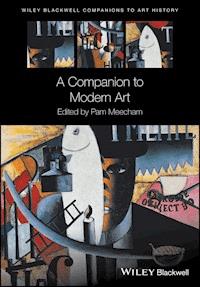
A Companion to Modern Art E-Book
177,99 €
Mehr erfahren.
- Herausgeber: John Wiley & Sons
- Kategorie: Geisteswissenschaft
- Serie: Blackwell Companions to Art History
- Sprache: Englisch
A Companion to Modern Art presents a series of original essays by international and interdisciplinary authors who offer a comprehensive overview of the origins and evolution of artistic works, movements, approaches, influences, and legacies of Modern Art.
- Presents a contemporary debate and dialogue rather than a seamless consensus on Modern Art
- Aims for reader accessibility by highlighting a plurality of approaches and voices in the field
- Presents Modern Art’s foundational philosophic ideas and practices, as well as the complexities of key artists such as Cezanne and Picasso, and those who straddled the modern and contemporary
- Looks at the historical reception of Modern Art, in addition to the latest insights of art historians, curators, and critics to artists, educators, and more
Sie lesen das E-Book in den Legimi-Apps auf:
Seitenzahl: 1458
Veröffentlichungsjahr: 2017
Ähnliche




















WILEY BLACKWELL COMPANIONS TO ART HISTORY
These invigorating reference volumes chart the influence of key ideas, discourses, and theories on art, and the way that it is taught, thought of, and talked about throughout the English-speaking world. Each volume brings together a team of respected international scholars to debate the state of research within traditional subfields of art history as well as in more innovative, thematic configurations. Representing the best of the scholarship governing the field and pointing toward future trends and across disciplines, the Blackwell Companions to Art History series provides a magisterial, state-of-the-art synthesis of art history.
A Companion to Contemporary Art since 1945
edited by Amelia Jones
A Companion to Medieval Art
edited by Conrad Rudolph
A Companion to Asian Art and Architecture
edited by Rebecca M. Brown and Deborah S. Hutton
A Companion to Renaissance and Baroque Art
edited by Babette Bohn and James M. Saslow
A Companion to British Art: 1600 to the Present
edited by Dana Arnold and David Peters Corbett
A Companion to Modern African Art
edited by Gitti Salami and Monica Blackmun Visonè
A Companion to Chinese Art
edited by Martin J. Powers and Katherine R. Tsiang
A Companion to American Art
edited by John Davis, Jennifer A. Greenhill and Jason D. LaFountain
A Companion to Digital Art
edited by Christiane Paul
A Companion to Dada and Surrealism
edited by David Hopkins
A Companion to Public Art
edited by Cher Krause Knight and Harriet F. Senie
A Companion to Islamic Art and Architecture, Volume 1 and 2
edited by Finbarr Flood and Gulru Necipoglu
A Companion to Modern Art
edited by Pam Meecham
This edition first published 2018© 2018 John Wiley & Sons, Inc.
All rights reserved. No part of this publication may be reproduced, stored in a retrieval system, or transmitted, in any form or by any means, electronic, mechanical, photocopying, recording or otherwise, except as permitted by law. Advice on how to obtain permission to reuse material from this title is available at http://www.wiley.com/go/permissions.
The right of Pam Meecham to be identified as the author of the editorial material in this work has been asserted in accordance with law.
Registered OfficeJohn Wiley & Sons, Inc., 111 River Street, Hoboken, NJ 07030, USA
Editorial Office9600 Garsington Road, Oxford, OX4 2DQ, UK
For details of our global editorial offices, customer services, and more information about Wiley products visit us at www.wiley.com.
Wiley also publishes its books in a variety of electronic formats and by print-on-demand. Some content that appears in standard print versions of this book may not be available in other formats.
Limit of Liability/Disclaimer of WarrantyWhile the publisher and authors have used their best efforts in preparing this work, they make no representations or warranties with respect to the accuracy or completeness of the contents of this work and specifically disclaim all warranties, including without limitation any implied warranties of merchantability or fitness for a particular purpose. No warranty may be created or extended by sales representatives, written sales materials or promotional statements for this work. The fact that an organization, website, or product is referred to in this work as a citation and/or potential source of further information does not mean that the publisher and authors endorse the information or services the organization, website, or product may provide or recommendations it may make. This work is sold with the understanding that the publisher is not engaged in rendering professional services. The advice and strategies contained herein may not be suitable for your situation. You should consult with a specialist where appropriate. Further, readers should be aware that websites listed in this work may have changed or disappeared between when this work was written and when it is read. Neither the publisher nor authors shall be liable for any loss of profit or any other commercial damages, including but not limited to special, incidental, consequential, or other damages.
Library of Congress Cataloging-in-Publication Data
Names: Meecham, Pam, editor.Title: A companion to modern art / edited by Pam Meecham, UCL Institute of Education, University College London.Description: 1st edition. | Hoboken : Wiley, 2017. | Series: Wiley Blackwell companions to art history ; 13 | Includes bibliographical references and index. |Identifiers: LCCN 2017014340 (print) | LCCN 2017016070 (ebook) | ISBN 9781118639870 (pdf) | ISBN 9781118639801 (epub) | ISBN 9781118639849 (cloth)Subjects: LCSH: Art, Modern.Classification: LCC N6350 (ebook) | LCC N6350 .C55 2017 (print) | DDC 709.04–dc23LC record available at https://lccn.loc.gov/2017014340
Cover Image: © Photo SCALA, Florence. Malevic, Kasimir (1878–1935): Englishman in Moscow. Amsterdam, Stedelijk Museum. © 2016, DeAgostini Picture Library
10 9 8 7 6 5 4 3 2 1
CONTENTS
Acknowledgments
Notes on Contributors
Introduction
Authors
Audience for the
Companion
Time-frame
Organization of the Book
Conclusion
Notes
References
Part I: Ancient & Modern
Chapter 1: Revitalizing Romanticism; or, Reflections on the Nietzschean Aesthetic and the Modern Imagination
Being Vital
The Dionysian Creator
The Rebirth of Vitality
Locus and Labyrinth: Dancing and Dreaming
Notes
References
Chapter 2: A Cartography of Desires and Taboos: The Modern Primitive and the Antipodes
Conclusion
Notes
References
Chapter 3: Primitive/Modern/Contemporary
Part One: Cave-Men in Sports Cars
Part Two: Under New Management
Notes
References
Chapter 4: Did Modernism Redefine Classicism? The Ancient Modernity of Classical Greek Art
Notes
References
Chapter 5: Robert Goldwater and the Search for the Primitive: The Asmat Project at the Museum of Primitive Art
The Creation of Twentieth-Century Primitivism
The Museum of Primitive Art
An Unrivalled Collection of the Arts of New Guinea2
Acknowledgments
Notes
References
Chapter 6: Surrealist Ireland: the Archaic, the Modern and the Marvelous
Surrealism, Ireland, and the Marvelous
Surrealism in Ireland
Leonora Carrington and the Diasporic Twilight
Shifting Cartographies: Surrealism and Contemporary Irish Art
Alice Maher
Gerard Byrne
Conclusion
Notes
References
Part II: Displaying the Modern
Chapter 7: Picturing the Installation Shot
The Installation of the Installation Shot
The Domains of the Installation Shot
The Shock of the Installation Shot?
The Modernist Exhibition Established?
Notes
References
Chapter 8: Contemporary Displays of Modern Art
Convoluted Chronologies
“The Call of the Canon” (Halbertsma 2007, 16)
“A Familiar Anxiety of Influence” (Stephens 2014)
Continuity and Change
Audiences and Value Neutral Exhibitions
Delegitimizing a Critical Paradigm
“From the Infinite Unmapped” (Curtis 2015, 134)
The Return of the Museum as Laboratory
Notes
References
Chapter 9: Camera-Eye: Photography and Modernism
Photography and Modernity
Photography and Mass Reproduction
New Ways of Seeing
Photography, Art, Revolution
Modern Photography and the Art Museum
In Summary
Notes
References
Chapter 10: Photographic Installation Strategies En-bloc and In-the-round
Documentation
Encyclopedic Alterations
Installation and Spatial Orientation of the Work
Viewing Relations
Notes
References
Chapter 11: Documenta 6: Memories of Another Modernism
Modernism as Panacea
Modernism as Cold War Weapon
Socialist Realism and Other Modernisms
Abstraction Set Against Realism
Modernisms Transecting the Border
Differing Vocabularies
The “Defector Dialectic”
Forgotten Vocabulary
Modernisms Redacted or Modernism Restored
Notes
References
Part III: Re-assessments: Modernism and Globalization
Chapter 12:
Bijiasuo
and Truth: Modernism Reassessed in an Era of Globalization
Deserting
Dislocating
Declaiming
Dividing
Departing
Notes
References
Further Reading
Chapter 13: Extensive Modernity: On the Refunctioning of Artists as Producers
The Impossibility of a Break
The Postmodern Parenthesis
Artists as Producers in Extensive Modernity
The Avant-garde in Extensive Modernity: Towards the Organization on Defeat
Notes
References
Chapter 14: Architecture's Modernisms
Introduction
Vienna 1910: Ornament and Crime
Hollywood 1922: The Kings Road House
Paris 1923: Vers une Architecture
Dessau: 1925–1926
Rio de Janeiro: 1939
Richmond, California: 1942
Chicago: 1951
Brasília: 1960
Glasgow: 1962
St Louis, Missouri: 1972
IKEA Wuhan, China 2014
Notes
References
Chapter 15: The Wide Margins of the Century: Rural Modernism, Pastoral Peasants, and Economic Migrations
The Peasant and Modern Art
The Idea of the Pastoral
John Berger and Jean Mohr and the Figure of the Peasant
Contemporary Resonances
Notes
References
Chapter 16: Destabilizing Essentialism through Localizing Modernism
Introduction
In Search of Pluralized Narratives of Modernism
Isamu Noguchi: From the “Universal” to a “Japanese-American”
Revisiting the Artist Image as a “Traveler”
Noguchi in Beijing6
To Japan
Conclusion
Acknowledgments
Notes
References
Part IV: Locating Modernism: Multiple Modernisms and Nation Building
Chapter 17: The Many Modernisms of Australian Art
Defining Australian Modernism1
National Identity in Australian Culture
Modernism, Monuments, and National Identity in Australian Art
Notes
References
Chapter 18: Greek-Cypriot Locality: (Re) Defining our Understanding of European Modernity
Introduction
Modernity Denied: Gazing at Cyprus from
Afar
and from
Within
Modernity Expressed: Vernacular Photography and a Changing Island
Modernity and the West: The Beginnings of an Alter-modernity
Colonialism and the Emergence of National Consciousness
An Organized Left and Societal Modernization
Conclusions
Acknowledgments
Notes
References
Chapter 19: A Northern Avant-garde: Spaces and Cultural Transfer
Stockholm and the International Art Market
Académie Matisse and the Formation of “The Men of 1909”
Cubism in Retrospect – Siri Derkert (1888–1973)
Modernism and Abstraction – Hilma af Klint (1862–1944)
The Baltic Exhibition 1914
Notes
References
Chapter 20: Modernisms, Genealogy, and Utopias in Finland
Introduction
Electricity Ushering in a New Way of Life
Utopian Fantasies
Images of the Modern and the Heroicized Narrative of Modernism
Notes
References
Chapter 21: The Engaged Artist: Considerations of Relevance
Introduction
Case Study: Harlem Hospital's New Mural Pavilion and
The Pursuit of Happiness
Abstract Murals
Case Study: LaGuardia Airport's Marine Air Terminal and Newark Airport
Two Lesser-known Transitional Artists: Max Spivak (1906–1981) and Seymour Fogel (1911–1984)
Postwar Transitions
Philip Evergood, Ben Shahn, and Peter Blume
Notes
References
Chapter 22: Visualizing Figures of Caribbean Slavery through Modernism
Evaluating Art's Commemorative Efficacy
Conflict and Visualization
Conclusions: Heroism, Modernism, and Blind Faith in Art
Acknowledgments
Notes
References
Part V: The Modern Artist, the Modern Child, and a Modern Art Education
Chapter 23: A Modern Art Education
The Tail End of the Tale
Some Art Lessons
Institutionalizing Ambiguity
Fables and Early Educational Reform
Modern Art Education at a Cross-roads
Art Education and the Beautification of the World
The Child
Teacher Training
When Invention Overtook Imitation
On Seeing and Seers
Conceptual Leaps
Why Art is Taught
Art, A Language?
Retreats from the Center
Conclusion
A Tale of Two Centuries…
Notes
References
Further Reading
Chapter 24: Misrecognition: Child's Play, Modern Art, and Vygotskian Psychology
Preamble
Introduction
Premise
Play
Working Definition
Strategies of Play within Modernism
Re-thinking Cubism
Collaboration and Improvisation
Play as Improvisation
Conclusion
Notes
References
Chapter 25: MoMA and the Modern Child: The Critical Role of Education Programming in MoMA's Modernism
Constructing the Modern Child
A Progressive Foundation for MoMA
The Young People's Gallery
The Children's Art Carnival
“An American Gift to the Indian Child”
Notes
References
Chapter 26: Paul Cézanne's
Young Girl at the Piano – Overture to
“Tannhäuser” or
“Le Haschisch des femmes”
Introduction
Conditions of Production
Girls and Pianos in Nineteenth-Century France
Modern Youth, Modern Girls
Wagner's Tannhäuser
Interiorities: The Female Pianist and Modernist Painters
The Hysterical Pianist
Cézanne and the Family
Cézanne and Modernism
Coda:
Le Haschisch des Femmes
Notes
References
Index
EULA
List of Figures
Chapter 1
Figure 1.1
Charles Ricketts, Illustration to accompany Theodore J. Sheldon's poem, for the Shelley Centenary (1892). Published in
The Magazine of Art
(1892) Volume 16.
Source
: Private Collection.
Figure 1.2
Edvard Munch,
The Sun
(1909–1911). Oslo, University Hall.
Source
: © 2016. Photo Scala, Florence.
Figure 1.3
Hannah Hoch,
Cut with the Kitchen Knife through the Last Weimar Beer-Belly Cultural Epoch of Germany
, photomontage and collage with watercolour, 44–7/8 × 35–7/16
″
, 1919–20. Berlin, Nationalgalerie.
Source
: akg-images/Erich Lessing/© DACS 2016.
Chapter 2
Figure 2.1
“Le monde au temps des surrealistes,” in
Variétés
, Hors Serie, Giugno, 1929, pp. 26–27. New York, Museum of Modern Art (MoMA).
Source
: © 2016. Digital image, The Museum of Modern Art, New York/Scala, Florence.
Figure 2.2
Len Lye, film still
Tusalava
, 1929.
Source
: Stills Collection, Ngā Taonga Sound & Vision. TUSALAVA (1929). Courtesy of the Len Lye Foundation.
Figure 2.3
Rohan Wealleans,
Paint Ritual
(2009), Performance for “The 6th Asia Pacific Triennial of Contemporary Art” (APT 6), Gallery of Modern Art, Brisbane.
Source
: Photograph: Ray Fulton, QAGOMA. Image courtesy: The artist and Queensland Art Gallery|Gallery of Modern Art.
Chapter 3
Figure 3.1
Ernst-Ludwig Kirchner,
Male Figure (Adam)
(1920–21). Carved wood, h. 169.6; w. 40; D. 31cm, Stuttgart, Staatsgalerie.
Source
: akg-images.
Figure 3.2
Arsène Matton,
Belgium Brings Security to the Congo
, 1910–22. Royal Museum for Central Africa, Tervuren.
Source
: HO.0.1.332, collection RMCA Tervuren; photo Jo Van de Vyver, © RMCA Tervuren.
Figure 3.3
Foreign Exchange (or The Stories You Wouldn't Tell a Stranger)
, exhibition installation view. Weltkulturen Museum, Frankfurt.
Source
: Weltkulturen Museum Frankfurt/Main, photo: Wolfgang Günzel 2013.
Chapter 4
Figure 4.1
Pablo Picasso,
Pipes of Pan
, oil on canvas, 205 × 174 cm, 1923. Paris, Musée Picasso.
Source
: © 2016. Photo Scala, Florence/© Succession Picasso/DACS, London 2016.
Figure 4.2
Herakles the Archer, east pediment of the Temple of Aphaia, Aegina,
c
. 480–70 BC. Marble, h. 79 cm (as restored by Bertel Thorvaldsen). Glyptothek, Munich.
Source
: Photo by CM Dixon/Print Collector/Getty Images.
Figure 4.3
Antoine Bourdelle,
Herakles the Archer
, bronze, h. 248 cm, 1909. Paris, Musée d'Orsay.
Source
: Photo © RMN (Musée d'Orsay)/Adrien Didierjean.
Chapter 5
Figure 5.1
Michael Rockefeller display at the Metropolitan Museum of Art, New York.
Source
: © Hemis/Alamy Stock Photo.
Figure 5.2
Press event relating to the donation of the Museum of Primitive Art to The Metropolitan Museum of Art, May 1969. Portrait (left to right): Robert Goldwater, Thomas Hoving, Douglas Newton, Nelson A. Rockefeller. Standing in front of Asmat carved shields. The Metropolitan Museum of Art, New York.
Source
: © Photograph by Michael Fredericks. Image courtesy The Metropolitan Museum of Art, New York. Image copyright © The Metropolitan Museum of Art. Image source Art Resource, NY.
Chapter 6
Figure 6.1
Leonora Carrington,
The Sidhe, The White People of the Tuatha Dé Danann
, oil on canvas, 59.5 × 78.5 cm, 1954. Private Collection.
Source
: Photo from Leonora Carrington, exh. cat. Ediciones Era, Mexico, 1974 / © Estate of Leonora Carrington / ARS, NY and DACS, London 2016.
Figure 6.2
Alice Maher,
The Double
, 2009. Video animation. Sound by Trevor Knight. 5 min 5 sec.
Source
: © Alice Maher.
Figure 6.3
Gerard Byrne,
A Man and a Woman Make Love
(2012). Multi-channel projection. Duration: variable loop of approx. 19 min. Commissioned by dOCUMENTA 13, Kassel, 2012.
Source
: Courtesy of Gerard Byrne Studio.
Chapter 7
Figure 7.1
Gustave Le Gray,
The Salon of 1852
, 1st Floor Gallery, salted paper print from waxed-paper negative, 24 × 37 cm, 1852. Paris, Musée d'Orsay.
Source
: Photo © RMN-Grand Palais (Musée d'Orsay) / Hervé Lewandowski.
Figure 7.2
Installation view of the Brücke exhibition at the Karl-Max Seifert showroom, Dresden-Löbtau, 1906.
Source
: Courtesy Neue Galerie New York.
Figure 7.3
Installation view of the Ninth Street Show, 1951, photo by Aaron Siskind.
Source
: Leo Castelli Gallery records,
c.
1880–2000, bulk, 1957–1999. Archives of American Art, Smithsonian Institution. / Aaron Siskind © Aaron Siskind Foundation / Willem de Kooning © The Willem de Kooning Foundation / Artists Rights Society (ARS), New York and DACS, London 2016; Franz Kline © ARS, NY and DACS, London 2016.
Chapter 8
Figure 8.1
Museu de Arte de São Paulo, exhibition view, 2015.
Source
: Museu de Arte de Sao Paolo, photo by Eduardo Ortega./Emiliano Di Cavalcanti: © DACS 2016; Marie Laurencin, Fernand Leger, André Lhote: © ADAGP, Paris and DACS, London 2016; Anita Malfatti: © Estate of Anita Malfatti; Pablo Picasso: © Succession Picasso/DACS, London 2016; Candido Portinari: Portinari, Candido/© DACS 2016; Diego Rivera: © Banco de México Diego Rivera Frida Kahlo Museums Trust, Mexico, D.F./DACS 2016.
Figure 8.2
IRWIN,
Retroavantgarde
, 120 × 200 cm, mixed media, 1996. First exhibited in January 1997 in Kunsthalle Wien.
Source
: Courtesy: Galerija Gregor Podnar.
Chapter 9
Figure 9.1
André Kertész,
Fork
, Paris, 1928.
Source
: © Estate of André Kertész/Higher Pictures.
Figure 9.2
Tina Modotti,
Worker's Hands
, 1926. Platinum/palladium print, 7 1/2 × 8 7/16′ (19 × 21.5 cm). New York, Museum of Modern Art (MoMA).
Source
: Anonymous gift. 346.1965 © 2016. Digital image, The Museum of Modern Art, New York/Scala, Florence.
Figure 9.3
Berenice Abbott,
Broadway and Rector from Above
, New York, 1935.
Source
: Photo by Berenice Abbott/Getty Images.
Chapter 9
Figure 10.1
Gerhard Richter walking along
48 Portraits
(1972). Installed in German Pavilion at Venice Biennale with portrait of Kafka in the center, June 1972.
Source
: © Gerhard Richter 2016.
Figure 10.2
Photo version of
48 Portraits
(1972). Installed at Museum Ludwig,
c.
1986.
Source
: © Gerhard Richter 2016.
Chapter 11
Figure 11.1
Lee Miller in Hitler's Bathtub, Munich, Germany 1945
, by Lee Miller with David E. Scherman.
Source
: © Lee Miller Archives, England 2016. All rights reserved. www.leemiller.co.uk.
Chapter 12
Figure 12.1
Pablo Picasso,
Nude on Black Armchair
, oil on canvas, 162 × 130 cm, 1932. Private collection. Bought in 1999 by Les Wexner donated to the Wexner Center for the Arts.
Source
: © 2016. Christie's Images, London/Scala, Florence/© Succession Picasso/DACS, London 2016.
Figure 12.2
Anti-violence against women mural at J. Nehru University, Delhi, India.
Source
: Photo Jonathan Harris (2014).
Chapter 13
Figure 13.1
Paolo Woods,
Chinafrica
, photo series, 2007.
Source
: Paolo Woods/INSTITUTE.
Chapter 14
Figure 14.1
Ludwig Mies van der Rohe, 860 Lakeshore Drive, Chicago, 1951.
Source
: Photo Richard J. Williams/© DACS 2016.
Figure 14.2
Oscar Niemeyer and Lucio Costa, Praça dos Três Poderes, Brasília, 1960.
Source
: Photo Richard J. Williams/© NIEMEYER, Oscar/DACS 2016.
Chapter 15
Figure 15.1
Jean-François Millet,
Gleaners
(1857). Oil on canvas, h. 83.5 cm; w. 110 cm, Paris, Musée d'Orsay.
Source
: © The Art Archive/Alamy Stock Photo.
Figure 15.2
Jean Mohr,
Turkish Workers Being Medically Examined by German Doctors, Istanbul
. From John Berger and Jean Mohr,
A Seventh Man
(1975).
Source
: © Jean Mohr, Musée de l'Elysée, Lausanne.
Figure 15.3
Neville Gabie,
Canteen – Cabot Circus
, 2008.
Source
: courtesy the artist and Danielle Arnaud.
Chapter 16
Figure 16.1
Constantin Brâncuşi,
Léda
, polished bronze and nickel, 53 × 79 × 24cm, 1926. Paris, Centre Pompidou – Musée National d'Art Moderne – Centre de Création Industrielle.
Source
: Photo © Centre Pompidou, MNAM-CCI, Dist. RMN-Grand Palais/Bertrand Prévost./© Succession Brâncuşi – All rights reserved. ADAGP, Paris and DACS, London 2016.
Figure 16.2
Isamu Noguchi,
Chinese Girl (Girl Reclining on Elbow)
, terracotta, 1930 (cast 1931). The Isamu Noguchi Foundation and Garden Museum, New York.
Source
: Photo The Isamu Noguchi Foundation and Garden Museum, New York/© The Isamu Noguchi Foundation and Garden Museum/ARS, New York and DACS, London 2016.
Chapter 17
Figure 17.1
Grace Cossington Smith,
The Sock Knitter
(1915). Oil on canvas, 61.6 × 50.7 cm. Art Gallery of New South Wales, Sydney, Australia.
Source
: Art Gallery of New South Wales, Sydney, Australia/Bridgeman Images/© Estate of Grace Cossington-Smith.
Figure 17.2
Sidney Nolan,
Ned Kelly
(1946). Enamel paint on composition board, 90.8 × 121.5 cm. National Gallery of Australia, Canberra.
Source
: National Gallery of Australia, Canberra/Gift of Sunday Reed 1977/Bridgeman Images.
Chapter 18
Figure 18.1
Ioannis Kissonergis,
Turk with Nargile
, watercolour, 34 × 16cm, 1945–48. State Gallery of Contemporary Cypriot Art, Nicosia.
Source
: State Gallery of Contemporary Cypriot Art, Nicosia. © Michalis Kissonergis.
Figure 18.2
Costas Stathis,
In the Coffee Shop VII
, oil on board, 44 × 30cm. Collection Stathis Orphanides. Costas Stathis was a painter of scenery and people in the village of Askas, where he spent the last thirty-five years of his life. The artist was a regular visitor of the local coffee shop, which would double as a grocery store, either to drink a cup of herbal tea and play cards with his co-villagers or to paint a coffee-house scene.
Source
: Photo courtesy of Stathis Orphanides.
Figure 18.3
Loukia Nicolaidou:
Nude
, oil on canvas, 103 × 70.5cm, 1933–36. Limassol Municipal Gallery.
Source
: Photo Limassol Municipal Gallery. Courtesy estate of the artist.
Chapter 19
Figure 19.1
Arvid Fougstedt,
Matisse's School
(1910). From left: Carl Palme, Rudolf Levy, Henri Matisse, Arthur Percy, Sigrid Hjertén, Leander Engström, Isaac Grünewald, Einar Jolin, Per Krogh och Birger Simonsson. Indian ink on paper. Borås Konstmuseum.
Source
: Borås Konstmuseum/© DACS 2016.
Figure 19.2
Siri Derkert,
Self Portrait
, oil on canvas, 1915. Moderna Museet, Stockholm.
Source
: Photo: Moderna Museet, Stockholm/© DACS 2016.
Figure 19.3
Hilma af Klint, installation shot,
Paintings for the Temple: The Ten Largest
, 1907. Moderna Museet, Stockholm, 16 February to 26 May 2013.
Source
: Photo: Åsa Lundén/Moderna Museet, Stockholm.
Chapter 20
Figure 20.1
Torsten Wasastjerna,
The Skating Rink in the North Harbour of Helsinki
, gouache, 1890s. Helsinki City Museum.
Source
: © Helsinki City Museum.
Figure 20.2
Greta Hällfors-Sipilä,
Same Day's Evening at Tiva's and Halle's. Björn and Fagi Singing Together
, 1930, watercolour, gouache and pencil on paper, 24 × 20 cm, Ateneum Art Museum.
Source
: Photo: Finnish National Gallery/Hannu Karjalainen/© DACS 2016.
Chapter 21
Figure 21.1
Charles Alston,
Modern Medicine
, 1940. Harlem Hospital Center.
Source
: Photo and mural conservation Evergreene Architectural Arts. Courtesy of Harlem Hospital Center, New York City.
Figure 21.2
Ilya Bolotowsky, mural in former Roosevelt Island Hospital, 1941.
Source
: Collection of the Public Design Commission of the City New York/© Estate of Ilya Bolotowsky/DACS, London/VAGA, NY 2016.
Figure 21.3
Peter Blume,
The Rock
, 1944–1948, oil on canvas, 146.4 × 188.9cm. Art Institute of Chicago.
Source
: Art Institute of Chicago, IL, USA/De Agostini Picture Library/Bridgeman Images/© The Educational Alliance, Inc./Estate of Peter Blume/VAGA, NY/DACS, London 2016.
Chapter 22
Figure 22.1
Aubrey Williams,
Revolt
, oil on canvas, 134 × 165cm, 1960. National Gallery of Guyana.
Source
: © Estate of Aubrey Williams. All rights reserved, DACS 2016.
Figure 22.2
Philip Moore,
1763 Monument
, h. 4.9 m, 1976. Plinth by architect Albert Rodrigues, h. 5.9 m. Sited on Vlissengen Road, Georgetown, Guyana.
Source
: Leon Wainwright. By kind permission of the National Trust of Guyana.
Chapter 23
Figure 23.1
John Latham,
Art & Culture
, 1966–1969. Assemblage: leather case containing book, letters, photostats, etc., and labeled vials filled with powders and liquids, 3 1/8 × 11 1/8 × 10′ (7.9 × 28.2 × 25.3 cm). New York, Museum of Modern Art (MoMA).
Source
: Blanchette Rockefeller Fund. 511.1970.at. © 2016. Digital image, The Museum of Modern Art, New York/Scala, Florence / John Latham Foundation.
Figure 23.2
Johannes Itten teaching morning exercises on the roof of the Itten School, Berlin, 1931.
Source
: Photo Estate of Johannes Itten/© DACS 2016.
Chapter 24
Figure 24.1
Georges Braque,
Corner Relief Construction
(1914). The corner sculpture in Braque's Hôtel Roma studio, 1914.
Source
: © archives Laurens, Paris/© ADAGP, Paris and DACS, London 2016/Photograph from Georges Braque: A Life by Alex Danchev (2005) Penguin Books, Fig. 12.
Figure 24.2
Mark Tansey,
Picasso and Braque
(1992). Oil on canvas, 80 × 108
″
. Los Angeles County Museum of Art, Modern and Contemporary Art Council Fund (AC1992.154.1)
Source
: © Mark Tansey.
Chapter 25
Figure 25.1
Jacqueline Kennedy and Indira Gandhi at the presentation of the gift of the Children's Art Carnival, New Delhi, 1962. New York, Museum of Modern Art (MoMA).
Source
: Exhibition Records, ICE-28-61:VII.174.9. The Museum of Modern Art Archives, NY. MA274. © 2016. Digital image, The Museum of Modern Art, New York/Scala, Florence.
Figure 25.2
Participants at the exhibition “Children's Holiday Carnival.” MoMA, NY, December 10, 1956 through January 13, 1957. New York, Museum of Modern Art (MoMA).
Source
: Photo: Soichi Sunami. Photographic Archive, The Museum of Modern Art Archives, NY. Acc.: IN0610.8. © 2016. Digital image, The Museum of Modern Art, New York/Scala, Florence.
Chapter 26
Figure 26.1
Paul Cézanne,
Young Girl at the Piano (The Overture to Tannhäuser)
(
c.
1868). Oil on canvas, 57 × 92cm. State Hermitage Museum, St Petersburg, Russia.
Source
: © Photo Josse/Scala, Florence.
Figure 26.2
Edgar Degas,
Madame Camus at the Piano
, oil on canvas, 139 × 94 cm, 1869. Foundation E. G. Bührle Collection, Zurich.
Source
: Foundation E. G. Bührle Collection, Zurich.
Figure 26.3
Eva Gonzalès,
In Secret
, 1877–78. from La Renaissance, XV, June 1932, page 114.
Source
: Copyright © Victoria and Albert Museum, London. All Rights Reserved.
Guide
Cover
Table of Contents
Pages
ii
xi
xiii
xiv
xv
xvi
1
2
3
4
5
6
7
8
8
9
10
11
12
12
13
15
17
18
19
20
21
23
24
25
26
27
28
29
30
31
32
33
34
35
36
37
38
39
40
41
42
43
44
45
46
47
48
49
50
51
52
53
55
56
57
58
59
60
61
62
63
64
65
66
67
68
69
70
71
72
73
74
75
76
77
78
79
80
81
82
83
84
85
86
87
88
89
91
92
93
94
95
96
97
98
99
100
101
102
103
104
105
106
107
109
110
111
112
113
114
115
116
117
118
119
120
121
122
123
124
125
127
128
129
130
131
132
133
134
135
136
137
138
139
140
141
142
143
145
146
147
148
149
150
151
152
153
154
155
156
157
158
159
160
161
162
163
164
165
166
167
168
169
170
171
172
173
174
175
176
177
178
179
180
181
182
183
184
185
187
188
189
190
191
192
193
194
195
196
197
198
199
200
201
202
203
204
205
206
207
209
210
211
212
213
214
215
216
217
218
219
220
221
222
223
224
225
226
227
229
230
231
232
233
234
235
236
237
238
239
240
241
242
243
245
246
247
248
249
250
251
252
253
254
255
256
257
258
259
260
261
263
264
265
266
267
268
269
270
271
272
273
274
275
276
277
278
279
280
281
283
284
285
286
287
288
289
290
291
292
293
294
295
296
297
298
299
300
301
302
303
304
305
306
307
308
309
310
311
312
313
314
315
316
317
318
319
321
322
323
324
325
326
327
328
329
330
331
332
333
334
335
336
337
338
339
340
341
342
343
344
345
346
347
348
349
350
351
352
353
354
355
356
357
358
359
360
361
362
363
364
365
366
367
368
369
370
371
372
373
375
376
377
378
379
380
381
382
383
384
385
386
387
388
389
390
391
392
393
394
395
396
397
398
399
400
401
402
403
404
405
406
407
408
409
410
411
412
413
414
415
416
417
418
419
420
421
422
423
425
427
428
429
430
431
432
433
434
435
436
437
438
439
440
441
442
443
444
445
446
447
448
449
450
451
453
454
455
456
457
458
459
460
461
462
463
464
465
466
467
468
469
470
471
472
473
474
475
476
477
478
479
480
481
482
483
484
485
486
487
488
489
490
491
493
494
495
496
497
498
499
500
501
502
503
504
505
506
507
508
509
510
511
512
513
514
515
Acknowledgments
I would like to thank my colleagues at UCL Institute of Education, University College London in the Department of Culture, Communication, and Media and more specifically the Art, Design, and Museology group who have contributed to this volume in numerous ways through conversations, reading of drafts, and their committed teaching. They include Nicholas Addison, Andy Ash, Lesley Burgess, Annie Davey, Tom Jones, John Reeve, and Claire Robins to whom I owe a debt for their collegiate enthusiasm for this project. I also wish to thank Lesley Gourlay, Head of Department, for her unqualified enthusiasm for this project. I am also in debt to the department's present and former students who have brought new international perspectives to my understanding of modern art and modernism. To departmental technical staff, Jessica Barr, Kelvin Gwilliam, and Peter Thomas as always I am grateful for their unfailing practical support. While it is invidious to single out an individual a special mention needs to be made of Josephine Borradaile for her unending patience, attention to detail, and organizational skills.
My thanks go to staff at Wiley Blackwell. In the first instance, Jayne Fargnoli for commissioning this volume and for providing enthusiastic support throughout the early stages of its development. Juliet Booker, Emily Corkhill, Mary Hall, Rebecca Harkin, Catriona King, Julia Kirk, Rosemary Morlin, Jake Opie, Denisha Sahadevan, and Kat Wong have also provided guidance throughout the long process of working on the Companion. For her diligent work in tracing sometimes obscure images a special thanks goes to Caroline Hensman, the Companion's picture researcher.
Conversations, seminars, conferences are too many to mention but I would like to acknowledge the level of interest people have taken in this Companion in particular conversations with colleagues in Australia, Cyprus, Malta, Singapore and the United States. And of course a special thanks to the authors in the Companion who have delivered innovative and stimulating chapters and revisions of revisions with good humor. It has been a pleasure to work with and learn from such a wide range of authors whose experience and historical understanding of art in the modern period has been illuminating.
My personal thanks as always go to my sons David and Joseph and to Neil Hall to whom this book is dedicated.
London, June 2018
Notes on Contributors
Nicholas Addison is course leader in the Teaching and Learning Exchange, University of the Arts, London (UAL). He has published extensively on art education, particularly in relation to critical studies within secondary education. His research and other publications examine the interface between art practices and theories of subjectivity and meaning making. He is concerned to map the possibilities of art practice as a mode of research within education drawing on activity theory and critical pedagogy to understand how cultural activities can inform and transform everyday practices. He is leading a research project examining residual, dominant, and emergent pedagogies at UAL.
Laura Back is currently Design Integrity Officer at Australian Parliament House, Canberra, and is co-author of Moments in Time: Dioramas at the Australian War Memorial (2008). She was formerly Curator of Sculpture at the Australian War Memorial, and Curator of Australian and International Decorative Arts and Design at the Queen Victoria Museum and Art Gallery, Launceston, Tasmania.
Fionna Barber is Reader in Art History in the Manchester School of Art. Her publications include Art in Ireland since 1910 (Reaktion 2013) and she is the editor with Heidi Hanson and Sara Dybris McQuaid of the forthcoming collection Ireland and the North to be published by Peter Lang in 2017. She is currently working on a study of women artists' responses to revolution and reconstruction in early twentieth-century Ireland.
Greta Berman is the Professor of Art History at the Juilliard School. Her doctoral dissertation (PhD, Columbia University 1975) was on WPA murals in New York City. She has curated numerous shows, including one on Realism during Abstract Expressionism (Rutgers Zimmerli Art Museum 1982) with Jeffrey Wechsler. The catalogue for the show, Realism and Realities: The Other Side of American Painting, 1940–1960, was published in 1982 by Rutgers University Press. Her current work focuses primarily on art/music connections and synesthesia.
Judith Brocklehurst is an artist, writer, and researcher based in London. She studied sculpture in Dresden, from 1993–1995. Her practice based PhD, was completed in 2017 at the UCL Institute of Education, University College London: it investigated historical urban space through social media photography.
Whitney Davis is George C. and Helen N. Pardee Professor of History and Theory of Ancient and Modern Art at the University of California at Berkeley. He is the author of seven books and over one hundred articles on prehistoric, ancient, and modern arts. His book, A General Theory of Visual Culture (Princeton University Press 2011), received the monograph prize of the American Society for Aesthetics.
Angela Dimitrakaki is Senior Lecturer in Contemporary Art History and Theory, University of Edinburgh. Her books include ECONOMY: Art, Production and the Subject in the 21st Century (co-edited with Kirsten Lloyd 2015); Gender, ArtWork and the Global Imperative: A Materialist Feminist Critique (2013); Politics in a Glass Case: Feminism, Exhibition Cultures and Curatorial Transgressions (edited with Lara Perry 2013) and, in her native Greek, Art and Globalisation: From the Postmodern Sign to the Biopolitical Arena (2013).
Anna Green has spent her working life teaching in museums and universities: from Dulwich Picture Gallery to Norwich Castle Museum; from the Open University to Norwich University of the Arts, and the University of East Anglia. Her particular areas of academic interest begin with nineteenth-century French painting and Childhood Studies, but also include: Museum Education; the “Norwich School”; and seventeenth-century Dutch still life. Key publications include: French Paintings of Childhood and Adolescence, 1848–1886 (Ashgate 2007); and “The Norwich School of Artists,” and “Still Life,” in A Vision of England (Norfolk Museums & Archaeology Service 2013).
Jonathan Harris is Professor in Global Art and Design Studies and Head of Birmingham School of Art, Birmingham City University. Harris is author and editor of twenty books, including The New Art History: A Critical Introduction (Routledge 2001), Writing Back to Modern Art: After Greenberg, Fried and Clark (Routledge 2005), Globalization and Contemporary Art (Wiley-Blackwell 2011) and The Utopian Globalists: Artists of Worldwide Revolution, 1919–2009 (Wiley-Blackwell 2013). Harris has taught or lectured at many universities worldwide, including UCLA, Northwestern, Harvard, Edinburgh, London, Copenhagen, Aarhus, Barcelona, Warburg Institute Hamburg, St Petersburg Architects' House, Tsinghua, Zhejiang, Hong Kong City, Western Australia and Sydney.
Wiebke Leister is a German artist and writer based in London. She is course leader for MA Photography at London College of Communication, co-organizer of the Photography and the Contemporary Imaginary Research Hub and core member of the Photography and the Archive Research Centre at University of the Arts, London. Her research investigates conditions of photographic Non-Likeness, in particular presentations of expressive signs of the face in relation to its facial canvas.
Andrew McNamara is an art historian and Professor of Visual Arts at Queensland University of Technology, Brisbane. His publications include: Sweat – The Subtropical Imaginary (2011); An Apprehensive Aesthetic (2009); Modern Times: The Untold Story of Modernism in Australia, with Ann Stephen and Philip Goad (2008). He is a Fellow of the Australian Academy of the Humanities.
Pam Meecham is a Professor of Museum Studies at UCL Institute of Education, University College London. She has lectured worldwide on a range of museum and art history related subjects and published widely on visual culture, art history, and museum and gallery education.
Annika Öhrner, Associate Professor at Södertörn University, Stockholm, defended her dissertation Barbro Östlihn and New York, Art's Space and Possibilities, at Uppsala University in 2010. Her research interests and publications include topics on early twentieth-century avant-garde formations and art from the 1960s to the present. Öhrner has curated several exhibitions including retrospectives of Meret Oppenheim (2004) and Siri Derkert (2011) at Stockholm's Moderna Museet and initiated international research networks and symposia, such as The European Artistic Avant-garde c. 1910–1930: Formations, Networks and Trans-national Strategies (2013) and Art in Transfer and Curatorial Practices and Transnational strategies in the Era of Pop (2014).
Nicos Philippou is author of Coffee House Embellishments and co-editor of Re-envisioning Cyprus and Photography and Cyprus: Time, Place, Identity. His writings on photography and vernacular culture have been published in journals, art magazines, and collected volumes. As a photographer he has participated in several exhibitions in Cyprus and abroad. He is currently lecturing at the Communications Department of the University of Nicosia and writing his PhD thesis: Photography, Ideology and the Construction of Cypriotness.
Briley Rasmussen is Assistant Professor and Director of Museum Studies at the University of Florida. Her research explores the history of education practices in art museums, centering on the intersections of art history, museum history, museum education and artistic practice. Recently, she has been examining the educational mission and programs of the Museum of Modern Art from 1929–1969, looking at the ways in which these programs were integral to how the museum was presenting and defining modern art in this period.
Claire Robins is a Reader in Art and Education at UCL Institute of Education, University College London, where she leads the MA Art and Design in Education and supervises PhD students. Her research interests span contemporary art, curatorial practices, gallery/museum education, and art education. She has written widely across the intersection of these fields of study. Her book, Curious Lessons in the Museum: The Pedagogic Potential of Artists' Interventions, was published by Ashgate in 2013. She is currently researching the ways in which key twentieth-century exhibitions influenced developments in art education.
Julie Sheldon is Professor of Art History at Liverpool John Moores University, where she is also Dean of the Graduate School. Her books include: Modern Art: A Critical Introduction (2nd edition, 2004) and Making American Art (2008) (both co-authored with Pam Meecham); Art in a City Revisited (co-edited with Bryan Biggs); The Letters of Elizabeth Rigby, Lady Eastlake (2009); Art for the Nation: The Eastlakes in the Victorian Art World (2011) (with Susanna Avery-Quash); and The Della Robbia Pottery: From Renaissance to Regent Street (2015).
Rosemary Shirley is a Senior Lecturer in Art History and Curating at Manchester School of Art, Manchester Metropolitan University. She is author of the book Rural Modernity, Everyday Life and Visual Culture (Ashgate 2015) and she has contributed chapters to the edited collections: Affective Landscapes in Art, Literature and Everyday Life (2015) and Transforming the Countryside (2016). Her research centers on everyday life and visual cultures in historical and contemporary rural contexts.
Nick Stanley is Emeritus Professor in the Faculty of Art, Design and Media, Birmingham City University and currently an Honorary Research Fellow at the British Museum, Department of Africa, Oceania and the Americas. His research is mainly in museums in the western Pacific.
Ann Stephen is Senior Curator, University Art Gallery, University of Sydney. Her books include: On Looking at Looking: The Art and Politics of Ian Burn (2006); and J. W. Power in Europe: Abstraction-Création with ADS Donaldson (2012). She is a Fellow of the Australian Academy of the Humanities.
Elena Stylianou is an Assistant Professor in Art and Art History at the European University Cyprus. She earned her Doctorate from Teachers College, Columbia University, NY (2004–2007) with a specialization in Art Theory. She has taught at the Museum of Modern Art (MoMA) and the Museum of the City of New York. The recipient of numerous fellowships and awards she has published widely on contemporary art, museums, photography, and archives. Most recently she co-edited Museums and Photography: The Display of Death, published by Routledge in 2017.
Renja Suominen-Kokkonen, PhD, is adjunct Professor at the Universities of Turku and Helsinki, and Senior Lecturer in Art History at the University of Helsinki, and was Director of the Finnish Doctoral Program for Art History from 2009 to 2013. She has published monographs and articles on the formation of the architectural profession in Finland and on early women architects. Her research includes articles and a monograph on modern architecture, especially on Aino Marsio-Aalto's and Alvar Aalto's collaboration, Aino and Alvar Aalto – A Shared Journey (2007). Her publications in English include an edited volume on the history of art-historical research in Finland, The Shaping of Art History (2007), and she is the editor and contributor to The Challenges of Biographical Research in Art History Today (2013).
Colin Trodd is Senior Lecturer in Art History at the University of Manchester. He is author and editor of several books, including Victorian Art and the Idea of the Grotesque (1999), Art and the Academy (2000), Governing Cultures (2000), Representations of G. F. Watts (2004) and Visions of Blake: William Blake in the Art World 1830–1930 (2012). He has co-edited three Special Editions of Visual Culture in Britain: Victorian History Painting? (2005), Ford Madox Brown and the Victorian Imagination (2014) and William Blake: The Man from the Future (forthcoming).
Naoko Uchiyama is a PhD candidate in art history at UCL Institute of Education, University College London: studying the formation of cultural images in modern sculpture with a special interest in artists' itinerancy and shifting identities.
Leon Wainwright is Reader in Art History at The Open University, UK and the author of Phenomenal Difference: A Philosophy of Black British Art (Liverpool University Press 2017), Timed Out: Art and the Transnational Caribbean (Manchester University Press 2011), and editor or co-editor of numerous books and collections on modern and contemporary art, museology and anthropology. A former long-standing member of the editorial board of the journal Third Text, and founding editor of the Open Arts Journal, he is a recipient of the Philip Leverhulme Prize in the History of Art.
Liz Wells writes and lectures on photographic practices, and is also a freelance exhibition curator. She edited Photography: A Critical Introduction (2015, 5th ed.), The Photography Reader (2003), and is a co-editor for photographies, Routledge journals. Publications on land and environment include Land Matters, Landscape Photography, Culture and Identity (2011). She is Professor in Photographic Culture, Faculty of Arts and Humanities, Plymouth University, UK, and a Visiting Professor, Belfast School of Art, University of Ulster.
Richard J. Williams is Professor of Contemporary Visual Cultures at the University of Edinburgh. He has published widely on the visual cultures of cities, and the legacy of architectural modernism in particular. His books include Sex and Buildings (London: Reaktion Books 2013).
Paul Wood is a Research Associate at the Open University, UK. His publications include Western Art and the Wider World (2014) and Conceptual Art (2002). He is co-editor with Charles Harrison and Jason Gaiger of Art in Theory (1992–2003), a three-volume anthology of changing ideas about art from the founding of the French Academy in 1648 to 2000.
Introduction
Pam Meecham
Revisiting The Past is a Foreign Country David Lowenthal deliberated that “sheer recency” leaves the knowledge of yesterday incoherent and “Hindsight cannot assimilate what has just happened into a properly mulled chronicle” (Lowenthal 2015, 13). Modern art's history, once confidently allocated a time-period of c. 1870 to 1970 and confined to developments in Western culture, is no longer told as a single-voiced narrative. Moreover modern art's conventional movement based framework (variously Realism, Impressionism, Post-Impressionism, and so on) rarely dominates textbook accounts of the period. Chronicled through stylistic experimentation with form (line, shape, color and texture) and through the exploration of the properties of materials (largely paint and canvas) modern art's traditional narrative broadly ran from French nineteenth-century Realism through to American Abstract Expressionism of the 1940s and 1950s. Such a story, never without its critics, has since the 1960s been subject to transformations that challenged the identification of unbroken, stylistic experimentation as modern art's primary priority. The unalloyed history of heroic artists' quests for innovative, formal breakthroughs in their work, and so a rejection of academic values, was questioned by historians, sociologists, theorists and artists working from diverse perspectives emanating from the emancipatory forces set in motion by the civil unrest of 1968. The exclusion of modern art's political and social agendas and the procedures by which artworks were selected for canonical status became the focus for those interrogating the ways that modern art's history had been written and its artworks displayed. Realigning modern art's histories in the twenty-first century is a continuing process with definitions,1 timelines, and modernism's geographic locations unsettled and expanded. No longer (if it ever was) a Western largely urban phenomenon modern art now overtly inhabits an expanded globalized field: the period no longer firmly anchored as a European and North American phenomena. Moreover the standard account of modernism2 as an antagonist culture with an adversarial aesthetic that stood in opposition to the status quo, which even within Europe did not translate seamlessly across cultures, now takes up various guises. Variously, it is, and has been, a tool with which to critique a dominant conservative culture, a challenge to the quotidian, or seen as an emancipatory visual culture distancing itself from forms of imperialism. For others modern art, design and architecture stood as markers for social progress or, conversely, for all that was wrong with Western enlightenment: more dystopian than utopian.
Writing about modern art and modernism is a less confident enterprise than during its formation: more prone now to caveats and often with a cast of once minor characters brought into sharper focus. Accounting for and interpreting modern art in the twenty-first century is a far cry then from sweeping surveys of the mid-twentieth century such as E. H. Gombrich's 1950 The Story of Art with its tale of permanent revolution brought about by nineteenth-century industrialization and its fabled “break with tradition”; or, George Heard Hamilton's 1967 Painting and Sculpture in Europe, 1880–1940 justifiably admired for its coherent narrative. Many things have militated against modernism and modern art's moral and aesthetic certainty. Writers in this volume relate the tensions of a still globalizing world where re-assessments of the past are conducted through local sources beyond any expectation of a unitary cultural authority. Questioning the imposition of modernism's timelines, values and disciplinary categories, theorists, artists and activists, since at least 1920s Surrealism, have re-mapped Western modernism away from the center's hegemonic framework to include more peripheral visions. More specifically theorists have, as early as the 1950s, articulated the consequences of “belatedness” for those outside the center and confronted the tyranny of time marked out as a progressive ordered whole (Homi Bhabha 1991; Frantz Fanon 1952; Olu Oguibe 1993). Referring to “the politics of pastness” Appadurai argues against the received history of a break with tradition, broadly conceptualized as a distinction between the traditional and the modern which had profoundly negative consequences for those identified as outside modernity (Appadurai 1996, 3; Kapur 2000). Further, being “modern” did not always guarantee inclusion. Australia, although identified as a modern culture, was circumscribed by a “tyranny of distance” from the perceived center that shaped national histories (Blainey 1966).
Although historically written of as a defining feature of Western culture, modernism's uneven and combined development,3 and still contested terrain, prohibit any singular universal pattern of progress or a tidy précis. Whether modern art's origins are sited in the Renaissance or changing sensibilities brought about by the seventeenth-century English Civil War or eighteenth-century Romanticism, or situated in the pictorial innovations of Gustave Courbet or Paul Cézanne, or pump-primed by the agenda-setting artists at Paris' unofficial Salon des Refusés (exhibition of rejects) of 1863, the established modernist narrative (never as coherent as it appeared on the page) has been upended by the consequences of the end of the Cold War, postcolonial independence, the end of apartheid and, less momentously, disciplinary changes to art history. In 1979 Jean-François Lyotard described an incredulity towards modernism's metanarratives and posited a move towards multiple terrains and more fluid assessments of the past. The often irreconcilable differences across multiple domains however have rendered attempts at a globally cohesive history of modern art a largely fugitive enterprise, David Summers' Real Spaces, World Art History and the Rise of Western Modernism (2003) and Whitney Davis' A General Theory of Visual Culture (2011) notwithstanding.
So this Companion does not attempt a definitive account or a historical survey. Rather than an all-encompassing framework the book draws together some (by no means all) of modern art's histories, its temporalities, artworks, historical transitions and cultural transfers. Perspectives offered here often fall outside of unitary concepts of national cultures in a period of mass-migration (both historic and present) but also look to ways in which the development of modern art was also mediated and transformed by the experience of self-defining nation-states in the nineteenth and twentieth-centuries. Encompassing locations and artists once accorded minor status, some authors in this book relate narratives from the “elsewhere” of modernity. They evidence ways that the local was not merely a foil to central orthodoxies but contributed to modern art's development with innovation taking place beyond the once mandatory sanction of cosmopolitan centers. While rejection of the status quo and distain for the aesthetic orthodoxies of academic art were widespread, local adaptions particularly in cultures defined by forms of imperialism often embraced the emancipatory possibilities of the modern: both through its aesthetic innovations and its characterization of the modern artist. The asymmetrical relationship of modern art's perceived center to the periphery notwithstanding, some authors in this volume offer readings that rather than be a local variant on the main narrative offer more complex versions of the ways that cultures impacted on, and reacted to, received canons.
This Companion makes no claim to being an encyclopedic, comprehensive history of modern art. Rather it offers a random glimpse of modernism and modern art and its display from multiple perspectives. This syncretic view encompasses a range of beliefs, methodologies, and cross-disciplinary and subject-specific approaches including anthropology, art history, architecture, education, and photography that I trust will act as a check to generalizing conclusions and contribute to a more expansive understanding of modern art and modernism's reach. Alongside towering canonical figures such as Paul Cézanne and Pablo Picasso this volume also considers the less celebrated and understudied. Forcing artists into a narrative into which they don't fit or indeed would not have wished to inhabit is a position addressed by several contributors. There is no single method of study in this volume resulting in the coexistence of different and sometimes contradictory narratives. Some authors taking a cue from Sven Lindqvist's 1978 manual and manifesto Gräv där du står: hur man utforskar ett job, the title of which gave its name to the “Dig where you Stand” movement, have returned to local contexts to uncover formally repressed histories. Other authors have looked from more global vantage points interweaving narratives across different time-periods and geographies. Several authors also incorporate in their chapters the far-reaching legacies of modern art's developments for both historic and present-day cultures with reference to contemporary artists.
Authors
The Companion presents a variety of positions written by emerging and established scholars. Although far from geographically comprehensive, several authors do come from (or offer research undertaken in) locations outside an Anglo-American nexus. Modernism has been written of as a closed system that omits the possibility of further narratives however authors in this Companion take the view that reading of the diverse ways that modernism and modern art have intersected with both the local, national, and international both inside and outside national boundaries and colonized cultures still has much to say. Stories told here are not just narrated as foils for the center but retold as acts of cultural exchange challenging the notion of a single point of origin and offer different entry points. Authors from Cyprus, Finland, Germany, Ireland, and Sweden capture some of Europe's internal complexities rather than present Europe as a homogenized unity. Reconsidered in terms of their own centers authors from the former periphery such as Australia, reject cultural deference through processes of cultural reversal, shedding new light on artworks under-represented in gallery and art historical literature alike. Several authors offer examples of the ways that outside the official centers, militant anti-bourgeois modernism was both appropriated and developed. Some authors redefine relationships with modernism's cultural traditions and narrate its contemporary legacies that invert assumptions, sometimes reading against the grain of canonical modernism. A cross-section of commentaries productively re-examine modern art's historiography offering stratified narratives that problematize evolutionary developments: writing of alternative modernities and multiple modernisms. Working with so many authors it became evident that the preoccupations of generations rarely coincide but I hope the unexpected encounters will prove compelling and revealing. Writers in this volume look again at modernism's and modern art's continuing complexity.
Audience for the Companion
A Companion to Modern Art is written for an expanded audience for what has hitherto been a relatively restricted interest. If there ever was a golden age of modern art (perhaps during the early decades of the twentieth century when it was touted as a new Renaissance), it was never universally acclaimed pitted as it often was against the perceived threat of popular culture. Not entirely tempered by nostalgia and heritage culture, and currently the subject of interest for younger generations there is a resurgence of interest in modernism's militant activism, its aesthetics, artworks, architecture, pedagogies, and exhibitionary discourses. The Companion is also written for the general reader and student interested in the artworks and locations for modernism or searching for fresh readings of canonical artists.
Time-frame
Although from the vantage point of 1964 American abstract painter Ad Reinhardt was willing to cite, probably mischievously, 1950 as the point at which artistic revolution moved from avant-garde to official art (Reinhardt, 1964); the Companion takes a less exacting view of dating. Although dates of world wars and 1968, 1989, and 1994 are frequently used as period markers, in a more interconnected world they can also appear overly determined. This volume takes the development of modern art from the eighteenth century and broadly ends with the emergence of Conceptual Art (mid-1960s) that is often cited as the radical break with high modernism and its almost exclusive attachment to painting with the caveat that in some instances timelines have been retuned to take account of globalization.
Organization of the Book
The Companion foregoes the periods and movements of received histories as an overarching framework as there is currently little consensus on which movements, artists, and critics were pivotal to the development and geographic spread of modern art: the contentious and disputed roles of Futurism, Cubism, and Expressionism standing as examples. Neither is the Companion an overt history of avant-gardism although as an international, hugely diverse confederation of philosophies, practices, beliefs, and artworks, avant-gardism can be found in a range of guises in most chapters. This Companion consist of five overarching themes: Part I Ancient & Modern, Part II Displaying the Modern, Part III Re-assessments: Modernism and Globalization, Part IV Locating Modernism: Multiple Modernisms and Nation Building and Part V The Modern Artist, the Modern Child and a Modern Art Education. However, it is the case that chapters while segmented into sections, often overlap with others through commonalities played out in different contexts. It was my intention to present poly-vocal accounts of the development and legacies of modern art.
Part I Ancient & Modern
The first theme of the Companion addresses the interconnectedness of “remote” historic periods on modern art's formation and the continuing relevance in contemporary culture of three of modernism's central preoccupations: Romanticism, the primitive and the archaic. Taking Friedrich Nietzsche as a key figure in the modern reception of Romanticism, Colin Trodd's chapter “Revitalizing Romanticism; or, Reflections on the Nietzschean Aesthetic and the Modern Imagination” examines the importance of vitalism, imagination, myth and aesthetics, prefigured through spontaneous power and creativity. Returning to the modern artist's preoccupation with Romantic discourse at the beginning of the twentieth century, Trodd looks at the artistic and cultural traditions to which Nietzsche functioned as a cultural catalyst. In case-studies, he pays particular attention to the ways that a number of modern artists including Charles Ricketts, Gustav Klimt, Edvard Munch, Hannah Hoch and Giorgio de Chirico pictured Nietzschean art.




