


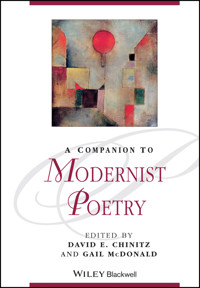
A Companion to Modernist Poetry E-Book
145,99 €
Mehr erfahren.
- Herausgeber: John Wiley & Sons
- Kategorie: Geisteswissenschaft
- Serie: Blackwell Companions to Literature and Culture
- Sprache: Englisch
A COMPANION TO MODERNIST POETRY
A Companion to Modernist Poetry
A Companion to Modernist Poetry presents contemporary approaches to modernist poetry in a uniquely in-depth and accessible text. The first section of the volume reflects the attention to historical and cultural context that has been especially fruitful in recent scholarship. The second section focuses on various movements and groupings of poets, placing writers in literary history and indicating the currents and countercurrents whose interaction generated the category of modernism as it is now broadly conceived. The third section traces the arcs of twenty-one poets’ careers, illustrated by analyses of key works.
The Companion thus offers breadth in its presentation of historical and literary contexts and depth in its attention to individual poets; it brings recent scholarship to bear on the subject of modernist poetry while also providing guidance on poets who are historically important and who are likely to appear on syllabi and to attract critical interest for many years to come.
Edited by two highly respected and notable critics in the field, A Companion to Modernist Poetry boasts a varied list of contributors who have produced an intense, focused study of modernist poetry.
Sie lesen das E-Book in den Legimi-Apps auf:
Seitenzahl: 1432
Veröffentlichungsjahr: 2014
Ähnliche




















Table of Contents
Blackwell Companions to Literature and Culture
Title page
Copyright page
Notes on Contributors
Introduction
1: Rhythm, Form, and Diction in Modernist Poetry
Breaking the Pentameter, and Other Myths
Modern Metrical Practices
Reading Modern Rhythms
“Inane phraseology”
Modernity and the Inexplicable
Note
References and Further Reading
Part I: Influences and Institutions
2: Urbanism
Notes
References and Further Reading
3: The Visual Arts
Shared Functions
Shared Techniques
Notes
References and Further Reading
4: Music
Notes
References and Further Reading
5: Fiction
References and Further Reading
6: Science and Technology
References and Further Reading
7: Popular Culture
Notes
References and Further Reading
8: Religion: Orthodoxies and Alternatives
References and Further Reading
9: Politics
Language
Social Practice
Culture
References and Further Reading
10: War and Empire
Yeats and the Celtic Alternative
Pound and the Roman Precedent
Eliot and the Contemporary Moment
Notes
References and Further Reading
11: Psychology and Sexuality
The New Matrix of Psychology and Sexuality
“Do I dare to eat a peach?”: Sexuality and Literature
Sex Leaves the Private Sphere
Freud and the New Psychology
Modernist Literary Psychologies
Notes
References and Further Reading
12: Symbolism and Decadence
Notes
References and Further Reading
13: The European Avant-Garde
Symbolism and After
Futurism and Cubo-Futurism
Expressionism and Dadaism
Surrealism
Note
References and Further Reading
14: Little Magazines
The Little Magazine and the Making of New Artistic Forms
Definitions
Places for Poetry
1910s: New Forms, Modern Themes
1920s: Consolidating Modernist Aesthetics
1930s: Reaffirming Political Commitments
1940s: Modernist Poetry Enters the University
New Technologies and New Genres
Notes
References and Further Reading
15: Modernist Criticism
Varieties of Modernist Criticism
Metacriticism and Tradition
Pound, Imagism, Lawrence, and the Question of Free Verse
Eliot: Impersonality and Transmutation
Modernist Criticism in the Academy
Modernist Dissensions and Romantic Debts
References and Further Reading
Part II: Groups and Groupings
16: The Georgian Poets and the Genteel Tradition
The “Genteel Tradition”
“Georgian” Poetry
References and Further Reading
17: The New Poetry
The Door Opens
A Poetics of Modernity
References and Further Reading
18: Poetry of the Great War
Notes
References and Further Reading
19: The Harlem Renaissance
Notes
References and Further Reading
20: The Fugitives
Note
References and Further Reading
21: Modernist Women Poets
Notes
References and Further Reading
22: Left Poetry
Notes
References and Further Reading
23: Objectivism
Note
References and Further Reading
24: World Modernist Poetry in English
Note
References and Further Reading
25: Modernism: The Next Generation
Notes
References and Further Reading
Part III: Poets
26: Thomas Hardy
Language and Modernity
Abstraction and Incompleteness
Human Shows and Modernism
References and Further Reading
27: W. B. Yeats
References
28: Gertrude Stein
Notes
References and Further Reading
29: Robert Frost
Among the Modernists
Language and Sound
Skepticism and Metaphysics
Notes
References and Further Reading
30: Wallace Stevens
Harmonium (1923/1931)
Ideas of Order (1935/1936)
The Man with the Blue Guitar and Other Poems (1937)
Parts of a World
Transport to Summer
The Auroras of Autumn
The Rock (1954) and Opus Posthumous (1957)
References and Further Reading
31: Mina Loy
References and Further Reading
32: William Carlos Williams
Note
References
33: D. H. Lawrence
References and Further Reading
34: Ezra Pound
“The Serious Artist”
“A poem including history”
“I cannot make it cohere”
References and Further Reading
35: H.D.
References and Further Reading
36: Marianne Moore
References and Further Reading
37: T. S. Eliot
“Prufrock”
The Waste Land
Ash-Wednesday
Four Quartets
References and Further Reading
38: Claude McKay
Note
References and Further Reading
39: Edna St. Vincent Millay
References and Further Reading
40: Hugh MacDiarmid
Early Scots Lyrics and A Drunk Man Looks at the Thistle
Late Poetry in English
Notes
References and Further Reading
41: E. E. Cummings
Notes
References and Further Reading
42: David Jones
In Parenthesis
The Anathemata
The Sleeping Lord
Notes
References and Further Reading
43: Melvin Tolson
Notes
References and Further Reading
44: Hart Crane
Reading Crane
Major Works
Crane's Influences
Crane and Modernism
Crane's Impact
Notes
References and Further Reading
45: Langston Hughes
Jazzonia: The 1920s
Too Much of Race: The 1930s
A Dream Deferred: The 1940s and 1950s
Hard Words: The 1960s
Notes
References and Further Reading
46: W. H. Auden
Being Absolutely Modern
Learning to Be Indifferent
Thinking No Thought But Ours
Notes
References and Further Reading
Conclusion: Modernist Poetry Today
47: Contemporary Critical Trends
Orientation
Tactics
Literal Reading
Differential Reading
Radical Reading
Distant Reading
Strategies
The Commitment to Form
Social Philology and Sound
Constructivist and Cultural Poetics
Summation
References and Further Reading
Index
End User License Agreement
Guide
Cover
Table of Contents
Start Reading
CHAPTER 1
Index
Pages
ii
iv
ix
x
xi
xii
xiii
xiv
xv
xvi
1
2
3
4
5
6
7
8
9
10
11
12
13
14
15
16
17
18
19
20
23
24
25
26
27
28
29
30
31
32
33
34
35
36
37
38
39
40
41
42
43
44
45
46
47
48
49
50
51
52
53
54
55
56
57
58
59
60
61
62
63
64
65
66
67
68
69
70
71
72
73
74
75
76
77
78
79
80
81
82
83
84
85
86
87
88
89
90
91
92
93
94
95
96
97
98
99
100
101
102
103
104
105
106
107
108
109
110
111
112
113
114
115
116
117
118
119
120
121
122
123
124
125
126
127
128
129
130
131
132
133
134
135
136
137
138
139
140
141
142
143
144
145
146
147
148
149
150
151
152
153
154
155
156
157
158
159
160
161
162
163
164
165
166
167
168
169
170
171
172
173
174
175
176
177
178
179
180
181
182
183
184
185
186
187
188
189
190
191
192
193
194
195
196
199
200
201
202
203
204
205
206
207
208
209
210
211
212
213
214
215
216
217
218
219
220
221
222
223
224
225
226
227
228
229
230
231
232
233
234
235
236
237
238
239
240
241
242
243
244
245
246
247
248
249
250
251
252
253
254
255
256
257
258
259
260
261
262
263
264
265
266
267
268
269
270
271
272
273
274
275
276
277
278
279
280
281
282
283
284
285
286
287
288
289
290
291
292
293
294
295
296
297
298
299
300
301
302
303
304
305
306
307
308
309
310
311
312
313
314
315
316
317
318
319
320
321
322
325
326
327
328
329
330
331
332
333
334
335
336
337
338
339
340
341
342
343
344
345
346
347
348
349
350
351
352
353
354
355
356
357
358
359
360
361
362
363
364
365
366
367
368
369
370
371
372
373
374
375
376
377
378
379
380
381
382
383
384
385
386
387
388
389
390
391
392
393
394
395
396
397
398
399
400
401
402
403
404
405
406
407
408
409
410
411
412
413
414
415
416
417
418
419
420
421
422
423
424
425
426
427
428
429
430
431
432
433
434
435
436
437
438
439
440
441
442
443
444
445
446
447
448
449
450
451
452
453
454
455
456
457
458
459
460
461
462
463
464
465
466
467
468
469
470
471
472
473
474
475
476
477
478
479
480
481
482
483
484
485
486
487
488
489
490
491
492
493
494
495
496
497
498
499
500
501
502
503
504
505
506
507
508
509
510
511
512
513
514
515
516
517
518
519
520
521
522
523
524
525
526
527
528
529
530
531
532
533
534
535
536
537
538
539
540
541
542
543
544
545
546
547
548
549
550
551
552
553
554
555
556
557
558
559
560
561
562
565
566
567
568
569
570
571
572
573
574
575
576
577
578
579
580
581
582
583
584
585
586
587
588
589
590
591
592
593
594
595
596
597
598
599
600
601
602
603
604
Blackwell Companions to Literature and Culture
This series offers comprehensive, newly written surveys of key periods and movements and certain major authors, in English literary culture and history. Extensive volumes provide new perspectives and positions on contexts and on canonical and post-canonical texts, orientating the beginning student in new fields of study and providing the experienced undergraduate and new graduate with current and new directions, as pioneered and developed by leading scholars in the field.
Published Recently
69.
A Companion to the American Short Story
Edited by Alfred Bendixen and James Nagel
70.
A Companion to American Literature and Culture
Edited by Paul Lauter
71.
A Companion to African American Literature
Edited by Gene Jarrett
72.
A Companion to Irish Literature
Edited by Julia M. Wright
73.
A Companion to Romantic Poetry
Edited by Charles Mahoney
74.
A Companion to the Literature and Culture of the American West
Edited by Nicolas S. Witschi
75.
A Companion to Sensation Fiction
Edited by Pamela K. Gilbert
76.
A Companion to Comparative Literature
Edited by Ali Behdad and Dominic Thomas
77.
A Companion to Poetic Genre
Edited by Erik Martiny
78.
A Companion to American Literary Studies
Edited by Caroline F. Levander and Robert S. Levine
79.
A New Companion to the Gothic
Edited by David Punter
80.
A Companion to the American Novel
Edited by Alfred Bendixen
81.
A Companion to Literature, Film, and Adaptation
Edited by Deborah Cartmell
82.
A Companion to George Eliot
Edited by Amanda Anderson and Harry E. Shaw
83.
A Companion to Creative Writing
Edited by Graeme Harper
84.
A Companion to British Literature, 4 volumes
Edited by Robert DeMaria, Jr., Heesok Chang, and Samantha Zacher
85.
A Companion to American Gothic
Edited by Charles L. Crow
86.
A Companion to Translation Studies
Edited by Sandra Bermann and Catherine Porter
87.
A New Companion to Victorian Literature and Culture
Edited by Herbert F. Tucker
88.
A Companion to Modernist Poetry
Edited by David E. Chinitz and Gail McDonald
This edition first published 2014
© 2014 John Wiley & Sons, Ltd
Registered Office
John Wiley & Sons Ltd, The Atrium, Southern Gate, Chichester, West Sussex, PO19 8SQ, UK
Editorial Offices
350 Main Street, Malden, MA 02148-5020, USA
9600 Garsington Road, Oxford, OX4 2DQ, UK
The Atrium, Southern Gate, Chichester, West Sussex, PO19 8SQ, UK
For details of our global editorial offices, for customer services, and for information about how to apply for permission to reuse the copyright material in this book please see our website at www.wiley.com/wiley-blackwell.
The right of David E. Chinitz and Gail McDonald to be identified as the authors of the editorial material in this work has been asserted in accordance with the UK Copyright, Designs and Patents Act 1988.
All rights reserved. No part of this publication may be reproduced, stored in a retrieval system, or transmitted, in any form or by any means, electronic, mechanical, photocopying, recording or otherwise, except as permitted by the UK Copyright, Designs and Patents Act 1988, without the prior permission of the publisher.
Wiley also publishes its books in a variety of electronic formats. Some content that appears in print may not be available in electronic books.
Designations used by companies to distinguish their products are often claimed as trademarks. All brand names and product names used in this book are trade names, service marks, trademarks or registered trademarks of their respective owners. The publisher is not associated with any product or vendor mentioned in this book.
Limit of Liability/Disclaimer of Warranty: While the publisher and authors have used their best efforts in preparing this book, they make no representations or warranties with respect to the accuracy or completeness of the contents of this book and specifically disclaim any implied warranties of merchantability or fitness for a particular purpose. It is sold on the understanding that the publisher is not engaged in rendering professional services and neither the publisher nor the authors shall be liable for damages arising herefrom. If professional advice or other expert assistance is required, the services of a competent professional should be sought.
Library of Congress Cataloging-in-Publication Data applied for
Hardback ISBN: 978-0-470-65981-6
A catalogue record for this book is available from the British Library.
Cover image: Paul Klee, Red Balloon, 1922 (no. 179), oil on gauze on board. Solomon R. Guggenheim Museum, New York / Giraudon / The Bridgeman Art Library
Cover design by Richard Boxall Design Associates
Notes on Contributors
Tim Armstrong is Professor of Modern English and American Literature at Royal Holloway, University of London. He is the author of Modernism, Technology, and the Body (1998), Haunted Hardy: Poetry, History, Memory (2000), Modernism: A Cultural History (2005), and The Logic of Slavery: Debt, Technology, and Pain in American Literature (2012). His Thomas Hardy: Selected Poems (Longman Annotated Texts) was reissued in 2009.
Chris Baldick is Professor of English at Goldsmiths, University of London. His publications include Literature of the 1920s (2012), Decadence: An Annotated Anthology (coedited with Jane Desmarais, 2012), The Modern Movement (Oxford English Literary History, Volume 10) (2004), and The Oxford Dictionary of Literary Terms (2008).
Rebecca Beasley is University Lecturer in Twentieth and Twenty-First Century Literature in the Faculty of English at the University of Oxford, and a Fellow of The Queen's College. She is the author of Ezra Pound and the Visual Culture of Modernism (2007), and Theorists of Modernist Poetry: Ezra Pound, T. S. Eliot and T. E. Hulme (2007). She is currently writing a book on the impact of Russian culture on British modernism.
Melissa Bradshaw teaches in the English Department at Loyola University Chicago. She is the author of Amy Lowell, Diva Poet, which won the 2011 MLA Book Prize for Independent Scholars and has published articles on divas in American culture and on Greenwich Village bohemianism. She is the coeditor of Selected Poems of Amy Lowell (2002) and Amy Lowell, American Modern (2004), a volume of critical essays.
Sascha Bru (Leuven University) is the author of numerous essays on modernist and avant-garde writers. His most recent book is entitled Democracy, Law and the Modernist Avant-Gardes: Writing in the State of Exception (2009). He is the coeditor of various volumes, including The Oxford Cultural and Critical History of Modernist Magazines, vol. 3, and Regarding the Popular: Modernism, the Avant-Garde, and High and Low Culture. He is currently co-directing the large-scale research project MDRN (www.mdrn.be).
Brad Bucknell is Associate Professor of English in the Department of English and Film Studies at the University of Alberta. He has published on the figure of Salome, on Pater and time, on African-American literary theory, on The Matrix, on T. S. Eliot, and on Gertrude Stein. His book Literary Modernism and Musical Aesthetics appeared in 2002.
David E. Chinitz is Professor of English at Loyola University Chicago. He is the author of T. S. Eliot and the Cultural Divide (2003) and Which Sin to Bear? Authenticity and Compromise in Langston Hughes (2013), the editor of A Companion to T. S. Eliot (2009), and coeditor of the forthcoming Complete Prose of T. S. Eliot, Vol. 6: 1940–1946. He is currently president of the Modernist Studies Association.
Suzanne W. Churchill is Professor of English at Davidson College. She is the author of The Little Magazine Others and the Renovation of Modern American Poetry and coeditor, with Adam McKible, of Little Magazines and Modernism: New Approaches. She has published on modernist and Harlem Renaissance magazines, poetry, and pedagogy in various journals and collections. She is also founder and editor of the website “Index of Modernist Magazines.”
John Xiros Cooper is Professor Emeritus in English at the University of British Columbia. He has contributed books, articles, and papers on twentieth-century writers, modernism, the culture of modernity, poetry, and the history of modernist publishing.
Stephen Cope is Visiting Assistant Professor of English at Hobart and William Smith Colleges in Geneva, NY, and serves on the summer faculty at Bard College. He is the editor of George Oppen: Selected Prose, Daybooks, and Papers (2007). His present work focuses on the cultural politics of literary experimentalism in modernist literature.
Michael Coyle is Professor of English at Colgate University. Founding President of the Modernist Studies Association, he currently serves as President of the T. S. Eliot Society. His interest in modernist poetry and popular culture informs his Ezra Pound, Popular Genres, and the Discourse of Culture (1995), as well as his work in Broadcasting Modernism (2009), record reviews for Cadence, and articles on the relation of jazz and rock to folk and popular culture.
Anthony Cuda is an Associate Professor at the University of North Carolina, Greensboro. He is the author of The Passions of Modernism (2010) and coeditor with Ronald Schuchard of The Online Complete Prose of T. S. Eliot, Vol. 2: The Perfect Critic.
Julia E. Daniel is an Assistant Professor of Modern American Poetry at West Virginia University. She has published work on the verse drama of T. S. Eliot and is currently completing her book project, Building Nature, which explores the influence of city planning and landscape architecture in modern verse. She serves on the board of the T. S. Eliot Society and has worked as book review editor for Time Present, the Society's newsletter.
Leonard Diepeveen is the George Munro Chair in Literature and Rhetoric in English at Dalhousie University. He is the author of The Difficulties of Modernism (2003); Mock Modernism: An Anthology of Parodies, Travesties, Frauds, 1910–1935 (2013); and the co-author of Artworld Prestige (2013).
Thomas Dilworth is a Professor in the English Department at the University of Windsor, Ontario; a Killam Fellow; and a Fellow of the Royal Society of Canada. He is the author of David Jones in the Great War (2012), Reading David Jones (2008), and The Shape of Meaning in the Poetry of David Jones (1988), which won the British Council Prize in the Humanities.
Robert Faggen is Barton Evans and Andrea Neves Professor of Literature at Claremont McKenna College and Director of the Gould Center for Humanistic Studies/Milosz Institute. He is the author of Robert Frost and the Challenge of Darwin and The Cambridge Introduction to Robert Frost, and the editor of The Notebooks of Robert Frost and coeditor of The Letters of Robert Frost. His biography of Ken Kesey is forthcoming.
Barry J. Faulk is Professor of English at Florida State University where he teaches nineteenth- and twentieth-century British literature. He is the author of Music Hall and Modernity (2004) and British Rock Modernism (2010), as well as of essays on T. S. Eliot, Walter Sickert, and Nick Hornby.
Karen Jackson Ford is a Professor of English at the University of Oregon, where she teaches poetry and poetics. She has published Gender and the Poetics of Excess (1997), Split-Gut Song: Jean Toomer and the Poetics of Modernity (2005), and essays on American poetry. She is currently working on a book about race and poetic form in the United States.
Omaar Hena is an Assistant Professor of English at Wake Forest University, where he teaches and researches modern and contemporary world Anglophone literature with an emphasis on poetry and poetics. He has contributed to Contemporary Literature, Minnesota Review, The Princeton Encyclopedia of Poetry and Poetics, and The Oxford Handbook to Contemporary British and Irish Poetry. He is currently working on a book manuscript, Figural Democracy: Postcolonial Poetry and the Politics of Globality.
Miranda Hickman is Associate Professor of English at McGill University. Her publications include The Geometry of Modernism (2005), One Must Not Go Altogether with the Tide: The Letters of Ezra Pound and Stanley Nott (ed., 2011), and Rereading the New Criticism (ed. with John McIntyre, 2012). Her interests include transatlantic modernisms, poetry, gender studies, and textual scholarship. Her current work addresses women in cultural criticism between the world wars.
Matthew Hofer is Associate Professor of English at the University of New Mexico. He has published extensively on twentieth-century literature, especially poetry and poetics. His essays have appeared in many journals and collections, and he has recently edited an expanded edition of Edward Dorn and Leroy Lucas's classic 1966 photo-essay The Shoshoneans. He also runs the University of New Mexico Press series: Recencies: Research and Recovery in Twentieth-Century American Poetics.
Susan Holbrook teaches North American literatures and Creative Writing at the University of Windsor, Ontario. She is the coeditor of The Letters of Gertrude Stein and Virgil Thomson: Composition as Conversation (2010) and author of poetry books Joy Is So Exhausting (2009), Good Egg Bad Seed (2004), and misled (1999).
Walter Kalaidjian is Professor of English at Emory University. His research and teaching focus on transnational modern and contemporary poetry. He has authored four books on twentieth-century American poetry: The Edge of Modernism, American Culture Between the Wars, Languages of Liberation, and Understanding Theodore Roethke. In addition, he is the editor of the Cambridge Companion to American Modernism and the forthcoming Cambridge Companion to Modern American Poetry.
Erin Kappeler is a Visiting Assistant Professor of English at the University of Maine at Farmington. Her essays and reviews appear in Modernism/Modernity, College Literature, and the edited volume Critical Rhythm (forthcoming). She is currently at work on a book project entitled Shaping Free Verse: American Prosody and Poetics 1880–1920, which provides the first account of free verse as a historical genre.
Holly A. Laird is Frances W. O'Hornett Chair of Literature and Director of Women's and Gender Studies at the University of Tulsa. Her publications include Women Coauthors; Self and Sequence: The Poetry of D. H. Lawrence; and numerous essays on Victorian and modern literature and culture. Her current projects include editing The History of British Women Writers: 1880–1920; and a study of modernist suicide and suicidology.
Michael Levenson is William B. Christian Professor of English at the University of Virginia and author of A Genealogy of Modernism (1984), Modernism and the Fate of Individuality (1990), The Spectacle of Intimacy (co-author Karen Chase, 2000), and Modernism (2011). He is also the editor of the Cambridge Companion to Modernism (2000, 2nd ed. 2011).
Christopher MacGowan is a Professor of English at the College of William and Mary. He is the editor of Collected Poems of William Carlos Williams, Volume II: 1939–1962 and Paterson and, with A. Walton Litz, of Collected Poems, Volume I: 1909–1939. His most recent book is TheTwentieth-Century American Fiction Handbook (2011).
Meredith Martin is Associate Professor of English at Princeton University. Her book The Rise and Fall of Meter: Poetry and English National Culture, 1860–1930 (2012) received the Brooks-Warren prize for literary criticism. Her essays and reviews appear in Victorian Poetry, Victorian Studies, and Modernism/Modernity. She is the editor of the Princeton Prosody Archive, an online archive pertaining to the study of versification between 1750 and 1923.
Steven Matthews is Professor of English at Oxford Brookes University, UK. He is author of Irish Poetry: Politics, History, Negotiation; Yeats as Precursor; Les Murray; Modernism; T. S. Eliot and Early Modern Literature, and of a volume of poetry, Skying. He has also edited Modernism in the Sourcebooks series for Palgrave, of which he is General Editor.
William J. Maxwell is an Associate Professor of English and African American Studies at Washington University in St. Louis, where he teaches twentieth-century American and African-American literatures. He has published over forty articles and reviews, and three books: New Negro, Old Left: African-American Writing and Communism between the Wars (1999); an annotated edition of Claude McKay's Complete Poems (2004, 2008); and FB Eyes: How J. Edgar Hoover's Ghostreaders Framed African American Literature (forthcoming).
Margery Palmer McCulloch is a graduate of the universities of London and Glasgow. Her most recent publications include Modernism and Nationalism: Source Documents for the Scottish Renaissance (2004), Scottish Modernism and its Contexts 1918–1959 (2009), and in 2011 the coedited Edinburgh Companion to Hugh MacDiarmid and essay collection Scottish and International Modernisms. She is currently Honorary Senior Research Fellow and Leverhulme Emerita Fellow at Glasgow University, and was coeditor of Scottish Literary Review (2005–13).
Gail McDonald teaches at Goldsmiths College, University of London. She is the author of Learning to Be Modern: Pound, Eliot, and the American University (1993), American Literature and Culture, 1900–1960 (2006), and articles on American progressivism, modernist poetry, and pedagogy. A founder and past president of the Modernist Studies Association, she is Director of the T. S. Eliot International Summer School.
Gabrielle McIntire is Associate Professor at Queen's University, Canada. She is the author of Modernism, Memory, and Desire: T. S. Eliot and Virginia Woolf (2008), and has published articles on Virginia Woolf, T. S. Eliot, Nella Larsen, and Joseph Conrad in journals including Modern Fiction Studies, Modernism/Modernity, Narrative, and Callaloo.
Cristanne Miller is SUNY Distinguished Professor and Edward H. Butler Professor of Literature at the University at Buffalo, State University of New York. She has published on nineteenth-century and modernist poetry, including most recently Cultures of Modernism: Marianne Moore, Mina Loy, Else Lasker-Schüler. Gender and Literary Community in New York and Berlin (2005), “Words for the Hour”: A New Anthology of American Civil War Poetry (coedited with Faith Barrett, 2005), and Reading In Time: Dickinson in the Nineteenth Century (2012). She also coedited Marianne Moore's Selected Letters (1997). Miller is now preparing a new reader's edition of Dickinson's complete poems for Harvard University Press.
John Timberman Newcomb is Professor of English at the University of Illinois Urbana-Champaign. He has published three books on American poetry, Wallace Stevens and Literary Canons (1992), Would Poetry Disappear? American Verse and the Crisis of Modernity (2004), and How Did Poetry Survive? The Making of Modern American Verse (2012), along with essays on Edna St. Vincent Millay, Archibald MacLeish, Stephen Crane, W. B. Yeats, and skyscraper verse.
Katy Price is Lecturer in Modern and Contemporary Literature at Queen Mary, University of London. Her first book is Loving Faster Than Light: Romance and Readers in Einstein's Universe (2012). She is currently writing a social history of prophetic dreams in the twentieth century.
Susan Rosenbaum is Associate Professor of English at the University of Georgia, where she teaches courses in American literature and culture. She is the author of Professing Sincerity: Modern Lyric Poetry, Commercial Culture, and the Crisis in Reading (2007), and she is currently completing a book titled Imaginary Museums: Surrealism, American Poetry, and the Visual Arts, 1920–1970.
Kathy Lou Schultz is Associate Professor of English at the University of Memphis where she directs the Honors Program. Her monograph is The Afro-Modernist Epic and Literary History: Tolson, Hughes, Baraka (2013). Schultz's recent articles include “To Save and Destroy: Melvin B. Tolson, Langston Hughes, and Theories of the Archive,” which appeared in Contemporary Literature, and “Amiri Baraka's Wise Why's Wise: Lineages of the Afro-Modernist Epic,” published in the Journal of Modern Literature. Her poetry collections include Some Vague Wife (Atelos) and Biting Midge: Works in Prose (Belladonna).
Robin G. Schulze is Professor of English at the University of Delaware and a scholar of American modernist poetry and modernist culture. She is the author of The Web of Friendship: Marianne Moore and Wallace Stevens (1995), and the editor of Becoming Marianne Moore: The Early Poems, 1907–1924 (2002). Her most recent book is The Degenerate Muse: American Nature, Modernist Poetry, and the Problem of Cultural Hygiene (2013).
Vincent Sherry is the Howard Nemerov Professor in the Humanities and Professor of English at Washington University in St Louis. His books include The Uncommon Tongue: The Poetry and Criticism of Geoffrey Hill (1987), Ezra Pound, Wyndham Lewis, and Radical Modernism (1993), Joyce's ULYSSES (1995), and The Great War and the Language of Modernism (2005). His Modernism, Decadence, and the Literary History of Lost Modernity is forthcoming in 2014.
Stan Smith is Professor Emeritus in English at Nottingham Trent University and a foundation fellow of the English Association. He is the author and editor of many books, essays, and articles on modern and contemporary literature, including two monographs on Auden, and is editor of The Cambridge Companion to W. H. Auden. Recent work includes a sonnet sequence, Family Fortunes (2008), and the Introduction to a new edition of Raymond Williams's TheCountry and the City (2011).
Eve C. Sorum is an Associate Professor of English at the University of Massachusetts-Boston. She has published essays on Thomas Hardy, T. S. Eliot, Virginia Woolf, W. H. Auden, Ford Madox Ford, and the self-elegy, in journals including Studies in the Novel, Modernism/Modernity, and Journal of Modern Literature, and in Modernism and Mourning (ed. Patricia Rae, 2006). She is currently working on a book on elegiac modernisms.
Sunny Stalter-Pace is an Assistant Professor in the English Department at Auburn University, Alabama. She has published articles on modern poetry, drama, film, and song in journals including American Quarterly and Journal of Modern Literature. She is completing revisions on a book entitled Underground Movements: Modern Culture on the New York Subway.
Helen Sword has published widely on modernist literature, higher education pedagogy, digital poetics, and academic writing. Her books include Engendering Inspiration (1995), Ghostwriting Modernism (2002), The Writer's Diet (2007), Pacific Rim Modernisms (coedited 2009), and Stylish Academic Writing (2012). She is Professor and Director of the Centre for Learning and Research in Higher Education at the University of Auckland, where she received a 2007 Teaching Excellence Award for Innovation in Teaching.
Lara Vetter is Associate Professor of English at the University of North Carolina at Charlotte. She is the author of Modernist Writings and Religio-scientific Discourse: H.D., Loy, and Toomer, and coeditor of Approaches to Teaching H.D.'s Poetry and Prose and Emily Dickinson's Correspondences. Her edition of H.D's By Avon River is forthcoming in the spring of 2014, and she is currently working on a monograph about H.D.'s late-career writings.
Michael Webster is Professor of English at Grand Valley State University, where he teaches American literature and courses in nature writing, modernism, and mythology. He is author of Reading Visual Poetry after Futurism (1995) and has written articles on Cummings, as well as on poetic iconicity, visual poetry, Eliot, Joyce, Pound, and Apollinaire. He is also coordinator of the E. E. Cummings Society and editor of SPRING: The Journal of the E. E. Cummings Society.
Michael H. Whitworth is Fellow and Tutor in English at Merton College, Oxford, and University Lecturer in the English Faculty, University of Oxford. His books include Einstein's Wake: Relativity, Metaphor, and Modernist Literature (2001), Virginia Woolf (2005), and Reading Modernist Poetry (2010).
Malcolm Woodland is Associate Professor in the Department of English, University of Toronto. He is the author of Wallace Stevens and the Apocalyptic Mode, of articles on Stevens, Mark Strand, Agha Shahid Ali, and Trish Salah, and of three review essays on the year in Canadian poetry (2006–2008) for the University of Toronto Quarterly.
Introduction
David E. Chinitz and Gail McDonald
Companions, introductions, anthologies, and other aids to the study of modernism necessarily begin with definitions of the term “modernism” itself, and, in the last fifteen years or so, these definitions have become increasingly qualified and uncertain, even dithering, in tone. Periodization has become a particularly thorny problem, with modernism's start date and, especially, its end date – if any – a source of apprehension and not infrequent debate. Some conceptions focusing on what may be summed up quickly as “difficult style” find much in contemporary literature that continues to qualify as modernist. A different, recently influential understanding locates modernism wherever and whenever the rapid and pervasive social changes associated with modernity are ongoing. By this definition, too, modernism cannot be assigned to a historical period.
Lesen Sie weiter in der vollständigen Ausgabe!
Lesen Sie weiter in der vollständigen Ausgabe!
Lesen Sie weiter in der vollständigen Ausgabe!
Lesen Sie weiter in der vollständigen Ausgabe!
Lesen Sie weiter in der vollständigen Ausgabe!
Lesen Sie weiter in der vollständigen Ausgabe!
Lesen Sie weiter in der vollständigen Ausgabe!
Lesen Sie weiter in der vollständigen Ausgabe!
Lesen Sie weiter in der vollständigen Ausgabe!
Lesen Sie weiter in der vollständigen Ausgabe!
Lesen Sie weiter in der vollständigen Ausgabe!
Lesen Sie weiter in der vollständigen Ausgabe!
Lesen Sie weiter in der vollständigen Ausgabe!
Lesen Sie weiter in der vollständigen Ausgabe!
Lesen Sie weiter in der vollständigen Ausgabe!
Lesen Sie weiter in der vollständigen Ausgabe!
Lesen Sie weiter in der vollständigen Ausgabe!
Lesen Sie weiter in der vollständigen Ausgabe!
Lesen Sie weiter in der vollständigen Ausgabe!
Lesen Sie weiter in der vollständigen Ausgabe!
Lesen Sie weiter in der vollständigen Ausgabe!
Lesen Sie weiter in der vollständigen Ausgabe!
Lesen Sie weiter in der vollständigen Ausgabe!
Lesen Sie weiter in der vollständigen Ausgabe!
Lesen Sie weiter in der vollständigen Ausgabe!
Lesen Sie weiter in der vollständigen Ausgabe!
Lesen Sie weiter in der vollständigen Ausgabe!
Lesen Sie weiter in der vollständigen Ausgabe!
Lesen Sie weiter in der vollständigen Ausgabe!
Lesen Sie weiter in der vollständigen Ausgabe!
Lesen Sie weiter in der vollständigen Ausgabe!
Lesen Sie weiter in der vollständigen Ausgabe!
Lesen Sie weiter in der vollständigen Ausgabe!
Lesen Sie weiter in der vollständigen Ausgabe!
Lesen Sie weiter in der vollständigen Ausgabe!
Lesen Sie weiter in der vollständigen Ausgabe!
Lesen Sie weiter in der vollständigen Ausgabe!
Lesen Sie weiter in der vollständigen Ausgabe!
Lesen Sie weiter in der vollständigen Ausgabe!
Lesen Sie weiter in der vollständigen Ausgabe!
Lesen Sie weiter in der vollständigen Ausgabe!
Lesen Sie weiter in der vollständigen Ausgabe!
Lesen Sie weiter in der vollständigen Ausgabe!
Lesen Sie weiter in der vollständigen Ausgabe!
Lesen Sie weiter in der vollständigen Ausgabe!
Lesen Sie weiter in der vollständigen Ausgabe!
Lesen Sie weiter in der vollständigen Ausgabe!
Lesen Sie weiter in der vollständigen Ausgabe!
Lesen Sie weiter in der vollständigen Ausgabe!
Lesen Sie weiter in der vollständigen Ausgabe!
Lesen Sie weiter in der vollständigen Ausgabe!
Lesen Sie weiter in der vollständigen Ausgabe!
Lesen Sie weiter in der vollständigen Ausgabe!




