


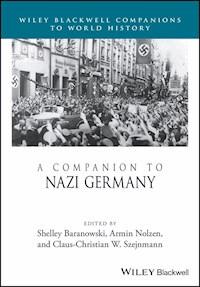
A Companion to Nazi Germany E-Book
148,99 €
Mehr erfahren.
- Herausgeber: John Wiley & Sons
- Kategorie: Geisteswissenschaft
- Serie: Blackwell Companions to World History
- Sprache: Englisch
A Deep Exploration of the Rise, Reign, and Legacy of the Third Reich
For its brief existence, National Socialist Germany was one of the most destructive regimes in the history of humankind. Since that time, scholarly debate about its causes has volleyed continuously between the effects of political and military decisions, pathological development, or modernity gone awry. Was terror the defining force of rule, or was popular consent critical to sustaining the movement? Were the German people sympathetic to Nazi ideology, or were they radicalized by social manipulation and powerful propaganda? Was the “Final Solution” the motivation for the Third Reich’s rise to power, or simply the outcome?
A Companion to Nazi Germany addresses these crucial questions with historical insight from the Nazi Party’s emergence in the 1920s through its postwar repercussions. From the theory and context that gave rise to the movement, through its structural, cultural, economic, and social impacts, to the era’s lasting legacy, this book offers an in-depth examination of modern history’s most infamous reign.
- Assesses the historiography of Nazism and the prehistory of the regime
- Provides deep insight into labor, education, research, and home life amidst the Third Reich’s ideological imperatives
- Describes how the Third Reich affected business, the economy, and the culture, including sports, entertainment, and religion
- Delves into the social militarization in the lead-up to war, and examines the social and historical complexities that allowed genocide to take place
- Shows how modern-day Germany confronts and deals with its recent history
Today’s political climate highlights the critical need to understand how radical nationalist movements gain an audience, then followers, then power. While historical analogy can be a faulty basis for analyzing current events, there is no doubt that examining the parallels can lead to some important questions about the present. Exploring key motivations, environments, and cause and effect, this book provides essential perspective as radical nationalist movements have once again reemerged in many parts of the world.
Sie lesen das E-Book in den Legimi-Apps auf:
Seitenzahl: 1537
Veröffentlichungsjahr: 2018
Ähnliche




















Table of Contents
Cover
Title Page
Notes on Contributors
Introduction
0.1 Overview
0.2 Contents
References
Part I: Theories, Background, and Contexts
Chapter One: How Do We Explain the Rise of Nazism?
References
Further Reading
Chapter Two: Organic Modernity:
2.1 Reactionary Aspects
2.2 Modern Dimensions
2.3 Biological Politics
2.4 The Organic Alternative
References
Chapter Three: The First World War and National Socialism
3.1 Radical Nationalism and Antisemitism Through War and Defeat
3.2 Brutalization: Violence as a Legacy of the Great War
3.3 Mythologies of the War Experience
3.4 Conclusion
References
Further Reading
Chapter Four: The Collapse of the Weimar Parliamentary System
4.1 The Irony of German Weakness: The Defeat of Putschism, and American Economic Intervention
4.2 Fragmentation and Radicalization on the Right
4.3 Why the Nazis?
4.4 Conclusion
References
Further Reading
Chapter Five: National Socialist Ideology
5.1 Historiography
5.2 Nazi Ideology ‘from below’
5.3 Was There a Core Set of Beliefs?
5.4 Towards a Social and Cultural History of Nazi ideology
5.5 Conclusions
References
Further Reading
Part II: Structures of Nazi Rule
Chapter Six: The NSDAP After 1933
6.1 Introduction
6.2 Membership Growth, Means of Motivation
6.3 Positions, Functionaries
6.4 Technologies, Decision Programmes
6.5 Interactions, Issues
6.6 Conclusion
References
Further Reading
Chapter Seven: Work(ers) Under the Swastika
7.1 Destruction, Integration, and Resistance: Labour in Germany, 1933–1945
7.2 Scholarship on Organized Labour, the Demise of the Weimar Republic, and National Socialism since 1945
7.3 Conclusion
References
Further Reading
Chapter Eight: Resistance
8.1
Widerstand
– An Ambiguous Term and Concept with Different Meanings
8.2 Periods and Types of Resistance in Nazi Germany
8.3 The Wide Range of Resistance and Nonconformity in Nazi Germany: Organizations, Social Milieus, and Individuals
8.4 Conclusion
References
Chapter Nine: Centre and Periphery
9.1 Towards a Centralized Dictatorship
9.2 The Formation of New Regional Authorities
9.3 The Nazi Political System Under Pressure of War
9.4 Conclusions
References
Further Reading
Chapter Ten: Information Policies and Linguistic Violence
10.1 Introduction
10.2 Structures and Forms of Nazi Information Policies and Linguistic Violence, 1933–1939
10.3 A Case Study in Nazi Information Policies and Linguistic Violence: The 1938 November Pogroms
10.4 Nazi Information Policies at War, 1939–1945
10.5 Conclusion
References
Further Reading
Chapter Eleven: Education, Schooling, and Camps
11.1 Introduction
11.2 Continuities with Earlier Ideas and the Nazi Approach
11.3 Exclusion and Positive Inclusion in Nazi Education
11.4 The Pivotal Function of Camps
11.5 Actors and Their Room for Manoeuvre
11.6 Organizing Nazi Education
11.7 ‘Total’ Pretence Versus Practice on the Ground
11.8 Embracing the Nazi Agenda
11.9 Long‐term Effects
Acknowledgements
References
Further Reading
Chapter Twelve: Research and Scholarship*
12.1 Introduction
12.2 The German Science and Research Landscape in 1932–1933
12.3 Research and Science
12.4 Expansion
12.5 Cleansing German Scholarship
12.6 Scholars and Nazism
12.7 Scholarship: Changes after 1933
12.8 Scholarship and Nazi Crimes
References
Further Reading
Chapter Thirteen: Nazi Morality
13.1 Historicizing Morality
13.2 Building the Nazi Morality
13.3 Practising Moralities
13.4 Conclusion
References
Further Reading
Chapter Fourteen: The German Home Front Under the Bombs
14.1 Life and Work on the Home Front
14.2 The Home Front and the War
14.3 Bombing and the Home Front
14.4 The Hard Logic of Total War
References
Further Reading
Chapter Fifteen: Total Defeat
15.1 Military Setbacks
15.2 Nazi Rule and Internal Crises
15.3 Total War and the
Volksgemeinschaft
15.4 Nazi Violence
15.5 The Impact of Defeat
References
Further Reading
Part III: Economy and Culture
Chapter Sixteen: The Nazi Economy
16.1 Imperialism
16.2 Crises
16.3 Capitalism under the Nazis
16.4 ‘Aryanization’
16.5 The Second World War and the Legacy of the Third Reich
References
Further Reading
Chapter Seventeen: National Socialism and German Business
17.1 Historiography
17.2 Neither Theory nor Blueprint
17.3 Winning over Business
17.4 The Politics of Regulation
17.5 Recovery and Rearmament
17.6 War
17.7 Conclusion
References
Further Reading
Chapter Eighteen: Individual Consumers and Consumption in Nazi Germany
18.1 The Nazi Party and State‐Sanctioned Consumption
18.2 Individual Consumers, the Private Sector, and the Four Year Plan
18.3 The War Years
References
Chapter Nineteen: Gender
19.1 Convergence and Difference: Gender, Exclusion, and Persecution after 1933
19.2 Sworn Comrades: the Gender Order and Nazi Activism
19.3 ‘Boundless Expansion’ and Boundaries of Gender and Race: Conquest, Genocide, and Forced Labour
19.4 Conclusion
References
Chapter Twenty: Religion*
20.1 Introduction
20.2 Protestants: Battle Between Brothers in Their Own House
20.3 Catholics
20.4 Christian Solidarity with Persecuted Jews?
20.5 Small Religious Bodies
20.6 ‘German Believers’ and ‘Believers in God’
20.7 The Nazi Regime – a ‘Political Religion’?
20.8 Religious Historical Changes During the War, 1939–1945
20.9 Conclusion
References
Further Reading
Chapter Twenty-One: Family and Private Life
21.1 The Family in the Weimar Republic
21.2 Nazi Family Policies
21.3 The
Hilfswerk ‘Mutter und Kind
’
21.4 ‘Inferior’ Families
21.5 The Impact of the Second World War on Family Life
21.6 Private Life
21.7 Conclusion
References
Further Reading
Chapter Twenty-Two: Sports
22.1 Introduction: Sports and
Volksgemeinschaft
22.2 The Concept of the Human
22.3 Forming the Body
22.4 Bodily Experience and ‘Racial Identity’
22.5 Antisemitism
22.6 Education
22.7 Organized Popular Sports
22.8 Work and Leisure
22.9 Performative Aspects: the Self‐Representation of the
Volksgemeinschaft
22.10 Culture of the Masses
22.11 External Effect
22.12 Disposition to Fight
22.13 Conclusion
References
Further Reading
Chapter Twenty-Three: Cinema, Art, and Music
23.1 Introduction
23.2 Cultural Policy in Nazi Germany
23.3 The Artists’ Perspective
23.4 Consuming Cinema, Art, and Music in the Third Reich
23.5 Still En Route Towards a Social History of the Third Reich
References
Chapter Twenty-Four: Emotions and National Socialism
24.1 Between Comradeship and Devotion: Women’s Love for Hitler
24.2 Between Hostility and Honour: ‘Race Defilement’ and Practices of Antisemitism in Court
24.3 Mixed Feelings in Nazi Germany
References
Further Reading
Chapter Twenty-Five: Environment
References
Further Reading
Part IV: Race, Imperialism, and Genocide
Chapter Twenty-Six: Terror
26.1 Introduction
26.2 The Archaeology of Nazi Violence
26.3 The Reichstag Fire as Nazi Terror’s Starting Point
26.4 Institutionalizing Terror, 1934 to 1937/1938
26.5 Military Expansion and the Escalation of Terror
26.6 From Individual Terror to Mass Murder
26.7 The Fateful Year 1941 and the War against the Soviet Union
26.8 Terror after the Military Defeat in Stalingrad, 1942–1943
26.9 Conclusion
References
Further Reading
Chapter Twenty-Seven: Flight and Exile
27.1 Current Scholarship
27.2 European Diasporas and ‘Homecomings’ after the First World War
27.3 Nazi‐era Refugee Movement before the Second World War
27.4 Destination Palestine
27.5 From the November Pogrom Through the War Years
27.6 The Challenges of Émigré Life
References
Further Reading
Chapter Twenty-Eight: Germany and the Outside World*
28.1 Introduction
28.2 ‘Seizure of Power’: Reactions
28.3 ‘Peace Politics’ and Rearmament
28.4 Strategies and Treaties
28.5 The Personnel of Foreign Policy: Structure and Development
28.6 Expansion and War Preparations
References
Further Reading
Chapter Twenty-Nine: Social Militarization and Preparation for War, 1933–1939
29.1 Introduction
29.2 The Military as the Driving Force for Militarization in the Nazi State
29.3 The NSDAP and Its Organizations as Militarization Agencies
29.4 Image of War
29.5 Summary
References
Further Reading
Chapter Thirty: Race
30.1 Introduction
30.2 New Frontiers? International Race Theories and Racial Policies
30.3 Race Theories: Scientific and Popular Racism since the Nineteenth Century
30.4 Everyday Life: Assessing the Social Through Biological Categories
30.5 Racial Policies: Euthanasia, Ethnic Cleansing, Holocaust
30.6 Conclusion: An Extremely Racist Society
References
Further Reading
Chapter Thirty-One: Unfree and Forced Labour*
31.1 Forced Labour Until 1933: German Practices and International Debates
31.2 Unfree Work in Germany, 1933–1939
31.3 Unfree and Forced Labour in the German Reich, 1939–1945
31.4 Unfree Labour and Different Chances of Survival: Forced Labourers in Germany
31.5 German Companies and German Population
31.6 The Situation in the Occupied Territories
31.7 Unfree Labour in Occupied Western Europe
31.8 Unfree Labour in Occupied Eastern Europe
31.9 Analytical Categories and Individual Assessment
31.10 Desiderata
References
Further Reading
Chapter Thirty-Two: ‘Ethnic Germans’
32.1 Introduction: The Invention of ‘Ethnic Germans’ (
Volksdeutsche
)
32.2 1933–1939:
Gleichschaltung
and Early Annexations
32.3 1939–1945: Population Transfers, Expulsions, Settlement, and Mass Murder
32.4 1940–1945: Recruitment of Soldiers and Manpower
32.5 1939–1945: Citizenship
32.6 Conclusion: Agency and Complicity
References
Further Reading
Chapter Thirty-Three: Ghettos
33.1 History of Ghettos in Nazi‐Occupied Europe
33.2 Ghettos in Occupied Poland 1939–1941
33.3 Organization of Life Within the Ghettos
33.4 Daily Life
33.5 Organizing Life and Culture
33.6 Ghettos and the ‘Final Solution’
33.7 Jewish Reactions to Deportation and Death
33.8 Conclusion
References
Further Reading
Chapter Thirty-Four: Holocaust Studies
34.1 Decision Making and Proximity
34.2 Biography
34.3 Collaboration
34.4 Sources
34.5 Future Directions
References
Further Reading
Part V: Legacies of Nazism
Chapter Thirty-Five: Memories of Nazi Germany in the Federal Republic of Germany
35.1 The Period of Transition Following the End of the War (1945–1949)
35.2 The Adenauer Era – Drawing a Final Line and Starting Over (1949–1965)
35.3 First Moral Engagements with the Past (1965–1985)
35.4 The Rise of a New Memory Culture (1985–2005)
35.5 New Developments, Discontents, Challenges (2005 onwards)
35.6 Conclusion
References
Further Reading
Chapter Thirty-Six: Remembering National Socialism in the German Democratic Republic
36.1 The Genesis of Anti‐Fascist Memory
36.2 Anti‐Fascist Memory as Legitimation of SED Rule
36.3 Remembering Anti‐Fascist Resistance Fighters
36.4 Remembering the Holocaust
36.5 GDR Citizens’ Perceptions of National Socialism
36.6 Coming to Terms with Anti‐Fascism
References
Chapter Thirty-Seven: Presenting and Teaching the Past*
37.1 Introduction
37.2 ‘Official’ Remembrance: School History Books
37.3 The Holocaust in the Museum
37.4 Snapshots of Germany in 2015: Should Victims Be Trampled On?
37.5 Audio‐Visual Representations of the Holocaust
37.6 Fluid and Individualized Memories: World Wide Web and Web 2.0
References
Further Reading
Index
End User License Agreement
List of Tables
Chapter 06
Table 6.1 Members of the NSDAP and its organizations, as at 1 September 1939.
Table 6.2 Means and mechanisms of membership motivation in the NSDAP.
Table 6.3 Offices and leaders of the NSDAP’s Reich executive (Reichsleitung).
Table 6.4 The Nazi Party’s political leaders by position and date of joining, as at 1 January 1935.
Table 6.5 Leading officials (
Führende
) of the Nazi Party’s affiliations, the NSF, the NSDStB, and the Reich Food Estate (Reichsnährstand, RNSt), as at 1 January 1935.
Table 6.6 The NSDAP’s technologies and dominating decision programmes.
Table 6.7 The NSDAP’s main interactions and its dominating issues.
Chapter 31
Table 31.1 Foreign civilian workers in the German Reich 1939–1945 according to countries of origin.
Table 31.2 Situation of different groups of workers in the German Reich, 1939–1945.
List of Illustrations
Chapter 10
Figure 10.1 Adolf Hitler, Joseph Goebbels, and Otto Dietrich, c.1935 (INTERFOTO/Alamy Stock Photo).
Figure 10.2 Still frame from the
Deutsche Wochenschau
of 10 July 1941, which depicts two alleged “Jewish agents.” The frame also reveals a Wehrmacht soldier in the background, compounding the power of the camera (Bundesarchiv Filmarchiv/Transit Film GmbH).
Figure 10.3 Still from the
Deutsche Wochenschau
of 10 July 1941, framing putative Jewish residents of Lemberg in the visual language of antisemitism (Bundesarchiv Filmarchiv/Transit Film GmbH).
Chapter 11
Figure 11.1 ‘Der Aufbau der Erziehung im Grobdeutschen Reich’ [The Structure of Education in the Greater German Reich].
Chapter 21
Figure 21.1 A Nazi family, 1930s.
Figure 21.2 Family mealtime. Nazi propaganda picture of a German mother surrounded by her happy children.
Figure 21.3 The Third Reich ‘Honour Cross of the German Mother’ (
Mutterkreuz
) of 1938.
Figure 21.4 Women in a ‘Recuperation Home for Mothers’ run by the ‘National Socialist People’s Welfare’, c.1938.
Guide
Cover
Table of Contents
Begin Reading
Pages
ii
iii
iv
x
xi
xii
xiii
xiv
xv
xvi
1
2
3
4
5
6
7
8
9
10
11
12
13
15
17
18
19
20
21
22
23
24
25
26
27
28
29
30
31
32
33
34
35
36
37
38
39
40
41
42
43
44
45
46
47
48
49
50
51
52
53
54
55
56
57
58
59
60
61
63
64
65
66
67
68
69
70
71
72
73
74
75
76
77
78
79
80
81
82
83
84
85
86
87
88
89
90
91
92
93
94
95
97
98
99
100
101
102
103
104
105
106
107
108
109
110
111
112
113
114
115
116
117
118
119
120
121
122
123
124
125
126
127
128
129
130
131
132
133
134
135
136
137
138
139
140
141
142
143
144
145
146
147
148
149
150
151
152
153
154
155
156
157
158
159
160
161
162
163
164
165
166
167
168
169
170
171
172
173
174
175
176
177
178
179
181
182
183
184
185
186
187
188
189
190
191
192
193
194
195
196
197
199
200
201
202
203
204
205
206
207
208
209
210
211
212
213
214
215
216
217
218
219
220
221
222
223
224
225
226
227
228
229
231
232
233
234
235
236
237
238
239
240
241
242
243
244
245
247
248
249
250
251
252
253
254
255
256
257
258
259
260
261
262
263
265
266
267
268
269
270
271
272
273
274
275
276
277
278
279
281
282
283
284
285
286
287
288
289
290
291
292
293
294
295
296
297
298
299
300
301
302
303
304
305
306
307
308
309
310
311
312
313
315
316
317
318
319
320
321
322
323
324
325
326
327
328
329
330
331
333
334
335
336
337
338
339
340
341
342
343
344
345
346
347
348
349
350
351
352
353
354
355
356
357
358
359
360
361
362
363
364
365
366
367
368
369
370
371
372
373
374
375
376
377
378
379
380
381
382
383
385
386
387
388
389
390
391
392
393
394
395
396
397
398
399
400
401
402
403
404
405
406
407
408
409
410
411
412
413
414
415
416
417
418
419
420
421
422
423
424
425
426
427
428
429
431
432
433
434
435
436
437
438
439
440
441
442
443
444
445
446
447
448
449
450
451
452
453
454
455
456
457
458
459
460
461
462
463
465
466
467
468
469
470
471
472
473
474
475
476
477
478
479
480
481
482
483
484
485
486
487
488
489
490
491
492
493
494
495
496
497
499
500
501
502
503
504
505
506
507
508
509
510
511
512
513
514
515
517
518
519
520
521
522
523
524
525
526
527
528
529
530
531
532
533
534
535
536
537
538
539
540
541
542
543
544
545
546
547
548
549
551
552
553
554
555
556
557
558
559
560
561
562
563
564
565
566
567
568
569
570
571
572
573
574
575
576
577
578
579
581
583
584
585
586
587
588
589
590
591
592
593
594
595
596
597
598
599
600
601
602
603
604
605
606
607
608
609
610
611
612
613
615
616
617
618
619
620
621
622
623
624
625
626
627
628
629
630
631
632
633
634
635
636
637
638
639
640
641
642
643
644
645
646
648
647
649
650
651
652
653
654
655
656
657
658
659
660
661
662
663
664
WILEY BLACKWELL COMPANIONS TO WORLD HISTORY
This series provides sophisticated and authoritative overviews of the scholarship that has shaped our current understanding of Europe’s past. Each volume comprises between 25 and 40 concise essays written by individual scholars within their area of specialization. The aim of each contribution is to synthesize the current state of scholarship from a variety of historical perspectives and to provide a statement on where the field is heading.
The essays are written in a clear, provocative, and lively manner, designed for an international audience of scholars, students, and general readers. The Blackwell Companions to European History series is a cornerstone of the overarching Companions to History series, covering British, American, and World History.
A Companion to the French Revolutionby Peter McPhee (Editor)
A Companion to Eighteenth‐Century Europeby Peter H. Wilson (Editor)
A Companion to Europe Since 1945by Klaus Larres (Editor)
A Companion to the Medieval Worldby Carol Lansing (Editor), Edward D. English (Editor)
A Companion to Nazi Germanyby Shelley Baranowski (Editor), Armin Nolzen (Editor), and Claus‐Christian W. Szejnmann (Editor)
A Companion to Europe 1900–1945by Gordon Martel (Editor)
A Companion to Nineteenth‐Century Europe, 1789–1914by Stefan Berger (Editor)
A Companion to the Reformation Worldby R. Po‐chia Hsia (Editor)
A Companion to the Worlds of the Renaissanceby Guido Ruggiero (Editor)
A COMPANION TO NAZI GERMANY
Edited by
Shelley Baranowski,Armin Nolzen,andClaus‐Christian W. Szejnmann
This edition first published 2018© 2018 John Wiley & Sons Ltd27 Flight and Exile © 2018 Debórah Dwork
All rights reserved. No part of this publication may be reproduced, stored in a retrieval system, or transmitted, in any form or by any means, electronic, mechanical, photocopying, recording or otherwise, except as permitted by law. Advice on how to obtain permission to reuse material from this title is available at http://www.wiley.com/go/permissions.
The right of Shelley Baranowski, Armin Nolzen, and Claus‐Christian W. Szejnmann to be identified as the author(s) of the editorial material in this work has been asserted in accordance with law.
Registered Office(s)John Wiley & Sons, Inc., 111 River Street, Hoboken, NJ 07030, USAJohn Wiley & Sons Ltd, The Atrium, Southern Gate, Chichester, West Sussex, PO19 8SQ, UK
Editorial Office101 Station Landing, Medford, MA 02155, USA
For details of our global editorial offices, customer services, and more information about Wiley products visit us at www.wiley.com.
Wiley also publishes its books in a variety of electronic formats and by print‐on‐demand. Some content that appears in standard print versions of this book may not be available in other formats.
Limit of Liability/Disclaimer of WarrantyWhile the publisher and authors have used their best efforts in preparing this work, they make no representations or warranties with respect to the accuracy or completeness of the contents of this work and specifically disclaim all warranties, including without limitation any implied warranties of merchantability or fitness for a particular purpose. No warranty may be created or extended by sales representatives, written sales materials or promotional statements for this work. The fact that an organization, website, or product is referred to in this work as a citation and/or potential source of further information does not mean that the publisher and authors endorse the information or services the organization, website, or product may provide or recommendations it may make. This work is sold with the understanding that the publisher is not engaged in rendering professional services. The advice and strategies contained herein may not be suitable for your situation. You should consult with a specialist where appropriate. Further, readers should be aware that websites listed in this work may have changed or disappeared between when this work was written and when it is read. Neither the publisher nor authors shall be liable for any loss of profit or any other commercial damages, including but not limited to special, incidental, consequential, or other damages.
Library of Congress Cataloging‐in‐Publication data applied for
[Hardback] 9781118936887
Cover Image: © Everett Historical/ShutterstockCover Design: Wiley
Notes on Contributors
Aleida Assmann was Professor of English Literature and Literary Theory at the University of Konstanz, Germany (1993–2014), and holds guest professorships at various universities (Princeton, Yale, Chicago, and Vienna). Her main areas of research are the history of media and cultural memory, with special emphasis on Holocaust and trauma. Publications in English are Memory in a Global Age: Discourses, Practices and Trajectories (ed. with Sebastian Conrad, 2010), Cultural Memory and Western Civilization: Functions, Media, Archives (2012), and Introduction to Cultural Studies: Topics, Concepts, Issues (2012).
Shelley Baranowski is Distinguished Professor of History Emerita at the University of Akron, Ohio. Her most recent books include Nazi Empire: German Colonialism and Imperialism from Bismarck to Hitler (2011) and Strength through Joy: Consumerism and Mass Tourism in the Third Reich (2004). Her current book project is a study of mass violence among the Axis empires.
Frank Becker is Professor of Modern and Contemporary History at the University of Duisburg‐Essen. He received his doctorate in history at the University of Münster in 1992, where he received his habilitation in 1998. In 2003, he was Visiting Scholar at the German Historical Institute London and, in 2006, Visiting Professor at Vienna University. His publications include Bilder von Krieg und Nation: Die Einigungskriege in der bürgerlichen Öffentlichkeit Deutschlands (1864–1913) (2001), Den Sport gestalten: Carl Diems Leben (1882–1962) (2013), and Zivilisten und Soldaten. Entgrenzte Gewalt in der Geschichte (ed., 2015).
Marc Buggeln is a research assistant at the Humboldt‐University in Berlin. He received his PhD from the University of Bremen in 2008 with a study on the satellite camp system of the Neuengamme concentration camp. This study won the Herbert‐Steiner‐Preis in 2009 and the translation funding prize Geisteswissenschaften International in 2011. He is a member of the editorial board of HSozKult. Currently he is working on a history of public finance in West Germany.
David Clarke is Senior Lecturer in German at the University of Bath. He has published research on German literature and film, with a particular focus on the German Democratic Republic and cultural memory. His most recent research addresses the politics of memory in relation to human rights abuses in the German Democratic Republic. He is co‐author, with Ute Wölfel, of Remembering the German Democratic Republic: Divided Memory in a United Germany (2011).
Charles E. Closmann is an associate professor of history at the University of North Florida. His research interests include the environmental history of water pollution in Nazi Germany and the relationship between war and the environment. His current project concerns the history of militarized landscapes in Florida.
Debórah Dwork is the Rose Professor of Holocaust History and the founding director of the Strassler Center for Holocaust and Genocide Studies, Clark University. She is a leading authority on university education in this field, as well as her area of scholarship: Holocaust history. One of the first historians to record Holocaust survivors’ oral histories and to use their narratives as a scholarly source, Dwork’s books include Children With A Star (1991) and, with Robert Jan Van Pelt, Auschwitz; (1270–1996) and Flight from the Reich (2009).
Jörg Echternkamp is Associate Professor for Modern History at Martin Luther University, Halle‐Wittenberg, and Research Director at the Centre for Military History and Social Sciences, Potsdam. He held the Alfred Grosser chair at Sciences Po, Paris, in 2012–2013. Key publications are Soldaten im Nachkrieg (2014), Germany and the Second World War, Volume 9/1–2: German Wartime Society 1939–1945 (ed., 2008–2014), Der Aufstieg des deutschen Nationalismus (1998), and Experience and Memory: The Second World War in Europe (2010).
Geoff Eley is Karl Pohrt Distinguished University Professor of Contemporary History at the University of Michigan, Ann Arbor. His most recent works include Forging Democracy: The History of the Left in Europe, 1850–2000 (2002), A Crooked Line: From Cultural History to the History of Society (2005), and Nazism as Fascism: Violence, Ideology, and the Ground of Consent in Germany, 1930–1945 (2013). He is currently writing a general history of Europe in the twentieth century.
Manfred Gailus, DPhil, is apl. Professor of Modern German History at the Centre for Research on Antisemitism at the Technical University of Berlin. His major research interests are the social, political, cultural, and religious history of the nineteenth and twentieth centuries, especially the history of nationalism, Protestantism, and National Socialism. His main publications are Protestantismus und Nationalsozialismus: Studien zur nationalsozialistischen Durchdringung des protestantischen Sozialmilieus in Berlin (2001), Nationalprotestantische Mentalitäten: Konturen, Entwicklungslinien und Umbrüche eines Weltbildes (ed. with Hartmut Lehmann, 2005), Mir aber zerriss es das Herz: Der stille Widerstand der Elisabeth Schmitz (2010), Täter und Komplizen in Theologie und Kirchen 1933–1945 (ed., 2015), and Friedrich Weißler: Ein Jurist und bekennender Christ im Widerstand gegen Hitler (2017).
Stephen G. Gross is an assistant professor at New York University in the Department of History and the Center for European and Mediterranean Studies. His first book, Export Empire: German Soft Power in Southeastern Europe, 1890–1945 (2015), explores the relationship between imperialism, economic development, and cultural exchange from the perspective of non‐state actors. His research has been supported by the Fulbright Fellowship, the DAAD (Deutscher Akademischer Austauschdienst), and the Institute for New Economic Thinking, and he has published articles on political economy in Central European History, Contemporary European History, and German Politics and Society, among other journals. He is currently working on his second book, which will examine German energy policy in a European and global context, from 1945 to the present.
Michael Grüttner, is apl. Professor for Contemporary History at the Technische Universität Berlin. His research interests are the social history of the nineteenth and twentieth centuries, the history of National Socialism, and the history of universities. Among his publications are Studenten im Dritten Reich (1995), Biographisches Lexikon zur nationalsozialistischen Wissenschaftspolitik (2004), Universities under Dictatorship (co‐ed. with John Connelly, 2005), Die Berliner Universität zwischen den Weltkriegen 1918–1945 (in cooperation with Christoph Jahr et al., 2012), and Das Dritte Reich 1933–1939 (2014).
Jens‐Uwe Guettel holds a Staatsexamen degree in History and English from the Freie Universität Berlin and a PhD in History from Yale University. He is Associate Professor of History and Germanic Languages and Literatures at the Pennsylvania State University and is currently working on a book project on radical democracy and reform in the German Empire before 1914. Recent publications include German Expansionism, Imperial Liberalism, and the United States, 1776–1945 (2012), ‘The US Frontier as Rationale for the Nazi East? Settler Colonialism and Genocide in Nazi‐occupied Eastern Europe and the American West’, Journal of Genocide Research, vol. 15, no. 4 (2013), and ‘The Myth of the Pro‐colonialist SPD: German Social Democracy and Imperialism before the First World War’, Central European History, vol. 45, no. 3 (2012).
Elizabeth Harvey is Professor of History at the University of Nottingham. She is the author of Youth and the Welfare State in Weimar Germany (1993) and Women and the Nazi East: Agents and Witnesses of Germanization (2003). She co‐edited, with Lynn Abrams, Gender Relations in German History (1996) and, with Johanna Gehmacher and Sophia Kemlein, Zwischen Kriegen: Nationen, Nationalismen und Geschlechterverhältnisse in Mittel‐ und Osteuropa 1918–1939 (2004). She co‐edited, with Johanna Gehmacher, a special issue on political travel for Österreichische Zeitschrift für Geschichtswissenschaften (2011) and co‐edited, with Maiken Umbach, a special issue on photography and twentieth‐century German history for Central European History (2015). Her current research interests include the history of photography and photojournalism and the history of private life under National Socialism. She is currently working on a project on gender and forced labour under Nazism.
Isabel Heinemann is Assistant Professor of Modern and Contemporary History at Münster University, Germany. Her main fields of interest are National Socialist racial policies and the history of the US American family in the twentieth century. Among her publications are ‘Rasse, Siedlung, deutsches Blut’: Das Rasse‐ und Siedlungshauptamt der SS und die rassenpolitische Neuordnung Europas (2nd edn, 2003), Inventing the Modern American Family: Family Values and Social Change in 20th Century United States (2012), and ‘Defining “(Un)wanted Population Addition”: Anthropology, Racist Ideology, and Mass Murder in the Occupied East’, in Racial Science in Hitler’s New Europe 1938–1945 (ed. Anton Weiss‐Wendt and Rory Yeomans, 2013).
Konrad H. Jarausch is Lurcy Professor of European Civilization and Senior Fellow of the Zentrum für Zeithistorische Forschung in Potsdam/Germany. He has written and/or edited over 40 books on German and European history, among them, most recently, Out of Ashes: A New History of Europe in the 20th Century (2015).
Sven Keller is a research fellow (2009–2012) at the University of Augsburg, since 2012 a research fellow at the Institute of Contemporary History, Munich, and since 2015 also curator of the Dokumentation Obersalzberg. Recent publications are Volksgemeinschaft am Ende: Gesellschaft und Gewalt 1944/45 (2013), Dr. Oetker und der Nationalsozialismus: Geschichte eines Familienunternehmens 1933–1945 (with Jürgen Finger und Andreas Wirsching; 2013), and Tagebuch einer jungen Nationalsozialistin: Die Aufzeichnungen Wolfhilde von König 1939–1946 (ed., 2015).
Thomas Kühne (PhD, University of Tübingen) is the Strassler Professor of Holocaust History at Clark University. His research inquires into the cultural history of war and genocide. His most recent book is The Rise and Fall of Comradeship: Hitler’s Soldiers, Male Bonding and Mass Violence in the 20th Century (2017). His awards include fellowships from the Guggenheim Memorial Foundation, the Institute for Advanced Study, Princeton, and the German Bundestag Research Prize.
Andrea Löw is Deputy Director of the Centre for Holocaust Studies, Institute of Contemporary History, Munich. Her research is on the Holocaust, especially on ghettos. Some of her publications are Alltag im Holocaust: Jüdisches Leben im Großdeutschen Reich 1941–1945 (ed., with Doris L. Bergen and Anna Hájková, 2013), Das Warschauer Getto: Alltag und Widerstand im Angesicht der Vernichtung (together with Markus Roth, 2013), and Juden im Getto Litzmannstadt: Lebensbedingungen, Selbstwahrnehmung, Verhalten (2nd edn, 2010).
Wendy Lower is the John K. Roth Professor of History and Director of the Mgrublian Center for Human Rights, Claremont McKenna College. Her most recent study, Hitler’s Furies: German Women in the Nazi Killing Fields (2013), was a finalist for the National Book Award and the National Jewish Book Award. She is the author of Nazi Empire Building and the Holocaust in Ukraine (2005), and editor of The Diary of Samuel Golfard and the Holocaust in Galicia (2011).
Lars Lüdicke, DPhil, is an historian and publisher. His major research interests are modern history with a special focus on the history of Germany in its international context, politics, and constitutional and social history. His main publications are Griff nach der Weltherrschaft: Die Außenpolitik des Dritten Reiches 1933–1945 (2009), Constantin von Neurath: Eine politische Biographie (2014), and Hitlers Weltanschauung: Von ‘Mein Kampf’ bis zum ‘Nero‐Befehl’ (2016).
Daniel Mühlenfeld, MA, is working on a PhD thesis dealing with the Reich Ministry for People’s Enlightenment and Propaganda. Recently he has published essays on Nazi propaganda and the ‘people’s community’: ‘Die Vergesellschaftung von “Volksgemeinschaft” in der sozialen Interaktion: Handlungs‐ und rollentheoretische Überlegungen zu einer Gesellschaftsgeschichte des Nationalsozialismus’, Zeitschrift für Geschichtswissenschaft, vol. 61 (2013); ‘Vom Nutzen und Nachteil der “Volksgemeinschaft” für die Zeitgeschichte. Neuere Debatten und Forschungen zur gesellschaftlichen Verfasstheit des “Dritten Reiches”’, Sozialwissenschaftliche Literaturrundschau, vol. 36 (2013) ; ‘Between State and Party: Position and Function of the Gau Propaganda Leader in National Socialist Leadership’, German History, vol. 28 (2010); and ‘Was heißt und zu welchem Ende studiert man NS‐Propaganda? Neuere Forschungen zur Geschichte von Medien, Kommunikation und Kultur während des “Dritten Reiches”’, Archiv für Sozialgeschichte, vol. 49 (2009).
Armin Nolzen, MA, is a member of the editorial board of Beiträge zur Geschichte des Nationalsozialismus (www.beitraege‐ns.de). He is currently working on a history of the NSDAP, 1919–1945. Among his publications are ‘Charismatic Legitimation and Bureaucratic Rule: The NSDAP in the Third Reich, 1933–1945’, German History, vol. 23 (2005), and ‘The NSDAP, the War, and German Society’, in Germany and the Second World War, vol 9. pt. 1: German Wartime Society 1939–1945: Politicization, Disintegration, and the Struggle for Survival (2008), edited by Jörg Echternkamp, translated by Derry Cook‐Radmore. His major research interests are the societal history of the Nazi regime, the comparative history of fascist movements, socialization research, and the Frankfurt School.
Richard Overy is Professor of History at the University of Exeter, UK. He has published more than 30 books on the European dictatorships, the Second World War, and the history of air power, including Why the Allies Won (1995), Russia’s War (1998), and Chronicle of the Third Reich (2010). His book The Dictators: Hitler’s Germany and Stalin’s Russia (2004) was winner of the Wolfson Prize; his book The Bombing War: Europe 1939–1945 (2013) won a Cundill Award for Historical Literature in 2014. He is a Fellow of the British Academy.
Kiran Klaus Patel is Jean Monnet professor of European and global history at Maastricht University. He is a member of the historians’ committee researching the history of the Reich Ministry of Labour during the Nazi regime. Key publications include Soldiers of Labor: Labor Service in Nazi Germany and New Deal America, 1933–1945 (2005), The New Deal: A Global History (2016), and Special Section of Journal of Contemporary History (ed. with Sven Reichardt), ‘The Dark Sides of Transnationalism: Social Engineering and Nazism, 1930s–1940s’ (2016).
Thomas Pegelow Kaplan is the Leon Levine Distinguished Professor and Director of the Center for Judaic, Holocaust, and Peace Studies at Appalachian State University in North Carolina. His research focuses on histories of violence, language, and culture of Nazi Germany and the 1960s global youth revolts. He is the author of The Language of Nazi Genocide: Linguistic Violence and the Struggle of Germans of Jewish Ancestry (2009) and numerous chapters and articles.
Lisa Pine is Reader in History at London South Bank University. Her research interests include the social history of Nazi Germany and the Holocaust. Her main publications are Life and Times in Nazi Germany (2016), Education in Nazi Germany (2010), Hitler’s ‘National Community’: Society and Culture in Nazi Germany (2007), and Nazi Family Policy, 1933–1945 (1997). She teaches courses on modern and contemporary history.
Dieter Pohl is Professor of Contemporary History at the Alpen Adria University in Klagenfurt, Austria. He also serves as a member of the executive board of the European Holocaust Research Infrastructure and several other advisory boards. Among his publications are Verfolgung und Massenmord in der NS‐Zeit (2003), Die Herrschaft der Wehrmacht: Deutsche Militärbesatzung und einheimische Bevölkerung in der Sowjetunion 1941–1944 (2008), Zwangsarbeit in Hitlers Europa (co‐ed., 2013), Die Verfolgung und Ermordung der europäischen Juden durch das nationalsozialistische Deutschland 1933–1945 (co‐editor, since 2007; to date 9 vols.).
Karl Heinrich Pohl teaches history and history didactics at the University of Kiel. His academic interests are history of the bourgeoisie, labour history, regional and local history as well as history didactics of museums and memorial sites. His recent publications are Gustav Stresemann, Biografie eines Grenzgängers (2015), Historische Museen und Gedenkstätten in Norddeutschland (ed., 2015), and Der kritische Museumsführer: Neun Historische Museen im Fokus (2013).
Kim Christian Priemel is Associate Professor of Contemporary European History at the University of Oslo. His major publications are The Betrayal: The Nuremberg Trials and German Divergence (2016) and Flick: Eine Konzerngeschichte vom Kaiserreich bis zur Bundesrepublik (2007).
Alexandra Przyrembel is Professor of Modern European History at the University of Hagen. She is especially interested in the global history of capitalism, the history of knowledge, and the history of emotions. She has co‐edited, with Rebekka Habermas, Von Käfern, Märkten und Menschen: Wissen und Kolonialismus in der Moderne (2013), and authored Verbote und Geheimnisse: Das Tabu und die Genese der europäischen Moderne (1784–1913) (2011), ‘Ambivalente Gefühle: Sexualität und Antisemitismus im Nationalsozialismus’, Geschichte und Gesellschaft, vol. 39 (2013), and ‘Rassenschande’: Reinheitsmythos und Vernichtungslegitimation im Nationalsozialismus (2003).
Thomas Schaarschmidt is Head of Department at the Centre for Contemporary History Potsdam (ZZF). In 2007 he edited Die NS‐Gaue: Regionale Mittelinstanzen im zentralistischen Führerstaat together with Jürgen John and Horst Möller. Previously he was based at Leipzig University. He has published on international relations and on the idea of regionality in Nazi and Communist Germany. His current research project deals with political and social mobilization in Nazi Berlin.
Detlef Schmiechen‐Ackermann is Professor of Modern History at Leibnitz University, Hanover. His most recent major publications are Der Ort der ‘Volksgemeinschaft’ in der deutschen Gesellschaftsgeschichte (ed., 2018), ‘Volksgemeinschaft’: Mythos, wirkungsmächtige soziale Verheiβung oder soziale Realität im ‘Dritten Reich’? Zwischenbilanz einer kontroversen Debatte (ed., 2012), Grenzziehungen – Grenzerfahrungen – Grenzüberschreitungen: Die innerdeutsche Grenze 1945–1990 (ed., 2011), Geschichte Niedersachsens: Volume 5: Von der Weimarer Republik bis zur Wiedervereinigung (2010), and Diktaturen im Vergleich (2010; 3rd. edn).
Astrid Schwabe teaches history and history didactics at the European University of Flensburg (Germany). After her MA in Cultural Studies she pursued a doctorate at the Institute for Regional Contemporary History of Schleswig‐Holstein. Her academic interests are contemporary regional history and public history, in particular teaching and learning history through digital media. Her publications include Historisches Lernen im World Wide Web (2012), Filme erzählen Geschichte (2010), and Schleswig‐Holstein und der Nationalsozialismus (2nd edn, 2006).
Alexa Stiller is a research associate in the Department of History at the University of Berne, Switzerland. Her PhD thesis was on the Nazis’ Germanization policy in the annexed territories of Poland, France, and Slovenia. She has published several articles on Nazi Germanization policy, the Holocaust, and the Nuremberg trials. Her major publications are Reassessing the Nuremberg Military Tribunals: Transitional Justice, Trial Narratives, and Historiography (2012) and NMT: Die Nürnberger Militärtribunale zwischen Geschichte, Gerechtigkeit und Rechtschöpfung (2013).
Pamela E. Swett is Professor of History at McMaster University in Canada. She has published articles and books on daily life and its intersections with political and commercial developments in Weimar and National Socialist Germany, including Selling under the Swastika: Advertising and Commercial Culture in Nazi Germany (2014) and Neighbors and Enemies: The Culture of Radicalism in late Weimar Berlin (2004).
Claus‐Christian W. Szejnmann is Professor of Modern History at Loughborough University. His major publications are Heimat, Region, and Empire: Spatial Identities under National Socialism (ed. with M. Umbach, 2012), Rethinking History, Dictatorship and War: New Approaches and Interpretations (ed., 2009), Ordinary People as Mass Murderers: Perpetrators in Comparative Perspective (ed. with O. Jensen, 2006), Vom Traum zum Alptraum: Sachsen in der Weimarer Republik (2000), and Nazism in Central Germany: The Brownshirts in “Red” Saxony (1999).
Benjamin Ziemann is Professor of Modern German History at the University of Sheffield, UK. His many publications include Contested Commemorations: Republican War Veterans and Weimar Political Culture (2013), Encounters with Modernity: The Catholic Church in West Germany, 1945–1975 (2014), Understanding the Imaginary War: Culture, Thought and Nuclear Conflict, 1945–90 (ed. with Matthew Grant, 2016), and Reading Primary Sources: The Interpretation of Texts from Nineteenth‐ and Twentieth‐Century History (ed. with Miriam Dobson, 2008).
Introduction
Shelley Baranowski, Armin Nolzen, and Claus‐Christian W. Szejnmann
0.1 Overview
During its brief lifetime, National Socialist Germany became one of the most, if not the most, destructive regimes in history (Burleigh and Wippermann 1991; Evans 2003, 2005, 2008). Its imperialism, which at minimum aspired to dominate Europe, entailed the massive expulsions of racial ‘inferiors’ from territories that the Nazi leadership slated for colonial settlement, the ruthless exploitation of agricultural land, natural resources, and labour, and the persecution and murder of many groups, including the total extermination of the Jews (Hilberg 1961; Friedländer 1997, 2007; Mazower 2009). As the most extreme outcome of European continental and global rivalries since the sixteenth century, the Nazi regime succumbed only after a long and ruinous war that ended European hegemony and reshaped a global order dominated by the United States and the Soviet Union for nearly a half a century. The scale of Nazi violence, the extent of its racial ‘purification’, and especially its eliminationist antisemitism continue to disturb us to this day.
Since the end of the Second World War, historians have continually debated the causes of National Socialism’s rise to and consolidation of power and the Nazi regime’s motivations for territorial expansion and genocide (Kershaw 2015). Was Nazism the result of Germany’s pathological development since (variously) the Reformation, the failed revolutions of 1848, the Bismarckian unification in 1871, or the defeat in the First World War, or was it the most extreme outcome of European modernity? Was Nazism the expression of lower middle‐class resentment directed especially against the working class, or was it in fact a ‘catch‐all’ protest party that cut across class, religious, and regional lines? To what degree was Nazism anti‐Marxist or anti‐capitalist? To what extent did the Third Reich rule by terror? Or was popular consent at least as important in sustaining Nazism as repression? To what extent did Germans share Nazism’s ideology and objectives, including eliminationist antisemitism? And what exactly was Nazi ideology and how did it relate to and engage with contemporary traditions and ideas? Also, did Hitler and the Nazi leadership plan the ‘Final Solution’ far in advance or did the extermination of the Jews evolve from ‘cumulative radicalization’ (Mommsen 1997), the exigencies of war, or the complex interplay between initiatives on the ground and at the top?
Over the last two decades, approaches and themes in the scholarship about Nazism as well as public engagement and the readiness to confront the past have changed dramatically due to developments such as the ‘cultural turn’ and comparative history, generational shifts, the end of the Cold War, German unification, and the increasing influence of the media and the digital revolution. In the meantime, the burgeoning scholarship on the Holocaust since the end of the Cold War, including ‘perpetrator studies’ (Hilberg 1993; Herbert 2000; Longerich 2012), recent explorations on Nazism and colonialism, and newer work on the impact of the Nazi ‘people’s community’ (Volksgemeinschaft; see Steber and Gotto 2014), is raising new questions about the way the Third Reich operated and about the relationship between the Nazi regime and the German people. Nowadays, it seems highly questionable to consider this relationship a dichotomy between ‘authority’ (Herrschaft) and ‘society’ (Gesellschaft). There is now a ‘societal turn’, which understands Nazi Germany as a type of a modern genocidal regime in which politics, the economy, law, art, and education intersected and to which more or less all groups in society – civil service, technical elites, middle classes, workers, women, and youths – heavily contributed (Kühne 2010; Stargardt 2015). The central focus on Hitler is greatly diminished, and whilst we do not wish to downplay aspects of terror during the regime (Wachsmann 2015), accommodation, activism, and consent were the most common patterns of behaviour, and resistance to Nazism was a rare exception (Gellately 2002; Fritzsche 2008; Rohkrämer 2013). The focus of this volume will be on covering Nazi society as a whole, showing the interrelations between high politics, mass culture, daily life and collective and individual behaviour. Its main concern is to show how Nazism was able to infiltrate and mobilize German society as a whole and the extent to which ‘ordinary Germans’ contributed.
Coming to terms with Nazism shaped both Germanys after the Second World War and continues to influence united Germany since 1990. Issues such as memories, reparations, and pedagogy, and the work of memorial sites and museums have gained in importance and make the topic of continuing relevance today (Reichel, Schmid, and Steinbach 2009). This is because much of the Western world sees the Holocaust and Nazism as a moral ‘ground zero’ in the past and as the ultimate example of evil, which serve as a lesson and moral standard for the present and the future. However, the days when it seemed the preserve of historians and politicians to engage with Nazism are long gone. Journalists, writers, artists, filmmakers, and also the wider public have often made crucial contributions and shaped debates and approaches, while companies, cities, and public services are commissioning (or resisting!) studies about their particular role during the Third Reich.
Seventy years after the end of the Third Reich, traditional periodization has lost relevance, and contextualizing Nazism and the Third Reich is much broader than before. This volume makes an effort to shed light on continuities and discontinuities by going beyond the years that mark the start and the end of the Nazi dictatorship, 1933 and 1945, for example, by exploring what happened to Nazi perpetrators after 1945 in both Germanys. Today many scholars question whether it makes sense to see the Holocaust as a unique event, or rather as the most extreme example of genocide that has become a horrific feature of modern humankind. These questions will be addressed more thoroughly by a separate Blackwell companion to the Holocaust which will be edited by Simone Gigliotti and Hilary Earl (2018). One thing seems certain: Nazism and the Third Reich occupy an undiminishing importance and relevance in today’s societies. It is time to take stock of exciting and path‐breaking new developments and approaches. Whilst this volume cannot and does not claim to cover all of them, its contributions nevertheless seek to take stock of, reflect on, and suggest new avenues for research and engagement on some of the major issues surrounding the topic.
0.2 Contents
The Companion to Nazi Germany begins with the Nazi Party’s emergence in the 1920s, continues through its rise to power in the early 1930s to the defeat of the Third Reich in 1945, and concludes with its complex repercussions in the post‐war era. Each chapter assesses the relevant historiographical debates and raises questions that will stimulate new research. The chapters are grouped under five thematic topics: (I) Theories, Background, and Contexts; (II) Structures of Nazi Rule; (III) Economy and Culture; (IV) Race, Imperialism, and Genocide; and (V) Legacies of Nazism. Although it is difficult to avoid overlap among the sections – the most obvious case being the theme of race – we have grouped the chapters according to their primary emphasis.
0.2.1Theories, Background, and Contexts
This section has two objectives: first, to assess the historiography of Nazism, and second, to explore the prehistory of the Nazi regime from the First World War to 1933. Thus, Geoff Eley’s ‘How Do We Explain the Rise of Nazism? Theory and Historiography’ begins by surveying the debates from the 1920s to the present: fascism, totalitarianism, the German ‘deviation’ from the West (Sonderweg), and the discussion about continuities and/or discontinuities from earlier periods in German history to the Third Reich. After surveying the social histories of the rise of Nazism and the dynamics of the Nazi appeal, Eley argues that carefully distinguishing between the political and economic sources of Weimar’s delegitimization allows us to appreciate in a fresh way the significance of the republic’s last four years. Konrad Jarausch’s ‘Organic Modernity: National Socialism as Alternative Modernism’ zeroes in on one of the most persistent historical debates, the relationship between National Socialism and the modern era. Rather than see Nazism and modernity as opposites or as an example of ‘reactionary modernism’, as Jeffrey Herf (1984) argued, Jarausch provides the rubric of ‘organic modernity’, Nazism’s attempt to create a ‘racial utopia’ that would eliminate the social polarization inherent in the democratic and communist variants of modernity.
As for the contexts of Nazism’s emergence, Benjamin Ziemann’s ‘The First World War and National Socialism’ opens by acknowledging the significance of the war and the German defeat to the emergence of Nazism, which recent scholarship has emphasized. Yet by examining public political performances and symbols, he underscores the limited impact of the German right despite its putschism, emphasizing instead the ability of the republican state and pro‐republican groups to create a democratic polity for a time. It was not until the mid‐1920s that the right began to realign as the Nazi Party reformed and ultimately assumed leadership, especially as the Weimar economy weakened. Similar to Ziemann’s recognition of the contingencies of the Nazi rise to power, Shelley Baranowski’s ‘The Collapse of the Weimar Parliamentary System’ notes that historians of Germany no longer accept that the Weimar Republic was congenitally flawed from its beginnings. Instead, piecing together recent trends in the scholarship, she suggests that the breakdown of the parliamentary system after 1929 arose from a perfect storm, which combined the increasing reluctance of the First World War allies to exert leverage over Germany (unlike during the hyperinflation and putschism of 1923), the anti‐republican radicalization and fragmentation of the German right, and the mushrooming popular support for National Socialism. Alternatively, Claus‐Christian Szejnmann’s ‘National Socialist Ideology’ looks at how Nazi ideology was intrinsically interwoven with German traditions and the emotions and expectations of many of its people. He argues against brushing aside Nazi ideology as ‘mere propaganda’ or narrowly focusing on its violent antisemitic core. Instead, he takes seriously the attempts by the Nazis to persuade Germans on a variety of pressing concerns during a historically unique crisis by engaging with society and its diverse culture and traditions, by being shaped by it and contributing to it themselves – including the emergence of a powerful anti‐capitalist Zeitgeist – and by negotiating shared visions as well as differences and conflicts. Szejnmann thus helps to explain the Nazis’ increasing popularity during the Weimar Republic, the binding force and dynamic nature of the ‘people’s community’, and Nazism’s ability to penetrate and mobilize society so comprehensively during the racist dictatorship.
0.2.2Structures of Nazi Rule
Since the 1960s, the scholarship has moved away from exclusively top‐down approaches. Yet it is appropriate to begin our examination of the Third Reich in power with a section on the party itself and its efforts to transform the German state and impose its ideological imperatives. Beginning with the Nazi Party organization, Armin Nolzen’s ‘The NSDAP After 1933: Members, Positions, Technologies, Interactions’ evaluates the history of the NSDAP (Nationalsozialistische Deutsche Arbeiterpartei) between 1933 and 1945 by examining its members, positions, technologies, and interactions. With its rapid membership growth, the party developed into four distinct organizational units: the party itself, its divisions, affiliates, and sponsored organizations. Through a process of ongoing differentiation, each of these units separated from one another after 1933. Simultaneously the NSDAP transformed its positions and cadre politics into a hierarchy, which advanced six technologies to pursue its ‘people management’ (Menschenführung): institutionalization, education, mobilization, violence, social work, and policing. Through those technologies, the NSDAP overcame its inner conflicts. Jens‐Uwe Guettel’s ‘Work(ers) Under the Swastika’ argues that the Nazi regime’s repression of organized labour in the months immediately following its assumption to power was critical to bringing its other ideological goals to fruition (see also Mason 1993). To be sure, Guettel points out that despite the size of the working‐class parties and organizations, workers themselves did not compose a unified bloc and their positions towards the Nazi regime varied from acceptance to begrudged accommodation. Nevertheless, having noted the declining interest in labour history in recent years, he forcefully argues for the reintroduction of labour as indispensable category of analysis (see also Wildt and Buggeln 2014). Detlef Schmiechen‐Ackermann’s ‘Resistance’ shows how in the historiography about the Third Reich various kinds of ‘Widerstand’ against Hitler have competed with a narrow interpretation that associated with it the aim to destroy Nazism. In response, he identifies several periods and types of resistance: communist resistance, socialist resistance, dissent and nonconformity on the basis of religious convictions, military opposition, Jewish resistance, youth resistance, and resistance behind barbed wires. The numerous types of resistance, nonconformity, and dissent stress the need for a broad definition of ‘Widerstand’ which also allows for terminological diversification. Above all, Schmiechen‐Ackermann argues that after 1933 accommodation and collaboration were the normal patterns of public behaviour, while ‘resistance’ aiming to overthrow the Nazi regime was pursued only by a minority.
In turn, Thomas Schaarschmidt’s ‘Centre and Periphery’ describes the establishment of the Nazi state beginning with its destruction of federalism, which had been a key principle of the German constitution since the Reich’s founding in 1871. After Hitler came to power, it took just two years to establish a highly centralized state in which regional institutions were supposed to be little more than administrations working on behalf of central authorities. Nevertheless, the improvised character of the Nazi state provoked new power arrangements on the intermediate level which helped to mobilize social and material resources for Hitler’s military objectives. In this context, regional party leaders became key players. Since they were invested with new powers during the war, they became crucial for the interaction of the central, intermediate, and local levels in Nazi Germany. Thomas Pegelow Kaplan’s ‘Information Policies and Linguistic Violence’ describes the efforts of the Nazi propaganda ministry under Joseph Goebbels to redirect the resources of the state to fight Nazism’s enemies. Noting that historians have either overemphasized or minimized the power of Nazi propaganda, he focuses instead on the ‘linguistic violence’ that Nazi information agencies deployed, which permeated everyday discourse. Using the Reich ‘Crystal Night’ (Kristallnacht) pogrom as an example, Pegelow Kaplan argues that ‘linguistic violence’ targeted racial ‘enemies’ and in turn spawned actual violence. Although ‘enemies’ carved out some space to contest their persecution, the agencies associated with the propaganda ministry were crucial to reconstructing the language to exclude and punish those whom the regime assaulted.
Kiran Klaus Patel, in ‘Education, Schooling, and Camps’, stresses the continuities with earlier periods in Nazi educational thinking and practice. He points out the inconsistencies and conflicts in the Nazi educational system and emphasizes the active role of ordinary citizens. While some Germans opposed the Third Reich’s educational efforts and others were excluded from its remit, many actively embraced its educational agenda. This held true for Germans of both sexes. Self‐mobilization was therefore often more important than top‐down ideologization, and individual educational institutions were often less influential than the fact that Germans were increasingly part of a society shaped by Nazi values. Michael Grüttner’s ‘Research and Scholarship’ shows that National Socialism indeed was an anti‐intellectual movement that restricted academic freedom. Yet Nazism was not anti‐science, as has been claimed for a long time; rather it tried to use science for its own purposes. The Nazi regime developed an instrumental attitude towards science with different consequences for various academic disciplines. Whereas the Third Reich supported the natural and engineering sciences, the humanities stagnated and theology feared for its existence. Nevertheless, scholars and scientists in numerous fields willingly participated in the regime’s repression, racial cleansing, imperialism, and genocide. To a certain degree, they were motivated by a particular Nazi morality which Thomas Kühne discusses in his chapter. Its components – race as the law of nature, a code of honour, an ethic of hardness, and the dictatorship of the community over the individual – were to replace Judaeo‐Christian and Western moralities. Yet the Nazi regime did not succeed in replacing the older moralities. Instead, the murderous violence of the Third Reich arose from the competition between Nazi morality and its predecessors.




