


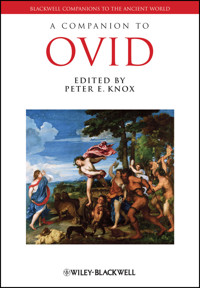
A Companion to Ovid E-Book
43,99 €
Mehr erfahren.
- Herausgeber: John Wiley & Sons
- Kategorie: Geisteswissenschaft
- Serie: Blackwell Companions to the Ancient World
- Sprache: Englisch
A Companion to Ovid is a comprehensive overview of one of the most influential poets of classical antiquity.
- Features more than 30 newly commissioned chapters by noted scholars writing in their areas of specialization
- Illuminates various aspects of Ovid's work, such as production, genre, and style
- Presents interpretive essays on key poems and collections of poems
- Includes detailed discussions of Ovid's primary literary influences and his reception in English literature
- Provides a chronology of key literary and historical events during Ovid's lifetime
Sie lesen das E-Book in den Legimi-Apps auf:
Seitenzahl: 1334
Veröffentlichungsjahr: 2012
Ähnliche




















Table of Contents
Cover
BLACKWELL COMPANIONS TO THE ANCIENT WORLD
Title page
Copyright page
Figures
Notes on Contributors
Preface
List of Abbreviations
Chronological Table of Important Events in Roman History and Literature during the Life of Ovid
PART I: Contexts
CHAPTER ONE: A Poet’s Life
Introduction
In His Own Words
FURTHER READING
CHAPTER TWO: Poetry in Augustan Rome
Introduction
The Roman Political Revolution
Poetry from Revolution to Empire
Professing Poetry in Rome
Public and Private in Augustan Poetry
FURTHER READING
CHAPTER THREE: Rhetoric and Ovid’s Poetry
Rhetoric: Its Conventional Usage and Its Wider Application
Young Ovid in the Classroom
The Early Love Elegies
Speech in (Female) Character
Rhetoric in Epic Context: Metamorphoses XIII
Ovid’s Most Difficult Audience: Addressing Augustus
FURTHER READING
CHAPTER FOUR: Ovid and Religion
Introduction
The Amatory Poems: Ovid as Priest
The Metamorphoses: Ovid’s Anti-Theodicy
The Fasti: Ovid as Victim
The Exile Poetry: Ovid as Victim and Priest
Ovid’s Religion
FURTHER READING
PART II: Texts
CHAPTER FIVE: The Amores: Ovid Making Love
Introduction
Components: Surprise, Sex, and Scherzando
Cohesion: Erotic Story and (Meta)poetic Statement?
FURTHER READING
CHAPTER SIX: The Heroides: Female Elegy?
Introduction
The Collection
Myth and Character
Contemporary Approaches
The Heroides as Epistles
Conclusion
FURTHER READING
CHAPTER SEVEN: The Ars Amatoria
Preliminaries
The Ars and Roman Love Elegy
The Women of the Ars and the Lex Iulia
The Ars, Society, and Augustus
The Ars and Erotodidaxis
The Ars and Didactic Poetry
The Ars and the de Officiis
Coda
FURTHER READING
CHAPTER EIGHT: Remedia Amoris
Introduction
The Metapoetic Frame
Praecepta
Genre(s)
FURTHER READING
CHAPTER NINE: Fasti: the Poet, the Prince, and the Plebs
Introduction
The Calendar
Ovid’s Calendar
Reading the Fasti
Haec Mea Militia Est
FURTHER READING
CHAPTER TEN: The Metamorphoses: A Poet’s Poem
Great Expectations
Prospectus
Materials
Making
A ‘hero-free’ Epic
‘The sweet witty soul of Ovid’
Why Read the Metamorphoses?
FURTHER READING
CHAPTER ELEVEN: The Metamorphoses: Politics and Narrative
Introduction
The Idea of Augustus
Metamorphic Narrative
Imperial Portraiture
FURTHER READING
CHAPTER TWELVE: Tristia
Introduction
Problems of Interpretation
Stylistics and Intertextuality
Chronology
Contents
Themes and Topics
Humor
Poetics
FURTHER READING
CHAPTER THIRTEEN: Ibis
Introduction
Identifying Ibis
Genre
Curses!
Myth and Erudition
Conclusion
FURTHER READING
CHAPTER FOURTEEN: Epistulae ex Ponto
Introduction
Chronology
Structures and Themes: Pont. 1–3
Structure and Themes: Pont. 4
The Recipients
The Poetry of Mores and the Role of Augustus
Present Poetry and Future Poetry
Ovid’s Character and the World of the Exile
FURTHER READING
CHAPTER FIFTEEN: Lost and Spurious Works
Lost Works
Doubtful Works from Antiquity
Medieval and Renaissance Pseudepigrapha
FURTHER READING
PART III: Intertexts
CHAPTER SIXTEEN: Ovid and Hellenistic Poetry
Introduction
Alexandria
Ovidian Aetiologies
Sufferings in Love
The Metamorphoses
Conclusion
FURTHER READING
CHAPTER SEVENTEEN: Ovid and Callimachus: Rewriting the Master
Introduction
Callimachus in the Canon
The Panel and the Frame
Acontius the Poet
Epigraph and Poet
FURTHER READING
CHAPTER EIGHTEEN: Ovid’s Catullus and the Neoteric Moment in Roman Poetry
Predecessors in Roman Poetry
Catullus and the Neoterics as Predecessors to Ovid
Catullus in Ovid’s Poetic Program
Ovid as Emulator of Catullus
Conclusion
FURTHER READING
CHAPTER NINETEEN: Propertius and Ovid
Introduction
The Role of the Love Elegist as Defined by Propertius
Humor
Cynthia and Corinna
Progressive Narratives
Propertius 4 and Ovid’s later works
FURTHER READING
CHAPTER TWENTY: Tibullus and Ovid
Introduction
Tibullus in Ovid’s Elegiac Canon
Ovid as a Tibullan Erotodidact
Tibullus in the Amores
Looking to Tibullus from Tomi
Conclusion
FURTHER READING
CHAPTER TWENTY-ONE: Ovid’s Reception of Virgil
Career and Genres
Virgil by Name
Virgil as Intertext
Subversion or Collaboration?
Ovid’s ‘Aeneid’ (Met. 13.623–14.608)
Virgil Outside Ovid’s ‘Aeneid’
FURTHER READING
PART IV: Critical and Scholarly Approaches
CHAPTER TWENTY-TWO: Editing Ovid: Immortal Works and Material Texts
Immune to Time and the Elements
Carmina et errores: Ovid in Manuscript
Corrected and Emended: Ovid in Print
Nicolaus Heinsius, Verus Sospitator Ovidi
The Modern Critical Corpus
FURTHER READING
CHAPTER TWENTY-THREE: Commenting on Ovid
Introduction
Antiquity
Middle Ages
The Renaissance
Early Printed Commentaries
Exegesis in the Nineteenth Century and After
Current Trends and Future Prospects
FURTHER READING
CHAPTER TWENTY-FOUR: Ovidian Intertextuality
Introduction
Mars’ and Ariadne’s Memories
Literary Existence and the Self-consciousness of Poetry
Speaking Volumes: The Heroides and Intertextual Irony
Intertextuality and Word Plays: Looking for Ovidian Subtlety
Intertextuality, Genre, Callimacheanism
Intertextuality and Augustanism: Ovid and the Aeneid
FURTHER READING
CHAPTER TWENTY-FIVE: Sexuality and Gender
Introduction
The Matrix of Poetry
Homosocial Desire and the Circulation of Female Sexuality
The Poetics of Gender
Conclusion
FURTHER READING
CHAPTER TWENTY-SIX: Ovid’s Generic Transformations
Introduction
Generic Complications
Generic Impurities
Beyond Epic vs. Elegy
FURTHER READING
CHAPTER TWENTY-SEVEN: Theorizing Ovid
Introduction
Ovid Against the Canon
Gendered Readings
Narratology and Ovid
Readers and Illusions: The Imaginary and the Real
FURTHER READING
PART V: Literary Receptions
CHAPTER TWENTY-EIGHT: Ovidian Strategies in Early Imperial Literature
Introduction
Martial’s Ars Amatoria
The Authority of the Metamorphoses
The Ovidian Alternative
FURTHER READING
CHAPTER TWENTY-NINE: The Medieval Ovid
Introduction
Dante’s Ovid
Ovid in the Roman de la Rose
Ovid and Chaucer
FURTHER READING
CHAPTER THIRTY: Ovid in Renaissance English Literature
Introduction
Wanton Ovid
Heroic Error
Writing Ovidian Women
Milton’s Ovidian Errors
FURTHER READING
CHAPTER THIRTY-ONE: Ovid and Shakespeare
FURTHER READING
CHAPTER THIRTY-TWO: Ovid in the Twentieth Century
Introduction
Early Modern Ovid
Ovid after the War
The Late Twentieth Century
Postmodern Ovid
Conclusion
FURTHER READING
CHAPTER THIRTY-THREE: Translating Ovid
Introduction
Shifting English Conceptions
Golding’s and Sandys’ Legacies
Expanding Perimeters
Contemporary Revisions
FURTHER READING
Bibliography
Index
BLACKWELL COMPANIONS TO THE ANCIENT WORLD
This series provides sophisticated and authoritative overviews of periods of ancient history, genres of classical literature, and the most important themes in ancient culture. Each volume comprises approximately twenty-five and forty concise essays written by individual scholars within their area of specialization. The essays are written in a clear, provocative, and lively manner, designed for an international audience of scholars, students, and general readers.
ANCIENT HISTORY
Published
A Companion to the Roman Army
Edited by Paul Erdkamp
A Companion to the Roman Republic
Edited by Nathan Rosenstein and Robert Morstein-Marx
A Companion to the Roman Empire
Edited by David S. Potter
A Companion to the Classical Greek World
Edited by Konrad H. Kinzl
A Companion to the Ancient Near East
Edited by Daniel C. Snell
A Companion to the Hellenistic World
Edited by Andrew Erskine
A Companion to Late Antiquity
Edited by Philip Rousseau
A Companion to Ancient History
Edited by Andrew Erskine
A Companion to Archaic Greece
Edited by Kurt A. Raaflaub and Hans van Wees
A Companion to Julius Caesar
Edited by Miriam Griffin
A Companion to Byzantium
Edited by Liz James
A Companion to Ancient Egypt
Edited by Alan B. Lloyd
A Companion to Ancient Macedonia
Edited by Joseph Roisman and Ian Worthington
A Companion to the Punic Wars
Edited by Dexter Hoyos
A Companion to Augustine
Edited by Mark Vessey
A Companion to Marcus Aurelius
Edited by Marcel van Ackeren
A Companion to Ancient Greek Government
Edited by Hans Beck
LITERATURE AND CULTURE
Published
A Companion to Classical Receptions
Edited by Lorna Hardwick and Christopher Stray
A Companion to Greek and Roman Historiography
Edited by John Marincola
A Companion to Catullus
Edited by Marilyn B. Skinner
A Companion to Roman Religion
Edited by Jörg Rüpke
A Companion to Greek Religion
Edited by Daniel Ogden
A Companion to the Classical Tradition
Edited by Craig W. Kallendorf
A Companion to Roman Rhetoric
Edited by William Dominik and Jon Hall
A Companion to Greek Rhetoric
Edited by Ian Worthington
A Companion to Ancient Epic
Edited by John Miles Foley
A Companion to Greek Tragedy
Edited by Justina Gregory
A Companion to Latin Literature
Edited by Stephen Harrison
A Companion to Greek and Roman Political Thought
Edited by Ryan K. Balot
A Companion to Ovid
Edited by Peter E. Knox
A Companion to the Ancient Greek Language
Edited by Egbert Bakker
A Companion to Hellenistic Literature
Edited by Martine Cuypers and James J. Clauss
A Companion to Vergil’s Aeneid and its Tradition
Edited by Joseph Farrell and Michael C. J. Putnam
A Companion to Horace
Edited by Gregson Davis
A Companion to Families in the Greek and Roman Worlds
Edited by Beryl Rawson
A Companion to Greek Mythology
Edited by Ken Dowden and Niall Livingstone
A Companion to the Latin Language
Edited by James Clackson
A Companion to Tacitus
Edited by Victoria Emma Pagán
A Companion to Women in the Ancient World
Edited by Sharon L. James and Sheila Dillon
A Companion to Sophocles
Edited by Kirk Ormand
A Companion to the Archaeology of the Ancient Near East
Edited by Daniel Potts
A Companion to Roman Love Elegy
Edited by Barbara K. Gold
A Companion to Greek Art
Edited by Tyler Jo Smith and Dimitris Plantzos
A Companion to Persius and Juvenal
Edited by Susanna Braund and Josiah Osgood
This paperback edition first published 2013
© 2013 Blackwell Publishing Ltd
Edition history: (hardback, 2009)
Blackwell Publishing was acquired by John Wiley & Sons in February 2007. Blackwell’s publishing program has been merged with Wiley’s global Scientific, Technical, and Medical business to form Wiley-Blackwell.
Registered Office
John Wiley & Sons Ltd, The Atrium, Southern Gate, Chichester, West Sussex, PO19 8SQ, UK
Editorial Offices
350 Main Street, Malden, MA 02148–5020, USA
9600 Garsington Road, Oxford, OX4 2DQ, UK
The Atrium, Southern Gate, Chichester, West Sussex, PO19 8SQ, UK
For details of our global editorial offices, for customer services, and for information about how to apply for permission to reuse the copyright material in this book please see our website at www.wiley.com/wiley-blackwell.
The right of Peter E. Knox to be identified as the author of the editorial material in this work has been asserted in accordance with the UK Copyright, Designs and Patents Act 1988.
All rights reserved. No part of this publication may be reproduced, stored in a retrieval system, or transmitted, in any form or by any means, electronic, mechanical, photocopying, recording or otherwise, except as permitted by the UK Copyright, Designs and Patents Act 1988, without the prior permission of the publisher.
Wiley also publishes its books in a variety of electronic formats. Some content that appears in print may not be available in electronic books.
Designations used by companies to distinguish their products are often claimed as trademarks. All brand names and product names used in this book are trade names, service marks, trademarks or registered trademarks of their respective owners. The publisher is not associated with any product or vendor mentioned in this book. This publication is designed to provide accurate and authoritative information in regard to the subject matter covered. It is sold on the understanding that the publisher is not engaged in rendering professional services. If professional advice or other expert assistance is required, the services of a competent professional should be sought.
Library of Congress Cataloging-in-Publication Data
A companion to Ovid / edited by Peter E. Knox.
p. cm. – (Blackwell companions to the ancient world)
Includes bibliographical references and index.
ISBN 978-1-4051-4183-3 (hardcover : alk. paper) 978-1-1184-5134-2 (pbk. : alk. paper)
1. Ovid, 43 B.C.-17 or 18 A.D.–Criticism and interpretation. 2. Epistolary poetry, Latin–History and criticism. 3. Didactic poetry, Latin–History and criticism. 4. Elegiac poetry, Latin–History and criticism. 5. Mythology, Classical, in literature. 6. Rome–In literature. 7. Love in literature. I. Knox, Peter E.
PA6537.C57 2009
871′.01–dc22
2008041557
A catalogue record for this book is available from the British Library.
Cover image: Titian, Bacchus and Ariadne, 1522–23. © National Gallery Collection; by kind permission of the Trustees of the National Gallery, London / CORBIS.
Cover design by Workhaus
Figures
1 The Fasti Amiternini
2 ‘St. Dunstan’s Classbook’
3 A fragment of the Metamorphoses
4 A medieval commentary
5 Regius’ commentary
6 John Lyly’s Euphues
7 Phaedra in a Renaissance translation
8 The ‘Flores of Ovide’
9 Golding’s Metamorphoses
10 Sandys’ Metamorphoses
Notes on Contributors
Benjamin Acosta-Hughes is Associate Professor of Greek and Latin and Comparative Literature at the University of Michigan. He works primarily on Hellenistic poetry, its reception of Archaic lyric, and its recall in Roman literature. He is currently editing a Loeb Library edition of Hellenistic epigrams.
Joan Booth is Professor of Latin Language and Literature at Leiden University in the Netherlands. She is the author of a commentary on Ovid, Amores II (1991), and of Catullus to Ovid: Reading Latin Love Elegy (1999). She is also co-editor (with Robert Maltby) of What’s in a Name? The Significance of Proper Names in Classical Latin Literature (2006) and editor of Cicero on the Attack: Invective and Subversion in the Orations and Beyond (2007).
Barbara Weiden Boyd is Henry Winkley Professor of Latin and Greek at Bowdoin College. She is the author of Ovid’s Literary Loves: Influence and Innovation in the Amores (1997), and editor of Brill’s Companion to Ovid (2002). She is currently writing a commentary on the Remedia Amoris.
Gordon Braden is Linden Kent Memorial Professor of English at the University of Virginia. He is the author of The Classics and English Renaissance Poetry (1978), Renaissance Tragedy and the Senecan Tradition (1985), The Idea of the Renais-sance (with William Kerrigan, 1989), Petrarchan Love and the Continental Renaissance (1999), editor of Sixteenth-Century Poetry: An Annotated Anthology (2004), and co-editor of Vol. 2 of The Oxford History of Literary Translation in English (forthcoming).
Sergio Casali is Associate Professor of Latin at the University of Rome ‘Tor Vergata’. He has published a commentary on Ovid, Her. 9 (1995), and articles, notes, and reviews on Roman poetry. He is currently working on a commentary on Virgil, Aeneid IV, for the Cambridge Greek and Latin Classics series. A commentary in Italian on Aeneid II is also forthcoming.
Mario Citroni teaches at the University of Florence. His numerous publications on Latin poetry include a commentary on Book 1 of Martial (1975), Poesia e Lettori in Roma Antica (1995), and the edited volume Memoria e identità: la cultura romana costruisce la sua immagine (2003).
Jo-Marie Claassen has retired from teaching Classics at the University of Stellenbosch. She has published on Ovid and Cicero, exile in the ancient world and today, women and children in antiquity, the Classical tradition in South African architecture, academic development, and the use of the computer in the teaching of Latin. She recently completed an English translation of the verse drama Germanicus by the Afrikaans poet N. P. Van Wyk Louw.
Elaine Fantham taught for eighteen years at the University of Toronto before moving to Princeton in 1986 as Giger Professor of Latin. She is author of a commentary on Ovid’s Fasti, Book 4 (1998) and a number of articles on the Fasti. Since her retirement in 2000 she has continued teaching and publishing, most recently The Roman World of Cicero’s De Oratore (2004), An Introduction to Ovid’s Metamorphoses (2004), and a biography of Julia, daughter of Augustus, Julia Augusti (2006).
Joseph Farrell, Professor of Classical Studies at the University of Pennsylvania, is the author of Virgil’s Georgics and the Traditions of Ancient Epic (1991) and has published widely on Augustan poetry and other aspects of Latin literature and culture.
Laurel Fulkerson is Associate Professor of Classics at the Florida State University. She has written various articles on Ovid, particularly on the Heroides, and is the author of The Ovidian Heroine as Author: Reading, Writing, and Community in the Heroides (2005). Her current work is on the portrayal of emotions in ancient literature.
John M. Fyler is Professor of English at Tufts University, Massachusetts, and is also on the faculty of the Bread Loaf School of English. He is the author of Language and the Declining World in Chaucer, Dante, and Jean de Meun (2007) and Chaucer and Ovid (1979), as well as of a number of essays on Ovid, Chaucer, and medieval literature. He also edited the House of Fame for the Riverside Chaucer.
Luigi Galasso teaches Latin language and literature in the Faculty of Musicology at the University of Pavia. He has edited the second book of Ovid’s Epistulae ex Ponto with a commentary (1995) and is the author of a commentary on the whole of Ovid’s Metamorphoses (2000).
Roy K. Gibson is Professor of Latin at the University of Manchester, and the author of Ovid, Ars Amatoria 3 (2003), Excess and Restraint: Propertius, Horace and Ovid’s Ars Amatoria (2007), and the co-editor (with Steven Green and Alison Sharrock) of The Art of Love: Bimillennial Essays on Ovid’s Ars Amatoria and Remedia Amoris (2006).
Julia Dyson Hejduk is Associate Professor of Classics at Baylor University. Her research interests include Latin poetry, Roman religion, and women of ancient Rome. She has written one monograph, King of the Wood: The Sacrificial Victor in Virgil’s Aeneid (2001), a sourcebook in translation with commentary, Clodia: A Sourcebook (2008), and several articles on Virgil and Ovid. She is currently at work on a monograph involving religion and intertextuality in Ovid, Ovid and His Gods: The Epic Struggles of an Elegiac Hero.
Martin Helzle, Professor of Classics and Chair at Case Western Reserve University, has published extensively on Ovid. Most recently he published a commentary on Ovid’s Epistulae ex Ponto 1–2 (2003).
Geraldine Herbert-Brown is an independent scholar. She is author of Ovid and the Fasti (1994), editor of Ovid’s Fasti: Historical Readings at its Bimillennium (2002), and has published articles on other Roman authors, including Lucilius, Pliny the Elder, and Tacitus.
Stephen Heyworth is Bowra Fellow and Tutor in Classics at Wadham College, Oxford. He edited Classical Quarterly from 1993 to 1998; and in 2007 issued a new Oxford Classical Text of Propertius, as well as a companion volume, Cynthia, and edited a volume of papers, Classical Constructions, published in memory of Don Fowler. He has also published articles on Callimachus, Catullus, Horace, Virgil, and Ovid.
Heather James is Associate Professor of English and Comparative Literature at the University of Southern California. She is the author of Shakespeare’s Troy: Drama, Politics, and the Translation of Empire (1997) as well as numerous articles on classical reception in the Renaissance, and is editor of the Norton Anthology of Western Literature.
Alison Keith is Professor and Chair of the Department of Classics at the University of Toronto. She has written extensively on the intersection of gender and genre in Latin literature, including Engendering Rome (2000), and is currently finishing a book on Propertius, Poet of Love and Leisure.
E. J. Kenney is Kennedy Professor Emeritus of Latin at the University of Cambridge. His publications include a critical edition of Ovid’s amatory works (2nd edn, 1995); editions with commentary of Lucretius’ De Rerum Natura III (1971), Anon. Moretum (1984), Apuleius’ Cupid and Psyche (1990), and Ovid’s Her. 16–21 (1996); a translation with introduction and notes of Apuleius’ Golden Ass (1998); The Classical Text (1974; Italian translation by A. Lunelli 1995); and numerous articles and reviews. He is at present completing a commentary on Ovid’s Metamorphoses Books 7–9.
Peter E. Knox is Professor of Classics at the University of Colorado. He is the author of Ovid’s Metamorphoses and the Traditions of Augustan Poetry (1986), as well as a commentary on selected Heroides (1995). Most recently he edited Oxford Readings in Ovid and has written articles on a wide range of topics in Hellenistic poetry and Latin literature.
Jane L. Lightfoot has been Fellow and Tutor in Classics at New College, Oxford, since 2003. All her books have been published with Oxford University Press: Parthenius of Nicaea (1999), Lucian: On the Syrian Goddess (2003) and The Sibylline Oracles: With Introduction, Translation, and Commentary on the First and Second Books (2008). She is working on a volume of Hellenistic poetry for the Loeb Classical Library.
Robert Maltby is Professor of Latin Philology at the University of Leeds. His research interests are in Roman comedy and elegy and the Latin language in general, especially ancient etymology. His main publications include A Lexicon of Ancient Latin Etymologies (1991) and Tibullus: Elegies (2002).
Christopher Martin is a member of the English department at Boston University, where he serves as NEH Distinguished Teaching Professor. He has published Policy in Love: Lyric and Public in Ovid, Petrarch and Shakespeare (1994) and the anthology Ovid in English (1998), as well as journal articles on literature of the Renaissance and other topics. He is currently completing a book on conceptions of old age in late-Elizabethan literature.
Charles McNelis is Associate Professor of Classics at Georgetown University. In addition to articles on ancient poetry and intellectual life, he has written Statius’ Thebaid and the Poetics of Civil War (2007) and is currently working on a commentary on Statius’ Achilleid for the Cambridge Greek and Latin Classics series.
Mark Possanza is Associate Professor of Classics at the University of Pittsburgh. He is the author of Translating the Heavens: Aratus, Germanicus and the Poetics of Latin Translation (2004) and of articles on textual problems in Latin authors.
Efrossini Spentzou is a Senior Lecturer in Classics at Royal Holloway, University of London. She is the author of Readers and Writers in Ovid’s Heroides: Transgressions of Gender and Genre (2003). She co-edited with the late Don Fowler Cultivating the Muse: Struggles for Power and Inspiration in Classical Literature (2002). She has just finished Reflections of Romanitas: Discourses of Subjectivity in an Imperial Age (co-authored with Richard Alston).
Richard Thomas is Professor of Greek and Latin at Harvard University, where he writes and teaches on Roman and Hellenistic Greek poetry, reception, and Bob Dylan. Recent books include Reading Virgil and his Texts (1999), Virgil and the Augustan Reception (2001), co-edited with Charles Martindale, Classics and the Uses of Reception (2006), co-edited with Catharine Mason, Bob Dylan’s Performance Artistry (2007).
Gareth Williams, Professor of Classics at Columbia University, is the author of several works on Ovid’s exile poetry, including Banished Voices: Readings in Ovid’s Exile Poetry (1994) and The Curse of Exile: A Study of Ovid’s Ibis (1996). Recent publications include a commentary on Seneca’s De Otio and De Brevitate Vitae (2004) and several studies on Seneca’s Natural Questions.
David Wray is Associate Professor of Classics and Comparative Literature at the University of Chicago. He is the author of Catullus and the Poetics of Roman Manhood (2001) and articles on Roman and Hellenistic poetry.
Theodore Ziolkowski is Class of 1900 Professor Emeritus of German and Comparative Literature at Princeton University. In addition to Virgil and the Moderns (1993), Ovid and the Moderns (2005), and the forthcoming Minos and the Moderns: Cretan Myth in Twentieth-century Literature and Art (2008), his recent works include Modes of Faith: Secular Surrogates for Lost Religious Belief (2007), Clio the Romantic Muse (2004), and The Sin of Knowledge (2000).
Preface
Another companion for Ovid … Arriving on the bimillenary of his exile to the shores of the Black Sea, perhaps this Companion is timely. More than one of the contributors to this volume has noted that we are living in another aetas Ovidiana, to borrow a famous, if somewhat problematic, phrase. Two excellent volumes of essays appeared in 2002, which offer readers of Ovid a wealth of information and provocation for future study. In preparing this volume I have had in mind the newcomers to Ovid’s works, be they students or scholars, and the emphasis of the chapters has been on utility. Vast as the sweep of subjects covered in this Companion is, there are inevitably omissions, many of them deeply to be regretted. In particular, it proved impossible to do justice to every aspect of the rapidly developing field of reception studies, so the papers in the volume focus on literary receptions, with a heavy bias toward literature in English. Ovid’s influence on the visual arts deserves a Companion of its own, which could not be included here.
I have allowed the contributors considerable leeway in approaching their topics, including some variation in matters of presentation, such as the use of BC or BCE to indicate dates. In the first instance thanks must go to all the contributors for their diligence, their forbearance, and their talents. I hope that my labors as editor have obscured as little as possible of their learning. I am deeply grateful to Sophie Gibson for soliciting this volume, and to Ben Thatcher and Hannah Rolls for their hard work in seeing it to completion.
Peter E. KnoxUniversity of Colorado, Boulder, November 2007
List of Abbreviations
Ovid’s works are referred to throughout the volume by the following standard abbreviations: Amores (Am.), Heroides (Her.), Ars amatoria (Ars), Remedia amoris (Rem.), Medicamina faciei (Med.), Metamorphoses (Met.), Fasti (Fast.), Tristia (Tr.), Ibis (Ib.), Epistulae ex Ponto (Pont.). All translations are the authors’ own, unless otherwise indicated. References to other authors follow standard conventions to be found in, for example, The Oxford Latin Dictionary or Liddell and Scott. The following abbreviations for journals and reference works are used here:
A&A
Antike und Abendland
A&R
Atene e Roma
AC
L’Antiquité classique
AJP
American Journal of Philology
ANRW
Aufstieg und Niedergang der römischen Welt
ASNP
Annali della Scuola Normale Superiore di Pisa, Classe di Lettere e Filosofia
AU
Der Altsprachliche Unterricht
BICS
Bulletin of the Institute of Classical Studies
BMCR
Bryn Mawr Classical Review
BNP
Brill’s New Pauly
CA
Classical Antiquity
CB
The Classical Bulletin
CFC(L)
Cuadernos de filología clásica. Estudios latinos
CJ
The Classical Journal
CL
Corolla Londiniensis
CML
Classical and Modern Literature
CPh
Classical Philology
CQ
Classical Quarterly
CR
Classical Review
CSCA
California Studies in Classical Antiquity
CW
Classical World
DBI
Dizionario Biografico degli Italiani
FGrH
Fragmente der griechischen Historiker
G&R
Greece and Rome
GRBS
Greek, Roman and Byzantine Studies
HSCP
Harvard Studies in Classical Philology
ICS
Illinois Classical Studies
IJCT
International Journal of the Classical Tradition
IMU
Italia Medioevale e Umanistica
JHS
Journal of Hellenic Studies
JPh
Journal of Philology
JRS
Journal of Roman Studies
JWCI
Journal of the Warburg and Courtauld Institute
LCM
Liverpool Classical Monthly
LEC
Les Études Classiques
MAAR
Memoirs of the American Academy in Rome
MD
Materiali e discussioni per l’analisi dei testi classici
MH
Museum Helveticum
MLatJb
Mittellateinisches Jahrbuch
MLQ
Modern Language Quarterly
N&Q
Notes and Queries
OLD
Oxford Latin Dictionary
, ed. P. G. W. Glare (Oxford, 1982)
PBA
Proceedings of the British Academy
PCPhS
Proceedings of the Cambridge Philological Society
PLLS
Papers of the Leeds International Latin Seminar
POxy
Oxyrhynchus Papyri
PQ
Philological Quarterly
R&L
Religion and Literature
RBPH
Revue Belge de philologie et d’histoire
RE
Real-Encylopädie der Altertumswisseschaft
RhM
Rheinisches Museum
RHT
Revue d’Histoire des Textes
RSC
Rivista di studi classici
SB
Studies in Bibliography
SEEJ
Slavic and East European Journal
ShS
Shakespeare Survey
SH
Supplementum Hellenisticum
, ed. H. Lloyd-Jones and P. J. Parsons (Berlin, 1983)
SO
Symbolae Osloenses
SSH
Supplementum Supplementi Hellenistici
, ed. H. Lloyd-Jones (Berlin, 2005).
TAPA
Transactions of the American Philological Association
TLL
Thesaurus Linguae Latinae
TRF
Tragicorum Romanorum Fragmenta
, ed. O. Ribbeck (Leipzig, 1871)
WJA
Würzburger Jahrbücher der Altertumswissenschaft
WS
Wiener Studien
YCS
Yale Classical Studies
ZPE
Zeitschrift für Papyrologie und Epigraphik
Chronological Table of Important Events in Roman History and Literature during the Life of Ovid
Most of the dates of Ovid’s works are entirely conjectural. Those given below reflect a consensus view, but can only be considered approximate.
PART IContexts
CHAPTER ONE
A Poet’s Life
Peter E. Knox
Introduction
Late in his career, Ovid defined his place in recent literary history by drawing up a list of names (Tr. 4.10.41–54):
temporis illius colui fouique poetas, quotque aderant uates, rebar adesse deos.saepe suas uolucres legit mihi grandior aeuo, quaeque nocet serpens, quae iuuat herba, Macer.saepe suos solitus recitare Propertius ignes, iure sodalicii, quo mihi iunctus erat.Ponticus heroo, Bassus quoque clarus iambis dulcia conuictus membra fuere mei.et tenuit nostras numerosus Horatius aures, dum ferit Ausonia carmina culta lyra.Vergilium uidi tantum, nec auara Tibullo tempus amicitiae fata dedere meae.successor fuit hic tibi, Galle, Propertius illi; quartus ab his serie temporis ipse fui.
The poets of that time I cultivated and cherished, and for me poets were so many gods. Often Macer, already advanced in years, read to me of his birds, of poisonous snakes, or healing plants. Often Propertius would recite his flaming verse, by virtue of the comradeship that joined him to me. Ponticus, noted for epic, and Bassus, noted for iambics, were sweet members of my circle. And Horace, he of the many numbers, held our ears in thrall, while he tuned his fine-crafted songs to the Ausonian lyre. Virgil I only saw; greedy fate gave Tibullus no time for friendship with me. He was your successor, Gallus, and Propertius his; after them I was fourth in order of time.
The climate for poetry in Rome during Ovid’s lifetime was electric. Ovid places himself in distinguished company, including poets whose works, though lost to us now, were celebrated in their time: Aemilius Macer, the author of didactic verse (Courtney 1993: 292–9; Hollis 2007: 93–117), Ponticus, an epic poet (Hollis 2007: 426), Bassus, writer of iambs (Hollis 2007: 421), and Gallus, celebrated by Virgil in his Eclogues and widely recognized as the first Roman elegist (Courtney 1993: 259–70; Hollis 2007: 219–52). The selection cannot be random, and is not likely to have been limited only to poets whom he had met or heard. These are the names that mattered to Ovid among his contemporaries, whose works influenced his own forays into epic, didactic, invective, and the verse epistle. But when it comes to classifying himself in this company he is an elegist, following in the footsteps of Gallus, Tibullus, and Propertius, the same company he cites in his apology to Augustus (Tr. 2.445–66) with the concluding remark (467), ‘to these I succeeded’ (his ego successi). In the process he defined the canon, for when Quintilian turns to the chief exponents of elegy in Latin, it is these same four whom he names and no others (Inst. 10.1.93): ‘we challenge the Greeks also in elegy, in which Tibullus seems to me particularly polished and elegant, though some prefer Propertius. Ovid is more extravagant than both of them, just as Gallus is harsher.’ It is telling that Ovid thus classifies himself as an elegist, even after the achievement of his Metamorphoses, for the background of elegy informs even his hexameter epic: it is the wellspring from which he draws inspiration in all his manifold creative endeavors.
In His Own Words
Ovid is himself the source for most of what we think we know about his life; indeed, he provides more information about himself than most ancient poets. It is always hazardous to infer too much or too confidently from such references in a poet’s own work: as Ovid himself avers (Am. 3.12.19), nec tamen ut testes mos est audire poetas (‘nor is it the custom to listen to poets as if they were courtroom witnesses’). It is nonetheless possible to glean some data about his background and career, not only from the long autobiographical poem composed toward the end of his life during his exile on the Black Sea (Tr. 4.10), but also from numerous revealing remarks scattered throughout his works. His hometown was Sulmo (Tr. 4.10.3 Sulmo mihi patria est), now called Sulmona, situated in a well-watered valley in the Abruzzi of central Italy, and in Ovid’s time one of the chief towns of the tribe known as the Paeligni. He was born Publius Ovidius Naso on 20 March 43 BCE. The significance of this date was not lost on Ovid later in life, for as he notes (Tr. 4.10.6) it was in this year that the two consuls Hirtius and Pansa both fell in the campaign against Mark Antony at the head of the last army of the Roman Republic. Most of the poets Ovid names in his autobiography began their careers in the confused circumstances of the civil wars that followed Julius Caesar’s assassination. Virgil, who released his Georgics in 29 BCE in the immediate aftermath of Octavian’s victory at Actium, had earlier composed his book of Eclogues, in which the tenor of the times is refracted through the lens of Theocritean bucolic. Horace’s book of Epodes, probably published near the end of the Triumviral period, also meditates on the fears and apprehensions of that era. At about the same time, Ovid’s two surviving predecessors in elegy, Tibullus and Propertius, were producing books in which the harsh realities of the time impinge on their idealized visions of the life of love. Ovid, so far as we can tell, was touched by none of this. His career belongs entirely to the early Empire, a time of peace at least on the domestic front, and the great matters treated in his works are affairs of the heart and of character, rather than of state.
His first literary performances probably took place several years after the battle of Actium and the fall of Alexandria, perhaps around 25 BCE. The date can only be approximate, deriving as it does from information given by Ovid himself (Tr. 4.10.57–8):
carmina cum primum populo iuuenalia legi, barba resecta mihi bisue semelue fuit.
When I first read my youthful songs to the public, my beard had been cut but once or twice.
We may suppose that Ovid was no more than about eighteen years old when this took place (Wheeler 1925: 11–17), but precision on this score is unimportant: the point that Ovid makes is about the precociousness of his venture into a life of poetry.
His family presumably preferred a different career path. As the second son of an old, equestrian family of considerable standing in the community, Ovid might have been expected to pursue a career in public life, where opportunities beckoned under the new regime in Rome. As recently as during the Social War of 91–89 BCE, Sulmo had aligned itself with the rest of the Paeligni against Rome, but there was a long tradition of alliance. In his move to consolidate power Augustus sought to draw on such communities throughout Italy to recruit new magistrates and senators. From Ovid we learn that he embarked on just such a course: he studied rhetoric in Rome and Athens, the traditional route to a political career (Wheeler 1925: 4–11). He held two positions on boards of magistrates, as one of the tresuiri capitales (Tr. 4.10.33–4; Kenney 1969b: 244), who exercised police functions in the city. And later he informs us (Fast. 4.383–4) that he held a seat among the decemuiri stlitibus iudicandis (‘Board of Ten for Judging Lawsuits’), an important judicial post that was commonly a precursor to seeking the quaestorship and a senatorial career. On Ovid’s testimony his earliest recitations of poetry took place at the very time when he was ostensibly embarking on a life in law and politics. He ironically remarks that his father had hoped for a more lucrative livelihood:
saepe pater dixit ‘studium quid inutile temptas? Maeonides nullas ipse relinquit opes.’
Often my father said, ‘Why do you attempt a useless pursuit? Homer himself left no wealth.’
Perhaps his father might have gotten the joke, but if Augustus ever noticed this poem, he would not have been amused. Ovid abandoned public office for the life of letters, but his choices in that field were not bound to win him favor.
During the first twenty-five years of his career, a period extending roughly from the mid-twenties BCE to 2 CE, Ovid was occupied exclusively with elegy, issuing a stunning series of works: Amores, Heroides, Ars amatoria, and Remedia amoris. To this period too belong most of the lost works (Chapter 15), among which the tragedy Medea may be reckoned the greatest loss. The exact sequence of the release of these works is unclear and much disputed. The matter is complicated in the first instance by the fact that his earliest collection, the Amores, survives only in a three-book edition, which, Ovid asserts, has been reduced from an original five-book collection. There is no consensus about the date of either edition, or about the nature of the revision effected upon the earlier work, but opinions generally divide between those who argue that Ovid’s final edition collects the best poems from the first edition without the addition of new poems or extensive revision (Cameron 1968) and those who contend that the three-book edition was essentially a new work (McKeown 1987: 86–9). Ovid himself seems to suggest the former, when he describes his earliest work in the autobiography from Tomi (Tr. 4.10.61–2):
multa quidem scripsi, sed, quae uitiosa putaui, emendaturis ignibus ipse dedi.
I wrote a great deal indeed, but what I considered defective I myself gave to the flames for correction.
Even if this inference is correct, it is not entirely clear where in the chronological sequence to date the release of the Heroides, a collection that itself raises intractable questions about composition and publication. The dates given above in the Chronological Table are thus tentative at best.
By the time Ovid completed the Remedia amoris, the last of his amatory elegiacs, in roughly 2 CE he was probably already deeply involved in the composition of his two large-scale narrative poems, the Fasti and the Metamorphoses. It is clear that he had not completed the Fasti by the year 8 CE, when his life changed drastically with the issuance of a decree of relegation by the emperor. Ovid himself refers to twelve books (Tr. 2.549–50), but only six survive and there are clear signs of revision to the existing poem during the period of exile. There is no reason to believe that the remaining six ever left the poet’s hand, and the poet’s words here carry no more weight than his assertion that the Metamorphoses was unfinished (Tr. 2.555–6):
dictaque sunt nobis, quamuis manus ultima coeptis defuit, in facies corpora uersa nouas.
And though this work lacked final revision, I also told of bodies that changed into new shapes.
The composition of this masterpiece was surely the preoccupation of the years immediately preceding his exile.
We will never know what led Augustus to send Ovid into exile, or what sense of irony or private joke led him to choose the venue for Ovid’s relegation, remote and inhospitable Tomi on the shores of the Black Sea. The reason famously given by Ovid (Tr. 2.207), ‘a poem and a mistake’ (carmen et error), may invert the sequence, a hysteron proteron of sorts, if, as many scholars believe, the poem, which Ovid identifies as the Ars amatoria, was brought into the indictment later to provide cover for some other offense, the error that Ovid never explains. Many scholars cannot escape the suspicion that Ovid’s relegation was somehow related to the disgrace of Augustus’ granddaughter Julia, exiled on a charge of adultery in the same year (e.g. Syme 1978: 215–29). Others incline to a scandal of a more personal nature (e.g. Goold 1983), or attempt to relate the exile to changes in the climate for literature during Augustus’ dotage (Knox 2004). The consequences for Ovid were tragic, but did not sap his creative powers. A stream of innovative new works flowed from his stylus while he lamented life on the Roman frontier: the Tristia in five books composed during the journey to Tomi and in his first years there; that bizarre display of erudite invective known as the Ibis; and four books of epistles to friends and acquaintances, his Epistulae ex Ponto, the last book of which probably contains his final works. A common thread uniting all the works of exile is Ovid’s return to the elegiac mode, the measure in which he began his career and by which he defined himself. Ovid began writing just a few years after Octavian assumed the title by which he is best known to history, and his death came only a few years after the emperor’s. Ovid, perhaps the most Augustan poet and certainly the last, died at Tomi sometime during the winter of 17–18 CE.
FURTHER READING
Still fundamental for basic information and collection of the evidence about Ovid’s career are surveys such as Wheeler (1925), Martini (1933), or Kraus (1968). In the absence of new evidence, there is always a place for re-evaluation and recontextualization. For instance, Kenney (1969b) investigates Ovid’s use of legal language against the background of his public career, while Syme (1978) attempts to review Ovid’s network of friends and associates within the changing political landscape of Augustus’ later years. The subject of Ovid’s exile continually attracts new speculation: in addition to the works surveyed by Thibault (1964), papers by Goold (1983) and Knox (2004) may be consulted for recent attempts to set the relegation within the context of the times.
CHAPTER TWO
Poetry in Augustan Rome
Mario Citroni
Introduction
Lesen Sie weiter in der vollständigen Ausgabe!
Lesen Sie weiter in der vollständigen Ausgabe!
Lesen Sie weiter in der vollständigen Ausgabe!
Lesen Sie weiter in der vollständigen Ausgabe!
Lesen Sie weiter in der vollständigen Ausgabe!
Lesen Sie weiter in der vollständigen Ausgabe!
Lesen Sie weiter in der vollständigen Ausgabe!
Lesen Sie weiter in der vollständigen Ausgabe!
Lesen Sie weiter in der vollständigen Ausgabe!
Lesen Sie weiter in der vollständigen Ausgabe!
Lesen Sie weiter in der vollständigen Ausgabe!
Lesen Sie weiter in der vollständigen Ausgabe!
Lesen Sie weiter in der vollständigen Ausgabe!
Lesen Sie weiter in der vollständigen Ausgabe!
Lesen Sie weiter in der vollständigen Ausgabe!
Lesen Sie weiter in der vollständigen Ausgabe!
Lesen Sie weiter in der vollständigen Ausgabe!
Lesen Sie weiter in der vollständigen Ausgabe!
Lesen Sie weiter in der vollständigen Ausgabe!
Lesen Sie weiter in der vollständigen Ausgabe!
Lesen Sie weiter in der vollständigen Ausgabe!
Lesen Sie weiter in der vollständigen Ausgabe!
Lesen Sie weiter in der vollständigen Ausgabe!
Lesen Sie weiter in der vollständigen Ausgabe!
Lesen Sie weiter in der vollständigen Ausgabe!
Lesen Sie weiter in der vollständigen Ausgabe!
Lesen Sie weiter in der vollständigen Ausgabe!
Lesen Sie weiter in der vollständigen Ausgabe!
Lesen Sie weiter in der vollständigen Ausgabe!
Lesen Sie weiter in der vollständigen Ausgabe!
Lesen Sie weiter in der vollständigen Ausgabe!
Lesen Sie weiter in der vollständigen Ausgabe!
Lesen Sie weiter in der vollständigen Ausgabe!
Lesen Sie weiter in der vollständigen Ausgabe!
Lesen Sie weiter in der vollständigen Ausgabe!
Lesen Sie weiter in der vollständigen Ausgabe!
Lesen Sie weiter in der vollständigen Ausgabe!




