


A Companion to Persius and Juvenal E-Book
155,99 €
Mehr erfahren.
- Herausgeber: John Wiley & Sons
- Kategorie: Geisteswissenschaft
- Serie: Blackwell Companions to the Ancient World
- Sprache: Englisch
A Companion to Persius and Juvenal breaks new ground in its in-depth focus on both authors as "satiric successors"; detailed individual contributions suggest original perspectives on their work, and provide an in-depth exploration of Persius' and Juvenal's afterlives.
- Provides detailed and up-to-date guidance on the texts and contexts of Persius and Juvenal
- Offers substantial discussion of the reception of both authors, reflecting some of the most innovative work being done in contemporary Classics
- Contains a thorough exploration of Persius' and Juvenal's afterlives
Sie lesen das E-Book in den Legimi-Apps auf:
Seitenzahl: 1306
Veröffentlichungsjahr: 2012
Ähnliche




















Contents
Cover
Blackwell Companions to the Ancient World
Title Page
Copyright
List of Illustrations
Abbreviations
Notes on Contributors
Acknowledgments
Introduction: Persius and Juvenal as Satiric Successors
I.1 Satirists and Poetic Succession
I.2 Inheritance-Hunting: Satiric Succession in Practice
I.3 Reading Persius and Juvenal
Part I: Persius and Juvenal: Texts and Contexts
Chapter 1: Satire in the Republic: From Lucilius to Horace
1.1 Grandmaster Lucilius
1.2 Horace on Lucilius
1.3 Conclusion: Lucilian libertas into the Empire
Further Reading
Chapter 2: The Life and Times of Persius: The Neronian Literary “Renaissance”
2.1 Persius and Nero, the Literary Emperor
2.2 The Neronian Literary Triad: Seneca, Lucan, and Petronius
2.3 Conclusion
Further Reading
Chapter 3: Juvenalis Eques: A Dissident Voice from the Lower Tier of the Roman Elite
3.1 The “Real” Juvenal and His Persona
3.2 Equestrian Rank and Literary Men in the Age of Domitian, Trajan, and Hadrian
3.3 Some Passages in Juvenal 3
3.4 JuvenalisEques: Two Last Thoughts
Further Reading
Chapter 4: Life in the Text: The Corpus of Persius’ Satires
4.1 The Space of the Book
4.2 The Story of the Book
4.3 The Stuff of the Book
4.4 The Sensations of the Book
4.5 The Seriousness of the Book
Further Reading
Chapter 5: Juvenal: The Idea of the Book
5.1 Introduction: How Many Juvenals?
5.2 Sex and Deviant Bodies in Rome
5.3 The Women of Juvenal: Boar Hunters and Cross-Dressers
5.4 Concluding Thoughts
Further Reading
Chapter 6: Satiric Textures: Style, Meter, and Rhetoric
6.1 Persius
6.2 Juvenal
Further Reading
Chapter 7: Manuscripts of Juvenal and Persius
7.1 Juvenal
7.2 Juvenal: The Earliest Stages of Transmission
7.3 Making Sense of the Mess
7.4 The Prototype
7.5 Juvenal: 400–500
7.6 Commentaries and Scholia
7.7 Juvenal 500–600
7.8 Carolingian Renaissance
7.9 The Vulgate Text
7.10 Persius Manuscripts
Further Reading
Part II: Retrospectives: Persius and Juvenal as Successors
Chapter 8: Venusina lucerna: Horace, Callimachus, and Imperial Satire
8.1 Identity and Saturnalia
8.2 A Half-Inventor, Many Authorities
8.3 Callimachean Dreams (from Horace to Persius)
8.4 Persius and Juvenal against Epic
8.5 Horatian Principles of Callimachean Satire
8.6 What Way?
8.7 Refuges, Corners and Arenas
8.8 Totus Noster Callimachus
Further Reading
Chapter 9: Self-Representation and Performativity
9.1 Identity and Status
9.2 Lucilian Individuality and Imperial Satire
9.3 Unreliable Voices
9.4 Interlocutors, Other Speakers, and Addressees
9.5 Imperial Satire's Performance “Script”
9.6 Conclusion
Further Reading
Acknowledgments
Chapter 10: Persius, Juvenal, and Stoicism
10.1 Introduction
10.2 Persius and Stoicism
10.3 Persius on Poetry
10.4 Self-Shaping and Imaginary Interlocutors
10.5 Persius, Philosophy, and Food
10.6 The Degraded Body
10.7 The Stoics on Poetry
10.8 Juvenal and Philosophy
Further Reading
Chapter 11: Persius, Juvenal, and Literary History after Horace
11.1 Persius' Prologue
11.2 Persius and Iambic Verse
11.3 Old Comedy
11.4 Conclusion
Further Reading
Chapter 12: Imperial Satire and Rhetoric
12.1 Introduction
12.2 The Satirist's Rhetoric of Definitions
12.3 The Satirist's Definitions of Rhetoric
12.4 Images of Rhetoric in Persius, Juvenal, and Their Predecessors
12.5 Rhetoric and the World in Juvenal's Fourth Satire
12.6 Conclusion
Further Reading
Chapter 13: Politics and Invective in Persius and Juvenal
13.1 Introduction
13.2 Approaches to the “Politics” of Latin Literature
13.3 The Politics of “Free Speech” in Persius and Juvenal
13.4 Invective
13.5 Conclusion: Invective and Politics
Further reading
Chapter 14: Imperial Satire as Saturnalia
14.1 Bakhtin's Carnival
14.2 Saturnalia
14.3 Persius
14.4 Juvenal
14.5 Conclusion
Further Reading
Part III: Prospectives: The Successors of Persius and Juvenal
Chapter 15: Imperial Satire Reiterated: Late Antiquity through the Twentieth Century
15.1 Late Antiquity into the Seventeenth Century
15.2 English Satire's Big Show: The Long Eighteenth Century
15.3 A Few Modern Receptions
Further Reading
Chapter 16: Persius, Juvenal, and the Transformation of Satire in Late Antiquity
16.1 Christian Satire
16.2 A Juvenalian Renaissance
16.3 Satire in Historiography
16.4 A New Theory of Satire
Further Reading
Chapter 17: Imperial Satire in the English Renaissance
17.1 Overview
17.2 Reputations
17.3 Wyatt
17.4 The Elizabethans and Jacobeans
17.5 The Translators
Further Reading
Chapter 18: Imperial Satire Theorized: Dryden's Discourse of Satire
18.1 Introduction
18.2 Dryden and Satire: From Practice to Theory (and Back)
18.3 Satirists as Successors
18.4 Persius and Juvenal: Exemplars of Succession
18.5 Dryden's Ideals for Satire and the Ideals in Practice
18.6 Conclusion
Further Reading
Chapter 19: Imperial Satire and the Scholars
19.1 The Earliest Commentaries
19.2 Will the Real Probus Please Stand Up?
19.3 Who Was Cornutus?
19.4 Persius and Juvenal at School
19.5 The Imperial Satirists in the Renaissance Canon and Classroom
19.6 Renaissance Scholarship on Juvenal and Persius
19.7 Pithou's Legacy
19.8 Interpolation Hunting
19.9 “Editors, For The Use Of...”
19.10 Examples
Further Reading
Chapter 20: School Texts of Persius and Juvenal
20.1 Preface
20.2 Introduction
20.3 Lives
20.4 Commentaries
20.5 Conclusion
Further Reading
Chapter 21: Revoicing Imperial Satire
21.1 Introduction: Translation, Ideology, and Rhetoric
21.2 The Martial of Margate: Juvenal as Nineteenth-Century Moralist
21.3 Translation in the Continuum of Explanation
21.4 Translation, Scholarship, and Cultural Ownership
21.5 Juvenal for Britain! (Frequently and in Several Sizes)
21.6 Reading (Gifford Through) Evans
21.7 Manly Vigour and Gentlemanly Decorum
21.8 Juvenal, Horace . . . and Persius
21.9 Ramsay's Loeb
21.10 Conclusion
Further Reading
Chapter 22: Persius and Juvenal in the Media Age
22.1 The Satirists' Camera Eye
22.2 Persius: Fade to Dark
22.3 Juvenal: Themes and Variations
22.4 Juvenal's Rome
22.5 From Decimus Iunius Iuvenalis to Gaius Arrius Nurus
22.6 A Scamp and a Shooting Star
Further Reading
References
Index Locorum
General Index
Blackwell Companions to the Ancient World
This series provides sophisticated and authoritative overviews of periods of ancient history, genres of classical literature, and the most important themes in ancient culture. Each volume comprises approximately twenty-five to forty concise essays written by individual scholars within their area of specialization. The essays are written in a clear, provocative, and lively manner, designed for an international audience of scholars, students, and general readers.
Ancient History
Published
A Companion to the Roman Army
Edited by Paul Erdkamp
A Companion to the Roman Republic
Edited by Nathan Rosenstein and Robert Morstein-Marx
A Companion to the Roman Empire
Edited by David S. Potter
A Companion to the Classical Greek World
Edited by Konrad H. Kinzl
A Companion to the Ancient Near East
Edited by Daniel C. Snell
A Companion to the Hellenistic World
Edited by Andrew Erskine
A Companion to Late Antiquity
Edited by Philip Rousseau
A Companion to Ancient History
Edited by Andrew Erskine
A Companion to Archaic Greece
Edited by Kurt A. Raaflaub and Hans van Wees
A Companion to Julius Caesar
Edited by Miriam Griffin
A Companion to Byzantium
Edited by Liz James
A Companion to Ancient Egypt
Edited by Alan B. Lloyd
A Companion to Ancient Macedonia
Edited by Joseph Roisman and Ian Worthington
A Companion to the Punic Wars
Edited by Dexter Hoyos
A Companion to Augustine
Edited by Mark Vessey
A Companion to Marcus Aurelius
Edited by Marcel van Ackeren
Literature and Culture
Published
A Companion to Classical Receptions
Edited by Lorna Hardwick and Christopher Stray
A Companion to Greek and Roman Historiography
Edited by John Marincola
A Companion to Catullus
Edited by Marilyn B. Skinner
A Companion to Roman Religion
Edited by Jörg Rüpke
A Companion to Greek Religion
Edited by Daniel Ogden
A Companion to the Classical Tradition
Edited by Craig W. Kallendorf
A Companion to Roman Rhetoric
Edited by William Dominik and Jon Hall
A Companion to Greek Rhetoric
Edited by Ian Worthington
A Companion to Ancient Epic
Edited by John Miles Foley
A Companion to Greek Tragedy
Edited by Justina Gregory
A Companion to Latin Literature
Edited by Stephen Harrison
A Companion to Greek and Roman Political Thought
Edited by Ryan K. Balot
A Companion to Ovid
Edited by Peter E. Knox
A Companion to the Ancient Greek Language
Edited by Egbert Bakker
A Companion to Hellenistic Literature
Edited by Martine Cuypers and James J. Clauss
A Companion to Vergil's Aeneid and its Tradition
Edited by Joseph Farrell and Michael C.J. Putnam
A Companion to Horace
Edited by Gregson Davis
A Companion to Families in the Greek and Roman Worlds
Edited by Beryl Rawson
A Companion to Greek Mythology
Edited by Ken Dowden and Niall Livingstone
A Companion to the Latin Language
Edited by James Clackson
A Companion to Tacitus
Edited by Victoria Emma Pagán
A Companion to Women in the Ancient World
Edited by Sharon L. James and Sheila Dillon
A Companion to Sophocles
Edited by Kirk Ormand
A Companion to the Archaeology of the Ancient Near East
Edited by Daniel Potts
A Companion to Roman Love Elegy
Edited by Barbara K. Gold
A Companion to Greek Art
Edited by Tyler Jo Smith and Dimitris Plantzos
A Companion to Persius and Juvenal
Edited by Susanna Braund and Josiah Osgood
This edition first published 2012
© 2012 Blackwell Publishing Ltd.
Blackwell Publishing was acquired by John Wiley & Sons in February 2007. Blackwell's publishing program has been merged with Wiley's global Scientific, Technical, and Medical business to form Wiley-Blackwell.
Registered Office
John Wiley & Sons Ltd, The Atrium, Southern Gate, Chichester, West Sussex, PO19 8SQ, UK
Editorial Offices
350 Main Street, Malden, MA 02148–5020, USA
9600 Garsington Road, Oxford, OX4 2DQ, UK
The Atrium, Southern Gate, Chichester, West Sussex, PO19 8SQ, UK
For details of our global editorial offices, for customer services, and for information about how to apply for permission to reuse the copyright material in this book please see our website at www.wiley.com/wiley-blackwell.
The right of Susanna Braund and Josiah Osgood to be identified as the authors of the editorial material in this work has been asserted in accordance with the UK Copyright, Designs and Patents Act 1988.
All rights reserved. No part of this publication may be reproduced, stored in a retrieval system, or transmitted, in any form or by any means, electronic, mechanical, photocopying, recording or otherwise, except as permitted by the UK Copyright, Designs and Patents Act 1988, without the prior permission of the publisher.
Wiley also publishes its books in a variety of electronic formats. Some content that appears in print may not be available in electronic books.
Designations used by companies to distinguish their products are often claimed as trademarks. All brand names and product names used in this book are trade names, service marks, trademarks or registered trademarks of their respective owners. The publisher is not associated with any product or vendor mentioned in this book. This publication is designed to provide accurate and authoritative information in regard to the subject matter covered. It is sold on the understanding that the publisher is not engaged in rendering professional services. If professional advice or other expert assistance is required, the services of a competent professional should be sought.
Library of Congress Cataloging-in-Publication Data
A companion to Persius and Juvenal/edited by Susanna Braund and Josiah Osgood.
p. cm. – (Blackwell companions to the ancient world)
Includes bibliographical references and index.
ISBN 978-1-4051-9965-0 (hardback: alk. paper) 1. Persius–Criticism and interpretation. 2. Juvenal–Criticism and interpretation. 3. Verse satire, Latin–History and criticism.
I. Braund, Susanna Morton. II. Osgood, Josiah, 1974–
PA6556.C66 2012
871′.0109–dc23
2012005847
A catalogue record for this book is available from the British Library.
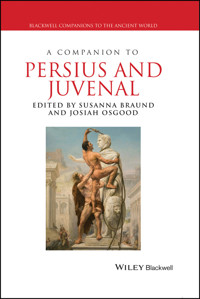
Jacket image: Joseph-Noël Sylvestre, Le Sac de Rome en 410 par les Vandales, 1890, oil on canvas, 197 × 130 cm. Musée Paul Valéry, Sète. Photo © Eric Teissèdre.
Jacket design by Workhaus
List of Illustrations
7.1 The textual transmission of Juvenal
20.1 The opening of Horace's Satires 1.8 from Quinti Horatii Flacci OPERA, . . . Philadelphia: W. Poyntell, 1804
22.1 Alfred Hitchcock's Suspicion
22.2 Poster for Douglas Sirk's Sleep, My Love
22.3 Michael Moore's Fahrenheit 9/11
22.4Durs Grünbein liest Juvenal. The German poet reading from Satire 3
Abbreviations
Abbreviations throughout are in accord with those of S. Hornblower and A. Spawforth, eds., The Oxford Classical Dictionary, 3rd edn., Oxford, 1996 (hereafter OCD3). The Oxford Latin Dictionary cited throughout as OLD is the edition edited by P.G.W. Glare, Oxford, 1982.
Notes on Contributors
David Armstrong is Professor Emeritus of Classics at the University of Texas, Austin. He has published on Horace, Roman satire, and the Herculaneum papyri of Philodemus of Gadara, and is working currently on the interface between Hellenistic philosophy and Roman poetry, and on an edition and translation of Philodemus’ On Anger.
Shadi Bartsch, Buttenwieser Professor of Classics at the University of Chicago, has written or edited some eight books on widely ranging topics in classical antiquity and numerous articles and she has translated Roman tragedy. Her most recent book is The Mirror of the Self: Sexuality, Self-Knowledge and the Gaze in the Early Roman Empire (2006). Her interests include the study of ancient philosophy, especially Stoicism and the Stoic philosopher Seneca; the culture and literature of the first century ce at Rome; and the history of classical rhetoric. She is currently working on a large-scale project on the ancient treatment of metaphor as a cognitive and pedagogic tool. Among Bartsch's honors and grants, she has held a Guggenheim Fellowship, an ACLS Fellowship, and a Franke Fellowship at the University of Chicago.
Susanna Braund moved to University of British Columbia in 2007 to take up a Canada Research Chair in Latin poetry and its reception after teaching previously at Stanford, Yale, London, Bristol and Exeter Universities. She has published extensively on Roman satire, including a commentary on Juvenal Satires 1– 5 (Cambridge Greek and Latin Classics), on Latin epic poetry and on Seneca. She has translated Lucan for Oxford World's Classics and Persius and Juvenal for the Loeb Classical Library.
Andrea Cucchiarelli is Associate Professor at the University of Rome “La Sapienza.” He has published articles on Lucretius, Virgil, Horace, and Petronius, and he is author of two books: La satira e il poeta. Orazio tra Epodi e Sermones (2001), and La veglia di Venere – Pervigilium Veneris (2003). A commentary on Virgil's Bucolics is forthcoming.
Martin T. Dinter is Lecturer in Latin literature and language at King's College London. He has published articles on Horace, Virgil, Lucan, and Valerius Flaccus and has authored a monograph on Lucan (Anatomizing Civil War: Four Studies in Lucan's Epic Technique, 2012). He is co-editor with Emma Buckley of the Blackwell Companion to Neronian Literature and Culture (forthcoming) and editor of the Cambridge Companion to Roman Comedy (2012).
Stuart Gillespie is a member of the Department of English Literature at the University of Glasgow. He is editor of the journal Translation and Literature and joint general editor of The Oxford History of Literary Translation in English (2005–). In the field of classical reception he has recently published a monograph, English Translation and Classical Reception: Towards a New Literary History (2011), and edited (with Philip Hardie) The Cambridge Companion to Lucretius (2007).
Barbara K. Gold is Edward North Professor of Classics at Hamilton College. She is the editor of Literary and Artistic Patronage in Ancient Rome (1982), author of Literary Patronage in Greece and Rome (1987), and co-editor of Sex and Gender in Medieval and Renaissance Texts: The Latin Tradition (1997) and of Roman Dining (2003). She has published widely on satire, lyric and elegy, feminist theory, comedy, and late antiquity. Forthcoming are Perpetua: A Martyr's Tale and the Blackwell Companion to Roman Love Elegy.
Dan Hooley teaches Classics at the University of Missouri. He has written three books, Roman Satire (2007), The Knotted Thong: Structures of Mimesis in Persius (1997), and The Classics in Paraphrase: Ezra Pound and Modern Translators of Latin Poetry (1988). Currently he is working on a new book on satire's reception, Reading Persius. His articles and contributed chapters have focused on satire, Roman and English poetry, and translation and reception studies.
Catherine Keane is Associate Professor of Classics at Washington University in St. Louis, Missouri. She is the author of Figuring Genre in Roman Satire (2006) and A Roman Verse Satire Reader (2010), as well as numerous articles and book chapters on satire and related literature. Her current book project is a study of anger in Juvenalian satire.
E.J. Kenney is Kennedy Professor Emeritus of Latin in the University of Cambridge. His publications include a critical edition of Ovid's amatory works (2nd edn., 1995); editions with commentary of Lucretius' De Rerum Natura III (1971), Anon. Moretum (1984), Apuleius’ Cupid and Psyche (1990), Ovid's Heroides 16– 21 (1996), and Ovid's Metamorphoses 7– 9 (with Italian translations of the text by G. Chiarini and commentary by Ilaria Marchesi (2011)). He is at present completing the revision of his commentary on De Rerum Natura III for a second edition.
Charles McNelis is Associate Professor of Classics at Georgetown University. He is the author of Statius’ Thebaid and the Poetics of Civil War (2007) and various articles that focus on the place of Greek literature and culture in imperial Latin. He is currently completing a commentary on Statius’ Achilleid for the Cambridge Greek and Latin Classics series, and, together with Alexander Sens, is writing a book for Oxford University Press called Reading Lycophron's Alexandra.
Paul Allen Miller is Carolina Distinguished Professor of Classics and Comparative Literature at the University of South Carolina. He is the former editor of Transactions of the American Philological Association. He is the author of Lyric Texts and Lyric Consciousness (1994), Latin Erotic Elegy (2002), Subjecting Verses (2004), Latin Verse Satire (2005), Postmodern Spiritual Practices (2007), and Plato's Apology of Socrates (2010) with Charles Platter. He has edited thirteen volumes of essays on literary theory, gender studies, and topics in classics and he has published articles on Latin, Greek, French, and English literature.
Gideon Nisbet is Lecturer in Classics at the University of Birmingham. He is the author of Greek Epigram in the Roman Empire: Martial's Forgotten Rivals (2003), Ancient Greece in Film and Popular Culture (2006; 2nd edn. 2008), and, with his colleague Niall Livingstone, the Greece and Rome New Survey on Epigram (2010). He is currently writing a book on the reception of Greek epigram in translations and popularizing scholarship of the nineteenth and early twentieth centuries, under the working title Wilde's Meleager.
Josiah Osgood is Professor of Classics at Georgetown University. His teaching and research cover many areas of Roman history and Latin literature, with a special focus on the fall of the Roman Republic. He is author of Caesar's Legacy: Civil War and the Emergence of the Roman Empire (2006) and Claudius Caesar: Image and Power in the Early Roman Empire (2011).
Holt N. Parker received his PhD from Yale, and is Professor of Classics at the University of Cincinnati. He has been awarded the Rome Prize, an NEH Fellowship, a Loeb Library Foundation Grant, and the Women's Classical Caucus Prize (twice). He has published on Sappho, Sulpicia, sexuality, slavery, sadism, and spectacles. His book, Olympia Morata: The Complete Writings of an Italian Heretic (2003) won the Josephine Roberts Award from the Society for the Study of Early Modern Women. Censorinus: The Birthday Book (2007), the first complete English translation, makes an attractive present. With William A. Johnson he edited Ancient Literacies (2009). His translation of Beccadelli's The Hermaphrodite is out in the I Tatti Renaissance Library (2010).
Amy Richlin is Professor of Classics at UCLA. She has published widely on the history of sexuality, on Latin literature, and on Roman women's history. Her books include The Garden of Priapus (1983, 1992), Rome and the Mysterious Orient: Three Plays by Plautus (2005), and Marcus Aurelius in Love (2006). She is now revising a book on epistolarity, the end of the ancient sex/gender system, and the circulation of knowledge, with the working title How Fronto's Letters Got Lost: Reading Roman Pederasty in Modern Europe.
Paul Roche is Senior Lecturer in Latin at the University of Sydney. He has edited Lucan, De Bello Civili Book 1 (2009), co-edited Writing Politics in Imperial Rome (2009) and edited Pliny's Praise: The Panegyricus in the Roman World (2011). He is currently writing a commentary on Book VII of Lucan's De Bello Civili.
Matthew Roller is Professor of Classics at Johns Hopkins University. He has published widely on the literature, history, monuments, and culture of the late Republic and early Empire. His main publications are Constructing Autocracy: Aristocrats and Emperors in Julio-Claudian Rome (2001), and Dining Posture in Ancient Rome: Bodies, Values, and Status (2006). His current large-scale project is a study of examples and exemplarity in Roman culture.
Ralph M. Rosen is Rose Family Endowed Term Professor of Classical Studies at the University of Pennsylvania. He has published widely on ancient comedy and satire, ancient aesthetics and intellectual history. His most recent books are Making Mockery: The Poetics of Ancient Satire (2007), and (co-edited with Ineke Sluiter) Valuing Others in Classical Antiquity (2010).
Cristiana Sogno is Associate Professor of Classics at Fordham University. She has published a monograph on Symmachus and articles on Late Latin literature and Roman history. Her most recent publication is From the Tetrarchs to the Theodosians, co-edited with Scott McGill and Edward Watts (2010).
Christopher S. van den Berg is Assistant Professor of Classics at Amherst College. He received his PhD in Classics and Comparative Literature from Yale University in 2006. He has authored lexicographical articles for the Thesaurus Linguae Latinae, survey pieces for the Historisches Wörterbuch der Rhetorik, and articles on religious vocabulary and socio-aesthetic terminology. His first book, The World of Tacitus’ Dialogus de Oratoribus, is under contract with Cambridge University Press.
Martin M. Winkler is University Professor and Professor of Classics at George Mason University. Among his books are The Persona in Three Satires of Juvenal, Der lateinische Eulenspiegel des Ioannes Nemius, and the anthology Juvenal in English. His other publications, besides articles on Roman literature, are chiefly on the classical tradition and on classics and cinema.
Acknowledgments
The editors would like to express their warm thanks to Andrew McClellan for all his careful work on the volume, especially the bibliography, and for compiling the index, and to the copy-editor Annie Jackson, whose eagle eye and persistence have made the volume not only more accurate but also more handsome. Thanks too to David Armstrong for getting the ball rolling initially, to the anonymous readers of a preliminary proposal who gave helpful advice, and to Haze Humbert at the press for being receptive to the idea of satiric successors. The editors very much enjoyed working together on this project and are still fast friends.
Susanna Braund and Josiah Osgood
Source acknowledgments
The editors and publisher gratefully acknowledge the permission granted to reproduce the copyright material in this book:
Reprinted by permission of the publishers and the Trustees of the Loeb Classical Library from Juvenal and Persius, Loeb Classical Library Volume 91, edited and translated by Susanna Morton Braund, Cambridge, MA: Harvard University Press, Copyright © 2004 by the President and Fellows of Harvard College. Loeb Classical Library © is a registered trademark of the President and Fellows of Harvard College.
Introduction: Persius and Juvenal as Satiric Successors
Josiah Osgood
I.1 Satirists and Poetic Succession
Satire written in the verse of heroic epic but expounding the ills of contempor-ary society was an original and distinctive Roman contribution to world literature. Its inventor, the high-ranking Gaius Lucilius (living perhaps 168–102 BCE), was later celebrated for his complete outspokenness, while Horace (65–8 BCE), writing as the old Republic was being subsumed by the monarchical rule of Rome's first emperor, Augustus, had to mute his tone; in his second book of Satires (finished around 30 BCE), he turns over much of the sermonizing to a series of often questionable interlocutors, who ostensibly criticize even Horace himself. A contemporary reader, however impressed, might have left the collection wondering what kind of future, if any, satire was to enjoy. Horace himself turned to producing his Odes, the lyric masterpieces of Latin literature that celebrated the new emperor; and when he did later resume writing hexameter poetry, he created the new form of philosophical verse epistles.
Yet we know that satire did go on to find at least two great practitioners in the early imperial period, Persius (34–62 CE) and Juvenal (fl. 110–30 CE), at work under the emperors Nero and Hadrian respectively. Both achieved great originality, Persius by adopting a tone of anger and isolation in his poetry, Juvenal by experimenting with a range of emotions including, most famously in his earlier books of satires, indignation (on Juvenal's range, going “beyond anger,” see above all Braund (1988)). While Juvenal, in particular, is easily enjoyed when read on his own, the central premise of this volume is that a good deal of the energy of both Juvenal's and Persius' poetry – which we define as “imperial satire” – emanates from a complex engagement with the work of their predecessors and the question of what it meant to be a successor to them, or whether that was even possible at all. Persius and Juvenal, in other words, do not just tacitly write more satires, in the tradition of Horace and Lucilius; they each ponder what it would mean to be a Lucilius or Horace for their own time.
To be sure, already Horace in his Satires made an important theme of poetic succession. While he can sum up his dependence on Lucilius with the simple assertion, “I follow him” (sequor hunc, Sat. 2.1.34), echoing his earlier claim that Lucilius was dependent on the writers of Greek Old Comedy (Sat. 1.4.6: hosce secutus), in these two satires, as well as in Satires 1.10, Horace also marks out divergences, divergences that he can enact through detailed allusions to his predecessor's work. (The use of allusion to configure literary history in Roman poetry through simultaneous appropriation and divergence is widely studied, especially for epic poetry; Hinds (1998) is the classic discussion.) The loss of most of Lucilius' poetry frustrates a full appreciation, but it seems clear, for example, that Horace's account of a trip to Brundisium in Satires 1.5 streamlines a more prolix travelogue by his predecessor, covering much of the same ground (as it were) but at a different pace (Gowers (1993a)). Horace forever enshrined Lucilius as satire's father figure: “I would not dare to deprive him . . . of his crown” (neque ego illi detrahere ausim |. . . coronam, 1.10.48–49); but he also cleverly juxtaposes the “old man” (senis, Sat. 2.1.34) with his own, more humble, father, who models a different type of satire for Horace and his readers (see especially 1.4.103–31 with Schlegel (2000); and in this volume Rosen, Chapter 1).
Lesen Sie weiter in der vollständigen Ausgabe!
Lesen Sie weiter in der vollständigen Ausgabe!
Lesen Sie weiter in der vollständigen Ausgabe!
Lesen Sie weiter in der vollständigen Ausgabe!
Lesen Sie weiter in der vollständigen Ausgabe!
Lesen Sie weiter in der vollständigen Ausgabe!
Lesen Sie weiter in der vollständigen Ausgabe!
Lesen Sie weiter in der vollständigen Ausgabe!
Lesen Sie weiter in der vollständigen Ausgabe!
Lesen Sie weiter in der vollständigen Ausgabe!
Lesen Sie weiter in der vollständigen Ausgabe!
Lesen Sie weiter in der vollständigen Ausgabe!
Lesen Sie weiter in der vollständigen Ausgabe!
Lesen Sie weiter in der vollständigen Ausgabe!
Lesen Sie weiter in der vollständigen Ausgabe!
Lesen Sie weiter in der vollständigen Ausgabe!
Lesen Sie weiter in der vollständigen Ausgabe!
Lesen Sie weiter in der vollständigen Ausgabe!
Lesen Sie weiter in der vollständigen Ausgabe!
Lesen Sie weiter in der vollständigen Ausgabe!
Lesen Sie weiter in der vollständigen Ausgabe!
Lesen Sie weiter in der vollständigen Ausgabe!
Lesen Sie weiter in der vollständigen Ausgabe!
Lesen Sie weiter in der vollständigen Ausgabe!
Lesen Sie weiter in der vollständigen Ausgabe!
Lesen Sie weiter in der vollständigen Ausgabe!
Lesen Sie weiter in der vollständigen Ausgabe!
Lesen Sie weiter in der vollständigen Ausgabe!




