


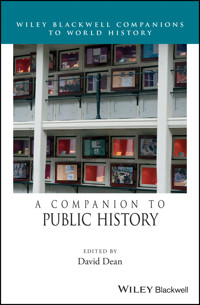
A Companion to Public History E-Book
148,99 €
Mehr erfahren.
- Herausgeber: John Wiley & Sons
- Kategorie: Geisteswissenschaft
- Serie: Blackwell Companions to World History
- Sprache: Englisch
An authoritative overview of the developing field of public history reflecting theory and practice around the globe
This unique reference guides readers through this relatively new field of historical inquiry, exploring the varieties and forms of public history, its relationship with popular history, and the ways in which the field has evolved internationally over the past thirty years. Comprised of thirty-four essays written by a group of leading international scholars and public history practitioners, the work not only introduces readers to the latest scholarly academic research, but also to the practice and pedagogy of public history. It pays equal attention to the emergence of public history as a distinct field of historical inquiry in North America, the importance of popular history and ‘history from below’ in Europe and European colonial-settler states, and forms of historical consciousness in non-Western countries and peoples. It also provides a timely guide to the state of the discipline, and offers an innovative and unprecedented engagement with methodological and theoretical problems associated with public history.
Generously illustrated throughout, The Companion to Public History’s chapters are written from a variety of perspectives by contributors from all continents and from a wide variety of backgrounds, disciplines, and experiences. It is an excellent source for getting readers to think about history in the public realm, and how present day concerns shape the ways in which we engage with and represent the past.
- Cutting-edge companion volume for a developing area of study
- Comprises 36 essays by leading authorities on all aspects of public history around the world
- Reflects different national/regional interpretations of public history
- Offers some essays in teachable forms: an interview, a roundtable discussion, a document analysis, a photo essay.
- Covers a full range of public history practice, including museums, archives, memorial sites as well as historical fiction, theatre, re-enactment societies and digital gaming
- Discusses the continuing challenges presented by history within our broad, collective memory, including museum controversies, repatriation issues, ‘textbook’ wars, and commissions for Truth and Reconciliation
The Companion is intended for senior undergraduate students and graduate students in the rapidly growing field of public history and will appeal to those teaching public history or who wish to introduce a public history dimension to their courses.
Sie lesen das E-Book in den Legimi-Apps auf:
Seitenzahl: 1447
Veröffentlichungsjahr: 2018
Ähnliche




















Table of Contents
Cover
Introduction
What is public history?
The compass of the
Companion
Beginnings and endings
Looking ahead
Prologue
Part I: Identifying Public History
Chapter One: Complicating Origin Stories
What’s in a name?
The early landscape of professional training
The seminar in historical administration
The AASLH education program, 1967 – circa 1985
Merging practice and scholarship
Forging public history into an academic field
Summing up
Chapter Two: Where Is Public History?
Introduction
Questions from a worker who reads …
Traces in the landscape
Musée des Beaux Arts
and Bruegel’s “Landscape with the Fall of Icarus”
Artists remembering slavery in the Lancaster and London landscape
Stumbling across the past in Germany
Political pasts and artistic representation in contemporary life
Social knowledge on the internet
Conclusion
Chapter Three: Consuming Public History
The film
Reviews and responses
Conclusion
Chapter Four: Historians on the Inside
A history gap?
The affinity of history and policy
The “history office” and other models
Part II: Situating Public History
Chapter Five: Nation, Difference, Experience
Constructing the museum
Critique and response
Reconceptualizing the past
Objects and visitors
Localizing history
Representing experience
Performing difference
Conclusion
Chapter Six: Archive Fever, Ghostly Histories
Making history, after the archive
On turns and turnings
Chapter Seven: Digital Public History
Digital history, or history in the digital era?
More “digital history” than “digital humanities”
Web 2.0 and crowdsourcing
Mediating between individual and collective memories
International digital public history: Local, global, glocal
Chapter Eight: Popularizing the Past through Graphic Novels
Perceptions of public history: Process and experiences
Graphic novels: presenting the past and “doing” history
Chapter Nine: Becoming a Center
Assembly and bureaucracy in the nineteenth century
Continuity and transitions in the early twentieth century
Conclusion
Part III: Doing Public History
Chapter Ten: Looking the Tiger in the Eye
Context and background
Project design and public history pedagogy
History, oral history, and storytelling
The challenges of practicing public history
Chapter Eleven: Storytelling, Bertolt Brecht, and the Illusions of Disciplinary History
Fourth wall conventions
The place and meaning of stories
Storytelling and public history
Conclusion
Chapter Twelve: Genealogy and Family History
The growth of family history
The impact of television on family history
Motivations
Family historians as new social historians
The Amateur/Professional divide
Gender and family history
The political uses of family history
Conclusion
Chapter Thirteen: The Power of Things
Objects, subjects, things
Object agency
Object potentialities
Potentiality in public history and the museum
Chapter Fourteen: An Unfinished Story
In place of a preface
A national tragedy?
The subjects of the constructed memorial complex
Who are our fathers?
If a memorial opens, does that mean it is needed by someone for something?
Part IV: Using Public History
Chapter Fifteen: Colonialism Revisited
Chapter Sixteen: Repatriation
Chapter Seventeen: The Transformative Power of Memory
Introduction
Excerpt from
what we have learned: Principles of truth and reconciliation
References
Chapter Eighteen: Sophiatown and the Politics of Commemoration
Heritage and the past in contemporary South Africa
The Sophiatown project
Representivity, authenticity, and whose history?
Modes of participation and the dynamics of power
Conclusion
Chapter Nineteen: Tourism and Heritage Sites of the Atlantic Slave Trade and Slavery
Slave trade tourism in West Africa
Slave trade and slavery tourism in Brazil and the United States
Conclusion
Part V: Preserving Public History
Chapter Twenty: Material Culture as History
Introduction
Narrating the material past as heritage
Colonialism or coloniality?
Alternative narratives and knowledge orders
Conclusion
Chapter Twenty One: Preservation and Heritage
Introduction
Traditional architecture in the Gulf region
The location and topography of Al‐Jazeera al‐Hamra
Conclusion
Further reading
Chapter Twenty Two: Centennial Dilemmas
Maintenance and other backlogs
Mission creep
NPS exceptionalism
Sidebar: Appomattox Courthouse National Historical Park
Chapter Twenty Three: Preserving Public History
Why and how historic houses have become museums
Access to heritage
Are there too many house museums?
The future of house museums
House museums in contemporary history/heritage practice
Chapter Twenty Four: Placing the Photograph
Retaking the picture in place
Augmenting place
Placing memory
Conclusion
Epilogue: Pictured pasts
Part VI: Performing Public History
Chapter Twenty Five: Reenacting and Reimagining the Past
Historical pageantry
Ethnic masquerades
Ethnographic spectacles
Open‐air museums
Living history museums
Reenactment
Conclusion
Chapter Twenty Six: Reenacting the Stone Age
Introduction
Conclusion
Chapter Twenty Seven: Performing Continuity, Performing Belonging
The Hofer Cabaret
Purimspiel
Chapter Twenty Eight: Performing History
Jongos
and
Quilombos
: Public policies and politics of the past
Performing history: The memory of slavery in the cases of Bracuhy and among the
jongo
performers of Pinheiral
Conclusion: public history and the duty of remembrance in Brazil’s slaveholding southeast
Chapter Twenty Nine: Video Games as Participatory Public History
Debating the simulation of history in the forums
Developing personal rules of play and modding the game
Part VII: Contesting Public History
Chapter Thirty: Public Historians and Conflicting Memories in Northern Ireland
Historians and public memories: An ambiguous relationship
Commemorations, celebrations, and conflicting memories
Public history as peacemaking
Public history and the creation of cultural spaces of dialogue
History of the difficult past: Acknowledging the victims
Historians’ relations with local communities
Common historical narratives
Conclusion
Chapter Thirty One: Trauma and Memory
Memory and trauma in the aftermath of war
Politics of protesting disappearances
Conclusion: Trauma time and linear temporality
Chapter Thirty Two: Museums and National History in Conflict
Introduction
The 228 incident, 1947
The White Terror, 1949–1992
The establishment of memorial museums in Taiwan
The management and naming of museums
Human rights versus contemporary art? A battle of remembering
The controversy over the new permanent exhibit at the Taipei 228 Memorial Museum
Beyond commemoration: The museum as a site of countering social amnesia
Chapter Thirty Three: Between Public History and History Education
Introduction
Similarities and differences
Interactions
Conclusion
Chapter Thirty Four: Labeling History
The Quality Turn and origin stories
Imbros to Gökçeada: The making of a settler island
Traditional tensions: Locating the olive in history
Branding and labeling: Marketing the producer
Conclusion
Epilogue: To Put Your Signature: Tanzania’s Graffiti Movement
Bibliography
Index
End User License Agreement
List of Illustrations
Chapter 02
Figure 2.1
Corso Vittorio
.
Figure 2.2 Scratched words on Croick Church.
Figure 2.3
Gilt of Cain
.
Figure 2.4
Stolpersteine
(Stumbling Stones), Vienna.
Chapter 05
Figure 5.1 National Museum of Australia, 2005.
Figure 5.2 Entrance to the
Journeys
gallery, National Museum of Australia, 2009.
Figure 5.3 View into the
Landmarks
gallery, National Museum of Australia, 2011. Showing the Colonial Foundations module running along the mezzanine and visitors exploring part of the Sydney and Hobart exhibits in the foreground.
Figure 5.4 Carmello Mirabelli exhibit,
Journeys
gallery, 2009. National Museum of Australia.
Figure 5.5 Sunshine exhibit,
Landmarks
gallery, National Museum of Australia, 2011.
Chapter 06
Figure 6.1 Oliver Bendorf, “Do You Suffer from Archive Fever?” There’s something irreducibly comic to the English English‐language reader about the idea of ‘archive fever.’ In English English ‘fever’ is an archaism: only modern babies have fevers, medically speaking. The ridiculous image of a historian suffering from a fever in or about or thinking about an archive was the foundation of
Dust
(Steedman, 2001); the comic potential of the term certainly isn’t lost on Oliver Bendorf.
Figure 6.2 “The Leader of the Luddites.” British Museum.
Figure 6.3 “Stockingmaker.” Print from the Book of Trades, or Library of the Useful Arts, 1805. Picture Collection, The New York Public Library, Astor, Lenox and Tilden Foundations.
Chapter 09
Figure 9.1 National Capital Commission, “Discover Confederation Boulevard.”
Chapter 10
Figure 10.1 Rama Lakshmi with students at the Fort discussing the docent walk, October 2012.
Figure 10.2 Students interact with local residents during the Fort walk, October 2012.
Figure 10.3 The shadow puppets depicting the attack on the Bangalore Fort in 1791, October 2012.
Chapter 13
Figure 13.1 Watch, Benjamin Hill (movement) c. 1650–1660. London. Victoria and Albert Museum.
Figure 13.2 The Gartree Giant, Burton Overy, Leicestershire.
Chapter 14
Figure 14.1 Monument to Soviet Repression (foreground) and Urkun Memorial (background), Ata Beyit National Memorial Complex, Chong Tash, Kyrgyztan.
Figure 14.2 Trends over Time in Media Publications About Ata‐Beyit (author generated).
Chapter 21
Figure 21.1 The region of Al‐Jazeera al‐Hamra in the UAE.
Figure 21.2 Al‐Jazeera al‐Hamra General View.
Figure 21.3 Al‐Jazeera al‐Hamra Building Exteriors.
Figure 21.4 Al‐Jazeera al‐Hamra Decorative Elements.
Figure 21.5 Al‐Jazeera al‐Hamra Roof.
Figure 21.6 Al‐Jazeera al‐Hamar Mosque.
Chapter 22
Figure 22.1 Chained Circles. National Park Service Themes and Concepts Venn Diagram (author generated).
Chapter 24
Figure 24.1 The author’s hand, holding a 1980 photographic print of his family. “Jimmy” Opp is pictured second from left. Composite digital image, October 2015.
Figure 24.2 Screenshot showing a then and now photographic overlay of San Francisco, 1941 and 2016. In the historical photograph, sandbags are piled against the Home Telephone Building to protect against possible air raids. A mixture of people mingle on the streets from both 1941 and 2016 when the slider, visible in the upper right hand corner, is in transition between the “then” and the “now.” David Levene, photographer; Jim Powell, picture editor, “San Francisco, then and now,” from
The Guardian’s
Photography then and now online series.
Figure 24.3 Screenshot from Rideau Timescapes App. Each pin on the map interface represents one or more historical photographs.
Figure 24.4 Screenshot from Rideau Timescapes App. The layered historical photographs show the change of the landscape over time, or by pressing the camera button, compare the historical image with the present surroundings.
Figure 24.5 Detail of screenshot from DearPhotograph.com. Posted January 10, 2012.
Figure 24.6 Detail of screenshot from DearPhotograph.com. Posted June 29, 2013.
Chapter 26
Figure 26.1 Caspar David Friedrich,
A Walk at Dusk
(c. 1830–1835). Oil on Canvas. Getty Museum.
Chapter 27
Figure 27.1 The Partition of Czechoslovakia 1939.
Figure 27.2 Page from the script of
Laugh With Us.
Figure 27.3
Comedy about a Trap
Production.
Chapter 28
Figure 28.1 The Jongo Circle of the Quilombo São José.
Chapter 32
Figure 32.1 The Taipei 228 Memorial Museum is housed in a renovated historical building.
Figure 32.2 Wen‐fu Yu,
Beyond the Wall
, comprising of bamboo skewers with doves, symbolizes the longing for hope, freedom, and peace.
Figure 32.3 Yu invited survivors of White Terror to disassemble his artwork together.
Chapter 34
Figure 34.1 Map of Imbros.
Figure 34.2 Adatepe Olive Oil Label (detail).
Figure 34.3 Olives and olive oil at a sidewalk stand.
Guide
Cover
Table of Contents
Begin Reading
Pages
ii
iii
iv
v
xi
xii
xiii
xv
xvi
xvii
xviii
xix
xx
xxi
xxii
xxiii
xxiv
xxv
1
2
3
4
5
6
7
8
9
10
11
13
14
15
17
19
20
21
22
23
24
25
26
27
28
29
30
31
32
33
34
35
36
37
38
39
40
41
42
43
44
45
46
47
48
49
50
51
52
53
54
55
56
57
58
59
60
61
62
63
64
65
66
67
68
69
70
71
72
73
75
77
78
79
80
81
82
83
84
85
86
87
88
89
90
91
92
93
94
95
96
97
98
99
100
101
102
103
104
105
106
107
108
109
110
111
112
113
114
115
116
117
118
119
120
121
122
123
124
125
126
127
128
129
130
131
132
133
134
135
136
137
138
139
140
141
142
143
144
145
146
147
149
150
151
152
153
154
155
156
157
158
159
160
161
162
163
164
165
166
167
168
169
170
171
172
173
174
175
176
177
178
179
180
181
182
183
184
185
187
188
189
190
191
192
193
194
195
196
197
198
199
201
202
203
204
205
206
207
208
209
210
211
212
213
214
215
217
218
219
220
221
222
223
224
225
226
227
228
229
230
231
232
233
234
235
236
237
238
239
240
241
243
244
245
246
247
248
249
250
251
252
253
254
255
256
257
258
259
260
261
263
264
265
266
267
268
269
270
271
272
273
274
275
277
278
279
280
281
282
283
284
285
286
287
288
289
291
292
293
294
295
296
297
298
299
300
301
302
303
304
305
306
307
308
309
311
312
313
314
315
316
317
318
319
320
321
322
323
324
325
326
327
328
329
330
331
332
333
334
335
336
337
338
339
340
341
342
343
344
345
346
347
349
351
352
353
354
355
356
357
358
359
360
361
362
363
365
366
367
368
369
370
371
372
373
374
375
377
378
379
380
381
382
383
384
385
386
387
388
389
390
391
392
393
394
395
396
397
398
399
400
401
402
403
405
406
407
408
409
410
411
412
413
414
415
416
417
419
420
421
422
423
424
425
426
427
428
429
430
431
432
433
434
435
436
437
438
439
440
441
442
443
444
445
446
447
448
449
450
451
452
453
455
456
457
458
459
460
461
462
463
464
465
466
467
468
469
470
471
472
473
474
475
476
477
478
479
480
481
482
483
484
485
486
487
488
489
490
491
492
493
494
495
496
497
498
499
500
501
502
503
504
505
506
507
508
509
510
511
512
513
514
515
516
517
518
519
520
521
522
523
524
525
526
527
528
529
530
531
532
533
534
535
536
537
538
539
540
541
542
543
544
545
546
547
548
549
BLACKWELL COMPANIONS TO WORLD HISTORY
This series provides sophisticated and authoritative overviews of the scholarship that has shaped our current understanding of the world's past. Each volume comprises between 25 and 40 essays written by individual scholars within their area of specialization. The aim of each contribution is to synthesize the current state of scholarship from a variety of historical perspectives and to provide a statement on where the field is heading. The essays are written in a clear, provocative, and lively manner, designed for an international audience of scholars, students, and general readers.
The Blackwell Companions to World History is a cornerstone of the overarching Companions to History series, covering British, American, and European History
WILEY BLACKWELL COMPANIONS TO BRITISH HISTORY
A Companion to Roman BritainEdited by Malcolm Todd
A Companion to Britain in the Later Middle AgesEdited by S. H. Rigby
A Companion to Tudor BritainEdited by Robert Tittler and Norman Jones
A Companion to Stuart BritainEdited by Barry Coward
A Companion to Eighteenth‐Century BritainEdited by H. T. Dickinson
A Companion to Nineteenth‐Century BritainEdited by Chris Williams
A Companion to Early Twentieth‐Century BritainEdited by Chris Wrigley
A Companion to Contemporary BritainEdited by Paul Addison and Harriet Jones
A Companion to the Early Middle Ages: Britain and Ireland c.500–c.1100Edited by Pauline Stafford
WILEY BLACKWELL COMPANIONS TO EUROPEAN HISTORY
A Companion to Europe 1900–1945Edited by Gordon Martel
A Companion to Eighteenth‐Century EuropeEdited by Peter H. Wilson
A Companion to Nineteenth‐Century EuropeEdited by Stefan Berger
A Companion to the Worlds of the RenaissanceEdited by Guido Ruggiero
A Companion to the Reformation WorldEdited by R. Po‐chia Hsia
A Companion to Europe Since 1945Edited by Klaus Larres
A Companion to the Medieval WorldEdited by Carol Lansing and Edward D. English
A Companion to the French RevolutionEdited by Peter McPhee
A Companion to Mediterranean HistoryEdited by Peregrine Horden and Sharon Kinoshita
WILEY BLACKWELL COMPANIONS TO WORLD HISTORY
A Companion to Western Historical ThoughtEdited by Lloyd Kramer and Sarah Maza
A Companion to Gender HistoryEdited by Teresa A. Meade and Merry E. Wiesner‐Hanks
A Companion to the History of the Middle EastEdited by Youssef M. Choueiri
A Companion to Japanese HistoryEdited by William M. Tsutsui
A Companion to International History 1900–2001Edited by Gordon Martel
A Companion to Latin American HistoryEdited by Thomas Holloway]take back[
A Companion to Russian HistoryEdited by Abbott Gleason
A Companion to World War IEdited by John Horne
A Companion to Mexican History and CultureEdited by William H. Beezley
A Companion to World HistoryEdited by Douglas Northrop
A Companion to Global Environmental HistoryEdited by J. R. McNeill and Erin Stewart Mauldin
A Companion to World War IIEdited by Thomas W. Zeiler, with Daniel M. DuBois
A Companion to Chinese HistoryEdited by Michael Szonyi
A Companion to Public HistoryEdited by David Dean
A COMPANION TO PUBLIC HISTORY
Edited By
David Dean
This edition first published 2018© 2018 John Wiley & Sons Ltd
All rights reserved. No part of this publication may be reproduced, stored in a retrieval system, or transmitted, in any form or by any means, electronic, mechanical, photocopying, recording or otherwise, except as permitted by law. Advice on how to obtain permission to reuse material from this title is available at http://www.wiley.com/go/permissions.
The right of David Dean to be identified as the author of the editorial material in this work has been asserted in accordance with law.
Registered OfficeJohn Wiley & Sons, Inc., 111 River Street, Hoboken, NJ 07030, USAJohn Wiley & Sons Ltd, The Atrium, Southern Gate, Chichester, West Sussex, PO19 8SQ, UK
Editorial Office350 Main Street, Malden, MA 02148‐5020, USA
For details of our global editorial offices, customer services, and more information about Wiley products, visit us at www.wiley.com.
Wiley also publishes its books in a variety of electronic formats and by print‐on‐demand. Some content that appears in standard print versions of this book may not be available in other formats.
Limit of Liability/Disclaimer of WarrantyWhile the publisher and authors have used their best efforts in preparing this work, they make no representations or warranties with respect to the accuracy or completeness of the contents of this work and specifically disclaim all warranties, including without limitation any implied warranties of merchantability or fitness for a particular purpose. No warranty may be created or extended by sales representatives, written sales materials or promotional statements for this work. The fact that an organization, website, or product is referred to in this work as a citation and/or potential source of further information does not mean that the publisher and authors endorse the information or services the organization, website, or product may provide or recommendations it may make. This work is sold with the understanding that the publisher is not engaged in rendering professional services. The advice and strategies contained herein may not be suitable for your situation. You should consult with a specialist where appropriate. Further, readers should be aware that websites listed in this work may have changed or disappeared between when this work was written and when it is read. Neither the publisher nor authors shall be liable for any loss of profit or any other commercial damages, including but not limited to special, incidental, consequential, or other damages.
Library of Congress Cataloging‐in‐Publication Data
Names: Dean, D. M. (David M.), editor.Title: A companion to public history / edited by David Dean.Description: 1 edition. | Hoboken, NJ : Wiley, 2018. | Includes bibliographical references and index. |Identifiers: LCCN 2017041634 (print) | LCCN 2017049813 (ebook) | ISBN 9781118508916 (pdf) | ISBN 9781118508923 (epub) | ISBN 9781118508947 (cloth)Subjects: LCSH: Public history.Classification: LCC D16.163 (ebook) | LCC D16.163 .C65 2018 (print) | DDC 900–dc23LC record available at https://lccn.loc.gov/2017041634
Cover Image: © Photo Amsterdam Museum, Monique Vermeulen, Orphanage cabinetsCover Design: Wiley
For all my public history students: past, present, and future
List of Illustrations
Cover:
Orphanage Cabinets, Amsterdam Museum. Photo: Amsterdam Museum.
Prologue:
Courtyard and Orphanage Cabinets, Amsterdam Museum. Photo: Amsterdam Museum.
Chapter 2:
2.1 Corso Vittorio. Photo: Hilda Kean.
2.2 Scratched words on Croick Church. Photo: Hilda Kean.
2.3 Gilt of Cain: Photo: Hilda Kean.
2.4 Stolpersteine (Stumbling Stones), Vienna. Photo: Hilda Kean.
Chapter 5:
5.1 National Museum of Australia, 2005. Photo: George Serras.
5.2 Entrance to the Journeys gallery, National Museum of Australia, 2009. Photo: Jason McCarthy.
5.3 View into the Landmarks gallery, National Museum of Australia, 2011. Photo: George Serras.
5.4 Carmello Mirabelli exhibit, Journeys gallery, 2009. National Museum of Australia. Photo: Lannon Harley.
5.5 Sunshine exhibit, Landmarks gallery, National Museum of Australia, 2011. Photo: Jason McCarthy.
Chapter 6:
6.1 Oliver Bendorf, “Do You Suffer from Archive Fever?”. Source: http://archivesmonth.blogspot.ca/2013/10/do‐you‐suffer‐from‐archive‐fever.html.
6.2 “The Leader of the Luddites.” British Museum.
6.3 “Stockingmaker.” Print from the Book of Trades, or Library of the Useful Arts, 1805. Picture Collection, The New York Public Library, Astor, Lenox and Tilden Foundations.
Chapter 9:
9.1 National Capital Commission, “Discover Confederation Boulevard.” Source: Carleton University Library.
Chapter 10:
10.1 Rama Lakshmi with students at the Fort discussing the docent walk, October 2012. Photo: Indira Chowdhury.
10.2 Students interact with local residents during the Fort walk, October 2012. Photo: Indira Chowdhury.
10.3 The shadow puppets depicting the attack on the Bangalore Fort in 1791, October 2012. Photo: Indira Chowdhury.
Chapter 13:
13.1 Watch, Benjamin Hill (movement) c. 1650–1660. London. Victoria and Albert Museum.
13.2 The Gartree Giant, Burton Overy, Leicestershire. Photo: Angus Mackinnon.
Chapter 14:
14.1 Monument to Soviet Repression and Urkun Memorial, Ata Beyit National Memorial Complex, Chong Tash, Kyrgyztan. Photo: Nurlanov Ilgiz.
14.2 Trends over Time in Media Publications About Ata‐Beyit (author generated).
Chapter 21:
21.1 The region of Al‐Jazeera al‐Hamra in the UAE. Source: Google Maps (edited screenshot).
21.2 Al‐Jazeera al‐Hamra General View. Photo: Hamad M. Bin Seray.
21.3 Al‐Jazeera al‐Hamra Building Exteriors. Photo: Hamad M. Bin Seray.
21.4 Al‐Jazeera al‐Hamra Decorative Elements. Photo: Hamad M. Bin Seray.
21.5 Al‐Jazeera al‐Hamra Roof. Photo: Hamad M. Bin Seray.
21.6 Al‐Jazeera al‐Hamar Mosque. Photo: Hamad M. Bin Seray.
Chapter 22:
22.1 Chained Circles. National Park Service Themes and Concepts Venn Diagram (author generated).
Chapter 24:
24.1 The author’s hand, holding a 1980 photographic print of his family. Composite digital image, October 2015.
24.2 Screenshot showing a then and now photographic overlay of San Francisco, 1941 and 2016. Source: https://www.theguardian.com/us‐news/2016/feb/04/san‐francisco‐then‐and‐now‐super‐bowl‐50.
24.3 Screenshot from Rideau Timescapes App.
24.4 Screenshot from Rideau Timescapes App.
24.5 Detail of screenshot from DearPhotograph.com. Posted January 10, 2012.
24.6 Detail of screenshot from DearPhotograph.com. Posted June 29, 2013.
Chapter 26:
26.1 Caspar David Friedrich, A Walk at Dusk (c. 1830–1835). Oil on Canvas. Getty Museum.
Chapter 27:
27.1 The Partition of Czechoslovakia 1939. Source: Wikipedia.
27.2 Page from the script of Laugh with Us. Photo: Lisa Peschel.
27.3 Comedy about a Trap Production. Photo: Dan Cashdon.
Chapter 28:
28.1 The Jongo Circle of the Quilombo São José. Photo LABHOI/UFF (2005).
Chapter 32:
32.1 The Taipei 228 Memorial Museum is housed in a renovated historical building. Photo: Chia‐Li Chen.
32.2 Wen‐fu Yu, Beyond the Wall. Photo: Chin‐jung Tsao.
32.3 Yu invited survivors of White Terror to disassemble his artwork together. Photo: Chin‐jung Tsao.
Chapter 34:
34.1 Map of Imbros. Source: http://www.gunubirlikgeziler.com/wp‐content/uploads/2016/06/gokceada‐harita.jpg.
34.2 Adatepe Olive Oil Label (detail). Source: https://www.adatepe.com/.
34.3 Olives and olive oil at a sidewalk stand. Photo: Helin Burkay.
Epilogue:
1 Hali Mbaya (Hard Times), Dar es Salaam, Tanzania. WaPi, British Consul, 2009. Photo with permission from the Wachata Crew.
2 Elimu (Education), Dar es Salaam, Tanzania. WaPi, British Consul, 2009. Photo with permission from the Wachata Crew.
Notes on Contributors
George H.O. Abungu is a former Associate Professor of Heritage Studies at the University of Mauritius. He is the founder of Okello Abungu Heritage Consultants, Nairobi, and from 1999 to 2002 was Director‐General of the National Museums of Kenya. He has served as Vice‐President and Executive Committee member of the International Council of Museums. In 2012, George was made a Knight of the French Ordre des Arts et des Lettres.
Vanessa Agnew researches and teaches on the cultural history of music, travel, reenactment, the history of science, genocide, and exile and refugee studies in the Department of Anglophone Studies, University of Duisburg‐Essen, Germany. Her Enlightenment Orpheus: The Power of Music in Other Worlds (Oxford UP, 2008) won the Oscar Kenshur Prize for Eighteenth‐Century Studies and the American Musicological Society’s Lewis Lockwood Award. She co‐edited Settler and Creole Reenactment (with Jonathan Lamb, Palgrave, 2010), special issues of Rethinking History 11 (2007) and Criticism 46 (2004), and book series Historical Reenactment (Palgrave) and Music in Society and Culture (Boydell and Brewer). She is working on a book project, Right to Arrive, which applies reenactment theory to Kant’s rights of the stranger in order to reframe discussions around hospitality, the mediating role of culture, and the current refugee crisis.
Ana Lucia Araujo is a cultural historian and a Professor of History at the historically black Howard University in Washington, D.C. Her work explores the history and the memory of the Atlantic slave trade and slavery and their social and cultural legacies. She is particularly interested in the public memory, heritage, and visual culture of slavery. Over the last years, she authored the books Brazil Through French Eyes: A Nineteenth‐Century Artist in the Tropics (2015), Shadows of the Slave Past: Memory, Heritage and Slavery (2014), Public Memory of Slavery: Victims and Perpetrators in the South Atlantic (2010), and Romantisme tropical: l'aventure illustrée d'un peintre français au Brésil (2008). She also edited a number of books: African Heritage and Memories of Slavery in Brazil and the South Atlantic World (2015), Politics of Memory: Making Slavery Visible in the Public Space (2012), Paths of the Atlantic Slave Trade: Interactions, Identities (2011), and Living History: Encountering the Memory of the Heirs of Slavery (2009). Her newest book is titled Reparations for Slavery and the Slave Trade: A Transnational and Comparative History (2017).
Michael Belgrave is a historian and foundation member of Massey University’s Albany campus in Auckland, New Zealand. He was previously research manager of the Waitangi Tribunal and has continued to maintain a strong interest in Treaty of Waitangi research and settlements, providing substantial research reports into a wide number of the Waitangi Tribunal’s district inquiries. More recently, he has been heavily involved in negotiating the historical aspects of treaty settlements with a number of iwi (Māori tribes). He has published widely on treaty and Māori history, including being lead editor of Waitangi Revisited: Perspectives on the Treaty of Waitangi (Oxford University Press). His Historical Frictions: Maori Claims and Reinvented Histories explores the way that generation after generation Māori claims have been articulated in the courts and in settlements relying on historical narratives which have changed significantly to reflect different times. His most recent book, Dancing with the King (Auckland University Press), a history of peace‐making following the Waikato War of 1863–1864 won the 2018 Ernest Scott Prize. He has been an advisor to a number of government departments as well as to numerous iwi.
Hamad M. Bin Seray is Associate Professor in the Department of History and Archaeology, Faculty of Humanities and Social Sciences at the United Arabic Emirates University. He took his undergraduate degree in history at UAEU and his MA and PhD at the University of Manchester. He is the author of more than seventy‐six publications including over twenty articles in refereed journals and eighteen books. These include Aramaic in the Gulf, The Arabian Gulf in Syriac Sources, Non‐Arabic Races in Pre‐Islamic Makkah and their Religious, Commercial and Social Roles, and Civil Relations between the Arabian Gulf Region and the Indian Subcontinent and South East Asia from the 3rd Century BC to the 7th Century AD.
Helin Burkay is a Post‐Doctoral Fellow at the Rachel Carson Center for Environment and Society at the Ludwig‐Maximilians‐Universität München in Munich, Germany. She holds a PhD in Sociology from Carleton University and a BA in Political Science from Bogazici University. Her research is on the cultural politics of development, land, and food in the Middle East. She is currently working on two projects, one on the ethnic culinary heritage and politics of memory in Turkey and the other on the ethics of environmental research.
Thomas Cauvin is Assistant Professor of History at Colorado State University in the United States and teaches Public History, Museum Studies, and Digital History. Born in France, Cauvin received his PhD (open‐access online) at the European University Institute in Italy, where he focused on the comparative study of museums and memories in Ireland and Northern Ireland (2012). President of the International Federation for Public History, his research focuses on public history, museums, memories, and the public uses of the past. He has published the first single‐authored textbook on Public History in North America and several articles – in English, French, Italian, and Spanish – on the rise and internationalization of public history. As a public historian, he has worked with local communities for the creation of traveling exhibits, online crowdsourcing projects, and historic preservation of French heritage in Louisiana.
Chia‐Li Chen is Professor and Head of the Graduate Institute of Museum Studies at the Taipei National University of the Arts. She received her PhD in Museum Studies at the University of Leicester. She is the author of Museums and Cultural Identities (VDM Verlag) and From Margin to Representation (National Taiwan University Press) and has published several English papers in journals and books such as Re‐presenting Disability, Displaced Heritage and Museum Revolutions. Her research interests focus on three main areas: museums and contemporary social issues, especially the engagement and representation of the disabled and minority groups; museum, traumatic memories and human rights education; and the application of music in literature museums.
Indira Chowdhury is Founder‐Director of the Centre for Public History at the Srishti Institute of Art, Design, and Technology, Bengaluru, India. Formerly professor of English at Jadavpur University, Kolkata, she is also the founder of Archival Resources for Contemporary History (ARCH), Bengaluru, now known as ARCH@Srishti. She has a PhD in history from the School of Oriental and African Studies, London, and her book The Frail Hero and Virile History won the Tagore prize in 2001. In 2010, she published A Masterful Spirit: Homi Bhabha 1909–1966. She was awarded the New India Fellowship to work on her book that has been recently published and titled Growing the Tree of Science: Homi Bhabha and the Tata Institute of Fundamental Research (OUP: 2016). She was President of the Oral History Association of India (2013–2016) and President of the International Oral History Association (2014–2016).
Catherine Clinton holds the Denman Chair of American History at the University of Texas–San Antonio and Professor Emerita at Queen’s University Belfast. Her first book, The Plantation Mistress: Woman’s World in the Old South, appeared in 1982, and her Harriet Tubman: The Road to Freedom was named as one of the best nonfiction books of 2004 by the Christian Science Monitor and the Chicago Tribune. Stepdaughters of History: Southern Women and the American Civil War, the published version of her Fleming Lectures delivered in 2012, was published by Louisiana State University Press in 2016. She has also published award‐winning books for children, including I, Too, Sing America and Hold the Flag High. In 2016, she served as president of the Southern Historical Association. She serves on scholarly advisory councils for Civil War History, Ford’s Theatre, and Civil War Times, and is a member of the Screen Writer’s Guild. She was an advisor for Steven Spielberg’s Lincoln (2012), following publication of Mrs. Lincoln: A Life (2009). In 2015, Clinton participated in a round table at the Smithsonian Institution with US treasurer Rosie Rios and Secretary of the Treasury Jacob Lew, to discuss the prospect of honoring a woman on US currency; in April 2016, the US Treasury announced Harriet Tubman would appear on the front of the newly redesigned $20 bill.
Rebecca Conard is Professor of History Emeritus at Middle Tennessee State University and former Director of the MTSU Public History Program. She holds a PhD from the University of California–Santa Barbara and an MA from U.C.L.A. Her research into the history of public history has led to one book, Benjamin Shambaugh and the Intellectual Foundations of Public History (2002), and several shorter works, including the Winter 2006 issue of the Public Historian devoted to reflective practice. As a public history practitioner, she has co‐founded two historical research firms and worked extensively with national, state, and local‐level agencies and organizations. Long active in the National Council on Public History, she has served on the board, on various committees, and as vice president/president from 2001 to 2003.
Annemarie de Wildt is a historian and curator at the Amsterdam Museum (previously Amsterdam Historical Museum). She has curated many exhibitions on topics that focus on daily life, urban conflicts and culture, migration, and identity. Her exhibition projects include prostitution, Amsterdam songs, sailors’ tattoos, the passion for football, animals in the city, neighborhood shops, graffiti, and the love‐hate relationship between Amsterdam and the House of Orange. Her exhibitions are characterized by a hybrid variety of objects, often a mix of “high” and “low” culture and with a strong role for human stories. She has given many lectures and workshops in the Netherlands and abroad. Annemarie de Wildt is a keen blogger and has published various books/catalogs and many articles and blogs on the practice and dilemmas of curating and (contemporary) collecting.
Jerome de Groot is Senior Lecturer in the School of Arts, Languages, and Cultures at the University of Manchester. He researches on the representation of history in contemporary popular film, television, drama, and games, and on English literature between 1640 and 1660. His publications include Remaking History: The Past in Contemporary Historical Fictions (2015), The Historical Novel (2009), Consuming History: Historians and Heritage in Contemporary Popular Culture (2008, revised ed. 2016), and Royalist Identities (2004).
David Dean is Professor in the Department of History at Carleton University in Ontario, Canada, where he is also Co‐Director of the Carleton Centre for Public History. He has published widely in the fields of public history and early modern British history, including Law‐Making and Society in Late Elizabethan England (1996, 2002) and the co‐edited collection History, Memory, Performance (2015). He edited Museums as Sites for Historical Understanding, Peace, and Social Justice: Views from Canada, a special issue of Peace and Conflict: Journal of Peace Psychology (2013). He was Company Historian to Canada’s National Art Centre’s English Theatre Company between 2008 and 2012 and is a Fellow of the Royal Historical Society. He is a member of the steering committee of the International Federation for Public History and co‐editor of the new journal, International Public History.
Sandra H. Dudley is a social and material anthropologist and Head of the School of Museum Studies, University of Leicester. Intersecting anthropology, museum studies, and material culture studies, her work is focused in refugee and museum settings in Southeast and South Asia (Burma [Myanmar], Thailand, and India) and the United Kingdom. She has particular interests in forced migration and displacement, objects and collections, and ontology. Her publications include Displaced Things: Optimistic Encounters in Burma, Museums and Beyond (2018) and Materialising Exile: Material Culture and Embodied Experience among Karenni Refugees in Thailand (2010). She has edited and co‐edited many books including Museum Objects. Experiencing the Properties of Things (2012), Narrating Objects, Collecting Stories (2012), The Thing about Museums: Objects and Experience, Representation and Contestation (2011), and Museum Materialities: Objects, Engagements, Interpretations (2010). She is Joint Chief Editor of Berghahn’s international annual journal in museum studies, Museum Worlds: Advances in Research.
Jenny Edkins is Professor of International Politics at Aberystwyth University, Wales, United Kingdom. She is author of Face Politics (Routledge, 2015), Missing: Persons and Politics (Cornell, 2011), Trauma and the Memory of Politics (Cambridge, 2003), and Whose Hunger? Concepts of Famine, Practices of Aid (Minnesota, 2000). She is currently completing a monograph for Manchester University Press entitled Change & the politics of uncertainty. She is Co‐Director of Performance and Politics International (PPi), a post‐disciplinary grouping of scholars from arts and social science departments in Aberystwyth established to explore the interface between aesthetic politics and political aesthetics and the complex relationship between performance and politics. She co‐edits the Routledge book series Interventions, which has published over 100 cutting‐edge critical volumes since 2009, and the textbook Global Politics: A New Introduction, now going into its third edition. She is on the organizing team of the Gregynog Ideas Lab, a summer school inaugurated in 2012 as an open meeting space for graduate students and early career faculty working on critical, post‐structural, postcolonial, feminist, and psychoanalytic approaches to international politics.
Natasha Erlank completed her doctorate at the University of Cambridge and taught at the University of Cape Town and Rhodes University before moving to the Department of Historical Studies at the University of Johannesburg. She works principally on Southern Africa in the early twentieth century, and her research interests include gender history, the history of Christianity, and public history. Among her many publications is the co‐edited One Hundred Years of the ANC: Debating Liberation Histories Today (2012) and the special issue of the journal African Studies (2015) on commemorating Sophiatown. Her article, “From Main Reef to Albertina Sisulu Road: The Signposted Heroine and the Politics of Memory,” The Public Historian vol. 39, no. 2 won the National Council on Public History’s G. Wesley Johnson Award for 2018.
Tanya Evans teaches Australian history and public history in the Department of Modern History at Macquarie University in Sydney, Australia. She specializes in the history of the family, poverty, and sexuality. She is passionate about researching ordinary people and places in the past and incorporating ordinary people and places in the process of her research and the construction of historical knowledge. Her three books so far have been about the history of “illegitimacy,” poverty, and philanthropy. Fractured Families: Life on the Margins in Colonial New South Wales (New South, 2015) was a history of Australia’s oldest surviving charity, The Benevolent Society, which was written in collaboration with family historians. She pitches her work at a variety of audiences because her research is targeted at disrupting people’s assumptions about the history of the family. New South Press published Swimming with the Spit:100 Years of the Spit Amateur Swimming Club in October 2016. This is a community history of her local swimming club. She is currently writing a history of motherhood in Australia while continuing to research the different ways in which family history is practiced in Australia, England, and Canada.
Alix R. Green is Lecturer in History at the University of Essex. She read history at the University of Cambridge, and spent ten years in policy research and government relations before gaining her doctorate at the University of Hertfordshire. She brings her experience outside higher education to her current work on contemporary political history and the uses of history in public life. Her book, History, Policy and Public Purpose: Historians and Historical Thinking in Government, was published by Palgrave Macmillan in 2016. She is the founding convenor of the Public History Seminar at the Institute of Historical Research, London, and a Fellow of the Royal Historical Society. She is currently serving as the Society’s Honorary Director of Communications and as a juror on its Public History Prize committee.
Richard Handler is a cultural anthropologist who has written on nationalism and the politics of culture, museums and the representation of history, anthropology and literature, and the history of Boasian anthropology. He is the coauthor, with Eric Gable, of The New History in an Old Museum: Creating the Past at Colonial Williamsburg(Duke University Press, 1997). He is currently Professor of Anthropology and Director of the Program in Global Studies at the University of Virginia.
Te Herekiekie Herewini is Manager of the Karanga Aotearoa Repatriation Programme (KARP) based at Te Papa, Wellington, New Zealand. His role includes working alongside the Repatriation Advisory Panel, a group of Māori elders and cultural experts, as well as strategic planning, initiating the formal request to repatriate, and negotiating the return of the Māori and Moriori remains. Te Herekiekie is also a PhD candidate (part‐time) at the University of Victoria in Wellington. Since KARP was established in 2003, it has repatriated over 419 Māori and Moriori ancestral remains from international institutions.
Steven High is Professor of History at Concordia University, Montreal, Canada, and co‐founder of the Centre for Oral History and Digital Storytelling. Between 2005 and 2012, he led the Montreal Life Stories project, a large collaborative research project that saw 500 survivors of mass violence interviewed and their stories integrated into a wide range of public outcomes. He is the (co‐)author of nine books, including (with Ted Little and Ry Thi Duong) Remembering Mass Violence: Oral History, New Media and Performance; Oral History at the Crossroads: Sharing Life Stories of Displacement and Survival; Beyond Testimony and Trauma: Oral History in the Aftermath of Mass Violence; and (with Ted Little and Liz Miller) Going Public: The Art of Participatory Practice.
Gulnara Ibraeva is an owner and principal investigator of the private research & consultancy firm, PIL, based in Bishkek, Kyrgyzstan. She is the author of numerous reports, manuals, and papers. Among those are Extended Migration Profile: Kyrgyzstan 2010–2015 (2015), Critical Discourse Analysis of a Media Case of Violence against Female Migrants from Kyrgyzstan (in the book Gender in Modern Central Asia, LIT Vienna, 2015), Gender and Migration (2013), with Elias M., Elmhirst R. Understanding Gendered Innovation Processes in Forest Landscapes: Case Studies from Indonesia and Kyrgyz Republic (2017). She is the author of the books Marriage Strategies in Kyrgyzstan: Generations of Fathers and Children (2006), Media and Languages in Kyrgyzstan (2002), and, with Svetlana Kulikova, The Historical Development and Current Situation of the Mass Media of Kyrgyzstan (2001).
Hilda Kean is former Dean and Director of Public History at Ruskin College, Oxford, establishing the first MA in Public History in Britain. A Visiting Professor at the University of Greenwich and Senior Research Fellow at University College, London, her many books include Animal Rights. Social and Political Change in Britain since 1800 (1998, 2000); London Stories: Personal Lives, Public Histories (2004); Public History and Heritage Today. People and Their Pasts (with Paul Ashton 2009, 2012); The Public History Reader (with Paul Martin 2013); The Great Cat and Dog Massacre. The Real Story of World War Two’s Unknown Tragedy (2017, 2018). She is editing the Routledge Companion to Animal‐Human History with Philip Howell in 2018. Her website is http://hildakean.com.
Seth M. Markle is an Associate Professor of History and International Studies at Trinity College in Hartford, Connecticut. His research focuses on the histories of cultural and political exchange between Africa and the African Diaspora. After graduating from Tufts University (BA, Africana Studies/English) in 2000, he continued working as a youth organizer in Boston before studying at New York University (PhD, History). Since 2003, he has worked in various hip‐hop communities in Dar es Salaam (Tanzania), Nairobi (Kenya), and Hartford, CT (United States) via research, journalism, radio broadcasting, arts education programming, youth development, event planning, and photograph and video documentation. Seth’s A Motorcycle on Hell’s Run: Tanzania, Black Power and the Uncertain Future of Pan‐Africanism, 1964–1974 was published by Michigan State University Press in 2017. Currently, he is working on two separate multi‐modal research projects about the history of hip‐hop in Tanzania and Hartford, respectively. His journalistic work on music and politics has been featured in Pop'Africana Magazine, worldhiphopmarket.com, CounterPunch.com, All.Africa.com, Pambazuka News, and Africanhiphp.com.
Hebe Mattos and Martha Abreu are Professors of History at University Federal Fluminense (UFF) in Rio de Janeiro, Brazil. They are authors of several books, research films, and academic articles and were pioneers in the studies of post‐abolition in the country. They are coauthors and co‐editors of articles and books about memory of slavery and the cultural history of post‐abolition in Brazil, among them, “Jongo, Recalling History” in the hybrid e‐book Cangoma Calling: Spirits and Rhythms of Freedom in Brazilian Jongo Slavery Songs (2013). They are also co‐directors of Present Pasts, a series of four documentary films about the memory of slavery among the descendants of the last generation of African enslaved workers in Brazil (2012), based on the oral history archive they coordinated at Oral History and Image Lab of UFF (LABHOI). The films are also available online: A Present Past – Afro‐Brazilian Memories in Rio de Janeiro (2011); Verses and Cudgels – Stick Playing in the Afro‐Brazilian Culture of the Paraíba Valley (with Matthias Assunção, 2009); Jongos, Calangos and Folias – Black Music, Memory and Poetry (2007); and Memory of Captivity (with Guilherme Fernandez and Isabel Castro, 2005). The films circulate through characters, places, dances, challenges, and common expressions. Together, the different points of view on the history of the descendants of the last enslaved Africans add up, allowing a broader and more complex view of each of the addressed topics.
Jeremiah McCall is a teacher and historian who specializes in the effective uses of video games and other interactive technologies in history education, and the ways that the ancient world is represented in modern media. He has written extensively on these subjects, and his book, Gaming the Past (Routledge 2012), is the first program that focuses on training classroom teachers in the use of historical video games. Jeremiah teaches at Cincinnati Country Day School.
John Moses is a member of the Upper Mohawk and Delaware bands of the Six Nations of the Grand River Territory near Brantford, Ontario. He is a PhD candidate in cultural mediations at the Institute for Comparative Studies in Literature, Art, and Culture at Carleton University, Ottawa, Ontario, and a federal public servant with the Department of Canadian Heritage and Portfolio in Gatineau, Québec.
Serge Noiret is the History Information Specialist (PhD) at the European University Institute, Florence, Italy. His current research focuses on (digital) public history and digital humanities. He has published widely on contemporary Italian and European history and politics, public history, and digital history, including the special issue of Memoria e Ricerca on public history: Pratiche nazionali e identità globale (2011). With Mark Tebeau, he is editing the Handbook of Digital Public History (De Gruyter, 2019). He has taught at EUI, the University of Urbino, and the University of Naples; is a member of several Europe‐based organizations concerned with digital history and digital humanities and is a member of the scientific board of the Conseil Scientifique of the Réseau National des Maisons des Sciences de l’Homme in Paris. From 2012 to 2017 he was President of the International Federation for Public History, and since 2016, President of the Italian Association for Public History.
James Opp is Professor of History at Carleton University, Ottawa. His current research projects include tracing the history of photographic archives in prairie Canada, exploring photographer Yousuf Karsh’s commercial work in the 1950s, and tracking down obscure corporate archives of photographs. With John C. Walsh he is the co‐editor of Placing Memory and Remembering Place in Canada (UBC Press, 2010) and Home, Work, and Play: Situating Canadian Social History, 3rd Ed. (Oxford University Press, 2015). He coproduced (with Anthony Whitehead) the Rideau Timescapes App, a free iOS app that delivers more than 700 digitized historical photographs to visitors of the Rideau Canal, a UNESCO World Heritage site in eastern Ontario. This project was awarded the Canadian Historical Association’s Public History Prize in 2013.
Elizabeth Paradis, since graduating from Carleton University, Ottawa, with a master’s degree in Public History, has worked as a documentalist, oral historian, filmmaker, and researcher on numerous historical and interdisciplinary projects in various institutional and professional public history settings. Her MA degree addressed the relationship between the past, history, and performance in historical reality television, and she has had the opportunity to explore First Nations, Quebecois, Environmental, and Canadian twentieth‐century history, as well as theories of performance and gender. Most recently, Elizabeth has focused on copyediting, particularly for sociological publications, in addition to her work as an editorial assistant for this volume. When she is not soaking up all the joy she can from her young family, she looks forward to finding new ways to immerse herself in reflexive public history projects and fascinating editing work.
Lisa Peschel is a lecturer in the Department of Theatre, Film and Television at the University of York, England. She has been researching theatrical performance in the Terezín/Theresienstadt ghetto since 1998. Her articles on survivor testimony and scripts written in the ghetto have appeared in journals such as Theatre Survey, Theatre Topics, and Holocaust and Genocide Studies and in Czech, German, and Israeli publications. She has been invited to lecture and conduct performance workshops at institutions in the United States and Europe including Oxford University, University College London, and Dartmouth College. Her anthology Performing Captivity, Performing Escape: Cabarets and Plays from the Terezín/Theresienstadt Ghetto was published in 2014 (Czech‐ and German‐language edition 2008) and her edited volume with Patrick Duggan, Performing (for) Survival: Theatre, Crisis, Extremity, in 2016. Awards include a Fulbright grant in the Czech Republic and fellowships at the US Holocaust Memorial Museum, the Center for Jewish Studies at Harvard University, and the Jewish Museum in Prague. She is currently a co‐investigator on the £1.8 million project “Performing the Jewish Archive” funded by the UK Arts and Humanities Research Council.
John H. Sprinkle, Jr., a graduate of the University of Delaware, holds a PhD in American history from the College of William and Mary. After a decade as a private sector historic preservation consultant, he joined the National Park Service in 1998 where he has served in the National Historic Landmark program, the Federal Preservation Institute, and, currently, in the agency’s Park History program. The views and conclusions in his chapter are those of the author and should not be interpreted as representing the opinions or policies of the National Park Service or the United States Government. Mr. Sprinkle is the author of Crafting Preservation Criteria: The National Register of Historic Places and American Historic Preservation. His next book will focus on the intersection of the land conservation and historic preservation movements.
Carolyn Steedman is Emeritus Professor of History at the University of Warwick. Poetry for Historians, which she has been wanting to write for twenty years, will be out with Manchester University Press in spring 2018. The book is not a collection of poems for historians, but about poetry and history writing as cultural activities and forms of making in the modern world.
Patrick Morales Thomas is an Anthropologist at the National University of Colombia. He holds a doctorate in Social Anthropology and Ethnology from the Ecole des Hautes Etudes en Sciences Sociales in Paris. His areas of work have focused on the analysis of processes of re‐indigenization in Colombia, the development of public policies related to intangible cultural heritage, and historical memory of the armed conflict in ethnic communities. He is currently the coordinator of Team Approach Ethnic National Center for Historical Memory in Bogotá, Colombia.
Amy M. Tyson received her PhD in American Studies from the University of Minnesota, where she first became interested in labor and performance at living history museums – the subject of her book The Wages of History: Emotional Labor on Public History’s Front Lines (Amherst: University of Massachusetts Press, 2013). She is Associate Professor of History at DePaul University in Chicago, where she teaches courses in public history, oral history, local and community history, popular culture, and modern US history. Her research interests center on nineteenth‐ and twentieth‐century US social and cultural history, with a particular interest in how that history is interpreted and distilled for the larger public through museums, plays, art, music, and pageantry.
John C. Walsh is a Historian at Carleton University in Ottawa, Canada, where he is also the Co‐Director of the Carleton Centre for Public History. He researches, teaches, and supervises graduate students in the fields of Canadian social and cultural history, public history, and memory studies. Along with James Opp, he is the co‐editor of Placing Memory and Remembering Place in Canada (UBC Press, 2010). Walsh is currently working on a commemorative public art installation and documentary film for the Lost Stories Project (www.loststories.ca)
Kirsten Wehner is a curator, designer, and anthropologist whose practice explores how spaces and experiences can be shaped to foster cultural understanding, creative engagement, and appreciation and care for the non‐human world. From 2011 to 2016, Kirsten was Head Curator, People and the Environment, at the National Museum of Australia (www.nma.gov.au/pate), and from 2004 to 2011 was Senior Curator and then Content Director for the Museum’s gallery development program. Her curatorial experience encompasses more than thirty exhibitions, digital platforms, and interpretive programs exploring diverse aspects of Australian environmental history. She holds a PhD in visual and cultural anthropology from New York University and in 2018 will complete an MA in Narrative Environments at Central Saint Martins, University of the Arts, London. Kirsten's publications include the co‐edited/authored volumes Curating the Future: Museums, Communities and Climate Change (2017, Routledge) and Landmarks: A History of Australia in 33 Places (2013, NMA Press). She is a member of the Australia‐Pacific Observatory of Humanities for the Environment (www.hfe‐observatories.org) and was a 2015–2016 Fellow at the Rachel Carson Center for Environment and Society, Ludwig‐Maximilians Universität, Munich, Germany.
Tim Winter is Research Professor at the Alfred Deakin Institute, Deakin University, Melbourne. He is the former President of the Association of Critical Heritage Studies and holds an ARC Future Fellowship on the Silk Roads of the twenty‐first century. He has been a Scholar at the University of Cambridge, The Getty, and Asia Research Institute, Singapore, and published widely on heritage, development, urban conservation, and the international politics of heritage. His recent books include The Routledge Handbook of Heritage in Asia and Shanghai Expo: An International Forum on the Future of Cities. He is currently working on books on heritage diplomacy in relation to Belt and Road and twentieth‐century conflict in Asia (warinasia.com).
Joanna Wojdon is Associate Professor at the Department of Methodology of Teaching History and Civic Education, Institute of History, University of Wrocław, Poland, a Fulbright alumna, a board member of the International Society for History Didactics, and Managing Editor of its Yearbook International Journal of Research on History Didactics, History Education, and History Culture. She has developed the first MA program in public history in Poland, offered at the University of Wrocław since 2014, and since 2018 also in English. Other areas of her scholarly interests include using information technology in history education (E‐teaching History, Cambridge Scholars 2016), history and edutainment (ISHD Yearbook, 2015), political and propaganda influence on education, especially in Poland under communism (Textbooks as Propaganda; Poland under Communist Rule 1944‐1989, Routledge 2017), and the history of the Polish Americans after World War II (White and Red Umbrella: The Polish American Congress in the Cold War Era 1944–1988, Helena History Press 2015.
Linda Young is a historian by discipline and was once a curator by trade. She taught aspects of Museum Studies and Cultural Heritage Studies for more than twenty‐five years, for the last twelve years at Deakin University in Melbourne. Her book, House Museums in the United Kingdom and the United States: A History (Rowman & Littlefield, 2017), traces a variety of foundational motivations that throw new light on historic houses as a species of museum, and casts them as enabling an alleged personal, domestic dimension into the construction of national identities.




