


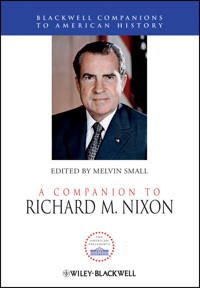
A Companion to Richard M. Nixon E-Book
166,99 €
Mehr erfahren.
- Herausgeber: John Wiley & Sons
- Kategorie: Geisteswissenschaft
- Serie: Blackwell Companions to American History
- Sprache: Englisch
This companion offers an overview of Richard M. Nixon's life, presidency, and legacy, as well as a detailed look at the evolution and current state, of Nixon scholarship. * Examines the central arguments and scholarly debates that surround his term in office * Explores Nixon's legacy and the historical significance of his years as president * Covers the full range of topics, from his campaigns for Congress, to his career as Vice-President, to his presidency and Watergate * Makes extensive use of the recent paper and electronic releases from the Nixon Presidential Materials Project
Sie lesen das E-Book in den Legimi-Apps auf:
Seitenzahl: 1382
Veröffentlichungsjahr: 2013
Ähnliche




















Contents
List of Plates
Notes on Contributors
INTRODUCTION
Part I: Pre-Presidential Years
Chapter One: NIXON BIOGRAPHIES
Nixon Ascendant Biographies
Psychobiography
Nixon Memoirs
Redemption and Damnation: Post-Watergate Biographies
Scholarly Biographies
Where Next?
REFERENCES
Chapter Two: THE PRE-POLITICAL YEARS, 1913–1945
The Early Works: Mistakes and Mythology
The Earliest Biographies: “Fighting Quaker” and This Man Nixon
The Vice-Presidential Years
Presidential Years
The Psychohistorians and Richard Nixon
Rehabilitation
“The Age of Nixon”
Conclusion
BIBLIOGRAPHY
Chapter Three: PAT NIXON
NOTES
REFERENCES
Chapter Four: THE CONGRESSIONAL YEARS
BIBLIOGRAPHY
FURTHER READING
Chapter Five: THE ALGER HISS CASE
NOTES
REFERENCES
Chapter Six: THE RICHARD NIXON VICE PRESIDENCY: RESEARCH WITHOUT THE NIXON MANUSCRIPTS
NOTE
REFERENCES
Chapter Seven: THE ELECTION OF 1960
Background
The Republican Convention
Campaign Plans
The Religious Issue
The Great Debates
The Final Push
A Close Election
REFERENCES
FURTHER READING
Part II: Domestic Policies
Chapter Eight: THE ELECTION OF 1968
NOTE
REFERENCES
FURTHER READING
Chapter Nine: THE ELECTION OF 1972
REFERENCES
Chapter Ten: THE ADMINISTRATIVE PRESIDENCY
Analytical Prelude
Emergence of an Administrative Presidency
Strategies
Contextual Tools: Political Appointees
Contextual Tools: Career Officials
Unilateral Tools: Structure, Money, and Rules
Impacts and Legacies
NOTES
BIBLIOGRAPHY
Chapter Eleven: RICHARD NIXON, THE GREAT SOCIETY, AND SOCIAL REFORMS: A LOST OPPORTUNITY?
A “Head Start” for Social Policy in the Country
The Family Assistance Plan, Cornerstone of a New Welfare State
To Ease Racial Tensions?
A Legislative and Bureaucratic failure.
A Lost Opportunity?
BIBLIOGRAPHY
Chapter Twelve: CIVIL RIGHTS POLICY
REFERENCES
FURTHER READING
Chapter Thirteen: ECONOMIC POLICY
Introduction
First Period, January 1969–February 1970
Second Period, February 1970–November 1972
Third Period, November 1972–August 1974
Economic Policy-making and Presidential Agency
NOTES
BIBLIOGRAPHY
Chapter Fourteen: POLITICAL REALIGNMENT
REFERENCES
Chapter Fifteen: NIXON AND THE ENVIRONMENT
Origins of Environmentalism
White House Response
EPA
Second Thoughts
From Mass Movement to New Social Regulation
Land and Resources
Demise of the Planning Impulse
The End of the Beginning
REFERENCES
FURTHER READING
Chapter Sixteen: NIXON AND THE MEDIA
BIBLIOGRAPHY
Chapter Seventeen: NIXON AND DISSENT
The Administration’s Response to Dissent
Explaining Nixon’s Anti-dissent Policies
REFERENCES
FURTHER READING
Chapter Eighteen: NIXON AND AGNEW
REFERENCES
Part III: Foreign Policies
Chapter Nineteen: FOREIGN POLICY OVERVIEW
The Challenges of 1969
“A Structure of Peace” and the Primacy of Diplomacy
Détente and Linkage
Triangular Diplomacy
Beyond the Grand Façade: The Nixon Doctrine
Containment by Other Means
REFERENCES
FURTHER READING
Chapter Twenty: NIXON AND KISSINGER
The Nixon-Kissinger Relationship
Vietnam
The Soviet Union and Détente
The Opening to China
The Middle East
Assessment
NOTE
REFERENCES
Chapter Twenty-one: THE VIETNAM WAR
REFERENCES
FURTHER READING
Chapter Twenty-two: EXPLORATIONS OF DÉTENTE
NOTES
REFERENCES
FURTHER READING
Chapter Twenty-three: THE CHINA CARD
Introduction
Sources and Overview
Nixon’s approach to China
Nixon’s China Strategy
Nixon’s Achievements with China
Conclusion
BIBLIOGRAPHY
Chapter Twenty-four: NIXON AND EUROPE: TRANSATLANTIC POLICY IN THE SHADOW OF OTHER PRIORITIES
REFERENCES
FURTHER READING
Chapter Twenty-five: LATIN AMERICA AND THE QUEST FOR STABILITY
Nixon and Latin American before 1969
Nixon as President
Cuba and Chile
Legacies and Judgments
BIBLIOGRAPHY
Part IV: Post-Presidential Years
Chapter Twenty-six: WATERGATE
REFERENCES
Chapter Twenty-seven: NIXON AND FORD
NOTE
REFERENCES
Chapter Twenty-eight: NIXON’S IMAGE: A BRIEF HISTORY
REFERENCES
Chapter Twenty-nine: THE NIXON TAPES
REFERENCES
BIBLIOGRAPHY
Supplemental images
INDEX
BLACKWELL COMPANIONS TO AMERICAN HISTORY
This series provides essential and authoritative overviews of the scholarship that has shaped our present understanding of the American past. Edited by eminent historians, each volume tackles one of the major periods or themes of American history, with individual topics authored by key scholars who have spent considerable time in research on the questions and controversies that have sparked debate in their field of interest. The volumes are accessible for the non-specialist, while also engaging scholars seeking a reference to the historiography or future concerns.
Published:
A Companion to the American Revolution
Edited by Jack P. Greene and J. R. PoleA Companion to 19th-Century America
Edited by William L. BarneyA Companion to the American South
Edited by John B. BolesA Companion to American Indian History
Edited by Philip J. Deloria and Neal SalisburyA Companion to American Women’s History
Edited by Nancy HewittA Companion to Post-1945 America
Edited by Jean-Christophe Agnew and Roy RosenzweigA Companion to the Vietnam War
Edited by Marilyn Young and Robert BuzzancoA Companion to Colonial America
Edited by Daniel VickersA Companion to 20th-Century America
Edited by Stephen J. WhitfieldA Companion to the American West
Edited by William DeverellA Companion to American Foreign Relations
Edited by Robert SchulzingerA Companion to the Civil War and Reconstruction
Edited by Lacy K. FordA Companion to American Technology
Edited by Carroll PursellA Companion to African-American History
Edited by Alton HornsbyA Companion to American Immigration
Edited by Reed UedaA Companion to American Cultural History
Edited by Karen HalttunenA Companion to California History
Edited by William Deverell and David IglerA Companion to American Military History
Edited by James BradfordA Companion Los Angeles
Edited by William Deverell and Greg HiseA Companion to American Environmental HistoryEdited by Douglas Cazaux SackmanIn preparation:
A Companion to American Urban History
Edited by David Quigley
PRESIDENTIAL COMPANIONS
Published:
A Companion to Franklin D. Roosevelt
Edited by William PedersonA Companion to Richard M. Nixon
Edited by Melvin SmallIn preparation:
A Companion to Abraham Lincoln
Edited by Michael GreenA Companion to Thomas Jefferson
Edited by Francis D. CoglianoA Companion to Benjamin Franklin
Edited by David WaldstreicherA Companion to George Washington
Edited by Edward G. LengelA Companion to Harry S. Truman
Edited by Daniel S. MargoliesA Companion to Theodore Roosevelt
Edited by Serge RicardA Companion to Lyndon B. Johnson
Edited by Mitchell LernerA Companion to Andrew Jackson
Edited by Sean Patrick AdamsA Companion to Woodrow Wilson
Edited by Ross A. KennedyA Companion to Dwight D. Eisenhower
Edited by Chester J. PachA Companion to Ronald Reagan
Edited by Andrew L. JohnsA Companion to James Madison and James Monroe
Edited by Stuart LeibigerA Companion to John Adams and John Quincy Adams
Edited by David WaldstreicherA Companion to the Antebellum Presidents, 1837–61
Edited by Joel SilbeyA Companion to the Reconstruction Presidents, 1865–81
Edited by Edward Frantz
This edition first published 2011© 2011 Blackwell Publishing Ltd.
Blackwell Publishing was acquired by John Wiley & Sons in February 2007. Blackwell’s publishing program has been merged with Wiley’s global Scientific, Technical, and Medical business to form Wiley-Blackwell.
Registered OfficeJohn Wiley & Sons Ltd, The Atrium, Southern Gate, Chichester, West Sussex, PO19 8SQ, United Kingdom
Editorial Offices350 Main Street, Malden, MA 02148-5020, USA9600 Garsington Road, Oxford, OX4 2DQ, UKThe Atrium, Southern Gate, Chichester, West Sussex, PO19 8SQ, UK
For details of our global editorial offices, for customer services, and for information about how to apply for permission to reuse the copyright material in this book please see our website at www.wiley.com/wiley-blackwell.
The right of Melvin Small to be identified as the author of the editorial material in this work has been asserted in accordance with the UK Copyright, Designs and Patents Act 1988.
All rights reserved. No part of this publication may be reproduced, stored in a retrieval system, or transmitted, in any form or by any means, electronic, mechanical, photocopying, recording or otherwise, except as permitted by the UK Copyright, Designs and Patents Act 1988, without the prior permission of the publisher.
Wiley also publishes its books in a variety of electronic formats. Some content that appears in print may not be available in electronic books.
Designations used by companies to distinguish their products are often claimed as trademarks. All brand names and product names used in this book are trade names, service marks, trademarks or registered trademarks of their respective owners. The publisher is not associated with any product or vendor mentioned in this book. This publication is designed to provide accurate and authoritative information in regard to the subject matter covered. It is sold on the understanding that the publisher is not engaged in rendering professional services. If professional advice or other expert assistance is required, the services of a competent professional should be sought.
Library of Congress Cataloging-in-Publication Data
A companion to Richard M. Nixon / edited by Melvin Small. p. cm. – (Blackwell companions to American history) Includes bibliographical references and index.
ISBN 978-1-4443-3017-5 (hbk : alk. paper)1. Nixon, Richard M. (Richard Milhous), 1913–1994. 2. Presidents–United States–Biography. 3. United States–Politics and government–1969–1974. I. Small, Melvin. E856.C66 2011 973.924092–dc22[B]
2010049302
A catalogue record for this book is available from the British Library.
List of Plates
1
Richard Nixon, age 1, 1914.
2
The violinist ca. 1927.
3
Richard Nixon, Lieutenant Commander, US Navy, 1945.
4
On the campaign trail, 1968.
5
Nixon with H.R. Haldeman, John Ehrlichman, Henry Kissinger, William Rogers, and Charles de Gaulle in France, March 2, 1969.
6
Nguyen van Thieu in Washington, June 8, 1969.
7
Relaxing at the pool in San Clemente, July 9, 1971.
8
With Mao Zedong in Beijing, February 21, 1972.
9
With Golda Meir and Henry Kissinger, March 1, 1973.
10
With Leonid Brezhnev in Washington, June 19, 1973.
11
Watergate tape transcripts, April 29, 1974.
12
The family: Ed Cox, Patricia (Tricia) Nixon Cox, Pat Nixon, Julie Nixon Eisenhower, David Eisenhower, White House, August 7, 1974.
Notes on Contributors
Nigel Bowles was educated at the University of Sussex, Georgetown University, and Oxford University. He has taught at the University of Edinburgh and the University of Oxford where he has been a lecturer since 1988. His books include The White House and Capitol Hill (1987) and Nixon’s Business: Authority and Power in Presidential Politics (2005), for which he won the Richard E. Neustadt Prize of the Political Studies Association of the United Kingdom in 2006. His current project is provisionally entitled “The Politics of Money: Presidents, Congress, and the Federal Reserve Board, 1945 to 1988.”Justin P. Coffey is an Assistant Professor of History at Quincy University in Quincy, IL. He earned his Ph.D. from the University of Illinois at Chicago in 2003. His specialty is recent American History, with a concentration on the ideological battles of the 1960s. He is currently at work on a biography of former vice president Spiro T. Agnew. He has published articles and reviews in journals such as the Maryland Historical Magazine and Reviews in American History.Sahr Conway-Lanz is an archivist at the Yale University Library. He is also a historian who received his Ph.D. from Harvard University. He authored Collateral Damage: Americans, Noncombatant Immunity, and Atrocity after World War II (2006) and was awarded the Bernath Article Prize from the Society of Historians of American Foreign Relations in 2005.Joseph Dmohowski is an Associate Professor and Serials Librarian with special expertise in Nixon materials at Whittier College’s Wardham Library. His most recent article, “Under the Table: Michael Wilson and the Screenplay for The Bridge on the River Kwai,” which appeared in the Spring 2009 issue of Cineaste, focused on the politics of the Hollywood blacklist.Irwin F. Gellman has written three monographs on the presidency of Franklin D. Roosevelt, Roosevelt and Batista (1973), Good Neighbor Diplomacy (1979), and Secret Affairs: Franklin Roosevelt, Cordell Hull, and Sumner Welles (1995). Since 1995 he has embarked on a multi-volume biography of the life and times of Richard M. Nixon. The first volume in the series is The Contender: Richard Nixon: The Congress Years, 1946–1952 (1999). He is currently finishing the second volume tentatively titled, “The Apprenticeship: Richard Nixon: The Vice Presidential Years, 1952–1961” and expects it to be published in 2011.Evelyn Goh is Reader in International Relations at Royal Holloway, University of London. Her research interests include US-China relations, US foreign policy, and East Asian security, both as diplomatic history and in the contemporary context. She is the author of Constructing the US Rapprochement with China, 1961–1974 (2004), and has published widely on contemporary East Asian security and international relations. She is currently working on a book project on the re-negotiating of regional order in East Asia after the Cold War.David Greenberg is Associate Professor of History and Journalism and Media Studies at Rutgers University and the author of three books on US political history, including the prize-winning Nixon’s Shadow: The History of an Image (2003). Formerly a full-time journalist, he served as managing editor and acting editor of The New Republic, where he remains a contributing editor, and has been a contributor to Slate since its founding. He has written for the New York Times, The New Yorker, Raritan, and many other scholarly and popular publications.John Robert Greene is the Paul J. Schupf Professor of History and Humanities at Cazenovia College. Among his many books on the presidency are The Limits of Power: The Nixon and Ford Administrations (1993), The Presidency of Gerald Ford (1995), and The Presidency of George Bush (2000). He is an associate editor of Congress and the Presidency.Jussi M. Hanhimäki is Professor and Chair of International Relations and Politics at the Graduate Institute of International and Development Studies in Geneva. Among his recent books are Handbook on Transatlanic Security (2010), United Nations: A Very Short Introduction (2008), and The Flawed Architect: Henry Kissinger and American Foreign Policy (2004). One of the founding editors of Cold War History, he was a recipient of SHAFR’s Bernath Lecture Prize (2002) and in 2006 was named Finland Distinguished Professor by the Academy of Finland.Karen M. Hult is Professor of Political Science at Virginia Polytechnic Institute & State University. She is the author of Agency Merger and Bureaucratic Redesign (1987) and the co-author, with Charles E. Walcott, of Empowering the White House: Governance under Nixon, Ford and Carter (2004); Governing the White House: From Hoover through LBJ (1995); and Governing Public Organizations (1990). She has co-authored essays on the White House Counsel and the Staff Secretary as part of the White House Transition Project in 2000 and 2008. She is a past president of the APSA’s Presidency Research Group and book review editor of Presidential Studies Quarterly.Romain Huret teaches at the University of Lyon II in France. He is the author of La Fin de Pauverte? Les Experts Sociaux en guerre contre le pauverte aux Etats Unis (1945-1974) (2007) and the forthcoming Nixon ou L’impossible Consensus. He has served as the international contributing editor for France for the Journal of American History.Jeffrey P. Kimball is Professor Emeritus of History at Miami University, an award-winning author of articles and books on diplomacy, war, and peace, and a former Nobel Institute Senior Fellow, Woodrow Wilson International Public Policy Scholar, and president of the Peace History Society. He wrote Nixon’s Vietnam War (1998) and The Vietnam War File (2003).Tim Kiska is Associate Professor of Communication at the University of Michigan-Deaborn, where he teaches journalism and journalism history. He joined the faculty after working for more than three decades as a journalist, first at the Detroit Free Press (1970–1987), and later at the Detroit News (1987–2002). He is the author of A Newscast for the Masses: the History of Detroit Television Journalism (2009) and From Soupy to Nuts: A History of Detroit Television (2005). Kiska also works as a producer/reporter at WWJ-AM, a CBS-owned all-news radio station and specializes in exit polls and election analysis.Dean J. Kotlowski is Associate Professor of History at Salisbury University in Maryland. He is the author of Nixon’s Civil Rights: Politics, Principle, and Policy (2001) and many articles in such journals as Journal of Policy History, Diplomatic History, Journal of American History, and Presidential Studies Quarterly. During the 2005–2006 academic year, he was Paul V. McNutt Visiting Professor of History at Indiana University and during the fall of 2008 was a Fulbright Visiting Professor at De La Salle University in Manila, where he conducted research for a biography on Paul V. McNutt.Mark Atwood Lawrence, Associate Professor of History at the University of Texas at Austin, is author of Assuming the Burden: Europe and the American Commitment to War in Vietnam (2005) and The Vietnam War: A Concise International History (2008). He also published articles and essays on various topics in Cold War history and is now at work on a study of US policy-making toward the Third World during the 1960s and early 1970s.Anthony Rama Maravillas earned his Masters Degree and Ph.D. in history at the University of Illinois at Chicago, under the direction of Richard M. Fried. After completing his graduate work, Prof. Maravillas has taught at various universities and colleges in the Chicago area, and researched and written about the career of Richard Nixon, concentrating on his dissertation topic, “Nixon in the Fifties” (2001).Robert Mason is Senior Lecturer in History at the University of Edinburgh. He is the author of Richard Nixon and the Quest for a New Majority (2004) and The Republican Party and American Politics from Hoover to Reagan (2011). His current project is a study of connections between the Republican Party and political parties in Western Europe.Paul Charles Milazzo is Assistant Professor of History at Ohio University and the author of Unlikely Environmentalists: Congress and Clean Water, 1945–1972 (2006). He received his Ph.D. from the University of Virginia in 2001. His research and teaching interests include twentieth century US history, politics, and policy, the environment, and American intellectual history with an emphasis on conservative thought.Iwan W. Morgan is Professor of US Studies at the Institute for the Study of the Americas, University of London. He has written extensively on American political history, particularly in relation to economic and fiscal policy. His publications include: Beyond the Liberal Consensus: A Political History of the United States since 1965 (1994), Nixon (2002), and, most recently, The Age of Deficits: Presidents and Unbalanced Budgets from Jimmy Carter to George W. Bush (2009), and Assessing George W. Bush’s Legacy (2010).Keith L. Nelson is Emeritus Professor of History at the University of California, Irvine, where he taught from 1965 to 2004. His books include Victors Divided: America and the Allies in Germany, 1918–1923 (1975), Why War? Ideology, Theory, and History with Spencer C. Olin, Jr. (1980), and The Making of Détente: Soviet-American Relations in the Shadow of Vietnam (1995). He has also edited The Impact of War on American Life (1970).Luke A. Nichter is Assistant Professor of History at Texas A&M University-Central Texas. He is revising a multi-archival manuscript for publication, tentatively titled “Richard Nixon and Europe: Confrontation and Cooperation, 1969–1975.” He also runs the website http://nixontapes.org, where he makes the most complete digitized collection of Nixon tapes in existence freely available to the public. He is also writing a book-length biography of George W. Bush.Keith W. Olson became Professor Emeritus at the University of Maryland in 2008 where his research and teaching interests focused on twentieth-century United States history. He is the author of Watergate: The Presidential Scandal that Shook America (2003), The G.I. Bill, the Veterans, and the Colleges (1982), and Biography of a Progressive (1979). He was the recipient of three Fulbrights to Finland where he was awarded with an honorary Ph.D. from the University of Tampere.Rick Perlstein is the author of the New York Times best seller, Nixonland: The Rise of a President and the Fracturing of America (2008) and Before the Storm: Barry Goldwater and the Unmaking of the American Consensus (2001), winner of the 2001 Los Angeles Times Book Prize for History. An independent historian, essayist, and journalist, his writings have been featured in Newsweek, the New York Times, the Wall Street Journal, The New Republic, and The Nation.W. J. Rorabaugh teaches history at the University of Washington in Seattle. An expert on the 1960s, he is the author of The Real Making of the President: Kennedy, Nixon, and the 1960 Election (2009), as well as Berkeley at War: The 1960s (1989), and Kennedy and the Promise of the Sixties (2002). He also wrote The Alcoholic Republic (1979).Robert D. Schulzinger is College of Arts and Sciences Professor of Distinction of History and International Affairs at the University of Colorado, Boulder where he has taught since 1977. He is a former president of the Society for Historians of American Foreign Relations and is the editor in chief of Diplomatic History. He is the author or co-author of twelve books on the history of US foreign relations and recent US history. Among them are Henry Kissinger: Doctor of Diplomacy (1989), A Time for War: The United States and Vietnam, 1941–1975 (1997), and A Time for Peace: The Legacy of the Vietnam War (2006).Katherine Scott is Assistant Historian, United States Senate. She received her Ph.D. from Temple University in 2009. Her dissertation, “Reining in the State: Civil Society, Congress, and the Movement to Democratize the National Security State, 1970–1978,” explores the citizens’ movement to promote transparency in government, protect the right to privacy, and impose greater democratic controls over the national-security state by instituting new national legal and institutional structures.Melvin Small is Distinguished Professor of History Emeritus at Wayne State University. A specialist in the domestic side of US foreign relations and a former president of the Peace History Society, he has written, among other books, the prize-winning Johnson, Nixon, and the Doves (1988), The Presidency of Richard Nixon (1999), Antiwarriors (2002), and At the Water’s Edge (2005).Athan G. Theoharis is Emeritus Professor of History at Marquette University. A nationally recognized authority on the history of the FBI, he is the author or co-author of twenty books including Spying on Americans (1978), The Boss (1988), Chasing Spies (2002), and The Quest for Absolute Security (2008). He has testified before Congress on wiretapping, the FBI charter, the Freedom of Information Act, and Kennedy assassination records, and served as a consultant in 1975 to the Senate Committee on Intelligence Activities (The Church Committee).Gil Troy is Professor of History at McGill University and a Visiting Scholar at the Bipartisan Policy Center in Washington. A graduate of Harvard College and Harvard University, he is currently updating The History of American Presidential Elections edited by Arthur M. Schlesinger, Jr. and Fred M. Israel. Troy’s books include See How They Ran: The Changing Role of Presidential Candidates (1996), Mr. and Mrs. President: From the Trumans to the Clintons (2000), Morning in America: How Ronald Reagan Invented the 1980s (2007), and Leading from the Center: Why Moderates Make the Best Presidents (2008). He blogs at the History News Network, www.hnn.us.
INTRODUCTION
Melvin Small
Nearly forty years after he left office, Richard Nixon remains one of the most controversial, if not the most controversial, presidents in American history. Many of his supporters hail him as the brilliant master of US foreign policy who opened relations with the People’s Republic of China, launched a détente with the Soviet Union that led to the end of the Cold War, and ended American participation in the Vietnam War. They applaud his pragmatic, non-ideological approach to achieving a more peaceful world. And they gush over his inventiveness, such as playing the China card to win major concessions from both Beijing and Moscow. Indeed, for many observers, his diplomatic achievements overshadowed the worst political scandal in American history and made it possible for the disgraced former president to emerge during the last two decades of his life as a sagacious elder statesperson, a valuable national resource, whose books and articles positively influenced not only his successors’ foreign policies, but the national debate about those policies.
His many detractors find fault not only with his diplomatic activities but also with the manner in which he conducted them. According to them, although his opening to China was certainly a positive accomplishment, it netted the United States little over the next decade or more. In addition, his détente with the Soviet Union, in which he may have given away the store in his Strategic Arms Limitation Agreement and the wheat deal, collapsed pretty quickly to a point where President Gerald Ford had to disassociate himself from that policy in the 1976 presidential campaign. Finally, although he claimed credit for ending the Vietnam War with a peace with honor, critics suggested he could have made the same concessions to Hanoi much earlier that might have ended the war in 1970 or so, and, more importantly, South Vietnam was conquered by the communists in 1975. Critics also assail his indifference to, and sometimes even ill advised policies in, the Third World, especially in Chile.
More important to many is the way he and his national security advisor, Henry Kissinger, conducted their foreign policies, lying to the public and illegally implementing policies in a brazen attempt to operate as if they were not bound by constitutional rules in the democratic United States. And there are those, of course, especially in the 1970s and 1980s, who maintained that it was Henry Kissinger and not Richard Nixon who was the prime architect of administration policies.
The historiographical debate is just as contentious on the domestic front. Although Nixon would never have accepted the title, some historians have labeled him the last liberal president – not that he was a liberal but that he signed off on a host of policies that could be interpreted as being in the New Deal-Fair Deal-Great Society tradition. There is no doubt that he signed off on more environmental legislation than any president since Theodore Roosevelt. His administration receives the credit as well for ending school segregation in the South and sponsoring affirmative-action programs for businesses with government funding, for establishing OSHA and AMTRAK, promoting the all-volunteer army as well as the eighteen-year-old vote, approving of Title IX of the Education Act that contributed to the gains of the women’s movement, increasing significantly funding for the NEA and NEH, launching the first war on cancer, and introducing welfare-reform and national-health plans.
Those who challenge his “liberal” credentials call attention to the huge Democratic margins in Congress that made it difficult for him to resist much of their popular legislation. They are also disturbed by his polarizing electoral strategies, including his Southern Strategy and a wide variety of illegal and extra-legal “dirty tricks” to destroy not only his strongest opponents in the Democratic Party but hundreds of others who dared to challenge his policies in the media. Thanks to the existence of his tapes, critics can also point to his demeaning comments about Africans, African Americans, Jews, and others who were not fortunate to be born as white Christians. Further, those tapes reveal an insecure and paranoid person, lashing out at his “enemies,” and taking actions against them that violated behavioral and constitutional norms in the American democracy.
Above all, there is Watergate. Again, he has his defenders. Some contend that whatever he did did not merit the threats of impeachment and removal from office, especially since he allegedly was only playing hardball politics like many of his predecessors. A minority of his supporters go even further, identifying conspiracies organized by his enemies – the CIA, John Dean, the media – to take him down.
While agreeing that other presidents did some of the things that Nixon did some of the time, or even a lot of the time, critics maintain that no other president committed so many crimes and misdemeanors so consistently, beginning from his first days in office. They contend that it is difficult to identify a defense for his cover-up of the Watergate burglary as well as his suborning of perjury related to that burglary, considering the clarity of the evidence on the tapes. Those tapes also reveal many more illegal acts that transcended the break-in and suggested that the president was on his way to subverting American democracy in a dramatic fashion.
Because of the Watergate investigation and the Senate and House hearings related to the break-in, many of the Nixon administration’s domestic files were released rather quickly. Historians did not have to wait to see some of the evidence as long as they usually had to wait for the release of comparable documents from other administrations. The slow release of tapes, beyond those originally related to the investigation, began in the mid-1990s, providing another treasure trove for historians and journalists. More recently, a good portion of the diplomatic records, particularly those related to Henry Kissinger, have become available to the scholarly community.
Because his domestic and foreign policies between 1969 and 1974 have been so consequential, and also because Richard Nixon was a major political figure from 1946 to 1968 and from 1974 to his death in 1994, historians, other scholars, journalists, and Nixon alumni created a cottage industry writing about him, using the unusually rich resources available at the National Archives, the Nixon Library, and other depositories. Where we are in Nixon studies in 2010 is the subject of this volume.
In 2009, I invited 28 scholars to write chapters in their specialties in Nixonology. They were asked to present primarily historiographical essays that would permit readers to learn about the major printed, electronic, and archival resources in their areas and, especially, the different ways different authors have tackled the key issues. Most of the contributions reflect the state of Nixon studies in mid-2010. The participants include not only Americans but four from the United Kingdom and one each from France and Canada. The foreign scholars brought a unique perspective to their analyses.
The volume is divided into four sections. The first and last sections deal with Nixon’s pre-presidential (8 chapters) and post-presidential (4 chapters) years. The second section deals with Nixon’s domestic policies as president (10 chapters) while the third deals with his foreign policies (7 chapters). All of the authors’ bibliographies have been aggregated in a master bibliography. Its formidable length, including many books and articles published in the twenty-first century, reflects the continuing interest in assessing the life and work of Richard Nixon.
Part I
PRE-PRESIDENTIAL YEARS
Chapter One
NIXON BIOGRAPHIES
Iwan W. Morgan
One of the most written about of all America’s leaders, Richard Nixon still remains one of the most elusive for biographers. None of the many studies produced to date on the life and character of the thirty-seventh president has fully captured this complex man. The absence of anything approaching a definitive biography of Nixon stands in marked contrast to those gracing the lives of most of his significant predecessors.
Why Richard Nixon is such a difficult subject for biography is not hard to explain. First, gaining access to his presidential records, held until recently at the Nixon Presidential Materials Project in the National Archives at College Park, Maryland, was initially fraught with difficulty. The former president conducted a dogged campaign first to block and then to slow their release, one that his estate continued after his death in 1994. Meanwhile, the Nixon pre-presidential and post-presidential papers were held some three thousand miles to the west at the private Richard M. Nixon Presidential Library and Birthplace in Yorba Linda, California and also, until recently, at the National Archives facility in Laguna Niguel. The integration in 2007 of these hitherto separate collections in the Richard Nixon Presidential Library and Museum, now made part of the presidential library system administered by the National Archives, has largely resolved these legalistic and logistic problems, a development that should ease but not erase the challenge of Nixon biography (Hoff 1996; Worsham 2007).
Even with fuller access to the historical documents, the task of writing Nixon’s story will continue to pose problems that do not pertain to biographical examination of other modern presidents. As traditionally understood, the art of historical biography is the telling of history through the telling of lives (Ambrosius 2004). This is particularly difficult in Nixon’s case because symbolism has been as significant as substance in biographical interpretation of him. In consequence, no other major figure of twentieth-century American politics has been subject to such divergent characterization. Such diffuse terms as populist, liberal, conservative, free-world crusader, red-baiter, mad bomber, and peacemaker have all been used to describe him at one stage or another – and these by no means exhaust the lexicon of Nixonography. In view of Nixon’s lack of fixed identity in his biographical canon, some analysts contend that his image and the disputed meanings it engendered have become as important to understand as what he actually did. In the words of Daniel Frick, “[W]hen we fight about Nixon, we are fighting about the meaning of America. And that is a struggle that never ends” (Frick 2008: 17; see also Greenberg 2003). If that is the case, disagreement over what his life signified about his nation is less a matter of establishing what is true than it is a struggle to shape understanding of the recent past, which in turn influences perspectives on the present and future.
The problems of document-based research and of separating symbol from substance largely explain why Nixon biographies by professional historians to date number only three. Reaction against his final campaign for rehabilitation from the disgrace of Watergate and presidential resignation is another factor. Nixon has occupied a lowly status in the scholarly ranking of presidential greatness – usually with the likes of James Buchanan, Ulysses S. Grant, and Warren Harding for company in the “failed presidents” category (Bose and Nelson 2003; Felzenberg 2008). Frustrated with the consistently negative assessment of historians in particular, the former president declared in a 1988 television interview: “History will treat me fairly. Historians probably won’t, because most historians are on the left” (Nixon 1990: 75).
Lesen Sie weiter in der vollständigen Ausgabe!
Lesen Sie weiter in der vollständigen Ausgabe!
Lesen Sie weiter in der vollständigen Ausgabe!
Lesen Sie weiter in der vollständigen Ausgabe!
Lesen Sie weiter in der vollständigen Ausgabe!
Lesen Sie weiter in der vollständigen Ausgabe!
Lesen Sie weiter in der vollständigen Ausgabe!
Lesen Sie weiter in der vollständigen Ausgabe!
Lesen Sie weiter in der vollständigen Ausgabe!
Lesen Sie weiter in der vollständigen Ausgabe!
Lesen Sie weiter in der vollständigen Ausgabe!
Lesen Sie weiter in der vollständigen Ausgabe!
Lesen Sie weiter in der vollständigen Ausgabe!
Lesen Sie weiter in der vollständigen Ausgabe!
Lesen Sie weiter in der vollständigen Ausgabe!
Lesen Sie weiter in der vollständigen Ausgabe!
Lesen Sie weiter in der vollständigen Ausgabe!
Lesen Sie weiter in der vollständigen Ausgabe!
Lesen Sie weiter in der vollständigen Ausgabe!
Lesen Sie weiter in der vollständigen Ausgabe!
Lesen Sie weiter in der vollständigen Ausgabe!
Lesen Sie weiter in der vollständigen Ausgabe!
Lesen Sie weiter in der vollständigen Ausgabe!
Lesen Sie weiter in der vollständigen Ausgabe!
Lesen Sie weiter in der vollständigen Ausgabe!
Lesen Sie weiter in der vollständigen Ausgabe!
Lesen Sie weiter in der vollständigen Ausgabe!
Lesen Sie weiter in der vollständigen Ausgabe!
Lesen Sie weiter in der vollständigen Ausgabe!
Lesen Sie weiter in der vollständigen Ausgabe!
Lesen Sie weiter in der vollständigen Ausgabe!
Lesen Sie weiter in der vollständigen Ausgabe!
Lesen Sie weiter in der vollständigen Ausgabe!
Lesen Sie weiter in der vollständigen Ausgabe!




