


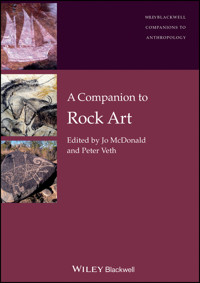
A Companion to Rock Art E-Book
155,99 €
Mehr erfahren.
- Herausgeber: John Wiley & Sons
- Kategorie: Geisteswissenschaft
- Serie: Blackwell Companions to Anthropology
- Sprache: Englisch
This unique guide provides an artistic and archaeological journey deep into human history, exploring the petroglyphic and pictographic forms of rock art produced by the earliest humans to contemporary peoples around the world.
- Summarizes the diversity of views on ancient rock art from leading international scholars
- Includes new discoveries and research, illustrated with over 160 images (including 30 color plates) from major rock art sites around the world
- Examines key work of noted authorities (e.g. Lewis-Williams, Conkey, Whitley and Clottes), and outlines new directions for rock art research
- Is broadly international in scope, identifying rock art from North and South America, Australia, the Pacific, Africa, India, Siberia and Europe
- Represents new approaches in the archaeological study of rock art, exploring issues that include gender, shamanism, landscape, identity, indigeneity, heritage and tourism, as well as technological and methodological advances in rock art analyses
Sie lesen das E-Book in den Legimi-Apps auf:
Seitenzahl: 1475
Veröffentlichungsjahr: 2012
Ähnliche




















Table of Contents
Cover
The Blackwell Companions to Anthropology
Title page
Copyright page
List of Plates
List of Figures
List of Tables
Notes on Contributors
Foreword: Redefining the Mainstream with Rock Art
CHAPTER 1 Research Issues and New Directions
RATIONALE FOR THIS VOLUME AND ITS STRUCTURE
RESEARCH ISSUES AND NEW DIRECTIONS
PART I: Explanatory Frameworks: New Insights
CHAPTER 2 Rock Art and Shamanism
DEFINITION
ALTERED STATES OF CONSCIOUSNESS
SHAMANIC AND SHAMANISTIC
METHOD AND EVIDENCE
ANIMISM AND SHAMANISM: A SOUTHERN AFRICAN EXAMPLE
MYTHOLOGY AND SHAMANISM
NORTH AMERICA
ANALOGY
UPPER PALEOLITHIC ART
“UNUSUAL AND PECULIAR”
MOVING FORWARD
ACKNOWLEDGMENT
CHAPTER 3 Pictographs, Patterns, and Peyote in the Lower Pecos Canyonlands of Texas
THE METHOD
STEP 1: FEATURE ANALYSIS
STEP 2: ETHNOGRAPHIC REVIEW AND FORMULATING HYPOTHESES
STEP 3: TESTING HYPOTHESES
CONCLUSIONS
CHAPTER 4 Variation in Early Paintings and Engravings
APPROACHES TO MEANING IN PLEISTOCENE PAINTINGS AND ENGRAVINGS
RITUAL PAINTING AND ENGRAVING IN THE WEST MEDITERRANEAN REGION
PLEISTOCENE PAINTING, ENGRAVING, AND RITUAL IN THE EAST MEDITERRANEAN
CONCLUSION
ACKNOWLEDGMENTS
PART II: Inscribed Landscapes
CHAPTER 5 Rock Art and Seascapes
MARITIME PEOPLES AND SEASCAPES
EDGE OF THE SEA
INLAND SEASCAPE
MARITIME IDENTITY AND AGENCY
MARITIME IDENTITY AND MARINE REFERENCING
REAFFIRMING MARINE COSMOLOGIES
FISHING MAGIC
VOYAGING
CONCLUSIONS
ACKNOWLEDGMENTS
CHAPTER 6 The Social Dynamics of Aggregation and Dispersal in the Western Desert
STYLE AS SOCIAL STRATEGY
WESTERN DESERT AGGREGATION AND DISPERSION PATTERNS
WHY DID WESTERN DESERT PEOPLE PRODUCE ROCK ART?
ARCHAEOLOGICAL TEST IMPLICATIONS
CONCLUSIONS
CHAPTER 7 Rock Art and Transformed Landscapes in Puerto Rico
ENCLOSURES IN A CARIBBEAN CONTEXT
TRANSFORMED LANDSCAPES AND ROCK ART
ICONOGRAPHIC COMPARISON
DISCUSSION
CONCLUDING REMARKS
PART III: Rock Art at the Regional Level
CHAPTER 8 Megalithic Rock Art of the Mediterranean and Atlantic Seaboard Europe
WHAT IS MEGALITHIC ART?
THE INTERPLAY OF ART AND ARCHITECTURE
ORIGINS AND ESTABLISHING A GRAMMAR
ORIGINS AND DISTRIBUTION OF PAINTED MOTIFS
ESTABLISHING A VERY NORTHERN EUROCENTRIC GRAMMAR
THE IRISH SEA PROVINCE CONNECTION AND BEYOND
DEFINING A NORTHERN BOUNDARY
DISCUSSION: VARIATIONS OF A THEME
ACKNOWLEDGMENTS
CHAPTER 9 North American–Siberian Connections
PREVIOUS STUDIES
USING MULTIVARIATE STATISTICS TO ANALYZE ROCK ART DATA
NORTH AMERICAN EARLY HUNTING TRADITION
SOUTH SIBERIAN EARLY PETROGLYPH STYLES
CONCLUSIONS
CHAPTER 10 Southern Melanesian Rock Art
NEW CALEDONIA’S CULTURAL CHRONOLOGY
ROCK ART RESEARCH IN NEW CALEDONIA
NEW CALEDONIAN PETROGLYPHS
SOME KANAK ORAL TRADITIONS ON PETROGLYPHS
PAINTED ROCK ART
ANALYSIS
CONCLUSION
CHAPTER 11 Rock Art Research in India
ROCK ART STUDIES IN INDIA
DISTRIBUTION OF SITES
PROBLEMATIZING INDIAN ROCK ART RESEARCH
CASE STUDIES FROM SOUTHERN INDIA
CONCLUSIONS
PART IV: Engendered Approaches
CHAPTER 12 Engendering Rock Art
SEX AND GENDER
WHAT KINDS OF PEOPLE ARE DEPICTED?
WHO MADE IMAGES ON STONE AND HOW DID MAKING IMAGES ON STONE MAKE GENDER?
GENDERED LIVES
GENDERED LANDSCAPES
GENDERED COSMOS
GENDERED DISCOURSE ABOUT ROCK ART, AND BEYOND
CHAPTER 13 Pictures of Women
ANTHROPOMORPHS
DIFFERENT WAYS OF LOOKING AT GENDERED DEPICTIONS
MURUJUGA
SYDNEY REGION
CONCLUSIONS ABOUT ROCK ART IN A GENDERED SOCIAL CONTEXT
CHAPTER 14 Engendering North European Rock Art
ROCK ART IN NORTHERN EUROPE
SEX
FROM SEX TO GENDER
FROM SEX AND GENDER TO SEX AND COSMOLOGY
COSMOLOGIES AND GENDER SYSTEMS
CONCLUSION
ACKNOWLEDGMENTS
PART V: Form, Style, and Aesthetics in Rock Art
CHAPTER 15 Understanding Pleistocene Rock Art
THE PROBLEM OF UNDERSTANDING IN PLEISTOCENE ART STUDIES
PHILOSOPHICAL HERMENEUTICS: AN INTRODUCTION
UNDERSTANDING PLEISTOCENE ROCK ART: AN HERMENEUTICS OF MEANING
SOME CONCLUDING THOUGHTS
CHAPTER 16 Rock “Art” and Art
ROCK ART AESTHETICS
OBJECTIONS: HISTORY OF ART AND ROCK “ART”
REPLIES: ART TODAY AND ROCK ART
CONCLUDING COMMENTS
ACKNOWLEDGMENTS
CHAPTER 17 Recursive and Iterative Processes in Australian Rock Art
ROCK ART, ANCESTORS, AND THE PRESENT
THE PAST IN THE PRESENT: ITERATIVE AND RECURSIVE PRACTICE
CONCLUDING REFLECTIONS
CHAPTER 18 A Theoretical Approach to Style in Levantine Rock Art
WHAT IS LEVANTINE ROCK ART?
A THEORETICAL APPROACH TO STYLE
EXPLORING STYLES IN LEVANTINE ROCK ART
CONCLUSIONS
PART VI: Contextualizing Rock Art
CHAPTER 19 Rock Art in Situ
STYLE
CONTEXT AND ROCK ART
CONTEXTUAL ANALYSIS
THE CONTEXT OF MEANING
CONTEXTUAL ANALYSIS IN VARIABLE CONTEXTS
EXAMPLES FROM THE BLACK HILLS
CONCLUSION
CHAPTER 20 Symbolic Discontinuities
INSCRIBED LANDSCAPES
ROCK ART STUDIES
PLACE
PEOPLE IN THE PLACE THROUGH TIME
SYMBOLIC DISCONTINUITIES
CHAPTER 21 Parietal Art and Archaeological Context
THE VOLP CAVES
THE ART AND LIFE OF THE MAGDALENIANS AT TUC D’AUDOUBERT
INTERPRETATIVE DIRECTIONS
CHAPTER 22 Rock Art, Inherited Landscapes, and Human Populations in Southern Patagonia
STUDY AREA AND BACKGROUND
PALI AIKE VOLCANIC FIELD (PAVF)
THE CORDILLERA
SUPRA-REGIONAL PATTERNS
GENERAL DISCUSSION
CONCLUSIONS
ACKNOWLEDGMENTS
PART VII: The Mediating Role of Rock Art
CHAPTER 23 When Worlds Collide Quietly
DISCIPLINES OF THE PAST
DEFINING CONTACT ROCK ART
ROCK ART IN WATARRKA NATIONAL PARK, CENTRAL AUSTRALIA
CHARACTERIZING THE ROCK ART ASSEMBLAGE
INTERPRETING THE WATARRKA ASSEMBLAGE
DRAWING FROM A DISTANCE
THE ART OF ENCOUNTER
CONCLUSION
CHAPTER 24 Picturing Change and Changing Pictures
PICTURING CHANGE AND PAINTING HISTORY
WHAT IS CONTACT PERIOD ROCK ART?
WOLLEMI NATIONAL PARK AND THE GREATER SYDNEY REGION, NEW SOUTH WALES
CENTRAL AUSTRALIA
PILBARA, WESTERN AUSTRALIA
WESTERN ARNHEM LAND, NORTHERN TERRITORY
CONCLUSION
ACKNOWLEDGMENTS
PART VIII: Rock Art, Identity, and Indigeneity
CHAPTER 25 Rock Art, Identity, and Indigeneity
INTERPRETING ORAL TRADITIONS
SHARED UNDERSTANDINGS
ROCK ART AND LAND RIGHTS
CONCLUSIONS
CHAPTER 26 Shamanism in Indigenous Context
SHAMANISM AND ROCK ART STUDIES: PHENOMENOLOGY VERSUS HISTORY
HOW DO WE IDENTIFY SHAMANISM IN ROCK ART IN SIBERIA?
ARE PHENOMENOLOGICAL AND HISTORICAL PERSPECTIVES INCOMPATIBLE?
UNIVERSALS IN CONTEXT
CONCLUSIONS
ACKNOWLEDGMENT
CHAPTER 27 Rock Art, Aboriginal Culture, and Identity
ROCK ART, COSMOLOGY, AND THE WANJINA-WUNGGURR CULTURAL LANDSCAPE
GWION GWION
ROCK ART AND ABORIGINAL IDENTITIES
WUNGGURR CONCEPTION SITES
WURNAN
THE RITUAL RE-PAINTING OF ROCK ART
ROCK ART AS THE BASIS FOR CONTEMPORARY WORKS OF ART
ROCK ART, ABORIGINAL HERITAGE, AND NATIVE TITLE
CONCLUSIONS
PART IX: Rock Art Management and Interpretation
CHAPTER 28 Rock Art and the UNESCO World Heritage List
FOR THE FUTURE, LESSONS ALREADY LEARNT
ROCK ART IN THE FRAMEWORK OF A WORLD HERITAGE THEMATIC PROGRAMME
RECOMMENDATIONS FOR GOOD PRACTICE
CONCLUSION
CHAPTER 29 Safeguarding a Fragile Legacy
OVERVIEW OF UDP ROCK ART MANAGEMENT SINCE THE 1960S
INSTITUTIONAL RESPONSIBILITIES
INVENTORIES, PLANNING, IMPLEMENTATION, AND INDIGENOUS VOICES
WORLD HERITAGE, TOURISM, AND PUBLIC INTERPRETATION
DISCUSSION
CONCLUSION
ACKNOWLEDGMENTS
CHAPTER 30 Managing Rock Art Sites
WHAT IS CULTURAL HERITAGE MANAGEMENT?
SITE SIGNIFICANCE
SIGNIFICANCE AND MANAGEMENT
DIFFERENT MANAGEMENT APPROACHES
MAIN ELEMENTS OF MANAGEMENT
CASE STUDIES
FINAL COMMENTS
CHAPTER 31 From Discovery to Commoditization
THE GRANTING OF NATIVE TITLE AND THE MANAGEMENT OF ROCK ART AND CULTURAL HERITAGE
BUT IT’S TOO COMPLEX TO BE ABORIGINAL ART?
WHAT IS SPECIAL ABOUT THE CANNING STOCK ROUTE ART?
MARTU VIEWS ON ROCK ART
RECORDING, DATING, AND ANALYSIS OF THE ROCK ART
MANAGEMENT ISSUES ON THE CANNING STOCK ROUTE
KNOWN GENERAL IMPACTS ON THE CANNING STOCK ROUTE
DOCUMENTED IMPACTS ON TANGIBLE AND INTANGIBLE CULTURAL HERITAGE
INDIGENOUS PROTECTED AREAS, CONSERVATION VALUES, AND RANGERS ON COUNTRY
TOWARD SUSTAINABLE FUTURE VISITATION TO CANNING STOCK ROUTE ROCK ART LOCALES
PART X: Dating Rock Art: Technological Advances and Applications
CHAPTER 32 Radiocarbon Dating of Rock Paintings
PAINT ON A ROCK CANVAS
RADIOCARBON DATING
DATING ROCK ART
OUR WORK USING PLASMA OXIDATION
CONCLUSIONS AND FUTURE WORK
ACKNOWLEDGMENTS
CHAPTER 33 Twelve Years of Research in Chauvet Cave
PRINCIPLES AND METHODS
TOPOGRAPHIC SURVEY AND SPELEOLOGICAL EXPLORATIONS
PARIETAL ART RESEARCH
THE NATURAL ENVIRONMENT
PALEOCLIMATIC AND PALEOENVIRONMENTAL CONTEXTS
BIOGEOCHEMICAL STUDIES OF ANIMAL DIETS
STUDY OF THE ARCHAEOLOGICAL CONTEXT
DATING AND CHRONOLOGICAL CHARACTERIZATION
PALEONTOGICAL AND ARCHAEOZOOLOGICAL STUDY
PRINCIPAL SCIENTIFIC RESULTS
CONCLUSION
ACKNOWLEDGMENTS
CHAPTER 34 In Suspect Terrain
ROCK SURFACES AND ROCK ENGRAVINGS
ROCK VARNISH DATING APPROACHES
SQUABBLES OR ISSUES OF FACT?
AFTERMATHS AND OUTCOMES
PART XI: Rock Art in the Digital Age
CHAPTER 35 Digital Enhancement of Deteriorated and Superimposed Pigment Art
THE ROLE OF DIGITAL TECHNOLOGY IN ROCK ART RESEARCH
METHODS OF ENHANCEMENT
CASE STUDY 1: RECOVERING PIGMENT ART IN TORRES STRAIT, NORTHEASTERN AUSTRALIA
CASE STUDY 2: SUPERIMPOSITIONS IN JAWOYN COUNTRY, NORTHERN AUSTRALIA
DISCUSSION
CONCLUSION
ACKNOWLEDGMENTS
CHAPTER 36 Robust and Scientifically Reliable Rock Art Documentation from Digital Photographs
ADOPTION OF ROBUST DIGITAL IMAGING BY ROCK ART PRACTITIONERS
REFLECTANCE CAPTURE
ALGORITHMIC RENDERING
PHOTOGRAMMETRY
CONCLUSIONS
CHAPTER 37 Engaging a New Digital Citizenry
THE EMERGENCE OF SINGULARITY THINKING
AN ARCHAEOLOGICAL APPROACH TO SINGULARITY (AND SINGLE-MINDED) THINKING
HERALDING THE DIGITAL DARK AGE
MULTIGENERATIONAL MEMORIES IN THE NEW MILLENNIUM
BORN ARCHIVAL MEDIA
DIGITAL SURROGATES OF HIDDEN HERITAGE
SHIFTING PRIORITIES AND THE PROTECTION OF DIGITAL HERITAGE
A PLATFORM FOR INDIGENOUS DIGITAL HERITAGE
CONCLUSIONS: WE ARE THE SINGULARITY
Supplemental Images
Index
The Blackwell Companions to Anthropology offer a series of comprehensive syntheses of the traditional subdisciplines, primary subjects, and geographic areas of inquiry for the field. Taken together, the series represents both a contemporary survey of anthropology and a cutting-edge guide to the emerging research and intellectual trends in the field as a whole.
Forthcoming
This edition first published 2012
© 2012 Blackwell Publishing Ltd
Blackwell Publishing was acquired by John Wiley and Sons in February 2007. Blackwell’s publishing program has been merged with Wiley’s global Scientific, Technical, and Medical business to form Wiley-Blackwell.
Registered Office
John Wiley and Sons Ltd, The Atrium, Southern Gate, Chichester, West Sussex, PO19 8SQ, UK
Editorial Offices
350 Main Street, Malden, MA 02148-5020, USA
9600 Garsington Road, Oxford, OX4 2DQ, UK
The Atrium, Southern Gate, Chichester, West Sussex, PO19 8SQ, UK
For details of our global editorial offices, for customer services, and for information about how to apply for permission to reuse the copyright material in this book please see our website at www.wiley.com/wiley-blackwell.
The right of Jo McDonald and Peter Veth to be identified as the authors of the editorial material in this work has been asserted in accordance with the UK Copyright, Designs and Patents Act 1988.
All rights reserved. No part of this publication may be reproduced, stored in a retrieval system, or transmitted, in any form or by any means, electronic, mechanical, photocopying, recording or otherwise, except as permitted by the UK Copyright, Designs and Patents Act 1988, without the prior permission of the publisher.
Wiley also publishes its books in a variety of electronic formats. Some content that appears in print may not be available in electronic books.
Designations used by companies to distinguish their products are often claimed as trademarks. All brand names and product names used in this book are trade names, service marks, trademarks or registered trademarks of their respective owners. The publisher is not associated with any product or vendor mentioned in this book. This publication is designed to provide accurate and authoritative information in regard to the subject matter covered. It is sold on the understanding that the publisher is not engaged in rendering professional services. If professional advice or other expert assistance is required, the services of a competent professional should be sought.
Library of Congress Cataloging-in-Publication Data
A companion to rock art / edited by Jo McDonald and Peter Veth.
pages cm
Includes bibliographical references and index.
ISBN 978-1-4443-3424-1 (hardback)
1. Petroglyphs–Handbooks, manuals, etc. 2. Rock paintings–Handbooks, manuals, etc. I. McDonald, Jo (Josephine), editor of compilation. II. Veth, Peter Marius, editor of compilation.
GN799.P4C525 2012
709.01'13–dc23
2012015860
A catalogue record for this book is available from the British Library.
Jacket image: Bighorn Sheep figure at the Three Rivers Petroglyph Site. Albuquerque, New Mexico. © Kevin Schafer / Alamy.
Jacket design by Richard Boxall Design Associates.
List of Plates
Plate 1
San rock paintings of antelope-headed therianthropes
Plate 2
Rock art panel at the White Shaman site, Lower Pecos Canyonlands
Plate 3
Antlered anthropomorph at the Halo Shelter, Lower Pecos Canyonlands
Plate 4
Canoes from southwest Torres Strait
Plate 5
Hidden painted spirals from the Tomba della scacchiera, Sardinia
Plate 6
Hand stencils on a wall of Fetra-Hé cave, Lifou Island, New Caledonia
Plate 7
Rock art from Katavani Kunta Valley, Andhra Pradesh, India
Plate 8
Great Mackerel Rock-Shelter
Plate 9
Rock art from Backa in Brastad parish in Bohuslän, Sweden
Plate 10
Cattle painting from the Ennedi Highlands, Chad
Plate 11
Painted ceiling of a rock-shelter at Injaluk Hill, Western Arnhem Land, Australia
Plate 12
A Wanjina painting referring to a mythical chase across country
Plate 13
Geographic distribution of Levantine rock art and main motifs of the Levantine repertoire
Plate 14
The clay bison in Tuc d’Audoubert Cave, Ariège, France
Plate 15
Lineal traces in rock and mobile art found at Pali Aike and
Morros
sites in southern Patagonia
Plate 16
Stencils, painting, and charcoal drawing at Watarrka National Park, Central Australia
Plate 17
Charcoal drawings re-outlined in white at Wollemi National Park, near Sydney, Australia
Plate 18
Cruise ship from the Djulirri main gallery, Wellington Range, Arnhem Land, Australia
Plate 19
Grave stone slab discovered by Vladimir Kubarev at Karakol in Altai
Plate 20
Drum of a Khakass shaman
Plate 21
Namarali
at Karndirrim rock-shelter repainted by Donny Woolagoodja
Plate 22
Large painted panel at Game Pass Shelter 1, uKhahlamba-Drakensberg Park
Plate 23
Complex in-filled anthropomorphic figures, central Canning Stock Route
Plate 24
Karen Steelman sampling pigment rock art in the Australian Western Desert
Plate 25
Chauvet Cave: end chamber, right wall
Plate 26
Varnish microlamination thin-sections
Plate 27
Computer enhancement of a canoe with sail, from the island of Dauan in the Torres Strait
Plate 28
Photomosaic and interpretative drawing of C2 panel,
Nawarla Gabarnmung
shelter, Jawoyn Country, northern Australia
Plate 29
Three-dimensional surface data derived photogrammetrically of rock art surface in the Black Hills, Wyoming
Plate 30
Laetoli footprints: digital data provided by photogrammetry
List of Figures
Figure 1.1
“Stand Up for the Burrup”: roll call at the SAA Conference 2011
Figure 2.1
A Tukano shaman’s drawing of a
yajé
vision
Figure 2.2
San rock painting of an elongated shaman
Figure 2.3
A San trance, or curing, dance
Figure 3.1
The Lower Pecos Canyonlands of southwest Texas and northern Mexico
Figure 3.2
White Shaman Shelter: an antlered anthropomorph
Figure 3.3
Cedar Springs: a small red deer
Figure 3.4
Panther Cave: impaled deer and impaled dots
Figure 3.5
Black Cave: a large anthropomorphic figure
Figure 3.6
Huichol yarn painting by Chavelo Gonzalez
Figure 4.1
African and east Mediterranean sites
Figure 4.2
Map of sites in the east and west Mediterranean regions
Figure 4.3
Continuing iconicity through the sequence at Parpalló
Figure 5.1
Group VIII at New Zalavruga rock art site on the River Vyg, Russia
Figure 5.2
A panel from Preminghana petroglyph site, northwest Tasmania
Figure 5.3
A panel inside a lava tube cave at Kalaoa (Hawaii Island)
Figure 5.4
Selected cave paintings, Chasm Island (Burrabarra), northern Australia
Figure 5.5
Cygnet Repu of Mabuyag Island, Torres Strait, painting a
kaigas
Figure 6.1
Arrangement of aggregation signals around a range system, based on Jilakurru
Figure 7.1
Tibes: aerial view, site plan, and petroglyphs
Figure 7.2
Caguana: Plaza A west side, site plan, and petroglyph sequence
Figure 7.3
Viví: site plan and Central Mountains
Figure 7.4
Jácana: site plan, north wall, and petroglyph comparisons with Caguana
Figure 7.5
Petroglyph sequence at Jácana by wall location
Figure 7.6
Viví petroglyph sequence, Enclosure A
Figure 8.1
Key megalithic art sites of Europe
Figure 8.2
Shee-Twohig’s motif classification
Figure 8.3
The two decorated faces and upper ridge of the Pattern Stone
Figure 8.4
The merging of two styles at Nether Largie North in the Kilmartin Valley
Figure 9.1
Early Hunting tradition scene
Figure 9.2
Non-metric multidimensional scaling and discriminant analysis
Figure 9.3
Animals and pecked hand from the Legend Rock outline pecked animal tradition
Figure 9.4
Non-metric multidimensional scaling
Figure 10.1
Photograph of petroglyph site on the mainland of New Caledonia by M. Leenhardt
Figure 10.2
Spirals and concentric circles from site WPT003 of Katiramona
Figure 10.3
Diversity of enveloped crosses from New Caledonia
Figure 10.4
Diversity of anthropomorphic petroglyph motifs
Figure 10.5
Alignments of cupules of site EPE009 of Tabé (Tchamba)
Figure 10.6
Bird and turtle motifs of Fetra-Hé cave
Figure 10.7
Traditional Kanak wooden door lintel
Figure 11.1
Distribution of known regions containing rock art within India
Figure 11.2
Rock bruisings and cupules on Hiregudda
Figure 11.3
Cupules associated with deep grooves on Hiregudda
Figure 12.1
Sexed, ambiguous, and ambivalent figures, Northern Arizona
Figure 12.2
Rock painting of a female apparently using a digging stick
Figure 13.1
Pilbara locality map showing Dampier Archipelago and other art provinces
Figure 13.2
Woodstock/Abydos: male and female figures
Figure 13.3
Murujuga: characteristic grouped figures
Figure 13.4
Open engraving assemblage from Ku-ring-Gai Chase
Figure 13.5
Vertical engravings on Cowan and Berowra Creeks
Figure 13.6
Sydney Basin engravings: examples of men and women in association
Figure 14.1
Rock art traditions in northern Europe
Figure 14.2
Rock art chronology of boat images in southern Scandinavia
Figure 14.3
Depiction of engendered human rock art motifs from Alta, Vingen, and Bardal
Figure 14.4
Depiction of engendered human rock art motifs from Bohuslän, Sweden
Figure 14.5
Related ritual specialists from the Scandinavian Bronze Age
Figure 14.6
Rock art motifs from Jerpin Pudas 3, Vyg in northwest Russia
Figure 14.7
Rock art from Ole Pedersen in Alta
Figure 16.1
Chauvet Cave, France
Figure 16.2
Cattle engraving from the Ennedi Highlands, Chad
Figure 16.3
Cattle engraving from the Ennedi Highlands, Chad
Figure 17.1
A Bradshaw figure over hand stencils on an island off the Kimberley coast
Figure 17.2
A Mimi or trickster spirit at Ubirr Rock, Kakadu National Park
Figure 17.3
Krill Krill ceremony at Turkey Creek, Kimberley region
Figure 18.1
Cova Remigia and Cingle Mola Remigia rock-shelters
Figure 18.2
Regional sequence of Levantine human figures
Figure 18.3
Spatial relations among Levantine motifs
Figure 18.4
Changes in themes according to the regional stylistic sequence of human figures
Figure 19.1
Black Rock Style I panel showing running humans driving deer or elk
Figure 19.2
Black Rock Style II panel with typical complex abstract design
Figure 19.3
Abraded vulvas and bison track typical of Black Rock Style III
Figure 19.4
Black Rock Style IV incised figures of warriors
Figure 20.1
Locality map for Quebrada de Humahuaca
Figure 20.2
View of Upper Rift Valley with outcrops
Figure 20.3
Pintoscayoc 1 rock-shelter
Figure 20.4
Rock art sequence pre-annexation times
Figure 20.5
Rock art sequence during annexation times
Figure 21.1
Location of the three geological networks of Tuc d’Audoubert Cave
Figure 21.2
Tracing of two bison drawn with fingers, Tuc d’Audoubert Cave
Figure 21.3
Tracing of an engraved panel, Tuc d’Audoubert Cave
Figure 21.4
Salle des Talons
, Tuc d’Audoubert Cave
Figure 22.1
Southern Patagonia: location of areas and localities
Figure 22.2
Series of parallel traces at Potrok Aike (Pali Aike)
Figure 22.3
Dots and parallel traces at Ultima Esperanza (Chile)
Figure 22.4
Principal component analysis of types of motifs by region
Figure 22.5
Principal component analysis of grouped motifs by region
Figure 23.1
Location map of Central Australia and Watarrka (Kings Canyon) National Park
Figure 23.2
Reproduction of drawings from the upper plateau of the George Gill Range
Figure 23.3
Reproduction of non-figurative graphics from Watarrka National Park
Figure 23.4
Example of drawings evident in George Gill Range
Figure 23.5
Drawings from the upper plateau of the George Gill Range
Figure 24.1
Map of Australia with main field locations indicated
Figure 24.2
Engraved camel, Central Australia
Figure 24.3
Examples of introduced subject matter in Pilbara rock art
Figure 24.4
Pilbara engraved ship
Figure 26.1
Engraved images of shamans playing the drum
Figure 26.2
Human standing on deer in motion, Kalbak-Tash, Altai
Figure 26.3
Aspects of shamanic iconography identified in prehistoric rock art
Figure 26.4
Crack in the rock surface with petroglyphs, Ilinskaya, Krasnoyarsk County
Figure 26.5
The Ilinskya rock art complex which has many cupules
Figure 27.1
The Wanjina Namarali at Karndirrim
Figure 29.1
Evidence of people camping below paintings at Fergies Cave
Figure 29.2
Front cover of the Natal Parks Board (1995) pamphlet about rock art
Figure 30.1
The cyclical and iterative management process
Figure 31.1
The Canning Stock Route
Figure 31.2
Historic and recent graffiti in the Durba Hills (Jilakurru)
Figure 31.3
Martu Ranger AS (Arthur Samson) illustrating pigment art on the Canning Stock Route
Figure 32.1
A polished section of a rock painting showing accretion and paint layers
Figure 32.2
Schematic of an accelerator mass spectrometry (AMS) instrument
Figure 32.3
Early plasma oxidation studies on paint samples
Figure 33.1
Map of Chauvet Cave
Figure 33.2
Group of hand-dots, Chauvet Cave
Figure 33.3
Panneau du Mégacéros
, Chauvet Cave
Figure 33.4
The various stages of the creation of the
Panneau des Chevaux
, Chauvet Cave
Figure 33.5
Panneau des Chevaux
, Chauvet Cave
Figure 33.6
Chauvet-type signs
Figure 33.7
Cave bear bones,
Salle Hillaire
, Chauvet Cave
Figure 34.1
Human figure rock engravings from the Coso Range, California
Figure 34.2
Holocene and Late Pleistocene VML calibration as defined by Tanzhuo Liu
Figure 35.1
The Torres Strait islands, located between mainland Australia and Papua New Guinea
Figure 35.2
Dauan, Torres Strait: grayscale conversion of a face/mask
Figure 35.3
Example of layers from Panel C2,
Nawarla Gabarnmung
shelter, Jawoyn Country, northern Australia
Figure 35.4
Harris matrix of the Panel C2 motifs,
Nawarla Gabarnmung
shelter
Figure 36.1
Reflectance transformation image (RTI) of Paleolithic goat petroglyph, Côa Valley, Portugal
Figure 36.2
Enhanced images of the Sennedjem Lintel
Figure 36.3
Image and non-photorealistic rendering of the Legend Rock Wyoming State Park archaeological site
Figure 36.4
Sixty images stitched into a virtual stereo pair
Figure 37.1
Human achievements in the context of the Long Now
List of Tables
Table 7.1
Ceremonial enclosure characteristics at Tibes, Caguana, Viví, and Jácana, Puerto Rica
Table 9.1
Discriminant analysis predictions of group members for North American Plains petroglyph traditions
Table 9.2
Attribute descriptions for Siberian rock art statistical analyses
Table 13.1
Comparison of broad motif classes from Port Hedland with two Pilbara rock art provinces and Murujuga
Table 13.2
Marujuga: proportions of the different classes of anthropomorphic figures
Table 13.3
Gender information encoded in Murujuga anthropomorphic depictions
Table 13.4
Sydney Basin: comparison of broad themes in the engraved and pigment art assemblages
Table 13.5
Sydney Basin: gender information in anthropomorphs from engraved and pigment sites
Table 13.6
Sydney Basin: sites at which women motifs are present
Table 14.1
Selected Bronze Age rock art areas showing the relationship between different types of rock art imagery
Table 14.2
Human engravings from 263 rock sites in northern Bohuslän
Table 19.1
Summary of petroglyph styles in the Black Hills, South Dakota and Wyoming
Table 20.1
Chronology and rock art characteristics of sites in Quebrada de Humahuaca
Table 22.1
Relative abundance of motifs by region in southern Patagonia
Table 28.1
Rock art sites on the World Heritage List (as of May 2011)
Table 28.2
Rock art sites on the tentative World Heritage List (as of May 2011)
Table 29.1
Management criteria by which points were allocated in the RAND management plan for uKhahlamba-Drakensberg rock art
Table 33.1
List of the
14
C results obtained for the Chauvet Cave
Table 37.1
Media through the millennia
Notes on Contributors
Michael Ashley oversees the technological development activities at the Center for Digital Archaeology (CoDA) at the University of California at Berkeley, formulating the vision and long-term strategies, and developing technical partnerships and international alliances. He is a digital conservation architect with more than 16 years of experience in cultural heritage informatics management and education. He received his PhD at the University of California at Berkeley, where he co-founded several initiatives, including the award-winning Open Knowledge and the Public Interest (OKAPI), and the Media Vault Program. As an archaeological photographer, he was Media Team leader for the Çatalhöyük Project for seven years, and has worked on heritage preservation projects worldwide.
Robert Bégouën is Curator of the Volp Caves in Ariège, France. Three cave sites (Enlène, Les Trois Frères, and Le Tuc d’Audoubert) are managed by the Association Louis Bégouën, which assures the protection of the property. Since 1976, Robert Bégouën has dedicated himself to the study of these major European upper Paleolithic cave sites. He has made numerous discoveries, including Le Tuc d’Audoubert. He is interested in rock art, but also in all the archaeological remains and vestiges (e.g., the tracks and imprints) which help to reconstitute the activities of the prehistoric people in these cave environments.
James Blinkhorn is a DPhil student in Archaeological Science at the School of Archaeology, University of Oxford. He has studied Indian archaeology and rock art since 2002, receiving his BA and MPhil from the Faculty of Anthropology and Archaeology, University of Cambridge. His fieldwork experience includes devising and implementing survey strategies for identifying and recording rock art in Andhra Pradesh and Madhya Pradesh, India. His broader interests include the emergence of symbolic behavior and modern human dispersals.
Lesen Sie weiter in der vollständigen Ausgabe!
Lesen Sie weiter in der vollständigen Ausgabe!
Lesen Sie weiter in der vollständigen Ausgabe!
Lesen Sie weiter in der vollständigen Ausgabe!
Lesen Sie weiter in der vollständigen Ausgabe!
Lesen Sie weiter in der vollständigen Ausgabe!
Lesen Sie weiter in der vollständigen Ausgabe!
Lesen Sie weiter in der vollständigen Ausgabe!
Lesen Sie weiter in der vollständigen Ausgabe!
Lesen Sie weiter in der vollständigen Ausgabe!
Lesen Sie weiter in der vollständigen Ausgabe!
Lesen Sie weiter in der vollständigen Ausgabe!
Lesen Sie weiter in der vollständigen Ausgabe!
Lesen Sie weiter in der vollständigen Ausgabe!
Lesen Sie weiter in der vollständigen Ausgabe!
Lesen Sie weiter in der vollständigen Ausgabe!
Lesen Sie weiter in der vollständigen Ausgabe!
Lesen Sie weiter in der vollständigen Ausgabe!
Lesen Sie weiter in der vollständigen Ausgabe!
Lesen Sie weiter in der vollständigen Ausgabe!
Lesen Sie weiter in der vollständigen Ausgabe!
Lesen Sie weiter in der vollständigen Ausgabe!
Lesen Sie weiter in der vollständigen Ausgabe!
Lesen Sie weiter in der vollständigen Ausgabe!
Lesen Sie weiter in der vollständigen Ausgabe!
Lesen Sie weiter in der vollständigen Ausgabe!
Lesen Sie weiter in der vollständigen Ausgabe!
Lesen Sie weiter in der vollständigen Ausgabe!
Lesen Sie weiter in der vollständigen Ausgabe!
Lesen Sie weiter in der vollständigen Ausgabe!
Lesen Sie weiter in der vollständigen Ausgabe!
Lesen Sie weiter in der vollständigen Ausgabe!
Lesen Sie weiter in der vollständigen Ausgabe!
Lesen Sie weiter in der vollständigen Ausgabe!
Lesen Sie weiter in der vollständigen Ausgabe!
Lesen Sie weiter in der vollständigen Ausgabe!
Lesen Sie weiter in der vollständigen Ausgabe!
Lesen Sie weiter in der vollständigen Ausgabe!
Lesen Sie weiter in der vollständigen Ausgabe!
Lesen Sie weiter in der vollständigen Ausgabe!
Lesen Sie weiter in der vollständigen Ausgabe!
Lesen Sie weiter in der vollständigen Ausgabe!
Lesen Sie weiter in der vollständigen Ausgabe!
Lesen Sie weiter in der vollständigen Ausgabe!
Lesen Sie weiter in der vollständigen Ausgabe!
Lesen Sie weiter in der vollständigen Ausgabe!
Lesen Sie weiter in der vollständigen Ausgabe!
Lesen Sie weiter in der vollständigen Ausgabe!
Lesen Sie weiter in der vollständigen Ausgabe!
Lesen Sie weiter in der vollständigen Ausgabe!
Lesen Sie weiter in der vollständigen Ausgabe!




