


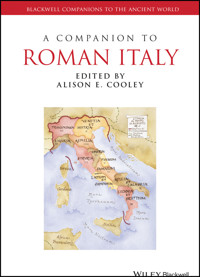
A Companion to Roman Italy E-Book
142,99 €
Mehr erfahren.
- Herausgeber: John Wiley & Sons
- Kategorie: Geisteswissenschaft
- Serie: Blackwell Companions to the Ancient World
- Sprache: Englisch
A Companion to Roman Italy investigates the impact of Rome in all its forms—political, cultural, social, and economic—upon Italy's various regions, as well as the extent to which unification occurred as Rome became the capital of Italy.
- The collection presents new archaeological data relating to the sites of Roman Italy
- Contributions discuss new theories of how to understand cultural change in the Italian peninsula
- Combines detailed case-studies of particular sites with wider-ranging thematic chapters
- Leading contributors not only make accessible the most recent work on Roman Italy, but also offer fresh insight on long standing debates
Sie lesen das E-Book in den Legimi-Apps auf:
Seitenzahl: 1501
Veröffentlichungsjahr: 2016
Ähnliche




















Table of Contents
Cover
Title Page
List of Illustrations
List of Tables
Notes on Contributors
Acknowledgements
INTRODUCTION: Setting the Scene
CHAPTER 1: Italy Before the Romans
1.1 Introduction
1.2 Forces of Centralization – InterpretingSettlement Patterns
1.3 Single Communities – Cemeteries
1.4 Individual Networks and Mobility
1.5 Community Organization Beyond Territory
1.6 Supra-Community Organization
1.7 Sanctuaries as
Fora
1.8 Free Agents and Organization ofInstant Communities
1.9 Conclusion
FURTHER READING
REFERENCES
PART I: The Impact of Rome – Unification and Integration
CHAPTER 2: Rome’s Encroachment on Italy
2.1 Introduction
2.2 The Early Years (Circa 509–390
BC
)
2.3 Italy Encounters Rome (Circa 390–264
BC
)
2.4 The Impact of Roman Encroachment: Italy in the Third and Early Second Centuries
BC
2.5 Roman Encroachment and Cultural Change
2.6 Conclusion
FURTHER READING
REFERENCES
CHAPTER 3: Italy and the Greek East, Second Century BC
3.1 Introduction
3.2 Romans and Greeks to 205
BC
3.3 Romans and Greeks in the Second Century
BC
3.5 Resistance
3.6 Conclusion
FURTHER READING
REFERENCES
CHAPTER 4: The Social War
1
4.1 Introduction
4.2 Italian Grievances and Aspirations
4.3 Which Italians?
4.4 Attitudes to the Citizenship
4.5 The War
FURTHER READING
REFERENCES
CHAPTER 5: The Civil Wars and the Triumvirate
5.1 Rome and Italy: Ideological Imbrication?
5.2 Out of the Frying Pan into the Fire
5.3 Practical Developments
5.4 Political Involvement
5.5
Tota Italia
FURTHER READING
REFERENCES
CHAPTER 6: Coming to Terms with Dynastic Power, 30 BC–AD 69
6.1
Tota Italia
6.2
Domus Augusta
and
Familia Caesaris
6.3 The Economic Impact of Dynastic Power
6.4 The End of the Dynasty
FURTHER READING
REFERENCES
CHAPTER 7: Italy during the High Empire, from the Flavians to Diocletian
7.1 Rebuilding After Civil Wars
7.2 Italy and the Emperors
7.3 The Impact of Women on the Landscapes of Italy
7.4 Patterns in City Life
7.5 Administration of Italy
FURTHER READING
REFERENCES
CHAPTER 8: Late Roman and Late Antique Italy
8.1 Introduction
8.2 Constantine and a New Order
8.3 Emperors, Invaders and Italy,
AD
340–490
8.4 Changed Landscapes
8.5 From Ostrogoths to Lombards
FURTHER READING
REFERENCES
PART II: Local and Regional Diversity
2.1 Cultural Diversity
CHAPTER 9: Funerary Practices
9.1 Introduction
9.2 A “Roman” Way of Death?
9.3 Inhumation and Cremation
9.4 Rituals and Graves
9.5 Monuments
9.6 Epitaphs
9.7 Bones and Bodies
9.8 Conclusions
FURTHER READING
REFERENCES
CHAPTER 10: Diversity in Architecture and Urbanism
10.1 Introduction
10.2 Cultural Diversity in Early Italy
10.3 The Etruscans
10.4 Early Latium and Rome: Between Etruria and Greece
10.5 Geographical Diversity
10.6 Republican Italy: Rome, Colonies and Allied Towns
10.7 Rome in the Principate
10.8 Urban Change in Augustan Italy
10.9 Conclusion
FURTHER READING
REFERENCES
CHAPTER 11: Language and Literacy in Roman Italy
11.1 Introduction
11.2 Languages in Pre-Roman Italy
11.3 The Diffusion of the Latin Language and Alphabet
11.4 Literacy: The Uses of Writing in Ancient Italy
11.5 Language, Literacy and Cultural Identities
FURTHER READING
REFERENCES
2.2 Greek Italy
CHAPTER 12: Roman Naples
12.1 Introduction
12.2 Naples: Greek, Campanian, and Roman
12.3 Public Building and Civic Identities: The Reshaping of an Urban Environment
12.4 Institutions in Transition: The Municipal Administration of Roman Naples
12.5 The Cultural Life of Roman Naples
12.6 Public and Private: Identities in the Funerary Record
12.7 Conclusions
FURTHER READING
REFERENCES
2.3 Case-study: Becoming Roman in
Cisalpina
CHAPTER 13: Magna Graecia, 270 BC–AD 200
13.1 Introduction
13.2 Roman Conquest: Magna Graecia Before the Social War
13.3 Reorganizing Magna Graecia
13.4 Economic Development
13.5 Magna Graecia and the Greek World
13.6 Cities and Urban Development
13.7 Urban Society and Culture: Cultural Identities Between Greece and Rome
FURTHER READING
REFERENCES
CHAPTER 14: The Changing Face of Cisalpine Identity
14.1 Gaul, Transapadana, Italy. What’s in a Name?
14.2 The Archaic Background: The Arrival of the Gauls
14.3 First Roman Forays Acrossthe Apennines, 290–218
BC
14.4 The Transformation of the Landscape, 201–148
BC
14.5 Citizenship and Belonging
14.6 Conclusion: An Epitaph for Cremona
FURTHER READING
REFERENCES
PART III: Town and Country
3.1 Settlement Patterns
CHAPTER 15: Urbanization
15.1 Introduction
15.2 Defining Urbanization
15.3 The Development of Cities in Italy
15.4 The Historical Context of Urbanization in Roman Italy in the Republican Period
15.5 Regional Diversity
15.6 Case Studies: Poseidonia/Paestum and Cosa
15.7 Patterns of Public Building
15.8 The Role of the City in Roman Italy
15.9 Conclusion
FURTHER READING
REFERENCES
CHAPTER 16: Urban Peripheries
16.1 Introduction
16.2 The Urban Periphery in Roman Italy
16.3 Spurs for Periurban Development
16.4 The Role of the Urban Periphery
16.5 Conclusion
FURTHER READING
REFERENCES
CHAPTER 17: Villas
17.1 Introduction
17.2 Definitions
17.3 Origins, Chronology, and Development
17.4 Geography
17.5
Fructus
and
Luxuria
: Production andLuxury in the Italian Villa
17.6
Otium
and
Negotium
in Villa Lifestyles: Literary Evidence
17.7 Villas in Archaeology: Case Studies (Villa dei Papiri; Settefinestre; Villa Regina)
17.8 Decline?
FURTHER READING
REFERENCES
3.2 Case-studies of Towns and their Territories
CHAPTER 18: Republican and Early Imperial Towns in the Tiber Valley
18.1 Introduction
18.2 Historical Background
18.3 Settlement Patterns and Economy
18.4 Key Issues in the Development of Roman Towns in the Middle and Lower Tiber Valley
18.5 Discussion
FURTHER READING
REFERENCES
CHAPTER 19: Cosa and the
Ager Cosanus
19.1 Cosa
19.2 The
Ager Cosanus
FURTHER READING
REFERENCES
CHAPTER 20: Pompeii and the
Ager Pompeianus
20.1 Landscape History and Cultural Memory
1
20.2 The Landscape of the City and the Country
20.3 Emulation and Local Elite Identities
20.4 Homes in the City and the Countryside
20.5 Urban Spectacle
20.6 Pompeii and the History of Italy
FURTHER READING
REFERENCES
CHAPTER 21: Ostia
21.1 Introduction
1
21.2 The Foundation of Ostia
21.3 The
Colonia Maritima
21.4 The Creation of a
Façade Maritime
21.5 The Formation of the Imperial City
21.6 Commercial City
21.7 Housing
21.8 From the Third Century to Late Antiquity
FURTHER READING
REFERENCES
PART IV: Economy and Society
CHAPTER 22: Regional Interaction
22.1 Regional Interaction and Local Networks
22.2 Market-Days in Roman Italy
22.3 A Cultural Network for Gladiatorial Spectacles
FURTHER READING
REFERENCES
CHAPTER 23: Agricultural Production in Roman Italy
23.1 Introduction
23.2 Ancient Texts and Archaeology
23.3 Animals: The ‘Other’ Mediterranean Triad
23.4 Plants: The Original Mediterranean Triad
23.5 Aristocrats and Agrobusiness
23.6 On the Family Farm
23.7 Conclusions
FURTHER READING
REFERENCES
CHAPTER 24: Local Elites
24.1 Introduction
24.2 The Roman Conquest and the Italian Elites
24.3 “Dim Characters with Fantastic Names”: The Roman Revolution and the “Victory of the Italians”
24.4 The Italian Elites Under the Principate
24.5 Conclusion
FURTHER READING
REFERENCES
CHAPTER 25: Sub-Elites
25.1 Introduction
25.2 Working in Wool and Working for Status?:
Lanarii
25.3 Getting from Point A to Point B and Getting Ahead?: and
Lesen Sie weiter in der vollständigen Ausgabe!
Lesen Sie weiter in der vollständigen Ausgabe!
Lesen Sie weiter in der vollständigen Ausgabe!
Lesen Sie weiter in der vollständigen Ausgabe!
Lesen Sie weiter in der vollständigen Ausgabe!
Lesen Sie weiter in der vollständigen Ausgabe!
Lesen Sie weiter in der vollständigen Ausgabe!
Lesen Sie weiter in der vollständigen Ausgabe!
Lesen Sie weiter in der vollständigen Ausgabe!
Lesen Sie weiter in der vollständigen Ausgabe!
Lesen Sie weiter in der vollständigen Ausgabe!
Lesen Sie weiter in der vollständigen Ausgabe!
Lesen Sie weiter in der vollständigen Ausgabe!
Lesen Sie weiter in der vollständigen Ausgabe!
Lesen Sie weiter in der vollständigen Ausgabe!
Lesen Sie weiter in der vollständigen Ausgabe!
Lesen Sie weiter in der vollständigen Ausgabe!
Lesen Sie weiter in der vollständigen Ausgabe!
Lesen Sie weiter in der vollständigen Ausgabe!
Lesen Sie weiter in der vollständigen Ausgabe!
Lesen Sie weiter in der vollständigen Ausgabe!
Lesen Sie weiter in der vollständigen Ausgabe!
Lesen Sie weiter in der vollständigen Ausgabe!
Lesen Sie weiter in der vollständigen Ausgabe!
Lesen Sie weiter in der vollständigen Ausgabe!
Lesen Sie weiter in der vollständigen Ausgabe!
Lesen Sie weiter in der vollständigen Ausgabe!
Lesen Sie weiter in der vollständigen Ausgabe!
Lesen Sie weiter in der vollständigen Ausgabe!
Lesen Sie weiter in der vollständigen Ausgabe!
Lesen Sie weiter in der vollständigen Ausgabe!
Lesen Sie weiter in der vollständigen Ausgabe!
Lesen Sie weiter in der vollständigen Ausgabe!
Lesen Sie weiter in der vollständigen Ausgabe!
Lesen Sie weiter in der vollständigen Ausgabe!
Lesen Sie weiter in der vollständigen Ausgabe!
Lesen Sie weiter in der vollständigen Ausgabe!
Lesen Sie weiter in der vollständigen Ausgabe!
Lesen Sie weiter in der vollständigen Ausgabe!
Lesen Sie weiter in der vollständigen Ausgabe!
Lesen Sie weiter in der vollständigen Ausgabe!
Lesen Sie weiter in der vollständigen Ausgabe!




