


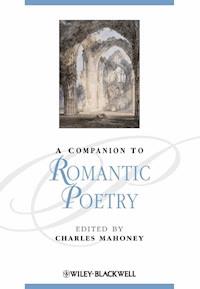
A Companion to Romantic Poetry E-Book
34,99 €
Mehr erfahren.
- Herausgeber: John Wiley & Sons
- Kategorie: Geisteswissenschaft
- Sprache: Englisch
Through a series of 34 essays by leading and emerging scholars, A Companion to Romantic Poetry reveals the rich diversity of Romantic poetry and shows why it continues to hold such a vital and indispensable place in the history of English literature. * Breaking free from the boundaries of the traditionally-studied authors, the collection takes a revitalized approach to the field and brings together some of the most exciting work being done at the present time * Emphasizes poetic form and technique rather than a biographical approach * Features essays on production and distribution and the different schools and movements of Romantic Poetry * Introduces contemporary contexts and perspectives, as well as the issues and debates that continue to drive scholarship in the field * Presents the most comprehensive and compelling collection of essays on British Romantic poetry currently available
Sie lesen das E-Book in den Legimi-Apps auf:
Seitenzahl: 1505
Veröffentlichungsjahr: 2010
Ähnliche




















Contents
List of Illustrations
Notes on Contributors
Acknowledgments
Introduction Charles Mahoney
Part I Forms and Genres
1 Mournful Ditties and Merry Measures: Feeling and Form in the Romantic Short Lyric and Song Michael O’Neill
2 Archaist-Innovators: The Couplet from Churchill to Browning Simon Jarvis
3 The Temptations of Tercets Charles Mahoney
4 To Scorn or To “Scorn not the Sonnet” Daniel Robinson
5 Ballad Collection and Lyric Collectives Steve Newman
6 Satire, Subjectivity, and Acknowledgment William Flesch
7 “Stirring shades”: The Romantic Ode and Its AfterlivesEsther Schor
8 Pastures New and Old: The Romantic Afterlife of Pastoral Elegy Christopher R. Miller
9 The Romantic Georgic and the Work of WritingTim Burke
10 Shepherding Culture and the Romantic Pastoral John Bugg
11 Ear and Eye: Counteracting Senses in Loco-descriptive Poetry Adam Potkay
Part II Production and Distribution, Schools and Movements
12 “Other voices speak”: The Poetic Conversations of Byron and Shelley Simon Bainbridge
13 The Thrush in the Theater: Keats and Hazlitt at the Surrey InstitutionSarah M. Zimmerman
14 Laboring-Class Poetry in the Romantic Era Michael Scrivener
15 Celtic Romantic Poetry: Scotland, Ireland, WalesJane Moore
16 Anglo-Jewish Romantic PoetryKaren Weisman
17 Leigh Hunt’s Cockney Canon: Sociability and Subversion from Homer to HyperionMichael Tomko
18 Poetry, Conversation, Community: Annus Mirabilis, 1797–1798 Emily Sun
Part III Contemporary Contexts and Perspectives
19 Spontaneity, Immediacy, and Improvisation in Romantic Poetry Angela Esterhammer
20 Celebrity, Gender, and the Death of the Poet: The Mystery of Letitia Elizabeth Landon Ghislaine McDayter
21 Poetry and Illustration: “Amicable strife” Sophie Thomas
22 Romanticism, Sport, and Late Georgian Poetry John Strachan
23 “The science of feelings”: Wordsworth’s Experimental Poetry Ross Hamilton
24 Romanticism, Gnosticism, and Neoplatonism Laura Quinney
25 Milton and the Romantics Gordon Teskey
Part IV Critical Issues and Current Debates
26 “The feel of not to feel it,” or the Pleasures of Enduring Form Anne-Lise François
27 Romantic Poetry and Literary Theory: The Case of “A slumber did my spirit seal” Marc Redfield
28 “Strange utterance”: The (Un)Natural Language of the Sublime in Wordsworth’s Prelude Timothy Bahti
29 The Matter of Genre in the Romantic SublimeIan Balfour
30 Sexual Politics and the Performance of Gender in Romantic PoetryJames Najarian
31 Blake’s Jerusalem: Friendship with AlbionKaren Swann
32 The World without Us: Romanticism, Environmentalism, and Imagining NatureBridget Keegan
33 Ethical Supernaturalism: The Romanticism of Wordsworth, Heaney, and LacanGuinn Batten
34 The Persistence of RomanticismWillard Spiegelman
Index
A Companion to Romantic Poetry
Blackwell Companions to Literature and Culture
This series offers comprehensive, newly written surveys of key periods and movements and certain major authors, in English literary culture and history. Extensive volumes provide new perspectives and positions on contexts and on canonical and post-canonical texts, orientating the beginning student in new fields of study and providing the experienced undergraduate and new graduate with current and new directions, as pioneered and developed by leading scholars in the field.
Published recently
54. A Companion to the History of the English Language
Edited by Haruko Momma and Michael Matto
55. A Companion to Henry James
Edited by Greg Zacharias
56. A Companion to the British and Irish Short Story
Edited by Cheryl Alexander Malcolm and David Malcolm
57. A Companion to Jane Austen
Edited by Claudia L. Johnson and Clara Tuite
58. A Companion to the Arthurian Literature
Edited by Helen Fulton
59. A Companion to the Modern American Novel 1900–1950
Edited by John T. Matthews
60. A Companion to the Global Renaissance
Edited by Jyotsna G. Singh
61. A Companion to Thomas Hardy
Edited by Keith Wilson
62. A Companion to T. S. Eliot
Edited by David E. Chinitz
63. A Companion to Samuel Beckett
Edited by S. E. Gontarski
64. A Companion to Twentieth-Century United States Fiction
Edited by David Seed
65. A Companion to Tudor Literature
Edited by Kent Cartwright
66. A Companion to Crime Fiction
Edited by Charles Rzepka and Lee Horsley
67. A Companion to Medieval Poetry
Edited by Corinne Saunders
68. A New Companion to English Renaissance Literature and Culture
Edited by Michael Hattaway
69. A Companion to the American Short Story
Edited by Alfred Bendixen and James Nagel
70. A Companion to American Literature and Culture
Edited by Paul Lauter
71. A Companion to African American Literature
Edited by Gene Jarrett
72. A Companion to Irish Literature
Edited by Julia M. Wright
73. A Companion to Romantic Poetry
Edited by Charles Mahoney
This edition first published 2011© 2011 Blackwell Publishing Ltd except for editorial material and organization© 2011 Charles Mahoney
Blackwell Publishing was acquired by John Wiley & Sons in February 2007. Blackwell’s publishing program has been merged with Wiley’s global Scientific, Technical, and Medical business to form Wiley–Blackwell.
Registered OfficeJohn Wiley & Sons Ltd, The Atrium, Southern Gate, Chichester, West Sussex, PO19 8SQ, United Kingdom
Editorial Offices350 Main Street, Malden, MA 02148-5020, USA9600 Garsington Road, Oxford, OX4 2DQ, UKThe Atrium, Southern Gate, Chichester, West Sussex, PO19 8SQ, UK
For details of our global editorial offices, for customer services, and for information about how to apply for permission to reuse the copyright material in this book please see our website at www.wiley.com/wiley-blackwell.
The right of Charles Mahoney to be identified as the author of the editorial material in this work has been asserted in accordance with the UK Copyright, Designs and Patents Act 1988.
All rights reserved. No part of this publication may be reproduced, stored in a retrieval system, or transmitted, in any form or by any means, electronic, mechanical, photocopying, recording or otherwise, except as permitted by the UK Copyright, Designs and Patents Act 1988, without the prior permission of the publisher.
Wiley also publishes its books in a variety of electronic formats. Some content that appears in print may not be available in electronic books.
Designations used by companies to distinguish their products are often claimed as trademarks. All brand names and product names used in this book are trade names, service marks, trademarks or registered trademarks of their respective owners. The publisher is not associated with any product or vendor mentioned in this book. This publication is designed to provide accurate and authoritative information in regard to the subject matter covered. It is sold on the understanding that the publisher is not engaged in rendering professional services. If professional advice or other expert assistance is required, the services of a competent professional should be sought.
Library of Congress Cataloging–in–Publication Data
A companion to romantic poetry / edited by Charles Mahoney.
p. cm. – (Blackwell companions to literature and culture ; 73)
Includes bibliographical references and index.
ISBN 978-1-4051-3554-2 (hardcover : alk. paper) 1. English poetry–19th century–History and criticism–Handbooks, manuals, etc. 2. English poetry–18th century–History and criticism–Handbooks, manuals, etc. 3. Romanticism–Great Britain–Handbooks, manuals, etc. I. Mahoney, Charles, 1964–
PR590.C58 2010
821’.709145–dc22
2010033795
A catalogue record for this book is available from the British Library.
This book is published in the following electronic formats: ePDFs 978-1-4443-9063-6; Wiley Online Library 978-1-4443-9065-0; ePub 978-1-4443-9064-3
Illustrations
10.1
Contemporary tracts documenting various kinds of British sheep in close detail; figures engraved on wood by Thomas Bewick
21.1
Thomas Rowlandson, “Doctor Syntax Sketching after Nature”; etching
21.2
William Blake, illustration for Edward Young’s Night Thoughts (1797)
21.3
William Blake, title page for The Book of Thel (1789)
21.4
Thomas Stothard, illustration for “Christabel”
21.5
George Beaumont, frontispiece for Wordsworth’s The White Doe of Rylstone (1815)
21.6
J. M. W. Turner, Childe Harold’s Pilgrimage – Italy
22.1
Portrait of Thomas Cribb, the British Champion, 1811
Notes on Contributors
Timothy Bahti, formerly Professor of Comparative Literature at the University of Michigan and now an independent scholar, is the author of Allegories of History: Literary Historiography after Hegel (1992), Ends of the Lyric: Direction and Consequence in Western Poetry (1996), and some forty articles on poetry, philosophy, and literary theory.
Simon Bainbridge is Professor of Romantic Studies at Lancaster University. He is the author of the monographs Napoleon and English Romanticism (1995) and British Poetry and the Revolutionary and Napoleonic Wars: Visions of Conflict (2003), the editor of Romanticism: A Sourcebook (2008), and has written many essays and articles on the writing of the Romantic period. He is a past president of the British Society for Romantic Studies.
Ian Balfour is Professor of English at York University. He is the author of Northrop Frye (1988), The Rhetoric of Romantic Prophecy (2002), and numerous essays on Romanticism and literary theory. He is completing a book on the sublime. In 2010–11 he served as the M. H. Abrams Distinguished Visiting Professor of English at Cornell University.
Guinn Batten is Associate Professor of English at Washington University in St. Louis. The author of The Orphaned Imagination: Melancholy and Commodity Culture in British Romanticism (1998), she has contributed to The Blackwell Companion to Irish Literature, The Cambridge Companion to Contemporary Irish Poetry, The Cambridge Companion to Seamus Heaney, and The Cambridge History of Irish Literature. She is writing a book on contemporary Irish poetry and the Romantic Enlightenment.
John Bugg is Assistant Professor of English at Fordham University. His articles and reviews have appeared in PMLA, Eighteenth-Century Studies, the Huntington Library Quarterly, and European Romantic Review. He is currently at work on a book project entitled Five Long Winters that examines the relations between literary culture and political repression at the end of the eighteenth century. He is also putting together an edition of the correspondence of publisher and bookseller Joseph Johnson.
Tim Burke is a Research Fellow in the Raymond Williams Centre for Recovery Research at Nottingham Trent University, UK, a role he combines with teaching Drama and English in a high school. He is the author of several articles on laboring-class culture, and the editor of volume 3 of Eighteenth-Century English Labouring-Class Poets (3 vols., 2003). With John Goodridge, he edits the Database of British and Irish Labouring-Class Writers (http://human.ntu.ac.uk/research/labouringclasswriters/index.htm).
Angela Esterhammer is Professor of English Literature at the University of Zurich. She works in the areas of English and European Romanticism, performativity and performance, and philosophy of language. Her most recent book publications are Romanticism and Improvisation 1750–1850 (2008) and Spheres of Action: Speech and Performance in Romantic Culture (coedited with Alexander J. Dick, 2009).
William Flesch teaches English and comparative literature, film, and philosophy at Brandeis University. He is the author of three books, most recently the Facts on File Companion to British Poetry of the 19th Century, and numerous articles, both on narrative theory and poetic form.
Anne-Lise François is Associate Professor of Comparative Literature and English at the University of California, Berkeley. She is the author of Open Secrets: The Literature of Uncounted Experience (2007) and of several articles on “habit” in Wordsworth and Hardy. Her current research focuses on the fate of the “commons” in Romantic and post-Romantic environmental literature.
Ross Hamilton is Associate Professor of English at Barnard College, Columbia University. He is the author of Accident: A Literary and Philosophical History (2008), which received the 2007–8 Harry Levin Prize for Literary History from the American Comparative Literature Association. He is completing a second book, tentatively entitled Falling: Literature, Science and Social Change, which explores literary analogues to the paradigm shift from natural philosophy to early modern science.
Simon Jarvis is Gorley Putt Professor of Poetry and Poetics in the Faculty of English, University of Cambridge, and the author of books on Wordsworth and Adorno, as well as of many essays on the poetics of verse. The Unconditional: A Lyric appeared in 2005.
Bridget Keegan is Professor of English at Creighton University in Omaha, Nebraska. Most recently, she is author of British Labouring-Class Nature Writing, 1730–1837 (2008). She has published numerous articles on Clare and is currently working on a study of eighteenth-century women writers and Catholic culture.
Charles Mahoney, Associate Professor of English at the University of Connecticut, is the author of Romantics and Renegades: The Poetics of Political Reaction (2003), editor of Leigh Hunt, Later Literary Essays (2003), and coeditor, with Michael O’Neill, of Romantic Poetry: An Annotated Anthology (2007).
Ghislaine McDayter is Associate Professor in the Department of English at Bucknell University. Her publications include essays on the Gothic, Byron, Shelley, Wollstonecraft, and Caroline Lamb. She has edited a collection of essays on Romanticism and psychoanalysis entitled Untrodden Regions of the Mind (2002). Her most recent book is Byromania and the Birth of Celebrity Culture (2009). She is presently writing a book on flirtation and nineteenth-century literature, tentatively entitled ‘The Voluptuous Tyrant’; Feminism and the Flirt in Romantic Literature.
Christopher R. Miller teaches English at the City University of New York, College of Staten Island. He is the author of The Invention of Evening: Perception and Time in Romantic Poetry (2006) and a forthcoming book entitled Surprise: The Poetics of the Unexpected in the Long Eighteenth Century.
Jane Moore is Reader in English Literature at Cardiff University. She is the author of Mary Wollstonecraft (1999) and the editor of The Satires of Thomas Moore (2003).
James Najarian is Associate Professor of English at Boston College, where he edits the scholarly journal Religion and the Arts. He is the author of Victorian Keats: Manliness, Sexuality, and Desire (2002) and is working on a study of the idea of the “minor poet” in the nineteenth century.
Steve Newman is Associate Professor of English at Temple University. He is the author of Ballad Collection, Lyric and the Canon: The Call of the Popular from the Restoration to the New Criticism (2007) and other essays on the elite appropriation of the ballad in the long eighteenth century.
Michael O’Neill is Professor of English at Durham University. His recent books include The All-Sustaining Air: Romantic Legacies and Renewals in British, American, and Irish Poetry since 1900 (2007), Romantic Poetry: An Annotated Anthology (coeditor with Charles Mahoney, 2007), Wheel (poetry; 2008), and The Cambridge History of English Poetry (editor, 2010).
Adam Potkay is William R. Kenan, Jr. Professor of Humanities at the College of William and Mary, where he teaches eighteenth-century and Romantic literature. His most recent book, The Story of Joy from the Bible to Late Romanticism (2007), was awarded the Harry Levin Prize of the American Comparative Literature Association. He is currently working on a book on Wordsworth.
Laura Quinney is Professor of English at Brandeis University. She is the author of Literary Power and the Criteria of Truth, The Poetics of Disappointment: Wordsworth to Ashbery (1999) and William Blake on Self and Soul (2009).
Marc Redfield is Professor of English and Comparative Literature at Brown University, where he teaches literature and literary theory. His most recent book is The Rhetoric of Terror: Reflections on 9/11 and the War on Terror (2009).
Daniel Robinson is Professor of English at Widener University and is editor of The CEA Critic. He is the editor of the complete poetry of Mary Robinson (2009); and he has coedited, with Paula Feldman, A Century of Sonnets: The Romantic-Era Revival, 1750–1850 (1999) and Lyrical Ballads and Related Writings (2002). He also is the author of several articles on the Romantic-period sonnet.
Esther Schor, poet and Professor of English at Princeton University, won the National Jewish Book Award for Emma Lazarus. She is the author of Justice in Babel: Esperanto and the Dream of Understanding (2010), The Hills of Holland: Poems (2002), and Bearing the Dead (1994), and editor of The Cambridge Companion to Mary Shelley (2003).
Michael Scrivener, Professor of English at Wayne State University in Detroit since 1976, has published five books: Radical Shelley (1982), Poetry and Reform (1992), Seditious Allegories: John Thelwall and Jacobin Writing (2001), Incle and Yarico and The Incas: Two Plays by J. Thelwall (coedited with F. Felsenstein, 2006), and The Cosmopolitan Ideal in the Age of Revolution and Reaction, 1776–1832 (2007).
Willard Spiegelman is the Hughes Professor of English at Southern Methodist University, and the longtime editor-in-chief of the Southwest Review. He has written books on the Romantic poets as well as contemporary American poetry, including Majestic Indolence: English Romantic Poetry and the Work of Art (1995) and How Poets See the World: The Art of Description in Contemporary Poetry (2005). His most recent book is Seven Pleasures: Essays on Ordinary Happiness (2009).
John Strachan is Professor of Romantic Literature at the University of Sunderland, UK. His books include Advertising and Satirical Culture in the Romantic Period (2007) and several editions of Romantic poetry including British Satire 1785–1850 (2003) and Leigh Hunt, Poetical Works (2003). He is Associate Editor for Romanticism for the Oxford Companion to English Literature (7th edn., 2009).
Emily Sun has taught British Romantic poetry and literary theory at Colgate University and Kenyon College. She is the author of Succeeding King Lear: Literature, Exposure, and the Possibility of Politics (2010) and coeditor of The Claims of Literature: A Shoshana Felman Reader (2007). She is currently developing a study of lyricism and theatricality in nineteenth-century poetry and prose fiction, and a project on the relationship between politics and aesthetics in Western–Chinese cross-cultural perspective.
Karen Swann is Professor of English at Williams College. She has written articles on Wordsworth, Coleridge, Keats, and Shelley, and is currently at work on a study of Coleridge’s late career.
Gordon Teskey is Professor of English at Harvard University, editor of the Norton Critical Edition of Paradise Lost (2005), and author of Allegory and Violence (1996) and of Delirious Milton (2006). His research and teaching are in English and continental Renaissance literature and theory. He taught at Cornell University from 1982 to 2002.
Sophie Thomas is Associate Professor of English at Ryerson University in Toronto. She is the author of Romanticism and Visuality: Fragments, History, Spectacle (2008), and has published a variety of articles on topics related to Romanticism and visual culture in Studies in Romanticism, European Romantic Review, and Romantic Circles.
Michael Tomko is Assistant Professor of Literature in the Department of Humanities at Villanova University. His writing on the intersection of politics, religion, and Romantic literature has appeared in Eighteenth Century: Theory and Interpretation, European Romantic Review, Victorian Studies, and The Wordsworth Circle. He is currently working on a book manuscript on Romanticism and the Catholic Question.
Karen Weisman is Associate Professor of English, and an Associate of the Centre for Jewish Studies, at the University of Toronto. She is the author of Imageless Truths: Shelley’s Poetic Fictions (1994); the editor of The Oxford Handbook of the Elegy (2010); and the author of numerous articles and chapters on Romantic and post-Romantic poetry and culture. She is currently completing a book about Anglo-Jewish Romantic poetry.
Sarah M. Zimmerman is Associate Professor of English at Fordham University. She is the author of Romanticism, Lyricism, and History (1999) and is completing a study of the Romantic public lecture on literature. Both projects reflect an interest in reading literary genres in relationship to historical audiences, a concern which also informs essays on Percy Bysshe Shelley, Charlotte Smith, and John Clare.
Acknowledgments
This book was undertaken at the suggestion of Andrew McNeillie, and I am grateful to him for his initiative and subsequent support of the project. Since that time, a number of people at Blackwell have been instrumental in overseeing its progress and now its completion: Louise Butler, Isobel Bainton, Caroline Clamp and, above all, Emma Bennett have been models of patience and professionalism. The volume is stronger for their guidance. It has also benefited enormously from the precise, professional copy-editing of Ann Bone.
One of the pleasures of organizing and participating in a collaborative project of this scope has been the opportunity to work with so many talented colleagues in the United States and Canada, the United Kingdom and Europe. I am grateful to all of them not only for the quality of the work herein, but also for numerous intellectual and editorial insights along the way. And, above all, for their patience. Among many friends and colleagues who have provided support and advice for this volume, I am particularly indebted to Ian Balfour, David Duff, Ross Hamilton, Robert Morrison, Michael O’Neill, John Strachan, Gordon Teskey, Karen Weisman, and Susan Wolfson. At the University of Connecticut, I have benefited from the collegiality as well as the critical insights provided by Gregory Kneidel, Glen MacLeod, and Penelope Pelizzon. Finally, heartfelt thanks to Adrian for his enormous forbearance.
Charles Mahoney
Introduction
Charles Mahoney
“We are living through a great age for poetry,” Anne Elliot observes to Captain Benwick in the screen adaptation of Jane Austen’s Persuasion (Dear 1996: 47). Although Anne (and Austen) have reservations concerning its moral efficacy, the cultural significance of poetry is never questioned. Indeed, precisely this claim is made time and again by Romantic writers – from Wordsworth and Baillie to Austen and Hazlitt, Keats and De Quincey – but perhaps nowhere with greater conviction or urgency than in Shelley’s Defence of Poetry, when he contends:
The most unfailing herald, companion, and follower of the awakening of a great people to work a beneficial change in opinion or institution, is Poetry. … It is impossible to read the compositions of the most celebrated writers of the present day without being startled with the electric life which burns in their words. They measure the circumference and sound the depths of human nature with a comprehensive and all-penetrating spirit, and they are themselves perhaps the most sincerely astonished at its manifestations, for it is less their spirit than the spirit of the age. (Shelley 2002: 535)
Romantic poetry – for Shelley, the “power of communicating and receiving intense and impassioned conceptions respecting man and nature,” the “words which express what [the poets] understand not” (2002: 535) – Romantic poetry is revolutionary. It is electrifying. It is dangerous, “seldom safely enjoyed by those who enjoyed it completely,” according to Austen (1998: 90). For Hazlitt, it “partakes of, and is carried along with, the revolutionary movement of our age” (Hazlitt 1930–4: 11. 87). The center and circumference of Romanticism, Romantic poetry is for Shelley nothing less than the spirit of the age. It delineates, as Wordsworth expresses it, “the very world which is the world / Of all of us, the place in which, in the end, / We find our happiness, or not at all” (Wordsworth 1979: 1805 Prelude x. 725–7). Romantic poetry may not necessarily define Romanticism, but it is indispensable to any definition of Romanticism.
“Romanticism” is a notoriously difficult term to define. It resists historical confinement every bit as much as it deflects assignment of its definitive qualities. There are no incontestable dates with which to delimit Romanticism as a period; neither is there any one controlling idea that informs Romanticism as a concept. Integral to nearly every account of Romanticism, however, is the conviction that its poetry is somehow or another essential to its self-definition. Romantic poetry has also proven to be, for over half a century, a privileged site for the entry of critical theory into literary studies. The poetry that Cleanth Brooks and the New Critics read as the finest expression of their privileged category of “ambiguity” exemplified for William Wimsatt the intimate and ennobling exchange between mind and nature that inhered in the Romantic image. This same body of writing provided the material for M. H. Abrams’s classifications of the “greater Romantic lyric” and the “correspondent breeze,” as well as his comprehensive understanding of Romantic poetry as a template of “natural supernaturalism.” The poetry that made possible Geoffrey Hartman’s reading of the opposition between the Romantic imagination and nature, the via naturaliter negativa, was for Paul de Man exemplary of the rhetorical indeterminacy that characterized the “literariness” of poetic language. Work that Harold Bloom pressured as manifesting his theory of literary “misreading” served in turn for Marjorie Levinson and Jerome McGann as the aesthetic elision of an ideological reality. The arbitrarily marginalized writings of women poets catalyzed Paula Feldman and Stuart Curran to reorganize our understanding of the Romantic canon and chronology beyond the confines of a masculine gender line. And the ostensibly naive formalism of Romantic poetry provided Susan Wolfson with occasion to remap the relation of literary form to ideology under the heading of a renovated and contextualized formalist criticism.
As recently as twenty years ago, companions to Romantic poetry would have been (and often were) organized around the six principal male poets who dominated the canon – Blake, Wordsworth, Coleridge, Byron, Shelley, Keats – and consequently structured in terms of the categories generated by their writing. Today, our sense of both the achievements and the possibilities of Romantic poetry is far more expansive, due in no small measure to a number of groundbreaking anthologies that have dramatically increased our access to previously noncanonical Romantic writing. As Duncan Wu has remarked, “If critics create their own versions of Romanticism, so too do anthologists” (Wu 1994: xxvii), and Wu himself has been instrumental in this remapping, both with Romanticism (1994; 3rd edn. 2006) and Romantic Women Poets (1997). The circumference of our sense of Romantic poetry has grown almost beyond recognition in the wake of these two anthologies, accompanied as they have been by significant revisions to established offerings as well as by the emergence of new anthologies, not to mention numerous scholarly editions of the works of these recently “canonized” writers. As a result of the work of feminist, historicist, and cultural critics, the august canon that once seemed confined to six male poets has since exploded to include the work of such previously marginalized poets as Charlotte Smith, Mary Robinson and Joanna Baillie, Anna Barbauld, Robert Burns and Thomas Moore, John Thelwall, George Crabbe and Walter Scott, Robert Southey, Leigh Hunt and John Clare, Grace Aguilar, Felicia Hemans and Letitia Elizabeth Landon. If the French Revolution continues to provide the historical backdrop against which the achievements of Romantic poetry may be highlighted, the poetry itself continues to serve as the battleground for new and often antagonistic theories regarding the nature of literary canonization, evaluation, and interpretation.
Integral to the reevaluation of Romantic poetry has been a reinvigorated attention to the formal vocabulary of this poetry, including but by no means limited to such matters as form and meter, genre and mode. (As Michael O’Neill has observed in a related context, “it is in the use of poetic shaping that Romantic poetry conveys most authoritatively its variety and high quality” (O’Neill and Mahoney 2008: xxviii).) This revitalized attention occurs, moreover, not in isolation or as the obfuscation of history (however inflected), but in increasingly refined relation to such categories and concerns as gender, politics, ecology, economics, sexuality, canon formation, and of course literary theory. The essays in A Companion to Romantic Poetry attest to the remarkable diversity of this poetry at the same time as they illuminate it in relation to the historical and theoretical struggles that continue to take place in and around it. Arguably since Stuart Curran’s Poetic Form and British Romanticism, with its rejuvenated claim for the inevitability of thinking about form when thinking about Romantic poetry, it has become increasingly difficult not to think about the logic of Romantic forms – if not also the degree to which, as Curran argues, “the formal structuring principle in large part predetermines ideological orientation” (1986: 10). Similar claims for formal agency are advanced by Susan Wolfson throughout Formal Charges: The Shaping of Poetry in British Romanticism, with its practice of “an intensive reading of poetic events within a context of questions about poetic form and formalist criticism” (1997: 1), a method designed to interrogate conventional associations of “form” and “ideology.” In Romanticism and the Self-Conscious Poem, Michael O’Neill argues for a similar sense of formal agency in his reading of the “self-conscious poem” not only in terms of “the recognition made by a poem that it is a poem” but furthermore in the contention that “it is in the taking on of form that Romantic and post-Romantic poems are often at their most self-conscious” (1997: xiv, xv). William Keach’s attention to the logic of Romantic forms manifests itself in Arbitrary Power: Romanticism, Language, Politics as a sustained examination of the politicizing of poetic styles at the “intersections between political and linguistic ‘possibilities,’ between historical reference and stylistic performance” (2004: xii). More recently, David Duff has argued not only that “[i]deas about genre are inseparable from Romanticism” but that, following Curran, “the Romantics effected a major expansion of the generic repertoire” (2009: 1, 2). As these and other examples demonstrate, the renewed attention to the close reading of poetic form should not be misunderstood as a reactionary turn against the critical -ism of the day, but as a sophisticated attempt to explicate the critical relations that abide between Romantic poetry and ideology, history, gender, sexuality, class – indeed, as a politicizing of Romantic poetic forms from all angles. Consequently, attention to form in this Companion is not confined to those chapters that attend specifically to one form or genre. The centrality of formal considerations here is such that numerous chapters also explicitly take up matters of form and genre, whether in the context of, say, Romantic short lyrics and songs (chapter 1), the Romantic sonnet (chapter 4), Celtic Romantic poetry (chapter 15), Anglo-Jewish poetry (chapter 16), improvisation (chapter 19), Romantic poetry and illustration (chapter 21), the “pleasures of enduring form” (chapter 26), the genres of the Romantic sublime (chapter 29), or the persistence of Romantic poetry and poetic forms (chapter 34). The entirety of A Companion to Romantic Poetry participates in the critical premise that matters of poetic form matter, regardless of the specific teleology of any given critical practice.
The essays in this Companion are arranged in four parts. The first, “Forms and Genres,” underlines the centrality of meter and form to a poetic consideration of Romantic poetry. This section consists in considerations of forms as fixed as the couplet and the tercet, as hybrid as loco-descriptive poetry, and as seemingly undefinable as the pastoral. Certainly, these boundaries are frequently as permeable as they are arbitrary, and there is a significant degree of productive interplay between various forms and various chapters, such as between the ode and the elegy, the pastoral and the georgic. The second part, “Production and Distribution, Schools and Movements,” attends to the public spheres in which Romantic poetry was produced and in which it circulated, under such headings as the periodical press, the public lecture, or conversation. Integral to this section is an understanding that the “schools” of Romantic poetry are not limited to, say, the Lake School and the Cockney School but include such diverse poetic entities as labouring-class poetry, Celtic Romantic poetry, and Anglo-Jewish poetry. The third part, “Contemporary Contexts and Perspectives,” assembles a series of readings of cultural and intellectual concerns particularly germane to Romantic poets themselves. These include poetic celebrity, improvisation, the role of sport in Romantic poetry, poetry and science, poetry and illustration, and the Romantic poets’ relations to Milton. Finally, the fourth part, “Critical Issues and Current Debates,” brings to the fore a number of critical concerns in recent scholarship on Romantic poetry. While there is certainly a good deal of overlap between parts III and IV, these chapters more often highlight the critical lexicon of the late twentieth and early twenty-first century. Included here are considerations of the enduring forms of Romantic aesthetics, constructions of gender in Romantic poetry, emerging trends in ecocriticism, the relation between literary criticism and Romantic poetry, and the persistence of Romantic poetry in twentieth-century American poetry.
Near the conclusion of the Preface, Wordsworth reminds his readers thatan accurate taste in Poetry and in all the other arts, as Joshua Reynolds has observed, is an acquired talent, which can only be produced by thought and a long continued intercourse with the best models of composition. … if Poetry be a subject on which much time has not been bestowed, the judgment may be erroneous, and in many cases it necessarily will be so. (Wordsworth 1974: 1. 156)
Though it is certainly not the goal of this volume to inculcate taste (however Wordsworthian), A Companion to Romantic Poetry does aspire to provide “long continued intercourse” with some of the most resonant voices and forms of Romantic poetry, in the hope that such intercourse will reward the time of reading with a renewed conviction that Romantic poetry, as Shelley contended, “arrests the vanishing apparitions which haunt the interlunations of life, and veiling them or in language or in form sends them forth among mankind” (Shelley 2002: 532, emphasis added).
REFERENCES AND FURTHER READING
Austen, Jane (1998). Persuasion, ed. Gillian Beer. Harmondsworth: Penguin.
Curran, Stuart (1986). Poetic Form and British Romanticism. Oxford: Oxford University Press.
Dear, Nick (1996). Persuasion, by Jane Austen. A Screenplay. London: Methuen Drama.
Duff, David (2009). Romanticism and the Uses of Genre. Oxford: Oxford University Press.
Hazlitt, William (1930–4). The Complete Works of William Hazlitt, ed. P. P. Howe. 21 vols. London: Dent.
Keach, William (2004). Arbitrary Power: Romanticism, Language, Politics. Princeton: Princeton University Press.
Levinson, Marjorie (2007). What Is New Formalism? Publications of the Modern Language Association 122(2): 558–69.
O’Neill, Michael (1997). Romanticism and the Self-Conscious Poem. Oxford: Clarendon Press.
O’Neill, Michael, and Mahoney, Charles (eds.) (2008). Romantic Poetry: An Annotated Anthology. Oxford: Blackwell.
Rawes, Alan (ed.) (2007). Romanticism and Form. Basingstoke: Palgrave Macmillan.
Shelley, Percy Bysshe (2002). Shelley’s Poetry and Prose, ed. Donald H. Reiman and Neil Fraistat. 2nd rev. edn. New York: Norton.
Wolfson, Susan (1997). Formal Charges: The Shaping of Poetry in British Romanticism. Stanford: Stanford University Press.
Wolfson, Susan (1998). What Good Is Formalist Criticism? Or, Forms and Storms and the Critical Register of Romantic Poetry. Studies in Romanticism 37(1): 77–94.
Wordsworth, William (1974). The Prose Works of William Wordsworth, ed. W. J. B. Owen and Jame Worthington Smyser. 3 vols. Oxford: Clarendon.
Wordsworth, William (1979). The Prelude: 1799, 1805, 1850, ed. Jonathan Wordsworth, M. H. Abrams, and Stephen Gill. New York: Norton.
Wu, Duncan (1994). Romanticism: An Anthology. Oxford: Blackwell.
Wu, Duncan (1997). Romantic Women Poets: An Anthology. Oxford: Blackwell.
Part I
Forms and Genres
1
Mournful Ditties and Merry Measures: Feeling and Form in the Romantic Short Lyric and Song
Michael O’Neill
Short poems can condense all things into themselves, drops of dew that fold in on themselves but mirror the cosmos. Brief in one sense, they are immense in others, making one little stanzaic room an everywhere. Keats’s hauntingly tuned “In drear nighted December,” with its dancing, troubled lilt, contrasts nature’s indifference to its changes with the human experience of loss. The poem trips, in both senses of the word, as it concludes by pointing out how “The feel of not to feel it, / When there is none to heal it, / Nor numbèd sense to steel it, / Was never said in rhyme” (ll. 21–4). The passage moves fleetly, but, as it turns from song to speech in the last line, a line that catches up the close of the previous two stanzas in its rhyming wake, it mimes the effect of slowing, even half-stumbling. The poem’s end suggests the huge tracts of human experience never caught in “rhyme” and hints at its own success in netting a strange, uncomfortable sensation, the “feel of not to feel it,” when “passèd joy” (l. 20) is re-experienced like a phantom limb.
Keats’s poem shows how Romantic brief lyrics turn into metapoetry (poetry about poetry) with startling rapidity. The short lyric is poetry at its most exposed; each short lyric performs an implicit work of poetics, bearing out a poet’s essential idea of poetry, and this is partly because it must “sing,” or at least be “A Sort of a Song,” to borrow the title of a poem by William Carlos Williams. Brief lyric and song, my two concerns, blend and intermingle as subgenres: “lyric,” for my purposes, draws attention to the expression of feeling, “song” to the imperatives of the rhythmic movement of words, a movement rooted in traditional airs and measures.
The long, withdrawing roar of historicist and ideologically theorized reaction against aestheticism in its varied shapes and guises has meant a relative indifference to the gift of song which Romantic poetry extends to its readers. At times one may feel that the loss is ours; and one does not have to be a follower of Theodor Adorno, with his view that, through its very autonomy, art might offer a revealing “negative” image of social and political realities, to see that supposedly “pure lyric,” in obeying its own formal laws, has much to say about a very impure bundle of realities. In the hands of Romantic practitioners, the short lyric and song represent a major generic breakthrough. If the Romantic short lyric and song draw on the eighteenth-century revival of ballad and minstrelsy, they imbue their forms with a new personal note, even as they encourage the personal to communicate with the impersonal (often embodied in the form of poetry). The chapter argues that, in their dramatization of the relationship between form and feeling, the Romantic short lyric and song explore their own cultural purpose and value.
I
My title comes from a poem by Shelley, entitled, like so many ventures in the lyric mode, “Song,” and, like many of Shelley’s briefer pieces, it uses its lyricism to lament an absence, but it does so in such a way that it converts absence into musical presence. From its beginning, “Rarely, rarely comest thou, / Spirit of Delight!” (ll. 1–2), a trochaic lilt moves in sympathy with the coming and going of the “Spirit of Delight,” whose visitations are “rare,” in the dual sense of being very infrequent and being valuable. In “Song,” Shelley expressly shapes lyric into a dimension which “may be / Untainted by man’s misery” (ll. 35–6), yet the “taint” of “man’s misery” refuses to be eradicated. It reappears in the poet’s own refusal to sentimentalize: “Let me set my mournful ditty / To a merry measure. / Thou wilt never come for pity – / Thou wilt come for pleasure” (ll.19–22). The poem notes the disjunction between form and content, even as the “merry measure” bears witness to Shelley’s refusal simply to intone “mournful” commonplaces. Lyric art heightens, so the lines suggest, our awareness of the “mournful” by bringing into play awareness of art as always art, always obedient to rules governing “measure.”
Lesen Sie weiter in der vollständigen Ausgabe!
Lesen Sie weiter in der vollständigen Ausgabe!
Lesen Sie weiter in der vollständigen Ausgabe!
Lesen Sie weiter in der vollständigen Ausgabe!
Lesen Sie weiter in der vollständigen Ausgabe!
Lesen Sie weiter in der vollständigen Ausgabe!
Lesen Sie weiter in der vollständigen Ausgabe!
Lesen Sie weiter in der vollständigen Ausgabe!
Lesen Sie weiter in der vollständigen Ausgabe!
Lesen Sie weiter in der vollständigen Ausgabe!
Lesen Sie weiter in der vollständigen Ausgabe!
Lesen Sie weiter in der vollständigen Ausgabe!
Lesen Sie weiter in der vollständigen Ausgabe!
Lesen Sie weiter in der vollständigen Ausgabe!
Lesen Sie weiter in der vollständigen Ausgabe!
Lesen Sie weiter in der vollständigen Ausgabe!
Lesen Sie weiter in der vollständigen Ausgabe!
Lesen Sie weiter in der vollständigen Ausgabe!
Lesen Sie weiter in der vollständigen Ausgabe!
Lesen Sie weiter in der vollständigen Ausgabe!
Lesen Sie weiter in der vollständigen Ausgabe!
Lesen Sie weiter in der vollständigen Ausgabe!
Lesen Sie weiter in der vollständigen Ausgabe!
Lesen Sie weiter in der vollständigen Ausgabe!
Lesen Sie weiter in der vollständigen Ausgabe!
Lesen Sie weiter in der vollständigen Ausgabe!
Lesen Sie weiter in der vollständigen Ausgabe!
Lesen Sie weiter in der vollständigen Ausgabe!
Lesen Sie weiter in der vollständigen Ausgabe!
Lesen Sie weiter in der vollständigen Ausgabe!
Lesen Sie weiter in der vollständigen Ausgabe!
Lesen Sie weiter in der vollständigen Ausgabe!
Lesen Sie weiter in der vollständigen Ausgabe!
Lesen Sie weiter in der vollständigen Ausgabe!
Lesen Sie weiter in der vollständigen Ausgabe!
Lesen Sie weiter in der vollständigen Ausgabe!
Lesen Sie weiter in der vollständigen Ausgabe!




