


A Companion to Ronald Reagan E-Book
183,99 €
Mehr erfahren.
- Herausgeber: John Wiley & Sons
- Kategorie: Geisteswissenschaft
- Serie: Blackwell Companions to American History
- Sprache: Englisch
A COMPANION TO RONALD REAGAN
Ronald Reagan’s life (1911–2004) spanned some of the most important domestic and international events of the last century. Moreover, his administration (1981–1989) represents a pivotal point in American history, when the pattern of US domestic and foreign policy was fundamentally and permanently changed. As perhaps the key political figure in the last quarter of the twentieth century, Reagan’s legacy continues to exercise significant influence on contemporary politics.
Providing a systematic and definitive examination of Reagan’s life and legacy in its entirety, A Companion to Ronald Reagan evaluates the events, policies, politics, and people of his administration, and assesses the scope and influence of his various careers—sportscaster, actor, political activist, governor, and political icon—within the context of the times. Finally, it grapples with Reagan’s evolving historical and popular legacy in the twenty-first century. Providing the most comprehensive coverage of Ronald Reagan, his administration, and his legacy currently available, this unique companion is the definitive resource for undergraduate and graduate students as well as scholars.
Sie lesen das E-Book in den Legimi-Apps auf:
Seitenzahl: 1732
Veröffentlichungsjahr: 2015
Ähnliche




















Table of Contents
Wiley Blackwell Companions to History
Title page
Copyright page
Notes on Contributors
“To Grasp and Hold a Vision”: Ronald Reagan in Historical Perspective
References
Part I: Ronald Reagan's Pre-Presidential Life and Career
Chapter One: Reagan's Early Years: From Dixon to Hollywood
References
Further Reading
Chapter Two: Political Ideology and Activism to 1966
References
Further Reading
Chapter Three: Reagan's Gubernatorial Years: From Conservative Spokesperson to National Politician
References
Chapter Four: Reagan Runs: His Campaigns for the Presidency, 1976, 1980, and 1984
1976: Challenging an Incumbent President
1980: The Right Moment
1984: The Choreographed Triumph
References
Further Reading
Part II: The Reagan Administration, 1981–1989
Domestic Policy: Politics and Economics
Chapter Five: The Great Communicator: Rhetoric, Media, and Leadership Style
The Development of the Great Communicator
Reagan's Speechwriting
Reagan and the Media
The Effect of the Great Communicator
Conclusion
References
Further Reading
Chapter Six: Reagan and the Evolution of American Politics, 1981–1989
Reagan as Party Leader
Reagan as Movement Leader
Elections 1980–1988
Coalitions in the Electorate
Realignment?
Areas for Further Research
References
Further Reading
Chapter Seven: Ronald Reagan and the Supreme Court
References
Further Reading
Chapter Eight: “Reaganomics”: The Fiscal and Monetary Policies
Introduction: Toward a “Second-Generation” History
Reagan's Economic Policies before the Presidency
The High-Water Mark of “Reaganomics”: The Economic Recovery Tax Act of 1981
The Federal Reserve's War on Inflation
Fighting Deficits: Retreat toward the Center
Beyond Tax-Cutting: Structural Reforms
The Legacy: Was There a “Reagan Revolution?”
Acknowledgments
Notes
References
Chapter Nine: Reagan and the Economy: Business and Labor, Deregulation and Regulation
Suppressing Union Power, Beginning with PATCO
Reaganism: The Last Stage of Boulwarism: The PATCO Strike and Its Aftermath
Antitrust: A Break with the Past?
Deregulation: Ideologues, Scandals, and Backlash
References
Further Reading
Chapter Ten: Reagan and the Military
References
Further Reading
Domestic Policy: Social and Cultural Issues
Chapter Eleven: Ronald Reagan, Race, Civil Rights, and Immigration
Reagan, Racial Politics, and the Backlash of the 1980s
President Reagan's Leadership on Civil Rights
Affirmative Action
School Desegregation
The Courts
The War on Drugs and Rising Incarceration
Economic Policies and Their Impact on Racial Minorities and the Poor
Immigration
Conclusion
References
Further Reading
Chapter Twelve: Reagan, Religion, and the Culture Wars of the 1980s
The Origins of the Religious Right
The Reagan Campaigns
Waging a Culture War
God's Cold War
The Legacies of Reagan's Culture Wars
References
Further Reading
Chapter Thirteen: Reagan and AIDS
First Term: What Are the Political and Health Effects of Presidential Silence on AIDS?
Turning Points: The Start of Reagan's Second Term, the Death of Rock Hudson, and a Fledgling National AIDS Policy
C. Everett Koop and the Making of the Reagan Administration Response to AIDS
The Origins of AIDS as an Issue of National Security
Notes
References
Chapter Fourteen: The Crackdown in America: The Reagan Revolution and the War on Drugs
The Reagan Revolution and the War on Drugs
Morning in America? The Reagan Revolution, the War on Drugs, and the Politics of Symbolism
Overcoming the Vietnam Syndrome: Reagan's War on Drugs in the Military
“Narco-Guerrillas” and the Expansion of the International Drug War
Resistance and the Failure of Prohibition
Casual Drug Users as Accomplices to Murder? Crack and the Late 1980s Drug Frenzy
Note
References
Further Reading
Chapter Fifteen: Ronald Reagan's Environmental Legacy
References
Further Reading
Foreign Policy: Issues
Chapter Sixteen: Reagan, the Soviet Union, and the Cold War, 1981–1985
References
Further Reading
Chapter Seventeen: Shaking the Empire, or a Negotiated Settlement: Ronald Reagan and Visions of the Cold War's End
What Happened? Four Schools of Thought
What Was the Cold War?
Ideology, the Crystal Ball, and the Cold War
George Kennan: Envisioning the End at the Beginning
Paul Nitze and the Origins of “Windows of Vulnerability”
Charles Bohlen and the Bases of Soviet Power
Ronald Reagan: Envisioning the End at the End
The Deteriorating Global Situation
Predictions for the Soviet Union “after Brezhnev”
The Reagan Revolution and the End of the Cold War
The Reagan Counter-Offensive
The War Scare of 1983
Conclusion: Reagan and the End of the Cold War
Notes
References
Further Reading
Chapter Eighteen: The Iran–Contra Affair
Historiography
The Issues at Stake
A Context: The National Security Council and Its Staff, and Rising Presidential Power
Background to the Scandal
The Scandal Unfolds
The Players: McFarlane, North, Casey, and Poindexter
Ironies
Why No Impeachment?
Suggestions for Future Research
Acknowledgments
References
Further Reading
Chapter Nineteen: The Reagan Doctrine
The Reagan Doctrine's Roots
Initial Responses: Understanding the Reagan Doctrine during the 1980s
Memoirs
Scholarly Interpretations
References
Further Reading
Chapter Twenty: Reagan and Terrorism
Terrorism and Freedom Fighters
Terrorist Attacks during Reagan's Presidency
Reagan's Responses to International Terrorism
Reagan's War on Terrorism and Bush's Global War on Terror
References
Further Reading
Foreign Policy: Regions
Chapter Twenty-One: Reagan and Africa
The Pre-Presidential Years
Reagan and Southern Africa
Beyond Southern Africa: AIDS and Humanitarianism
Libya
Conclusion
Notes
References
Further Reading
Chapter Twenty-Two: Reagan and Western Europe
Reagan, Europe, and the Second Cold War
The Euromissiles
Memory Politics across the Atlantic
“Reaganomics” as Seen from Europe
Conclusion
References
Further Reading
Chapter Twenty-Three: Reagan and Asia
The China Puzzle
Made in Japan
Vietnam: Rambo/Ronbo
Conclusion
Notes
References
Chapter Twenty-Four: Reagan and Central America
Historical Context
Sources and History
Core Works
El Salvador
Nicaragua
Guatemala
Honduras and Costa Rica
Peace Movements
Legacy
References
Further Reading
Chapter Twenty-Five: Reagan and the Middle East
References
Further Reading
Key Figures
Chapter Twenty-Six: Mikhail Gorbachev
Acknowledgments
Notes
References
Further Reading
Chapter Twenty-Seven: The Vice Presidency of George H. W. Bush
The Road to the Vice Presidency
The Reagan–Bush Relationship
Vice President Bush and Domestic Policy
Vice President Bush and Foreign Policy
Conclusion
Notes
References
Further Reading
Chapter Twenty-Eight: Ronald Reagan, Tip O'Neill, and 1980s Congressional History
References
Chapter Twenty-Nine: The Troika: James Baker III, Edwin Meese III, and Michael Deaver
The Troika
James A. Baker III, White House Chief of Staff (1981–1985)
Edwin Meese III, Counselor to the President (1981–1985)
Foreign Policy and the Troika
Michael K. Deaver, White House Deputy Chief of Staff (1981–1985)
The Break-Up of the Troika (1985)
References
Further Reading
Chapter Thirty: A Foreign Policy Divided Against Itself: George Shultz versus Caspar Weinberger
Shultz versus Weinberger
The Weinberger Doctrine
Lebanon
Central America
The Soviet Union
The Legacies of Shultz and Weinberger
References
Chapter Thirty-One: Margaret Thatcher
Margaret Thatcher: A Career Conspectus
Evaluating Margaret Thatcher
Thatcherism
Thatcher and Reagan
Cold War Allies
Transatlantic Tensions
Reputations
References
Further Reading
Part III: The Legacy of Ronald Reagan
Chapter Thirty-Two: Ronald Reagan and the Conservative Movement
Reagan and the Development of the Conservative Movement
Reagan and Social Conservatives
Conservatives and Reagan's Foreign Policy
Reagan's Legacy for the Conservative Movement
Notes
References
Further Reading
Chapter Thirty-Three: Reagan and Globalization
Acknowledgments
References
Further Reading
Chapter Thirty-Four: Reputation and Legacies: An American Symbol
The Reagan Centennial
Contemporary Assessments
Reagan on the Rise
Reagan with Records
Conclusion
References
Further Reading
Index
End User License Agreement
Bibliography is available at www.wiley.com/go/johns/ronaldreagan
Guide
Cover
Table of Contents
Start Reading
CHAPTER 1
Index
Pages
ii
iv
viii
ix
x
xi
xii
xiii
xiv
1
2
3
4
5
6
9
10
11
12
13
14
15
16
17
18
19
20
21
22
23
24
25
26
27
28
29
30
31
32
33
34
35
36
37
38
39
40
41
42
43
44
45
46
47
48
49
50
51
52
53
54
55
56
57
58
59
60
61
62
63
64
65
66
67
68
69
70
74
75
76
77
78
79
80
81
82
83
84
85
86
87
88
89
90
91
92
93
94
95
96
97
98
99
100
101
102
103
104
105
106
107
108
109
110
111
112
113
114
115
116
117
118
119
120
121
122
123
124
125
126
127
128
129
130
131
132
133
134
135
136
137
138
139
140
141
142
143
144
145
146
147
148
149
150
151
152
153
154
155
156
157
158
159
160
161
162
163
164
165
166
167
168
169
170
171
172
173
174
175
176
177
178
179
180
181
182
183
185
186
187
188
189
190
191
192
193
194
195
196
197
198
199
200
201
202
203
204
205
206
207
208
209
210
211
212
213
214
215
216
217
218
219
220
221
222
223
224
225
226
227
228
229
230
231
232
233
234
235
236
237
238
239
240
241
242
243
244
245
246
247
248
249
250
251
252
253
254
255
256
257
258
259
260
261
262
263
264
265
266
267
268
269
270
271
272
273
274
276
277
278
279
280
281
282
283
284
285
286
287
288
289
290
291
292
293
294
295
296
297
298
299
300
301
302
303
304
305
306
307
308
309
310
311
312
313
314
315
316
317
318
319
320
321
322
323
324
325
326
327
328
329
330
331
332
333
334
335
336
337
338
339
340
341
342
343
344
345
346
347
348
349
350
351
352
353
354
355
356
357
358
359
360
361
362
363
364
365
366
367
368
369
370
371
372
373
374
375
376
378
379
380
381
382
383
384
385
386
387
388
389
390
391
392
393
394
395
396
397
398
399
400
401
402
403
404
405
406
407
408
409
410
411
412
413
414
415
416
417
418
419
420
421
422
423
424
425
426
427
428
429
430
431
432
433
434
435
436
437
438
439
440
441
442
443
444
445
446
447
448
449
450
451
452
453
454
455
456
457
458
459
460
461
462
463
464
465
466
467
468
470
471
472
473
474
475
476
477
478
479
480
481
482
483
484
485
486
487
488
489
490
491
492
493
494
495
496
497
498
499
500
501
502
503
504
505
506
507
508
509
510
511
512
513
514
515
516
517
518
519
520
521
522
523
524
525
526
527
528
529
530
531
532
533
534
535
536
537
538
539
540
541
542
543
544
545
546
547
548
549
550
551
552
553
554
555
556
557
558
559
560
561
562
563
564
565
566
567
568
569
570
571
572
573
574
575
576
577
578
579
580
581
582
585
586
587
588
589
590
591
592
593
594
595
596
597
598
599
600
601
602
603
604
605
606
607
608
609
610
611
612
613
614
615
616
617
618
619
620
621
622
623
624
625
626
627
628
629
630
631
632
633
634
635
636
637
638
639
640
641
642
643
644
645
646
647
648
649
650
651
652
653
654
655
656
657
658
659
660
661
662
663
664
665
666
667
668
669
670
671
672
673
674
675
676
677
678
679
680
681
682
WILEY BLACKWELL COMPANIONS TO HISTORY
This series provides sophisticated and authoritative overviews of the scholarship that has shaped our current understanding of the past. Defined by theme, period and/or region, each volume comprises between twenty-five and forty concise essays written by individual scholars within their area of specialization. The aim of each contribution is to synthesize the current state of scholarship from a variety of historical perspectives and to provide a statement on where the field is heading. The essays are written in a clear, provocative, and lively manner, designed for an international audience of scholars, students, and general readers.
WILEY BLACKWELL COMPANIONS TO AMERICAN HISTORY
A Companion to the American Revolution
Edited by Jack P. Greene and J. R. Pole
A Companion to 19th-Century America
Edited by William L. Barney
A Companion to the American South
Edited by John B. Boles
A Companion to American Indian History
Edited by Philip J. Deloria and Neal Salisbury
A Companion to American Women's History
Edited by Nancy A. Hewitt
A Companion to Post-1945 America
Edited by Jean-Christophe Agnew and Roy Rosenzweig
A Companion to the Vietnam War
Edited by Marilyn B. Young and Robert Buzzanco
A Companion to Colonial America
Edited by Daniel Vickers
A Companion to American Foreign Relations
Edited by Robert D. Schulzinger
A Companion to 20th-Century America
Edited by Stephen J. Whitfield
A Companion to the American West
Edited by William Deverell
A Companion to the Civil War and Reconstruction
Edited by Lacy K. Ford
A Companion to American Technology
Edited by Carroll Pursell
A Companion to African-American History
Edited by Alton Hornsby, Jr
A Companion to American Immigration
Edited by Reed Ueda
A Companion to American Cultural History
Edited by Karen Halttunen
A Companion to California History
Edited by William Deverell and David Igler
A Companion to American Military History
Edited by James Bradford
A Companion to Los Angeles
Edited by William Deverell and Greg Hise
A Companion to American Environmental History
Edited by Douglas Cazaux Sackman
A Companion to Benjamin Franklin
Edited by David Waldstreicher
A Companion to American Legal History
Edited by Sally E. Hadden and Alfred L. Brophy
A Companion to the U.S. Civil War
Edited by Aaron Sheehan-Dean
A Companion to the Meuse-Argonne Campaign
Edited by Edward G. Lengel
A Companion to American Sport History
Edited by Steven A. Riess
WILEY BLACKWELL PRESIDENTIAL COMPANIONS
A Companion to Franklin D. Roosevelt
Edited by William Pederson
A Companion to Richard M. Nixon
Edited by Melvin Small
A Companion to Theodore Roosevelt
Edited by Serge Ricard
A Companion to Thomas Jefferson
Edited by Francis D. Cogliano
A Companion to Lyndon B. Johnson
Edited by Mitchell Lerner
A Companion to George Washington
Edited by Edward G. Lengel
A Companion to Andrew Jackson
Edited by Sean Patrick Adams
A Companion to Woodrow Wilson
Edited by Ross A. Kennedy
A Companion to John Adams and John Quincy Adams
Edited by David Waldstreicher
A Companion to the Antebellum Presidents, 1837–1861
Edited by Joel H. Silbey
A Companion to the Reconstruction Presidents, 1865–1881
Edited by Edward O. Frantz
A Companion to John F. Kennedy
Edited by Marc J. Selverstone
A Companion to Warren G. Harding, Calvin Coolidge, and Herbert Hoover
Edited by Katherine A. S. Sibley
A Companion to Ronald Reagan
Edited by Andrew L. Johns
This edition first published 2015
© 2015 John Wiley & Sons Inc.
Registered Office
John Wiley & Sons Ltd, The Atrium, Southern Gate, Chichester, West Sussex, PO19 8SQ, UK
Editorial Offices
350 Main Street, Malden, MA 02148-5020, USA
9600 Garsington Road, Oxford, OX4 2DQ, UK
The Atrium, Southern Gate, Chichester, West Sussex, PO19 8SQ, UK
For details of our global editorial offices, for customer services, and for information about how to apply for permission to reuse the copyright material in this book please see our website at www.wiley.com/wiley-blackwell.
The right of Andrew L. Johns to be identified as the author of the editorial material in this work has been asserted in accordance with the UK Copyright, Designs and Patents Act 1988.
All rights reserved. No part of this publication may be reproduced, stored in a retrieval system, or transmitted, in any form or by any means, electronic, mechanical, photocopying, recording or otherwise, except as permitted by the UK Copyright, Designs and Patents Act 1988, without the prior permission of the publisher.
Wiley also publishes its books in a variety of electronic formats. Some content that appears in print may not be available in electronic books.
Designations used by companies to distinguish their products are often claimed as trademarks. All brand names and product names used in this book are trade names, service marks, trademarks or registered trademarks of their respective owners. The publisher is not associated with any product or vendor mentioned in this book.
Limit of Liability/Disclaimer of Warranty: While the publisher and editor have used their best efforts in preparing this book, they make no representations or warranties with respect to the accuracy or completeness of the contents of this book and specifically disclaim any implied warranties of merchantability or fitness for a particular purpose. It is sold on the understanding that the publisher is not engaged in rendering professional services and neither the publisher nor the author shall be liable for damages arising herefrom. If professional advice or other expert assistance is required, the services of a competent professional should be sought.
Library of Congress Cataloging-in-Publication Data
A companion to Ronald Reagan / edited by Andrew L. Johns.
pages cm
Includes bibliographical references and index.
ISBN 978-0-470-65504-7 (cloth)
1. United States–Politics and government–1981–1989. 2. United States–Foreign relations–1981–1989. 3. Reagan, Ronald. I. Johns, Andrew L., 1968– editor.
E876.C653 2015
973.927092–dc23
2014018380
A catalogue record for this book is available from the British Library.
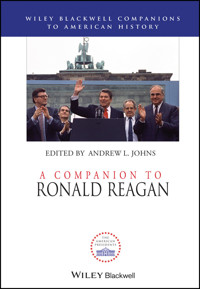
Cover image: President Ronald Reagan after his speech in front of the Brandenburg Gate, West Berlin, June 12, 1987. © AP PHOTO / Ira Schwartz / Press Association
Notes on Contributors
Michael R. Adamson is an independent consulting historian based in the San Francisco Bay Area. He has more than a decade of experience in the areas of business history, historic preservation, litigation support, environmental impact assessment, and contract work for government agencies. He is the author of A Better Way to Build: A History of the Pankow Companies (2013), and his essays have appeared in a wide variety of venues, including Diplomatic History, Presidential Studies Quarterly, and Business History Review. He has taught history at a number of Bay Area institutions, most recently at California State University, Sacramento.
Jennifer Brier is director of the Program in Gender and Women's Studies and Associate Professor in GWS and History Departments at the University of Illinois at Chicago. She is the author of Infectious Ideas: US Political Response to the AIDS Crisis (2009) and has curated several historical exhibitions, including Out in Chicago, the Chicago History Museum's prize-winning exhibition on LGBT history in Chicago, and Surviving and Thriving: AIDS, Politics, and Culture, a traveling exhibition produced by the National Library of Medicine. She is currently at work on a major public history project called History Moves, a community-curated mobile gallery that will provide a space for Chicago community organizers and activists to share their histories with a wide audience.
W. Elliot Brownlee is Research Professor of History at the University of California, Santa Barbara. He has written numerous books and articles on US economic history and the history of taxation, with particularly close attention to periods of national crisis. His latest book is The Political Economy of Transnational Tax Reform: The Shoup Mission to Japan in Historical Context, co-edited with Eisaku Ide and Yasunori Fukagai (2013). The second edition of his Federal Taxation in America: A History appeared in 2004. He is currently at work on the history of fiscal consolidation in the United States and the comparative history of taxation and financial crises in the United States and Japan. He has recently held visiting professorships at the University of Tokyo and at Yokohama National University.
Clea Bunch is Associate Professor of History at the University of Arkansas at Little Rock. A specialist in the history of the modern Middle East and US–Middle Eastern relations, she is the author of The United States and Jordan: Middle East Diplomacy during the Cold War (2014).
Andrew E. Busch is Crown Professor of Government and George R. Roberts Fellow at Claremont McKenna College, where he teaches courses on American politics and government. He is the author and co-author of fourteen books, including Horses in Midstream: US Midterm Elections and Their Consequences, 1894–1998 (1999); Ronald Reagan and the Politics of Freedom (2001); The Front-Loading Problem in Presidential Nominations (with William G. Mayer, 2003); The Constitution on the Campaign Trail: The Surprising Political Career of America's Founding Document (2007); and After Hope and Change: The 2012 Elections and American Politics (with James W. Ceaser and John W. Pitney, Jr., 2013). He is currently director of the Rose Institute of State and Local Government at CMC.
Michael F. Cairo is Professor of Political Science and director of the International Affairs program at Transylvania University in Lexington, Kentucky. He received his PhD in Foreign Affairs from the University of Virginia. He is the author of The Gulf: The Bush Presidencies and the Middle East (2012: the inaugural book in the series on Conflict, Diplomacy, and Peace) and has contributed chapters to Diplomats at War: The American Experience (2013) and Executing the Constitution (2006), in addition to other articles and book reviews. His next project examines American diplomacy in the Middle East peace process, from the Lyndon Johnson to the Barack Obama administrations.
Elizabeth C. Charles works in the Office of the Historian at the US Department of State as a researcher and compiler for the Foreign Relations of the United States series. She is currently working on volumes that cover the topics of Soviet Union and arms control during the Reagan administration. She finished her PhD in modern Russian and Cold War history at the George Washington University in 2010.
Lori Clune is Assistant Professor of History at California State University, Fresno. She earned her PhD from the University of California, Davis in 2010, and has published articles, essays, and reviews on various topics in Cold War history. She is currently working on a manuscript based on her dissertation that gives a transnational account of the trial and execution of Julius and Ethel Rosenberg.
Jason M. Colby is Associate Professor of History at the University of Victoria in British Columbia, Canada. He is the author of The Business of Empire: United Fruit, Race, and US Expansion in Central America (2011), as well as of numerous articles on the history of US–Latin American relations. He is currently completing a book on the business of killer whale capture and the transformation of the Pacific Northwest between 1960 and 1990.
Lilia Fernandez is Associate Professor of History at Ohio State University. She is also affiliated with the Latino Studies Program, the Department of Women's, Gender, and Sexuality Studies, and the Comparative Studies Department. She specializes in twentieth-century history of Latinos/as in Chicago and has published articles, book chapters, and essays on Mexican American community formation, Mexican and Puerto Rican labor migration, and nativism and xenophobia throughout the world. Her book Brown in the Windy City: Mexicans and Puerto Ricans in Postwar Chicago (2012) traces the sociospatial relations of both populations in the city in the mid-twentieth century.
William Glenn Gray is Associate Professor of History at Purdue University. He is the author of Germany's Cold War: The Global Campaign to Isolate East Germany, 1949–1969 (2003); the author of articles in Diplomatic History and the International History Review; and the co-editor of the Encyclopedia of the Cold War (2008). He is currently working on a book that traces West Germany's rise to global influence in the 1960s and 1970s.
Heather S. Gregg is Associate Professor at the Naval Postgraduate School's Department of Defense Analysis, where she works primarily with Special Operations Forces. She earned her PhD in political science in 2003 from the Massachusetts Institute of Technology; her dissertation focused on historic and contemporary causes of religiously motivated violence. Her publications include The Path to Salvation: Religious Violence from the Crusades to Jihad (2014) and articles in Terrorism and Political Violence and Foreign Policy Analysis.
Jacob Darwin Hamblin is Associate Professor of History at Oregon State University. His research focuses on the international dimensions of science, technology, and the environment. His books include Arming Mother Nature: The Birth of Catastrophic Environmentalism (2013); Poison in the Well: Radioactive Waste in the Oceans at the Dawn of the Nuclear Age (2008); and Oceanographers and the Cold War (2005).
Michael F. Hopkins is Senior Lecturer in History at the University of Liverpool and director of the MA in Twentieth Century History Program. He is the author of Oliver Franks and the Truman Administration (2003); The Cold War (2011); and Dean Acheson and the Obligations of Power (forthcoming). He is also the co-editor of Cold War Britain (2003) and The Washington Embassy: British Ambassadors to the United States, 1939–1977 (2009).
Andrew E. Hunt is Associate Professor of History at the University of Waterloo. He is the author of The Turning: A History of Vietnam Veterans against the War (1999), and David Derllinger: The Life and Times of a Nonviolent Revolutionary (2006), as well as the co-author of Social History of the United States: The 1980s (2008).
Andrew L. Johns is Associate Professor of History at Brigham Young University and at the David M. Kennedy Center for International Studies. He is the author of Vietnam's Second Front: Domestic Politics, the Republican Party, and the War (2010) and the co-editor of The Eisenhower Administration, the Third World, and the Globalization of the Cold War (2006) and Diplomatic Games: Sport, Statecraft, and International Relations since 1945 (2014). In addition, he is editor of the journal Passport: The Society for Historians of American Foreign Relations Review and general editor of the Studies in Conflict, Diplomacy, and Peace book series.
Robert David Johnson is Professor of History at Brooklyn College and at the Graduate Center of the City University of New York. He is the author and editor of numerous books, articles, and essays on US foreign relations and political history, including The Peace Progressives and American Foreign Relations (1995), Congress and the Cold War (2005), and All the Way with LBJ: The 1964 Presidential Election (2009).
Jeremy Kuzmarov is J. P. Walker Assistant Professor of History at the University of Tulsa. He is the author of The Myth of the Addicted Army: Vietnam and the Modern War on Drugs (2009) and Modernizing Repression: Police Training and Nation-Building in the American Century (2012).
Christopher Maynard is Professor of History and Associate Dean of the College of Arts and Sciences at the University of North Alabama. He is author of Out of the Shadow: George H. W. Bush and the End of the Cold War (2008).
James H. Meriwether is Professor of History at California State University, Channel Islands. He has been a Fulbright scholar at the University of Zimbabwe (2000–2001) and the University of Nairobi (2007–2008). Author of Proudly We Can Be Africans: Black Americans and Africa, 1935–1961 (2002), his current project focuses on the United States and the decolonization of Africa.
Yanek Mieczkowski is Professor and Chair of the History Department at Dowling College. He is the author of Eisenhower's Sputnik Moment: The Race for Space and World Prestige (2013), Gerald Ford and the Challenges of the 1970s (2005), and The Routledge Historical Atlas of Presidential Elections (2001). He also worked as a writing fellow for The American National Biography, to which he has contributed 37 biographies.
Gregory Mitrovich is a research scholar at the Arnold A. Saltzman War and Peace Institute at Columbia University. He is the author of Undermining the Kremlin: America's Strategy to Subvert the Soviet Bloc, 1947–1956 (2000), which won the Stuard L. Bernath Book Prize from the Society for Historians of American Foreign Relations.
Chester J. Pach is Associate Professor of History at Ohio University. He is the author of Arming the Free World: The Origins of the United States Military Assistance Program, 1945–1950 (1991) and The Presidency of Dwight D. Eisenhower (rev. ed. 1991). His next book will be The Presidency of Ronald Reagan, which is forthcoming.
Michael V. Paulauskas is Visiting Assistant Professor of History at Middle Tennessee State University. With funding from a Fulbright Hays–DDRA fellowship, a Kennan Institute Short-Term Research Grant, and the UNC Center for Global Initiatives, he completed his dissertation “Moscow on the Potomac: The Soviet Embassy and Détente, 1969–1979” at the University of North Carolina at Chapel Hill in 2012.
Andrew Preston is Reader in American History and Fellow of Clare College at Cambridge University, where he also serves as editor of The Historical Journal. He is the author of The War Council: McGeorge Bundy, the NSC, and Vietnam (2006) and Sword of the Spirit, Shield of Faith: Religion in American War and Diplomacy (2012).
John Sbardellati is Associate Professor of History at the University of Waterloo in Ontario, Canada. He received his PhD from the University of California, Santa Barbara in 2006. He is the author of J. Edgar Hoover Goes to the Movies: The FBI and the Origins of Hollywood's Cold War (2012).
Sandra Scanlon is Lecturer in American history at University College Dublin, Ireland. She received her doctorate from the University of Cambridge, where she was a Gates Cambridge scholar, and was awarded a postdoctoral fellowship by the Irish Research Council for the Humanities and Social Sciences. Her first monograph was The Pro-War Movement: Domestic Support for the Vietnam War and the Making of Modern American Conservatism (2013), and in 2013 she was a Fulbright scholar at Emory University.
Michael Schaller is Regents Professor of History at the University of Arizona. He has written several books on US–Asian relations. His recent publications include Ronald Reagan (2011) and American Horizons: US History in a Global Context (2013).
Kurt Schuparra is the author of Triumph of the Right: The Rise of the California Conservative Movement, 1945–1966 (1998) and of several articles on California political history since 1945. He has also published commentaries on politics and government fiscal policy in a number of news publications, including the San Francisco Chronicle, Sacramento Bee, and Orange County Register. He has served as a policy consultant in the administrations of California governors Jerry Brown and Gray Davis, as well as in the California Legislature and private sector. He received a PhD in history from the University of Arizona in 1995.
James F. Siekmeier is Associate Professor of History at West Virginia University. From 2001 to 2007 he worked in the Office of the Historian, US Department of State, on the American Republics volumes in the Foreign Relations of the United States series. He recently published The Bolivian Revolution and the United States, 1952–Present (2011), and he is currently working on a book manuscript on globalization and Latin American nationalism.
Matthew Avery Sutton is Edward R. Meyer Distinguished Professor of History at Washington State University. He is the author of Aimee Semple McPherson and the Resurrection of Christian America (2007); Jerry Falwell and the Rise of the Religious Right: A Brief History with Documents (2013); and American Apocalypse: A History of Modern Evangelicalism (2014). He has also published articles in diverse venues ranging from the New York Times to the Journal of American History.
Dustin Walcher is Associate Professor of History at Southern Oregon University. His work analyzes international political economy, social unrest, and political violence. He is currently revising a manuscript that examines the link between the failure of US-led economic initiatives and the rise of social revolution in Argentina between the 1950s and 1960s.
Reed L. Welch is Associate Professor of Political Science at West Texas A&M University. His research interests include presidential leadership and public opinion, political communications, and campaigns and elections. He is co-author of Government in America: People, Politics, and Policy (2008) and has written numerous articles, reviews, and columns in journals such as Presidential Studies Quarterly, Congress and the Presidency, and the American Journal of Political Science.
Jonathan Reed Winkler is Associate Professor of History at Wright State University in Dayton, Ohio. He is a historian of US diplomatic, military, and naval history and international affairs in the modern era. He is the author of Nexus: Strategic Communications and American Security in World War I (2008), which won the 2008 Theodore Roosevelt and Franklin D. Roosevelt Prize in Naval History and the 2009 Distinguished Publication Award from the Ohio Academy of History.
Thomas W. Zeiler is Professor of History and International Affairs at the University of Colorado at Boulder, where he directs the Global Studies Academic Program. He is the author and editor of several books on US foreign relations, international economy and globalization, sports and diplomacy, and military history: Ambassadors in Pinstripes: The Spalding World Baseball Tour and the Birth of the American Empire (2006); Annihilation: A Global Military History of World War II (2011); A Companion to World War II (2012); Guide to US Foreign Policy: A Diplomatic History (2012); and Jackie Robinson and Race in America (2013).
“To Grasp and Hold a Vision”Ronald Reagan in Historical Perspective
Andrew L. Johns
In his farewell address to the American people in January 1989, Ronald Reagan highlighted what he considered to be his greatest achievement during his two terms as president of the United States: “We stood, again, for freedom. I know we always have, but in the past few years the world again—and in a way, we ourselves—rediscovered it…we've made a difference…America is respected again in the world and looked to for leadership” (Reagan, 1989). For Reagan, nothing could be more significant or a more fitting epitaph to his tenure in office; for, if the United States stood once more as the beacon of hope, the standard of liberty, and the guardian of freedom for the world, then he had accomplished his mission as his country's leader.
In the quarter century since he left the White House, however, the question of whether Reagan's presidency and legacy should be considered a success, a failure, or somewhere in between has been a matter of contentious debate by historians, partisans, and pundits alike. This should not be surprising. Ronald Reagan's life (1911–2004) spanned the most important and divisive domestic and international events of the twentieth century. His rhetoric transformed the national political conversation in the United States. He harnessed and came to personify the rise of the conservative movement that challenged the supremacy of the liberal consensus, which dated from the New Deal. His administration represented a pivotal moment in American history; the 1980s witnessed a fundamental and permanent paradigm shift in US domestic and foreign policy, an evolution due in no small measure to Reagan's political philosophy and actions as president. As arguably the most important US political figure from the last quarter of the twentieth century, Reagan enjoyed widespread popularity and notoriety in the public mind—even among his political adversaries—and his legacy continues to exercise significant influence on contemporary politics.
As a result, Reagan's place in history is constantly being reevaluated. For example, in February 2009, C-SPAN conducted a survey in which it asked scholars to rank US presidents on the basis of a number of specific leadership characteristics. Reagan scored well indeed, much better than he had in the previous C-SPAN survey nine years earlier—finishing 10th overall. More specifically, he ranked 3rd in public persuasion; 8th in moral authority and international relations; and 7th in vision/agenda setting and performance in the context of the times. These results should be considered especially noteworthy, given the opposition of the majority of scholars who participated in the survey to many, if not most, aspects of Reagan's political agenda and to his decisions while in office. Yet, regardless of what judgment one reaches about Reagan's specific policies or his overall approach to government, it is undeniable that Reagan stands as one of the most influential presidents in US history.
Given these realities, it seems imperative to seek to understand Reagan and his impact on the history of the United States. To date, there have been very few efforts to contend in a definitive historiographical fashion with the totality of Reagan's life and legacy without devolving into either “hagiography or vilification” (Wilentz, 2008: 1). To be sure, Reagan does not attract from historians—who generally disliked him and disapproved of his politics and policies—the same level of attention as leading liberal presidents like Franklin Delano Roosevelt (FDR) or Lyndon Baines Johnson (LBJ). As the historian Sean Wilentz observed: “Historians have long been drawn to leaders whom they identify with progressive efforts to humanize the workings of American democracy and other conditions of American life…Reagan doesn't fit the preferred mold” (Wilentz, 2008: 2–3). This scholarly bias partially explains why the literature on Reagan tends to be dominated by panegyrics, vociferous partisan criticism, or (in the case of Edmund Morris's authorized and partially fictionalized biography Dutch, published in 1999) lost opportunities for in-depth analysis; in this respect it is unlike the more focused scholarly works that engage the presidencies of his Democratic counterparts.
Indeed even now, nearly three decades after Reagan concluded his tenure in the Oval Office, the scholarly history of his presidency remains incomplete and sporadic. Part of the reason for this is that historians and political scientists are just beginning to scratch the surface of assessing Reagan and his administration on the basis of the documentary record. The systematic declassification of national security documents by the Office of the Historian at the US Department of State for the Foreign Relations of the United States series has yet to begin, and the voluminous collection at the Ronald Reagan Presidential Library in Simi Valley, California (which includes over 50 million pages of presidential documents; over 1.6 million images; tens of thousands of motion picture, audio, and video artifacts; and Reagan's personal, gubernatorial, and post-presidential papers) is still in the process of becoming fully accessible and open to researchers.
Despite the relative paucity of available archival material, however, academic and popular interest in Reagan is strong, and it is increasing in both scope and depth. Given Reagan's place in the nation's memory, his political importance to the Republican Party and to the conservative movement, and the seminal events that occurred during his presidency, such interest is understandable. Yet the broader literature on Reagan remains fractured; his is a story being told piecemeal, like an enormous jigsaw puzzle worked on from different perspectives. As a result, Reagan's life, career, presidency, and legacy have generally not yet been grappled with in their entirety, although this is beginning to change. Lou Cannon's 1985, 1991, and 2003 biographies of Reagan paved the way for such assessments. Since Reagan's death in 2004, the pace of scholarly assessments of his legacy has accelerated. Most notably, Sean Wilentz (2008), Stephen Hayward (2001; 2009), John Ehrman (2005), and other historians have identified an “age of Reagan” that spans from the mid-1960s through the 1990s. John Ehrman and Michael W. Flamm's Debating the Reagan Presidency (2009) provides a solid overview of the majority of Reagan's contributions in domestic policy and foreign relations. And, as the emotion of immediacy relating to Reagan's career begins to fade and the relative objectivity of perspective takes root, we can expect more engagement with significant historiographical issues relating to Reagan and his administration.
The historical questions surrounding Ronald Reagan are fascinating and complex. For example, what kind of leader was the man who valued leadership so highly? Was he, like his predecessor Dwight D. Eisenhower, a “hidden-hand” president, working behind the scenes to shape his administration's strategic direction? His defenders would certainly agree. In 2010, Representative Patrick McHenry (R–NC) suggested replacing Ulysses S. Grant on the $50 bill with Ronald Reagan. Reagan, the congressman explained, “was a modern statesman, whose presidency transformed our nation's political and economic thinking. Through both his domestic and international policies he renewed America's self confidence, defeated the Soviets and taught us that each generation must provide opportunity for the next” (Press release, 2010). Or was he closer to the caricature painted by his political opponents: the somnolent, inattentive, and negligent president whose avuncular nature masked a disengagement from the policy process and who allowed his staff to lead the country into ruinous decisions at home and abroad?
Debate continues over the reality of the “Reagan revolution” as well. Were the Reagan years, in fact, revolutionary? Some conservatives would suggest that Reagan did not go far enough in scaling back government and in restoring the free market, while many liberals decry the damage done by deregulation, tax cuts, and other economic decisions that constituted “Reaganomics” during the 1980s. What is undeniable, however, is that, even if Reagan did not produce a “revolution,” he was certainly successful in reorienting the public conversation about government and its role in the lives of Americans, that this debate continues to the present day largely on the basis of the parameters established during the Reagan administration, and that no president since Franklin Delano Roosevelt can claim to have influenced the trajectory of national discourse to a greater degree than Ronald Reagan.
What of Reagan's conservatism? The journalist Andrew Romano observed: “Grown men don't tend to worship other grown men—unless, of course, they happen to be professional Republicans, in which case no bow is too deep, and no praise too fawning, for the 40th president of the United States: Saint Ronald Reagan.” For conservatives, Reagan is, as Romano wrote, “a god of sorts: wise, just, omniscient, infallible” (Romano, 2010: 32). While bedrock Republican principles such as cutting taxes, reducing all non defense-related government spending, and social conservatism sound very Reaganesque, the reality is that the Reagan of Republican lore bears only slight resemblance to the Reagan of the 1980s. To be sure, Reagan's rhetoric highlighted these themes. Yet, once in office, Reagan governed as a pragmatist rather than as an ideologue. It is telling (and worth realizing, too) that the “Reagan purity test” to which many Republican candidates are subjected would likely have been failed by the mythic man himself. In fact Reagan struggled during his first term to keep conservatives like Senator Jesse Helms (R–NC) united and encountered pressure from Congress and various interest groups on his foreign policy. As the historian Julian Zelizer has written: “Rather than a president boldly going wherever he wanted, Reagan in his first term was a commander in chief responding and readjusting as his options quickly narrowed” (Zelizer, 2010: 332).
Reagan's foreign policies also provoke heated dispute. Should he be credited with forcing the Soviet Union to the negotiating table and with “winning” the long international struggle, or was he merely a bit player whose role in and responsibility for the dénouement of the Cold War were secondary to Mikhail Gorbachev's? How does Reagan's championing of the Strategic Defense Initiative (“Star Wars”) figure into the Soviet–American relationship and into the president's legacy? More generally, how should Reagan's diplomatic and military decisions in Lebanon, Grenada, South Africa, Libya, and beyond be assessed by historians? Did the “Reagan doctrine” do more harm than good? To what extent should Reagan be held culpable for the Iran–contra affair, and how will this influence his legacy and his reputation as the “Teflon president?” How did the Reagan administration's engagement with international terrorism affect US policy and terrorist actions subsequently?
More broadly, Reagan's expansive legacy transcends the political and diplomatic arenas and spans political and popular culture. He is the icon of the right despite the disjuncture between rhetoric and reality. He is the cautionary tale of the left despite providing liberals with an immediately recognizable foe and an easy target when one is making a political point. He and his policies have made cameo appearances in numerous songs during and after his presidency—including those by Prince (“Ronnie, Talk to Russia”), Def Leppard (“Gods of War”), INXS (“Guns in the Sky”), Don Henley (“All She Wants to Do Is Dance”), NOFX (“Ronnie and Mags”), and in lyrics by scores of punk bands. His legacy is contested on television and in film, most recently in 2013's The Butler, where Reagan is portrayed unsympathetically on the issue of race. His name appears on an increasing number of schools, highways, government buildings, and parks around the country—not to mention a nuclear-powered aircraft carrier (when commissioned in 2001, it was the first to be named for after a former president who was still alive) and the Ronald Reagan Washington National Airport. Like with FDR, Reagan's personality and ability to communicate resonated with the American people, making him the most popular president of his generation, garnering respect for him on both sides of the political divide, and cementing his place in American history—even if his legacy remains a source of contention.
In a speech in Moscow on May 31, 1988, Reagan noted that the very essence of successful leadership was “to grasp and hold a vision.” In his conceptualization of the United States, its place in the world, and his responsibility as president, Reagan demonstrated precisely that kind of leadership—both rhetorically and in his politics, policies, and decisions. Perhaps nowhere is this more obvious than in the fact that his successors in the Oval Office—Bill Clinton, George W. Bush, and Barack Obama—all have looked to Reagan as a model of presidential leadership despite their political and philosophical differences. In the final analysis, regardless of what one thinks of Reagan, his political views, and his legacy, it is difficult not to agree with Barack Obama's characterization of the nation's 40th president. During the 2008 presidential campaign, Obama suggested that
Ronald Reagan changed the trajectory of America in a way that Richard Nixon did not and in a way that Bill Clinton did not. He put us on a fundamentally different path because the country was ready for it. I think they felt like with all the excesses of the 1960s and 1970s and government had grown and grown but there wasn't much sense of accountability in terms of how it was operating…he just tapped into what people were already feeling, which was we want clarity, we want optimism, we want a return to that sense of dynamism and entrepreneurship that had been missing.
(New York Times, January 21, 2008)
The essays that follow assess Ronald Reagan and his career across a wide spectrum, from domestic issues like AIDS and the Supreme Court to international problems such as the global Cold War and the Iran–contra affair. They engage the key historiographical questions about his life, his presidency, and his ongoing influence in American politics and society. They conclude that his legacy is profound and partisan, contested and controversial—but that Ronald Reagan should be considered a transformative figure in US history. The volume is divided into three parts. Part I deals with Reagan's pre-presidential life; this includes his career as governor of California and his presidential campaigns. Part II is divided into five sections that assess the Reagan administration: two that deal with Reagan's domestic policies from a political and economic perspective and examine social and cultural issues; two that engage Reagan's foreign policies, first in terms of specific issues and then regionally; and one that considers key individuals who influenced Reagan and his presidency. Finally, Part III assesses Reagan's influence and legacy, both at home and abroad, over the past three decades.
Taken collectively, the essays in this volume paint a complex and fascinating portrait of Reagan the man, the president, and the myth. This entry in the Blackwell Companions series aims to fill a historiographical lacuna, assess the current state of the scholarship, and pave the way for further research and writing on Ronald Reagan. But in many ways this is simply a snapshot of the current state of the historical work on Reagan. As the literature expands, becomes more sophisticated, and relies to an increasing degree on the newly emerging documentary record, our understanding of the 40th president, his policies, and his legacy will evolve. It is the hope and intention of the authors and of the editor of this anthology that the essays that follow will provide a starting point for those inquires.
References
Ehrman, J. (2005).
The Eighties: America in the Age of Reagan
. Yale University Press.
Ehrman, J., and M.W. Flamm, eds. (2009).
Debating the Reagan Presidency
. Rowman and Littlefield.
Hayward, S. F. (2001).
The Age of Reagan: The Fall of the Old Liberal Order, 1964–1980
. Forum.
Hayward, S. F. (2009).
The Age of Reagan: The Conservative Counterrevolution, 1980–1989
. Crown Forum.
Press release (2010, March 2). “Representative Patrick McHenry Announces Legislation to Put President Reagan on the $50 Bill,”
http://mchenry.house.gov/news/documentprint.aspx?DocumentID=174295
(accessed December 15, 2012).
Reagan, R. (1989, January 11). “Farewell Address to the Nation,”
http://www.reagan.utexas.edu/archives/speeches/1989/011189i.htm
(accessed December 17, 2012).
Romano, A. (2010). “What Would Reagan Really Do?”
Newsweek
, July 19, 2010.
Wilentz, S. (2008).
The Age of Reagan: A History, 1974–2008
. HarperCollins.
Zelizer, J. E. (2010).
Arsenal of Democracy: The Politics of National Security: From World War II to the War on Terrorism
. Basic Books.
Part IRonald Reagan's Pre-Presidential Life and Career
Chapter OneReagan's Early YearsFrom Dixon to Hollywood
John Sbardellati
This opening essay covers the period from Reagan's childhood through his days in Hollywood. It draws upon Reagan's two memoirs and puts them in conversation with the more critical accounts formulated by his many chroniclers. The significance of this period of Reagan's life can be found in the core themes that animate these works: his rise to stardom and the evolution of his public image, the development of his talents for communication, the link between his role as film industry leader and spokesman and his anticommunist politics, and his political trajectory from New Deal liberal to staunch conservative.
Ronald Wilson Reagan was born on February 6, 1911, in Tampico, Illinois. He would describe his childhood years in nearby Dixon as “one of those rare Huck Finn–Tom Sawyer idylls” (Reagan and Hubler, 1965: 18). In Dixon, Reagan was imbued with the values of small-town America. From his outdoor adventures playing “Cowboys and Indians” to his courtship of the pastor's daughter, Reagan described his formative years as blissful, despite his family's relative poverty. From his Protestant mother, Nelle, Reagan would inherit his sunny disposition as well as his penchant for performing. His father, Jack, an Irish Catholic shoe salesman, struggled with alcoholism but still managed to impress upon the young Reagan the value of hard work. During the Depression, Jack would find employment as a New Deal administrator for the Works Progress Administration, but the lesson drawn by Reagan years later was simply that people “wanted work, not handouts” (Reagan, 1990: 68).
Reagan's biographers have complicated this rosy self-portrait of his upbringing. As Robert Dallek writes: “Reagan's attachment to old-style American virtues was not simply the product of his small-town beginnings and schooling. It was also part of a national upsurge during the 1920s of uncritical allegiance to familiar verities” (1984: 5). Garry Wills notes the irony of Reagan's likening of the atmosphere of his boyhood to that of Mark Twain's novels, given that these works abound in themes of “superstition, racism, and crime.” Wills points out that Reagan's parents moved to Tampico amid a wave of racial violence, that the family's constant relocating must have made for a rootless upbringing for Ronald and his brother, Neil, and that Jack's drinking and Nelle's ardent commitment to temperance—a hallmark of the Disciples of Christ, to which she belonged—exacerbated the religious divide in the Reagan household (1987: 9–31). Lou Cannon depicts the young Reagan as a confident and optimistic boy who played football, who saved several lives as a lifeguard, and whose extracurricular activities at Eureka College included sports, the theater, and leading a student strike. Yet Cannon also notes that Reagan tended to romanticize many aspects of his childhood. His father's alcoholism and the family's frequent roaming presented “hard boyhood lessons of emotional survival,” which ultimately rendered him “a loner.” Furthermore, Cannon asserts that Reagan's amiability masked his deep ambitions and his occasional manipulative tendencies: “His genial demeanor and genuine modesty shielded a hard, self-protective core that contained both a gyroscope for maintaining balance and a compass pointing toward success” (1991: 172, 182–183).
The compass pointed toward a career in acting; but, for Dutch Reagan (as he then preferred to be called), broadcasting was the place to start. Proximity to Chicago made radio the more realistic field in which to make his name, but after striking out in the windy city, Reagan managed to land a sportscasting gig with station WOC (World of Chiropractic) in Davenport, Iowa, in 1932. Dutch would later work for four years at its sister station, WHO, in Des Moines. In his memoirs, Reagan explained that he got his foot in the door through a combination of perseverance, luck, and (especially) ability to perform on the spot during an impromptu audition. He was covering several sports but was especially known for announcing baseball games for the Chicago Cubs and the Chicago White Sox. He called these games from Des Moines, where he received terse descriptions of the action via telegraph. This re-creation process required him to draw upon his fertile imagination and, by necessity, gave a largely fictional character to his broadcasts. Reagan especially savored telling the story of the time when the wire went dead in the ninth inning of a tied game between the Cubs and the St. Louis Cardinals. Unwilling to admit the technical problem to his audience, he stalled by having the batter foul off pitch after pitch, for almost seven minutes of air time. This anecdote, which he repeats in both memoirs, serves as a parable of his quick-wittedness, though one may wonder how much the story itself was invented, since in his first memoir Reagan has Augie Galan as the batter (Reagan and Hubler, 1965: 78–79) but claims in his second that the hitter was Billy Jurges (Reagan, 1990: 73).
More significantly, as Wills writes, the story highlights Reagan's sensitivity to his audience as well as his determination to sustain the make-believe. Wills situates Reagan's career as sports announcer within the broader field of sports journalism at the time. The profession's dominant figure was Grantland Rice, whose prose deeply influenced Dutch's own sports writing. “Rice used overblown language,” writes Wills, “because the surface details of sports engagement were merely the signs of a larger moral epic, in which destiny and free will worked out man's fate. All the metaphors were justified because sports is itself a metaphor for life.” The facts, in Reagan's field of journalism, ranked second to the moral. Drama was cherished more than truth—hence the importance of sustaining the illusion, even when the wire has gone




