


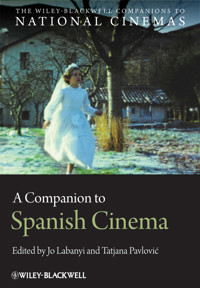
A Companion to Spanish Cinema E-Book
38,99 €
Mehr erfahren.
- Herausgeber: John Wiley & Sons
- Kategorie: Geisteswissenschaft
- Serie: CNCZ - The Wiley-Blackwell Companions to National Cinemas
- Sprache: Englisch
A Companion to Spanish Cinema is a bold collection of newly commissioned essays written by top international scholars that thoroughly interrogates Spanish cinema from a variety of thematic, theoretical and historic perspectives.
- Presents an insightful and provocative collection of newly commissioned essays and original research by top international scholars from a variety of theoretical, disciplinary and geographical perspectives
- Offers a systematic historical, thematic, and theoretical approach to Spanish cinema, unique in the field
- Combines a thorough and insightful study of a wide spectrum of topics and issues with in-depth textual analysis of specific films
- Explores Spanish cinema’s cultural, artistic, industrial, theoretical and commercial contexts pre- and post-1975 and the notion of a “national” cinema
- Canonical directors and stars are examined alongside understudied directors, screenwriters, editors, and secondary actors
- Presents original research on image and sound; genre; non-fiction film; institutions, audiences and industry; and relations to other media, as well as a theoretically-driven section designed to stimulate innovative research
Sie lesen das E-Book in den Legimi-Apps auf:
Seitenzahl: 1391
Veröffentlichungsjahr: 2012
Ähnliche




















Contents
Acknowledgments
List of Figures
List of Contributors
1 Introduction
Part I Reframing the National
2 Transnational Frameworks
Introduction (Marvin D’Lugo and Gerard Dapena)
Transnational Beginnings (Gerard Dapena)
Breaking the Sound Barrier (Gerard Dapena)
War, Isolation, and New Transnational Openings (Gerard Dapena)
The Golden Age of Popular Coproductions (Gerard Dapena)
The Politics of the Transnational Auteur (Marvin D’Lugo)
The Producer-Author as Transnational Entrepreneur (Marvin D’Lugo)
The Latin American Connection (Alberto Elena)
Cinematic Relations with the Arab World (Alberto Elena)
Spanish Cinema by Immigrant Directors (Alberto Elena)
3 Echoes and Traces
Other Voices, Other Scripts: Language, Imagery, and Censorship
Spectacular (Dis)locations: Art, Business, and Morality
Troubled Transitions: The “Talkies,” the Republic, the Civil War, the Dictatorship, and Beyond
4 Negotiating the Local and the Global
Introduction: Fragmentation, Invisibility, and Political Devolution (José Colmeiro)
On the Global Formation of Andalusian and Basque Cinemas (Joseba Gabilondo)
Galician Cinema: Making the Invisible Visible (José Colmeiro)
Part II The Construction of the Auteur
5 Auteurism and the Construction of the Canon
Auteurism and Spain (Marvin D’Lugo)
Luis Buñuel (Marvin D’Lugo)
Carlos Saura (Marvin D’Lugo)
Pedro Almodóvar (Paul Julian Smith)
Víctor Erice (Paul Julian Smith)
Julio Medem (Paul Julian Smith)
Alejandro Amenábar (Paul Julian Smith)
6 Strategic Auteurism
Introduction (Susan Martin-Márquez)
Neville, Berlanga, and de la Iglesia: A Strategically Disruptive Auteurism (Steven Marsh)
Authorizing Screenwriting: Rafael Azcona and Pedro Beltrán (Santos Zunzunegui)
Jesús Franco: From Pulp Auteur to Cult Auteur (Antonio Lázaro-Reboll)
Pere Portabella: The Politics and Aesthetics of Auteurism (Santos Zunzunegui)
Editing in the Woman Auteur (Susan Martin-Márquez)
Part III Genre
7 Comedy and Musicals
Comedy in Spanish Cinema: An Overview (Steven Marsh)
Queridos cómicos: Actors and Entertainment1 (Santos Zunzunegui)
The Heyday of the Musical Film (Eva Woods Peiró)
Contemporary Musical Comedy, Sex, and Gender (Chris Perriam)
Conclusion (Chris Perriam)
8 Melodrama and Historical Film
Melodrama: Modernity’s Rebellious Genre (Annabel Martín)
The Historical Film: Genre and Legibility (Vicente Rodríguez Ortega)
The Ambivalent Attractions of the Past: Historical Film of the Early Franco Period (Jo Labanyi)
Between the National and the Global: The Historical Film from the 1960s to the Present (Vicente Rodríguez Ortega)
9 Film Noir, the Thriller, and Horror
Introduction (Antonio Lázaro-Reboll)
Film Noir (Jo Labanyi and Vicente Rodríguez Ortega)
The Thriller (Vicente Rodríguez Ortega)
The Horror Genre (Antonio Lázaro-Reboll)
Part IV Stars as Cultural Icons
10 The Construction of the Star System
The 1920s and 1930s
The 1940s and 1950s
11 Stars, Modernity, and Celebrity Culture
Introduction (Chris Perriam)
Child Stars: Pablito Calvo, Joselito, Marisol, Pili and Mili, Rocío Dúrcal (Tatjana Pavlović)
The Politics of Stardom and Celebrity (Chris Perriam and Nuria Triana Toribio)
Part V Image and Sound
12 Photography, Production Design, and Editing
An Anomalous Cinema?
A Cinema of Attractions
Dialectics of the Avant-Garde
Two Iconographies of the Popular
From Propaganda Documentary to Plush Interiors
Claustrophic Lighting
Sets for a Cardboard Version of History
Openings to Modernity: Realism and Editing
Choreography and Musical Design: Something Different
Holding the Image: The Aesthetics of the Static Shot
A New Experimental Avant-Garde
From Eccentricity to Designer Look
Stylistic Diversification
Conclusion
13 Soundtrack
Introduction (Kathleen M. Vernon)
The Transition from Silent to Sound Cinema (Román Gubern)
Listening to Spanish Cinema (Kathleen M. Vernon)
Part VI The Film Apparatus
14 Censorship, Film Studios, and Production Companies
Film Censorship (Román Gubern)
Film Studios (Román Gubern)
Filmófono (Steven Marsh)
CIFESA (Jo Labanyi)
Cesáreo González and Suevia Films (Josetxo Cerdán)
Telecinco Cinema and El Deseo (Nuria Triana Toribio)
Producciones La Iguana, Lamia Producciones, and Miss Wasabi Films (Tatjana Pavlović)
15 Film Clubs, Festivals, Archives, and Magazines
Film Clubs (Román Gubern)
Film Festivals (Román Gubern)
Film Archives (Román Gubern)
Film Preservation and Restoration (Ferran Alberich)
Film Magazines from the 1930s to the 1960s (Román Gubern)
Academic Film Journals since the 1980s (Vicente Sánchez-Biosca)
16 Audiences
Introduction: Audiences and Audience Research (Kathleen M. Vernon)
From Patterns to Passion: Cinema-Going Prior to the 1960s (Kathleen M. Vernon)
Spanish Cinema Audiences from the mid-1960s to the Present (Manuel Palacio)
The Future of Film Audiences (Kathleen M. Vernon)
Part VII Relations with Other Media
17 Cinema, Popular Entertainment, Literature, and Television
Cinema and Other Forms of Entertainment Prior to the Arrival of Television (Vicente Sánchez-Biosca)
Literary Adaptations (Sally Faulkner)
Film and Television (Paul Julian Smith)
Part VIII Beyond the Fiction Film
18 Newsreels, Documentary, Experimental Film, Shorts, and Animation
Introduction (Josetxo Cerdán)
Non-Fiction Film during the Civil War (Vicente Sánchez-Biosca)
NO-DO: The Francoist Newsreel (Vicente Sánchez-Biosca)
Shorts, Documentary, Experimental Film, and Animation in Transhistorical Perspective (Josetxo Cerdán)
Part IX Reading Films through Theory
19 Isabel Coixet’s Engagement with Feminist Film Theory
Gaze Theory and Mira y verás
Melodrama, the Woman’s Film, and My Life without Me
From Body Genres to the Haptic
The Haptic and My Life without Me
20 Becoming a Queer (M)Other in/and/through Film
Introduction
Acting and Re-enacting the Loss of the Child
Transsexuality
Trans-subjectivity
Maternal Relationality
Conclusion
21 The Space of the Vampire
Index
Wiley-Blackwell Companions to National CinemasThe Wiley-Blackwell Companions to National Cinemas showcase the rich film heritages of various countries across the globe. Each volume sets the agenda for what is now known as world cinema whilst challenging Hollywood’s lock on the popular and scholarly imagination. Whether exploring Spanish, German or Chinese film, or the broader traditions of Eastern Europe, Scandinavia, Australia, and Latin America the 20–25 newly commissioned essays comprising each volume include coverage of the dominant themes of canonical, controversial, and contemporary films; stars, directors, and writers; key influences; reception; and historiography and scholarship. Written in a sophisticated and authoritative style by leading experts they will appeal to an international audience of scholars, students, and general readers.
Published:
A Companion to German Cinema, edited by Terri Ginsberg & Andrea Mensch
A Companion to Chinese Cinema, edited by Yingjin Zhang
A Companion to East European Cinemas, edited by Anikó Imre
A Companion to Spanish Cinema, edited by Jo Labanyi & Tatjana Pavlović
This edition first published 2013© 2013 Blackwell Publishing Ltd.
Blackwell Publishing was acquired by John Wiley & Sons in February 2007. Blackwell’s publishing program has been merged with Wiley’s global Scientific, Technical, and Medical business to form Wiley-Blackwell.
Registered OfficeJohn Wiley & Sons, Ltd, The Atrium, Southern Gate, Chichester, West Sussex, PO19 8SQ, UK
Editorial Offices350 Main Street, Malden, MA 02148-5020, USA9600 Garsington Road, Oxford, OX4 2DQ, UKThe Atrium, Southern Gate, Chichester, West Sussex, PO19 8SQ, UK
For details of our global editorial offices, for customer services, and for information about how to apply for permission to reuse the copyright material in this book please see our website at www.wiley.com/wiley-blackwell.
The right of Jo Labanyi and Tatjana Pavlović to be identified as the authors of the editorial material in this work has been asserted in accordance with the UK Copyright, Designs and Patents Act 1988.
All rights reserved. No part of this publication may be reproduced, stored in a retrieval system, or transmitted, in any form or by any means, electronic, mechanical, photocopying, recording or otherwise, except as permitted by the UK Copyright, Designs and Patents Act 1988, without the prior permission of the publisher.
Wiley also publishes its books in a variety of electronic formats. Some content that appears in print may not be available in electronic books.
Designations used by companies to distinguish their products are often claimed as trademarks. All brand names and product names used in this book are trade names, service marks, trademarks or registered trademarks of their respective owners. The publisher is not associated with any product or vendor mentioned in this book. This publication is designed to provide accurate and authoritative information in regard to the subject matter covered. It is sold on the understanding that the publisher is not engaged in rendering professional services. If professional advice or other expert assistance is required, the services of a competent professional should be sought.
Library of Congress Cataloging-in-Publication Data
A companion to Spanish cinema / edited by Jo Labanyi and Tatjana Pavlovi ć. – 1 p. cm. – (Wiley-Blackwell companions to national cinemas)Includes bibliographical references and index.
ISBN 978-1-4051-9438-9 (hardback)1. Motion pictures–Spain. I. Labanyi, Jo. II. Pavlovi ć, Tatjana.PN1993.5.S7C6595 2012791.430946–dc23
2012023050
A catalogue record for this book is available from the British Library.
Cover design by Nicki Averill.Cover image from El Sur (Víctor Eríce, 1983; prod. Elías Querejeta PC). Courtesy of Video Mercury and Filmoteca Española.
Acknowledgments
Our special thanks to Margarita Lobo, Alicia Potes, and Miguel Soria at Filmoteca Española in Madrid for their help with locating and providing graphic material, and with identifying copyright holders. We also thank Elena Baranda of Video Mercury for granting permission to reproduce a significant number of images, including the still from Víctor Erice’s El sur used on the cover. We are also hugely grateful to Curry O’Day, tech support specialist at Tulane University, for his invaluable technical help with the illustrations. We owe a particular debt to Jayne Fargnoli of Wiley-Blackwell for her faith in our ability to produce an innovative volume, and to Galen Young and Allison Kostka for their efficiency throughout the production process.
List of Figures
2.1
Alberto Closas and Lucía Bosé in
Muerte de un ciclista
(Juan Antonio Bardem, 1955; prod. Suevia Films). Courtesy of Criterion Collection.
2.2
Handbill publicizing María Félix and Rossano Brazzi in
La corona negra
(Luis Saslavsky, 1950; prod. Suevia Films). Private collection.
2.3
Silvia Pinal in the title role of Luis Buñuel’s scandalous transnational hit
Viridiana
(1961; prod. UNINCI / Alatriste).
2.4
Stéphane Audran in José Luis Borau’s
Hay que matar a B
(1973; prod. El Imán): a cross between one of Hitchcock’s icy blondes and a Latin version of Rita Hayworth in Welles’
The
Lady from Shanghai
(1947).
2.5
Mexican heart throb Jorge Negrete surveys Seville, represented by the iconic image of the Giralda, in the first Spanish–Latin American coproduction,
Jalisco canta en Sevilla
(Fernando de Fuentes, 1948; prod. Chamartín).
2.6
A first attempt to depict a broad canvas of immigration in Spain by the Egyptian-born Basel Ramsis:
El otro lado: Un acercamiento a Lavapiés
(2003; prod. Dayra Arts S.L. / Basel Ramsis). Courtesy of Basel Ramsis.
3.1
The invisible echo (
El tambor del Bruch
, Ignacio F. Iquino, 1948; prod. Emisora Films).
3.2
The visible trace in
El Judas
(Ignacio F. Iquino, 1952; prod. IFI).
3.3
Barcelona-cum-New York in
Bilbao
(Bigas Luna, 1978; prod. Figaro-Ona Films).
3.4
Spain is different – but Catalonia is the same:
Los Tarantos
(Francisco Rovira Beleta, 1963; prod. Tecisa / Films Rovira Beleta).
3.5
Immigrant laborers and foreign tourists in
La piel quemada
(Josep Maria Forn, 1967; prod. Teide PC).
3.6
The new dawn of political consciousness:
Aurora de esperanza
(Antonio Sau Olite, 1937; prod. SIE).
3.7
The dark face of Francoism:
Vampir-Cuadecuc
(Pere Portabella, 1970; prod. Films 59).
4.1
Pantalla Propia: O Cine das Nacións
(
A Screen of One’s Own: The Cinema of Nations
). Special issue of the cultural magazine
Cadernos da Nosa Terra de Pensamento e Cultura
on the cinema of Spain’s autonomous communities (November 1990). Courtesy of
Cadernos da Nosa Terra
.
4.2
Habana Blues
trio (
Habana Blues
, Benito Zambrano, 2005; prod. Maestranza Films). Courtesy of Maestranza Films.
4.3
Poster for
Kutsidazu bidea, Ixabel
(Fernando Bernués and Mireia Gabilondo, 2006; prod. Tentazioa Produkzioak). Courtesy of Tentazioa Produkzioak.
4.4
Poster for Xavier Villaverde’s
Continental
(1989; prod. Continental Producciones). Courtesy of Continental Producciones.
4.5
Poster for Miguelanxo Prado’s
De profundis
(2006; prod. Continental Producciones). Courtesy of Continental Producciones.
5.1
The leg fetishism in Buñuel’s
Ensayo de un crimen
(1955) would inspire Almodóvar’s
Carne trémula
(1997; prod. El Deseo), as illustrated in this shot.
5.2
The Buñuelian specular ritual aligns the gaze of characters on screen with the extradiegetic gaze of the camera and spectators:
Belle de jour
(Buñuel, 1967; prod. Robert and Raymond Hakim / Paris Film Production).
5.3
Saura’s use of freeze-frames at the end of
La caza
(1965) and
Ana y los lobos
(1973; both prod. Elías Querejeta PC) gives them a photographic quality that encourages spectators to “relive” the characters’ fictional past.
5.4
Almodóvar’s
¿
Qué he hecho yo para merecer esto?
(1984; prod. Kaktus PC / Tesauro SA): domestic objects look back at housewife Gloria.
5.5
The magic pendulum in Víctor Erice’s
El sur
(1983; prod. Elías Querejeta PC); Sonsoles Aranguren as the young Estrella (1983).
5.6
Looking into the void in Medem’s
Vacas
(1992; prod. Sogetel): Emma Suárez (Cristina) and Txema Blasco (Manuel).
5.7
The Gran Vía emptied for the opening sequence of Amenábar’s
Abre los ojos
(1997; prod. Las Producciones del Escorpión).
6.1
The ghost of Robinson de Mantua (Félix de Pomés) emerges from a mirror in
La torre de los siete jorobados
(Edgar Neville, 1944; prod. España Films).
6.2
Jaume Canivell (José Zazatornil) attempts small talk in the company of Chus (Amparo Soler Leal) and Laura (Laly Soldevila) in
La escopeta nacional
(Luis García Berlanga, 1978; prod. Impala).
6.3
Kyril (Dritan Biba) bids a final farewell to Daniel (Fernando Guillén Cuervo) in a Chueca café in
Los novios búlgaros
(Eloy de la Iglesia, 2003; prod. Altube Filmeak SL).
6.4
Cover of the December 2008 issue of
Academia
, the magazine of the Spanish Film Academy, commemorating the Goya Lifetime Achievement Award to Jesús Franco. The artwork by Jordi Labanda was originally created for the 1997 CD of soundtracks of Franco’s films,
The Crazy World of Jess Franco
(Subterfuge Records). Courtesy of Jordi Labanda.
6.5
Vampir-Cuadecuc
(1970; prod. Films 59): Portabella’s avant-garde film constructed its metaphorical universe around the shooting of Jesús Franco’s horror film
Count Dracula
. Courtesy of Films 59.
6.6
Die Stille vor Bach
, Portabella’s exploration of the relationship between image and music (2007; prod. Films 59). Courtesy of Films 59.
6.7
From the 1940s to the 1960s dozens of women worked in film editing, as did this unidentified friend of Sara Ontañón, in a photograph from the latter’s personal collection. Courtesy of Alfonso Orueta, with kind assistance from Esther López Sobrado.
7.1
La gran familia
(Fernando Palacios, 1962; prod. Pedro Masó Producciones): the godfather, Juan (José Luis López Vázquez), soaks up the sun during the family’s holiday in Tarragona.
7.2
Michel (Michel Piccoli) kisses his new life-size doll in
Tamaño natural
(Luis García Berlanga, 1974; prod. Uranus Productions France).
7.3
The gherkin-shaped head of José “Pepe” Isbert in
El cochecito
(Marco Ferreri, 1960; prod. Films 59).
7.4
Luis Heredia as El Poca, one of the beggars in Buñuel’s
Viridiana
(1961; prod. UNINCI / Alatriste).
7.5
Peter Wald (Raymond de Sarka), a bellboy and aspiring dancer in
El negro que tenía el alma blanca
(Benito Perojo, 1926; prod. Goya Producciones Cinematográficas). Courtesy of Filmoteca Española.
7.6
Camp and masculinity converge in this publicity still of Antonio Molina in miner’s overalls in
Esa voz es una mina
(Luis Lucia, 1956; prod. Producciones Cinematográficas Ariel). Courtesy of Video Mercury and Filmoteca Española.
7.7
Spanish entertainers in blackface in
Vampiresas 1930
(Jesús Franco, 1962; prod. Hispamer Films).
7.8
Marieta (Mónica Cervera) and chorus dancing on the Gran Vía in
20 centímetros
(Ramón Salazar, 2005; prod. Estudios Picasso).
8.1
Bourgeois opulence and psychic disorder: the life-size doll that will become a child substitute in
De mujer a mujer
(Luis Lucia, 1950; prod. CIFESA). Courtesy of Video Mercury and Filmoteca Española.
8.2
Melodrama linked to nation and power through landscape and the movement of cattle (
Orgullo
, Manuel Mur Oti, 1955; prod. Celta Films SA). Courtesy of Video Mercury and Filmoteca Española.
8.3
Melodrama’s domestic family drama at play: confrontation between mother and daughter in
Orgullo
(Manuel Mur Oti, 1955; prod. Celta Films SA). Courtesy of Video Mercury and Filmoteca Española.
8.4
Almodóvar translates melodrama’s intensity of emotion into sight and sound in
La flor de mi secreto
(1995; prod. El Deseo).
8.5
The scarred body that cures the wounded I–You in its powerful muteness (
The Secret Life of Words
, Isabel Coixet, 2005; prod. El Deseo).
8.6
Handbill for the historical epic
Inés de Castro
(1944), made four years before CIFESA’s first incursion into the genre, in the form of a medieval castle whose gates open to reveal the details (J. M. Leitão de Barros; prod. Faro Producciones Cinematográficas). Private collection.
8.7
Agustina firing the phallic cannon in
Agustina de Aragón
(Juan de Orduña, 1950; prod. CIFESA).
8.8
Cross-class romance between Amparo Rivelles as a duchess and Jorge Mistral as a bandit leader. Low necklines were allowed by the censors in costume dramas (
La duquesa de Benamejí
, Luis Lucia, 1949; prod. CIFESA). Courtesy of Video Mercury and Filmoteca Española.
8.9
The threatening monster opens its eyes for the first time in
El laberinto del fauno
(Guillermo del Toro, 2006; prod. Estudios Picasso / Tequila Gang).
8.10
The boy protagonist of
Pa negre
contemplates the photograph that will trigger a series of imaginative projections relating to homoerotic desire in the aftermath of the Civil War (Agustí Villaronga, 2010; prod. Massa d’Or Produccions).
9.1
The
noir
stairwell in
Nada
: the predatory Román watches Andrea from above (Edgar Neville, 1947; prod. CIFESA).
9.2
The tormented writer in
Los peces rojos
(Antonio Nieves Conde, 1952; prod. Yago Films / Estela Films).
9.3
Poster for
La semana del asesino
portraying the protagonist Marcos as a divided man, his face split in two (Eloy de la Iglesia, 1971; prod. Atlas International Film). Courtesy of Video Mercury.
9.4
Ángel (Antonio Banderas) mesmerized by the lecture on the art of killing (
Matador
, Pedro Almodóvar, 1986; prod. Compañía Iberoamericana de TV).
9.5
The materiality of the video image comes to the fore as the serial killer gets ready to slaughter Ángela in Amenábar’s
Tesis
(1995; prod. Las Producciones del Escorpión / Sogepaq).
9.6
Poster for the 2004 San Sebastián Horror and Fantasy Film Festival. Courtesy of Donostia Kultura.
10.1
Raquel Meller on the cover of
Nuestro Mundo
(June 17, 1932). The caption informs readers that she has been made a Chevalier de la Légion d’Honneur by the French government. Private collection.
10.2
Promotional still showcasing Emma (Concha Piquer) as a stylish showgirl on the beach with Afro-Cuban star Peter Wald (Raymond de Sarka) in
El negro que tenía el alma blanca
(Benito Perojo, 1926; prod. Goya Producciones Cinematográficas SA). Courtesy of Filmoteca Española.
10.3
Handbill for
El clavo
(Rafael Gil, 1944; prod. CIFESA). Private collection.
10.4
Jorge Mistral as a bandit leader, with open shirt displaying his physical attractions (
La duquesa de Benamejí
, Luis Lucia, 1949; prod. CIFESA). Courtesy of Video Mercury and Filmoteca Española.
10.5
A double dose of the transgressive Montiel on the cover of a 1958 serialized photo-novel version of
El último cuplé
(Juan de Orduña, 1957; prod. Producciones Orduña Films). Private collection.
10.6
Sara Montiel strikes an inviting pose in
La violetera
(Luis César Amadori, 1958; prod. Producciones Benito Perojo), one of the sequels that capitalized on the success of
El último cuplé
.
11.1
Penélope Cruz as Raimunda in
Volver
(Pedro Almodóvar, 2006; prod. El Deseo).
11.2
Joselito in his film début
El pequeño ruiseñor
(Antonio del Amo, 1957; prod. Argos SLPC). Courtesy of Video Mercury and Filmoteca Española.
11.3
Marisol in
Tómbola
(Luis Lucia, 1962; prod. Guión Producciones Cinemátográficas).
11.4
The protagonists of
La mala educación
(Pedro Almodóvar, 2004; prod. El Deseo) walk into a screening of Sara Montiel’s
Esa mujer
(1969). Almodóvar’s homage illustrates Montiel’s continued popularity as a cultural icon, particularly for gay spectators.
11.5
José Luis López Vázquez in
La prima Angélica
(Carlos Saura, 1974; prod. Elías Querejeta PC).
11.6
The patriarch Antonio Alcántara (Imanol Arias) in the first episode of the television series
Cuéntame cómo pasó
(TVE-1, 2001–).
11.7
Carmen Maura in
Mujeres al borde de un ataque de nervi
os (Pedro Almodóvar, 1988; prod. El Deseo).
12.1
Woman’s eye slit by a razor blade: the shocking prologue to Luis Buñuel’s
Un chien andalou
(1929; prod. Pierre Schilzneck / María Portolés [Buñuel’s mother]).
12.2
An example of the statuesque, theatrical mise-en-scène favored by CIFESA’s historical epics: Aurora Batista as Juana la Loca in
Locura de amor
(Juan de Orduña, 1948). Courtesy of Video Mercury and Filmoteca Española.
12.3
Sunburned landscape and faces as harbingers of tragedy in Carlos Saura’s
La caza
(1965; prod. Elías Querejeta PC).
12.4
Mujeres al borde de un ataque de nervios
(Pedro Almodóvar, 1988; prod. El Deseo): fetishization, collage, and postmodern design.
13.1
Poster for
El presidio
(Edgar Neville and Ward Wing, 1931), MGM’s Spanish version of its English-language production
The Big House
(George W. Hill, 1931). Private collection.
13.2
Handbill for the 1950 Spanish release of
Gone with the Wind
/
Lo que el viento se llevó
(Victor Fleming, 1939; prod. Warner Bros): the effort involved in dubbing the film into Spanish was massive. Private collection.
13.3
The embodiment of an aural-corporal eroticism still new to Spanish cinema: Emma Penella
en deshabillé
with Nino Manfredi in
El verdugo
(Luis García Berlanga, 1964; prod. Inter Lagar SA / Zebra Film).
14.1
Publicity for the Barcelona premiere of
Gilda
(Charles Vidor, 1946; prod. Columbia Pictures) in the magazine
Fotogramas
(January 1, 1948). Rita Hayworth’s dress has been touched up by the censors to cover her bare shoulders. Sony Pictures © 1946, renewed 1973 Columbia Pictures Industries, Inc. All Rights Reserved. Courtesy of Columbia Pictures.
14.2
A similar image of Rita Hayworth in
Gilda
(see Figure 14.1) appeared shortly before in
¡
Hola!
magazine (December 20, 1947), announcing the film’s Madrid premiere. This time the censors let Rita Hayworth’s bare shoulders through; censorship was arbitrary. Sony Pictures © 1946, renewed 1973 Columbia Pictures Industries, Inc. All Rights Reserved. Courtesy of Columbia Pictures.
14.3
Angelillo, the popular singing star for whom
La hija de Juan Simón
(Nemesio M. Sobrevila / José Luis Sáenz de Heredia, 1935; prod. Filmófono) was a star vehicle.
14.4
The crazy modern dance “El Tipolino” in
Un marido a precio fijo
(Gonzalo Delgrás, 1942) – one of CIFESA’s cosmopolitan modern comedies of the early 1940s. Courtesy of Video Mercury and Filmoteca Española.
14.5
The CIFESA “look” illustrated by costume drama
Pequeñeces
(Juan de Orduña, 1950), adapted from the 1890 novel by the Jesuit Padre Coloma, starring Aurora Bautista (center) as a serial adulteress, with Sara Montiel (right) as a French courtesan. An example of CIFESA’s use of literary adaptations to promote a “quality brand.” Courtesy of Video Mercury and Filmoteca Española.
14.6
Publicity still for
Faustina
(José Luis Sáenz de Heredia, 1957; prod. Suevia Films / Chapalo Films) showcasing the Mexican diva María Félix with Spanish co-star Fernando Fernán Gómez. Suevia pioneered cinematic collaboration between Spain and Latin America in the late 1940s and 1950s. Courtesy of Video Mercury and Filmoteca Española.
15.1
Nuestro Cinema
(June–July 1933) featuring a still from Joris Ivens’
Konsomolsk
(1932). Private collection.
15.2
Children giving the fascist salute in the original version of
Raza
(José Luis Sáenz de Heredia, 1942; prod. Consejo de la Hispanidad), excised in the 1950 bowdlerized version. The original version was recently restored by Ferran Alberich for Filmoteca Española.
15.3
The first issue of
Popular Film
(August 1926). Private collection.
15.4
Nicholas Ray on the cover of
Film Ideal
(May 1963). Private collection.
15.5
Luchino Visconti shooting
Il Gatopardo
(1963), featured on the cover of
Nuestro Cine
(January 1964). Private collection.
16.1
Cinema as everyday family entertainment: eating supper in the movie theater in
Esa pareja feliz
(Juan Antonio Bardem and Luis García Berlanga, 1953; prod. Altamira Industria Cinematográfica).
16.2
The avid engagement of early 1940s rural cinema audiences recreated in
El espíritu de la colmena
(Víctor Erice, 1973; prod. Elías Querejeta PC).
16.3
Manolo Escobar and Conchita Velasco as co-stars in one of the highest-grossing comedies of the late 1960s,
Pero ¿en qué país vivimos?
(José Luis Sáenz de Heredia, 1967; prod. Arturo González Producciones Cinematográficas).
16.4
Conchita Velasco in one of her many unconventional female roles with co-star Manolo Escobar in
Relaciones casi públicas
(José Luis Sáenz de Heredia, 1968; prod. Arturo González Producciones Cinematográficas).
17.1
Amparo (Ana Belén) gazes triumphantly as Agustín (Paco Rabal) draws her into view in
Tormento
(Pedro Olea, 1974; prod. José Frade PC).
17.2
Emma Suárez’s knowing performance as Diana in Pilar Miró’s film version of Lope de Vega’s
El perro del hortelano
(1996; prod. Enrique Cerrezo Producciones Cinematograficas).
17.3
The Alcántara family watches Massiel win the Eurovision Song Contest for Spain in 1968, in the first episode of
Cuéntame cómo pasó
(TVE-1, 2001–).
17.4
Pedro Almodóvar’s
Volver
(2006; prod. El Deseo): Agustina (Blanca Portillo) appears on television.
18.1
NO-DO’s camera enters Franco’s residence at the Palacio del Pardo: prologue to the first NO-DO (January 4, 1943). Courtesy of Filmoteca Española.
18.2
Behind the scenes at NO-DO: Joaquín Soriano (director) and Alberto Reig (assistant director) on the Moviola (NO-DO 105 A, 1945). Courtesy of Filmoteca Española.
18.3
El sastre
(2007) – directed, shot, edited, and produced by Óscar Pérez – won the Best Short Documentary Film award at the Amsterdam International Documentary Film Festival. Courtesy of Óscar Pérez.
18.4
Tuareg women protect themselves from the sun in the desert, captured with an intense realism by Lluis Escartín’s camera in
Amanar Tamasheq
(2010; prod. Lluis Escartín / Green Valley). Courtesy of Lluis Escartín.
18.5
Shot in high-contrast black and white,
El honor de las injurias
(Carlos García Alix, 2007; prod. Andrea Santaolaya / No hay penas SL) undertakes a criminal investigation into the figure of the anarchist Felipe Sandoval. Courtesy of Andrea Santaolaya / No hay penas SL.
19.1
As the doctor reveals the diagnosis to Ann, lateral shot/ reverse-shots and selective focus highlight the intense emotional impact on both characters (
My Life without Me
, Isabel Coixet, 2003; prod. El Deseo).
19.2
Ann’s mother sobs while watching
Mildred Pierce
’s mother–daughter showdown on television (
My Life without Me
, Isabel Coixet, 2003; prod. El Deseo).
19.3
Ann in the rain: the sensual textures of haptic images evoke the embodied experiences of characters, and prompt an embodied response in viewers (
My Life without Me
, Isabel Coixet, 2003; prod. El Deseo).
19.4
The glass harp: haptic images are created in
My Life without Me
through the use of extreme close-ups, superimpositions, selective focus, lighting contrasts, reflections, and lens flare (
My Life without Me
, Isabel Coixet, 2003; prod. El Deseo).
20.1
The sobbing Manuela seen from the dying Esteban’s point of view (
Todo sobre mi madre
, Pedro Almodóvar, 1999; prod. El Deseo).
20.2
Panning shot of the theater’s red velvet curtain (
Todo sobre mi madre
, Pedro Almodóvar, 1999; prod. El Deseo).
20.3
Close-up of Agrado’s profile (
Todo sobre mi madre
, Pedro Almodóvar, 1999; prod. El Deseo).
20.4
Sister Rosa with some transgendered prostitutes, seen via Manuela’s point-of-view shot (
Todo sobre mi madre
, Pedro Almodóvar, 1999; prod. El Deseo).
20.5
The image of the tunnel, indirectly conveying Manuela’s journey to Barcelona, involves the spectator in its textured materiality (
Todo sobre mi madre
, Pedro Almodóvar, 1999; prod. El Deseo).
21.1
The growth of the red photogram (
Arrebato
, Iván Zulueta, 1980; prod. Nicolás Astiarraga PC).
21.2
Piercing the skin (
Arrebato
, Iván Zulueta, 1980; prod. Nicolás Astiarraga PC).
21.3
The vampire in the filmstrip (
Arrebato
, Iván Zulueta, 1980; prod. Nicolás Astiarraga PC).
21.4
José (Eusebio Poncela) dissolving (
Arrebato
, Iván Zulueta, 1980; prod. Nicolás Astiarraga PC).
21.5
A nostalgic projection: Cecilia Roth camps it up as Betty Boop (
Arrebato
, Iván Zulueta, 1980; prod. Nicolás Astiarraga PC).
List of Contributors
Ferran Alberich is one of Spain’s top specialists in film preservation and restoration. The film restorations he has undertaken for several Spanish archives include Sáenz de Heredia’s Raza (original 1941 version), Llobet Gràcia’s Vida en sombras, Armand Guerra’s Carne de fieras (on which he authored the 1993 monograph Carne de fieras), and, recently, Luis Buñuel’s Un chien andalou. He has also directed several film shorts and documentaries, and has worked as a film and television screenwriter.Josetxo Cerdán is Associate Professor in the Media and Communications Department of the Universitat Rovira i Virgili, Tarragona. He has coauthored Ricardo Urgoiti: Los trabajos y los días (2007) and Del sainete al esperpento (2011). His coedited volumes include Mirada, memoria y fascinación: Notas sobre el documental español (2001), Documental y vanguardia (2005), Suevia Films-Cesáreo González: Treinta años de cine español (2005), and Al otro lado de la ficción (2007). His main current interests are documentary and non-fiction film, and the transnational distribution of Spanish cinema. He is also Artistic Director of the international documentary film festival of Navarre, Punto de Vista, and is guest curator of the 2012 Flaherty Film Seminar.José Colmeiro holds the Prince of Asturias Chair in Spanish Studies at the University of Auckland, New Zealand. He has published widely on Hispanic cultural studies, contemporary literature, cinema, and popular culture. His major monographs includeLa novela policíaca española: Teoría e historia crítica (1994),Crónica del desencanto: La narrativa de Manuel Vázquez Montalbán (“Letras de Oro” prize, 1996), andMemoria histórica e identidad cultural: De la postguerra a la postmodernidad (2005). He edited the volumeManuel Vázquez Montalbán: El compromiso con la memoria (2007), as well as Francisco García Pavón’sLas hermanas coloradas (1999) and Silvia Mistral’sÉxodo: Diario de una refugiada española (2009), and coeditedSpain Today: Essays in Literature, Culture, Society (1995). His forthcoming book projectGaleg@s sen fronteiras will explore the effects of globalization on local cultures.Gerard Dapena is a scholar of Hispanic cinemas and visual culture. He has published and lectured on various aspects of Spanish and Latin American film and art history. He has taught courses in art history and film studies at New York University, Bard College, Macalester College, The New School, and The School of Visual Arts, among other institutions, and currently is Visiting Assistant Professor of Art History in the Liberal Arts Department of Ringling College of Art and Design. Presently, he is working on a monograph on early Francoist cinema.Marvin D’Lugo is Professor of Spanish and Screen Studies at Clark University, Massachusetts, where he teaches courses on Spanish and Latin American cinemas. Principal editor of Studies in Hispanic Cinemas since 2008, he is also the author of The Films of Carlos Saura: The Practice of Seeing (1991), Guide to the Cinema of Spain (1997), and Pedro Almodóvar (2006), and coeditor of A Companion to Pedro Almodóvar (forthcoming 2012). He writes frequently on the auteur tradition and transnational aesthetics in Spanish and Latin American film. He is currently completing a book on auditory culture and Hispanic transnational cinemas.Alberto Elena is Professor of Media Studies at the Universidad Carlos III, Madrid. A member of the editorial boards ofArchivos de la Filmoteca,New Cinemas, andSecuencias, he has organized several film retrospectives and has been on the jury of a number of international festivals. His publications includeEl cine del Tercer Mundo: Diccionario de realizadores (1993),Satyajit Ray (1998),Los cines periféricos (Africa, Oriente Medio, India) (1999),The Cinema of Latin America (2003, coauthored),The Cinema of Abbas Kiarostami (2005), andLa llamada de África: Estudios sobre el cine colonial español (2010), as well as numerous contributions to specialist journals.Brad Epps is Professor of Romance Languages and Literatures and Studies of Women, Gender, and Sexuality at Harvard University. He has published widely on modern literature, film, art, urban studies, queer theory, and immigration in Catalonia, Spain, Latin America, and the United States. He is the author ofSignificant Violence: Oppression and Resistance in the Narratives of Juan Goytisolo (1996); editor of a special issue ofCatalan Review on Barcelona and modernity (2004); and coeditor ofPassing Lines: Immigration and Sexuality (2005),Spain Beyond Spain: Modernity, Literary History, and National Identity (2005), a special issue ofGLQ on Monique Wittig (2007), andAll About Almodóvar: A Passion for Cinema (2009). He has taught in Spain, Germany, France, Chile, Cuba, the Netherlands, Sweden, and China and is preparing two books: the monograph Barcelona and Cinema and the coauthoredEl cine como historia: la historia como cine.Sally Faulkner is Senior Lecturer in Hispanic Studies at the University of Exeter. Her research and teaching interests include Spanish cinema, modern Spanish literature, cultural studies, film studies, and adaptation studies. She is author of the monographs Literary Adaptations in Spanish Cinema (2004) and A Cinema of Contradiction: Spanish Film in the 1960s (2006) and coeditor of the special issue Memory and Exile in Twentieth- and Twenty-First Century Spanish Culture (2011) for the Journal of Iberian and Latin American Research. She currently holds a UK Arts and Humanities Research Council Fellowship for a project entitled “A New History of Spanish Cinema: Middlebrow Films and Mainstream Audiences” and is writing A History of Spanish Cinema for Continuum’s European Cinema series.Joseba Gabilondo is Associate Professor in the Department of Romance and Classical Studies at Michigan State University. He has published the essay collection Nazioaren hondarrak: Euskal literatura garaikidearen historia postnazional baterako hastapenak (Remnants of the Nation: Prolegomena to a Postnational History of Basque Literature, 2006), plus numerous articles on Basque and Spanish nationalism, intellectual discourse, postnationalism, masculinity, queer theory, globalization, and Hollywood cinema. He has also edited the special issue The Hispanic Atlantic (2001) for the Arizona Journal of Hispanic Cultural Studies and coedited Empire and Terror: Nationalism / Postnationalism in the New Millennium (2004). He is currently completing two monographs entitled Before Babel: A Cultural History of Basque Literatures (a cultural and postnational history of Basque literatures from the Middle Ages to the twenty-first century) and Atlantic Spain: Nationalism and the Postcolonial Ghost.Román Gubern has been a guest researcher at MIT and Professor of Film History at Cal Tech, the University of Southern California, Venice International University, and the Universidad Autónoma of Barcelona. He has additionally been director of the Instituto Cervantes in Rome and president of the Asociación Española de Historiadores del Cine, and is a member of the Association Française pour la Recherche sur l’Histoire du Cinéma, the Academia de Artes y Ciencias Cinematográficas de España, and the Honorary Committee of the International Association for Visual Semiotics. He has published more than forty books on cinema, mass communications, comics, and popular culture, among them Godard polémico (1969), Cine español en el exilio (1976), Benito Perojo: Pionerismo y supervivencia (1994), Val del Omar, cinemista (2004), and most recently Luis Buñuel: The Red Years (2011).Julián Daniel Gutiérrez-Albilla is Assistant Professor of Spanish and Comparative Literature at the University of Southern California. He is author of the monograph Queering Buñuel: Sexual Dissidence and Psychoanalysis in his Mexicanand Spanish Cinema (2008) and coeditor ofHispanic and Lusophone WomenFilmmakers: Theory, Practice and Difference (forthcoming 2012). His essays on Spanishand Latin American cinema have appeared in a wide range of academic journals in the United States and United Kingdom, and in the edited volumesGender and Spanish Cinema (2004),Visual Synergies in Fiction and Documentary Film from Latin America (2009), andSpain on Screen: Developments in Contemporary Spanish Cinema (2011). He is currently preparing a monograph Ethics, Memory, and Subjectivity in Contemporary Spanish Cinema.Jo Labanyi is Professor of Spanish at New York University, where she directs the King Juan Carlos I of Spain Center. A founding editor of the Journal of Spanish Cultural Studies, she edits the series Remapping Cultural History for Berghahn Books. Her most recent books are Spanish Literature: A Very Short Introduction (2010) and the coedited volume Europe and Love in Cinema (2012). She is currently coauthoring ACultural History of Modern Spanish Literature, Cinema and Everyday Life in 1940s and 1950s Spain: An Oral History (based on an AHRC-funded collaborative project), and Film Magazines, Photography, and Fashion in 1940s and 1950s Spain (based on a British Academy-funded collaborative project). She is a participant in the research project Los medios audiovisuales en la transición española (1975–1985): Las imágenes del cambio democrático, directed by Manuel Palacio at the Universidad Carlos III, Madrid. Her research interests include modern Spanish literature, film, photography, popular culture, gender, and memory studies. She was elected Fellow of the British Academy in 2005.Antonio Lázaro-Reboll is Senior Lecturer in Hispanic Studies at the University of Kent. He is the author of Spanish Horror Film (forthcoming 2012) and coeditor of Spanish Popular Cinema (2004, with Andrew Willis). His research interests are in Spanish cultural studies and film studies, especially Spanish popular film, the development of film cultures in Spain (reception, consumption, and fandom), and cross-cultural dialogue between Spain and other world cinemas (international traditions of the horror genre, global psychotronic culture). He is currently working on the emergence of subcultural modes of production, reception, and consumption in Spain in the 1970s across different media (film, comics, magazines) and their relation to late Francoism and the transition.Steven Marsh teaches Spanish film and cultural studies in the Hispanic and Italian Studies Department at the University of Illinois at Chicago, where he is Director of Graduate Studies. He is the author ofPopular Spanish Film under Franco: Comedy and the Weakening of the State (2006), coeditor ofGender and Spanish Cinema (2004), and one of the authors of the forthcoming international collaborative projectCinema and Everyday Life in 1940s and 1950s Spain: An Oral History. He has published articles and book chapters in the United States, Britain, Spain, France, and Chile. Currently he is finalizing a counterhistory of Spanish sound cinema from the 1930s to the present day, which proposes a spectral theorization of Spanish independent, underground, and experimental film. He lives in Chicago and Madrid.Annabel Martín is Associate Professor of Spanish and Comparative Literature and Director of the Women’s and Gender Studies Program at Dartmouth College, New Hampshire. Working within the field of cultural studies, she has a particular interest in nationalism and in narratives of cultural and gender identity in contemporary Spain. She is author of the monograph La gramática de la felicidad: Relecturas franquistas y posmodernas del melodrama (2005) and is currently preparing a collaborative project with several Basque artists and writers, Rest in Peace: The Basque Political Contours of the Arts, which explores the cultural context surrounding the end of ETA terrorism in Spain and the role played by the arts in processes of reconciliation. She is also a member of a research team at the Universitat de València studying tourism and national identity, and is Reviews Editor of the Journal of Spanish Cultural Studies.Susan Martin-Márquez is Professor in the Department of Spanish and Portuguese and in the Program in Comparative Literature at Rutgers University, where she directs the Cinema Studies Program. Her research centers on Spanish-language cinemas and modern Spanish Peninsular literary and cultural studies, and engages with critical race and postcolonial theory and gender and sexuality studies; she is also interested in formal analysis. She is the author of Feminist Discourse and Spanish Cinema: Sight Unseen (1999) and Disorientations: Spanish Colonialism in Africa and the Performance of Identity (2008; Spanish translation 2011), and a coauthor of the forthcoming Cinema and Everyday Life in 1940s and 1950s Spain: An Oral History. She is currently working on two books, one that explores the reconfiguration of imperial space and forced labor regimes in Spain’s nineteenth-century penal colonies and another on militant filmmaking and transatlantic encounters and dis-encounters in the long 1960s.Manuel Palacio is Professor at the Universidad Carlos III, Madrid, where he is currently Dean of the Faculty of Humanities, Communications, and Documentation. His monograph Historia de la televisión en España (2001) was joint winner of the Spanish Film Historians Association Book Prize, and he has also coauthoredPráctica fílmica y vanguardia artística en España (1983). He is the editor of volumes five (1997), six (1995), and twelve (1995) of Cátedra’sHistoria General del Cine, and ofLas cosas que hemos visto: 50 años y más de TVE (2006). His articles have appeared in academic journals in Spain, Belgium, France, the United Kingdom, and the United States, and in edited volumes published in Spain, France, Italy, and the United Kingdom such asCinema d’avanguardia in Europa (1996),Antología crítica del cine español (1997),L’Oeil critique: Le journaliste critique de télévision (2002),The Cinema of Latin America (2003),De Goya àSaura: Échos et résonances (2005), andLa nueva memoria: Historia(s) del cine español(2005). He currently directs the Spanish state-funded research projectLos medios audiovisuales en la transición española (1975–1985): Las imágenes del cambio democrático.Tatjana Pavlović is Associate Professor of Spanish at Tulane University in New Orleans. Her research and teaching interests center on twentieth-century Spanish intellectual history, literature, cultural studies, and film theory. She is author of the monograph Despotic Bodies and Transgressive Bodies: Spanish Culture from Francisco Franco to Jesús Franco (2003) and coauthor of the comprehensive survey 100 Years of Spanish Cinema (2009). Her recent monograph The Mobile Nation (1954–1964): España cambia de piel (2011) focuses on a crucial period of transition in the history of Spanish mass culture, examining the publishing industry, the expansion of the television network, popular cinema, the development of mass tourism, and the national automobile manufacturing industry.Chris Perriam is Professor of Hispanic Studies at the University of Manchester, where he has directed the Film and Languages Program. He has published widely on Spanish star studies, queer writing in Spain, and modern Spanish and Latin American poetry. Recent publications include the coauthored Carmen on Film: A Cultural History (2007) and the coedited special issue The Transnational in Iberian and Latin American Cinemas (2007) for Hispanic Research Journal. His work on Spanish stars has appeared in his monograph Stars and Masculinities in Spanish Cinema: From Banderas to Bardem (2003), the edited volume Spain on Screen: Developments in Contemporary Spanish Cinema (2011), and his coedited book Theorizing World Cinema (forthcoming 2012), as well as in academic journals in the United Kingdom and Spain. He is currently researching a monograph entitled Film and Spanish Queer Cultures.Vicente Rodríguez Ortega is Assistant Professor at the Universidad Carlos III, Madrid and a member of the research group TECMERIN, having graduated in Cinema Studies at New York University. His research interests are new media, issues of globalization, and contemporary cinema. He is the author ofLa ciudad global en el cine contemporàneo (2012) and coeditor ofContemporary Spanish Cinema and Genre (2009). He has published essays on transnational cinemas, digital technology, and Spanish cinema and globalization in journals such asTransnational Cinemas,Senses of Cinema,Studies in European Cinemas, andFilm International. He is a regular contributor toReverse Shot and is cofounder of the website The Water Tapes. He has also made several shorts and a feature-length documentary entitledFreddy’s.Vicente Sánchez-Biosca is Professor of Audiovisual Communications at the Universitat de València, editor of the academic journal Archivos de la Filmoteca, and a member of the artistic advisory board of the Casa de Velázquez. A Fulbright Scholar in 1991, he has held visiting positions at the universities of Paris III (Sorbonne Nouvelle), Montreal, São Paulo, Buenos Aires, Havana, Princeton, and Paris-Est (Marne-la-Vallée). His most recent books are Cine y vanguardias artísticas (2004), Cine de historia/cine de memoria (2006), Cine y guerra civil española (2006), and the coauthored NO-DO: El tiempo y la memoria (2000) and El pasado es el destino: Propaganda y cine del bando nacional en la Guerra Civil (2011). He has also edited two monographic issues for Archivos de la Filmoteca, entitled Materiales para una iconografía de Francisco Franco (2002–3) and Migración de imágenes: Íconos de la guerra civil (2009). He currently directs a Spanish state-funded research project on visual representation in the memory of the Spanish Civil War.Paul Julian Smith is Distinguished Professor in the PhD Program in Hispanic and Luso-Brazilian Languages and Literatures at The Graduate Center, CUNY and was previously Professor of Spanish at the University of Cambridge for nineteen years. He has been Visiting Professor at ten universities in the United States and Spain, and has been invited to give more than one hundred guest lectures or conference papers in many countries. He is the author of sixteen books and some seventy articles on Spanish and Spanish American cinema, literature, and culture. His books include Desire Unlimited: The Cinema of Pedro Almodóvar (1994, 2nd rev. edn. 2000), Amores Perros: Modern Classic (2008), and Spanish Screen Fiction: Between Cinema and Television (2009). He is also a pioneer of television studies in Spanish. He is a regular contributor to Sight and Sound, the magazine of the British Film Institute; a columnist for Film Quarterly, published by University of California Press; and a member of the jury of the Morelia International Film Festival, Mexico. He was elected Fellow of the British Academy in 2008.Nuria Triana Toribio is Senior Lecturer in Spanish Cinema at the University of Manchester. She is the author of Spanish National Cinema (2003) and coauthor of The Cinema of Álex de la Iglesia (2007). She is coeditor of the series Spanish and Latin American Filmmakers for Manchester University Press. She has published on film festivals, contemporary Spanish film cultures, and new strategies of auteurism, particularly in relation to transnational financing, production, and dissemination. Her most recent work has appeared in Screen, Secuencias, and Studies in Hispanic Cinemas.Kathleen M. Vernon is Associate Professor of Hispanic Studies at the State University of New York at Stony Brook. She has published and taught on various aspects of Spanish and Latin American cinema from the 1930s to the present, with special focus on historical and musical films, comedy, documentary, and women’s cinema. She is coeditor of the first English-language journal devoted to Spanish and Latin American film, Studies in Hispanic Cinemas. Her books include the edited volume The Spanish Civil War and the Visual Arts (1991), and the coedited Post-Franco, Postmodern: The Films of Pedro Almodóvar (1995) and A Companion to Pedro Almodóvar (forthcoming 2012). She is currently completing a monograph, The Rhythms of History: Cinema, Music, and Cultural Memory in Contemporary Spain, and is a coauthor of the forthcoming multi-authored books, Cinema and Everyday Life in 1940s and 1950s Spain: An Oral History and Film Magazines, Fashion, and Photography in 1940s and 1950s Spain.Eva Woods Peiró is Associate Professor in Hispanic Studies at Vassar College, where she also directs the Media Studies Program. Her books include the monograph White Gypsies: Race and Stardom in Spanish Musicals (2012) and the coedited volume Visualizing Spanish Modernity (2005). She is a coauthor for the forthcoming collaborative book projects Cinema and Everyday Life in 1940s and 1950s Spain: An Oral History and its sequel, Film Magazines, Fashion, and Photography in 1940s and 1950s Spain. Her published journal and book articles focus on Spanish popular cinema and its projection of race, class, and gender.Santos Zunzunegui is Professor of Audiovisual Communications and Publicity at the Universidad del País Vasco, Bilbao. His research interests are semiology, textual critique, and film history. He had held visiting positions at the universities of Girona, Paris III (Sorbonne Nouvelle), École Normale Supérieure (Paris), Buenos Aires, Louis Lumière-Lyon II, Geneva, and Idaho. He is a member of the editorial board of the journal Cahiers du Cinéma España and of the Honorary Committee of the Diccionario del Cine Español published by the Sociedad General de Autores y Editores (SGAE). His many monographs include El cine en el País Vasco (1985), Pensar la imagen (1989), Robert Bresson (2001), Historias de España: De qué hablamos cuando hablamos de cine español (2002), Orson Welles (2005), and La mirada plural (2008, winner of the Francisco Ayala International Audiovisual Communications Prize). He is also coeditor of La nueva memoria: Historia(s) del cine español (2005).
1
Introduction
Jo Labanyi and Tatjana Pavlović
The aim of this volume is not only to provide detailed information about cinema made in Spain from its beginnings to the present day but also, above all, to question existing paradigms. A key issue that emerges in its chapters is the transnational nature of Spanish cinema throughout its history – even under the highly nationalistic Franco dictatorship. To talk of Spanish cinema is to talk of its relations with other cinemas, through coproductions, through the sharing of actors and technical personnel, and particularly through its drawing on a common fund of formal, generic, and thematic concerns. Several chapters argue against the notion of Spanish cinema’s exceptionalism while also insisting on the importance of considering its historical and geographical specificities. The volume also makes a point of decentering the study of Spanish cinema by stressing the importance of Barcelona as the center of the film industry in its early decades (to our knowledge, the volume offers the first history of cinematic production in Catalonia from its origins to the present available in any book on Spanish cinema) and by giving detailed attention to cinematic production in Spain’s major autonomous communities: not just those that have their own language (Catalonia, the Basque Country, and Galicia) but also Andalusia, which has marketed “Andalusian cinema” as a brand – one that is transnational rather than strictly local, since the aim has been to attract filmmakers from outside the area to film there. The transnational and the local are thus seen as intertwined throughout the history of cinematic production in Spain.
The volume also works against the common concentration on art cinema in much discussion of Spanish film. We have given equal attention to production aimed at a discerning elite and that aimed at the popular audiences to which the film industry – for it is an industry – has always catered, examining the often political processes that assign certain directors to the canon or exclude them from it. In this respect, cinema is seen as part of a continuum of cultural production involving other media – such as amusement parks, bullfighting and football, popular theater and the musical revue, literature, and television – and as bound up with other forms of cultural practice such as fashion and political activism. Considerable attention is given to the ways in which audiences have engaged with Spanish films, through their active participation in the star system (one of the industry’s major marketing devices, but one gladly embraced by spectators) and fandom (particularly for genres perceived as marginal to hegemonic values, such as horror). The volume consequently considers cinema – especially in the case of cult movies and box-office hits – to be a valuable indicator of how cultural tastes have evolved in Spain over the course of the twentieth and early twenty-first centuries.
While most individual chapters adopt a chronological approach, the volume as a whole has been conceived on a thematic basis – something that again distinguishes it from existing histories of Spanish cinema. This allows consideration not just of individual films (though these are considered too, since many chapters focus on particular case studies) but of how these films form part of a cinematic apparatus comprising production companies, film studios, a broad range of film workers (cameramen, screenwriters, editors, as well as directors and actors), film clubs, festivals, archives, and film magazines directed at both specialist and popular audiences. In addition to the making and exhibition of films, the volume also considers questions of state regulation (censorship and subsidies), including the cinema policies of the major film-producing autonomous communities, and of preservation and restoration. We have made a point of including discussion of non-fiction film, often left out of studies of “national” cinemas since newsreels, documentaries, shorts, and animation have their own conventions and – with the exception of the mid-twentieth-century newsreels screened in cinema theaters, such as the Francoist NO-DO – have different exhibition circuits from the feature film. Experimental film is considered together with other forms of non-fiction film, to avoid subjecting it to the same analytical criteria that govern the fiction film. It is noted that some Spanish practitioners of non-fiction film have obtained a level of international recognition rarely achieved by Spanish feature-film directors.
We have also aimed to avoid the analysis of films primarily in terms of their subject matter, which characterizes much existing work on Spanish cinema. We thus have no chapters devoted to films “about” a particular topic (the city, women, or immigrants, to cite some of the favorites with critics), though of course such issues come up in the process of discussing films grouped together under other headings. One section focuses exclusively on cinematic techniques, visual and acoustic: we believe the discussion in this section of the historical evolution of camerawork, production design, editing, and soundtrack (including dubbing and film music) to be unique as well as enormously productive. Our main category for organizing the discussion of film texts has been not subject matter but genre. Given that genre is a classification system aimed at audiences, through its twin function as a marketing device and as a set of conventions that enable spectators to “read” films associated with a particular generic label, the focus on genre has the advantage of allowing consideration of how films connect with their public. The substantial discussion of genre also provides a historical overview of changing cultural tastes. Our desire to go beyond the discussion of Spanish cinema in terms of subject matter is also the impulse behind our inclusion of a section of theoretically informed analyses of specific film texts.
Despite the fact that Spanish cinema’s patterns of production and consumption have from its inception been linked with global film industries, the ingrained critical paradigm of “national” production still dominates the field of Spanish film studies. Part I, “Reframing the National,” thus seeks to deterritorialize the concept of national cinema by placing it in dialogue with other film industries both inside and outside Spain. Transnational modes of production are above all economic models, conditioned by the Spanish film industry’s limited domestic audience. Expansion has been into two principal areas: (1) the transnational Hispanic market, facilitated by affective affinities of language and culture (yet not without its neo-colonial dimension), and (2) the European market created more recently through political union. Both markets provide the Spanish industry with a means of maintaining autonomy in the face of US hegemony and the growing encroachment of leviathan media corporations. However, Hollywood distributors’ mergers and alliances with Spanish companies and the arrival of new technologies (such as cable and satellite provision, digital platforms, and multimedia formats) have threatened the very notion of a uniquely Spanish national film industry. Spain’s incorporation into the European Union, with its protectionist laws, subsidies, and cross-European production standards, has created new tensions between, on the one hand, maintaining styles of film production that are understood and marketed as culturally European and, on the other, the pressures of a more standardized audiovisual industry dominated by the large Hollywood corporate media monopolies.
Within these emerging contexts, the cinema production of Spain’s autonomous communities has made innovative connections between the local and the transnational, bypassing the national by aligning with world markets. Such ventures show that promotion of area-specific culture can benefit from the “branding” that global capitalism makes possible. Nonetheless, the challenge of reaching sufficiently broad audiences to guarantee box-office success remains. To speak of “Spanish cinema” is thus to speak of a tension between the assertion of local cinemas and homogenizing structural or marketing trends. The essays in Part I also show that transnationalism can correspond to political rather than economic factors – as with the “export” and “import” of film professionals thanks to political exile and the use of international film festivals to consecrate the careers of antiregime directors. In practice, the transnational strategies of cinema production in Spain’s contemporary autonomous communities have obeyed ends that are as much nationalist as economic – the two usually but not necessarily working together. We are also reminded that cinema production in Catalonia and Galicia (the former particularly) goes back way before political devolution, and that, although the politics of language is an important factor, Catalan, Galician, and Basque cinemas cannot be limited to films made in the local vernacular. In order to reinforce this last point, we have included Andalusia in this discussion.
Part II, “The Construction of the Auteur,” discusses the contentious concept that originated with Cahiers du Cinéma’s politique des auteurs in the 1960s. Despite focusing on canonical figures who have been perceived as forming the pantheon of Spanish cinema (such as Buñuel, Saura, and Almodóvar), the first of the two chapters questions common assumptions – and their ideological underpinnings – about the canon, including its equation with arthouse cinema and the conception of filmmaking as the artistic product of the director’s personal vision. This critique is taken further in the second chapter, which sees auteurism not in terms of the film’s qualities but as a strategic practice that can be carried out by directors, critics, and fans alike – as it was by the producers discussed in Part I, who consolidated the reputation of antiregime directors by playing the international film festival circuit. In so doing, this chapter recuperates the less-known, often discordant voices of Spanish cinema obscured by the discourse of auteurist cinema and its dismissive attitude toward the collaborative processes essential to filmmaking. Consequently, the chapter highlights the work of secondary actors, screenwriters, and editors and exposes the explicit androcentrism of the politique des auteurs. The chapter also traces a definitive shift away from 1960s auteurist film culture (which had in fact foreshadowed the later critical interest in popular cinema by constructing Hollywood classics as the creation of auteurs) by considering wider “authorial signatures” of understudied popular directors and avant-garde and pulp filmmakers.
Just as critics, academics, and fans strategically construct certain film directors as cult figures, auteurs too – be they avant-garde, popular, pulp, or women – embrace their authorial aura, succumb to self-mythologizing narratives, and invest in self-authorizing strategies. The successful construction of auteurist status in Spanish cinema involves both official recognition at home and the prestige bestowed upon national cinema abroad. Auteurism still predominates because the “director brand” continues to be a key commercial strategy for marketing films and priming audience reception. The synergies and tensions between the two chapters of Part II show how malleable labels associated with auteurism can be, and how fragile – even if deep-seated – are current notions of national cinema, art cinema, cultural prestige, and commercial value.
The three chapters in Part III, “Genre,” each discuss two or three cognate film genres: respectively, comedy and musicals; melodrama and historical film; and noir, the thriller, and horror. In all cases, genre is considered as a flexible category that groups together a number of features, frequently in combination with features of other genres. Despite this definitional fuzziness, analysis of the historical evolution of films loosely pertaining to a particular genre can be instructive, particularly in revealing continuities as well as change. As is noted, such continuities, while they can be taken to indicate a specifically Spanish tradition (often going beyond cinema to encompass other cultural forms), are in most cases linked to similar trends in other national cinemas and cultures.




