


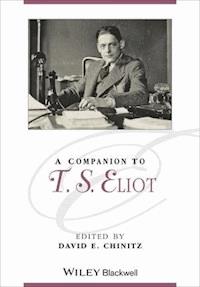
A Companion to T. S. Eliot E-Book
38,99 €
Mehr erfahren.
- Herausgeber: John Wiley & Sons
- Kategorie: Geisteswissenschaft
- Serie: Blackwell Companions to Literature and Culture
- Sprache: Englisch
Reflecting the surge of critical interest in Eliot renewed in recent years, A Companion to T.S. Eliot introduces the 'new' Eliot to readers and educators by examining the full body of his works and career. Leading scholars in the field provide a fresh and fully comprehensive collection of contextual and critical essays on his life and achievement. * It compiles the most comprehensive and up-to-date treatment available of Eliot's work and career * It explores the powerful forces that shaped Eliot as a writer and thinker, analyzing his body of work and assessing his oeuvre in a variety of contexts: historical, cultural, social, and philosophical * It charts the surge in critical interest in T.S. Eliot since the early 1990s * It provides an illuminating insight into a poet, writer, and critic who continues to define the literary landscape of the last century
Sie lesen das E-Book in den Legimi-Apps auf:
Seitenzahl: 1184
Veröffentlichungsjahr: 2011
Ähnliche




















Table of Contents
Cover
Blackwell Companions to Literature and Culture
Title page
Copyright page
Notes on Contributors
Preface
Acknowledgments to Sources
Abbreviations Used for Works by T. S. Eliot
Part I: Influences
1 The Poet and the Pressure Chamber: Eliot’s Life
Boston and the Mind of Europe, 1906–1915
Toward The Waste Land, 1916–1921
After The Waste Land, 1922–1930
“Into the Rose-Garden,” 1932–1939
War and the Quartets, 1939–1947
The Smiling Public Man, 1943–1965
2 Eliot’s Ghosts: Tradition and its Transformations
“Tradition and the Individual Talent”
Talent and the Individual Tradition
Orthodoxy and the Individual Heresy
3 T. S. Eliot and the Symbolist City
Symbolism and the City
Eliot’s Decadent Initiation
Cultural Spaces
Urban Anthropology
4 Not One, Not Two: Eliot and Buddhism
The Ten Thousand Things Return to the One
Where Does the One Return? Narrative Structure(s) in The Waste Land
“Several Kinds of Sanatoria”: Buddhism in the Plays
5 Yes and No: Eliot and Western Philosophy
6 A Vast Wasteland? Eliot and Popular Culture
“An artificial and unimportant distinction”
Culture Contact
Artists and Audiences
Broadway and Beyond
7 Mind, Myth, and Culture: Eliot and Anthropology
The Anthropological Method
Mystical Mentality
Dissociation
The Definition of Culture
8 “Where are the eagles and the trumpets?”: Imperial Decline and Eliot’s Development
The Singing Schools of Decadence
War, Empire, and the Lexicons of Decadence
The Waste Land: Dracula’s Shadow
Part II: Works
9 Searching for the Early Eliot: Inventions of the March Hare
Searching for Precedents: The Juvenilia
Searching for a Voice
Searching for Meaning
Searching for an Audience
Voice, Theme, and Audience: Two Poems
10 Prufrock and Other Observations: A Walking Tour
Publication and Reception
Background and Major Sources
“The Love Song of J. Alfred Prufrock”
“Portrait of a Lady,” “Conversation Galante,” and “La Figlia che Piange”
“Preludes,” “Rhapsody on a Windy Night,” and “Morning at the Window”
“The Boston Evening Transcript,” “Aunt Helen,” “Cousin Nancy,” “Mr. Apollinax,” and “Hysteria”
11 Disambivalent Quatrains
12 “Gerontion”: The Mind of Postwar Europe and the Mind(s) of Eliot
A Postwar Vacuum
Versions of Exile
13 “Fishing, with the arid plain behind me”: Difficulty, Deferral, and Form in The Waste Land
14 The Enigma of “The Hollow Men”
An In-Between Poem
Orientation through Allusion
Disorientation through Language
Reorientation through Criticism
15 Sweeney Agonistes: A Sensational Snarl
“Toward a New Form”
A Mostly Flat Party
Agon Without End
16 “Having to construct”: Dissembly Lines in the “Ariel” Poems and Ash-Wednesday
The Ariel Poems
Ash-Wednesday
17 “The inexplicable mystery of sound”: Coriolan, Minor Poems, Occasional Verses
Coriolan
Minor Poems
Occasional Verses
18 Coming to Terms with Four Quartets
19 “Away we go”: Poetry and Play in Old Possum’s Book of Practical Cats and Andrew Lloyd Webber’s Cats
20 Eliot’s 1930s Plays: The Rock, Murder in the Cathedral, and The Family Reunion
The Rock
Murder in the Cathedral
The Family Reunion
21 Eliot’s “Divine” Comedies: The Cocktail Party, The Confidential Clerk, and The Elder Statesman
The Cocktail Party
The Confidential Clerk
The Elder Statesman
Evaluation
22 Taking Literature Seriously: Essays to 1927
Canon
Professionalism
Knowledge
Tradition
23 He Do the Critic in Different Voices: The Literary Essays after 1927
24 In Times of Emergency: Eliot’s Social Criticism
The French Connection – and the English
The Idea of a Christian Society
Notes towards the Definition of Culture
Part III: Contexts
25 Eliot’s Poetics: Classicism and Histrionics
26 T. S. Eliot and Something Called Modernism
Defining and Historicizing Modernism
Eliot and the Material Historical Production of Modernist Difficulty
Restoring Eliot to the “Fuller Context” of Modernism, Restoring Complexity to Eliot
27 Conflict and Concealment: Eliot’s Approach to Women and Gender
The Struggle for Masculinity: Gender Roles in the Early Poems
Seductive, Manipulative, Pathetic: Images of Women before 1927
A Revision of the Pattern: Women in Eliot’s Later Work
28 Eliot and “Race”: Jews, Irish, and Blacks
Eliot and “Free-thinking Jews”: The Prose Works
Eliot and “the Jews”: The Poetry
Sweeney: Eliot and “the Irish”
King Bolo: Eliot and “the Blacks”
29 “The pleasures of higher vices”: Sexuality in Eliot’s Work
From Lower to Higher Vices
The Critical Climate
30 “An occupation for the saint”: Eliot as a Religious Thinker
Moments in and out of Time
“Spilt Religion”
Orthodoxy and its Discontents
31 Eliot’s Politics
32 Keeping Critical Thought Alive: Eliot’s Editorship of the Criterion
33 Making Modernism: Eliot as Publisher
Right Place, Right Time
Shaping the High Modernist Canon
The Next Generation
34 Eliot and the New Critics
35 “T. S. Eliot rates socko!”: Modernism, Obituary, and Celebrity
36 Eliot’s Critical Reception: “The quintessence of twenty-first-century poetry”
Eliot among the Reviewers
Early Approaches
Entering the Books
Establishing Standard Readings
37 Radical Innovation and Pervasive Influence: The Waste Land
Bibliography of Works by T. S. Eliot
Index
Blackwell Companions to Literature and Culture
This series offers comprehensive, newly written surveys of key periods and movements and certain major authors, in English literary culture and history. Extensive volumes provide new perspectives and positions on contexts and on canonical and post-canonical texts, orientating the beginning student in new fields of study and providing the experienced undergraduate and new graduate with current and new directions, as pioneered and developed by leading scholars in the field.
Published Recently
45. A Companion to Shakespeare’s SonnetsEdited by Michael Schoenfeldt46. A Companion to SatireEdited by Ruben Quintero47. A Companion to William FaulknerEdited by Richard C. Moreland48. A Companion to the History of the BookEdited by Simon Eliot and Jonathan Rose49. A Companion to Emily DickinsonEdited by Martha Nell Smith and Mary Loeffelholz50. A Companion to Digital Literary StudiesEdited by Ray Siemens and Susan Schreibman51. A Companion to Charles DickensEdited by David Paroissien52. A Companion to James JoyceEdited by Richard Brown53. A Companion to Latin American Literature and CultureEdited by Sara Castro-Klaren54. A Companion to the History of the English LanguageEdited by Haruko Momma and Michael Matto55. A Companion to Henry JamesEdited by Greg Zacharias56. A Companion to the British and Irish Short StoryEdited by Cheryl Alexander Malcolm and David Malcolm57. A Companion to Jane AustenEdited by Claudia L. Johnson and Clara Tuite58. A Companion to the Arthurian LiteratureEdited by Helen Fulton59. A Companion to the Modern American Novel: 1900–1950Edited by John T. Matthews60. A Companion to the Global RenaissanceEdited by Jyotsna G. Singh61. A Companion to Thomas HardyEdited by Keith Wilson62. A Companion to T. S. EliotEdited by David E. Chinitz63. A Companion to Samuel BeckettEdited by S. E. Gontarski64. A Companion to Twentieth-Century United States Fiction Edited by David SeedFor more information on the Blackwell Companions to Literature and Culture series, please visit www.wiley.com
This edition first published 2009
© 2009 Blackwell Publishing Ltd except for editorial material and organization © 2009 David E. Chinitz
Blackwell Publishing was acquired by John Wiley & Sons in February 2007. Blackwell’s publishing program has been merged with Wiley’s global Scientific, Technical, and Medical business to form Wiley-Blackwell.
Registered Office
John Wiley & Sons Ltd, The Atrium, Southern Gate, Chichester, West Sussex, PO19 8SQ, United Kingdom
Editorial Offices
350 Main Street, Malden, MA 02148-5020, USA
9600 Garsington Road, Oxford, OX4 2DQ, UK
The Atrium, Southern Gate, Chichester, West Sussex, PO19 8SQ, UK
For details of our global editorial offices, for customer services, and for information about how to apply for permission to reuse the copyright material in this book please see our website at www.wiley.com/wiley-blackwell.
The right of David E. Chinitz to be identified as the author of the editorial material in this work has been asserted in accordance with the Copyright, Designs and Patents Act 1988.
All rights reserved. No part of this publication may be reproduced, stored in a retrieval system, or transmitted, in any form or by any means, electronic, mechanical, photocopying, recording or otherwise, except as permitted by the UK Copyright, Designs and Patents Act 1988, without the prior permission of the publisher.
Wiley also publishes its books in a variety of electronic formats. Some content that appears in print may not be available in electronic books.
Designations used by companies to distinguish their products are often claimed as trademarks. All brand names and product names used in this book are trade names, service marks, trademarks or registered trademarks of their respective owners. The publisher is not associated with any product or vendor mentioned in this book. This publication is designed to provide accurate and authoritative information in regard to the subject matter covered. It is sold on the understanding that the publisher is not engaged in rendering professional services. If professional advice or other expert assistance is required, the services of a competent professional should be sought.
Library of Congress Cataloging-in-Publication Data
A companion to TS Eliot / edited by David E. Chinitz.
p. cm. – (Blackwell companions to literature and culture)
Includes bibliographical references and index.
ISBN 978-1-4051-6237-1 (hardcover : alk. paper)
ISBN 978-1-4443-5604-5 (epub)
ISBN 978-1-4443-5605-2 (mobi)
1. Eliot, T. S. (Thomas Stearns), 1888–1965–Criticism and interpretation–Handbooks, manuals, etc. I. Chinitz, David. II. Title: Companion to T.S. Eliot.
PS3509.L43Z64945 2009
821′.912–dc22
2008047763
A catalogue record for this book is available from the British Library.
Notes on Contributors
Ann Ardis is the author of New Women, New Novels: Feminism and Early Modernism (1990) and Modernism and Cultural Conflict, 1880–1922 (2002) as well as coeditor of Virginia Woolf Turning the Centuries (2000), Women’s Experience of Modernity, 1875–1945 (2002), and Transatlantic Print Culture, 1880–1940: Emerging Media, Emerging Modernisms (2008). She is currently working on a book-length study of periodicals on both sides of the Atlantic at the turn of the twentieth century that sought to engage an increasingly diverse public in discussions of “modern” literature, art, and politics.
Richard Badenhausen is Professor and Kim T. Adamson Chair at Westminster College, Salt Lake City, where he teaches classes in literature, trauma studies, and theories of place. He has published many articles on Eliot and is the author of T. S. Eliot and the Art of Collaboration (2005). He is currently completing a book entitled T. S. Eliot’s Traumatic Texts.
Sarah Bay-Cheng is Associate Professor of theater at the University at Buffalo–SUNY, where she teaches avant-garde drama, modernist film and theater, and contemporary intermedia and virtual reality performance. She is author of Mama Dada: Gertrude Stein’s Avant-Garde Theater (2004) and editor of Poets at Play: An Anthology of Modernist Drama (forthcoming). Her essays have appeared in journals such as Theatre Journal and Theatre Topics, and in anthologies such as A Companion to Twentieth-Century American Drama (Blackwell, 2005) and Theatre and Film (2005).
Jewel Spears Brooker, Professor at Eckerd College, Florida, has written scores of essays and has written or edited eight books, including Reading “The Waste Land”: Modernism and the Limits of Interpretation (1990) (with Joseph Bentley), Mastery and Escape: T. S. Eliot and the Dialectic of Modernism (1994), and T. S. Eliot: The Contemporary Reviews (2004). She is coeditor of two forthcoming volumes of Eliot’s Complete Prose. Dr. Brooker has served as a member of the National Humanities Council and as president of the T. S. Eliot Society and the South Atlantic Modern Language Association.
Edward Brunner teaches American literature at Southern Illinois University, Carbondale. He has published books on Hart Crane, W. S. Merwin, and the Cold War poetry of the years just after World War II.
Christine Buttram, Associate Professor of English at Winona State University in Minnesota, has published articles in the Journal of Modern Literature, English Language Notes, Essays in Criticism, and the Yeats Eliot Review. Her book on Eliot and the human body is nearing completion. For several years, she has served on the Board of the T. S. Eliot Society.
Bryan Cheyette is Chair in Modern Literature at the University of Reading, UK. He is the editor of seven books and author of Constructions of “the Jew” in English Literature and Society (1996) and Muriel Spark (2001), and he is now completing Diasporas of the Mind: Literature and “Race” after the Holocaust. He has recently guest edited the journal Wasifiri and is coeditor of volume VII of the Oxford History of the Novel in English, on the British and Irish novel, 1940–2000 (forthcoming).
David E. Chinitz is serving as Vice President of the T. S. Eliot Society and as Interdisciplinary Chair of the Modernist Studies Association while completing a book on Langston Hughes. His publications include T. S. Eliot and the Cultural Divide (2003) and articles in such journals as Callaloo, Modernism/Modernity, American Literary History, and PMLA. He is a Professor of English at Loyola University Chicago.
John Xiros Cooper is a Professor of English at the University of British Columbia. He has written three books on T. S. Eliot and edited a collection of essays on Eliot and music. He is the author of Modernism and the Culture of Market Society (2004) and is currently writing a book on Eliot’s British publisher, called Modernism in the Mainstream: The Case of Faber and Faber.
Michael Coyle, Professor of English at Colgate University in Hamilton, NY, is founding president of the Modernist Studies Association. Since Ezra Pound, Popular Genres, and the Discourse of Culture (1995), he has edited Ezra Pound and African American Modernism (2001), Raymond Williams and Modernism (2003), Broadcasting Modernism (with Debra Rae Cohen and Jane Lewty, forthcoming), and Ezra Pound and Education (with Steven Yao, forthcoming). He is currently finishing Professional Attention: Ezra Pound and the Career of Modernist Criticism.
Anthony Cuda is an Assistant Professor of English at the University of North Carolina–Greensboro, where he teaches American literature and twentieth-century poetry. He has published essays in Twentieth Century Literature, Modern Language Quarterly, the Journal of Modern Literature, and elsewhere; is finishing a book called “The Passions of Modernism: Eliot, Yeats, Woolf, Mann”; and is coeditor with Ronald Schuchard of the forthcoming Complete Prose of T. S. Eliot, volume 2.
Elisabeth Däumer is Professor of English and American literature at Eastern Michigan University, with specialties in literary theory and twentieth-century poetry. She has published essays on T. S. Eliot, Muriel Rukeyser, and feminist theory. She is also coeditor (with Shyamal Bagchee) of The International Reception of T. S. Eliot (2007).
Kevin J. H. Dettmar is W. M. Keck Distinguished Service Professor and Chair of the Department of English at Pomona College in Claremont, California. He has published books and articles in both modernist studies and popular music studies, and is the general editor of the Longman Anthology of British Literature.
Frances Dickey is an Assistant Professor at the University of Missouri. She has published on Whitman, Frost, Eliot, and Bishop; her essay “Parrot’s Eye: A Portrait by Manet and Two by T. S. Eliot” received the Kappell Prize from Twentieth Century Literature in 2006. She is writing a book on portraiture in modern American poetry.
Leonard Diepeveen is Professor of English at Dalhousie University. He is the author of The Difficulties of Modernism (2003) and Changing Voices: The Modern Quoting Poem (1993). As well, he is coauthor, with Timothy van Laar, of Art with a Difference: Looking at Difficult and Unfamiliar Art (2001) and Active Sights: Art as Social Action (1998).
Barry J. Faulk is an Associate Professor at Florida State University, where he teaches Victorian literature and cultural studies. He is the author of Music Hall and Modernity (2004) and has published articles in Modernism/Modernity, Cultural Critique, and Victorian Literature and Culture.
Nancy K. Gish is Professor of English and women’s studies at the University of Southern Maine. She is the author of Time in the Poetry of T. S. Eliot (1981) and “The Waste Land”: A Poem of Memory and Desire (1988). She has also published books on Hugh MacDiarmid and articles on contemporary Scottish poets. Her most recent book, coedited with Cassandra Laity, is Gender, Desire, and Sexuality in T. S. Eliot (2007).
Jason Harding is a Lecturer in English at the University of Durham, UK. He is the author of The Criterion: Cultural Politics and Periodical Networks in Inter-War Britain (2002) and coeditor (with Giovanni Cianci) of T. S. Eliot and the Concept of Tradition (2007). He is currently editing a volume in the Complete Prose of T. S. Eliot under the general editorship of Ronald Schuchard.
Christina Hauck is an Associate Professor of modern British literature at Kansas State University. She has published articles on Virginia Woolf, T. S. Eliot, Marie Stopes, Lord Alfred Douglas, and others, and she is currently writing a book on sexual reproduction and modernist identity. She is also a Dharma Teacher in the Kwan Um School of Zen and a co-founder, with Margaret Wheeler, of the Tall Grass Zen Center in Manhattan, Kansas.
Aaron Jaffe is an Associate Professor of English at the University of Louisville, Kentucky. He is the author of Modernism and the Culture of Celebrity and the coeditor of two forthcoming essay collections: Modernist Star Maps (2009) and The Year’s Work in Lebowski Studies (2009).
Michael Levenson, William B. Christian Professor of English at the University of Virginia, is the author of A Genealogy of Modernism (1986), The Spectacle of Intimacy (with Karen Chase, 2000), Modernism and the Fate of Individuality (2005), and the forthcoming Modernism. He is also the editor of the Cambridge Companion to Modernism (1999).
James Longenbach is the Joseph H. Gilmore Professor of English at the University of Rochester, NY. He is the author of six books of literary criticism, most recently The Art of the Poetic Line (2008), and three books of poems, most recently Draft of a Letter (2007).
Randy Malamud is Professor of English at Georgia State University in Atlanta. He is the author of five books, including T. S. Eliot’s Drama: A Research and Production Sourcebook (1992) and Where the Words are Valid: T. S. Eliot’s Communities of Drama (1994), and the editor of “The Waste Land” and Other Poems (2005) and, most recently, A Cultural History of Animals in the Modern Age (2007). He is a regular contributor to the Chronicle of Higher Education and a frequent collaborator with the photographer Britta Jaschinski.
Marc Manganaro’s scholarly interests have centered on the relation of modernist literature and anthropology. He has authored Myth, Rhetoric, and the Voice of Authority: A Critique of Frazer, Eliot, Frye, and Campbell (1992) and Culture, 1922: the Emergence of a Concept (2002), and he edited and introduced Modernist Anthropology: From Fieldwork to Text (1990). Formerly Professor of English and a Dean at Rutgers University, he is presently Dean of the College of Arts and Sciences at Gonzaga University in Spokane, Washington.
Gail McDonald is Senior Lecturer in English at the University of Southampton, UK. Her work on Eliot includes Learning to be Modern: Pound, Eliot, and the American University. Her most recent book is American Literature and Culture, 1900–1960 (Blackwell, 2007). She is a founder of the Modernist Studies Association.
John Timberman Newcomb is Associate Professor of English at the University of Illinois. He has published two books – Wallace Stevens and Literary Canons (1992) and Would Poetry Disappear: American Verse and the Crisis of Modernity (2004) – and numerous articles and reviews on American poetry. His current book project is “The Poetry of Modern Life: American Verse on the Urban Boulevard, 1910–1925.”
Lee Oser’s books include The Return of Christian Humanism: Chesterton, Eliot, Tolkien, and the Romance of History; T. S. Eliot and American Poetry; and Out of What Chaos: A Novel (all 2007). He is currently working on full-length studies of Shakespeare and Newman.
Jeffrey M. Perl is the author of The Tradition of Return: The Implicit History of Modern Literature (1984) and Skepticism and Modern Enmity: Before and After Eliot (1989). He is founder of the journal Common Knowledge, which he has edited since 1992. Currently Professor of English literature at Bar-Ilan University in Israel, he taught for many years at Columbia University and the University of Texas.
Cyrena N. Pondrom is Professor of English and women’s studies at the University of Wisconsin–Madison, and a recipient of NEH, ACLS, and Fulbright Fellowships. Her publications include The Road from Paris: French Influence on English Poetry, 1900–1920 (1974), The Contemporary Writer: Interviews with Sixteen Novelists and Poets (with L. S. Dembo, 1972), and numerous essays on Gertrude Stein, Hilda Doolittle (H.D.), Marianne Moore, Edith Sitwell, T. S. Eliot, and other modern figures. She is at work on a book-length study titled T. S. Eliot and the Performativity of Gender.
Patrick Query has published articles and chapters on Eliot, W. B. Yeats, Evelyn Waugh, Graham Greene, and W. H. Auden, as well as numerous reviews. His recently completed book manuscript, entitled The Idea of Europe in Ritual and Writing, 1919–1939, deals with the ways in which British and Irish writers of the interwar years used verse drama, bullfighting, and Catholic ritual to explore ideas of European identity. He is currently Assistant Professor of English at the United States Military Academy at West Point, New York.
Lawrence Rainey is founding editor of the scholarly journal Modernism/Modernity. He has authored Revisiting “The Waste Land” (2005) and edited The Annotated “Waste Land” with Eliot’s Contemporary Prose (2005). In 2006 these books were jointly awarded the Robert Motherwell Prize for an outstanding contribution to the study of modernism. He has also written Institutions of Modernism (2000), edited Modernism: An Anthology (2005), and edited and translated Futurism: An Anthology (2009). He has received research fellowships from the Guggenheim and Leverhulme Foundations, and numerous other scholarly awards.
Gareth Reeves is Reader in English at Durham University, UK. He is the author of two books on Eliot – T. S. Eliot: A Virgilian Poet (1989) and T. S. Eliot’s “The Waste Land” (1994), for Harvester’s Critical Studies of Key Texts series – and of The Thirties Poetry: Auden, MacNeice, Spender, with Michael O’Neill (1992). He is the author of two volumes of poetry, Real Stories (1984) and Listening In (1993), and of many essays on twentieth-century English, American and Irish poetry.
Sanford Schwartz teaches literature at Penn State University. The author of The Matrix of Modernism: Pound, Eliot, and Early Twentieth-Century Thought (1988) and various essays on modern literary, cultural, and intellectual history, he recently completed a study of C. S. Lewis’s Space Trilogy in its twentieth-century context (2009).
Tony Sharpe was for several years Head of the Department of English and Creative Writing at Lancaster University, UK, where he teaches modern and American literature. He is the author of Vladimir Nabokov (1991), T. S. Eliot: A Literary Life (1991), Wallace Stevens: A Literary Life (2000) and, most recently, W. H. Auden (2007), as well as of various articles and chapters reflecting his interest in modern and contemporary poetry. He is currently working on a study of Auden’s use of North Pennine places.
Vincent Sherry is Professor of English at Washington University in St. Louis. He is currently writing the Blackwell biography of Ezra Pound and a book-length study of European Decadence and modernist literature in English. His publications include The Great War and the Language of Modernism (2003); James Joyce: Ulysses (1995; 2nd ed. 2004); Ezra Pound, Wyndham Lewis, and Radical Modernism (1993); and The Uncommon Tongue: The Poetry and Criticism of Geoffrey Hill (1987). He also edited the Cambridge Companion to the Literature of the First World War (2005).
Carol H. Smith is Professor Emerita of English at Rutgers University. She is the author of T. S. Eliot’s Dramatic Theory and Practice: From “Sweeney Agonistes” to “The Elder Statesman” (1963) and of articles on modernism and twentieth-century writers. She is currently working on a study of H.D. (Hilda Doolittle) and her circle.
Jayme Stayer has taught at the University of Toledo, the University of Texas A&M–Commerce, Universidad Centroamericana in San Salvador, and John Carroll University, Ohio. His scholarly publications include work on Beethoven, Bakhtin, Stravinsky, and Eliot, and on rhetoric. He is currently working on a book on the rhetoric of voice and audience in Eliot’s early poetry. A Jesuit, he joined the Society of Jesus in 2003. And, no, he is not particularly fond of Eliot’s post-conversion poetry.
Preface
Critical work on T. S. Eliot has undergone a renaissance since the early 1990s, bringing new ideas and methods to bear on a much-studied writer whose depths, by then, were long supposed to have been plumbed. Key developments have included innovative work in the areas of sexuality and gender; new insight on Eliot’s relations with popular culture and mass media; more closely historicized readings of his political, social, religious, and philosophical views; a more sophisticated understanding of his role in the definition and dissemination of modernism; and rekindled debate over his prejudices. Meanwhile, The Varieties of Metaphysical Poetry, a major addition to the canon of Eliot’s prose, appeared in 1993, providing important new material for literary scholars; and Inventions of the March Hare, a fascinating collection of early poems and drafts that had been lost in manuscript for decades, was finally published in 1996, further altering critical assessments of Eliot’s development, influences, and social views. Between then and now, Cats (for which Eliot had been posthumously awarded a Tony) ended its marathon run on Broadway; Eliot was named “Poet of the Century” in Time magazine; and journalism on some of the scholarly controversies kept Eliot in the public eye to an unusual degree.
A Companion to T. S. Eliot presents the “new” T. S. Eliot in a series of chapters covering, from a contemporary perspective, the full range of Eliot’s output and career. Part I of the Companion comprises eight chapters elucidating the forces that shaped Eliot as writer and thinker, with attention given to influences high and low; Eastern and Western; aesthetic, biographical, historical, philosophical, and scientific. Part II guides the reader through Eliot’s entire oeuvre, analyzing richly every phase of his poetry, drama, and critical prose.
Part III contextualizes Eliot in a variety of ways. By examining his work through the lenses of race, gender, sexuality, religion, and politics, several chapters shed light on the new developments in Eliot studies and the controversies surrounding Eliot in our own time. Two chapters consider facets of Eliot’s career – his work as a publisher and his founding and editing of the Criterion – that were adjunct to his writing, yet crucial to the immense authority he wielded as a cultural figure. Others give informative glimpses into his reception and reputation among several readerships, or highlight aspects of his poetics that help to account for his literary eminence and continuing influence.
A Companion to T. S. Eliot is not merely the most comprehensive book of its kind, but also the first to synthesize broadly the resurgence of Eliot studies under a new, post-postmodernist critical regime, and with the inspiration of fresh primary material. A number of projects underway at this writing, including the compilation at long last of Eliot’s Complete Prose, the resumption of his Letters (hitherto suspended since the publication of volume 1 in 1988), and authoritative new editions of his poems and plays, promise to keep the momentum of today’s scholarship on Eliot going, and quite likely to accelerate it further, for some time to come.
Until those new editions of Eliot’s work appear, readers confront a haphazard assortment of texts. Several collections of Eliot’s poems and prose are available, with those published in the United States differing from those published in Britain, each with its own unique content, pagination, and typographical errors. While any selection among these editions is inevitably arbitrary, it seemed better, for the purposes of this Companion, to make some selection than to make none, so that references could be standardized around a consistent and accessible set of texts. The editions in use here are listed in the Companion’s “Bibliography of Works by T. S. Eliot.” Creative works appearing in the Complete Poems and Plays 1909–1950 (Harcourt) have been referenced to that text in preference to any others where they may also appear; similarly, essays are referenced primarily to Selected Essays (new ed., Harcourt). Prose pieces not included there are cited, if possible, in the listed editions of Eliot’s other collections (The Sacred Wood, On Poetry and Poets, etc.); uncollected pieces – which still constitute the majority of Eliot’s prose – are referenced, perforce, to their original sources. Writers and editors, as well as students and other readers, can look forward to a future in which such limitations, frustrations, and inconveniences are no longer a part of their experience of Eliot.
I would like to thank Julia Daniel for her assiduous and capable assistance with the editing of this Companion, and Loyola University Chicago for the research-support grant that sponsored Julia’s work. For their advice, my thanks go to Debra Rae Cohen, Michael Coyle, Kevin J. H. Dettmar, Lawrence Rainey, and Jayme Stayer. Emma Bennett and the editorial staff at Blackwell have been most helpful, and I am grateful to Al Bertrand for engaging me in this project. I would also like to acknowledge the contributors to this volume for their generous cooperation with my editorial activism. And to Lisa, Michael, and Raina: thank you, as always, for being with and bearing with me.
D. E. C.
Acknowledgments to Sources
The editor and publisher gratefully acknowledge the permission granted to reproduce the copyright material in this book. Excerpts from the following works by T. S. Eliot are reprinted by permission of Faber & Faber Ltd.: The Complete Poems and Plays: 1909–1950, Inventions of the March Hare: Poems 1909–1917, The Letters of T. S. Eliot, 1898–1922, Poems Written in Early Youth, and The Waste Land: A Facsimile and Transcript of the Original Drafts. In addition, the following works are reprinted by permission of Houghton Mifflin Harcourt Publishing Co.: excerpts from “Five-Finger Exercises” and “Landscapes” in Collected Poems 1909–1962 by T. S. Eliot, copyright ©1936 by Houghton Mifflin Harcourt Publishing Company and renewed 1964 by T. S. Eliot; excerpts from The Letters of T. S. Eliot, 1898–1922, copyright ©1988 by SET Copyrights Limited; and excerpts from Inventions of the March Hare: Poems 1909–1917 by T. S. Eliot, copyright ©1996 by Valerie Eliot.
Every effort has been made to trace copyright holders and to obtain their permission for the use of copyright material. The publisher apologizes for any errors or omissions in the above list and would be grateful if notified of any corrections that should be incorporated in future reprints or editions of this book.
Abbreviations Used for Works by T. S. Eliot
For the particular editions of Eliot’s works referred to in this book, see the “Bibliography of Works by T. S. Eliot.”
Note:
Endnote references in capitals refer to chapters in this volume.
Part I: Influences
1
The Poet and the Pressure Chamber: Eliot’s Life
Anthony Cuda
Over the course of his long career, T. S. Eliot preferred to think about poetry not as the communication of ideas but as a means of emotional relief for the artist, a momentary release of psychological pressure, a balm for the agitated imagination. In 1919, he called poetic composition an “escape from emotion”; in 1953, a “relief from acute discomfort” (SE 10; OPP 98). At first, poetry alleviated for him the mundane pressures of a bank clerk who lived hand-to-mouth, caring for his sick wife during the day and writing for the Times Literary Supplement at night; later, it lightened the spiritual pressures of a holy man in a desert of solitude with the devils conniving at his back. Most frequently, though, it eased the pressure of an artist doubting his talent, an acclaimed poet who wrote more criticism than poetry, ever fearful that the fickle Muse had permanently left him. The most intensely creative stages of Eliot’s life often coincided with the periods in which he faced the most intense personal disturbances and upheavals.
But where do we, as students of Eliot, begin to account for that pressure? “The pressure,” as he himself called it, “under which the fusion takes place” and from which the work of art emerges (SE 8)? We could begin with the bare facts. Eliot was the youngest of seven children, born on September 26, 1888 in St. Louis, Missouri. His family traced its roots to the early colonies in New England, and his grandfather, a Unitarian minister, moved the family from Boston to St. Louis in 1834 and founded the Church of the Messiah, the first Unitarian church west of the Mississippi. Eliot’s father, Henry Ware Eliot, chose to diverge from his own father’s footsteps in the ministry and pursued a career as president of the Hydraulic-Press Brick Company, while his mother, Charlotte Champe Eliot (a teacher, social worker, and writer) introduced the children to art and culture. But where among these facts, which are barely even “memories draped by the beneficent spider,” does the author of The Waste Land begin to emerge (CPP 49)?
Maybe it’s better to begin in two places at once. For 14 years while Eliot was young, his family divided its time between St. Louis and coastal New England, spending summers near Gloucester, a deep-sea fishing port in Massachusetts where his father eventually built a summer cottage. The yellow fog that winds through “Prufrock” and the brown river-god of “The Dry Salvages” both reflect the time he spent as a boy in the industrialized city of St. Louis. The urban imagery of his early poems, he admitted much later, “was that of St. Louis, upon which that of Paris and London have been superimposed” (“Influence” 422). The peaceful sailing scenes and serene coastal imagery of poems like “Marina” and , on the other hand, arise from his summers in Gloucester, where he learned to sail with his brother. This is where the pressures of Eliot’s creative life seem to begin: somewhere between the hard, claustrophobic inwardness of the city and the open, romantic expanses of the New England shores.
Lesen Sie weiter in der vollständigen Ausgabe!
Lesen Sie weiter in der vollständigen Ausgabe!
Lesen Sie weiter in der vollständigen Ausgabe!
Lesen Sie weiter in der vollständigen Ausgabe!
Lesen Sie weiter in der vollständigen Ausgabe!
Lesen Sie weiter in der vollständigen Ausgabe!
Lesen Sie weiter in der vollständigen Ausgabe!
Lesen Sie weiter in der vollständigen Ausgabe!
Lesen Sie weiter in der vollständigen Ausgabe!
Lesen Sie weiter in der vollständigen Ausgabe!
Lesen Sie weiter in der vollständigen Ausgabe!
Lesen Sie weiter in der vollständigen Ausgabe!
Lesen Sie weiter in der vollständigen Ausgabe!
Lesen Sie weiter in der vollständigen Ausgabe!
Lesen Sie weiter in der vollständigen Ausgabe!
Lesen Sie weiter in der vollständigen Ausgabe!
Lesen Sie weiter in der vollständigen Ausgabe!
Lesen Sie weiter in der vollständigen Ausgabe!
Lesen Sie weiter in der vollständigen Ausgabe!
Lesen Sie weiter in der vollständigen Ausgabe!
Lesen Sie weiter in der vollständigen Ausgabe!
Lesen Sie weiter in der vollständigen Ausgabe!
Lesen Sie weiter in der vollständigen Ausgabe!
Lesen Sie weiter in der vollständigen Ausgabe!
Lesen Sie weiter in der vollständigen Ausgabe!
Lesen Sie weiter in der vollständigen Ausgabe!
Lesen Sie weiter in der vollständigen Ausgabe!
Lesen Sie weiter in der vollständigen Ausgabe!
Lesen Sie weiter in der vollständigen Ausgabe!
Lesen Sie weiter in der vollständigen Ausgabe!
Lesen Sie weiter in der vollständigen Ausgabe!
Lesen Sie weiter in der vollständigen Ausgabe!
Lesen Sie weiter in der vollständigen Ausgabe!
Lesen Sie weiter in der vollständigen Ausgabe!
Lesen Sie weiter in der vollständigen Ausgabe!
Lesen Sie weiter in der vollständigen Ausgabe!
Lesen Sie weiter in der vollständigen Ausgabe!
Lesen Sie weiter in der vollständigen Ausgabe!




