


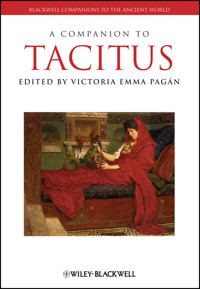
A Companion to Tacitus E-Book
161,99 €
Mehr erfahren.
- Herausgeber: John Wiley & Sons
- Kategorie: Geisteswissenschaft
- Serie: Blackwell Companions to the Ancient World
- Sprache: Englisch
A Companion to Tacitus brings much needed clarity and accessibility to the notoriously difficult language and yet indispensable historical accounts of Tacitus. The companion provides both a broad introduction and showcases new theoretical approaches that enrich our understanding of this complex author. * Tacitus is one of the most important Roman historians of his time, as well as a great literary stylist, whose work is characterized by his philosophy of human nature * Encourages interdisciplinary discussion intended to engage scholars beyond Classics including philosophy, cultural studies, political science, and literature * Showcases new theoretical approaches that enrich our understanding of this complex author * Clarifies and explains the notoriously difficult language of Tacitus * Written and designed to prepare a new generation of scholars to examine for themselves the richness of Tacitean thought * Includes contributions from a broad range of established international scholars and rising stars in the field
Sie lesen das E-Book in den Legimi-Apps auf:
Seitenzahl: 1315
Veröffentlichungsjahr: 2011
Ähnliche




















Table of Contents
Cover
BLACKWELL COMPANIONS TO THE ANCIENT WORLD
Title page
Copyright page
Notes on Contributors
Abbreviations
General Abbreviations
Roman Praenomina
Greek Authors and Works
Roman Authors and Works
Works of Secondary Scholarship
Introduction
ACKNOWLEDGMENTS
PART I: Texts
1 The Textual Transmission
1. Annals 1–6
2. Annals 11–16, Histories
3. The Minor Works
GUIDE TO FURTHER READING
2 The Agricola
1. Background
2. Structure and Content
3. Praise and Blame
4. Empire and Principate
5. Styles and Genres
6. The Historical Value of Agricola
7. Concluding Remarks: Agricola in Tacitus’ Career
GUIDE TO FURTHER READING
ACKNOWLEDGMENTS
3 Germania
1. Contexts
2. Interpretations
3. History in Germania, Germania in History
4. Conclusion
GUIDE TO FURTHER READING
4 Tacitus’ Dialogus de Oratoribus
1. A History of Approaches and Problems
2. Social History in Antiquity
3. The Literary Form
4. Round One: Patronage and Prestige
5. Round Two: Education, Style, and Culture
6. Round Three: Historical Assessments
7. Epilogue
GUIDE TO FURTHER READING
5 The Histories
1. Synopsis
2. Introduction
3. Style
4. Bad Leadership
5. Collapse of Soldiers’ Sense of Mission
6. The Form of the Histories
7. Ethnic Identity
GUIDE TO FURTHER READING
6 The Annals
1. Tacitus’ Career and Earlier Works
2. The Annals
3. Style and Language
4. Tacitus in Later Times
GUIDE TO FURTHER READING
PART II: Historiography
7 Tacitus’ Sources
GUIDE TO FURTHER READING
8 Tacitus and Roman Historiography
GUIDE TO FURTHER READING
9 The Concentration of Power and Writing History
1. First Unit of the Histories: Methodological Issues, the Emergence of a Theme (1.1–11)
2. The Concentration of Power in the Main Narrative Sections (1.12–49)
3. Methods of Historical Persuasion
4. Types of Passages
5. Conclusion
GUIDE TO FURTHER READING
PART III: Interpretations
10 Deliberative Oratory in the Annals and the Dialogus
1. Introduction
2. Deliberative Oratory: The Background
3. The Dialogus
4. The Annals
5. Conclusions
GUIDE TO FURTHER READING
11 Tacitus’ Senatorial Embassies of 69 CE
1. Histories 1.19.2
2. Histories 1.74.2
3. Histories 3.80–81
4. Conclusion
ACKNOWLEDGMENTS
GUIDE TO FURTHER READING
12 Deuotio, Disease, and Remedia in the Histories
1. A Brief History of deuotio
2. The Death of Galba as loco deuotionis
3. Otho’s Self-Sacrifice
4. Flavian remedia
GUIDE TO FURTHER READING
13 Tacitus in the Twenty-First Century
ACKNOWLEDGMENTS
GUIDE TO FURTHER READING
14 Tacitus’ History and Mine
GUIDE TO FURTHER READING
15 Seneca in Tacitus
1. Introduction
2. Measuring the Man
3. Seneca’s First Mention
4. Writing the Writer
5. Conclusion
GUIDE TO FURTHER READING
PART IV: Intertextuality
16 Annum quiete et otio transiit
1. Bovine Quietude
2. In Peace You Rest Unfree
ACKNOWLEDGMENTS
GUIDE TO FURTHER READING
17 “Let us tread our path together”
1. Out of the Silence
2. Between Oratory and History
3. Dialogues
4. The Problem of Survival
5. Pliny’s Revenge
6. Tacitus’ Revenge
7. Into the Silence
GUIDE TO FURTHER READING
18 Tacitus and Epic
1. Poeticus Decor
2. Eaedem Scelerum Causae
3. Vrbem Romam a Principio Reges Habuere
GUIDE TO FURTHER READING
19 Silius Italicus and Tacitus on the Tragic Hero
GUIDE TO FURTHER READING
20 Historian and Satirist
1. Family Trees
2. Historical Satire
3. Personae and Protocol
4. The Satires on Tacitus?
5. The State of Vice
6. Exemplarity from History to Satire
7. Conclusion
GUIDE TO FURTHER READING
PART V: Theoretical Approaches
21 Masculinity and Gender Performance in Tacitus
1. Vitellius as a Contrastive Foil and the Questionable Masculinity of Roman Soldiers
2. Gender in the Annals
3. Disruptions of the Gender Dichotomy
4. Narrative and Extratextual Performance of Gender
22 Women and Domesticity
1. Domesticity and Ethnography: The Agricola and Germania
2. Domestic Politics: The Annals
GUIDE TO FURTHER READING
23 Postcolonial Approaches to Tacitus
1. What Is a Postcolonial Approach?
2. Postcolonial Classics
3. Postcolonial Tacitus
GUIDE TO FURTHER READING
24 Tacitus and Political Thought
1. Introduction
2. Political Interpretations of Tacitus
3. Prudence and the Navigation of the Political World
4. Conclusion
ACKNOWLEDGMENTS
GUIDE TO FURTHER READING
Bibliography
Index
BLACKWELL COMPANIONS TO THE ANCIENT WORLD
This series provides sophisticated and authoritative overviews of periods of ancient history, genres of classical literature, and the most important themes in ancient culture. Each volume comprises between twenty-five and forty concise essays written by individual scholars within their area of specialization. The essays are written in a clear, provocative, and lively manner, designed for an international audience of scholars, students, and general readers.
ANCIENT HISTORY
Published
A Companion to the Roman Army
Edited by Paul Erdkamp
A Companion to the Roman Republic
Edited by Nathan Rosenstein and Robert Morstein-Marx
A Companion to the Roman Empire
Edited by David S. Potter
A Companion to the Classical Greek World
Edited by Konrad H. Kinzl
A Companion to the Ancient Near East
Edited by Daniel C. Snell
A Companion to the Hellenistic World
Edited by Andrew Erskine
A Companion to Late Antiquity
Edited by Philip Rousseau
A Companion to Ancient History
Edited by Andrew Erskine
A Companion to Archaic Greece
Edited by Kurt A. Raaflaub and Hans van Wees
A Companion to Julius Caesar
Edited by Miriam Griffin
A Companion to Byzantium
Edited by Liz James
A Companion to Ancient Egypt
Edited by Alan B. Lloyd
A Companion to Ancient Macedonia
Edited by Joseph Roisman and Ian Worthington
A Companion to the Punic Wars
Edited by Dexter Hoyos
In preparation
A Companion to Sparta
Edited by Anton Powell
LITERATURE AND CULTURE
Published
A Companion to Classical Receptions
Edited by Lorna Hardwick and Christopher Stray
A Companion to Greek and Roman Historiography
Edited by John Marincola
A Companion to Catullus
Edited by Marilyn B. Skinner
A Companion to Roman Religion
Edited by Jörg Rüpke
A Companion to Greek Religion
Edited by Daniel Ogden
A Companion to the Classical Tradition
Edited by Craig W. Kallendorf
A Companion to Roman Rhetoric
Edited by William Dominik and Jon Hall
A Companion to Greek Rhetoric
Edited by Ian Worthington
A Companion to Ancient Epic
Edited by John Miles Foley
A Companion to Greek Tragedy
Edited by Justina Gregory
A Companion to Latin Literature
Edited by Stephen Harrison
A Companion to Greek and Roman Political Thought
Edited by Ryan K. Balot
A Companion to Ovid
Edited by Peter E. Knox
A Companion to the Ancient Greek Language
Edited by Egbert Bakker
A Companion to Hellenistic Literature
Edited by Martine Cuypers and James J. Clauss
A Companion to Vergil’s Aeneid and its Tradition
Edited by Joseph Farrell and Michael C. J. Putnam
A Companion to Horace
Edited by Gregson Davis
A Companion to Families in the Greek and Roman Worlds
Edited by Beryl Rawson
A Companion to Greek Mythology
Edited by Ken Dowden and Niall Livingstone
A Companion to the Latin Language
Edited by James Clackson
A Companion to Tacitus
Edited by Victoria Emma Pagán
In preparation
A Companion to Sophocles
Edited by Kirk Ormand
A Companion to Aeschylus
Edited by Peter Burian
A Companion to Greek Art
Edited by Tyler Jo Smith and Dimitris Plantzos
A Companion to the Archaeology of the Ancient Near East
Edited by Daniel Potts
This edition first published 2012
© 2012 Blackwell Publishing Ltd.
Blackwell Publishing was acquired by John Wiley & Sons in February 2007. Blackwell’s publishing program has been merged with Wiley’s global Scientific, Technical, and Medical business to form Wiley-Blackwell.
Registered Office
John Wiley & Sons Ltd, The Atrium, Southern Gate, Chichester, West Sussex, PO19 8SQ, UK
Editorial Offices
350 Main Street, Malden, MA 02148-5020, USA
9600 Garsington Road, Oxford, OX4 2DQ, UK
The Atrium, Southern Gate, Chichester, West Sussex, PO19 8SQ, UK
For details of our global editorial offices, for customer services, and for information about how to apply for permission to reuse the copyright material in this book please see our website at www.wiley.com/wiley-blackwell.
The right of Victoria Emma Pagán to be identified as the author of the editorial material in this work has been asserted in accordance with the UK Copyright, Designs and Patents Act 1988.
All rights reserved. No part of this publication may be reproduced, stored in a retrieval system, or transmitted, in any form or by any means, electronic, mechanical, photocopying, recording or otherwise, except as permitted by the UK Copyright, Designs and Patents Act 1988, without the prior permission of the publisher.
Wiley also publishes its books in a variety of electronic formats. Some content that appears in print may not be available in electronic books.
Designations used by companies to distinguish their products are often claimed as trademarks. All brand names and product names used in this book are trade names, service marks, trademarks or registered trademarks of their respective owners. The publisher is not associated with any product or vendor mentioned in this book. This publication is designed to provide accurate and authoritative information in regard to the subject matter covered. It is sold on the understanding that the publisher is not engaged in rendering professional services. If professional advice or other expert assistance is required, the services of a competent professional should be sought.
Library of Congress Cataloging-in-Publication Data
A companion to Tacitus / edited by Victoria Emma Pagán.
p. cm. – (Blackwell companions to the ancient world)
Includes bibliographical references and index.
ISBN 978-1-4051-9032-9 (hardcover: alk. paper) 1. Tacitus, Cornelius—Criticism and interpretation. 2. Rome—Historiography. I. Pagán, Victoria Emma, 1965–
PA6716.C66 2012
937'.07092–dc23
2011024866
A catalogue record for this book is available from the British Library.
This book is published in the following electronic formats: ePDFs [ISBN 9781444354157]; Wiley Online Library [ISBN 9781444354188]; ePub [ISBN 9781444354164]; Mobi [ISBN 9781444354171]
Notes on Contributors
Antony Augoustakis holds a PhD in Classics from Brown University and is Associate Professor of Classics at the University of Illinois at Urbana-Champaign. He is the author of Motherhood and the Other: Fashioning Female Power in Flavian Epic (2010) and Plautus’ Mercator (2009). He edited the Brill Companion to Silius Italicus (2010) and co-edited, with Carole Newlands, Statius’ Silvae and the Poetics of Intimacy (2007). He is in the final stages of editing the Blackwell Companion to Terence, while he is also working on a commentary on Statius’ Thebaid Book 8 (2013). Other publications in progress include two edited volumes, Religion and Ritual in Flavian Epic (2012) and the Oxford Readings in Flavian Epic (co-edited with Helen Lovatt, 2013).
Herbert W. Benario is Professor Emeritus of Classics at Emory University. He received his PhD from The Johns Hopkins University in 1951. He is the author, inter alios, of a translation of Tacitus’ Agricola, Germany, Dialogue on Orators (1967, 1991, 2006); An Introduction to Tacitus (1975); Tacitus Annals 11 and 12 (1983); and Tacitus Germany/Germania (1999). He wrote the Surveys of Recent Work on Tacitus for Classical World, which, in six installments, covered fifty years of Tacitean research.
Olivier Devillers is Professor of Latin at the Université Michel de Montaigne, Bordeaux 3 where he is the director of Ausonius Editions, the publications of the Ausonius Institute, Centre National de Recherche Scientifique. He has written two books on Tacitus: L’art de la persuasion dans les Annales de Tacite (1994) and Tacite et les sources des Annales: Enquêtes sur la méthode historique (2003). He serves on the board of the International Society for Neronian Studies and the editorial board of Neronia Electronica.
Rebecca Edwards is Assistant Professor of Classics at Wright State University in Dayton, Ohio. She received her PhD from Indiana University in 2003. She has written several articles on Tacitus and is working on a book that will study Tacitus’ use of space and place.
Holly Haynes is Associate Professor of Classics at The College of New Jersey. She received her PhD in Classics and Comparative Literature from the University of Washington. She has also taught at Dartmouth College and New York University. She is the author of The History of Make-Believe: Tacitus on Imperial Rome (2003) and several articles on ancient literature, politics, and ideology. Her current projects include pieces on memory and trauma in the post-Domitianic period and on Petronius’ Satyricon.
Timothy A. Joseph is Assistant Professor of Classics at the College of the Holy Cross in Worcester, Massachusetts. He received his PhD from Harvard University in 2007. He has published on Tacitus and Vergil, and his ongoing projects include further work on Latin historiography and epic and their intersections.
Daniel Kapust is Assistant Professor of Political Science at the University of Wisconsin-Madison, where he received his PhD in Political Science in 2005. He has also been Assistant Professor of Political Science at the University of Georgia. He is the author of Republicanism, Rhetoric, and Roman Political Thought: Sallust, Livy, and Tacitus (2011) and articles on Sallust, Livy, Tacitus, Cicero, Machiavelli, political fear, and Hobbes.
Catherine Keane is Associate Professor of Classics at Washington University in St. Louis. She received her PhD from the University of Pennsylvania in 1999 and held a Mellon Post-Doctoral Fellowship in Classics at Northwestern University. She is the author of Figuring Genre in Roman Satire (2006) and A Roman Verse Satire Reader (2010), as well as numerous articles and chapters on satire and related literature. Her current book project examines emotion, rhetoric, and poetics in Juvenal’s satire.
James Ker is Associate Professor of Classical Studies at the University of Pennsylvania. He holds a BA in Classics from the University of Canterbury, New Zealand, and an MA and PhD from the University of California, Berkeley. His research and teaching are primarily in Latin literature, ancient rhetoric and philosophy, and Greco-Roman cultural history. He is the author of The Deaths of Seneca (2009) and various articles on Greek and Roman literature and culture.
Christopher B. Krebs is Associate Professor of Classics at Harvard University. He received his PhD in 2003 at Kiel University. He is the author of Negotiatio Germaniae: Tacitus’ Germania und Enea Silvio Piccolomini, Giannantonio Campano, Conrad Celtis und Heinrich Bebel (2005); A Most Dangerous Book: Tacitus’s Germania from the Roman Empire to the Third Reich (2011); and the co-editor of Time and Narrative in Ancient Historiography: The Plupast from Herodotus to Appian (forthcoming). He is working on a commentary on Caesar, Bellum Gallicum VII.
Barbara Levick, Emeritus Fellow and Tutor in Literae Humaniores at St. Hilda’s College, Oxford, is the author of Roman Colonies in Southern Asia Minor (1967); Tiberius the Politician (2nd ed., 1999); Claudius (1990); Vespasian (1999); The Government of the Roman Empire (2nd ed., 2001); Julia Domna, Syrian Empress (2007); and Augustus, Image and Substance (2010). She is the editor of The Ancient Historian and his Materials: Essays in Honour of C. E. Stevens (1975) and joint editor of Monumenta Asiae Minoris Antiqua 9 and 10 (1988 and 1993), of Women in Antiquity: New Perspectives (1994), and of The Customs Law of Asia (2008).
Eleni Manolaraki is Assistant Professor of Classics at the University of South Florida. She received her PhD from Cornell University in 2003. She has published articles on Lucan, Statius, Silius Italicus, Tacitus, and Pliny the Younger; she also edited the fourth edition of M. Le Glay’s A History of Rome (Wiley-Blackwell, 2009). She has completed a monograph entitled “Noscendi Nilum Cupido: The Nile from Lucan to Philostratus.”
Jonathan Master is Assistant Professor of Classics at Emory University. He received his PhD from Princeton University in 2007. He works on Roman historiography, particularly Tacitus. He is the author of “Nobody Knows You Like Your Mother: Tacitus, Histories 2.64 on Vitellius’ True Identity” (Materiali e Discussioni 63 [2009]).
Kristina Milnor is the Tow Family Associate Professor of Classics at Barnard College. She received a Graduate Certificate in Women’s Studies in 1997 and her PhD in Classical Studies in 1998 at the University of Michigan. She is the author of Gender, Domesticity, and the Age of Augustus (Oxford, 2005), which won the American Philological Association’s Goodwin Award of Merit in 2006. She has also written articles on Livy, Sulpicia, and Plautus. She is completing a book entitled Graffiti and the Literary Landscape in Roman Pompeii.
Charles E. Murgia is Professor Emeritus of Classics at the University of California, Berkeley. He received his PhD from Harvard University in 1966. His publications mostly concern questions of manuscripts, text, date, and/or authenticity in Vergil, Servius, Lucretius, Tacitus, Pliny, Quintilian, Ovid, Propertius, “Secret Mark,” as well as Latin prose style. He is editing Volume 5 of the Harvard Edition of Servius and plans to edit the works of Vergil for Teubner.
Victoria Emma Pagán is Professor and Chair of Classics at the University of Florida. She received her PhD from the University of Chicago in 1997. She is the author of Conspiracy Narratives in Roman History (2004); Rome and the Literature of Gardens (2006); A Sallust Reader (2009); Conspiracy Theory in Ancient Rome (forthcoming); and over a dozen articles on Latin literature.
Arthur Pomeroy is Professor of Classics at Victoria University of Wellington. He received his PhD from Cornell University. He is the author of The Appropriate Comment: Death Notices in the Ancient Historians (1991); Arius Didymus: Epitome of Stoic Ethics (1999); Theatres of Action: Papers for Chris Dearden (co-edited with John Davidson, 2003); Roman Social History: A Sourcebook (with Tim Parkin, 2007); Then It Was Destroyed by the Volcano: Classics on the Large and Small Screen (2008); and various articles on a wide range of Latin authors and on the reception of the ancient world in modern film and television.
David S. Potter is the Arthur Thurnau Professor of Greek and Latin at the University of Michigan. He received his DPhil from Oxford in 1984. He has written Literary Texts and the Roman Historian; Life, Death and Entertainment in the Roman Empire (co-editor); Prophecy and History in the Crisis of the Roman Empire; Prophets and Emperors: Humans and Divine Authority from Augustus to Theodosius; The Roman Empire at Bay; A Companion to the Roman Empire (editor); and articles on textual criticism and Greek and Roman history and epigraphy.
James B. Rives is Kenan Eminent Professor of Classics at the University of North Carolina at Chapel Hill. He received his PhD from Stanford University in 1990. He is the author of Religion in the Roman Empire (2007); a historical/historiographical commentary on Tacitus’ Germania (1999); and Religion and Authority in Roman Carthage (1995). He has also revised the Penguin Classics editions of Suetonius (2007) and Tacitus’ Agricola and Germania (2009) and has written numerous articles on the religious history of the Roman empire.
Steven H. Rutledge is Associate Professor of Classics at the University of Maryland, College Park. He received his PhD from Brown University in 1996. He is the author of Imperial Inquisitions: Prosecutors and Informants from Tiberius to Domitian (2001); Tacitus: Selections from the Agricola, Germania, Dialogus de oratoribus, Historiae, and Annales (forthcoming); and Ancient Rome as a Museum: Power, Identity, and the Culture of Collecting (forthcoming); as well as a number of articles on Roman literature, culture, and history.
Dylan Sailor is Associate Professor of Classics at the University of California, Berkeley where he earned his PhD in 2002. He is the author of Writing and Empire in Tacitus (2008) and articles on Roman historical writing.
Nancy Shumate is Professor of Classical Languages and Literatures at Smith College in Northampton, Massachusetts. She received her PhD from Harvard University, and is the author of Crisis and Conversion in Apuleius’ Metamorphoses (1996) and Nation, Empire, Decline: Studies in Rhetorical Continuity from the Romans to the Modern Era (2006), as well as articles on Latin literature and Roman culture.
Thomas Späth is Professor of Ancient Cultures and Constructions of Antiquity and Director of the Center for Global Studies at the University of Bern. He received his PhD in Ancient History at the University of Basel in 1991. He is the author of Männlichkeit und Weiblichkeit bei Tacitus: Zur Konstruktion der Geschlechter in der römischen Kaiserzeit (1994), co-editor with Véronique Dasen of Children, Memory, and Family Identity in Roman Culture (2010), and author of articles on masculinity, gender, Roman cultural history, and antiquity in cinema.
Christopher S. van den Berg is Assistant Professor of Classics at Amherst College. He received his PhD in the joint program in Classics and Comparative Literature at Yale University in 2006. As the American Philological Association’s NEH Fellow to the Thesaurus Linguae Latinae in Munich, he authored a number of lexicographical articles. He has also written survey pieces for the Historisches Wörterbuch der Rhetorik and published articles on Roman religious vocabulary (the pulvinar) and on socio-aesthetic terminology in Roman literary culture. His book, The World of Tacitus’ Dialogus de Oratoribus, is under contract with Cambridge University Press.
Christopher Whitton is a Lecturer in Classics at the University of Cambridge and Fellow of Emmanuel College. He received his PhD from Cambridge in 2007. He has published on a range of imperial authors and is currently preparing a commentary on Pliny’s Epistles 2 for the Cambridge “green and yellow” series, as well as articles on Pliny, Tacitus, and Juvenal.
Kathryn Williams is Associate Professor of Classics at Canisius College in Buffalo, NY. She earned her PhD in Classics from the University of Virginia. She has published articles on Sallust, Tacitus, and Pliny the Younger and most recently contributed a chapter on the interrelationship between Tacitus’ works and Juvenal’s Satire 4 in Latin Historiography and Poetry in the Early Empire: Generic Interactions (ed. Miller and Woodman, 2010). Her current project is a monograph on Tacitean envoys.
Abbreviations
Names of authors or works in square brackets [—] indicate spurious or questionable attributions.
General Abbreviations
ad; ad loc.ad locum, at the line being discussed in the commentarycf.comparech., chs.chapter, chaptersed., eds.editor(s), edited (by)esp.especiallyff. and the following (lines, pages)fr., frr.fragment, fragmentsmod.modifiedMS, MSSmanuscript, manuscriptsn.noteno.numberp., pp.page, pagesplut.pluteus, a desk in which manuscripts were storedpref.prefacesc.scilicet, namelyschol.scholias.v.sub verbo, under the wordtrans.translator, translated (by)Vat. Lat.Vaticanus LatinusRoman Praenomina
First names of male Roman citizens, relatively few and handed down in families, are abbreviated on inscriptions and conventionally in modern works of scholarship. The following occur in this volume:
A.AulusC.GaiusCn.GnaeusL.LuciusM.MarcusP.PubliusQ.QuintusSex.SextusT.TitusGreek Authors and Works
DioCassius Dio[Hippoc.]HippocratesAer.de Aera, Aquis, LocisHomer Il.IliadOd.OdysseyHdt.HerodotusIsoc.IsocratesPan.PanegyricusPl.PlatoPhaed.PhaedrusPlut.PlutarchCatoLife of Cato the YoungerGalbaLife of GalbaOthoLife of OthoPolybius Hist.HistoriaeRoman Authors and Works
Caes.CaesarCiu.de Bello CiuiliGal.de Bello GallicoCatoCatoOrig.OriginesCic.CiceroAmic.de AmicitiaAtt.Epistulae ad AtticumBrut.Brutusde Orat.de OratoreFam.Epistulae ad FamiliaresFin.de Finibus Bonorum et MalorumInu.de InuentioneLeg.de LegibusOff.de OfficiisOpt. Gen.de Optimo Genere OratorumOrat.OratorPart.Partitiones OratoriaeQ. fr.Epistulae ad Quintum fratremSest.pro SestioTusc.Tusculanae DisputationesColumellaColumellaRust.de Re RusticaDig.DigestGel.Aulus GelliusHAHistoria AugustaTacitusLife of TacitusHoraceHoraceArs P.Ars PoeticaCarm. CarminaSat.SatiresJuv.JuvenalSat.SatiresLucanLucanBCBellum CiuileMart.MartialMelaPomponius MelaOv.OvidArs.Ars AmatoriaTr.TristiaPers.PersiusPlin.Pliny the ElderNat.Naturalis HistoriaPlin.Pliny the YoungerEp.EpistulaePan.PanegyricusPublilius (Syrus) Sent. SententiaeQuint.QuintilianInst. Institutio OratoriaRGDARes Gestae Diui AugustiRhet. Her.Rhetorica ad HerenniumSal.SallustCat.de Coniuratione CatilinaeJug.de Bello JugurthinoHist.HistoriaeSCPP or SCPSenatus Consultum de Cn. Pisone PatreSen.Seneca the ElderSuas.SuasoriaeSen.Seneca the YoungerApocol.ApocolocyntosisBen.de BeneficiaBreu.de Breuitate VitaeClem.de ClementiaDial.DialogiEp.Epistulae moralesMarc. Consolatio ad MarciamPolyb.Consolatio ad PolybiumIra de IraNat.Naturales QuaestionesPha. PhaedraTranq.de Tranquillitate[Sen.][Seneca the Younger]Oct.OctaviaSil.Silius ItalicusPun.PunicaSuet.SuetoniusAug. Diuus AugustusCal.Gaius CaligulaClaud. Diuus ClaudiusDom. DomitianusGalbaGalbaIul.Diuus IuliusNeroNeroOthoOthoTib.TiberiusVit.VitelliusTac.TacitusAg.AgricolaAnn.AnnalsDial.Dialogus de OratoribusGer.GermaniaHist.HistoriesVarro Ling. de Lingua LatinaVell.Velleius PaterculusVergil Aen. AeneidEcl.EcloguesG.GeorgicsVitr.VitruviusWorks of Secondary Scholarship
CILCorpus Inscriptionum Latinarum (1863–)HRRelHistoricorum Romanorum Reliquiae, H. Peter, ed.(1914)ILSInscriptiones Latinae Selectae, H. Dessau, ed. (1892–1916)OLDOxford Latin Dictionary, P. G. W. Glare, ed. (1968–1982)PIRProsopographia Imperii Romani Saeculi I, II, III, 1st ed., E. Klebs and H. Dessau, eds. (1897–1888); 2nd ed., E. Groag, A. Stein, et al., eds. (1933–)TLLThesaurus Linguae Latinae (1900–)Introduction
Victoria Emma Pagán
Res ipsa hortari uidetur … supra repetere: “The very subject matter seems to urge me to look back” (Sal., Cat. 5.9). So Sallust, at a loss as exactly how to begin his account, says in his magisterial preface to the Catilinarian Conspiracy. He chooses to go back, albeit momentarily, to the founding of Rome: urbem Romam (Cat. 6.1). Of course, the vanishing horizon of Sallust’s first work turns out to be the inaugural words of Tacitus’ last (urbem Romam, Ann. 1.1.1). For Sallust, urbs Roma is a point of retreat at the start of a career; for Tacitus, the point of departure at the end. This companion is born of such a tension, between retreat and departure, the tradition of established scholarship and the innovation of groundbreaking discovery. This is not the first companion to Tacitus. While the contributions to this volume were being written, Tony Woodman’s Cambridge Companion to Tacitus was in production and published in 2009. That companion concludes with an essay by Mark Toher on “Tacitus’ Syme,” and so in a Tacitean move (that simultaneously betrays and flaunts the anxiety of influence), Syme’s Tacitus shall introduce this companion.
Toher provides a biographical sketch of Ronald Syme’s life in Oxford together with an assessment of his two colossal and most famous works, The Roman Revolution and Tacitus. Toher locates the impact of Syme’s influence on the study of Tacitus in a pervasive identity crisis:
It is fair to say that our understanding of Tacitus, who he was and why he wrote, is in significant part due to Syme’s own analysis of him; much that is generally accepted by scholars of Tacitus is due to Tacitus. The problem is then compounded by the fact that in Tacitus there is a fair amount of complementary and complimentary projection: the Tacitus that emerges from Tacitus has features that were characteristic of Syme himself.
(Toher 2009, 325)
It is often noted that Tacitus was of provincial origin and Syme was from New Zealand; the one lived among the learned aristocracy of Rome, the other of Oxford. On every page Syme adopts for himself the terse, pointed, sententious style of Tacitus (e.g., “Aufidius cannot compete.” “Small things, but significant.” 1958, 276, 389). Of course, having thoroughly ingested Tacitus, Syme could not help but write like him; imitation was as much an occupational hazard for Syme as it was for Tacitus, who imitated his literary predecessor Sallust. Yet the sympathies run deeper than biographical coincidence or literary form.
Lesen Sie weiter in der vollständigen Ausgabe!
Lesen Sie weiter in der vollständigen Ausgabe!
Lesen Sie weiter in der vollständigen Ausgabe!
Lesen Sie weiter in der vollständigen Ausgabe!
Lesen Sie weiter in der vollständigen Ausgabe!
Lesen Sie weiter in der vollständigen Ausgabe!
Lesen Sie weiter in der vollständigen Ausgabe!
Lesen Sie weiter in der vollständigen Ausgabe!
Lesen Sie weiter in der vollständigen Ausgabe!
Lesen Sie weiter in der vollständigen Ausgabe!
Lesen Sie weiter in der vollständigen Ausgabe!
Lesen Sie weiter in der vollständigen Ausgabe!
Lesen Sie weiter in der vollständigen Ausgabe!
Lesen Sie weiter in der vollständigen Ausgabe!
Lesen Sie weiter in der vollständigen Ausgabe!
Lesen Sie weiter in der vollständigen Ausgabe!
Lesen Sie weiter in der vollständigen Ausgabe!
Lesen Sie weiter in der vollständigen Ausgabe!
Lesen Sie weiter in der vollständigen Ausgabe!
Lesen Sie weiter in der vollständigen Ausgabe!
Lesen Sie weiter in der vollständigen Ausgabe!
Lesen Sie weiter in der vollständigen Ausgabe!
Lesen Sie weiter in der vollständigen Ausgabe!
Lesen Sie weiter in der vollständigen Ausgabe!
Lesen Sie weiter in der vollständigen Ausgabe!
Lesen Sie weiter in der vollständigen Ausgabe!




