


A Companion to Terence E-Book
150,99 €
Mehr erfahren.
- Herausgeber: John Wiley & Sons
- Kategorie: Geisteswissenschaft
- Serie: Blackwell Companions to the Ancient World
- Sprache: Englisch
A comprehensive collection of essays by leading scholars in the field that address, in a single volume, several key issues in interpreting Terence offering a detailed study of Terence’s plays and situating them in their socio-historical context, as well as documenting their reception through to present day
• The first comprehensive collection of essays on Terence in English, by leading scholars in the field
• Covers a range of topics, including both traditional and modern concerns of gender, race, and reception
• Features a wide-ranging but interconnected series of essays that offer new perspectives in interpreting Terence
• Includes an introduction discussing the life of Terence, its impact on subsequent studies of the poet, and the question of his ethnicity
Sie lesen das E-Book in den Legimi-Apps auf:
Seitenzahl: 1173
Veröffentlichungsjahr: 2013
Ähnliche




















Contents
Contributors
Acknowledgments
Introduction
1 Biography
2 Terentian Scholarship
3 Essays in this Companion
PART I: TERENCE AND ANCIENT COMEDY
CHAPTER ONE: Terence and Greek New Comedy
FURTHER READING
CHAPTER TWO: Terence and the Traditions of Roman New Comedy
1 Terence, Popularity, and the Palliata
2 The Prologues and the Roman Comic Tradition
3 Plot and Characterization
4 Language and Meter
5 Staging and Theatricality
6 Perspective
FURTHER READING
CHAPTER THREE: Terence and Non-Comic Intertexts
1 Poetics
2 Tragedy
3 Love Poetry
4 Philosophy and Didactic
5 Rhetoric
FURTHER READING
CHAPTER FOUR: Fabula Stataria: Language and Humor in Terence
1 Sound and Sense
2 Bilingual Humor
3 Register and Humor
4 Metatheater
5 Reported Speech and Parody
FURTHER READING
NOTES
CHAPTER FIVE: Meter and Music
1 How Terence’s Meters Work
2 Terence’s Meters
3 Meter and Music
4 Eunuchus
FURTHER READING
PART II: CONTEXTS AND THEMES
CHAPTER SIX: Terence and the Scipionic Grex
1 History of the Idea
2 The Sources
3 Terence and Scipio
FURTHER READING
NOTES
CHAPTER SEVEN: opera in bello, in otio, in negotio: Terence and Rome in the 160s BCE
1 Roman Reflections: Locating the Roman Self in a Terentian Comedy
2 Reflections on Rome: Referencing Roman Current Events and Policy
3 Reflections for Romans: Elite Male Ideals for All to Admire
4 Noble Service at War, at Rest, at Work
5 Otium in Terence in Rome: Changing Value Systems
6 Denouement
FURTHER READING
CHAPTER EIGHT: Religious Ritual and Family Dynamics in Terence
1 Roman Religion
2 Greek New Comedy and Roman comoedia palliata
3 Sacrifice in Menander
4 Sacrifice in Plautus
5 Sacrifice in Terence
6 The Larger Religious Picture
7 Terence and the Family
8 Conclusion
FURTHER READING
NOTE
ACKNOWLEDGMENTS
CHAPTER NINE: Gender and Sexuality in Terence
1 Gender and Sexuality among Senior Citizens
2 The Younger Generation
3 Rape
4 Gender and Sexuality on the Margins: Courtesans and Others
5 Conclusion
NOTES
CHAPTER TEN: Family and Household in the Comedies of Terence
1 Cast and Character; Household and Community
2 Managing Sons: Subsistence Parenting
3 Managing Daughters: An Economy of Exchange
4 Mirrored Experience, Parents and Children in Terence
5 Other Families: Non-citizen or Non-propertied
6 Mirrored Experience, Author and Audience
FURTHER READING
CHAPTER ELEVEN: Masters and Slaves
FURTHER READING
PART III: THE PLAYS
CHAPTER TWELVE: Andria
1 First Things
2 First Scene
3 obscura diligentia vs neglegentia
4 Ethical Paradox
FURTHER READING
CHAPTER THIRTEEN: Heauton Timorumenos
1 The Clinia/Antiphila Plot
2 The Clitipho/Bacchis Plot
3 The Menedemus/Clinia Plot
4 The Chremes/Clitipho Plot
5 The Chremes/Syrus Plot
6 The Bacchis Plot
7 Plautus’ Influence
8 Influence of Improvisation
9 Structure
10 Intrigue in Menander
11 Ethos in Menander
12 Conflicts in Menander
13 Conclusion
FURTHER READING
CHAPTER FOURTEEN: Eunuchus
1 The Rape
2 Metatheater or Playing Eunuch
3 The Hooker with a Heart (and a House Full) of Gold
4 The (Out)cast(s) of Characters: Soldier and Parasite
5 Conclusion
FURTHER READING
CHAPTER FIFTEEN: Phormio
ACKNOWLEDGMENT
FURTHER READING
CHAPTER SIXTEEN: Hecyra
1 Hecyra’s Bad Reputation
2 What Really Happened
3 The Secret to Hecyra’s Success
4 Hecyra’s Playbill
5 Musical Spectacle
6 The Clever Slave
7 Plot Twists and Farce
8 Philumena’s Secret
9 Pamphilus: Callous Rapist or Comic Fool?
10 The Tribulations of Pamphilus
11 Reasons for Hecyra’s Comic Appeal
FURTHER READING
NOTE
CHAPTER SEVENTEEN: Adelphoe
1 Adelphoe as an Adaptation
2 Terence’s Dramaturgy in Adelphoe
3 Demea’s Transformation
4 Knemon
5 Demeas
6 Demea
FURTHER READING
ACKNOWLEDGMENT
PART IV: RECEPTION
CHAPTER EIGHTEEN: History of the Text and Scholia
1 The Direct Tradition: Earliest Phases
2 Surviving Ancient Manuscripts: A and Others
3 The γ-Class of Medieval Manuscripts
4 The δ-Class of Medieval Manuscripts
5 Relations among Families of Manuscripts
6 The Evidence of the Scholiasts and Grammarians
7 Overall Nature of the Tradition: Scope for Conjecture
8 Modern Editions
9 Ancient Scholarship, Second Century BCE to Fourth CE
10 Donatus
11 Other Extant Ancient Scholia
12 The Middle Ages
FURTHER READING
NOTES
CHAPTER NINETEEN: Terence in Latin Literature from the Second Century BCE to the Second Century CE
1 First Performances and Revivals
2 Criticism
3 Praise for Language and Style
4 Rhetorical Praxis
5 Terence’s Characters as Moral Examples
6 Non-specific References to Terence’s Plays
FURTHER READING
CHAPTER TWENTY: Terence in Late Antiquity
1 From the Stage to the Schools
2 Late Antique Editions of Terence
3 Terence in Late Latin Literature
4 The Making of a “Classic”
FURTHER READING
NOTES
CHAPTER TWENTY-ONE: Hrotsvit of Gandersheim Christianizes Terence
FURTHER READING
CHAPTER TWENTY-TWO: “Thou shalt present me as an eunuch to him”: Terence in Early Modern England
1 Terence in Theory
2 Terence in the Schools
3 Terence in Early English Drama
4 Terence and Shakespeare
5 Terence in Later English Drama
FURTHER READING
CHAPTER TWENTY-THREE: Mulier inopia et cognatorum neglegentia coacta: Thornton Wilder’s Tragic Take on The Woman of Andros
FURTHER READING
ACKNOWLEDGMENT
CHAPTER TWENTY-FOUR: Terence in Translation
1 Terence for Schoolboys: Udall and Webbe
2 The First Complete Translation: Bernard
3 Back to the Schoolroom: Hoole
4 Terence and Restoration Comedy: Echard
5 The Eighteenth Century: Cooke, Patrick, Gordon, Colman
6 The Victorian Age: Riley and the Bohn Classical Library
7 The Twentieth Century and Since: Expansion and Experiment
8 Conclusion
FURTHER READING
Acknowledgment
CHAPTER TWENTY-FIVE: Performing Terence (and Hrotsvit) Now
1 Performance
2 Hrotsvit
3 Performing Hrotsvit
4 Terence
5 Performing Terence and Hrotsvit
6 Results of the Experiment
FURTHER READING, VIEWING, AND LISTENING
References
General Index
Index Locorum
BLACKWELL COMPANIONS TO THE ANCIENT WORLD
This series provides sophisticated and authoritative overviews of periods of ancient history, genres of classical literature, and the most important themes in ancient culture. Each volume comprises approximately twenty-five and forty concise essays written by individual scholars within their area of specialization. The essays are written in a clear, provocative, and lively manner, designed for an international audience of scholars, students, and general readers.
ANCIENT HISTORY
Published
A Companion to the Roman ArmyEdited by Paul Erdkamp
A Companion to the Roman RepublicEdited by Nathan Rosenstein and Robert Morstein-Marx
A Companion to the Roman EmpireEdited by David S. Potter
A Companion to the Classical Greek WorldEdited by Konrad H. Kinzl
A Companion to the Ancient Near EastEdited by Daniel C. Snell
A Companion to the Hellenistic WorldEdited by Andrew Erskine
A Companion to Late AntiquityEdited by Philip Rousseau
A Companion to Ancient HistoryEdited by Andrew Erskine
A Companion to Archaic GreeceEdited by Kurt A. Raaflaub and Hans van Wees
A Companion to Julius CaesarEdited by Miriam Griffin
A Companion to ByzantiumEdited by Liz James
A Companion to Ancient EgyptEdited by Alan B. Lloyd
A Companion to Ancient MacedoniaEdited by Joseph Roisman and Ian Worthington
A Companion to the Punic WarsEdited by Dexter Hoyos
A Companion to AugustineEdited by Mark Vessey
A Companion to Marcus AureliusEdited by Marcel van Ackeren
A Companion to Ancient Greek GovernmentEdited by Hans Beck
A Companion to the Neronian AgeEdited by Emma Buckley and Martin T. Dinter
LITERATURE AND CULTURE
Published
A Companion to Classical ReceptionsEdited by Lorna Hardwick and Christopher Stray
A Companion to Greek and Roman HistoriographyEdited by John Marincola
A Companion to CatullusEdited by Marilyn B. Skinner
A Companion to Roman ReligionEdited by Jörg Rüpke
A Companion to Greek ReligionEdited by Daniel Ogden
A Companion to the Classical TraditionEdited by Craig W. Kallendorf
A Companion to Roman RhetoricEdited by William Dominik and Jon Hall
A Companion to Greek RhetoricEdited by Ian Worthington
A Companion to Ancient EpicEdited by John Miles Foley
A Companion to Greek TragedyEdited by Justina Gregory
A Companion to Latin LiteratureEdited by Stephen Harrison
A Companion to Greek and Roman Political ThoughtEdited by Ryan K. Balot
A Companion to OvidEdited by Peter E. Knox
A Companion to the Ancient Greek LanguageEdited by Egbert Bakker
A Companion to Hellenistic LiteratureEdited by Martine Cuypers and James J. Clauss
A Companion to Vergil’s Aeneid and its TraditionEdited by Joseph Farrell and Michael C. J. Putnam
A Companion to HoraceEdited by Gregson Davis
A Companion to Families in the Greek and Roman WorldsEdited by Beryl Rawson
A Companion to Greek MythologyEdited by Ken Dowden and Niall Livingstone
A Companion to the Latin LanguageEdited by James Clackson
A Companion to TacitusEdited by Victoria Emma Pagán
A Companion to Women in the Ancient WorldEdited by Sharon L. James and Sheila Dillon
A Companion to SophoclesEdited by Kirk Ormand
A Companion to the Archaeology of the Ancient Near EastEdited by Daniel Potts
A Companion to Roman Love ElegyEdited by Barbara K. Gold
A Companion to Greek ArtEdited by Tyler Jo Smith and Dimitris Plantzos
A Companion to Persius and JuvenalEdited by Susanna Braund and Josiah Osgood
A Companion to the Archaeology of the Roman RepublicEdited by Jane DeRose Evans
A Companion to TerenceEdited by Antony Augoustakis and Ariana Traill
This edition first published 2013© 2013 Blackwell Publishing Ltd
Blackwell Publishing was acquired by John Wiley & Sons in February 2007. Blackwell’s publishing program has been merged with Wiley’s global Scientific, Technical, and Medical business to form Wiley-Blackwell.
Registered OfficeJohn Wiley & Sons, Ltd, The Atrium, Southern Gate, Chichester, West Sussex, PO19 8SQ, UK
Editorial Offices350 Main Street, Malden, MA 02148-5020, USA9600 Garsington Road, Oxford, OX4 2DQ, UKThe Atrium, Southern Gate, Chichester, West Sussex, PO19 8SQ, UK
For details of our global editorial offices, for customer services, and for information about how to apply for permission to reuse the copyright material in this book please see our website at www.wiley.com/wiley-blackwell.
The right of Antony Augoustakis and Ariana Traill to be identified as the authors of the editorial material in this work has been asserted in accordance with the UK Copyright, Designs and Patents Act 1988.
All rights reserved. No part of this publication may be reproduced, stored in a retrieval system, or transmitted, in any form or by any means, electronic, mechanical, photocopying, recording or otherwise, except as permitted by the UK Copyright, Designs and Patents Act 1988, without the prior permission of the publisher.
Wiley also publishes its books in a variety of electronic formats. Some content that appears in print may not be available in electronic books.
Designations used by companies to distinguish their products are often claimed as trademarks. All brand names and product names used in this book are trade names, service marks, trademarks or registered trademarks of their respective owners. The publisher is not associated with any product or vendor mentioned in this book. This publication is designed to provide accurate and authoritative information in regard to the subject matter covered. It is sold on the understanding that the publisher is not engaged in rendering professional services. If professional advice or other expert assistance is required, the services of a competent professional should be sought.
Library of Congress Cataloging-in-Publication Data
A companion to Terence / edited by Antony Augoustakis and Ariana Traill ; associate editor John Thorburn.pages cm. – (Blackwell companions to the ancient world ; 103)Includes bibliographical references and index.
ISBN 978-1-4051-9875-2 (hardback) – ISBN 978-1-118-30199-9 (epub) – ISBN 978-1-118-30197-5 1. Terence–Criticism and interpretation. 2. Latin drama (Comedy)–History and criticism. 3. Theater–History–To 500. 4. Theater–Rome. I. Augoustakis, Antony, editor of compilation. II. Traill, Ariana, 1969– editor of compilation. III. Thorburn, John E., editor of compilation. PA6768.C66 2013 872′.01–dc23
2012048374
A catalogue record for this book is available from the British Library.
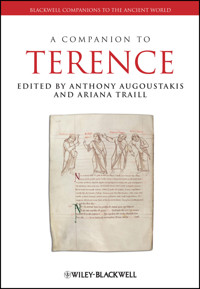
Cover image: Folio from Terence’s Comedies, mid-twelfth century. Bodleian Library, University of Oxford, MS Auct. F.2.13, folio 82vCover design by Workhaus
Contributors
Antony Augoustakis is Associate Professor of Classics at the University of Illinois (Urbana–Champaign, Illinois, USA) and editor of the journal Illinois Classical Studies. He is the author of Motherhood and the Other: Fashioning Female Power in Flavian Epic (Oxford, 2010) and Plautus’ Mercator (Bryn Mawr, 2009). He has edited the Brill Companion to Silius Italicus (Leiden, 2010), Ritual and Religion in Flavian Epic (Oxford, 2013), and co-edited with Carole Newlands Statius’ Siluae and the Poetics of Intimacy (Arethusa, 2007). He is currently working on a commentary on Statius’ Thebaid Book 8 (Oxford) and the Oxford Readings in Flavian Epic, co-edited with Helen Lovatt (Oxford).John Barsby is Emeritus Professor of Classics at the University of Otago (Dunedin, New Zealand). He has published editions of Ovid’s Amores I (Oxford, 1974), Plautus’ Bacchides (Aris & Phillips, 1986), and Terence’s Eunuchus (Cambridge, 1999) and is the editor of the new Loeb edition of Terence (Harvard, 2001). He has also edited a collection of essays Greek and Roman Drama: Translation and Performance (J.B. Metzler, 2002). He is currently working on a history of the Otago Classics Department.Peter Brown is an Emeritus Fellow of Trinity College, Oxford University (United Kingdom) and a member of the Advisory Board of the Archive of Performances of Greek and Roman Drama. He has published extensively on Greek and Roman drama, and his translation of the Comedies of Terence appeared in the Oxford World’s Classics series in January, 2008. He is co-editor with Suzana Ograjenšek of Ancient Drama in Music for the Modern Stage (Oxford, 2010).Andrew Cain is Associate Professor of Classics at the University of Colorado (Boulder, CO, USA). He is the author of The Letters of Jerome: Asceticism, Biblical Exegesis, and the Construction of Christian Authority in Late Antiquity (Oxford, 2009), St. Jerome, Commentary on Galatians (Catholic University of America Press, 2010), Jerome’s Epitaph on Paula: A Commentary on the Epitaphium Sanctae Paulae, with an Introduction, Text, and Translation (Oxford, 2013), and Jerome and the Monastic Clergy: A Commentary on Letter 52 to Nepotian, with an Introduction, Text, and Translation (Brill, 2013). He also has edited Jerome of Stridon: His Life, Writings,and Legacy (Ashgate, 2009) as well as The Power of Religion in Late Antiquity (Ashgate, 2009).David M. Christenson is Professor of Classics at the University of Arizona (Tucson, AZ, USA). He is the author of an edition with commentary of Plautus’s Amphitruo (Cambridge, 2000), and is currently working on a new edition of Plautus’s Pseudolus (Cambridge) and a book on Roman comedy for I.B. Tauris Publishers’ Understanding Classics series. He has published two volumes of translations, Roman Comedy: Five Plays by Plautus and Terence (2010) and Four Plays by Plautus: Casina, Amphitryon, Captivi, Pseudolus (2008), both with Focus Publishing, and his collection, Four Ancient Comedies About Women: Lysistrata, Samia, Hecyra, Casina, is forthcoming in 2013 (Oxford).Stavros Frangoulidis is Professor of Latin at Aristotle University of Thessaloniki (Greece). He has been co-organizer of several RICAN conferences (devoted to the study of the Ancient Novel) and co-editor of the relevant proceedings (published as Ancient Narrative Supplementa). He is the author of Handlung und Nebenhandlung: Theater, Metatheater und Gattungsbewusstein in der römischen Komödie (Stuttgart, 1997) and of Roles and Performances in Apuleius’ Metamorphoses (Stuttgart, 2001). His latest monograph is Witches, Isis and Narrative:Approaches to Magic in Apuleius’ Metamorphoses (Berlin, 2008).George Fredric Franko is Professor of Classical Studies at Hollins University (Roanoke, Virginia, USA). He holds degrees from the College of William and Mary and Columbia University. Although a generalist, much of his scholarly work has been on Plautus.Mary-Kay Gamel is Professor of Classics, Comparative Literature, and Theater Arts at the University of California (Santa Cruz, CA, USA), and has been involved in staging twenty-six productions of ancient and medieval drama, many in her own translations and versions. She has written widely on ancient drama in performance, and is completing a book on definitions of authenticity in staging this drama. She received the 2009 Scholarly Outreach Award from the American Philological Association.T.H.M. Gellar-Goad is the Teacher-Scholar Postdoctoral Fellow in Classical Languages at Wake Forest University (Winston-Salem, NC, USA). He has published on Plautus and Roman religion, and holds degrees from the University of North Carolina at Chapel Hill and from North Carolina State University. His other major research interests are Lucretius and Roman satire.Robert Germany is Assistant Professor of Classics at Haverford College (Haverford, PA, USA). He is the author of “The Politics of Roman Comedy” in the forthcoming Cambridge Companion to Roman Comedy and has a forthcoming monograph entitled Mimetic Contagion: Art and Artifice in Terence’sEunuchus. His next project is a study of the unity of time in ancient drama.Daniel P. Hanchey is Assistant Professor of Classics at Baylor University (Waco, TX, USA). He has published several articles on Cicero, and is currently working on a larger project focusing on the ideas of memory and social/commercial exchange in Cicero’s dialogues.Mathias Hanses is a Doctoral Student in Classics at Columbia University (NY, USA) and holds Master’s degrees in both Classics (M.Phil., Columbia; M.A., University of Illinois) and American Studies (University of Münster, Germany). He has published on political bias in Roman historiography, the Classics in the American Revolution, and the History of Classical Scholarship. In New York, he is preparing a dissertation on “The Life of Comedy after the Death of Plautus,” tracing the Romans’ creative engagement with the comic heritage from Terence to Seneca (and beyond).Sharon L. James earned B.A. degrees in Spanish Literature and Classical Studies at UC Santa Cruz, and her M.A. and Ph.D. in Comparative Literature at UC Berkeley. She is Associate Professor of Classics at the University of North Carolina (Chapel Hill, NC, USA). She has published articles on gender, Latin poetry, and Roman comedy, including Learned Girls and Male Persuasion (2003), a study of Roman love elegy. She is presently completing a major book project on women in New Comedy.Evangelos Karakasis is Assistant Professor of Latin at the University of Ioannina (Greece). He is the author of Terence and the Language of Roman Comedy (Cambridge, 2005), Song Exchange in Roman Pastoral (Berlin, 2011), and of several articles on Roman comedy, elegy and pastoral.Ortwin Knorr is Associate Professor of Classics at Willamette University (Salem, OR, USA), Chair of its Classical Studies Department, and Director of its Center for Ancient Studies and Archaeology. Trained in Göttingen, Heidelberg, and Berkeley, he received his Ph.D. from the University of Göttingen in Germany. He is the author of Verborgene Kunst: Argumentationsstruktur und Buchaufbau in den Satiren des Horaz (Hildesheim, 2004) and articles on Terence, Plautus, Horace, and early Christian writers.Eckard Lefèvre is Professor Emeritus of Classics at the Albert-Ludwigs-Universität at Freiburg (Germany). He holds degrees from Christian-Albrechts-Universität at Kiel (Dr. phil. 1962; habilitation 1967) and Université Marc Bloch at Strasbourg (Dr. h.c. 2000). He is author of several books on Greek and Roman literature, particularly on Roman comedy (Plautus and Terence).Timothy J. Moore is John and Penelope Biggs Distinguished Professor of Classics at Washington University in St. Louis (Missouri, USA). He holds degrees from Millersville University and the University of North Carolina. He is the author of Artistry and Ideology: Livy’s Vocabulary of Virtue (Frankfurt, 1989), Playing to the Audience: The Theater of Plautus (Austin, 1998), Roman Theatre (Cambridge, 2012), and Music in Roman Comedy (Cambridge, 2012), and of articles on ancient music, Latin literature, and Japanese kyōgen comedy.Roman Müller is Privatdozent at the University of Heidelberg (Germany). 1996 Dr. phil. in Classics (University of Heidelberg), 2001 Habilitation. He is the author of books on Terence’s dialogues (Sprechen und Sprache: Dialoglinguistische Studien zu Terenz, Heidelberg, 1997), on stylistic consciousness in Roman literature (Sprachbewußtsein undSprachvariation im lateinischen Schrifttum der Antike, München, 2001) and on poetic theory in Greek and Latin (Antike Dichtungslehre: Themen und Theorien, Tübingen, 2012). Additionally he has published numerous articles in his fields of interest: ancient comedy, literary criticism, rhetoric, history of poetry, interdependence of language and literature.Z.M. Packman is retired from North Carolina State University (Raleigh, NC, USA) after earlier service of some length at Washington University in St. Louis (Missouri) and The University of Natal in Pietermaritzburg (South Africa). She has published several articles on Roman comedy, and several on related aspects of Roman law.Alison Sharrock is Professor of Classics at the University of Manchester (UK). She is the author of several books and articles on Latin poetry and comedy, including Reading Roman Comedy: Poetics and Playfulness in Plautus and Terence (Cambridge, 2009).John H. Starks, Jr. is Assistant Professor at Binghamton University, State University of New York (Binghamton, NY, USA), with degrees from Washington & Lee University and the University of North Carolina. He has published on Punic and Syrian stereotyping in Plautus and racially tinged epigrams in Vandal-era satire (Oxford, 2011), as well as extensive work on actresses in the Greek and Roman worlds (Oxford, 2008, and two Cambridge monographs in progress). He has also adapted and directed a dozen productions of ancient comedy, including Plautus’ Curculio and Poenulus in Latin.Ariana Traill is Associate Professor of Classics at the University of Illinois (Urbana-Champaign, Illinois, USA). She holds degrees from the University of Toronto and Harvard. She is the author of Women and the Comic Plot in Menander (Cambridge, 2008) and several articles on Greek and Roman drama and its reception. She is currently working on a commentary on Plautus’ Cistellaria.Martine van Elk is Associate Professor at California State University (Long Beach, CA, USA). She has co-edited, with Lloyd Kermode and Jason Scott-Warren, a collection of essays entitled Tudor Drama Before Shakespeare (Palgrave, 2004) and is the author of numerous articles and essays on Shakespeare, early modern vagrancy, and early modern women writers. She is currently working on a comparative study of early modern English and Dutch writers.Benjamin Victor is Associate Professor of Latin Language and Literature at the Université de Montréal (Canada). His interests include textual criticism and the history of the book. He is co-editor, with Albert Derolez and Wouter Bracke, of Corpus Catalogorum Belgii (Brussels, Royal Flemish Academy, 1994–present). He is currently working on a new edition of Terence for the Budé series of classical texts.Heather Vincent is Associate Professor of Classics at Eckerd College (St. Petersburg, FL, USA). She holds degrees from Vanderbilt University, the University of Maryland, and Brown University. She is the author of book chapters and articles on Roman satire and modern humor theory. She is currently working on a book manuscript concerning cross-disciplinary approaches to verbal and performative humor in ancient satire.
Acknowledgments
As editors of this volume, we would like to thank first and foremost all the authors for their contributions and their patience for as long as this Companion took to be published. To Haze Humbert, Galen Young, Ben Thatcher, and the whole team at Wiley Blackwell, we extend a warm thank you, for the several extentions and supreme display of patience and indulgence. A lesson we have learned is that a Companion of this size does obviously meet with several delays and other obstacles along the way, but ultimately we hope that this publication will make its readers as proud as it has made us, authors and editors alike. John Thorburn, the associate editor, is to be thanked for dropping the idea for a Companion to Terence initially and for having helped at various points during this long trip. Both of us would like to thank our families and colleagues for their moral support and general patience with the endless needs of book editors.
A note on texts and translations used: the Latin text comes from the Kauer, Lindsay, and Skutsch OCT edition of Terence (1958) or from Barsby’s (2001) Loeb edition; translations of Terence are taken from Barsby’s (2001) Loeb edition (at times modified); the only exceptions are to be found in Brown’s and Christenson’s essays, since both authors have used their own published translations (2006 and 2010 respectively), as well as Victor’s who often cites a passage of Terence as given by the manuscripts. For Plautus, we used the text and translation of De Melo’s Loeb edition (2011–), at times modified, and for Menander, Arnott’s (1979–2000, with modifications from Kassel and Austin). Quotations from Donatus are taken from Wessner’s Teubner edition (1902–8). All translations of other sources are the authors’ own, unless otherwise indicated. The spelling of ancient authors and abbreviations follows the system of the OLD, OCD4, LSJ, and L’Année Philologique.
Introduction
Antony Augoustakis and Ariana Traill
1 Biography
According to the very important biography composed by C. Suetonius Tranquillus in the second century CE (Vita Terenti, edition Wessner 1902–8, translation modified and adapted from Rolfe 1914, 2.452–63) and preserved by Terence’s fourth century CE commentator, Aelius Donatus (see chapters 18 and 20, this volume), Publius Terentius Afer was born in Carthage in 195/4 BCE (or ten years later, see the fifth chapter of the Vita) and was a slave of the senator Terentius Lucanus at Rome (on the life and times of Terence, see most recently Kruschwitz 2004, 9–24 and Manuwald 2011; on later lives, such as Petrarch’s, see Ruiz Arzálluz 2010). Allegedly, Terence was good looking, and his master granted him his freedom, as well as a good grounding in liberal education. His charming looks are given as the reason for Terence’s connections with the rich and famous of the mid-republic (see chapter 6, this volume). According to the biographer, however, ultimately Terence did not profit from his relations with the mighty men, Scipio, Laelius, or Furius:
1. Publius Terentius Afer Carthagine natus servivit Romae Terentio Lucano senatori, a quo ob ingenium et formam non institutus modo liberaliter sed et mature manu missus est. quidam captum esse existimant: quod fieri nullo modo potuisse Fenestella docet, cum inter finem secundi Punici belli et initium tertii < et > natus sit et mortuus: nec, si a Numidis vel Gaetulis captus sit, ad ducem Romanum pervenire potuisse nullo commercio inter Italicos et Afros nisi post deletam Carthaginem coepto. 2. Hic cum multis nobilibus familiariter vixit, sed maxime cum Scipione Africano et C. Laelio, quibus etiam corporis gratia conciliatus existimatur: quod et ipsum Fenestella arguit contendens utroque maiorem natu fuisse, quamvis et Nepos aequales omnes fuisse tradat et Porcius suspicionem de consuetudine per haec faciat
“dum lasciviam nobilium et laudes fucosas petit,dum Africani vocem divinam inhiat avidis auribus,dum ad Philum se cenitare et Laelium pulchrum putat,dum [se amari ab his credit] in Albanum crebro rapitur ob florem aetatis suae:suis postlatis rebus ad summam inopiam redactus est.itaque e conspectu omnium < ubi > abit Graeciae in terram ultimam,mortuust Stymphali, Arcadiae < in > oppido. nil P < ublio>Scipio < tum > profuit, nil Laelius, nil Furius,tres per id tempus qui agitabant nobiles facillime:eorum ille opera ne domum quidem habuit conducticiam,saltem ut esset quo referret obitum domini servulus.”
1. Publius Terentius Afer, born at Carthage, was the slave at Rome of the senator Terentius Lucanus, who because of the young man’s talent and good looks not only gave him a liberal education, but quickly gave him his freedom. Some think that he was captured in war: Fenestella shows that such a thing could not have happened, since Terence was born and died between the end of the Second Punic War and the beginning of the Third; and even if he had been seized by Numidians or Gaetulians, he could not have come into the hands of a Roman general, because commercial activities between the Italic and the African people did not begin until after the destruction of Carthage. 2. He lived on intimate terms with many men of high rank, in particular with Scipio Africanus and Gaius Laelius. It is even thought that he won their favor by means of the beauty of his body. Fenestella, however, denies this too, maintaining that he was older than either of them. But Nepos writes that they were all three of the same age, and Porcius rouses a suspicion of great intimacy with the following words: “While he courted the wantonness of great men and their counterfeit praise, and with greedy ears he drank in the divine voice of Africanus; while he thought it fine to frequent the tables of Philus and Laelius, and he was often carried off to the Alban villa because of his youthful charms, having neglected his affairs he was reduced to utmost want. So when he withdrew from the sight of men to a remote part of Greece, he died in a town of Arcadia, Stymphalus. Publius was not at all then helped by Scipio, Laelius, Furius—the three aristocrats who at the time lived most comfortably. Their help did not give him even a rented house, to provide at least a place where his slave might announce his master’s death.”
Lesen Sie weiter in der vollständigen Ausgabe!
Lesen Sie weiter in der vollständigen Ausgabe!
Lesen Sie weiter in der vollständigen Ausgabe!
Lesen Sie weiter in der vollständigen Ausgabe!
Lesen Sie weiter in der vollständigen Ausgabe!
Lesen Sie weiter in der vollständigen Ausgabe!
Lesen Sie weiter in der vollständigen Ausgabe!
Lesen Sie weiter in der vollständigen Ausgabe!
Lesen Sie weiter in der vollständigen Ausgabe!
Lesen Sie weiter in der vollständigen Ausgabe!
Lesen Sie weiter in der vollständigen Ausgabe!
Lesen Sie weiter in der vollständigen Ausgabe!
Lesen Sie weiter in der vollständigen Ausgabe!
Lesen Sie weiter in der vollständigen Ausgabe!
Lesen Sie weiter in der vollständigen Ausgabe!
Lesen Sie weiter in der vollständigen Ausgabe!
Lesen Sie weiter in der vollständigen Ausgabe!
Lesen Sie weiter in der vollständigen Ausgabe!
Lesen Sie weiter in der vollständigen Ausgabe!
Lesen Sie weiter in der vollständigen Ausgabe!
Lesen Sie weiter in der vollständigen Ausgabe!
Lesen Sie weiter in der vollständigen Ausgabe!
Lesen Sie weiter in der vollständigen Ausgabe!
Lesen Sie weiter in der vollständigen Ausgabe!
Lesen Sie weiter in der vollständigen Ausgabe!
Lesen Sie weiter in der vollständigen Ausgabe!
Lesen Sie weiter in der vollständigen Ausgabe!
Lesen Sie weiter in der vollständigen Ausgabe!
Lesen Sie weiter in der vollständigen Ausgabe!
Lesen Sie weiter in der vollständigen Ausgabe!
Lesen Sie weiter in der vollständigen Ausgabe!
Lesen Sie weiter in der vollständigen Ausgabe!




