


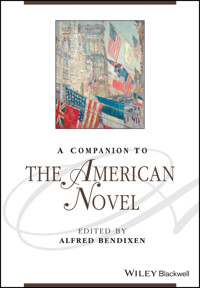
A Companion to the American Novel E-Book
42,99 €
Mehr erfahren.
- Herausgeber: John Wiley & Sons
- Kategorie: Geisteswissenschaft
- Serie: Blackwell Companions to Literature and Culture
- Sprache: Englisch
Featuring 37 essays by distinguished literary scholars, A Companion to the American Novel provides a comprehensive single-volume treatment of the development of the novel in the United States from the late 18th century to the present day.
- Represents the most comprehensive single-volume introduction to this popular literary form currently available
- Features 37 contributions from a wide range of distinguished literary scholars
- Includes essays on topics and genres, historical overviews, and key individual works, including The Scarlet Letter, Moby Dick, The Great Gatsby, Beloved, and many more.
Sie lesen das E-Book in den Legimi-Apps auf:
Seitenzahl: 1665
Veröffentlichungsjahr: 2012
Ähnliche




















Table of Contents
Cover
Blackwell Companions to Literature and Culture
Title page
Copyright page
Notes on Contributors
Preface
Acknowledgments
A Chronology of the American Novel
Part I: Historical Developments
1 The Development of the American Novel: The Transformations of Genre
2 The American Novel: Beginnings Through the American Renaissance
The American Novel in the Early National Period
The Turn to Market Values and the Novels of the 1820s and 1830s
The Novel at Mid-Century
3 The American Novel: Realism and Naturalism (1860–1920)
Realism
Naturalism
4 Modernism and the American Novel
5 Beyond Modernism: The American Novel Between the World Wars
6 The Cold War Novel: The American Novel Between 1945–1970
From V-Day to the Atomic Age to Vietnam
The Postwar War Novel
The Atomic Age, American Anxiety, and Noir Existentialism
Sex and the Suburban Reader
Resistance Through Black Humor: A Cynical America Emerges
The World Beyond Black and White: New Voices in American Literature
The Literature of Letting Go: Postmodernism and Contemporary Literature
7 The Novel in a Changing America: Multiculturalism and Other Issues (1970–Present)
Introduction: Postmodernism and Multiculturalism – Irreconcilable Contradictions?
Specific Multiethnic Literary Traditions in the Novel
Post-Postmodernism?
Conclusion
Part II: Genres and Traditions
8 Fear, Ambiguity, and Transgression: The Gothic Novel in the United States
What is “American” Gothic?
Dark Woods
Dark Waters
Dark and Gloomy Wrongs
Witches and Imperiled Maidens
Body and Body Politic
Dracula’s Children in the New World
Conclusion
9 The American Historical Romance: From James Fenimore Cooper and Nathaniel Hawthorne to Toni Morrison, Louise Erdrich, and E. L. Doctorow
National Aspirations and the Nonneutral Territory of Hawthorne’s Historical Romances
Faulkner’s Historiographical Romance
Inheriting Faulkner, I: The Case of Toni Morrison
Inheriting Faulkner II: The Case of Louise Erdrich
The Haunted House of American Historical Fiction: An Epilogue
10 Making This Whole Nation Feel: The Sentimental Novel in the United States
Sentimentalism and Enlightenment Political Theory
Sentimental Philosophy
Early American Sentimentalism
Pre-Civil War Sentimentalism
Recent Critical Approaches to Sentimentalism
11 Social Protest, Reform, and the American Political Novel
12 The American War Novel Tradition and the Individual Soldier
13 From the Sublime to the Ridiculous: Comic Traditions in the American Novel
Traditions of Comic Content: Folk Characters, Plots, and Techniques
Traditions of Humorous Form
Final Thoughts
14 Plotting a Way Home: The Jewish American Novel
15 Chicano/a Traditions in the American Novel
16 African American Traditions and the American Novel
17 The American Novel of Mystery, Crime, and Detection
18 O Brave New Worlds: Science Fiction and the American Novel
Introduction
The Discovery of Science Fiction
The Beginnings of Science Fiction
The Pulp Tradition
The Rise of the Science Fiction Novel
The Uses of Science Fiction
19 Dreaming of a White Future: Mary E. Bradley Lane, Edward Bellamy, and the Origins of the Utopian Novel in the United States
20 Queer Theory and the American Novel
21 The American Short-Story Cycle: Out From the Novel’s Shadow
Part III: Major Texts
22 The Woman’s Law in Hawthorne’s The Scarlet Letter
23 Writ in Water: The Books of Melville’s Moby-Dick
The Book of Queequeg
The Book of Ahab
The Book of Ishmael
The Book of Moby Dick
24 Wonder of Wonders: Harriet Beecher Stowe’s Uncle Tom’s Cabin
25 Citational Strategies and Literary Traditions: Placing Henry James’s The Portrait of a Lady
26 Mark Twain’s Adventures of Huckleberry Finn: A Child’s Search for Comfort and Peace
27 What Women Want: Kate Chopin’s The Awakening
28 Private Fleming’s Various Battles: Stephen Crane’s The Red Badge of Courage
29 Lily’s Story: Edith Wharton’s House of Mirth
30 The Confessional Narration of Ernest Hemingway’s The Sun Also Rises
31 Fitzgerald’s The Great Gatsby and the Myth of the Land
32 Ground Zero: Faulkner’s The Sound and the Fury
33 A Bigger Vision: Richard Wright’s Native Son and the Great American Novel
A City of Extremes
A Blizzard of Whiteness
34 Our Invisible Man: The Aesthetic Genealogy of US Diversity
35 The Visionary Exuberance of Saul Bellow’s The Adventures of Augie March
36 The Flesh and the Word: Toni Morrison’s Beloved
37 A Different Kind of Love Story: Cormac McCarthy’s The Road
Selected Readings in the Genres of the American Novel
1 The Gothic Tradition in the American Novel
2 American Historical Novels
3 Feminist Traditions in the American Novel
4 American Political and Social Novels
5 American Novels About War
6 American Comic Novels
7 Westerns by American Novelists
8 American Novels of Crime and Detection
9 American Novels of Science Fiction
10 American Gay and Lesbian Novels
11 Jewish American Novels
12 African American Novels
13 Latino/a American Novels
Index
Blackwell Companions to Literature and Culture
This series offers comprehensive, newly written surveys of key periods and movements and certain major authors, in English literary culture and history. Extensive volumes provide new perspectives and positions on contexts and on canonical and post-canonical texts, orientating the beginning student in new fields of study and providing the experienced undergraduate and new graduate with current and new directions, as pioneered and developed by leading scholars in the field.
Published Recently
61. A Companion to Thomas HardyEdited by Keith Wilson62. A Companion to T. S. EliotEdited by David E. Chinitz63. A Companion to Samuel BeckettEdited by S. E. Gontarski64. A Companion to Twentieth-Century United States FictionEdited by David Seed65. A Companion to Tudor LiteratureEdited by Kent Cartwright66. A Companion to Crime FictionEdited by Charles Rzepka and Lee Horsley67. A Companion to Medieval PoetryEdited by Corinne Saunders68. A New Companion to English Renaissance Literature and CultureEdited by Michael Hattaway69. A Companion to the American Short StoryEdited by Alfred Bendixen and James Nagel70. A Companion to American Literature and CultureEdited by Paul Lauter71. A Companion to African American LiteratureEdited by Gene Jarrett72. A Companion to Irish LiteratureEdited by Julia M. Wright73. A Companion to Romantic PoetryEdited by Charles Mahoney74. A Companion to the Literature and Culture of the American WestEdited by Nicolas S. Witschi75. A Companion to Sensation FictionEdited by Pamela K. Gilbert76. A Companion to Comparative LiteratureEdited by Ali Behdad and Dominic Thomas77. A Companion to Poetic GenreEdited by Erik Martiny78. A Companion to American Literary StudiesEdited by Caroline F. Levander and Robert S. Levine79. A New Companion to the GothicEdited by David Punter80. A Companion to the American NovelEdited by Alfred BendixenThis edition first published 2012
© 2012 Blackwell Publishing Ltd
Blackwell Publishing was acquired by John Wiley & Sons in February 2007. Blackwell’s publishing program has been merged with Wiley’s global Scientific, Technical, and Medical business to form Wiley-Blackwell.
Registered Office
John Wiley & Sons Ltd, The Atrium, Southern Gate, Chichester, West Sussex, PO19 8SQ, UK
Editorial Offices
350 Main Street, Malden, MA 02148-5020, USA
9600 Garsington Road, Oxford, OX4 2DQ, UK
The Atrium, Southern Gate, Chichester, West Sussex, PO19 8SQ, UK
For details of our global editorial offices, for customer services, and for information about how to apply for permission to reuse the copyright material in this book please see our website at www.wiley.com/wiley-blackwell.
The right of Alfred Bendixen to be identified as the author of the editorial material in this work has been asserted in accordance with the UK Copyright, Designs and Patents Act 1988.
All rights reserved. No part of this publication may be reproduced, stored in a retrieval system, or transmitted, in any form or by any means, electronic, mechanical, photocopying, recording or otherwise, except as permitted by the UK Copyright, Designs and Patents Act 1988, without the prior permission of the publisher.
Wiley also publishes its books in a variety of electronic formats. Some content that appears in print may not be available in electronic books.
Designations used by companies to distinguish their products are often claimed as trademarks. All brand names and product names used in this book are trade names, service marks, trademarks or registered trademarks of their respective owners. The publisher is not associated with any product or vendor mentioned in this book. This publication is designed to provide accurate and authoritative information in regard to the subject matter covered. It is sold on the understanding that the publisher is not engaged in rendering professional services. If professional advice or other expert assistance is required, the services of a competent professional should be sought.
Library of Congress Cataloging-in-Publication Data
A companion to the American novel / edited by Alfred Bendixen.
p. cm.
Includes bibliographical references and index.
ISBN 978-1-4051-0119-6 (cloth)
ISBN 978-1-1182-2035-1 (epub)
ISBN 978-1-1182-2038-2 (mobi)
ISBN 978-1-1182-2039-9 (epdf)
1. American fiction–History and criticism. 2. National characteristics, American, in literature. 3. Literature and society–United States. I. Bendixen, Alfred.
PS371.C714 2012
813.009–dc23
2011042863
A catalogue record for this book is available from the British Library.
Notes on Contributors
Juan J. Alonzo is Associate Professor of English at Texas A&M University, where he teaches courses in Mexican American literature and culture and Film Studies. He specializes in representations of ethnicity in American literature and film, and on issues of adaptation as they relate to ethnic identity. His essays have appeared in Aztlán: A Journal of Chicano Studies, Western American Literature, and Recovering the U.S. Hispanic Literary Heritage. Alonzo’s book, Badmen, Bandits, and Folk Heroes: The Ambivalence of Mexican American Identity in Literature and Film (2009), is a comparative study of the literary and cinematic representation of Mexican American masculine identity from early twentieth-century adventure stories and movie Westerns through contemporary self-representations by Chicano/a writers and filmmakers.
Sharon Becker currently teaches American literature as a Visiting Assistant Professor of English at Towson University, MD. She received her PhD from Claremont Graduate University where she also served as associate editor of Women’s Studies: An Interdisciplinary Journal. She specializes in the literature and culture of the first half of the twentieth century, with a particular focus on men and issues of gender and identity. Her dissertation investigated the literature produced by male writers living in Los Angeles in the 1930s, and she has also presented papers on John Fante, Henry James, and Jack Kerouac.
Susan Belasco is Professor of English and Chair of the Department of English at the University of Nebraska, Lincoln. Her research and teaching interests include nineteenth-century American literature and culture, women’s literature, and digital humanities. She is the editor of Margaret Fuller’s Summer on the Lakes and Fanny Fern’s Ruth Hall. She is the co-editor of “These Sad but Glorious Days”: Dispatches from Europe, 1846–1850 by Margaret Fuller, Periodical Literature in Nineteenth-Century America, Approaches to Teaching Uncle Tom’s Cabin, and The Bedford Anthology of American Literature. A past president of the Research Society for American Periodicals, she is also the editor of Walt Whitman’s periodical poetry for the The Walt Whitman Archive and serves on the advisory board for The Uncle Tom’s Cabin and American Culture Archive. Her most recent book is Stowe in Her Own Time.
Alfred Bendixen is Professor of English at Texas A& M University. He is the founder of the American Literature Association, which he currently serves as Executive Director. Much of his scholarship focuses on the recovery of unjustly neglected literary texts, especially by women writers, and the exploration of neglected genres, including the ghost story, detective fiction, science fiction, and travel writing. His books include Haunted Women (1985), an edition of the composite novel, The Whole Family (1986), “The Amber Gods” and other stories by Harriet Prescott Spofford (1989), and Edith Wharton: New Critical Essays (1992). He is the associate editor of the Continuum Encyclopedia of American Literature (1999), and the co-editor of the Cambridge Companion to American Travel Writing (2009) and A Companion to the American Short Story, published by Wiley-Blackwell in 2010.
Emily Miller Budick holds the Ann and Joseph Edelman Chair in American Studies at The Hebrew University of Jerusalem, where she has taught since 1972. Her major publications include Emily Dickinson and the Life of Language: A Study in Symbolic Poetics (1985), Fiction and Historical Consciousness: The American Romance Tradition (1989), Engendering Romance: Women Writers and the Hawthorne Tradition, 1850–1990 (1994), Nineteenth-Century American Romance: Genre and the Democratic Construction of Culture (1996), Blacks and Jews in Literary Conversation (1998), Aharon Appelfeld’s Fiction: Acknowledging the Holocaust (2004), and Psychotherapy and the Everyday Life (2008). She is currently at work on a book entitled Psychoanalysis and the “Subject” of the Holocaust.
Deborah Carlin is Professor of English at the University of Massachusetts Amherst. She is the author of Cather, Canon, and the Politics of Reading (1992), and the editor of Queer Cultures (2003), a course textbook and essay anthology, and the Broadview Edition of Sarah Orne Jewett’s The Country of the Pointed Firs and Dunnet Landing Tales (2009). Professor Carlin has published articles and reviews on Willa Cather as well as on Edith Wharton; African American literary criticism and theory; nineteenth-century American women’s philanthropic fiction; trauma, narrative, and multiple personality; and on graduate internship programs in the humanities. Her most recent article is “The Intersectional Potential of Queer Theory: An Example from a General Education Course in English” in a special edition of New Directions in Teaching and Learning.
Leonard Cassuto is Professor of English at Fordham University. He is the author of Hard-Boiled Sentimentality: The Secret History of American Crime Stories, which was nominated for the Edgar and Macavity Awards and named one of the Ten Best Books of 2008 in the crime and mystery category by the Los Angeles Times. Cassuto’s other books include The Inhuman Race: The Racial Grotesque in American Literature and Culture (1997) and five edited volumes, including The Cambridge History of the American Novel (2011), of which he is the general editor. Cassuto is also an award-winning journalist who writes about subjects ranging from science to sports, and a columnist on graduate education for the Chronicle of Higher Education.
Charles L. Crow is Professor Emeritus of English at Bowling Green State University in Ohio. He is the author of American Gothic, monographs on Maxine Hong Kingston and Janet Lewis, and articles on such authors as W. D. Howells, Mark Twain, Frank Norris, Willa Cather, and Edith Wharton, and on California as a literary region. He is the editor of American Gothic 1787–1916: An Anthology (1999), and A Companion to the Regional Literatures of America (2003), and co-editor (with Howard Kerr) of The Occult in America (1983) and (with Howard Kerr and John W. Crowley) of The Haunted Dusk: American Supernatural Fiction, 1820–1920 (1983).
Martha J. Cutter is Associate Professor of English and African American Studies at the University of Connecticut. Since 2006 she has been the editor-in-chief of MELUS: Multi-Ethnic Literature of the United States and before that was the senior editor of Legacy: A Journal on American Women Writers for two years. Her first book, Unruly Tongue: Language and Identity in American Women’s Writing (1999) won the 2001 Nancy Dasher Award from the College English Association. Her second book, Lost and Found in Translation: Contemporary Ethnic American Writing and the Politics of Language Diversity, was published in 2005. Her articles have appeared in American Literature, African American Literature, Callaloo, Women’s Studies, Studies in American Literary Realism, CEA Critic, Arizona Quarterly, MELUS, Legacy, Criticism, and in the collections Mixed Race Literature (2002), Passing and the Fictions of Identity (1996), and Passing in the Works of Charles Chesnutt (2009). She is currently at work on a book on the passing narrative in US history and literature.
Melvin Donalson is Professor of English at California State University, Los Angeles, and a published poet, fiction writer, and essayist. He is the editor of Cornerstones: An Anthology of African American Literature (1996), and one of the associate editors of the Encyclopedia of 20th Century African American Literature (2007). In addition to his creative works, he has written several books on cinema: Black Directors in Hollywood (2003), Masculinity in the Interracial Buddy Film (2006), and Hip Hop in American Cinema (2007).
Olivia Carr Edenfield is Associate Professor of English at Georgia Southern University, where she has divided her time between teaching and administration. She has published on William Faulkner in The Southern Literary Journal, Ernest Hemingway in The Hemingway Review, and both John Ashbury and Elizabeth Bishop in The Explicator. Her extensive interview with the short story writer Andre Dubus appeared in the 2010 issue of Resources for American Literary Study. She is currently editing Dubus’s letters and interviews and serves as his authorized biographer. She has directed symposiums on fiction for the American Literature Association and is a member of its executive board.
Monika Elbert is Professor of English at Montclair State University in New Jersey and editor of the Nathaniel Hawthorne Review. She has published widely on nineteenth-century American authors, especially on Hawthorne, and has recently co-edited a collection, Culinary Aesthetics and Practices in 19th-Century American Literature (2009), which includes her essay on Hawthorne’s nationalism and food preferences. She also recently edited the collection, Enterprising Youth: Social Values and Acculturation in 19th-Century American Children’s Literature (2008), which includes her essay on charity in Alcott’s Christmas stories. She is features editor of the enriched e-Book version of the Penguin The Scarlet Letter (2008), for which she contributed several essays, a filmography, extensive notes, chronologies, and contemporary book reviews of the novel. Her earlier work on Hawthorne included an introduction and critical notes to the Washington Square Press edition of The Scarlet Letter (1994) and a book, Encoding the Letter “A”: Gender and Authority in Hawthorne’s Early Fiction (1990). Part of her final chapter on Hester Prynne was reprinted as “Hester and the New Feminine Vision” in Bloom’s Major Literary Characters: Hester Prynne (ed. Harold Bloom, 2004).
Kathy Fedorko is Professor of English at Middlesex County College, NJ, as well as the Director of the College’s Center for the Enrichment of Learning and Teaching, which she helped found. She is the author of Gender and the Gothic in the Fiction of Edith Wharton, as well as many articles about Edith Wharton. She has served as president of the Edith Wharton Society and as assistant editor and member of the editorial board of the Edith Wharton Review.
Peter L. Hays is Professor Emeritus of the University of California, Davis, having retired in 2004 after having taught there for 38 years, particularly twentieth-century American literature, and especially the modernist period. He has published five books – The Limping Hero, A Concordance to Hemingway’s In Our Time, Ernest Hemingway, Teaching Hemingway’s The Sun Also Rises, and Arthur Miller’s Death of a Salesman – and over 125 articles and notes; he is also News and Notes editor of The Fitzgerald Newsletter.
Maria Karafilis is Professor of English at the California State University, Los Angeles, where she currently holds the Bailey Endowed Chair and Directorship of the American Communities Program. Her publications on writers including Mary Antin, Sutton Griggs, Catharine Maria Sedgwick, and Harriet Beecher Stowe have appeared in journals such as Arizona Quarterly, American Literary Realism, African American Review, and American Transcendental Quarterly. She also edited and wrote the introduction for a new edition of Catharine Maria Sedgwick’s The Linwoods (2002).
Wyn Kelley, Senior Lecturer in the Literature section at MIT, is the author of Melville’s City: Literary and Urban Form in Nineteenth-Century New York (1996) and Herman Melville: An Introduction (2008), as well as a number of essays in collections; she is the editor of A Companion to Herman Melville (2006). She has served as associate editor of Leviathan: A Journal of Melville Studies, and is currently associate editor of MEL (Melville Electronic Library) and a founding member of the Melville Society Cultural Project (melvillesociety.org). As part of the New Media Literacies team at MIT, she helped write a Teachers’ Strategy Guide for Reading in a Participatory Culture (2008), a curriculum for teaching Moby-Dick in a new media environment.
Michael J. Kiskis was Leonard Tydings Grant Professor of American Literature at Elmira College, NY, where he taught the survey of American literature as well as courses on the American Renaissance, American Realism and Naturalism, Herman Melville, Walt Whitman, and Mark Twain. He died in May, 2011. He was editor of Mark Twain’s Own Autobiography: The Chapters of the North American Review (2nd edn, 2010) and co-editor of Constructing Mark Twain: New Directions in Scholarship. He was past president of the Mark Twain Circle of America and of the Northeast Modern Language Association and past editor of Studies in American Humor and Modern Language Studies. He was a contributor to American Literary Scholarship for which he wrote the late nineteenth century review chapter and the chapter devoted to Mark Twain. He also edited a special Mark Twain issue of American Literary Realism (2009). In addition to more than 30 essays devoted to Mark Twain, he also published articles on Charlotte Perkins Gilman, Edgar Allan Poe, and on questions of pedagogy.
Judith Yaross Lee, Professor of Communication Studies in the Scripps College of Communication at Ohio University, is the author of Garrison Keillor: A Voice of America (1991), Defining New Yorker Humor (2000), and some three dozen essays and journal articles on the history and rhetoric of American popular and literary culture, including annual reviews of scholarship for Studies in American Humor. With Joseph W. Slade, she edited Beyond the Two Cultures: Essays on Science, Technology, and Literature (1990) and The Midwest (2004), one of eight volumes in the award-winning Greenwood Encyclopedia of American Regional Cultures. A past president of the American Humor Studies Association and 2009–11 president of the Research Society for American Periodicals, she is currently at work on Twain’s Brand: Humor in Contemporary American Culture.
Richard Lehan, Emeritus Professor of English at UCLA, has written many books and essays on modern literary movements. His most recent books include The City in Literature (1998), Realism and Naturalism: The Novel in an Age of Transition (2005), and Literary Modernism and Beyond: The Extended Vision and the Realms of the Text (2009). He is also the author of two books on Scott Fitzgerald and two more on Theodore Dreiser. Presently he is completing a book about the literary response to the transformation of American ideals during the move from a frontier nation to world empire.
Robert M. Luscher is Professor of English, Graduate Program Chair, and Faculty Director of the Thompson Scholars Learning Community at the University of Nebraska at Kearney. He is the author of John Updike: A Study of the Short Fiction (1993) and has published numerous essays on the short-story cycle, including “The Short Story Sequence: An Open Book,” “ ‘In Search of Lost Time’: Clark Blaise’s Pittsburgh Stories as a Short Story Sequence,” “Updike’s Olinger Stories: New Light among the Shadows,” “(Re)closure in the Short Story Sequence: Vietnam Redux in Robert Olen Butler’s A Good Scent from a Strange Mountain,” “The Visionary in Ernest Gaines’s Bloodline,” and “Seeing the Forest for the Trees: The ‘Intimate Connection’ of Mary Wilkins Freeman’s Six Trees.” He and Jeff Birkenstein are co-editing a collection of essays entitled Cultural Representation and the International Short Story Sequence.
Wendy Martin is the Chair of the Department of English and Professor of American Literature and American Studies at Claremont Graduate University, CA. She is also Vice Provost and Director of Transdisciplinary Studies at CGU and holds the George and Ronya Kozmetsky Endowed Chair of Transdisciplinary Studies. The author of numerous articles and reviews on American women writers and American literature and culture, she founded and continues to edit Women’s Studies: An Interdisciplinary Journal. Her books include The American Sisterhood: Feminist Writings from the Colonial Times to the Present (1972), An American Triptych: The Lives and Work of Anne Bradstreet, Emily Dickinson, and Adrienne Rich (1984), New Essays on The Awakening (1988), We Are the Stories We Tell: Best Short Fiction by North American Women Writers Since 1945 (1990), Colonial American Travel Narratives (1994), The Beacon Book of Essays by Contemporary American Women (1996), The Cambridge Companion to Emily Dickinson (2002), More Stories We Tell: Best Short Fiction by North American Women Writers Since 1970 (2004), The Art of the Short Story (2006), Emily Dickinson (2007), and Best of Times, Worst of Times: Contemporary American Short Stories from the New Gilded Age (2011). She also serves on the editorial board of the Heath Anthology of American Literature.
James H. Meredith, President of the Ernest Hemingway Foundation and Society, has researched war literature across the United States, in the United Kingdom, Canada, Germany, France, Switzerland, Italy, Spain, China, Belgium, and the Netherlands. He has received multiple research grants to work in the British Library and the Imperial War Museum, leading to the publication of Understanding the Literature of World War II (1999); Understanding the Literature of World War I (2004); “Fitzgerald and War,” in A Historical Guide to F. Scott Fitzgerald (2004); and “Tender Is the Night and the Calculus of Modern War,” in Twenty-First Century Readings of Tender is the Night (2007). He is contributing editor of War, Literature and the Arts: An International Journal of the Arts, and the author of published essays on Andre Dubus, Henry Adams, Ernest Hemingway, F. Scott Fitzgerald, Stephen Crane, Edith Wharton, Robert Graves, Siegfried Sassoon, Wilfred Owen, the American Civil War, World Wars I and II, and the trauma of modern war. He retired from the US Air Force as a lieutenant colonel after 25 years of service and was Professor of English at the Air Force Academy. He is currently a member of the Core Faculty at Capella University.
James Nagel is the Eidson Distinguished Professor of American Literature at the University of Georgia and the president of the Society for the Study of the American Short Story. Early in his career he founded the scholarly journal Studies in American Fiction and the widely influential series Critical Essays on American Literature, which published 156 volumes of scholarship. Among his 22 books are Stephen Crane and Literary Impressionism (1981), Hemingway in Love and War (1996) (which was made into a Hollywood film), Hemingway: The Oak Park Legacy (1996), The Contemporary American Short-Story Cycle (2004), Anthology of The American Short Story (2007), and Wiley-Blackwell’s A Companion to the American Short Story (2010), co-edited with Alfred Bendixen. He has been a Fulbright Professor as well as a Rockefeller Fellow. He has published some 80 articles in the field and lectured on American literature in 15 countries. His current projects include a study of race and culture in the works of four writers from New Orleans.
Marianne Noble is an Associate Professor of Literature at American University in Washington, DC. She is the author of The Masochistic Pleasures of Sentimental Literature (2000), which won a Choice Outstanding Book Award. She has published numerous articles on Harriet Beecher Stowe, Emily Dickinson, Frederick Douglass, Nathaniel Hawthorne, and other nineteenth-century American authors, and recently co-edited a collection of essays entitled Dickinson and Philosophy. She is currently working on a book called Sympathy and the Quest for Genuine Human Contact in American Romantic Literature.
Jean Pfaelzer is Professor of English, Asian Studies, and Women’s Studies at the University of Delaware. She is a Senior Fulbright Scholar (2011) and a Library of Congress Scholar. She is the author of The Utopian Novel in America: The Politics of Form (1985), Parlor Radical: Rebecca Harding Davis and the Origins of American Social Realism (1996), and the award-winning Driven Out: The Forgotten War Against Chinese Americans (2007). She edited A Rebecca Harding Davis Reader (1995) and a critical edition of the first American all-female utopia, Mizora: A Prophecy of the Future by Mary E. Bradley Lane (2005). She writes for such websites as The Globalist and Huffington Post on issues of labor and immigration. Her forthcoming book is Of Human Bondage: The History of Slavery in California.
Eric S. Rabkin is Arthur F. Thurnau Professor and Professor of English Language and Literature at the University of Michigan in Ann Arbor. He leads the Genre Evolution Project investigating culture as a complex adaptive system. His recent courses deal with fantasy, science fiction, technology and the humanities, and graphic narrative. His written, edited, co-written, and co-edited publications include over 30 books, including Narrative Suspense: “When Slim Turned Sideways …” (1973), The Fantastic in Literature (1976), Science Fiction: History, Science, Vision (1977), Arthur C. Clarke (1979), Mars: A Tour of the Human Imagination (2005), Visions of Mars (2011), and a taped lecture series entitled Masterpieces of the Imaginative Mind: Literature’s Most Fantastic Works (2007). His work has been supported by the American Council of Learned Societies and the American Philosophical Society. In 2006, he was voted the outstanding teacher at the University of Michigan. In 2010 he received the Science Fiction Research Association’s Pilgrim Award for lifetime contributions to science fiction scholarship.
Jeanne Campbell Reesman is Professor of English and Director of the PhD program in English at the University of Texas at San Antonio, where she has also served as Graduate Dean and Director of English, Classics, Philosophy, and Communication. Her publications include over 50 monographs, collections, textbooks, and editions from distinguished presses including the University of Georgia Press, Oxford, Macmillan, Stanford, University of Pennsylvania, and Éditions Phébus (Paris). She has received grants from the US Fulbright Commission, the National Endowment for the Humanities, the Huntington Library, the American Philosophical Society, and the National Science Foundation. Her written books include the critical biography, Jack London’s Racial Lives (2009), Jack London: A Study of the Short Fiction (1999), Jack London, Revised Edition (with Earle Labor), and American Designs: The Late Novels of James and Faulkner (1991). Edited books include Jack London, Photographer (with Sara S. Hodson and Philip Adam, 2010), Jack London: One Hundred Years a Writer (with Sara S. Hodson, 2002), Trickster Lives: Culture and Myth in American Literature (2001), No Mentor but Myself: Jack London on Writing and Writers (with Dale Walker, 2000), Speaking the Other Self: American Women Writers (1997), Rereading Jack London (with Leonard Cassuto, 1996). Reesman is also author of the reference book Companion to Jack London (2011). She is editor of volume C: American Literature 1865–1914 of the Norton Anthology of American Literature. Her book in progress is entitled Mark Twain Versus God: The Story of a Relationship.
Chip Rhodes is Associate Professor and Chair of the English Department at Western New England College. He is the author of two books, Structures of the Jazz Age: Mass Culture, Progressive Education and Racial Discourse in American Modernism (1998) and Politics, Desire and the Hollywood Novel (2008). He was a 2004 Fulbright Lecturer in American Studies in Germany
John Carlos Rowe is USC Associates’ Professor of the Humanities and Chair of the Department of American Studies and Ethnicity at the University of Southern California. He was Professor of English and Comparative Literature at the University of California, Irvine from 1975–2004, where he was a founding member of the Critical Theory Institute.He is the author of Henry Adams and Henry James: The Emergence of a Modern Consciousness (1976), Through the Custom-House: Nineteenth-Century American Fiction and Modern Theory (1982), The Theoretical Dimensions of Henry James (1984), At Emerson’s Tomb: The Politics of Classic American Literature (1997), The Other Henry James (1998), Literary Culture and U.S. Imperialism: From the Revolution to World War II (2000), The New American Studies (2002), Afterlives of Modernism: Liberalism, Transnationalism, and Political Critique (2011), and The Cultural Politics of the New American Studies (2011), as well as over 150 scholarly essays and critical reviews. He is the editor of The Vietnam War and American Culture (1991), New Essays on The Education of Henry Adams (1996), “Culture” and the Problem of the Disciplines (1998), Post-Nationalist American Studies (2000), A Concise Companion to American Studies (2010), and A Historical Guide to Henry James (2011). His current scholarly projects are Our Henry James, Culture and U.S. Imperialism since World War II, and The Rediscovery of America: Multicultural Literature and the New Democracy.
Derek Parker Royal is the founder and executive editor of Philip Roth Studies. His essays on American literature and graphic narrative have appeared in a variety of scholarly publications, and he has been the guest editor of eight special journal issues devoted to Jewish American literature, multiethnic writings, and comics studies. He is the editor of Philip Roth: New Perspectives on an American Author (2005) and Unfinalized Moments: Essays in the Development of Contemporary Jewish American Fiction (2011). He is currently working on two book manuscripts, The Hernandez Brothers: Conversations and More Than Jewish Mischief: Narrating Subjectivity in the Later Fiction of Philip Roth.
Ben Siegel was Professor of English at Cal Poly, Pomona University where he taught for 52 years. He died in January 2010. He was the author or editor of 16 books and numerous articles and reviews. His books include The Puritan Heritage: America’s Roots in the Bible (1964), Isaac Bashevis Singer (1969), The Controversial Sholem Asch (1976), The American Writer in the University (1989), and several volumes of “Conversations” with such notable authors as Robert Penn Warren and Saul Bellow (1995), edited with Gloria Cronin. With Melvin Friedman he edited collections of essays on the American novel since 1960, and after his friend’s death he collaborated with Jay Halio on two volumes of essays in honor of that distinguished scholar: American Literary Dimensions (1999) and Comparative Literary Dimensions (2000). With Jay Halio, he went on to produce several collections of essays: Daughters of Valor: Contemporary Jewish American Women Writers (1996), Turning Up the Flame: Philip Roth’s Later Novels (2005), and Playful and Serious: Philip Roth as a Comic Writer (2009).
Valerie Smith is the Woodrow Wilson Professor of Literature and Professor of English and African American Studies at Princeton University. Her research and teaching interests include African American literature and culture, black feminist theory, autobiography, black film, and twentieth-and twenty-first-century U S literature. She is the author of Self-Discovery and Authority in Afro-American Narrative (1991), Not Just Race, Not Just Gender: Black Feminist Readings (1998) and the forthcoming Toni Morrison: Writing the Moral Imagination, as well as numerous articles on African American literature and visual culture and black feminist theory. She is also the editor of African American Writers, Representing Blackness: Issues in Film and Video, and New Essays on Song of Solomon, and co-editor of a special issue of Black American Literature Forum (now African American Review) on black film with Camille Billops and Ada Gay Griffin, and a special issue of Signs with Marianne Hirsch on gender and cultural memory. At present, she is completing a book on the Civil Rights movement in cultural memory.
Emily Toth is Professor of English and Women’s Studies at Louisiana State University and the author or editor of 11 books, including five on Kate Chopin: two biographies, Kate Chopin (1990) and Unveiling Kate Chopin (1999); two collections of papers, A Kate Chopin Miscellany (1979) and Kate Chopin’s Private Papers (1998); and the Chopin short story collection, A Vocation and a Voice (1991). Emily Toth’s other books include a prizewinning historical novel Daughters of New Orleans (1983) and a biography recently bought by Sandra Bullock for a major motion picture, Inside Peyton Place: the Life of Grace Metalious (1981, 2000). Emily Toth also writes the “Ms. Mentor” online advice column on the Chronicle of Higher Education’s Career Network (http://www.chronicle.com/jobs) and has published Ms. Mentor’s Impeccable Advice for Women in Academia (1997) and Ms. Mentor’s New and Ever More Impeccable Advice for Women and Men in Academia (2008). She gives gossip and advice to all.
Andrew Warnes is a Reader in American Studies at the School of English, Leeds University, UK. He is interested in the history of the modern novel, African American writing and culture, and the relationship between literary creation and food among other forms of material culture. His principal publications include Savage Barbecue: Race, Culture and the Invention of America’s First Food (2008), Richard Wright’s Native Son (2007), and Hunger Overcome?: Food and Resistance in Twentieth-Century African-American Literature (2004).
Philip Weinstein is Alexander Griswold Cummins Professor of English at Swarthmore College. His earlier books focused on Henry James and on the English novel from Dickens to Joyce. More recently his work has centered on (or abidingly attended to) Faulkner. These books include Faulkner’s Subject: A Cosmos No One Owns (1992), What Else But Love? The Ordeal of Race in Faulkner and Morrison (1996), Unknowing: The Work of Modernist Fiction (2005), and, most recently, Becoming Faulkner (2010).
Greg W. Zacharias is Professor of English and the founder and director of the Center for Henry James Studies and coordinator of the Humanities Research Group at Creighton University. He is project director and co-general editor (with Pierre A. Walker) of The Complete Letters of Henry James (2006–present). Zacharias is editor of A Companion to Henry James (2008) and author of Henry James and the Morality of Fiction (1993). He has also published a number of essays on Henry James and on Mark Twain. He is executive director of the Henry James Society.
Preface
Alfred Bendixen
A Companion to the American Novel offers a critical guide to what is now arguably the most popular, most studied, most admired, and most scrutinized genre in American writing. The American novel is the literary form that has come to define the culture of the United States in all of its glories and imperfections. It is the form we turn to both for the highest level of aesthetic appreciation and for the easiest kinds of escape. It is a form with a substantial record of confronting political and social injustice powerfully and effectively, but also one that has been intimately involved in erecting the social and moral framework that has enabled some of the ugliest aspects of American life: the novel has both supported the formation of various prejudices and been a vehicle for exposing, assailing, or ridiculing these forms of bigotry. In short, the novel is the crucial form for understanding the complexities of race, class, and gender in the United States. Yet it is also a genre with a remarkable devotion to psychological insight. The novelist can choose to move inward from social realities into the labyrinths and wonders of the human mind, charting a realm that measures the limitations and the possibilities of the imagination, or exploring frustrations and aspirations that are fundamentally emotional or spiritual. Whether its landscape is psychological or social or both, the novel is unrivalled in its ability to examine multiple aspects of American life.
The American novel emerged from a rich literary tradition that included many distinguished British and European predecessors, and its development was marked by interactions with the literary productions of other countries. Thus the history of the American novel is not a simple story of American exceptionalism, but a complex story of how different modes and genres developed over time, sometimes resulting in new genres or subgenres and sometimes leading to stunning transformations in form and meaning. Its central theme is diversity. The traditions of the American novel include writers as different as Hemingway and Faulkner, Hawthorne and Morrison, Melville and Twain, James and Bellow. The form embraces detective stories and science fiction as well as epics, picaresque narratives, and war novels. It welcomes both comedy and tragedy, sometimes within the same novel. It includes tales of bold triumphs as well as of moving tragedy. A Companion to the American Novel emphasizes the wide diversity of purposes and modes that distinguishes the American novel as a literary form with a long and complicated history.
This book is divided into three large categories. Part I offers a series of essays that provide a history of the American novel from its beginnings until the present. The chapters here provide an overview of major movements and historical developments, placing the most important works within a larger context. The chapters that comprise Part II of this volume deal with specific genres, traditions, and topics. Although it is not possible to cover every issue important to the development of the American novel, the 14 essays here offer insightful introductions to several genres that have been particularly important to the American literary imagination and delineate the qualities that mark some of the most important traditions. The final Part of this Companion presents perceptive studies of 16 major novels tracing the development of the form from The Scarlet Letter (1850) to The Road (2006). The book is introduced by a substantial chronology, a list of the most important examples of the genre by date of publication, and concludes with a series of lists of representative works for some of the most important traditions and genres, thus providing the reader with directions for further exploration.
The 36 scholars who have contributed to this volume have been given both general guidelines and a great deal of freedom. The contributors, who include some of the most eminent scholars currently working in American literary studies, have been asked to provide essays that were informative and insightful, perceptive and accessible, original and reliable. Their work provides a wide range of responses, illustrating the diverse ways in which scholars now approach the American novel. Thus some essays provide a very broad overview of genres while others focus sharply on relatively few key examples. The totality constitutes a complex introduction to the rich diversity of the American novel and current scholarship on this literary form.
Acknowledgments
The editor wishes to express his deep appreciation to the scholars who contributed essays to this volume and responded professionally, promptly, and cheerfully to requests for revisions. I also want to thank Emma Bennett and Ben Thatcher at Wiley-Blackwell who provided generous encouragement at every step. I am grateful for the skilled work of the editorial team at Wiley-Blackwell, particularly Isobel Bainton and Helen Gray. Special thanks and appreciation go to Jenny Roberts for her meticulous work as copy-editor of this volume. Both the English Department and The Melbern G. Glasscock Center for Humanities Research at Texas A&M University generously provided funds to cover the costs of preparing the index. I want to thank my colleagues in the English Department at Texas A&M University and in the American Literature Association for providing me with a wealth of invaluable advice and the kind of intellectual support that a book of this kind requires. In particular, I want to thank the three executive coordinators of the American Literature Association – James Nagel, Gloria L. Cronin, and Olivia Carr Edenfield – for many years of friendship and collaboration and many, many productive conversations.
As always, my greatest expression of appreciation and gratitude is reserved for my wife, Judith Hamera, an exemplary scholar and the best partner ever.
A Chronology of the American Novel
Beginnings until 2000
Lesen Sie weiter in der vollständigen Ausgabe!
Lesen Sie weiter in der vollständigen Ausgabe!
Lesen Sie weiter in der vollständigen Ausgabe!
Lesen Sie weiter in der vollständigen Ausgabe!
Lesen Sie weiter in der vollständigen Ausgabe!
Lesen Sie weiter in der vollständigen Ausgabe!
Lesen Sie weiter in der vollständigen Ausgabe!
Lesen Sie weiter in der vollständigen Ausgabe!
Lesen Sie weiter in der vollständigen Ausgabe!
Lesen Sie weiter in der vollständigen Ausgabe!
Lesen Sie weiter in der vollständigen Ausgabe!
Lesen Sie weiter in der vollständigen Ausgabe!
Lesen Sie weiter in der vollständigen Ausgabe!
Lesen Sie weiter in der vollständigen Ausgabe!
Lesen Sie weiter in der vollständigen Ausgabe!
Lesen Sie weiter in der vollständigen Ausgabe!
Lesen Sie weiter in der vollständigen Ausgabe!
Lesen Sie weiter in der vollständigen Ausgabe!
Lesen Sie weiter in der vollständigen Ausgabe!
Lesen Sie weiter in der vollständigen Ausgabe!
Lesen Sie weiter in der vollständigen Ausgabe!
Lesen Sie weiter in der vollständigen Ausgabe!
Lesen Sie weiter in der vollständigen Ausgabe!
Lesen Sie weiter in der vollständigen Ausgabe!
Lesen Sie weiter in der vollständigen Ausgabe!
Lesen Sie weiter in der vollständigen Ausgabe!
Lesen Sie weiter in der vollständigen Ausgabe!
Lesen Sie weiter in der vollständigen Ausgabe!
Lesen Sie weiter in der vollständigen Ausgabe!
Lesen Sie weiter in der vollständigen Ausgabe!
Lesen Sie weiter in der vollständigen Ausgabe!
Lesen Sie weiter in der vollständigen Ausgabe!
Lesen Sie weiter in der vollständigen Ausgabe!
Lesen Sie weiter in der vollständigen Ausgabe!
Lesen Sie weiter in der vollständigen Ausgabe!
Lesen Sie weiter in der vollständigen Ausgabe!
Lesen Sie weiter in der vollständigen Ausgabe!
Lesen Sie weiter in der vollständigen Ausgabe!
Lesen Sie weiter in der vollständigen Ausgabe!




