


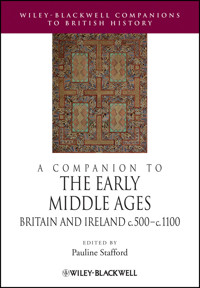
A Companion to the Early Middle Ages E-Book
43,99 €
Mehr erfahren.
- Herausgeber: John Wiley & Sons
- Kategorie: Geisteswissenschaft
- Serie: Blackwell Companions to British History
- Sprache: Englisch
Drawing on 28 original essays, A Companion to the Early Middle Ages takes an inclusive approach to the history of Britain and Ireland from c.500 to c.1100 to overcome artificial distinctions of modern national boundaries.
- A collaborative history from leading scholars, covering the key debates and issues
- Surveys the building blocks of political society, and considers whether there were fundamental differences across Britain and Ireland
- Considers potential factors for change, including the economy, Christianisation, and the Vikings
Sie lesen das E-Book in den Legimi-Apps auf:
Seitenzahl: 1481
Veröffentlichungsjahr: 2013
Ähnliche




















Table of Contents
WILEY-BLACKWELL COMPANIONS TO HISTORY
Title page
Copyright page
List of Maps
Notes on Contributors
Abbreviations
Maps
PART I: Introductory Matter
CHAPTER ONE: Introduction
CHAPTER TWO: Historiography
Historiography, Nations, and Nationalism
Twentieth-century Trends
CHAPTER THREE: Sources
PART II: Britain and Ireland, c.500–c.750
CHAPTER FOUR: Britain and Ireland, c.500
Sources and Approaches
The Late Roman Background
The Break with Rome
The Irish
The Picts
The British
The Anglo-Saxons
Ethnic Identity
Conclusion
CHAPTER FIVE: Economy
Regions and Sub-regions
The Post-Roman Imprint
Some Economic Mechanisms
Varieties of Economic Life
Conclusion
CHAPTER SIX: Kings and Kingship
Origins and Sources
Kingdoms and Sub-kingdoms
Overlordship
Military Power
Dynasties and Royal Succession
Kings’ Duties within their Kingdoms: Law and Religion
Conclusion
CHAPTER SEVEN: Communities and Kinship
Ethnicity, Kinship, and Status
Law and Law-making: Dispute, Feud, and Settlement
Conclusion
CHAPTER EIGHT: Social Structure
Names and Personal Identity
Life-cycles and Sexual Identity
Status and Class
Lordship, Estates, and Food-renders
Conclusion
CHAPTER NINE: Britain, Ireland, and Europe, c.500–c.750
Britain, Ireland, and the Transformation of the Roman World
The Spread of the Christian Church
Britain, Ireland, and the Franks
Ireland, England, and the Continent
English Missionaries on the Continent
Christianization and Social Change
CHAPTER TEN: Conversions to Christianity
Historiographical Approaches
The British Church
The Conversion of Ireland
The Conversion of the English
Conclusion
Acknowledgment
CHAPTER ELEVEN: Church Organization and Pastoral Care
Christianization
Bishops, Sees, and Dioceses
Religious Communities
Conclusion
CHAPTER TWELVE: Latin Learning and Christian Art
Education and Learning
The Decorated Gospel-books and Insular Christian Art
Conclusion
PART III: Britain and Ireland in the Long Ninth Century, c.750–c.900
CHAPTER THIRTEEN: Viking Raids and Conquest
The Beginnings of Scandinavian Activity in Britain and Ireland
The Intensification of Raiding
The Origins of Political Conquest
Conquest and the Establishment of Territorial Rule
Securing Political Control
Discussion
CHAPTER FOURTEEN: Scandinavian Settlement
England
Scotland
Wales
Ireland
Isle of Man
Conclusion
CHAPTER FIFTEEN: Britain, Ireland, and Europe, c.750–c.900
Contacts in Contexts
Alcuin and Charlemagne’s Letter to Offa, 796
Lupus of Ferrières, Charles the Bald, Æthelwulf, and Judith
Archbishop Fulk of Rheims and King Alfred
PART IV: Britain and Ireland, c.900–c.1100
CHAPTER SIXTEEN: Scotland
The Emergence of the Scottish Kingdom
The Problems of the Sources
Constantín son of Aed
The Alternating Kingship in the Later Tenth Century
The Fall of the House of Alpín
Macbethad and Máel Coluim III
The End of an Era
CHAPTER SEVENTEEN: Ireland, c.900–c.1000
The Kingdoms of Ireland: National and Regional Identities
Succession and Rule
The Vikings
The Church
Conclusion
CHAPTER EIGHTEEN: Ireland, c.1000–c.1100
The Eleventh-century Transformation
Clontarf in Irish Tradition
Debunking the “Myth” of Clontarf
Clontarf’s External Aspect
Ireland’s Maritime Frontier
Dublin: The Key to Success
The Career Path to Kingship
The Uí Briain and Canterbury
Supranational Aspirations
The Reign of Muirchertach Ua Briain
Close Encounters of a New Kind
Conclusion
CHAPTER NINETEEN: Northumbria
Northumbria in the Tenth Century
The West Saxon Kings and Northumbria
The Kings of Scots and Northumbria in the Tenth Century
Northumbria in the Eleventh Century
The Norman Conquest and Northumbria
Conclusion
CHAPTER TWENTY: Southumbria
The Making of England
Kingship, Ideology, and Identity
Church and State
Wessex, Mercia, and Northumbria
The Economy
Conclusion
CHAPTER TWENTY-ONE: Wales and West Britain
Background
Britons and Anglo-Saxons in the Tenth Century
Wales in the Eleventh Century
The Coming of the Normans
Church and Kingdom
Economy and Political Development
Conclusion
CHAPTER TWENTY-TWO: Britain, Ireland, and Europe, c.900–c.1100
The Age of Æthelstan
The Age of Monastic Reform
The Age of Cnut
The Age of Papal Reform
The Age of the Normans
Conclusion
Acknowledgment
CHAPTER TWENTY-THREE: The Institutional Church
Dioceses and Bishops
Monasticism
CHAPTER TWENTY-FOUR: Pastoral Care and Religious Belief
Bishops and Pastoral Care
Pastoral Care in the Localities
Mother-churches and the Growth of the Local Church
The Conversion of the Vikings
The Church and Lay Piety
Saints Cults
CHAPTER TWENTY-FIVE: Nobility
Historiography
Recognition: Political Relationships
Social Distinction
Conclusion
CHAPTER TWENTY-SIX: Settlement and Social Differentiation
Ireland
Scotland
Wales
Anglo-Saxon England
Differentiating between Religious and Secular Society
Urban Layouts and Living Conditions
Conclusion
CHAPTER TWENTY-SEVEN: Localities
CHAPTER TWENTY-EIGHT: Queens and Queenship
Sources
Family Politics and Household
Queenship, Office, and Consecration
Bibliography
Index
WILEY-BLACKWELL COMPANIONS TO HISTORY
This series provides sophisticated and authoritative overviews of the scholarship that has shaped our current understanding of the past. Defined by theme, period and/or region, each volume comprises between twenty-five and forty concise essays written by individual scholars within their area of specialization. The aim of each contribution is to synthesize the current state of scholarship from a variety of historical perspectives and to provide a statement on where the field is heading. The essays are written in a clear, provocative, and lively manner, designed for an international audience of scholars, students, and general readers.
WILEY-BLACKWELL COMPANIONS TO BRITISH HISTORY
WILEY-BLACKWELL COMPANIONS TO EUROPEAN HISTORY
WILEY-BLACKWELL COMPANIONS TO WORLD HISTORY
For further information on these and other titles in the series please visit our website at
www.wiley.com.
This paperback edition first published 2013
© 2013 Blackwell Publishing Limited
Edition history: Blackwell Publishing Ltd (hardback, 2009)
Blackwell Publishing was acquired by John Wiley & Sons in February 2007. Blackwell’s publishing program has been merged with Wiley’s global Scientific, Technical, and Medical business to form Wiley-Blackwell.
Registered Office
John Wiley & Sons Ltd, The Atrium, Southern Gate, Chichester, West Sussex, PO19 8SQ, UK
Editorial Offices
350 Main Street, Malden, MA 02148-5020, USA
9600 Garsington Road, Oxford, OX4 2DQ, UK
The Atrium, Southern Gate, Chichester, West Sussex, PO19 8SQ, UK
For details of our global editorial offices, for customer services, and for information about how to apply for permission to reuse the copyright material in this book please see our website at www.wiley.com/wiley-blackwell.
The right of Pauline Stafford to be identified as the author of the editorial material in this work has been asserted in accordance with the UK Copyright, Designs and Patents Act 1988.
All rights reserved. No part of this publication may be reproduced, stored in a retrieval system, or transmitted, in any form or by any means, electronic, mechanical, photocopying, recording or otherwise, except as permitted by the UK Copyright, Designs and Patents Act 1988, without the prior permission of the publisher.
Wiley also publishes its books in a variety of electronic formats. Some content that appears in print may not be available in electronic books.
Designations used by companies to distinguish their products are often claimed as trademarks. All brand names and product names used in this book are trade names, service marks, trademarks or registered trademarks of their respective owners. The publisher is not associated with any product or vendor mentioned in this book. This publication is designed to provide accurate and authoritative information in regard to the subject matter covered. It is sold on the understanding that the publisher is not engaged in rendering professional services. If professional advice or other expert assistance is required, the services of a competent professional should be sought.
Library of Congress Cataloging-in-Publication Data
A companion to the early Middle Ages : Britain and Ireland c.500–c.1100 / edited by Pauline Stafford.
p. cm. – (Wiley-Blackwell companions to British history)
Includes bibliographical references and index.
ISBN 978-1-4051-0628-3 (hardcover : alk. paper) — 978-1-118-42513-8 (pbk.). 1. Great Britain–History–To 1066. 2. Ireland–History–To 1172. 3. Great Britain–Civilization–To 1066. 4. Ireland–Civilization–To 1172. 5. Civilization, Medieval. 6. Middle Ages. I. Stafford, Pauline.
DA152.C6975 2009
941.01–dc22
2008032202
A catalogue record for this book is available from the British Library.
Cover image: St. John’s Gospel, carpet page from Lindisfarne Gospels, 710-21.
Cover design by Richard Boxall Design Associates
List of Maps
Map 1
Ireland in the Early Middle Ages
Map 2
Southern Britain in the Early Middle Ages
Map 3
West Britain in the Early Middle Ages
Map 4a
Northern Britain in the Early Middle Ages: Early Christian Period
Map 4b
Northern Britain in the Early Middle Ages: Viking Age and after
Map 5
Continental European links to Britain and Ireland
Map 6
Economically advantaged and disadvantaged areas in Britain and Ireland
Notes on Contributors
William M. Aird lectures on medieval history at Cardiff University, Wales. He was awarded his PhD by Edinburgh University. With a particular interest in the history of the Normans in the eleventh and twelfth centuries, he is the author of a number of articles and monographs including, St. Cuthbert and the Normans: The Church of Durham, 1071–1153 (1998) and Robert Curthose, Duke of Normandy, c.1050–1134 (2008). His current research concerns the medieval Life of St. Margaret of Scotland and the career of Edward A. Freeman.
Edel Bhreathnach is the Academic Project Manager at the Mícheál Ó Cléirigh Institute for the Study of Irish History and Civilisation, University College Dublin. She has published on many aspects of medieval Ireland, including the royal complex of Tara, Co. Meath, and edited the interdisciplinary volume The Kingship and Landscape of Tara (2005). Her current interests include royal sites in Ireland and the intellectual history of the Franciscan order in late medieval and early modern Ireland.
Thomas M. Charles-Edwards is Jesus Professor of Celtic, University of Oxford. His main field of research is early medieval Irish and Welsh history and literature. He was a Scholar of the School of Celtic Studies in the Dublin Institute of Advanced Studies and has held posts in Oxford since 1969. He was elected a Fellow of the British Academy in 2001 and an Honorary Member of the Royal Irish Academy in 2006. His main publications are Bechbretha (1983, with Fergus Kelly), The Welsh Laws (1989), Early Irish and Welsh Kinship (1993), Early Christian Ireland (2000), and The Chronicle of Ireland (2006), and he edited After Rome (2003). He is currently writing volume 1 of the Oxford History of Wales.
Howard B. Clarke is a graduate of the University of Birmingham and spent most of his working life teaching in the former Department of Medieval History at University College, Dublin. Having retired in 2005 as Associate Professor of Medieval Economic and Social History, he served for four years as secretary of the Royal Irish Academy. He has published widely on medieval urban history, especially that of Dublin but including also the Provençal town of Draguignan. He is currently editing the two cartularies of Evesham Abbey, which will provide a basis for further publications on a variety of twelfth-century surveys.
Sally Crawford is an Honorary Senior Research Fellow at the Centre for the History of Medicine at the University of Birmingham, and an Honorary Research Associate at the Institute of Archaeology, Oxford. She has written extensively on Anglo-Saxon archaeology, burial ritual, childhood and medicine, and has directed excavations on medieval sites in the UK. Published books include Childhood in Anglo-Saxon England (1999) and Daily Life in Anglo-Saxon England (2008). She is a founder of the Society for the Study of Childhood in the Past; a founder and general editor of the Journal of Early Medicine; and co-editor of Anglo-Saxon Studies in Archaeology and History. Current projects include The Handbook of Anglo-Saxon Archaeology and The Encyclopedia of Childhood, vol. 1: Ancient and Medieval.
Julia Crick was educated at the University of Cambridge in the Department of Anglo-Saxon, Norse and Celtic and the Faculty of History. She is currently Associate Professor of History at the University of Exeter. Her research interests include property, power, and gender before 1100, aspects of paleography, and the transmission of texts, monastic culture, and the uses of the past. Her most recent book, Charters of St. Albans, appeared in 2007 in the Royal Historical Society/British Academy series “Anglo-Saxon Charters.” She has published a number of studies of landholding practices and family solidarity before the Norman Conquest.
Catherine Cubitt is Senior Lecturer in Early Medieval History at the University of York. She is the author of Anglo-Saxon Church Councils, c.650–c.850 (1995) and has published articles on many aspects of Anglo-Saxon religious history. She has just completed a study of penance and confession, Sin and Society in Tenth- and Eleventh-century England, and is currently working on the introduction to a translation of the 649 Lateran Council.
John Reuben Davies gained his PhD from the University of Cambridge, and is Research Assistant in the Department of History at the University of Glasgow. He is the author of The Book of Llandaf and the Norman Church in Wales (2003), co-author of the online Database of Dedications to Saints in Medieval Scotland, and co-editor of Saints’ Cults in the Celtic World (2009). He has also published on the Latin hagiography of Wales and Scotland, as well as on the broader ecclesiastical history of Wales, Scotland, and Ireland in the early and central Middle Ages.
Seán Duffy is Senior Lecturer in Medieval History and a Fellow of Trinity College Dublin. His primary research interests are currently the history and archaeology of Dublin from the Viking Age to the early modern period; medieval Irish relations with Wales, Scotland, and the Isles; and Anglo-Irish relations, particularly the historiography of the English colony in medieval Ireland. He has published widely on Irish history generally, and medieval Ireland in particular. He is Chairman of the Friends of Medieval Dublin, and since 1999 has organized an annual interdisciplinary conference on medieval Dublin, the proceedings of which are published.
Paul Fouracre taught at Goldsmiths College, London from 1984 before becoming Professor of Medieval History at the University of Manchester in 2003. His research area is Francia under the Merovingian and Carolingian dynasties, and he is presently working on the cost of lighting rituals. He is the author of The Age of Charles Martel (2000), the editor of The New Cambridge Medieval History, volume 1 (2005) and, up to 2008, the coordinating editor of the journal Early Medieval Europe.
Dawn Hadley is Reader in Historical Archaeology at the University of Sheffield. She gained a degree in History from the University of Hull, and her PhD at the University of Birmingham focused on the Scandinavian impact on the social and ecclesiastical organization of the Danelaw. She has published widely on the Scandinavian settlements in England, on the construction of masculinity in Anglo-Saxon society, and on Anglo-Saxon and medieval funerary practices. She is currently working on the construction of masculinity through the material culture of medieval drinking and on the archaeology of childhood.
Charles Insley is Senior Lecturer in Medieval History at Canterbury Christ Church University; formerly, he was County Editor of the Victoria County History of Northamptonshire. He was an undergraduate and postgraduate student at Worcester College Oxford, where he received a DPhil for his thesis on the pre-Conquest charters of Exeter Cathedral. He has published a number of articles on Anglo-Saxon history, as well as papers on twelfth- and thirteenth-century Wales. He is currently finishing an edition of the Exeter charters and is writing a biography of England’s first king, Æthelstan.
Simon MacLean studied at the universities of Glasgow and London. He was a Research Fellow at Trinity Hall, Cambridge, from 2000 to 2002, before becoming Lecturer in History at the University of St. Andrews. His research focuses on the Carolingian Empire and its successor kingdoms. Major publications include Kingship and Politics in the Late Ninth Century: Charles the Fat and the End of the Carolingian Empire (2003) and History and Politics in Late Carolingian and Ottonian Europe: The Chronicle of Regino of Prüm and Adalbert of Magdeburg (2009). He was awarded a Philip Leverhulme Prize in 2008.
Janet L. Nelson is Emeritus Professor of Medieval History at King’s College London. Her interests in the earlier medieval period have ranged across Anglo-Saxon as well as Frankish topics, with a major focus on rulership, politics, and government. She has published four collections of her papers, as well as a biography of Charles the Bald. She currently co-directs the Prosopography of Anglo-Saxon England Database project at King’s, and is working on a biography of Charlemagne.
Thomas Pickles is a Fellow by Special Election and Lecturer in Medieval History at St. Catherine’s College, Oxford. His research focuses on the history of the Anglo-Saxon church. He takes an interdisciplinary approach that combines texts with stone sculpture, archaeology, place-names, and landscape analysis. His forthcoming publications include a study on the date, distribution, and significance of the Old English place-names biscopes-tn, muneca-tn, and prosta-tn and an investigation of images of angel veneration on Anglo-Saxon stone sculpture. He is currently writing up his doctoral thesis as a book called The Church in Anglo-Saxon Yorkshire: “Minsters” in the “Danelaw.”
Huw Pryce is Professor of Welsh History at Bangor University, where he has taught since 1981. He has wide research interests in medieval Wales, and also works on aspects of modern Welsh historiography. His publications include Native Law and the Church in Medieval Wales (1993), Literacy in Medieval Celtic Societies (editor, 1998), The Acts of Welsh Rulers 1120–1283 (with the assistance of Charles Insley, 2005), and Power and Identity in the Middle Ages: Essays in Memory of Rees Davies (co-editor with John Watts, 2007).
Martin J. Ryan is a Teaching Fellow in Early Medieval History in the School of Arts, Histories, and Cultures at the University of Manchester. He received his PhD from the same institution with a thesis on land tenure in pre-Viking England, and is currently working on a revised version of this study for publication as a monograph. He is also researching theories of violence and inequality in the biblical commentaries of the Venerable Bede. He is co-editor, with Alan Deyermond, of Early Medieval Spain: A Symposium (2009), and co-author, with Nicholas Higham, of The Anglo-Saxon World (forthcoming).
Pauline Stafford is Professor Emerita at Liverpool University, previously Professor of Medieval History. She is a specialist in the history of Anglo-Saxon England and of women and gender in England and Europe from the eighth to the twelfth century. Her previous publications include Queens, Concubines and Dowagers: The King’s Wife in the Early Middle Ages (1983, 1998), Unification and Conquest: A Political and Social History of England in the Tenth and Eleventh Centuries (1989), Queen Emma and Queen Edith: Queenship and Women’s Power in Eleventh-century England (1997, 2001), Law, Laity and Solidarities (2001), Gender, Family and the Legitimation of Power: England from the Ninth to Early Twelfth Century (2006), and the jointly edited Gendering the Middle Ages (2000).
David E. Thornton read History at the University of York, has an MA in Welsh History from the University of Wales, and a PhD from the University of Cambridge. He worked as a postdoctoral researcher at the School of Celtic Studies, Dublin, and at the Unit for Prosopographical Research, Oxford. Since 1997, he has been Assistant Professor in European History at Bilkent University, Turkey, where he is also Library Director. His research interests include early medieval Britain and Ireland, and Anglo-Norman England, and he is currently working on Irish anthroponymy before 1100 and the geographical origins of religions in the late medieval diocese of Worcester.
Alex Woolf was educated at Bexhill County Grammar School and the University of Sheffield. He is a lecturer in the School of History at the University of St. Andrews and has published on a wide range of topics in early insular history. His monograph From Pictland to Alba 789–1070, volume II of the “New Edinburgh History of Scotland,” was published in 2007.
Barbara Yorke is Professor of Early Medieval History at the University of Winchester. She has worked, and published papers, on many different topics relating to the history of Anglo-Saxon England, with a particular interest in royal houses and the interrelationship of ecclesiastical and secular authority. Her books include Kings and Kingdoms of Early Anglo-Saxon England (1990), Wessex in the Early Middle Ages (1995), Nunneries and the Anglo-Saxon Royal Houses (2003), and The Conversion of Britain: Religion, Politics and Society c.600–800 (2006).
Abbreviations
AC
A
Annales Cambriae
, version A: E. Phillimore, “The
Annales Cambriæ
and Old-Welsh genealogies from
Harleian MS 3859
,”
Y Cymmrodor
, 9 (1888), 141–83.
AC
B, C
Annales Cambriae
, versions B and C: J. Williams (ab Ithel) (ed.),
Annales Cambriae
, Rolls Series, 20 (London, 1860).
AFM
Annals by the Four Masters
: J. O’Donovan (ed. and trans),
Annála Rioghachta Éireann: Annals of the Kingdom of Ireland by the Four Masters from the Earliest Period to the Year 1616
, 7 vols. (Dublin, 1851; 3rd edn. 1990).
AI
The Annals of Inisfallen
: S. Mac Airt (ed.),
The Annals of Inisfallen
(Dublin, 1944, repr. 1951, 1977).
ASC
(A–G)
The Anglo-Saxon Chronicle
, many editions: see D. N. Dumville and S. D. Keynes (gen. eds.),
The Anglo-Saxon Chronicle: A Collaborative Edition
(Cambridge, 1983– ); see also
EHD
, vol. I:
c.500–1042
; vol. II:
1042–1189
.
AT
The Annals of Tigernach
: W. Stokes (ed. and trans.),
The Annals of Tigernach
(reprinted from
Revue Celtique
, 1895–7; repr. Felinfach, 1993).
AU
The Annals of Ulster
: S. Mac Airt and G. Mac Niocaill (eds. and trans.),
The Annals of Ulster (to AD 1131)
. Part I:
Text and translation
(Dublin, 1983).
ByS
Brenhinedd y Saesson
: T. Jones (ed.),
Brenhinedd y Saesson, or The Kings of the Saxons
(Cardiff, 1971).
ByT
(Pen 20)
Brut y Tywysogion
(Peniarth MS 20 version): T. Jones (trans.),
Brut y Tywysogion or the Chronicle of the Princes, Peniarth MS 20 Version
(Cardiff, 1952).
ByT
(RB)
Brut y Tywysogion
(Red Book of Hergest version): T. Jones (ed.),
Brut y Tywysogion or the Chronicle of the Princes, Red Book of Hergest Version
(2nd edn., Cardiff, 1973).
EHD
English Historical Documents:
I: D. Whitelock (ed. and trans.),
English Historical Documents
, vol. I:
c.500–1042
, 2nd edn. (London, 1979). II: D. C. Douglas and G. W. Greenaway (eds.),
English Historical Documents
, vol. II:
1042–1189
, 2nd edn. (London, 1981).
HE
Bede,
Historia ecclesiastica gentis Anglorum
(
The Ecclesiastical History of the English People
), various editions.
MGH
Monumenta Germaniae historica
:
SRG
,
Scriptores rerum Germanicarum
;
SRL
,
Scriptores rerum Langobardorum
;
SRM
,
Scriptores rerum Merovingicarum
;
SS
,
Scriptores
S (Sawyer)
Charter no. in P. Sawyer,
Anglo-Saxon Charters: An Annotated List and Bibliography
(London, 1968).
Map 1 Ireland in the Early Middle Ages
Map 2 Southern Britain in the Early Middle Ages
Map 3 West Britain in the Early Middle Ages
Map 4a Northern Britain in the Early Middle Ages: Early Christian Period
Map 4b Northern Britain in the Early Middle Ages: Viking Age and after
Map 5 Continental European links to Britain and Ireland
PART I
Introductory Matter
CHAPTER ONE
Introduction
PAULINE STAFFORD
This volume is a collaborative history of Britain and Ireland from c. AD 500 to c.1100. It gives special attention to areas of recent historiographical development and advance. It does not set out to provide a narrative, though it will attempt to provide a new historical account and overall picture of these critical centuries. It covers Britain and Ireland at an arguably significant, if not formative period. This task is both a huge challenge and a pressing need. Britain-wide, let alone Britain and Ireland-wide, history poses problems at any period, but acute ones for these centuries. The historiographies of these islands are divergent and make comparison difficult; the demands on any scholar who tries to range across them are high. Their political geography was far more complicated at this period than at any later date. Thus, the core political story, which holds together so many historical surveys of later periods, cannot easily be written.
The focus is on Britain and Ireland. Ireland is, of course, not a part of Britain, either as defined in the early Middle Ages or now. “Britain” is the biggest island of what might be described as the “Atlantic Archipelago,” and early medieval writers, following classical geographers, already used the term “Britannia” in this way. Britain thus includes what we would now call Scotland, England, and Wales. Any inclusion of Ireland or any part of Ireland within it is a result of centuries of English imperialism. But Ireland is to be given all due attention in this volume. The reasons are simple. What is now Ireland was at this date linked to, as much as separate from, much of the development of Britain, and was, in many respects, crucial to that development. It would be impossible, for example, to tell the story of English conversion to Christianity, or of Scottish kingship, without reference to Ireland. As these conversion and political stories would illustrate, the Irish Sea joined as much as, if not more than, it separated those around its shores at this date. They experienced common problems, such as Scandinavian attacks during the ninth century, and, at times, formed close political links; for example, between the north of Ireland and the west of what is now Scotland throughout much of the period, or between Dublin and York in the later ninth and tenth centuries. The political boundaries within what is now Britain and Ireland were far from fore-ordained c.500, or even much later. One aim of this volume is to see the early Middle Ages in the Atlantic Archipelago as it developed, rather than teleologically, that is, from the viewpoint of its later shape. That aim necessitates the inclusion of Ireland.
The inclusion of Ireland also has the effect of de-centering England, or rather southern England. One of the potential pitfalls of British history is Anglo-centricity, a history of England with additions. This danger is compounded in this early period by the poverty of sources for northern and western Britain vis-à-vis southern England. Ireland, by contrast, has extremely rich sources, if in some ways markedly different from English ones (see chapter 3). Ireland cannot and should not be taken as representative of Scotland or Wales at this date: it is thus not being seen here as providing the “Celtic” alternative picture. But its inclusion sets up comparisons that ensure a wider focus, and one from which the study of southern England should itself benefit.
Even these most preliminary statements about a history of Britain and Ireland run into a fundamental problem, that of political terminology. It is a problem that dogs a volume of this type, and its organization. “Ireland,” “Scotland,” “Wales,” “England” represent modern political entities. They find some expression within this period, but they correspond very imperfectly to the political geography, or to the identities, of the centuries between 500 and 1100. All these terms were in use during or soon after this period, but none describes or does justice to the complex and shifting politics within it. That complex and shifting situation is partly revealed by the bewildering variety of names used for groups and political entities within Britain and Ireland over these centuries. A range of Latin and vernacular terms was in use. Some denoted apparently wide groups or areas: for example, Scotti, Hibernia, Érenn, Alba, Picts, Angli, Englisc, Angelcynn, Englalond – very rarely Anglo-Saxon – Britannia, Britones, Cymry. Yet alongside these, others remained in use and appear to describe much more limited groups: West Saxons, East Saxons, Northumbrians, Leinstermen, Ulstermen/Ulaid. Some of these terms have recently been the subject of much productive scholarship, though their meaning and significance are still hotly debated. Their variety underlines the fluid politics, if not identities, of this period. Study of them has certainly highlighted potential differences between cultural and political identities. But it has also raised problems of change in the use and meaning of some of them, and emphasized their ideological deployment; for example, in the making of claims to political control. Such debates, plus the fact that these terms are far from consistently used over the whole period, mean that they cannot easily be substituted for the modern terms.
The modern terms will thus be used here to describe the geographical areas that they now cover, since it is necessary to give the modern reader some purchase on these remote centuries. But we must be aware from the beginning of the problems that this use entails. The aim of this volume is to approach this period without assumptions about its eventual political shape, with no sense that any one of them was fated – or bound – to develop, retaining an eye for a range of political possibilities, rather than putting on blinkers which lead the historical gaze firmly forward to a known future. Chapter 2 will consider the nationalist historiographies that have profoundly influenced the study of this period, and alert us to their power. Yet the very use of these terms may carry an insidious because silent teleology. It is almost impossible to avoid them, but we must be fully aware of their dangers. These same historiographies have produced other terminological sensitivities among modern historians, particularly over such terms as “nation” and “state.” The authors in this volume are especially alert to the problems of these terms. Many of them have preferred the more neutral “polity,” a synonym for any political unit, which avoids questions about whether and when any of these might be described as “states”; the more general usage in this volume is “kingdom,” which describes the nature of almost all the political systems with which they are dealing.
There are certainly other ways in which historians have divided the areas to be considered here. The distinction between upland and lowland Britain – that is, north and west and south and east, respectively, of an imaginary line from the Humber to the Severn – may seem a useful one.1 That line has a very rough correspondence with economic distinctions between pastoral and arable-based farming, though there are many significant micro-patterns either side of it. In Ireland, the fertile plain of Brega has some of the same economic significance as lowland Britain. Historians have pointed out the significant coincidences of such geographical divisions and political development: southern English and southern Scottish power, for example, centered on control of these lowland areas. These divisions are discussed more fully by Howard Clarke in chapter 5.
These divisions are crude, even when refined to allow, for example, for the particular geography of Wales, with a highland center separating coastal strips. Like Howard Clarke, we should be aware of the importance of other, more regional and local divisions. Important as the wider geographical divisions are, they too have not formed the basis of the organization of this volume which eschews any straightforward geographical or economic determinism. We should, nonetheless, be aware of geography and its influence, and of other geographical features such as the Mounth, the highland area acting as a significant barrier between northern and southern Scotland, or the combination of deep estuary and extensive marshland that made the Humber a more formidable barrier to travel in the early Middle Ages than it is now. On the other hand, the Irish Sea, as has been noted, should be seen as a highway as much as a divider. Its routeways and links took Patrick there in the fifth century, and the southern English nobles fled across it after defeat by the Normans in 1066. They explain the strong political and cultural links that bound Ireland and western Scotland. The kingdom and Chronicle of Man demonstrate that sea kingdoms should not be ruled out as possible lines of development, including ones that might have encompassed areas of what are now Wales and west and northern England, though it should also be remembered that the Irish Sea’s unity long had a darker incarnation as a slaving lake.
We must be wary of how we divide, yet also aware that contemporaries themselves were divided and made divisions. The Northumbrian monk Bede, in the early eighth century, divided the inhabitants of Britain by languages, those of the Angles, Britons, Scots, and Picts and Latin. The divisions within the period may have varied, and were almost certainly even more complex. The Germanic language of the “English” differed between, for example, Anglian and the Late West Saxon in which most of our surviving vernacular texts are written. In what is now north-west England, the “Cumbrians” and ultimately “Cumberland” shared a name very similar to the Welsh self-designation as “Cymry” and probably spoke a Brittonic language whose status vis-à-vis Welsh is much debated. The incoming Scandinavian settlers of north-west as of eastern England spoke a different Germanic tongue from the one in local use by the ninth century, though recent work has suggested the possibility of mutual comprehension. As Barbara Yorke points out in chapter 4, for Bede, as for many others in the early Middle Ages, peoples were defined at least in part by language. But we should not assume it was any more simple a barrier or definer than geography.
The date limits of this volume, c.500–1100, are to a degree arbitrary. They correspond roughly to the end of Roman Britain and the arrival and first impact of the Normans. These are processes that have long been seen as significant. For example, another division that could be made within these islands is between areas that had been Romanized or felt Roman influence before AD 500 and those that had not, although Roman influence was felt much more widely than simply in Romanized areas, and the whole Atlantic Archipelago was, in some senses, a peripheral area to the Roman world (see chapter 9). The end date is deliberately not taken as 1066, the year of the Norman victory at Hastings. That date has more immediate relevance for England than for the rest of the area under consideration here. And an end date of 1100 allows consideration of the Normans’ immediate impact, throughout Britain and Ireland, without focusing a spotlight upon them which then defines their arrival as a turning point.
Within this period, no simple narrative has been attempted; the chapters, especially pre-800, have not been organized to produce this. There are some obvious lineaments and themes which give it shape: the end of Roman Britain and the arrival of a new set of Germanic inhabitants at the beginning, both processes well under way, and Roman withdrawal complete, before AD 500, but with continuing significance into the sixth century. Conversion to Christianity, already under way in fifth-century Ireland and technically complete in Wales and west Britain by 500, was a phenomenon of the sixth and seventh centuries among the Picts and in England. The vikings – a term that describes a particular type of Scandinavian activity – were active throughout most of the Atlantic Archipelago during the long ninth century, and continued to be important into the later tenth and eleventh centuries. They receive due attention here, especially in the first stages of their activity, not least because they dominate the historiographies of this period. Those historiographies have also placed center stage some of the “hero kings” who are known for their responses to the vikings: Máel Sechnaill in Ireland, Cinaed/Kenneth in Scotland, Rhodri “Mawr” in Wales, Alfred “the Great” in England. In England and Scotland, these kings have been seen to mark a crucial step on the road to monarchy and unity. All four find their place in this volume, though their reigns are not used to organize its coverage. It is linear political narrative in particular that has been largely omitted here.
The prime reason for this is a recognition of the limits of the volume, which covers such a wide chronology and geographical area at a time of great political complexity. Any linear political narrative would be sketchy and would threaten to simplify the story around a series of “great kings,” so judged, in most cases, by the very historiographies that entrench the views of inevitable developments which is one of the interpretations that this volume seeks to scrutinize. Linear political history lends itself to the painting of a heroic past beloved of particular types of nationalist historiography, though cultural history has its own pitfalls, not least of Golden Ages that can console the political “failures.” Good political narrative of this period needs to allow for the range of outcomes that was still possible, placing and understanding political action within its full contemporary context, ideally with very detailed coverage of that context. So complex a story is clearly impossible for this date range within this compass. The chapters that deal with the structures of politics and political society – with, for example, nobility, kingship, communities, courts and law, kinship – give some idea of the nature and parameters of political activity, and highlight similarities and differences here. A number of chapters do nonetheless attempt an overall narrative for particular parts of Britain and Ireland at certain dates. This is especially the case where such a story is hard to find in existing historiography and/or where its establishment is still a pressing need or is contested, and thus central to current historical endeavors – thus for Scotland, Wales, and, to a lesser extent, Ireland in the tenth and eleventh centuries. For England in this period, the lineaments of such a story are readily available. Here, the opportunity has been taken to subject a particularly influential picture of precocious English unity to scrutiny, especially by separating coverage of Southumbria and Northumbria in their post-900 development, though separating England/Britain north and south of the Humber still lumps together West Saxons and Mercians post-900. In all these cases, treatment is responding in different ways to the state of existing work. Inevitably, however, there have been many omissions.
Three chapters (9, 15, and 22) deal with “Britain, Ireland, and Europe.” They are a deliberate reminder that these islands were far from isolated from, albeit by some definitions peripheral to, continental Europe. Events and developments there, and especially in Francia (covering large parts of modern France, Germany, and the Low Countries), were of significance for Britain and Ireland. And, as these chapters make clear, influence was not a one-way traffic.
This volume has thus been structured by a number of aims and questions. Some are well-established ones – for example, Christianization or the arrival and impact of the vikings – and here the volume seeks to provide both an update on recent rethinking and a new synthesis. Many are broadly sociopolitical, much concerned with the building blocks of political society and with the question of how it worked. But behind these questions also lurks an older question, or rather an older question reframed: were there substantial and fundamental differences across these islands? In its older form, this question often seemed to take divergence for granted and to seek its origins. We hope that our reframing is different. We do not begin from an assumption of difference and divergence, especially not by 1100. That remains an overall question.
The question “How did it work?” is not the same as “Why, if at all, did it change?” Attention to structures may highlight factors producing possible change. And treatment of the economy, Christianization, vikings may be critical here. But the chapter structure deliberately avoids giving priority to any particular historical explanation of change – whether, for example, economic or ideological – preferring to allow room for all, for interactions, and for long-term continuities.
Three final notes on the approach in this volume are needed here. First, the treatment of women: one of the great advances in recent historiography has been the study of women (see chapter 2). Any broad treatment has to decide how to include this. With the exception of chapter 28 on queens and queenship, the deliberate decision here was against specific chapters on women. Rather, the brief was to be alert to women throughout. The danger is that they may disappear again in such a broad sweep of history; the hope is that they thus become, as they should be, part of the mainstream of historical writing. Second, the treatment of names: preference throughout is for the non-anglicized form of names. Some familiar names may thus appear – at least to English readers – in unfamiliar forms: Kenneth as Cinaed, Malcolm as Máel Coluim. Writing British and Irish history makes us acutely aware of English imperialism, including its linguistic forms. This nomenclature also reflects significant shifts in recent Scottish historiography (see chapter 2). Third, divergences of interpretation: no systematic attempt has been made to iron out differences of interpretation between authors. Given the problems of sources and historiography, differences among historians on this period have been, and sometimes still are, both significant and legitimate. It is to that historiography and those sources that attention must now turn.
Note
1 Frame, Political Development, p. 13.
Bibliography
Frame, R., The Political Development of the British Isles, 1100–1400 (Oxford, 1990).
CHAPTER TWO
Historiography
PAULINE STAFFORD
History is not simply what happened in the past, but the answers to questions that historians pose about what happened in the past. The questions posed largely determine the answers that can or will be given. If we are to understand and work with the history we have, we must identify those questions and have some understanding of the contexts in which they were produced. This is one, if not the main, task of historiography. Historiography is the study of the writing of history. As we would now define it, history is technically what professional historians produce, trained in the techniques of their craft. So it is their context and questions that are especially significant. But non-professionals have also turned to the past, and their use of it and concern with it can be part of the professional historian’s environment. Questions are never asked or defined in a vacuum: previous traditions, assumptions, and contemporary concerns are always a context, as well as – especially in the case of professional historians – changing theoretical models and concepts. Knowledge of, and engagement with, historiography should be part of all historical writing. It is arguably of particular importance in a volume of this type, which aspires, in some part, to be comparative, since one of the problems of comparative history is the often non-comparability of historiographies. Historians in different traditions have not necessarily asked the same questions, or started with the same set of assumptions; the answers that they have produced do not necessarily lend themselves to comparative use. Many of the individual chapters that follow will give topic-specific historiographical guidance and discussion. This second introductory chapter is concerned with the larger trends, especially those within different national historiographies of the various components of Britain and Ireland.
Lesen Sie weiter in der vollständigen Ausgabe!
Lesen Sie weiter in der vollständigen Ausgabe!
Lesen Sie weiter in der vollständigen Ausgabe!
Lesen Sie weiter in der vollständigen Ausgabe!
Lesen Sie weiter in der vollständigen Ausgabe!
Lesen Sie weiter in der vollständigen Ausgabe!
Lesen Sie weiter in der vollständigen Ausgabe!
Lesen Sie weiter in der vollständigen Ausgabe!
Lesen Sie weiter in der vollständigen Ausgabe!
Lesen Sie weiter in der vollständigen Ausgabe!
Lesen Sie weiter in der vollständigen Ausgabe!
Lesen Sie weiter in der vollständigen Ausgabe!
Lesen Sie weiter in der vollständigen Ausgabe!
Lesen Sie weiter in der vollständigen Ausgabe!
Lesen Sie weiter in der vollständigen Ausgabe!
Lesen Sie weiter in der vollständigen Ausgabe!
Lesen Sie weiter in der vollständigen Ausgabe!
Lesen Sie weiter in der vollständigen Ausgabe!
Lesen Sie weiter in der vollständigen Ausgabe!
Lesen Sie weiter in der vollständigen Ausgabe!
Lesen Sie weiter in der vollständigen Ausgabe!
Lesen Sie weiter in der vollständigen Ausgabe!
Lesen Sie weiter in der vollständigen Ausgabe!
Lesen Sie weiter in der vollständigen Ausgabe!
Lesen Sie weiter in der vollständigen Ausgabe!
Lesen Sie weiter in der vollständigen Ausgabe!
Lesen Sie weiter in der vollständigen Ausgabe!
Lesen Sie weiter in der vollständigen Ausgabe!
Lesen Sie weiter in der vollständigen Ausgabe!
Lesen Sie weiter in der vollständigen Ausgabe!
Lesen Sie weiter in der vollständigen Ausgabe!




