


A Companion to the Neronian Age E-Book
159,99 €
Mehr erfahren.
- Herausgeber: John Wiley & Sons
- Kategorie: Geisteswissenschaft
- Serie: Blackwell Companions to the Ancient World
- Sprache: Englisch
An authoritative overview and helpful resource for students and scholars of Roman history and Latin literature during the reign of Nero.
- The first book of its kind to treat this era, which has gained in popularity in recent years
- Makes much important research available in English for the first time
- Features a balance of new research with established critical lines
- Offers an unusual breadth and range of material, including substantial treatments of politics, administration, the imperial court, art, archaeology, literature and reception studies
- Includes a mix of established scholars and groundbreaking new voices
- Includes detailed maps and illustrations
Sie lesen das E-Book in den Legimi-Apps auf:
Seitenzahl: 1276
Veröffentlichungsjahr: 2013
Ähnliche




















Table of Contents
Blackwell Companions To The Ancient World
Title Page
Copyright
Dedication
Illustrations
Figures
Maps
Plates
Notes on Contributors
Acknowledgments
Introduction: The Neronian (Literary) “Renaissance”
The Neronian Literary Triad: Seneca, Lucan, and Petronius
Conclusion
References
Part I: Nero
Chapter 1: The Performing Prince
The Training and Pastimes of Princes
Music and Musical Performance in Nero's Rome
Acceptable Diversions / Voluptates Concessae
Further Reading
References
Chapter 2: Biographies of Nero
The First Assessments
Cassius Dio
Tacitus
Suetonius
Conclusion
Further Reading
References
Chapter 3: Nero the Imperial Misfit: Philhellenism in a Rich Man's World
Breaking with Tradition
Greek Culture at the Imperial Court
Caesar Omnia Habet: It's a Rich Man's World
Like the Gleaming Sun
Greek Theatrical Culture in Rome
Lord of the Golden Age
Festival Victor and Benefactor of all Greeks
The Last Act: Triumph and On-Stage Death
Further Reading
References
Part II: The Empire
Chapter 4: The Empire in the Age of Nero
The Principate
Governing the Provinces
Power and Privilege in the Roman Empire
Further Reading
References
Chapter 5: Apollo in Arms: Nero at the Frontier
The Western Empire
The Eastern Empire: The Black Sea and Armenia (see Map 1)
Plans in Ethiopia and the Caucasus
Conclusions
References
Chapter 6: Domus Neroniana: The Imperial Household in the Age of Nero
Further Reading
References
Chapter 7: Religion
The Emperor and Religion
Nero's Priestly Offices
The Worship of the Imperial Family in Rome
Emperor Cult outside Rome
Literary Representations of the Dichotomy Religion/Superstition
Religion and Superstition in the Satyrica
Conclusion
Further Reading
References
Chapter 8: Neronian Philosophy
Introduction
Cornutus
Musonius Rufus
Seneca
De Clementia
Conclusion
Further Reading
References
Part III: Literature, Art, and Architecture
Chapter 9: Seneca, Apocolocyntosis
Menippean Monarchy
Who's Laughing Anyway?
De-deification
Problems with Praise
Conclusion
Further Reading
References
Chapter 10: The Carmina Einsidlensia and Calpurnius Siculus' Eclogues
Carmina Einsidlensia
Calpurnius Siculus, Eclogues
Further Reading
References
Chapter 11: Seneca's Philosophical Writings: Naturales Quaestiones, Dialogi, Epistulae Morales
Introduction: The Writings of Seneca the Younger
One's Place In The Universe: Naturales Quaestiones (Natural Questions)
How To Be “Indifferent” Towards Politics, Friends, and Family: Dialogi (Dialogues)
The Care of the Self, unto Itself: Epistulae Morales (Moral Letters)
L. Annaeus Seneca, Stoicus Sui Generis
Further Reading
References
Chapter 12: Senecan Tragedy
Preliminaries
Tragedy and Philosophy
“Let no new thing arise”: Senecan Intertextuality
The Politics of Senecan Tragedy
Further Reading
References
Chapter 13: Lucan's Bellum Civile
Lucan as Epic Successor and Innovator
The Bellum Civile and the Aeneid
Roman Values
Caesar, Pompey, Cato
The Narrator's Voice, The Reader's Gaze
The Cloud of Unknowing
Pathos, Hyperbole, Paradox
Further Reading
References
Chapter 14: Petronius' Satyrica
Cast of Satyrs
Petronius and the Picaresque Novel
Filling in the Gaps
Through the Peep holes
Looking down on Trimalchio
Making Virgil Blush
Audience Responses
Eumolpus and Educational Guidance
Chapter 15: Persius
Further Reading
References
Chapter 16: Columella, De Re Rustica
Background
Columella—The Author
Genre
Work
Sources
Style
Mos Maiorum and Columella's Contemporary Readers
Reception
Further Reading
References
Chapter 17: Literature of the World: Seneca's Natural Questions and Pliny's Natural History
Roman Writing about Nature
A Moral Universe: Luxury and Extravagance at Rome
Nero and the Natural World
Further Reading
References
Chapter 18: Greek Literature Under Nero
Two Influential Starting Points
From Rhetoric to Philosophy
Philosophy for the Soul / Medicine for the Body
Science and Mechanics: Heron of Alexandria
Seasoning Literature with Wit: The Epigram
The Beginning of Something New: Christian Theology and the Letters of Paul
Conclusion
Further Reading
References
Chapter 19: Buildings of an Emperor—How Nero Transformed Rome
Public Buildings and their Function
Nero's Palace Complexes in Rome
Conclusion
Further Reading
References
Chapter 20: Portraits of an Emperor— Nero, the Sun, and Roman Otium
Nero's Portraits
Memoria Damnata. The Removal of Nero's Portraits after his Death
The Comparison of Nero with Apollo and the Sun God
Sculptures of the Neronian Period?
Interpreting Nero: Past and Present Scholarship
Interpreting Nero in Context
Further Reading
References
Chapter 21: Neronian Wall-Painting. A Matter of Perspective
Nature and Space: Beyond Trompe-L'Oeil
Space and Narrative: The Theater as Perspectival Tool
Narrative and Perception: The Theming of Space
The Domus Aurea: The Art of Pervasive Confinement
Neronian Wall-Painting in Perspective
Further Reading
References
Part IV: Reception
Chapter 22: Nero in Jewish and Christian Tradition from the First Century to the Reformation
Nero in Jewish Tradition: Destroyer of the Holy Nation, Father of Rabbis, Redivivus
The Number of the Beast: Nero as Persecutor, Heretic, Antichrist in Earliest Christianity
The Great Presumption of Interpretation: Nero in Early Christianity
Nero's Long Shadow: The Life and Times of a Tyrant in Medieval, Renaissance, and Reformation Tradition
Further Reading
References
Chapter 23: Haec Monstra Edidit. Translating Lucan in the Early Seventeenth Century
The Shadow of Scaliger
Lucan among the Protestants
Lucan in the Netherlands
Grotius' Lucan and the Twelve Year Truce
Lucan in Dutch
Lucan's Challenge
Further Reading
References
Chapter 24: Haunted by Horror: The Ghost of Seneca in Renaissance Drama
Further Reading
References
Chapter 25: “Fantasies so Varied and Bizarre”: The Domus Aurea, the Renaissance, and the “Grotesque”
“Breaking our Backbones on our Knees”
Seeing Beyond the Vanishing Point
From Margins to Centre
A Visually Mediated Discourse of Renaissance Visuality
Further Reading
References
Epilogue
Chapter 26: Nero from Zero to Hero
Nero the Hero
Reasons for the Change in Attitude: Visual Interests
Theatre in Particular
Further Reasons: Greek Identity under Roman rule
Further Reasons: Politicians and Spin
Nero the Showman in the Ancient Historical Sources
Tacitus in Particular
The Pace of Tacitus' Narrative
Nero in the Fictional Dialogue Nero
References
Index
Supplemental Images
Blackwell Companions To The Ancient World
This series provides sophisticated and authoritative overviews of periods of ancient history, genres of classical literature, and the most important themes in ancient culture. Each volume comprises approximately 25 to 40 concise essays written by individual scholars within their area of specialization. The essays are written in a clear, provocative, and lively manner, designed for an international audience of scholars, students, and general readers.
Ancient History
Published
Literature and Culture
Published
This edition first published 2013
© 2013 Blackwell Publishing Ltd.
Blackwell Publishing was acquired by John Wiley & Sons in February 2007. Blackwell's publishing program has been merged with Wiley's global Scientific, Technical, and Medical business to form Wiley-Blackwell.
Registered Office
John Wiley & Sons Ltd, The Atrium, Southern Gate, Chichester, West Sussex, PO19 8SQ, UK
Editorial Offices
350 Main Street, Malden, MA 02148-5020, USA
9600 Garsington Road, Oxford, OX4 2DQ, UK
The Atrium, Southern Gate, Chichester, West Sussex, PO19 8SQ, UK
For details of our global editorial offices, for customer services, and for information about how to apply for permission to reuse the copyright material in this book please see our website at www.wiley.com/wiley-blackwell.
The right of Emma Buckley and Martin T. Dinter to be identified as the authors of the editorial material in this work has been asserted in accordance with the UK Copyright, Designs and Patents Act 1988.
All rights reserved. No part of this publication may be reproduced, stored in a retrieval system, or transmitted, in any form or by any means, electronic, mechanical, photocopying, recording or otherwise, except as permitted by the UK Copyright, Designs and Patents Act 1988, without the prior permission of the publisher.
Wiley also publishes its books in a variety of electronic formats. Some content that appears in print may not be available in electronic books.
Designations used by companies to distinguish their products are often claimed as trademarks. All brand names and product names used in this book are trade names, service marks, trademarks or registered trademarks of their respective owners. The publisher is not associated with any product or vendor mentioned in this book. This publication is designed to provide accurate and authoritative information in regard to the subject matter covered. It is sold on the understanding that the publisher is not engaged in rendering professional services. If professional advice or other expert assistance is required, the services of a competent professional should be sought.
Library of Congress Cataloging-in-Publication Data
A companion to the Neronian age / edited by Emma Buckley and Martin T. Dinter.
pages cm.— (Blackwell companions to the ancient world)
Includes bibliographical references and index.
ISBN 978-1-4443-3272-8 (hardback : alkaline paper) 1. Nero, Emperor of Rome, 37-68. 2. Rome— History — Nero, 54-68. 3. Rome — Intellectual life. 4. Latin literature — History and criticism. 5. Art, Roman — History. 6. Architecture, Roman — History. I. Dinter, Martin T. II. Buckley, Emma.
DG285.C66 2013
937′.07— dc23
A catalogue record for this book is available from the British Library.
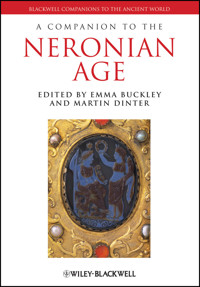
Cover image: Nero cameo / Cameo showing Nero and Agrippina from the Shrine of the Three Holy Kings in Cologne Cathedral, 1st century AD. Photo © Dombauarchiv Kln, Matz und Schenk.
Cover design by Workhaus
For John Henderson
MAGISTRO OPTIMO OB AMICITIAM ET MERITA EIUS
Illustrations
Figures
Maps
Plates
Notes on Contributors
Acknowledgments
It is our pleasure to thank the following scholars and institutions for granting us permission to use their images in this volume: Dr. Heinz-Jürgen Beste, Professor Marianne Bergmann, Dr. Fedora Filippi, Professor Henner von Hesberg, Dr. Katharina Lorenz, Dr. Abigail Price, Dr. Michael Squire, Dr. Mariantonietta Tomei, the Institut für Archäologische Wissenschaften, Frankfurt, the Akademisches Kunstmuseum Bonn, the Glyptothek Munich, the Abgusssammlung Göttingen, the New York University Excavations at Aphrodidias, the Münzkabinett, Staatliche Museen zu Berlin – Preußischer Kulturbesitz, the DAIR, the Soprintendenza Speciale per i Beni Archeologici di Roma, the Photoarchiv of the Institut für Klassische Archäologie und Museum Klassischer Abgüsse, Ludwig-Maximilians-Universität, Munich, the GFN, the Museo della Civiltà Romana, and the Metropolitankapitel der Hohen Domkirche Köln.
Thanks are also due to Susanna Morton Braund and Josiah Osgood for their permission to re-use material from MTD's contribution to their Companion to Persius and Juvenal (2012) in my introduction to this volume.
In addition thanks go to Professor Sinclair Bell (Northern Illinois University) for his assistance in revising Professor Bergmann's contribution and to Oliver Norris and Francesca Patterson, King's College London, for their editorial assistance. Thanks are also due to the team at Wiley-Blackwell: Haze Humbert, Galen Young (née Smith), Allison Medoff and Ben Thatcher as well as Lee Zischkale and last but not least Claire Creffield and Sarah Dancy who copyedited this volume.
Numerous colleagues have gone out of their way to assist with this volume. Special thanks are due to Dr. Joe Howley, Dr. Gwaeneth McIntyre, Dr. Felix Racine, and Dr. Michael Squire, who all provided extra critical expertise with some of the chapters. Above all, thanks are due to John Henderson, whose work not only underpins much of what we understand about Neronian literature and culture, but who has also been a wonderful teacher to the editors and many of the contributors to this volume.
EB and MTD, St. Andrews University and King's College London
Introduction: The Neronian (Literary) “Renaissance”
Martin T. Dinter
Neronian literature, more than that of any other period in Rome, demands to be read in the shadow, or rather, glare of its ruler. The sun-king always penetrates the dark studies and rural retreats that confine Neronian writing In short, we cannot help reading Nero into Neronian literature.
(Gowers, in Plaza (2009) 174)
Depending on which myth of Nero the reader buys into, Neronian literature is either written in interaction with Nero, the most literary of emperors, who provides context and inspiration for literary output, or in spite of Nero, under Neronian repression, as a reaction to and refuge from the emperor's crushing weight. In any case, Nero constantly lurks in the background of any poet's production, or so the biographers and scholiasts tell us. The question of why we categorize literature and art as Neronian and Augustan, rather than Claudian, Caligulean, or Tiberian, for example, has as much to do with the fact that the chances of textual transmission have favored the former periods over the latter as with our tendency to group texts around the more memorable emperors. Thus although many of Seneca's tragedies might well have been written under the reign of Claudius to while away years of exile in Corsica, they are firmly counted amongst Neronian literature. Not only do they fit better with our image of the young and arty emperor than with the apparently ever so dull Claudius (but see Griffin (1994) and Osgood (2011) for a reappraisal of Claudius). They also go well with the rest of what we have of Neronian literature. Here, as always, periodization is inevitably a form of characterization which allows us to comprehend “a block of human experience” (Morris (1997) 96; cf. Lorenz in this volume), chopping the continuum of culture into chunks small enough to grasp and to discuss. As long as we recognize the artificial nature of this framework we will also keep in mind its provisionality. For as much as change was celebrated on the accession of Nero, succession is often (and in this case in particular) about continuity and stability. There were both practical and conceptual difficulties in cutting a sharp caesura between the reign of Nero's adoptive father and that of the young prince. We can catch a glimpse at the hopes projected onto the new ruler from Seneca's Apocolocyntosis, a satire the title of which suggests the “pumpkinification” rather than deification of the emperor Claudius, and from the Eclogues of Calpurnius Siculus, where golden age imagery hails the accession of the Apollo-like figure of a young prince—Nero! (see Whitton, Henderson in this volume).
As for us, the historians Tacitus and Cassius Dio, together with the biographer Suetonius, have drawn our image of the emperor through their writings and have mediated his story to future generations. None of them, however, is writing without his own agenda, and their relative hostility towards the last scion of the Julio-Claudian line has prompted attempts to unearth the historical Nero and to contextualize their slander (Griffin (1984); Barton (1994); Champlin (2003)). Thus the amazingly extravagant Nero who fiddled while Rome burned, had sex with a host of partners (including allegedly his mother of course, as “motherfucker” is the ultimate slander), and was a selfish child inappropriately obsessed with the “arts” and irresponsible when it came to governance is at least partly a literary construct of Flavian propaganda (Hurley in this volume), which looked askance on the abortive Neronian attempt to rewrite Augustan models of rule, from the imperial household out (see Mordine in this volume for Nero's “countercultural” domestic politics).
The only Nero we have is the Nero that was created (Martin (1990) 1558). And whilst the good emperor Nero, whose administration runs smoothly throughout the empire, whose religious observances are unexceptional (Lavan, Šterbenc Erker in this volume), and who scores military successes in the east (D. Braund in this volume) shines through occasionally, we owe much damaging material to Dio and his Byzantine epitomators' taste for the exaggerated and the unusual (Hurley in this volume); for the latter, Nero was an “exhibitionist,” a “Roman curiosity,” not a political figure (Gowing (1997) 2559). And if there are shades of moral corruption on display we can rely on finding the darkest black in Dio. This material is then picked up in the Judeo-Christian reception and employed to paint a satanic image of Nero (Maier in this volume).
Before Nero, the monstrous tyrant, was unleashed with the death of Agrippina, however, the sources concede a good quinquennium (a period of five years) to Nero's reign. In those years, the promising young emperor, having succeeded to the throne at the age of only 16, still follows the guidance of his dominant mother Agrippina, his tutor Seneca, and the prefect of the praetorian guard Burrus. The latter two also take on the administration of the empire, leaving Nero time to pursue his musical and artistic ambitions (alluded to by Calpurnius and Seneca in Apocolocyntosis) and to hone his horseracing skills. Suetonius actually praises the young emperor's initial virtues as duty to family, generosity, mercy, and affability (Suetonius, Nero 9–10). In addition, some of Seneca's prose output such as the treatises On Clemency (De Clementia) and On Anger (De Ira) has been directly related to educating the young prince in the manner of a “prince's mirror” (cf. Braund (2009) 78 for the literary genre and Mannering in this volume). Early on in Nero's life we can thus establish literature that centers on the emperor both with celebratory anticipation of his reign such as the Apocolocyntosis and Calpurnius' Eclogues and with educational support such as Seneca's treatises.
When ascending to the throne, Nero had had no military training (Fantham in this volume). It seems significant in this context that Suetonius starts his account of Nero's bad characteristics, disgraces, and crimes with Nero's training in music, and his obsessive studies with the citharode (lyre-player) Terpnus, who helped Nero to master the difficult and well-regulated art of singing whilst accompanying oneself on the lyre (Nero 20–21). His search for an audience that would appreciate his talent drove Nero to visit Greece, as he declared that only the cultivated Greek audience with their critical skills could do justice to (and were seen as deserving of) his performances (Suetonius, Nero 22.3–4). He thus swiftly ordered all six important Greek games, the Olympian, Nemean, Isthmian, Pythian, Actian, and Heraian, to be moved to the same year so that he could compete at (and win) them. His return to Italy was then staged as that of a victorious imperator, showcasing once more the priorities of the artist emperor Nero (Mratschek in this volume). Unsurprisingly Dio is rather critical of this expedition: “But he crossed over into Greece, not at all as Flamininus or Mummius or as Agrippa and Augustus, his ancestors, had done, but for the purpose of driving chariots, playing the lyre, making proclamations, and acting in tragedies. Rome, it seems, was not enough for him” (Dio 62.8.2–3, trans. Cary (1914)).
There is, however, a wider cultural context that made Nero's admiration of the Greeks and their intellectual and aesthetic achievements somewhat problematic in the eyes of the more traditional Roman (Mratschek in this volume). In the Aeneid (6.851–2) Virgil (through the voice of Anchises) sums up the Roman attitude towards their Greek neighbors as friendly condescension towards a nation busily at work with the arts but ruled (well) by others. That Nero begged to differ and sang, made music, painted, and sculpted might partially be due to his pedigree, about the Augustan side of which Suetonius remains eerily quiet. His maternal grandfather Germanicus had produced a verse translation of Aratus' Phaenomena and Diosemeia, two learned Hellenistic poems on star signs and weather lore, and his mother Agrippina famously authored memoirs (sadly lost to posterity) of her mother's life and the misfortunes that beset her family, possibly in order to win pity and favor from the public. It is no wonder then that Nero himself wrote—Martial even decorates him with the epithet “learned poet” (poeta doctus, 8.70.8)—nor was he the only upper-class Roman who did so. The Neronian upper classes were thoroughly engaged with literary culture, as the circles both Nero and Persius surrounded themselves with demonstrate. The anonymous Laus Pisonis, for example, praises its subject, the anti-Neronian conspirator Calpurnius Piso, for his poetic talent and musical performance with the cithara.
Nero's philhellenic attitude to and interest in the arts is a symptom of a world about to turn Graeco-Roman and which stands at the beginning of the great cultural shift of the Second Sophistic. Nero, from this perspective, was not just playing at being poet, but instantiated a new Hellenistic-style rulership, as shown not only by his personal taste for artistic pursuits, but also by the broader cultural program he saw through. This is in evidence in his architectural projects such as his Baths, Gymnasium, and even the Domus Aurea (Beste and von Hesberg, Bergmann in this volume). Nero's frantic building activity in Rome left a legacy not only in what remains of his oversized palace complex but also in the temples he built, the residential quarters he had constructed after the Great Fire, and the aforementioned structures he had erected on the Campus Martius. Many of these buildings were shaped by Nero's desire to implement a new concept of leisure activities (otium) deemed acceptable for a Roman and some were even designed to encourage the populace to partake actively in these pursuits (Bergmann, Beste and von Hesberg, Mratschek in this volume). Seen this way, Nero's building programs begin to look less like shocking innovation and more like acceleration of a culture already shaping itself towards a Hellenizing future. Nero's influence on the visual arts shows this neatly: while imperial portraiture pushes the boundaries (Bergmann in this volume), Neronian “taste” more generally is far less distinct, showing more of a continuum with tastes prevalent under the emperor Claudius (Lorenz in this volume).
As to Nero's literary output we can much more easily define what the emperor did not write. Tacitus (Annals 13.3) laments the fact that Nero used Seneca as his speechwriter rather than penning his own speeches, as other emperors did. This might well have been because of a lack of ability or interest, but Suetonius (Nero 52) does not hesitate to blame Seneca for pushing the emperor away from the genre in which he himself excelled above all others. We know that Seneca composed Nero's eulogy for Claudius' funeral, which provoked much laughter, and that rather than speaking in the senate the emperor preferred to communicate his wishes by letter (Nero 15.2). Out of fear that he might damage his voice and throat Nero also on occasion refused to address the soldiers of the Praetorian Guard (Nero 25.3). There is but one speech which scholars think that Nero authored himself (helped by that fact that Seneca had died two years before its deliverance): on his tour of Greece Nero granted tax exemption and autonomy to the province of Achaia (the Peloponnese, eastern central Greece, and parts of Thessaly) in a proclamation made in Greek—unusual for a Roman emperor—at the Isthmos of Corinth in November 67 AD (see Sherk (1998) no. 71 for a translation). Whilst manifesting his philhellenism Nero here styles himself in the mode of Hellenistic king as benefactor (euergetes) of the Greeks (Mratschek in this volume).
Instead of oratory, then, the young emperor took to writing poetry, as Suetonius recounts:
He was instructed, when a boy, in the rudiments of almost all the liberal sciences; but his mother diverted him from the study of philosophy, as unsuited to one destined to be an emperor; and his preceptor, Seneca discouraged him from reading the ancient orators, that he might longer secure his devotion to himself. Therefore, having a turn for poetry, he composed verses both with pleasure and ease; nor did he, as some think, publish those of other writers as his own. Several little pocketbooks and loose sheets have come into my possession, which contain some well-known verses in his own hand, and written in such a manner, that it was very evident, from the blotting and interlining, that they had not been transcribed from a copy, nor dictated by another, but were written by the composer of them. (Nero 52, trans. Rolfe (1914))
Tacitus reports how Nero incorporated this predilection into his daily life, but is highly critical of the group's poetic output:
Nero affected also a zeal for poetry and gathered a group of associates with some faculty for versification but not such as to have yet attracted remark. These, after dining, sat with him, devising a connection for the lines they had brought from home or invented on the spot, and eking out the phrases suggested, for better or worse, by their master; the method being obvious even from the general cast of the poems, which run without energy or inspiration and lack unity of style. (Annals 14.16, trans. Church and Jackson (1876))
Lucan is the only member of that group that we can name, and he would share the deadly fate of the other two Neronian authors close to Nero's court, his uncle Seneca and Nero's arbiter elegantiae (“judge of taste”) Petronius. Persius, who would certainly have been eligible by pedigree, was not part of this circle—a manifestation of the rejection of society and its standards on his part, one might speculate. According to an ancient commentator of Persius' work, however, the poet was well aware of the kind of output these literary circles produced and even quotes them. If this scholiast were to be believed, four lines of poetry and some snippets and half lines embedded in Persius' oeuvre (1.93–5 and 99–102) would stem from Nero directly. Unlikely to be Nero's lines, these samples might simply be a parody of the “Neronian” style demonstrating that Persius, although reclusive, was no cultural hermit without access to or knowledge of the literary fashion of his time (Nichols in this volume).
Overall, we only have fragments of Nero's poetic output and know about some titles. Dio (62.29) reports that the emperor performed a poem on the Trojan War, a subsection of which, it has been suggested, might have been the song about the “Capture of Troy” which Nero is said to have performed on the roof of his palace whilst Rome lay beneath him in flames (cf. also Suetonius, Nero 38). The little of Nero's poetry that has come down to us stems from Seneca's Naturales Quaestiones 1.5.6, which quotes a line on the iridescence of doves, and from the scholia to Lucan's Bellum Civile 3.261, which cites three lines on the submersion of the Tigris and links them with that passage in Lucan and lines 9–10 from Seneca's tragedy Troades (Mayer (1978), Dewar (1991)). This connection exemplifies on a small scale that the representatives of Neronian literature all draw on the same characteristic figures and diction (see further below).
Dio also reports on another planned poetic project of Nero's and the events that are believed to have turned Nero against Lucan:
Nero was making preparations to write an epic narrating all the achievements of the Romans; and even before composing a line of it he began to consider the proper number of books, consulting among others Annaeus Cornutus, who at this time was famed for his learning. This man he came very near putting to death and did deport to an island, because, while some were urging him to write four hundred books, Cornutus said that this was too many and nobody would read them. And when someone objected, “Yet Chrysippus, whom you praise and imitate, composed many more,” the other retorted: “But they are a help to the conduct of men's lives.” So Cornutus incurred banishment for this. Lucan, on the other hand, was debarred from writing poetry because he was receiving high praise for his work. (Dio 62.29.2–4, trans. Cary (1914))
What this passage exemplifies is that Nero's interaction not only with his competitors in acting and singing but also with his literary colleagues was strained. Nero's extraordinary love for and ambition in the arts created an environment in which art and literature could flourish. As the authors under Nero harked back to their Augustan predecessors and revived forms and genres practiced in this period they garnered Nero's reign the flattering epithet of the “Neronian Renaissance” (Mayer 1982). His eccentric (to say the least) personal conduct and capacity for ruthlessness and brutality, however, ensured that the cultural boom he facilitated would not outlast him. Suetonius cannot resist reporting popular opinion about Nero as transmitted by the mocking of his subjects. These verses provide in a nutshell the image of Nero our sources aim to convey, that of a mother-slayer, artist prince and megalomaniac.
“Nero, Orestes, Alcmeon their mothers slew.”
“A calculation new. Nero his mother slew.”
“Who can deny the descent from Aeneas' great line of our Nero?
One his mother took off, the other one took off his sire.”
“While our ruler twangs his lyre and the Parthian his bowstring,
Paean-singer our prince shall be, and Far-darter our foe.”
“Rome is becoming one house; off with you to Veii, Quirites!
If that house does not soon seize upon Veii as well.”
(Suetonius, Nero 39, trans. Rolfe (1914))
Of the many facets of the emperor Nero—good ones and bad ones—what the emperor himself seems to have valued the most were his faculties as an artist as manifested by his last words “What an artist dies in me!” (“Qualis artifex pereo”). As none of the Neronian authors managed to survive the reign of Nero, the emperor was arguably the last of them to go. His death thus signifies both the end of a dynasty and the end of a cultural epoch.
For the purpose of this introduction I shall attempt to connect a few of the dots that link the oeuvres of the three most prominent Neronian writers, Seneca, Lucan, and Petronius, to shed some light on what is at stake in the Neronian literary Renaissance.
The Neronian Literary Triad: Seneca, Lucan, and Petronius
Any attempt to ask what is “Neronian” about the literature and culture of the period is, in one sense, asking for trouble. The student of “Neronian” literature faces problems of dating, authorship, and authenticity (see, e.g., Henderson on Calpurnius Siculus in this volume; Whitton, Mannering, Buckley on questions of dating for Seneca; Hansen on contemporaneous Greek writers under Nero). And it is clear that there is a wealth of literature to which we simply do not have access now—in particular the learned “technical” literature, written in both Greek and Latin, that is the subject of the chapters of Reitz and Hansen. At the same time, the texts that have had the most profound influence on our perception of Neronian literature—Seneca's tragedies, Lucan's civil war epic and Petronius' novel Satyrica—share recognizably common themes, motifs, and imagery. As Lucan and Seneca were closely related, it might come as no surprise that their literary output features similarities. However, since even Petronius' writing showcases similar concerns, it seems fair to proclaim as “Neronian” a number of characteristics which pervade these texts. And while, for reasons of space, I must concentrate here only on these “central” figures of Neronian Rome, they exhibit a way of seeing the world which also finds its surprising reflection much further afield: not only in the distorted world of Persius' satires, but also in the strange, marvelous, and grotesque systems to be found in the works of natural history of Pliny and Seneca. (See Nichols, Doody in this volume.)
Readers of ancient literature have been primed to mine prefaces for key words and leitmotifs. These, in turn, help to form the reader's expectations of the narrative to come. When we apply this principle to the first line of Lucan's Bellum Civile the proem immediately yields three key concepts: “of wars worse than civil waged over the plains of Emathia [I sing]” (bella per Emathios plus quam ciuilia campos, 1.1, trans. Braund here and throughout; on Lucan see Hardie in this volume). First, in this epic we will have to deal with civil wars, wars in which no glory can be won as brothers fight brothers and sons fathers: from the first line of the Bellum Civile onwards the Homeric concept of kleos (“fame” or “glory”), which Virgil happily adapted for the making of Rome in the Aeneid, is undermined. Secondly we will not move towards Rome as we do in the preface to the Aeneid, which concludes with Romae in line 1.7—Rome built in/on seven lines—thus pointing the reader straight to the end of it all (and Rome will lurk in the background for the rest of that epic all along). In contrast to Virgil, Lucan makes us witness the unmaking rather than the making of Rome in the first seven lines of his epic. With him we flee Rome in ever widening geographical circles and soon she will be but a memory of a city once great. Thus the epic's direction, at least for the first seven books, is towards Pharsalus—the Emathian fields of the first line—where we will witness the showdown between two great figures, Pompey and Caesar, both dubbed Magnus throughout the plot. This “Iliadic” first part of Lucan's epic full of battle and warfare is then followed by books featuring an “Odyssean” lack of orientation and closure (a reverse of the Aeneid's pattern of Homeric influence). Thirdly this epic announces in its first line that it will be a literary comparative, a constant “more than” (plus quam), outdoing its literary models and sources. Lucan commits literary parricide and provides his readers both with an anti- and über-Aeneid whilst at the same time weaving the language of the other great “Augustan” epic, Ovid's Metamorphoses, into his texts (von Albrecht (1970), Narducci (2002)). Accordingly, Lucan's epic constantly strives not only to be different from but also to be “more than” what we would have imagined. This desire manifests itself not only in some scenes memorable for their über-realism—arguably the reader is supplied with rather too much information in the cases of Scaeva's near death experience and Erictho's magic practices—but also in an epic language characterized by paradox and hyperbole (Martindale (1976), Bartsch (1997)), a feature common to all three authors I shall discuss here.
Metatheatrical, metapoetic or metaliterary comments signpost for the reader what the poet's aims are and what he does to achieve them as imperial Latin literature finds ways to communicate how it means to function. Often these comments help to define a poet's place in the literary tradition by illustrating his awareness of influence, his consciousness of the burden of the past. Accordingly, the desire of the Neronian poets to outdo their literary predecessors is often written into their output. From the outset Seneca's Thyestes thus announces crimes worse than those previously committed (Seidensticker (1978)): “Now from my stock there is rising a crew that will outdo its own family, make me innocent and dare the undared” (iam nostra subit / e stirpe turba quae suum uincat genus / ac me innocentem faciat et inausa audeat) (Thyestes 18–20, trans. Fitch (2004), here and throughout; see Buckley in this volume on Senecan tragedy). Indeed a series of comparatives has built up the reader's expectations beforehand: “Has something worse been devised?” (peius inuentum est?, 4; cf. peius fame, “worse than hunger,” 5). In addition we are also briefed to expect something new: “new penalties” (noua / supplicia, 13–14); “if anything can be added to my punishment” (addi si quid ad poenas potest, 15). Taking up this motif, the tyrant Atreus then spends considerable time devising the worst ever revenge on his brother (255–79). What is more, despite the promise to create something great and new we also witness a constant re-telling, re-writing, and re-phrasing of the literary tradition in Senecan tragedy, our sensitivity to which has been enhanced by the critical concept of intertextuality. Thus the initial question by the ghost of Tantalus—in quod malum transcribor? (13)—is not only meaningful in its immediate context: “To what new sufferings am I shifted?”, “To what punishment am I being re-assigned?” It shifts to register also “Into what evil am I being copied? For committing what evil am I being reassigned to another writer?” When taking the metaphor of writing “literally,” this verse also indicates that Seneca is here helping himself to a portion of the literary tradition (Schiesaro (2003) 28). Seneca thematizes this methodology of improving on previous writers at length in a letter to Lucilius (Letter 79) where he concludes that only pure wisdom cannot be bettered but poetry can.
Even in Petronius' Satyrica the famous Cena Trimalchionis (26–78), an eccentric and sumptuous dinner party of a parvenu freedman, can be boiled down to a line of extraordinary dishes, outdoing all others and enriched with a generous dash of spectacle (Murgatroyd in this volume). For sure, Petronius puts more extravagance on our plates here than his literary models, Horace's Cena Nasidieni (Satires 2.8) or Plato's Symposium. The level of the dinner conversation at Trimalchio's table, however, never comes anywhere near the philosophical heights of Plato (not for want of trying). The challenge to the guests' intellectual capacity is not to contribute to the talk but rather to be able to decipher the food. No need for philosophy here, you simply are what you eat, so you'd better reach for your napkin (cf. 33). One should, however, not simply cast aside the Satyrica as intellectually unchallenging. In its rather special way it presents a discourse on philosophy and morals, religion, and society, with a lot of sex thrown in for good measure (Murgatroyd in this volume).
A prominent and recurrent topos in these three Neronian authors is that of spectacle, of seeing and being seen. Just as the emperor Nero frequently put himself on display and was well aware of the powers of representation, so we find Trimalchio as well making quite an entry:
We were in the midst of these delicacies when, to the sound of music, Trimalchio himself was carried in and bolstered up in a nest of small cushions, which forced a snicker from the less wary. A shaven poll protruded from a scarlet mantle, and around his neck, already muffled with heavy clothing, he had tucked a napkin having a broad purple stripe and a fringe that hung down all around. On the little finger of his left hand he wore a massive gilt ring, and on the first joint of the next finger, a smaller one which seemed to me to be of pure gold, but as a matter of fact it had iron stars soldered on all around it. And then, for fear all of his finery would not be displayed, he bared his right arm, adorned with a golden arm-band and an ivory circlet clasped with a plate of shining metal. (Satyrica 32, trans. Firebaugh (1927))
There are further indications that Trimalchio is the emperor of his household: he keeps his beard in a golden casket, just like Nero (29; cf. Suetonius, Nero 12.4), and has an accident involving a falling performer similar to the incident in which Nero was almost hit by a falling Icarus in the theater (54; cf. Suetonius, Nero 12.2). Yet there are also more sordid things to watch in the Satyrica. For Petronius also makes us watch a character lustily gazing through a peep-hole in the wall at the deflowering of Pannychis (“Miss All Night Long”), a girl who “appeared not to be older than seven years old,” in a mock marriage ceremony (Satyrica 25.3; see Murgatroyd in this volume).
In contrast, Senecan tragedy takes a darker view of spectacle and spectatorship and makes the reader witness many a casualty. This is often achieved through a vivid and overly detailed messenger report, which in the case of Thyestes (lines 623–788) describes the murder of his three sons, covering every detail and employing more than 10 percent of the play's verses in total. As the messenger sets out to tell the horrors he has witnessed he is still dumbstruck and haunted by the images he has just seen. Only when encouraged by the chorus does he muster the courage to speak:
Chorus: Speak out and reveal this evil, whatever it is.
Messenger: Once my mind slows down, once my fear-frozen body loosens its limbs. The picture of that savage deed sticks in my eyes!
(Thyestes 633–6, trans. Fitch (2004)).
In Seneca's tragedies revenge is not exercised on the tragic antagonists themselves but instead they are turned into spectator-victims (Littlewood (2004) 11). What is more, in Thyestes Atreus hopes for an even larger audience for his crimes and wishes that he could not only summon his brother, the father of the children he has murdered, but also the gods to the feast that he has prepared from their flesh. Thus just before revealing his cruel deed to his brother Atreus exults: “Indeed I wish I could stop the gods fleeing, round them up and drag them all to see this feast of vengeance! But it is enough that the father see it” (Thyestes 893–5, trans. Fitch (2004)).
Lucan showcases the theme of spectacle by creating scenes in his civil war epic in which “being seen” is the protagonists' main concern. In Bellum Civile 4 Vulteius and his men commit communal suicide on a raft in the amphitheater-like “naumachia,” setting whilst surrounded by Pompeius' troops (cf. Leigh (1997) 4) whilst their dying wish is that their leader Caesar may see them. In Bellum Civile 8 Pompey dies whilst displaying in an inner monologue considerable concern about how the spectacle of his death will look, both to his family looking on and the world that will be deciding on his reputation (Dinter (2012) 59–60). In a way not dissimilar, Nero himself demonstrates that he is acutely aware of the powers of spectacle when choreographing the crowning of the Armenian king Tiridates (D. Braund, Mratschek in this volume). Spectacle and engagement clearly played an important part in Neronian Rome (Griffin in this volume).
A further aspect that links together these three Neronian authors is use of body language and the imagery derived from it. For Lucan, Rome has become a suicidal body whose limbs turn against her very self, a concept facilitating multilayered body imagery that permeates the entire epic and resurfaces in vital passages that he announces already in his prologue: “we sing…of a mighty people attacking its own guts with victorious sword-hand” (Bellum Civile 1.1–3). Not only does Rome dominate the world geographically, but Lucan succeeds in drawing in the entire cosmos thanks to employing the concept of sympatheia, a continuous application of imagery of the cosmic body's dissolution, such as global conflagration and inundation that mirrors the civil war on a cosmic level (Lapidge (1979)). This concept is equally at home in Senecan tragedy: the earth is shaking, the sun darkens and the zodiac is in disarray when Atreus celebrates his godless feast as the play's final choral ode manifests (Thyestes 789–884). In addition, the problematic situation of Atreus' kingdom Mycenae is signified from the tragedy's very beginning by a drought (Thyestes 100–121). Petronius' Satyrica is full of literal bodies and bodily concerns, but he too merges the physical with the metaphorical. He translates cosmic imagery into food when Trimalchio presents and explains a zodiac dish that allows him to design and interpret the universe to his taste (Satyrica 35 and 39). It has long been observed that Trimalchio's household displays features that make him the centre of that small universe; time is thus measured in relation to the master's life (26 and 30), whilst his household also displays characteristics of the underworld, such as a Cerberus at the entrance door (29). Accordingly Trimalchio can be seen as a “Pluto figure,” playing on the name's meaning of “rich man” (= ploutos) who sits in his own version of the underworld, plotting his funeral (Satyrica 71).
In Lucan's epic, in addition to the state body and the cosmic body we also find the human body and the military corps in disarray. During the battle of Pharsalus the landscape is carpeted with corpses. Caesar no longer walks on the ground but wades through heaps of dead bodies, which taken together form the prostrate Roman body on whose inner organs he tramples: “Caesar, you are walking still in a lofty heap of slaughter through the guts of your fatherland” (Bellum Civile 7.721–2) and “[Caesar] forbids the soldiers to strike the masses and indicates the Senate; well he knows which is the empire's blood, which are the guts of the state” (Bellum Civile 7.578–9). In Senecan tragedy the poetics of the body can equally communicate the literary and conceptual agendas at stake. As Seo (forthcoming) observes, “Each play reveals its own reigning metaphor in its portrayals of violence, that is, the particular pattern of imagery associated with violence will be consistent with and even constitutive of the themes of the play itself.” Tantalus' eternal hunger which is paraded in the proem of the Thyestes thus manifests itself in Atreus' insatiable hunger for revenge and his cannibalistic cookery and the frightening satiety that Thyestes experiences after eating his sons' flesh (Segal (1983) 183–6; Seo (forthcoming)). The play's emphasis on viscera here reinforces the physiological “embodiment” of evil. For Petronius' novel, Rimell (2002) argues that the Satyrica can be read as a unified whole rather than as episodic jumble, despite its fragmentation. By exploring corporeality as a metaphor rather than just as an ingredient of the genre of the novel, she finds that the surviving fragments are connected by an imagery of disintegration, expressed through the pervasive metaphor of the literary text as a human or animal body. Trimalchio's aforementioned obsession with his own death and funeral (Satyrica 71) may well serve as an example. In addition, bodies, whether heavenly or otherwise, can serve as sources of knowledge in the dark and erratic world of Neronian literature. In Seneca's Oedipus we find that Tiresias and his daughter Manto perform an extispicy, the inspection of entrails for divination, in which the graphic disarray of the sacrificial victim's organs mirrors the upheaval of the state (Oedipus




