


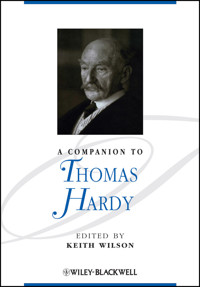
A Companion to Thomas Hardy E-Book
36,99 €
Mehr erfahren.
- Herausgeber: John Wiley & Sons
- Kategorie: Geisteswissenschaft
- Serie: Blackwell Companions to Literature and Culture
- Sprache: Englisch
Through original essays from a distinguished team of international scholars and Hardy specialists, A Companion to Thomas Hardy provides a unique, one-volume resource, which encompasses all aspects of Hardy's major novels, short stories, and poetry
- Informed by the latest in scholarly, critical, and theoretical debates from some of the world's leading Hardy scholars
- Reveals groundbreaking insights through examinations of Hardy’s major novels, short stories, poetry, and drama
- Explores Hardy's work in the context of the major intellectual and socio-cultural currents of his time and assesses his legacy for subsequent writers
Sie lesen das E-Book in den Legimi-Apps auf:
Seitenzahl: 1276
Veröffentlichungsjahr: 2012
Ähnliche




















Table of Contents
Cover
Endorsements
Blackwell Companions to Literature and Culture
Title page
Copyright page
Notes on Contributors
Abbreviations
Introduction
PART I: The Life
1 Hardy as Biographical Subject
PART II: The Intellectual Context
2 Hardy and Philosophy
3 Hardy and Darwin: An Enchanting Hardy?
4 Hardy and the Place of Culture
ACKNOWLEDGMENTS
5 “The Hard Case of the Would-be-Religious”: Hardy and the Church from Early Life to Later Years
6 Thomas Hardy’s Notebooks
I
II
III
IV
V
VI
7 “Genres are not to be mixed. . . . I will not mix them”: Discourse, Ideology, and Generic Hybridity in Hardy’s Fiction
I
II
III
8 Hardy and his Critics: Gender in the Interstices
PART III: The Socio-Cultural Context
9 “His Country”: Hardy in the Rural
10 Thomas Hardy of London
11 “A Thickness of Wall”: Hardy and Class
12 Reading Hardy through Dress: The Case of Far From the Madding Crowd
13 Hardy and Romantic Love
14 Hardy and the Visual Arts
15 Hardy and Music: Uncanny Sounds
PART IV: The Works
16 The Darkening Pastoral: Under the Greenwood Tree and Far From the Madding Crowd
17 “Wild Regions of Obscurity”: Narrative in The Return of the Native
18 Hardy’s “Novels of Ingenuity” Desperate Remedies, The Hand of Ethelberta, and A Laodicean: Rare Hands at Contrivances
The “Ingenuity” Label
Ingenuity, Realism, and Hardy’s Prefaces
Ingenuity and the Ingenious
Plotting: Fictional and Mechanical Devices
The Plotting of Love and Marriage
Conclusion
19 Hardy’s “Romances and Fantasies” A Pair of Blue Eyes, The Trumpet-Major, Two on a Tower, and The Well-Beloved: Experiments in Metafiction
20 The Haunted Structures of The Mayor of Casterbridge
21 Dethroning the High Priest of Nature in The Woodlanders
22 Melodrama, Vision, and Modernity: Tess of the d’Urbervilles
23 Jude the Obscure and English National Identity: The Religious Striations of Wessex
24 “. . . into the hands of pure-minded English girls”: Hardy’s Short Stories and the Late Victorian Literary Marketplace
25 Sequence and Series in Hardy’s Poetry
Series, Sequence-Poems and Temporal Collapse
Debating Series: Bergson, Russell, and Royce
Desire and the Series
Series of Poems: Writing as Repetition
26 Hardy’s Poems: The Scholarly Situation
Editions of Hardy’s Poems
Letters
Notebooks
Biographies
Electronic Resources
Critical and Interpretive Studies
What of the Future?
27 That’s Show Business: Spectacle, Narration, and Laughter in The Dynasts
PART V: Hardy the Modern
28 Modernist Hardy: Hand-Writing in The Mayor of Casterbridge
29 Inhibiting the Voice: Thomas Hardy and Modern Poetics
30 Hardy’s Heirs: D. H. Lawrence and John Cowper Powys
Index
“Keith Wilson’s A Companion to Thomas Hardy is distinguished for the thoroughness with which it covers intellectual contexts and for the quality of its contributors. Scholars and students of Hardy will not want to be without it.”
Studies in English Literature
“Like the many other titles in the Blackwell Companions to Literature and Culture series, this volume offers comprehensive, newly written work that meets the needs of experienced undergraduates, graduate students, and all who seek the best recent scholarship on Hardy … These fresh perspectives on Hardy will lead many to reread Hardy with new vision.”
English Literature in Transition
“There must be at least ten good books’ worth of ideas and analyses in these thirty essays.”
Hardy Review
“Hardy was a diverse, complex author, and this text mirrors his diversity and does much to explain his complexity. Highly recommended.”
Choice
“Given the range and number of its essays as well as its treatment of those who influenced Hardy, such as Darwin and Mill, this book will be indispensable for anyone conducting research in the nineteenth-century novel or poetry or teaching in the area … With thirty critical essays from some of the most prominent experts in Hardy scholarship, in addition to Keith Wilson’s provocative and concise introduction, this new book will inspire readers to return to the texts themselves.”
New Books on Literature
“This collection of essays is accessible to both the general reader and the scholar … The typeface is clear, the page quality and binding of a high standard, making this, like other titles in the series, an excellent addition to any academic library collection serving English literary studies and the public library looking to provide an up-to-date critical context for its fiction collection.”
Reference Reviews
Blackwell Companions to Literature and Culture
This series offers comprehensive, newly written surveys of key periods and movements and certain major authors, in English literary culture and history. Extensive volumes provide new perspectives and positions on contexts and on canonical and post-canonical texts, orientating the beginning student in new fields of study and providing the experienced undergraduate and new graduate with current and new directions, as pioneered and developed by leading scholars in the field.
Published Recently
62.
A Companion to T. S. Eliot
Edited by David E. Chinitz
63.
A Companion to Samuel Beckett
Edited by S. E. Gontarski
64.
A Companion to Twentieth-Century United States Fiction
Edited by David Seed
65.
A Companion to Tudor Literature
Edited by Kent Cartwright
66.
A Companion to Crime Fiction
Edited by Charles Rzepka and Lee Horsley
67.
A Companion to Medieval Poetry
Edited by Corinne Saunders
68.
A New Companion to English Renaissance Literature and Culture
Edited by Michael Hattaway
69.
A Companion to the American Short Story
Edited by Alfred Bendixen and James Nagel
70.
A Companion to American Literature and Culture
Edited by Paul Lauter
71.
A Companion to African American Literature
Edited by Gene Jarrett
72.
A Companion to Irish Literature
Edited by Julia M. Wright
73.
A Companion to Romantic Poetry
Edited by Charles Mahoney
74.
A Companion to the Literature and Culture of the American West
Edited by Nicolas S. Witschi
75.
A Companion to Sensation Fiction
Edited by Pamela K. Gilbert
76.
A Companion to Comparative Literature
Edited by Ali Behdad and Dominic Thomas
77.
A Companion to Poetic Genre
Edited by Erik Martiny
78.
A Companion to American Literary Studies
Edited by Caroline F. Levander and Robert S. Levine
79.
A New Companion to the Gothic
Edited by David Punter
80.
A Companion to the American Novel
Edited by Alfred Bendixen
81.
A Companion to Literature, Film, and Adaptation
Edited by Deborah Cartmell
This edition first published 2013
© 2013 Blackwell Publishing Ltd except for editorial material and organization © 2013 Keith Wilson
Edition history: Blackwell Publishing Ltd (hardback, 2009)
Blackwell Publishing was acquired by John Wiley & Sons in February 2007. Blackwell’s publishing program has been merged with Wiley’s global Scientific, Technical, and Medical business to form Wiley-Blackwell.
Registered Office
John Wiley & Sons Ltd, The Atrium, Southern Gate, Chichester, West Sussex, PO19 8SQ, UK
Editorial Offices
350 Main Street, Malden, MA 02148-5020, USA
9600 Garsington Road, Oxford, OX4 2DQ, UK
The Atrium, Southern Gate, Chichester, West Sussex, PO19 8SQ, UK
For details of our global editorial offices, for customer services, and for information about how to apply for permission to reuse the copyright material in this book please see our website at www.wiley.com/wiley-blackwell.
The right of Keith Wilson to be identified as the author of the editorial material in this work has been asserted in accordance with the UK Copyright, Designs and Patents Act 1988.
All rights reserved. No part of this publication may be reproduced, stored in a retrieval system, or transmitted, in any form or by any means, electronic, mechanical, photocopying, recording or otherwise, except as permitted by the UK Copyright, Designs and Patents Act 1988, without the prior permission of the publisher.
Wiley also publishes its books in a variety of electronic formats. Some content that appears in print may not be available in electronic books.
Designations used by companies to distinguish their products are often claimed as trademarks. All brand names and product names used in this book are trade names, service marks, trademarks or registered trademarks of their respective owners. The publisher is not associated with any product or vendor mentioned in this book. This publication is designed to provide accurate and authoritative information in regard to the subject matter covered. It is sold on the understanding that the publisher is not engaged in rendering professional services. If professional advice or other expert assistance is required, the services of a competent professional should be sought.
Library of Congress Cataloging-in-Publication Data
A companion to Thomas Hardy / edited by Keith Wilson.
p. cm. – (Blackwell companions to literature and culture)
Includes bibliographical references and index.
ISBN 978-1-4051-5668-4 (cloth) – 978-1-118-30749-6 (pbk.)
1. Hardy, Thomas, 1840–1928–Criticism and interpretation–Handbooks, manuals, etc.
I. Wilson, Keith (Keith G.)
PR4754.C56 2009
823′.8–dc22
2008047634
A catalogue record for this book is available from the British Library.
Cover image: Photograph of Thomas Hardy c. 1913–14 by E. O. Hoppé. Image courtesy of National Portrait Gallery, London. © E. O. Hoppé Estate | Curatorial Assistance, Inc.
Cover design by Richard Boxall Design Associates
Notes on Contributors
Tim Armstrong is Professor of Modern Literature at Royal Holloway College, University of London. His recent publications include Modernism, Technology and the Body: A Cultural Study (1998), Haunted Hardy: Poetry, History, Memory (2000), and Modernism: A Cultural History (2005). His Thomas Hardy: Selected Poems (Longman Annotated Texts) will appear in a new edition in 2009.
Penny Boumelha is Deputy Vice-Chancellor (Academic) at Victoria University of Wellington in New Zealand and a Fellow of the Academy of the Humanities in Australia. She is the author of Thomas Hardy and Women: Sexual Ideology and Narrative Form (1982), has edited a Casebook on Jude the Obscure (2000), and published essays on Hardy, including introductions for Penguin and Oxford World’s Classics editions of three of the novels. She has published widely on nineteenth-century writers, realism, and issues of gender and narrative, including a monograph on Charlotte Brontë (1990).
J. B. Bullen is Professor Emeritus of English at the University of Reading. He has had a longstanding interest in interdisciplinary studies, and his books include The Expressive Eye: Vision and Perception in the Work of Thomas Hardy (1986), The Myth of the Renaissance in Nineteenth-Century Writing (1995), The Pre-Raphaelite Body (1998), Byzantium Rediscovered (2003) and Continental Crosscurrents (2005). He has published articles on Coleridge, Ruskin, Dickens, George Eliot, Browning, Pater, and has edited Roger Fry’s Vision and Design (1981), Clive Bell’s Art (1987), and Post-Impressionists in England (1988). He is editor of Cultural Interactions, a series of interdisciplinary monographs for the publisher Peter Lang, and his critical biography of Dante Gabriel Rossetti appears in 2009.
Pamela Dalziel is Associate Professor of English and Distinguished University Scholar at the University of British Columbia. She has edited Thomas Hardy: The Excluded and Collaborative Stories (1992), Thomas Hardy’s “Studies, Specimens &c.” Notebook (with Michael Millgate, 1994), An Indiscretion in the Life of an Heiress and Other Stories (1994), and A Pair of Blue Eyes (1998). Her most recent books are Thomas Hardy’s “Poetical Matter” Notebook (with Michael Millgate, 2009) and Visual Hardy: Representing Gender and Genre in the Illustrated Novels (forthcoming).
Tim Dolin is an Associate Professor in the School of Media, Culture and Creative Arts at Curtin University of Technology in Perth, WA. He is the author of a short biography, Thomas Hardy (2008), and editor of three of Hardy’s novels for Penguin. He is presently working on narrative and performance in Hardy.
Roger Ebbatson is Emeritus Professor at the University of Worcester, and was formerly Visiting Professor at Loughborough University. His publications include The Evolutionary Self: Hardy, Forster, Lawrence (1982), Hardy: The Margin of the Unexpressed (1993), An Imaginary England: Nation, Landscape and Literature, 1840–1920 (2005), and Heidegger’s Bicycle: Interfering with Victorian Texts (2006).
Simon Gatrell, Professor of English at the University of Georgia, has published widely on Victorian literature in general and Thomas Hardy’s work in particular. His most recent book is Thomas Hardy Writing Dress (2011), a study of Hardy’s fiction and poetry through dress.
William Greenslade is Professor of English at the University of the West of England. He is the author of Degeneration, Culture and the Novel 1880–1940 (1994) and has edited Thomas Hardy’s “Facts” Notebook (2004), George Gissing’s The Whirlpool (1997), and (co-edited with Terence Rogers) Grant Allen: Literature and Cultural Politics at the Fin de Siècle (2005). He has written a number of essays on late nineteenth-century British literature and culture, including “Socialism and Radicalism,” in Gail Marshall (ed.), The Cambridge Companion to the Fin de Siècle (2007).
Margaret R. Higonnet, Professor of English and Comparative Literature at the University of Connecticut, has served as President of the American Comparative Literature Association and the American Conference on Romanticism. Her publications range over German Romantic theory, feminist theory, children’s literature, and the First World War. She has edited The Sense of Sex: Feminist Perspectives on Hardy (1992) and contributed introductions to editions of Tess of the d’Urbervilles and The Return of the Native.
Michael Irwin is Emeritus Professor of English, University of Kent. His academic publications include numerous essays on Hardy, and a book, Reading Hardy’s Landscapes (2000). He was chairman of the Thomas Hardy Society from 2004 to 2008.
George Levine is Professor Emeritus, Rutgers University, and Distinguished Scholar in Residence, New York University. Among his books are The Realistic Imagination (1981), Darwin and the Novelists (1988), and Dying to Know: Narrative and Scientific Epistemology in Victorian England (2002). He has edited many volumes of essays, including Aesthetics and Ideology (1994) and The Cambridge Companion to George Eliot (2001). His most recent publications are Darwin Loves You: Natural Selection and the Re-enchantment of the World (2006), How to Read the Victorian Novel (2007), and Realism, Secularism and Ethics: Essays in Victorian Literature (forthcoming).
Charles Lock has held the Chair of English Literature at the University of Copenhagen since 1996; he was previously Professor of English at the University of Toronto. Among his publications are Thomas Hardy: Criticism in Focus (1992) and some two hundred scholarly articles.
Phillip Mallett is Senior Lecturer in English at the University of St Andrews. His work on Hardy includes the Norton editions of The Mayor of Casterbridge (2000) and The Return of the Native (2005), and four edited collections of essays, including The Achievement of Thomas Hardy (2000) and Palgrave Advances in Thomas Hardy Studies (2004). His Rudyard Kipling: A Literary Life appeared in 2003.
J. Hillis Miller is UCI Distinguished Research Professor of Comparative Literature and English, University of California at Irvine. His most recent book is Literature as Conduct: Speech Acts in Henry James (2005). His For Derrida is forthcoming in Spring 2009 from Fordham University Press. He is currently writing two books on communities in literature, one to be entitled The Conflagration of Community: Fiction Before and After Auschwitz. His The Medium is the Maker: Browning, Freud, Derrida, and the New Telepathic Ecotechnologies is forthcoming from Sussex Academic Press in September 2009. He is a Fellow of the American Academy of Arts and Sciences, a member of the American Philosophical Society, and received the MLA Lifetime Scholarly Achievement Award in 2005.
Michael Millgate is University Professor of English Emeritus at the University of Toronto. In addition to publications in American literature, he has written Thomas Hardy: His Career as a Novelist (1971), Thomas Hardy: A Biography (1982), Testamentary Acts: Browning, Tennyson, James, Hardy (1992), and Thomas Hardy: A Biography Revisited (2004). He has also edited The Life and Work of Thomas Hardy by Thomas Hardy (1984), Selected Letters of Thomas Hardy (1990), Letters of Emma and Florence Hardy (1996), and Thomas Hardy’s Public Voice (2001), and co-edited The Collected Letters of Thomas Hardy (7 vols., 1978–88), Thomas Hardy’s “Studies, Specimens &c.” Notebook (1994), and Thomas Hardy’s “Poetical Matter” Notebook (2009).
William W. Morgan is Professor Emeritus of English at Illinois State University. He has published two co-edited books on Hardy as well as Hardy-related essays in such journals as PMLA, JEGP, Victorian Poetry, Victorians Institute Journal, Victorian Newsletter, the Thomas Hardy Journal, and the Hardy Review. For ten years he wrote the annual review of Hardy studies for Victorian Poetry. He is a vice-president of both the Thomas Hardy Society and the Thomas Hardy Association, and was for several years director of the Association’s Hardy Poetry Page. He has also published two chapbooks of poems, Trackings: The Body’s Memory, The Heart’s Fiction (1998), and Sky With Six Geese (2005), and over thirty poems in various journals.
Richard Nemesvari is Dean of Arts and Professor of English at St. Francis Xavier University. He is the author of Thomas Hardy, Sensationalism, and the Melodramatic Mode (2011), and editor of The Trumpet-Major (1991) and Jane Eyre (1999). His essay “Hardy and Victorian Popular Culture: Performing Modernity in Music Hall and Melodrama” was published in The Ashgate Research Companion to Thomas Hardy (2010), and his essay “ ‘Going in a little for the subjective’: Textual and Moral Performance in The Doctor’s Wife” was published in the Wiley-Blackwell collection A Companion to Sensation Fiction (2011). In addition to numerous essays on Hardy he has also published on Emily Brontë, Wilkie Collins, and Joseph Conrad.
Ralph Pite published Thomas Hardy: The Guarded Life in 2006 and Hardy’s Geography in 2002. He is Professor of English at the University of Bristol and currently working on a study of Edward Thomas and Robert Frost. He is also researching twentieth-century poetry and the environment.
Andrew Radford is a Lecturer in the Department of English Literature at the University of Glasgow. He is the author of Thomas Hardy and the Survivals of Time (2003) and The Lost Girls: Demeter-Persephone and the Literary Imagination, 1850–1930 (2007). He is currently at work on a book-length study of Victorian sensation fiction.
Stephen Regan is Professor of English and Head of the Department of English Studies at Durham University, where he is also director of the Basil Bunting Centre for Modern Poetry. His publications include Irish Writing: An Anthology of Irish Writing 1789–1939 (2004), The Nineteenth Century Novel: A Critical Reader (2001), The Eagleton Reader (1998), The Politics of Pleasure: Aesthetics and Cultural Theory (1992), and Philip Larkin (1992). He is the founding editor of The Year’s Work in Critical and Cultural Theory, published annually by Oxford University Press. His latest book (co-edited with Richard Allen) is Irelands of the Mind: Memory and Identity in Modern Irish Culture (2008).
Angelique Richardson is Senior Lecturer in English at the University of Exeter. She is the author of Love and Eugenics in the Late Nineteenth Century: Rational Reproduction and the New Woman (2003), editor of the Penguin Women Who Did: Stories by Men and Women, 1890–1914 (2005), and Essentialism in Science and Culture, Critical Quarterly special issue (2011), and co-editor of Darwin and the Emotions: Mind, Medicine and the Arts (2012), and Victorian Literature: A Sourcebook (2011). She is writing a book on Hardy and biology.
Mary Rimmer is Professor of English at the University of New Brunswick. She has edited Hardy’s Desperate Remedies (1998), published articles on Hardy, and collaborated on editions of four early Trinidad novels: E. L. Joseph’s Warner Arundell: The Adventures of a Creole, Mrs. William Noy Wilkins’ The Slave Son, the anonymous Adolphus: A Tale, and Stephen N. Cobham’s Rupert Gray: A Study in Black and White. She is writing a book on Hardy’s allusions.
Claire Seymour teaches English at Queen’s College London, and is a tutor in English and music for the Open University, and in opera studies for Rose Bruford College. She was the editor of the Thomas Hardy Journal from 2005 to 2008, and has introduced several Wordsworth Classics editions of Hardy, including Under the Greenwood Tree, The Return of the Native, and Life’s Little Ironies. She is the author of The Operas of Benjamin Britten: Expression and Evasion (2004).
Dennis Taylor is a professor of English at Boston College, and editor emeritus of the journal, Religion and the Arts. His books include Hardy’s Poetry 1860–1928 (1981; revised edition 1989), co-winner of the 1990 Macmillan/Hardy Society Prize, Hardy’s Metres and Victorian Prosody (1988), and Hardy’s Literary Language and Victorian Philology (1993; revised edition 1998). He is the editor of the Penguin edition of Jude the Obscure (1998), and also the editor (with David Beauregard) of Shakespeare and the Culture of Christianity of Early Modern England (2003).
Jane Thomas is Senior Lecturer in English at the University of Hull, where she specializes in Victorian literature and the work of Thomas Hardy. Her publications include Thomas Hardy: Femininity and Dissent. Reassessing the Minor Novels (1999) and editions of The Well-Beloved and Life’s Little Ironies, as well as numerous articles. She has additional research interests in nineteenth-century literature and art, twentieth-century literature, gender, and women’s writing and has published chapters and articles on the changing Victorian canon, Thomas Woolner, William Morris, Carol Anne Duffy, Caryl Churchill, and Michèle Roberts. She is currently writing a monograph for Palgrave on Thomas Hardy and Desire. She is a member of the council of management of the Thomas Hardy Society and of the editorial board of the Thomas Hardy Journal.
G. Glen Wickens is Professor of English at Bishop’s University, where he teaches Victorian and modern British literature as well as film studies. He is the author of Thomas Hardy, Monism, and the Carnival Tradition (2002) and of articles on Hardy, Tennyson, and various aspects of Victorian thought. His current research interests include a book-length study of the films of Marlon Brando.
The late Peter Widdowson was Professor of Literature at the University of Gloucestershire. He wrote extensively on Thomas Hardy after publishing Hardy in History in 1989 – most recently on silent film versions of Hardy’s fiction in T. R. Wright (ed.), Thomas Hardy on Screen (2005). He also published Literature (1999), The Palgrave Guide to English Literature and its Contexts, 1500–2000 (2004), Graham Swift (2005), and (with Peter Brooker and Raman Selden) A Reader’s Guide to Contemporary Literary Theory (5th edn., 2005).
Keith Wilson is Professor of English at the University of Ottawa. His Hardy-related publications include Thomas Hardy on Stage (1995), editions of The Mayor of Casterbridge (1997, 2003) and The Fiddler of the Reels and Other Stories (2003, co-edited with Kristin Brady), the edited collection Thomas Hardy Reappraised: Essays in Honour of Michael Millgate (2006), and numerous essays. He is the co-editor with Michael Millgate of the forthcoming 8th supplementary volume of Hardy’s Collected Letters. He has published widely on nineteenth- and twentieth-century British literature, the representation of London, and Victorian and Edwardian music hall.
Julian Wolfreys is Professor of Modern Literature and Culture in the Department of English and Drama, at Loughborough University. The author and editor of numerous books on nineteenth- and twentieth-century literature and literary theory, his most recent publications include Transgression: Identity, Space, Time (2008). He is currently compiling the Jacques Derrida concordance, and working on two other books, one on English diaspora, the other on death in the text of Jacques Derrida.
Terry R. Wright is Professor of English Literature at Newcastle University. He has written several books on Hardy, including Hardy and the Erotic (1989) and Hardy and his Readers (2003), and edited Thomas Hardy on Screen (2007). He has also written The Religion of Humanity (1986), Theology and Literature (1988), George Eliot’s “Middlemarch” (1991), and D. H. Lawrence and the Bible (2000).
Abbreviations
The following short-form designations are used for frequently cited texts. In the case of Hardy’s novels, citations in the text refer to the edition of the novel listed in a chapter’s individual “Reference and Further Reading” list.
AL
A Laodicean
CL
The Collected Letters of Thomas Hardy
, ed. Richard Little Purdy and Michael Millgate, 7 vols. (Oxford: Clarendon Press, 1978–88)
CPV
The Variorum Edition of the Complete Poems of Thomas Hardy
, ed. James Gibson (London: Macmillan, 1979)
CPW
The Complete Poetical Works of Thomas Hardy
, ed. Samuel Hynes. 5 vols. (Oxford: Clarendon Press, 1982–95)
D
The Dynasts
DR
Desperate Remedies
FFMC
Far From the Madding Crowd
GND
A Group of Noble Dames
HE
The Hand of Ethelberta
JO
Jude the Obscure
LLI
Life’s Little Ironies
LN
The Literary Notebooks of Thomas Hardy
, ed. Lennart A. Björk, 2 vols. (Basingstoke: Macmillan, 1985).
LW
The Life and Work of Thomas Hardy
, ed. Michael Millgate (London and Basingstoke: Macmillan, 1984)
MC
The Mayor of Casterbridge
MV
Moments of Vision
PBE
A Pair of Blue Eyes
RN
The Return of the Native
TD
Tess of the d’Urbervilles
THPV
Thomas Hardy’s Public Voice: The Essays, Speeches, and Miscellaneous Prose
, ed. Michael Millgate (Oxford: Clarendon Press, 2001)
TM
The Trumpet-Major
TT
Two on a Tower
UGT
Under the Greenwood Tree
W
The Woodlanders
WB
The Well-Beloved
WT
Wessex Tales
Introduction
Keith Wilson
The life and work of Thomas Hardy – to appropriate the phrase that he adopted as the title for his disguised autobiography, published under the name of his second wife, Florence Emily Hardy – intersect in a complex of paradoxes that make him a key transitional figure, perhaps the key transitional figure, in nineteenth-century literature’s movement towards modernism. The most obvious of these was born of the good fortune of longevity: the last surviving of the great Victorian novelists, in the last thirty years of his life he turned away from fiction towards poetry and lived long enough to become one of England’s most important twentieth-century poets. In returning to the medium that he claimed had always been his first love, he began the process that would ultimately establish his secure status as that rarest of literary phenomena: a writer whose achievements are defined equally by work in both prose and verse. Critical acceptance of a parity of importance between his writings in the two very different genres took some time to emerge. While a scattering of critical work was published on the poetry in the forty years after his death, it was as late as 1972 before Donald Davie, in his book Thomas Hardy and British Poetry, advanced the then deliberately provocative claim, though it seems tame enough now, that “in British poetry of the last fifty years … the most far-reaching influence, for good and ill, has not been Yeats, still less Eliot or Pound or Lawrence, but Hardy.” Once the assertion had been made, it seemed a judgment whose time had inevitably come. Within a year, Philip Larkin’s Oxford Book of Twentieth-Century English Verse had found space to include more poems by Hardy than by any other single poet.
This familiar view of Hardy’s bifurcated literary position, one foot lodged firmly in nineteenth-century fiction and the other planted just as securely in twentieth-century poetry, is a reading that many of the essays in this collection seek to qualify by bringing the fiction and the verse into more seamless relationship with each other. The essays gathered together here range confidently between the two, an ease of movement that testifies not only to the natural imaginative reciprocity between Hardy’s work in prose and poetry, but also to the critical assurance that comes from the long immersion these scholars have all had in their subject: rarely if ever have quite so many distinguished Hardyans been brought together between one set of book covers. While undermining the conventional genre-based way of viewing their subject, they also cumulatively foreground the complex array of paradoxes that Hardy’s life and work suggest.
He was a writer whose sensibility and subject matter were shaped by intimate experience in formative years of south-west England’s rural life, knowledge of whose rhythms and ways allowed him to create a whole imaginatively consistent world that restored to currency the evocative regional designation “Wessex.” Along with Wordsworth, he is probably England’s best-known “nature” writer, and even Wordsworth is not quite so inextricably associated with a particular area of rural England as Hardy, who by reimagining Wessex reinvented it. But he also relished his secure place in the socially and intellectually sophisticated world of contemporary London, translating his early reputation as a benign regional pastoralist into one as a dangerous, at times almost subversive, freethinker, so given to challenging social and religious orthodoxies as to become the kind of writer whose books a bishop might burn. A non-believer, confident only in the bleak faith that after a fifty-year search he would have discovered God had a God been there to discover, he remained throughout his life more responsive to the traditions, liturgy, tunes, buildings, and ingrained community rituals of the Anglican Church than is many a convinced Christian. An acute recorder of fleeting circumstantial minutiae – the fascinated muser on the mysteries embodied in the most ephemeral of earth’s creatures – he also, perhaps more insistently than any other Victorian or modern writer, viewed the world and everything within it against the immensities of a daunting spatial and temporal infinitude. A consummate lyricist, and creator of one of the most poignantly personal elegiac sequences in the language, he believed his major poetic work to be an epic drama chronicling the public history of Napoleonic Europe across a whole decade, in this making a judgment with which many of his contemporaries agreed.
Even his supposed “pessimism,” seized on by early commentators as manifesting an almost perverse desire to exact, in his own words, “a full look at the Worst,” was conveyed in works that had, and still have, the capacity to generate in countless non-academic readers (and a good few academic ones) a surprisingly celebratory affirmation of the intensity of life’s pleasures: love, community, music, dance, humor, and, perhaps above all, wonder in the face of nature’s incandescent beauties and mysteries. Admittedly it sometimes seems like a predictable stock of Hardyan favorites that will be invoked in testimony to his capacity to capture and relish life’s riches, enduring traditions, and whimsical humor: the Christmas dance at the tranter’s from Under the Greenwood Tree; Far From the Madding Crowd’s sheep-shearing in the “Great Barn,” a secular cathedral celebratory of community rituals that “had suffered no mutilation at the hands of time”; that breathless paean to erotic anticipation, “Timing Her”; “The Ruined Maid,” the respectable world’s risqué nod to the enlightened self-interest of sexual opportunism; and supremely, “Great Things,” whose last-stanza acknowledgment of the inevitable passing of fleshly pleasures – drink, dance, love – cannot undermine the intensity of their antecedent celebration. But for all the predictability of these favorite exhibits for the defense, those earlier commentators who saw Hardyesque pessimism as a determinative charge that required answering no longer seem even to begin to do justice to the rich complexity of Hardy’s responses to human circumstance.
For perhaps the most significant paradoxes that Hardy’s work embodies are those relating to what are unanswerable, finally moral, questions about humanity’s place in the world. On the one hand, he was a thinker who found life to offer so few and limited consolations as recurrently to figure consciousness as an ironic burden without which humanity might well have been far better off. From this perspective, the post-Darwinian human lot seems sufficiently harrowing as to make Michael Henchard’s desire to be wiped from human memory, or Tess’s lament to “have my life unbe,” or Little Father Time’s horrific solution to economic deprivation and social exclusion appear as rational as they are tragic. But on the other hand, there is an equally enduring sense in Hardy’s work that the world’s only hope of ultimate betterment resides entirely in that same questionable gift of consciousness.
Too often mere lip service has been paid to this aspect of Hardy’s thinking by reflex identification of the somewhat cold comfort to be found in the closing lines of The Dynasts, which offer the hope, expressed by the Chorus of the Pities, that consciousness may come to inform the Will “till It fashion all things fair.” The comfort feels all the colder for Hardy’s subsequent apparent retraction of this possibility in the claim that, had he written The Dynasts after the First World War, its last words, which proved nothing anyway, would not have gone to Pities. The speculative inclination that lay behind those words has been reduced to mere tokenism in much critical commentary, perhaps because that routinely invoked pessimism has in literary critics long since hardened into the cynicism for which contemporaries mistook it in Hardy. In differing ways many of the essays in this collection address important aspects of the meliorative impulse in Hardy’s thinking. Behind, for example, George Levine’s notion that “Hardy looks with Darwinian eyes and re-enchants” the world and Angelique Richardson’s conclusion that “for Hardy, to be a good human at the end of the nineteenth century was to be close to, and acknowledge kinship with, animals” lies recognition of that affirmativeness to which so many Hardy enthusiasts instinctively respond. While he may have been unable to assert with the confidence of Browning’s Fra Lippo Lippi that “This world’s no blot … / Nor blank; it means intensely, and means good,” he does recognize a vital role for humanity in finding a “way to the Better” that gives genuine philosophical purchase to that most quintessentially Hardyan of human virtues: loving-kindness.
These new essays by thirty of the world’s foremost Hardy scholars engage with many of the contradictory but densely interfused aspects of Hardy’s genius. They provide the fullest exploration of the immense variety and intellectual range of Hardy’s work to be found within a single volume. I am very grateful to all those contributors who have helped bring it to completion. In addition, I would like to record special thanks, for a variety of scholarly kindnesses, to Pamela Dalziel, April London, Michael Millgate, and Mary Rimmer, and at Blackwell to Emma Bennett, Al Bertrand, Ally Dunnett, Hannah Morrell, and Janet Moth, whose copy-editing was exemplary.
PART IThe Life
1
Hardy as Biographical Subject
Michael Millgate
Thomas Hardy was, for the greater part of his life, an actively publishing author and a prominent public figure, frequently written about, interviewed, and photographed. By his final decades he had become one of the most famous men in the world, and his death in the early days of 1928 prompted widespread national and international mourning, culminating in the ceremonial interment of his ashes in Westminster Abbey. Because of Hardy’s fame, the obituarists, reporters, and other commentators of the day had only to turn to the standard biographical sources – most notably the Who’s Who entry that Hardy had himself written and kept up to date (THPV 142–3, 473–4) – in order to be able to produce confident if brief accounts of his personal history and literary career. A few poorly informed biographies had already appeared – Hardy having reacted to the best of them with angry comments in the margins of his own copy – but it was only after his death that knowledge about his life was immensely enhanced and expanded by his widow’s publication of a full-scale two-volume biography, The Early Life of Thomas Hardy 1840–1891 appearing before the end of 1928, The Later Years of Thomas Hardy 1892–1928 just two years later. The Life of Thomas Hardy – so called long before its first single-volume publication in 1962 – immediately became the standard work of biographical reference and has inevitably remained the foundation document for all subsequent Hardy biography.
Inevitably, but by no means unproblematically. Although the two volumes of the Life were published over Florence Hardy’s name and initially accepted as being of her own composition, it was always recognized that she must have depended largely upon Hardy’s prior assistance, and following her own death in 1937 it became known that the work had been almost entirely ghost-written by Hardy himself in his late seventies with the specific intention of its being posthumously published over the name of his widow. Florence Hardy’s actual role, though certainly important, was essentially secondary, Hardy having first written the manuscript pages in secret and then handed them successively to Florence to be typed up in triplicate – at which point the manuscript pages themselves would be destroyed in order to remove all traces of Hardy’s participation. The typescripts then became the project’s working papers, subject as such to Hardy’s further and sometimes extensive revisions and, when necessary, to his wife’s retyping. After Hardy’s death it fell to Florence to write up the two final chapters, largely on the basis of notes that her husband had left, and then see through the press the two volumes bearing her name. Ironically enough, it was her failure to destroy the working typescripts, many of them containing corrections and revisions in Hardy’s hand, that facilitated the subsequent discovery of the work’s true authorship.
For Hardy himself, writing at the pinnacle of his fame and out of a profound opposition to all invasions of his own and his family’s privacy, the composition of the Life had been a largely self-protective hence minimally revelatory exercise that drew with deliberate caution on personal memories and correspondence and on the rich store of anecdotes and observations contained within the numerous notebooks, small and large, that he had accumulated over the course of a lifetime. Written in the distancing third person, the work was clearly intended to find its place within the well-recognized tradition of family-generated memorializations as an “authorized” and as it were official biography, capable as such of anticipating and, ideally, pre-empting the production of more intrusive biographies written by outsiders. After Hardy’s death, however, and before its first publication, the Life’s underlying autobiographical character was significantly compromised by the additions, deletions, and alterations introduced by Florence Hardy on the advice and under the influence of Sydney Cockerell and James Barrie, whose assistance she had sought and whose male assertiveness she found difficult to resist.
The term “autobiography” does, however, sit somewhat better – if still imperfectly – with the comprehensively re-edited one-volume edition of 1984 that restored Hardy’s intended title, The Life and Work of Thomas Hardy, and sought to reconstruct his originally intended text on the basis of those working typescripts that his widow had so remarkably failed to destroy (LW x–xxix). As thus purged of post-Hardyan interventions, Life and Work can fairly claim autobiographical status as Hardy’s own account of his own life – the personal information he felt able to share with his readership, the self-image (to put it another way) he wished to project. So considered, it certainly has value, especially since the dates and details supplied for public events customarily jibe with those ascertainable from contemporary sources – Hardy having evidently worked through his old notebooks in chronological sequence – and the references to friendships and social occasions mesh well enough with Hardy’s own correspondence, both outgoing and incoming, and with the recollections of the journalists, admirers, friends, and fellow writers who encountered him in London clubs, on social occasions, or over tea at Max Gate. It also provides unique insights into Hardy’s pre-adult and early adult years, although it necessarily defers to the endnotes the four expressive letters written from London to his sister Mary that were introduced into The Early Life of Thomas Hardy only after his death.
Biographers – and all students of Hardy – are clearly better off with Life and Work than without it, but they can only regret its failure, or refusal, to address a large number of central issues. Almost nothing of significance is said about Hardy’s political and religious beliefs and values or about either of his marriages, and although his publicly acknowledged friendship with Florence Henniker is mentioned a few times, as is his elderly attraction to Agnes Grove, there are no references, direct or indirect, to his earlier relationships (such as they may have been) with Cassie Pole, Eliza Bright Nicholls, and Rosamund Tomson, while his cousin Tryphena Sparks, though briefly invoked, is not actually named. Events and quotations are sometimes inadequately described or dated, and while there’s nothing in Life and Work even remotely comparable to Henry James’s wholesale rewriting, in Notes of a Son and Brother, of those letters by his brother William that provided the book with its ostensible raison d’être, it’s nevertheless clear that Hardy was from time to time perfectly willing to stretch the truth a little in order to enforce a point. Indeed, his snide assertion that Henry James had at first been excluded from the Rabelais Club because his writings lacked “virility” (LW 136) must have been made in despite of the knowledge that James had been, like himself, one of the club’s original members.
Especially disturbing is Hardy’s insistence upon the destruction of the materials used in the composition of Life and Work, including what must have been those extraordinarily interesting diary-notebooks, dating back at least to the early 1860s, of which only a few detached leaves containing penciled sketches or rough drafts of never-completed poems were allowed to survive. It is true that a good many individual entries from the diary-notebooks were copied by Hardy himself – with or without revision – into one or other of the “accumulative” notebooks (sometimes called commonplace books) that he continued to use during his highly creative final years. Hardy had also included these more substantial notebooks among the documents that were to be destroyed following his death, but while Sydney Cockerell, as one of his literary executors, was ready and even eager to comply with that directive, Florence Hardy, as the other literary executor, succeeded in preventing the destruction of at least some of them – notably “Literary Notes” I and II, “Memoranda” I and II, “Facts”, and “Poetical Matter” – on the grounds that she would need them when writing the closing chapters of “her” biography. She may also have openly or clandestinely protected one or two other notebooks – including “Studies, Specimens, &c.” – simply because she could not bear to see them consigned to the flames that had already consumed so much that had been deemed precious and vital during her husband’s last years.
These surviving notebooks are of particular and almost unique importance as allowing direct and fully authenticated access to Hardy’s thoughts and ideas – even (if to a much lesser degree) to his beliefs – and it is very helpful to the biographer to have them all accessible in satisfactory and sometimes excellent editions, specifically C. J. P. Beatty’s edition (recently revised) of The Architectural Notebook of Thomas Hardy, Richard H. Taylor’s edition of The Personal Notebooks of Thomas Hardy (including the two “Memoranda” notebooks, the brief “Schools of Painting” notebook, and the preparatory notebook for The Trumpet-Major), Lennart Björk’s two-volume edition of The Literary Notebooks of Thomas Hardy, William Greenslade’s edition of Thomas Hardy’s “Facts” Notebook, and the editions of the “Studies, Specimens &c.” and “Poetical Matter” notebooks co-edited by Pamela Dalziel and Michael Millgate. The Dorset County Museum, where the originals of most of the notebooks are preserved, also has pages surviving from Hardy’s early pocket-books, other scraps of paper containing notes and occasionally drawings of his plans for the building of Max Gate and – no less importantly – the largest and most significant accumulation of books from Hardy’s dispersed library. Other substantial collections of books once owned (and often annotated) by Hardy exist on both sides of the Atlantic, information as to the inclusion and location of individual titles being readily accessible through the comprehensive online reconstruction of the Max Gate library available at http://www.library.utoronto.ca/fisher/hardy/.
Although the destruction of the materials drawn upon for Life and Work was in practice somewhat less than comprehensive, it was sufficient to reinforce both the indispensability of the work itself and its effectiveness as a barrier to further and deeper knowledge – resembling as such Hallam Tennyson’s Memoir of his father, also based very largely upon unique documents that were themselves promptly and irretrievably destroyed. Whereas biographers of, say, Virginia Woolf or Robert Louis Stevenson have rich resources for the narration of their subject’s early lives, both having been born into families already highly literate (Stevenson’s mother even kept and preserved a diary of his babyhood), biographers of Hardy start out with little more than the early pages of the so largely uncheckable Life and Work, a tithe map for Higher Bockhampton, an 1853 auctioneers’ catalogue for the Kingston Maurward estate, some miscellaneous family documents (including a copy of Hardy’s father’s will, a few calculations related to the family’s building business, and the receipt for his own instruction in Latin), the official records of births, marriages, and deaths, and the successive national censuses – the first conveniently dating from 1841, a couple of months before Hardy’s first birthday, and the fourth, in 1871, unkindly revealing his fiancée, Emma Lavinia Gifford, as having claimed to be four years younger than she actually was. Also regrettably sparse are the additional Hardy family memorabilia, preserved by the family’s last representative, Hardy’s sister Kate, and now part of the Lock Collection on deposit in the Dorset County Museum. Together with the same museum’s holdings of the few books that Hardy owned as a child and a further group of family items, mostly of later date, that were originally collected by Hardy’s cousin James Sparks and are now in the library at Eton College, these comprise very nearly the totality of what physically survives from Hardy’s early background. Although genealogists – Brenda Tunks above all – have successfully traced both sides of his family back through several Dorset generations, almost nothing is known of them as individuals.
There is a significant if sometimes superficial enhancement of biographical resources as Hardy grows older, produces successful novels, attracts attention, becomes the subject of journalistic articles and interviews, makes famous friends, and writes personal and business letters that are kept by their recipients. Such letters are of particular importance as bearing demonstrably authentic witness to Hardy’s thoughts, feelings, and relationships throughout his adult life, and they are copiously available in The Collected Letters of Thomas Hardy, published in seven volumes with a supplementary eighth volume currently in progress. Sadly, this plenitude, though biographically crucial, sometimes yields less than might have been hoped: no more than fourteen Hardy letters dating from before his thirtieth birthday are currently known to exist – one of the most important of them, to his sister Mary, having been reproduced in facsimile in The Early Life of Thomas Hardy – and there are few enough from any period of his life that could be described as genuinely intimate or self-revelatory. Hardy’s transcriptions of two fragments from letters received from Emma Gifford are all that remains of the active correspondence they evidently maintained during their long and mostly long-distance courtship – Emma having apparently burned both sets of letters one angry afternoon well into their marriage. Florence for her part seems to have burned, if in a somewhat different spirit, the bulk of the exceptionally relaxed and interesting letters that Hardy was writing to her during the later stages of their pre-marital friendship, and although the collected edition includes all that survive of Hardy’s sometimes painful letters to Florence Henniker it’s possible to suspect that others may have been thrust into the fire by Mrs. Henniker at the time of their arrival – or even by Hardy himself in 1923 after they had been sent to Max Gate under the terms of Mrs. Henniker’s will.
Hardy in his late seventies certainly disposed of many of the incoming letters he had thus far preserved, with the result that few items of substantial biographical importance are to be found among the 5,000 or so letters written to Hardy that are now in the Dorset County Museum (see Weber and Weber 1968). Appearing on a good many of those letters, however, are draft replies in Hardy’s hand – subsequently to be typed and sent by Florence or by May O’Rourke, the part-time typist sometimes employed at Max Gate – and the correspondence as a whole usefully supplements the Collected Letters in documenting his dealings with publishers and witnessing to the character and importance of some of his personal friendships. Beyond Hardy’s power to control or destroy – presumably beyond his knowledge – were the thoroughly indiscreet letters written by Emma Hardy (especially to Rebekah Owen) and, later, by Florence Hardy (especially to Edward Clodd and Sydney Cockerell). Extensively – though by no means exhaustively – represented in Letters of Emma and Florence Hardy, these are useful documents for understanding life at Max Gate, the many hours that Hardy spent working alone in his study having supplied his wives with both motive and opportunity for the writing of long letters of domestic complaint. Such missives were often regretted afterwards – “I hope you burn my letters,” Florence wrote rather unhopefully to Rebekah Owen, “Some are, I fear, most horribly indiscreet” (Millgate 1996: 114) – but likely to be followed by others equally indiscreet. The secret diaries to which Emma confided her resentments against her husband are now beyond reach, having been discovered and destroyed by Hardy following her death, but her autobiographical Some Recollections, including an account of her first meeting with her future husband, has been published (subsequently to Hardy’s having adapted a portion of it for inclusion in Life and Work) and her capacity for outspokenness is reflected in the extraordinary letter in which she accused Hardy’s sister Mary of being “a witch-like creature & quite equal to any amount of evil-wishing & speaking – I can imagine you, & your mother & sister on your native heath raising a storm on a Walpurgis night” (Millgate 1996: 8).
The diaries kept by Emma during some of the Hardys’ European holidays, including the honeymoon in France in 1874, are among the important papers of hers, apparently overlooked by both Hardy and Florence, that Florence’s executor, Irene Cooper Willis, discovered in an old ottoman in the Max Gate attic Emma had formerly occupied. Subsequently deposited in the Dorset County Museum and now published in facsimile (Taylor 1985), the diaries are fascinating both as reflective of Emma’s personality and as constituting the nearest thing we have to a first-hand account not just of the travels themselves but of the ways in which she and Hardy related to each other on a day-to-day basis. It is not known just what diaries Florence Hardy may have kept during her marriage, nor whether those diaries at all extensively survive (Irene Cooper Willis had several at one time and an actual example, apparently devoted largely to household matters, was featured in a BBC Antiques Roadshow television program a few years back), but during her widowhood she certainly talked about Hardy to a number of deeply interested visitors – including Frederick Baldwin Adams, Jr., the American Hardy collector, and Richard Little Purdy, Hardy’s scholarly bibliographer. Purdy in particular, working extensively on Hardy’s papers while they were still in place in the Max Gate study, became over time very friendly with Florence and made a private record (now in the Beinecke Library) of some of their conversations. Florence’s observations on these occasions, especially as reflected in the more discursive segments of Purdy’s bibliography, have had a significant influence upon Hardy biography as upon other aspects of Hardy studies, and it’s necessary to keep in mind that she could on occasion have misconstrued or misremembered what Hardy said and that her remarks must in any case have been colored by her own emotions and biases, even by a concern for her own place in literary history.
It was during the course of Hardy’s career as a novelist that the literary interview became a prominent journalistic genre, and Hardy himself became a frequent target for its practitioners. Some of them did capture something of Hardy’s manner and record occasional passages of interest, but the vulnerability of interviews to manipulation and consequent misrepresentation always renders them somewhat suspect as source materials: in Hardy’s day, for instance, an interviewer who did not have shorthand would have had to depend upon a doubtful combination of notes, memory, and imagination. William Archer’s interview for the Pall Mall Magazine of April 1901 (Ray 2007: 28–37) is certainly important, Hardy having had the opportunity to correct or revise the record before publication, but because gossip about books was the staple of numerous newspaper columns and cheap magazines in the late Victorian and early Edwardian years it became common enough for interviews to be plagiarized, repackaged, or invented outright. Stuck as cuttings into one of Hardy’s scrapbooks in the Dorset County Museum are the published texts of several interviews that he has annotated as having been either partly or wholly faked. Printed along with some of the interviews – and often included among the illustrations to the growing number of books about “Hardy’s Wessex” – were sketches and photographs of Hardy himself, interesting in themselves and as forerunners of the many images of him that eventually came into existence.
Hardy seems essentially to have stopped granting interviews round about 1912, and although he always remained quite visible as a public figure – attending productions of plays made from his novels, accepting public honors, welcoming at Max Gate visitors as various as Lawrence of Arabia, Leonard and Virginia Woolf, and the Prince of Wales – he seems neither to have been filmed nor had his voice recorded. But when he died early in 1928 he was of course outlived by many people who had known him to different degrees and in different roles, and witnesses both reliable and unreliable were from time to time prevailed upon, or came eagerly forward, to share their Hardyan memories. Hardy’s younger sister Kate, whose surviving diary for the years 1915–39 is itself of occasional interest, was interviewed on at least two occasions, by Donald Winslow (Winslow 1970) and by another well-informed American scholar, Harold Hoffman (Rabiger 1981: 46–8), who in 1939–40 did remarkable research in England for a biography of Hardy he did not live to complete. Hoffman’s surviving papers (at Miami University, Ohio) remain largely disorganized and unworked as a result of his early death, but – as is clear from the detailed account given by their discoverer, Michael Rabiger (Rabiger 1981: 6–39) – they are of considerable interest because of the witnesses then alive with whom he spoke or corresponded. Even in the 1960s and early 1970s the bookseller and publisher James Stevens Cox was able to conduct and publish quite an extensive series of interviews with people still living who had encountered Hardy in some way – as friends, servants, tradespeople, actors in stage versions of the novels, and so forth – and while the questions were often loaded, the answers concocted out of the faintest of memories, the sheer unrepeatability of the series guarantees its remaining of permanent value.
The recorded impressions of those who encountered Hardy on a more equal footing, as fellow writers, or as friends of long standing, are in general disappointing, perhaps in part because he rarely risked intimacy and tended to become genuinely close to, hence perceptively readable by, only those friends, whether male or female, whom he thought capable of respecting and reciprocating his own intense instinct and need for privacy. In the 1950s, however, the poet Henry Reed, himself a devoted Hardyan and the author of an acerbic Hardy-related radio play about biographical research called A Very Great Man Indeed, put together an excellent radio program (BBC Archives) in which Dorothy Allhusen, Middleton Murry, Walter de la Mare, Lady Cynthia Asquith, and others spoke interestingly and at some length about the Hardy they had known. Other rewarding reminiscences are conveniently gathered into Thomas Hardy Remembered, edited by Martin Ray, and it is striking that several of those who wrote most memorably about Hardy – for example, Edmund Blunden, Elliott Felkin, Siegfried Sassoon, and especially Virginia Woolf – did so as relatively youthful figures encountering an ancient and hugely famous sage whose character and manners had long become settled and established and who had accumulated much experience of dealing graciously with visiting admirers, especially during the tea-parties for friends and pilgrims that became during the 1920s almost daily features of the Max Gate summers.
Max Gate itself (now a National Trust property) was of course designed by Hardy and built under his supervision, and although many have found the house difficult to admire it makes better sense from the inside than from the outside and perhaps needs to be “read” like one of the more idiosyncratic of the Hardyan texts. Hardy’s drawings for the house, like his other architectural drawings, testify to the persistence of his interest in his first career – later still, in 1893–4, he was the architect, his brother the contractor, in the restoration of the little Dorset church of West Knighton (Beatty 2007: 41–5) – and it is impossible to ignore the importance, at once direct and symbolic, either of Max Gate or of the nearby National Trust property known as the “Birthplace,” the Hardy family cottage in Higher Bockhampton in which Hardy was born. Scarcely less significant are Stinsford church and churchyard, where Hardy’s heart now lies, and those Dorset villages (e.g., Puddletown and Melbury Osmund) associated with family ancestors and relatives. Appreciation of Hardy’s distinctiveness as a specifically regional writer, often using identifiable settings for his novels, stories, and poems, similarly mandates a degree of familiarity with that wider area of southern England, centered upon Dorset and still largely rural, to which he gave the name of Wessex. Dorchester in particular, the county town, where Hardy received his schooling and his earliest architectural training, remained a central point throughout his life and became the model for the Casterbridge of The Mayor of Casterbridge. Also located within Dorset are two homes from the early years of Hardy’s first marriage: “Riverside,” Sturminster Newton, the beautifully situated house in which he and Emma spent what Hardy – in a rare confidential moment – called their “happiest time” (LW 122), and “Lanherne” in Wimborne, perhaps the most attractive of the houses in which the couple lived, even though they didn’t take to Wimborne itself.
The most zealous of biographers might well draw the line at checking out all the London addresses at which Hardy stayed at different periods of his life. The house in Surbiton in which he and Emma lived when first married is no longer standing, but 16 Westbourne Park Villas, in which he lived so intensely as a young architect and earnestly self-educating poet, is readily identifiable – it can even be glimpsed from the train at a point just short of the Paddington terminus – as is the house in Tooting (marked with an official plaque) in which Hardy endured a long period of illness. Especially suggestive from a biographical point of view are the church and rectory at St. Juliot in Cornwall, where Emma Gifford created for Hardy when they first met a magic that he would re-create in poems written after her death. The church itself and nearby Boscastle remain fully responsive to whoever comes with the poems and their occasion already in mind, and it is an illuminating experience to stay in the rectory, as one now very comfortably can (it currently offers accommodation to paying guests), and realize the closeness of the bedrooms in which Hardy and Emma must respectively have slept.
There are of course other sources that biographers might conceivably draw upon, but none of them seem sufficient to substitute or even greatly compensate for the evasions and blanknesses of Life and Work and the limitations of so many of the other potential source-materials. It can be reasonably said that, just as Tennyson biographers have learned to accommodate themselves to the problems presented by Hallam Tennyson’s memoir, so Hardy biographers must find – without desperate recourse to outright speculation – a way or ways around Life and Work. But it is one thing to question the available evidence or even the accepted interpretive wisdom, quite another to arrive at demonstrably satisfactory answers. Life and Work




