


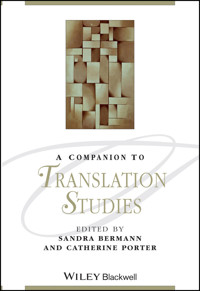
A Companion to Translation Studies E-Book
158,99 €
Mehr erfahren.
- Herausgeber: John Wiley & Sons
- Kategorie: Geisteswissenschaft
- Serie: Blackwell Companions to Literature and Culture
- Sprache: Englisch
This companion offers a wide-ranging introduction to the rapidly expanding field of translation studies, bringing together some of the best recent scholarship to present its most important current themes
- Features new work from well-known scholars
- Includes a broad range of geo-linguistic and theoretical perspectives
- Offers an up-to-date overview of an expanding field
- A thorough introduction to translation studies for both undergraduates and graduates
- Multi-disciplinary relevance for students with diverse career goals
Sie lesen das E-Book in den Legimi-Apps auf:
Seitenzahl: 1412
Veröffentlichungsjahr: 2014
Ähnliche




















Table of Contents
Blackwell Companions to Literature and Culture
Title page
Copyright page
Notes on Contributors
Acknowledgments
Introduction
From Translation to Translation Studies
Translation Studies Today
Organization of the Companion
Current Trends and New Directions
Part I: Approaches to Translation
Histories and Theories
1: The Changing Landscape of Translation and Interpreting Studies
Representation
Minority–Majority Relations
Globalization, the Global Economy, and Global Resistance
Future Directions
2: Philosophical/Theoretical Approaches to Translation
Translation and the Transfer of Mental Content
Anthropological and Philosophical Challenges
Transformative Possibilities of Translation on the Target Language
Translation as a Window onto a Foreign World
Translation as Re-creation
The Same Message in a Different Code
Translation as the Afterlife of the Original
The Ethics of Translation
The Indeterminacy of Translation
After After Babel
3: Philosophy in Translation
Vernaculars
Philosophy and Ordinary Language
Enthralled: Translation and Language Anxiety
Untranslatability
4: Variations on Translation
Methodologies
5: Text Analysis and Translation
Introduction
Language, Linguistics, and Translation
Contrastive Stylistics and the Metalanguage of Translation
Equivalence of Meaning
Functional Parameters
“Discourse Analysis” and Translation
Translation Universals
6: The Sociology of Translation: A New Research Domain
Introduction
Translation as a Profession
Translation as a Cultural Practice: Interactionism vs. Field Theory
Center and Periphery: Asymmetrical Flows of Translation
The Social Functions of Translation: Political, Economic, and Literary Fields
The Social Conditions of the International Circulation of Ideas
Epistemology of the Human and Social Sciences
Conclusion
7: Style in, and of, Translation
Style, Meaning, and Translation
Translations and Translators as Stylistic Domains
Methodological Implications
8: Translation as Higher-Order Text Processing
Introduction
Constituents of the Translation Process
Translation as Cross-Language Text Processing
9: Multimodality in Translation and Interpreting Studies: Theoretical and Methodological Perspectives
Non-Verbal Semiotics in Traditional Textualities
Non-Verbal Semiotics in Digital Textualities
From Semiotics to Multimodality
Concluding Remarks
Technologies
10: Machine Translation: A Tale of Two Cultures
The Golden Age, 1954−1960
Decline and Fall: The ALPAC Report and its Aftermath
MT Today
11: Localization and the (R)evolution of Translation
Introduction
The Digital Revolution and the Advent of Mass-Market Software
Localization: A Problem of Reuse
Complexity
From Localization to Internationalization
Object Orientation
Localization Moves from the Desktop to the Web
The Shift from Documents to Content, “Chunking,” and Single-Source Publishing
Part II: Translation in a Global Context
Intercultural Perspectives on Translation
12: Cultural Hegemony and the Erosion of Translation Communities
Translation as a Cross-Cultural Concept
Containing Translation: Social Restraints on Translational Challenges of Culture
Current Shifts in Translation as a Cross-Cultural Concept
Epistemicide, Translation, and the Future of Cross-Cultural Concepts
13: Translation as Intercultural Communication: Views from the Chinese Discourse on Translation
Clarification of Terms
Traditional Chinese Discourse on Translation as Intercultural Communication
The Significance of these Passages for Practicing Translators and Translation Theorists
14: Arabic and Translation: Key Moments in Trans-Cultural Connection
Introduction
Damascus (Eighth Century)
Baghdad (Ninth–Tenth Centuries)
Al-Andalus (Tenth–Thirteenth Centuries)
Beirut and Cairo (Nineteenth Century)
Conclusion
15: Worlds Without Translation: Premodern East Asia and the Power of Character Scripts
Alphabetic Triumphalism
The Power of the Chinese Script in East Asia
A Script for Translation Studies?
16: Global and Local Languages
Global and Local Languages as Universal Constructs
Against Universalism: Global English and Local Languages in the Era of Globalization
Translation in the Era of Globalization
Conclusion
Translation and the Postcolonial
17: What Is Special about Postcolonial Translation?
18: Postcolonial Issues in Translation: The African Context
Introduction: The “Postcolonial Turn” in Translation Studies
Writing-as-Translation
Criticism of African Literature in Translation
Translation Selection and the Languages of Translation
Conclusions
19: Postcolonial Issues: Translating Testimony, Arbitrating Justice
Identities in Translation
20: Translocation: Translation, Migration, and the Relocation of Cultures
Introduction
Migration, a Metaphor for Translation
Migration, Language, Translation
Translation and the Staging of Migrant Identity
Translocation and Translating Migrant Subjectivities
Conclusion
21: Performing Translation
The Theater of Translation
“Doing the Discipline”: Austin's “Performative”
Translation and Derrida's Drama of Iterability
“Doing Gender”: Translation and Butler's “Performativity”
“Doing Ethics”: Performing Translation
22: Queering Translation
23: How Adolfo Caminha's Bom-Crioulo Was “Outed” through its Translated Paratext
24: Self-Translation
Why (Not) Self-Translate?
Process
Product
25: Translated Literature and the Role of the Reader
Introduction
Readers as Agents
Reading Within
Reading Across
Reading Between
Reading Among
Reading Against
Reading Beyond
Translation and Comparative World Literature
26: Translation and National Literature
27: Poetic Innovation and Appropriative Translation in the Americas
I
II
28: Majnun Layla: Translation as Transposition
The Traces of Majnun in Arabic Works
A Persian Rendering of Majnun Layla
29: Benjamin's Proust: Commentary and Translation
I
II
III
IV
V
30: A Crisis of Translation: Early European Encounters with Japan
31: Revisiting Re-translation: Re-creation and Historical Re-vision
The Translation Paradox
Why Re-Translate?
Translation and Re-creation
Bringing a Language into the Modern Era
How a Translation Becomes Part of the Canon
Back to the Future: The Enduring Power of Re-translation
Acknowledgment
32: Reading Literature in Translation
I
II
III
IV
Part III: Genres of Translation
Varieties of Translation Practice
33: The Expository Translator
34: Varieties of English for the Literary Translator
National Variants
Other Variants
Regional Variants
Slang and Colloquial Variants
Stylistic Variants
Formal Variants
Chronological Variants
Conclusion
35: Tragedy and Translation
I The Translator as Ghost Whisperer
II First Moments in Unfamiliarity
III Ghosts Who Speak “For Us”
IV Future Echoes
36: The Go-Betweens: Leah Goldberg, Yehuda Amichai, and the Figure of the Poet-Translator
37: Translation and Film: Dubbing, Subtitling, Adaptation, and Remaking
Dubbing and Subtitling
Adaptation and Remaking
38: Visual Paratexts in Literary Translation: Intersemiotic Issues in the Translation of Classical Chinese Literature
Visual Paratexts: Theorizing the Verbal–Visual Relationship
Interlingual Translation and the Visual Paratext: Key Considerations
Case Study 1: Illustrations in the Liaozhai Zhiyi and its Translations: The Case of “The Painted Skin”
Case Study 2: Visual Paratexts in the Translation of Lu You's Travel Diary
Conclusion
39: Pseudotranslation on the Margin of Fact and Fiction
Pseudotranslations as Objects of Study
Possible Functions and Roles of Pseudotranslations
Complexities of Pseudotranslation
The Diary of a Simple Turk
Translating the Sacred
40: Translation and the Sacred: Translating Scripture
41: Story, Sentence, Single Word: Translation Paradigms in Javanese and Malay Islamic Literature
Translating Stories and Treatises: A Holistic Model
Translating Sentences
Translating Words: The Interlinear Model
Concluding Observations
42: Translating the Sacred: Colonial Constructions and Postcolonial Perspectives
Situating Sacred Translations: Colonial and Sacred Purposes
Translating “Scripture” in India: The Construction of Hindu “Scriptures”
Conclusion
Intralingual Translation and Questions of History
43: Intralingual Translation: Discussions within Translation Studies and the Case of Turkey
Definition of Intralingual Translation
Types of Intralingual Translation
Intralingual Translation in Turkey: “Simplification” of the Language
Conclusion
44: Intralingual Translation and the Making of a Language
Intralingual and Interlingual Translation
Historical Linguistics and Language “Nations”
A History of Glosses
Language “Families” in Translation
The Language of National Epic
45: Translating Japanese into Japanese: Bibliographic Translation from Woodblock to Moveable Type
I
II
III
IV
Index
Blackwell Companions to Literature and Culture
This series offers comprehensive, newly written surveys of key periods and movements and certain major authors, in English literary culture and history. Extensive volumes provide new perspectives and positions on contexts and on canonical and post-canonical texts, orientating the beginning student in new fields of study and providing the experienced undergraduate and new graduate with current and new directions, as pioneered and developed by leading scholars in the field.
Published Recently
This edition first published 2014
© 2014 John Wiley & Sons, Ltd
Registered Office
John Wiley & Sons Ltd, The Atrium, Southern Gate, Chichester, West Sussex, PO19 8SQ, UK
Editorial Offices
350 Main Street, Malden, MA 02148-5020, USA
9600 Garsington Road, Oxford, OX4 2DQ, UK
The Atrium, Southern Gate, Chichester, West Sussex, PO19 8SQ, UK
For details of our global editorial offices, for customer services, and for information about how to apply for permission to reuse the copyright material in this book please see our website at www.wiley.com/wiley-blackwell.
The right of Sandra Bermann and Catherine Porter to be identified as the authors of the editorial material in this work has been asserted in accordance with the UK Copyright, Designs and Patents Act 1988.
All rights reserved. No part of this publication may be reproduced, stored in a retrieval system, or transmitted, in any form or by any means, electronic, mechanical, photocopying, recording or otherwise, except as permitted by the UK Copyright, Designs and Patents Act 1988, without the prior permission of the publisher.
Wiley also publishes its books in a variety of electronic formats. Some content that appears in print may not be available in electronic books.
Designations used by companies to distinguish their products are often claimed as trademarks. All brand names and product names used in this book are trade names, service marks, trademarks or registered trademarks of their respective owners. The publisher is not associated with any product or vendor mentioned in this book.
Limit of Liability/Disclaimer of Warranty: While the publisher and authors have used their best efforts in preparing this book, they make no representations or warranties with respect to the accuracy or completeness of the contents of this book and specifically disclaim any implied warranties of merchantability or fitness for a particular purpose. It is sold on the understanding that the publisher is not engaged in rendering professional services and neither the publisher nor the author shall be liable for damages arising herefrom. If professional advice or other expert assistance is required, the services of a competent professional should be sought.
Library of Congress Cataloging-in-Publication Data
A companion to translation studies / edited by Sandra Bermann and Catherine Porter. – First Edition.
pages cm
ISBN 978-0-470-67189-4 (hardback)
1. Translating and interpreting – Study and teaching (Higher) 2. Translating and interpreting – Vocational guidance. I. Bermann, Sandra, 1947– editor of compilation. II. Porter, Catherine (Translator) editor of compilation.
P306.5.C654 2014
418'.020711–dc23
2013038467
A catalogue record for this book is available from the British Library.
Cover image: Theo van Doesburg, Composition, 1918. The Art Archive / Peggy Guggenheim Collection Venice / Gianni Dagli Orti
Cover design by Richard Boxall Design Associates
Notes on Contributors
Roger Allen, Professor of Arabic and Comparative Literature at the University of Pennsylvania, retired in 2011; he won the Saif Ghobash Banipal Prize for literary translation from Arabic in 2012. His books include The Arabic Novel (2nd edn. 1995), The Arabic Literary Heritage (1998), and Introduction to Arabic Literature (2000).
Ben Conisbee Baer, Associate Professor of Comparative Literature at Princeton University, published The Tale of Hansuli Turn, a translation of Tarashankar Bandyopadhyay's Hansuli Banker Upakatha, with Columbia University Press in 2011. A book on literary representations of indigenous vanguards in the colonial world between the 1920s and the 1940s is forthcoming.
Brian James Baer is founding editor of the journal Translation and Interpreting Studies. His recent publications include the edited volume Contexts, Subtexts, Pretexts: Literary Translation in Eastern Europe and Russia (2011) and the collection of translations No Good without Reward: Selected Writings of Liubov Krichevskaya (2011).
Mona Baker is Professor of Translation Studies, Centre for Translation & Intercultural Studies, University of Manchester, UK. She is author of In Other Words (1994) and Translation and Conflict (2006), founding editor of The Translator, and founding vice president of the International Association of Translation and Intercultural Studies.
Paul F. Bandia is Professor of Translation Studies at Concordia University, Montreal, Canada. He has published widely in translation and postcolonial studies. He is the author of Translation as Reparation (2008), and co-editor of Charting the Future of Translation History (2006) and Agents of Translation (2009).
Susan Bassnett is a writer, translator, and scholar. She has published widely on translation and comparative literature. Recent books include Reflections on Translation (2011), Translation Studies (4th edn. forthcoming), and Translation (forthcoming).
Kathryn Batchelor is Lecturer at the University of Nottingham, UK. Recent publications include Decolonizing Translation (2009), Translating Thought/Traduire la pensée, co-edited with Yves Gilonne (special issue of Nottingham French Studies, 2010), and Intimate Enemies: Translation in Francophone Contexts, co-edited with Claire Bisdorff (2013).
Özlem Berk Albachten is Professor in the Department of Translation and Interpreting Studies at Boğaziçi University, Istanbul, Turkey. She holds a BA in Italian language and literature (Istanbul University), and an MA and PhD in translation studies (University of Warwick, UK). Her research areas include translation history, intralingual translation, and travel writing.
Sandra Bermann, Cotsen Professor of the Humanities at Princeton University, co-founded Princeton's Program in Translation and Intercultural Communication with Michael Wood. A past president of the American Comparative Literature Association, she has translated Alessandro Manzoni's On the Historical Novel and co-edited, with Wood, Nation, Language and the Ethics of Translation (2005).
Martha P. Y. Cheung was Chair Professor in Translation at Hong Kong Baptist University. Her major publications include An Anthology of Chinese Discourse on Translation, volume 1: From Earliest Times to the Buddhist Project (2006) and Chinese Discourses on Translation: Positions and Perspectives (special issue of The Translator, 2009). Martha Cheung died on September 10, 2013. She had by then completed her essay for this volume, along with the biographical note, abstract, and keywords.
Peter Connor is Chair of the French Department and directs the Center for Translation Studies at Barnard College. The author of Georges Bataille and the Mysticism of Sin (2000), he has translated Bataille's Tears of Eros, Jean-Luc Nancy's The Inoperative Community, and essays by Jacques Derrida, Jacques Lacan, and Sarah Kofman.
David Damrosch is Ernest Bernbaum Professor of Literature at Harvard University, and is a past president of the American Comparative Literature Association. His books include What Is World Literature? (2003) and How to Read World Literature (2009). He is the founding director of the Institute for World Literature (www.iwl.fas.harvard.edu).
Kathleen Davis, Associate Professor of English at the University of Rhode Island, is the author of Deconstruction and Translation (2001) and Periodization and Sovereignty: How Ideas of Feudalism and Secularization Govern the Politics of Time (2008). Her forthcoming books will focus respectively on periodization across the disciplines and on time in Old English poetry.
Wiebke Denecke is Associate Professor of Chinese, Japanese, and Comparative Literature at Boston University, author of The Dynamics of Masters Literature: Early Chinese Thought from Confucius to Han Feizi (2010), Classical World Literatures: Sino-Japanese and Greco-Roman Comparisons (2013), and an editor of the new Norton Anthology of World Literature (2012).
Keiran J. Dunne is an Associate Professor of French Translation in the Institute for Applied Linguistics at Kent State University, where he teaches graduate courses on computer-assisted translation, localization, project management, and the language industry. His recent publications focus on localization, terminology management, project management, and the industrialization of translation.
Michael Emmerich is Assistant Professor of Japanese Literature and Cultural Studies at the University of California, Santa Barbara. He is the author of The Tale of Genji: Translation, Canonization, and World Literature (2013).
Rachel J. Galvin is an Andrew W. Mellon Fellow at Johns Hopkins University. She holds a PhD in comparative literature from Princeton. She is the author of a poetry collection, Pulleys & Locomotion (2009) and a translation from the French of Raymond Queneau, Hitting the Streets (2013).
Ferial J. Ghazoul is Professor of English and Comparative Literature at the American University in Cairo. She is the editor of Alif: Journal of Comparative Poetics, and the author of works on the Arabian Nights, comparative medieval literature, and postcolonial literature.
Rainier Grutman is a Professor of French and Translation Studies at the University of Ottawa (Canada). Trained in Romance languages and comparative literature in his native Belgium, he has published widely (in French, English, Spanish, and Italian) on bilingual writers, multilingual texts, and (self-)translation.
Tom Hare is William Sauter LaPorte ’28 Professor in Regional Studies, Department of Comparative Literature, at Princeton University. He works on medieval Japanese and ancient Egyptian materials. He recently published Zeami, Performance Notes (2008), a translation with commentary of the dramaturgical and theoretical writings of the great Noh playwright, Zeami (1363–1443).
Michael Henry Heim, Distinguished Professor of Slavic Languages and Literature at UCLA, was an award-winning literary translator fluent in at least eight languages and a highly regarded scholar. Among more than three dozen published translations, his renderings of Anton Chekhov, Gunter Grass, Milan Kundera, and Thomas Mann have received special acclaim. Michael Henry Heim died on September 29, 2012. He had completed his essay for this volume; the editors have supplied this biographical note and the abstract and keywords for his chapter.
Valerie Henitiuk is Senior Lecturer at the University of East Anglia and director of the British Centre for Literary Translation. Her research has appeared in several journals and anthologies. Her most recent book, Worlding Sei Shônagon: The Pillow Book in Translation, was released by University of Ottawa Press in 2012.
Hephzibah Israel is Lecturer in Translation Studies, University of Edinburgh. She researches Protestant translation practices in South Asia. Her book Religious Transactions in Colonial South India: Language, Translation and the Making of Protestant Identity (2011) offers fresh perspectives on the translated Bible as an object of cultural transfer.
Adriana X. Jacobs is an ACLS New Faculty Fellow in Comparative Literature and Judaic Studies at Yale University, where she teaches modern Hebrew and Israeli poetry, Jewish Latin American literature, and translation theory. Her current book project is titled “Where You Take Words: Sites of Translation in Contemporary Israeli Poetry.”
Efrain Kristal is Professor and Chair of UCLA's Department of Comparative Literature. His publications include Invisible Work: Borges and Translation (2002) and a forthcoming essay on Yves Bonnefoy's Shakespeare translations for the Oxford Handbook to Shakespeare's Poetry. He is also translating Remo Bodei's treatise on aesthetics, Le forme del Bello.
Isabel Lacruz is Assistant Professor of Spanish and Translation Studies at Kent State University, where she received her doctorate in experimental psychology in 2005. Her research interests include the cognitive and psycholinguistic aspects of translation and the use of eye tracking methodologies to study the translation process.
Gillian Lane-Mercier is Associate Professor of French Literature at McGill University. Author of La Parole romanesque (1989) and co-author of Faulkner: Une expérience de retraduction (2001), she is currently completing a book-length study of the issues raised by the translation into English of joual, a non-standard register of Québec French.
Brian Lennon is Associate Professor of English and Comparative Literature at Pennsylvania State University and the author of In Babel's Shadow: Multilingual Literatures, Monolingual States (2010).
Elizabeth Lowe, Professor and director of the Center for Translation Studies at the University of Illinois at Urbana-Champaign, is author of The City in Brazilian Literature (1982) and co-author, with Earl E. Fitz, of Translation and the Rise of Inter-American Literature (2007). She translates Brazilian classical and contemporary literature.
Cristiano A. Mazzei holds a Masters degree in translation studies from the University of Massachusetts Amherst. His academic interests include identity formation through translation and interpreting, intersections of translation/interpreting studies and gender, queer, and postcolonial theories, interpreting as performance, and translation/interpreting pedagogy. He directs the Translating & Interpreting Program at Century College.
Christi A. Merrill teaches South Asian literature and postcolonial theory at the University of Michigan. She is the author of Riddles of Belonging: India in Translation and Other Tales of Possession (2008). Her translations of Vijaydan Detha's Rajasthani stories, Chouboli and Other Stories (2010), won the 2012 A. K. Ramanujan Prize.
Jeremy Munday is Professor of Translation Studies at the University of Leeds, UK. His research interests include translation theory, discourse analysis, and Latin American literature in translation. He is author or editor of eight books on translation, including Introducing Translation Studies (2001), Style and Ideology in Translation (2008), and Evaluation in Translation (2012).
Robert Neather is Associate Professor in the Translation Program at Hong Kong Baptist University, where he is also associate director of the Centre for Translation. His research interests include literary translation and the semiotics of translation in museums. He has published in various journals including Meta, Semiotica, and The Translator.
Luis Pérez González is Senior Lecturer in Translation Studies at the Centre for Translation and Intercultural Studies, University of Manchester, UK. He has published numerous papers in scholarly journals and collected volumes on translation studies, and is the editor of The Interpreter and Translator Trainer.
Catherine Porter, Professor Emerita of French at SUNY College at Cortland, is a past president of the Modern Language Association and a translator of French scholarly works in the humanities and the social sciences. Recent translations include works by Avital Ronell, Jean-Christophe Bailly, Luc Boltanski, Bruno Latour, and Anne Berger.
Ronit Ricci is a senior lecturer at the School of Culture, History and Language, College of Asia-Pacific, at the Australian National University. She is the author of Islam Translated: Literature, Conversion, and the Arabic Cosmopolis of South and Southeast Asia (2011).
Gabriela Saldanha is a Lecturer in Translation Studies, University of Birmingham, UK. She is co-editor of the Routledge Encyclopedia of Translation Studies (2009), co-author of the forthcoming Research Methodologies in Translation Studies, and co-editor of Global Landscapes of Translation (a forthcoming special issue of Translation Studies).
Gisèle Sapiro, Professor of Sociology at EHESS, Paris, and Director of Research at CNRS, has published La Guerre des écrivains, 1940–1953 (1999) and La Responsabilité de l'écrivain (2011) and edited Translatio (2008), Les Contradictions de la globalisation éditoriale (2009), L'Espace intellectuel en Europe (2009), and Traduire la littérature et les sciences humaines (2012).
Gregory M. Shreve is Emeritus Professor of Translation Studies (Kent State University) and Adjunct Professor of Translation Studies (New York University). He is co-editor of several books on translation including Cognitive Processes in Translation and Interpreting (1997) and Translation and Cognition (2010).
William J. Spurlin is Professor of English at Brunel University London. His recent books include Imperialism within the Margins: Queer Representation and the Politics of Culture in Southern Africa (2006) and Lost Intimacies: Rethinking Homosexuality under National Socialism (2009). He chairs the International Comparative Literature Association's Comparative Gender Studies Committee.
Şehnaz Tahir Gürçağlar is Professor of Translation Studies at Boğaziçi University, Istanbul, where she teaches translation theory, translation history, translation criticism, and interpreting. She is the author of The Politics and Poetics of Translation in Turkey, 1923–1960 (2008). Her research interests include translation history, retranslation, and reception studies.
Maria Tymoczko, Professor of Comparative Literature at the University of Massachusetts Amherst, specializes in Celtic medieval literature, Irish studies, and translation studies. Her publications include The Irish “Ulysses” (1994), Translation in a Postcolonial Context: Early Irish Literature in English Translation (1999), Enlarging Translation, Empowering Translators (2007), and Neuroscience and Translation (forthcoming).
Phillip John Usher is currently Assistant Professor at Barnard College, Columbia University, and the author of Errance et cohérence: Essai sur la littérature transfrontalière à la Renaissance (2010) and Epic Arts in the French Renaissance (2013).
Trish Van Bolderen is a doctoral student in translation studies at the University of Ottawa (Canada), where she is researching self-translation practices within Canada.
Michael Wood is Professor Emeritus of English and Comparative Literature at Princeton University. He is the author of Yeats and Violence (2010) and co-editor, with Sandra Bermann, of Nation, Language and the Ethics of Translation (2005).
Wai-Ping Yau is Assistant Professor in the Department of English Language and Literature, Hong Kong Baptist University. His research interests include literary translation, screen translation, remaking, and adaptation
Robert J. C. Young is Julius Silver Professor of English and Comparative Literature at New York University. His books include White Mythologies (1990), Colonial Desire (1995), Postcolonialism: An Historical Introduction (2001), and The Idea of English Ethnicity (2008). He is also editor of Interventions: International Journal of Postcolonial Studies.
Acknowledgments
We owe thanks to more people than we can name for making this project possible, beginning with the authors who graciously agreed to write for the Companion and worked patiently with us through the lengthy process of manuscript preparation. In addition, we owe a special debt of gratitude to Liesl Yamaguchi for her extraordinary editorial assistance throughout this project, as well as to Jill Jarvis for her research and to Catherine Hansen for her indexing. Lawrence Venuti generously shared his reflections on the field as we worked on early stages of the book, and Edwin Gentzler was of particular help as we sought to broaden our range of potential contributors; we gratefully acknowledge their good counsel. Our editor at Wiley Blackwell, Emma Bennett, and her associates Ben Thatcher and Bridget Jennings, have offered patient, prompt, and exceptionally able assistance at every turn. To George Bermann and Philip Lewis we also owe many thanks for listening and reading and advising as this project made its way to completion.
Sandra Bermann
Catherine Porter
Introduction
Translation has played a major role in human history from the earliest times. Evidence of this singular activity, one deeply implicating our sense of language, identity, and intercultural communication, can be found in the clay tablets of the ancient Near East and continues powerfully in the information technology of the twenty-first century. It has accompanied the conquests of princes and movements of empires, the routes of trade, and human migration from ancient times to the present. Wherever people have brought new languages and cultures, translation has been there, variously transforming societies, texts, and traditions. Moreover, as psychoanalysts, poets, and theorists remind us, translation plays a crucial, if less often discussed, role in the development of individual subjectivity, agency, and identity.
Translation has most often done its work in the shadows of official history. But it has begun to grow in visibility with the globalizing culture of the twentieth and twenty-first centuries. Across the planet, translation inflects the arts and entertainment, daily conversations, news and information technologies, as well as business, trade, finance, law, government, education, military, and scientific research. Its effects and complexities have generated themes for novels, feature films, and countless Internet sites, while the word “translation” itself has become a metaphor for transformation or transposition of many kinds. Increasingly a site of theoretical reflection, translation's role in representing self and other in complicated hierarchies of power, in staging the performance of sexualities, in posing ethical questions, and in constructing linguistic and cultural histories has been increasingly acknowledged. As Bella Brodzki starkly puts it, translation today is seen to “underwrite all cultural transactions, from the most benign to the most venal” (Brodzki 2007, 2) and scholars have begun to speak of a “translation turn” in the humanities and social sciences.1 But though translation's part in past and present history has become more visible, it is not yet very well understood and not always carefully studied. The purpose of this book is to explore this social and linguistic practice more fully through the lively discipline that has recently developed to study it.
From Translation to Translation Studies
Given translation's longstanding role in human history, the discipline of translation studies is surprisingly new. Though reflections on translation have accumulated over the centuries, only in the late twentieth and early twenty-first centuries did a disciplinary field develop to study it. A young discipline in the 1960s and 1970s, situated largely in Europe and the Americas, it survived at first on the margins of the humanities and social sciences. Financial and technological globalization and the countless linguistic and cultural encounters in the contemporary world spurred its development as new insights into language and culture arose from within the academy itself. In a mere half-century, translation studies has become a stimulating field of academic as well as practical interest and has begun to challenge and transform research and curricula throughout the humanities and social sciences. With insights building from literary and cultural studies as well as from linguistics, technology, and the arts, translation studies has become a central site for analyzing the contact of cultures and a paradigm for studying our multilingual world (Ricoeur 2006; Stierstorfer and Gomille 2008; Ost 2009).
Lesen Sie weiter in der vollständigen Ausgabe!
Lesen Sie weiter in der vollständigen Ausgabe!
Lesen Sie weiter in der vollständigen Ausgabe!
Lesen Sie weiter in der vollständigen Ausgabe!
Lesen Sie weiter in der vollständigen Ausgabe!
Lesen Sie weiter in der vollständigen Ausgabe!
Lesen Sie weiter in der vollständigen Ausgabe!
Lesen Sie weiter in der vollständigen Ausgabe!
Lesen Sie weiter in der vollständigen Ausgabe!
Lesen Sie weiter in der vollständigen Ausgabe!
Lesen Sie weiter in der vollständigen Ausgabe!
Lesen Sie weiter in der vollständigen Ausgabe!
Lesen Sie weiter in der vollständigen Ausgabe!
Lesen Sie weiter in der vollständigen Ausgabe!
Lesen Sie weiter in der vollständigen Ausgabe!
Lesen Sie weiter in der vollständigen Ausgabe!
Lesen Sie weiter in der vollständigen Ausgabe!
Lesen Sie weiter in der vollständigen Ausgabe!
Lesen Sie weiter in der vollständigen Ausgabe!
Lesen Sie weiter in der vollständigen Ausgabe!
Lesen Sie weiter in der vollständigen Ausgabe!
Lesen Sie weiter in der vollständigen Ausgabe!
Lesen Sie weiter in der vollständigen Ausgabe!
Lesen Sie weiter in der vollständigen Ausgabe!
Lesen Sie weiter in der vollständigen Ausgabe!
Lesen Sie weiter in der vollständigen Ausgabe!
Lesen Sie weiter in der vollständigen Ausgabe!
Lesen Sie weiter in der vollständigen Ausgabe!
Lesen Sie weiter in der vollständigen Ausgabe!
Lesen Sie weiter in der vollständigen Ausgabe!
Lesen Sie weiter in der vollständigen Ausgabe!
Lesen Sie weiter in der vollständigen Ausgabe!
Lesen Sie weiter in der vollständigen Ausgabe!
Lesen Sie weiter in der vollständigen Ausgabe!
Lesen Sie weiter in der vollständigen Ausgabe!
Lesen Sie weiter in der vollständigen Ausgabe!
Lesen Sie weiter in der vollständigen Ausgabe!
Lesen Sie weiter in der vollständigen Ausgabe!
Lesen Sie weiter in der vollständigen Ausgabe!
Lesen Sie weiter in der vollständigen Ausgabe!
Lesen Sie weiter in der vollständigen Ausgabe!
Lesen Sie weiter in der vollständigen Ausgabe!
Lesen Sie weiter in der vollständigen Ausgabe!
Lesen Sie weiter in der vollständigen Ausgabe!
Lesen Sie weiter in der vollständigen Ausgabe!
Lesen Sie weiter in der vollständigen Ausgabe!
Lesen Sie weiter in der vollständigen Ausgabe!
Lesen Sie weiter in der vollständigen Ausgabe!
Lesen Sie weiter in der vollständigen Ausgabe!




