


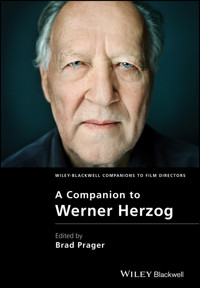
A Companion to Werner Herzog E-Book
155,99 €
Mehr erfahren.
- Herausgeber: John Wiley & Sons
- Kategorie: Geisteswissenschaft
- Serie: WBCF - Wiley-Blackwell Companions to Film Directors
- Sprache: Englisch
A Companion to Werner Herzog showcases over two dozen original scholarly essays examining nearly five decades of filmmaking by one of the most acclaimed and innovative figures in world cinema. * First collection in twenty years dedicated to examining Herzog's expansive career * Features essays by international scholars and Herzog specialists * Addresses a broad spectrum of the director's films, from his earliest works such as Signs of Life and Fata Morgana to such recent films as The Bad Lieutenant and Encounters at the End of the World * Offers creative, innovative approaches guided by film history, art history, and philosophy * Includes a comprehensive filmography that also features a list of the director's acting appearances and opera productions * Explores the director's engagement with music and the arts, his self-stylization as a global filmmaker, his Bavarian origins, and even his love-hate relationship with the actor Klaus Kinski
Sie lesen das E-Book in den Legimi-Apps auf:
Seitenzahl: 1431
Veröffentlichungsjahr: 2012
Ähnliche




















Contents
Notes on Contributors
Acknowledgments
Werner Herzog’s Companions: The Consolation of Images
New Images
Herzog’s Writing
Cinematic Companions
American Independence
Part I Critical Approaches and Contexts
1 Herzog and Auteurism: Performing Authenticity
Authenticity: Ecstatic Truth and Physical Investment
Theatricality and Identity
Self-parody
2 Physicality, Difference, and the Challenge of Representation: Werner Herzog in the Light of the New Waves
Physical Difference
Trance
Presentational and Representational Real
3 The Pedestrian Ecstasies of Werner Herzog: On Experience, Intelligence, and the Essayistic
The Essay Film
Herzog’s Essays
Part II Herzog and the Inter-arts
4 Werner Herzog’s View of Delft: Or, Nosferatu and the Still Life
5 Moving Stills: Herzog and Photography
Photography and Stasis
Photography and Trauma
Photography and Imagination
6 Archetypes of Emotion: Werner Herzog and Opera
Art and Truth
Opera and the Ethics of Acknowledgment
Catastrophe and Beauty
Opera Time
7 Coming to Our Senses: The Viewer and Herzog’s Sonic Worlds
Soundings
On Wings of Song
Visionary Sound
Hearing When the Eyes Play Tricks
Speaking in Tongues
Conclusion
8 Death for Five Voices: Gesualdo’s “Poetic Truth”
The Poetic Truth
Musical Performance
“Broken pieces”?
9 Demythologization and Convergence: Herzog’s Late Genre Pictures and the Rogue Cop Film in Bad Lieutenant: Port of Call—New Orleans
Herzog and Genre: Generic Demythologization vs. Points of Convergence
The Rogue Cop and the Corrupt City
Bad Cops: Seething Bodies and Misplaced Investitures
Legal-Narrative Iterability and the Degenerating Cop
Herzog’s Generic Retreat?
Part III Herzog’s German Encounters
10 “I don’t like the Germans”: Even Herzog Started in Bavaria
11 Herzog’s Heart of Glass and the Sublime of Raw Materials
Visual Legacies of Nature and Technology
Hearts of Glass
Raw Materials: Between Industry and Alchemy
The Art of Glassmaking
Blood and Soil: History and Apocalypse
Acknowledgments
12 The Ironic Ecstasy of Werner Herzog: Embodied Vision in The Great Ecstasy of Woodcarver Steiner
“The best ski flyer of all time”: Hyperbolic Filmmaking and Self-Irony
The Ecstasy of Flight
The Aesthetic Ecstasy of the Filmmaker Herzog
The Special Resonance of Herzog’s Ecstasy
13 Tantrum Love: The Fiendship of Klaus Kinski and Werner Herzog
Imitation Crab: Aguirre
Free Range Chicken
Acting as Chiropraxis: Woyzeck
Managing Kinski’s Posthumous Scream: My Best Fiend
Acting as Prolepsis: Cobra Verde
Part IV Herzog’s Far-Flung Cinema Africa, Australia, the Americas, and Beyond
14 Werner Herzog’s African Sublime
The African Sublime
An African Sublime?
Sublime Terror and the Figure of the Black
Fata Morgana, Mirage, and Montage
The Sublime Other: the African and Herzog’s Documentary Look
Conclusion
Acknowledgments
15 Didgeridoo, or the Search for the Origin of the Self: Werner Herzog’s Where the Green Ants Dream and Bruce Chatwin’s The Songlines
Encounters
Green Ants and Other Differences
The Songlines, or the Discovery of the Synthesis
Relationship Problems: The Viceroy of Ouidah and Cobra Verde
Epilogue
16 A March into Nothingness: The Changing Course of Herzog’s Indian Images
Indianthusiasm
Herzog’s Early Indian Images
Ballad of the Little Soldier
Ten Thousand Years Older
Conclusion
17 The Case of Herzog: Re-Opened
Documentary, Performance, Politics
The Politics of Time
On Good Behavior
Conclusion
18 The Veil Between: Werner Herzog’s American TV Documentaries
Forethoughts
The Measures Taken Again and Again
Bells from the American Deep
Bodies at Auction—How Much Wood Would a Woodchuck Chuck?
The Situating of American—Huie’s Sermon
The Whiteness of the Whale—God’s Angry Man
Afterthought
19 Herzog’s Chickenshit
Nothing to See
20 Encountering Werner Herzog at the End of the World
Explorers and Superheroes
Part V Toward the Limits of Experience Philosophical Approaches
21 Perceiving the Other in the Land of Silence and Darkness
Post-Neo-Romantic Post-Auteur Herzog
Herzog becomes Herzog
Land of Silence and Darkness
Touching-Feeling, Seeing the Haptic
(Blind) Visionaries as Theme
The Isolation of Silence and the Prison of Language
Conclusion: Three Levels of Visual Alterity
22 Werner Herzog’s Romantic Spaces
“I don’t need anything behind me”: Depth as Surface
“The Past”: Interiority and Irony in The White Diamond
Ultimate Causes
Acknowledgments
23 The Melancholy Observer: Landscape, Neo-Romanticism, and the Politics of Documentary Filmmaking
The Aesthetics of War
The Indifference of Nature
Neo-Romanticism and the Ecstasy of Truth
Conclusions
24 Portrait of the Chimpanzee as a Metaphysician: Parody and Dehumanization in Echoes from a Somber Empire
Echo/Icon: The Truth of a False Etymology
Trauma and the Sublime: History as Secular Apocalypse
Shadow-Boxing in Minnesota: Herzog, Rouch, and Cinéma Vérité
The “Metaphysical Tarzan” and His Cheetah
25 Herzog and Human Destiny: The Philosophical Purposiveness of the Filmmaker
Seeing
Knowing
Filmography
Index
Wiley-Blackwell Companions to Film Directors
The Wiley-Blackwell Companions to Film Directors survey key directors whose work constitutes what is referred to as the Hollywood and world cinema canons. Whether Haneke or Hitchcock, Bigelow or Bergmann, Capra or the Coen Brothers, each volume, composed of 25 or more newly commissioned essays written by leading experts, explores a canonical, contemporary and/or controversial auteur in a sophisticated, authoritative, and multi-dimensional capacity. Individual volumes interrogate any number of subjects – the director’s oeuvre; dominant themes, well-known, worthy, and under-rated films; stars, collaborators, and key influences; reception, reputation, and above all, the director’s intellectual currency in the scholarly world.
Published
Forthcoming
This edition first published 2012© 2012 Blackwell Publishing Ltd.
Blackwell Publishing was acquired by John Wiley & Sons in February 2007. Blackwell’s publishing program has been merged with Wiley’s global Scientific, Technical, and Medical business to form Wiley-Blackwell.
Registered OfficeJohn Wiley & Sons, Ltd, The Atrium, Southern Gate, Chichester, West Sussex, PO19 8SQ, UK
Editorial Offices350 Main Street, Malden, MA 02148-5020, USA9600 Garsington Road, Oxford, OX4 2DQ, UKThe Atrium, Southern Gate, Chichester, West Sussex, PO19 8SQ, UK
For details of our global editorial offices, for customer services, and for information about how to apply for permission to reuse the copyright material in this book please see our website at www.wiley.com/wiley-blackwell.
The right of Brad Prager to be identified as the author of the editorial material in this work has been asserted in accordance with the UK Copyright, Designs and Patents Act 1988.
All rights reserved. No part of this publication may be reproduced, stored in a retrieval system, or transmitted, in any form or by any means, electronic, mechanical, photocopying, recording or otherwise, except as permitted by the UK Copyright, Designs and Patents Act 1988, without the prior permission of the publisher.
Wiley also publishes its books in a variety of electronic formats. Some content that appears in print may not be available in electronic books.
Designations used by companies to distinguish their products are often claimed as trademarks. All brand names and product names used in this book are trade names, service marks, trademarks or registered trademarks of their respective owners. The publisher is not associated with any product or vendor mentioned in this book. This publication is designed to provide accurate and authoritative information in regard to the subject matter covered. It is sold on the understanding that the publisher is not engaged in rendering professional services. If professional advice or other expert assistance is required, the services of a competent professional should be sought.
Cataloging-in-Publication data is available from the Library of Congress
A catalogue record for this book is available from the British Library.
ISBN 9781405194402 (hardback)
Notes on Contributors
Eric Ames is Associate Professor of German and a member of the Cinema Studies faculty at the University of Washington. He is author of Carl Hagenbeck’s Empire of Entertainments (2008) and of Ferocious Reality: Documentary According to Werner Herzog (2012).Kenneth S. Calhoon is Professor of German and Comparative Literature at the University of Oregon. He is author of Fatherland: Novalis, Freud, and the Discipline of Romance (1992) and the editor of Peripheral Visions: The Hidden Stages of Weimar Cinema (2001). He has recently completed a book-length project entitled Affecting Grace: Theater and Subject from Shakespeare to Kleist.Erica Carter is Professor and Head of German at King’s College London. Her recent research focuses on the early film theory of Béla Balázs, and on the experience of Empire among German-speaking exile film audiences in mid-twentieth-century Britain. Her publications on cinema and popular culture include Dietrich’s Ghosts. The Sublime and the Beautiful in Third Reich Film (2004), the co-edited German Cinema Book (2004), and Béla Balázs: Early Film Theory (2010).Roger F. Cook is Professor of German Studies and Director of the Film Studies Program at the University of Missouri. He co-edited The Cinema of Wim Wenders: Image, Narrative, and the Postmodern Condition (1996) and has written extensively on New German Cinema and contemporary German film. He has also written on eighteenth- and nineteenth-century German literature, with a particular emphasis on Heinrich Heine. He is the author of By the Rivers of Babylon: Heinrich Heine’s Late Songs and Reflections (1998) and the editor of A Companion to the Works of Heinrich Heine (2003).Timothy Corrigan is a Professor of Cinema Studies, English, and History of Art at the University of Pennsylvania. His books include New German Film: The Displaced Image (1994), A Cinema without Walls: Movies and Culture afterVietnam (1991), Critical Visions: Readings in Classic and Contemporary Film Theory (co-authored with Patricia White and Meta Mazaj), and The Essay Film: from Montaigne, after Marker (2011). He is the editor of The Films of Werner Herzog: Between Mirage and History (1986) and Film and Literature: An Introduction and Reader (2011). Corrigan also serves as editor of the journal Adaptation and is a member of the editorial board of Cinema Journal.John E. Davidson is the founding Director of the Film Studies Program and Associate Professor of Germanic Languages and Literatures at The Ohio State University. He is the author of Deterritorializing the New German Cinema (1999) and the co-editor of Framing the Fifties: Cinema in a Divided Germany (2007). His recent publications include works on TV-documentary practices, Kluge, Bitomsky, cinematic realism after reunification, and the mourning of labor. He is currently completing a monograph on Ottomar Domnick, and his ongoing interest in cinema as a social practice of “automobilization” will culminate in a study of German film that will span the twentieth century.Lance Duerfahrd is Assistant Professor of English at Purdue University. He has recently published articles on crying and disability in William Wyler’s The Best Years of Our Lives, on the nonspeaking characters in Marx Brothers’ movies, and on the films of Billy Wilder and Joseph Lewis. He is completing a book about Samuel Beckett entitled The Work of Poverty.Jaimey Fisher is Associate Professor of German and Cinema and Technocultural Studies and is the Director of the Cinema and Technocultural Studies program at the University of California, Davis. He is the author of Disciplining Germany: Youth, Reeducation, and Reconstruction after the Second World War (2007) and is the co-editor of Critical Theory: Current State and Future Prospects (2001), The Collapse of the Conventional: German Film and its Politics at the Turn of the Twenty-First Century (2010), and Spatial Turns: Space, Place, and Mobility (2010). He has published articles in Iris, New German Critique, Genre, and German Quarterly.Matthew Gandy is Professor of Geography at University College London and was Director of the UCL Urban Laboratory from 2005–2011. He has published widely on cultural, urban and environmental themes, including depictions of nature and landscape in the visual arts. His essays on cinema include explorations of the work of Michelangelo Antonioni, Todd Haynes, Pier Paolo Pasolini, and Hiroshi Teshigahara.Randall Halle is the Klaus W. Jonas Professor of German Film and Cultural Studies at the University of Pittsburgh. His research interests include German visual culture and film theory, critical theory, queer theory, and social philosophy. His essays have appeared in journals such as New German Critique, Screen, German Quarterly, and Film-Philosophy. He is the co-editor of After the Avant-Garde (2008), Light Motives: German Popular Film in Perspective (2003), and a double special issue of Camera Obscura on Marginality and Alterity in Contemporary European Cinema. He is the author of Queer Social Philosophy: Critical Readings from Kant to Adorno (2004) and German Film after Germany: Toward a Transnational Aesthetic (2008).Stefanie Harris is Associate Professor of German and Film Studies at Texas A&M University. Her research and teaching focus on interdisciplinary approaches to literature and media, aesthetics and politics, literary theory, media theory, and film. She has published numerous essays on literature, film, and other media, and is the author of the book Mediating Modernity: German Literature and the “New” Media, 1895–1930 (2009).Noah Heringman is Associate Professor of English at the University of Missouri. He has published Romantic Science: The Literary Forms of Natural History (2003) and Romantic Rocks, Aesthetic Geology (2004), and he is currently completing a book entitled Sciences of Antiquity. He has also published articles on Romantic poetry, the history of geology, natural history, and antiquarianism. His current research aims to locate an ethnographic form of deep time at the intersection of art history and colonial voyaging.Roger Hillman is Associate Professor of Film Studies and German Studies at the Australian National University, Canberra. His book publications include Unsettling Scores: German Film, Music, and Ideology (2005), which has a chapter on Werner Herzog, and he is the co-author of Transkulturalität: Türkisch-deutsche Konstellationen in Literatur und Film (2007). His other research interests include European cinema, and film and music more generally.Rembert Hüser is Associate Professor at the University of Minnesota, where he teaches visual arts and film and media studies in the Departments of German, Scandinavian & Dutch, and Cultural Studies & Comparative Literature. He is currently interested in architecture as notational system, Mike Kelley’s Petting Zoo, Beethoven ‘70, and FSK’s version of “I Wish I Could (Sprechen Sie Deutsch)”.Laurie Johnson is Associate Professor of German at the University of Illinois, with additional appointments in Comparative Literature and in the Unit for Criticism and Interpretive Theory. Her specialties are German Romanticism and Idealism, with interests in the history of psychology and psychiatry and in psychoanalysis. She is the author of Aesthetic Anxiety: Uncanny Symptoms in German Literature and Culture (2010) and of The Art of Recollection in Jena Romanticism (2002).Lutz Koepnick is Professor of German, Film and Media Studies and Chair of the Department of German at Washington University in St. Louis. He has written widely on German film, visual culture, and literature, on media arts and aesthetics, and on critical theory and cultural politics. His book publications include: Framing Attention: Windows on Modern German Culture (2007); The Dark Mirror: German Cinema between Hitler and Hollywood (2002); and Walter Benjamin and the Aesthetics of Power (1999). His co-edited or co-authored volumes include: After the Digital Divide? German Aesthetic Theory in the Age of New Media (2009); Window/Interface (2007); The Cosmopolitan Screen: German Cinema and the Global Imaginary, 1945 to the Present (2007); Caught by Politics: Hitler Exiles and American Visual Culture (2007); and Sound Matters: Essays on the Acoustics of German Culture (2004).Manuel Köppen teaches at the Humboldt University in Berlin, where he completed his habilitation in 2004. He has also been guest professor at Cornell University and the University of Amsterdam. Besides numerous essays, he has authored two monographs: Sozialdemokratische Belletristik vor dem ersten Weltkrieg. Eine Untersuchung zum Zusammenhang von literarischer Struktur, Wirklichkeitssicht und politischer Praxis (1982); and Das Entsetzen des Beobachters. Krieg und Medien im 19. und 20. Jahrhundert (2005). He has also edited or co-edited the volumes: Kunst und Literatur nach Auschwitz (1993); Bilder des Holocaust. Literatur—Film—Malerei (1997); Die andere Stimme. Das Fremde in der Kultur der Moderne. Festschrift für Klaus R. Scherpe (1999); Passagen. Literatur—Theorie—Medien. Festschrift für Peter U. Hohendahl (2001); and Kunst der Propaganda. Der Film im Dritten Reich (2007).Will Lehman is Assistant Professor of German at Western Carolina University. His research focuses primarily on German fantasies of, and interactions with, non-European native peoples. He has published articles on German cinema and television as well as the German-Jewish-Argentinean writer Roberto Schopflocher. His current book project, German Faces, Other Spaces, examines the relationship between cinematic images of German ex-patriots in “uncivilized” native spaces and the continued cultivation of Germanness within an increasingly homogenized Europe.Lúcia Nagib is Centenary Professor of World Cinemas at the University of Leeds. Her single-authored books include: World Cinema and the Ethics of Realism (2011), Brazil on Screen: Cinema Novo, New Cinema, Utopia (2007), O cinema da retomada: depoimentos de 90 cineastas dos anos 90 (2002), Em torno da nouvelle vague japonesa (1993) and Werner Herzog: o cinema como realidade (1991). She is the editor of The New Brazilian Cinema (2003), Mestre Mizoguchi: uma lição de cinema (1990), and Ozu: o extraordinário cineasta do cotidiano (1990), and the co-editor of Theorizing World Cinema (2011) and Realism and the Audiovisual Media (2009).Brigitte Peucker is the Elias Leavenworth Professor of German and a Professor of Film Studies at Yale University. She is currently at work on Aesthetic Spaces: The Place of Art in Film. Her earlier books include The Material Image: Art and the Real in Film (2007), Incorporating Images: Film and the Rival Arts (1995), and Lyric Descent in the German Romantic Tradition (1987). She is editor of the Blackwell Companion to Rainer Werner Fassbinder (2012), and the author of many essays on questions of representation in film and literature. She serves as Director of Graduate Studies for the Combined Program in Film at Yale.Brad Prager is Associate Professor of German and a member of the Program in Film Studies at the University of Missouri. He has authored two monographs: Aesthetic Vision and German Romanticism: Writing Images (2007) and The Cinema of Werner Herzog: Aesthetic Ecstasy and Truth (2007). His articles have appeared in New German Critique, Studies in Documentary Film, Art History, and in the Modern Language Review. Most recently he has co-edited the collections The Collapse of the Conventional: German Film and its Politics at the Turn of the Twenty-First Century (2010) and Visualizing the Holocaust: Documents, Aesthetics, Memory (2008).Holly Rogers is Lecturer in Music at the University of Liverpool. She published several articles on music in art cinema during her post-doctoral work at the Humanities Institute of Ireland, and she currently holds a research fellowship at Trinity College Dublin. She is author of Sounding the Gallery: Video and the Rise of Art-Music (2012). Her recent research focuses on the use of sound by early video artists.Alan Singer is Professor of English at Temple University in Philadelphia. He writes frequently on issues in aesthetics and literary theory. His most recent critical book, The Self-Deceiving Muse: Notice and Knowledge in the Work of Art (2010) addresses literary, painterly, video, and filmic texts. His newest novel is The Inquisitor’s Tongue (2011).Reinhild Steingröver teaches German and film studies at the Eastman School of Music, University of Rochester. She also curates silent film with live new music programs in Berlin and Rochester, NY. She is the author of a monograph on Thomas Bernhard, and has co-edited After the Avant-garde. Engagements with Contemporary German and Austrian Experimental Film (2008) as well as Not so Plain as Black and White. Afro-German History and Culture, 1890–2000 (2005). She is currently completing a book entitled Last Features: DEFA’s Lost Generation.Guido Vitiello is Assistant Professor at the University of Rome “La Sapienza,” where he teaches Film Studies. His recent research focuses on such topics as the Holocaust in film and popular culture, and on the memory of the Third Reich in German film. He is the author, among other books, of Una stagione all’inferno. Hans-Jürgen Syberberg e la questione della colpa nel cinema tedesco (2007), and he has published numerous essays on film, history, and Holocaust memory.Chris Wahl is a Research Fellow at the Film and Television University “Konrad Wolf” in Potsdam-Babelsberg where he is working on a project about slow motion and superimpositions funded by the German Research Foundation (DFG). Wahl is the author of Sprachversionsfilme aus Babelsberg: Die internationale Strategie der Ufa 1929–1939 (2009). He is also the co-editor of Der Mann mit der leichten Hand: Kurt Hoffmann und seine Filme (2010), which deals with Kurt Hoffmann, the most popular German director of the 1950s, and he is the sole editor of Lektionen in Herzog: Neues über Deutschlands verlorenen Filmautor und sein Werk (2011), the first scholarly book in the German language on Werner Herzog since the 1970s.
Acknowledgments
I am grateful to Jayne M. Fargnoli, Executive Editor at Wiley-Blackwell, who has worked with me on this project and provided me with support from the start. I also appreciate the contribution of Project Editor Galen Young, who oversaw much of the book’s later development, as well as that of Tessa Hanford, who put time and effort into seeing it through the final stages.
I have benefited from being in dialogue with each one of the volume’s contributors. In particular I owe thanks to Brigitte Peucker, who was editing A Companion to Rainer Werner Fassbinder as I was assembling this volume. On more than one occasion she offered me much needed advice. I am also grateful to Kenneth S. Calhoon, Erica Carter, Manuel Köppen, and Guido Vitiello, for providing indispensable comments. Particular acknowledgment is due to Chris Wahl, who has been a remarkable interlocutor. At every turn he has been generous with insights, resources and ideas, and I am thankful that we have been in contact from beginning to end. I am also appreciative of feedback and resources provided by Eric Ames, especially for his observations concerning Werner Herzog’s work as a documentary filmmaker.
For advice at various stages I thank Dagmar Herzog, Eric Rentschler, and Michael D. Richardson. Samuel Frederick provided an important literary source at a key moment, and Kristin Bowen and Eric Ludwig each performed valued editorial work. Most important, I am grateful to my colleagues in the Department of German and Russian Studies at the University of Missouri. They have supported this project from its inception, as has the University of Missouri’s College of Arts and Science, which provided me, once again, with the time and resources I needed.
Personally, I owe a special debt of gratitude to Andrew Hoberek and Anne Myers. Their companionship means a great deal to me.
Werner Herzog’s Companions
The Consolation of Images
Brad Prager
I should be all alone in this worldMe, Steiner and no other living being.No sun, no culture; I, naked on a high rockNo storm, no snow, no banks, no moneyNo time and no breath.Then, finally, I would not be afraid any more.
Text on the screen at the end of Herzog’s The Great Ecstasy of Woodcarver Steiner (1973)1
It moves through you like a flash and forever enlightens your entire existence. Sometimes from across the centuries you find someone who feels like a brother. In one illuminating instant you know that you are not alone. […] It was as if a stranger had reached out his arm to me from across the depths of time and placed his hand on my shoulders so that I would no longer be alone.
Herzog, on the landscape painter Hercules Segers (1983)2
At the end of The Great Ecstasy of Woodcarver Steiner, Werner Herzog’s unconventional documentary about a ski-jumping woodcarver, the above ode to isolation appears written across the screen. Herzog acknowledges that these words, altered slightly to fit the context, are lifted from “Helbling’s Story” by the Swiss author Robert Walser. The story consists of the reflections of a man, who by his own account does not have the mind for serious work, only pretends to read books of interest, and admits that he is nothing special. At its conclusion, Helbling, without much fuss, declares himself deficient and unfortunate, and resolves that he would be better off alone. He sees his misery as the fault of others and wishes that all his companions would vanish, taking the world along with them. Although the most stunning compositions in Herzog’s documentary depict Walter Steiner, an athlete and craftsman, isolated from the sports fans below and floating in freedom against an empty background, the connections between Steiner and Walser’s Helbling are by no means self-evident. Why would Herzog, who seems to like and even admire his athletic protagonist, conclude his film with these particular lines?
The inclusion of these lines at the film’s end has more to do with Herzog’s approach to Walser than with his views about Steiner. Herzog’s work—in this case a film about an athlete who is, at times, at odds with his public—takes up a dialogue with other works of art, and although Herzog notoriously eschews the rhetoric of influence and avoids sustained comparisons, he embeds his own filmmaking within a long cinematic and literary history. In studying his body of work, one is confronted with an artist who has had an extraordinarily varied career, both as a writer and as a filmmaker, and who is in the habit of interpreting his own works for us. What, then, can be accomplished by considering the affinities, or, to say it differently, the moments of literary and cinematic companionship, where Herzog’s work is concerned? Haunting a project such as the present one is the idea that Herzog, who presents himself to the public as a solitary wanderer, perhaps needs no companions, and that his work can be better assessed in isolation. This collection of essays, which operates from the assumption that Herzog’s writings and films benefit from exploring their points of contact with others’ ideas, is devoted to an investigation of interconnections. It presumes that the study of the director’s writings and films, in its past, present and future modes, gains from expanding horizons, even if that examination sometimes strays from the directions in which Herzog points us.
At every phase of his storied career Herzog has declared and even insisted on his distinctiveness. Beginning with early press coverage that labeled him an “individualist among outsiders” (Plula 1971: 58) and a well-known interview where he allied himself with “eccentrics” (Borski 1973: 6), through to public conversations nearly four decades later, Herzog has asserted that his work and his worldview are unlike those of others.3 The claim is, of course, irrefutable: there is no Herzog but Herzog. And beyond that simple fact his reputation for unpredictability and for constant reinvention has been well earned. However, for someone who insists on his own incomparability, he is also acutely attentive to the long heritage with which his work aligns itself. His writings and films are part of a self-conscious and oft-revisited lineage, one that he perpetually reinforces through his own passionate appreciation of art. At the end of The Great Ecstasy of Woodcarver Steiner Herzog adapts Walser’s reflection on isolation, calling upon Walser as one would call upon a companion and including him among that vast assemblage of artists and outcasts whom he identifies as having reached out to him from across the span of time. In that group Herzog also includes the seventeenth-century Dutch painter Hercules Segers, about whom he expressed a similar admiration in 1983, ten years after the completion of Steiner. Although Herzog inclines toward isolation, asserting that he is a solitary wanderer and that his work stands apart from all others, he draws his inspiration from a bounty of aesthetic interlocutors including Walser, Segers, and scores of others whose names he has mentioned over the course of countless interviews.
In an essay partially devoted to reflecting on the sublime sensations associated with his own films Herzog again transcribed his version of Walser’s words. Most of that essay is devoted to Longinus, the Greek philosopher thought to have authored the treatise On the Sublime. After commenting on Longinus Herzog reproduces Walser’s slightly amended lines as part of his explanation about how a film’s spectator completes the sublime experience. Building on Immanuel Kant’s idea that “the sublime is not to be sought in the things of nature, but in our ideas” (2003: 134), Herzog asserts that sublimity is an effect; its truths are located in the spectator, rather than on the screen. For this reason, one can infer, the connection between his film and Walser’s prose is left open, and the ecstatic charge strikes the viewer when he or she completes the circuit.4 Akin to his observations about Segers, the part of that essay that deals with Longinus is an ode; he praises the Greek philosopher and refers to him as a “good friend” (2010a: 11). Herzog is aware that there is ambiguity about the authorship of On the Sublime, and that it is widely acknowledged that it may or may not have been written by a person named Longinus, yet he enthusiastically proclaims his affinity for that text’s author, who, like Segers, has reached out to him from across the span of time. His words of praise echo those he expresses for the French filmmaker Jean Rouch, whose film The Mad Masters (1955) features performers in a trance-like state. Herzog says that in making Heart of Glass (1976), a film in which he hypnotized his cast, Rouch’s film was a source of courage, and it was as if he had someone “like an older brother, who was giving me support, giving me advice” (Herzog 2007). For Herzog the works of the philosopher Longinus, the artist Segers, the author Walser, and the filmmaker Rouch each incline toward that “ecstatic truth” he associates with “illumination.” The truth is, in this case, unconnected to political or ideological standpoints and must always be disentangled from what he has called the “truth of accountants,” which “creates norms” (Cronin 2002: 301). Following from such influences Herzog’s cinema inscribes itself into a history of truth-illuminating images.
Referring the reader to the word’s etymological origins Herzog notes that for the Greeks “truth,” or aletheia comes from lanthanein, which means, “to lie hidden or unseen.” Truth, as that which is unhidden, reveals what is concealed and is thus the product of an “act of disclosure” (Herzog 2010a: 11). He adds that this disclosure is, “a gesture related to the cinema, where an object is set into the light and then a latent, not yet visible image is conjured onto celluloid, where it first must be developed, then disclosed” (2010a: 11). Cinematic images are thus the product of a relation: they are captured by one person in the sealed space of the camera, revealed by another in the developing process, and reach yet a third in the darkness of the movie house. Cinema takes place between interlocutors, and it appears as the result of an exchange; found by one, its ecstatic truth must be sought by another. One can surely clear away the etymological arguments, which for some readers may echo those of Martin Heidegger, and rather note that in Herzog’s scenario the addition of light, first upon the celluloid and then in the theater, is indispensable to truth’s revelation. Every one of the metaphors in his essay on Segers is likewise bound up with light’s appearance. Herzog describes its influx alternately as illuminating, enlightening, and akin to a flash. Franz Kafka, who loved the cinema, formulated matters similarly, writing, “art flies around the truth, but with the definite intention of not getting burnt. Its capacity lies in finding the dark void, a place where the beam of light can be intensely caught, without this having been perceptible before” (1991: 39). Truth thus emerges at a point of contrast: the darker the space, the more dynamic the beam that bisects it. Cinema draws its strength from darkness.
From this perspective cinema’s truth is transferred illumination. This is one consequence of defining cinema in the language of disclosure. A less mystifying account, however, would underscore how art is at its most fascinating when it is illuminating art. Rather than waiting for the illumination of truth from a work that is deemed to be independent of all others, it may be constructive to think along other lines and ask which part of the truth Herzog claims for art is concerned with works illuminating one another. The image whereby one artist reaches out to another across time suggests a method of interpretation that aims to close a gap between the past and the present. Herzog’s relentless references to art’s history—the closing of the fissures that divide, say, a 32,000-year-old cave drawing, a dance by Fred Astaire, and a screen performance by Klaus Kinski—can be seen as an effort to find continuities and rebuff the distinctions brought on by the forward motion of time. Herzog’s Signs of Life (1968), for example, which is about a soldier driven mad owing to the remoteness of his post, stands alongside Segers’ desolate seventeenth-century imagery. The well-known shot in Herzog’s first feature film of a windmill-covered landscape takes its inspiration from the Dutch artist, whose paintings and etchings of windmills were ciphers for more than only the air’s quiet movement. They bespoke the human encroachment on the landscape as well as the hazards of having an overly deliberative mind. Yet one has to acknowledge that it is not only Segers who alters Herzog, but that Herzog likewise alters Segers. One returns to the paintings subsequent to viewing Signs of Life and sees their pathos relative to a maze of interconnections between madness and isolation.
The history of Herzog’s work contains a multitude of such reciprocal disclosures. In order that viewers not miss them, Herzog takes it upon himself to recommend a ceaseless stream of works. He has a habit of intoning his recommendations such that one is made to feel that even if one has read the book or watched the film in question, one has not looked at it hard enough or seen its truth through the darkness. With this degree of gravitas Herzog offers a reading list to those who plan to attend his Rogue Film School, a place where one supposedly also learns how to pick locks and steal cameras. The reading list seems like a practical joke intended to discourage his devotees: he endorses only the most unwieldy books including Rabelais’ Gargantua and Pantagruel novels, a cycle of sixteenth-century works that add up to more than a thousand pages, and he also suggests reading The Warren Commission Report, which is 880 pages long. This latter recommendation seems particularly counterintuitive. At first glance this account of the Kennedy assassination is the very materialization of what Herzog would describe as the accountants’ truth; it provides only provable facts rather than illuminating something that is generally hidden from sight. The book is, however, not without its ecstatic moments. It includes unlikely details such as the extent to which Jack Ruby was fond of dogs, how he referred to them as his children, and “became extremely incensed” when he witnessed their maltreatment (1964: 804). Is Herzog being unserious, or does he see a moment of truth-illuminating disclosure in this collectively authored report? Does The Warren Commission Report, either because of its strange and unlikely set of details, or because of its notoriously contested facts, have something ecstatic about it?
In light of these examples of reciprocity comments Herzog made early in his career about the filmmakers Satyajit Ray and François Truffaut can be explained. Herzog contends that earlier films, when seen next to his work, “learn from him.”5 That the statement is hyperbolic seems to be a deliberate provocation. How can films produced prior to his “learn from him”? The sentiment expresses something about Herzog’s companions and about the productive nature of affinities. He does not like to feel that other films influenced him, yet reciprocal illumination may be entirely distinct from the discourse of influence. Although Herzog frequently presents himself as a solitary pilgrim, his art itself gravitates toward the companionship of other works, and leans toward interconnections with other artists. Despite the proposition’s seductive appeal, art is at no point independent from art, and the interaction between texts and films may even be the engine of their sublimity insofar as that interaction throws the sublime experience of synthesis back upon the spectator.
Among Herzog’s cinematic companions he frequently mentions trailblazing filmmakers such as D. W. Griffith and Tod Browning. Herzog’s feature film Aguirre, the Wrath of God (1972), to choose another example from early in the director’s oeuvre, echoes what at first seems to be an unlikely source: Charlie Chaplin’s The Gold Rush (1925). Chaplin’s film opens with a sequence that depicts the Chilkoot Pass in Alaska. A trail of a prospectors proceeds up a mountainside, each of them tiny as ants. Chaplin then cuts to a high-angle shot, and we see the prospectors’ backs and shoulders as they, one after the next, ascend the mountain and nearly bump up against the lens. Herzog’s Aguirre begins with a strikingly similar image, and its proportions resonate unmistakably with Chaplin’s. That single shot may still be Herzog’s best known, and although he had made feature films before Aguirre, for many viewers this striking tableau set his international career in motion: a snaking trail of Spaniards and their indigenous servants is reduced to the smallest conceivable scale, almost lost amid the lush green verdure. Herzog’s gold rush, the search for El Dorado, is here transposed from Chaplin’s Alaska, and the works of the two path-breaking independent filmmakers can be linked. Seen in this way—in the light of inverse influence—we might now view both films differently. For example, in one of the subsequent sequences in The Gold Rush, Chaplin depicts his lone prospector stalked by a bear. It is a poignant moment in which Chaplin’s preoccupied figure is unwittingly shadowed. Illuminated by Herzog’s work this Alaskan bear becomes something that can only be described as a stirring fore-echo of Herzog’s Grizzly Man (2005). Although it was, in that latter film, expressed as recklessness, Treadwell’s intrepid spirit was simultaneously American and pioneering. Both of these Alaskan figures remain unaware of the extreme danger that awaits them. Chaplin’s prospector, because he is so decidedly sympathetic, shares a common pathos and depth with Treadwell, especially once his footage has been presented and framed by Herzog.
In what follows I consider how Herzog’s work is connected with other approaches, including German writers and filmmakers, prewar filmmakers, and tendencies in American independent cinema. The contributors to this volume have not been asked them to restrict themselves to single films; Herzog’s works hang together, and they reward attempts to see them in this light. It is a pitfall of thinking in auteurist terms that every work by a given director is of a piece with the whole, yet so many themes recur that such thinking is inevitable, and, insofar as art is its own companion and film can illuminate other films, it is desirable. The twenty-five essays in the present volume—whether approaching the matter in connection with French film, Dutch painting, or American poetry—seek to illuminate not only key moments within individual films, but also the approach of the filmmaker as a whole, examining his language and his images with respect to their composition, historicity, and context.
New Images
During the 1970s and into the early 1980s Herzog was commonly associated with the New German Cinema, whose representatives were largely independent filmmakers, though they each also profited from the group’s wider recognition. Rainer Werner Fassbinder, Wim Wenders, and a few other leading lights defined them. Timothy Corrigan notes that cultural-historical context rather than a collective stylistic signature identified that set’s higher profile filmmakers, observing that they shared a “common zero ground,” and gathered around “the machinery of filmmaking” as a means of “freeing themselves from the suspicions of their native language” (1986: 6). Referring to Truffaut’s famous fictional figure from The 400 Blows (1959), a young man in France who rebuffed all authority, Corrigan called the cohort of postwar filmmakers, who were rendered fatherless because of the war, “Antoine Doinels” (6).6 Herzog’s decision not to trouble himself with film school, but rather to continue as an autodidact and a student of the world, can be linked to his decision not to participate in signing the group’s political manifestoes. Akin to Wenders and Fassbinder, Herzog was feted at Cannes where he was awarded the Grand Jury Prize in 1975 for The Enigma of Kaspar Hauser (1974). Throughout this time he consented to precious few collective affiliations, yet his refutation was not always absolute. As late as 1979, after he completed his transnational production of Nosferatu—The Vampyre (1979), which starred Kinski and the Swiss actor Bruno Ganz alongside the French actress Isabelle Adjani, Herzog participated in a group interview for the magazine Der Spiegel. In the company of young directors Uwe Brandner, Reinhard Hauff, and Hark Bohm, all of whom were, like Herzog, born during World War II, Herzog boasts, “we dominate the cinema with our films; we are German film. We are not the young-film movement or something like that.”7 By the end of the interview Herzog has emerged as the dominant voice. Careful readers can already detect intimations of tensions with Bohm that would grow into conflicts over Herzog’s South American film Ballad of a Little Soldier (1984) (see Bohm and Zimmer 1984), yet Herzog was clearly, at this point, willing to sit together with other filmmakers and, more important, to use the word “we.” Despite his professions of isolation, Herzog produced a number of identifiably German films in the 1970s, including The Enigma of Kaspar Hauser, Heart of Glass (1976), Stroszek (1977), and Woyzeck (1979), and he was, in some measure, himself produced by the German film industry over the course of that decade. His filmmaking, regularly supported by the public television station ZDF, emerged out of a specific cultural context. Whether or not he considered New German Cinema’s filmmakers to be his companions, he benefited from the growth of and the attention given to the German film industry.
Herzog praised many of his fellow filmmakers, especially Fassbinder,8 and he now and again worked with Wenders, stepping more than once before the latter’s camera. In a staged encounter in Tôkyô-ga (1985), Wenders’ feature-length documentary about images, simulacra, and the cinema of Yasujirō Ozu, Herzog appears to fortuitously bump into the documentarian Wenders in Japan. Herzog there describes his willingness to climb 8,000 meters or travel with NASA on Skylab in search of what he describes as “new images.” At the Cannes Film Festival a few years earlier Herzog had similarly spoken directly into Wenders’ camera for the documentary Room 666 (1982). At that festival in May 1982—a year in which Herzog’s Fitzcarraldo (1982) and Wenders’ Hammett (1982) were both in competition—a number of filmmakers, including Michelangelo Antonioni, Steven Spielberg, and Fassbinder, who died only a few weeks later, all answered questions about the fate of cinema relative to the looming shadow of television. As in Tôkyô-ga Herzog shows a willingness to collaborate and even to have a bit of fun: he is the only one of the various filmmakers who shuts off the droning television that Wenders has left on in the background as a bit of documentary mise-en-scène, and Herzog also takes off his shoes as he responds to Wenders’ written talking point. This last act may have been playful self-citation on Herzog’s part: he would perhaps rather avoid being put in the position of having to eat his shoes, as he had done in front of the director Les Blank’s camera shortly before, in Berkeley, California in 1979, to settle a wager with Errol Morris. In his answer to Wenders Herzog offers a bit of optimism: he concludes, “I’m not all that worried,” noting that television may have its uses, and that we might one day do our banking or choose groceries with such an item, but that television will not replace the experience of cinema.
Comments related to those Herzog made in Wenders’ Tôkyô-ga can already be found in much earlier interviews in which he argues that his goal is “to show images, which have not been seen yet in cinema.”9 Herzog wants to reveal something altogether new, yet he deliberately introduces tendentious and much discussed topics into his films such as the history of war, colonial exploration, and the exploitation of the earth. Insofar as his films are about looking—at war-torn landscapes, at the slave trade, or at the faces of the colonized themselves—they are also reflections on the history of images. Herzog expresses his rhetoric in evolutionary terms when he, in Blank’s Werner Herzog Eats his Shoe (1980), maintains that we were going to “die out like dinosaurs” if we do not develop adequate images. In seeking to present us with a view of our fate, or in pursuit of a standpoint from which we might otherwise see ourselves, we can understand Herzog’s fascination with animal and alien perspectives. A flock of flamingoes in Fata Morgana (1969), for example, is meant to be perceived only fleetingly as an impression of movement that challenges our sensitivity to form, or as a means of seeing the world as representatives of an alien civilization would see it (a theme to which he returned in The Wild Blue Yonder [2005]). There is always the intimation that we should seek an “outside” to how we perceive the world, regardless of the fact that we are unlikely to find it. To listen to him speak in Werner Herzog Eats His Shoe, the “inside” we inhabit is defined by advertising, capitalism, and television shows such as Bonanza; in a film such as The Enigma of Kaspar Hauser, that inside consists of those limitations defined by language; and in Fata Morgana, it is primarily our human (and specifically, western) perceptual apparatus that defines it.
The concept of the “new image,” however, presents a dilemma—one that is related to the problem of companions—insofar as images are within rather than external to history. Herzog for the most part declines to make explicit statements of advocacy, and his images are undeniably chosen in accord with his claim of autonomy; he wants his films subordinated to no extant discourses and prefers to avoid political speech. After his return from an earlier Cannes Festival, in 1968, Herzog responded to the question of whether he intended to be part of the political protests that were brewing in connection with the upcoming Berlin Film Festival. He had left his short film Last Words (1968) in that year’s competition at Oberhausen, where others had withdrawn their entries, and he hoped his films would be evaluated on an unpolitical basis. In a short essay that bears the title “Howling with the Wolves” Herzog expresses regret that in times of political tension one does not have a right to expect to be understood in a nuanced way; sides are chosen, and those who do not howl with the wolves will be counted among the lambs (1968: 460). For this reason, Herzog explains, he has stated that Signs of Life, which is about World War II but takes place in Greece and is freely adapted from a story by the German Romantic writer Achim von Arnim, was unpolitical. The imagery on which Herzog draws, with its reference to lambs and wolves, is surely biblical, yet it also can be seen to refer to Heinrich von Kleist’s “St. Cecilia or the Power of Music: A Legend” (1810).10 In that story, which was also written during the Romantic era, iconoclasts come to the city of Aachen to destroy a cathedral and are reduced to a trance-like state by the beauty of religious music; they find themselves only capable of howling like wolves. One interpretation of Kleist’s story is that the power of music, that is, the power of aesthetics, trumps political rebellion and reduces politically motivated revolutionaries to making braying, animalistic sounds. It brings out what Herzog sees as a truth about political speech. The nature of their collective action is animalistic; they howl like madmen, and thus lose control of their self-expression. An ecstatic performance triumphs over politically motivated violence, and art saves the cathedral.
By most accounts Herzog’s films aspire to reach beyond the bounds of prosaic language and inspire in the viewer an experience of sublimity. The sublime has, however, a unique function; following Burke and Kant it tends to be defined in asocial terms, especially when compared with the sociability generally linked to beautiful representations. Beauty is gentle, its experience is predicated on universal agreement, and its appearance affirms the presence of a larger (typically divine) plan. The sublime, however, is challenging and is viewed as the acknowledgment of the solitary subject’s lonesome struggle to impose categories, concepts, and meanings on grandiose or terrifying objects. Perhaps for this reason, owing to this specter of solipsism, Herzog’s filmmaking has always been shadowed by sublimity. It is, in other words, not the images themselves, but the sum of the figure cut by the director taken together with his work that causes us to examine his images under the sign of the sublime. Yet genuine isolation—the confrontation with truly new images—is inconceivable insofar as the perception of cinematic images is always already social; the act of viewing is invariably embedded in context, in history, and in language. This, then, is the source of an ever-present tension in engagements with Herzog’s work: his images point toward an isolation, an autonomy and a sui generis status that they cannot claim. Corrigan aptly identifies the movement of the director’s films as one “between a language of some sort (history, literature, politics, etc.) and the hypnotic substance of images” (1986: 16). Alan Singer, who describes the director’s sublime visions as always embedded in self-reflective irony, articulates this back and forth movement similarly, writing: “Herzog’s vistas are deliberately not a release from the rigors of contemplation that is the seductive pleasure of the sublime, but are ever more engrossing visual situations that compel attention to their unique formal determinations. By contrast with the pleasure of sublimity, these determinations might even be described as the exigencies of an inescapable historical will/knowledge insofar as the traces of their production are integral to their compositional order and intelligibility” (1986: 188).
For all his consciousness of the hazards of contemplation, Herzog is not in the tradition of Bertolt Brecht, and he is not primarily concerned with undercutting our aesthetic absorption. The juxtapositions in his films take a distinctive shape, and his most ecstatic moments are purposefully set in opposition to the historical determination of vision. They are held up against the history of the image in the form of Richard Wagner (in Fitzcarraldo [1982] and Lessons of Darkness [1992]), Leni Riefenstahl (in Scream of Stone [1991] and Cobra Verde [1987]), and even, now and again, a figure such as Karl May (in Aguirre, the Wrath of God and Ballad of a Little Soldier).11 Although Herzog professes little interest in Riefenstahl and May, he incorporates into his work what Singer describes as an “inescapable historical will/knowledge,” a will and knowledge that are inescapable on two levels: the associations that follow from them are inevitable, especially for his German audiences; and they are also mesmerizing. They are compelling, and are for this reason deliberately laid aesthetic traps. To vary Marshall McLuhan’s famous formulation: the mystification is the message. Herzog is an enchanting magician, yet he is also a modern critic of beguiling practices, and he thus reflects our stupefaction back at us. The history and historicity of his images—their “uses”—are always incorporated into and repurposed in his works.
Having excused himself from associations with New German Cinema and delinked himself from most major art historical trends, Herzog sometimes stylizes himself in accord with a Romantic “forest isolation” (Waldeinsamkeit). Jan Christopher Horak describes the director’s stylization as that of the prophet-artist, who remains “apart from the temporal problems shared by most mortals” (1986: 31).12 This image—the self-stylization as literary figure in search of solitude—recalls figures such as Christopher McCandless, the subject of Jon Kracauer’s 1996 nonfiction book Into the Wild, who undertook to separate himself wholesale from society, as well as Byron’s Childe Harold, who, while roaming in foreign lands, learns from solitude the lessons of death (2004: 136). Herzog’s published diary, The Conquest of the Useless (2009), where he documents the difficulties that beset the production of the film Fitzcarraldo, contains many such images of the self in Romantic isolation. His journal is full of language and sentiments associated with Waldeinsamkeit, where the Wald in question is the Amazon. His stylized self-reliance is illustrated in his description of a soccer game in Lima, where the director found himself confused as to which players were on which team. He concludes: “I knew the only hope of winning the game would be if I did it all by myself […] I would have to take on the entire field myself, including my own team” (2009: 8). Even more characteristic is a curious incident from around the time Herzog was isolated by the burden of his dream of enacting Fitzcarraldo’s vision of hauling a steamship over a mountain. Coming to terms with the fact that no one would help him realize his plan, he writes: “In the evening I finished reading a book, and because I was feeling so alone, I buried the book on the edge of the forest with a borrowed spade” (2009: 244). The incident is curious: for whom does Herzog want us to believe he is leaving this message? For what future reader? Is he setting the book aside for posterity or is he burying it once and for all?
In gravitating toward total isolation Herzog becomes a character akin to those that grace his films. His travel diary Of Walking in Ice—a chronicle of his journey on foot from Munich to Paris in the winter of 1974—is filled with hyperbolic valorizations of solitude. It includes customary Herzogian declarations such as “when I move, a buffalo moves. When I rest, a mountain reposes” (1980a: 8). In such passages its tone has everything in common with the power fantasies of Kinski’s Lope de Aguirre, who declared that the earth quaked beneath him when he walked. To read with Horak, who is a remarkably close reader of Of Walking in Ice, one might think of this as “posturing” (1986: 37), or even as messianic fantasy (35). Herzog is a character in his own ongoing film, and the dedifferentiation of documentary and features, for which he has become famous, contributes to the blurring of the lines: the real Timothy Treadwell, the quasi-fictional Aguirre, and the lyrical wanderer Herzog—their dreams gravitate toward isolation, and toward shaping the world to accommodate their singular vision. The enthusiastic naturalist, the visionary yet diabolical conquistador, and the German filmmaker each create their own worlds. The grander the vision, the more expansive and varied the inner landscape. Yet these characters and their visions exist in language and in history. The self, like the work of art, can never be truly isolated.
Herzog’s Writing
There are ample writings by Herzog apart from Of Walking in Ice and Conquest of the Useless. The trail of texts is long, and the German novelist and scholar W. G. Sebald is one example of a writer who acknowledged his authorial affinity with Herzog. He generally wrote about Herzog in a context in which writers such as Walser, Wittgenstein, and Nabokov more frequently appeared. Indeed Herzog emerges as an influence in more than one of the author’s novels.13 Sebald, who died in an auto accident in 2001, was nearly the same age as Herzog (he was born in 1944, Herzog was born in 1942), and was from a region of Germany close to the one in which Herzog was raised. In a 2001 essay entitled “Moments Musicaux” Sebald indicates that he felt spoken to by the scene in Fitzcarraldo in which the protagonist, played by Klaus Kinski, believes that Enrico Caruso is acknowledging him from the stage of a Brazilian opera house during a performance of Giuseppe Verdi’s Ernani.14 In Herzog’s film, Kinski believes he has been swept up; having been made part of the production he swoons ecstatically. The incident comes early in the film, and the encounter with the stage bespeaks the confusion of reality and fantasy that becomes the film’s major theme. Sebald writes that upon seeing the production of Ernani in Herzog’s film, he recalled having seen that same opera as a child in a town identified as “S.” The letter likely indicates the town of Sonthofen in the Bavarian Alps, which lies only 130 miles from Herzog’s own “S.,” that is, Sachrang, where the young film director was simultaneously growing up. In Sebald’s essay, he writes that the local upholsterer and tobacconist played the lead roles in the production, and Herzog’s cinematic scene becomes a cipher through which Sebald replays moments from his own past. He too is transported as if onto the stage.
At a subsequent point in Sebald’s essay he recounts how he had a ticket to see a production of Verdi’s Nabucco (1842), at the Bregenz Festival when it was staged there in 1993–4. He grew concerned that the treatment of the persecution of the Jews in this opera would be vulgar, and he found himself, for this reason, prepared to part with his ticket. At this point, he explains, a woman who asked him whether he might have a spare ticket approached him. In what is clearly an evocation of one of the initial moments of Fitzcarraldo, we are informed that she—like Kinski and Claudia Cardinale in Herzog’s film, who have traveled by boat to see Caruso—has “come a long way” (2005: 195) and that she is disappointed that there are no tickets available. Sebald notes that this woman likely approached him because he “looked like someone let down by his companion” (195). One can surmise that here, owing to his suspicions about how the festival was putting Verdi to use, he felt let down, and for this reason he heads home where he takes comfort (or refuge) in his books.
Herzog is of the same generation as a cohort of postwar writers, which includes Sebald, but also more widely known ones such as Peter Schneider and Peter Handke. Herzog once praised Schneider’s Der Mauerspringer (The Wall Jumper) highly in a published review, describing the novel as both good and urgent (dringlich) (1982: 213), but he would surely protest against such comparisons. He has never been directly affiliated with Schneider or Handke, nor does he think of himself as specifically German (he prefers to describe his origins as Bavarian).15 He has doubtlessly walked a path quite different from such writers, and it would be a mistake to include him in that category without underscoring the many caveats, yet in examining the work of his early years there is also cause to consider the connections. Herzog’s interest in the historical figure Kaspar Hauser, for example, links his projects with those of Handke, who was, like Herzog, born in 1942. Handke and Herzog are an unlikely combination insofar as Handke is more commonly connected with Wim Wenders. Those two collaborated on a number of films and share a common mood characterized by protagonists who drift from place to place, and by their joint attempt to articulate their disaffection negatively through the absence of affect. Such tendencies are generally associated with the so-called new subjectivity of the West German 1970s, a literary movement that appears to have spoken little to Herzog.
A 1967 poem by Handke entitled “Fright” (“Erschrecken”) ends with the line “This desert is a Fata Morgana!” which, in denying the desert its dominance, may be meant as a reassuring conclusion to an ode to fear (1974: 149). As a word for “mirage” fata morgana occurs regularly enough in German, yet if one considers Herzog’s own remarks as to how Africa has always left him frightened (Cronin 2002: 47), one might be tempted to picture a parallel between Handke’s anxious verse and Herzog’s excursion in the late 1960s, from which he returned with the film Fata Morgana.16 However, Handke’s play Kaspar




