


A Companion to William Faulkner E-Book
28,99 €
Mehr erfahren.
- Herausgeber: John Wiley & Sons
- Kategorie: Geisteswissenschaft
- Serie: Blackwell Companions to Literature and Culture
- Sprache: Englisch
This comprehensive Companion to William Faulkner reflects the current dynamic state of Faulkner studies.
- Explores the contexts, criticism, genres and interpretations of Nobel Prize-winning writer William Faulkner, arguably the greatest American novelist
- Comprises newly-commissioned essays written by an international contributor team of leading scholars
- Guides readers through the plethora of critical approaches to Faulkner over the past few decades
- Draws upon current Faulkner scholarship, as well as critically reflecting on previous interpretations
Sie lesen das E-Book in den Legimi-Apps auf:
Seitenzahl: 1422
Veröffentlichungsjahr: 2017
Ähnliche




















Table of Contents
Cover
Title Page
Notes on Contributors
Acknowledgments
Introduction
PART I: Contexts
1 A Difficult Economy: Faulkner and the Poetics of Plantation Labor
Preface: A Labor Parable
An Historical Interlude
From Subsemantics Toward Semantics: Three Phases of Labor Withdrawal
References and Further Reading
2 “We’re Trying Hard as Hell to Free Ourselves”: Southern History and Race in the Making of William Faulkner’s Literary Terrain
An Integrated White Space
Sole Owner and Proprietor: Faulkner in the 1930s
Fictions of the Middle Ground
References and Further Reading
3 A Loving Gentleman and the Corncob Man: Faulkner, Gender, Sexuality, and
The Reivers
“American” Sexuality and Gender
Southern Sexualities and Genders
Bill(y) Faulkner’s Sexualities and Genders
William Faulkner’s Fictional Sexualities and Genders
References and Further Reading
4 “C’est Vraiment Dégueulasse”: Meaning and Ending in
A bout de souffle
and
If I Forget Thee, Jerusalem
Cunning
References and Further Reading
5 The Synthesis of Marx and Freud in Recent Faulkner Criticism
Marx
(Counter-)Hegemony
I, Myself
False Consciousness
Faulkner and the Frankfurt School
References and Further Reading
6 Faulkner’s Lives
References and Further Reading
PART II: Questions
7 Reflections on Language and Narrative
References and Further Reading
8 Race as Fact and Fiction in William Faulkner
References and Further Reading
9 “Why Are You So Black?” Faulkner’s Whiteface Minstrels, Primitivism, and Perversion
References and Further Reading
10 Shifting Sands: The Myth of Class Mobility
Reading Anse
The Myth of Mobility
References and Further Reading
11 Faulkner’s Families
The Sartorises
The Compsons
The Sutpens
The McCaslins
Conclusion
References and Further Reading
12 Changing the Subject of Place in Faulkner
Reflecting on Faulkner’s South
Critical Reflections on Place in Faulkner
A Disappearing Place
A Collapsing Sense of Place
Split Subjects of Place
Change as Thought and Felt
Oxford in the Post-Faulkner Era
References and Further Reading
13 The State
Reformed Liberalism: The Dynamics of Ideological Change
“Once a Bitch, Always a Bitch”: Jason Compson Takes on the Capitalist State
(Dis)Order in the Court: The State on Trial in
Sanctuary
Case Closed: Mapping Ideological Boundaries in
Intruder in the Dust
Yoknapatawpha, USA: Faulkner’s Political Property
Acknowledgment
References and Further Reading
14 Violence in Faulkner’s Major Novels
Psychoanalytic and Sociological Imagery of Violence:
The Sound and the Fury
(1929)
Faulkner’s Most Violent Novel:
Sanctuary
(1931)
Violence and Protestant Culture:
Light in August
(1932)
Violence of Content and Violence of Expression:
Absalom, Absalom!
(1936)
Violence in the World of the Rednecks:
The Hamlet
(1940)
The Violence of the Plantation System:
Go Down, Moses
(1942)
Humor and Violence:
The Reivers
(1962)
References and Further Reading
15 An Impossible Resignation: William Faulkner’s Post-Colonial Imagination
Empty Space
Map Making
Go Down, Moses
References and Further Reading
16 Religion: Desire and Ideology
Rigid Attachments/Ineffable Longings
Religion, Race, and Representation
References and Further Reading
17 Cinematic Fascination in
Light in August
References and Further Reading
18 Faulkner’s Brazen Yoke: Pop Art, Modernism, and the Myth of the Great Divide
References and Further Reading
PART III: Genres and Forms
19 Faulkner’s Genre Experiments
References and Further Reading
20 “Make It New”: Faulkner and Modernism
References and Further Reading
21 Faulkner’s Versions of Pastoral, Gothic, and the Sublime
References and Further Reading
22 Faulkner, Trauma, and the Uses of Crime Fiction
Faulkner’s “Straight” Crime Texts
Light in August
and
Absalom, Absalom!
Sanctuary
References and Further Reading
23 William Faulkner’s Short Stories
Early Sketches and Stories: The New Orleans period
Short Story Writing For a Living: Faulkner’s First Short Story Collection
Doctor Martino and Other Stories
: Miscellaneous Stories
Short Story Cycles or Novels?
Late Stories:
Knight’s Gambit, Collected Stories
Summing Up
References and Further Reading
24 Faulkner’s Non-Fiction
Race
Books and Writers: Art
Technology and the Modern World
Travel
Sports
Mississippi
References and Further Reading
25 Faulkner’s Texts
References and Further Reading
PART IV: Sample Readings
26 “By It I Would Stand or Fall”: Life and Death in
As I Lay Dying
References and Further Reading
27 Faulkner and the Southern Arts of Mystification in
Absalom, Absalom!
References and Further Reading
28 “The Cradle of Your Nativity”: Codes of Class Culture and Southern Desire in Faulkner’s Snopes Trilogy
References and Further Reading
PART V: After Faulkner
29 “He Doth Bestride the Narrow World Like a Colossus”: Faulkner’s Critical Reception
Casting Long Shadows: Early Readings of Faulkner’s Work
Taming Faulkner’s Fiction: New Critical Readings
New Directions: Bleikasten and Irwin
From Faulkner to
Faulkners
: The “Theory Boom” and Faulkner Studies
The Problem of Late Faulkner
Comparative Faulkner
The Contemporary Scene: Where Are We Now with Faulkner Studies?
Acknowledgment
References and Further Reading
30 Faulkner, Latin America, and the Caribbean: Influence, Politics, and Academic Disciplines
Faulkner and Latin American Literature
Faulkner and Politics, the Politics of Faulkner Studies: Anti-Americanism and Inter-Americanism
Reconsidering Faulkner, Reconsidering the South
Acknowledgment
References and Further Reading
31 Faulkner’s Continuance
References and Further Reading
Index
End User License Agreement
List of Illustrations
Chapter 11
Figure 1 Faulkner’s pencil drawing of the McCaslin genealogy. Alderman Library, University of Virginia accession number 6074, item 981f. From
William Faulkner Manuscripts
by William Faulkner.
Figure 2 Faulkner’s chronology for
Absalom, Absalom!
Alderman Library, University of Virginia accession number 6074, item IA:13.h. From
William Faulkner Manuscripts
by William Faulkner.
Figure 3 Reprinted from H. H. Bell, Jr. (1965). A Reading of Faulkner’s
Sartoris
and “There was a Queen.”
Forum
, 4(8): 23–6.
Guide
Cover
Table of Contents
Begin Reading
Pages
ii
iii
iv
viii
ix
x
xi
xii
xiii
xiv
1
2
3
4
5
7
8
9
10
11
13
14
15
16
17
18
19
20
21
22
23
24
25
26
27
28
29
30
31
32
33
34
35
36
37
38
40
41
42
43
44
46
47
48
49
50
51
52
53
54
56
57
58
59
60
61
62
63
64
65
66
67
68
69
70
71
72
73
74
75
76
77
78
79
80
81
82
83
84
85
86
87
88
89
90
91
92
93
94
95
96
97
98
99
100
101
102
103
104
105
106
107
108
109
110
111
112
113
115
116
117
118
119
120
121
122
123
124
125
126
127
128
129
130
131
132
133
134
135
136
137
138
139
140
141
142
143
144
145
146
147
148
149
150
151
152
153
154
155
156
157
158
159
160
161
162
163
164
165
166
167
168
169
170
171
172
173
174
175
176
177
178
179
183
184
185
186
187
188
189
190
191
192
193
194
195
197
198
200
201
202
203
204
205
206
207
208
209
210
211
212
213
214
215
216
217
218
219
220
221
222
223
224
225
226
227
228
229
230
231
232
233
234
235
236
237
238
239
240
241
242
243
244
245
246
247
248
249
250
251
252
253
254
255
256
257
258
259
260
261
262
263
264
265
266
267
268
269
270
271
272
273
274
275
276
277
278
279
280
281
282
283
284
285
286
287
288
289
290
291
292
293
294
295
296
297
298
299
300
301
302
303
304
305
306
307
308
309
310
311
312
313
314
315
316
317
319
321
322
323
324
325
326
327
328
329
330
331
332
333
334
335
336
337
338
339
340
341
342
343
344
345
346
347
348
349
350
351
352
353
354
355
356
357
358
359
360
361
362
363
364
365
366
367
368
369
370
371
372
373
374
375
376
377
378
379
380
381
382
383
384
385
386
387
388
389
390
391
392
393
394
395
396
397
398
399
400
401
402
403
404
405
406
407
408
409
410
411
412
413
414
415
416
417
418
419
420
421
422
423
424
425
426
427
429
430
431
432
433
434
435
436
437
438
439
440
441
442
443
444
445
446
447
448
449
450
451
452
453
454
455
456
457
458
459
460
461
462
463
464
465
466
467
468
469
470
471
472
473
474
475
477
479
480
481
482
484
486
487
489
490
491
494
495
497
498
499
500
501
502
503
504
505
506
507
508
509
510
511
512
513
514
515
516
517
518
519
520
521
522
523
524
525
526
528
529
530
531
532
533
534
535
536
537
538
Blackwell Companions to Literature and Culture
This series offers comprehensive, newly written surveys of key periods and movements and certain major authors, in English literary culture and history. Extensive volumes provide new perspectives and positions on contexts and on canonical and post-canonical texts, orientating the beginning student in new fields of study and providing the experienced undergraduate and new graduate with current and new directions, as pioneered and developed by leading scholars in the field.
Published Recently
72. A Companion to Irish LiteratureEdited by Julia M. Wright
73. A Companion to Romantic PoetryEdited by Charles Mahoney
74. A Companion to the Literature and Culture of the American WestEdited by Nicolas S. Witschi
75. A Companion to Sensation FictionEdited by Pamela K. Gilbert
76. A Companion to Comparative LiteratureEdited by Ali Behdad and Dominic Thomas
77. A Companion to Poetic GenreEdited by Erik Martiny
78. A Companion to American Literary StudiesEdited by Caroline F. Levander and Robert S. Levine
79. A New Companion to the GothicEdited by David Punter
80. A Companion to the American NovelEdited by Alfred Bendixen
81. A Companion to Literature, Film, and AdaptationEdited by Deborah Cartmell
82. A Companion to George EliotEdited by Amanda Anderson and Harry E. Shaw
83. A Companion to Creative WritingEdited by Graeme Harper
84. A Companion to British Literature, 4 volumesEdited by Robert DeMaria, Jr., Heesok Chang, and Samantha Zacher
85. A Companion to American GothicEdited by Charles L. Crow
86. A Companion to Translation StudiesEdited by Sandra Bermann and Catherine Porter
87. A New Companion to Victorian Literature and CultureEdited by Herbert F. Tucker
88. A Companion to Modernist PoetryEdited by David E. Chinitz and Gail McDonald
89. A Companion to J. R. R. TolkienEdited by Stuart D. Lee
90. A Companion to the English NovelEdited by Stephen Arata, Madigan Haley, J. Paul Hunter, and Jennifer Wicke
91. A Companion to the Harlem RenaissanceEdited by Cherene Sherrard-Johnson
A COMPANION TO WILLIAM FAULKNER
EDITED BY RICHARD C. MORELAND
This paperback edition first published 2015© 2007 Blackwell Publishing Ltd except for editorial material and organization© 2007 Richard C. Moreland
Edition history: Blackwell Publishing Ltd (hardback, 2007)
Registered OfficeJohn Wiley & Sons Ltd, The Atrium, Southern Gate, Chichester, West Sussex, PO19 8SQ, UK
Editorial Offices350 Main Street, Malden, MA 02148-5020, USA9600 Garsington Road, Oxford, OX4 2DQ, UKThe Atrium, Southern Gate, Chichester, West Sussex, PO19 8SQ, UK
For details of our global editorial offices, for customer services, and for information about how to apply for permission to reuse the copyright material in this book please see our website at www.wiley.com/wiley-blackwell.
The right of Richard C. Moreland to be identified as the author of the editorial material in this work has been asserted in accordance with the UK Copyright, Designs and Patents Act 1988.
All rights reserved. No part of this publication may be reproduced, stored in a retrieval system, or transmitted, in any form or by any means, electronic, mechanical, photocopying, recording or otherwise, except as permitted by the UK Copyright, Designs and Patents Act 1988, without the prior permission of the publisher.
Wiley also publishes its books in a variety of electronic formats. Some content that appears in print may not be available in electronic books.
Designations used by companies to distinguish their products are often claimed as trademarks. All brand names and product names used in this book are trade names, service marks, trademarks or registered trademarks of their respective owners. The publisher is not associated with any product or vendor mentioned in this book.
Limit of Liability/Disclaimer of Warranty: While the publisher and author have used their best efforts in preparing this book, they make no representations or warranties with respect to the accuracy or completeness of the contents of this book and specifically disclaim any implied warranties of merchantability or fitness for a particular purpose. It is sold on the understanding that the publisher is not engaged in rendering professional services and neither the publisher nor the author shall be liable for damages arising herefrom. If professional advice or other expert assistance is required, the services of a competent professional should be sought.
Library of Congress Cataloging-in-Publication DataA companion to William Faulkner / edited by Richard C. Moreland.p. cm. —(Blackwell companions to literature and culture ; 47)Includes bibliographical references and index.
ISBN-13: 978-1-4051-2224-5 (hardcover : alk. paper) 978-1-119-04540-3 (papercover)ISBN-10: 1-4051-2224-2 (hardcover : alk. paper) 1-119-04540-1 (papercover)1. Faulkner, William, 1897–1962—Criticism and interpretation—Handbooks, manuals, etc.I. Moreland, Richard C. II. Series.PS3511.A86Z7585 2007813′.52—c222006012584
A catalogue record for this book is available from the British Library.
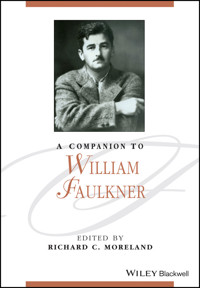
Cover image: William Faulkner in a publicity photo forSanctuary, c.1931; Cofield Collection, Southern MediaArchive, University of Mississippi Special Collections
Notes on Contributors
Ted Atkinson serves as assistant professor of English at Augusta State University. His primary areas of research and teaching interest are modern American literature and culture and Southern studies. His publications include Faulkner and the Great Depression: Aesthetics, Ideology, and Cultural Politics (2005), as well as essays in the Faulkner Journal and Mississippi Quarterly.
Timothy P. Caron is professor of English at California State University, Long Beach, where he teaches courses in nineteenth- and twentieth-century American literature. His research and teaching interests include religion and literature, particularly in the works of writers such as William Faulkner, Flannery O’Connor, Richard Wright, Zora Neale Hurston, Ralph Ellison, Toni Morrison, and Cormac McCarthy. He is currently working on a book on the critical reception of William Faulkner.
Deborah Cohn is associate professor of Spanish at Indiana University. She has published essays in Comparative Literature Studies, CR: The New Centennial Review, Latin American Research Review, Southern Quarterly, and elsewhere. She co-edited Look Away!: The U.S. South in New World Studies with Jon Smith (2004). She recently received a National Endowment for the Humanities fellowship to work on a book entitled Creating the Boom’s Reputation: The Promotion of the Boom in and by the U.S.
Susan V. Donaldson is National Endowment for the Humanities Professor at the College of William and Mary, where she has taught American literature and American studies since 1985. She is the author of Competing Voices: The American Novel, 1865–1914 (1998), which won a Choice Outstanding Academic Book award, and of over three dozen essays on Southern literature and culture. She has co-edited, with Anne Goodwyn Jones, Haunted Bodies: Gender and Southern Texts (1997); guest-edited two special issues of the Faulkner Journal on sexuality and masculinity respectively; and co-edited, with Michael Zeitlin, another special issue on memory and history. Her works in progress include a book on the politics of storytelling and visual culture in the US South and a book-length study of William Faulkner, Eudora Welty, Richard Wright, and the demise of Jim Crow.
Leigh Anne Duck is an assistant professor of English at the University of Memphis. Her essays have appeared in American Literary History, the Journal of American Folklore, and Mississippi Quarterly, as well as the books Faulkner in the Twenty-First Century (2003) and Look Away!: The U.S. South in New World Studies (2004). Her book The Nation’s Region: Southern Modernism, Segregation, and U.S. Nationalism is forthcoming.
John N. Duvall is professor of English and editor of Modern Fiction Studies at Purdue University. He is author of Faulkner’s Marginal Couple: Invisible, Outlaw, and Unspeakable Communities (1990) and The Identifying Fictions of Toni Morrison: Modernist Authenticity and Postmodern Blackness (2000), and editor or co-editor of Productive Postmodernism: Consuming Histories and Cultural Studies (2002), Faulkner and Postmodernism (2002), and Approaches to Teaching DeLillo’s White Noise (2006). He is currently finishing a study of racial figuration in Southern fiction.
Greg Forter is associate professor of English at the University of South Carolina. He is the author of Murdering Masculinities: Fantasies of Gender and Violence in the American Crime Novel (2000) and, among other essays, “Against Melancholia: Contemporary Mourning Theory, Fitzgerald’s The Great Gatsby, and the Politics of Unfinished Grief” (differences 2003). His current project traces the links among gender identity, racial fantasy, and socially induced loss in American modernism.
Richard Godden teaches American literature in the Department of American Studies at the University of Sussex. He has published Fictions of Capital (1990) and Fictions of Labor (1997); a study of Faulkner’s later work, William Faulkner: An Economy of Complex Words, is forthcoming. He currently works on the relationship between narrative poetics and the economic forms of Flexible Fordism.
Grace Elizabeth Hale is associate professor of American studies and history at the University of Virginia. The author of Making Whiteness: The Culture of Segregation in the South (1999) and the forthcoming Rebel, Rebel: Outsiders in Postwar America, she has also written about American culture for American Scholar, Southern Cultures, Southern Exposure, Radical History Review, the Journal of Southern History, the Journal of American History, and the American Historical Review. Her new project traces non-poor Americans’ cyclical discoveries of American poverty from the Great Depression to the present.
Lothar Hönnighausen is professor emeritus of English and North American Studies at the University of Bonn. Among his Faulkner publications are William Faulkner: The Art of Stylization in his Early Graphic and Literary Work (1987), William Faulkner: Masks and Metaphors (1997), and many essays. He is the editor of the series Transatlantic Perspectives and co-editor of Space – Place – Environment (2004) and Regionalism in the Age of Globalism (2004).
Robert Jackson is an instructor of history at the University of Virginia, where he currently is completing a dissertation on the history of early Southern filmmaking. His work in American literature has explored the late nineteenth- and twentieth-century South, African American literature, and ecocriticism. His book Seeking the Region in American Literature and Culture: Modernity, Dissidence, Innovation was published in 2005.
Anne Goodwyn Jones has taught as an itinerant professor at the University of Missouri-Rolla, the Mississippi University for Women, and the University of Mississippi. She is now in Oxford, Mississippi, a good spot for writing about Faulkner. Author of several essays on Faulkner, she is completing a book on Faulkner’s masculinities, working on Southern masculinity for the 2007 Lamar Lectures at Mercer University, and preparing courses on representations of slavery.
Donald M. Kartiganer holds the William Howry Chair in Faulkner Studies at the University of Mississippi. He is the author of The Fragile Thread: The Meaning of Form in Faulkner’s Novels (1979), and co-editor of eight collections of critical essays on American literature and Faulkner. He has recently completed a book-length study, “Repetition Forward: The Ways of Modernist Meaning.”
Vincent Allan King is associate professor of English at Black Hills State University, where he teaches American literature and creative writing. He has written scholarly essays on Robert Penn Warren, Dorothy Allison, Tony Crunk, William Gilmore Simms, Thomas Pynchon, and William Faulkner.
Arthur F. Kinney is the Thomas W. Copeland Professor of Literary History at the University of Massachusetts. He is the author of Faulkner’s Narrative Poetics: Style as Vision (1978) and Go Down, Moses: The Miscegenation of Time (1996). He has edited four volumes on Faulkner’s families with long historical introductions, and co-edited, with Lynn Z. Bloom and Francis L. Utley, Bear, Man, and God: Eight Approaches to William Faulkner’s The Bear (1971) and, with Stephen Hahn, the MLA’s Approaches to Teaching “The Sound and the Fury” (1996). He has also published a book and several essays on Flannery O’Connor; his essays have appeared, among other publications, in Southern Review, Virginia Quarterly Review, and the Mississippi Quarterly.
Catherine Gunther Kodat is associate professor of English and American studies, chair of the English Department, and director of the Program in American Studies at Hamilton College. She is finishing a book on the uses of culture during the Cold War.
Barbara Ladd teaches at Emory University in Atlanta, Georgia. Her publications include “Literary Studies: The Southern United States, 2005” (PMLA 2005); “Faulkner, Glissant, and a Creole Poetics of History and the Body in Absalom, Absalom! and A Fable,” in Faulkner in the Twenty-First Century (2003); and Resisting History: Gender, Modernity, and Authorship in William Faulkner, Zora Neale Hurston, and Eudora Welty (forthcoming).
Sean Latham is associate professor of English at the University of Tulsa, where he serves as editor of the James Joyce Quarterly and director of the Modernist Journals Project. He is a specialist in modernist literature, and his publications include “Am I A Snob?” Modernism and the Novel (2003) and Joyce’s Modernism (2005) as well as articles in PMLA, New Literary History, Modern Fiction Studies, and the Journal of Modern Literature. He is president-elect of the Modernist Studies Association and a trustee of the International James Joyce Foundation.
Cheryl Lester is associate professor of American studies and English and director of American studies at the University of Kansas, where she has served as a faculty member since 1987. She is the author of numerous articles on migration, race, and place in the writings of William Faulkner, and is currently completing a book-length study on Faulkner and co-editing a collection of essays on applications of Bowen Theory, emotional process, and counter-hegemony. With Alice Lieberman, she is the co-editor of Social Work Practice with a Difference: A Literary Approach (2003). With Philip Barnard, she is the translator and co-editor of The Literary Absolute: The Theory of Literature in German Romanticism (1988) by Philippe Lacoue-Labarthe and Jean-Luc Nancy.
Julia Leyda teaches in the Department of English Literature at Sophia University in Tokyo. Her research interests include US literature and culture, cinema studies, and the role of space and place in the construction of identity. She has published articles in Arizona Quarterly, Cinema Journal, the Japanese Journal of American Studies, and Comparative American Studies. She is currently writing a book with Sheila Hones tentatively entitled “Geographies of American Studies.”
Peter Lurie is an assistant professor of English at the University of Richmond. He has taught in the History and Literature Program at Harvard and was the News International Research Fellow in Film Studies at Keble College, Oxford. He is the author of Vision’s Immanence: Faulkner, Film, and the Public Imagination (2004) and of articles on Faulkner, cultural studies, and Hart Crane.
Thomas L. McHaney is an editor of the 25-volume William Faulkner Manuscripts (1986) and Mosquitoes: A Facsimile and Transcription of the Holograph Manuscript (1997), and author, most recently, of a short biography of Faulkner, a critical guide to The Sound and the Fury, and a history of the Southern Renaissance.
Richard C. Moreland is professor, director of undergraduate studies, and former director of graduate studies in English at Louisiana State University. He is the author of Faulkner and Modernism: Rereading and Rewriting (1990) and Learning from Difference: Teaching Morrison, Twain, Ellison, and Eliot (1999). He is currently working on questions of learning in modern American literature and culture.
Patrick O’Donnell is professor and chair of the English Department at Michigan State University. He is the author of a number of books and essays on modern and contemporary literature and film, including Latent Destinies: Cultural Paranoia in Contemporary U.S. Narrative (2000), Echo Chambers: Figuring Voice in Modern Narrative (1992), and Passionate Doubts: Designs of Interpretation in Contemporary American Fiction (1986). He is currently working on book-length projects about the novels of Henry James and contemporary film, contemporary American fiction since 1980, and a co-edited MLA volume, Approaches to Teaching As I Lay Dying.
Jay Parini is Axinn Professor of English at Middlebury College. He is a poet, novelist, and biographer. A volume of his new and selected poems, The Art of Subtraction, appeared in 2005. His biography of Faulkner, One Matchless Time, came out in 2004. He has also written lives of John Steinbeck and Robert Frost. He edited The Oxford Encyclopedia of American Literature (2004).
Noel Polk is editor of the Mississippi Quarterly and professor of English at Mississippi State University. He has published and lectured widely on William Faulkner, Eudora Welty, and other American authors. He has recently completed the editing of all of Faulkner’s novels for the Library of America. Recent books include Eudora Welty: A Bibliography of Her Work (1994), Children of the Dark House: Text and Context in Faulkner (1996), and Outside the Southern Myth (1997).
Owen Robinson is lecturer in US literature at the University of Essex. He is the author of Creating Yoknapatawpha: Readers and Writers in Faulkner’s Fiction (2006), and, with Richard Gray, has co-edited A Companion to the Literature and Culture of the American South (2004). He is currently working on writing centered on New Orleans, as part of the AHRC-funded project American Tropics: Towards a Literary Geography.
John Carlos Rowe is University of Southern California Associates’ Professor of the Humanities at the University of Southern California. He is the author of numerous books, including Literary Culture and U.S. Imperialism: From the Revolution to World War II (2000) and The New American Studies (2002), and the editor of “Culture” and the Problem of the Disciplines (1998) and Post-Nationalist American Studies (2000). His current scholarly projects are: Culture and U.S. Imperialism since World War II, The Rediscovery of America: Multicultural Literature and the New Democracy, and Blackwell’s Companion to American Studies.
Evelyn Jaffe Schreiber is associate professor of English at the George Washington University in Washington, DC. Her book Subversive Voices: Eroticizing the Other in William Faulkner and Toni Morrison (2002) examines identity and race via the theory of Jacques Lacan and cultural studies, and was awarded the Toni Morrison Society book prize, 2003. Her literary articles appear in Mississippi Quarterly, the Faulkner Journal, Literature and Psychology, Style, and the Journal of the Fantastic in the Arts. Her current research analyzes Morrison’s novels using trauma theory.
Hans H. Skei is professor of comparative literature at the University of Oslo. He is the author of William Faulkner: The Short Story Career (1981), William Faulkner: The Novelist as Short Story Writer (1985), and Reading Faulkner’s Best Short Stories (1999), and has translated into Norwegian Faulkner’s Snopes trilogy as well as Intruder in the Dust and The Sound and the Fury. He is the editor of William Faulkner’s Short Fiction: An International Symposium (1997), and is on the editorial board of the Faulkner Journal. He has published a number of essays on other Southern writers, including Shelby Foote, Eudora Welty, Walker Percy, and Mary Chesnut.
Philip Weinstein is Alexander Griswold Cummins Professor of English at Swarthmore College. His books that focus on Faulkner include: Faulkner’s Subject: A Cosmos No One Owns (1992), What Else But Love?: The Ordeal of Race in Faulkner and Morrison (1996), and Unknowing: The Work of Modernist Fiction (2005).
Michael Zeitlin teaches American literature at the University of British Columbia. He has published a number of essays on Faulkner’s fiction and is the co-editor, with André Bleikasten and Nicole Moulinoux, of Méconnaissance, Race, and the Real in Faulkner’s Fiction (2004). He is also co-editor, with Edwin Arnold, of the Faulkner Journal.
Acknowledgments
I am extremely pleased that so many accomplished and talented contributors agreed to participate in this project, from which I have learned so much about Faulkner, current criticism, and writing. I also want to thank a series of research assistants for their crucial help and advice – Tameka Cage, Elizabeth Cowan, Marla Grupe, Anthony Hoefer, Eric Lundgren, and Alicia Ringuet – as well as the students in my Faulkner seminars in 2004 and 2005, who helped me imagine how so many different ideas might converge in readings and discussions. It has been a pure pleasure to work with Emma Bennett, Karen Jones, Jennifer Hunt, and Astrid Wind at Blackwell, all of whom have been both patient and persistent with me and the other contributors, and I owe a special debt to the skill and good judgment of copy-editor Fiona Sewell. As always, I have also relied on the personal support of Ed, Irv, Wayne, Allison, my parents Joe and Joyce, Gavin, Luke, and Susan.
Introduction
Richard C. Moreland
William Faulkner has received more critical attention than any other American writer, and since the 1980s that critical attention has dramatically changed. At first either ignored or considered scandalous or insufficiently engaged, Faulkner was then long championed by the New Critics for his formal experiments and his focus on apparently universal themes of tradition, community, and individual moral consciousness. Now, however, his writing is more often appreciated for raising unwieldy questions about the legacies of ongoing economic change, historical violence, and intractable social tensions, both within the US South and in related contexts such as urbanization and mass culture in other parts of the US and Europe, plantation economies in the Caribbean, and civil wars and racial codes in Latin America. His readers have also returned to questions of social and aesthetic forms, especially the formation of gnarled cultural consciousness and uneasy critique, both in his subject matter and in his adaptations of existing literary styles and popular culture genres. This dynamically changing state of Faulkner criticism is what this volume proposes to represent.
The chapters are grouped in five parts. The first part, “Contexts,” emphasizes recent critical attention to various dimensions of the world within which Faulkner’s work is situated – reflecting, exploring, and interrogating that world. The chapters in this part demonstrate how various contexts precede and surround Faulkner’s work, not merely figuring as backdrops or subject matter but thoroughly informing everything that is done, said, heard, or written in his novels and stories. This part begins with Richard Godden’s study of powerfully persistent, underlying economic structures in the US South and slow, faltering changes in the relations between laborers and their masters, debtors, and employers. Grace Elizabeth Hale and Robert Jackson place Faulkner’s work within a history of regional and national thinking about race and civil rights that changed almost as slowly as economic structures, while Anne Goodwyn Jones closely links Faulkner’s life and work with changing “beliefs about gender and sexuality contemporary to both.” Catherine Gunther Kodat shows how Faulkner, like Jean-Luc Godard, struggled with art’s place in a more rapidly shifting twentieth-century world of cinema, pulp fiction, and mass-market commerce. Michael Zeitlin’s focus is yet another context in which Faulkner’s writing has been read and reread, a Western intellectual history dominated by Marx and Freud, and Jay Parini reflects on his own and others’ approaches to Faulkner biography as “historical context of a particular kind.”
Turning from “Contexts” to “Questions,” the second part considers certain common issues, problems, and debates in recent Faulkner criticism somewhat less as aspects of the surrounding world than as questions posed within Faulkner’s fiction. Owen Robinson’s chapter traces how Faulkner’s distortions of language and narrative tend to defamiliarize certain fundamental but unstable constructions of reality, and to implicate his readers in these constructions, both as individual readers and as members of choruses like those represented in the fiction. Barbara Ladd shows Faulkner exploring a more conscious moral imperative articulated by Ralph Ellison – “the necessity for white writers to represent black characters in all their human complexity not only as a way to understand black humanity but as a way for whites to come to understand ‘the broader aspects’ of their own humanity.” John N. Duvall’s chapter considers some of these broader aspects of both race and sexuality in Faulkner’s use of “whiteface” male characters to underscore the “otherness and alienation that result from their fundamental inability to assimilate to the values of their community.” The class dimension of this alienation is emphasized in Julia Leyda’s attention to the ways Faulkner’s fiction challenges “the liberal and paternalist ideas that naturalize and legitimize inequality.” Although such questions of race, gender, sexuality, and class figure throughout the fiction, Arthur F. Kinney demonstrates how thoroughly Faulkner frames them within family relationships that seem to define and haunt his characters. Cheryl Lester’s chapter stresses instead the importance of geography and place, reviewing critical treatments of place in Faulkner to assess “the limits of Faulkner’s hold on his world and its diverse peoples, material life, historical formation, geopolitical location, struggles, and possibilities.” The question addressed by Ted Atkinson is how Faulkner responds to the profound change during his career in the relation between the individual and the state, as the philosophy of liberalism was transformed in the US “from its nineteenth-century roots as a philosophy of individual liberty and laissez-faire economics into a twentieth-century agent for collective identity and decisive federal action.” Lothar Hönnighausen’s topic is the variety of ways the fiction represents violence – in individual cases and in recurring patterns of racial, class, family, and mob violence. In at least one period of his career, according to Sean Latham, Faulkner was engaged with the violent aftermath “not of the Civil War, but of the original colonization of the Americas” as he attempted a post-colonial “perspective skewed not by tragedy but by a liberating impulse to escape the anguish of a South turned hopelessly inward on itself.” Leigh Anne Duck reflects on more intimate versions of anguish and escape in the “often idiosyncratic interactions” in Faulkner’s fiction “between the Southern religious context and individuals’ spiritual perceptions.” Peter Lurie’s chapter traces how Faulkner’s Light in August addressed the growing influence of cinema in his time: in permitting the historical traumas of Southern history “to remain traumatized, ‘unhistorical,’ fascinating, Faulkner allows a way to distinguish his novel from narratives of the South, like Birth of a Nation, that present this history so falsely.” And Vincent Allan King discusses Faulkner’s self-conscious relationship with both modernism and the popular culture industry.
Chapters in the third part focus on the main “Genres and Forms” in which Faulkner found many of these worldly contexts and questions articulated, and the different ways he attempted to reshape these genres and forms in his own writing. His experiments in poetry, drawing, hand-made books, letters, drama, romance, prose sketches and other short fictions, screenplays, essays, and speeches are the subject of this part’s first chapter, by Thomas L. McHaney. Philip Weinstein considers the influence of “some modernist precursors without whose work it is difficult to imagine Faulkner becoming Faulkner,” including Conrad, Freud, Eliot, and Joyce; then he “compares Faulkner’s practice with that of his most compelling peers,” especially Proust, Woolf, Hemingway, and Mann. Susan V. Donaldson places Faulkner at the intersection of older traditions of pastoral, gothic, and the sublime, including a shift “from the erotic sublime to something like a racial sublime,” while Greg Forter sees Faulkner negotiating in different ways “the tension between authorial invention and generic formula” in his engagement with the conventions of the contemporary detective story and the psychological suspense story or roman noir. Hans H. Skei surveys Faulkner’s long career as a writer of short stories, a form he took seriously for both financial and artistic reasons, sometimes easily accepting editors’ suggestions but often also rewriting stories as better stories, as parts of story collections or cycles, or as imported parts or adapted and expanded germs of novels. Noel Polk’s two chapters end this part by considering first Faulkner’s non-fiction writing, not as a guide to his fiction, “but rather as emerging out of a more discursive and public part of his character,” especially his sense of his responsibilities as a citizen, friend, and father. Then Polk reviews the textual record of Faulkner’s writing in the forms of holographs, typescripts, tear-sheets, and galley proofs as another resource for understanding his life and the different public appearances of his work.
Criticism focused on contexts, questions, genres, and forms in the first three parts is combined in the fourth part’s “Sample Readings” of particular works. Donald M. Kartiganer reads As I Lay Dying as a self-reflexive novel of and about compromise, “combining private need with family duty, lyric meditation with narrative action – conceived by a writer who has reached a moment in his career when these conflicting drives have become the terms of his own personal and professional situation.” In John Carlos Rowe’s reading of Absalom, Absalom!, the novel’s narrative unreliability and literary self-consciousness about genres and forms such as lies, fables, chronicles, parables, yarns, odes, epitaphs, gossip, allegory, as well as realism, avant-garde modernism, and postmodern metafiction, raise the question of how these different forms of storytelling serve or disserve the political and moral criticism of social reality. Evelyn Jaffe Schreiber’s reading of the Snopes trilogy – The Hamlet, The Town, and The Mansion – combines cultural studies with Lacanian psychoanalysis to help explain how the men in these novels, both collectively and individually, either force, resist, or adapt to cultural change in a stratified society.
The fifth and final part, “After Faulkner,” considers three different legacies of Faulkner’s writing. Timothy P. Caron reviews the critical response to Faulkner from early and New Critical readings through the theory boom to a new attention to Faulkner’s later writing and a turn toward comparative Faulkner studies. Discussing one of the most important areas of this recent comparative work, Deborah Cohn analyzes Faulkner’s literary influence on Spanish American authors, the political implications of his relationship with Latin America, and the current scholarly interest in “commonalities shared by the South, Latin America, and the Caribbean, including the legacies of slavery and the plantation; cultural mixing and hybridity; and the experience of US colonialism and imperialism.” Finally, Patrick O’Donnell reflects on even broader commonalities suggested by Edouard Glissant’s sense of Faulkner’s “continuity, his ongoing presence in a [postcolonial] world of historical contingency and brutal contact, whose narrative is a multiplicity of conflicting and converging narratives.”
This volume is itself a multiplicity of narratives both conflicting and converging with each other. Most of the conflicts result from the very different questions asked by each contributor. How might Faulkner’s work reflect the history of economic conditions in the US South? Where does his writing fit in the twentieth century’s changing ways of thinking and writing about race, sexuality, Marx, or Freud? How does Faulkner’s fiction itself address these questions, or other questions about class, family, the state, colonization, religion, cinema, or pulp fiction? Comparing Faulkner to other modernist writers produces a different picture than analyzing his adaptations of pastoral, the sublime, or crime fiction. But of course many of the questions asked in different chapters also intersect and overlap in various contributors’ references to some of the same novels, even some of the same incidents in those novels, and different questions converge again in the chapters designated as sample readings. Perhaps this multiplicity of narratives comes together most dramatically in the strong sense throughout this volume that all these questions are parts of an ongoing critical dialogue, a trans-historical, transnational, trans-cultural, trans-sexual dialogue among different readers learning from and building upon each other’s different readings. In multiplicity, then, and what some of Faulkner’s contemporaries and characters might fear as a kind of miscegenation, this attentive, continuing dialogue suggests a healthy future for Faulkner studies.
PART IContexts
1A Difficult Economy: Faulkner and the Poetics of Plantation Labor
Richard Godden
Preface: A Labor Parable
The bound man carries in his hands the means to his unbinding, at least according to Hegel (1910: 180–9), whose argument runs as follows: the master, seeking to ensure the independence of his mastery, consigns the slave to chattel status, or that of a thing capable of acting only as a dependent extension of his master’s will. No human, no matter how peculiar the institution which binds him, is without will. Slaves who assume will-less-ness by playing Sambo make a choice in barely possible circumstances: more typically, they adopt the available means of limited resistance – they go slow, sick, silent, or they steal – activities registered as a delay in or reticence over the provision of the master’s goods. Consequently, the master, at the moment of his mastery and in receipt of those goods that amount to his substance, may recognize that those who render him supreme do so with reservation. Furthermore, since the objects through which he represents that mastery to himself derive from labor that is not his own, he needs must at some level know that his authority, the authority in the antebellum South of a labor lord rather than a landlord, depends on the labor of the bound man. Or, as Hegel would have it: “just when the master had effectively achieved lordship, he really finds that something has come about quite different from an independent consciousness. It is not an independent consciousness but rather a dependent consciousness that he has achieved” (1910: 184). Such recognition involves him in an impassable contradiction: the lord must extract from his lordship the very materials that define it. Put tersely, he must deny who he is (a man made by slaves) in order to be who he is (a slave-empty, masterful master).
Meanwhile, the bound man, contemplating his hands and the goods that they have made, exists in an equally problematic relation to those objects of labor. Having experienced himself as little more than an extension of his lord’s will (or as a negation, one “whose essence of life is for another” [Hegel 1910: 182]), he too is troubled because he recognizes, in the independent existence of the goods made by him, the negation of his own prior negation by the lord: “Shaping and forming the object has … the positive significance that the bondsman becomes thereby the author of himself as factually and objectively self existent” (p. 186). Such a moment is uncomfortable in that it requires the slave to experience his hands as both the instruments of his own death (as a dependent self) and of the subsequent manufacture of a nascent, independent, and radical self. “Precisely in labor, where there seems to be some outsider’s mind and ideas involved, the bondsman becomes aware, through his rediscovering of himself by himself, of having and being a mind of his own” (p. 187). Where the master risks his masterful self in the appreciation that the objects of his desire are the products of the slave’s hand, the slave risks his abject self in the consciousness that his labor not only postpones the master’s satisfaction, but also produces an object “that is permanent” and “remains after the master’s desire is gratified” (p. 186). Judith Butler notes that Hegel’s discussion of labor “begins to show how the world of substance becomes … the world of the subject” (Butler 1987: 58); though one should add that since slaves are subjects subjected to systemic coercion, they are likely to live in dread of that freedom which the substance of their labor might reveal to them. Nonetheless, within the parable, a parable peculiarly applicable to the slaveholding South, goods and persons radically divide – split on a structural contradiction: that the plantocracy is simultaneously independent (or the world the masters made) and yet dependent (or the world the slaves made). From which it would follow that white should be black; or, more accurately, that white planters are blacks in whiteface.
An Historical Interlude
The applicability of Hegel’s “Lordship and Bondage” to Faulkner’s major plantation fiction (The Sound and the Fury [1929], Absalom, Absalom! [1936], and Go Down, Moses [1942]) derives from a continuity of labor use within the Southern economy, a continuity bridging the ante- and postbellum periods. Jay Mandle, historian of African American labor, notes that Confederate defeat notwithstanding, black labor in the plantation South remained bound, or more accurately, “not slave, not free” (Mandle 1992: 21–32), during the second half of the nineteenth and the first third of the twentieth centuries. As W. E. B. Du Bois put it, after the war, “the slave went free; stood a brief time in the sun; then moved back again toward slavery” (1935: 30). The brevity of that free-time under the sun was ensured by a failure of Northern nerve in the matter of land redistribution. When the Emancipation Proclamation of 1863 decreed over three million slaves “free,” Lincoln effectively transformed a war into “a social revolution in the South.” The revolution remained “unfinished” (Foner 1988: 7) in large part because 40 acres and a mule, per freedman, were not forthcoming. No matter that ex-slaves might protest, “[t]he property which they hold was nearly all earned by the sweat of our brows” (Foner 1988: 105), Congressional Republicans, while prepared to deprive planters of their illegitimate property in persons, were unprepared to dispossess them of what were held to be their legitimate property rights in land. As Eric Foner observes: “Without land there could be no economic autonomy, for African American labor would continue to be subject to exploitation by its former owners” (Foner 1988: 104).
Non-redistribution ensured a protracted stand-off between a labor force on the brink of translation into a class of free workers, and planters unwilling to transform themselves into a managerial class; that is, to reconceive themselves as rentiers rather than labor lords (see Wright 1986: 17–50). Landowners sought prewar levels of control but had to reorganize production fast or face bankruptcy. “Southern planters emerged from the Civil War in a state of shock. Their class had been devastated – physically, economically and psychologically … The loss of the planters’ slaves and life savings (to the extent that they had invested in Confederate Bonds) wiped out the inheritance of generations” (Foner 1988: 129). Freedmen wanted autonomy but had as a lever only their capacity to work. Consequently, Northern hopes for the development of wage labor in the South proved fragile; freedmen were sufficiently “free” to resist gang labor and vagrancy acts, but lacking capital they were not “free” enough to avoid being bound in yet another peculiar institution – the institution of sharecropping.
Share wages differ substantially from free wages. The owner contracts to pay his laborer at the close of the growing season; payment takes the form of a predetermined share of the crop. Should the yield be low, or the international price of cotton drop, or the market be glutted, the cropper may not make enough to pay the merchant who has “furnished” his seed and sustenance on credit for the year – in which case, the tenant becomes a peon insofar as he is bound to labor to pay the debt (see Wright 1986: 81–123). A study of black tenants in Alabama in 1932 estimated that only 10 percent received any cash for their year’s work, with the remainder “breaking even” or “going into the hole” (Rony 1971: 159). With labor immobilized by such means, the debt holder – be he the merchant, or the planter, or both as one – exerts an absolute authority over the laborer. Jonathan Wiener argues that because owners maintained “involuntary servitude” as “the special form of Southern wage” from Reconstruction to the New Deal, they cannot be spoken of as “classical capitalists” (Wiener 1979: 992). Eric Foner, less emphatic, speaks of the South as “a peculiar hybrid – an improvised colonial economy integrated into the capitalist market place yet with its own distinctive system of repressive labor relations” (Foner 1988: 596). Mandle specifies the distinction, arguing that “the plantation mode of production” (turning on labor “confinement”) is a better analytic device for interpreting postbellum economic underdevelopment and racial etiquette than “the capitalist mode of production” (Mandle 1992: 23). He emphasizes how much of capitalism was missing from the South, at least until the early forties. The South was not a free labor market, nor did “bourgeois individualism” (shadowed by “merit” and “universalist principle”) carry much weight in a region where “subordination and paternalism typify relations between white and black” (Mandle 1992: 67).
Because the laborer could not realize his “wage” until he cashed in his crop (what Gerald Janes called “the long pay”; quoted by Mandle 1992: 21), he was bound to the land for at least a year, during which time the landlord sought unlimited power over the productive energies of the cropper and his family, or, in the words of Charles Johnson, writing in 1934, the planter “demands an unquestioning obedience to his managerial intelligence … the right to dictate and control every stage of cultivation; [he] cannot and does not tolerate the suggestion of independent status” (Johnson 1966: 127). What Johnson misses is that this level of “policing” also ensured that the knower knew little else, thereby rendering himself liable to the damaging insight that he depended upon his dependents.
Whether one views Johnson’s “tradition of dependence” (Johnson 1966: 104) as the result of a distinctive system of production or as the remnant of an archaic regime, it is clear that “dependency” was both all pervasive and much disputed within the agricultural South from Redemption to the New Deal. I would reiterate that dependency cuts two ways, though tacitly: that is to say, within such a regime, the white landowning class, owing their substance to black labor, are in essence black. The same claim could not be made of capitalist employers, that is, that they are in essence their workers, since under wage labor, employer–employee relations are “partial” in that the wage payer pays for, and assumes power over, only the working part of the workers’ day. In contradistinction, the notion of dependency grows out of what Mark Tushnett calls the “total relations” of slavery – relations between binder and bound that extend to the whole life of the slave or tenant, and to the whole life of the master or landlord (Tushnett 1981: 6). The co-dependence of the white landowning Southern class and black labor must be denied, though during the teens and early twenties shifting demographic patterns ensured that black did not rest quite so quiet and easy within white. As portions of the tenantry mobilized, so structures enforcing dependency necessarily relaxed: in Jay Mandle’s terms, “dependency” weakened toward “deference” as economic circumstances indicated that the bound black body might just unbind (1978: 71–83). Where the properties of the selfhood of the owning class – from face, to skin, to sex, to land – are determined by the laboring other, any looseness of the other threatens that self’s best parts. In Joel Williamson’s terms, commenting on disruptions within the legacy of Southern black–white relations in the first half of the twentieth century, for white to release black may involve the declaration, “I’m not going to be me anymore”:
Southern white identity … was intimately bound up with the Southern white image of the Negro, however unreal that image might have been. To let that image go, to see black people as people, was a precarious and exceedingly dangerous venture that exposed the individual to alienation from his natal culture and the loss of his sense of self.
(Williamson 1984: 499)
At which point figures for demographic change condition the corporeality – the face, sex, skin, and land – of an owning class as it negotiates the retention within itself of that which has made it what it is, the increasingly unsettled body of African American labor.
If the extended counter-revolution of the planter class from 1865 may be thought to involve the retention of the black within the white, US entry into the Great War finally triggered a long-deferred whitening of whiteness by way of steady out-migration. What has become known as the Great Migration involved many migrations into Southern towns as well as into Northern cities. But always the migrants moved away from rural lands. The rate of drift depended on the readiness of Northern capital to draw low-cost labor out of the South. For as long as European immigration served Northeastern labor needs, the planters retained their entrapped workforce. World War I cut the labor supply to the North, with a consequent and drastic increase in out-migration from the South. Between 1916 and 1919, half a million blacks left the region, and Mississippi recorded its first-ever decline in black population (Litwack 1998: 487). During the twenties, Mississippi alone lost over 14 percent of its black males aged between 15 and 34 – that is, ready to move and employable: the figure gains in dimension with the recognition that in 1910 over 10 percent of American blacks were Mississippians. Neil McMillen, historian of African American Mississippi, notes of the wartime phase of the great migration: “To the reader who followed early local press accounts of this mass movement, it surely seemed that an entire people were abandoning the state for the packing houses and steel mills of Chicago, Detroit and St Louis as fast as the railroad could carry them” (McMillen 1989: 262). Rates of abandonment slowed during the twenties and thirties, though migration figures remained consistent with those recorded during the 1910s, that is, at levels higher than in any previous decade. Creative rejection of that economy in daily practice might involve a considered refusal of deference, or taking the time to go to the railhead to find a copy of the Chicago Defender:1 but most typically it turned on the idea of motion – “a persistent and overriding theme in [Southern black] conversations (as in their songs) was movement away from where they were living and working, if not always towards a clearly defined destination” (Litwack 1998: 482). Motion remained for the majority conceptual, in that the depression, with its attendant news of the immiseration of urban blacks, ensured that Northern capital no longer needed to draw on the Southern labor reserve. In effect the breakdown of the plantation economy stalled, though the influx of federal funds, associated with the New Deal, set in place a capitalization of the Southern owning class, which allowed a new regime of accumulation to emerge.
In 1933, responding to a world market for cotton glutted with twelve and a half million unsold bales, the federal government (by way of the Agricultural Adjustment Act) offered Southern landowners between $7 and $20 an acre (depending on estimated yield) to plow their crops under. Fifty-three percent of the South’s cotton acreage went out of production. Since a sharecropper, cropping on a half-the-crop agreement, would by rights receive half the federal payment for the sacrifice of his acres, it paid the landowner not to sign sharecropping contracts for the following year. Instead, he might hire the same cropper on a wage, pay him to plow the crop under, and reap the entire subsidy himself. Between 1933 and 1940 the Southern tenantry declined by more than 25 percent, while the number of hired laborers increased, though not proportionately, since landowners might simply evict any unnecessary “dependents,” enclosing their farms to produce larger units, more viable for mechanized agriculture: “The first stage of the consolidation of the plantations was the wholesale eviction of tenants of all classes, especially sharecroppers. The process was protracted but it seems to have been underway all over the South by 1934, the first full crop year following the creation of the AAA” (Kirby 1987: 64). Eviction, enclosure, and drastically increased tenant mobility were the visible marks of this structural change, as sharecroppers (bound by debt) were made over into cash workers, “free” to be under- or unemployed in a region where dependency was slowly ousted by autonomy as a cultural dominant.
From Subsemantics Toward Semantics: Three Phases of Labor Withdrawal
Phase I: Hiding
In The Sound and the Fury




