


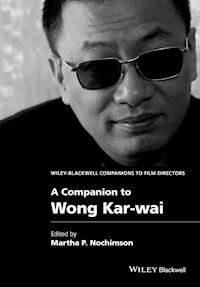
A Companion to Wong Kar-wai E-Book
171,99 €
Mehr erfahren.
- Herausgeber: John Wiley & Sons
- Kategorie: Geisteswissenschaft
- Serie: WBCF - Wiley-Blackwell Companions to Film Directors
- Sprache: Englisch
With 25 essays that embrace a wide spectrum of topics and perspectives including intertextuality, transnationality, gender representation, repetition, the use of music, color, and sound, depiction of time and space in human affairs, and Wong’s highly original portrayal of violence, A Companion to Wong Kar-Wai is a singular examination of the prestigious filmmaker known around the world for the innovation, beauty, and passion he brings to filmmaking.
- Brings together the most cutting edge, in-depth, and interesting scholarship on arguably the greatest living Asian filmmaker, from a multinational group of established and rising film scholars and critics
- Covers a huge breadth of topics such as the tradition of the jianghu in Wong's films; queering Wong's films not in terms of gender but through the artist's liminality; the phenomenological Wong; Wong's intertextuality; America through Wong's eyes; the optics of intensities, thresholds, and transfers of energy in Wong's cinema; and the diasporic presence of some ladies from Shanghai in Wong's Hong Kong
- Examines the political, historical, and sociological influence of Wong and his work, and discusses his work from a variety of perspectives including modern, post-modern, postcolonial, and queer theory
- Includes two appendices which examine Wong’s work in Hong Kong television and commercials
Sie lesen das E-Book in den Legimi-Apps auf:
Seitenzahl: 1489
Veröffentlichungsjahr: 2015
Ähnliche




















Wiley Blackwell Companions to Film Directors
The Wiley Blackwell Companions to Film Directors survey key directors whose work together constitutes what we refer to as the Hollywood and world cinema canons. Whether Haneke or Hitchcock, Bigelow or Bergman, Capra or the Coen brothers, each volume, comprising 25 or more newly commissioned essays written by leading experts, explores a canonical, contemporary, and/or controversial auteur in a sophisticated, authoritative, and multi-dimensional capacity. Individual volumes interrogate any number of subjects – the director's oeuvre; dominant themes, well-known, worthy, and under-rated films; stars, collaborators, and key influences; reception, reputation, and above all, the director's intellectual currency in the scholarly world.
A Companion to Michael Haneke, edited by Roy Grundmann
A Companion to Alfred Hitchcock, edited by Thomas Leitch and Leland Poague
A Companion to Rainer Werner Fassbinder, edited by Brigitte Peucker
A Companion to Werner Herzog, edited by Brad Prager
A Companion to Pedro Almodóvar, edited by Marvin D'Lugo and Kathleen Vernon
A Companion to Woody Allen, edited by Peter J. Bailey and Sam B. Girgus
A Companion to Jean Renoir, edited by Alastair Phillips and Ginette Vincendeau
A Companion to François Truffaut, edited by Dudley Andrew and Anne Gillain
A Companion to Luis Buñuel, edited by Robert Stone and Julián Daniel Gutiérrez-Albilla
A Companion to Jean-Luc Godard, edited by Tom Conley and T. Jefferson Kline
A Companion to Martin Scorsese, edited by Aaron Baker
A Companion to Fritz Lang, edited by Joseph McElhaney
A Companion to Robert Altman, edited by Adrian Danks
A Companion to Wong Kar-wai, edited by Martha P. Nochimson
A Companion to Wong Kar-wai
Edited by
Martha P. Nochimson
This edition first published 2016 © 2016 John Wiley & Sons, Inc. except for Chapter 14 © P.O.L, 2009
Registered OfficeJohn Wiley & Sons Ltd, The Atrium, Southern Gate, Chichester, West Sussex, PO19 8SQ, UK
Editorial Offices350 Main Street, Malden, MA 02148-5020, USA 9600 Garsington Road, Oxford, OX4 2DQ, UK The Atrium, Southern Gate, Chichester, West Sussex, PO19 8SQ, UK
For details of our global editorial offices, for customer services, and for information about how to apply for permission to reuse the copyright material in this book please see our website at www.wiley.com/wiley-blackwell.
The right of Martha P. Nochimson to be identified as the author of the editorial material in this work has been asserted in accordance with the UK Copyright, Designs and Patents Act 1988.
All rights reserved. No part of this publication may be reproduced, stored in a retrieval system, or transmitted, in any form or by any means, electronic, mechanical, photocopying, recording or otherwise, except as permitted by the UK Copyright, Designs and Patents Act 1988, without the prior permission of the publisher.
Wiley also publishes its books in a variety of electronic formats. Some content that appears in print may not be available in electronic books.
Designations used by companies to distinguish their products are often claimed as trademarks. All brand names and product names used in this book are trade names, service marks, trademarks or registered trademarks of their respective owners. The publisher is not associated with any product or vendor mentioned in this book.
Limit of Liability/Disclaimer of Warranty: While the publisher and author have used their best efforts in preparing this book, they make no representations or warranties with respect to the accuracy or completeness of the contents of this book and specifically disclaim any implied warranties of merchantability or fitness for a particular purpose. It is sold on the understanding that the publisher is not engaged in rendering professional services and neither the publisher nor the author shall be liable for damages arising herefrom. If professional advice or other expert assistance is required, the services of a competent professional should be sought.
Library of Congress Cataloging-in-Publication Data applied for.
9781118424247 (hardback)
A catalogue record for this book is available from the British Library.
Cover image: Photo of Wong Kar-wai © Fairfax Media / Getty Images.
Contents
Notes on Contributors
Acknowledgments
Part One Introduction
Wong Kar-wai: Invoking the Universal and the Local
References
Part Two Mapping Wong's Liminality
1 Transnational Wong
Introduction
Transnational vs. national
Wong between models, theories, disciplines
Transience and randomness
Shifting narratives and self-referentiality
Talking to themselves
Conclusion
Notes
References
2 It is a Restless Moment
Generating and shaping flow
The Grandmaster
: Force, gesture, and release
Time flows, the body knows
Restless on the dance floor: Corporeal understanding
Notes
References
3 Wong Kar-wai and his
jiang hu
Introduction: The
jiang hu
and its discontent
Jiang hu
: Phantom space, lost space
Jiang hu
as intertextual space
Jiang hu
as space regained
Notes
Acknowledgments
References
Part Three Thresholds of Texture and Mood
4 Wong Kar-wai's Cinema of Repetition
To begin with repetition
A space of disappearance
The erotics of disappearance
The ruins of action
References
5 Wong Kar-wai
Images unfolding
From resonance to mapping
Translation and the “transcultural”
Notes
References
6 Color Design in the Cinema of Wong Kar-wai
The critical reception of color
Classical color aesthetics
Wong's improvisational methods
Color as an authorial signature
Colored audition and other forms of synesthesia
Vitality of landscapes
Play of memory
Color as a narrative enigma
Conclusion
Notes
References
7 The Value of Re-exports
“Once Upon a Time in Kung Fu”?
The world's first Wong Kar-wai moment
Global cinema as musical inventory
Bespoke or off the rack?
Borrowed music as mood music
Mood music as point of view
Repetition as appropriation
Acknowledgments
Notes
References
Discography
Part Four In the Corridors of History and Culture
8 Wong's Ladies from Shanghai
Introduction: Wong Kar-wai's Shanghai romance
The mother, the whore, and the housewife
Su Lizhen multiplied
Hemmed in: From scopophilia to cinephilia
Acknowledgments
Notes
References
9 The Sinophone Cinema of Wong Kar-wai
Introduction
Situating the Sinophone cinema of Wong
Minor transnationalism of a periphery outside China
Conclusion
Acknowledgments
Notes
References
10 New Queer Angles on Wong Kar-wai
Prologue: Do it over
Queer investments
Straight-up queer
Between genres
Erotics of failure
Bodies and bonds
Epilogue: Some strange noise
Acknowledgments
References
11 “Pity about the furniture”
Social realism, the Hong Kong New Wave, and its precedents for Wong's screen violence
Commercial filmmaking, Patrick Tam, and an alternative mode in screen violence
Violence, Wong Kar-wai style
Acknowledgments
Notes
References
12 In the Mood for Food
Introduction
As Tears Go By
(1988)
Days of Being Wild
(1990)
Ashes of Time
(1994)
Chungking Express
(1994)
Fallen Angels
(1995)
Happy Together
(1997)
In the Mood for Love
(2000)
2046
(2004)
My Blueberry Nights
(2007)
Coda:
The Grandmaster
(2013)
References
13
Chungking Express
, Tarantino, and the Making of a Reputation
Chungking Express
and the film festival circuit
Rolling Thunder Pictures and the Tarantino connection
The Godard connection
The missing context(s)
The legacy
Notes
References
Part Five Close-up of Wong's Inflections of Time and Space
14
Chungking Express
Acknowledgments
Notes
References
15 Wong Kar-wai
Submitting
Looking
Touching
Moving
Notes
References
16 Infidelity and the Obscure Object of History
Introduction
The 1960s trilogy as inter-/meta-texts
Infidelity and the anxiety of betrayal
Conclusion
Notes
References
17 Metonymy, Mneme, and Anamnesis in Wong Kar-wai
Introduction
Metaphor, symbol, metonymy
Time and metonymy in Wong's films
Nostalgic space vs. chronotopic space
Days of Being Wild
: Wrapping time into time
Mneme and anamnesis
Anamnesis, art, play
Nostalgia for the future
Notes
References
Part Six Focus on Individual Films
18 Serial, Sequelae, and Postcolonial Nostalgia
The transnational vs. the local/regional
From the transnational to the local/regional
The serial structure and the dialectic relationship between the transnational and the local
Notes
References
19 We Can't Go On Not Meeting Like This
Fallen Angels
and Wong's Intertextuality
Daddy, daddy
Speaking of silence
Forget Him
The Blonde and the camera
Speaking our language
Notes
References
20 The Third Reality
21 Cinephiliac Engagement and the Disengaged Gaze in
In the Mood for Love
The gaze disengaged
The cinephiliac reception of
In the Mood for Love
Offscreen space and the cinephiliac moment
The absence of spatial desire
Fragments of the present
Notes
References
22 Wong's America, North and South
Introduction
A matched pair
The homosocial road movie
From
Happy
to
Blueberry
Wong outside, outsiders in Wong
Natural access
In the driver's seat
Male–male relations
Female–female relations
Conclusion
References
23 Queer Utopias in Wong Kar-wai's
Happy Together
Starting over
New beginnings
Border crossings
Coda
Notes
References
24 Wong Kar-wai's Genre Practice and Romantic Authorship
The Wong Kar-wai brand of Romantic authorship
Nostalgia and Romantic authorship
Romantic authorship as modernist structuring of desire
Notes
References
25 Wong Kar-wai, Auteur and Adaptor
Notes
References
Filmography
As writer
As director
Appendix I Wong Works in Television
Notes
References
Appendix II Wong Works in Advertising
Conclusion
Notes
References
Selected Bibliography
Index
EULA
List of Tables
Chapter 6
Table 6.1
List of Illustrations
Chapter 1
Figure 1.1
The Wong Kar-wai protagonist in his/her environment: encountering random others. (a)
Days of Being Wild
(1990), directed by Wong Kar-wai, produced by Rover Tang. (b)
Chungking Express
(1994), directed by Wong Kar-wai, produced by Jeffrey Lau and Chan Yi-kan.
Chapter 2
Figure 2.1
In the Mood for Love
(2000), directed and produced by Wong Kar-wai.
Figure 2.2
In the Mood for Love
(2000), directed and produced by Wong Kar-wai.
Figure 2.3
In the Mood for Love
(2000), directed and produced by Wong Kar-wai.
Figure 2.4
In the Mood for Love
(2000), directed and produced by Wong Kar-wai.
Figure 2.5
In the Mood for Love
(2000), directed and produced by Wong Kar-wai.
Figure 2.6
In the Mood for Love
(2000), directed and produced by Wong Kar-wai.
Figure 2.7
In the Mood for Love
(2000), directed and produced by Wong Kar-wai.
Figure 2.8
In the Mood for Love
(2000), directed and produced by Wong Kar-wai.
Figure 2.9
In the Mood for Love
(2000), directed and produced by Wong Kar-wai.
Figure 2.10
The Grandmaster
(2013), directed by Wong Kar-wai, produced by Jacky Pang Yee Wah, Wong Kar-wai, and Harvey Weinstein.
Figure 2.11
The Grandmaster
(2013), directed by Wong Kar-wai, produced by Jacky Pang Yee Wah, Wong Kar-wai, and Harvey Weinstein.
Figure 2.12
The Grandmaster
(2013), directed by Wong Kar-wai, produced by Jacky Pang Yee Wah, Wong Kar-wai, and Harvey Weinstein.
Chapter 3
Figure 3.1
Xu Haofeng after the screening in Busan of
The Sword Identity
(2011), directed by Xu Haofeng, produced by Li Rui-Gootian. Photo courtesy of Li Rui-Gootian.
Figure 3.2
The “battle formation” of the prostitutes looking down at the men fighting.
The Grandmaster/Yi dai zong shi
(2013), directed by Wong Kar-wai, produced by Block 2 Pictures, Jet Tone Films, Sil-Metropole Organisation, and Bona International Film Group.
Chapter 5
Figure 5.1
Inside and outside the loft.
Fallen Angels
(1995), directed by Wong Kar-wai, produced by Jeffrey Lau.
Figure 5.2
Patterned curtain as intensive relay.
Fallen Angels
(1995), directed by Wong Kar-wai, produced by Jeffrey Lau.
Figure 5.3
First hit, with patterned curtain.
Fallen Angels
(1995), directed by Wong Kar-wai, produced by Jeffrey Lau.
Figure 5.4
Final shot: the image of capital.
Fallen Angels
(1995), directed by Wong Kar-wai, produced by Jeffrey Lau.
Chapter 6
Figure 6.1
The agent and the jukebox in
Fallen Angels
(1995), directed by Wong Kar-wai, produced by Jeffrey Lau.
Figure 6.2
Po-wing transfixed by the lampshade in
Happy Together
(1997), directed by Wong Kar-wai, produced by Chan Ye-cheng.
Chapter 7
Figure 7.1
Chow as Listener in
2046
(2004), directed and produced by Wong Kar-wai.
Figure 7.2
Pain as the object of the voyeuristic gaze in
2046
(2004), directed and produced by Wong Kar-wai.
Chapter 8
Figure 8.1
Rebecca Pan as “Rebecca,” the aging, drunken “flower” of Shanghai, in
Days of Being Wild
(1990), directed by Wong Kar-wai, produced by Rover Tang.
Figure 8.2
The out-of-focus Mrs Suen (Rebecca Pan) pierces Lizhen's (Maggie Cheung) carefully coiffed head and speaks through the younger woman, who has her back to the camera.
In the Mood for Love
(2000), directed and produced by Wong Kar-wai.
Figure 8.3
Mo-wan (Tony Leung) and Lizhen (Maggie Cheung) in the back of the taxi in
2046
(2004), directed and produced by Wong Kar-wai.
Chapter 10
Figure 10.1
As Tears Go By
(2008), directed by Wong Kar-wai, produced by Alan Tang.
Figure 10.2
“The Hand,” a short segment from
Eros
(2004), directed by Wong Kar-wai, produced by Stéphane Tchalgadjieff, Domenico Procacci, Jacky Pang Yee Wah, Jacques Bar, and Raphael Berdugo.
Figure 10.3
The Grandmaster
(2013), directed by Wong Kar-wai, produced by Jacky Pang Yee Wah, Wong Kar-wai, and Harvey Weinstein.
Chapter 11
Figure 11.1
Lobby card for
Days of Being Wild
(1990), directed by Wong Kar-wai, produced by Rover Tang, showing the fight in the Manila café. Photo courtesy of the Museum of Chinese in America (MOCA), Sun Sing Theatre Collection.
Figure 11.2
Archival footage of 1967 riots within
2046
(2004), directed and produced by Wong Kar-wai.
Figure 11.3
Lobby card for
Days of Being Wild
(1990), directed by Wong Kar-wai, produced by Rover Tang. Note Tony Leung Chiu-wai (in black), centrally seated among the ensemble cast, although later confined to the film's odd, indeterminate ending. Photo courtesy of the Museum of Chinese in America (MOCA), Sun Sing Theatre Collection.
Chapter 12
Figure 12.1
In the Mood for Love
(2000), directed and produced by Wong Kar-wai.
Figure 12.2
The Grandmaster
(2013), directed by Wong Kar-wai, produced by Jacky Pang Yee Wah, Wong Kar-wai, and Harvey Weinstein.
Chapter 13
Figure 13.1
DVD cover of
Chungking Express
(1994), directed by Wong Kar-wai, produced by Jeffrey Lau and Chan Yi-kan.
Part Five
Figure 14.1
Chungking Express
(1994), directed by Wong Kar-wai, produced by Jeffrey Lau and Chan Yi-kan.
Figure 14.2
Chungking Express
(1994), directed by Wong Kar-wai, produced by Jeffrey Lau and Chan Yi-kan.
Chapter 15
Figure 15.1
As Tears Go By
(1988), directed by Wong Kar-wai. Produced by Alan Tang.
Figure 15.2
2046
(2004), directed and produced by Wong Kar-wai.
Figure 15.3
2046
(2004), directed and produced by Wong Kar-wai.
Figure 15.4
2046
(2004), directed and produced by Wong Kar-wai.
Figure 15.5
2046
(2004), directed and produced by Wong Kar-wai.
Figure 15.6
2046
(2004), directed and produced by Wong Kar-wai.
Figure 15.7
2046
(2004), directed and produced by Wong Kar-wai.
Figure 15.8
2046
(2004), directed and produced by Wong Kar-wai.
Figure 15.9
Zabriskie Point
(1970), directed by Michelangelo Antonioni, produced by Metro-Goldwyn-Mayer.
Chapter 16
Figure 16.1
Days of Being Wild
(1990), directed by Wong Kar-wai, produced by Rover Tang.
Figure 16.2
The Grandmaster
(2013), directed by Wong Kar-wai, produced by Jacky Pang Yee Wah, Wong Kar-wai, and Harvey Weinstein.
Chapter 17
Figure 17.1
The dramatically ticking clock is an allusion to the inevitable progress of mathematically calculated time.
Days of Being Wild
(1990), directed by Wong Kar-wai, produced by Rover Tang.
Figure 17.2
Yuddy looks for a paradoxical sort of stability.
Days of Being Wild
(1990), directed by Wong Kar-wai, produced by Rover Tang.
Chapter 18
Figure 18.1
Leslie Cheung's Yuddy dancing in front of the “flying saucer” rattan chair popular in late 1950s to early 1960s Hong Kong. From
Days of Being Wild
(1990), directed by Wong Kar-wai, produced by Rover Tang.
Chapter 19
Figure 19.1
Fallen Angels
(1995), directed by Wong Kar-wai, produced by Jeffrey Lau.
Figure 19.2
Fallen Angels
(1995), directed by Wong Kar-wai, produced by Jeffrey Lau.
Chapter 21
Figure 21.1
Lizhen and Mo-wan on the latter's doorstep. From
In the Mood for Love
(2000), directed and produced by Wong Kar-wai.
Figure 21.2
“Best part” sequence: the frame after Lizhen's exit and before Mo-wan's entry. From
In the Mood for Love
(2000), directed and produced by Wong Kar-wai.
Chapter 22
Figure 22.1
Driving through America. From
My Blueberry Nights
(2007), directed by Wong Kar-wai, produced by Jacky Pang Yee Wah and Wong Kar-wai.
Figure 22.2
Driving through America. From
Happy Together
(1997), directed by Wong Kar-wai, produced by Chan Ye-cheng.
Chapter 23
Figure 23.1
Ho Po-wing staring at his bedside table.
Happy Together
(1997), directed by Wong Kar-wai, produced by Chan Ye-cheng.
Figure 23.2
An injured Lai Yiu-fai leaning his head on Ho Po-wing's shoulder.
Happy Together
(1997), directed by Wong Kar-wai, produced by Chan Ye-cheng.
Figure 23.3
Lai Yiu-fai's British passport.
Happy Together
(1997), directed by Wong Kar-wai, produced by Chan Ye-cheng.
Figure 23.4
Lai Yiu-far gazing at his reflection in a deeply stained wardrobe mirror.
Happy Together
(1997), directed by Wong Kar-wai, produced by Chan Ye-cheng.
Chapter 24
Figure 24.1
Zhang Ziyi in
The Grandmaster
(2013), directed by Wong Kar-wai, produced by Jacky Pang Yee Wah, Wong Kar-wai, and Harvey Weinstein.
Figure 24.2
Buddha statuary in
The Grandmaster
(2013), directed by Wong Kar-wai, produced by Jacky Pang Yee Wah, Wong Kar-wai, and Harvey Weinstein.
Figure 24.3
Picture taking in
The Grandmaster
(2013), directed by Wong Kar-wai, produced by Jacky Pang Yee Wah, Wong Kar-wai, and Harvey Weinstein.
Chapter 25
Figure 25.1
Ashes of Time
(1994), directed by Wong Kar-wai, produced by Tsai Sung-lin, Jacky Pang Yee Wah, Wong Kar-wai, and Jeffrey Lau.
Figure 25.2
In the Mood for Love
(2000), directed and produced by Wong Kar-wai.
Guide
Cover
Table of Contents
Part
Pages
ix
x
xi
xii
xiii
xiv
xv
xvi
1
3
4
5
6
7
8
9
10
11
12
13
14
15
16
17
18
19
20
21
23
24
25
26
27
28
29
30
31
32
33
34
35
36
37
38
39
40
41
42
43
44
45
46
47
48
49
50
51
52
53
54
55
56
57
58
59
60
61
62
63
64
65
66
67
68
69
70
71
72
73
74
75
76
77
78
79
80
81
82
83
84
85
86
87
88
89
90
91
92
93
94
95
96
97
98
99
100
101
102
103
104
105
106
107
108
109
110
111
113
115
116
117
118
119
120
121
122
123
124
125
126
127
128
129
130
131
132
133
134
135
136
137
138
139
140
141
142
143
144
145
146
147
148
149
150
151
152
153
154
155
156
157
158
159
160
161
162
163
164
165
166
167
168
169
170
171
172
173
174
175
176
177
178
179
180
181
182
183
184
185
186
187
188
189
190
191
192
193
194
195
196
197
198
199
200
201
202
203
204
205
207
208
209
210
211
212
213
214
215
216
217
218
219
220
221
222
223
224
225
226
227
228
229
230
231
232
233
234
235
236
237
238
239
240
241
242
243
244
245
246
247
248
249
250
251
252
253
254
255
256
257
258
259
260
261
262
263
264
265
266
267
268
269
270
271
272
273
274
275
276
277
278
279
280
281
282
283
284
285
286
287
288
289
290
291
292
293
294
295
296
297
298
299
300
301
302
303
304
305
306
307
308
309
310
311
312
313
314
315
316
317
318
319
320
321
322
323
324
325
326
327
328
329
330
331
332
333
334
335
336
337
338
339
340
341
342
343
344
345
347
348
349
350
351
352
353
354
355
356
357
358
359
360
361
362
363
364
365
366
367
368
369
370
371
372
373
374
375
376
377
378
379
380
381
382
383
384
385
386
387
388
389
390
391
392
393
394
395
396
397
398
399
400
401
402
403
404
405
406
407
408
409
410
411
412
413
414
415
419
420
421
422
423
424
425
426
427
428
429
430
431
432
433
434
435
435
436
437
438
439
440
441
442
443
444
445
446
447
448
449
450
451
452
453
454
455
456
457
458
459
460
461
462
463
464
465
466
467
468
469
470
471
472
473
474
475
476
477
478
479
480
481
482
483
484
485
486
487
488
489
490
491
492
493
494
495
496
497
498
499
500
501
502
503
504
505
506
507
508
509
510
511
512
513
514
515
516
517
518
519
520
521
522
523
524
525
526
527
528
529
530
531
532
533
534
535
536
537
538
539
540
541
542
543
544
545
546
547
548
549
550
551
552
553
554
555
556
557
558
559
560
561
562
563
564
565
566
567
568
569
570
571
572
573
574
575
576
577
578
579
580
581
582
583
584
585
586
587
588
589
590
591
592
593
594
595
596
597
598
599
600
601
602
603
604
605
606
607
608
609
610
611
612
613
614
615
616
617
618
619
620
621
622
623
624
625
626
627
Notes on Contributors
Ackbar Abbas is Professor of Comparative Literature at the University of California, Irvine. His book Hong Kong: Culture and the Politics of Disappearance was published in 1997.
Raymond Bellour, researcher and author, is a Research Director Emeritus at the Centre National de la Recherche Scientifique (CNRS) in Paris. He has an interest in literature, both Romantic – the Brontës, Ecrits de jeunesse (1972); Alexandre Dumas, Mademoiselle Guillotine (1990) – and contemporary: Henri Michaux (1965); the edition of Michaux's complete works in “La Pléiade” (1998–2004); and Lire Michaux (2011). He also has an interest in cinema – Le Western (1966); L'Analyse du film (1979), translated as The Analysis of Film; Le corps du cinéma: Hypnoses, émotions, animalités (2009) – as well as in mixed states of images (painting, photography, cinema, video, virtual images), the passages between them, and the relations between words and images: the volumes L'Entre-Images: Photo, cinéma, vidéo (1990), translated as Between-the-Images; Jean-Luc Godard: Son+Image (1992); L'Entre-Images 2: Mots, images (1999); and La querelle des dispositifs: Cinéma – installations, expositions (2012). He has curated the exhibitions Passages de l'image (1989), (2005), (2006), and (2010). He is a founding member of the film journal .
Lesen Sie weiter in der vollständigen Ausgabe!
Lesen Sie weiter in der vollständigen Ausgabe!
Lesen Sie weiter in der vollständigen Ausgabe!
Lesen Sie weiter in der vollständigen Ausgabe!
Lesen Sie weiter in der vollständigen Ausgabe!
Lesen Sie weiter in der vollständigen Ausgabe!
Lesen Sie weiter in der vollständigen Ausgabe!
Lesen Sie weiter in der vollständigen Ausgabe!
Lesen Sie weiter in der vollständigen Ausgabe!
Lesen Sie weiter in der vollständigen Ausgabe!
Lesen Sie weiter in der vollständigen Ausgabe!
Lesen Sie weiter in der vollständigen Ausgabe!
Lesen Sie weiter in der vollständigen Ausgabe!
Lesen Sie weiter in der vollständigen Ausgabe!
Lesen Sie weiter in der vollständigen Ausgabe!
Lesen Sie weiter in der vollständigen Ausgabe!
Lesen Sie weiter in der vollständigen Ausgabe!
Lesen Sie weiter in der vollständigen Ausgabe!
Lesen Sie weiter in der vollständigen Ausgabe!
Lesen Sie weiter in der vollständigen Ausgabe!
Lesen Sie weiter in der vollständigen Ausgabe!
Lesen Sie weiter in der vollständigen Ausgabe!
Lesen Sie weiter in der vollständigen Ausgabe!
Lesen Sie weiter in der vollständigen Ausgabe!
Lesen Sie weiter in der vollständigen Ausgabe!
Lesen Sie weiter in der vollständigen Ausgabe!
Lesen Sie weiter in der vollständigen Ausgabe!
Lesen Sie weiter in der vollständigen Ausgabe!
Lesen Sie weiter in der vollständigen Ausgabe!
Lesen Sie weiter in der vollständigen Ausgabe!
Lesen Sie weiter in der vollständigen Ausgabe!
Lesen Sie weiter in der vollständigen Ausgabe!
Lesen Sie weiter in der vollständigen Ausgabe!
Lesen Sie weiter in der vollständigen Ausgabe!
Lesen Sie weiter in der vollständigen Ausgabe!
Lesen Sie weiter in der vollständigen Ausgabe!
Lesen Sie weiter in der vollständigen Ausgabe!
Lesen Sie weiter in der vollständigen Ausgabe!
Lesen Sie weiter in der vollständigen Ausgabe!




