


A Companion to World History E-Book
37,99 €
Mehr erfahren.
- Herausgeber: John Wiley & Sons
- Kategorie: Geisteswissenschaft
- Serie: Blackwell Companions to World History
- Sprache: Englisch
A COMPANION TOWORLD HISTORY
"This new volume offers insightful reflections by both leading and emerging world historians on approaches, methodologies, arguments, and pedagogies of a sub-discipline that has continued to be in flux as well as in need of defining itself as a relevant alternative to the traditional national, regional, or chronological fields of inquiry"
Choice
"The focus...on the practicalities of how to do world history probably gives it its edge. Its thirty-three chapters are grouped into sections that address how to set up research projects in world history, how to teach it, how to get jobs in it, how to frame it, and how it is done in various parts of the globe. It is an actual handbook, in other words, as opposed to a sample of exemplary work."
English Historical Review
A Companion to World History offers a comprehensive overview of the variety of approaches and practices utilized in the field of world and global history. This state-of-the-art collection of more than 30 insightful essays – including contributions from an international cast of leading world historians and emerging scholars in the field – identifies continuing areas of contention, disagreement, and divergence, while pointing out fruitful directions for further discussion and research. Themes and topics explored include the lineages and trajectories of world history, key ideas and methods employed by world historians, the teaching of world history and how it draws upon and challenges "traditional" approaches, and global approaches to writing world history. By considering these interwoven issues of scholarship and pedagogy from a transnational, interregional, and world/global scale, fresh insights are gained and new challenges posed. With its rich compendium of diverse viewpoints, A Companion to World History is an essential resource for the study of the world's past.
Sie lesen das E-Book in den Legimi-Apps auf:
Seitenzahl: 1606
Veröffentlichungsjahr: 2012
Ähnliche




















Contents
Maps, Figures, and Tables
Notes on Contributors
Editor’s Acknowledgments
INTRODUCTION: The Challenge of World History
PART I: Trajectories and Practices
CHAPTER ONE: World History
From Disciplinary Exclusion to Limited Acceptance, circa Late 1800s to 1990
Influences, Resources, and Canon Formation, circa Late 1980s to 2011
Variations Now
Concluding Reflections
CHAPTER TWO: Why and How I Became a World Historian
First Steps
A Growing Identification with Global History and World History
Engaged in a Field
Researching the world: techniques and methods
CHAPTER THREE: Becoming a World Historian
Graduate Programs in World History
The Structure of Graduate Programs in World History
Placement: Where Do Graduate Students Trained in World History Find Jobs?
Conclusions
Appendix: World History Comprehensive Exam Reading List (Washington State University, 2010)
CHAPTER FOUR: The World Is Your Archive?
CHAPTER FIVE: What Are the Units of World History?
Comparison and Connection
Zones and Systems
Globalization
Humanity
Teaching the world: publics and pedagogies
CHAPTER SIX: Meetings of World History and Public History
Defending History
Revisiting Public History
Two “Backward Hamlets”
Conclusion
CHAPTER SEVEN: Challenges of Teaching and Learning World History
A Teaching Problem: Figuring Out the Story and Connections
Standards in World History
Figuring Out How Students See the Story and Make Connections
Meeting the Challenges
CHAPTER EIGHT: Teaching World History at the College Level
Snapshot 1: World History Survey, University of New Orleans, 2000
Snapshot 2: World History for Graduate Students, San Francisco State University, 2006
Snapshot 3: Twentieth-Century World History Survey, University of Stellenbosch, 2008
Snapshot 4: The World and the West Seminar, San Francisco State University, 2010
World History as a Work in Progress
PART II: Categories and Concepts
Framing
CHAPTER NINE: Environments, Ecologies, and Cultures across Space and Time
Harnessing Energy
Scales of Alteration
Nature–Culture Interactions
CHAPTER TEN: Deep Pasts
The Meaning and Mechanisms of Interconnections
Comparative History of the Ancient World
The Verticality of Global History in the Ancient World
CHAPTER ELEVEN: Big History
What Is Big History?
Why Study Big History?
How Old Is Big History?
When Did Academic Big History Emerge?
Who Is Doing Big History Today?
Different Approaches to Big History
Big History and Religious Views
Big History Research
The Future of Big History: Opportunities and Constraints
CHAPTER TWELVE: Global Scale Analysis in Human History
Core/Periphery Hierarchy
Spatial Boundaries of World-Systems
World-System Cycles: Rise and Fall, and Pulsations
Modes of Accumulation
Patterns and Causes of Social Evolution
CHAPTER THIRTEEN: Region in Global History
CHAPTER FOURTEEN: Scales of a Local
A “Globalizing” World?
Conceptualizing the Local and the Global
Historicizing the Local and the Global
Local Case Studies: Ji’an and Jingdezhen
Comparing
CHAPTER FIFTEEN: Comparative History and the Challenge of the Grand Narrative
CHAPTER SIXTEEN: The Science of Difference
From William Jones to Max Müller
The Bible and Darwin
The Failure of Race Science
Indo-Europeans/Aryans: Barbarians and Nomads
Aryans and Brahmans
CHAPTER SEVENTEEN: Projecting Power
CHAPTER EIGHTEEN: The Body in/as World History
Acts of Relegation, Acts of Repositioning
Conclusion: The Body as World System?
Connecting
CHAPTER NINETEEN: Benchmarks of Globalization
What a History of the Present Can Do
The Time of the Global
Global Actors and Spaces of Action
Reframing the Global Condition
CHAPTER TWENTY: Networks, Interactions, and Connective History
Material Culture
The Stranger-Effect
Exploration
Peaceful Migration
War and Empire
Religion
Trade: Land Routes
Trade: Sea Routes
Globalization
CHAPTER TWENTY-ONE: Objects in Motion
The Silk Road
The Mongol World Empire
The Age of Exploration
The Industrial Age
Conclusion
CHAPTER TWENTY-TWO: People in Motion
Scale One, the Cosmos: Big History and Life on Earth
Scale Two, the Earth: Peopling the World
Scale Three, Modern Human Society: Globalizing Encounters and Migrations, 1500–1900
Scale Four, Microhistory and Biography: Individual Lifespans and Journeys
CHAPTER TWENTY-THREE: Religious Ideas in Motion
The Call for a Global Frame
Space and Beliefs in Motion
Networks of Carriers
Negotiations and Reverberations
New Spheres for Religion
CHAPTER TWENTY-FOUR: Diseases in Motion
Introduction: Germs Don’t Travel Alone
Imported Epidemics and the Decimation of Native Americans
Moving Environments and Moving Germs: Malaria and Cholera
Diseases That Traveled without New Germs
Conclusion
CHAPTER TWENTY-FIVE: Bullets in Motion
Audiences
Issues: Globalization
Issues: Problems of Analysis
Themes: Global Patterns of War
Themes: War and Society
Themes: War and Culture
PART III: Many Globes
CHAPTER TWENTY-SIX: The World from Oceania
CHAPTER TWENTY-SEVEN: The World from China
CHAPTER TWENTY-EIGHT: Historicizing the World in Northeast Asia
The Configuration of the National and the Global
From World History to National History
Overcoming Western History
Overcome by Western History
Decentering World History
CHAPTER TWENTY-NINE: Writing Global History in Africa
Conversion, the Emergence of a New Cosmology and Self-Rewriting
Defining Africa’s Position in the World as Permanent Preoccupation
What the World Has Done to Africa
What Africa Has Done in the World
CHAPTER THIRTY: Islamicate World Histories?
In the Wake of Defeat and Humiliation: Tortuous Dialogues with Orientalist Visions
Europe: Coveted Object of Desire, and of Alienation
Global Capitalism, Contested Western Hegemony, and New World Historical Visions
Can We Write World Histories That Are Genuinely “World Histories”?
CHAPTER THIRTY-ONE: The World from Latin America and the Peripheries
Statement of the Problem
Proto-history: The Difference of the Partialities with Respect to the Center
History: Since the Formation of a Global Center and Periphery
Conclusion
CHAPTER THIRTY-TWO: (Re)Writing World Histories in Europe
Toward a New Consensus
Carving Out an Institutional Home
CHAPTER THIRTY-THREE: Other Globes
Global Economics: International Trade and Business
Global Politics: International Relations and Comparative Politics
Global Anthropology: Ethnographies of the World
Global Texts: Comparative Literature and Worlds of Translation
Global Art: Aesthetics across Cultures
Many Globes: Seeing a World
Bibliography
Index
WILEY-BLACKWELL COMPANIONS TO HISTORY
This series provides sophisticated and authoritative overviews of the scholarship that has shaped our current understanding of the past. Defined by theme, period and/or region, each volume comprises between twenty-five and forty concise essays written by individual scholars within their area of specialization. The aim of each contribution is to synthesize the current state of scholarship from a variety of historical perspectives and to provide a statement on where the field is heading. The essays are written in a clear, provocative, and lively manner, designed for an international audience of scholars, students, and general readers.
WILEY-BLACKWELL COMPANIONS TO EUROPEAN HISTORY
A Companion to Europe 1900–1945Edited by Gordon MartelA Companion to Eighteenth-Century EuropeEdited by Peter H. WilsonA Companion to Nineteenth-Century EuropeEdited by Stefan BergerA Companion to the Worlds of the RenaissanceEdited by Guido RuggieroA Companion to the Reformation WorldEdited by R. Po-chia HsiaA Companion to Europe Since 1945Edited by Klaus LarresA Companion to the Medieval WorldEdited by Carol Lansing and Edward D. English
WILEY-BLACKWELL COMPANIONS TO AMERICAN HISTORY
A Companion to the American RevolutionEdited by Jack P. Greene and J. R. PoleA Companion to 19th-Century AmericaEdited by William L. BarneyA Companion to the American SouthEdited by John B. BolesA Companion to American Indian HistoryEdited by Philip J. Deloria and Neal SalisburyA Companion to American Women’s HistoryEdited by Nancy A. HewittA Companion to Post-1945 AmericaEdited by Jean-Christophe Agnew and Roy RosenzweigA Companion to the Vietnam WarEdited by Marilyn B. Young and Robert BuzzancoA Companion to Colonial AmericaEdited by Daniel VickersA Companion to American Foreign RelationsEdited by Robert D. SchulzingerA Companion to 20th-Century AmericaEdited by Stephen J. WhitfieldA Companion to the American WestEdited by William DeverellA Companion to the Civil War and ReconstructionEdited by Lacy K. FordA Companion to American TechnologyEdited by Carroll PursellA Companion to African-American HistoryEdited by Alton Hornsby, JrA Companion to American ImmigrationEdited by Reed UedaA Companion to American Cultural HistoryEdited by Karen HalttunenA Companion to California HistoryEdited by William Deverell and David IglerA Companion to American Military HistoryEdited by James BradfordA Companion to Los AngelesEdited by William Deverell and Greg HiseA Companion to American Environmental HistoryEdited by Douglas Cazaux SackmanA Companion to Benjamin FranklinEdited by David Waldstreicher
WILEY-BLACKWELL COMPANIONS TO WORLD HISTORY
A Companion to Western Historical ThoughtEdited by Lloyd Kramer and Sarah MazaA Companion to Gender HistoryEdited by Teresa A. Meade and Merry E. Wiesner-HanksA Companion to International History 1900–2001Edited by Gordon MartelA Companion to the History of the Middle EastEdited by Youssef M. ChoueiriA Companion to Japanese HistoryEdited by William M. TsutsuiA Companion to Latin American HistoryEdited by Thomas HollowayA Companion to Russian HistoryEdited by Abbott GleasonA Companion to World War IEdited by John HorneA Companion to Mexican History and CultureEdited by William H. BeezleyA Companion to Global Environmental HistoryEdited by J. R. McNeill and Erin Stewart MauldinA Companion to World HistoryEdited by Douglas Northrop
This edition first published 2012© 2012 Blackwell Publishing Ltd except chapter 20 © 2012 Professor Felipe Fernandez-Armesto and Mr Benjamin Sacks
Blackwell Publishing was acquired by John Wiley & Sons in February 2007. Blackwell’s publishing program has been merged with Wiley’s global Scientific, Technical, and Medical business to form Wiley-Blackwell.
Registered OfficeJohn Wiley & Sons, Ltd, The Atrium, Southern Gate, Chichester, West Sussex, PO19 8SQ, UK
Editorial Offices350 Main Street, Malden, MA 02148-5020, USA9600 Garsington Road, Oxford, OX4 2DQ, UKThe Atrium, Southern Gate, Chichester, West Sussex, PO19 8SQ, UK
For details of our global editorial offices, for customer services, and for information about how to apply for permission to reuse the copyright material in this book please see our website at www.wiley.com/wiley-blackwell.
The right of Douglas Northrop to be identified as the author of the editorial material in this work has been asserted in accordance with the UK Copyright, Designs and Patents Act 1988.
All rights reserved. No part of this publication may be reproduced, stored in a retrieval system, or transmitted, in any form or by any means, electronic, mechanical, photocopying, recording or otherwise, except as permitted by the UK Copyright, Designs and Patents Act 1988, without the prior permission of the publisher.
Wiley also publishes its books in a variety of electronic formats. Some content that appears in print may not be available in electronic books.
Designations used by companies to distinguish their products are often claimed as trademarks. All brand names and product names used in this book are trade names, service marks, trademarks or registered trademarks of their respective owners. The publisher is not associated with any product or vendor mentioned in this book. This publication is designed to provide accurate and authoritative information in regard to the subject matter covered. It is sold on the understanding that the publisher is not engaged in rendering professional services. If professional advice or other expert assistance is required, the services of a competent professional should be sought.
Library of Congress Cataloging-in-Publication Data
A companion to world history / edited by Douglas Northrop. p. cmIncludes bibliographical references and index.
ISBN 978-1-4443-3418-0 (hardback)1. History–Methodology. 2. History–Study and teaching. 3. Historiography. I. Northrop, Douglas Taylor. D13.C628 2012 907.2–dc23
2012009799
A catalogue record for this book is available from the British Library.
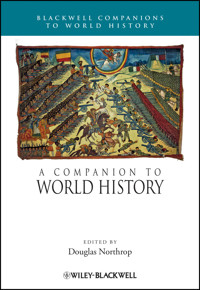
Cover image: Painting of the Battle of Adwa, 2 March 1896, by unknown Ethiopian artist, c. 1940–1949. Courtesy of the Trustees of the British Museum, London.Cover design by Richard Boxall Design Associates
For Sawyer and Jeremy, every day a new world
Maps, Figures, and Tables
Maps
I.1
Imagining a recentered globe: the Hobo-Dyer projection
10.1
Major sites in the Old Assyrian trading system
14.1
Jiangxi province in late imperial China
16.1
Central Asia and early Indo-European peoples
20.1
The Indian Ocean: wind and weather patterns, with trade routes
20.2
The Pacific: wind patterns and population movements
20.3
The Atlantic: wind patterns and trade routes
21.1
The silk roads, from ca. 200 BCE
21.2
Going global: European trade contacts in Africa and Asia, ca. 1700
21.3
Europeans in the Americas, ca. 1700
26.1
Oceania, with island groups and voyaging zones
Figures
7.1
An expert teacher’s concept map
7.2
A novice teacher’s concept map
12.1
Basic iteration model of world-system evolution
12.2
Temporary institutional shortcuts in the iteration model
33.1
Our world’s visual greeting: picturing humanity for the universe
Table
9.1
Gross energy consumed by humans
Notes on Contributors
Michael Adas is the Abraham E. Voorhees Professor and Board of Governors’ Chair at Rutgers University. His teaching and research have centered on the comparative study of the impact of Western science and technology on European and American colonialism in Asia and Africa. His recent books include Machines as the Measure of Men: Science, Technology, and Ideologies of Western Dominance and Dominance by Design: Technological Imperatives and America’s Civilizing Mission. Adas has also co-authored six editions of World Civilizations: The Global Experience. He is currently working on a comparison of the combat experience in World War I and Vietnam.Robert B. Bain is Associate Professor of Education and History, and chair of the secondary teacher education program, at the University of Michigan. Bain earned his PhD in American social history at Case Western Reserve University. After working for years as a high-school social-studies teacher, he joined the faculty at Michigan, where his research and clinical work focuses on the translation of historical “habits of mind” into K-12 classrooms: how teachers and students can acquire the methods, approaches, and assumptions of disciplinary historians in teaching and learning. A former World History Association council member, most recently he is a co-designer and researcher in the Big History Project.Charles Bright is Arthur J. Thurnau Professor and Professor of History at the University of Michigan, Residential College. In addition to his collaborative work with Michael Geyer over two decades on global history, he has worked on prison history, publishing The Powers That Punish: Prisons and Politics in the Era of the “Big House,” 1920–1955, and on the history of Detroit, doing oral histories and creative projects with theater groups in the city. The current essay is part of a book project (with Geyer), The Global Condition in the Long-Twentieth Century.Antoinette Burton is Professor of History at the University of Illinois, Urbana-Champaign, where she is also Bastian Professor of Global and Transnational Studies. A historian of Victorian Britain, modern empire, Indian women, feminism and postcoloniality, she is the author most recently of A Primer for Teaching World History: Ten Design Principles (2012).Christopher Chase-Dunn is a Distinguished Professor of Sociology and Director of the Institute for Research on World-Systems at the University of California, Riverside. He is the author of Rise and Demise: Comparing World-Systems (with Thomas D. Hall), The Wintu and Their Neighbors (with Kelly Mann), and The Spiral of Capitalism and Socialism (with Terry Boswell). He is founder and former editor of the Journal of World-Systems Research. Chase-Dunn is currently doing research on global party formation and antisystemic social movements. He also studies the rise and fall of settlements and polities since the Stone Age and global state formation.Luke Clossey is Associate Professor in the Department of History of Simon Fraser University. His dissertation research won prizes from the World History Association and the Canadian Historical Association, and was published as Salvation and Globalization in the Early Jesuit Missions (2008). Now that he has finished fighting over punctuation with the co-authors of the essay included here, he can return to fieldwork preparatory to writing a history of the early modern global cult of Yeshua ben Miriam, a first-century Jewish messiah.Eduardo Devés-Valdés (PhD, University of Leuven (Lovain), and a second PhD in Latin American Studies from the University of Paris III), a specialist in Latin American thought and thought in peripheral regions, is Professor of American Studies and coordinator of the Postdoctoral Studies Program at the University of Santiago, Chile. He has published more than 150 works, including El pensamiento africano sud-sahariano en sus conexiones y paralelos con el latinoamericano y el asiático, and has taught and researched at various locations across Latin America, Asia, Africa, Europe, and the United States.Felipe Fernández-Armesto teaches at the University of Notre Dame. His books on global history include The World (2010), 1492 (2010), Pathfinders (2007), Civilizations (2000), and Millennium (1999).Anne Gerritsen (PhD, Harvard) is Associate Professor of Chinese History at the University of Warwick. She works on topics that are local in scope, such as the history of the Jiangxi prefecture of Ji’an and ceramics manufacture in the Jiangxi town of Jingdezhen, as well as topics that are global, such as the worldwide trade in porcelain, and global perceptions and knowledge of Chinese material culture and technology. She is currently the director of the Global History and Culture Centre, based in the Department of History at the University of Warwick.Trevor Getz is a Professor of African History at San Francisco State University. He is the author or co-author of seven books, the latest of which is the graphic history Abina and the Important Men. He is currently working on a digital world history textbook with Jonathan Brooke and is editing the Oxford University Press series African World Histories.Michael Geyer is Samuel N. Harper Professor of German and European History at the University of Chicago and faculty director of the Human Rights Program. His main academic interests are war and violence, the history and theory of Human Rights, and global history in the nineteenth and twentieth centuries. Among his recent publications is Beyond Totalitarianism: Stalinism and Nazism Compared, edited with Sheila Fitzpatrick (2009). The current essay is part of a book project (with Charles Bright), The Global Condition in the Long-Twentieth Century.Thomas D. Hall is Professor Emeritus in the Department of Sociology and Anthropology, DePauw University, Greencastle, Indiana. He holds an MA in Anthropology, University of Michigan, and a PhD in Sociology, University of Washington. His interests include indigenous peoples, ethnicity, and comparative frontiers. Recent publications include “World-systems analysis and archaeology: Continuing the dialogue,” with P. Nick Kardulias and Christopher Chase-Dunn, Journal of Archaeological Research 19 (3) (2011): 233–279; “Resilience and community in the age of world-system collapse,” with Glen D. Kuecker, Nature and Culture 6 (1) (2011): 18–40; Indigenous Peoples and Globalization: Resistance and Revitalization, with James V. Fenelon (2009).Huri Islamoğlu is Professor of Economic History, Boğazici University, Istanbul; and since 2008, Visiting Professor of History, University of California, Berkeley. Her publications include (with Peter Perdue) Shared Histories of Modernity in China, India and the Ottoman Empire (2009); Constituting Modernity: Private Property in the East and West (2004); Ottoman Empire and the World Economy (1987); and State and Peasant in the Ottoman Empire (1994). She has written and lectured in the fields of comparative economic history and political economy, legal history, agricultural history and agriculture and current globalization trends, and global governance.Paul A. Kramer is an Associate Professor of History at Vanderbilt University, with research and teaching interests in US imperial, transnational and global histories since the mid-nineteenth century. He is the author of The Blood of Government: Race, Empire, the United States and the Philippines (2006). He co-edits the Cornell University Press series The United States in the World, and is currently at work on a book-length project on the nexus between empire and US immigration policy across the twentieth century.Scott C. Levi (PhD, University of Wisconsin-Madison, 2000) is Associate Professor of Central Asian history at Ohio State University. In addition to his articles and book chapters, Levi has authored The Indian Diaspora in Central Asia and its Trade, 1550–1900 (2002), edited India and Central Asia: Commerce and Culture, 1500–1800 (2007), and co-edited (with Ron Sela) Islamic Central Asia: An Anthology of Sources (2010).Jie-Hyun Lim is Professor of Comparative History and the director of the Research Institute of Comparative History and Culture at Hanyang University in Seoul. He has held visiting appointments in Krakow, Cardiff, Kyoto, Berlin and Cambridge, Mass. He has written numerous books and articles on the comparative histories of nationalist movements, colonialism, issues of memory, and the sociocultural history of Marxism in East Asia and Eastern Europe. He now edits a Palgrave series on mass dictatorship in the twentieth century. His most recent project is a transnational history of “victimhood nationalism,” covering post–World War II Korea, Japan, Poland, Israel, and Germany.Xinru Liu (PhD, University of Pennsylvania) teaches world history and the history of South Asia and Central Asia at the College of New Jersey in Ewing and is associated with the Institute of History and the Institute of World History, Chinese Academy of Sciences. Among her many publications are Ancient India and Ancient China (1988); Silk and Religion: An Exploration of Material Life and the Thought of People in AD 600–1200 (1996); Connections across Eurasia: Transportation, Communications, and Cultural Exchange on the Silk Roads, with Lynda Norene Shaffer (2007); and The Silk Road in World History (2010).Adam McKeown is Associate Professor of History at Columbia University, where he offers courses on the histories of globalization, world migration and drugs, and is the co-coordinator of the PhD track in International and Global History. He wrote Melancholy Order: Asian Migration and the Globalization of Borders (2008), and Chinese Migrant Networks and Cultural Change: Peru, Chicago, Hawaii, 1900–1936 (2001). He is now working on the history of globalization since 1760.Stephen Morillo, DPhil Oxford, Professor of History and Chair of Division III (Social Sciences) at Wabash College, specializes in premodern comparative world and military history. He is President of De Re Militari, the Society for Medieval Military History. He has written Structures and Systems: Conceptual Frameworks of World History, a forthcoming world history textbook, and is working on a cultural history of warrior elites in world history. His numerous other books, articles, and chapters include What Is Military History? and War in World History: Society, Technology and War from Ancient Times to the Present, a military world history textbook.Katja Naumann is a researcher at the Center for the History and Culture of East Central Europe at the University of Leipzig, where she coordinates a handbook on the transnational history of the region. She lectures at the Global and European Studies Institute in Leipzig and coordinates the headquarters of the European Network in Universal and Global History. Further, she works on the editorial boards of the geschichte.transnational forum and Comparativ: A Journal for Global History and Comparative Studies. In her dissertation she analyzed the development of world history teaching in the United States (1918–1968).Douglas Northrop is Associate Professor of History and Near Eastern Studies at the University of Michigan, where he teaches modern Central Asian studies and helped create a program in world and global history. His books include Veiled Empire: Gender and Power in Stalinist Central Asia and An Imperial World: Empires and Colonies Since 1750 (forthcoming). His current research brings together environmental, colonial, cultural, and urban history in telling the story of Central Asia through natural disaster – specifically, a series of major earthquakes that struck the region during the last two centuries.Martin S. Pernick, Professor of History at the University of Michigan, received a PhD in history from Columbia University, and has taught at the Harvard School of Public Health, and the Pennsylvania State University Hershey Medical Center. He authored A Calculus of Suffering (1985), on professional and cultural attitudes towards pain treatment in nineteenth-century America, and The Black Stork (1996), on eugenics and euthanasia in American medicine and film; plus numerous articles on epidemics, defining death, disability, eugenics, public health films, medical professionalism, informed consent, and the relation between history and bioethics, in US and comparative history.Kenneth Pomeranz is University Professor of History at the University of Chicago. He previously taught at the University of California, Irvine, and was Founding Director of the University of California’s Multi-Campus Research Program in World History. His publications include The Great Divergence: China, Europe, and the Making of the Modern World Economy and The Making of a Hinterland: State, Society and Economy in Inland North China, 1853–1937. He is a Fellow of the American Academy of Arts and Sciences, and has received fellowships from the Guggenheim Foundation, American Philosophical Society, ACLS, Institute for Advanced Studies, and NEH, among others.Sebastian R. Prange is Assistant Professor of History at the University of British Columbia. His research centers on the organization of Muslim trade networks in the medieval and early modern Indian Ocean, with a regional focus on South India.Dominic Sachsenmaier taught transcultural and Chinese history at Duke University before his recent move to become a Professor of Modern Asian History at Jacobs University in Germany. His main current research interests are Chinese and Western approaches to global history as well as the impact of World War I on political and intellectual cultures in China and other parts of the world. He has also published in fields such as seventeenth-century Sino-Western cultural relations, overseas Chinese communities in Southeast Asia, and multiple modernities. His most recent book is Global Perspectives on Global History: Theories and Approaches in a Connected World (2011).Damon Ieremia Salesa is Associate Professor of Pacific Studies at the Centre of Pacific Studies at the University of Auckland, New Zealand. He is the author of Racial Crossings: Race, Intermarriage and the Victorian British Empire (2011), one of the contributing authors to The New Oxford History of New Zealand (2009), editor (with Kolokesa Māhina and Sean Mallon) of Tangata o le Moana Nui: The Peoples of the Pacific and New Zealand (2012), and author of many other articles on race, Pacific, indigenous and imperial history. He is currently completing a book project, Empire Trouble and Troublesome Half-Castes: Samoans and the Greatest Powers in the World.Daniel A. Segal is the Director of the Munroe Center of Social Inquiry and Jean M. Pitzer Professor of Anthropology and History at Pitzer College. He is a past Fellow of the Center for Advanced Study in the Behavioral Sciences and a recipient of the American Historical Association’s William Gilbert Award. He has published on race and nationalism in Trinidad, incest in Jane Austen, and on the history of undergraduate history textbooks. He contributes to the Slow Blog movement at http://daniel-segal.blogspot.com/.Ian Simmons ended his book-writing days with a triad of books on environmental history, each written at a specific spatial scale but all covering the last 10,000 years. The last, Global Environmental History (2008), tried to encompass both the scientific outlook in which he was schooled and the broader contributions of the social sciences and humanities. He lives in Durham, UK, and is preparing a website on medieval environmental change in east Lincolnshire, a little-known area to which he was a wartime evacuee. His happy memories also include being a post-doc at Berkeley in the 1960s.David Simo is Professor of German Literature, Comparative Literature, and Cultural Studies at the University of Yaoundé 1 in Cameroon, and a visiting professor at various German, French, and American universities. Born in Baham, Cameroon, in 1951, he studied German language and literature, comparative literature, and political science in Abidjan, Saarbrücken and Metz, earning a PhD in comparative literature in Metz (France), 1979, and a postdoctoral qualification (Habilitation) in Hanover, 1991, on intercultural experiences. He has published articles on German and African literature, postcolonial theory and criticism, and cultural studies. He received the Humboldt Foundation’s Reimar Lüst Prize, and serves as Director of the Center for German African Scientific Research Cooperation in Yaoundé.Mrinalini Sinha is the Alice Freeman Palmer Professor of History at the University of Michigan, Ann Arbor. She is the author of Colonial Masculinity: The “Manly Englishman” and the “Effeminate Bengali” in the Late Nineteenth Century (1995) and of Specters of Mother India: The Global Restructuring of an Empire (2006). She is currently working on the implications of the 1929 nationalist resolution for the complete political independence of India from the British Empire.Fred Spier is Senior Lecturer in Big History at the University of Amsterdam. Spier has a MSc in biochemistry and both an MA and a PhD in cultural anthropology and social history. He executed a 10-year research project on religion, politics and ecology in Andean Peru. In his book Big History and the Future of Humanity (2010), Spier presents an explanatory model for all of history. Translations exist or are forthcoming in Spanish, Chinese and Arabic. Spier currently serves as the first Vice President of the International Big History Association (IBHA).Heather Streets-Salter received her PhD at Duke University in 1998. She is Associate Professor at Northeastern University, where she directs the graduate program in World History. Previously she directed the graduate program in World History at Washington State University from 2003 to 2011. Recent works include Martial Races: The Military, Martial Races, and Masculinity in British Imperial Culture, 1857–1914 (2004), Traditions and Encounters: A Brief Global History (2006) with Jerry Bentley and Herb Ziegler, and Modern Imperialism and Colonialism: A Global Perspective (2010) with Trevor Getz. Her current monograph is called Empire Crossings: Connections across Imperial Borders in Southeast Asia.Karin Vélez is Assistant Professor of History at Macalester College. A doctoral graduate of Princeton University, she has also worked at Northeastern University, Duke University as a Thompson Writing Program Fellow (2008), and Williams College as a Gaius Charles Bolin Fellow (2005). She has recently published on the transatlantic gifts of the Huron of Lorette (French Colonial History Journal 12 (2011)) and on early modern missions to the Americas (in Mary Laven et al., eds, Ashgate Research Companion to the Counter-Reformation (2012)). She is currently finalizing a book manuscript, “Catholic landings in the early modern world: Jesuits, converts and the collective miracle of Loreto.”Kerry Ward is Associate Professor of World History and Director of African Studies at Rice University. She is the author of Networks of Empire: Forced Migration in the Dutch East India Company (2009). Ward has published in the fields of slavery and forced migration, Indian Ocean history, South African and Indonesian colonial history, and historical memory and public history. She is currently Secretary of the World History Association.Barbara Weinstein is the Silver Professor of History at New York University. Her research has focused primarily on postcolonial Brazil, and includes two monographs, The Amazon Rubber Boom, 1850–1920 (1983) and For Social Peace in Brazil: Industrialists and the Remaking of the Working Class in São Paulo, 1920–1964 (1996). She is co-editor of The Making of the Middle Class: Toward a Transnational History (2012), and is currently completing The Color of Modernity, a study of race, regional inequalities, and national identities in Brazil.Leslie Witz is a Professor in the Department of History at the University of the Western Cape, in Cape Town, South Africa. His major research centers around how different histories are created and represented in the public domain through memorials, museums, festivals, and tourism. His book Apartheid’s Festival: Contesting South Africa’s National Pasts was published in 2003. He has also written two books for popular audiences: Write Your Own History (1988) and How to Write Essays (1990). Witz is the chair of the board of Lwandle Migrant Labour Museum.Norman Yoffee’s research oscillates between the fields of Assyriology (Mesopotamian studies) and Anthropology. These fields come together in Myths of the Archaic State: Evolution of the Earliest Cities, States, and Civilizations (2005). After retiring from the Departments of Near Eastern Studies and Anthropology at the University of Michigan, he is now Adjunct Professor in the Departments of Anthropology, University of Nevada, Las Vegas, and University of New Mexico, and is Senior Fellow, Institute for the Study of the Ancient World, New York University. His home page is sitemaker.umich.edu/nyoffee.Weiwei Zhang is Associate Professor of History at Nankai University, China. He has taught at Nankai since 1975, offering courses in modern global history and world-systems study and working to develop a noncentric and holistic approach which emphasizes global disequilibrium and social physics. A member of the executive board of the Network of Global and World History Organizations (NOGWHISTO), and of the board of directors of the Asian Association of World Historians, Zhang earned his PhD in 1998 at Nankai, served as visiting scholar at the Institute of Historical Research, University of London (1987–1988, 1999–2000), at Seoul National University, Korea (1997), and the University of Louisville (2002), and received a Teaching Model Award of Higher Education, Tianjin (1996).
Editor’s Acknowledgments
No book is an island – and no author stands alone. Every writer’s voice appears, and takes on full meaning, in conversation with others: with those who wrote earlier, and those located around the globe. This idea should be particularly obvious to anyone interested in world history, given the field’s focus on core themes like interaction, encounter, and mutual influence. It should be just as plain in a large-scale collective book like this one – with its almost three dozen chapters, each of which sets out to map a terrain of scholarship produced by scores of authors. The scale of such an undertaking produces obvious logistical challenges (and the requisite jokes about cat-herding), but the effort also shows at every step the interlocking, iterative character of historical work. As this book now heads out to its own world of readers, I am humbled and grateful for the unstinting contributions of the many who brought it into existence.
This list starts with Tessa Harvey, publisher for History at Wiley-Blackwell, who first proposed the idea of such a book, and framed it as part of the Companions series. Tessa encouraged me to take the plunge as editor, helped sharpen my initial ideas as they grew into the volume’s overall architecture, and brainstormed details and assisted with the recruitment of an extraordinary slate of authors – who now fill its pages. Gillian Kane likewise helped as the volume took shape, and provided steady encouragement as the months passed. Later in the production process I had the good fortune to work with Isobel Bainton and Sue Leigh, the very best of project editors and managers, who kept track of myriad balls in the air and without whom the book could never have appeared, and with Ann Bone, Glynis Baguley, and Zeb Korycinska, the most vigilant (and patient) of copyeditors, proofreaders, and indexers.
In plotting the table of contents I consulted with, and twisted the arms of, dozens of colleagues. Many, happily, agreed to participate by writing a chapter. Some went above and beyond in thinking about the volume as a whole, and helped me make connections among its various components – here I am particularly grateful to Michael Adas. Among those whose names do not appear in the chapter listing, but who nevertheless played an important role in shaping my ideas about what this book could and should do, I thank Kären Wigen and Martin Lewis.
The essays that follow engage questions of scholarship alongside pedagogy, and confront issues of institution as much as intellect. These practicalities that enable (and channel) intellectual work can be invisible to readers and students, yet are nonetheless critical. Given world history’s oft-marginal status in the disciplinary arenas of History, I am astonishingly fortunate to have worked at three institutions that not only allowed, but even encouraged, such exploration. I first taught world history at Pitzer College, where Daniel Segal brought me into his fascinating pedagogical projects and showed me what was at stake in the effort; later I helped design world-oriented graduate and undergraduate programs at the University of Georgia, and then, since 2004, at the University of Michigan. My thinking has been shaped by hundreds of students along the way, first-year undergraduates through PhDs in global history, and by colleagues at every step.
I am particularly mindful of the remarkable support provided by the University of Michigan, an unusually encouraging place for serious efforts to build world/global history. Gratitude is due especially to Geoff Eley, the extraordinary department chair of History, and Kathleen Canning, the dedicated former director of the Eisenberg Institute for Historical Studies (EIHS). In spring 2009 more than two dozen Michigan faculty and PhD students signed up for an EIHS boot camp, which I co-taught with Robert Bain, on “Thinking and Teaching in Global Dimensions.” Since then curricula, faculty hires, visiting speakers, and student admissions have all changed – interweaving “the global” (in all its flavors and meanings) throughout institutional life. Unlike most academics, with at most a handful of people working on the margins of a department, I am now privileged to have no fewer than 31 (!!) History faculty self-declared as members of a “globalist” faculty group. (In Michigan’s language of acronyms, this status formally means belonging to the “GWITECC” faculty caucus – dedicated to “global, world, international, trans-regional, edges, connective, and comparative history.”) A few current members are represented in the pages that follow (Bain, Bright, Pernick, Sinha); others who contribute to the vibrant presence of world history at Michigan, and who have shaped my thinking about it, include Howard Brick, Gabrielle Hecht, Nancy Hunt, Valerie Kivelson, Ian Moyer, Hitomi Tonomura, and Penny Von Eschen.
By authorial convention I save for last the most fundamental and heartfelt of debts. My family has heard much about the challenges of this book, and has seen firsthand the logistical complications of shepherding 33 chapters to completion. My wife, Michelle McClellan, dealt as much as I did with the sharp end of those challenges, and she deserves as much credit for finding their solutions. My sons, Jeremy and Sawyer, saw me working on this book for a long time – but as perhaps the only preadolescents in Michigan simultaneously learning Uyghur alphabets, studying aeronautical engineering, and reading voraciously about world politics, they also served as inspiration for its completion. To me they are emblematic of what it means to let minds range freely, all around the globe, crossing borders wherever and whenever one’s interests may go.
INTRODUCTION
The Challenge of World History
DOUGLAS NORTHROP
What do historians see – and what do they miss? It depends, of course, on how any particular historian chooses to look. She or he must first decide on a time and place to investigate, identify sources to serve as evidence, and pose questions to ask about them. Each choice is shaped by a scholar’s training – the way they learned the craft of “history.” Usually this happens at an academic institution, through formal education in one or more clearly defined “fields”: French history, African history, early modern history, the history of science, and so on. Experienced scholars convey their expertise to students, carefully preparing the next generation of historians, honing linguistic skills and imparting deep knowledge of particular archives, libraries, and publications. New historians thus emerge well versed in their area’s theoretical, methodological, and historiographical debates – at least as these are understood at their academic institution, located in its own geographic and cultural context, and at a certain point in time. But what happens if these institutional and intellectual pathways are disrupted – if historical questions are asked in new ways, stretching across the boundaries of the existing fields? Can time and space be stretched, as in Map I.1, and historians take a new, broader, perspective?
This is precisely what practitioners of world and global history aim to do. They represent a young “field,” at least by the standards of professional history, one that by most measures has only come into its own over the past quarter-century. World history is still in some ways embattled, harshly criticized by self-styled disciplinary gatekeepers, including some specialists in nationally defined fields – Japanese history, Russian history, American history, etc. World history may represent a practical threat (as a new claimant to limited institutional resources) but is more likely to be attacked in intellectual terms, as a marginal, even doomed approach, too general, impossibly broad, obviously too superficial to permit serious scholarship. Yet world history – as a professional arena – is populated by a diverse and rapidly growing group of scholars and teachers who have worked hard to show the contrary. They have developed all the trappings and infrastructure of a legitimate institutional domain: professional organizations (especially the World History Association, ), journals (notably the Anglophone and ), book prizes, teaching prizes, PhD programs, undergraduate courses, elementary- and secondary-school curricula, textbooks at all levels, handbooks for teachers, scholarly monographs, popular publications, Advanced Placement tests, museum exhibits, television shows – the list goes on. World historians thus stand on much stronger ground now to argue with skeptics than they did a generation ago. The field is sufficiently rooted and broad-based to have moved beyond self-justification; it includes a panoply of internal conversations and arguments about what world-historical work can and should do. World historians take deeply divergent approaches, sometimes evincing little consensus about the field’s wider parameters or its common standards. World history is a professional arena visibly in flux, still taking shape, open for dispute. This volume sketches the resulting arguments, and traces the field’s principal trajectories. But world historians as a group share the impulse to see the human past differently – more expansively – by reaching beyond the boxes in which history is conventionally taught.
Lesen Sie weiter in der vollständigen Ausgabe!
Lesen Sie weiter in der vollständigen Ausgabe!
Lesen Sie weiter in der vollständigen Ausgabe!
Lesen Sie weiter in der vollständigen Ausgabe!
Lesen Sie weiter in der vollständigen Ausgabe!
Lesen Sie weiter in der vollständigen Ausgabe!
Lesen Sie weiter in der vollständigen Ausgabe!
Lesen Sie weiter in der vollständigen Ausgabe!
Lesen Sie weiter in der vollständigen Ausgabe!
Lesen Sie weiter in der vollständigen Ausgabe!
Lesen Sie weiter in der vollständigen Ausgabe!
Lesen Sie weiter in der vollständigen Ausgabe!
Lesen Sie weiter in der vollständigen Ausgabe!
Lesen Sie weiter in der vollständigen Ausgabe!
Lesen Sie weiter in der vollständigen Ausgabe!
Lesen Sie weiter in der vollständigen Ausgabe!
Lesen Sie weiter in der vollständigen Ausgabe!
Lesen Sie weiter in der vollständigen Ausgabe!
Lesen Sie weiter in der vollständigen Ausgabe!
Lesen Sie weiter in der vollständigen Ausgabe!
Lesen Sie weiter in der vollständigen Ausgabe!
Lesen Sie weiter in der vollständigen Ausgabe!
Lesen Sie weiter in der vollständigen Ausgabe!
Lesen Sie weiter in der vollständigen Ausgabe!
Lesen Sie weiter in der vollständigen Ausgabe!
Lesen Sie weiter in der vollständigen Ausgabe!
Lesen Sie weiter in der vollständigen Ausgabe!
Lesen Sie weiter in der vollständigen Ausgabe!
Lesen Sie weiter in der vollständigen Ausgabe!
Lesen Sie weiter in der vollständigen Ausgabe!
Lesen Sie weiter in der vollständigen Ausgabe!
Lesen Sie weiter in der vollständigen Ausgabe!
Lesen Sie weiter in der vollständigen Ausgabe!
Lesen Sie weiter in der vollständigen Ausgabe!
Lesen Sie weiter in der vollständigen Ausgabe!
Lesen Sie weiter in der vollständigen Ausgabe!
Lesen Sie weiter in der vollständigen Ausgabe!
Lesen Sie weiter in der vollständigen Ausgabe!
Lesen Sie weiter in der vollständigen Ausgabe!
Lesen Sie weiter in der vollständigen Ausgabe!
Lesen Sie weiter in der vollständigen Ausgabe!
Lesen Sie weiter in der vollständigen Ausgabe!
Lesen Sie weiter in der vollständigen Ausgabe!




