


83,99 €
Mehr erfahren.
- Herausgeber: John Wiley & Sons
- Kategorie: Wissenschaft und neue Technologien
- Sprache: Englisch
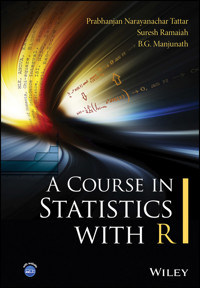
Integrates the theory and applications of statistics using R A Course in Statistics with R has been written to bridge the gap between theory and applications and explain how mathematical expressions are converted into R programs. The book has been primarily designed as a useful companion for a Masters student during each semester of the course, but will also help applied statisticians in revisiting the underpinnings of the subject. With this dual goal in mind, the book begins with R basics and quickly covers visualization and exploratory analysis. Probability and statistical inference, inclusive of classical, nonparametric, and Bayesian schools, is developed with definitions, motivations, mathematical expression and R programs in a way which will help the reader to understand the mathematical development as well as R implementation. Linear regression models, experimental designs, multivariate analysis, and categorical data analysis are treated in a way which makes effective use of visualization techniques and the related statistical techniques underlying them through practical applications, and hence helps the reader to achieve a clear understanding of the associated statistical models.
Key features:
- Integrates R basics with statistical concepts
- Provides graphical presentations inclusive of mathematical expressions
- Aids understanding of limit theorems of probability with and without the simulation approach
- Presents detailed algorithmic development of statistical models from scratch
- Includes practical applications with over 50 data sets
Sie lesen das E-Book in den Legimi-Apps auf:
Seitenzahl: 968
Veröffentlichungsjahr: 2016
Ähnliche



















Table of Contents
Cover
Title Page
Copyright
Dedication
List of Figures
List of Tables
Preface
Acknowledgments
Part I: The Preliminaries
Chapter 1: Why R?
1.1 Why R?
1.2 R Installation
1.3 There is Nothing such as PRACTICALS
1.4 Datasets in R and Internet
1.5 http://cran.r-project.org
1.6 R and its Interface with other Software
1.7 help and/or ?
1.8 R Books
1.9 A Road Map
Chapter 2: The R Basics
2.1 Introduction
2.2 Simple Arithmetics and a Little Beyond
2.3 Some Basic R Functions
2.4 Vectors and Matrices in R
2.5 Data Entering and Reading from Files
2.6 Working with Packages
2.7 R Session Management
2.8 Further Reading
2.9 Complements, Problems, and Programs
Chapter 3: Data Preparation and Other Tricks
3.1 Introduction
3.2 Manipulation with Complex Format Files
3.3 Reading Datasets of Foreign Formats
3.4 Displaying R Objects
3.5 Manipulation Using R Functions
3.6 Working with Time and Date
3.7 Text Manipulations
3.8 Scripts and Text Editors for R
3.9 Further Reading
3.10 Complements, Problems, and Programs
Chapter 4: Exploratory Data Analysis
4.1 Introduction: The Tukey's School of Statistics
4.2 Essential Summaries of EDA
4.3 Graphical Techniques in EDA
4.4 Quantitative Techniques in EDA
4.5 Exploratory Regression Models
4.6 Further Reading
4.7 Complements, Problems, and Programs
Part II: Probability and Inference
Chapter 5: Probability Theory
5.1 Introduction
5.2 Sample Space, Set Algebra, and Elementary Probability
5.3 Counting Methods
5.4 Probability: A Definition
5.5 Conditional Probability and Independence
5.6 Bayes Formula
5.7 Random Variables, Expectations, and Moments
5.8 Distribution Function, Characteristic Function, and Moment Generation Function
5.9 Inequalities
5.10 Convergence of Random Variables
5.11 The Law of Large Numbers
5.12 The Central Limit Theorem
5.13 Further Reading
5.14 Complements, Problems, and Programs
Chapter 6: Probability and Sampling Distributions
6.1 Introduction
6.2 Discrete Univariate Distributions
6.3 Continuous Univariate Distributions
6.4 Multivariate Probability Distributions
6.5 Populations and Samples
6.6 Sampling from the Normal Distributions
6.7 Some Finer Aspects of Sampling Distributions
6.8 Multivariate Sampling Distributions
6.9 Bayesian Sampling Distributions
6.10 Further Reading
6.11 Complements, Problems, and Programs
Chapter 7: Parametric Inference
7.1 Introduction
7.2 Families of Distribution
7.3 Loss Functions
7.4 Data Reduction
7.5 Likelihood and Information
7.6 Point Estimation
7.7 Comparison of Estimators
7.8 Confidence Intervals
7.9 Testing Statistical Hypotheses–The Preliminaries
7.10 The Neyman-Pearson Lemma
7.11 Uniformly Most Powerful Tests
7.12 Uniformly Most Powerful Unbiased Tests
7.13 Likelihood Ratio Tests
7.14 Behrens-Fisher Problem
7.15 Multiple Comparison Tests
7.16 The EM Algorithm*
7.17 Further Reading
7.18 Complements, Problems, and Programs
Chapter 8: Nonparametric Inference
8.1 Introduction
8.2 Empirical Distribution Function and Its Applications
8.3 The Jackknife and Bootstrap Methods
8.4 Non-parametric Smoothing
8.5 Non-parametric Tests
8.6 Further Reading
8.7 Complements, Problems, and Programs
Chapter 9: Bayesian Inference
9.1 Introduction
9.2 Bayesian Probabilities
9.3 The Bayesian Paradigm for Statistical Inference
9.4 Bayesian Estimation
9.5 The Credible Intervals
9.6 Bayes Factors for Testing Problems
9.7 Further Reading
9.8 Complements, Problems, and Programs
Part III: Stochastic Processes and Monte Carlo
Chapter 10: Stochastic Processes
10.1 Introduction
10.2 Kolmogorov's Consistency Theorem
10.3 Markov Chains
10.4 Application of Markov Chains in Computational Statistics
10.5 Further Reading
10.6 Complements, Problems, and Programs
Chapter 11: Monte Carlo Computations
11.1 Introduction
11.2 Generating the (Pseudo-) Random Numbers
11.3 Simulation from Probability Distributions and Some Limit Theorems
11.4 Monte Carlo Integration
11.5 The Accept-Reject Technique
11.6 Application to Bayesian Inference
11.7 Further Reading
11.8 Complements, Problems, and Programs
Part IV: Linear Models
Chapter 12: Linear Regression Models
12.1 Introduction
12.2 Simple Linear Regression Model
12.3 The Anscombe Warnings and Regression Abuse
12.4 Multiple Linear Regression Model
12.5 Model Diagnostics for the Multiple Regression Model
12.6 Multicollinearity
12.7 Data Transformations
12.8 Model Selection
12.9 Further Reading
12.10 Complements, Problems, and Programs
Chapter 13: Experimental Designs
13.1 Introduction
13.2 Principles of Experimental Design
13.3 Completely Randomized Designs
13.4 Block Designs
13.5 Factorial Designs
13.6 Further Reading
13.7 Complements, Problems, and Programs
Chapter 14: Multivariate Statistical Analysis - I
14.1 Introduction
14.2 Graphical Plots for Multivariate Data
14.3 Definitions, Notations, and Summary Statistics for Multivariate Data
14.4 Testing for Mean Vectors : One Sample
14.5 Testing for Mean Vectors : Two-Samples
14.6 Multivariate Analysis of Variance
14.7 Testing for Variance-Covariance Matrix: One Sample
14.8 Testing for Variance-Covariance Matrix: -Samples
14.9 Testing for Independence of Sub-vectors
14.10 Further Reading
14.11 Complements, Problems, and Programs
Chapter 15: Multivariate Statistical Analysis - II
15.1 Introduction
15.2 Classification and Discriminant Analysis
15.3 Canonical Correlations
15.4 Principal Component Analysis – Theory and Illustration
15.5 Applications of Principal Component Analysis
15.6 Factor Analysis
15.7 Further Reading
15.8 Complements, Problems, and Programs
Chapter 16: Categorical Data Analysis
16.1 Introduction
16.2 Graphical Methods for CDA
16.3 The Odds Ratio
16.4 The Simpson's Paradox
16.5 The Binomial, Multinomial, and Poisson Models
16.6 The Problem of Overdispersion
16.7 The - Tests of Independence
16.8 Further Reading
16.9 Complements, Problems, and Programs
Chapter 17: Generalized Linear Models
17.1 Introduction
17.2 Regression Problems in Count/Discrete Data
17.3 Exponential Family and the GLM
17.4 The Logistic Regression Model
17.5 Inference for the Logistic Regression Model
17.6 Model Selection in Logistic Regression Models
17.7 Probit Regression
17.8 Poisson Regression Model
17.9 Further Reading
17.10 Complements, Problems, and Programs
Appendix A: Open Source Software–An Epilogue
Appendix B: The Statistical Tables
Bibliography
Author Index
Subject Index
R Codes
End User License Agreement
Pages
xvii
xviii
xix
xx
xxi
xxii
xxiii
xxv
xxvi
1
3
4
5
6
7
8
9
10
11
12
13
14
15
16
17
18
19
20
21
22
23
24
25
26
27
28
29
30
31
32
33
34
35
36
37
38
39
40
41
42
43
44
45
46
47
49
50
51
52
53
54
55
56
57
58
59
60
61
62
63
64
65
66
67
68
69
70
71
72
73
74
75
76
77
78
79
80
81
82
83
84
85
86
87
88
89
90
91
92
93
94
95
96
97
98
99
100
101
103
105
106
107
108
109
110
111
112
113
114
115
116
117
118
119
120
121
122
123
124
125
126
127
128
129
130
131
132
133
134
135
136
137
138
139
140
141
142
143
144
145
146
147
148
149
150
151
152
153
154
155
156
157
158
159
160
161
162
163
164
165
166
167
168
169
171
172
173
174
175
176
177
178
179
180
181
182
183
184
185
186
187
188
189
190
191
192
193
194
195
196
197
198
199
200
201
202
203
204
205
206
207
208
209
210
211
212
213
214
215
216
217
218
219
220
221
222
223
224
225
226
227
228
229
230
231
232
233
234
235
236
237
238
239
240
241
242
243
244
245
246
247
248
249
250
251
252
253
254
255
256
257
258
259
260
261
262
263
264
265
266
267
268
269
270
271
272
273
274
275
276
277
278
279
280
281
282
283
284
285
286
287
288
289
290
291
292
293
294
295
296
297
298
299
300
301
302
303
304
305
306
307
308
309
310
311
312
313
314
315
316
317
318
319
320
321
322
323
324
325
326
327
328
329
330
331
332
333
334
335
337
339
340
341
342
343
344
345
346
347
348
349
350
351
352
353
354
355
356
357
358
359
360
361
362
363
364
365
366
367
368
369
370
371
372
373
374
375
376
377
378
379
380
381
382
383
384
385
386
387
388
389
390
391
392
393
394
395
396
397
399
401
402
403
404
405
406
407
408
409
410
411
412
413
414
415
416
417
418
419
420
421
422
423
424
425
426
427
428
429
430
431
432
433
434
435
436
437
438
439
440
441
442
443
444
445
446
447
448
449
450
451
452
453
454
455
456
457
458
459
460
461
462
463
464
465
466
467
468
469
470
471
472
473
474
475
476
477
478
479
480
481
482
483
484
485
486
487
488
489
490
491
492
493
494
495
496
497
498
499
500
501
502
503
504
505
507
508
509
510
511
512
513
514
515
516
517
518
519
520
521
522
523
524
525
526
527
528
529
530
531
532
533
534
535
536
537
538
539
541
542
543
544
545
546
547
548
549
550
551
552
553
554
555
556
557
558
559
560
561
562
563
564
565
566
567
568
569
571
572
573
574
575
576
577
578
579
580
581
582
583
584
585
586
587
588
589
590
591
592
593
594
595
597
598
599
600
601
602
603
604
605
606
607
608
609
610
611
612
613
614
615
616
617
618
619
620
621
622
623
624
625
626
627
628
629
631
633
634
635
636
637
638
639
640
641
642
643
644
645
646
647
649
650
651
652
653
654
655
656
657
658
659
660
661
662
663
664
665
Guide
Cover
Table of Contents
Preface
Part I: The Preliminaries
Begin Reading
List of Illustrations
Chapter 2: The R Basics
Figure 2.1 Characteristic Function of Uniform and Normal Distributions
Chapter 4: Exploratory Data Analysis
Figure 4.1 Boxplot for the Youden-Beale Experiment
Figure 4.2 Michelson-Morley Experiment
Figure 4.3 Boxplots for Michelson-Morley Experiment
Figure 4.4 Boxplot for the Memory Data
Figure 4.5 Different Types of Histograms
Figure 4.6 Histograms for the Galton Dataset
Figure 4.7 Histograms with Boxplot Illustration
Figure 4.8 A Rootogram Transformation for Militiamen Data
Figure 4.9 A Pareto Chart for Understanding The Cause-Effect Nature
Figure 4.10 A Time Series Plot for Air Passengers Dataset
Figure 4.11 A Scatter Plot for Galton Dataset
Figure 4.12 Understanding Correlations through Different Scatter Plots
Figure 4.13 Understanding The Construction of Resistant Line
Figure 4.14 Fitting of Resistant Line for the Galton Dataset
Chapter 5: Probability Theory
Figure 5.1 A Graph of Two Combinatorial Problems
Figure 5.2 Birthday Match and Banach Match Box Probabilities
Figure 5.3 The Cantor Set
Figure 5.4 Venn Diagram to Understand Bayes Formula
Figure 5.5 Plot of Random Variables for Jiang's example
Figure 5.6 Expected Number of Coupons
Figure 5.7 Illustration of Convergence in Distribution
Figure 5.8 Graphical Aid for Understanding Convergence in Mean
Figure 5.9 Normal Approximation for a Gamma Sum
Figure 5.10 Verifying Feller Conditions for Four Problems
Figure 5.11 Lindeberg Conditions for Standard Normal Distribution
Figure 5.12 Lindeberg Conditions for Curved Normal Distribution
Figure 5.13 Liapounov Condition Verification
Chapter 6: Probability and Sampling Distributions
Figure 6.1 Understanding the Binomial Distribution
Figure 6.2 Understanding the Geometric Distribution
Figure 6.3 Various Poisson Distribution
Figure 6.4 Poisson Approximation of Binomial Distribution
Figure 6.5 Convolution of Two Uniform Random Variables
Figure 6.6 Gamma Density Plots
Figure 6.7 Shaded Normal Curves
Figure 6.8 Whose Tails are Heavier?
Figure 6.9 Some Important Sampling Densities
Figure 6.10 Poisson Sampling Distribution
Figure 6.11 Non-central Densities
Chapter 7: Parametric Inference
Figure 7.1 Loss Functions for Binomial Distribution
Figure 7.2 A Binomial Likelihood
Figure 7.3 Various Likelihood Functions
Figure 7.4 Understanding Sampling Variation of Score Function
Figure 7.5 Score Function of Normal Distribution
Figure 7.6 Power Function Plot for Normal Distribution
Figure 7.7 UMP Tests for One-Sided Hypotheses
Figure 7.8 Non-Existence of UMP Test for Normal Distribution
Chapter 8: Nonparametric Inference
Figure 8.1 A Plot of Empirical Distribution Function for the Nerve Dataset
Figure 8.2 Histogram Smoothing for Forged Swiss Notes
Figure 8.3 Histogram Smoothing using Optimum Bin Width
Figure 8.4 A Plot of Various Kernels
Figure 8.5 Understanding “Kernel” Choice for Swiss Notes
Figure 8.6 Nadaraya-Watson Kernel Regression for Faithful Dataset
Figure 8.7 Loess Smoothing for the Faithful
Chapter 9: Bayesian Inference
Figure 9.1 Bayesian Inference for Uniform Distribution
Chapter 10: Stochastic Processes
Figure 10.1 Digraphs for Classification of States of a Markov Chain
Figure 10.2 Metropolis-Hastings Algorithm in Action
Figure 10.3 Gibbs Sampler in Action
Chapter 11: Monte Carlo Computations
Figure 11.1 Linear Congruential Generator
Figure 11.2 Understanding Probability through Simulation: The Three Problems
Figure 11.3 Simulation for the Exponential Distribution
Figure 11.4 A Simulation Understanding of the Convergence of Uniform Minima
Figure 11.5 Understanding WLLN and CLT through Simulation
Figure 11.6 Accept-Reject Algorithm
Figure 11.7 Histogram Prior in Action
Chapter 12: Linear Regression Models
Figure 12.1 Scatter Plot for Height vs Girth of Euphorbiaceae Trees
Figure 12.2 Residual Plot for a Regression Model
Figure 12.3 Normal Probability Plot
Figure 12.4 Regression and Resistant Lines for the Anscombe Quartet
Figure 12.5 Matrix of Scatter Plot for US Crime Data
Figure 12.6 Three-Dimensional Plots
Figure 12.7 The Contour Plots for Three Models
Figure 12.8 Residual Plot for the Abrasion Index Data
Figure 12.9 Cook's Distance for the Abrasion Index Data
Figure 12.10 Illustration of Linear Transformation
Figure 12.11 Box-Cox Transformation for the Viscosity Data
Figure 12.12 An RSS Plot for all Possible Regression Models
Chapter 13: Experimental Designs
Figure 13.1 “Granova” Plot for the Anorexia Dataset
Figure 13.2 Box Plots for the Olson Data
Figure 13.3 Model Adequacy Plots for the Tensile Strength Experiment
Figure 13.4 A qq-Plot for the Hardness Data
Figure 13.5 Graeco-Latin Square Design
Figure 12.6 Design and Interaction Plots for 2-Factorial Design
Figure 12.7 Understanding Interactions for the Bottling Experiment
Chapter 14: Multivariate Statistical Analysis - I
Figure 14.1 A Correlation Matrix Scatter Plot for the Car Data
Figure 14.2 Chernoff Faces for a Sample of 25 Data Points of Car Data
Figure 14.3 Understanding Bivariate Normal Densities
Figure 14.4 A Counter Example of the Myth that Uncorrelated and Normal Distribution imply Independence
Figure 14.5 A Matrix Scatter Plot for the Board Stiffness Dataset
Figure 14.6 Early Outlier Detection through Dot Charts
Chapter 15: Multivariate Statistical Analysis - II
Figure 15.1 Uncorrelatedness of Principal Components
Figure 15.2 Scree Plots for Identifying the Number of Important Principal Components
Figure 15.3 Pareto Chart and Pairs for the PC Scores
Figure 15.4 Biplot of the Cork Dataset
Chapter 16: Categorical Data Analysis
Figure 16.1 Death Rates among the Rural Population
Figure 16.2 Bar Diagrams for the Faithful Data
Figure 16.3 Spine Plots for the Virginia Death Rates
Figure 16.4 A Diagrammatic Representation of the Hair Eye Color Data
Figure 16.5 Mosaic Plot for the Hair Eye Color Data
Figure 16.6 Pie Charts for the Old Faithful Data
Figure 16.7 Four-Fold Plot for the Admissions Data
Figure 16.8 Four-Fold Plot for the Admissions Data
Figure 16.9 Understanding the Odds Ratio
Chapter 17: Generalized Linear Models
Figure 17.1 A Conditional Density Plot for the SAT Data
Figure 17.2 Understanding the Coronary Heart Disease Data in Terms of Percentage
Figure 17.3 Residual Plots using LOESS
List of Tables
Chapter 4: Exploratory Data Analysis
Table 4.1 Frequency Table of Contamination and Oxide Effect
Chapter 5: Probability Theory
Table 5.2 Birthday Match Probabilities
Chapter 6: Probability and Sampling Distributions
Table 6.1 Bayesian Sampling Distributions
Chapter 7: Parametric Inference
Table 7.1 Pitman Family of Distributions
Table 7.2 Risk Functions for Four Statistics
Table 7.3 Death by Horse Kick Data
Table 7.4 Type I and II Error
Table 7.5 Multinomial Distribution in Genetics
Chapter 8: Nonparametric Inference
Table 8.1 Statistical Functionals
Table 8.2 The Aspirin Data: Heart Attacks and Strokes
Table 8.3 Kernel Functions
Table 8.4 Determining Weights of the Siegel-Tukey Test
Table 8.5 Data Arrangement for the Kruskal-Wallis Test
Chapter 9: Bayesian Inference
Table 9.1 Birthday Probabilities: Bayesian and Classical
Chapter 11: Monte Carlo Computations
Table 11.1 Theoretical and Simulated Birthday Match Probabilities
Table 11.2 Theoretical and Simulated Expected Number of Coupons
Chapter 12: Linear Regression Models
Table 12.1 ANOVA Table for Simple Linear Regression Model
Table 12.2 ANOVA Table for Euphorbiaceae Height
Table 12.3 ANOVA Table for Multiple Linear Regression Model
Chapter 13: Experimental Designs
Table 13.1 Design Matrix of a CRD with Treatments and Observations
Table 13.2 ANOVA for the CRD Model
Table 13.3 ANOVA for the Randomized Balanced Block Model
Table 13.4 ANOVA for the BIBD Model
Table 13.5 ANOVA for the LSD Model
Table 13.6 The GLSD Model
Table 13.7 ANOVA for the GLSD Model
Table 13.8 ANOVA for the Two Factorial Model
Table 13.9 ANOVA for the Three-Factorial Model
Table 13.10 ANOVA for Factorial Models with Blocking
Chapter 16: Categorical Data Analysis
Table 16.1 Simpson's Data and the Paradox
Chapter 17: Generalized Linear Models
Table 17.1 GLM and the Exponential Family
Table 17.2 The Low Birth-Weight Variables
A COURSE IN STATISTICS WITH R
Prabhanjan Narayanachar Tattar
Fractal Analytics Inc.
Suresh Ramaiah
Karnatak University, India
B.G. Manjunath
Dell International Services, India
This edition first published 2016
© 2016 John Wiley & Sons, Ltd
Registered office
John Wiley & Sons Ltd, The Atrium, Southern Gate, Chichester, West Sussex, PO19 8SQ, United Kingdom
For details of our global editorial offices, for customer services and for information about how to apply for permission to reuse the copyright material in this book, please see our website at www.wiley.com.
The right of the author to be identified as the author of this work has been asserted in accordance with the Copyright, Designs and Patents Act 1988.
All rights reserved. No part of this publication may be reproduced, stored in a retrieval system, or transmitted, in any form or by any means, electronic, mechanical, photocopying, recording or otherwise, except as permitted by the UK Copyright, Designs and Patents Act 1988, without the prior permission of the publisher.
Wiley also publishes its books in a variety of electronic formats. Some content that appears in print may not be available in electronic books.
Designations used by companies to distinguish their products are often claimed as trademarks. All brand names and product names used in this book are trade names, service marks, trademarks or registered trademarks of their respective owners. The publisher is not associated with any product or vendor mentioned in this book.
Limit of Liability/Disclaimer of Warranty: While the publisher and author have used their best efforts in preparing this book, they make no representations or warranties with respect to the accuracy or completeness of the contents of this book and specifically disclaim any implied warranties of merchantability or fitness for a particular purpose. It is sold on the understanding that the publisher is not engaged in rendering professional services and neither the publisher nor the author shall be liable for damages arising herefrom. If professional advice or other expert assistance is required, the services of a competent professional should be sought.
Library of Congress Cataloging-in-Publication Data applied for.
ISBN: 9781119152729
A catalogue record for this book is available from the British Library.
Cover Image: Tee\_Photolive/Getty
List of Figures
Figure 2.1Characteristic Function of Uniform and Normal Distributions
Figure 4.1 Boxplot for the Youden-Beale Experiment
Figure 4.2 Michelson-Morley Experiment
Figure 4.3 Boxplots for Michelson-Morley Experiment
Figure 4.4 Boxplot for the Memory Data
Figure 4.5 Different Types of Histograms
Figure 4.6 Histograms for the Galton Dataset
Figure 4.7 Histograms with Boxplot Illustration
Figure 4.8 A Rootogram Transformation for Militiamen Data
Figure 4.9 A Pareto Chart for Understanding The Cause-Effect Nature
Figure 4.10 A Time Series Plot for Air Passengers Dataset
Figure 4.11 A Scatter Plot for Galton Dataset
Figure 4.12 Understanding Correlations through Different Scatter Plots
Figure 4.13 Understanding The Construction of Resistant Line
Figure 4.14 Fitting of Resistant Line for the Galton Dataset
Figure 5.1 A Graph of Two Combinatorial Problems
Figure 5.2 Birthday Match and Banach Match Box Probabilities
Lesen Sie weiter in der vollständigen Ausgabe!
Lesen Sie weiter in der vollständigen Ausgabe!
Lesen Sie weiter in der vollständigen Ausgabe!
Lesen Sie weiter in der vollständigen Ausgabe!
Lesen Sie weiter in der vollständigen Ausgabe!
Lesen Sie weiter in der vollständigen Ausgabe!
Lesen Sie weiter in der vollständigen Ausgabe!
Lesen Sie weiter in der vollständigen Ausgabe!
Lesen Sie weiter in der vollständigen Ausgabe!
Lesen Sie weiter in der vollständigen Ausgabe!
Lesen Sie weiter in der vollständigen Ausgabe!
Lesen Sie weiter in der vollständigen Ausgabe!
Lesen Sie weiter in der vollständigen Ausgabe!
Lesen Sie weiter in der vollständigen Ausgabe!
Lesen Sie weiter in der vollständigen Ausgabe!
Lesen Sie weiter in der vollständigen Ausgabe!
Lesen Sie weiter in der vollständigen Ausgabe!
Lesen Sie weiter in der vollständigen Ausgabe!
Lesen Sie weiter in der vollständigen Ausgabe!
Lesen Sie weiter in der vollständigen Ausgabe!
Lesen Sie weiter in der vollständigen Ausgabe!
Lesen Sie weiter in der vollständigen Ausgabe!
Lesen Sie weiter in der vollständigen Ausgabe!
Lesen Sie weiter in der vollständigen Ausgabe!
Lesen Sie weiter in der vollständigen Ausgabe!
Lesen Sie weiter in der vollständigen Ausgabe!
Lesen Sie weiter in der vollständigen Ausgabe!
Lesen Sie weiter in der vollständigen Ausgabe!
Lesen Sie weiter in der vollständigen Ausgabe!
Lesen Sie weiter in der vollständigen Ausgabe!
Lesen Sie weiter in der vollständigen Ausgabe!




