


29,99 €
Mehr erfahren.
- Herausgeber: Independent Thinking Press
- Kategorie: Bildung
- Sprache: Englisch
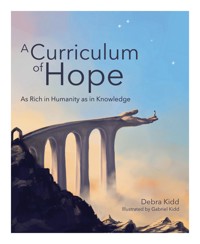
Written by Debra Kidd, A Curriculum of Hope: As rich in humanity as in knowledge explores how good curriculum design can empower schools to build bridges between their pupils' learning and the world around them. A great many schools are wondering how they can build a curriculum model that meets the demands of government policy as well as the needs of the children and communities they serve. InCurriculum of Hope, Debra illustrates how teachers can deliver learning experiences that genuinely link knowledge to life. Working on the premise that a strong curriculum is supported by five key pillars of practice coherence, credibility, creativity, compassion and community she presents a plethora of examples that demonstrate how schools, parents, pupils and the wider local community can learn together to build from within. Debra enquires into the ways in which schools can create units of work that are both knowledge- and humanity-rich, and challenges the view that the role of children is simply to listen and learn instead advocating their active engagement with local and global issues. She does so by delving into the role of pedagogy as a means of empowering children, and by exploring some of the more overlooked pedagogical tools that can have a great impact on children's learning and well-being story, movement and play as well as some of the recent research into memory and retention. Towards the back of the book you will find case studies demonstrating how teachers can work with both their own and other subject departments across the school to plan in ways that allow for pupil choice, autonomy and responsibility. Furthermore, there are some accompanying planning documents for these examples provided in the appendix (The Seed Catalogue) which you may find useful, and these documents are also available for download. Suitable for teachers and leaders in all schools.
Das E-Book können Sie in Legimi-Apps oder einer beliebigen App lesen, die das folgende Format unterstützen:
Veröffentlichungsjahr: 2020
Ähnliche





Praise for A Curriculum of Hope
From the opening garden analogy onwards, A Curriculum of Hope is a delightfully written and intellectually rigorous attempt to do something that is so badly needed in current educational discourse. This is to consciously challenge unhelpful binary polarisation and find the much-needed middle-ground narrative that embraces the ‘messiness’ of learning and the innovative and creative practice that flows from it. A Curriculum of Hope is both a great addition to the debate and an excellent read!
Professor Samantha Twiselton, Director, Sheffield Institute of Education, and Vice President (external), The Chartered College of Teaching
The credibility of our national curriculum depends on the expertise of our teachers – in A Curriculum of Hope, Debra Kidd provides much-needed professional guidance. She motivates educators to seek empowerment and articulates a coherent strategy for teachers and school leaders to bring the curriculum to life in their classrooms and schools.
Ross Morrison McGill @TeacherToolkit – the UK’s most followed educator on social media, who writes at TeacherToolkit.co.uk
Reading A Curriculum of Hope is like having a conversation with a fellow teacher. It features stories of real events in real classrooms, references to broader thinking and research, and humbling examples of what can be done to open up learning opportunities for our pupils.
This is a good book, full of concern for the best interests of all children. It explains how to help them learn and how we should decide what they should learn. That’s what the most professional of teachers do. Debra is one of those teachers and a superb writer.
Mick Waters, Professor of Education, University of Wolverhampton
I love Debra Kidd’s writing. She takes on the orthodoxies of the current educational establishment with wit, wisdom and a shining belief in the myriad, rich possibilities of education and our children.
Melissa Benn, writer and author of Life Lessons: The Case for a National Education Service
BIn this brilliant book, Debra Kidd manages to set out a curriculum concept rooted in reality, experience, joy and compassion. The structures, ideas and possibilities she shares will be invaluable to teachers, curriculum planners and leaders who desire to provide children with rich learning experiences that will have a powerful impact on their lives.
A Curriculum of Hope is an important book written by someone with a wealth of experience across the spectrum of education. It should be read, respected and acted upon. What a treat!
Hywel Roberts, teacher, author and storyteller
A Curriculum of Hope provides a considerable contribution to the debate surrounding curriculum. With razor sharp clarity, Debra Kidd identifies a number of problems with some wide-ranging ‘umbrella’ topics in the primary phase and proposes a clear rationale for developing content and concepts thoughtfully through threads. Debra makes the case that we need to ensure knowledge is utilised in ways that make learning effective for more than simply passing tests. She also provides some excellent examples for thinking about coherence across subjects in secondary schools.
Beautifully crafted and packed with insights, A Curriculum of Hope adds another dimension to the discussion about what it means to create a connected, compelling curriculum.
Mary Myatt, author of High Challenge, Low Threat and The Curriculum: Gallimaufry to Coherence
‘Hope’ is the thing with feathers –
That perches in the soul –
And sings the tune without the words –
And never stops – at all –
Emily Dickinson
To the Pedagogical Activists of the World
Charlie McChrystal’s council house garden was a bit of a mess. The inside of the house was spotless – my grandma made sure that every corner was cleaned within an inch of its life; the doorstep was whitewashed; none of their meagre possessions out of place. But the garden was overgrown with dandelions and buttercups.
Charlie McChrystal fought in the First World War. His first wife and their only child died in the Second. He was a broken, flawed man by the time I knew him, most alive and happy when distracted by Laurel and Hardy. As a child I was a little afraid of him, but every now and then a playfulness would break out in him and the sun would appear. It was rare, but we basked in the warmth of that sunlight when it shone.
Charlie McChrystal didn’t talk about the war much. His sister told us how he had signed up with his friends from the small town they came from – Padiham in Lancashire – and how, when marching to the trenches of Ypres, he had stopped to pee behind a tree. As he looked on his pals were killed by a shell as they walked ahead. He never spoke of this to us, but even as children we knew he carried pain.
Charlie McChrystal wouldn’t dig up dandelions. He wouldn’t let others dig them up either. Because to him the dandelion was the only glimmer of hope in the hell hole of the trenches. The one ‘bugger’, as he put it, that you knew would survive. To his mind there were no weeds, just life.
Charlie McChrystal didn’t value education much. He encouraged his own children to leave school and earn a living as fast as possible. They lived in abject poverty, and education was seen as a luxury they couldn’t afford. When a neighbour donated a piano to the family, he chopped it up for firewood. But he fathered a child who would go on to encourage her own children to learn, whose mantra was ‘Don’t be like me – get an education.’ Charlie McChrystal bred a rebel in Florence McChrystal. My mum. A dandelion. ii
I pray that we, and our children and their children, never see what Charlie McChrystal saw and that our world moves towards a time when no child or adult experiences the horrors of war or the kind of grinding poverty that my own parents grew up in. But if I say to teachers that we need to be the dandelions in the education system – pushing up through the cracks and resisting the performance-related pressures that can lead us to act without integrity or compassion – I hope that you will understand what I mean. And that you will take a moment to think of Charlie McChrystal, whose education and understanding of the world was forged in war and loss, but who nevertheless held on to hope.
Acknowledgements
This book would not have been possible without the brave teachers and heads I’ve encountered who have let me experiment with their curriculum models to test this work over decades. In particular, to Matthew Milburn and Helen Jones who, many years ago, entrusted their Key Stage 3 curriculum to me and set me off on this journey – thank you. To primary dynamo heads Andy Moor, Tina Farr, Julie Rees, Jenny Bowers, Richard Kieran, Vicky Carr, Sara Radley and Becky Bridges who have built humanity-rich curriculum models rooted in their local contexts but looking out across the horizon and beyond – you have been inspirational, and thank you for letting me play in your schools. To Sarah Smith in Pembrokeshire who allowed me and Hywel Roberts to plait the new Curriculum for Wales across the secondary school, asking big questions as we went along, and to Andrea Skelly who worked with us to build a humane curriculum in an alternative provision setting, thank you. To Rachael Mweti in Singapore who let me loose on the primary years programme, and Chris Waugh for generously sharing his work in New Zealand – thank you, too.
To my fellow curriculum explorer, ‘sherpas’ as he would have us known, Hywel Roberts – thank you for the collaborations, the friendship and the endless laughter. To the late Dorothy Heathcote who taught me how to guide children over the bridge of concern into genuine investment, and to Professor Mick Waters whose humour and wisdom have greatly influenced how I think and act and who is the most knowledgeable person I have ever met – thank you. To all those teachers who stand in front of children every day and who resist the mundane, the box-ticking and the pressure, and who change lives for the better – thank you.
Thank you also to Emma Tuck – the world’s most thorough copy-editor and font of knowledge – this book is in much better shape because of you.
And to Gabriel Kidd and Beth Andrew for their artwork and plaits – a proper pair of dandelions – thank you.iv
Contents
Introduction: The Groundwork
Schooling is living, it is not a preparation for living. And living is a constant messing with problems that seem to resist solution.
Martin Haberman, The Pedagogy of Poverty versus Good Teaching (1991)
If schools were gardens, which one would you choose?
Everything is meticulously plotted out in rows. Every plant must have a utilitarian purpose, producing crops on the same day every year. Most of the garden must be given over to the five plants that the government have deemed most useful. The 30% of seedlings that are the slowest to grow are deliberately weeded out to create the impression of rigour in the system, in spite of the fact that they may have eventually thrived. Distraction from, or interference with, the main aim of producing crops is eliminated through the use of netting over the plants which keeps pollinators and birds at bay.The garden has been left entirely alone in the hope that it will blossom into a wildlife meadow, attracting bees and butterflies. In reality, it is a mass of brambles, bindweed and knotweed, and the gardener dare not enter without protective clothing.These are the two options that some factions in education like to suggest are available to us, with a fear of the latter driving many towards the former. Who wouldn’t choose order over chaos and productivity over waste if they were the only options available? But they are not. Pretending they are is simply a tool of control designed to encourage people to adopt an ‘official’ model. Most sensible leaders and teachers know better.2
There is a third option: we can have a garden that has multiple functions. It is a garden of remembrance but carefully planted to support the future. Some weeds are encouraged to grow because they bloom early in the spring and provide vital nectar for bees and other pollinators (hello, dandelions!). Among the statues, plaques and memorial benches are plants that feed us, plants that sustain other life forms, plants that simply make us happy with their beauty, colour and scent, and which remind us of the importance of such things in our lives. There are plants that heal us and plants that are rich in myths and stories. Our garden is a communal space, so there are places to sit, places to shelter, places from which to admire the wildlife and artwork we have attracted or placed there. We share it, grow within it and nurture it, and when we are struggling we call in others to help us to maintain and protect it.
Most sensible people will, of course, choose the third option. Most schools will claim to be the third, regardless of reality. But to have a truly integrated garden we have to be completely committed to the idea that education is about much more than produce; that difficult problems don’t have easy solutions and that some easy solutions have unintended consequences; that sometimes you need to leave spaces for beauty and pleasure which all can share; and that we really need good, expert gardeners to keep the whole thing going.
Most of all we need to recognise that gardens are always in the present, no matter how much hope we are investing in the future. That rose won’t bloom if there is not a constant daily process of feeding, deadheading, pruning and checking for predatory pests. The hostas will be shredded by slugs if we don’t consider carefully where we plant them and how we protect them. To that end, we can spread poison in our garden or encourage hedgehogs, birds and toads to share our space. Every present choice has a future consequence – Haberman’s messy living – and grappling with choices and consequences throughout the curriculum should be a child’s entitlement, if we want them to understand how life works.
Maintaining hope is essential to gardening, but equally important is intention, planning and maintenance. This is a book about curriculum, so forgive me for labouring the metaphorical link to a garden. We might think of curriculum design as a form of garden design, but the design is inseparable from the act of gardening (the teaching and care of children) and from the forces that threaten our successes (the predators and pests we have to protect our garden from and that erode our sense of hope).3
Some might argue that these pests come in the form of tests and accountability structures, but they’re just weather. The real pests feed on our plants – the black spots of a lack of imagination, the fungus of apathy, the slug-like unquestioning compliance which leads to what Haberman describes as a ‘pedagogy of poverty’, where children have little opportunity to make choices or thrive in the here and now. A curriculum of hope is about much more than tests. It’s about building a hopeful future in a productive present. Let’s go back in time for a moment …
It was 2005. We had a new cohort of Year 7s in school and were writing a new curriculum. The results were pretty static and had been for some time, crawling along the floor targets. The students were compliant, most of the time, but largely apathetic. Everyone was working hard, but despite all that effort the school seemed to be coasting along. What could we do? At that time I was working partly in primary and partly in this secondary school. One of the reasons we were looking so hard at Year 7 was to ensure that the transition from primary to secondary didn’t put limitations on young people and instead aimed to give them a chance to show us who they were and what they were capable of beyond what their data might suggest.
We had started off thinking about identity – a settling unit that allowed them to think about who they were, where they came from and who they might become, and to infuse that with some understanding of the place where they lived – at both a local and national level. We came up with the idea of an inductive unit of work where the students could design a ‘Northern British Museum’ in our school, bringing their knowledge across subjects to life by curating spaces for an exhibition for the local community. They would need to create exhibits to show what they knew and were beginning to understand about British history, geography, sport, literature, culture, science and so on, and to bring in some elements of their own experiences and those of their families in order to add a local dimension.
In effect, this transition period would be a means of mining their prior knowledge and building from where they were at. While some of their choices were predictable and might be seen in any school undertaking this task, anywhere in the country, some were more surprising. It became clear pretty early on that 4we were going to have a coal room. We were in Barnsley, and while the mines had gone, they cast long shadows over the lives of these young people.
Exhibited with love and care in the mining section of the museum was a lump of coal that one boy’s granddad had carried out of the local pit on the day it was closed. There were also handwritten notes from Arthur Scargill, carefully folded newspapers which had been kept for decades, letters, diary entries, spoken word testimonies and more. Local families’ lives and histories were given the same reverence as the exhibits celebrating Shakespeare and royalty. Seemingly disparate pieces of knowledge were lent a sense of purpose and coherence through the processes involved in deciding what was worth keeping and what had to be left out. It was the students, working in partnership with staff, who were deciding what the ‘best which has been thought and said’1 might be, and while the usual suspects were present, they brought these and other touching surprises to the table.
Shortly before we were due to open to parents, I found myself preparing some finishing touches with a Year 7 class: ‘What we’re missing is a statement piece. All great museums have one in their foyer: something – usually a statue – that gives us a sense of what the museum is about and what we might expect from it. Something about its values, maybe. If we had a statue that was a statement piece in our museum, what might it look like? What might the inscription carved into the stone plinth say? Can you create that for me, working in groups, as a still image? And write your inscription down on paper.’
They were off … We had carefully crafted our rules and expectations for effective group work over a number of weeks. Even the students who had come from primary with warnings practically tattooed on their foreheads were engrossed. Two of them held each other in an embrace – they had arrived labelled with ‘anger management issues’, accused of being unable to work cooperatively. Two Barnsley lads, clasping each other in an embrace, with no one around them batting an eyelid.
‘This is ours, Miss – it’s called Tolerance.’
5I was so pleased I took a photo – evidence, you see – but then I was distracted from behind.
‘Miss! Can our statue move?’
I turned around.
‘Statues don’t usually move.’
‘This one is mechanical and if you put 10p in it, it moves.’
I sighed and dug 10p out of my pocket.
The boys made their mechanical image. It began with a cricket match – one boy bowling, another batting. There were two fielders, hands held open in anticipation of a catch. I knew that England had won the Ashes that summer and this wasn’t the first group of students who had wanted to have that achievement recognised in the museum. But when I put the 10p coin down, the tableau changed. The bowler moved one hand down towards the other – finger outstretched as if to press a button. The batsman and fielders turned their backs and crouched as if to protect themselves. And it was clear in that simple shift that we were now looking at the detonation of a bomb. For in the same summer the 7/7 bombings had taken place in London. I was silent for a moment. There was a lot to process.
‘Do you want to know our inscription, Miss?’ asked this 11-year-old.
‘Yes please!’
‘From Ashes to Ashes.’
I’ve redesigned many curriculum models in the last 15 years, but this moment shaped a lot of the work I have done because it reminded me of two important things when thinking about working with children: (1) give them the space to let them show you who they are and what they know, and (2) give them the space to let them show you what they worry about. And then attend to those elements. Too often as teachers we focus on the content to be delivered and too little on the 6recipient. Teaching is about being attentive to the conditions and the needs of those recipients. Yes, it’s hard, but there’s no point planting a sun-loving plant in the shade, and vice versa.
It has always seemed somewhat obvious to me that knowledge sits at the heart of learning. These children could not curate rooms about literature, history, sport, science, music, theatre or even coal mining without knowledge. But there was more going on here. There was an element of community – placing our work within the community, representing the community, inviting in the community. There was an element of creativity – not in terms of making, but in connecting our thinking and generating broader understanding. And there was compassion – not only in the way the children were acting towards others in their classes and beyond, but also compassion in the way that the curriculum acted towards them, in giving them space to build trust, to feel safe, to explore their hopes, dreams and fears, and in giving them the opportunity to have a voice.
It started me off on what has become a long journey of thinking about how curriculum acts as a vehicle for building what it is children need to know, but also a tool with which they can better shape their school experience, their relationships with others and the future world they will inhabit. I call this a humanity-rich curriculum, and at its heart are five pillars of practice which – in a humanity-rich, hopeful curriculum – will be plaited together as a set of entitlements for children. Just as a plant needs water, light, nutrients and protection from threats to survive, so a strong curriculum that supports the growth of children should have these five elements built in.7
Coherence: The curriculum is planned and plaited so that it connects in sensible and logical ways, allowing children to build an understanding of ideas, concepts, chronology and themes, and to better understand them because they are encountered in a way that makes those connections explicit and relevant. (For more on curriculum coherence see Mary Myatt.2) Within a single subject, that might mean attending to the progression of ideas or to a chronology. Across subjects it might be that you consider mapping where there are touchpoints – which is easier to do in primary than secondary, but even here there are too many missed opportunities. For example, are the English department studying war poetry at the same time that the history department are studying the First World War? Are the geography and science departments coordinating their units on climate change? How does the context offered above for Key Stage 3 demonstrate how a shared purpose can create points of coherence for the students?Credibility: The curriculum is clear about what children will know (propositional knowledge) and be able to do (procedural knowledge) and how these elements link to a prescribed national or regional curriculum, so that it is explicit how external expectations are mapped onto the internally experienced or enacted curriculum. Where a national curriculum is vague – for example, ‘events beyond living memory that are significant nationally or globally’ in the English national curriculum3 – what knowledge are we choosing to teach and what do we want children to understand and be able to do with that knowledge? Are we making this explicit?Creativity: The curriculum offers the child the right to experience, develop and practise creativity as an entitlement. Its view of creativity extends beyond making and doing in an artistic sense, and also allows for the development of fluency of knowledge and ideas through a process of interpretation, experimentation, connection and play. In the museum example on pages 3–5, the process of curation allowed the students to think about how to creatively link their knowledge, how to present it in an aesthetically pleasing and informative way, how to communicate the knowledge in order to capture the interest of the visitors and how to use a process of selection and rejection to organise and shape their knowledge – all aspects of the creative process.Compassion: The curriculum uses a range of experiences, including stories, to allow children to develop empathy with other points of view and perspectives, and to use that empathy to move into active compassion. Active compassion is solution-focused and its aim is to move children beyond empathy towards action. As such, the compassion is symbiotic for the child: the child is encouraged to be a compassionate individual, but rather than being placed in a passive and potentially harmful space of powerlessness, is 8encouraged, through activities and outcomes, to be a powerful agent of change. The curriculum also acts compassionately towards the child in acting in his or her best interests – giving the child access to a full curriculum and activities that are known to impact on the mental health of the child – for example, physical activities and the arts.Community: The curriculum is built with the broader community beyond the school in mind. Whether that takes the form of inviting in community members, building charitable and civic links of assistance, utilising the expertise within the parent body and local community, involving children in local democratic processes or arranging trips within the local area, community becomes a critical part of the curriculum design itself and not simply an appendage. Community is seen as a vital component of the cultural capital available to the school, so the school works in partnership with local organisations, theatres, museums and galleries to broaden the children’s experience. A curriculum really rooted in community does not simply take advantage of what the community has to offer; it allows children to be of service to that community, shaping its future.When these five pillars are in place, we see curriculum models emerging in which empowerment is the goal. Empowerment through knowledge, through action, through thought, through language, through play and, critically, through hope. This empowerment moves way beyond ‘what works’ in order to better pass tests, and moves towards ‘what works’ in terms of attending to the mental and emotional needs of children and to the present and future needs of the world around them.
This doesn’t demand a great deal of extra work for teachers and schools, but it does ask that we refocus and consider the value of what we teach, the relationship of the content to other important ideas and experiences, and how knowledge, skills, emotion, action and experience can be plaited into lines of inquiry for children. These lines of inquiry come in the shape of questions that bind curriculum together and encourage a shared exploration of knowledge within rich contexts, forming ‘grand narratives’ of learning. Throughout this book I will share examples of how this plaiting is being developed in many schools, both in the UK and abroad, and explore how we can ensure that humanity and hope are not lost in our quest for results.
9That is not to say that tests don’t matter – at least at the end point of secondary education. They do for as long as they act as passes to the future. But in a great education, test results are by-products, not end products, and should never be the raison d’être for curriculum planning – a point made by Amanda Spielman in her commentary on England’s new(est) inspection framework:
A good curriculum should lead to good results. However, good examination results in and of themselves don’t always mean that the pupil received rich and full knowledge from the curriculum. In the worst cases, teaching to the test, rather than teaching the full curriculum, leaves a pupil with a hollowed out and flimsy understanding.4




