


6,99 €
Mehr erfahren.
- Herausgeber: Chorabooks
- Kategorie: Religion und Spiritualität
- Sprache: Englisch
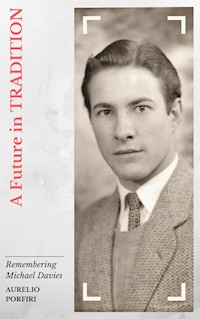
This little work by Aurelio Porfiri is full of love, respect, and insight. It contains a precious interview that the author conducted with Davies back in 2001, which, for circumstantial reasons, never saw the light of day. Pieces like this complete our picture of the man, the times in which he lived, and the cause for which he struggled.
Dr. Peter A. Kwasniewski (From the Foreword)
This book is not meant to provoke a liturgical war; that is not my intention. I just think that Michael Davies was an important part in the development of what we call (improperly) the traditionalist world, a world that I am certainly not eager to idealize or even to see as benign. I am aware of the shortcomings (and there are many) that are present among many traditionalists, but I can also see the legitimate reasons behind most of their protests. The situation of the Church is very harrowing and can no longer be hidden or denied.
Aurelio Porfiri (from the Introduction)
Das E-Book können Sie in Legimi-Apps oder einer beliebigen App lesen, die das folgende Format unterstützen:
Veröffentlichungsjahr: 2020
Ähnliche




Aurelio Porfiri
A FUTURE IN TRADITION
Copyright © 2020 Chorabooks, a division of Choralife Publisher Ltd.
All rights reserved.
14/F office A. Bangkok Bank Building
No.28 Des Voeux Road Central
Hong Kong
Visit our website at www.chorabooks.com
First Ebook edition: October 2020
Indice dei contenuti
Foreword
Introduction
A Welsh Teacher
Vatican II
A Prolific Writer
Other Fighters for the Good Cause
In Defense of the Priesthood
Modernism
In the Words of His Friends
Intervew with Michael Davies
Bibliography
Foreword
Dr. Peter A. Kwasniewski
Michael Davies was a great man.
No one who knew him would dispute this. And even those who were not privileged to be among his friends can still sense his greatness from afar, can touch it in the pages of his books and observe it in the unselfish dedication of his life to the Church and to her glorious tradition of divine worship. As Joseph Cardinal Ratzinger said upon hearing of his death: “I had the good fortune to meet him several times and I found him a man of deep faith and ready to embrace suffering. Ever since the Council he put all his energy into the service of the Faith and left us important publications especially about the sacred liturgy. Even though he suffered from the Church in many ways in his time, he always truly remained a man of the Church.”
This last line deserves particular emphasis: “Even though he suffered from the Church in many ways in his time, he always truly remained a man of the Church.”
In our day, it seems increasingly difficult to hold together two principles: on the one hand, a grateful, consistent, and wholehearted adherence to the holy traditions of our fathers, and, on the other hand, an unswerving fidelity to the Catholic Church in its concrete existence here and now, after the Council, under the guidance of shepherds who often leave much to be desired, not only in their personal behavior (which has ever been a problem in history) but in their doctrine and discipline as well. We see a splintering of “traditionalists” into many factions. We see some rejecting, in the name of tradition, the validity of the council or the reality of the papal incumbent. Some reject the papacy itself as they seek for greener pastures in the East—pastures they will find superior only by donning permanent blinders. Still others, bruised and battered by polemics, end up repudiating the very traditionalism they once espoused, under the impression that to be faithful Catholics they must somehow adapt themselves in an evolutionary manner to the faith of the reigning Narcissus. For those who care about continuity in faith between the past and the present, the contemporary ecclesiastical scene is fraught with confusion and chaos.
As one who lived through the worst years of the liturgical revolution and the attempted total suppression of the traditional liturgy, not to mention the suppression of nearly everything recognizably Catholic, Michael Davies experienced all of this far more keenly than many of us do. In the wake of the comparative conservatism of John Paul II and the bold move of Benedict XVI’s Summorum Pontificum, today we can see pockets of identifiably Catholic life throughout the world, and sometimes in our own neighborhoods. For Davies in the 1970s, there was nothing but a wasteland dotted with the wreckage of former glories, and he, along with other shellshocked Catholics, suffered bitter anguish from it and felt moved to righteous indignation.
But he did not despair; he did not give up; he did not rail angrily; he did not invent a theology to suit his exile. He held firmly to the Faith. He acknowledged the Church’s hierarchy, while freely and respectfully pointing out its dereliction of duty. He promoted traditional Catholic doctrine, devotions, and liturgy through his countless articles, lectures, books, letters, and personal contacts. He defended the validity of the new rites of Mass and of ordination while critiquing their numerous accidental deficiencies. He had the clearsightedness to be able to understand Archbishop Lefebvre and the courage to mount a defense of him at a time when the latter had few admirers outside of his following. He patiently engaged the most controversial questions of the day, doggedly insisting on the need above all to remain true to what has already been established, defined, approved, and tested in the communion of saints.
He was not, of course, alone in his heroic witness and pioneering labor. Others, too, such as Msgr. Klaus Gamber, Fr. Bryan Houghton, László Dobszay, Eric de Saventhem, Dietrich van Hildebrand, and Neil McCaffrey (just to name a few) kept alive the flame of hope in the darkest hour. In a nightmare scenario, working against unbelievable odds, laymen strove with popes, cardinals, and bishops for the retention of tradition in a religion defined by it. Their stance has been vindicated and their legacy has borne abundant fruit.
I had the good fortune to meet Michael Davies in Arlington, Virginia, where he had given a lecture on the Vendée uprising. Afterwards, like an infatuated fan, I told him how much I admired him. He was the embodiment of modesty and simplicity, and was, I think, uncomfortable with his role on the world stage. He would have preferred that someone else lead the troops; indeed, he would have liked it best of all had popes and bishops actually cared enough about Catholic tradition to have rendered his strenuous advocacy and jetsetting lecture tours absolutely unnecessary. But he expended himself without complaining because he passionately believed in the cause of preserving the great liturgical rites of Latin Christendom. Without him, I’m not sure there would be a Catholic traditional movement in the Anglophone world—at least not nearly to the same extent. We give thanks to almighty God, who made use of this humble Englishman to articulate, defend, and promote traditional Catholicism around the globe. That the Anglosphere has long been the world leader of traditionalism and shows every sign of retaining that distinction is certainly not unrelated to his efforts and writings.
This does not mean that Davies is as well known or as much appreciated as he should be. Yes, his is a household name among traditionalists—but what of the vast majority of Catholics who think, through no fault of their own, that the dominant vernacularized liturgy we now have is a Catholic liturgy (in the full sense), or deserves to be called the Roman Rite, or embodies what the Second Vatican Council called for? Most Catholics are not yet remotely aware of the profound problems underlying the liturgical reform and its results; they know nothing of the Protestantization, pseudo-Byzantification, and “Pistoiafication” of the Mass and other sacramental rites. Consequently, Michael Davies’s books—such as the famous trilogy Cranmer’s Godly Order, Pope John’s Council, and Pope Paul’s New Mass—remain as timely today as they were in former decades. Indeed, after fifty years of enforced normativity, the reform has become an alternative tradition within the Church, and it is therefore more urgent than ever to alert seminarians and clergy to its uncatholic and anticatholic elements, so that their consciences may motivate them to take up again the Church’s traditional rites.
This little work by Aurelio Porfiri is full of love, respect, and insight. It contains a precious interview that the author conducted with Davies back in 2001, which, for circumstantial reasons, never saw the light of day. Pieces like this complete our picture of the man, the times in which he lived, and the cause for which he struggled. The book also features reminiscences from friends who knew Davies well. Naturally, it is not to be assumed that the author and I would concur on every single point expressed in these pages. I am nevertheless pleased to recommend a work that redounds to the benefit of the Church and of her sacred liturgy.
May the witness of Michael Davies inspire us in this time of war, and may his work bear ever-increasing fruit in those who receive it with thankful appreciation and attentive care.
May 30, 2020
St. Joan of Arc
Introduction
Aurelio Porfiri
It was a long time ago, in 2001. This year is remembered for the destruction of the Twin Towers by Islamic terrorists, the infamous “9/11.” But before that I have another memory, a more personal one. It was probably on October 13, 2001 (a long time has passed and I do not have a precise recollection of the exact date), during the fifteenth general meeting of the Una Voce Association, where I met Michael Davies, a name I already knew from his books in defense of Catholic tradition and the Tridentine Mass.




