


6,49 €
Mehr erfahren.
- Herausgeber: Chorabooks
- Kategorie: Geisteswissenschaft
- Sprache: Englisch
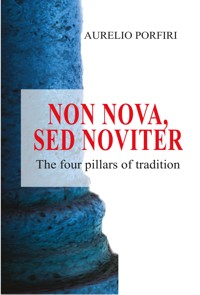
"The Catholic religion is grounded in the tradition that comes to us from Christ and the apostles. But what is tradition? Maestro Aurelio Porfiri sheds light on this important question by examining the four pillars of tradition: authority, obedience, antiquity, and continuity. Perhaps it takes a
maestro
steeped in musical history to illuminate the deeper aspects of tradition. This Maestro Porfiri does with many valuable insights taken from musicians, philosophers, theologians, and the sacred Council of Trent. He also examines the origins of words associated with tradition."
Robert L. Fastiggi, Ph.D., Professor of Dogmatic Theology, Sacred Heart Major Seminary, Detroit, Michigan, USA
"In this day and age of "cancel culture," the foundations of Western civilization, and of Catholic Church are under assault. There are those who would have us break our ties with the past, whether religious, philosophical, cultural, literary, artistic, etc. To them, it is as if what antiquity has bequeathed to us is no longer true, or that it no longer has relevance to the life and progress of modern man. However, in his essay on the "four pillars of Tradition,"
Non nova, sed noviter
, Aurelio Porfiri provides an excellent, well-written, masterful exposition on the importance, continued relevance, and necessity of tradition for the life of man in our world today. Porfiri's work is a timely warning that we forsake the importance of tradition at our own peril. His essay is also a rallying cry, a reminder that tradition is 'as much about the future than it is the past.' Indeed, as Porfiri argues so eloquently, tradition is "not an impediment to progress;" rather, it is, as he ably demonstrates, "indispensible" to it. I fully recommend this booklet on the "four pillars of Tradition" to Catholic and non-Catholic alike, and indeed, to anyone who cares about the future."
Steven O’Reilly writes for the blog RomaLocutaEst.com. He is author of the historical-fiction novel, PIA FIDELIS: The Two Kingdoms, set in the time of the Arian crisis and the rise of Julian the Apostate. He is also the author of Valid? The Resignation of Pope Benedict XVI.
“The best way to answer the question “What is tradition?” is to translate it into “Why have tradition? What value does it have?” A great majority answers that it has none; a smaller minority answers it is for nostalgia’s sake; Porfiri answers that our lives depend on it. He says tradition deepens a person, protects his future, and is worthy of trust because it makes a life more capable of producing bountiful fruits.“
David W. Fagerberg, Professor Emeritus, University of Notre Dame, Notre Dame, Indiana, USA
Das E-Book können Sie in Legimi-Apps oder einer beliebigen App lesen, die das folgende Format unterstützen:
Veröffentlichungsjahr: 2023
Ähnliche
















Aurelio Porfiri
Non nova, sed noviter
The four pillars of tradition
Copyright © 2023 Chorabooks, a division of Choralife Publisher Ltd.
All rights reserved.
14/F office A. Bangkok Bank Building
No.28 Des Voeux Road Central Hong Kong
First eBook edition: June 2023
Table of contents
Endorsements
Preface
Introduction
Authority
Obedience
Antiquity
Continuity
Endorsements
"The Catholic religion is grounded in the tradition that comes to us from Christ and the apostles. But what is tradition? Maestro Aurelio Porfiri sheds light on this important question by examining the four pillars of tradition: authority, obedience, antiquity, and continuity. Perhaps it takes a maestro steeped in musical history to illuminate the deeper aspects of tradition. This Maestro Porfiri does with many valuable insights taken from musicians, philosophers, theologians, and the sacred Council of Trent. He also examines the origins of words associated with tradition."
Robert L. Fastiggi, Ph.D., Professor of Dogmatic Theology, Sacred Heart Major Seminary, Detroit, Michigan, USA
"In this day and age of "cancel culture," the foundations of Western civilization, and of Catholic Church are under assault. There are those who would have us break our ties with the past, whether religious, philosophical, cultural, literary, artistic, etc. To them, it is as if what antiquity has bequeathed to us is no longer true, or that it no longer has relevance to the life and progress of modern man. However, in his essay on the "four pillars of Tradition," Non nova, sed noviter, Aurelio Porfiri provides an excellent, well-written, masterful exposition on the importance, continued relevance, and necessity of tradition for the life of man in our world today. Porfiri's work is a timely warning that we forsake the importance of tradition at our own peril. His essay is also a rallying cry, a reminder that tradition is 'as much about the future than it is the past.' Indeed, as Porfiri argues so eloquently, tradition is "not an impediment to progress;" rather, it is, as he ably demonstrates, "indispensible" to it. I fully recommend this booklet on the "four pillars of Tradition" to Catholic and non-Catholic alike, and indeed, to anyone who cares about the future."
Steven O’Reilly writes for the blog RomaLocutaEst.com. He is author of the historical-fiction novel, PIA FIDELIS: The Two Kingdoms, set in the time of the Arian crisis and the rise of Julian the Apostate. He is also the author of Valid? The Resignation of Pope Benedict XVI.
“The best way to answer the question “What is tradition?” is to translate it into “Why have tradition? What value does it have?” A great majority answers that it has none; a smaller minority answers it is for nostalgia’s sake; Porfiri answers that our lives depend on it. He says tradition deepens a person, protects his future, and is worthy of trust because it makes a life more capable of producing bountiful fruits.“
David W. Fagerberg, Professor Emeritus, University of Notre Dame, Notre Dame, Indiana, USA




