


9,99 €
Mehr erfahren.
- Herausgeber: Chorabooks
- Kategorie: Lebensstil
- Sprache: Englisch
I am well aware that the work of a historian says much about historical facts and events but also a lot about the historian himself. I do not pretend that I am able to “tell how it really was” regarding Church music, as German historian Leopold von Ranke (1795-1886) noted. We have in any case only a lot of scattered information, but this is not to be seen as a negative thing: we are called to offer the most plausible explanation from these scattered phenomena, an explanation that is not only valid but also valuable. This could be a stepping stone offered to future generations. I have found an interesting quote online attributed to Dana Arnold, a professor of architectural history: "History is about the past. Yet it exists only in the present – the moment of its creation as history provides us with a narrative constructed after the events with which it is concerned. The narrative must then relate to the moment of its creation as much as its historical subject. History presents an historian with the task of producing a dialogue between the past and the present. But as these temporal co-ordinates cannot be fixed, history becomes a continuous interaction between the historian and the past. As such, history can be seen as a process of evaluation whereby the past is always coloured by the intellectual fashions and philosophical concerns of the present. This shifting perspective on the past is matched by the fluid status of the past itself."
I am quite in agreement with this quote, especially considering the fact that I am not simply a music historian but also a musician, and as such I am always involved with the materials I am studying in a practical and experiential way.
So what is this book? You may call it an introduction to the study of Catholic sacred music. But then we run into a problem with terminology: sacred music? liturgical music? church music? ritual music? There are many ways that the repertoires are called, but we have tried not to lose our mind chasing after all these terminological issues. I know that they may be of interest to some, and I am not playing down the importance of the distinctions among them. Here we have preferred to use "sacred music," for that is also the way the Magisterium still refers to the music for liturgy.
Das E-Book können Sie in Legimi-Apps oder einer beliebigen App lesen, die das folgende Format unterstützen:
Veröffentlichungsjahr: 2020
Ähnliche















Aurelio Porfiri
FOREVER I WILL SING
Copyright © 2020 Chorabooks, a division of Choralife Publisher Ltd.
All rights reserved.
14/F office A. Bangkok Bank Building
No.28 Des Voeux Road Central
Hong Kong
Visit our website at www.chorabooks.com
First Ebook edition: February 2020
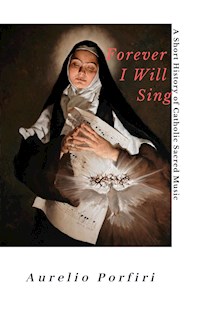
Cover image: Giovanni Gasparro, Santa Elisabetta della Trinità, olio su tela, 90 X 70 cm, 2016. Civate (Lecco), Collezione privata. Image copyright © Archivio Luciano e Marco Pedicini
Indice dei contenuti
Preface
Introduction
Beginnings
First developments
Singing with the spirit
A time of changes
A time of expansion
The times of Gregory the Great and Benedict
Developments in liturgical music
The origins of chant
Musica enchiaridis
Neumatic notations
Guido of Arezzo and musical notation
Developmments of polyphonic music
The school of Notre Dame
Avignon captivity
Flemish musicians
The golden age of polyphony
Baroque time
Time of enlightenment
Time of rebirths
New challenges and developments
Current developments
Bibliography
Preface
Card. Raymond Leo Burke
The Church has always given great importance to music in the Sacred Liturgy, her public worship, and has always sought to foster and safeguard the integrity of sacred music. Not all music is worthy of the temple, but only that which possesses those qualities which make it fitting for worship.
Pope Saint Pius X identified those qualities in his Motu proprio Tra le sollecitudini, given on the Feast of Saint Cecilia, November 22, 1903, one of the most striking exercises of the particular responsibility of the Roman Pontiff for the beauty and dignity of the celebration of the Sacred Liturgy. Having been elected to the See of Peter on August 9, 1903, Pope Saint Pius X devoted his first attention to a matter which had also been very much in his heart as Bishop of Mantua and Patriarch of Venice, namely, the reform of sacred music. (Cf. Robert F. Hayburn, Papal Legislation on Sacred Music: 95 A.D. to 1977 A.D. (Collegeville, Minnesota: The Liturgical Press, 1979), p. 219. [Hayburn].)
The importance of the teaching of Pope Saint Pius X on sacred music was duly acknowledged by the Fathers at the Second Vatican Ecumenical Council, especially his emphasis on the substantial part of sacred music in divine worship. (Cf. Sacrosanctum Concilium Oecumenicum Vaticanum Secundum, Constitutio Sacrosanctum Concilium, De Sacra Liturgia, Acta Apostolicae Sedis, 128, n. 112. [SC].)
In setting forth its teaching regarding sacred music the Council made clear that it was “preserving the norms and prescriptions of Church discipline and tradition, and considering the end of sacred music, which is the glory of God and the sanctification of the faithful.” (“... normas ac praecepta ecclesiasticae traditionis et disciplinae servans finemque Musicae sacrae respiciens, qui gloria Dei est atque sanctificatio fidelium.” SC, 128, n. 112.)
In the introduction to the Motu proprio, Pope Saint Pius X articulates the particular challenge of the Church’s discipline regarding sacred music. He comments: "And indeed, whether as a result of the changeable nature of this art, or of the many alterations in people’s taste and custom during the lapse of time; whether from the unhappy influence of secular and theatrical music on that of the Church, or from the pleasure excited by the music itself, which it may not be easy to retain within proper limits; whether, lastly, it be because of the many prejudices on this subject which sometimes obstinately remain, even among persons of great piety and high authority, there certainly is a constant tendency in sacred music to neglect the right principles of an art used in the service of the liturgy, principles expressed very clearly in the laws of the Church, in the decrees of general and provincial councils, and in the repeated commands of the sacred congregations and of the supreme pontiffs, Our predecessors." (“Ed invero, sia per la natura di quest’arte per se medesima fluttuante e variabile, sia per la successiva alterazione del gusto e delle abitudini lungo il correr dei tempi, sia pel funesto influsso che sull’arte sacra esercita l’arte profana e teatrale sia pel piacere che la musica direttamente produce e che non sempre torna facile contenere nei giusti termini, sia infine per i molti pregiudizi che in tale materia di leggeri s’insinuano e si mantengono poi tenacemente anche presso persone autorevoli e pie, v’ha una continua tendenza a deviare dalla retta norma stabilita dal fine, per cui l’arte è ammessa a servigio del culto, ed espressa assai chiaramente nei canoni ecclesiastici, nelle Ordinazioni dei Concili generali e provinciali, nelle prescrizioni a più riprese emanate dalle Sacre Congregazioni romane e dai Sommi Pontefici Nostri Predecessori.” Pope Pius X, Motu proprio “Tra le sollecitudini,” 22 November 1903, Acta Sanctae Sedis, 36 (1903-1904), p. 330. [TlS]. English translation: Hayburn, p. 223.)
Surely, the words of Pope Saint Pius X, written over 100 years ago, address directly the challenge of the discipline of sacred music today. At the same time, they make clear the particular care which the Roman Pontiff, in his pastoral charity toward the universal Church, must give to the question of that music which is fitting for the worship of God.
Without entering into the details of the discipline set forth in Tra le sollecitudini, I note the two general principles set forth by the Roman Pontiff. The first principle sets forth the purposes of sacred music, which cannot be an art in itself but rather must be true art at the specific service of the Sacred Liturgy. Pope Saint Pius X declares: "Sacred music, being an integral part of the liturgy, is directed to the general object of the liturgy, namely, the glory of God and the sanctification and edification of the faithful. It helps to increase the beauty and splendor of the ceremonies of the Church, and since its chief duty is to clothe the liturgical text, which is presented to the understanding of the faithful, with suitable melody, its object is to make that text more efficacious, so that the faithful through this means may be the more roused to devotion, and better disposed to gather to themselves the fruits of grace which come from the celebration of the sacred mysteries." (“La musica sacra, come parte integrante della solenne liturgia, ne partecipa il fine generale, che è la gloria di Dio e la santificazione ed edificazione dei fedeli. Essa concorre ad accrescere il decoro e lo splendore delle cerimonie ecclesiastiche, e siccome suo ufficio principale è di rivestire con acconcia melodia il testo liturgico che viene proposta all’intelligenza dei fedeli, così il suo proprio fine è di aggiungere maggiore efficacia al testo medesimo, affinchè i fedeli con tale mezzo siano più facilmente eccitati alla devozione e meglio si dispongano ad accogliere in sè i frutti della grazia, che sono proprì della celebrazione dei sacrosanti misteri.” TlS, p. 332. English translation: Hayburn, pp. 223-224.)
In a clear manner, Pope Saint Pius X indicates what must always be, foremost, in the mind and heart of the artist who composes music for sacred worship, namely, giving glory to God and inspiring holiness in the faithful who desire to offer Him worship. It follows naturally that the musician who sets out to write sacred music must place himself, with all humility, at the service of the texts of the Sacred Liturgy. His music must be at the service of a deeper appropriation of the sacred texts and of the realities which they announce.
The second principle sets forth the qualities which necessarily mark sacred music, namely, holiness, beauty and universality. The Holy Father describes each quality. Holiness means that sacred music must “avoid everything that is secular, both in itself and in the way it is performed.” (“… escludere ogni profanità, non solo in se medesima, ma anche nel modo onde viene proposta per parte degli esecutori.” TlS, p. 332. English translation, p. 224.) In other words, the artist who writes music for the worship of God must purify both the musical score itself of anything which is not coherent with the holiness of God and the performance itself of anything which is foreign to the House of God.
Beauty means that sacred music “must be an art, since in no other way can it have on the mind of those who hear it that effect which the Church desires in using in her liturgy the art of sound.” (“Deve essere arte vera, non essendo possibile che altrimenti abbia sull’animo di chi l’ascolta quell’efficacia, che la Chiesa intende ottenere accogliendo nella sua liturgia l’arte dei suoni.” TlS, p. 332. English translation: Hayburn, p. 224.) The particular demands of sacred music, in no way, indicate a form of musical art which is inferior or compromised, but rather a form of musical art elevated to the highest possible level, to the service of the privileged encounter of God with man through the Sacred Liturgy. The music employed in the worship of God must, therefore, strive to be the best music of the period.
Finally, the universality of sacred music demands that “although each country may use in its ecclesiastical music whatever special forms may belong to its own national style, these forms must be subject to the proper nature of sacred music, so that it may never produce a bad impression on the mind of any stranger who may hear it.” (“… che pur concedendosi ad ogni nazione di ammettere nelle composizioni chiesastiche quelle forme particolari che costituiscono in certo modo il carattere specifico della musica loro propria, queste però devono essere in tal maniera subordinate ai caratteri generali della musica sacra, che nessuno di altra nazione all’udirle debba provarne impressione non buona.” TlS, p. 332. English translation: Hayburn, p. 224.)
While the music proper to a particular region may be able to offer something to the development of sacred music, it can only do so when it respects the distinct nature of sacred music and is marked by its necessary qualities of holiness, beauty and universality. Any particular form of sacred music must indeed easily find its place within the body of the universal Church’s music for sacred worship.
The Church must keep before our eyes the two principles set forth by Pope Saint Pius X in his Motu proprio, “ Tra le sollecitudini,” namely, the nature of sacred music as true art at the specific service of the Sacred Liturgy, and its three essential qualities of holiness, beauty and universality, we will give the highest possible witness to the Mystery of Faith, to the living presence of God the Son Incarnate in our midst. The path of liturgical music will remain challenging.
Because of the importance of sacred music in the liturgy, it is good for all Catholics – both clergy and lay faithful – to have general knowledge of the history and development of the art of liturgical music throughout the centuries. For this reason, I commend this work of Maestro Aurelio Porfiri, Forever I Will Sing: A Short History of Catholic Sacred Music, commissioned by the Catholic Centre of the Chinese University in Hong Kong. Maestro Porfiri is an excellent musician who has devoted most of his life to the practice and study of that music dedicated to sacred worship in the Catholic tradition.
The author alerts the reader that his work is not meant to be a complete and thorough presentation of all the details of the development of liturgical music throughout centuries. To be that comprehensive would require even more than an entire encyclopedia. Rather, Maestro Porfiri seeks to present a comprehensive summary of 21 centuries of achievements and challenges in the realm of sacred music. One may notice a certain number of recurring themes: one is the constant care of the Church, lest the profane or secular be mixed with – or even take the place of – the sacred in her liturgies. Another recurring theme is the great attention and care which the Church has always had to promote the best possible music for the Sacred Liturgy, that is, music of great quality and artistic goodness. In fact, we know that a good part of the western musical tradition is founded upon liturgical music, and, in particular, upon the tradition of Gregorian Chant. Safeguarding this sacred tradition requires vigilance on the part of the pastors of the Church, vigilance which has been unfortunately lacking in many places during the years since the Second Vatican Council.
In this book we meet many different and great protagonists in the story of sacred music: saints, popes, monks, missionaries, composers, singers, organists and other musicians. They all held in common their belief in giving to God that which is due to His incomparable Majesty. Sadly, today this attentiveness to giving the best possible to God has, to a large degree, been lost. However, it is my hope that reading this book will help many to consider the rich tradition of the Church’s liturgical life, and thus to be inspired to help revitalize that tradition in their homes and in their parishes. We should not let ourselves be discouraged when we see the crisis in the Church today, but rather let us place our trust in the Lord Who alone can restore sanctity to the life of the Church, and most especially to her liturgical life. Through the intercession of the Virgin Mother of God, and of Saints Cecilia and Pius X, may Our Lord grant a new flowering of Sacred Music for His glory and the salvation of many souls.
Introduction
This book is a project that may be defined in two ways: according to the time it was written and according to the time it was conceived. It was written in a few months, not a long time for a book of this kind. But it was conceived over the course of a lifetime, a thought that I had for many years but that was never realized because I was aware of the difficulties that such an enterprise may present. It is now a reality. After the invitation from Father Louis Ha, Director of the Centre for Catholic Studies of the Chinese University of Hong Kong, to write such a book, I started to face the many problems that a book of this kind presents. I would like to summarize some of them. We have gathered here twenty-one centuries of music, history, ecclesiastical history, liturgy and so on, which means a huge amount of information has been processed and synthesized in a book that is not intended to be an encyclopedia but rather a general introduction to the history of Catholic sacred music. In addition, there were the difficulties of finding out everything about Catholic sacred music. Possibly there are some names, dates, and other relevant information that may be missing. I did my best to include what I thought should be included. As I have said, the scope of the book is so broad that it was not easy to include everything. And indeed not everything was included. I made choices, certainly guided by my background, the books I have read, the masters and professors who have taught me. But still, being a church musician for most of my life and being active in Rome - which in many regards and for obvious reasons is the center of Catholic sacred music – I have also had the opportunity to work extensive times in different cultural contexts, such as the American and the Asian ones. These experiences have given me a broad view on the subject matter. I hope this book will be helpful for readers and will lead them to read other books on more specific topics, some of which can be found in the bibliography at the end of the book.
I am well aware that the work of a historian says much about historical facts and events but also a lot about the historian himself. I do not pretend that I am able to “tell how it really was” regarding Church music, as German historian Leopold von Ranke (1795-1886) noted. We have in any case only a lot of scattered information, but this is not to be seen as a negative thing: we are called to offer the most plausible explanation from these scattered phenomena, an explanation that is not only valid but also valuable. This could be a stepping stone offered to future generations. I have found an interesting quote online attributed to Dana Arnold, a professor of architectural history: " History is about the past. Yet it exists only in the present – the moment of its creation as history provides us with a narrative constructed after the events with which it is concerned. The narrative must then relate to the moment of its creation as much as its historical subject. History presents an historian with the task of producing a dialogue between the past and the present. But as these temporal co-ordinates cannot be fixed, history becomes a continuous interaction between the historian and the past. As such, history can be seen as a process of evaluation whereby the past is always coloured by the intellectual fashions and philosophical concerns of the present. This shifting perspective on the past is matched by the fluid status of the past itself."
I am quite in agreement with this quote, especially considering the fact that I am not simply a music historian but also a musician, and as such I am always involved with the materials I am studying in a practical and experiential way.
So what is this book? You may call it an introduction to the study of Catholic sacred music. But then we run into a problem with terminology: sacred music? liturgical music? church music? ritual music? There are many ways that the repertoires are called, but we have tried not to lose our mind chasing after all these terminological issues. I know that they may be of interest to some, and I am not playing down the importance of the distinctions among them. Here we have preferred to use "sacred music," for that is also the way the Magisterium still refers to the music for liturgy.
Today is a different time for researchers than fifty years ago. We can make use of the internet for our research, as I certainly did. Translations of some of the texts in this book are freely available online, and I have used them when I saw fit. In other cases, I had to translate some of the texts myself. Some of the authors being cited were assigned to a particular century even though they lived through two different centuries (e.g., Clement of Alexandria (150-215), and many others). These editorial decisions were somewhat arbitrary, usually, made because most of their lives were in one century or the other. As I have said previously, a book which has the pretension of being scientific is always reflective of the one who writes it, despite all well intentioned efforts to the contrary.
I really hope that this book will increase the general interest in reading more about sacred music, this great treasure of art and culture of the Catholic Church. There are so many resources available, and it will not be difficult to deepen one’s knowledge about some of these topics. It is a history that is fascinating also because of some failures, struggles, and the effort to be always dignified, even if the mistakes and abuses have at times been numerous. Today we live in a difficult time for sacred music, so I think it is urgent that we are able to look back and evaluate once again the teachings of the Fathers, Masters, Saints and others. In this way we will be able to look once more at the main outcome of music in the liturgy and of the liturgy itself: the glory of God and the sanctification of the faithful.
Beginnings
1st century
Jewish and Christian music
When we speak about liturgical music at the dawn of Christianity, we need to take into account that we have somewhat limited information, and we have to summarize and select according to what we think is important and relevant. Certainly, one of the topics that seems relevant to mention at the outset is the possible influence of Jewish worship on Christian worship and consequently on its music. This is a question that has seen several answers, different hypotheses. What was emphasized by Abbé Claude Barthe [1] is probably correct. Taking inspiration from Joseph Heinemann, Barthe strongly questioned the monolithic nature of Judaic prayer and the unidirectional influence that this prayer and worship may have had on the birth of our Christian liturgy. Probably, Barthe observes, that influence was mutual, and so they grew up in tandem with each other . Certainly, we may be quite confident, agreeing with Abbé Barthe, that the influence was not only in one direction but that the two worships grew up close to each other and mutually influenced each other. Also, we need to mention that this kind of tendency--emphasizing the idea that the process of development was not straightforward (from Jewish music to Christian music)-- is also presented by other musicologists such as Felice Rainoldi [2] in his important contribution about the history of Christian music.
The study of liturgy
The study of liturgy is defined by Joseph A. Jungmann, an authority on the issue thanks to his seminal book The Mass of the Roman Rite ( Missarum Sollemnia): “ It is the task of the history of liturgy to bring to light these ideal patterns of past phases of development which have been hidden in darkness and whose shapes are all awry. After the tiresome preparation of studying and transcribing manuscripts, publishing, dating and localizing them properly, and assembling and interpreting facts, history must gather these all together to reproduce and focus the ideal patterns” [3].
As we have already noted, the reconstruction of facts, events, and situations is limited by the scattered available resources, but these give us quite a good idea of how the development of Christian music may have transpired over time. We do not hold a Rankean approach, thinking that it will be possible to reconstruct “exactly what has happened," but we are still able to offer a quite fair idea of the development of Christian music down the centuries.
Paul F. Bradshaw, an historian of liturgy, has made some important observations about the difficult task of reconstructing the liturgy of the early centuries. He thinks we know much less about it than we may have thought and that there is not a univocal liturgical rite coming from these centuries, but rather a collection of many different experiences coming from different geographical areas. [4] In sum, it is important to keep in mind that when we consider liturgy and its music, especially in the first Christian centuries, we need to have an intelligent and prudent approach. It is important to say this especially when the events of the first centuries have been and continue to be used in a sort of ideological way, with the idea that going back to the "uses of the early Christians" should be considered progress. But historians warn us to be careful, because although we can know something about that time, it is not so much as we may think.
Leitourgia, liturgy, for the Greeks was a public service that the wealthy offered to the public. These services were of different kinds. Aristotle mentioned this in his Oeconomica (Book 2): " Those who were expecting to equip a war-vessel or preside over a tribe or train a chorus or undertake the expense of some other public service of the kind, he allowed, if they chose, to commute the service for a moderate sum, and to be enrolled on the list of those who had performed it."
That "public service" was rendered in Greek as " leitourgia." We find this idea of leitourgia as a ministry in Exodus 31:6-10 (Septuagint): " I have also endowed all the experts with the necessary skill to make all the things I have ordered you to make: the meeting tent, the ark of the commandments with the propitiatory on top of it, all the furnishings of the tent, the table with its appurtenances, the pure gold lampstand with all its appurtenances, the altar of incense, the altar of holocausts with all its appurtenances, the laver with its base, the service cloths, the sacred vestments for Aaron the priest, the vestments for his sons in their ministry, the anointing oil, and the fragrant incense for the sanctuary."
The Hebraic word here referring to ministry is kahan, which is: " a primitive root, apparently meaning to mediate in religious services 1) to act as a priest, minister in a priest's office a) (Piel) 1) to minister as a priest, serve as a priest 2) to be or become a priest 3)to play the priest" (BlueLetterBible.com).
In Luke 1: 21-23 we read: " Meanwhile the people were waiting for Zechariah and were amazed that he stayed so long in the sanctuary. But when he came out, he was unable to speak to them, and they realized that he had seen a vision in the sanctuary. He was gesturing to them but remained mute. Then, when his days of ministry (ai hemerai tes leitourgias autou ) were completed, he went home".
So we see here this idea of liturgy as a service, a ministry, pass from the Greeks to Jewish worship and then to Christianity. Let us be aware that everything we are going to say about liturgy will be relevant also for music, because the two are strongly interrelated.
Pagan and Christian music
We also do not need to play down also the contrast, that will be well and alive also with the Church Fathers, between Christian and pagan music: " Despite the rich heritage which the young Church received from Jewish worship, she opposed and held back completely from the elaborate musical embellishments of liturgy which was part of the Old Testament tradition. The need for such a stand in early Christianity arose from the fact that the music of the day was very closely associated with pagan worship. Moreover, since the pagan cult of the gods and of the dead influenced and permeated every aspect of private life, the Church forbade even private practice of this art. It was precisely because of this unconditional rejection of contemporary music that Christianity became the formative, creative force in the production of a musical art which served religion not as an instrument of magic but rather as a means of devotion. Within the framework of religious history, therefore, an assessment of the early Christian understanding of music and singing must necessarily take into account the relationship of music to pagan cult." [5]
Jewish music
The Jewish environment, strongly religious, had three kinds of places for worship at the time of Jesus: the Temple of Jerusalem, the Synagogue and private prayers. The Temple was the heart of Jewish worship. The Temple of Jerusalem could afford to hire musicians and singers, and its music was very solemn and full of pomp. We can imagine this music when we read some of the Psalms, like Psalm 150, that refers to this grand worship given to God. But after the destruction of the Temple, the solemn worship there had a different character and quality in the Synagogues: " Synagogal singing, as we have said, has nothing to do with the music of the Sanctuary: it is somehow its opposite because it wanted to be a presence that constantly reminded of an irremediable absence. The music that took shape in the centuries after the fall of the Sanctuary thus always maintained adistinction, in contrast to the music of the previous epoch, as a witness of the impossibility of a linear continuation, and so the music that was referred to in the Pentateuch is always in the background as a point of reference, a far and absent place that can never be found again" [ author’s translation]. [6]
It is important to note also the role of prophesy in connection with music, as highlighted by Mike Aquilina in his important book about Church music in the early Church: “The prophets are preceded by a fairly large band of musicians not just because they make a better show that way, but because Israelite prophets often demanded music before they could prophesy.” [7]
Aquilina then quotes 2 Kings (3: 14-15): "Then Elisha said, "As the LORD of hosts lives, whom I serve, were it not that I respect the king of Judah, I should neither look at you nor notice you at all. Now get me a minstrel." When the minstrel played, the power of the LORD came upon Elisha."
The prophet could receive words from Lord through the help of music.
We know that Jesus and his disciples participated in the liturgy of the Temple. We read in John 2: 13-14: "Since the Passover of the Jews was near, Jesus went up to Jerusalem. He found in the temple area those who sold oxen, sheep, and doves, as well as the money-changers seated there…."
And he participated also at the worship in the Synagogue, as we read in Luke 4: 16-17: “He came to Nazareth, where he had grown up, and went according to his custom into the synagogue on the sabbath day. He stood up to read and was handed a scroll of the prophet Isaiah."
So, the music environment of the Chosen People was certainly influential, somehow, for the first Christians when they wanted to free themselves, or to complete, the message of God given to the Jews and reveal the good news that the Messiah, Jesus, the Son of God, was among them.
What were the characteristics of Jewish music? We can list some of them. These characteristics were common to Eastern Semitic music, such as the use of modes--what we can call some particular scales or ways to organize the notes. This music also gave importance to embellishments, because improvisation played a great part in it. This is something that seems strange to us today, but we need to keep in mind the distinction between cultures that were based on oral tradition and those strongly based on writing, where everything is fixed and cannot be changed. It was not metrical and had no regular rhythmic impulse (with the probable exception of dances). It used quarter tones, intervals that today we seldom use and that are mostly absent from Western classical music. There is no harmony and it is mostly purely vocal. As we have implied before, it was passed on mostly orally.
A hermeneutic of continuity
The Christian proclamation was characterized, as Salvatore Marsili has stated, by “ continuity with the Jewish tradition, on the one hand, and Christian novelty, on the other” (S. Marsili, “Continuità ebraica e novità cristiana” in Anamnesis 2, 1978). This is indeed what Jesus also says in Matthew 5: 17-18: “ I did not come to abolish the law and the prophets but to bring them to perfection. Amen, I say to you, until heaven and earth pass away, not the smallest letter or the smallest part of a letter will pass from the law, until all things have taken place."
So there is a continuity with tradition, but also a new meaning given to that tradition, or we may say a deeper meaning. It is just as when in Matthew 5: 23-26 Jesus speaks about the offering at the Temple: “ Therefore, if you bring your gift to the altar, and there recall that your brother has anything against you, leave your gift there at the altar, go first and be reconciled with your brother, and then come and offer your gift. Settle with your opponent quickly while on the way to court with him. Otherwise your opponent will hand you over to the judge, and the judge will hand you over to the guard, and you will be thrown into prison. Amen, I say to you, you will not be released until you have paid the last penny.”
The Benedictine liturgist Burkhard Neunheuser affirmed that the essential nucleus of liturgy was created from the Apostles under the Lord's instructions. [8] So there is not only a continuity with the Jewish tradition but also a new beginning, symbolized by this passage from Matthew 27:51: " And behold, the veil of the sanctuary was torn in two from top to bottom." This was the sign that the Temple worship was concluded, and was also foretold by Jesus in John 4: 20-21: “ Our ancestors worshiped on this mountain; but you people say that the place to worship is in Jerusalem." Jesus said to her, "Believe me, woman, the hour is coming when you will worship the Father neither on this mountain nor in Jerusalem.”
The early Church used new liturgical forms, that were: the Baptism in the name of Jesus, the breaking of the bread and memorial of his death, various forms of prayers and the imposition of hands to confer the Holy Spirit. But on the other hand, as we have said, we may consider this phase as a time of synthesis between the Jewish tradition and Christian novelty, a synthesis that would have many consequences, one of them being the importance of the use of psalms in both Jewish and Christian worship. Let us remember that the land of Jesus at the time was under Roman domination, a fact that would have consequences also on the new religion, as we shall see later on.
As for music, we may certainly conclude that cantillation—a proclamation of the sacred words that is between singing and speaking, an intoned recitation--is a clear influence coming from the Jewish environment.
Music in the New Testament
But did Jesus sing or not? Probably he did, and we may have witnesses in the New Testament. But we should not think, at least for some of the instances we are going to consider, of "singing" in the modern sense. For example, what we read in Luke 4: 15-21: “ He taught in their synagogues and was praised by all. He came to Nazareth, where he had grown up, and went according to his custom into the synagogue on the sabbath day. He stood up to read (ἀναγινώσκω) and was handed a scroll of the prophet Isaiah. He unrolled the scroll and found the passage where it was written: "The Spirit of the Lord is upon me, because he has anointed me to bring glad tidings to the poor. He has sent me to proclaim liberty to captives and recovery of sight to the blind, to let the oppressed go free, and to proclaim a year acceptable to the Lord." Rolling up the scroll, he handed it back to the attendant and sat down, and the eyes of all in the synagogue looked intently at him. He said to them, "Today this scripture passage is fulfilled in your hearing.”
What the Gospel refers to as reading was probably a form of intonation that we today define as cantillation. So it was not reading in the sense we mean by this word today, but it was something between speaking and singing. The Greek verb used is not referring specifically to singing but to the act of reading itself, but we know that the readings were not simply read but chanted. [9]
But we have other references about music in the New Testament, as in Matthew 14: 6-8: “When the birthday of Herod came, the daughter of Herodias danced in their midst and pleased Herod, so that with an oath he promised to give her whatever she might ask. Prompted by her mother, she said, ‘Give me here upon a platter the head of John the Baptist.”
And this "evil dancing" explains the bad reputation dance had for Christians. In Luke 2: 13-14 we have the singing of the angels at the birth of Jesus and in Matthew 21: 9 we have the crowd acclaiming Jesus while he entered in Jerusalem shouting (or singing) "Hosanna to the Son of David". In Matthew 26: 30 (and in Mark 14: 26) it is said: “And after singing a hymn, they went out to the Mount of Olives.”
That was the custom at the conclusion of the Passover meal. The Latin is et hymno dicto exierunt in montem olivarum, and the Greek is hymnésantes exelthon. [10] It was customary in Jewish worship to sing the Hallel for the Passover meal, which consisted in the singing of Psalms 113-118.




