


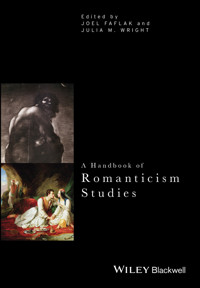
A Handbook of Romanticism Studies E-Book
35,99 €
Mehr erfahren.
- Herausgeber: John Wiley & Sons
- Kategorie: Geisteswissenschaft
- Serie: CTH - Critical Theory Handbooks
- Sprache: Englisch
The Handbook to Romanticism Studies is an accessible and indispensible resource providing students and scholars with a rich array of historical and up-to-date critical and theoretical contexts for the study of Romanticism.
- Focuses on British Romanticism while also addressing continental and transatlantic Romanticism and earlier periods
- Utilizes keywords such as imagination, sublime, poetics, philosophy, race, historiography, and visual culture as points of access to the study of Romanticism and the theoretical concerns and the culture of the period
- Explores topics central to Romanticism studies and the critical trends of the last thirty years
Sie lesen das E-Book in den Legimi-Apps auf:
Seitenzahl: 985
Veröffentlichungsjahr: 2012
Ähnliche




















Contents
Cover
Wiley-Blackwell Critical Theory Handbooks
Title Page
Copyright
Acknowledgments
Notes on Contributors
Introduction
References and Further Reading
Part 1: Aesthetics and Media
Chapter 1: Imagination
On the Romantic Imaginations We Want and Imaginations We Don't
Romantic Histories of the Imagination
Where to Go from Here
References and Further Reading
Chapter 2: Sensibility
Introduction
Why We Study Sensibility Now
Early Sensibility and Emotional Contagion
A Strategy for Readers: The Scene of Sensibility
Sensibility, Poetry, and Politics
Testing Sensibility in Novels
Conclusion: Trends in Sensibility Studies
Acknowledgments
References and Further Reading
Chapter 3: Sublime
References and Further Reading
Chapter 4: Periodicals
Literary Aesthetics
State Aesthetics
Celebrity Aesthetics and Dancing
References and Further Reading
Chapter 5: Visual Culture
Wordsworth and the Panorama
Spectacular Developments: The Diorama and the Phantasmagoria
Exhibitions, Museums, and Galleries
Illustration and Ekphrasis
References and Further Reading
Part 2: Theories of Literature
Chapter 6: Author
References and Further Reading
Chapter 7: Reader
Preliminaries: Terms and Loose Definitions
What Was a Romantic-Era “Reader”?
What Was at Stake?
The Romantic Reader as Social Animal
The Romantic Reader and Modern Theory
Conclusion
References and Further Reading
Chapter 8: Poetics
Eighteenth-Century Interventions
Romantic-Period Theories
Locating Romantic Poetry
Reading Romantic Poetry
References and Further Reading
Chapter 9: Narrative
Historical Circumstances and Narrative Genres
Romantic Themes and Narrative Techniques
Conclusion
Acknowledgments
References and Further Reading
Chapter 10: Drama
References and Further Reading
Chapter 11: Gothic
References and Further Reading
Chapter 12: Satire
References and Further Reading
Part 3: Ideologies and Institutions
Chapter 13: Historiography
What is History? Who Reads It?
Enlarging the Scope of History
The Remoteness of Antiquity
Sacred History, Secular History
Recent British History, and Histories of the Present
History's Relations with Other Discourses and Practices of Conservation
German Developments, and their British Reception
References and Further Reading
Chapter 14: Ideology
References and Further Reading
Chapter 15: Nation and Empire
Historical Background
Defining Nation and Empire
National Literature
Epic
Ballad and Song
The National Tale
References and Further Reading
Chapter 16: Class
Class, Language, and Genre
Laboring-Class Poetry
Romantic Anti-Capitalism and Romantic Individualism
References and Further Reading
Chapter 17: Race
Introduction
Theorizing Race
Race in the Romantic Period
The Eighteenth-Century Ancien Régime of Identity
Romanticism and Race: The Racial Sublime
References and Further Reading
Chapter 18: Gender and Sexuality
I
II
III
References and Further Reading
Part 4: Disciplinary Intersections
Chapter 19: Philosophy
Kant's Copernican Revolution
German Idealism: Fichte, Schelling, Hegel
Early German Romanticism: Schlegel, Novalis, Hölderlin
Legacies
References and Further Reading
Chapter 20: Religion
Romanticism, Secularization, and “Natural Magic”
“Of Christianity and Civilization”: New Historicism and Religious Politics
“That Broken Shrine”: Marion, Nancy, and Post-Secular Romanticisms
References and Further Reading
Chapter 21: Science
Organic Life and Beyond
Naturphilosophie
Classification and Systematics
Geology and Geometry: Time and Space
Conclusion
References and Further Reading
Chapter 22: Medicine
The Scottish Enlightenment and Romantic Medicine
Contested Bodies: Conflict and Revolution
“A Sage,/A Humanist”: The Rise of the Surgeon
References and Further Reading
Chapter 23: Psychology
I
II
III
IV
References and Further Reading
Index
Wiley-Blackwell Critical Theory Handbooks
Each volume in the Critical Theory Handbooks series features a collection of newly commissioned essays exploring the use of contemporary critical theory in the study of a given period, and the ways in which the period serves as a site for interrogating and reframing the practices of modern scholars and theorists. The volumes are organized around a set of key terms – such as race/ethnicity, law, gender, class, disability, body, nation, ideology, history, writing/literacy, belief, violence, aesthetics, time, material culture, visual culture, identity, and desire – that demonstrate the engagement by literary scholars with current critical trends, and aim to increase the visibility of theoretically oriented and informed work in literary studies, both within the discipline and to students and scholars in other areas.
Published:A Handbook of Romanticism Studies Joel Faflak and Julia M. Wright
Forthcoming:A Handbook of Anglo-Saxon Studies Jacqueline Stodnick and Renée R. Trilling
A Handbook of Middle English Studies Marion Turner
A Handbook of Modernism Studies Jean-Michel Rabaté
This edition first published 2012 © 2012 Blackwell Publishing Ltd
Blackwell Publishing was acquired by John Wiley & Sons in February 2007. Blackwell's publishing program has been merged with Wiley's global Scientific, Technical, and Medical business to form Wiley-Blackwell.
Registered Office John Wiley & Sons Ltd, The Atrium, Southern Gate, Chichester, West Sussex, PO19 8SQ, UK
Editorial Offices 350 Main Street, Malden, MA 02148-5020, USA 9600 Garsington Road, Oxford, OX4 2DQ, UK The Atrium, Southern Gate, Chichester, West Sussex, PO19 8SQ, UK
For details of our global editorial offices, for customer services, and for information about how to apply for permission to reuse the copyright material in this book please see our website at www.wiley.com/wiley-blackwell.
The right of Joel Faflak and Julia M. Wright to be identified as the authors of the editorial material in this work has been asserted in accordance with the UK Copyright, Designs and Patents Act 1988.
All rights reserved. No part of this publication may be reproduced, stored in a retrieval system, or transmitted, in any form or by any means, electronic, mechanical, photocopying, recording or otherwise, except as permitted by the UK Copyright, Designs and Patents Act 1988, without the prior permission of the publisher.
Wiley also publishes its books in a variety of electronic formats. Some content that appears in print may not be available in electronic books.
Designations used by companies to distinguish their products are often claimed as trademarks. All brand names and product names used in this book are trade names, service marks, trademarks or registered trademarks of their respective owners. The publisher is not associated with any product or vendor mentioned in this book. This publication is designed to provide accurate and authoritative information in regard to the subject matter covered. It is sold on the understanding that the publisher is not engaged in rendering professional services. If professional advice or other expert assistance is required, the services of a competent professional should be sought.
Library of Congress Cataloging-in-Publication Data
A handbook of Romanticism studies / edited by Joel Faflak and Julia M. Wright.
p. cm.
Includes bibliographical references and index.
ISBN 978-1-4443-3496-8 (cloth)
1. English literature—19th century—History and criticism—Handbooks, manuals, etc. 2. English literature—18th century—History and criticism—Handbooks, manuals, etc. 3. Romanticism—Great Britain. I. Faflak, Joel. II. Wright, Julia M.
PR457.H265 2012
820.9′007—dc23
2011034129
Acknowledgments
We begin our thanks with our contributors, for without their hard work and timely diligence this volume would not have been possible. We are also grateful to Emma Bennett for her steady support for this project from its inception, as well as others at Wiley-Blackwell for their astute advice and generous assistance as this volume came together. We both thank the Social Sciences and Humanities Research Council of Canada for its generous support of our research, and Geordie Miller for his research assistance. We would also like to thank Tilottama Rajan for her inestimable influence on our thinking about Romanticism, and the value of mentorship and collegiality. Wright would also like to thank the Canada Research Chairs Program for its invaluable support of her research, including that most precious of resources – research time. We are both also daily grateful for our partners' patience, perspective, tolerance, and great good humor.
Notes on Contributors
James Robert Allard is Associate Professor at Brock University, author of Romanticism, Medicine, and the Poet's Body (2007), and co-editor of Staging Pain, 1580–1800: Violence and Trauma in British Theater (2009).
Stephen C. Behrendt is George Holmes Distinguished University Professor of English at the University of Nebraska. In addition to his work in interdisciplinary studies in Romanticism, including his recent book British Women Poets and the Romantic Writing Community (2009), he is a widely published poet.
Julie Ellison is Professor of American Culture, English, and Art and Design at the University of Michigan. Her monographs include Emerson's Romantic Style (1984), Delicate Subjects (1990), and Cato's Tears and the Making of Anglo-American Emotion (1999).
Joel Faflak is Associate Professor of English and Theory and Criticism at the University of Western Ontario. He is the author of Romantic Psychoanalysis (2007), co-author of Revelation and Knowledge (2011), and editor of Thomas De Quincey's Confessions of an English Opium-Eater (2009). Among his edited and co-edited volumes are Sanity, Madness, Transformation (2005) and The Romanticism Handbook (2011).
Elizabeth A. Fay is Professor of English at the University of Massachusetts Boston. Her two most recent monographs are Fashioning Faces: The Portraitive Mode in British Romanticism (2010) and Romantic Medievalism (2002).
Jillian Heydt-Stevenson is Associate Professor of English at the University of Colorado. She has written Austen's Unbecoming Conjunctions (2005), co-edited Recognizing the Romantic Novel (2008), and was Associate Editor of Last Poems of William Wordsworth (1999); she has written articles on Austen, St. Pierre, Burney, Edgeworth, Coleridge, and landscape aesthetics.
Jerrold E. Hogle is University Distinguished Professor in English at the University of Arizona and Past President of the International Gothic Association. His books include Shelley's Process (1988), The Cambridge Companion to Gothic Fiction (editor, 2002), and The Undergrounds of “The Phantom of the Opera” (2002).
Anne Janowitz is Professor of Romantic Poetry at Queen Mary, University of London. She is the author of England's Ruins (1990), Lyric and Labour in the Romantic Tradition (1998), and Women Romantic Poets: Anna Barbauld and Mary Robinson (2004).
Steven E. Jones, Professor of English, Loyola University Chicago, and co-editor, Romantic Circles, is author of Satire and Romanticism (2000) and editor of The Satiric Eye: Forms of Satire in the Romantic Period (2003).
Theresa M. Kelley is Marjorie and Lorin Tiefenthaler Professor of English at University of Wisconsin, Madison. She is the author of Wordsworth's Revisionary Aesthetics (1988), Reinventing Allegory (1997), and Clandestine Marriage: Botany and Romantic Culture (forthcoming), and co-editor of Voices and Countervoices: Romantic Women Writers (1995). She has published essays on Romantic poetics, aesthetics, visual culture and philosophy, Keats, Mary Shelley, Smith, Percy Shelley, Blake, Hegel, Goethe, and Adorno.
Peter J. Kitson is Professor of English at the University of Dundee. He is the author of Romantic Literature, Race and Colonial Encounter (2007) and co-author of Literature, Science and Exploration: Bodies of Knowledge (2004). He is also editor or co-editor of several volumes, including Placing and Displacing Romanticism (2001) and Slavery and the Cultures of Abolition (2007). He has also edited collections of Romantic period travel writing (2001–2002) and transatlantic slavery texts (1999).
Jacqueline Labbe is Professor of English and Comparative Literary Studies at the University of Warwick. Her monographs include Charlotte Smith: Romanticism, Poetry and the Culture of Gender (2003) and Writing Romanticism: Charlotte Smith and William Wordsworth (2011), and she has edited Smith's The Old Manor House (2002) and Poetry (2007).
Kari Lokke is a Professor of Comparative Literature at the University of California, Davis. She is the author of Gérard de Nerval: The Poet as Social Visionary (1987) and Tracing Women's Romanticism: Gender, History and Transcendence (2004). With Adriana Craciun, she co-edited Rebellious Hearts: British Women Writers and the French Revolution (2001). She is currently writing a book on eighteenth- and nineteenth-century European representations of enthusiasm and fanaticism.
Marc Redfield is Professor of English and Comparative Literature at Brown University. His most recent book is The Rhetoric of Terror: Reflections on 9/11 and the War on Terror (2009).
Kristin Flieger Samuelian, Associate Professor at George Mason University, is the author of Royal Romances: Sex, Scandal, and Monarchy in Print, 1780–1821 (2010) and articles in Studies in Romanticism and Nineteenth-Century Studies, and the editor of the Broadview Emma.
Mark Schoenfield, Professor at Vanderbilt University, is the author of British Periodicals and Romantic Identity: The “Literary Lower Empire” (2009), as well as articles in Studies in Romanticism, Literature Compass, and the Wordsworth Circle.
Michael Scrivener, Professor of English at Wayne State University, has published Radical Shelley (1982), Seditious Allegories (2001), Two Plays by John Thelwall (2006), Poetry and Reform (1992), Cosmopolitan Ideal in the Age of Revolution and Reaction, 1776–1832 (2007), and Jewish Representation in British Literature, 1780–1840 (2011).
Richard C. Sha is Professor of Literature at American University in Washington, DC. He is the author of Perverse Romanticism: Aesthetics and Sexuality in Britain, 1750–1832 (2009) and The Visual and Verbal Sketch in British Romanticism (1998). He has edited two volumes: Romanticism and Sexuality (2001) and Historicizing Romantic Sexuality (2006).
Sophie Thomas is Associate Professor of English at Ryerson University in Toronto, where she teaches eighteenth- and nineteenth-century literature. She is the author of Romanticism and Visuality: Fragments, History, Spectacle (2008).
Michael Tomko is Assistant Professor of Literature at Villanova University. His research focuses on the intersection of politics, religion, and Romantic literature, and he is the author of British Romanticism and the Catholic Question (2011).
Ted Underwood is Associate Professor of English at the University of Illinois, Urbana-Champaign, and the author of The Work of the Sun: Literature, Science, and Political Economy 1760–1860 (2005). His articles on Romantic-era historiography have appeared in Modern Language Quarterly, Representations, and PMLA.
Orrin N. C. Wang is Associate Professor of English and Comparative Literature at the University of Maryland. The author of Fantastic Modernity: Dialectical Readings in Romanticism and Theory (1996), Wang has published widely on British and American Romanticism, as well as Boswell, Wollstonecraft, Shelley, and a number of postmodern theoretical schools.
David Worrall is Professor of English at Nottingham Trent University. He has written Theatric Revolution: Drama, Censorship and Romantic Period Subcultures (2006), The Politics of Romantic Theatricality: The Road to the Stage (2007), and Harlequin Empire: Race, Ethnicity and the Drama of the Popular Enlightenment (2007).
Julia M. Wright is Canada Research Chair in European Studies at Dalhousie University. She is the author of Blake, Nationalism, and the Politics of Alienation (2004) and Ireland, India, and Nationalism in Nineteenth-Century Literature (2007), and the editor or co-editor of a number of volumes, most recently a two-volume Companion to Irish Literature (editor, 2010) and Reading the Nation in English Literature (co-editor, 2009).
Introduction
Joel Faflak and Julia M. Wright
This Handbook of Romanticism Studies is organized around a set of key terms. Some of these terms have been central to Romanticism studies for some time, such as imagination, sublime, and poetics. Other terms reflect critical trends of the last thirty years, including philosophy, race, historiography, and visual culture. And yet other terms name a selection of genres and modes on the margins of canonical Romanticism but increasingly important to a wider Romanticism studies, including satire, gothic, drama, and sensibility. The list of terms addressed here is not exhaustive, but it does offer a wide range of entry points to the study of Romanticism, from debates over the formal properties of high art to the complex world of Romantic-era theater to the impact of philosophical and scientific debates on conceptions of culture and cultural works.
Romanticism studies, like other literary fields, has undergone a series of sea changes in the last thirty years. Until the 1980s, Romanticism scholarship and teaching were dominated by the so-called “Big Six”: William Blake, William Wordsworth, Samuel Taylor Coleridge, Lord Byron, John Keats, and Percy Bysshe Shelley. Sometimes this was reduced still further, to the “Big Five” or “Big Four,” dropping the unlyrical Blake and/or the too-worldly Byron. Then the field was reshaped by canon reform, spurred largely by feminist theory, the general turn to theory in English departments, and critical studies that rethought and resituated received ideas about Romantic transcendence and lyricism, such as Tilottama Rajan's Dark Interpreter (1980) and especially Jerome McGann's The Romantic Ideology (1983). Canon reform led to new classroom anthologies, such as Jennifer Breen's Romantic Women Poets (1992), McGann's Romantic Period Verse (1993), Duncan Wu's Romanticism (1994) and companionate Romantic Women Poets (1997), Andrew Ashfield's Romantic Women Poets (1995), Anne Mellor and Richard Matlak's British Literature 1780–1830 (1996), and Paula R. Feldman's British Women Poets of the Romantic Era (1997), not to mention dozens of new single-author editions of long-out-of-print novels and verse, particularly through new publishers such as Broadview Press, founded in 1985, and the short-lived Pandora Press, active in the 1980s. In recent years, the Romantic canon has been significantly shaped by New Historicism not only in its interest in material culture and its contexts – the sciences, historical events, labor conditions, the cost and hence accessibility of cultural works – but also in its reframing of culture itself on broader terms, embracing materials pitched at “popular” as well as elite audiences and media beyond that of the printed volume, including the stage, the single-sheet print or ballad, magazines, public spectacles, and oral culture in general.
Romanticism studies never really focused exclusively on a small set of lyric poets, though. There was a well-established “sub-canon” of writers, many personally connected to the Big Four: William Godwin and Mary Shelley (P. B. Shelley's father-in-law and wife, respectively); Robert Southey, Thomas De Quincey, and William Hazlitt (friends of Wordsworth and Coleridge); Thomas Love Peacock (friend of P. B. Shelley); Leigh Hunt (friend and mentor of Keats). Some of these writers were sub-canonical because they wrote prose rather than verse; along with Godwin, Mary Shelley (Frankenstein only), and Thomas Love Peacock, Jane Austen and Sir Walter Scott rounded out the canon of Romantic fiction. This ground began to shift with the canon reform of the 1980s, initially focused on women writers through the influence of such feminist texts as Gilbert and Gubar's The Madwoman in the Attic (1979): Mary Robinson, Felicia Hemans, Anna Letitia Barbauld, Amelia Opie, Sydney Owenson (Lady Morgan), Maria Edgeworth, Letitia Landon (L.E.L.), Charlotte Smith, and myriad other significant authors were incorporated into scholarship and thence into anthologies and modern editions. Moreover, as Julie Ellison suggests in her chapter here, such rethinkings of the canon opened the door to previously marginalized (feminized) modes, such as sensibility – and, we might add, sub-genres largely associated with women writers, such as the national tale and the silver fork novel.
The rise of postcolonial theory and “four nations” historiography followed feminism in reshaping our sense of Romantic literature, opening the door not only for Scottish, Irish, and Welsh writing as nationally distinctive (no longer to be collapsed into an ill-defined “English” or “British” category), as well as the literature of empire in general, but also for a rethinking of even canonical writers' positions. Scott, heralded by Georg Lukács as the originator of the historical novel, became important as a writer of the Celtic periphery, and Southey, known to the previous generation for dubbing P. B. Shelley and Byron “the Satanic school of poetry,” became known instead as a demagogue for empire. This was assisted by New Historicism, a Marxist revision of “old” historicism that attends to historical forces beyond the elite and major events to consider minority and oppressed groups, regional distinctiveness, and a range of cultural as well as documentary sources. With New Historicism came a concomitant turn to the details that round out the larger picture of culture – urban life, entertainment, learning, the thousands of printed works that never saw a second edition – and a sense of Romantic literature not as a collection of authors' major works but as a cultural moment in which myriad texts were produced, many anonymous, pseudonymous, or bearing the names of authors about whom we know little or nothing. In other words, as Romanticism studies turned its gaze toward marginalized populations – women, the colonized, the Celtic periphery, the lower classes – the field's sense of the literature of the period broadened as well. And, as it broadened, it moved away from not only the centrality of the Big Six but also the centrality of the author. In the wider print culture, authorship is a much more tenuous category, from the composite authorship of periodicals to the collaborative authorship of the stage and the concealed authorship of the radical press. It has also moved away from the idea of a dominant “Romanticism” that unifies the literary period as a coherent cultural moment, largely because, as a number of chapters here note, that unification proceeded through exclusion – not only of kinds of writers, but also of kinds of writing and cultural production, including those addressed here in chapters on the gothic, drama, satire, narrative, and visual culture.
Lesen Sie weiter in der vollständigen Ausgabe!
Lesen Sie weiter in der vollständigen Ausgabe!
Lesen Sie weiter in der vollständigen Ausgabe!
Lesen Sie weiter in der vollständigen Ausgabe!
Lesen Sie weiter in der vollständigen Ausgabe!
Lesen Sie weiter in der vollständigen Ausgabe!
Lesen Sie weiter in der vollständigen Ausgabe!
Lesen Sie weiter in der vollständigen Ausgabe!
Lesen Sie weiter in der vollständigen Ausgabe!
Lesen Sie weiter in der vollständigen Ausgabe!
Lesen Sie weiter in der vollständigen Ausgabe!
Lesen Sie weiter in der vollständigen Ausgabe!
Lesen Sie weiter in der vollständigen Ausgabe!
Lesen Sie weiter in der vollständigen Ausgabe!
Lesen Sie weiter in der vollständigen Ausgabe!
Lesen Sie weiter in der vollständigen Ausgabe!
Lesen Sie weiter in der vollständigen Ausgabe!
Lesen Sie weiter in der vollständigen Ausgabe!
Lesen Sie weiter in der vollständigen Ausgabe!
Lesen Sie weiter in der vollständigen Ausgabe!
Lesen Sie weiter in der vollständigen Ausgabe!
Lesen Sie weiter in der vollständigen Ausgabe!
Lesen Sie weiter in der vollständigen Ausgabe!
Lesen Sie weiter in der vollständigen Ausgabe!
Lesen Sie weiter in der vollständigen Ausgabe!
Lesen Sie weiter in der vollständigen Ausgabe!
Lesen Sie weiter in der vollständigen Ausgabe!
Lesen Sie weiter in der vollständigen Ausgabe!




