


Erhalten Sie Zugang zu diesem und mehr als 300000 Büchern ab EUR 5,99 monatlich.
- Herausgeber: Crossway
- Kategorie: Religion und Spiritualität
- Sprache: Englisch
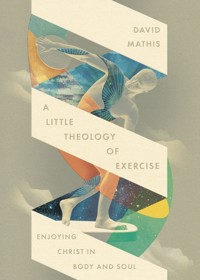
A Pastor Looks at Physical Exercise and Its Potential to Serve Spiritual Life We live in an age dominated by screens. For many, life is sedentary, and it's become increasingly difficult to prioritize physical activity. Quietly conformed to this new normal, they feel sluggish and unmotivated. Others, however, have become entangled in a fitness culture that prioritizes the self, fuels pride, and coddles idolatry. Is it possible to make exercise holy? A Little Theology of Exercise explores how stewarding our bodies can serve the soul, honor God, and serve others. Combining biblical texts with practical guidance, pastor and author David Mathis encourages readers to embrace moderate exercise as a way to deepen their knowledge and enjoyment of Christ and reflect his love in the world. By placing Christ at the center of physical training, readers will discover a greater joy in exercise and an even deeper joy in their relationship with God. - Christ Centered: Demonstrates how effective body stewardship serves the soul, including knowing and enjoying Christ better - Balanced: Helps readers embrace new healthy habits while navigating the challenges of non-Christian motivations - Timely: In our sedentary age, this resource spurs physical movement and enhances spiritual joy - Written by David Mathis: Bestselling author of Habits of Grace: Enjoying Jesus through the Spiritual Disciplines
Sie lesen das E-Book in den Legimi-Apps auf:
Seitenzahl: 116
Veröffentlichungsjahr: 2025
Das E-Book (TTS) können Sie hören im Abo „Legimi Premium” in Legimi-Apps auf:
Ähnliche






Thank you for downloading this Crossway book.
Sign up for the Crossway Newsletter for updates on special offers, new resources, and exciting global ministry initiatives:
Crossway Newsletter
Or, if you prefer, we would love to connect with you online:
“I’ve spent a lifetime in athletics but never thought this deeply about the glory of God in training the body, mind, and soul. David’s vision (and Scripture’s!) of a vigorous life to the glory of God truly inspires, and I’ll walk into the gym differently this week.”
Rick Barnes, Head Basketball Coach, University of Tennessee
“In A Little Theology of Exercise, David Mathis has written a unique and timely book to help Christians think spiritually about exercise in a sedentary age. Specifically, he answers the question ‘How can the joy of exercise serve joy in God?’ David skillfully avoids the pitfalls of either idolizing or ignoring the body by presenting a theology of the body from creation to fall to redemption to glorification. And so he presents a short theological manual packed with godly motivations for the use of the body to the glory of God. This book will challenge you, but it will also change the way you think about spiritual pleasure and physical exercise.”
Gavin Peacock, former professional footballer; Locum Pastor, Bethersden Baptist Church, UK; author, A Greater Glory: From Pitch to Pulpit
“‘Little’ is putting it lightly. David Mathis’s A Little Theology of Exercise is a work for such a time as this. Despite spending more on being healthy than ever before, Americans live in a largely sedentary culture and face a growing obesity epidemic. Given that context, his work strikes a necessary balance between convicting admonitions and instructive exhortations. Filled with biblical truths that highlight the remarkably designed human body with its God-given capacity for exercise, the book provides an excellent theological framework by which Christians should engage in exercise. I am especially grateful for David’s enlightening, embodied approach to exercise, one that recognizes the value of both soul and body health. Whether you exercise five days a week or five days a year, if you desire to glorify God with your life—with your body—I highly recommend his book.”
Lainey Greer, Founder, Your Body Matters; author, Embodied Holiness: The Biblical Call to Bodily Care
“David Mathis offers a biblical vision for physical exercise that reveals the deep connection between body and soul. Rather than viewing exercise as a secular activity or a means of self-improvement, Mathis reframes it as a God-given gift that can enhance joy in Christ to the glory of God. Whether you’re an athlete or someone simply seeking a more faithful approach to fitness, this book will challenge and encourage you.”
Jeremy Treat, Pastor for Preaching and Vision, Reality LA, Los Angeles, California; Professor of Theology, Biola University; author, The Crucified King; Seek First; The Atonement; and Renewal in Christ
“There is a growing obsession on social media with health matters. Apparently, everyone has a health tip! There’s a type of idolatry and legalism that creeps into such discussions. The solution isn’t to avoid these worthwhile topics but to look at them as Christians should: We are body-souls; and any discussion that considers exercise, for example, should remember that fact. David Mathis has offered a highly useful book that highlights the importance of exercise, but he does not forget that we are made in the image of God, created for his service, and most useful as we give our whole person to the Lord’s work.”
Mark Jones, Senior Minister, Faith Reformed Presbyterian Church, Vancouver, British Columbia
“The importance of regular exercise is an oft-overlooked topic in the Christian community. In A Little Theology of Exercise, David Mathis provides a theologically rich yet accessible look at how bodily stewardship serves our joy in God. This brief and inviting book will benefit those who already enjoy regular exercise as well as those who need a little motivation to get moving. I look forward to giving it to the men and women who take my fitness classes!”
Sharonda Cooper, Bible teacher; elite fitness instructor
“David Mathis has written this wonderfully helpful book about the vital role of using our bodies in our enjoyment of God. I loved reading his biblically grounded thinking that insightfully shows that the body is a marvelous gift from God but, like all his gifts, is a means to the much greater end of glorifying God through delighting in him. This book will make you want to go for a run and worship God as you do.”
K. Erik Thoennes, Professor of Theology, Talbot School of Theology, Biola University; Pastor, Grace Evangelical Free Church, La Mirada, California
“Mathis opens A Little Theology of Exercise with 1 Corinthians 6:19–20: ‘You are not your own, for you were bought with a price. So glorify God in your body.’ He then dives deep into this truth, clarifying what our culture has obscured. God amazingly designed our bodies not for self-worship but for his glory—not to remain sedentary but to be vigorously used in service to him. Mathis urges us to be wise stewards of our bodies by staying fit, which enables us to serve God more fervently, find greater delight in him, and glorify him through our bodies. Read this book! Its rich theology will transform your perspective on exercising and help you find joy in offering your body as a living sacrifice to God.”
Bobby Scott, Pastor of Discipleship, Community of Faith Bible Church, South Gate, California; Council Member, The Gospel Coalition; former track and field all-American
“At the core of every Christian’s perspective on physical health and fitness is a motive that either seeks transformation or opts for the status quo. In this important book, David Mathis makes the biblical and gospel-centered case for joyfully pursuing a fit and balanced life for its physical, mental, and spiritual benefits—for the glory of God. In a Christian culture that rightly rejects the extremes of a sedentary or idolatrous life, we find in this Scripture-saturated work a joyful rationale for doing hard things as a means to meeting the needs of others, enjoying God more deeply, and experiencing the joy God has on offer.”
David Bush, Founder, Fit for the King; author, The Body Gospel and Fit for the King: Your Health and God’s Purpose for Your Life
A Little Theology of Exercise
A Little Theology of Exercise
Enjoying Christ in Body and Soul
David Mathis
A Little Theology of Exercise: Enjoying Christ in Body and Soul
© 2025 by David Mathis
Published by Crossway1300 Crescent StreetWheaton, Illinois 60187
All rights reserved. No part of this publication may be reproduced, stored in a retrieval system, or transmitted in any form by any means, electronic, mechanical, photocopy, recording, or otherwise, without the prior permission of the publisher, except as provided for by USA copyright law. Crossway® is a registered trademark in the United States of America.
Cover design: David Fassett
Cover image: Getty Images, Rawpixel, Discobolus statue from Statens Museum for Kunst
First printing 2025
Printed in the United States of America
Unless otherwise indicated, Scripture quotations are from the ESV® Bible (The Holy Bible, English Standard Version®), © 2001 by Crossway, a publishing ministry of Good News Publishers. Used by permission. All rights reserved. The ESV text may not be quoted in any publication made available to the public by a Creative Commons license. The ESV may not be translated in whole or in part into any other language.
Scripture quotations marked NASB are taken from the New American Standard Bible®, copyright © 1960, 1971, 1977, 1995, 2020 by The Lockman Foundation. Used by permission. All rights reserved. www.lockman.org.
All emphases in Scripture quotations have been added by the author.
Trade paperback ISBN: 978-1-4335-9867-8 ePub ISBN: 978-1-4335-9869-2 PDF ISBN: 978-1-4335-9868-5
Library of Congress Cataloging-in-Publication Data
Names: Mathis, David, 1980- author.
Title: A little theology of exercise : enjoying Christ in body and soul / David Mathis.
Description: Wheaton, Illinois : Crossway, [2025] | Includes bibliographical references and index.
Identifiers: LCCN 2024038804 (print) | LCCN 2024038805 (ebook) | ISBN 9781433598678 (trade paperback) | ISBN 9781433598685 (pdf) | ISBN 9781433598692 (epub)
Subjects: LCSH: Theological anthropology—Christianity. | Exercise—Religious aspects—Christianity. | Soul—Christianity.
Classification: LCC BT701.3 .M359 2025 (print) | LCC BT701.3 (ebook) | DDC 261.5/61—dc23/eng/20250108
LC record available at https://lccn.loc.gov/2024038804
LC ebook record available at https://lccn.loc.gov/2024038805
Crossway is a publishing ministry of Good News Publishers.
2025-06-02 01:43:27 PM
To John and Jon
Founders,
Desiring God
You are not your own,
for you were bought with a price.
So glorify God in your body.
1 Corinthians 6:19–20
Contents
Preface
Introduction
Joy Set Before Us
PArt 1: Move the Body
Making Exercise Christian
1 His Word
What God Says About Our Bodies
2 Our Prayers
How We Ask for Help
Part 2: Condition the Soul
Why We Exercise
3 For Our God
Glorify Him in the Body
4 For the Mind
Build and Condition the Brain
5 For the Will
Learn to Lean into the Hill
6 For Joy
Seek Satisfaction in Jesus
7 For Love’s Sake
Get Fit for Good Works
Conclusion
Move the Needle
Acknowledgments
General Index
Scripture Index
Desiring God Note on Resources
Preface
“Man has held three views of his body,” writes C. S. Lewis in his 1960 book The Four Loves.
First there is that of those ascetic Pagans who called it the prison or the “tomb” of the soul, and [others] to whom it was a “sack of dung,” food for worms, filthy, shameful, a source of nothing but temptation to bad men and humiliation to good ones. Then there are the Neo-Pagans . . . , the nudists and the sufferers from Dark Gods, to whom the body is glorious. But thirdly we have the view which St. Francis expressed by calling his body “Brother Ass.”1
Lewis then comments, “All three may be . . . defensible; but give me St. Francis for my money.” He continues, “Ass is exquisitely right because no one in his senses can either revere or hate a donkey. It is a useful, sturdy, lazy, obstinate, patient, lovable and infuriating beast; deserving now a stick and now a carrot; both pathetically and absurdly beautiful. So the body.”2
Just as Lewis saw these three enduring views of the human body in his day, so too we see them today. We have our ascetic (or digital) pagans, who find their physical body a prison that holds them back. But now screens and virtual reality create new possibilities. Life, for many, in the tech age has become shockingly sedentary, planted endlessly in front of screens and living increasingly through their devices.
Meanwhile, those same screens display image after image of meticulously sculpted and enhanced human bodies—these are Lewis’s neo-pagans (half-nudists, at least) for whom the body is glorious or must be glorious, no matter the cost, however much dieting and exercise and surgery it requires.
Yet third, we have perhaps the road least traveled: Saint Francis’s road. Lewis’s road. And the road I aim to travel in this book. We might even call this the road of Christian Hedonists—Christian Hedonists. Today’s non-Christian hedonists may divide themselves up, more or less, between sedentary, digital paganism and semi-exhibitionist neo-paganism, while we Christian Hedonists are gladly left with “Brother Ass.”
I recognize the word ass is arresting. It accents our natural, sinful laziness and obstinance—the “infuriating beast” deserving the stick, as Lewis says. But let’s not miss the affection and warmth in the word brother. Lewis does not say “brother” lightly. Just as Jesus doesn’t say “brother” lightly. And I don’t repeat “brother” lightly. Brother accents the usefulness, sturdiness, patience, and lovability of these bodies that are “absurdly beautiful.” And even here, in recognizing their beauty, Lewis steers a careful course between genuine appreciation and holy reverence—our bodies are not to be worshiped but acknowledged and enjoyed as, in the words of the psalmist, “fearfully and wonderfully made” (Ps. 139:14).
We Christian Hedonists
I am a pastor and Christian teacher. I am not a personal trainer. I am not a dietician. In fact, I have hardly anything to say in this book about diet—except a general plug for moderation and a broad warning about drinking sugar. But as a Christian Hedonist—as one persuaded that God is most glorified in us when are most satisfied in him—I have a serious interest in how the human body serves not only natural joy but also spiritual joy. And I hope, as a Christian Hedonist, that the approach of this book will land on the reader far more like a carrot than a stick.3
Question 1 of the Heidelberg Catechism (1563) asks, “What is your only comfort in life and in death?” The answer is this: “That I am not my own, but belong—body and soul, in life and in death—to my faithful Savior, Jesus Christ.”4 Much could be said about how the life of the soul affects the life of the body, and this will be implicit at some places in the following study. But in this short book, I’d like to focus on stewarding the body—and in particular moving the body, exercising and exerting the body, even training and conditioning the body—in service of the soul (our joy), for the praise of God (his glory), and for the good of others (love).
My hope is that this book will be useful to a wide swath of Christians—not just those already convinced of the opportunity physical exercise can be to serve spiritual life. My prayer is that Christians who are living largely sedentary lives, who are ready to consider some new habits, and who want to harness the possibilities in bodily exertion to assist their joy in God will find this short study accessible and inspiring. I hope it will help you, in the context of our sedentary age, to realize and leverage the potential of your body in the service of Christian joy. I want you to freshly appreciate the gift and wonder of our bodies, designed by God for movement and exertion, as aids in our call to glorify him and as assistants (rather than obstacles) to life-transforming joy in Christ and acts of love toward others.
I also hope that




