


1,99 €
Mehr erfahren.
- Herausgeber: Quickie Classics
- Kategorie: Sachliteratur, Reportagen, Biografien
- Sprache: Englisch
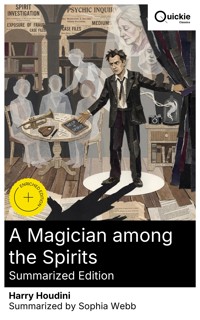
A Magician Among the Spirits is Houdini's incisive autopsy of the seance vogue that followed war and pandemic. In a cool, prosecutorial prose, he inventories slate-writing, trumpets, ectoplasm, billet tests, and spirit photography, then reconstructs, step by step, the methods that produced them. Mixing case files, affidavits, and on-the-spot trials, he situates his exposures within the transatlantic debate over psychical research, including his ruptured friendship with Sir Arthur Conan Doyle. The result is documentary history turned demonstration. Houdini writes not as a scoffer but as a consummate deceiver who knows illusion's limits. The immigrant son turned autodidact librarian of magic and spiritualism, he infiltrated seances, offered rewards for verifiable phenomena, and reproduced marvels under control. Personal loss, above all his mother's death, sharpened his resolve: he yearned to believe, yet his craft compelled doubt and a public ethic of protecting the bereaved from predation. Readers of occult history, performance studies, and critical inquiry will prize this lucid, humane dossier. Read it for exacting casework, for a culture's yearning on display, and for a model of empathy disciplined by evidence. Quickie Classics summarizes timeless works with precision, preserving the author's voice and keeping the prose clear, fast, and readable—distilled, never diluted. Enriched Edition extras: Introduction · Synopsis · Historical Context · Author Biography · Brief Analysis · 4 Reflection Q&As · Editorial Footnotes.
Das E-Book können Sie in Legimi-Apps oder einer beliebigen App lesen, die das folgende Format unterstützen:
Veröffentlichungsjahr: 2026
Ähnliche














A Magician among the Spirits (Summarized Edition)
Table of Contents
Introduction
Poised between the aching desire to speak with the dead and the cold light of demonstrable fact, A Magician Among the Spirits turns a master of illusion into a relentless investigator, staging a drama in which comfort, commerce, and conviction collide with method, measurement, and moral resolve, asking how far a society in mourning will go to preserve its consoling stories, how far a performer will go to defend the integrity of wonder, and what remains of mystery when the curtain is lifted and the mechanisms of belief are examined with the patience of a craftsman and the rigor of a skeptic.
Harry Houdini’s A Magician Among the Spirits is investigative nonfiction from a performer famed for exposing the limits of perception, first published in 1924 amid the early twentieth-century resurgence of Spiritualism. Moving through séance rooms and lecture halls in the United States and Europe, the book situates its inquiries in a culture fascinated by mediumship and the possibility of survival after death. Houdini brings the habits of a stage professional to a public controversy, setting his craft against claims of supernatural agency. The result is a work that blends reportage, personal testimony, and critical method to interrogate a widespread social movement.
At its core, the book follows Houdini as he investigates mediums and demonstrations, applying practical knowledge of misdirection, apparatus, and audience psychology to test extraordinary assertions under ordinary conditions. The narrative alternates between field encounters and reflective analysis, as he records procedures, lays out criteria for fair trials, and sifts competing testimonies. The voice is direct and meticulous, the style plainspoken yet exacting, and the tone resolute rather than mocking. Without disclosing the particulars of individual cases, it is enough to say the reader is invited into the workshop of a practitioner who knows how illusions are made and unmade.
One of the book’s central themes is the ethics of belief: how grief, hope, and trust can be marshaled by charismatic figures, and how skepticism can be practiced without cruelty. Houdini probes the boundaries between entertainment and revelation, asking what responsibilities a performer owes an audience when the subject is not amusement but consolation. He also examines the fallibility of observation, the ease with which darkness, suggestion, and contrivance can mislead witnesses, and the pressure of group expectation. Through these concerns runs a persistent question about evidence and authority, and about who should arbitrate claims that touch both private sorrow and public life.
The book remains timely because it shows how extraordinary claims flourish in environments of new media, rapid change, and collective vulnerability. Though its cases belong to another era, its methods illuminate present-day challenges to evaluating testimony, photographs, and expert opinion, from staged performances to viral deceptions. Readers encounter a sustained lesson in cross-checking sources, isolating variables, and refusing to outsource judgment to enthusiasm or despair. Houdini’s insistence on clear conditions and repeatable tests anticipates later norms of consumer protection and scientific inquiry, demonstrating that compassion and rigor can reinforce rather than cancel each other when belief carries social and personal consequences.
Formally, Houdini assembles his case through cumulative episodes, each framed with contextual notes and practical commentary that clarify how a test should be arranged and how a demonstration can be assessed. He favors precise descriptions of rooms, objects, and procedures, inviting the reader to reconstruct events step by step. The pace is steady rather than sensational; the drama comes from the method. Throughout, he supplements narrative with references to correspondence and public records, balancing personal observation with documented claims. The effect is a hybrid of field report and professional handbook, written to equip lay readers with tools for navigating contested experiences.
In approaching this book today, one reads not only a celebrated entertainer confronting a cultural vogue, but a meditation on the stewardship of wonder. Houdini argues, by demonstration and restraint rather than invective, that preserving the value of marvels requires drawing firm lines between craft and credulity. The introduction of disciplined doubt does not banish mystery; it clears a space in which it can be appreciated without harm. A Magician Among the Spirits endures because it honors grief while refusing exploitation, and because it models habits of attention that remain indispensable wherever sincere hopes meet rehearsed effects and untested assurances.
Synopsis
Harry Houdini’s A Magician Among the Spirits, first published in 1924, chronicles the famed escape artist’s sustained inquiry into modern spiritualism. Writing as a professional magician accustomed to crafting controlled illusions, he examines claims of communication with the dead that surged in popularity after the First World War. The book presents both a personal and public mission: compassion for the bereaved who seek solace, and a resolve to test assertions methodically. From the outset, Houdini asserts that only disciplined observation, repeatable conditions, and independent corroboration can separate extraordinary fact from stagecraft, and he prepares readers for an inquiry grounded in evidence rather than sentiment.
The narrative begins with a survey of modern spiritualism’s origins and spread. Houdini recounts early figures and pivotal demonstrations, tracing how parlors and lecture halls became sites of supposed spirit contact. He sketches the movement’s rapid growth and the variety of phenomena reported, from table movements to written messages. This historical frame establishes why sincere people, particularly in periods of loss, might find such performances convincing. Against that backdrop, he outlines basic standards for inquiry: clarity about conditions, control of the environment, and the elimination of opportunities for trickery. The stage is set for case-by-case examinations rather than sweeping declarations.
Houdini then details his investigative methods, developed from years of detecting misdirection. He attends séances both openly and anonymously, documents setups, and requests controls that restrict unobserved movements. When permitted, he introduces measuring devices, applies secure bindings, and inspects rooms, furniture, and props before and after sittings. He compiles testimonies, correspondence, and photographs to cross-check memories and claims. While frank about his skill at duplicating unusual effects, he emphasizes fairness: the same rigor should confirm or disconfirm. The result is not a single grand experiment but a cumulative record that weighs consistency, transparency, and resistance to tampering.
A substantial portion of the book dissects physical manifestations commonly cited as proof. Houdini catalogs techniques behind raps, tilting tables, slate writing, luminous forms, and other startling displays. He explains how darkness, distraction, and the sitter’s expectations can transform ordinary movements into seemingly impossible events. Demonstrations of simple mechanical aids and sleight-of-hand show how effects can be reproduced under non-mystical conditions. He stresses that replicability under controlled observation is the key test. Across multiple cases, he reports how tightened controls often change or halt the phenomena, a pattern he regards as highly informative for evaluating extraordinary claims.
Interpersonal conflicts and public debates form another thread in the narrative. Houdini describes discussions with notable believers who were persuaded by experiences they considered decisive, including prominent literary figures. He presents these exchanges with respect for their sincerity while disputing the adequacy of the conditions under which impressions were formed. The contrast between personal conviction and methodological safeguards becomes a central theme. Newspapers amplify the disagreements, and Houdini reflects on how press accounts, however well intentioned, can conflate testimony, rumor, and staged demonstrations, complicating later attempts to reconstruct what actually occurred.
Houdini devotes special attention to high-profile investigations convened to test mediums under prize conditions, including a committee organized by Scientific American. He recounts protocols designed to prevent hidden assistance and to monitor every limb, object, and aperture in the séance room. For celebrated practitioners who attracted national attention, he describes the introduction of bespoke restraints and cabinets intended to preserve freedom from injury while limiting opportunities for manipulation. Disagreements among investigators, disputes about fairness, and intense public scrutiny accompany these tests. Rather than sensationalizing outcomes, Houdini emphasizes the reasoning behind each procedural choice and the evidentiary standards applied.
Beyond physical manifestations, the book surveys mental and evidential claims. Houdini analyzes billet reading, sealed-message tests, book tests, and readings that seem to reveal private facts. He shows how casual handling of papers, unobtrusive peeks, and the use of confederates can create compelling but deceptive results. He discusses how suggestion, selective memory, and unconscious cues can lead sitters to perceive accuracy where methods suffice. The same analytical lens is applied to spirit photographs, where double exposures, retouching, and staged props are shown to produce persuasive images. Throughout, Houdini calls for procedures that deny hidden information and verify every step.
Legal and ethical questions weave through the casework. Houdini recounts public demonstrations intended to educate audiences about deceptive practices, arguing that instruction is a practical antidote to exploitation. He notes instances in which disputes spilled into courts or civic hearings, highlighting tensions between regulation, freedom of belief, and consumer protection. The book argues that claims touching grief and hope carry special obligations: transparency, testability, and accountability. Houdini distinguishes theatrical illusion—openly presented as entertainment—from assertions made as fact, insisting that different standards must apply when vulnerable people are asked to trust and to pay.
By the close, A Magician Among the Spirits stands as a sustained appeal for disciplined inquiry in an emotionally charged domain. Houdini’s case studies, methodological reflections, and historical sketches form a cautionary record of how convincing effects can arise without the extraordinary causes they appear to suggest. The book’s enduring significance lies in its union of empathy and rigor: it honors the human needs that draw people to such experiences while urging careful testing before assent. It remains a foundational document for readers interested in the crossroads of belief, deception, and the methods by which remarkable claims are responsibly examined.
Historical Context
A Magician Among the Spirits, published in 1924 in the United States, presents Harry Houdini’s sustained, first-hand inquiry into modern Spiritualism across America and Europe. Writing as a celebrated stage magician and escape artist, Houdini situates his narrative between the late nineteenth century and the early 1920s, visiting séance rooms, private parlors, and public lecture halls. He draws on correspondence, sworn statements, and demonstrations conducted under test conditions to examine claims of spirit communication. The book emerges from a transatlantic milieu in which newspapers, scientific societies, and courts had already grappled for decades with the boundary between entertainment, belief, and empirical evidence.
Spiritualism, as a movement, began in 1848 with the widely reported “rappings” associated with the Fox sisters of Hydesville, New York. Messages purportedly from the dead, table tipping, and trance speaking soon spread through public demonstrations and private circles. By the 1850s and 1860s, the movement had transatlantic reach, with adherents in major American cities and in Britain. The American Civil War’s casualties deepened demand for consolation, a pattern repeated after later national tragedies. Specialized periodicals, lecture circuits, and Spiritualist churches helped institutionalize practices and beliefs. Houdini writes against this backdrop of enduring popularity, addressing techniques that had become familiar to audiences and investigators alike.
Formal inquiry developed alongside belief. The Society for Psychical Research (SPR) was founded in London in 1882 to examine phenomena such as apparitions, trance mediumship, and telepathy with systematic methods. An American counterpart followed in 1885. Investigators like Henry Sidgwick, F. W. H. Myers, and Edmund Gurney helped shape protocols that emphasized controls, record-keeping, and critical reporting. Their proceedings gathered testimony and experiments, sometimes challenging claims, sometimes cautiously supporting them. Houdini engages with this literature, noting both documented exposures and lingering ambiguities. His book enters a debate already framed by efforts to balance open-minded inquiry with safeguards against error, deception, and suggestion.
Spiritualist claims unfolded in a culture saturated with stage magic. Nineteenth-century conjurers, notably John Nevil Maskelyne in London, publicly replicated and critiqued séance effects, arguing that magicians’ expertise was essential to fair testing. Houdini, born Erik Weisz in 1874 and raised in the United States, rose to international fame through handcuff challenges, escape feats, and controlled demonstrations of illusion. By 1917 he was president of the Society of American Magicians, using that platform to advocate against fraudulent mediumship. His professional knowledge—locks, misdirection, and hidden apparatus—underpins the comparative method he brings to cases that had impressed believers and puzzled researchers.
Technologies and techniques central to the movement had long histories by Houdini’s day. “Spirit photography” emerged in the 1860s, most famously through William H. Mumler, who was tried for fraud in New York in 1869 and acquitted. Slate-writing séances attracted international attention; the medium Henry Slade was prosecuted in London in 1876, convicted, and later released on appeal. Materialization claims associated with figures like Florence Cook, and the controversial investigations of physicist William Crookes in the 1870s, kept debate in the press. Houdini scrutinizes such methods, showing how lighting, confederates, and concealed devices could shape perceptions of seemingly inexplicable events.
The First World War and the 1918 influenza pandemic produced unprecedented bereavement, energizing new audiences for séances and mediums. In Britain, Sir Arthur Conan Doyle became Spiritualism’s most prominent advocate, publishing The New Revelation (1918) and The Vital Message (1919) and defending cases such as the Cottingley fairy photographs. Doyle and Houdini were initially cordial, but fundamentally disagreed about mediumistic claims. A 1922 séance involving the Doyles intensified their dispute. Houdini’s book reflects this climate of public controversy, in which celebrity endorsements, grieving families, and scientific rhetoric intersected on lecture platforms, in newspaper columns, and in contested demonstration rooms.
American popular science culture also shaped the book’s context. In 1922 Scientific American announced a prize for a conclusive demonstration of genuine physical mediumship, to be judged by a committee that included Houdini among investigators and magazine staff. Tests in Boston focusing on Mina “Margery” Crandon in 1924 drew national attention. Houdini proposed controls and built devices to prevent surreptitious movement during séances. The prize was never awarded, and disagreements over methods and reporting persisted. Houdini’s account tracks these procedures, highlighting how laboratory-style controls, courtroom standards of evidence, and theatrical knowledge collided in the effort to evaluate extraordinary claims.




