


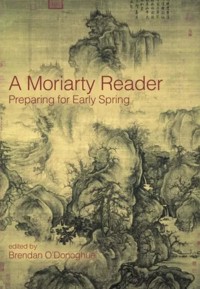
A Moriarty Reader E-Book
Erhalten Sie Zugang zu diesem und mehr als 300000 Büchern ab EUR 5,99 monatlich.
- Herausgeber: The Lilliput Press
- Kategorie: Geisteswissenschaft
- Sprache: Englisch
JOHN MORIARTY (1938-2007), Kerry-born poet, mystic and philosopher, has been hailed as one of the most original thinkers and writers to have emerged from Ireland in recent decades. Opening a way into John Moriarty's complex work through Guo Xi's painting Early Spring, this Reader reveals the extraordinary nature of Moriarty's thought. It draws on key passages from Moriarty's first publication, Dreamtime (1994/2011), and progresses through his subsequent landmark books, The Turtle Trilogy (1996–98), Nostos (2001)and 'What the Curlew Said' (2007), weaving together the most seminal passages from each. A Moriarty Reader serves as an excellent introductory text for those unfamiliar with his writings and illuminates unacknowledged aspects of his thinking for those already familiar with his work. There is a foreword by hospice movement founder Dr Michael Kearney, and a glossary, name and subject index provide interpretive keys to aspects of the work. The Reader highlights Moriarty's deft ability to challenge and bring into question habitual modes of Western thought and perception; his willingness and courage to act as a cultural shaman for Western humanity; his innovative philomythical and metanoetic search for wisdom and truth, and his astonishingly original interpretation of scripture. Bearing witness to his genius, this book reveals Moriarty to be one of Ireland's and Europe's most significant writers, an image-thinker of the highest rank, who warrants serious attention. 'A Moriarty Reader' encompasses a broad spectrum of historical cultures, but its focus on Moby-Dick (Pequod Culture) and Native American stories in particular will profoundly resonate with an international audience. Cohering around the Daoist-inspired painting of the title, this work will set the tone for Moriarty's panethnic adventure in philosophy, myth and religion.
Sie lesen das E-Book in den Legimi-Apps auf:
Seitenzahl: 906
Veröffentlichungsjahr: 2012
Das E-Book (TTS) können Sie hören im Abo „Legimi Premium” in Legimi-Apps auf:
Ähnliche




















.
Mac Monagle Photography
.
.
Mitakuye Oyasin
Contents
A Brief Biography
Acknowledgments
A Note on the Selection
Foreword byMichael Kearney
Editor’s Introduction
Dreamtime (1994/2009)
Introduction
CES NOIDHEN
ULROPEANS
MONA, OUR MOSES
THE MIND ALTERING ALTERS ALL,EVEN THE PAST
SHAMAN
TRIDUUM SACRUM
JOB AND JONAH
CROSSING THE KEDRON–COLORADO
PASSOVER
WATCHING WITH JESUS
Turtle Was Gone a Long Time Volume One, Crossing the Kedron (1996)
Introduction
OVERTURE
ENGWURA NOW
Paradise Lost
Sir Orfeo and Lady Eurydice
Opposites
In Buddha’s Footsteps
Coming Forth by Day
Mona Melencolia Europa
TENEBRAE NOW
Fifth Story
Sixth Story
TEP-ZEPI NOW AND TAI-WER
Turtle Was Gone a Long Time Volume Two, Horsehead Nebula Neighing (1997)
Introduction
PRELUDE: SERVING AS BOTH PROLOGUE AND EPILOGUE
HORSEHEAD NEBULA NEIGHING
Turtle Was Gone a Long Time Volume Three, Anaconda Canoe (1998)
Introduction
INTRODUCTION: SERVING AS BOTH PROLOGUE AND EPILOGUE
Part 1
Part 2
Part 3
Nostos, An Autobiography (2001)
Introduction
What the Curlew Said: Nostos Continued (2007)
Introduction
Thoor Ballylee
Glossary
A Brief Biography
John Moriarty emerged into this world on 2 February 1938, in Moyvane, north Kerry. He was the fourth child of Mary (née O’Brien) and Jimmy Moriarty. He received his secondary education at St Michael’s College, Listowel and went on to study Philosophy at University College Dublin. He taught English literature at the University of Manitoba for six years. He left his academic post in Canada aged thirty-three years, and returned to the west of Ireland in 1971 to work at various jobs before becoming a gardener.
He is the author of Dreamtime (1994, revised 1999/2009); the trilogy Turtle Was Gone a Long Time: Crossing the Kedron (1996), Horsehead Nebula Neighing (1997), and Anaconda Canoe (1998); Nostos, An Autobiography (2001); Invoking Ireland, Ailiu Iath n-hErend (2005); Night Journey to Buddh Gaia (2006); Urbi et Orbi (2006); Slí na Fírinne (2006); Serious Sounds (2007) and What the Curlew Said: Nostos Continued (2007) – all published by The Lilliput Press of Dublin.
Moriarty has also made a number of audio recordings, entitled Triduum Sacrum: Seeking to Stand Beautifully upon the Earth and One Evening in Eden.
On 23 June 2006, John Moriarty was conferred with the degree of Doctor of Literature, Honoris Causa by the National University of Ireland, Galway.
He departed this world on 1 June 2007.
Acknowledgments
I would like to extend my gratitude to Anne Garvey for her assistance with this Reader. I also greatly appreciate Brendan Purcell’s and Conor Farnan’s remarks on the text. I thank my parents Ann and Tadgh O’Donoghue for their incredible support, and Cathy for her love and much-needed patience.
A Note on the Selection
This Reader does not pretend to provide the definitive guide to Moriarty or to offer a definitive synopsis of his work. Hence the title, A Moriarty Reader, not the more authoritarian The Moriarty Reader. Its modest ambition is to illumine what Heidegger might call a Holzweg (‘forestpath/woodpath’) within the dense forest of Moriarty’s writings. Moreover, by venturing through this Holzweg I believe the reader will be able to explore hitherto unacknowledged and unrecognized aspects of his thought.
Of the eleven works Moriarty has had published, selections from six have been chosen for this Reader. Considering Moriarty’s oeuvre is not nearly as extensive as many other authors, it may seem peculiar and unwarranted to limit the selection to such a small number of books. Originally destined to include extracts from the entire collection of his published writings, it became evident at an early stage that the Reader was morphing into an intimidating tome. Conscious that producing a Reader similar in bulk to Nostos would more likely deter than encourage prospective readers to engage with Moriarty’s thought, a change of tack was deemed necessary. A decision was made to create a more accessible introductory text that would inspire the reading of his original works.
The six books chosen, Dreamtime, the three volumes of Turtle Was Gone a Long Time, Nostos and What the Curlew Said, are closely connected. They are tied by a common concern: the healing of Western culture. Passages have been predominantly selected with this in mind. Furthermore, Moriarty’s efforts to heal Western culture are essentially linked to his attempts to heal himself; for in Nostos he diagnosed himself as suffering from ‘the sickness of an age’.1And so rather than touching or grasping the problem of the West’s growing wasteland with ‘the antennae of cold, curious thought’, Moriarty orients himself to it in a wholly passionate and intimate way. Here Nietzsche’s remark in The Gay Science can be heard to ring true: ‘all great problems demand great love’.2
Tracing various philosophical, poetic, mythic and mystical paths and trails that Moriarty traverses in order to rejuvenate himself and an ailing Western culture, this Reader prepares an opening into his difficult and complex writings. Since initial encounters with Moriarty may seem bewildering due to the presence of a vast panoply of unfamiliar metaphors, myths and religio-philosophical terms, the current Reader seeks to ease the uninitiated into his occasionally chaotic, heterodoxical texts.
To render his works more approachable, a motif made manifest in Kuo Hsi’s (Guo Xi’s) painting ‘Early Spring’ guides the Reader. By allowing ‘Early Spring’ to direct this Reader I believe one can participate in Moriarty’s distinctive mode of discourse and thought in a novel, imaginative fashion.
Kuo Hsi (c. 1020–90) is accredited with developing an artistic strategy that depicts multiple perspectives simultaneously. This is called ‘the angle of totality’. Since he does not attempt to mirror or imitate Nature, he has no need to look at a particular scene or landscape from a single viewpoint. Avoiding the constraints of a fixed viewpoint, Kuo Hsi observes and depicts landscapes from the angle of totality by assuming a fluxional, multi-perspectival approach.
Similarly, in this Reader, no fixed or single method of reading Moriarty is advocated. Rather it promotes a multi-perspectival approach to reading and interpreting his texts. In doing so, it pays hermeneutic respect to the Moriarty who writes:
Give me land, lots of land,
Don’t fence me in.
If I had a deepest need in relation to people in society it was that – don’t fence me in.3
Giving Moriarty ‘land, lots of land’, permits the polyphonic structure of his texts to resonate more clearly.
How else could one approach Moriarty, who when asked where he is from and what his name is, responds through Dylan Thomas’s ‘Fern Hill’?
And where do you come from? asks the young woman sitting beside me in the bus. From a place inside me I say. From a farm inside me. From a farm far away inside me called Fern Hill I say.
Your name, please? the man in the passport office asked me.
Honoured-among-wagons, I replied. That’s my name on Monday. On Tuesday the blackbirds call me Prince of the apple towns. On Wednesday the geese call me Famous among the barns. On Thursday the owls who are carrying me away call me Nightly under the simple stars. On Friday morning coming home I am The Wanderer white with the dew, the cock on my shoulder. On Saturday alone on the hills I am the Farm forever fled. On Sunday, there it is, summer again, Fern Hill again, horses again, the spellbound horses walking warm out of the whinnying green stables on to the fields of praise.4
Acknowledging Moriarty’s deft ability to elude customary interpretations and classifications, it proves extremely fruitful to consider him from the angle of totality, as it allows the multifarious nature of his thinking to shine through.
Selected Passages
The passages from Moriarty’s original works selected for thisReaderare listed below.
Dreamtime(2009): ‘Ces Noidhen’, pp. 3–9; ‘Ulropeans’, pp. 98–100; ‘Mona, Our Moses’, pp. 100–3; ‘The Mind Altering Alters All, Even the Past’, pp. 198–201; ‘Shaman’, pp. 179–82; ‘Triduum Sacrum’, pp. 35–9; ‘Job and Jonah’, pp. 39–43; ‘Crossing the Kedron–Colorado’, pp. 44–6; ‘Passover’, pp. 144–5; ‘Watching with Jesus’, pp. 132–6.
Turtle Was Gone a Long Time, Volume One: Crossing the Kedron(1996): ‘Overture’, pp. ix–xi; Part 1, Engwura Now: ‘Paradise Lost’, pp. 3–7; ‘Sir Orfeo and Lady Eurydice’, pp. 27–9; ‘Opposites’, pp. 30–2; ‘In Buddha’s Footsteps’, pp. 37–40; ‘Coming Forth by Day’, pp. 105–8; ‘Mona Melencolia Europa’, pp. 121–3; Part 2, Tenebrae Now, A Pilgrim’s Progress in Six Stories: ‘Fifth Story’, pp. 202–12; ‘Sixth Story’, pp. 213–21; Part 3, Tep-Zepi Now and Tai-Wer, pp. 225–8.
Turtle Was Gone a Long Time, Volume Two: Horsehead Nebula Neighing(1997): ‘Prelude’, pp. vii–viii; pp. xxiv–xxvii; pp. l–liii; ‘Horsehead Nebula Neighing’, pp. 3–6; pp. 11–15; pp. 39–43; pp. 77–82; pp. 124–7; pp. 136–9; pp. 152–4; pp. 200–6; pp. 233–4; pp. 244–5.
Turtle Was Gone a Long Time, Volume Three: Anaconda Canoe(1998): ‘Introduction, Serving as Both Prologue and Epilogue’, pp. v–x; Part 1: pp. 3–5; pp. 10–11; pp. 12–16; pp. 18–23; Part 2: pp. 111–12; Part 3: pp. 122–6; pp. 147–50; p. 171; pp. 199–202; pp. 212–17.
Nostos, An Autobiography(2001): pp. 5–7; pp. 18–21; pp. 23–4; pp. 32–4; pp. 50–3; pp. 60–2; pp. 75–7; pp. 87–9; pp. 102–9; pp. 163–5; pp. 172–4; pp. 187–8; pp. 197–200; pp. 206–8; pp. 245–9; pp. 348–51; pp. 395–402; pp. 419–23; pp. 442–3; pp. 448–51; pp. 452–3; pp. 489–92; pp. 519–22; pp. 586–8; pp. 591–2; pp. 606–7; pp. 612–15; pp. 624–7; pp. 661–3; pp. 677–82; pp. 692–4; pp. 695–9.
What the Curlew Said: Nostos Continued(2007): pp. 9–11; pp. 15–17; pp. 18–19; pp. 21–3; pp. 25–7; pp. 34–42; pp. 73–6; pp. 105–8; pp. 133–7; pp. 150–2; pp. 157–9; pp. 165–78; pp. 193–4; pp. 202–4; pp. 211–12; pp. 217–18; pp. 255–7; pp. 279–81; pp. 285–7; pp. 295–6; pp. 333–5; pp. 367–76.
NOTES
1. John Moriarty,Nostos, An Autobiography(Dublin: The Lilliput Press, 2001), p. 50.
2. Friedrich Nietzsche,The Gay Science, trans. Walter Kaufmann (New York: Vintage Books, 1974), p. 283. Henceforth,The Gay Science.
3. Moriarty,Nostos, p. 566.
4. John Moriarty,Dreamtime(Dublin: The Lilliput Press, 2009), p. 211.
Foreword
MICHAEL KEARNEY
John Moriarty is one of Ireland’s most important thinkers whose work speaks poetically and powerfully to many of the critical personal, cultural and global crises we are facing. Moriarty is a shaman, a wounded healer, whose patient is, as O’Donoghue tells us, Western culture itself. His diagnosis is that we have developed a pathological and dangerous way of seeing our world and ourselves. This way of seeing is so endemic that we are not even aware of it, yet it shapes our values and the choices we make everyday. Moriarty’s prescription is radical: nothing less than a new way of seeing, one that viewseverythingwithin and without as ‘enfranchised’ and that views ourselves as intimately and dynamically contiguous with our world. To come into this way of seeing requires a change in direction that can seem daunting, even overwhelming. Moriarty, however, does not just set up the challenge nor present us with a set of abstract ideas for us to do with what we can. His ideas, stories, poetry and biographical material are offered as a vibrant weave in which we are invited to participate. To read Moriarty is to make a shamanic journey with him and, in the process, to be initiated into that other way of seeing and of being in the world.
I have had a number of encounters with John Moriarty, although, sadly, never in person. They began in 1994, the year his first book, Dreamtime, was published. I bought it, excited by its title as at the time I was researching stories of Aboriginal Australian dreamtime. I recall standing on the pavement outside Hodges Figgis bookshop in Dublin, holding the book in my hands, mesmerized by the image on the cover of a man with a face fissured like Burren limestone, an intense, dark, haunted gaze, and a crazy mane of hair, leaning on a shovel. I was so frightened by that look that I put the book on a bookshelf and did not read it until many years later. In 2007 I bought What the Curlew Said, published shortly after his death. Once again I recall being entranced by the image of Moriarty on the front: that same mane of hair, wild and woolly as ever, elbow resting on a giant lichen-covered rock, forest and mountains behind him. Now, however, something in his look was different. There was a certain surrender, and a softness, and a deep sadness: the look, to borrow D.H. Lawrence’s words, of ‘a man who has come through’, or, in his own words, of one ‘who has allowed nature happen to him’. This time I read, or, more accurately, consumed the book, cover to cover, and many times over, and it became a gateway back into John’s other work, which has inspired, challenged and delighted me, and continues to do so.
A place I feel I meet John Moriarty deeply is in a shared love of ‘The Red Road’, of Native American Indian wisdom and stories, and through a sense of how these can lead us to once again ‘walk beautifully on the Earth’.1He says, ‘When I came back from Canada to Connemara it wasn’t Aristotle or Plato or it wasn’t any of the European philosophies or psychologies that helped me to stand again on the Earth below in Connemara … it wasn’t Descartes, and it wasn’t even Shakespeare … it was some old, aboriginal stories, it was some old, Native American Indian stories that took me by the hand and took me back to the Earth.’2
Since living here in California I have been fortunate to become part of a Tiospaye, or Native American Indian fire circle, which gathers regularly for ceremony. I have often thought of Moriarty as Wolf, the water pourer, welcomes ‘the grandfathers’, ‘the oldest beings on the planet’, ‘the stone people’, into the lodge; as he tells us that just as these now reddened stones have returned in the fire to their original state, so too they will now restore us to our original state. I have felt close to him as I have fasted on my ‘altar’, my vision-quest site on the hillside, as I lay on the earth and looked up into the night and cried for a vision. I have remembered his redefinition of the heroic: ‘A hero like Cuchulainn isn’t what we need. We need another kind of hero altogether … A hero now isn’t someone who goes out and fights the sea. A hero now isn’t the person who comes home with the greatest number of enemy heads on his chariot. The hero now isn’t someone who wields a sword – it’s someone who puts down his sword and lets nature happen to him.’3I have taken heart in his words that, ‘the best way to experience grace is to surrender to gravity’,4and when he writes,
‘It is a small step for me,’ he said.
‘It is a small step for me but a giant step for humanity.’
Altogether more significant is a journey to
The Earth.5
Because of John Moriarty I made a journey last summer with my three daughters to the Grand Canyon, where we descended on Bright Angel Trail to the Colorado River. The impact he has had on me is why, after more than thirty years in medicine, I am trying to redirect my work to best act in service of the Earth. Moriarty, as Bright Angel, has deepened my delight in being alive and brought me closer to the world.
In his opening words Brendan O’Donoghue offers a metaphor for his hopes for this Reader: that it may serve as a pathway into the dense forest of Moriarty’s writings. Moriarty’s writings are challenging, and yes, dense, and, at times, seem to move in repetitive and circular currents. What some find challenging in his writing, however, is not, I believe, so much the complexity of his ideas as his way of communicating them, which is, ironically, when one persists, the very thing that makes his work so rich and deeply rewarding.
Moriarty is a mystic, a philosopher–poet, and a seanachi, a master storyteller in the oral tradition. We need all our faculties to read Moriarty and especially our intuition and poetic sensitivity. Perhaps we also need not to try too hard. In the words of the old Irish proverb, which I hear in the music of Moriarty’s voice, ‘Éist le tuile na habhann agus gheobhaidh tú breac’ (Listen to the flow of the river and you will catch a trout).6But we also need a guide, which is where O’Donoghue comes to our aid. This Reader does indeed provide a luminous pathway into the wild landscapes of Moriarty’s writing. It does this in a way that is both intellectually rigorous and infused with deep affection and respect for Moriarty and his work.
I, for one, am deeply touched and grateful for this Reader; for myself, yes, but also for Mitakuye Oyasin, ‘for all our relations’.
NOTES
1. John Moriarty,One Evening in Eden(Kerry: Slí na Fírinne Productions, 2007).
2.Ibid.
3.Ibid.
4.Ibid.
5. John Moriarty,What the Curlew Said: Nostos Continued(Dublin: The Lilliput Press, 2007), p. 376.
6. Carmel Fitzgerald, The Weather is a Good Storyteller(Dublin: Ashfield Press, 2004), p. 92.
.
The most fortunate author is one who is able to say as an old man that all he had of life-giving, invigorating, uplifting, enlightening thoughts and feelings still lives on in his writings, and that he himself is only the grey ash, while the fire has been rescued and carried forth everywhere.
—Friedrich Nietzsche,Human, All too Human: A Book for Free Spirits
Editor’s Introduction
John Moriarty stands apart as one of Ireland’s most singular and significant writers. Yet, while his work has received much acclaim, he remains a peripheral figure.
Brian Lynch described Moriarty’s first published book, Dreamtime (1994), as ‘one of the most extraordinary books ever published in Ireland’, representing ‘a milestone in contemporary Irish literature and thought’. Aidan Carl Mathews is equally unreserved in his praise of Nostos (2001), Moriarty’s autobiography, stating: ‘John Moriarty’s masterwork Nostos tells the story of his own life and the life of all those stories that our species has been sharing since the first annals of the primal savannah. It is a great book this, the greatest Irish book since Ulysses.’ According to Paul Durcan in his article ‘Moriarty on Bare Mountain’ (2006), Nostos ‘is to Irish literature what Thus Spoke Zarathustra is to German philosophy’.1Moreover, with unabashed use of hyperbole, underscored by playful irony and deadly seriousness, Durcan goes on to envisage the following:
Strange to surmise that in twenty years from now almost all the current icons of Irish cultural life will be in the process of being forgotten, while in the universities there will be courses devoted to John Moriarty, and movie-makers will vie for the rights to make a film on his life. One will see in TCD, under the severe, genial eye of Bishop Berkeley, the new John Moriarty Chair of Wisdom Literature, endowed by the Bank of Ireland, while outside theGPOcinema in O’Connell Street queues will be forming nightly to gain admission to the latest Oscar-winning movie from Ang Lee and Annie Proulx, Moriarty on Bare Mountain.
Lavish praise of Moriarty’s writings has been coupled with recognition of his work by NUI Galway, who conferred upon him an honorary Doctorate of Literature on 23 June 2006. At the conferral, president of the university, Professor Iognáid Ó Muircheartaigh, declared that during his eight years in office, the two greatest individuals he had conferred honorary doctorates upon were Nelson Mandela and John Moriarty. Concluding his address, he remarked:
… it is our great pleasure and indeed privilege to acknowledge today, in the traditional spirit of the precious mission of the university to protect and nurture, among other things, original, radical and non-conformist thinking, the extraordinary generous, humane, and utterly civilized manner in which John has lived a unique and indeed a uniquely courageous life.2
Professor Ó Muircheartaigh’s closing words are noteworthy, for Moriarty disclosed his initial opposition to this accolade due to the subversiveness of his writings. Only when representatives of the university visited Moriarty to persuade him that it was for the very nature of his ‘original, radical and non-conformist thinking’ he was being honoured, did he graciously accept the award.3
What entitles Moriarty to such laudation? Many aspects of his work warrant it: his ability to challenge and bring into question habitual modes of Western thought and perception; his willingness and courage to act as a cultural shaman for Western humanity; his innovative philomythical and metanoetic search for wisdom and truth; and his original interpretation of Christ.
Challenging the Habits of Eye and Mind
Animum debes mutare, non caelum4
Collectively and individually, Moriarty’s books can be considered powerful antidotes to the contracted habits of Western eye and mind. In Nostos, Moriarty turns to William James who famously compared a habit to a sheet of paper that has been folded, for once creased or folded, it has developed a tendency ‘to fall forever afterward into the same identical folds’.5On the back of James’s illustration of what a habit is, Moriarty wonders how folded into European ways of seeing his own mode of seeing is, and how folded into European ways of thinking his mind is. Wondering also if his sight and mind had become crumpled things, he poses two crucial questions:
Could I uncrumple, could I unfold, sight in me?
Could I uncrumple, could I unfold, mind in me?6
Uncrumpling and unfolding the creases and folds of European ways of seeing and thinking is no easy task. As Moriarty observes: ‘Once educated, a mind is no longer as transformatively available to alternative modes of thinking, intuition, and perception as it originally was.’7James is no less sceptical about the possibility of transforming human habitual behaviour, since habit is ‘second nature, or rather, as the Duke of Wellington said, it is “ten times nature”’. He also notes how, ‘in most of us, by the age of thirty, the character has set like plaster, and will never soften again’.8
What habits of eye and mind does Moriarty identify as being constrictive? How does he set about loosening their hold?
Primarily, Moriarty takes issue with reductive economic, religious, philosophical and scientific modes of perception and discourse. In a broader sense, he combats the entire ‘sensory-intellectual tool-kit of Europeans’.9
Rather than engaging in sustained philosophical argumentation, he mounts this audacious challenge mainly through myth, poetry and metaphor, and by way of philosophical, philomythical, shamanic, poetic, religious and mystical insights. These insights are for the most part mediated through poetic prose.
For Moriarty, how we perceive things determines our behaviour towards them.10He claims our Western perception of things is largely oppressive, and most acute when viewed from a utilitarian-economic perspective, that is to say, perceived solely in terms of their use and benefit for humanity. When a perspective of this nature holds sway, Moriarty asserts, our senses and faculties turn malignant; our ears become hammers and anvils, and our eyes become economic brain tumours. Consequently, when looking at a cow we see only milk and meat, when looking at a tree we see only timber, and when looking at ourselves we see only labour and manpower.11Moriarty enlists Thomas Traherne, William Blake and Wallace Stevens, among other poetic visionaries, to establish a more enlivened, courteous mode of perception. Through Traherne he realizes corn is ‘orient and immortal wheat, which never should be reaped, nor was ever sown’; with Blake he undergoes an exodus from perceptual captivity, whereby ‘… every sand becomes a Gem/ Reflected in the beams divine’. He comes to see:
The Atoms of Democritus
And Newton’s Particles of Light
Are sands upon the Red Sea shore,
Where Israel’s tents do shine so bright.12
Battling the Balor and Cyclops in us, Moriarty turns to Stevens’s ‘Thirteen Ways of Looking at a Blackbird’, in which multiple ways of perceiving are brilliantly articulated, thereby expanding our vision of things. By extension, for Moriarty himself, vision is visionary: ‘I see things as mirabilia and so it is in turn that I so often experience myself as Miranda in nature and name.’13The word mirabilia derives from Latin and means ‘wonders’, ‘marvels’ or ‘miracles’. Miranda is the name of Prospero’s daughter in Shakespeare’s The Tempest, and from mirandus, meaning ‘admirable’ or ‘wonderful’, Miranda can be semantically linked to the Spanish words mira, ‘sight’, and the verb, mirar, ‘to look at’. In Dreamtime, this broadened manner of seeing things clearly manifests itself:
Every bush is a burning bush,
Every river is a medicine river.
Every stone is an a-stone-ishment
turned inwards on its own rose window wonders.14
Can pitting visionary against utilitarian-economic perception, undermine the dominance of the latter? If it is possible for visionary perception to succeed, it is sure to be a protracted battle, for the roots of this utilitarian-economic mode of perception run deep. Vestiges of these roots can perhaps be traced back to the opening passages of the Bible, in which God is accredited with giving man permission to hold dominion, ‘over the fish of the sea, over the fowl of the air, and over the cattle, and over all the earth, and over every creeping thing that creepeth upon the earth’. Retaining a belief in such a God only serves to preserve a way of being in the world that was redundant from the outset.
Deeply aggrieved by and opposed to Genesis 1:26, 28, in which the mandate for human dominion over the Earth is said to be sponsored by God, Moriarty is also averse to biblical creation and creationism:
We sin against what is, be it universe or pluriverse, when we think of it as having come into existence as a consequence of conscious Divine Fiat.
Our sense of what is as the work of a God who consciously creates, consciously sustains and consciously brings to a foreordained conclusion – that sense of things is our sin against morning and evening the first day, against evening and morning the first night.
We believe in a God who consciously creates, consciously sustains, consciously choreographs towards a final tableau because of our dread of unconsciousness, our dread ofwu-hsin,wu wei,mo wei, our dread of miraculousness.15
For Moriarty, to think of the universe or pluriverse as something created or made, or as mere handiwork, is entirely offensive and inappropriate, given the stupendousness of what is: ‘It is defamation of the universe to say of it that it was made. Chairs are made, not furze bushes, not stars.’16Moriarty maintains that the notion of a created universe betrays an anthropocentric bias, a prejudice originating from humans being endowed with cerebro-manual dexterity and opposable thumbs, which enable humans to be tool users and make possible the art of craftsmanship.17Physiologically conditioned, this way tends to promote an understanding of the universe as something created or crafted. If a dolphin could imagine how the universe came into existence, Moriarty supposes it would diverge radically from something created or made.18
Dread of unconsciousness; wu-hsin, ‘no-mind’ or ‘no-thought’; wu wei, ‘non-action’; mo wei, ‘nothing does it’ or the ‘causeless’; and miraculousness, arises because these ideas threaten to undermine our deep-seated attachments to egocentric and anthropocentric perspectives. According to Moriarty, our biblical choreographing God is required as protection against these intrusive and disruptive notions, providing a ‘bulwark against miraculousness’. Furthermore, he declares: ‘In the yu-wei works and days which we ascribe to him, our biblical God is our sin against the Divine.’ This diminished sense of God, as some type of demiurge or master craftsman, is something Moriarty seeks to ‘desuperimpose’ from the Divine Ungrund.19
Maintaining the West is beset by a corrupted lust for explanation, Moriarty confronts reductive philosophical and scientific estimations. He strongly resists the ‘ghostly Platonic’ understanding of things, as mere imperfect representations or copies of immutable and perfect Forms, and Descartes’ grasp of things, as elaborated in Discourse on Method and Principles of Philosophy. In these particular texts, Descartes’ interpretation of corporeal matter is confined to quantitive descriptions of arithmetic and geometry, involving nothing more than ‘divisions, shapes and movements’.20Additionally, he thinks of the material world as an indefinite series of variations in the shape, size and motions of the homogeneous matter he calls res extensa (extended matter or substance), a concept Moriarty vehemently rejects, for whom ‘matter’ is ‘mind in hibernation’. Expanding on this he cites a passage from the Hermetica, in which Hermes instructs Tat on the nature of the cosmos, saying: ‘ho de sumpas kosmos houtos … pleroma est tes zoes’, translated to mean: ‘this whole cosmos … is a pleroma of aliveness’.21Disputing Descartes, Moriarty argues that the cosmos or universe is chiefly characterized by aliveness, adding: ‘since it is sometimes alive in the contrary ways that it is alive, we will always need to call upon myth as well as upon math when we attempt to talk about it’.22So strange and marvellous is the universe, according to Moriarty, that it justifies myth or the ‘folk-tale as much as it justifies science, it justifies the fairy-story as much as it justifies maths-physics’.23
Moriarty constests the compositional scientific estimation of things in Dreamtime: ‘Water isn’t H2O. It might be composed of H2O, but it isn’t only what it is composed of. Once it has come into existence it is no longer composed. It isn’t a compound,’ and turns to the Buddha’s Flower Sermon in which he smilingly and silently held up a white flower.24
By holding up a flower rather than delivering a speech, is the Buddha gently and peacefully destroying an addiction to ingrained, long-established habits of mind that are not even recognized as habits? Is the Buddha guiding onlookers to direct beholding rather than to a truth mediated by language and thought? Moriarty seems to suggest that the Buddha’s sermon is capable of dismantling the habitual pursuit of scientific and linguistic explanation: ‘Be true to your eyes, not to the desiderata of science or language. Zen Buddhists know it: there is a seeing that is the same thing as satori.’25
Challenging the habits of eye and mind, Moriarty attempts to free things from economic, religious, philosophical and scientific reductionism, to liberate things from our oppressive perceptual and intellectual regimes:
Standing before pharaoh in Egypt, Moses said, ‘Let my people go.’ And now addressing the pharaoh in ourselves, we say, Things, let things go.
Let us liberate the last of the things that need to be liberated – things themselves from our utilitarian biblical estimation of them, from our ghostly Platonic estimation of them, from ourres extensaCartesian estimation of them, from our compositional scientific estimation of them.
The Bastille Day of things, of eyes with which to see them, of minds with which to know them.26
Not limited to something as narrowly conceived as human liberty, the Bastille Day Moriarty has in mind relates to all things.
Moriarty as Cultural Shaman
The lesser shaman heals individuals. The great shaman heals his people as a whole. He heals them in their founding and constituting charter myths. He heals them in their founding and constituting intuitions, orientations and practices.27
—John Moriarty,What the Curlew Said
In a journal entry dated 11 May 1848, Kierkegaard notes: ‘From now on the human race will no longer be led by prophets and judges but forced back by martyrs, who will run headlong against that human discovery, progress.’28How far, and to what, does the human race need to be forced back? Taking on the role of a cultural shaman, Moriarty ventures deeper than Western humanity’s original charter myths, and presses the human race back roughly 17,000 years, to a cave near Lascaux in south-west France, in order to confront, suffer and heal one of its earliest, most visible transgressions.29The great transgression depicted has various names, including; ‘The Lascaux shaft scene’, ‘The Scene of the Dead Man’, or simply ‘The Pit’. The scene shows a falling, phallically erect birdman, being toppled by a speared bison bull who is in a hair-raised rage. Heinously wounded, the bison has been speared through his anus and genitals, whilst his innards can be seen spilling out from his underbelly. Speared in the generative roots of his being, Moriarty contends that this spear-cast not only destroyed a realm but a world, creating a chasm between human history and evolution: ‘Pulling apart since the big, ecumenical calamity so memorably recorded in the pit in Lascaux, history and evolution are like ships going their separate ways, ships already too far apart for loud-hailing communication with each other. Almost daily now, the distance between them deepens and widens. On the Moon widens, will widen when we get there on Mars.’30As a consequence of this increasing rift, it becomes crucial for humanity to realign itself with evolution and the Earth.
Moriarty imagines Paul Cézanne in ‘our herdless Serengeti’, painting the hand that buried the spear in the bison’s backside and genitals: ‘Before anything else, Paul, paint the hand that paints. Paint the hand that launched the lance into the Bison Bull’s genitals. Being the Master of Animals, that Bull is in a sense all animals.’31Could seeing the hand that speared the Bison Bull force humanity to confront the us-and-them divide, the human-animal divide, that was visually and violently inaugurated in the pit, in a way hitherto unimagined? Could such a painting induce humanity to suffer with all animals, to suffer with Nature? If so, would it compel us to see the human hand in the way Macbeth sees his?
Will all great Neptune’s ocean wash this blood
Clean from my hand? No, this my hand will rather
The multitudinous seas incarnadine,
Making the green one red.32
If Macbeth’s regicidal and bloodied hand can incarnadine the multitudinous green seas, can humanity’s collective bloodied hand incarnadine the Earth, incarnadine the universe? Extraordinarily, what is visible to Macbeth remains invisible to most. For it appears as if humanity is largely protected against the immeasurable suffering it inflicts upon Nature. This is perhaps due to the prevalence of a pathological individualism, that is, an individualism characterized by a deluded belief in one’s ability to prosper and flourish independent of, and irrespective of, one’s interrelatedness to and dependence upon Nature.
Moriarty attempts to break down the insularity of human behaviour by presenting us with hard, unavoidable facts about ourselves.33Through Melville/Ishmael, he makes us look at ourselves, ‘vicariously in the mincer … dressed in the flayed pelt of a sperm-whale’s penis’:
Look at the sailor, called the mincer, who now comes along, and assisted by two allies, heavily backs the grandissimus, as the mariners call it, and with bowed shoulders, staggers off with it as if he were a grenadier carrying a dead comrade from the field. Extending it upon the forecastle deck, he now proceeds cylindrically to remove its dark pelt, as an African hunter the pelt of a boa. This done, he turns the pelt inside out, like a pantaloon leg; gives it a good stretching, so as almost to double its diameter; and at last hangs it, well spread, in the rigging, to dry. Ere long, it is taken down; when removing some three feet of it, towards the pointed extremity, and then cutting two slits for arm-holes at the other end, he lengthwise slips himself bodily into it. The mincer now stands before you invested in the full canonicals of his calling.34
The grandissimus, Melville refers to, is the gigantic whale phallus, ‘longer as a Kentuckian is tall, nigh a foot in diameter at the base’.35The mincer, whose job involves slicing whale blubber as thin as bible leaves in order to ease the process of boiling it down for precious whale oil, can be seen carrying the whale’s enormous penis to the forecastle deck, where he sets it down to skin. Once the dark pelt has been removed, the mincer turns it inside out and stretches it until it is almost double in diameter; he then hangs it in the rigging to dry. After some time, he takes the pelt down and removing three feet of it, he slits two arm-holes in it. Clothing himself in his newly-tailored cassock, fashioned out of whale foreskin, ‘The mincer now stands before you invested in the full canonicals of his calling.’
Like the pit in Lascaux, this typifies yet another, more modern, ‘Great Transgression’, whereby, ‘the generative and regenerative power of Nature’ is once again perversely violated. For Moriarty, a transgression of this magnitude will inevitably have ‘Waste Land consequences both natural and cultural’. He further surmises that this act can or should ‘bring the universe down around us’:
I think of it: the flayed phallus, meat-raw and meat-red, lying for now on the bloody boards of the forecastle deck.
Not now an orgasm of generative pleasure, it is a ship-shuddering orgasm of accusation.
More: it is a world-shuddering orgasm of accusation.
More again: it is a universe-shuddering orgasm of accusation.
There are, I believe, kinds of human moral enormity that can or that should bring the universe down around us. And the sperm-whale’s flayed phallus is one such enormity.
Literally, the word ‘catastrophe’ means a bringing down, a coming down, a falling down, of stars.36
One of the ways Moriarty strives to make amends for these transgressions is to reintroduce big medicine myths, namely, myths capable of generating great and collective healing. To this effect, he immerses himself in a myth told by the Blackfoot Indians, which tells of the coming of the Buffalo Dance. This story has the potential to foster a state of commonage consciousness or what he more poetically calls ‘we-awareness’, in which the us-and-them divide ceases to exert its influence.
In the original version of the Blackfoot Indian myth, their tribe is nearing extinction due to starvation. However, through a young girl’s willingness to become wife to a buffalo bull, the buffalo are in return prepared to become food for her people. Christening the young girl Gets Up Off Her Tepee Floor, because of her ability to rise from tribal prostration, Moriarty sees her as someone who had the courage to stand in the difficult chasm that exists between humans and animals. Managing to hold her ground in this precarious gulf, she endured a reversal of humanity’s declension into us-and-them awareness back into a state of we-awareness.
The story concludes with the buffalo teaching Gets Up Off Her Tepee Floor and her resurrected father the Buffalo Dance. The buffalo teach them this dance having seen that they too could suffer greatly, even though they were human.
Moriarty views Gets Up Off Her Tepee Floor’s deed as healing us from the ‘Waste Land West that we still live in’, and from the continuing calamity we inflicted upon Nature and ourselves in the pit in Lascaux:
Gets Up Off Her Tepee Floor coming to her feet in Montana is Birdman coming to his feet in the pit in Lascaux. In that she stood in the rift, she stood in that pit within our psyches and, putting Blackfoot hand to it, she drew out the bleeding lance, so self-reproductively lodged in the world’s generative and regenerative powers. That lance pulled out, the Bison Bull turns to the Birdman and says, Now we give you our song and our dance, that the song and the dance of ecumenical we-awareness. And in this surely we are refounded, not just sociologically but in the deep places of our psyches.37
Imagining Gets Up Off Her Tepee Floor easing the spear out from the Bison Bull’s behind and genitals, out from the wounded human psyche and out of the ‘world’s generative and regenerative powers’, with her Blackfoot hand, allows us to go back into and come forward from an alternative Palaeolithic past.
Not done there, however, Moriarty seeks to confront, suffer and heal some of the West’s most transgressive acts and myths, which continue to influence and perpetuate its misguided ‘psychles’ of history. Part of this enterprise involves him confronting the Mesopotamian murder of Tiamat and Huwawa, the ancient Egyptian murder of Apophis, the Canaanite murder of Yam, the ancient Greek destruction and suppression of Typhon, Titan, Lamia, Lion, Centaur and Minotaur, among others, and Christendom’s ‘infernal confinement of the old anarchic Dragon, now called Satan’.
Put succinctly, ‘dragon-slaying, repression, lobotomy and extramural exclusion’, which characterize the Western way, have not worked. Hence, explicit in his countercultural stance, Moriarty seeks nothing less than the refounding and radical transformation of the Western psyche.38
Moriarty, Philomythos and Metanoesis
… myth not math is mother tongue.39
—John Moriarty,Nostos
On Good Friday, in the person of Jesus, European philosophy moved house. It moved, it passed over, from metaphysics to metanoesis.40
—John Moriarty, ‘Passover’,Dreamtime
In his search for wisdom, it isn’t at the feet of Socrates in the stoas of Athens, or in Plato’s Academy, nor in Aristotle’s Lyceum, that you would encounter Moriarty; instead you’d more likely discover him sitting at the hooves of Cheiron, high up in his Mount Pelion cave, listening to great healing myths being told.41
Mount Pelion is known as the ‘healing mountain’, for its slopes abound with medicinal plants and herbs. Heeding this, Moriarty imagines healing herbs hanging in Cheiron’s cave and healing myths hanging in his mind: ‘Myths he has lived. Myths that have lived him.’42
Turning more readily to myth than to philosophical and dialectical discourse, Moriarty pursues wisdom philomythically. This means he is more inclined towards philomythos or philomythy than philosophy. ‘Philomythos’ is a term invented by Aristotle and it implies that the lover of myth is a lover of wisdom. Early on in Metaphysics Aristotle observes how wonder gives rise to philosophizing. Yet, he also remarks, ‘a man who is puzzled and wonders thinks himself ignorant (whence even the lover of myth is in a sense a lover of Wisdom, for the myth is composed of wonders)’.43Given this regard for myth, it is unsurprising to find Aristotle in his latter years disclosing in a letter to Antipater how he is increasingly drawn to it: ‘The more solitary and isolated I am, the more I have come to love myths.’44
Although only a small word, the term ‘myth’ carries a vast freight of varied meanings. Broadly speaking, Moriarty tends to deal with creation myths, ‘myths that institute the basic elements of culture’, such as fire and bread, and ‘myths that are self-portraits, self-enactments, of our instincts’.45While these three different types of myth all play a vital role in his writings, Moriarty is especially concerned with those that act as self-portraits of the human instincts. Examples include the Minotaur myth, the myth of Actaeon, Oedipus, Herakles, Hippolytus, Persephone, Aphrodite, Perseus, Medusa, Andromeda, Clytemnestra and Iphigeneia. For Moriarty, to endure these myths is to endure their knowledge of who we phylogenetically and prepolitely are:46‘To go ashore into these myths is to go ashore into Galapagos, it is to go ashore into who we phylogenetically are. Indeed, these myths set fin-fraught foot on Galapagos long before Darwin did. What Darwin came so laboriously to know they already intuitively knew.’47By intuitively illuminating humanity’s phylogenetic and prepolite nature, Moriarty claims these myths oblige us to prefix the Greek word deinos, meaning ‘terrible’, ‘uncanny’, ‘strange’, ‘inordinate’, that and more, to the Greek word anthropus, meaning ‘human’; thus forming the noun ‘deinanthropus’ and the adjective ‘deinanthropic’. In creating these neologisms, Moriarty is emulating palaeontologists who prefixed deinos to saurus, to form ‘deinosaurus’ or ‘dinosaur’, meaning ‘terrible lizard’.
According to Moriarty, ‘Greek myth-logos’ provides a logos about who we deinanthropically are, and not about who we anthropically are. Hence, he considers certain Greek myths to be the embodiment of an enlightenment, for they enlighten us about ourselves. Nevertheless, he acknowledges how myth is unable to fully grasp or comprehend what it means to be human. Moriarty cites Heraclitus to demonstrate this: ‘You would not find out the boundaries of the soul, even by travelling along every path: so deep a measure does it have.’48
Initiating us into a deinanthropic sense of ourselves, Moriarty claims Greek myths interrogate and call into question humanity’s suitability and fitness for civilization, arguing that myth’s ability to speak to us in our impoliteness, that is, ‘before the polis polites us’, is one of the ‘blessings of myth’.
At ease with his impoliteness, Cheiron did not seek citizenship. Yet he was still regarded as a great and wise teacher. Distinguishing between goodness in Cheiron and politeness in Plato, Moriarty states: ‘Cheiron knew what not to ask or expect of himself. No. Goodness in Cheiron is not the same thing as politeness in Plato. Goodness in Cheiron smells of horse. In Plato, utterly transcending the senses, it has no smell at all, not even the odour of sanctity.’49
Noting how the Greeks enrolled with Cheiron in his cave before enrolling with Plato in his Academy, Moriarty declares it was only when they enrolled with Plato and not also with Cheiron that they lapsed into ‘sick civility’. He proclaims Greek myth should warn and inform the ‘Rousseau in us’, that a social contract between citizens does not entail a ‘psychic contract between who we civically are and who we phylogenetically are’.50This implies a return to Cheiron in his high mountain cave, in order to explore and endure myths in their deinanthropic revelations could be worthwhile, because they ‘can and do help to accommodate the psyche to itself and to the world’.51
Nonetheless, Moriarty is wary of overstretching the significance of myth, for even when it does aid us in seeing and accepting who we are, ‘we can still mismanage who we are. Culturally, we can get off to a bad start as … we in the West did.’52Not naïve to the dangers and misuses of myth, he contends myth can mean moha, a Sanskrit word signifying ‘delusion’: ‘So there we have it: myth can mean moha and in our century moha has cast a very nasty, nationalist-socialist shadow called, for short, Mein Kampf.’53
Mindful of the dangers and delusions inherent in myths, and aware of how they can be perniciously misused and manipulated, Moriarty does not shy away from critically assessing the implications of the West’s charter myths. But although there exist many pitfalls when working with myths, engaging with them remains an essential task for Moriarty, since, ‘often without our knowing it, myths and the detritus of myths are forms of our sensibility and categories of our understanding’.54
In his endeavour to ‘alter mind which in its altering alters all’, he seeks to harrow and transform those myths and their assumptions that condition the mind to think violently, repressively and dominatively. Similar to Blake, who in ‘The Mental Traveller’ says, ‘For the eye altering, alters all’, Moriarty supposes altering myths can bring about an altered culture.55However, he not only harrows Western myths, he reimagines them, instilling them with new meaning and significance. This is exemplified in his brilliant retelling of the Minotaur myth in the second volume of Turtle.56Besides harrowing and reimagining myths native to the West, Moriarty also imports more exotic and unfamiliar Inuit, Maori and Native North and South American myths, in order to help bring about a new way of being in the world.57
Through myth and parable, Moriarty appeals to the deeps of the psyche and the heart in a way that philosophical arguments, no matter how substantiated, coherent and persuasive, cannot. Sowing new and reimagined myths into these seldom-spoken-to depths, he nurtures and brings to life what Wallace Stevens would call a new intelligence.
In keeping with his unconventional quest for wisdom or his ‘very uncommon kind’ of philosophy, Moriarty also has recourse to mysticism.58He calls his philosophico-mystical pursuit of wisdom ‘metanoesis’. For Moriarty, metanoesis means beyond mind or going beyond the thinking mind. Although he believed he had coined this term, it can in fact be found in a work published in 1946, entitled Philosophy as Metanoetics, by the esteemed Japanese philosopher Tanabe Hajime. Expounding upon the term ‘metanoetics’ in greater detail than Moriarty, Tanabe writes:
‘Metanoetics’ carries the sense of ‘meta-noetics’, denoting philologically a transcending of noetics, or in other words, a transcending of metaphysical philosophy based on contemplation or intellectual intuition achieved by the use of reason. ‘Meta-noetics’ means transcending the contemplative or speculative philosophy of intellectual intuition as it is usually found in the realms of thought based on reason.59
According to Tanabe, philosophy as metanoetics involves following ‘the path of metanoesis self-consciously’. Additionally, he remarks, ‘It is not a philosophy that seeks to describe metanoesis as an object, but a philosophy based upon Other-power enabling me to practise metanoesis subjectively.’ More radically he claims philosophy attains ‘its ultimate end only when it becomes the metanoesis of philosophy itself’.60
When explicating the meaning of metanoetics, Tanabe’s text diverges significantly from Moriarty’s understanding of it. Tanabe is more deeply steeped in Buddhism and he places a greater emphasis on the Western philosophical tradition, entering into extensive dialogue with philosophers such as Kant, Hegel, Kierkegaard, Nietzsche and Heidegger. Moriarty on the other hand pursues metanoesis through Christ and the testimonies of Christian and non-Christian mystics. He also avails of parables drawn from Hinduism, Sufism and stories he himself wrote in ‘Tenebrae Now’, found in the first volume of Turtle. Furthermore, Moriarty claims metanoesis can be practised by way of the Christian ritual known as Tenebrae.61
Identifying Christ as the pioneer of metanoesis, Moriarty asserts that on Good Friday on Golgotha, European philosophy moved house from metaphysics to metanoesis. This signals a move from what is beyond the physical to what is beyond the reach of the thinking mind. As a consequence of this significant philosophical event taking place, Moriarty comes to view Golgotha as the new Ionia, and Christ looking down into his own and Adam’s empty skull as an alternative Thales. In light of Christ’s inauguration of metanoesis, he regards traditional philosophers from Thales to Heidegger to be outmoded or ‘out of date on the first Good Friday’.62
Moriarty considers the founding of metanoesis to be a Copernican revolution, ‘bigger and more confronting in its consequences’, than the one established by Kant almost eighteen hundred years later. For on Good Friday on Golgotha, when ‘European philosophy looked down into its own empty skull’, it learned it was possible to overcome dualistic thinking and all sense of selfhood.63Accordant with this mystical interpretation of Good Friday, Moriarty describes Golgotha as a ‘Nunatak that rises up above dualizing mind and, all sense of selfhood in abeyance, above self-seeking’.64
Thus, for Moriarty, the most daring philosophers are those who are willing to suspend all sense of selfhood and abandon ‘self-seeking’. Consequently, the mystics acquire a new philosophical relevancy; for they are the ones prepared to adventure into nothingness or the Abyss without the desire or need to retain a sense of selfhood. Moriarty cites passages from Upanishadic and Buddhist texts, and from Muslim mystics such as Al-Hallaj, Al-Niffari and Al-Din Attar Farid, to show how many have sought and succeeded in venturing beyond selfhood and the dualizing mind. Christian mystics also come to the fore in his texts, particularly Meister Eckhart, Henry Suso, Johannes Tauler, Marguerite Porete, Julian of Norwich, St John of the Cross, St Teresa of Avila, Jean Pierre de Caussade and Francois de Fénelon.
What Moriarty finds so surprising and remarkable about the testimonies of these mystics is that the nothingness or Abyss they describe is not a meaningless or nihilistic nothingness. Rather the nothingness they reveal is what Walter Hilton would dub a ‘rich naught’. Eckhart articulates a sense of this rich naught:
Comes then the soul into the unclouded light of God. It is transported so far from creaturehood into nothingness that of its own powers it can never return to its faculties or its former creaturehood. Once there, God shelters the soul’s nothingness with his uncreated essence, safeguarding its creaturely existence. The soul has dared to become nothing, and cannot pass from its own being into nothingness and back again, losing its own identity in the process, except God safeguarding it.65
Importantly, for Moriarty, Eckhart’s account of nothingness along with other mystical interpretations of it, have ‘rehabilitated our sense of the naught’.66
The Hindu, Sufi and self-authored parables he recounts can be thought of as both enactments and pre-enactments of the metanoetic journey. A very brief Sufi parable relating to Mulla (Master) Nasrudin, narrated by Moriarty, is indicative of a story that pre-enacts the metanoetic adventure. The parable tells of Nasrudin walking home in the dead of night, only to discover on reaching his house that he has lost his key. He sees a street lamp close by, shedding a very precise circle of light on the ground. Entering the narrow sphere of light, he begins to walk in and around it, searching for his key. A policeman comes along and assists him in his search. Getting down on their hands and knees they go continuously around the light, searching meticulously for the key. Not finding anything, the agitated policeman asks, ‘Are you sure you dropped it here?’ Nasrudin replies, ‘No, of course I didn’t.’ ‘Where did you lose it then?’ asks the policeman. ‘Somewhere out there in the dark,’ says Nasrudin. The policeman retorts by asking, ‘Why are you not searching out there?’ Nasrudin answers, ‘Because there is no light out there.’
For Moriarty this parable reveals the futility of searching for God within the ‘confining circle of sensory-intellectual light’, and this in turn indicates a need for the seeker, in this case Nasrudin, to enter the darkness.67
Tenebrae is the Latin for ‘darkness’, and for Moriarty it is a purely mystical term. It is also the name given to a Christian ritual performed after midnight, over the last three days of Holy Week. Moriarty describes its significance and its affect on him as follows:
There is, probably, no religious ritual quite so tremendous as it. I only have to think of it and I am silent as I was before I existed. As salt is soluble in water so, I imagine, would I be soluble in it. Physically soluble, and soluble also metaphysically, for there must be a limit to what an isolated, separate soul can live through.68
The traditional performance of Tenebrae involves a hearse or harrow: a triangular stand, with seven candles on each ascending side and one on the apex. The hearse provides the centrepiece to the Tenebrae ritual. Nocturnes of lamentations and tragic psalms are chanted antiphonally back and forth, while candles are gradually extinguished at appropriate intervals. This continues until only the apex candle is left lighting. The hearse with the one remaining lighted candle is then taken beneath the altar to a tomb or cave, ending the ritual in complete darkness.
As the ritual re-enactment of the darkness of Good Friday and the Passion and death of Christ, it is no ordinary darkness that prevails. Moriarty relates it to the darkness that descended on Good Friday from the sixth to the ninth hour:
Erat autem fere hora sexta, et tenebrae factae sunt in universam terram usque in horam nonam. Et obscuratus est sol: et velum templi scissum est medium.
And it was about the sixth hour, and there was a darkness over all the earth until the ninth hour. And the sun was darkened: and the veil of the temple was rent in the midst. (Luke 24:44–45)
Not only laying upon all things, Moriarty describes this pervading darkness ‘laying hold of them in their deepest empirical inwardness’. He notes: ‘Now come upon us from within as well as from without, is the dark that was before the world was.’69
Moriarty equates the extinguishing of the candles with an extinguishing of the human senses and faculties, and speaks of the denuded soul going forth into darkness. By way of making Tenebrae more accessible, he provides the following anecdote:
I noticed it one night: crossing my kitchen to the light switch by the far door, I could see the moonlit sea through the picture window. Having switched on the light, I returned to the table and sat down, but now, to my great disappointment, I couldn’t see the sea. The light I had switched on was eclipsing it. […]
Switching off the light I had switched on, I went back to the table and sat down and I looked for hours at the moonlit sea.
Sitting in Tenebrae, my senses and faculties suspended, I see.
Sitting in Tenebrae, the eclipsing light of my mind reabsorbed, I see.70
Realizing the mind, in its consciousness and unconsciousness, ‘is the blind not the window’, Moriarty comes to regard its workings as being as little able to bring us to God as the workings of the spleen.71Deeming the mind in all its luminosity and brilliant brightness to be an obstruction, he undergoes Tenebrae to suspend, if only temporarily, its eclipsing influence.
Moriarty and Christ
… made flesh, The Word was verbally unhoused.72
—John Moriarty,Dreamtime
Key to Moriarty’s understanding of Christ is the Triduum Sacrum. Not thinking of it as a series of external events, he regards it instead as a transformative private initiation. Although as natural and native to us as puberty, Moriarty believes many fail to undergo this tremendous initiation because ‘we are so mortgaged to life’ and to ‘an image of ourselves’ that we don’t allow it to happen. Nevertheless, he maintains it is possible to undergo the Triduum Sacrum in the same way as insects undergo metamorphosis. However, while metamorphosis in insects involves ‘a change of form: a caterpillar becomes a butterfly … The Triduum Sacrum in human beings is a going beyond form. It is ego-centred form losing itself in the Formless Divine.’73
Moriarty makes a distinction between an exoteric and an esoteric or mystical interpretation of the Triduum Sacrum. Exoterically interpreted, the Triduum Sacrum refers to Holy Thursday in the Garden of Olives, Good Friday on Calvary and Easter Sunday in the Garden of the Sepulchre. Mystically conceived, the Triduum Sacrum becomes Holy Thursday in Gethsemane, Good Friday on Golgotha and Easter Sunday on the shore of Turiya-Tehom or the Abyss.74
According to Moriarty, Christ’s crossing of the Kedron, into humanity’s ‘transtorrentem destiny’, pioneers the way for the enormously significant evolutionary event known as Gethsemane.75His notion of a ‘transtorrentem destiny’ springs from the Latin translation of St John’s Gospel, 18:1:
Et egressus est Jesus cum discipulis suis trans torrentem Cedron.
And Jesus went forth with his disciples over a torrent called the Kedron.
Although only a small torrent, Moriarty claims Christ crossed ‘Colorado-river deep in his own and in the world’s karma’, when traversing the Kedron.76In doing so, Christ not only absorbed his own and the world’s karma, but, according to Moriarty, he also went on to successfully inherit and integrate it, in the Garden of Gethsemane, ‘the place of the olive press, the press that presses all that you unconsciously are into full consciousness’.77It is for this reason he will say: ‘Psychologically, the highest word that it is given to us to speak is Gethsemane.’78
For Moriarty, Christ encounters and suffers the archaic vastness of human inwardness in Gethsemane and in the process comes into most frightful and dreadful contact with who he instinctively, animalistically and phylogenetically is. Shedding light on what Christ endured, he cites a number of major figures who have ventured into the dark and unlit abysses of their being. Ironically, one of the most enlightening citations comes from Nietzsche, an avid critic of Christianity. For Nietzsche attains vital insight into who and what he is in The Gay Science:
How wonderful and new and yet how gruesome and ironic I find my position vis-à-vis the whole of existence in the light of my insight! I have discovered for myself that the human and animal past, indeed the whole primal age and past of all sentient being continues in me to invent, to love, to hate, and to infer.79




